Electoral authoritarian regimes are usually characterized by unfair competition between political parties. These regimes are neither fully autocratic nor fully democratic: although democratic institutions are in place and multiparty elections are held regularly, the chances of the opposition party winning an election are slim, at best (Schedler Reference Schedler2006). Dominant parties in these regimes maintain their power through a ‘menu of manipulation’ (Schedler Reference Schedler2002), such as electoral fraud, vote-buying and the provision of unequal access to state institutions and financial resources. Different parties thus operate under very different circumstances in electoral authoritarian dominant-party states,Footnote 1 and this brings about different priorities and concerns.
Apart from being characterized by an uneven playing field between political parties, gender inequalities in politics are also particularly pronounced in these states (Bjarnegård Reference Bjarnegård2013; Fallon et al. Reference Fallon, Swiss and Viterna2012). From this perspective, it would seem promising that electoral gender quotas,Footnote 2 which aim to remedy the uneven playing field that men and women face in party nomination processes to legislative bodies (Baldez Reference Baldez2007; Bjarnegård and Zetterberg Reference Bjarnegård and Zetterberg2011; Krook Reference Krook2009), have been adopted in many of these states. Of the almost 80 countries across the globe that have introduced some kind of electoral gender quotaFootnote 3 in their constitution or electoral codeFootnote 4 (Quota Project 2015), a significant number are electoral authoritarian regimes (Dahlerup Reference Dahlerup2007). In these countries, commonly found in Africa and Asia, quotas frequently take the form of reserved seats for which some MPs are clearly distinguished as representatives of a certain group, in this case women.
While a limited but growing body of literature has started to pay attention to how quota policies interact with, shape and are shaped by intra-party dynamics (e.g. Bjarnegård and Zetterberg Reference Bjarnegård and Zetterberg2011, 2016; Kenny Reference Kenny2013; Murray Reference Murray2007, Reference Murray2010; Reiser Reference Reiser2014; Vandeleene Reference Vandeleene2014; Verge and de la Fuente Reference Verge and de la Fuente2014), previous research has focused mainly on advanced democracies (see, however, Hinojosa Reference Hinojosa2012). Scholars have shown that quotas may sometimes, but not always, promote a change in how parties prioritize their candidates. For instance, gender quotas have been held to decrease the importance of other, informally adopted, party regulations (such as incumbency rules; see, for example, Reiser Reference Reiser2014); however, they do not necessarily change gendered power asymmetries within party organizations (Verge and de la Fuente Reference Verge and de la Fuente2014).
This article fills a gap in the literature by focusing on the potential dynamics that quota reforms create within and between government and opposition parties in electoral authoritarian dominant-party states. In these countries, quotas have commonly been initiated ‘from above’, as a way for the dominant party to consolidate its power by boosting regime legitimacy internationally and/or by strategically creating new patronage networks (Krook Reference Krook2007; Tripp and Kang Reference Tripp and Kang2008). Hence it is likely that gender quota adoption in dominant-party states has an even stronger strategic component related to inter-party competition than is the case in many advanced democracies. Party leaderships in dominant-party states thus face two concerns, based on two different inequalities, when implementing the quota reform. On the one hand, in the spirit of the quota law, they should use it to strengthen women’s political power within the party. On the other hand, party leaderships are hard pressed to implement the reform in a manner that primarily strengthens the party vis-à-vis other parties. While the first concern would prompt parties to select candidates who work ‘for women’, the second concern would instead have parties look to recruit party-loyal candidates.
Using a feminist rational choice institutionalist perspective that brings together questions of gender, strategy, institutions, power and change (cf. Driscoll and Krook Reference Driscoll and Krook2009), this article aims, more specifically, to examine the extent to which parties in electoral authoritarian dominant-party regimes are able to reconcile the ever-present party electoral strategies with the newer gender equality concerns that arise as a consequence of the quota policy. Entrenched informal practices as well as rational vote-maximizing behaviour are important in order to fully understand the potential impact of any reform seeking to transform gender hierarchies (cf. Kenny Reference Kenny2013). Our approach is also explicitly comparative, in that we want to see whether and how the possibilities for reconciling gender equality goals with electoral strategies vary across parties in dominant-party regimes.
Our empirical analysis concentrates on the implementation of electoral gender quotas in a typical electoral authoritarian regime characterized by unfair competition between political parties: Tanzania. More specifically, we examine the implementation process of reserved seats (or special seats, as they are called in Tanzania) within the dominant party, the Chama Cha Mapinduzi (CCM – the Party of the Revolution), and the two biggest opposition parties, Chadema (the Party for Democracy and Progress) and the Civic United Front (CUF). The empirical analysis suggests that the extent to which gender concerns are prioritized in a quota implementation process in a dominant-party state is highly contingent on the electoral power of the party in which quotas are implemented: this single electoral reform is implemented in quite different ways across the three parties investigated. Importantly, the analysis suggests that the uneven playing field that characterizes dominant-party states is key to understanding the varying party strategies for implementing the gender quota. This uneven playing field leaves an imprint on intra-party dynamics and thus on the strategies and priorities of parties in different electoral positions.
PARTIES IMPLEMENTING GENDER QUOTAS ON AN UNEVEN PLAYING FIELD
Research has highlighted the different concerns, such as party ideology, institutional capabilities and electoral strategies, which political parties have to balance in the implementation of imposed regulations (Murray Reference Murray2007). A party-targeted regulation that has been widely adopted over the past 20 years – electoral gender quotas – affects intra-party politics in both democratic and (semi-)authoritarian countries. While political parties are the main implementers of quota policies introduced in constitutions or electoral codes, parties do not necessarily respond equally to these new rules (Bjarnegård and Zetterberg Reference Bjarnegård and Zetterberg2016). Different political parties will, in a given situation, balance and prioritize various concerns differently. Thus, with a feminist rational choice institutionalist perspective on these issues, this article departs from the understanding that gender equality concerns, too, are sometimes downplayed by political parties, not because they are not being taken seriously, but because parties may perceive it as more rational to prioritize other issues (see also Bergqvist et al. Reference Bergqvist, Bjarnegård and Zetterberg2015).
While parties everywhere have different starting points for political action, both in terms of electoral strategies and institutional capabilities, party differences in the balancing of various concerns are likely to be particularly accentuated in electoral authoritarian regimes, where the dominant party maintains its power partly by unfair electoral competition. By taking the electoral strength of a party into account, the theoretical task of this article is to develop an argument about the extent to which different parties in electoral authoritarian dominant-party states are able to reconcile the ever-present vote-maximizing electoral strategies with the gender equality concerns that arise as a consequence of the quota policy. In short, a feminist rational choice institutionalist perspective suggests that a strategic dominant party will take the opportunity to increase its status both through vote-maximization in the electoral game and by furthering gender equality as part of a broader co-optation scheme. Opposition parties with less room for manoeuvre will strategically opt for a prioritization of the electoral game, at the expense of intra-party gender equality. As for electoral concerns, governing parties are likely to assess any reform from the point of view of whether it will help them maintain or strengthen their power, whereas opposition parties will look for ways in which reforms have the potential to upset or challenge the existing unequal power balance. In respect of gender equality, the core of the argument is that governing parties can often delegateFootnote 5 important functions to party branches and sectoral layers within the party (such as women’s wings), and they can co-opt important actors while maintaining control over the party organization. Opposition parties instead run the risk of losing control over the party organization if they delegate functions to party officers whose loyalty they cannot ensure.
Developing the argument, the electoral authoritarian countries with dominant parties that we look at belong to a larger group of so-called hybrid regimes (Diamond Reference Diamond2002). They are considered hybrids because, even though somewhat competitive elections are held at regular intervals, real democratic competition is undermined with undemocratic means (Levitsky and Way Reference Levitsky and Way2010). Electoral authoritarian dominant-party states are common in Africa (for example, Mozambique, Uganda, Botswana, Senegal, Malawi, Tanzania) and in Asia (for example, Malaysia, Kyrgyzstan), but they also exist in Europe, in post-Soviet countries (such as Georgia). Dominant-party states are often created when multipartyism is introduced by a one-party regime, allowing the opposition to contest elections while using a ‘menu of manipulation’ (Schedler Reference Schedler2002). Such a menu of manipulation includes direct actions such as vote-buying and electoral fraud as means for the incumbent regime to maintain power. It also includes more indirect tactics facilitated by the resource gap that is created when the dominant party is able and willing to use its position as government party to ensure unequal access to state funds and to the media as well as an unequal treatment by state institutions.
The dominant party in an electoral authoritarian state uses state resources not only to finance instruments of coercion but also to finance the strategies of co-optation that are equally important to consolidate power (Fjelde Reference Fjelde2010). A dominant party has access to the resources needed to finance large-scale canvassing and the distribution of clientelist services and goods that keep voters favourably inclined. They also create attractive career paths for a large number of party members at different levels in the party and state apparatus. The incentives to remain loyal to the party are strong, as it is the only real opportunity to get access to powerful bodies and networks, and possibly to have a say in intra-party decision-making (Fjelde Reference Fjelde2010; Gandhi and Przeworski Reference Gandhi and Przeworski2006). Conversely, opposition parties have few opportunities for co-optation. They cannot compete with the large campaign funds available to the candidates of the dominant party, and it is difficult for their candidates to get their message out. Career prospects are grim, as supporters of opposition parties are often left out of old boys’ networks and excluded from potentially important kickbacks from business contacts. There are also threats of physical violence. Although repression cannot be at the same systematic scale as in many autocracies, physical intimidation and election violence are relatively common in many dominant-party systems, and opposition politicians are often particularly targeted (Greene Reference Greene2008). Thus, keeping the playing field skewed by controlling the resource gap means that autocratic incumbents can stay in power without necessarily resorting to outright repression and with the legitimacy that an electoral victory gives.
The resource gap has important implications for the internal organizational capability of all political parties in an electoral authoritarian dominant-party state. The dominant party is likely to have a more bureaucratized and vertically decentralized (i.e. territorially spread) party organization than its competitors. Having an autocratic past and a long history of being the governing party, the dominant party is adept at developing large institutional infrastructures in order to exert control in and maintain support from every corner of the country, which is useful for monitoring mobilization as well as for channelling political movements into pro-regime activities (Fjelde Reference Fjelde2010; Gandhi and Przeworski Reference Gandhi and Przeworski2006). The party apparatus thus delegates different tasks to party branches at the subnational level, the youth wing and the women’s wing, and so on. For opposition parties, on the other hand, it takes time and resources to develop a reliable party infrastructure. This easily becomes a vicious circle for opposition parties; because they lack a territorially spread infrastructure, they are unable to amass the wide support of loyal followers that they would need both to challenge the ruling party and to increase their resources and strengthen the internal organization.
An assumption in this article is therefore that a dominant party setting creates different incentives and structural opportunities for different parties. These different incentives and structures shape intra-party dynamics and behaviour among party leaderships. Thus, although party-targeted reforms such as gender quotas are uniform in their legal design, we suggest that their implementation is greatly affected by party dynamics and contingent on the electoral power of the party in which it is implemented. When laws affecting political parties are introduced in dominant-party regimes, they are commonly initiated and designed by the dominant party, as a way of consolidating its power. As a consequence, the dominant party appears to be in a good position to use a quota strategically to strengthen its parliamentary dominance of party-loyal representatives. By using its extensive network of party branches, leaders of the dominant party can maintain control over the recruitment of loyal candidates and decentralize its selection procedure at the same time. Opposition parties, on the other hand, will more often need to centralize their selection process in order for party leaders to maintain control (cf. Hazan and Rahat Reference Hazan and Rahat2010). However, even a dominant party cannot foresee all potential consequences of a reform. Quotas constitute a formal layer in a dominant-party context that is guided by informal rules generally operating in favour of the governing party. While the likely goal of the governing party when introducing a quota is to ensure continuity and increase the legitimacy of the regime, the opposition parties will instead have to assess the new reform for prospects for electoral gain. The prospects of a gender quota to also bring about real change in terms of increased intra-party power of women is thus likely to be contingent on the extent to which this aim can be reconciled with the best party-strengthening strategy.
The long-term success of a quota depends on the extent to which it actually alters intra-party power structures by giving increased influence and leadership positions to women. Political parties may employ a number of different strategies to comply with the spirit of the quota law and increase the involvement of women in intra-party selection processes (Bjarnegård and Zetterberg Reference Bjarnegård and Zetterberg2011). For instance, parties may increase the number of women in gatekeeping positions in the regular candidate selection process (see, for example, Cheng and Tavits Reference Cheng and Tavits2011), such as by introducing quotas to intra-party positions and by selecting women to reserved seats in the same way as candidates to constituency seats. Or they may decide to delegate the candidate selection process for reserved seats to a women’s wing or similar body (Hazan and Rahat Reference Hazan and Rahat2010).
Thus, in addition to serving electoral purposes, by representing a way to achieve more and loyal representatives, quotas can also constitute a way to increase gender equality, by strengthening women’s political power and decision-making inside political parties. The analytical task of this article is to investigate to what extent these two purposes could be reconciled in different parties in a dominant-party state.
PRESENTING THE CASE: THE DOMINANT-PARTY STATE OF TANZANIA
The empirical analysis focuses on the implementation of reserved seats in Tanzania. The dominance of the ruling Chama Cha Mapinduzi emanates from the time of the country’s independence, which is typical of many dominant-party states. The predecessor of the Chama Cha Mapinduzi, the Tanganyika African National Union (TANU), established a one-party state after independence. Tanzania’s first president, Julius Nyerere, developed an African version of socialism partly based on communal development. Consequently, much attention was paid to developing and bureaucratizing the party at regional and local levels. A decentralization policy gave a lot of power to regional and district party offices, and party branches were established in every ward and village throughout Tanzania as well as in large state institutions (such as the police and military) and workplaces (Morse Reference Morse2014).
The Tanganyika African National Union nationalist movement emphasized gender equality in line with its socialist ideology. The party’s founder, Nyerere, said that ‘women suffered from inequalities which . . . is certainly inconsistent with our socialist conception of the equality of all human beings’ (Nyerere 1968: 109 as cited in Yoon Reference Yoon2008). The Tanganyika African National Union attracted so many women members that it sometimes had more women than men as card-carrying members. One of its strategies for mass mobilization was institutionalizing the movement, where the women’s wing, the Union of Tanzanian Women, was one important institution created (Yoon Reference Yoon2008).
The Chama Cha Mapinduzi stayed in power after multipartyism was introduced in 1992, and it has maintained control of at least two-thirds of the legislature, the Bunge, ever since the first election in 1995. Importantly, the country’s move to multipartyism was not the result of an increasingly vociferous and strong internal opposition that needed to be satisfied. Rather, it was a way for the party to meet the demands of external donors. The Chama Cha Mapinduzi leaders calculated that if they themselves introduced democracy before the opposition grew strong, they would be able to shape the new system in their favour. They succeeded in this, and the Chama Cha Mapinduzi is still using the present political system, its access to state funds and its countrywide party infrastructure efficiently (Hoffman and Robinson Reference Hoffman and Robinson2009), to the extent that the strong ties between party and state that are characteristic of a one-party state failed to be broken by the introduction of multipartyism (Levitsky and Way Reference Levitsky and Way2010).
The two main opposition parties, Chadema and the Civic United Front, have not been able to attain the same nationwide presence or voter loyalty. Part of the explanation for this is probably that these parties do not have the same mass support. Chadema was founded by business elites, and the Civic United Front has most of its support from Muslims on the islands of Pemba and Zanzibar. Unlike Chama Cha Mapinduzi, these two opposition parties are far from bureaucratized and territorially spread, although they are working to improve their organizational capacity. The internal regulations of the opposition parties are not formalized and specified, nor is there a membership registry or a functioning communication or report system between branches and the central level. Both parties put a great deal of effort into establishing party branches throughout Tanzania; however, they struggle to control the party organization as there is some lack of loyalty of party officials at the local level. Defection to Chama Cha Mapinduzi is still common (Morse Reference Morse2014).
There are also differences between the opposition parties. Chadema has internal procedures for alternating leadership positions and it launched ‘Operation Sangara’ in 2005, emphasizing local leadership training and recruitment at local levels. The Civic United Front is more personalistic and centralized, led since its foundation by Secretary General Maalim Seif and Chairman Ibrahim Lipumba (Morse Reference Morse2014).
ANALYSING QUOTA IMPLEMENTATION IN TANZANIAN POLITICAL PARTIES
Tanzania has had ‘special seats’ (reserved seats) in place since 1985 – that is, before multipartyism was introduced. The introduction of this reform was partly the result of the socialist ideology of the ruling party, and partly a step in a broad co-optation strategy that particularly targeted women. The quota design has been sequentially reformed and the number of seats reserved for women has increased continuously. While it is important to note that women’s movements in Tanzania have pressed for the increase of the quota system, it is equally important to consider that many organized women are close allies to, or even a part of, the ruling party Chama Cha Mapinduzi – and that Chama Cha Mapinduzi has exerted considerable power over the design of the quota. Today, the special seats make up almost 30 per cent (102 out of 350) of all seats in parliament (IPU 2011). In contrast to the majoritarian election system with single-member constituencies, which is used for the open (or non-reserved) seats in parliament, the special seats are allocated to women based on lists (of women candidates only) put together by the parties before each election and according to the proportion of votes that the respective party received in that election. The special seats seem to be the main vehicle for women into the Tanzanian parliament: whereas women after the 2010 elections took up an all-time high 36 per cent of all seats in parliament, they would have represented less than 10 per cent of the seats if we excluded the special seats from the calculation (see also Yoon Reference Yoon2013).
Our focus is on the implementation of the special seats in the three parties – Chama Cha Mapinduzi, Chadema and the Civic United Front – that have obtained more than 5 per cent of the votes and thus have achieved representation through this mechanism. To analyse the implementation processes, we make use of internal party regulations and interview material gathered during fieldwork in Tanzania in November 2013.Footnote 6 We analysed party regulations to assess the parties’ own internal rules for the selection process. We interviewed party gatekeepers to understand where decisions were taken de facto, as well as the prioritizations and choices that were important in the selection of the special seats. In addition, we interviewed women candidates for special seats as well as representatives of party women’s wings in order to determine the extent to which, and how, women were involved in the selection and implementation process of the special seats, and how this affected their political influence. In total, we conducted 29 semi-structured interviews.
ANALYSIS
Our analysis of the extent to which parties in dominant-party regimes are able to reconcile the ever-present party concerns with newer gender concerns finds large differences across political parties. The dominant party, Chama Cha Mapinduzi, has much greater possibilities for reconciling the two interests than the opposition Chadema and the Civic United Front. Before showing where the differences lie and why they exist, we first give a brief background to the implementation process of the special seats by showing who had the most to gain from their introduction. At least in theory, the special seats may serve different purposes for different political parties, depending on how the added seats change the power balance within the parliament.
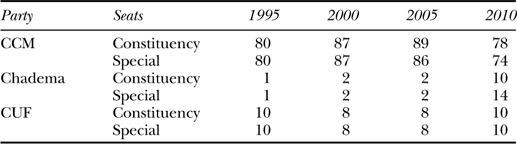
In the first two elections after multipartyism was introduced (1995 and 2000), the special seats had virtually no impact at all on the relative distribution of the seats in the Bunge. Table 1 below compares the share of the parliamentary seats won by each party with and without the special seats.
Parties and Percentage of Seats in the Tanzanian Parliament (the Bunge), with and without Special Seats, 1995–2010

Note: CCM=Chama Cha Mapinduzi; CUF=Civic United Front.
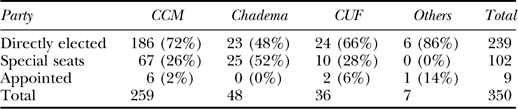
The special seat system, with a proportional addendum to an otherwise majoritarian election system, was designed when the Civic United Front was the main opposition party. It was very unlikely that the Civic United Front, whose support is geographically concentrated on two islands, would benefit from a nationwide proportional system of special seat allocation. From 2005 onwards, however, the proportionally distributed special seats instead strengthened Chadema. As a result of the quota, Chadema became the biggest opposition party in the 2010 elections (see Table 2). Chadema has mainly gained ground by increasing its support throughout the country, thus decreasing the relative power of the dominant party Chama Cha Mapinduzi. Although Chadema does not reach the levels of Chama Cha Mapinduzi, the proportionally distributed special seats give it a fair number of seats in parliament. Thus, the special seats appear to be of most electoral importance for Chadema. As Table 2 shows, more than half of the party’s MPs (25 out of 48) after the 2010 elections came from the special seats. Next, we analyse how the parties have selected candidates to these seats and how the party strategies affect the possibilities for reconciliation between gender concerns and party concerns.
Election Results, Tanzania, 2010: Seats per Party
Note: Per cent of each party’s overall seats in parentheses. CCM=Chama Cha Mapinduzi; CUF=Civic United Front. ‘Others’ include NCCR-Magueuzi, United Democratic Party (UDP), Tanzania Labour Party (TLP) and Attorney General.
Source: IPU (2011).
Chama Cha Mapinduzi
In contrast to the two opposition parties, Chama Cha Mapinduzi has been able to reconcile its goal to increase women’s power within the party structures with a power-maximizing electoral strategy that relies on a large quantity of loyal representatives. The reason for this successful reconciliation can be attributed both to incentives and to opportunities. The party has an incentive to reconcile the two interests; as such, their reconciliation gives the leadership the potential to strengthen the co-optation structures by delegating the selection process to the women’s wing. The organizational capacity of Chama Cha Mapinduzi also provides the party with an opportunity to reconcile gender equality concerns with larger party interests. As we outline below, the party leadership is able to maintain control over the process because decision-making processes are bureaucratized: those who are involved in processes of candidate selection follow the formal rules.
The ways in which candidates are selected in Chama Cha Mapinduzi illustrate well how bureaucratized the party is. Just as for candidacies to constituency seats, the whole process for selecting women to special seats is clearly outlined in the party documents, in particular in the regulations of the Chama Cha Mapinduzi women’s wing, the Union of Tanzanian Women (UWT). The Union of Tanzanian Women organization largely matches the Chama Cha Mapinduzi organization, with branches throughout the country and cells in every village. The Union of Tanzanian Women is in charge of the entire process up until the final rubber-stamp decision made by the party executive. The nomination for the special seats within Chama Cha Mapinduzi is competitive at each level, and in order to become a candidate, aspirants must be long-standing, loyal and active members of Chama Cha Mapinduzi and the Union of Tanzanian Women (Yoon Reference Yoon2008; see also Chama Cha Mapinduzi Constitution). The procedure for implementing quotas then starts at the district level. All aspirants have to collect election forms from their district, and submit their applications to the district offices of the Union of Tanzanian Women. The district Union of Tanzanian Women then forwards applications to the regional secretary. The regional congress (consisting of ward and district and regional leaders) of the Union of Tanzanian Women votes to come up with a shortlist of five names, which are then forwarded to the National Congress, usually ranked according to the number of votes they received at the regional congress. Candidates are scrutinized at the central national level of the Union of Tanzanian Women and, if they pass, the top two are usually selected for each region, while the remaining three tend to go to a national basket to be ranked by the Union of Tanzanian Women’s National Congress.
Sometimes the ranking of the candidates changes at this stage. If information that is not favourable to the party or the candidate emerges during the scrutiny, the regional office of the Union of Tanzanian Women does not have to abide by the vote count from the regional congress but can change the internal order of the candidates on the list. The Union of Tanzanian Women National Congress then comes up with one single ranked list by using a type of lottery. The lottery is used to decide which regions should come first on the list. However, for a party like Chama Cha Mapinduzi, which is certain of getting a large proportion of the vote, the creation of the final list does not cause major problems. It is confident that the votes won will be enough to ensure that they have regional representation of special seat members of parliament throughout the country.Footnote 7
The Chama Cha Mapinduzi National Executive Committee makes the final decision and sends the list to the Election Commission (Internal regulations of Chama Cha Mapinduzi Women’s Wing). The Union of Tanzanian Women is thus in charge of almost the entire process, and it is guaranteed representation in the National Executive Committee, where the final decision is taken.Footnote 8
Interestingly, the influence and status of the Union of Tanzanian Women within Chama Cha Mapinduzi is not something it brought with it from the one-party regime, but rather something it has achieved after multipartyism was introduced. Killian (Reference Killian1996) describes early special seat recruitment as being entirely in the hands of the national executive of Chama Cha Mapinduzi, where opinions and even favoured candidates of the Union of Tanzanian Women were sometimes entirely bypassed. During a reform of Chama Cha Mapinduzi’s constitution, the nomination for the special seats was entirely delegated to the Union of Tanzanian Women. It gives the Union of Tanzanian Women a unique power position within the party when it comes to selecting the special seats candidates. Once the women are elected to special seats, the Union of Tanzanian Women looks upon these MPs as their extended arm into the parliament. The MPs are expected to work on women’s issues in accordance with the Union of Tanzanian Women’s policies and with a focus on the particular region they represent.Footnote 9
Chadema
The largest opposition party Chadema has attempted, but not yet succeeded, to use the special seats to reconcile a concern for women with party (electoral) concerns. The party is undergoing change in its internal organization in order to be a mass organization that is present all over Tanzania. These reforms have been undertaken with support from foreign organizations and political parties.Footnote 10 Part of the strategy is a decentralization process, which is visible in the nomination of the special seats. Just as for Chama Cha Mapinduzi, the party has had the ambition of using its women’s wing to increase women’s voice in the selection process. The Chadema women’s wing, Bawacha, was not established until 2006 and thus, up until recently, it was not involved in the nomination of special seat candidates.Footnote 11 However, in line with the party’s aim of decentralization, the party decided to delegate the selection process for the special seats to the women’s wing. The updated formal rules, though, have not yet had repercussions in de facto party practices.
Apart from the informal practices, Chadema’s formal, written rules for selecting candidates to special seats are quite similar to the ones used by Chama Cha Mapinduzi. Just as for candidacies to constituency seats, the selection process is a multi-stage process that starts at the district level and ends at the national level. The formal rules state that aspirants fill out forms and that a district general meeting of Bawacha elects candidates from among the pool of aspirants. The top three names are highlighted, but all names are taken to Bawacha headquarters for scrutiny. The National Executive Committee of Bawacha includes all qualified candidates from the district level in an election, where the members of the Bawacha National General Meeting are eligible to vote. The candidates are simply listed according to the number of votes they receive in this meeting.
However, Chadema’s inability to reconcile the two interests is primarily attributed to a lack of opportunity due to organizational weaknesses. Its poorly developed party organization does not have sufficient capacity to engage in co-optation by delegating the power to the women’s wing. In 2010, the women’s wing was supposed to be responsible for the selection of special seat candidates, in accordance with the new guidelines. However, two days before the final selection, there was evidence of corruption in the process. The Central Committee of the party had to override the women’s wing and hire a consultant from the University of Dar es Salaam, who came up with graded criteria that were applied at the last minute, in order to come up with a list at all.Footnote 12
Although Bawacha followed the new procedures up until the last stage, many things went wrong. According to Susan Lyimo, the then chairperson of Bawacha, there was a lot of corruption in the process and some Chama Cha Mapinduzi loyalists fielded their wives and relatives as fake candidates.Footnote 13 Chadema’s failure to discover this earlier, or prevent it from happening in the first place, can be attributed to its status as an opposition party in a dominant-party state. Opposition parties do not have the same presence at the grassroots level and thus lack social control in every corner of the country. At the large final meeting, where the vote on candidates was to take place, there were rumours that members who were not supposed to vote were present. It eventually surfaced that a group had gone to the districts and brought 50 women who were told to vote for certain candidates to the meeting in Dar es Salaam. When Bawacha leaders found the list of names that the women were supposed to vote for, they handed the process over to the party again.Footnote 14
The vulnerability of Chadema in processes of candidate selection to special seats is problematic, not least because of the seats’ importance to the party: to reiterate, they represent a majority of the party’s seats in the legislature (see Table 1). Consequently, party loyalty among the few parliamentarians that this opposition party has is likely to be highly valued. The then secretary general of Chadema, Dr Slaa, stated that women elected to special seats are expected to be just like any other MP and contribute to all national programmes.Footnote 15 In contrast to women elected to special seats for Chama Cha Mapinduzi, they are not put in parliament on a gender/women’s wing mandate. Still, there are some differences between women in special seats and MPs in constituency seats. The special seat MPs in effect have a larger area to cover than an ordinary MP, but they do not get the constituency development fund that other MPs receive. There are no funds for working on women’s issues. In addition, Chadema cannot, like Chama Cha Mapinduzi, expect to have special seat MPs everywhere. They therefore try to change the discourse and call themselves national MPs, instead of regional, at the same time as trying to give every special seat MP a geographic area to represent and to visit.Footnote 16
The Civic United Front
Just like Chadema, the smaller opposition party, the Civic United Front, has not been able to reconcile a concern for women’s status in the party with its overall electoral concerns. Because its support base is concentrated in a smaller part of the country, the islands of Pemba and Zanzibar, the party has not been able to use quotas strategically. Its weak party organization also makes it difficult to empower women in the party structure. Overall, the party has had few incentives to ‘give away’ power to women.
When implementing the special seats, the Civic United Front has used the least bureaucratized, transparent and by far the most centralized (both in terms of territorial centralization and in terms of functional centralization) selection procedures of the three parties analysed. The Executive Committee and the General Assembly of the party have large leeway in selecting candidates to constituency seats, although they collect names from the local level. When it comes to the special seats, the wording of the internal rules is quite vague: ‘At any time where there is a need for special seat for women; for the parliament or a house of representative; the general assembly will set the special rules on obtaining MPs and the respective representatives’ (Article 92(5) of the Constitution of the Civic United Front).
The Civic United Front does have a women’s wing,Footnote 17 but it is clearly not very involved in selecting the special seats. There are ongoing discussions about the ways in which the women’s wing could be more involved in the selection process, but no new rules have yet been implemented. The executive secretary of the women’s wing, Nuru Bafadhil, describes the process as going straight from districts’ suggestion of names to the National Executive Committee of the party. The women’s wing can give comments and make recommendations, but the ranking of the names is entirely in the hands of the National Executive Committee, and the criteria they use are largely unknown to outsiders.Footnote 18 Even to insiders rules are rather opaque. A woman’s wing member at a branch in Dar es Salaam did not know how the special seats women were selected, or who they were: ‘We don’t know the names of the women on the special seats. They just come to the ward and then they leave . . . They are working in parliament with these issues.’Footnote 19
What is evident is that party loyalty matters, rather than documented work for women’s issues. The executive secretary even claims that working on women’s issues is not important at all for special seat candidates, because once in the parliament, representatives will work for and with everyone, not just for and with women. In particular, because the Civic United Front has so few women representatives, they see themselves as working for all of Tanzania, not for a particular region.Footnote 20 The party often seems to select special seat candidates from the party’s electoral strongholds, primarily the islands of Zanzibar and Pemba.Footnote 21
CONCLUSIONS
Comparing quota implementation across three political parties in Tanzania, this analysis has pointed to the different circumstances under which political parties operate in electoral authoritarian dominant-party states. The dominant party Chama Cha Mapinduzi has more resources and a more bureaucratized party organization than either of the two opposition parties, Chadema or the Civic United Front. We demonstrate that these differences also affect the different parties’ capacities to reconcile different interests. Whereas Chama Cha Mapinduzi puts the entire candidate selection for the special seats in charge of a strong and influential women’s wing that is present throughout the local level, the opposition parties are operating in a less formal and transparent manner, letting personal connections and party loyalty guide their selection, overshadowing concerns for women’s increased power within the party. Thus, in terms of gender equality, it is evident that the uneven playing field works to the benefit of Chama Cha Mapinduzi: the party is in a position to reconcile a focus on women’s status with a concern for electoral strength. Knowing that they will get a large majority of the votes, they can also ensure that each region in Tanzania gets its own women’s representative. As for the opposition parties, party loyalty, rather than work for women’s issues, seems to be paramount. In a dominant-party system, any additional parliamentary candidate loyal to the opposition is crucial, and maintaining control over candidate selection is a way of maximizing loyalty. While ideology is important for the formation of a party identity, it is hardly present in the negotiations surrounding candidate selection. ‘After all, you need candidates that can win the election’,Footnote 22 as Richard Shaba, office manager of Konrad Adenauer Stiftung, which is working to support Chadema, said. We thus suggest that quotas in dominant-party states, rather than contributing to changing party dynamics, are implemented in party contexts where formal and informal rules and procedures for inter- and intra-party interaction are relatively fixed. Consequently, quotas may succeed in elevating women to parliament, but at the same time they may reinforce established party dynamics that are based on, for instance, co-optation and social control.
The fact that the dominant party context may influence the design of gender equality legislation in favour of the ruling party is interesting in light of the new constitution reform proposal in Tanzania. The proposal suggests a two-member constituency system, where one seat will be reserved for a man and the other for a woman. If this new constitution is passed, parity would be in-built in Tanzania’s parliament. This proposal has received praise from international actors, but the message in this article may caution us to think twice and consider whether this could be a gain for gender equality but, at the same time, a democratic loss. Under present circumstances, where the dominant party Chama Cha Mapinduzi loses seats mostly to Chadema due to the proportional distribution of the special seats, it is probably in the electoral interest of Chama Cha Mapinduzi to introduce a complete first-past-the-post system. Such a system is likely to give a dominant party an electoral advantage while also appearing progressive and gender equal to international observers.
The findings of this article point to the importance of taking the specific dynamics of electoral authoritarian dominant-party states into account when analysing processes of candidate selection in general and quota implementation in particular. The findings bring with them several potential consequences that need to be further investigated. First, if we characterize gender quota reforms as layering processes in which continuity coexists with change (Mahoney and Thelen Reference Mahoney and Thelen2010; Verge and de la Fuente Reference Verge and de la Fuente2014), the uneven playing field and the ruling party’s menu of manipulation tend to make it difficult for power-maximizing opposition parties to develop their party organizations and open up the implementation process to include more women without putting electoral concerns at risk. On the other hand, the same informal institutions that prevent change within opposition parties may work as facilitators for women in dominant parties: the developed party infrastructures, which include co-optation and social control, make it easier for dominant parties to reconcile a focus on women’s political empowerment with electoral strategies. Second, the analysis has implications for representation processes more broadly. The women’s wing’s increased power over candidate selection within dominant parties makes it likely that women representing the different political parties behave quite differently once in parliament. Although legislator behaviour has not been a specific focus of this analysis, women in the dominant party may to a larger extent than others get a mandate to specialize in women’s issues. A perhaps provocative suggestion that comes out of the analysis is therefore that for those women in society who have a special interest in these issues, it is perhaps a rational strategy to engage in the dominant party rather than to join the opposition. On the other hand, too much of a specialization may also make it more difficult for women to have an impact on other issues. Thus, it is an open question whether delegating power over candidate selection to women’s wings is the most effective way of increasing women’s voices in representative institutions in dominant-party states.
Electoral authoritarian states are not on a temporary trajectory from autocracy to democracy. Most scholars now seem resigned to the fact that electoral authoritarian regimes are common as well as long-lived and that we need to analyse them as new types of regimes in their own right (e.g. Herbst Reference Herbst2001). Building on our findings, future research should thus investigate the extent to which these results also hold in other electoral authoritarian dominant-party states – for instance, in countries where the dominant party has a non-socialist background or where the quota system is designed differently. In addition, more light should be shed on how quotas impact women’s legislative careers and behaviour in different parties in dominant-party states. By addressing these issues, we will be able to form a more comprehensive picture of the possibilities for party-targeted gender equality reforms to change inter- and intra-party power dynamics in hybrid regimes.
Acknowledgements
This work was supported by the Swedish Research Council (grant number 421-2010-1638). The authors thank Gretchen Bauer, Gabrielle Bardall, panel participants at the International Political Science Association’s 2014 World Congress, members of the network on research on gender and political representation in a comparative perspective, workshop participants at the Swedish Political Science Association’s 2014 annual meeting, seminar participants in the political science departments at Uppsala University and at the University of Leicester, the anonymous reviewer, and the editors of this special issue, Meryl Kenny and Tània Verge, for helpful comments and suggestions. We are also very grateful to Nina Carlsson and Katarina Galic for outstanding research assistance. Special thanks go to the interviewees, for generously sharing their time, thoughts and experiences with us. However, interpretations and conclusions remain solely the responsibility of the authors. The authors are equal contributors to this article: names are listed in alphabetical order.