Introduction
Autonomy and control are key arguments put forward by people who favor the legalization of euthanasia and assisted suicide (EAS) (Quill and Battin, Reference Quill and Battin2004; Van Brussel, Reference Van Brussel2014) and one of the greatest causes of multidimensional end-of-life suffering (Monforte-Royo et al., Reference Monforte-Royo, Villavicencio-Chávez and Tomás-Sábado2012; Ohnsorge et al., Reference Ohnsorge, Gudat and Rehmann-Sutter2014a). Although the notions of autonomy and control undoubtedly feature in clinical, (bio)ethical, and sociological research on the issue of the right to die (McCormick and Conley, Reference McCormick and Conley1995; Bakitas, Reference Bakitas2005; Rodríguez-Prat et al., Reference Rodríguez-Prat, Monforte-Royo and Porta-Sales2016), there are two concerns that hinder a more detailed understanding of these notions.
The first is the lack of clear distinction between similar terms. On the one hand, terms such as control, autonomy, or self-determination are often treated as synonyms, even though they are not equivalent concepts (Lavoie et al., Reference Lavoie, Blondeau and Picard-Morin2011; Monforte-Royo et al., Reference Monforte-Royo, Crespo and Rodríguez-Prat2018). The first has to do with dependency from care, with loss of body functions, and a loss of control of the situation, whereas the second meaning of autonomy and self-determination is on the level of philosophical anthropology.
On the other hand, many studies do not distinguish between a wish to die (WTD), a wish to have death hastened, and requests for EAS (Tolle et al., Reference Tolle, Tilden and Drach2004; Ganzini et al., Reference Ganzini, Beer and Brouns2006). This lack of precision in the terms used to refer to distinct concepts can lead to simplifications. A person who expresses a desire to die (DD) (without undertaking actions that lead to it) because of a loss of physical functioning or loss of bodily control does not necessarily share the same motivations as someone who requests EAS because he/she wishes to die on his/her own terms or because they have a desire for self-determination.
The second concern is that it is often unclear whether the conclusions drawn from studies about autonomy are derived from the experiences of dying people (Monforte-Royo et al., Reference Monforte-Royo, Villavicencio-Chávez and Tomás-Sábado2011; Ohnsorge et al., Reference Ohnsorge, Gudat and Rehmann-Sutter2014a). At times, the conclusions are based on the views of healthcare professionals (Kelner, Reference Kelner1993; Peretti-Watel et al., Reference Peretti-Watel, Bendiane and Pegliasco2003; Seale, Reference Seale2009; Goel et al., Reference Goel, Chhabra and Weijma2014), or the perspectives of family members or the general public (Chambaere. et al., Reference Chambaere, Rietjens and Smets2012; Inthorn et al., Reference Inthorn, Schicktanz and Rimon-Zarfaty2015). It is difficult to know to what extent the autonomy argument emerges from dying people themselves, as opposed to healthcare professionals and the members of the general public.
Published data from places where EAS has been legalized, such as Belgium, The Netherlands, and Oregon, confirm that some individuals who have obtained EAS permission, subsequently, revoke their decision or die instead of causes other than EAS (Public Health Division, 2020). The aim of this review was to analyze what role autonomy and control play in relation to the WTD expressed by people with life-limiting conditions.
Methods
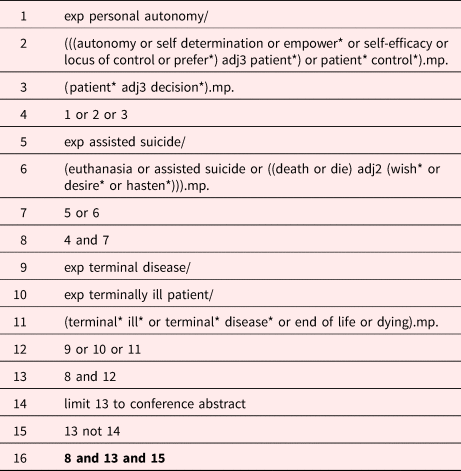
This systematic review was conducted in February 2019 through January 2021 in accordance with PRISMA guidelines (Moher et al., Reference Moher, Liberati and Tetzlaff2009). The search strategy combined MeSH terms with free-text searching (see Table 1). This strategy was applied to the EBSCO Discovery Service, as well as the large PsycINFO, Scopus, and Web of Science databases. No limits were placed on publication years.
Search strategy

Significance of bold values represents final strategy.
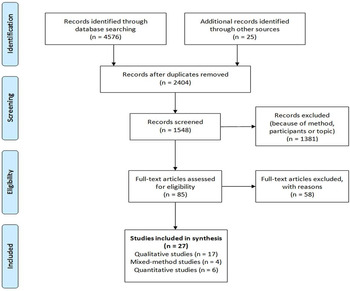
All articles for review were selected by applying these inclusion criteria: (1) primary studies examining the perspective of terminally ill people in the context of a request or WTD, (2) primary studies looking at personal autonomy, empowerment, self-efficacy, or locus of control (acknowledging that different terms are used to refer to the concept of autonomy or control), (3) written in English, and (4) published in peer-review journals. Studies only involving healthcare professionals, relatives, caregivers, or pediatric terminally ill persons were excluded. After these criteria were applied, the reference list of each retained research article was reviewed in order to identify any additional articles that were potentially relevant to the review. Disagreements regarding the inclusion or exclusion of articles were discussed among the authors. Figure 1 shows a flowchart of the article selection process.
PRISMA flow diagram for study selection.

We extracted and synthesized the data using the integrative method (Whittemore and Knafl, Reference Whittemore and Knafl2005), a method that permits the synthesis of diverse data methodologies. We designed a matrix to extract the main characteristics of each article following the data analysis process proposed by Whittemore and Knafl (Reference Whittemore and Knafl2005): data reduction, display and comparison, and conclusion drawing. Because the analysis involved the integration of quantitative and qualitative findings, we used a data-based convergent synthesis design, so that in presenting the results, we highlight the complementarity of the data and findings that these designs yield (Hong et al., Reference Hong, Pluye and Bujold2017).
The studies included were evaluated using the CASP guidelines for qualitative research (1999) (Supplementary Table S1) and the STROBE guidelines for quantitative research (von Elm et al., Reference von Elm, Altman and Egger2014) (Supplementary Table S2). None of the reports were excluded for any reasons of quality (Dixon-Woods et al., Reference Dixon-Woods, Sutton and Shaw2007).
Results
Twenty-seven studies were included in this review. After analyzing the extracted data, three themes emerged: (1) the type of research and aims of the studies undertaken, (2) the presence of the concept of autonomy or control in studies about the DD, and (3) the different ways in which autonomy or control are conceptualized (taxonomy). The following is a discussion of these three aspects.
Descriptive analysis
We identified research articles that to some extent focused on patient autonomy or control in relation to EAS requests or expressed DD among terminally ill persons. Supplementary Table S3 lists the studies included and indicates the authors, year of publication, country in which the study was conducted, research design, study population and objectives, and findings regarding personal autonomy, empowerment, self-efficacy, or locus of control.
The studies were focused on (1) identifying the reasons for the DD and analyzing the factors (sociodemographic and clinical) related to this desire, (2) identifying the reasons for requesting EAS and/or demedicalized assistance in dying or suicide and analyzing the factors (sociodemographic and clinical) related to this request, (3) exploring the nature and impact of suffering, (4) exploring the decision-making process among persons who requested demedicalized assistance in suicide, (5) exploring what people with advanced cancer want in relation to personal control, and (6) exploring the reactions of terminally ill persons in relation to existential issues.
The studies were conducted in Australia (n = 5), Canada (n = 5), USA (n = 5), The Netherlands (n = 3), Spain (n = 2), Sweden (n = 2), Switzerland (n = 2), Finland (n = 1), Germany (n = 1), and the UK (n = 1). Twelve studies used qualitative research methods, while 4 involved mixed methods and 10 were quantitative in design.
When the subjects/participants were considered, 16 studies were focused on specific populations, primarily people dying of cancer (n = 14), HIV (n = 1), or ALS (n = 1). The remaining studies included people with a number of diagnoses such as cancer, AIDS, neurological disease, psychiatric disorders, cardiorespiratory disease, and renal failure.
Presence of the concept of autonomy or control in studies about the DD
The analysis reveals that the data regarding the DD came from only a small number of participants in each study. In the study by Chochinov et al. (Reference Chochinov, Wilson and Enns1995), two participants (out of 200) reported a strong DD (but without the intention to pursue a hastened death). Among the reasons stated by them for desiring to die, one of these two persons alluded to a loss of control due to the loss of physical function. Another illustration is the study by Albert et al. (Reference Albert, Rabkin and Del Bene2005), who compared ALS patients who expressed a DD but did not act on it with ones who did hasten their death. Their analysis showed that perceived control over the management of ALS increased in only three patients (out of 80) who pursued a hastened death.
Among the participants in the study by Wilson et al. (Reference Wilson, Chochinov and McPherson2007) who were in favor of legalizing EAS (n = 238), the main reason stated was the right to choose (n = 93). However, only 22 people alluded to control as a factor in support of EAS legalization. When the authors analyzed the DD, they identified 357 individuals without a current interest in a hastened death, of whom 21 stated that loss of control was a concern to them. Of the 22 people with a current interest in a hastened death, only 5 were concerned about loss of control. Similarly, Güell et al. (Reference Güell, Ramos and Zertuche2015) found, when comparing participants who had expressed a DD with those who had requested euthanasia, that the only item on which the two groups differed significantly was “retaining autonomy to choose how and when to die/I will die,” a finding endorsed by a higher percentage of those who had requested euthanasia [33% (3 patients) vs. 4% of those who had merely expressed a DD].
Also relevant here are studies that gathered personal opinions about EAS (Wilson et al., Reference Wilson, Chochinov and McPherson2007). In some cases, research participants were in favor of legalizing EAS, even though they themselves were not personally interested in such an option at the present time. In the study conducted by Wilson et al. (Reference Wilson, Chochinov and McPherson2007), 36 participants (9.5%) reported that they would request for EAS at some point of their course of their disease, and 151 (39.8%) affirmed that it could be an option for the future but not at the moment of the interview. In the same vein, in the study conducted by Volker et al. (Reference Volker, Kahn and Penticuff2004), only one participant made reference to assisted suicide in relation to control over the dying process. In this case, the patient was against the idea of taking his own life.
Other terminally ill persons employed the notion of autonomy in arguing against EAS (from 9% to 34% of participants in the studies included in this review). The possibility of healthcare professionals assisting someone to die was seen by these participants as a loss of autonomy, in contrast to the alternate view that EAS increased patient autonomy (Karlsson et al., Reference Karlsson, Milberg and Strang2012). Accordingly, the eventual legalization of euthanasia was seen by one research team as increasing the power of the healthcare system rather than the autonomy of patients (Karlsson et al., Reference Karlsson, Milberg and Strang2012). Although the majority of participants who argued against EAS did so on religious grounds [“in the end it is in the hand of God” (Ohnsorge et al., Reference Ohnsorge, Gudat and Rehmann-Sutter2014a, p. 7)], some made reference to secular or moral values (humanism and philanthropy) or to the need of considering the impact of this decision among the family members: “I don't think it's something we have a right over . . . life is given and life is taken away but it's not ours to decide” (Kelly et al., Reference Kelly, Burnett and Pelusi2002). On euthanasia, “It's not a unilateral decision, because it's also got to do with the people around you” (Karlsson et al., Reference Karlsson, Milberg and Strang2012). Another common argument put forward against the legalization of EAS was that humans have no right to decide the time of their death (Wilson et al., Reference Wilson, Chochinov and McPherson2007; Karlsson et al., Reference Karlsson, Milberg and Strang2012).
Taxonomy
The 27 studies reviewed used a variety of terms to refer to similar but distinct concepts: loss of functionality, loss of control, locus of control, self-efficacy, agency, self-determination, and right to choose. Based on the definitions used by study authors and participants, it is possible to propose a taxonomy of the notion of autonomy in the context of a DD (see Supplementary Table S4).
Loss of functionality
In nine of the studies, the DD or interest in EAS was related to a loss of functioning (present or in a hypothetical future). This loss of physical mobility or the impossibility of performing activities of daily living was often alluded to as a consequence of advanced disease (Pearlman et al., Reference Pearlman, Hsu and Starks2005; Ohnsorge et al., Reference Ohnsorge, Gudat and Rehmann-Sutter2014a). Loss of functionality was described as a factor that leads to loss of control over the body and the living or life situation, and as a trigger then for perceived loss of dignity and loss of the self (Lavery et al., Reference Lavery, Boyle and Dickens2001; Pearlman et al., Reference Pearlman, Hsu and Starks2005). It was also linked to dependency and a lost ability to participate in meaningful activities (Ohnsorge et al., Reference Ohnsorge, Gudat and Rehmann-Sutter2014a).
Loss of internal control
The loss of internal or psychological control was the most common theme in the studies reviewed. This internal control, as emphasized in the primary studies, referred to the different functions of the WTD. The WTD has an internal emotional effect that helps patients to deal with their situation (Albert et al., Reference Albert, Rabkin and Del Bene2005; Ohnsorge et al., Reference Ohnsorge, Gudat and Rehmann-Sutter2014a). As long as the participants expressed this WTD, they felt that they had some control over the course of their illness and their life. In this sense, expressing a wish to hasten death and stating that one wants to take control of the situation was a coping strategy because it enabled them to feel “in control” of their destiny (Albert et al., Reference Albert, Rabkin and Del Bene2005; Ohnsorge et al., Reference Ohnsorge, Gudat and Rehmann-Sutter2014a).
The loss of internal control can be understood from the idea of meanings of the WTD: what the person wishes to express through this communicative act (Kuuppelomäki, Reference Kuuppelomäki2000; Wilson et al., Reference Wilson, Chochinov and McPherson2007; Karlsson et al., Reference Karlsson, Milberg and Strang2012). The different meanings of a wish to hasten death emerged from the original studies in relation to autonomy were: “wish for control over the situation,” “desire for control over when and how to die,” “last control,” and “the if-then scenario.” These themes were considered inseparable from maintaining this internal emotional effect (psychological control).
The wish for control over the situation (when they might die or over the illness or disease itself) was a common explanation for the expression of a WTD (Coyle and Sculco, Reference Coyle and Sculco2004; Dees et al., Reference Dees, Vernooij-Dassen and Dekkers2013). For some persons, the fact that they could exert some control relieved their suffering or anxiety about dying (Coyle and Sculco, Reference Coyle and Sculco2004; Albert et al., Reference Albert, Rabkin and Del Bene2005).
I immediately turned to the option of Exit [pause], because I said I'd like to have this option whatever happens. If things become unbearable for me for some reason, but I'm still not dying, then I'd like to be able to grant myself my own death […]. I want to be able to keep this in my own hands for when the moment comes. I was a very self-determined person all my life, and that's very important to me. (Ohnsorge et al., Reference Ohnsorge, Gudat and Rehmann-Sutter2014a, p. 8)
However, for people in countries where pursuing a hastened death had been legalized, the idea of choosing where and when to die was not merely a coping strategy but also a potential reality, as shown by one participant from The Netherlands:
When I became ill, I was afraid that I would get brain metastases. I guess I just want to have everything arranged properly for the GP, the family, and myself. I became a member of the euthanasia society and gave my GP an euthanasia directive. (Dees et al., Reference Dees, Vernooij-Dassen and Dekkers2013)
Another frequent meaning of the WTD is what is referred to as the “if-then scenario.” In this case, the patient does not currently express an interest in hastening death but contemplates a hypothetical future in which his/her situation becomes unbearable. This notion of “if-then” is described by some authors as having a “safety net” and this brought relief to them (Coyle and Sculco, Reference Coyle and Sculco2004; Nissim et al., Reference Nissim, Gagliese and Rodin2009; Ohnsorge et al., Reference Ohnsorge, Gudat and Rehmann-Sutter2014a, Reference Ohnsorge, Gudat and Rehmann-Sutter2014b): “If I had to go through [an episode of acute shortness of breath] again, I would throw myself in front of a subway train. I am not going through that again” (Coyle and Sculco, Reference Coyle and Sculco2004).
In some studies, the DD was conceived as a form of self-determination (control over one's own life) (Lavery et al., Reference Lavery, Boyle and Dickens2001; Coyle and Sculco, Reference Coyle and Sculco2004; Pearlman et al., Reference Pearlman, Hsu and Starks2005; Ohnsorge et al., Reference Ohnsorge, Gudat and Rehmann-Sutter2014a, Reference Ohnsorge, Rehmann-Sutter and Streeck2019). The results of 12 studies that included persons who expressed a current WTD show that the main justification they gave for this wish was the right to have control over how they died. A common argument was that they wanted to choose how and when they died, and in this respect, the possibility of requesting EAS was seen as the final control they could exert: “You must be allowed to decide for yourself whether you want to live or not” (Karlsson et al., Reference Karlsson, Milberg and Strang2012).
In the study by Pestinger et al. (Reference Pestinger, Stiel and Elsner2015), illness was described using the metaphor of chaos, the antithesis of absolute control. The possibility of taking action and of exerting control over the illness process was identified as a form of freedom and self-determination.
Discussion
This review of 27 research articles provides information about the role that autonomy may play in relation to the DD and the wish for EAS. Our analysis focused on three aspects: (1) a detailed exploration of the sociodemographic data emerged from the descriptive analysis, (2) the analysis of the presence of the concept of autonomy and control in studies about the DD, and (3) the lexical exploration of the terms used in the literature to refer to the concepts regarding autonomy, control, and self-determination (taxonomy). In what follows, we discuss the context in which studies were conducted, and the characteristics of participants and the taxonomy used in the studies. We also discuss the ethical implications arisen from the studies included.
Context in which studies were conducted and the characteristics of participants
First of all, we analyzed the descriptive aspects of the included studies. Analyzing the background of the settings of these studies is advised as a way to better understand what the importance of the value of autonomy in this context is, and how autonomy can articulate the expression of the DD.
From a sociocultural point of view, the fact that all 27 studies were carried out in developed countries (although only English language articles were assessed) is consistent with the importance that these advanced high-income societies ascribe, at least theoretically, to autonomy (Rodríguez-Prat and van Leeuwen, Reference Rodríguez-Prat and van Leeuwen2017). A meta-ethnography on the wish to hasten death identified 14 qualitative studies examining this phenomenon from the perspective of patients (Rodríguez-Prat et al., Reference Rodríguez-Prat, Balaguer and Booth2017). Only 2 of these 14 studies were conducted in non-Western countries [China (Mak and Elwyn, Reference Mak and Elwyn2005) and Thailand (Nilmanat et al., Reference Nilmanat, Promnoi and Phungrassami2015)], and in neither of them did the theme of autonomy emerge as an explanation for this wish. Other studies in which participants from other cultural traditions were asked for their opinion on the right to die likewise confirmed not only the absence of arguments in favor of death and dying self-determination but also a rejection of the possibility of choosing how and when one dies (Johansen et al., Reference Johansen, Hølen and Kaasa2005). However, in the Western context, other early studies have explored views, opinions, perceptions, attitudes, and experiences in relation to EAS or the DD, and apparently without finding a relationship to the desire for autonomy or personal control (Johansen et al., Reference Johansen, Hølen and Kaasa2005).
Studies conducted in countries characterized by different cultural paradigms reveal a view of autonomy that differs from the traditional liberal model (Rodríguez-Prat et al., Reference Rodríguez-Prat, Balaguer and Booth2017). In the study by Ho et al. (Reference Ho, Chan and Leung2013), carried out in China, reference is made to a more relational autonomy, in which the wider social context such as the family is important for healthcare decision-making. As is evident from the studies included in this review, moral understanding plays a key role in the expression and execution of a DD. The notion of moral understandings has been defined as the network of judgments, beliefs, expectations, and values that articulate our identity, the way we interrelate to other people, and the basis from which we understand the world (Walker, Reference Walker2007). In this sense, what patients understand about dignity, meaning of life, or autonomy shape their attitude towards their end-of-life situation. Among participants with a current interest in pursuing a hastened death, the main reason cited was the right to choose and the right to exercise control over how they would die (Wilson et al., Reference Wilson, Chochinov and McPherson2007). Thus, it would not be surprising that the argument in favor of choosing how and when one dies is more present in countries where EAS has been legalized than in countries where it has not been legalized.
The description of the individuals who are interested in EAS might be understood to reflect a Western discourse, with this being less religious or spiritual, less likely to tolerate suffering, hold assumptions regarding the circumstances under which life is no longer dignified, have little/less support from others in the immediate environment, and have a tendency to regard autonomy as a supreme value defined in terms of individual decision-making and rights (Hagens et al., Reference Hagens, Onwuteaka-Philipsen and Pasman2016; Rodríguez-Prat et al., Reference Rodríguez-Prat, Balaguer and Booth2017).
Taxonomy
The analysis of the terms used in relation to autonomy and the DD deepen into the different dimensions that autonomy can have from the participants’ expressions and experiences.
From our analysis, we can distinguish three levels in relation to the loss of autonomy (Monforte-Royo et al., Reference Monforte-Royo, Crespo and Rodríguez-Prat2018): loss of physical functioning (normally understood as loss of control), loss of internal control (locus of control or self-efficacy), and loss of control over one's own life (autonomy, self-determination, or self-agency), all of which are linked to the idea of the right to decide how and when to die.
Although the loss of physical functioning is not in itself a predictor of the DD, it is important to consider its potential impact in terms of depression (Monforte-Royo et al., Reference Monforte-Royo, Crespo and Rodríguez-Prat2018), demoralization (Breitbart et al., Reference Breitbart, Rosenfeld and Pessin2000), or a perceived loss of dignity (Kissane et al., Reference Kissane, Clarke and Street2001), all of which may be key variables in the emergence of such a desire to end one's life.
In the cross-sectional studies we reviewed, the idea of internal or psychological control was also illustrated in the instruments used, notably the Locus of Control Scale and General Self-Efficacy Scale. These scales were the only validated instruments used as a proxy for control. Although there are differences between the two concepts (locus of control and self-efficacy), both have been used to explain the extent to which an individual — through beliefs, expectations, and behaviors — feels and takes responsibility for what happens in life and for the goals that he/she achieves (Schwarzer, Reference Schwarzer1992). Thus, although these two instruments do not assess the different levels of autonomy, they may help to identify those patients who are more likely to want to exert control over the end-of-life process. It should be noted, however, that while some studies have shown a relationship between locus of control and the WTD (Robinson et al., Reference Robinson, Kissane and Brooker2017), the two reviewed studies authored by Owen et al. (Reference Owen, Tennant and Levi1992, Reference Owen, Tennant and Levi1994) found no significant correlations in this respect.
The reviewed study by Robinson et al. (Reference Robinson, Kissane and Brooker2017) also refers to the notion of control (specifically, the extent to which the individual feels in control of his or her life), although the authors only used one item for data gained from a general scale measuring the quality of life in their study. While it is difficult to draw an exact parallel between these notions of control (especially referring to the ideas of self-efficacy and internal/external locus of control) and the possible meanings and functions of the WTD, some of the quotations from interviewed research participants that were featured in the qualitative studies we included (specifically those referring to the use of internal strategies by patients) suggest that there are similarities: “I will do things my way […]. Nobody is going to talk me in or out of a damn thing […] I will always be in control” (Pearlman et al., Reference Pearlman, Hsu and Starks2005). From this quotation, even if it is not explicitly mentioned by the participant neither by the authors, we can identify an individual with high self-efficacy due to his self-confidence in mastering the situation.
Ethical implications
From the ethical perspective, many different considerations arise from this review's findings on autonomy. Autonomy is differently approached from principlist bioethics or from relational autonomy positions. Principlist bioethics, consistent with its philosophical liberal roots, which consider freedom and autonomy the main value, places respect for individual autonomy as the main of all four principles of bioethics. Autonomy then becomes the criteria of interpretation of the remaining three — non-maleficence, beneficence, and justice. Therefore, requests from people capable of rational — autonomous — decisions are to be granted. The good of the patient, the patient's empowerment, or respect for the patient is interpreted from this perspective (Cavalieri, Reference Cavalieri2001; Dees et al., Reference Dees, Vernooij-Dassen and Dekkers2013; Weinberger et al., Reference Weinberger, Sreenivasan and Garrick2014).
Relational autonomy-based ethics criticizes the atomistic consideration of the individual that underlies the former approach as unrealistic (Gómez-Vírseda et al., Reference Gómez-Vírseda, De Maeseneer and Gastmans2019). This introduces the discussion on to what extent totally autonomous decisions are possible (Branigan, Reference Branigan2015; Allan and Allan, Reference Allan and Allan2020). Relational autonomy points at the fact that human life is socially embedded (van Wijngaarden et al., Reference van Wijngaarden, Leget and Goossensen2016, Reference van Wijngaarden, Goossensen and Leget2018), and that decisions of life and death are not indifferent for society, starting for the immediate circle of interpersonal relationships that is the family (Gudat et al., Reference Gudat, Ohnsorge and Streeck2019). At the core of the discussion is the dialogue autonomy–heteronomy that is proposed in this stream. Keeping this in mind, varied research avenues are open regarding the relevance of autonomy in the WTD: some of them belonging to the fundamentals of ethics (the notions of vulnerability, dignity, autonomy, and right), the characteristics of the WTD, the practice of care (the contents and scope of the duty of the health professional, different types of intervention, and their ethical analysis), and society and politics (laws regarding the end of life or the social consideration of sickness, death, and dependence).
The studies reviewed in this paper reveal the need to address any WTD and even the possibility of an expressed WTD as a requirement to design strategies to prevent this wish from being an option or necessity. This first indicates a major need for appropriate pain management to reduce occurrences of WTD. Improved management of emotional or psychological distress (depression and anxiety) is another major necessity (Johansen et al., Reference Johansen, Hølen and Kaasa2005; Nissim et al., Reference Nissim, Gagliese and Rodin2009). In keeping with this requirement, the idea that proper palliative care, which would address physical and psychological symptoms and eliminate the WTD, is widespread. Putting aside those who find EAS the best solution given that not all can access good palliative care (Huxtable and Mullock, Reference Huxtable and Mullock2015; Allan and Allan, Reference Allan and Allan2020), the palliative care argument has been challenged by a particular type of patients who are not in pain or psychologically disturbed and nevertheless DD (Chapple et al., Reference Chapple, Ziebland and McPherson2006; Allan and Allan, Reference Allan and Allan2020).
Finally, autonomy (along with compassion) has been historically the main reason for the legalization of EAS. However, the lack of a clear distinction between WTD and requests for EAS can have serious consequences (Johansen et al., Reference Johansen, Hølen and Kaasa2005). In fact, cases of the application of euthanasia without consent are documented in countries, where euthanasia is not legal (Asch, Reference Asch1996; Pennec et al., Reference Pennec, Monnier and Pontone2012; Trankle, Reference Trankle2014). Where EAS is legal, the struggle to prevent hasted or involuntary euthanasia and noncompliance with other protocols, such as reporting all cases, is an ongoing issue. Defective compliance with such guidelines has been proved in some cases in The Netherlands (Muller et al., Reference Muller, Van der Wal and Van Eijk1994; Jochemsen and Keown, Reference Jochemsen and Keown1999; Wolf, Reference Wolf2005). Abuse of deep sedation is another concern at times in this country (Hasselaar et al., Reference Hasselaar, Reuzel and Verhagen2007) and also in Belgium (Robijn et al., Reference Robijn, Cohen and Rietjens2016). These concerns are evidence of a widespread perception of autonomy that stigmatizes vulnerability and dependence as less dignified, and so physicians feel responsible and bound to act accordingly. We agree with van Wijngaarden et al. (Reference van Wijngaarden, Leget and Goossensen2016, Reference van Wijngaarden, Goossensen and Leget2018) that reflection and subsequent adoption of measures to reduce EAS and WTD at different levels that result in a more accepting, caring, hopeful, and inclusive society is required.
Limitations
One of the limitations of this review is that the studies included had different objectives and used samples with different characteristics. Another issue is that the majority of qualitative studies do not refer to or discuss the frequency with which the identified themes emerged (Sandelowski et al., Reference Sandelowski, Barroso and Voils2007). For example, the study by Bolmsjö (Reference Bolmsjö2000) reports a relationship between autonomy and suicidal ideation, but it is not made clear how many participants shared this experience (only one quotation supports this statement).
Finally, none of the primary studies included discuss notions such as relational autonomy or similar concepts. The insistence on autonomy as the core value behind EAS may generate a series of pejorative narratives around dependency, and this is not likely to reflect the inherently vulnerability of human beings.
Implications for clinical practice and future research
Regardless of the finding that autonomy or personal control may not be the main explanatory or only factor behind EAS or the WTD, perceived loss of control has been strongly correlated with anxiety, stress, and depression (Monforte-Royo et al., Reference Monforte-Royo, Crespo and Rodríguez-Prat2018). This suggests that identifying areas over which terminally ill persons may wish to exert control (what they eat and where they live or die) is important.
Conclusion
This review reveals the variegated nature of the concept of autonomy and control and the requirement for careful conceptual distinctions of these terms. To date, the concept of “terminal illness” seems to be associated with cancer and only a few other conditions. Regardless, this review shows that autonomy is not the only reason behind the WTD or EAS, as it interacts with other considerations for each individual. Although autonomy is clearly a predominant value in Western societies, sociocultural differences were detected in the research conducted to date. In closing, the work presented here includes an analysis of the main ethical implications that appear — often implicitly — in the articles reviewed and we propose avenues of intervention and further research on a topic that is far from being exhausted.
Supplementary material
The supplementary material for this article can be found at https://doi.org/10.1017/S1478951521000985.
Conflict of interest
There are no conflicts of interest.