Introduction
In relation to historical populations researchers have frequently suggested that there is a relationship between death rate values and religious denominations. Religions imposed some clearly defined norms and principles which had an impact on the way of life of individuals, families and the whole community, on the attitude towards marriage, birth control and sexuality, and also contributed to the development of a world outlook specific for a given community. They played a very important role in creating models of behaviour. Through their norms, imperatives, prohibitions and values, individual denominations shaped a unique way of life, which in turn were translated into demographic measures.
In the 17th century many Catholic thinkers held and promoted a conviction that in accordance with God's will an individual should humbly accept pain, suffering and disease. From the time of the Council of Trent onwards, the Church persistently emphasized the existence of temporal punishment. Physical suffering was considered to be an unavoidable form of purgation that an individual had to go through during his earthly journey. Priests were very often involved in medical practices, especially in places where access to medical care was poor. Until the 19th century church medicine (medicina clericalis) was very widespread. At the same time it was common for the faithful to consult healers. The Church supported only natural law and its teaching on the subject of sexual life was based on this foundation (O'Connell, Reference O'Connell, Numbers and Amundsen1986). In 1864 Pope Pius IX, along with his encyclical Quanta cura, issued a syllabus that outlined the most serious errors of the Catholic Church (Syllabus Errorum). In the text he denounced, among other things, modern civilization, and consequently progress and science. This resulted in the Catholics' further distrust of new ideas, thoughts or novelties in the field of medicine and hygiene (Wojciechowski, Reference Wojciechowski1998; Wolleswinkel et al., Reference Wolleswinkel-van den Bosch, van Poppel, Looman and Mackenbach2001). In consequence Catholics were perceived by open-minded and dynamically developing Protestant communities as backward and excessively obedient to Church authority. This conservative and backward-looking life style was reflected mainly in high mortality rates in Catholic communities. This is confirmed by high values of crude death rates and infant death rates calculated for 19th century Catholic populations (van Poppel, Reference van Poppel1992; van Poppel et al., Reference van Poppel, Schellekens and Liefbroer2002; McQuillan, Reference McQuillan1999; Wolleswinkel et al., Reference Wolleswinkel-van den Bosch, van Poppel, Tabeau and Mackenbach1998, Reference Wolleswinkel-van den Bosch, van Poppel, Looman and Mackenbach2001; Kemkes-Grottenthaler, Reference Kemkes-Grottenthaler2003). In general, among the Catholic populations of Europe in the second half of the 19th century, death rates decreased more slowly than among Protestants (Wolleswinkel et al., Reference Wolleswinkel-van den Bosch, van Poppel, Tabeau and Mackenbach1998, Reference Wolleswinkel-van den Bosch, van Poppel, Looman and Mackenbach2001). The Protestant religion, in turn, exhorted believers to adapt to any forms of activity that promoted good health (Lindberg, Reference Lindberg, Numbers and Amundsen1986). The Protestants, contrary to the Catholics, cared for hygiene and for cleanliness of rooms, willingly followed doctors' advice, and Protestant women used midwife services (McQuillan, Reference McQuillan1999; Kemkes-Grottenthaler, Reference Kemkes-Grottenthaler2003). As early as the 17th century the Protestant Church was aware of the problem of high child mortality. In Protestant communes the faithful were issued with special instructions that showed how to cope with illnesses and what benefits could be drawn from good care for health and from following the rules of hygiene. At that time the Church was already encouraging women to breast-feed their babies for as long as possible, which resulted in a lower incidence of digestive system diseases among infants (McQuillan, Reference McQuillan1999; Kemkes-Grottenthaler, Reference Kemkes-Grottenthaler2003).
Researchers have also emphasized socioeconomic differences between Catholics and Lutherans. The Lutheran populations were more affluent and perhaps, as a result, better nourished. For instance, in the French region of Alsace in the 18th and 19th centuries the percentage of indigent Lutherans was significantly lower than that of Catholics (McQuillan, Reference McQuillan1999). Following earlier studies on height drawn from the recruitment registers of 1836 for the Marckolsheim, McQuillan (Reference McQuillan1999) stated that ‘young men from the predominantly Lutheran villages were on average some two centimetres taller and a smaller proportion were rejected for health reasons’ (p. 160). The better economic level among Lutherans was also associated with more advanced levels of literacy. Wealthier Lutherans were also likely to be in a better position to obtain medical care. In the Netherlands at the end of the 19th century and at the beginning of the 20th century some differences in school attendance between Catholics and Protestants were observed. Dutch Catholic children were under-represented in secondary schools (Wolleswinkel et al., Reference Wolleswinkel-van den Bosch, van Poppel, Looman and Mackenbach2001). It seems that, associated with better economic position, the higher level of education among Lutherans than Catholics was also related to a greater openness to cultural innovations. In the French region of Alsace in the period 1750–1870 Lutheran farmers showed an earlier interest in adopting new methods of agricultural technology. Such observations were confirmed by Golde (Reference Golde1975) with regard to the German villages of Baden.
The purpose of this study is to show the differences in mortality rates, and to explain their causes, in children from Catholic and Lutheran families in 19th century Poznań.
Data and Methods
Data
Following the decisions taken at the Congress of Vienna in February 1815, Poznań – the principal city of the Great Poland region (Wielkopolska) – became the capital of the Grand Duchy of Poznań, being in territorial and administrative terms a part of Prussia. The city was an important element of the Prussian state's defence system, and for this reason following a decision by the authorities it was turned into a fortress. Turning Poznań into a fortress surrounded with fortification walls seriously inhibited its spatial development and population growth (Zaleski, Reference Zaleski and Czekalski1929a,Reference Zaleski and Czekalskib; Łuczak, Reference Łuczak1965; Topolski, Reference Topolski, Topolski and Trzeciakowski1973; Trzeciakowska & Trzeciakowski, Reference Trzeciakowska and Trzeciakowski1987; Wędzki, Reference Wędzki, Topolski and Trzeciakowski1994). With time the city started to suffer due to the lack of free space, and by the end of the 19th century it was virtually suffocating within its enclosing walls. In the 19th century Poznań suffered from deficiencies of infrastructure. Until the mid-1860s it had no modern water supply system, and the municipal sewage system was built as late as at the end of the century. For these reasons, its population often suffered from outbreaks of epidemics and from flooding from the Warta River (Topolski, Reference Topolski, Topolski and Trzeciakowski1973; Trzeciakowska & Trzeciakowski, Reference Trzeciakowska and Trzeciakowski1987).
Among the three main religious groups in Poznań – Catholics, Lutherans and Jews – the Catholic and Lutheran groups were the largest. The members of the Lutheran population were mainly of German nationality, while the Roman Catholic population, represented mainly by poorer social classes (working class and lower middle class), were mainly Polish. The policy of the occupying Prussian authorities aimed at turning Poznań into a German-populated city; hence the considerable influx of German immigrants who were offered high-income jobs and good housing conditions by the local authorities (Zaleski, Reference Zaleski and Czekalski1929a,Reference Zaleski and Czekalskib; Kędelski, Reference Kędelski, Topolski and Trzeciakowski1994). For this reason Lutherans formed the wealthier part of the Poznań population, and thus the better position of the German intelligentsia was particularly visible. German Lutherans were recruited mainly from the rich middle class, bourgeoisie, entrepreneurs and influential intelligentsia, with the latter group dominated by clerks and officials. Polish members of the upper middle class and intelligentsia were very under-represented (Trzeciakowska & Trzeciakowski, Reference Trzeciakowska and Trzeciakowski1987; Trzeciakowski, Reference Trzeciakowski1992, Reference Trzeciakowski, Topolski and Trzeciakowski1994).
Data used in this study were obtained from parish death registers (Libri mortuorum) for the years 1855 to 1874, deposited in the State Archives in Poznań. Records for the two following Roman Catholic parishes were used:
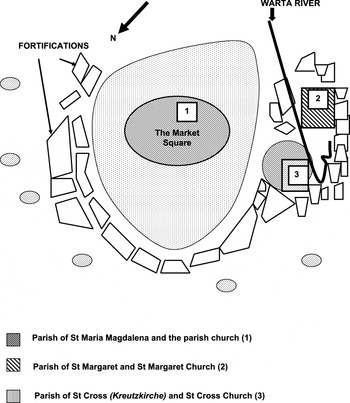
1. St Maria Magdalena Parish, situated within the fortifications in the City Centre, encompassing the Market Square and bordering on the streets (among others: Wielka, Wodna, Świętojańska, Gołębia, Szewska) as well as Garbary and the Grobla district (Fig. 1). The territory of the parish was sited in the elevated, flood-free city centre, and enjoyed a higher standard of living. The Market Square region was privileged in term of its infrastructure (e.g. the parishioners had access to clean water and to hospitals; Kaniecki, Reference Kaniecki2004).
2. St Margaret Parish, situated on the right bank of the Warta River and encompassing the districts of Chwaliszewo and Śródka, some of the poorest, most dilapidated districts in Poznań and seriously lacking in infrastructure. Up until the second half of the 19th century the streets were unpaved, and there was no running water or adequate sewage systems. In the 19th century, following the decision of the Prussian authorities, the whole district of Śródka and a part of Chwaliszewo were fortified, which inhibited their spatial growth (Karolczak, Reference Karolczak1997a,Reference Karolczakb; Fig. 1).
Map of 19th century Poznań with the studied populations.

Lutherans were represented by the Parish of St Cross (Kreutzkirche). At the end of the 18th century the parish encompassed the territory of the City Centre and the rural areas surrounding Poznań (Fig. 1). An attractive district populated by the rich Lutherans called Grobla, situated near the Market Square, was chosen for the Church of St Cross's location (Błaszczyk, Reference Błaszczyk2001).
From parish death registers information on the date, place, age and causes of death was obtained for 3136 deceased children from the St Maria Magdalena Parish, 3695 deceased children from the St Margaret Parish and 4469 deceased children from St Cross Parish.
Reliability and validity of the data
In historical studies the most needed and important operation is to assess the validity and reliability of the historical written sources. With regard to population registrations it is held that the numbers of recorded events are smaller than the numbers of events occurring at that time. Such a situation derived from the non-disclosure of particular events as well as poor quality of clerical work or poor organization of administration. The Prussian state had the highest standard of population statistics. A turning point in Prussian registration accuracy was marked by the 1840 census (Gieysztorowa, Reference Gieysztorowa1962, Reference Gieysztorowa1971, Reference Gieysztorowa1976, Reference Gieysztorowa1980; Szczypiorski, Reference Szczypiorski1962; Kaczmarski, Reference Kaczmarski1967; Borowski, Reference Borowski1967, Reference Borowski1968; Ładogórski, Reference Ładogórski1969; Wojtun, Reference Wojtun1976; Klotzke, Reference Klotzke1980; Budnik, Reference Budnik2005; Budnik & Liczbińska, Reference Budnik and Liczbińska2006). The Prussian Landrecht (Preussiche Landrecht) prescribed how information about natural movement had to be recorded and reported. In 1874, Civil State Offices were set up throughout the Prussian state. Officials of the civil state became responsible for the registration of demographic events. In the same year special acts regulating registrations were introduced to the provinces (Extra Beilage zum Amtsblatt der Königlichen Regierung zu Posen, 1874). Additionally, the 1875 act prescribed in detail periods during which particular events had to be registered. By law, every birth of a child had to be reported within seven days (a week) (§13), a stillbirth by the next day (§19), marriage on the day of the wedding (§27) and a death within 2 days (§39) (Extra Beilage zum Amtsblatt der Königlichen Regierung zu Posen, 1874). The deceased were not allowed to be buried before their death was properly registered, unless a special permit was issued by the police (Klotzke, Reference Klotzke1980; Budnik, Reference Budnik2005; Budnik & Liczbińska, Reference Budnik and Liczbińska2006).
In this study the validity and reliability of the historical sources were examined. It is well known that the greatest lack of registrations occurred among infants and young children (e.g. Gieysztorowa, Reference Gieysztorowa1962, Reference Gieysztorowa1971, Reference Gieysztorowa1976; Sułowski, Reference Sułowski1962; Budnik, Reference Budnik2005; Budnik & Liczbińska, Reference Budnik and Liczbińska2006). At the beginning of the 19th century the frequencies of neonatal deaths constituted 30% of total mortality. This allows for the best and the simplest test of reliability of historical registers (Gieysztorowa, Reference Gieysztorowa1962, Reference Gieysztorowa1976; Sułowski, Reference Sułowski1962). Gieysztorowa (Reference Gieysztorowa1976) argued that frequencies of deaths of children in the age category 0–1 year below 30% and for the age group 0–5 years below 50% should be treated with suspicion. In our study the frequencies of deaths for the age group 0–1 in the Catholic Parishes of St Margaret and St Maria Magdalena and the Lutheran Parish of St Cross were, respectively, 40%, 30.2% and 37%, and for the age group 0–5 years they were, respectively, 60.9%, 50.3% and 53%. Stillbirths in the 19th century were also a very good indicator of validity and reliability of register accuracy and constituted between 3% and 7% all births (Borowski, Reference Borowski1967; Gieysztorowa, Reference Gieysztorowa1976; Henneberg, Reference Henneberg1977; Klotzke, Reference Klotzke1980; Ładogórski, Reference Ładogórski1971; Budnik, Reference Budnik2005; Budnik & Liczbińska, Reference Budnik and Liczbińska2006). In this study the total level of stillbirths was as follows: in the Catholic Parish of St Margaret 3.7%, in the Catholic Parish of St Maria Magdalena 6.4% and in the Lutheran Parish of St Cross 5%. Historical demographers have emphasized that in many cases registrations of men were held from birth more accurately than those of women (Gieysztorowa, Reference Gieysztorowa1962, Reference Gieysztorowa1976). Hence, a sex ratio control is a very simple but accurate test of register accuracy because according to biological law the sex ratio ranged between 101 and 107, usually 105 boys per 100 girls (Gieysztorowa, Reference Gieysztorowa1962). In the parishes of St Margaret, St Maria Magdalena and St Cross the number of boys per 100 girls was respectively 107, 102 and 105. Furthermore, the ratio of numbers of births to numbers of marriages (B/M) and the numbers of deaths to numbers of marriages (D/M) in any historical period should be a very good test of register accuracy (Gieysztorowa, Reference Gieysztorowa1962, Reference Gieysztorowa1971, Reference Gieysztorowa1976; Kędelski, Reference Kędelski1992). Gieysztorowa (Reference Gieysztorowa1962, Reference Gieysztorowa1971, Reference Gieysztorowa1976) argued, based on French and Polish studies, that the first ratio should be in the vicinity of 5.0 and the latter should be approximately 3.0 (according to Sułowski, 1962: 2.5–4.2). In this study correspondent ratios are within these ranges.
Methods
Based on the above-mentioned mortality data demographic measures were calculated first. The basic parameter characterizing infant mortality is infant death rate (IDR), expressing the ratio of mortality of children below one year of age to the number of live births in a studied period. It has two components: neonatal death rate and postneonatal death rate. The neonatal death rate expresses the ratio of the number of deaths up to the 28th day of life (sometimes 30th day of life) to the total number of live births. Neonatal death rate corresponds to the so-called endogenous death rate, due to a child's congenital malformations, innate frailty, premature birth and perinatal injuries. Postneonatal death rate is the number of deaths among infants older than 30 days and younger than one year, related to the number of live births. Postneonatal death rate corresponds to a certain degree with the exogenous death rate, which in turn has its source in the infant's contacts with the environment and is caused by infectious disease, lack of hygiene, accidents, cases of food poisoning, etc. (Holzer, Reference Holzer2003). Additionally, the perinatal mortality rate was calculated. The latter expresses the ratio of numbers of stillbirths and deaths of infants up to 7 days old to the total number of live births and stillbirths (Holzer, Reference Holzer2003).
A much more complete statistical picture of mortality is offered by life tables. They were constructed for two model situations: a stationary and a stable population model. The classical stationary population model assumes a zero birth rate (births and deaths are in balance) and fertility, death rate, and sex and age structure are invariable in time. For this model, based on the age-at-death distribution of individuals, life tables were constructed using Halley's classical methods (Acsádi & Nemeskéri, Reference Acsádi and Nemeskéri1970). With regard to longer periods of time the stationary population model is often an oversimplification. More realistic is the model of a stable population, with a non-zero value of natural increase. The coefficient of the natural increase ‘r’ was calculated as a difference between the number of live births and the number of deaths related to the number of live population (Holzer, Reference Holzer2003). Using the rate of natural increase, the distribution of the deceased was reconstructed according to the following formula:

(Holzer, Reference Holzer2003; Pressat, Reference Pressat1961), where Dx′ is the number of deceased at the age of x for the stable population, Dx is the number of deceased at the age of x for the stationary population, r is the annual natural increase rate, and x is the number of years from birth till death. In this study selected parameters of life tables were characterized: the most synthetic biometric function of the life table, life expectancy of a newly born child, e 0; dx, the proportion of deceased in a given age category; lx, the fraction of surviving to a given age class; qx, the probability of death in a given age category. Intergroup differences in e 0 values were assessed using nomographs and tables of standard errors for these values (Henneberg & Strzałko, Reference Henneberg and Strzałko1975).
On the basis of life table parameters one of the measures of opportunity for natural selection – the classical Crow's Index I m (Crow, Reference Crow1958) – was calculated. The I m index uses the proportion of the number of children who did not reach reproductive age (P d) to the number of individuals who lived to reach reproductive age (P s): I m=P d/P s.
Furthermore, a qualitative and quantitative analysis of causes of death for the following age groups was carried out: 0–1 year, 2–14 years. The original 19th century terminology was retained. Diphtheria, whooping cough, measles, smallpox and scarlet fever were included in the category ‘infectious diseases’. Cholera was selected from the category ‘infectious diseases’ and treated separately. From the category ‘diseases of the respiratory system’ an untypical ‘illness unit’ – ‘cough’ – was also selected. The significance of intergroup differences was assessed with the u test (Oktaba, Reference Oktaba1976). A single level of significance p=0.05 was adopted.
Results
Values of infant, neonatal and postneonatal death rates and perinatal mortality
The values of infant death rates and neonatal and postneonatal death rates are shown in Table 1. As can be seen, the highest value of infant death rate occurred in the poor Catholic Parish of St Margaret. In particular, postneonatal mortality was very high – almost 2.5 times higher than neonatal. In turn, in the other Catholic population living in the more affluent City Centre, the Parish of St Maria Magdalena, the infant death rates as well as neonatal and postneonatal death rates had the lowest values. In the Lutheran Parish of St Cross infant death rate and neonatal and postneonatal death rates reached values significantly higher than in the Parish of St Maria Magdalena but significantly lower than in the poor Catholic Parish of St Margaret.
Values of infant, neonatal and postneonatal death rates (per 1000 live births) in the studied populations, 1855–1874

All differences in the rate values in the studied populations are statistically significant.
Perinatal mortality ranged between 84 per thousand live births and stillbirths (in the Lutheran Parish of St Cross) to 103 per thousand live births and stillbirths (in the Catholic Parish of St Maria Magdalena) (Table 2).
Values of perinatal mortality (per 1000 live births and stillbirths) and percentage of stillbirths in the total number of live births in the studied populations, 1855–1874

Statistically significant differences:
a Parish of St Margaret–Parish of St Maria Magdalena;
b Parish of St Margaret–Parish of St Cross;
c Parish of St Maria Magdalena–Parish of St Cross.
Life table parameters and Crow's Index
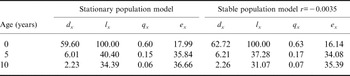
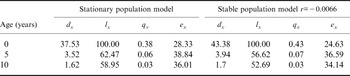
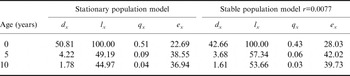
The values of the life table biometric functions in the three analysed populations are shown in Tables 3–5. As can be seen, all the life table parameters had less favourable values in the Catholic Parish of St Margaret: life expectancy at birth e 0 assumed the lowest value, only 16 years. Approximately 63% of children did not live to 5 years of age (parameter: d 0) and only 31% reached reproductive age (conventionally 15 years of age; parameter: l 10). A high mortality of children in the age category of 0 to the end of the age of 4 was confirmed by the high value of the probability of death (q 0=0.63) (Table 3; stable population model). In turn, in the wealthier Catholic Parish of St Maria Magdalena the value of life expectancy at birth e 0 is over 24 years; this is as many as 8 years more than in the poor Parish of St Margaret. After the first 5 years of life the average parishioner had a chance to live 36.6 years (parameter: e 5) and 49% of children did not live to reproductive period (d 0–10), which is less than in the Parish of St Margaret. Also, the value of the probability of death was here definitely lower (q 0=0.43) (Table 4; stable population model). The best values of life table parameters were obtained in the Lutheran Parish of St Cross: e 0 had the highest value of 28 years and after the first 5 years of life the average child had a chance to live 42 years (parameter: e 5), which is as many as 6 years more than in the Catholic Parish of St Maria Magdalena. Approximately only 48% of children did not survive to 15 years of age (d 0–10) (Table 5; stable population model).
Selected biometric function values of life tables for the Catholic Parish of St Margaret, 1855–1874

Selected biometric function values of life tables for the Catholic Parish of St Maria Magdalena, 1855–1874

Selected biometric function values of life tables for the Lutheran Parish of St Cross, 1855–1874

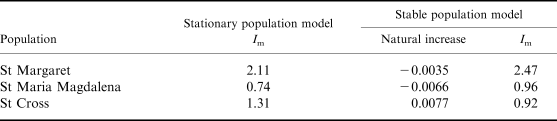
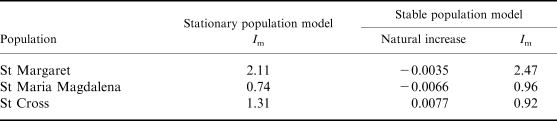
Table 6 shows the values of Crow's Index: it was less favourable in the poor Catholic Parish of St Margaret, which confirmed the very high infant and child mortality rate in this community. In the Catholic Parish of St Maria Magdalena and the Lutheran Parish of St Cross, Crow's Index assumes considerably lower values (respectively, 0.96 and 0.92; stable population model).
Crow's Index values in the studied populations, stationary and stable population models, 1855–1874
Analysis of causes of death
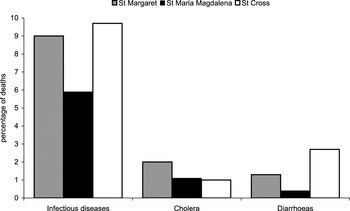
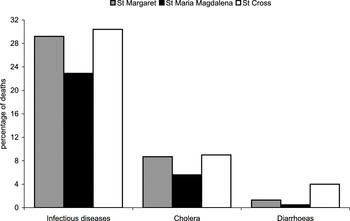
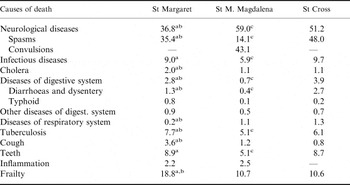
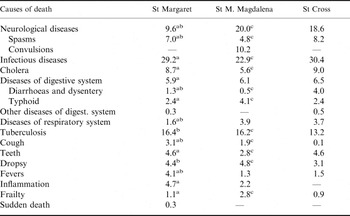
Tables 7 and 8 show the causes of deaths of children in age categories 0–1 year and 2–14 years. Generally speaking, among infants and older children in the studied populations a high toll of infectious diseases such as diphtheria, whooping cough, measles, smallpox and scarlet fever was observed. Frequencies of deaths due to cholera, diarrhoea and dysentery were also very high (Figs 2–3). In the poor Catholic Parish of St Margaret and in the Lutheran Parish of St Cross frequencies of deaths due to the above-mentioned diseases were the highest.
Deaths due to infectious diseases, cholera and diarrhoeas in the 0–1 year age range in the studied populations, 1855–1874.

Deaths due to infectious diseases, cholera and diarrhoeas in the 2–14 years age range in the studied populations, 1855–1874.

In the populations under study a high number of deaths due to tuberculosis, especially between the age of 2 and 14 years, was noted. In all age categories deaths due to the ‘illness unit’ referred as to ‘cough’ was also observed: the highest frequency was observed in the poor Parish of St Margaret; in turn, in the Lutheran St Cross Parish deaths due to ‘cough’ were very rare (Table 7–8).
Selected causes of deaths in the 0–1 year age category in the studied populations, 1855–1874 (percentages)

Statistically significant differences:
a Parish of St Margaret–Parish of St Maria Magdalena;
b Parish of St Margaret–Parish of St Cross;
c Parish of St Maria Magdalena–Parish of St Cross.
Selected causes of deaths in the 2–14 years age category in the studied populations, 1855–1874 (percentages)

Statistically significant differences:
a Parish of St Margaret–Parish of St Maria Magdalena;
b Parish of St Margaret–Parish of St Cross;
c Parish of St Maria Magdalena–Parish of St Cross.
Furthermore, among infants in all the studied populations a high number of deaths due to neurological diseases was noted: in the Catholic Parish of St Maria Magdalena deaths from convulsions predominated, while in the poor Catholic Parish of St Margaret and the Lutheran Parish of St Cross a high frequency of deaths due to spasms was noted. Among infants from the Parish of St Margaret, more than elsewhere, deaths caused by ‘frailty’, as referred to by 19th century doctors, were stated (Table 7). Also, among older children statistically more than in the other parishes, deaths from ‘fevers’ and ‘inflammation’ were observed (Table 8).
Discussion
Values of infant, neonatal and postneonatal death rates
The highest values of infant death rate and its components were found for the Catholic Parish of St Margaret. The parish encompassed Chwaliszewo and Śródka, the poorest and most dilapidated districts of Poznań. The population there lived mostly in overcrowded tenant house outbuildings under undignified conditions. Due to the high cost of rent often several families had to share a single room (Karolczak, Reference Karolczak1997a,Reference Karolczakb). The level of sanitation was very poor in these areas. In the district of Chwaliszewo water was drawn from shallow wells, which were often tainted with harmful sewage from cesspits, gutters and rubbish sites. The tenants drank water drawn straight from the Warta River. In the district of Śródka, in turn, there were primitive street gutters with ineffective drainage, which during summer heat periods were full of stagnant contaminated water. In spring and summer the inhabitants of Śródka did their laundry in the nearby Cybina River. This river was at the same time a source of drinking water (Kaniecki, Reference Kaniecki2004; Karolczak, Reference Karolczak1997a,Reference Karolczakb). It is no wonder therefore that infant death rates are the highest in this district. The population's poor biological condition resulted mainly from a very high infant and child death rate. In particular, postneonatal death rate was very high in Śródka, as postneonatal mortality has its source in infants’ contact with the environment and is almost exclusively caused by lack of hygiene, poor nutrition, etc.
Situated in the City Centre and thus free from flooding, areas around the Market Square, in the Parish of Maria Magdalena, were devoid of such dangers. In the 16th century, fountains with fresh spring water supplied by pipelines from outside the city were built in the Market Square and in the courtyard of the Jesuit Collegium. In 1832 the city was provided with a wooden aqueduct supplying water to the Market Square area (specifically to Bernardyński Square) (Kaniecki, Reference Kaniecki2004). Sanitation was also better in this parish. As early as the first half of the 19th century the city council built in the area adjacent to the Market Square three underground canals to discharge sewage. This was in fact a makeshift sewer system, but it at least partly solved the problem of surface water contamination with sewage. It needs to be added that a modern sewer system was not built in Poznań until the end of the 19th century (Kaniecki, Reference Kaniecki2004). The population of the Parish of St Maria Magdalena probably also had better access to medical care. At that time there were two hospitals working in the Market Square area. One of them was established in the 1820s in a former Bernardine Convent building and was run by nuns. The other one was the city hospital on Szkolna Street, which was opened in 1854 (Kaniecki, Reference Kaniecki2004). Thus, it seems that better living conditions, better material status and access to clean water were reflected in the values of infant death rates and their components. In the Parish of St Maria Magdalena the neonatal and postneonatal death rates had the lowest values among all the studied populations.
At the same time, in the Lutheran Parish of St Cross, which generally enjoyed a secure economic position, mortality measures vary very much. This parish had a significantly higher infant mortality rate than the Catholic Parish of St Maria Magdalena. The high infant death rate was surprising in this context because mortality among the Lutherans from historical Europe, being a community with a tradition of healthy life style, cleanliness and hygiene, was much lower than among the Catholics (van Poppel, Reference van Poppel1992; McQuillan, Reference McQuillan1999; van Poppel et al., Reference van Poppel, Schellekens and Liefbroer2002). The values of infant death rates obtained by McQuillan (Reference McQuillan1999) for 19th century Lutheran and Catholic communities from the French province of Alsace respectively ranged between 186–195 per 1000 live births and 225–236 per 1000 live births. It seems that the reasons for such a state of things were related to the fact that in the 19th century the Parish of St Cross was very large in terms of area, and its population had unequal access to the amenities making up the city's infrastructure (e.g. access to clean water and medical care; Kędelski, Reference Kędelski, Topolski and Trzeciakowski1994). In this respect the situation in Poznań at that time varied considerably. It is sufficient to mention that the only wells with clean water were in operation in the Market Square. Due to all these factors, despite their generally better economic position the Lutherans' living conditions varied. In the actual city of Poznań parishioners were spread across the whole of the urban area, and in the second half of the 19th century the parish encompassed as many as 40 municipalities (Gemeidelexikon, Reference Gemeidelexikon1888), situated on average several kilometres away from Poznań. This spread was a source of certain difficulties: for instance reaching the hospital, a medical practitioner or a midwife in time. These inconveniences posed a threat to the lives of vulnerable infants. Poor environmental conditions were reflected first of all in a high postneonatal death rate among the Lutherans. As mentioned earlier, postneonatal deaths are often due to the infant's contact with the environment.
Perinatal mortality rate and the problem of stillbirths
The earliest registration of stillbirths was introduced in Norway and Denmark as early as the 18th century. A hundred years later, stillbirth registration began in the Netherlands, Belgium and France. Such registration was an instrument to monitor live birth attendance, which finally allowed an assessment of progress in medical care. In 1802 clergymen in Norway and Denmark were obliged to report statistics of stillbirths. Then, infants that were born dead or died within 24 hours after births were defined as stillbirths. At the end of the 1830s the criteria were changed and infant death lacking any vital signs was defined as stillbirth (Woods et al., Reference Woods, Løkke and van Poppel2006). Differences in registration of stillbirths resulted from the fact that in some religious denominations a stillbirth was treated in a different way, especially among Catholics. The lack of documentation of stillbirths was evident in the Catholic registers. Catholics ‘believed that a child who had not been baptized should not be able to receive eternal salvation’ (Kemkes-Grottenthaler, Reference Kemkes-Grottenthaler2003, p. 910). They consciously did not report stillbirths. Van Poppel (Reference van Poppel1992) reported that infant death rates of the Dutch Catholics were too high while stillbirth rates remained too low. According to the author, Catholics were ashamed to report stillbirths. They believed that unbaptized children should be buried in non-consecrated cemeteries, and that their souls wandered like will-o'the-wisps, never receiving eternal salvation.
In the populations under study the lowest perinatal mortality was found for the Lutheran Parish of St Cross. This is not a surprise because Lutherans cared for personal hygiene and health. Kemkes-Grottenthaler (Reference Kemkes-Grottenthaler2003) pointed out that they engaged midwives based on medical competency. Catholic women, by contrast, used midwife services very rarely, and midwives were selected on the basis of moral standards and Catholic denomination. Professional skills were not taken into account. It seems that women from the Lutheran Parish of St Cross had very good access to medical care. In 1855, 27 medical practitioners of the 36 working in Poznań were of German and Jewish origin. By 1872 the number of medical practitioners had increased to 32 (Molik, Reference Molik1998, Reference Molik2001). In 1835 there were 24 German midwifes in Poznań (Makowski, Reference Makowski1992).
Higher perinatal mortality than in the Lutheran Parish of St Cross was noted in the Catholic Parish of Maria Magdalena from the City Centre. As mentioned before, there were two hospitals in the territory of the parish where children not only from the parish but from other places in Poznań came into the world (Makowski, Reference Makowski1992). This was the reason why in the parish registers the number of reported stillbirths was higher than in the two other parishes. What is striking is the low perinatal mortality in the very poor Catholic Parish of St Margaret. As we know the parish was characterized by very poor living and epidemiological conditions, so higher perinatal death rates would be expected. In the parish the percentage of stillbirths in the total number of live births was 3.7% (in the Parishes of St Maria Magdalena and St Cross respectively: 6.4% and 5.0%; Table 2). It would seem that parishioners lacking basic medical knowledge and medical care and midwives did not recognize stillbirths in a proper manner and reported them as deaths for other reasons, for instance, from ‘frailty’. It seems likely that this was the reason for the low number of stillbirths and the high number of infant deaths in the Parish of St Margaret.
Life table parameters and Crow's Index
As mentioned in the Data and Methods section, life tables were constructed in two ways: using stationary and stable population models. Since the stable population models, with corrected age structure of the deceased by the rate of natural increase, are more realistic, this study is primarily focused on them. In the Parish of St Margaret the newborn life expectancy value e 0 was only 16 years. It is a very low value, resulting from a high infant and child mortality. It is similar to the e 0 value from the medieval models of European tables. For example, the value of life expectancy e 0 estimated for 14th century England was at the level of 17.3 years (Russel, Reference Russell1958), and for the early medieval cemetery in Espenfeld, 19.0 years (Bach & Bach, after Henneberg & Strzałko, Reference Henneberg and Strzałko1975). Even a high Crow's Index value confirmed a high level of child mortality in this parish. A more favourable picture of mortality was observed in the Parish of St Maria Magdalena. The value of life expectancy was as many as 8 years more than the value of e 0 in the Parish of St Margaret and similar to the 19th century English metropolises of Liverpool and Manchester (Burnett, Reference Burnett, Shofield, Reher and Bideau1991). Better ecological conditions, including sanitary and epidemiological ones and access to clean water, helped to limit infant and child mortality. The best value of life expectancy was noted in the Lutheran Parish of St Cross, which may have been caused by lower than elsewhere mortality among children over 1 year of age, as was confirmed by a low value of Crow's index I m. It seems that social and economic factors, which in turn translated into differences in the style and quality of life, could have influenced the lower mortality among older children in the parish. The role of different socioeconomic and religious factors in the values of life table parameters in the historical populations from Germany was emphasized by Kemkes-Grottenthaler (Reference Kemkes-Grottenthaler2003). After the first five years of life (e 5) the average Protestant had the chance to live 29.6 years while a Catholic only 26.9 years (author's calculations based on: Kemkes-Grottenthaler, Reference Kemkes-Grottenthaler2003).
Differences in causes of deaths. Classification of causes of deaths in historical populations
With regard to historical populations, diagnosis and the terminology of causes of deaths were ambiguous. Insufficient medical knowledge, and lack of knowledge of physiology, pathology and epidemiology led to the use of terminology based on symptoms of diseases or names of body parts seized with illness. Diagnostics of causes of deaths usually reflected the level of medical knowledge at that time (Nowaczyk, Reference Nowaczyk2005). In Europe before medical doctors were required to issue a death certificate, death was reported by incompetent persons: family, neighbours, and very often priests. Clergymen might diagnose and record causes of death inaccurately, usually by symptoms of disease with which they were familiar, or which were easy to diagnose (Herring & Hoppa, Reference Herring and Hoppa1999). The reliability of such registers is questionable. In Europe an improvement in diagnostics of causes of deaths was observed when death certificates were introduced. In the second half of the 19th century, in the Polish state under Prussian partition physicians were obliged to collect data on causes of deaths and then to deliver them to statistical offices. The 1874 act prescribed in detail the method of data collection (Budnik & Liczbińska, Reference Budnik and Liczbińska2006). Generally, by the end of the 19th century, with changes in medical science, aetiology became more important in classifying causes of death, instead of anatomy or symptoms of illness.
The problem of terminology of causes of deaths and their classification in historical populations as well as investigations of the trends in time with regard to causes of deaths have been frequently discussed. It was suspicious that such trends, provided that they existed, were hampered during the shift from one ICD revision to the next. Improvement of medical knowledge was related to changes in the classification of diseases, coding patterns and arrangement of diseases (Wolleswinkel et al., Reference Wolleswinkel-van den Bosch, van Poppel and Mackenbach1996, Reference Wolleswinkel-van den Bosch, Looman, van Poppel and Mackenbach1997, Reference Wolleswinkel-van den Bosch, van Poppel, Looman and Mackenbach2000, Reference Wolleswinkel-van den Bosch, van Poppel, Looman and Mackenbach2001; Herring & Hoppa, Reference Herring and Hoppa1999; Gage, Reference Gage2005). Wolleswinkel with a team (1996) tried to assess the statistical continuity of certain causes of deaths at the introduction of every new ICD revision during the last 120 years. It was found that at every ICD transition large percentages of the causes of deaths had discontinuities smaller than 10%, which suggested that certain types of causes of deaths could be considered as continuous for the whole period.
Very poor sanitary conditions and a lack of clean water access in the Catholic Parish of St Margaret were responsible for death rates due to infectious disease. The parish suffered from outbreaks of measles (in 1857, 1861 and 1869), scarlet fever (in 1863), smallpox (in 1864 and 1871) and typhoid (in 1867). There were also outbreaks of cholera, which took its toll twice, in 1855 and in 1866. The greatest outbreak, in 1866, lasted from June till October and was responsible for as many as 54% of all deaths in the population. These cholera epidemics began at Chwaliszewo (Karolczak, Reference Karolczak1997a,Reference Karolczakb). In the Lutheran Parish of St Cross the frequency of infectious diseases such as measles, smallpox, typhoid and scarlet fever among infants and young children was little less than in the Catholic Parish of St Margaret. The Lutheran parish suffered from outbreaks of measles (in 1857, 1861 and 1869), scarlet fever, which took its toll twice (in 1863 and 1874), and smallpox (1871); the latest was responsible for as many as 20% of all deaths in the population in that year. As mentioned earlier, the reasons for such a state of things were related to the fact that in the 19th century the Parish of St Cross was very large in terms of area. Lutherans, who spread throughout the whole of Poznań as well as in the rural areas surrounding Poznań, had unequal access to the amenities making up the city's infrastructure (e.g. access to clean water and medical care; Kędelski, Reference Kędelski, Topolski and Trzeciakowski1994). A better ecological situation in the Catholic Parish of St Maria Magdalena was reflected in the twice as low values of infant and older children death rates due to infectious diseases than in the Parishes of St Margaret and St Cross. It is worth stressing that such low mortality was noted in the Polish territory and in Europe at the beginning of the 20th century! In the District of Oppeln (Regierungsbezirk Oppeln), for instance, in the years 1904–1907 the frequency of deaths due to typhoid, diphtheria and scarlet fever was 8.1% (Haines, Reference Haines1976), and in the Netherlands in 1917 approximately 2% (Wolleswinkel et al., Reference Wolleswinkel-van den Bosch, van Poppel, Tabeau and Mackenbach1998). The parish did not escape the cholera carried in June 1866 to one of the innkeepers in the Market Square by raftsmen from the city of Szczecin (Trzeciakowska & Trzeciakowski, Reference Trzeciakowska and Trzeciakowski1987).
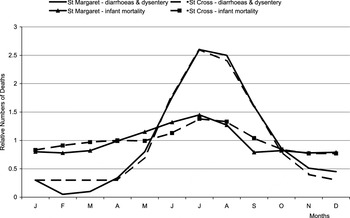
In the Catholic Parish of St Margaret and in the Lutheran Parish of St Cross a high frequency of infant and child deaths due to dysentery and diarrhoea was noted. In the Parish of St Margaret this was probably caused not only by poor ecological conditions, but also due to change in diet resulting from too early weaning by women who were required to engage in hard work, mostly uneducated and lacking in knowledge of the hygienic needs and principles of healthy nutrition (Wolleswinkel et al., Reference Wolleswinkel-van den Bosch, van Poppel, Tabeau and Mackenbach1998; Schellekens, Reference Schellekens2001; Schellekens & van Poppel, Reference Schellekens and van Poppel2006). This scenario of earlier weaning of infants in the parish, and difficult sanitary conditions, especially in the summer, was supported by the infant mortality peak in the summer months due to dysenteries and diarrhoeas (Fig. 4). Researchers have frequently stressed that women from Catholic families, due to an unjustified shame complex, breast-fed their babies for only a short time (McQuillan, Reference McQuillan1999; Kemkes-Grottenthaler, Reference Kemkes-Grottenthaler2003). In this study in the Lutheran Parish of St Cross an infant mortality peak due to diarrhoeas and dysenteries was also observed (Fig. 4). A high infant mortality level caused by diarrhoeas and dysentery reflected the varying ecological conditions in the parish, encompassing not only the city of Poznań but also the villages surrounding Poznań. In the rural areas the principles of breast-feeding, food preparation and health nutrition could not have been observed too rigorously and were sometimes neglected by mothers, less educated and more engaged in work in the fields (Żołądź-Strzelczyk, Reference Żołądź-Strzelczyk2002). In the Catholic Parish of St Maria Magdalena, a better level of hygiene, mostly related to access to clean water, was reflected in the lowest frequency of deaths due to diarrhoeas and dysenteries and, finally, the lack of a summer ‘abdominal’ peak.
Seasonality of infant deaths due to diarrhoeas and dysenteries against the overall annual rhythm of infant mortality.

In spite of better epidemiological conditions in the wealthier Parish of St Maria Magdalena a high mortality due to typhoid among older children (2–14 years) was noted. Typhoid could be carried to the parish from other parts of Poznań, or from the villages by poor men, the homeless and tramps. Such migrations favoured the spread of infectious diseases. It seems likely that a high number of deaths due to typhoid was also related to the hospitals within the parish territory, where not only parishioners but children from other parts of Poznań were treated.
Deaths from consumption (tuberculosis, phthisis) were very frequent in the studied populations, but most of all in both Catholic parishes. In the Parish of St Margaret they were associated with poor living conditions. Research has emphasized a relationship between morbidity from tuberculosis and poor living and work conditions and malnutrition (Łuczak, Reference Łuczak1965; Trzeciakowska & Trzeciakowski, Reference Trzeciakowska and Trzeciakowski1987; McFarlane, Reference McFarlane1989; Puranen, Reference Puranen, Shofield and Bideau1991; Landers, Reference Landers1993; Karolczak, Reference Karolczak1997a,Reference Karolczakb; Wolleswinkel et al., Reference Wolleswinkel-van den Bosch, van Poppel, Tabeau and Mackenbach1998, Reference Wolleswinkel-van den Bosch, van Poppel, Looman and Mackenbach2000, Reference Wolleswinkel-van den Bosch, van Poppel, Looman and Mackenbach2001; Bryder, Reference Bryder1996; Budnik & Liczbińska, Reference Budnik and Liczbińska2005, Reference Budnik and Liczbińska2006). It is possible that children of tubercular parents may have inherited a lower resistance to the disease (Comstock, Reference Comstock1978; Rich, after Puranen, Reference Puranen, Shofield and Bideau1991). A very high percentage of deaths due to tuberculosis in the Catholic Parish of St Maria Magdalena could be a result of the attendance of hospitals in the parish territory, where people from many parts of Poznań were hospitalized and died of consumption. Deaths due to tuberculosis in the Lutheran Parish of St Cross were also high, but in comparison with the Catholic parishes, they were at the statistically lowest level, which was linked mainly to the economic and social privilege of the Lutherans in 19th century Poznań.
Differences in frequencies of death due to ‘cough’ reflected the varying living conditions in the studied populations. Hence the highest percentage of deaths in the poor Catholic Parish of St Margaret was not a surprise. It seems also, that differences in the distribution of ‘cough’ in the studied populations resulted from differences in diagnostics. ‘Cough’ could stand for many causes of deaths. In the poor Parish of St Margaret many diseases of the respiratory system were probably diagnosed incorrectly. In turn, ‘cough’ only sporadically appeared in the Lutheran Parish of St Cross resulting from the fact that diseases of the respiratory system were diagnosed properly. Such ‘illness units’ as ‘inflammation’ and ‘fevers’ reflected a similar situation. The proportion of deaths due to the above-mentioned causes of deaths was statistically lower in the rich Catholic Parish of St Maria Magdalena in comparison to the poor Parish of St Margaret. In the Lutheran Parish of St Cross deaths from ‘inflammation’ practically did not occur. In London in the first half of the 17th century deaths due to the reason described as ‘fever’ accounted for 15.2% of all child deaths, but almost 150 years later this was twice lower. Landers (Reference Landers1992, Reference Landers1993) stated, after other researchers, that fevers could have been symptoms accompanying typhoid and typhus. Enteric fevers, pneumonia, tuberculosis, intermittent fever and septicaemia were certainly classed in the ‘fever’ category (Landers Reference Landers1992, Reference Landers1993).
In the Catholic and Lutheran populations a high percentage of deaths due to neurological diseases were noted. Such units as ‘brain paralysis’, ‘spinal paralysis’, ‘apoplexy’, strokes, encephalitis, neuritis and meningitis were included in this category. Some causes of death were registered based on symptoms (e.g. ‘headache’, ‘brainache’) or the names of body parts seized with illness (e.g. ‘brain’, ‘nerves’). In this study convulsions and spasms were classed as diseases of the nervous system. Convulsions (convulciones) might be a symptom of a variety of diseases: epilepsy, encephalitis or cerebral meningitis as well as symptoms associated with stroke, cerebral haemorrhage or the last stage of tetanus (Nowaczyk, Reference Nowaczyk2005). Several studies have reported a relationship between convulsions and teething (Landers, Reference Landers1993); others, diarrhoea and dysentery (Kintner, Reference Kintner1986; Wolleswinkel et al., Reference Wolleswinkel-van den Bosch, Looman, van Poppel and Mackenbach1997). Convulsions were often included in the category of ‘diseases of the nervous system’ (Wolleswinkel et al., Reference Wolleswinkel-van den Bosch, van Poppel, Tabeau and Mackenbach1998). Spasms (spasmus) were also classed as ‘neurological diseases’. Similar to convulsions, spasms could stand for many different illnesses, among which were neurological ones. Differences in the frequencies of deaths from diseases of the nervous system in the studied populations resulted not only from socioeconomic and ecological conditions, but also from the type of diagnostics.
Deaths from ‘frailty’ were most frequent in the Catholic Parish of St Margaret. The poor access of pregnant women to medical service as well as poor hygiene was the main reason of high infant mortality due to ‘frailty’ (debilities). This could be also a consequence of the low birth weight of children born to women engaged in hard manual work who could be undernourished, which in turn influenced the development and led to the poor condition of a fetus (Lunn, Reference Lunn, Shofield, Reher and Bideau1991; Lumey & van Poppel, Reference Lumey and van Poppel1994). More frequent than, for instance in the Parish of St Cross, deaths due to ‘frailty’ could also be a result of a lower standard of infant care than in the Lutheran Parish. What is emphasized by the research is the fact that in the Catholic families more children were born than in the Lutheran families, so the intergenetic intervals were shorter, and children, especially from the last pregnancies, neglected (van Poppel, Reference van Poppel1992; McQuillan, Reference McQuillan1999; Kemkes-Grottenthaler, Reference Kemkes-Grottenthaler2003). Finally, poorly educated parishioners with access only to inadequate medical care could have reported children born without any vital signs as dying due to ‘frailty’.
Conclusions
Differences in the mortality of children from Catholic and Lutheran families reflected widely understood ecological conditions, among which water played the most important role. At that time Poznań was unable to provide its inhabitants with clean water. The Market Square was the only place in the city privileged in terms of clean water. Catholics from the St Maria Magdalena Parish localized in the region of the Market Square had access to wells with clean water. In turn, Lutherans from the Parish of St Cross, with the exception of those living in the Market Square, were spread across Poznań and outside the administrative limits of the city. For many of them, as well as for poor Catholics from the Parish of St Margaret, access to clean water was difficult.
In this study, the denomination factor related to the differences in the quality of life and lifestyle, was effected through the socioeconomic variables. In Poznań in the second half of the 19th century Lutherans were more privileged in terms of economic position in comparison with Catholics. This was a result of the settlement campaign and Germanized policy guaranteeing to the German settlements profitable job and settlement concessions, which in turn translated into a better living standard among Lutherans.
The cultural benefits of the 19th century Catholics and Lutherans turned out to be insufficient to improve their biological condition and, finally to limit high child mortality at that time.
Acknowledgments
The author wishes to thank the Parkes Foundation Small Grants Fund for financial support during the implementation of the research project ‘Mortality among Catholics and Lutherans in C19 Poznań’. Thanks are also extended to the Dean of the Faculty of Biology of the Adam Mickiewicz University in Poznań for the co-financing of the above-mentioned project (PBWB 802/2007) of which this paper is a part.