


%20--%3e%3c!DOCTYPE%20svg%20PUBLIC%20'-//W3C//DTD%20SVG%201.0//EN'%20'http://www.w3.org/TR/2001/REC-SVG-20010904/DTD/svg10.dtd'%3e%3csvg%20version='1.0'%20id='Layer_1'%20xmlns='http://www.w3.org/2000/svg'%20xmlns:xlink='http://www.w3.org/1999/xlink'%20x='0px'%20y='0px'%20width='64px'%20height='64px'%20viewBox='5.5%20-3.5%2064%2064'%20enable-background='new%205.5%20-3.5%2064%2064'%20xml:space='preserve'%3e%3cg%3e%3ccircle%20fill='%23FFFFFF'%20fill-opacity='0'%20cx='37.785'%20cy='28.501'%20r='28.836'/%3e%3cpath%20fill='%23595959'%20d='M37.441-3.5c8.951,0,16.572,3.125,22.857,9.372c3.008,3.009,5.295,6.448,6.857,10.314%20c1.561,3.867,2.344,7.971,2.344,12.314c0,4.381-0.773,8.486-2.314,12.313c-1.543,3.828-3.82,7.21-6.828,10.143%20c-3.123,3.085-6.666,5.448-10.629,7.086c-3.961,1.638-8.057,2.457-12.285,2.457s-8.276-0.808-12.143-2.429%20c-3.866-1.618-7.333-3.961-10.4-7.027c-3.067-3.066-5.4-6.524-7-10.372S5.5,32.767,5.5,28.5c0-4.229,0.809-8.295,2.428-12.2%20c1.619-3.905,3.972-7.4,7.057-10.486C21.08-0.394,28.565-3.5,37.441-3.5z%20M37.557,2.272c-7.314,0-13.467,2.553-18.458,7.657%20c-2.515,2.553-4.448,5.419-5.8,8.6c-1.354,3.181-2.029,6.505-2.029,9.972c0,3.429,0.675,6.734,2.029,9.913%20c1.353,3.183,3.285,6.021,5.8,8.516c2.514,2.496,5.351,4.399,8.515,5.715c3.161,1.314,6.476,1.971,9.943,1.971%20c3.428,0,6.75-0.665,9.973-1.999c3.219-1.335,6.121-3.257,8.713-5.771c4.99-4.876,7.484-10.99,7.484-18.344%20c0-3.543-0.648-6.895-1.943-10.057c-1.293-3.162-3.18-5.98-5.654-8.458C50.984,4.844,44.795,2.272,37.557,2.272z%20M37.156,23.187%20l-4.287,2.229c-0.458-0.951-1.019-1.619-1.685-2c-0.667-0.38-1.286-0.571-1.858-0.571c-2.856,0-4.286,1.885-4.286,5.657%20c0,1.714,0.362,3.084,1.085,4.113c0.724,1.029,1.791,1.544,3.201,1.544c1.867,0,3.181-0.915,3.944-2.743l3.942,2%20c-0.838,1.563-2,2.791-3.486,3.686c-1.484,0.896-3.123,1.343-4.914,1.343c-2.857,0-5.163-0.875-6.915-2.629%20c-1.752-1.752-2.628-4.19-2.628-7.313c0-3.048,0.886-5.466,2.657-7.257c1.771-1.79,4.009-2.686,6.715-2.686%20C32.604,18.558,35.441,20.101,37.156,23.187z%20M55.613,23.187l-4.229,2.229c-0.457-0.951-1.02-1.619-1.686-2%20c-0.668-0.38-1.307-0.571-1.914-0.571c-2.857,0-4.287,1.885-4.287,5.657c0,1.714,0.363,3.084,1.086,4.113%20c0.723,1.029,1.789,1.544,3.201,1.544c1.865,0,3.18-0.915,3.941-2.743l4,2c-0.875,1.563-2.057,2.791-3.541,3.686%20c-1.486,0.896-3.105,1.343-4.857,1.343c-2.896,0-5.209-0.875-6.941-2.629c-1.736-1.752-2.602-4.19-2.602-7.313%20c0-3.048,0.885-5.466,2.658-7.257c1.77-1.79,4.008-2.686,6.713-2.686C51.117,18.558,53.938,20.101,55.613,23.187z'/%3e%3c/g%3e%3c/svg%3e)
%20--%3e%3c!DOCTYPE%20svg%20PUBLIC%20'-//W3C//DTD%20SVG%201.0//EN'%20'http://www.w3.org/TR/2001/REC-SVG-20010904/DTD/svg10.dtd'%3e%3csvg%20version='1.0'%20id='Layer_1'%20xmlns='http://www.w3.org/2000/svg'%20xmlns:xlink='http://www.w3.org/1999/xlink'%20x='0px'%20y='0px'%20width='64px'%20height='64px'%20viewBox='5.5%20-3.5%2064%2064'%20enable-background='new%205.5%20-3.5%2064%2064'%20xml:space='preserve'%3e%3cg%3e%3ccircle%20fill='%23FFFFFF'%20fill-opacity='0'%20cx='37.637'%20cy='28.806'%20r='28.276'/%3e%3cg%3e%3cpath%20fill='%23595959'%20d='M37.443-3.5c8.988,0,16.57,3.085,22.742,9.257C66.393,11.967,69.5,19.548,69.5,28.5c0,8.991-3.049,16.476-9.145,22.456%20C53.879,57.319,46.242,60.5,37.443,60.5c-8.649,0-16.153-3.144-22.514-9.43C8.644,44.784,5.5,37.262,5.5,28.5%20c0-8.761,3.144-16.342,9.429-22.742C21.101-0.415,28.604-3.5,37.443-3.5z%20M37.557,2.272c-7.276,0-13.428,2.553-18.457,7.657%20c-5.22,5.334-7.829,11.525-7.829,18.572c0,7.086,2.59,13.22,7.77,18.398c5.181,5.182,11.352,7.771,18.514,7.771%20c7.123,0,13.334-2.607,18.629-7.828c5.029-4.838,7.543-10.952,7.543-18.343c0-7.276-2.553-13.465-7.656-18.571%20C50.967,4.824,44.795,2.272,37.557,2.272z%20M46.129,20.557v13.085h-3.656v15.542h-9.944V33.643h-3.656V20.557%20c0-0.572,0.2-1.057,0.599-1.457c0.401-0.399,0.887-0.6,1.457-0.6h13.144c0.533,0,1.01,0.2,1.428,0.6%20C45.918,19.5,46.129,19.986,46.129,20.557z%20M33.042,12.329c0-3.008,1.485-4.514,4.458-4.514s4.457,1.504,4.457,4.514%20c0,2.971-1.486,4.457-4.457,4.457S33.042,15.3,33.042,12.329z'/%3e%3c/g%3e%3c/g%3e%3c/svg%3e)
Introduction
The first carbapenemase-producing Enterobacteriaceae (CPE) were identified in Japan in the 1990s, Reference Ito, Arakawa and Ohsuka1 and multiple CPE isolates have since emerged worldwide. Reference Ma, Song and Li2 Among these, KPC (class A), NDM, VIM, IMP (class B), and OXA-48-like (class D) represent the most important carbapenemases in terms of diffusion and clinical impact. Reference Alvisi, Curtoni and Fonnesu3 CPE isolates may accumulate resistance to beta-lactams and other families of antibiotics. From an epidemiological perspective, these microorganisms pose a significant threat because their resistance determinants are primarily co-transmitted via mobile genetic elements, especially plasmids. Although CPE colonization does not always lead to active infection, asymptomatic carriers can still spread the pathogen to other patients and the hospital environment. It is therefore important to detect CPE carriers in the hospital environment to prevent transmission and outbreaks. Screening is also important so healthcare providers will know to be alert for signs of active infection in CPE carriers. Once a patient develops a CPE infection, treatment options are severely limited, and for some patients, effective antimicrobial therapy may not be available. Reference Magiorakos, Burns and Rodríguez Baño4 The mortality rate for CPE infection can be over 25%. Reference Hoellinger, Deboscker and Danion5
Since the SARS-Cov-2 pandemic, the prevalence of carbapenemase producers has accelerated worldwide and has reached dramatic numbers. Reference Ma, Song and Li2 A recent global estimate based on data from 204 countries (1990–2021) reported 1.03 million deaths associated with these microorganisms in 2021, including 216,000 directly attributable deaths. Reference Naghavi, Vollset and Ikuta6 Projections indicate that by 2050, these numbers could escalate to 1.91 million attributable deaths and 8.22 million associated deaths. Reference Naghavi, Vollset and Ikuta6 A 2025 assessment by the European Centre for Disease Prevention and Control (ECDC) concluded that the incidence of CPE is continuing to rise throughout the European Union, and the probability of further spread is high. 7 The report further noted that there is increasing evidence of plasmid-mediated spread of CPE that is responsible for outbreaks in hospitals and within healthcare systems. 7 Similar to the global and European trends, the number of CPE cases are increasing over time in Spain. Reference Brolund, Lagerqvist and Byfors8 The prevalence of healthcare-associated CPE infections in patients admitted to Spanish hospitals in 2022 was 5.6%. Reference Gallego-Berciano, Parra and Gallego-Munuera9 The most common mechanism of carbapenem resistance in Spain was KPC-producers (69.5%), followed by OXA-48 producers (22.9%). Reference Watanabe, Cano and Escudero-Sánchez10 The cost per case (infected and/or colonized) varies depending on the healthcare system, center type, and time to detection, among other factors, but estimates suggest costs of up to 96,878€ in Spain. Reference Ferrer, Garnacho-Montero and Rascado11
The main types of screening methods for CPE that can be performed from direct samples are culture-based methods, immunological methods, proteomic-based methods, and molecular techniques. Culture on selective chromogenic media is a method whereby samples are cultured on a medium containing an antibiotic as a selective agent, and each bacterial species produces a different color. Disadvantages of this method are limited sensitivity and a turnaround time of up to 2 days. Immunochromatography-based methods are easy to use and provide excellent sensitivity and specificity values. Reference Boutal, Moguet and Pommiès12 As a limitation, they can only be used from positive blood cultures or rectal samples. Proteomic-based methods, such as matrix-assisted laser desorption ionization-time of flight mass spectrometry (MALDI-TOF MS), are reliable methods for detecting carbapenemase activity; however, MALDI-TOF MS is not fully automated, does not characterize the group of carbapenemase produced, and is limited for use only on positive blood cultures or clinical samples with high bacterial load. Reference Oviaño and Bou13 Other phenotypic tests based on carbapenemase hydrolysis such as carbapenemase-producing-CRE phenotypic assays (eg, the Carba NP test or modified carbapenem inactivation method) require long incubation (>4 hr) and may miss or have poor sensitivity for detecting rare or variant enzymes. Molecular techniques include polymerase chain reaction (PCR), whole genome sequencing, and microarrays. The Xpert® Carba-R Assay developed by Cepheid® is a molecular PCR test for the rapid and accurate detection and differentiation of genes encoding the five most prevalent carbapenemases. Reference Traczewski, Carretto and Canton14
A CPE screening strategy or protocol should include a description of the type of assay to be used, the definition of a high-risk patient, a description of contact precautions (CP), and timing of those CP (ie, either while waiting for results or only after results have been obtained). Given all the elements involved, there is no universal consensus on the optimal CPE screening strategy. General CPE screening guidelines by the ECDC recommend implementing preventive CP (PrevCP) and screening with a “rapid and sensitive” method for high-risk hospitalized patients upon hospital admission. Reference Magiorakos, Burns and Rodríguez Baño4 But screening protocols at the national level, if defined at all, differ based on the healthcare setting resources and organization, as well as the regional epidemiology of CPE. Spanish guidelines recommend the use of culture for CPE screening Reference Rodriguez-Bano, Cisneros and Cobos-Trigueros15 without further details on whom and when to screen or in terms of the overall screening strategy. A more comprehensive national guideline on CPE screening strategies is provided by the “Zero Resistance Project,” which recommends screening by culture only in intensive care units (ICU). 16
Standard CPs to reduce CPE transmission include, but are not limited to, adequate hand washing with properly worn gloves, gowns, and aprons by relevant staff members, various packages of disposable one-off use supply items, careful handling of infectious waste, screening of contact patients when positive carriers are detected, in-depth cleaning after an outbreak, and cohorting or isolation of carriers (or, alternatively, forced bed closures when cohorting or isolation is not feasible). PrevCP are these CPs implemented before results of the screening test are available. However, in Spain, PrevCP is rarely practiced, and CPs are only implemented after a positive CPE test. In the opinion of the authors, CPE screening in real-world clinical practice in Spain is consistently performed only for patients admitted to ICUs. Access to rapid detection techniques such as multiplex rapid PCR is limited because of hospital budget constraints and because it is not recommended in Spanish guidelines. Since culture is less costly, it is the preferred detection method. Therefore, current standard of care (SoC) of high-risk hospitalized patients (HRHP) in Spain is a mixture of three co-existing situations: (1) PrevCP and screening by culture; (2) screening by culture and CPs only after a positive result; and (3) no screening or CPs.
Given the economic constraints in hospital and healthcare systems, cost analyses are useful to guide the selection of specific CPE screening methods and strategies. The aim of the present analysis is to assess the cost impact of implementing a CPE screening strategy which consists of PrevCP + rapid molecular Xpert Carba-R PCR CPE screening of all HRHP at hospital admission versus current SoC in Spain.
Methods
Framework and model design
A decision-tree model was developed using Microsoft Excel to compare the cost of a PrevCP + PCR CPE screening strategy versus SoC at hospital admission for all HRHP in Spain. The payer perspective was adopted, with a time horizon of 60 days. The model structure following the HRHP from the time of admission to the hospital through discharge is shown in Figure 1. The aim of the analysis is to compare PCR versus culture screening. As such, the first decision node is the type of test used. The patient path after that is the same (although specific input values vary by test type), and that is why Figure 1 represents only the pathway for one type of test, in this case, culture. Informed consent and approval from an institutional review board were not required because the analysis did not involve human research.
Model structure following the HRHP from the time of admission to the hospital through discharge. CP, contact precautions; CPE, carbapenemase-producing Enterobacteriaceae; CPE(+), positive for CPE; CPE(−), negative for CPE; FN, false negative; FP, false positive; HRHP, high-risk hospitalized patient; PrevCP, preventive CP; TN, true negative; TP, true positive.

Figure 1. Long description
A flowchart illustrating the process of screening and managing carbapenemase-producing Enterobacteriaceae (CPE) in high-risk hospitalized patients. The flowchart begins with high-risk hospitalized patients (HRHP) undergoing either culture or PCR screening strategies. For the culture screening strategy, patients are divided into two paths: those who undergo preventive contact precautions (PrevCP) and screening, and those who do not. If patients undergo PrevCP and screening, they are further divided based on CPE status (positive or negative). True positives (TP) keep contact precautions (CP) and are monitored for CPE infection. True negatives (TN) remove CP and are discharged. False negatives (FN) remove CP and may lead to CPE infection, requiring restarting CP. False positives (FP) keep CP and are discharged. If patients do not undergo PrevCP and screening, true positives start CP and are monitored for CPE infection. True negatives do not require CP and are discharged. False negatives do not require CP but may lead to CPE infection, requiring starting CP. False positives start CP and are discharged. For the PCR screening strategy, the process is the same as the culture strategy. The flowchart highlights the importance of screening and contact precautions in managing CPE to prevent transmission and infection.
In this analysis, CPs included all measures implemented to avoid transmission, namely, but not limited to, adequate hand washing with properly worn gloves, gowns, and aprons by relevant staff members, various packages of disposable one-off use supply items, careful handling of infectious waste, screening of contact patients when positive carriers are detected, in-depth cleaning after an outbreak, cohorting or isolation of carriers (or, alternatively, forced bed closures when cohorting or isolation is not feasible). PrevCP are CPs implemented before results of the screening test are available. After a positive result is obtained, CPs are no longer “preventive” since a result has been obtained, but the measures used remain the same. If the screening test result is negative, CPs are stopped. CPs are assumed to be implemented in all CPE-infected patients, including those where CPE colonization had not been detected either because of lack of test or because a false negative result had been obtained. The rational for this assumption is that upon clinically visible infection, additional multiple tests are likely to be performed to identify the source of infection.
HRHP population
Hospital admission was defined as entry to the hospital through all possible pathways, including the emergency department, scheduled procedures, and other pathways. The authors came to a consensus that a HRHP is defined as (1) those who during their hospital stay, for the whole or in part, are admitted to high-risk units (ie, intensive care, transplant, oncology, hematology, neonatology, or postsurgical recovery) or (2) those with a history of previous admission(s) with detected CPE carriage.
Screening strategies
In Spain, SoC was defined as a weighted average of three co-existing situations (see ‘Epidemiological inputs’ subsection for situation probabilities and sources):
-
1. “PrevCP and Screen”: PrevCP are practiced for all HRHP while waiting for test results and released only after a negative CPE test result; screening is by culture.
-
2. “No PrevCP and Screen”: No PrevCP are applied to HRHP while waiting for test results, CP is applied only after a positive result; screening is by culture.
-
3. “No PrevCP and No Screen”: No PrevCP are applied to HRHP and they are not screened at all; CP is applied only after (and if) infection develops, in which case it is assumed that additional testing is performed to identify the source of infection.
If a HRHP is a CPE carrier, “No PrevCP and Screen” and “No PrevCP and No Screen” increase the risk of transmission as noted in red in Figure 1. The colonization status of patients was determined based on prevalence data, Reference Gallego-Berciano, Parra and Gallego-Munuera9,Reference Kardaś-Słoma, Fournier and Dupont17 and for those who were screened, true positives, false positives, true negatives, and false negatives were calculated using the sensitivity and specificity of the screening test (Table 1). Reference Bai, Hao and Shao18–24
Screening test characteristics in Spain

Table 1. Long description
A table comparing characteristics of PCR and Culture screening tests. The table has four rows and four columns. The columns are labeled Characteristic, PCR, and Culture. The rows are labeled Sensitivity, Specificity, Time to results, and Cost. Row 1: Sensitivity, PCR 98.7 percent, Culture 67.6 percent. Row 2: Specificity, PCR 99.4 percent, Culture 85.9 percent. Row 3: Time to results, PCR 1 hour, Culture 48 hours. Row 4: Cost, PCR 42.49 euros, Culture 2.20 euros.
a Weighted average of 3 different culture tests, adjusted for the distribution of carbapenemase genes in Spain. 25
b National average provided by the manufacturer.
c Based on data from the hospital of one of the authors.
The SoC was compared with three alternative screening strategies:
-
1. Same as SoC except rapid PCR instead of culture for screening
-
2. “PrevCP and Screen” all HRHP using culture
-
3. “PrevCP and Screen” all HRHP using rapid PCR
Model inputs
Screening test inputs
Table 1 summarizes the sensitivity, specificity, time to results, and costs for PCR and culture in Spain. The sensitivity and specificity of Xpert® Carba-R PCR were based on the package insert 24 and are in alignment with the results of a recent meta-analysis. Reference Bai, Hao and Shao18 As demonstrated in that meta-analysis, both sensitivity and specificity are ≥99% across the most common genes (OXA-48, KPC, VIM, NDM, IMP). Considering these results, it was deemed unnecessary to perform any epidemiologically based adjustment to PCR accuracy.
The sensitivity and specificity of culture is conditional on the assay used. Expert opinion was used to inform the brands used as well as the corresponding frequency distribution, if more than one was used. Because the specific test used for culture in Spain varies by hospital and depends on public procurement, a weighted average of the various media cultures was assumed when calculating the test characteristic inputs. Based on input from experts, ChromID CARBA (bioMérieux, Marcy l’Etoile, France) is used most often (66.67%) while BD BBL CHROMagar CPE (Becton, Dickinson and Company, Franklin Lakes, NJ) and ChromID CARBA SMART (bioMérieux) are used equally and less often (16.67%).
For Spain, the gene distribution differs significantly from the original populations in which the accuracy of culture tests were studied, namely due to the high prevalence of OXA-48. 25 Supplemental Table S1 summarizes the evidence available on each assay (with weighted by sample size average presented when more than one source was available), as well as the across-brands weighted average, based on the frequency of use of each brand in Spain (last two columns). Sensitivity and specificity of culture used (and presented in Table 1) was therefore obtained by using the last two columns of Supplemental Table S1 and the calculated distribution of carbapenemase genes in Spain (OXA, 69.4%; KPC, 14.9%; VIM, 11.4%; NDM, 6.1%; IMP, 0.1%). 25
Time to results for the PCR test and for the cultures were from published literature and validated by authors’ own experience. Reference Hoyos-Mallecot, Ouzani and Dortet26,Reference Maechler, Schwab and Hansen27 The national average cost of the PCR test was provided by the manufacturer. The weighted average cost for the cultures was based on data from the hospital of one of the authors (ChromID CARBA, 2.41€; BD BBL CHROMaga, 1.30€; ChromID CARBA SMART, 2.25€).
Epidemiological inputs
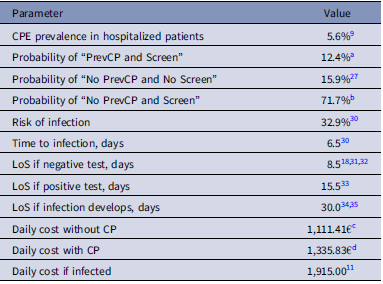
The epidemiological and healthcare resource use inputs are shown in Table 2. A CPE prevalence in hospitalized patients of 5.6% was based on published literature, Reference Gallego-Berciano, Parra and Gallego-Munuera9 the probability of 15.9% for “No PrevCP and No Screen” was based on published literature. Reference Maechler, Schwab and Hansen27 The probability of 12.4% for “PrevCP and Screen” was based on author opinion that PrevCP occurs only in Madrid and Andalucia (31% of patients 28 ) and only if the patient has a history of CPE in the Health Alert monitoring card (40%), Reference Palacios-Baena, Oteo and Conejo29 as well as in some ICUs (40% of 31% of total patients = 12.4%). The probability of 71.7% for “No PrevCP and Screen” was calculated as the proportion that does not follow the other two strategies.
Epidemiological, clinical, healthcare resource use, and cost inputs in Spain

Table 2. Long description
A table summarizing epidemiological, clinical, healthcare resource use, and cost inputs in Spain. The table has 12 rows and 2 columns. The columns are labeled Parameter and Value. Row 1: Parameter, CPE prevalence in hospitalized patients; Value, 5.6 percent. Row 2: Parameter, Probability of PrevCP and Screen; Value, 12.4 percent. Row 3: Parameter, Probability of No PrevCP and No Screen; Value, 15.9 percent. Row 4: Parameter, Probability of No PrevCP and Screen; Value, 71.7 percent. Row 5: Parameter, Risk of infection; Value, 32.9 percent. Row 6: Parameter, Time to infection, days; Value, 6.5. Row 7: Parameter, LoS if negative test, days; Value, 8.5. Row 8: Parameter, LoS if positive test, days; Value, 15.5. Row 9: Parameter, LoS if infection develops, days; Value, 30.0. Row 10: Parameter, Daily cost without CP; Value, 1,111.41 euro. Row 11: Parameter, Daily cost with CP; Value, 1,335.83 euro. Row 12: Parameter, Daily cost if infected; Value, 1,915.00 euro.
CPs, contact precautions; CPE, carbapenemase-producing Enterobacteriaceae; LoS, length of stay; PrevCP, preventive contact precautions.
a Calculated based on the authors’ input that PrevCP occurs only in Madrid and Andalucia (31% of patients 28 ) and only if the patient has a history of CPE in the Health Alert monitoring card (40%), Reference Palacios-Baena, Oteo and Conejo29 as well as in some intensive care units.
b Calculated as the proportion that does not follow the other two strategies (100%–12.4%–15.9%).
c Based on data from the hospital of one of the authors (Hospital del Mar, Barcelona).
d Based on data from two hospitals in Spain where the daily cost in the ward without CP (1,111.41€) is multiplied by (125/104 = 1.201923) [104 cases of colonized or infected patients implied 125 beds blocked or used].
Clinical inputs
The risk of developing CPE within 30 days among colonized patients was assumed to be 32.9%, calculated from the results of a study by Cano et al. (Supplemental Methods). Reference Cano, Gutiérrez-Gutiérrez and Machuca30 Based on Cano et al., Reference Cano, Gutiérrez-Gutiérrez and Machuca30 time to infection among carriers is assumed to occur at day 6.5 (Table 2).
Healthcare resource use and cost inputs
The healthcare resource use and cost inputs are shown in Table 2. The hospital LoS if the patient was not colonized or infected, Reference Bai, Hao and Shao18,Reference Maechler, Schwab and Hansen31,Reference Tahir, López-Cortés and Kola32 if they were colonized, Reference Hernández-García, Pérez-Viso and Carmen Turrientes33 or if they became infected Reference De La Villa, Sánchez-Carrillo and Sánchez-Martínez34,Reference Riu, Chiarello and Terradas35 were all determined from published literature.
Daily cost without CP (1,111.41€) was based on data from the hospital of one of the authors (Hospital Del Mar, Barcelona). The average daily cost of all hospitalizations in Spain in 2024 (valued in Euros 2025) is 934.4€, as reported by the Spanish Ministry of Health. 36 As such, our base case of 1,111.41€ is within the ±25% range considered in deterministic sensitivity analysis, allowing for generalizability.
Due to lack of real-world nationally representative data in Spain, data from two hospitals from two different provinces in Spain (Hospital del Mar, Barcelona [data provided by coauthor M. Milagro Montero] and Hospital Reina Sofía Córdoba [personal communication from Dr. Inmaculada Salcedo]) were used to estimate the excess cost of daily CP. For each hospital, we determined the number of beds used or blocked in a given day due to infectious diseases and the number of patients colonized or infected on that same day. In total (44 + 60) = 104 infected/colonized patients implied (57 + 68) = 125 blocked/used beds in the two hospitals. The excess cost of CP was then calculated as 125/104 = 1.201923 (ie, 20.1923%). So, the daily cost with CP is the daily cost of a hospital bed without CP (1,111.41€) multiplied by 1.201923, which equates to 1,335.83€. Daily cost if the patient was infected was determined from published literature. Reference Ferrer, Garnacho-Montero and Rascado11 All costs are reported in Euros 2024.
The costs of personal protective equipment (eg, gloves, gowns, aprons) and other disposable one-off use supply items to prevent transmission are minimal compared with the cost of blocked beds. Reference Canton, Guillen and Guitierrez Arroyo37 Moreover, the use of these disposable items and labor costs are unlikely to substantially differ between PCR and culture screening and are therefore not accounted for in this analysis.
Due to lack of evidence on both the nosocomial transmission rate and on the costs associated with such nosocomial spread and secondary infections in Spain, transmission-associated costs were excluded from the analysis.
Outcomes
Outcomes per hospital stay reported for each screening strategy per HRHP were the cost of screening, cost of hospitalization when PrevCP is implemented, cost of hospitalization when PrevCP is not implemented, and average total cost. Differences in costs across screening strategies were also reported.
Sensitivity analysis
A deterministic sensitivity analysis was done for the comparison in costs between SoC and “PrevCP and Screen” all HRHP using rapid PCR. Lower and higher limits used in the deterministic sensitivity analysis were the ±25% variation from base case, except where such variation yielded impossible values (eg, sensitivity or specificity higher than 100% or daily cost with CP being lower than without CP).
Results
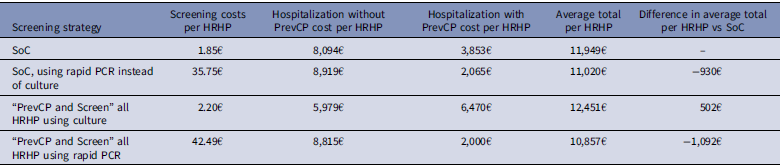
The average total cost per HRHP with SoC was 11,949€ (Table 3). When rapid PCR replaced culture for SoC screening, the cost of hospitalization without PrevCP increased by 825€ per HRHP, whereas the cost of hospitalization with PrevCP decreased by 1,788€, for a savings in average total cost of 930€ per HRHP (Table 3). Implementing “PrevCP and Screen” using culture for all HRHP increased the average total cost by 502€ per HRHP compared with SoC (Table 3). Implementing “PrevCP and Screen” using rapid PCR for all HRHP resulted in an average total cost savings of 1,092€ per HRHP compared with SoC; the cost of hospitalization without PrevCP increased by 721€ per HRHP, and the cost of hospitalization with PrevCP decreased by 1,853€, (Table 3).
Estimated costs per HRHP for carbapenemase-producing Enterobacteriaceae screening strategies in Spain

Table 3. Long description
A table comparing the costs of different screening strategies for carbapenemase-producing Enterobacteriaceae in Spain. The table has 4 rows and 6 columns. The columns are labeled Screening costs per HRHP, Hospitalization without PrevCP cost per HRHP, Hospitalization with PrevCP cost per HRHP, Average total per HRHP, and Difference in average total per HRHP vs SoC. The rows are labeled with different screening strategies: SoC, SoC using rapid PCR instead of culture, PrevCP and Screen all HRHP using culture, and PrevCP and Screen all HRHP using rapid PCR. Row 1: Screening costs per HRHP, 1.85; Hospitalization without PrevCP cost per HRHP, 8,094; Hospitalization with PrevCP cost per HRHP, 3,853; Average total per HRHP, 11,949; Difference in average total per HRHP vs SoC, -. Row 2: Screening costs per HRHP, 35.75; Hospitalization without PrevCP cost per HRHP, 8,919; Hospitalization with PrevCP cost per HRHP, 2,065; Average total per HRHP, 11,020; Difference in average total per HRHP vs SoC, -930. Row 3: Screening costs per HRHP, 2.20; Hospitalization without PrevCP cost per HRHP, 5,979; Hospitalization with PrevCP cost per HRHP, 6,470; Average total per HRHP, 12,451; Difference in average total per HRHP vs SoC, 502. Row 4: Screening costs per HRHP, 42.49; Hospitalization without PrevCP cost per HRHP, 8,815; Hospitalization with PrevCP cost per HRHP, 2,000; Average total per HRHP, 10,857; Difference in average total per HRHP vs SoC, -1,092.
HRHP, high-risk hospitalized patient; PrevCP, preventive contact precautions; SoC, standard of care.
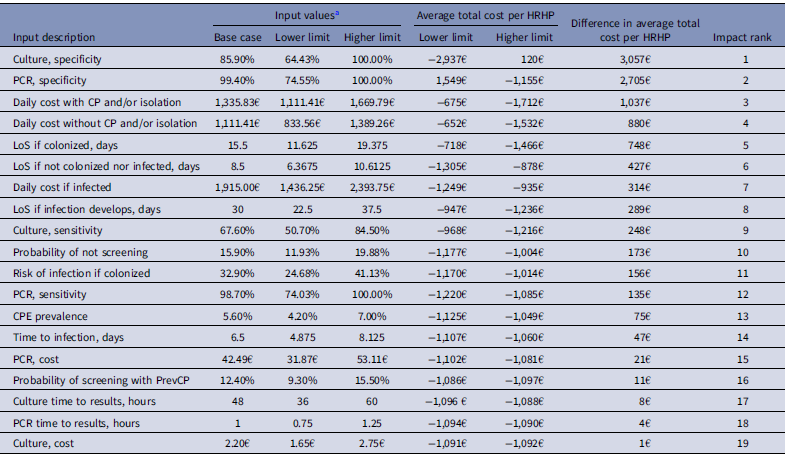
According to the deterministic sensitivity analysis of SoC versus the strategy “PrevCP and Screen” all HRHP using rapid PCR, the specificity of the screening method (culture or rapid PCR) has the most impact on the difference in cost per HRHP tested, followed by daily cost with or without CP (Table 4).
Deterministic sensitivity analysis of SoC versus the strategy “PrevCP and Screen” all HRHP using rapid PCR

Table 4. Long description
A table with 19 rows and 7 columns comparing the impact of various input values on the average total cost per HRHP. The columns are Input description, Input values with Base case, Lower limit, and Higher limit, Average total cost per HRHP with Lower limit and Higher limit, Difference in average total cost per HRHP, and Impact rank. Row 1: Culture, specificity, 85.90 percent, 64.43 percent, 100.00 percent, -2,937 euros, 120 euros, 3,057 euros, 1. Row 2: PCR, specificity, 99.40 percent, 74.55 percent, 100.00 percent, 1,549 euros, -1,155 euros, 2,705 euros, 2. Row 3: Daily cost with CP and/or isolation, 1,335.83 euros, 1,111.41 euros, 1,669.79 euros, -675 euros, -1,712 euros, 1,037 euros, 3. Row 4: Daily cost without CP and/or isolation, 1,111.41 euros, 833.56 euros, 1,389.26 euros, -652 euros, -1,532 euros, 880 euros, 4. Row 5: LoS if colonized, days, 15.5, 11.625, 19.375, -718 euros, -1,466 euros, 748 euros, 5. Row 6: LoS if not colonized nor infected, days, 8.5, 6.3675, 10.6325, -1,305 euros, -878 euros, 427 euros, 6. Row 7: Daily cost if infected, 1,915.00 euros, 1,436.25 euros, 2,393.75 euros, -1,249 euros, -935 euros, 314 euros, 7. Row 8: LoS if infection develops, days, 30, 22.5, 37.5, -947 euros, -1,236 euros, 289 euros, 8. Row 9: Culture, sensitivity, 67.60 percent, 50.70 percent, 84.50 percent, -968 euros, -1,216 euros, 248 euros, 9. Row 10: Probability of not screening, 15.90 percent, 11.93 percent, 19.88 percent, -1,177 euros, -1,004 euros, 173 euros, 10. Row 11: Risk of infection if colonized, 32.90 percent, 24.68 percent, 41.13 percent, -1,170 euros, -1,014 euros, 156 euros, 11. Row 12: PCR, sensitivity, 98.70 percent, 74.03 percent, 100.00 percent, -1,220 euros, -1,085 euros, 135 euros, 12. Row 13: CPE prevalence, 5.60 percent, 4.20 percent, 7.00 percent, -1,125 euros, -1,049 euros, 75 euros, 13. Row 14: Time to infection, days, 6.5, 4.875, 8.125, -1,107 euros, -1,060 euros, 47 euros, 14. Row 15: PCR, cost, 42.49 euros, 31.87 euros, 53.11 euros, -1,102 euros, -1,081 euros, 21 euros, 15. Row 16: Probability of screening with PrevCP, 12.40 percent, 9.30 percent, 15.50 percent, -1,086 euros, -1,097 euros, 11 euros, 16. Row 17: Culture time to results, hours, 48, 36, 60, -1,096 euros, -1,088 euros, 8 euros, 17. Row 18: PCR time to results, hours, 1, 0.75, 1.25, -1,094 euros, -1,090 euros, 4 euros, 18. Row 19: Culture, cost, 2.20 euros, 1.65 euros, 2.75 euros, -1,091 euros, -1,092 euros, 1 euro, 19.
CPs, contact precautions; CPE, carbapenemase-producing Enterobacteriaceae; HRHP, high-risk hospitalized patient; LoS, length of stay; PrevCP, preventive contact precautions; SoC, standard of care.
a Lower and higher limits were the ±25% variation from base case, except where such variation yielded impossible values (e.g., sensitivity or specificity higher than 100% or daily cost with CP being lower than without CP).
Discussion
Protocols for CPE prevention and screening differ among geographic regions and individual hospitals. Some institutions adopt a proactive approach, implementing PrevCP and isolation of all HRHP until screening results are available. Others, however, only implement PrevCP and isolation after a patient tests positive. The method of CPE screening also differs among regions and hospitals, and the methods have variable time to results and performance (ie, sensitivity and specificity). All of these factors ultimately affect costs. The results of this decision-tree modeling analysis indicate that screening for CPE in all HRHP upon hospital admission with rapid molecular PCR as recommended by European guidelines would be cost-saving in Spain compared with the current SoC. Although the screening costs are higher with the rapid molecular PCR, the higher costs are offset by savings accrued from lower hospitalization costs when PrevCP is implemented.
The impact of CPE screening with rapid molecular PCR versus culture has also been modeled for the UK from the perspective of the National Health Service. Reference Moloney, Lee and Craig38 The model assumed that all HRHP patients were isolated and screened. Screening by PCR resulted in an estimated cost savings of £462.13 (530€) per patient compared with culture over a 5-day LoS. Similar to the current analysis, the cost savings were primarily driven by the rapid results from the PCR test that allowed patients to be released from PrevCP the same day as the negative test, as opposed to waiting 2 days under PrevCP for culture test results. In contrast, another modeling analysis from the UK National Health Service perspective evaluated the cost-effectiveness of screening with PCR and culture in patients identified as high-risk for CPE but under the assumption that PrevCP only occurred after a positive test or development of CPE infection. Reference Manoukian, Stewart and Dancer39 The analysis found that under these assumptions, PCR screening was not cost-effective versus culture, particularly at low CPE prevalence. Together these results indicate that the time saved from PrevCP by PCR testing is a critical component of the cost-effectiveness for this screening method.
A cost savings was observed when the only change from the current SoC was the replacement of culture by rapid PCR for screening. Indeed, the savings were nearly as large as those in the “PrevCP and Screen” all HRHP using rapid PCR strategy. This finding reiterates that cost savings are generated by the speed of the PCR results compared with culture.
A limitation of the analysis is that it is not based on a head-to-head study. Some of the assumptions used in the model, such as the daily hospital cost, were from the authors’ own hospital data. More robust data on blocked beds and daily hospital costs in Spain are needed. However, the daily hospital costs were similar to the costs published by the Spanish Ministry of Health, 36 and when the daily hospital costs with or without PrevCP were varied ±25% in the deterministic sensitivity analysis, implementing “PrevCP and Screen” for all HRHP using rapid PCR remained cost-saving compared with SoC. Furthermore, the probabilities of the screening scenarios assumed in our analysis may not be applicable to hospitals or regions where the SoC differs from our experience. Another limitation is that transmission-related costs were not included due to lack of available data. CPE transmission from colonized patients can impose substantial financial burdens on hospitals, as a CPE outbreak requires increased testing, additional personnel time, intensified decontamination and infection control measures, and even bed or ward closures or ward remodeling. Reference Birgand, Leroy and Nerome40,Reference Otter, Burgess and Davies41 Evidence suggests that the rapid time to onset of PCR screening reduces transmission risk and minimizes lost bed-days, particularly as the regional prevalence of CPE rises. Reference Manoukian, Stewart and Dancer39,Reference Corless, Howard and Neal42 Thus, CPE screening with PCR could result in additional cost savings by reducing transmission risk. Accounting for the benefits of avoided transmission would benefit the PCR-based screening strategy; thus, our exclusion of transmission costs yields results that are conservative in nature.
Screening for CPE in Spanish hospitals is typically performed by culture, in contrast to European guideline recommendations, primarily because it is a low-cost method of screening. Results of this modeling analysis indicate that implementation of a rapid molecular PCR screening test for CPE could result in cost savings from a hospital perspective in Spain.
Supplementary material
The supplementary material for this article can be found at https://doi.org/10.1017/ash.2026.10766.
Acknowledgements
None.
Authorship and manuscript preparation
Cepheid provided assistance with study design, reviewing of the manuscript, and agreement to publish the manuscript. Scott Medical Communications, LLC, provided medical writing and editorial assistance. This assistance was funded by Cepheid.
Financial support
This study was funded by Cepheid.
Competing interests
Germán Bou has received consulting fees and participated in educational activities from Shionogi, MSD, Pfizer, Roche, Astellas, Bayer, Cepheid, Werfen, and Biomerieux. Filipa de Aragão is an employee of Incremental Action Consulting, Lda., which received a fixed fee for the development of the analysis. Lorena Lopez Cerero has nothing to disclose. Maria Milagro Montero has received consulting fees and participated in educational activities from Pfizer, MSD, Shionogi, Cepheid, and Biomerieux.




 Open access

