


Questions surrounding international aid’s ability to promote economic development and strengthen institutions have lingered for decades. These concerns have intensified amid the abrupt overhaul of the international aid system, which has brought massive funding cuts and a fundamental shift in donor-recipient relationships.Footnote 2 A key concern in these debates is whether foreign aid erodes state capacity. Critics argue that foreign aid undermines institutional development by weakening accountable governance, crowding out tax capacity, and hindering reform efforts.Footnote 3 Yet the mechanisms linking aid to institutional change often remain underspecified. Scholars have thus called attention to a persistent “black box” in aid-effectiveness research.Footnote 4
I partially attribute the persistence of this black box to an important, but largely overlooked, aspect of the aid effectiveness literature: bureaucracy. Bureaucrats are linchpins of state capacity and development programming, yet we know relatively little about how aid affects their work.Footnote 5 They develop and implement policies, and deliver core state services such as tax collection, healthcare, and education. A substantial body of literature demonstrates how various features of the bureaucracy impact development outcomes, from increasing growth and reducing corruption to equitably delivering public services.Footnote 6 Beyond formal structures, bureaucrats’ own preferences and motivations substantially influence service delivery outcomes.Footnote 7 Yet aid effectiveness research has not paid sufficient attention to how foreign aid interventions reshape the incentive structures of the bureaucrats who implement project aid channeled through the government.
Around 60 percent of official development assistance is channeled through public sector institutions in donor and recipient countries.Footnote 8 The remaining principal recipients—NGOs and multilateral organizations—frequently collaborate with government institutions to execute development agendas. Thus despite efforts at state circumvention, the operationalization of international development agendas relies substantially on the state.Footnote 9 This institutional reality, where international actors with distinct policy priorities inject significant resources into fiscally constrained bureaucracies, creates complex incentive structures with important implications for administrative behavior and organizational efficacy.
I argue that the channeling of aid projects through recipient government bureaucracies can undermine state-led programming by altering attributes of work, including financial and social dimensions of work, over which bureaucrats hold salient preferences. This generates trade-offs that drive bureaucrats to redirect effort from routine government functions to donor-funded initiatives. I focus on bureaucrats’ preferences for work attributes at both the individual and organizational levels. At the individual level, I examine bureaucrats’ preferences for financial incentives, implementation discretion, and goal ownership. At the organizational level, I examine bureaucrats’ preferences for differential donor exposure, equity in resource distribution, and intra-departmental coordination. These features of work are predictors of work satisfaction, performance, and the quality of services delivered.Footnote 10 In addition, bureaucrats’ preferences for work attributes and effort allocation determine their performance and service delivery outcomes.Footnote 11
I test my argument in Uganda, a country with an extensive history with development assistance. Uganda has consistently ranked among sub-Saharan Africa’s principal aid recipients for over three decades, receiving USD 2.3 billion in official development assistance in 2023 alone.Footnote 12 Uganda also exemplifies the region-wide shift in disbursing aid as general budget support to project type interventions.Footnote 13 Importantly, because project aid often operates outside the national budgetary cycle and is implemented at the more decentralized sector or sub-sector level as “off-budget support,” it directly alters the everyday functioning of bureaucracies, creating a useful context for examining how aid influences bureaucratic behavior.Footnote 14
To evaluate how aid projects alter bureaucrats’ incentives and effort, I implement a research design that combines qualitative interviews, descriptive survey data, and survey experiments. From 2019 to 2023, I conducted semi-structured interviews with sixty-four bureaucrats at various hierarchical levels across different central government ministries and agencies. These interviews informed the design of my survey and conjoint experiments by identifying which project features bureaucrats themselves view as consequential for their motivation and effort. I then administered the survey containing two conjoint experiments in 2023 to 559 randomly selected mid-level bureaucrats across more than seventy departments in six key ministries. Within the survey, respondents evaluated randomly assigned hypothetical project and department profiles, allowing me to isolate the effect of specific features on preferences and intended effort.
The evidence from this multi-method approach reveals channels through which external assistance may inadvertently compromise the very state capacity it often seeks to strengthen. Qualitative interviews show that aid projects exacerbate resource inequalities, generating frictions between individual bureaucrats. Forty-eight percent of bureaucrats surveyed also report that aid projects increase resource inequalities between colleagues. The experimental results causally identify bureaucratic decision making when faced with trade-offs. At the individual level, bureaucrats prefer projects funded by government over all external funders, including the World Bank, China, and the United States. They also prefer projects offering higher monetary benefits, greater discretion, and ownership. Moreover, higher monetary benefits on projects not only increase bureaucrats’ effort allocation to those projects but simultaneously reduce effort on regular government duties. Improvements in social dimensions of project work—discretion and ownership—do not appear to increase effort allocation. At the organizational level, bureaucrats prefer departments with greater donor exposure, equity, and ease of coordination and are willing to increase effort as all three features improve.
These findings highlight important dilemmas in how project aid affects bureaucracies. At the project level, financial incentives alone drive effort allocation, overriding the social dimensions of work that bureaucrats value. Similarly, while bureaucrats prefer government over donor funding, they reduce effort on government tasks as financial incentives on projects increase. At the departmental level, both financial and social factors drive effort allocation. Yet bureaucrats prefer departments with higher donor exposure even as they report that donor funding erodes the very equity and collaboration that motivate effort. Together, these findings illuminate that project aid undermines state-led programming when financial incentives crowd out social motivations, redirect effort away from government work, and weaken organizational cohesion.
This study advances scholarship on aid effectiveness by examining micro-level channels through which aid reshapes domestic institutions. While existing research on aid’s effect on state capacity has focused on aggregate outcomes, such as tax capacity and reform efforts, this research note identifies specific mechanisms through which aid reconfigures the administrative state. The results reveal that project-based aid creates a complex principal–agent environment where bureaucrats navigate competing demands from both domestic political actors and international donors.Footnote 15 The results indicate that, by providing financial rewards and a separate set of targets, donors create institutional distortions that crowd out social motivations and redirect effort, explaining why bureaucratic effort on projects is driven primarily by money.
Finally, this study underscores the need to more rigorously examine recipients’ preferences in aid effectiveness research and calls for reform.Footnote 16 When aid is channeled through the state, how it engages domestic state actors shapes whether it strengthens or fragments state institutions. This research supports recent debates about the future of foreign assistance and calls for greater reliance on recipient country systems.Footnote 17
Background and Theory
Foreign Aid in the Public Sector
Foreign aid remains among the most scrutinized instruments for driving economic development in low- and middle-income countries. Yet despite substantial resources dedicated to enhancing democratic governance and institutional capacity, many scholars argue that aid inflows can undercut the very institutions they aim to strengthen.Footnote 18 Donors can constrain state functions by bypassing government, stifling tax collection and accountability, undermining reforms, or siphoning talent from agencies.Footnote 19 These studies typically focus on aggregate indicators of governance or on the exit of public servants, and yet much aid is actually administered in conjunction with government agencies and their bureaucrats.
The public sector remains the dominant channel for ODA delivery, receiving 60 percent of disbursements, or over USD 170 billion, in 2023 alone.Footnote 20 Within public sector aid, resources typically flow through two distinct channels: general budget support and project support, with budget support decreasing substantially relative to project support.Footnote 21 Importantly, each form of support generates distinct organizational realities for recipient governments.
General budget support channels resources through recipient governments’ treasury systems and into the national budget, operating much like domestic revenue. This allows policymakers discretion to allocate funds according to local priorities through the standard legislative budget cycle, where bureaucrats often develop policy proposals that move through Cabinet approval to Parliamentary debate. Budget support may be conditional, requiring certain policy reforms to ensure continued support, but it is generally disbursed through recipient governments’ own public financial management systems.Footnote 22
By contrast, project support channeled through government institutions often operates outside standard budgetary processes. Such projects frequently bypass central treasury systems and are managed through separate project accounts to finance discrete interventions.Footnote 23 Project support therefore differs from both budget support and domestic financing in how priorities are set and resources allocated. Although donors may consult recipient governments during project design, aid projects are typically more heavily shaped by donor preferences, earmarked funding, and donor-defined outputs, reporting requirements, and timelines.Footnote 24 Yet we know relatively little about how projects become part of the day-to-day operations of government or how they affect bureaucrats’ incentives and behavior.
Bureaucratic Motivation and Performance
Bureaucrats are key agents of state capacity. They develop and implement policies and provide core services such as tax collection, healthcare, and policing.Footnote 25 A vast body of scholarship links bureaucracies to better development outcomes, highlighting how “Weberian” bureaucracies—particularly those with meritocratic recruitment and tenure—boost economic growth, curb corruption, and limit political interference.Footnote 26 Additionally, representative bureaucracies not only enhance organizational performance and service quality but also reduce bias, underscoring the importance of who staffs government agencies and how they are motivated.Footnote 27
Building on these insights, a growing body of research emphasizes the role of bureaucrats’ motivation and preferences in shaping service delivery outcomes.Footnote 28 Bureaucrats are not passive implementers responding solely to monitoring and incentives, but rather motivated agents whose effectiveness depends partly on whether their work environment aligns with their goals and preferences. For instance, allowing high-performing tax inspectors in Pakistan to select their preferred postings increased tax revenue growth by 30 to 41 percent.Footnote 29
While this demonstrates how frontline bureaucrats’ preferences can shape service delivery outcomes, assessing the performance of civil servants who work in government ministries is more challenging. Because central government bureaucrats tend to work in teams, where individual outputs are intertwined with those of others, and because their contributions are often continuous rather than discrete, traditional performance metrics can fall short.Footnote 30 As a result, scholars have relied on performance proxies, ranging from public service motivation to effort.Footnote 31 For example, Kalaj, Rogger, and Somani show that the amount of time Ethiopian bureaucrats spend coordinating with colleagues and interacting with clients significantly improves the quality of services delivered by their organization, highlighting how time use, as a proxy for effort, is an important input to performance outcomes.Footnote 32 It is therefore essential to understand how bureaucrats differentially allocate time across regular government duties and aid project responsibilities.
Doing so requires identifying what changes when project aid enters the bureaucracy. I focus on changes at both the individual and the organizational levels. At the individual level, I investigate how project aid may directly alter ownership, autonomy, and financial incentives. At the departmental level, I probe how project aid may indirectly alter exposure to donor funding, equity, and coordination. While these are certainly not the only changes that can occur following the arrival of aid projects, they are key determinants of work satisfaction and performance. I therefore argue that project aid channeled through the government can distort individual and organizational-level dimensions of work over which bureaucrats hold salient preferences, generating competing demands on bureaucrats’ motivations and effort.
Individual-Level Motivators
Many bureaucrats are called to public service and care about how their work impacts citizens, which fosters a sense of mission and a desire for ownership over their tasks. Being mission-oriented may explain why they often accept lower pay relative to private sector counterparts, but also requires that their personal goals align with those of their organization.Footnote 33 As Wilson notes, public employees frequently draw motivation from a sense of purpose that transcends material rewards.Footnote 34 Building on this, Honig argues that “mission-driven bureaucrats” thrive under empowerment-oriented management, where autonomy, recognition, and peer support enable a strong mission-driven identity.Footnote 35 By contrast, excessive compliance and rigid oversight can undermine that sense of mission, causing dedicated employees to disengage or exit. In line with this view, I expect bureaucrats to prefer projects that grant them ownership of priorities and to increase effort as that ownership increases.
Autonomy also signals trust between a principal and their agent, and can increase intrinsic motivation and productivity.Footnote 36 Moreover, more autonomous bureaucrats can better navigate complex relationships with peers, service recipients, and political principals in the execution of their duties.Footnote 37 In their novel study of Nigerian civil servants, Rasul and Rogger show that projects where bureaucrats have more discretion have higher completion rates than those where bureaucrats are monitored more, while Bandiera and colleagues find that more autonomous procurement officers in Pakistan lower the cost of purchases without compromising quality.Footnote 38 I therefore expect bureaucrats to prefer projects where they are more autonomous, specifically, where they have more discretion over implementation, and to increase effort as their ability to apply discretion increases.
Financial incentives nevertheless comprise an important source of motivation to perform better. They can attract people to work in the public sector and boost the performance of public sector workers.Footnote 39 Dal Bó, Finan, and Rossi find that higher wages attract workers who are also intrinsically motivated into public service in Mexico and Bobba, León, and Wantchekon find that the promise of bonuses boosts productivity among teams of bureaucrats in local governments in Benin.Footnote 40 I therefore expect bureaucrats to prefer working on projects with higher monetary benefits and to increase effort on such projects. However, because projects increase bureaucrats’ multitasking effort, I further expect that as bureaucrats increase effort on projects, they will simultaneously decrease effort on regular government duties.Footnote 41
Organizational-Level Motivators
Higher monetary benefits also have implications at the departmental level. Departments that manage more donor-funded projects are more likely to engage more of their bureaucrats in aid projects. Bureaucrats should therefore prefer to work in departments with more donor exposure and be willing to apply more effort in such departments because of the prospect of higher financial rewards.
But financial incentives are a double-edged sword, particularly when they are selectively allocated. Monetary benefits allocated to only those bureaucrats working on aid projects might be interpreted as deprivation by those bureaucrats who do not receive them. Scholarship shows that individuals care not only about their own income, but also about how their income compares to that of their peers.Footnote 42 In India, the productivity of entire units drops when pay is heterogeneous and effort is difficult to observe, as is the case with central government bureaucrats, and in California, university employees are more likely to express a desire to leave their organization when they learn their peers earn more than they do.Footnote 43 I therefore expect bureaucrats to prefer working in departments with more equitable pay and to increase effort as departments become more equitable.
Finally, bureaucrats care about belonging to their organization, including working with a team that supports each other.Footnote 44 Belonging to a group with a shared vision can enhance an individual’s sense of meaning and worth and inculcate a nonmaterially motivated desire to contribute to the group’s goals.Footnote 45 Bandiera, Barankay, and Rasul find that working alongside friends who are more productive increases an individual’s own productivity, while Kalaj, Rogger, and Somani find that time spent meeting with peers can improve the quality of services delivered by bureaucratic organizations.Footnote 46 I therefore expect bureaucrats to prefer working inside departments where they can coordinate more easily with their peers, and to increase effort as coordination improves.
One might object that project aid-induced diversionary effects are offset by the capacity building that donors invest in alongside project delivery. Training programs, technical assistance, systems strengthening, and additional staffing have absorbed a substantial share of development budgets on the premise that they leave durable improvements in how governments function. In principle, these investments could improve capacity even when projects distort incentives and social structures. In practice, the evidence is mixed at best.Footnote 47 Donor-driven capacity building tends to underperform because it is rigid, reduces domestic ownership, is poorly adapted to local context, or treats organizational change as a technical problem rather than a behavioral and institutional one.Footnote 48 Capacity building can work when embedded in existing organizational culture rather than delivered as one-off workshops, when locally owned and problem-driven, and when paired with managerial follow-through that enables learning to transfer into daily practice.Footnote 49 Williams further demonstrates that reform can be successful when operationalized as an ongoing process that creates opportunities for civil servants to diagnose performance problems and improve work practices from within.Footnote 50 These are precisely the conditions that project aid, with its parallel structures, pay disparities, and donor-defined targets, is often ill-suited to support.
Empirical Context
Uganda receives some of the greatest amounts of aid in sub-Saharan Africa by net disbursements, receiving over USD 2 billion in ODA in 2023.Footnote 51 However, aid is not evenly allocated across departments and sectors. For example, in the 2016/2017 financial year, donor funds covered 43 percent of the Ministry of Health’s budget compared to 0.3 percent for the Justice, Law and Order sector,Footnote 52 rising to 62 percent by 2019/2020.Footnote 53 Differences are just as stark across departments. Looking at the Ministry of Health’s budget, the pharmaceuticals section, which includes the Global Fund for AIDS, malaria and TB, had the highest budget: thirty times higher than public health services, ten times higher than clinical services, and six times higher than health infrastructure.Footnote 54 Donor funding has also gone through various phases from budget support to project support. Some of these shifts have been driven by differences in opinion about priority areas for funding between donors and the government, concerns about the misuse of funds, and concerns about democratic governance.Footnote 55 Currently, about 78 percent of aid to the public sector is disbursed as project support.Footnote 56
Bureaucrats in Uganda interact with the aid system as routine counterparts in project preparation, implementation, and oversight. They participate in the budgeting, procurement, authorization, and reporting associated with donor financing. These demands can impose substantial administrative burdens as fragmented donor procedures strain ministries’ limited human and managerial capacity.Footnote 57 In the health sector, for example, donor-funded projects are often only partially aligned with sector priorities and frequently require partner-specific reporting across multiple, poorly harmonized systems.Footnote 58 This reinforces parallel implementation arrangements, including salary top-ups.Footnote 59
Furthermore, because project aid is often allocated as off-budget support, data on the distribution of foreign aid across government ministries and agencies, particularly across departments and bureaucrats, is not readily available. The central government itself has incomplete information about the value of donor-funded projects in the various ministries. This is partly due to the ongoing gap between the information held by ministries implementing aid projects and the data collected by the Ministry of Finance, Planning, and Economic Development, which oversees development expenditure planning.Footnote 60 In 2019, the African Development Bank reported that the difference between what donors reported was disbursed and what government reported was spent amounted to USD 645 million or 13 percent of government expenditure.Footnote 61 Given its long history with aid, the uneven distribution of aid across departments and sectors, and the uncertainty around aid allocation, Uganda provides an ideal setting for unpacking aid’s impact on bureaucrats.
Research Design
To determine how project aid shapes bureaucrats’ motivations, incentives, and effort, I employ a research design comprising semi-structured interviews, descriptive survey data, and survey experiments. The interviews form the foundational layer. A qualitative approach allows subjects to give meaning to their experiences and links processes to outcomes, making it especially suitable for less studied populations.Footnote 62 By asking open-ended questions, I can unpack how project aid is operationalized in recipient bureaucracies and how these projects impact bureaucrats’ day-to-day work. Using a qualitative approach also allows me to identify which features of bureaucratic work are most susceptible to change following the arrival of aid projects.
Between 2019 and 2023, I conducted sixty-four qualitative interviews with bureaucrats at various hierarchical levels.Footnote 63 I used a snowball sampling approach, relying on initial contacts with government officials and policy experts and following recommendations from those I had interviewed. My sample included entry-level (31 percent), mid-level (47 percent), and senior career civil servants and political appointees (22 percent) in various ministries, departments, and agencies, including the ministries of Finance, Health, Agriculture, ICT, Gender, Lands, and President’s Office.
Next, I administered a survey to 559 central government bureaucrats across approximately seventy departments in six key ministries: Finance, Planning and Economic Development; Agriculture, Animal Industry and Fisheries; Trade, Industry and Cooperatives; Education and Sports; Health; and Works and Transport. These ministries, chosen through expert consultations and following Kalaj, Rogger, and Somani, are considered central to economic development.Footnote 64 The survey sample excluded directors, commissioners, secretaries, drivers, and librarians, focusing on mid-level officers because they are more likely to be assigned to aid projects while having limited input on how these projects are allocated. I obtained the staff lists for these ministries with permissions from Permanent Secretaries and Human Resources departments.
I then randomly selected respondents, ensuring proportional representation based on department and ministry size. Enumerators physically visited each department to administer the survey in person and I made randomly selected replacements when staff were missing. This included staff who were in upcountry offices, had been transferred, were studying abroad, or did not exist. I failed to obtain the staff list from the Ministry of Agriculture and did not randomly select bureaucrats there. Instead, thirty-seven bureaucrats were conveniently sampled. Each participant received a symbolic fee of about USD 3 for their time. Figure 1 shows the distribution of respondents by ministry, education level, contract type and rank.
Characteristics of survey respondents

Figure 1 Long description
The image contains four bar graphs depicting the distribution of sample characteristics. Panel A shows the distribution by ministry. The horizontal axis represents different ministries, and the vertical axis represents the percentage of respondents. The ministries listed are Finance, Health, Works, Education, Agriculture, and Trade. Finance has the highest percentage at 35.2 percent, followed by Health at 20.6 percent, Works at 18.4 percent, Education at 14.3 percent, Agriculture at 6.6 percent, and Trade at 4.8 percent. Panel B shows the distribution by education level. The horizontal axis represents different education levels, and the vertical axis represents the percentage of respondents. The education levels listed are Masters degree, Undergraduate degree, Post-graduate diploma, Post-high school diploma, PhD/Doctorate, and Other. Masters degree has the highest percentage at 49.4 percent, followed by Undergraduate degree at 31.7 percent, Post-graduate diploma at 13.8 percent, Post-high school diploma at 4.3 percent, PhD/Doctorate at 0.7 percent, and Other at 0.2 percent. Panel C shows the distribution by contract type. The horizontal axis represents different contract types, and the vertical axis represents the percentage of respondents. The contract types listed are Permanent, Temporary, and No response. Permanent has the highest percentage at 82.3 percent, followed by Temporary at 17.5 percent, and No response at 0.2 percent. Panel D shows the distribution by rank. The horizontal axis represents different ranks, and the vertical axis represents the percentage of respondents. The ranks listed are Technical, Administrative, Management, and Other. Technical has the highest percentage at 72.6 percent, followed by Administrative at 16.3 percent, Management at 10.7 percent, and Other at 0.4 percent.
Embedded within this survey were two conjoint experiments that randomly varied work attributes related to projects and departments. The purpose of the experiments was to determine bureaucrats’ preferences for work attributes—at both the individual and organizational level—that are susceptible to changes induced by aid projects channeled through government, and how these preferences map onto effort allocation. Conjoint experiments can allow us to disentangle bureaucrats’ preferences for complex sets of work attributes where direct performance data are unavailable.Footnote 65
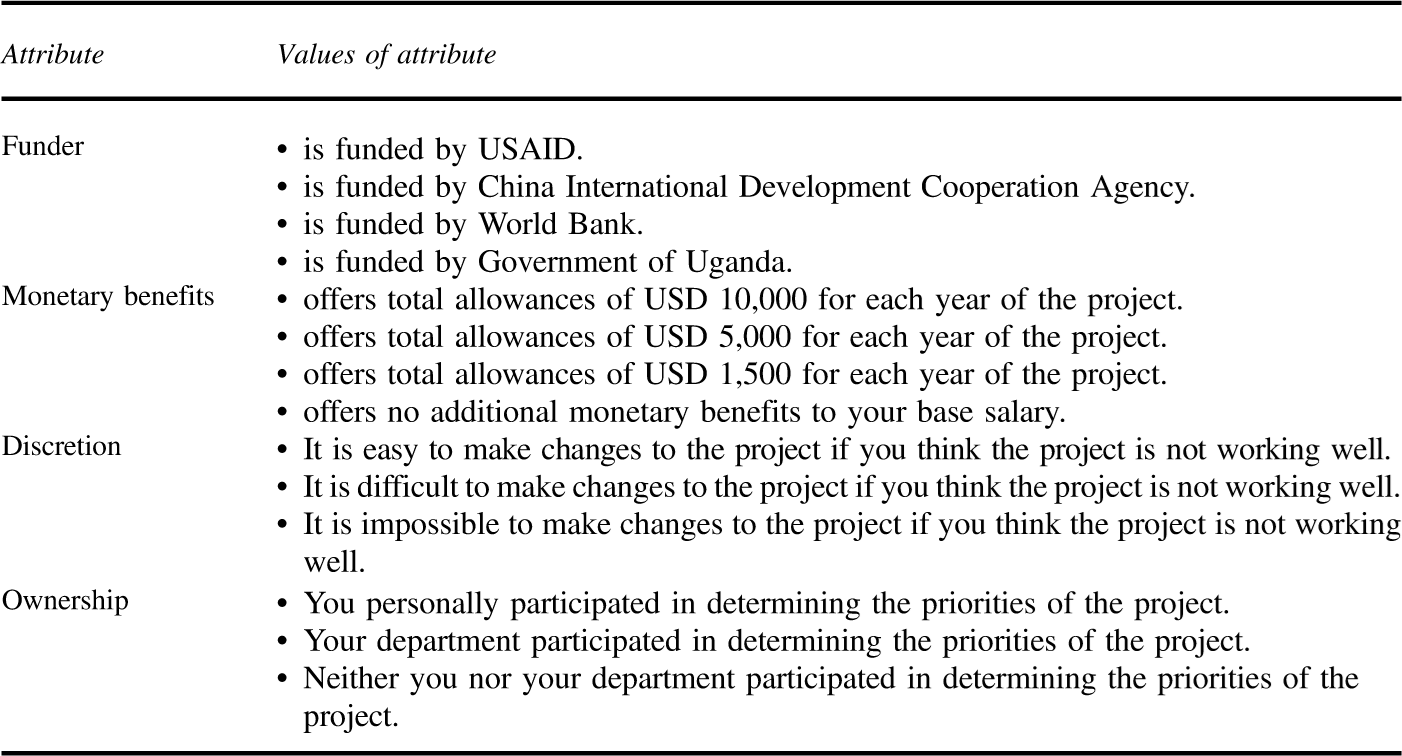
The project conjoint comprised four attributes: the funder, monetary benefits, ownership, and discretion. I selected the most typical funders for a country like Uganda, which include The World Bank, China, USAID, and the government itself. While I did not theorize the funder attribute ex ante, including it allowed me to provide a more realistic scenario for the project conjoint and to compare bureaucrats’ preferences for funding from government versus external actors.
Importantly, when bureaucrats work on aid projects, they receive various benefits, including monetary allowances. Allowances are discretionary unlike salaries, which are determined by clear guidelines in the Public Service Standing Orders that match salaries to rank. Allowances also form a significant source of income for bureaucrats and can surpass their baseline salaries. The monetary benefits figures in the experiment were determined in consultation with experts who work in public policy or who have worked as bureaucrats. In section G of the appendix, I also include excerpts of the government’s 2018 Circular Standing Instructions, which delineate bureaucrats’ allowances as well as the 2023 to 2024 salary scale for mid-level bureaucrats. Bureaucrats can receive night allowances, travel allowances, lunch allowances, and safari day allowances, among others.
The discretion and ownership features followed extensive discussions with bureaucrats about how donor-funded projects are conceptualized and budgeted for relative to government work. Government budgetary allocations follow a formal process: bureaucrats often develop policy proposals, which once approved by their heads of department, are submitted to the Cabinet of Ministers. If approved by Cabinet, these proposals are sent to Parliament for debate and approval. By contrast, donor-funded projects bypass these national budgetary procedures and are often negotiated as “off-budget” at the sector or subsector level. Many bureaucrats report having limited input in conceptualization, constraints in funding allocation, and burdensome reporting requirements that vary with each donor. This is in part due to the targeted nature of project aid and limited coordination among donors on the projects they undertake in recipient countries.Footnote 66
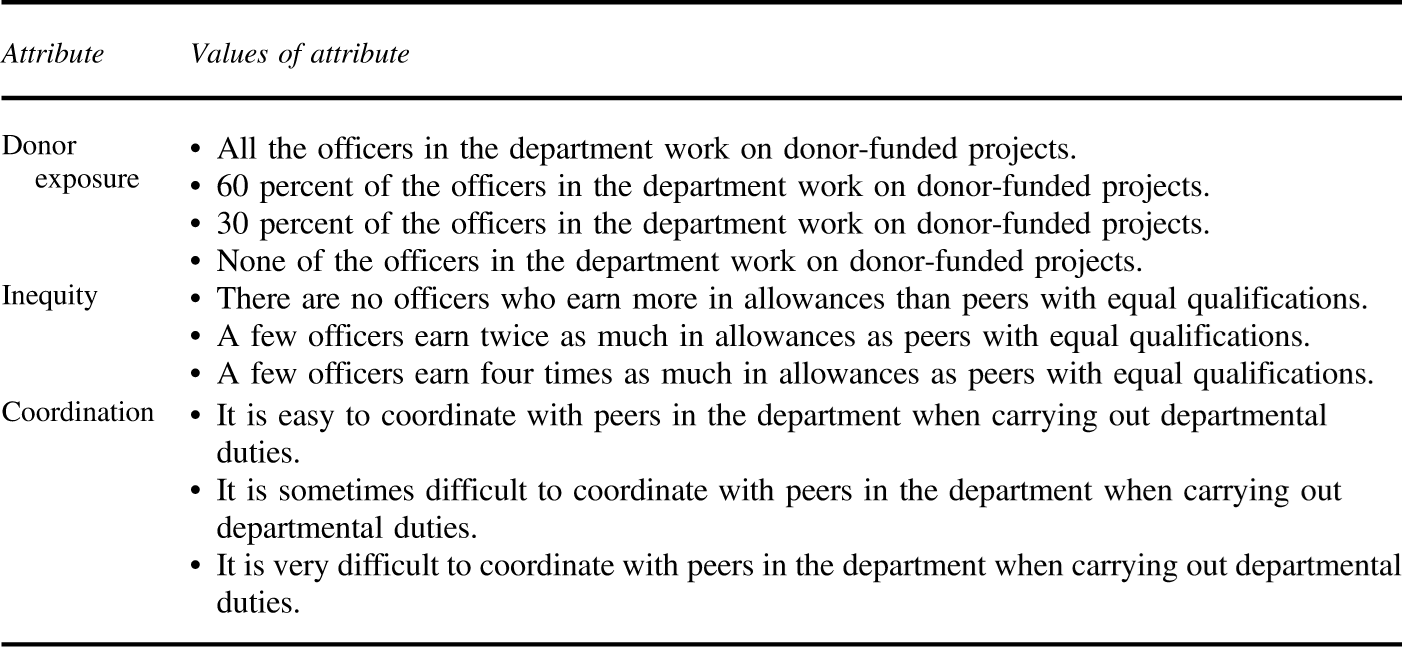
The department conjoint comprised three attributes: donor exposure, equity, and coordination. Aid projects are implemented inside departments and there is substantial variation across departments in the number of projects they operate. As a department takes on more aid projects, the number of its bureaucrats involved in such projects increases, hence the donor exposure. But because only some bureaucrats in the department are selected to work on projects at any given time, aid projects engender inequity between peers. That is, peer bureaucrats who are equally qualified may find themselves with vastly different earnings. Finally, many bureaucrats report having to divide their time between aid projects and government work. This may entail missing departmental meetings to go to the field, attending workshops, or attending project meetings. This can result in neglecting government work that is often conducted with other members of the department, corroding coordination in departments, especially those that have high donor exposure.
For each conjoint experiment, respondents completed three forced choice tasks and answered follow-up questions about their preferred project or department. This resulted in an effective sample size of 3,354 observations for the forced choice and 1,677 observations for the follow-up questions. I also operationalize my main outcome of interest—effort—as the additional number of hours beyond the typical 8:00 a.m. to 5:00 p.m. bureaucrats are willing to work each day to fullfill project and department objectives (up to four hours) and the number of hours bureaucrats are willing to shave off regular government work each day to fulfill project objectives (up to eight hours). Later I describe the two conjoints.
The first is the project conjoint, where I varied funder, monetary benefits, discretion, and ownershipFootnote 67 (See Table 1).
Project conjoint attributes and their possible values

Table 1 Long description
A table titled ‘Project conjoint attributes and their possible values’ with four columns and five rows. The columns are labeled ‘Attribute’ and ‘Values of attribute’. The rows list different attributes and their corresponding values. Row 1: Attribute, Funder; Values of attribute, is funded by USAID, is funded by China International Development Cooperation Agency, is funded by World Bank, is funded by Government of Uganda. Row 2: Attribute, Monetary benefits; Values of attribute, offers total allowances of USD 10,000 for each year of the project, offers total allowances of USD 5,000 for each year of the project, offers total allowances of USD 1,500 for each year of the project, offers no additional monetary benefits to your base salary. Row 3: Attribute, Discretion; Values of attribute, It is easy to make changes to the project if you think the project is not working well, It is difficult to make changes to the project if you think the project is not working well, It is impossible to make changes to the project if you think the project is not working well. Row 4: Attribute, Ownership; Values of attribute, You personally participated in determining the priorities of the project, Your department participated in determining the priorities of the project, Neither you nor your department participated in determining the priorities of the project.
Respondents view the following statement when presented with the forced choice tasks.
Now I am going to ask you your opinion about certain aspects of donor-funded projects. I will show you two pairs of three hypothetical projects that have a funding period of three years. For each pair of projects, I will ask you a couple of questions. There are no right or wrong answers—it is just what you prefer.
Project A: [randomized values for each attribute].
Project B: [randomized values for each attribute].
Following each forced-choice task, respondents answered two questions: (1) how many additional hours they would be willing to work each day and (2) how many hours they would be willing to take off routine government work each day to fulfill project objectives. Because bureaucrats do not resign their positions or take extended leaves of absence to meet project requirements, they must either reduce time from regular government work during their usual workday or add hours beyond it. These follow-up questions therefore captured marginal effort. However, because these effort questions referred only to the preferred project, estimates reflect relationships between project attributes and marginal effort conditional on choosing that project.
The second is the department conjoint, where I varied donor exposure, equity, and coordination (See Table 2).
Department conjoint attributes and their possible values

Table 2 Long description
The table is titled Department conjoint attributes and their possible values. It has three columns: Attribute, Values of attribute. The table has three rows for each attribute, describing different scenarios. Row 1: Donor exposure, All the officers in the department work on donor-funded projects. Row 2: Donor exposure, 60 percent of the officers in the department work on donor-funded projects. Row 3: Donor exposure, 30 percent of the officers in the department work on donor-funded projects. Row 4: Donor exposure, None of the officers in the department work on donor-funded projects. Row 5: Inequity, There are no officers who earn more in allowances than peers with equal qualifications. Row 6: Inequity, A few officers earn twice as much in allowances as peers with equal qualifications. Row 7: Inequity, A few officers earn four times as much in allowances as peers with equal qualifications. Row 8: Coordination, It is easy to coordinate with peers in the department when carrying out departmental duties. Row 9: Coordination, It is sometimes difficult to coordinate with peers in the department when carrying out departmental duties. Row 10: Coordination, It is very difficult to coordinate with peers in the department when carrying out departmental duties.
Respondents viewed the following statement when presented with the forced choice tasks.
Finally I am going to ask you your opinion about certain features of departments. I will show you two pairs of three hypothetical departments. For each pair of departments, I will ask you a couple of questions. There are no right or wrong answers—it is just what you prefer.
Department A: [randomized values for each attribute].
Department B: [randomized values for each attribute].
Similar to the project conjoint, respondents answered questions about which department they would prefer to work in and how many additional hours they would be willing to work each day to fulfill department objectives, conditional on choosing that department.
Results
Descriptive Results
Involvement of foreign donors in Uganda’s government agencies
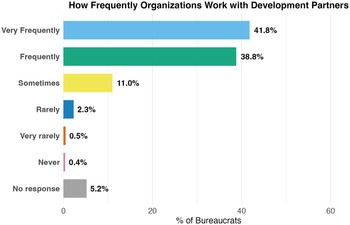
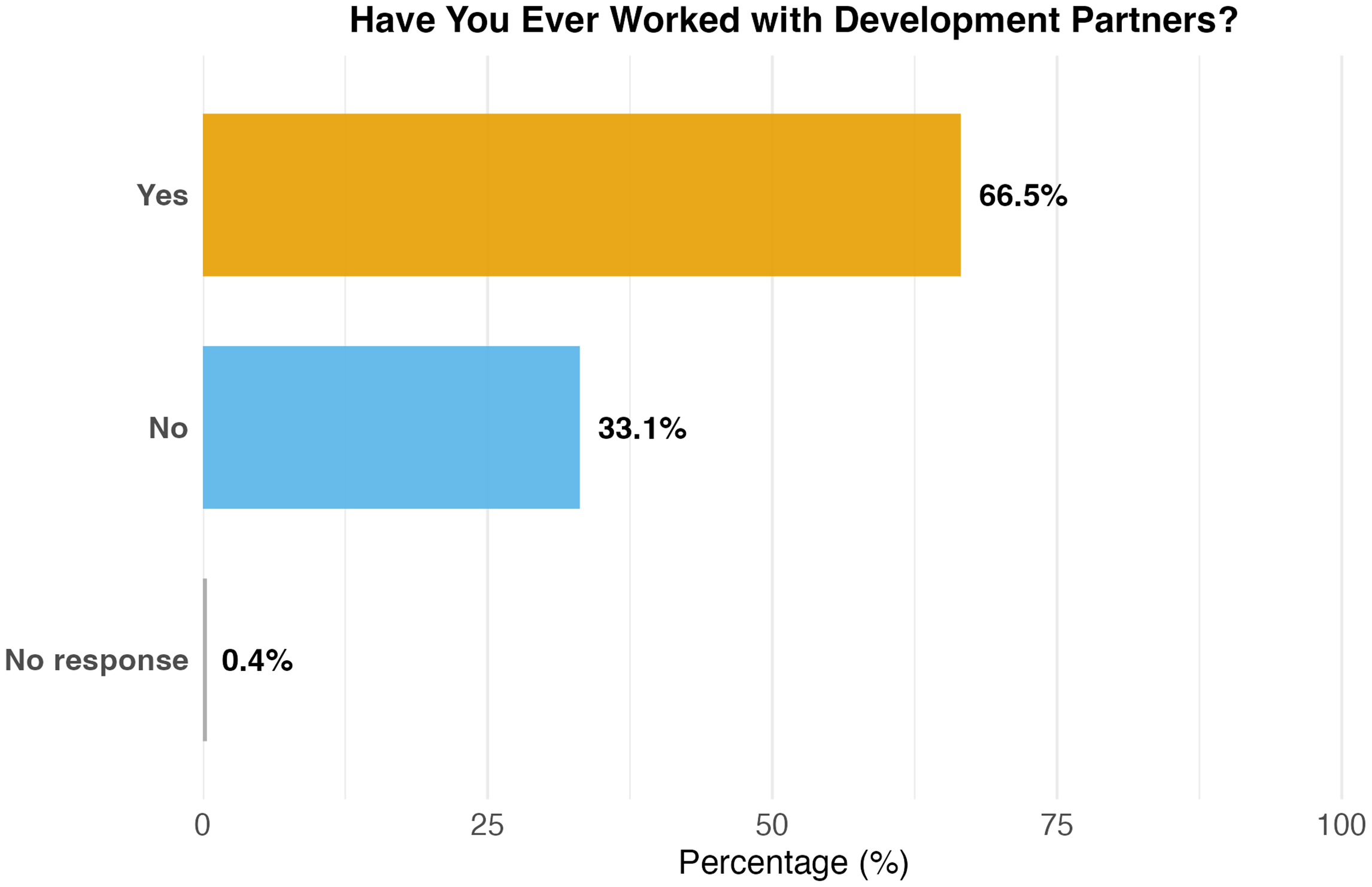
As shown in Figure 2, over 80 percent of bureaucrats surveyed report that their organization frequently or very frequently works with development partners, with little variation across ministries. Figure 3 further shows that 67 percent of bureaucrats report they have worked on a donor-funded project. Moreover, 83 percent of bureaucrats hope to work on a donor-funded project in the future. This figure is more pronounced among those who have already worked on a donor-funded project at 96 percent.
Share of bureaucrats who have ever worked on an aid project

Share of bureaucrats who have ever worked on an aid project

Surveyed bureaucrats who have worked on donor projects report working on two projects annually and an additional two hours beyond the typical workday, with most doing so sometimes or frequently. Despite the extent of donor engagement with government bureaucracies, Figure 4 shows only 31 percent of bureaucrats report that projects are initiated internally and 55 percent report that projects are either fully or partially developed by donors when they are introduced to government departments.
Aid project initiation in departments

However, in interviews, bureaucrats report that the power asymmetry in funding relationships leads them to accommodate donor priorities, even when these do not fully address local needs, and to design projects around what they believe donors will fund.
Remember this is now the person [donor] that has the money, so even during the negotiations, this person who has the money is likely to say don’t do this, and what we observed is that you may not address entirely your national or local problem … many people working with DPs [donors] will find themselves bent, tilted towards addressing what the other person needs.
Yes, you might have your priorities, but don’t have the funding. The donors come with their priorities and because they have the funding, and you need the funding to do off budget activities, then you accommodate … That’s the challenge with projects that originate at the department level. Because I have read about an opportunity, I go and convince the commissioner [head of department] on this and package it for the PS [Permanent Secretary].
The limited participation of government bureaucrats in project design weakens ownership over project priorities. This bureaucrat describes how external agenda setting undermines local stakeholder participation.
Rarely do they [donors] consult people as government … So you find that the local participation is very low, as you were saying that there is that public policy cycle, so you find that the agenda setting is done outside there.
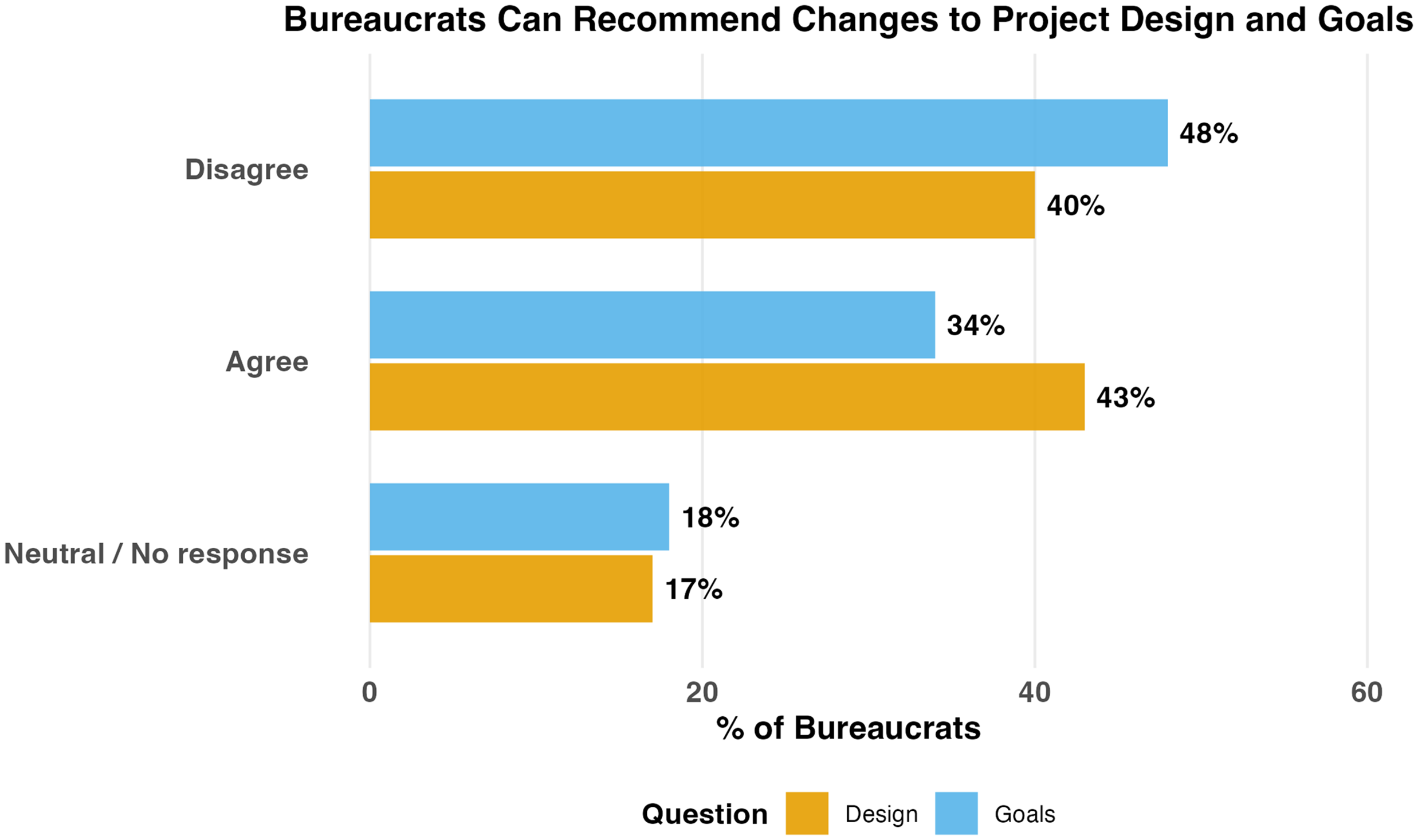
This has implications for bureaucrats’ influence over project goals and implementation. Forty percent of bureaucrats report they cannot make changes to a project’s design while 48 percent report they cannot make changes to a project’s objectives if they think the project is not working well. This further undermines bureaucratic ownership of the aid projects they work on (see Figure 5).
Discretion in implementation

Bureaucrats also receive monetary incentives to work on donor-funded projects. For example, a mid-level bureaucrat earning about USD 370 a month can receive USD 650 for each night abroad according to the government’s Circular Standing Instructions on allowances.Footnote 68 This exacerbates inequality: 47 percent of bureaucrats surveyed report that donor funding increases inequality between colleagues while only 29 percent report that it does not. This can create tension inside departments, especially where selection onto projects is not transparent. The figures are starker for departments where 57 percent of bureaucrats report that donor funding increases inequality between departments (see Figure 6).
Yes, because projects are financially motivated, for example, through field allowances. Project staff are more motivated because the funding is there, unlike those only on government programming.
You know, there is organizational politics, which is controlled by economic politics. As long as somebody is going to get something more in their pocket than another, automatically it is going to cause a problem even if they do not say it out. Accusations of favors, more exposure to work, travels abroad, etc., are there as humans and we can’t be short of such sentiments.
Inequality increases across bureaucrats and departments

These divides between bureaucrats corrode coordination as bureaucrats within the same institutions start pursuing disparate goals. This is intensified by the fact that bureaucrats on aid projects are under pressure to prioritize aid projects over their regular government duties.
Yes, donor projects are more time bound. Even projects by nature have more urgency than the routine government work. You can always postpone; the repercussions of not delivering the government assignment are less because for the donor, when the time ends, they will withdraw funding. But for the government work, you can again plan for it next year.
These various projects funded by different people in the same institution scatter the staff and if you are the person coordinating the whole organization, then you cannot drive in the same direction as you want. Actually, if you are not careful, it can lead to organizational breakdown. You have your scientists, directors, heads of units, involved in work for different foundations. So focusing, it’s quite disruptive.
Overall, the descriptive findings illustrate how aid creates environments where bureaucrats experience limited ownership and discretion while confronting increased inequality and coordination challenges. The results further demonstrate that while donor-funded projects offer attractive financial incentives—explaining bureaucrats’ eagerness to participate in them—they simultaneously introduce tensions that fragment departmental cohesion.
Experimental Results
To determine how distinct project and department characteristics impact bureaucrats’ preferences and effort, I estimate the Average Marginal Component Effects (AMCEs) for both the project and department conjoint experiments. The AMCEs estimate the marginal effect of each attribute level on the probability of project or department selection relative to a baseline category set to 0 and averaged over the joint distribution of the other remaining attributes. AMCEs significantly greater than zero indicate that the attribute level has a positive causal effect on the likelihood of project or department selection and on the willingness to work additional hours, while AMCEs significantly less than zero indicate that an attribute level has a negative causal effect.Footnote 69
Bureaucrats’ Work Preferences in the Context of Aid Projects
Project preferences
I start by estimating bureaucrats’ preferences for projects. I estimate the likelihood that bureaucrats will prefer projects with higher monetary benefits, greater ownership over priorities, and more discretion in implementation. The results in Figure 7 show that bureaucrats have very strong preferences for these project attributes. For monetary benefits, moving from no additional compensation to USD 10,000 per year increases the probability of project selection by 28 percentage points. Mid-range monetary benefits of USD 5,000 and USD 1,500 also show significant positive effects of 20 and 13 percentage points respectively, demonstrating that even moderate financial incentives meaningfully influence project preferences.
AMCE estimates for different project attribute levels
Note: Corresponding estimates are in Table A3, section H of the appendix.

For ownership, moving from no participation in determining project priorities to personal participation increases the likelihood of project selection by twenty-three percentage points, with departmental participation slightly higher at twenty-four percentage points. This similarity in effect sizes suggests that collective decision making at the departmental level is just as effective at fostering a sense of ownership as direct personal involvement, supporting literature showing that bureaucrats value being part of an empowered team.Footnote 70 For discretion, moving from impossible to make changes to easy to make changes increases the likelihood of selection by thirty-one percentage points, though even the ability to make changes with difficulty increases selection by fifteen percentage points, revealing bureaucrats value even limited implementation autonomy.
Though not explicitly hypothesized, the results also show that bureaucrats have preferences over different types of funders. Funding from China, relative to funding from the government, decreases the likelihood of project selection by eleven percentage points while funding from USAID decreases the likelihood of project selection by eight percentage points. Only funding from The World Bank has a negative effect on project selection that is statistically indistinguishable from funding from the government. Nevertheless, the general takeaway is that bureaucrats prefer funding from their own government over any other type of funder. This is important because donor-funded projects tend to have certain attributes, such as financial benefits, that we might mischaracterize as preferences for donors without the experiment.
Department preferences
I now examine how departmental characteristics shape bureaucrats’ workplace preferences. Following my theoretical framework, I estimate the likelihood that bureaucrats will prefer departments with higher donor exposure, greater pay equity, and easier coordination with peers. The AMCE results in Figure 8 reveal that bureaucrats have strong preferences for these departmental attributes.
AMCE estimates for different department attribute levels
Note: Corresponding estimates are in Table A4, section H of the appendix.

Figure 8 Long description
A line graph titled Department Bureaucrats Prefer to Work In. The horizontal axis is labeled Average Marginal Component Effect and ranges from 0.0 to 0.4. The vertical axis lists different department attributes: All, 60 percent, 30 percent, None, Equal, Twice as much, Four times as much, Easy, Sometimes difficult, and Very difficult. The graph includes three data lines, each representing a different feature: Coordination in yellow, Inequity in blue, and Donor Exposure in green. The Donor Exposure line shows higher values for All, 60 percent, and 30 percent attributes, peaking around 0.35. The Inequity line shows moderate values for Equal and Twice as much attributes, around 0.1 to 0.2. The Coordination line shows higher values for Easy and Sometimes difficult attributes, with the Easy attribute peaking around 0.4.
Coordination emerges as the most influential departmental attribute by a substantial margin. Moving from very difficult to easy coordination with peers increases the likelihood of department selection by forty-three percentage points. This result aligns with Jacobsson and Hollertz who argue that teamwork fosters social capital characterized by trust, mutual support, and shared norms, leading to improved service delivery.Footnote 71 For equity, moving from a situation where some equally qualified peers earn four times more in allowances to one where all equally qualified peers earn the same increases the probability of department selection by nineteen percentage points, supporting Breza, Kaur, and Shamdasani and Card and colleagues’ work on the importance of pay parity for productivity and work satisfaction.Footnote 72
For donor exposure, moving from no one to everyone in the department working on donor-funded projects increases the likelihood of department selection by twenty-three percentage points, supporting findings from the project experiment that financial incentives significantly influence bureaucrats’ decision making. However, this reveals a notable conflict: despite evidence that donor involvement often disrupts the coordination and equity they highly value, bureaucrats remain attracted to departments with greater access to donor resources. This contradiction points to what Cassar and Meier describe as competing motivational drivers, where material incentives may sometimes override social preferences.Footnote 73
These department-level findings echo the project findings: financial incentives draw bureaucrats to donor-heavy work environments, yet bureaucrats simultaneously value social factors that donor funding often undermines, specifically pay equity and coordination. This explains the tension highlighted in the interview data, with one bureaucrat explaining that when department meetings conflict with project meetings, “I will go for the project meeting because it is the one which has money.” As shown in the descriptive findings, these coordination challenges can deteriorate departmental cohesion. Despite recognizing these challenges, bureaucrats remain drawn to donor-rich environments for the financial opportunities they provide.
Bureaucrats’ Willingness to Work Additional Hours: The Role of Preferences in Effort Allocation
Next, I analyze how project and department characteristics influence bureaucrats’ willingness to work additional hours on their preferred project or department—my primary measure for effort allocation.Footnote 74 As theorized earlier, effort, often operationalized as time use, is a key input to performance outcomes for central government bureaucrats who manage multidimensional tasks and interact with diverse stakeholders. Figure 9 displays conditional AMCEs for both increasing effort on chosen projects and reducing effort on routine government work.
Bureaucrats’ willingness to work additional hours if they get the project of their choice (left panel); bureaucrats’ willingness to reduce government hours if they get the project of their choice (right panel)
Note: Corresponding estimates are in Tables A5 and A6 in section H of the appendix.

Consistent with my theoretical framework, bureaucrats report greater willingness to increase effort on donor-funded projects and to reduce effort on regular government work as monetary benefits rise. For effort on projects, the effect is statistically significant at the highest compensation level, USD 10,000 annually, while the estimates for USD 5,000 and USD 1,500 are positive but not statistically significant. For reductions in effort on regular government duties, the effect is statistically significant at the 5 percent level for USD 10,000 and at the 10 percent level for USD 5,000. This suggests that higher-powered incentives may be required to induce bureaucrats to increase their workday, while lower levels of compensation may be sufficient to shift time away from regular government tasks. The findings align with research showing that financial incentives can improve bureaucratic performance, but add an important caveat: when incentives are attached to donor-funded projects, the resulting effort may come partly at the expense of core government functions.Footnote 75
Contrary to my expectations, improvements in social dimensions (ownership and discretion) do not yield statistically significant or substantive increases in effort allocation, despite being preferred in project selection. The finding indicates that bureaucrats are primarily motivated by financial gain when allocating additional effort to donor-funded projects, rather than by social preferences. This further supports Cassar and Meier who argue that financial rewards can override nonmaterial motivations such as autonomy, recognition, and meaning, which are drivers of long-term work satisfaction.Footnote 76 This finding may also reflect bureaucrats’ entrenched expectations formed through Uganda’s decades-long history with foreign aid, where donor-funded projects consistently constrain autonomy. Experimental treatments cannot fully override these expectations. Nevertheless, the disconnect between preferences for project attributes and effort allocation suggest that donor-funded initiatives are capturing bureaucratic effort primarily through financial inducements rather than through meaningful engagement with bureaucrats’ professional values or priorities.
With the department attributes, the results reveal a markedly different pattern: bureaucrats demonstrate willingness to increase effort when both financial and social dimensions of work improve. First, bureaucrats are willing to increase effort as exposure to donor funding increases, though this result is only statistically significant when all bureaucrats in the department work on donor-funded projects, with substantive but nonsignificant shifts at intermediate levels of exposure. More importantly, bureaucrats are willing to increase effort as departments become more equitable—that is, as differences in allowance earnings between equally qualified peers diminish. This finding supports a rich literature demonstrating the importance of fairness for motivation, satisfaction, and performance.Footnote 77 Additionally, bureaucrats are willing to increase effort when departments are well coordinated, though this result is significant at only the 90 percent confidence level. This finding supports Kalaj, Rogger, and Somani’s research demonstrating that when bureaucrats invest more effort in communicating and collaborating with their colleagues, this enhanced teamwork translates into more efficient and effective public service deliveryFootnote 78 (see Figure 10).
Bureaucrats’ willingness to work additional hours if they get the department of their choice
Note: Corresponding estimates are in Table A7, section H of the appendix.

Figure 10 Long description
A line graph titled Hours Bureaucrats Would Work in Department. The horizontal axis is labeled Conditional Average Marginal Component Effect and ranges from 0.0 to 0.4. The vertical axis lists different conditions: All, 60 percent, 30 percent, None, Equal, Twice as much, Four times as much, Easy, Sometimes difficult, and Very difficult. The graph includes three data series represented by different colors: Coordination in yellow, Inequity in blue, and Donor Exposure in green. Each data series shows the effect of different conditions on the hours bureaucrats would work. The green line for Donor Exposure shows positive effects across most conditions, with the highest effect when All conditions are met. The blue line for Inequity shows varying effects, with notable positive effects under the Equal condition. The yellow line for Coordination shows positive effects under the Easy condition and negative effects under the Sometimes difficult and Very difficult conditions.
These findings reveal an important distinction in bureaucratic motivation in aid-exposed organizations: while effort on aid projects appears driven primarily by financial incentives, effort in departments responds to both financial and social factors. As Akerlof and Kranton argue, individuals derive nonmonetary utility from aligning their personal identity with organizational norms and may exert extra effort beyond purely financial considerations when their sense of organizational membership is strong.Footnote 79 Project-based aid thus engenders competing motivations within bureaucracies, enticing with financial rewards while eroding the organizational fabric that sustains long-term capacity.
Conclusion
Although significant literature finds that aid undermines state capacity, it typically highlights macro-level factors, such as weakened accountability, corruption, and institutional bypass. However, these macro-level analyses overlook an important intermediary: the bureaucrats who implement both government programs and aid projects on a daily basis. By examining bureaucrats’ experiences and preferences, this research note highlights micro-level mechanisms through which aid impacts recipient governments.
The results reveal dilemmas in bureaucratic motivation. First, although bureaucrats prefer government- over donor-funded work, they are willing to reallocate effort away from regular government duties to projects as financial incentives increase. Second, bureaucrats prefer projects that offer more ownership and discretion, but these social dimensions of work do not motivate increased effort on projects. And third, although bureaucrats report that donor-funded projects increase inequality and corrode collaboration between colleagues, dimensions of work they value and that motivate effort in departments, they also prefer departments with higher donor exposure. These dilemmas illuminate how project-based aid reshapes bureaucratic behavior by creating individual-level financial incentives that crowd out social preferences while simultaneously weakening the organizational fabric of departments.
These results do not suggest abandoning aid programming but rather point to opportunities for its improved integration within government institutions. Aid effectiveness could be enhanced by aligning projects with government programming to avoid incentive distortions and ensure institutional coherence and sustainability beyond the funding period. Indeed, there have been recent calls for increased local ownership of aid through reliance on recipient country systems, particularly the use of budget support.Footnote 80
Notably, although Uganda is frequently studied in the aid literature, the mechanisms identified here are not necessarily Uganda-specific. Financial incentives overriding social preferences reflects behavioral responses to compensation that can operate wherever donor projects offer substantial pay premiums over government salaries. This characterizes project implementation across Africa and Asia where donors routinely top up salaries or provide per diems that sometimes dwarf civil service compensation.Footnote 81 Nevertheless, Uganda’s long history of aid dependence may shape bureaucratic expectations in ways that differ from less aid-dependent countries or countries with more centralized aid management, such as Rwanda.Footnote 82 Future research should test whether these patterns hold in contexts with lower aid dependency, higher civil service compensation levels, and more centralized aid management. Future evaluations of aid projects should also collect data on the bureaucrats who implement these programs.
Acknowledgments
I thank Erik Wibbels, Anirudh Krishna, Adriane Fresh, Mai Hassan, Eddy Malesky, Paul Lakuma, Paul Denya, Peter Babyenda, Rashid Ahimbisibwe, Francis Fukuyama, James Vreeland, Melina Platas, John David Minnich, Matt Winters, Jeremy Springman, Guy Grossman, Diego Romero, Carlos Schmidt-Padilla, Mateo Villamizar-Chaparro, Theo Serlin, Helen Milner, Sarah Brooks, Leonard Wantchekon, Maia King, Susanna Campbell, Bernhard Reinsberg, and Cleo O’Brien-Udry for helpful comments and advice. Any errors remain my own.
Data Availability Statement
Replication files for this research note may be found at <https://doi.org/10.7910/DVN/G2KIZY>.
Supplementary Material
Supplementary material for this research note is available at <https://doi.org/10.1017/S0020818326101489>.
Funding
This research was supported by the James B. Duke International Research Travel Fellowship and the Evans Endowment at Duke University’s Political Science Department. The funders did not play any role in the design, execution, analysis and interpretation of data, or writing of the study.




 Open access

