INTRODUCTION
This two-part essay explores aspects of the Preclassic history of central Peten, northern Guatemala, through a focus on the long-lived (ca. 1300 b.c.–a.d. 1740) center of Nixtun-Ch'ich’ on the western shore of Lake Peten Itza. Occupation began in “Pre-Mamom” (Late/Terminal Early Preclassic or Formative) times with construction of low platforms beginning shortly thereafter, including structures in what became the city's monumental core (Rice Reference Rice2019a). In the Middle Preclassic period (800–400 b.c.), an urban grid was put into place over the city (Pugh Reference Pugh2019; Pugh and Rice Reference Pugh and Rice2017). I proposed (Rice Reference Rice2018) that the gridded landscape copied the array of raised scutes on the back of a crocodile, specifically a mythical crocodilian involved in world creation.
The proposition that the design of this and other Maya sites might have been cosmographic—that is, expressing varied cosmological beliefs and principles (Acuña Reference Acuña, Golden, Houston and Skidmore2015; Ashmore Reference Ashmore, Hanks and Rice1989, Reference Ashmore1991; Ashmore and Sabloff Reference Ashmore and Sabloff2002; Wagner Reference Wagner and Grube2001:286–292)—has not always set well with Mesoamerican archaeologists (see Houk [Reference Houk2017] for a review). The cosmological beliefs and principles of interest include directionality, quadripartition, concepts about celestial and underworld realms, natural and supernatural creatures, and so on. Smith (Reference Smith2003, Reference Smith2005) dismissed this possibility as speculative and unempirical. But as more and more archaeological, art historical, iconographic, and epigraphic research has been carried out in the Maya lowlands and elsewhere in Mesoamerica, it is increasingly difficult to deny that facades of buildings are decorated with supernatural beings; that pyramidal structures are effigy mountains (e.g., snake mountain; mountain of sustenance); that the juxtaposition of pyramids with reservoirs or caves is part of a longstanding veneration of a creation “Water-Mountain” (Nahuatl altepetl; Reese-Taylor Reference Reese-Taylor, Freidel, Chase, Dowd and Murdock2017:496–497; Scarborough Reference Scarborough1998); or that parallels exist between, for example, site layouts or alignments and the meanings of east-west axes (movements of the sun) and north-south axes (home of ancestors and underworld/rain gods, respectively). Given this accumulating evidence and the existence of the early gridded urban landscape of Nixtun-Ch'ich’ in the lowland Maya world, it should not be so problematical to accept that this site's unique layout was planned and implemented to reproduce a cosmic creator crocodile.
Here, I attempt to further contextualize the crocodilian site plan. In the first part of this essay, I review some of the literature on crocodilians as well as sharks in Mesoamerica and particularly in the Maya lowlands, drawing out their links to enduring themes related to cosmogenesis, sacrifice, and rebirth, renewal, and fertility. In the second part, I present some crocodile-infused speculations about a possible long-term historical role of Nixtun-Ch'ich’ beginning in the Preclassic period. This previously unknown site's significant early occupation, urban construction, and grid plan need to be considered within the context of existing reconstructions of places and events in Peten Preclassic history.
CROCODILES AND SHARKS IN ANCIENT TIMES
Crocodiles have been slow to emerge from the fog of uncertainty surrounding early iconography in Mesoamerica. Initially, much of the symbolism produced by the Formative-period Gulf Olmecs and their trade partners was compared with that of the Early Horizon Chavín site and culture in Peru (Benson Reference Benson1971, Reference Benson1972). Chavín iconography emphasized a feline (jaguar), a raptorial avian (falcon, condor, or eagle), and a serpent, which appeared carved in stone or incised in black- or gray-ware pottery and were sometimes conflated into a “monster” creature (Lumbreras Reference Lumbreras and Benson1971). Similarly, scholars of the roughly contemporaneous Gulf Olmecs and related cultures recognized a felid “were-jaguar,” a raptorial bird, and a “fire-serpent” in their iconography (Benson Reference Benson1968; Joralemon Reference Joralemon1971), and for nearly fifty years those creatures have dominated studies of Formative Mesoamerican iconography. Lathrap (Reference Lathrap and Reed1977:734, 741–742), however, also emphasized the early role of a crocodilian in lowland and highland South American worldviews, probably a black caiman (Melanosuchus niger, an alligatorid), widespread in the Amazon and its tributaries. This was a Chavín dualistic supernatural: a Sky Caiman, rain god, and giver of seed crops (chili pepper and bottle gourd, but not maize), and a Water and Underground Caiman, a source of fecundity and giver of root crops, especially manioc. Furthermore, he proposed an “ethnic unity” between the peoples represented by the Chavín and Olmec cultures. Unsurprisingly, the ethnic unity argument failed to gain traction with Mesoamericanists, and sustained interest in Formative and later crocodilians has been slow to develop.
An ancient and widespread Mesoamerican myth of cosmogenesis holds that a “primordial water creature”—a crocodile or a shark—was sacrificed to create the “surface of the world” (Stuart Reference Stuart and Marken2007:215; Arnold Reference Arnold2005), an act that also established the beginnings of space and time (Houston et al. Reference Houston, Stuart and Taube2006:93; Martin Reference Martin, Golden, Houston and Skidmore2015:222, n66). These and other creatures (birds and snakes) were incorporated into political and ideological components of Maya culture, serving as organizing precepts from earliest times (Rice Reference Rice2019b). Throughout Mesoamerica, their appearance in public art “legitimated privileged access to supernatural forces and powers by marking a leader's exclusive access to revered ancestors, supernatural spirits, or deities” (Clark Reference Clark1997:212). Early population movements within and between the Maya highlands and lowlands, for example along the course of the Río Usumacinta, contributed to the exchange of goods (e.g., obsidian) and architectural concepts (Inomata et al. Reference Inomata, Triadan, Aoyama, Castillo and Yonenobu2013) as well as sharing of language (Mora-Marín Reference Mora-Marín2018:93–94) and myths. The Proto-Mayan language, probably originating in the western highlands of Guatemala, includes words for lowland or tierra caliente plants and animals, such as *7ahiin, “caiman” or crocodilian (Kaufman Reference Kaufman, Aissen, England and Maldonado2017:70). In the lowlands, (Proto-)Mixe-Zoquean (Mije-Sokean) speakers, ancestors of the Olmecs, likely already possessed stories and myths about crocodilian (Reilly Reference Reilly and Fields1991, Reference Reilly1994) and selachian (shark; Arnold Reference Arnold2005) creatures in their midst.
Crocodiles
Crocodiles played key roles in ancient Maya myth and history, as they did elsewhere in the lowlands of the Americas (Lathrap Reference Lathrap and Reed1977), but references are scattered. These hulking reptiles, the offensive linemen of the tropical zoology squad, have attracted less—and less consistent—interest compared with creatures ascribed more iconographic glamor and charisma: the figurative wide receivers such as jaguars, scarlet macaws, and sharks. Yet the imagery of the fearsome, albeit ungainly, crocodile (ain; Yukateko, áayin; Ch'olan, ahiin) deserves more scrutiny, especially with respect to issues of time and history in the Preclassic period.
The largest members of the Mesoamerican reptilian world—crocodiles, alligators, and caimans—have often been misidentified by archaeologists and others (Harrison Reference Harrison2008:110–111; Rice Reference Rice2018). In modern biological taxonomy, they are members of the class Reptilia and order Crocodilia, with two families in Mesoamerica: Crocodylidae and Alligatoridae. These creatures occupy watery lowland habitats—saltwater, brackish, freshwater; lakes, rivers, marshes, mangrove, and other swamps—with ready access to land. The Crocodylidae family includes two species. Crocodylus acutus is a saltwater-dwelling reptile along the coasts of the Gulf of Mexico, the Caribbean Sea, and southward into Pacific South America (Healy Reference Healy, Leventhal and Kolata1983:47; Pacheco-Sierra et al. Reference Pacheco-Sierra, Gompert, Domínguez-Laso and Vázquez-Domínguez2016; Thorbjarnarson Reference Thorbjarnarson, Charlie Manolis and Stevenson2010). The smaller Morelet's crocodile, C. moreletii, is primarily a freshwater dweller in the interior lowlands of the Yucatán Peninsula, although it is sympatric with C. acutus along the Caribbean coast (Cedeño-Vásquez et al. Reference Cedeño-Vázquez, Perran Ross and Calmé2006). In the Alligatoridae family, caimans (subfamily Caimaninae) are found today only along the Pacific coast of Oaxaca, Chiapas, Guatemala, and lower Central America (as well as in the Amazon region of South America). If these modern distributions held true in ancient times, the creatures in lowland Maya art and texts are crocodiles, not alligators or caimans.
Studies of Preclassic and Classic iconography have revealed that saurian-crocodilian-reptilian images, typically dubbed “dragons” or “monsters,” share certain characteristics. These include a curled snout, back-curving maxillary teeth, and two or three dotted patches on the top and back of the head indicating “rough texture” (Stone and Zender Reference Stone and Zender2011:183). The eyes have two parts. The upper area is a heavy lid with vertical stripes or curves or a pendant trefoil; resembling the lower part of an Imix glyph, this might be a version of T819/AL4 il, “see, witness, observe” (Macri and Looper Reference Macri and Looper2003:64). The lower part of the eye typically has crossed bands. A curving ridge may appear above the eye, a cranial feature especially prominent in aged male crocodiles.
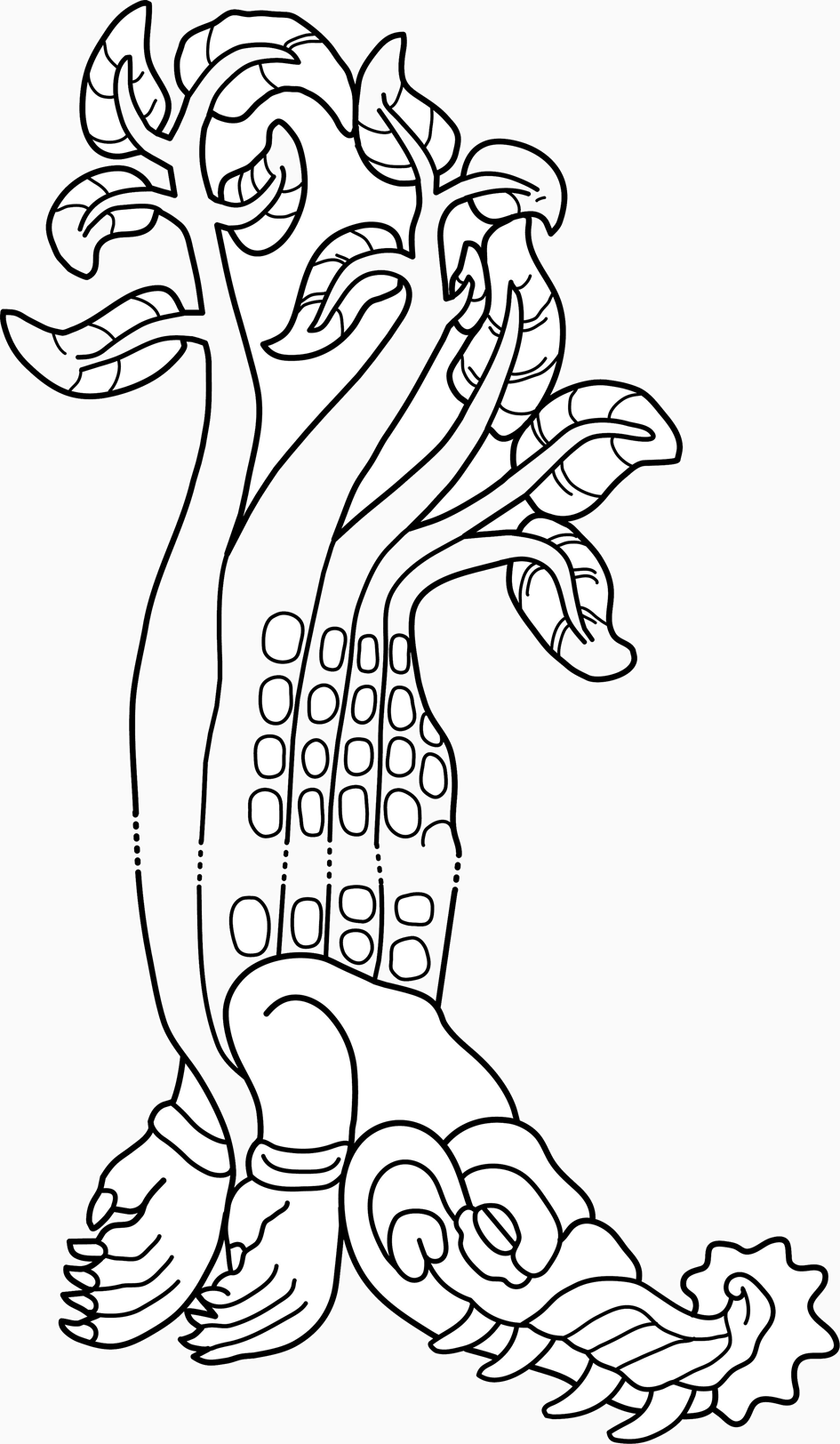
Crocodilians are associated with themes of creation, sacrifice, fertility and renewal, and also the sun (Acuña Reference Acuña, Golden, Houston and Skidmore2015:177, 182; García Barrios Reference García Barrios2015; Martin Reference Martin, Golden, Houston and Skidmore2015:192–196, 217, 222; Stuart Reference Stuart2005; Taube Reference Taube, Finamore and Houston2010:204–210; Vail and Hernández Reference Vail and Hernández2013). Variants of the reptilian “Cosmic Monster” often bridge certain binaries or complementary oppositions, such as celestial and terrestrial realms, with associated attributes and accoutrements. The two-part eye might reflect these dual domains, sky/sun and earthly/watery (Rice Reference Rice2018). Sometimes the beasts are paired (Martin Reference Martin, Golden, Houston and Skidmore2015: Figure 10), as with the terrestrial saurians Zipacna/Cipactli (maker of mountains) and Cabracan/Earthquake (destroyer of mountains) in Mexican myth and the Maya Popol Vuh (Christenson Reference Christenson2003; Tedlock Reference Tedlock1996). Crocodiles also may be associated with an axis mundi, cosmic center and order, and vegetation: a crocodilian world tree, positioned with its head and forelimbs in the ground and its upright body, the tree trunk, bearing branches and leaves (for example, on Izapa stelae; Figure 1). The Milky Way galaxy has been envisioned as this “crocodile tree” when stretching north-south, and as a Cosmic Monster when extended east-west on the winter solstice (Freidel et al. Reference Freidel, Schele and Parker1993:85–91).
“Crocodile tree” on Izapa Stela 25 (after stela drawing by Ayax Moreno).

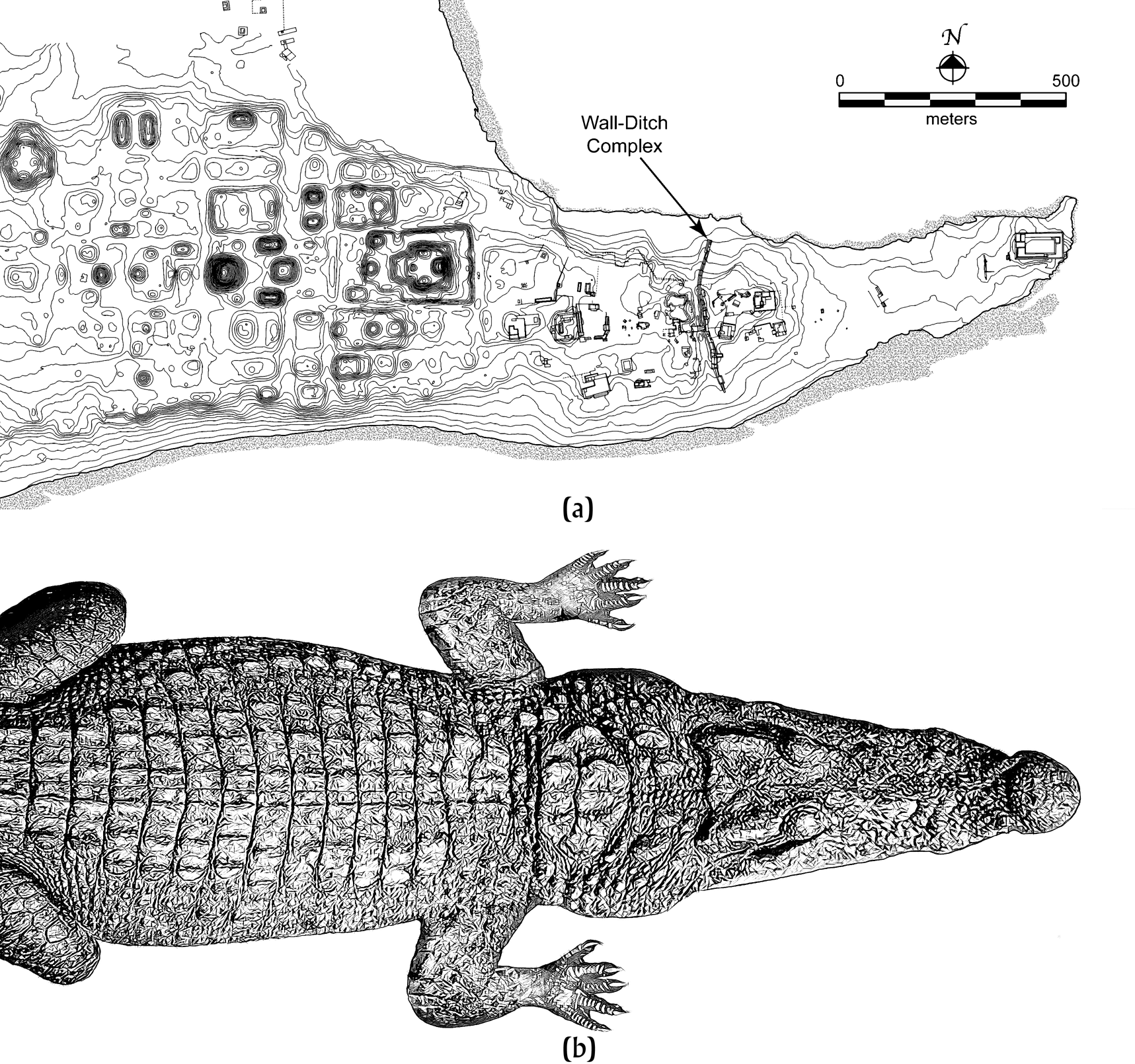
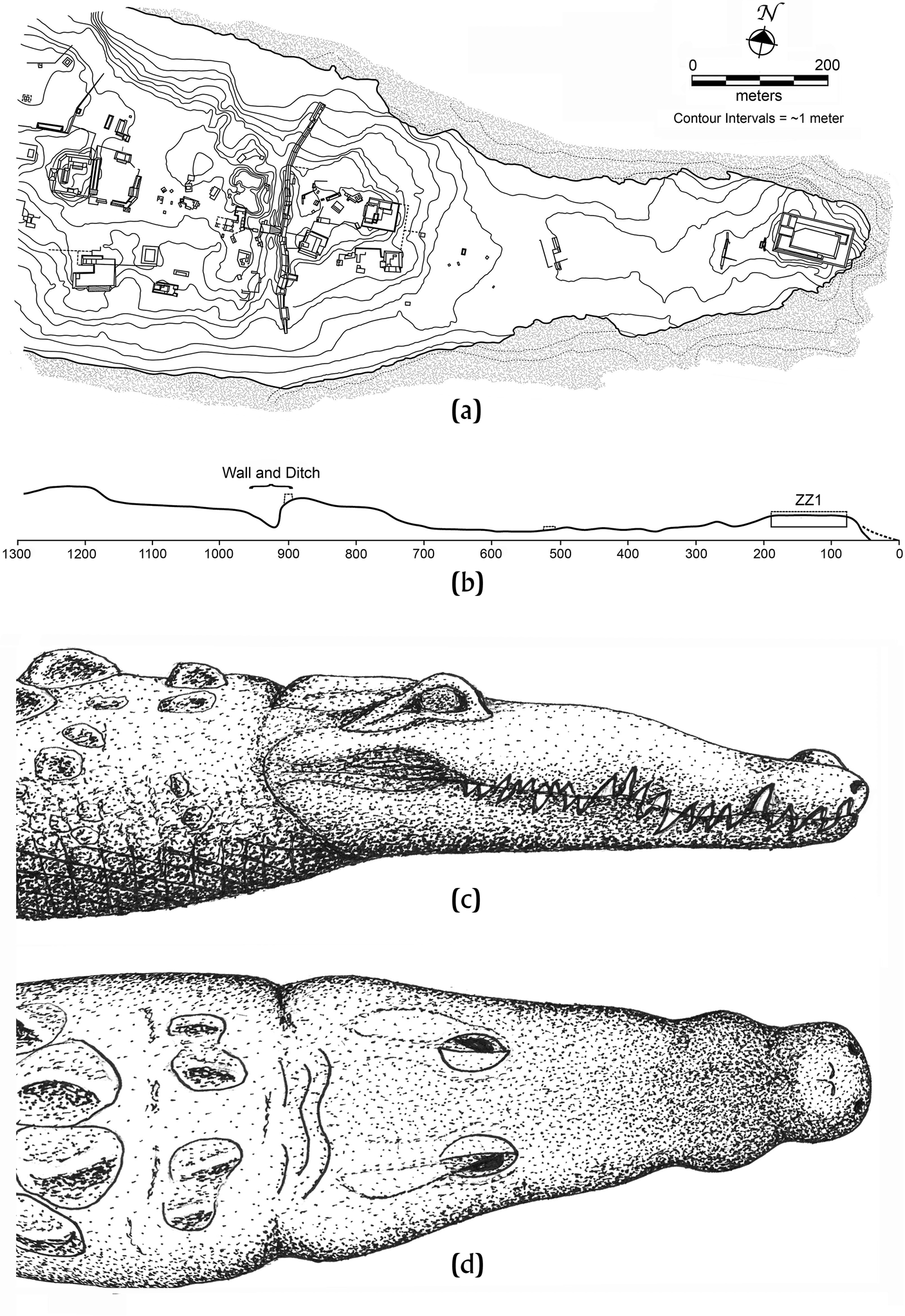
In the Peten lakes region, the urban grid of Nixtun-Ch'ich’ (Figure 2a) is proposed to reproduce the regular rectangular arrangement of raised scales or scutes on the dorsal surface of Crocodylus moreletii (Figure 2b; Rice Reference Rice2018; Wade Reference Wade2018). In particular, this Middle Preclassic layout can be compared with the mythical “hole-backed, starry deer-crocodile” mentioned in Classic texts at Palenque, whose decapitation brought about world creation (Stuart Reference Stuart2005:68–75). In the strong east-west orientation of the Nixtun-Ch'ich’ grid, the beast's body occupies the mainland with its head to the east. The “hole” in this monster's back is Fosa Y, a probable sinkhole located on the city's central axis urbis, immediately east of an E-Group. The lowest excavated deposits in Fosa Y yielded “Pre-Mamom” (Terminal Early Preclassic) and Middle Preclassic pottery (Rice et al. Reference Rice, Pugh and Chan2019; Rice and Pugh Reference Rice and Pugh2017:3–7). The Candelaria Peninsula, stretching into the waters of Lake Peten Itza (Figure 3a), constitutes the crocodile's head. The sacrificial cut severing the head is represented by the ditch of a wall-and-ditch defensive complex at the western edge of a large, elevated platform (Figures 3a and 3b). The topography of the peninsula mimics the profile of a crocodile's head (Figures 3b and 3c), with the platform and the defensive complex (the back of the head) and lower Preclassic levels of Mound ZZ1 on the tip of the peninsula (the lumpy snout). Excavations revealed that these constructions were initiated in or by the Middle Preclassic period (Rice Reference Rice2009). The Nixtun-Ch'ich’ creature is an early nocturnal aspect of the Classic Maya Cosmic Monster, both celestial and earthly, that carried the west-setting sun through its belly—the Underworld—during the night, to emerge in the east as a symbol of rebirth and renewal.
Gridded layout of Nixtun-Ch'ich', compared with a crocodile. (a) Map of the site (courtesy of Timothy W. Pugh). (b) A crocodile's dorsal surface, showing array of scutes. Drawing by Don Rice.

The Candelaria Peninsula compared with the head of a crocodile. (a) The peninsula and visible (late) structures, with 1-m contour intervals (after map by Marc Wolf). (b) Elevation of the peninsula along an east-west centerline. Note position of the wall-and-ditch complex. (c–d) Profile and dorsal surface of the head of Crocodylus moreletii (after Harrison Reference Harrison2008:Figure 10).

In Classic and later iconography, the mythical crocodile may display Venus/star symbols on the body, deer hooves and/or antlers, and an ak'b'al-like (“night, dark”) sign in the eye (Figure 4a). The Quadripartite Badge (Figure 4c) on its tail, a bowl marked with a k'in, “day,” sign holding sacrificial implements including a stingray spine, may be a metaphor for sacrifice, “the engine that drives the universe's natural cycles” (Stone and Zender Reference Stone and Zender2011:155, 183). Alternatively, it may mark the point of emergence of the swallowed sun from the creature's belly, to start a new day (Stuart Reference Stuart2005:167–168). On the unprovenienced Late Classic Vase of the Seven Gods, six supernaturals sit with God L (Lord One Death) in the Underworld in a building topped by a furred deer-crocodile as the “roof” of the Underworld (Figure 4b). The associated date is 4 Ajaw 8 Kumk'u, corresponding to the world creation that began in 3114 b.c. (and ended in a.d. 2012). A related aspect of this reptile is the terrestrial or Earth Monster Itzam Kab Ain/Ahiin (“Itzam/Iguana Earth Crocodile”; kab', “earth”), associated in Postclassic myth with sacrifice and dismemberment to create the earth's surface out of the primordial waters.
Crocodile and shark imagery. (a) Bicephalic starry deer-crocodile from Altar D', Copan. Note Quadripartite Badge atop rear head (after Schele and Miller (Reference Schele and Miller1986:45). (b) Deer-crocodile as “roof” of the Underworld. Detail of Vase of the Seven Gods (after Kerr No. 2796 [Kerr Reference Kerr2019]). (c) The “Quadripartite Badge” from an Early Classic black tripod (after Hellmuth Reference Hellmuth, Benson and Griffon1988:Figure 4.20). (d) Shark-head glyphs (after Stone and Zender Reference Stone and Zender2011:203, Figure 1a). (e) Early shark with crossed-bands from San Lorenzo Monument 58 (after Joyce et al. Reference Joyce, Edging, Lorenz, Gillespie and Fields1991:Figure 4a).

Classic and Postclassic images of this crocodilian are shown facing the viewer's left, a long-lived Maya convention for portraying protagonists that was followed by artists and scribes carving left-facing lords and portrait glyphs on stelae, altars, and lintels, and painting pottery and codices. At Nixtun-Ch'ich’ the right-/east-facing Middle Preclassic crocodile, constrained by the peninsular contours, emphasizes its connection with sunrise and antedates the Classic left-facing convention, which might be a later development. But it is also a consequence of modern Western mapping conventions, where north = top/up. And because the full modeled creature could not be perceived from ground level—perhaps it was seen only from high elevations north of the site, in which case the head would be to the left—this orientation of the sacred landscape was not likely to be an impediment to Maya veneration.
Sharks
The shark is another lowland water-dwelling creature that was, like the crocodile, a key protagonist in early origin myths. Preclassic peoples in the Isthmian region, as well as in western highland Mesoamerica, entertained myths centered on a large piscine/selachian creature. This fish zoomorph or “Olmec Dragon” is generally thought to portray a shark (xok/xook), a meaning found in the Vienna Dictionary of Yukatekan and also in Poqomchi', spoken in the Verapaces (Arnold Reference Arnold2005; Jones Reference Jones and Fields1985, Reference Jones and Fields1991:246–249; Joralemon Reference Joralemon and Nicholson1976, Reference Joralemon, Uriarte and González Lauck2008). In Yukatekan, xok (xoc) means “count, counting, reading” (Barrera Vásquez Reference Barrera Vásquez1991:948–949).
Two shark species are common in the waters around the Gulf Coast and Yucatán Peninsula: the nurse shark, Ginglymostoma cirratum, and the bull or cub shark, Carcharhinus leucas (Jones Reference Jones and Fields1991:248, 252). The latter may also inhabit fresh water, swimming well upstream in lowland coastal rivers and thus familiar to inland dwellers. Another possible candidate is the tropical gar or alligator gar (Atractosteus; Reilly Reference Reilly and Fields1991:160). These and other piscids were differentiated in later iconography by their snouts, but are typically shown with large crossed bands on their flanks (Figure 4e) and usually a crescentic eye (Joyce et al. Reference Joyce, Edging, Lorenz, Gillespie and Fields1991:Figures 4 and 5). Shark-head glyphs display a polythetic set of attributes, including: a bulbous or blunt snout, a prominent sharp tooth with up to four triangular maxillary teeth, a hook in the eye, one or more fins, and an oval infix at the top of the head indicating shininess or wetness (Figure 4d; Stone and Zender Reference Stone and Zender2011:203). Sharks are associated with bloodletting, principally through their serrated teeth, small numbers of which have been recovered at lowland and highland sites throughout Mesoamerican prehistory.
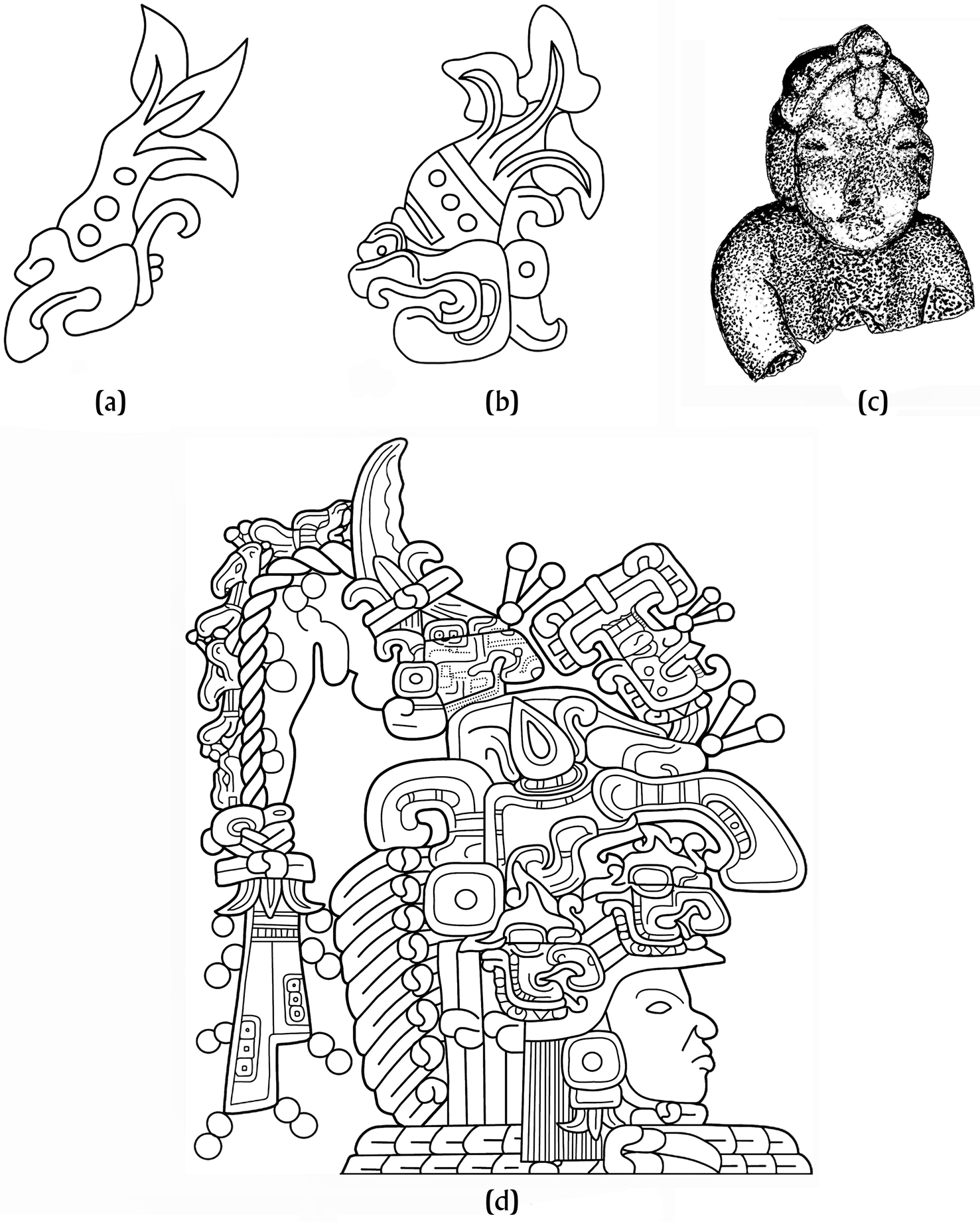
The presence of shark motifs in Early and Middle Preclassic iconography, especially in identity-defining headdresses (Figure 5; Arnold Reference Arnold2005; Jones Reference Jones and Fields1985, Reference Jones and Fields1991; Rice Reference Rice2007:93, 180–184), reveals that these fearsome creatures played a key role in “royal and mythic identity and … ancestral creation myths” (Martin Reference Martin and Sabloff2003:38, n3). An early figure in Maya iconography, especially seen in headbands, is known as the “Jester God” from his tripointed, jeweled cap. This character had anthropomorphic, avian, and piscine manifestations (Freidel Reference Freidel, Clancy and Harrison1990; Steinbach Reference Steinbach, Werness-Rude and Spencer2015), the last depicted with a “Xok adornment” (Miller and Taube Reference Miller and Taube1993:104–105; Stuart Reference Stuart, Golden, Houston and Skidmore2012:129, 131). One of his roles seems to have been in tying a new ruler's headband at accession and he might have been considered a “historicized ‘proto-ruler’” (Stuart Reference Stuart, Golden, Houston and Skidmore2012:128) or quasi-mythical ancestor figure. A Middle Preclassic anthropomorphic figurine from Nixtun-Ch'ich’ wears an ornate headband modeled in the clay and tied in the back, with a tiny, open-mouthed, fish-like (shark?) adornment on top of the head (Figure 5c; see also Rich et al. [Reference Rich, Freidel, Kent Reilly and Eppich2010] for an Olmec greenstone figure with a shark fin atop the head). Perhaps this head ornament designates the wearer as “one who counts.”
Fish/shark “monsters” in early headdresses. (a) Incised on a Dumbarton Oaks jade pectoral (after Schele and Miller Reference Schele and Miller1986:Plate 32a). (b) On Kaminaljuyu Stela 11 (after Schele and Miller Reference Schele and Miller1986:Plate 32a). (c) Fired-clay figurine #6 from Nixtun-Ch'ich' Mound ZZ1, with a fish or shark ornament atop the head. Height = 4.9 cm (Rice Reference Rice2019). (d) On La Mojarra Stela 1 (after Stross Reference Stross1994:Figure 1).

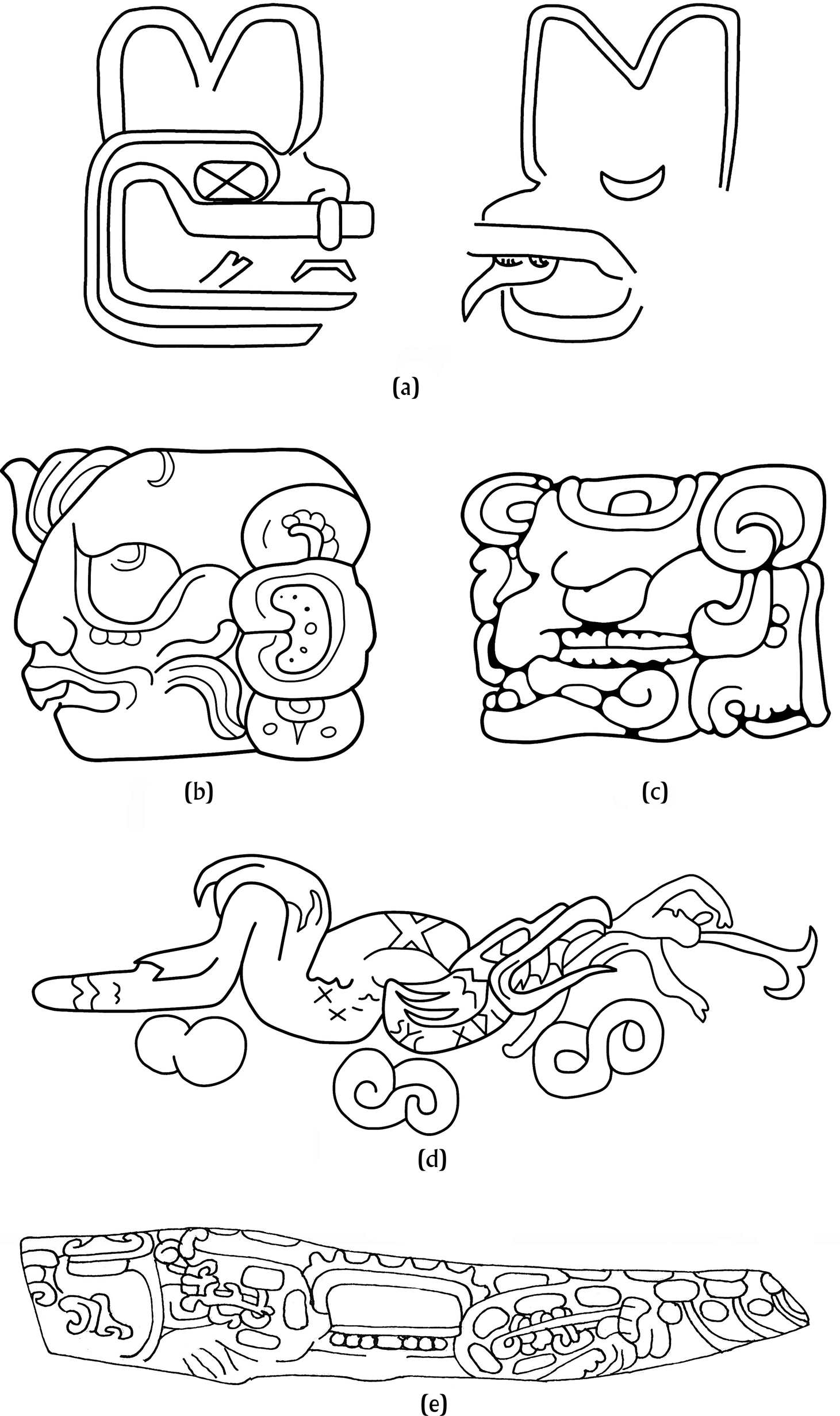
Scenes on Classic Maya polychrome vessels suggest mythic associations between sharks and the origins of rain, wind, and maize: speared sharks disgorge from their mouths the Wind and Maize Gods (Stone and Zender Reference Stone and Zender2011:202–203; see Finamore and Houston Reference Finamore and Houston2010:Plate 87). In the Palenque Triad, the center's patron God GI (God I; a form of the Maize God) has fish fins and a single shark-like tooth, reflecting his birth from a speared shark (Figure 6b). As mentioned, another appearance is in the headdress of the piscine version of the Maya Jester God.
Shark/fish and crocodilian zoomorphs. (a) Crocodile (left) and shark (right) on the knees of the Señor de Las Limas, Veracruz, sculpture (after Benson and de la Fuente Reference Benson and la Fuente1996:132). (b) God I (GI) of the Palenque Triad, showing fins and shark-like tooth (after Miller and Taube Reference Miller and Taube1993:129). (c) Shark headdress of the Old Stingray Paddler God on Quirigua Stela C (after Jones Reference Jones and Fields1991:Figure 7e). (d) Composite reptile/shark on Chalcatzingo Monument V (after Arnold Reference Arnold2005:Figure 8). (e) A composite crocodile-shark creature on Kaminaljuyu Sculpture 2. Length = 2.66 m. Redrawn and reversed from sketch by Henderson in Inomata and Henderson (Reference Inomata and Henderson2017:Figure 6b).

Pairing and Conflation
It is probably not coincidental that two lowland animals, sharks and crocodiles, lay at the heart of Mesoamerican creation myths and early symbol systems. In the well-known iconography of Isthmian/Olmec art and pottery, fish motifs include crossed bands, serrated-outlined ovals, crescent eyes, and a central tooth. Crocodile motifs, long misinterpreted as “were-jaguars” and “fire-serpents,” can now be correctly considered reptilian, with the maize sprouting from the V-shaped cleft in the head emphasizing the crocodile's association with fertility (Stocker et al. Reference Stocker, Meltzoff and Armsey1980:752). Similarly, as Stocker and colleagues (Reference Stocker, Meltzoff and Armsey1980:743) pointed out forty years ago, the “flame eyebrow” motif symbolizes the supraorbital crest of crocodilians and the “hand-paw-wing” is neither a jaguar's paw nor a bird's wing, but rather the foot of a crocodilian (Flannery and Marcus Reference Flannery and Marcus2000:Figure 10b caption). Some of these icons, along with others uniquely Maya, were present on pottery of the Terminal Early Preclassic Cunil complex (1100–900 b.c.) in eastern Peten and Belize (Garber and Awe Reference Garber and Awe2009; Sullivan and Awe Reference Sullivan, Awe and Aimers2013). They are largely absent in early pottery at Nixtun-Ch'ich’, which, from excavations to date, seems to emphasize more generalized aquatic creatures, including birds (Rice and Pugh Reference Rice and Pugh2017:Figure 7).
Fish/shark motifs sometimes occurred in complementary distributions with crocodilian symbols, especially incised or painted on varied pottery vessel forms (Flannery and Marcus Reference Flannery and Marcus1994:136–137; Joyce et al. Reference Joyce, Edging, Lorenz, Gillespie and Fields1991:146–148). As Reilly (Reference Reilly and Fields1991) explains, these two creatures can be considered paired oppositions, particularly evident in incising on the small serpentine statuette from the Pacific coast of a personage known as the Young Lord or “Slim.” His right thigh shows a fish/shark/gar zoomorph and the left thigh displays a crocodilian. The same pairing, but on reversed sides, is shown in the incised masked heads on the knees of the “Señor de Las Limas” sculpture from Veracruz (Figure 6a). Another pairing is seen in the Classic Paddler Gods: a shark/xok appears in some versions of a headdress of the Old Stingray Paddler (Figure 6c), who represents sun/day and is paired with the Jaguar Paddler representing night (Jaguar Night Sun).
Sharks and crocodiles had different symbolic senses and meanings with respect to human sacrifice. Sharks plus another selachian, the stingray, and yet another liminal creature, the turtle (Taube Reference Taube, Finamore and Houston2010:210, 212; see de Borhegyi Reference de Borhegyi1961; Finamore and Houston Reference Finamore and Houston2010)—are associated with sacrifice by bloodletting. Crocodiles are related to sacrifice by decapitation and both are associated with mandible removal. Both beasts are liminal: sharks, especially bull sharks, are creatures of the mighty sea, but travel inland on rivers; crocodiles are denizens of both still waters and land. Both are renowned for their formidable toothy maws, symbolic passages to mythic watery places, the sea, and the Underworld.
The difficulty in identifying animals in Mesoamerican iconography is caused by conflation: scribes’ and artists’ penchant for combining attributes of creatures that are today seen as biologically distinct, such as snakes, reptiles, fish, felines, and birds (Martin Reference Martin, Golden, Houston and Skidmore2015:192–196; Stone and Zender Reference Stone and Zender2011:182–183). At Early Formative Chalcatzingo (Morelos, Mexico), Monument 5 depicts a composite reptile-shark with crossed bands on the back and an open toothy mouth (Figure 6d; Angulo V. Reference Angulo V. and Grove1987:147–148). A similar creature appears on an unprovenienced Late Classic Maya polychrome vase (Finamore and Houston Reference Finamore and Houston2010:Plate 80). The supposed crocodile of Kaminaljuyu Sculpture 2 (Figure 6e; Inomata and Henderson Reference Inomata and Henderson2016:Figure 6b), with the distinctive curving eye ridge, also closely resembles a shark/fish, with its blunt snout and carved, serrated ovals on its flanks. Some heads or faces of Preclassic creatures identified as sharks or fishes display in one eye the crocodilian eye's crossed bands (Joyce et al. Reference Joyce, Edging, Lorenz, Gillespie and Fields1991:Figures 5c and 5d). The starry deer-crocodile itself is a stunning example of conflation, appearing in Classic polychrome pottery and in Postclassic codices (Taube Reference Taube, Finamore and Houston2010:Figures 3, 5, 6).
Conflation is also evident at Copan, Honduras, where the Early Classic “Papagayo” structure underlying temple Structure 10L-26 features a large, stuccoed, profile floating crocodile (Fash Reference Fash1991:84, Figure 40), its body decorated with possible feathers or fins. Temple 11 (Structure 10L-11) was also decorated with a carving of the Celestial Monster. Altar T, in the Copan village outside center city, depicts a splayed reptile with a toothy maxilla, crossed bands in the eye, and a fish-like bifurcated tail; such tails are also seen on crocodile figurines (Finamore and Houston Reference Finamore and Houston2010:Plates 72, 96). Other Copan monuments display crocodilians without the fishy attributes. Altar D', in the western Court of the Hieroglyphic Stairway, presents the bicephalic starry deer-crocodile with toothy jaws and crossed bands in the eye. Stela C shows ruler Waxaklajuun Ubaah K'awiil wearing an elaborate loincloth stylized as a crocodile head (Fash Reference Fash1991:Figure 68), recalling loincloths portraying a world tree and a crocodilian Maize God as axis mundi and symbol of fertility (Stocker et al. Reference Stocker, Meltzoff and Armsey1980:744–745; Taube Reference Taube2005:25, 27). These depictions, plus other watery imagery, suggest that this area of Copan represents, in part, a creation landscape with ties to both the Underworld and the celestial sphere. Given Copan's location, the creature represented could be C. moreletii, C. acutus, or a caiman.
Crocodiles and Sharks in Broader Context
Crocodiles, Sharks, and Tikal
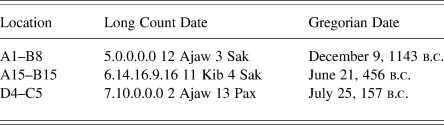
The well-known site of Tikal lies 45 km (straight-line distance) northeast of Nixtun-Ch'ich’ and 27 km north-northeast of the eastern tip of Lake Peten Itza. Although Tikal's Classic history and rulers have been well chronicled (Coe Reference Coe1990; Harrison Reference Harrison1999; Martin and Grube Reference Martin and Grube2008; Montgomery Reference Montgomery2001; Sabloff Reference Sabloff2003), the city's dynastic beginnings remain murky. The long text on the back of the roof-comb of Temple VI (Temple of the Inscriptions) bears retrospective Preclassic dates (Table 1), but with little other narrative preserved (Beliaev et al. Reference Beliaev, de León Antillón, Galeev and Vepretskii2016; Martin Reference Martin, Golden, Houston and Skidmore2015:2). Two correspond to period endings, but the 456 b.c. date seems to register a specific event. These dates may have been “invented” in the Late Classic to boast of the city's long dynastic history (Beliaev et al. Reference Beliaev, de León Antillón, Galeev and Vepretskii2016:35).
Preclassic dates from Panel W of the Temple of the Inscriptions, Tikal (from Beliaev et al. Reference Beliaev, de León Antillón, Galeev and Vepretskii2016:Table 1).

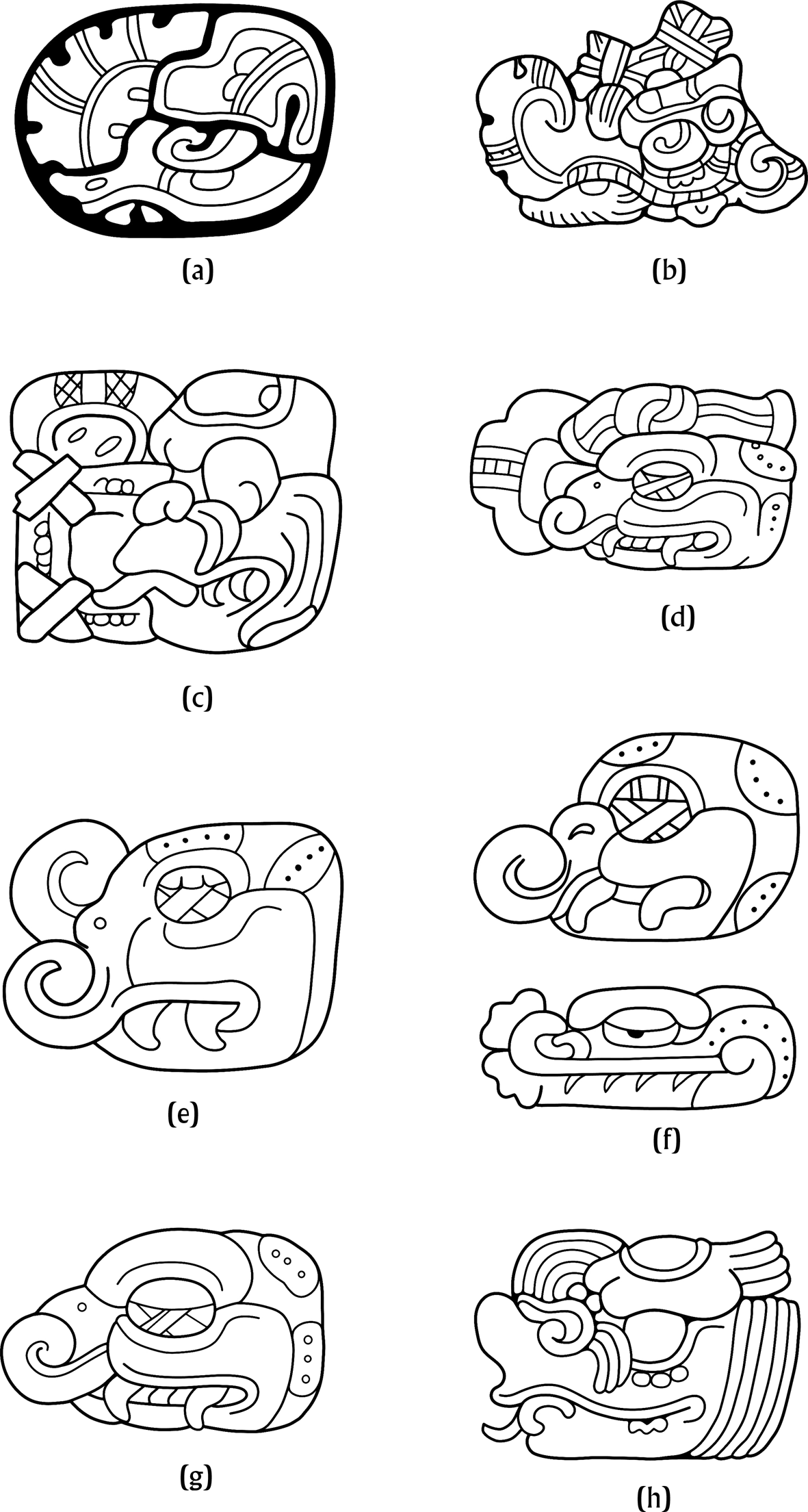
Tikal's epigraphic record suggests an important role of sharks and crocodiles in its early history. The individual claimed to be the founder of Tikal's ruling dynasty, perhaps around a.d. 100, is identified as Yax Ehb/Ehb' Xook, “First/Blue-Green Step Shark” (Figures 7a–7c). His tomb is thought to have been Burial 85, deep under the North Acropolis, where the bundled corpse of a “relatively tall robust male” wrapped in red-painted cloth was positioned (Coe Reference Coe1990:vol. II, pp. 217–220). He had been dismembered—decapitated and both femurs removed (perhaps they had reliquary power?)—before interment. The tomb was richly furnished with 23 pottery vessels, including six imports possibly from Kaminaljuyu (Culbert Reference Culbert1993:Figures 5c–5e, 6a), a cylindrical jade bead, part of a serpentine mask, a stingray spine, a wooden bowl, and shell fragments (Spondylus and Pomaceae). This ruler's name appears on unprovenienced pottery vessels and as retrospective mentions in the difficult text on Tikal Stela 31, dating to the early to mid-fifth century.
Crocodile and shark glyphs. Note similarities and differences in eyes and dentition. (a–c) Glyphs naming Tikal ruler Yax Ehb Xook (after Martin Reference Martin and Sabloff2003:Figure 1.1). (d) Yax Nuun Ayiin I nominal (after Martin and Grube Reference Martin and Grube2008:32). (e–h) Crocodile glyphs: (e) T0844 (Thompson Reference Thompson1962:393), (f) AL6 (Macri and Looper Reference Macri and Looper2003:64), (g) T1012 (Thompson Reference Thompson1962:457), and (h) (Stone and Zender Reference Stone and Zender2011:183).

Tikal's Early Classic ruler nicknamed “Curl Snout,” now identified as Yax Nuun Ayiin I (Figure 7d; “First/Blue-Green Knot Crocodile”), presided over Tikal from a.d. 379 to about 404 (Martin and Grube Reference Martin and Grube2008:32). The Classic crocodile-head glyph (Figures 7e–7g; T0844, AL6; Macri and Looper Reference Macri and Looper2003:64) was initially identified by Thompson (Reference Thompson1962:393) with six examples, all from Stela 31. In the ruler's nominals, the main sign is a crocodile head that features the eponymous curled snout, maxillary teeth, dotted patches on the head, two-part eye, and curving—sometimes tripartite—supraorbital ridge (compare Figures 2b, 3c, 3d, 4a, 6e, and 8b). Here and in other appearances, the crocodile's snout may be adorned with crenellations, interpreted as “yax” prefix meaning “green” or “first” (compare Figures 1 and 7; Mora-Marín Reference Mora-Marín2018:100–101) or as a conch shell, a breath symbol (Taube Reference Taube2005:25, Reference Taube, Finamore and Houston2010:210).
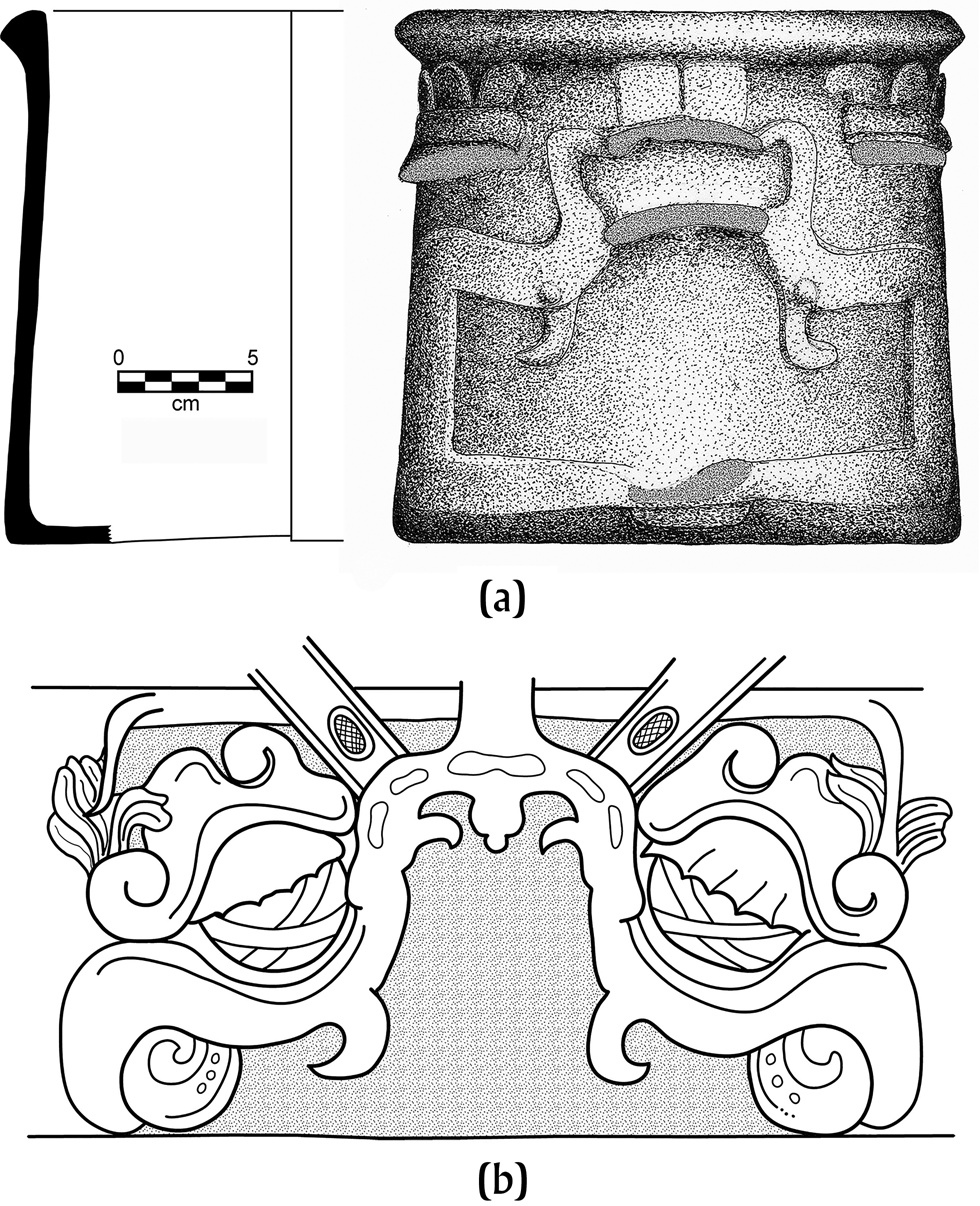
Crocodile images. (a) Late Preclassic, partially reconstructed, appliqued censer cached in the northeast corner of Nixtun-Ch'ich' Sector Y compared with (b) the mouth of a Late Classic “Cosmic Crocodile” from the roof facade of the Temple of the Cross, Palenque (after Taube Reference Taube, Finamore and Houston2010:207).

Yax Nuun Ayiin I was thought to be the son of a supposedly foreign-born (central Mexican) intruder in the Tikal domain, initially given the moniker Spearthrower Owl (Martin and Grube Reference Martin and Grube2008:33). His interment is believed to be Burial 10 under Structure 5D-34 in the North Acropolis (Coe Reference Coe1990:vol. II, pp. 479–487; Harrison Reference Harrison2008:112). His body was laid on a wooden bier, accompanied by nine sacrificed individuals and abundant grave goods, including 31 pottery vessels: a polychrome basal flange bowl depicts a headless crocodile (Coggins Reference Coggins1975:149; Culbert Reference Culbert1993:Figure 18a) and a cylinder tripod with three painted stucco panels shows a shark (or a serpent; Coggins Reference Coggins1975:166; Culbert Reference Culbert1993:Figure19b). Other goods include jade and shell jewelry (ear flares and a spangled headdress), figurines, spiny oyster shells, a Spondylus valve, replicas of stingray spines, obsidian eccentrics, and a pyrite mirror. Of particular interest, given the ruler's name, are a carved jade crocodile head and a crocodile skeleton (probably C. moreletii; Harrison Reference Harrison2008:112). A mosaic mask of a crocodile on the facade of Structure 5D-58 in Tikal's Central Acropolis might have distinguished Yax Nuun Ayiin I's residence (Harrison Reference Harrison2008:114, Figure 9). Strontium isotope analyses of Yax Nuun Ayiin I's teeth reveals that he spent his childhood not at Teotihuacan but in central Peten (Wright Reference Wright2005).
Crocodiles in Other Sites and Times
Crocodile imagery appears at other sites besides Tikal and Copan in the late Middle and early Late Preclassic periods in the southern Maya lowlands. For example, at Nakbe in the Mirador Basin, an altar has a “celestial band with alligator-like creatures” carved around the edge (Hansen Reference Hansen and Grube2001:Figure 73) and at Cahal Pech in the Belize Valley, Stela 9 shows a male—a possible Late Preclassic king—standing in the maw of a crocodilian “earth monster” (Brown et al. Reference Brown, Awe, Garber, Kathryn Brown and Bey2018; Awe et al. Reference Awe, Grube and Cheetham2009). Also in Belize, the facade of Cerros Structure 6B was decorated with a red, yellow, green, and black polychrome-painted modeled crocodile head (Freidel Reference Freidel and Boone1985:13, Plate 1).
In the Gulf coast region, a Classic-period fired-clay brick from Temple 1 at Comalcalco featured a modeled crocodile (Finamore and Houston Reference Finamore and Houston2010:Plate 73). Crocodiles were also of interest at the site of El Tigre (Itzamkanac in contact-period times) in southern Campeche (Vargas Pacheco Reference Vargas Pacheco2001a, Reference Vargas Pacheco2001b; Vargas Pacheco and Arias Ortiz Reference Vargas Pacheco, Ortiz, Laporte, Arroyo and Mejía2005). There, on the substructure of Structure 1 on the south side of the Main Plaza, is a large (4 × 7 m) Preclassic stone and stucco mask of the sort more typically found in Late Preclassic Peten. The central creature in this mask is thought to be a mythical composite, a “crocodile-iguana-feline,” missing its mandible and snout, but with double eyelids (Vargas Pacheco Reference Vargas Pacheco2001b). As with the Peten structure masks, this creature has large quincunx ear flares topped with knots. It is proposed to be a representation of the Maya deity Itzam Na (Itzamnaaj), with the site his home (Vargas Pacheco and Arias Ortiz Reference Vargas Pacheco, Ortiz, Laporte, Arroyo and Mejía2005). Such facade masks may be intended to portray the structure as the mythological crocodile rising out of the primordium.
The El Tigre crocodile is considered to be a symbol of fertility, particularly because of its association with rains and water. The former might originate in the reptile's bellowing calls during the mating season, just before the beginning of the annual rainy season deluges. The links to water are more complex and relate to more than just the crocodile's habitat. In the northern lowlands today, largely lacking surface waters, crocodiles are placed in ponds in the belief that they will prevent the water from drying up or prevent closure by siltation, or both, by digging in the bottom to locate sources of water (Rice Reference Rice2018:n3; Vargas Pacheco and Arias Ortiz Reference Vargas Pacheco, Ortiz, Laporte, Arroyo and Mejía2005:17). In both associations, what is important is not simply fecundity but the broader concept of renewal.
At Late Classic Palenque, a crocodile was carved in the corbeled roofing of the Piedras Bolas aqueduct under the Main Plaza (French et al. Reference French, Stuart, Morales, Lucero and Fash2006). It might relate to a similar concept of the reptile preventing the aqueduct from silting up, and its annual renewal with the rains. The face of a massive aquatic Cosmic Crocodile also appears on the roof facade of the Temple of the Cross, which reproduces a mythic “six-sky” creation locale (Taube Reference Taube, Finamore and Houston2010:206). This image resembles the damaged face on the side of a cached Late Preclassic censer from Nixtun-Ch'ich’ (Figure 8; c.f., a shark face on Laguna de los Cerros Monument 1 [Joyce et al. Reference Joyce, Edging, Lorenz, Gillespie and Fields1991:Figure 5c]).
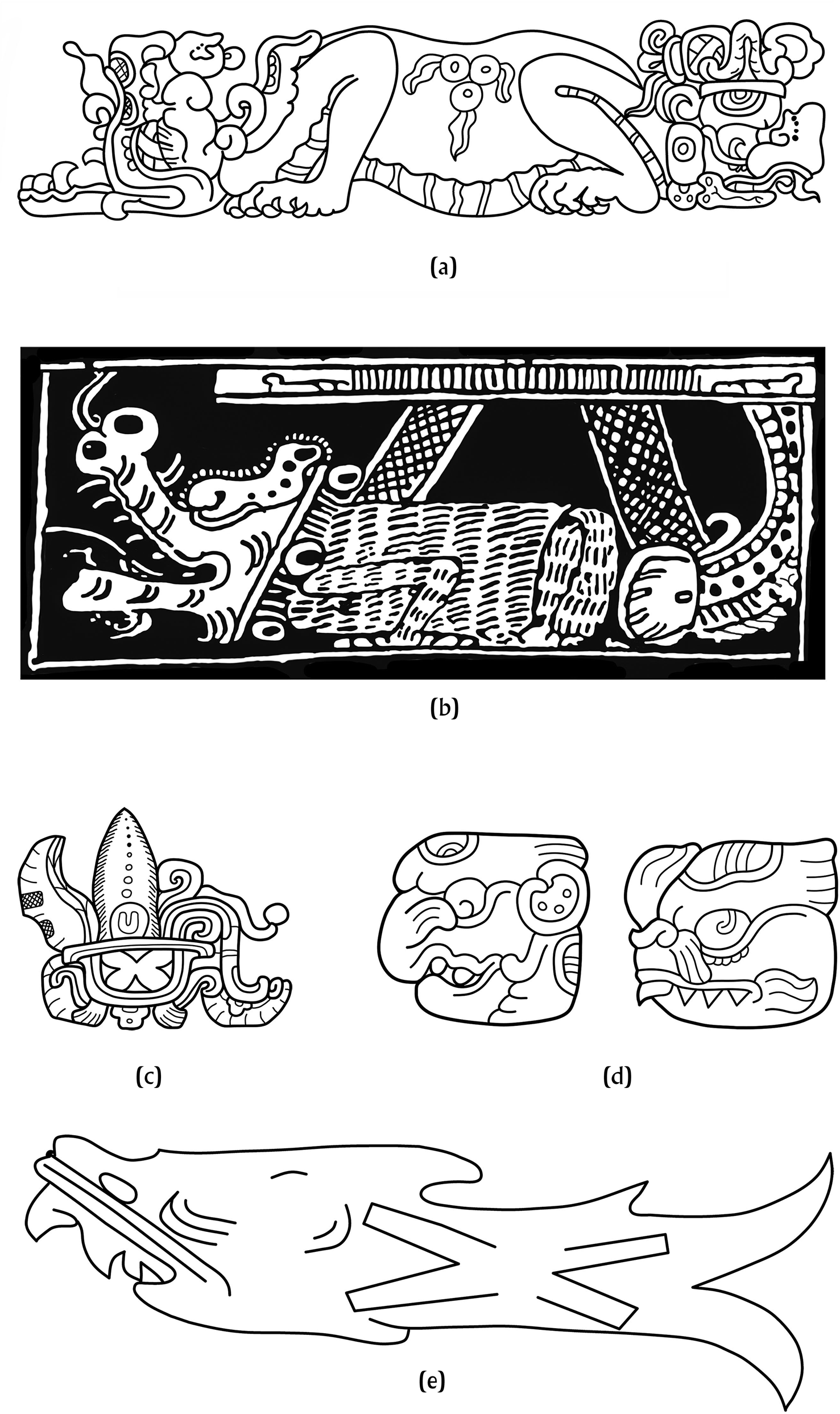
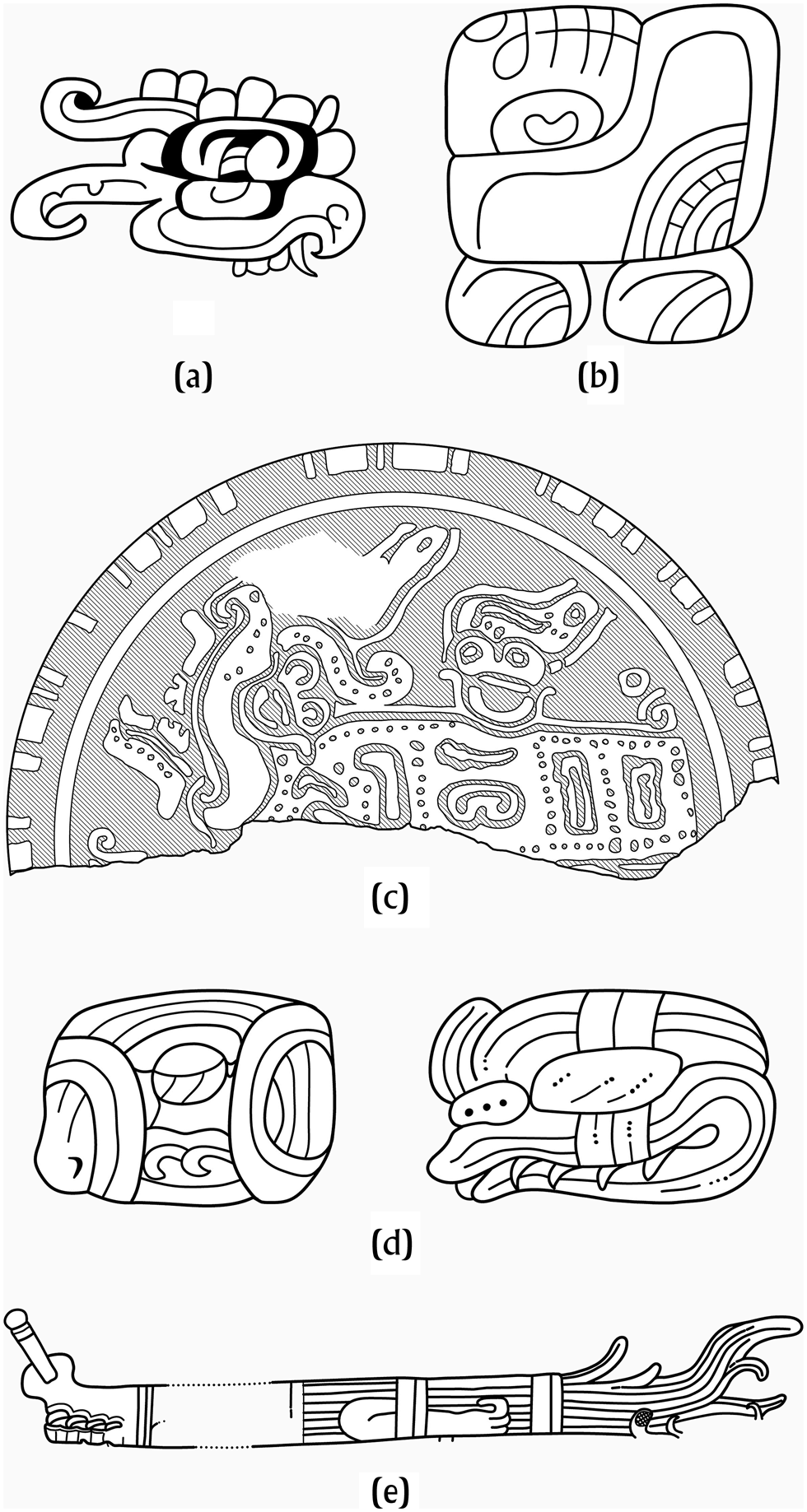
The sacrifice of a crocodilian beast deep in the primordium brought about not only the creation of the earth's surface but also the beginning of time: the 13 days of the 260-day sacred almanac, their signs said to drip with the blood of the sacrifice (Martin Reference Martin, Golden, Houston and Skidmore2015:222, n66). In Nahuatl, the first day name is Cipactli, which refers to a crocodilian (Edmonson Reference Edmonson1988:Figure 15b; Rodríguez Galicia and Valadez Azúa Reference Rodríguez Galicia, Azúa, Götz and Emery2013:66) although it may also reference a fish or shark (Arnold Reference Arnold2005:14). Among the lowland Classic Maya, the first day is Imix (“waterlily”) or a variant, the characteristic vegetation of crocodiles’ freshwater habitats; in Tojolab'al (Chiapas) the day name is Ain, “crocodile” (Edmonson Reference Edmonson1988:Figure 15b). The main sign of the day name glyph may be a logogram for ha', “water” (Doyle Reference Doyle2012:30). An Early Classic Imix allograph from Mundo Perdido at Tikal (Figure 9a), however, resembles the fish- and shark-head glyphs described above, with a downturned snout, a mirror-element on the head, an eye with a pendant curl, and four maxillary teeth. Allographs from Piedras Negras and Palenque in the western lowlands show the Imix sign above a reptilian head (Doyle Reference Doyle2012:130).
Miscellaneous signs and images. (a) Crocodilian Imix day sign from an Early Classic polychrome lidded vase with tetrapod rattle supports, from Mundo Perdido, Tikal (after Doyle Reference Doyle2012:Figure 2). (b) Glyphic sign for the chi-altar place from Tikal Stela 31 (after Stuart Reference Stuart, Bell, Canuto and Sharer2004:Figure 11.2). (c) Chompoxte Red-on-cream tripod plate from offering 38, chultun 5, Cante Island (Lake Yaxha), showing a cosmic monster (after Hermes Reference Hermes and Wurster2000:Figure 151-13). (d) Crocodile allographs of MUT as main sign of Emblem Glyphs. Left, Lintel 3, Temple 4, Tikal; right, Hieroglyphic Stairway 2, Dos Pilas (after Tokovinine Reference Tokovinine2008a:Figure 3b). (e) Bound crocodile atop skyband throne, detail from Naranjo Stela 32 (after Tokovinine Reference Tokovinine2008a:Figure 4b).

Apart from imagery, physical remains of crocodiles have been relatively little discussed in lowland Maya faunal studies (Rice Reference Rice2018:Table 2; Thurston Reference Thurston2011:58–96). Crocodiles would have been an important source of protein in lowland areas, and Stocker and colleagues (Reference Stocker, Meltzoff and Armsey1980:746–747) even suggested the Olmecs might have farmed them in their ponds. In Preclassic northern Belize, however, crocodiles were largely “ignored as a food source” (Masson Reference Masson and Emery2004:110), perhaps because of their role in mythic origins. Nevertheless, their skins, teeth, mandibles, and other body parts might have been valued items for caching or ceremonial regalia. A drilled and polished left crocodile mandible was recovered at Altar de Sacrificios (Pohl Reference Pohl, Leventhal and Kolata1983:81) and at Cahal Pech in west-central Belize, a mandible was recovered in a Cunil-phase cache (Garber and Awe Reference Garber and Awe2009:Figure 7d; Zweig Reference Zweig2010:100–101). Outside of the Maya lowlands, at a compound at Classic Teotihuacan, investigators recovered 30 crocodilian osteoderms, bony plates underlying the raised scutes. These were thought to be from a crocodile hide imported from Veracruz and tanned at the site to make elite garments and regalia (Rodríguez Galicia and Valadez Azúa Reference Rodríguez Galicia, Azúa, Götz and Emery2013:60–61, 65–66). Farther west in coastal Colima, sometime between 200 b.c. and a.d. 400, a male youth was buried in a funerary mound with a necklace or amulet of 32 crocodile teeth, probably from C. acutus (Carballal Staedtler and Moguel Cos Reference Carballal Staedtler and Moguel Cos2017).
The Postclassic Period
In the Postclassic period, the spearing of sharks and the pairing of fish and crocodiles is illustrated in the “Fisherman Mural” in Mayapan's Structure Q-95, which may commemorate a central Mexican myth (Peraza Lope and Masson Reference Peraza Lope, Masson, Masson and Lope2014:95–97). The mural depicts a bound crocodile and three speared fishes (sharks?), along with a human fisherman, possibly Quetzalcoatl/Kukulcan. Crocodiles are associated with the turning/renewal of 20-year k'atun periods in a mural of Structure 1 at Santa Rita (Vail and Hernández Reference Vail and Hernández2013:177, Figure 5.9) and especially on the k'atun pages of the Paris Codex (Love Reference Love1994:17, Figure 3.10), which may be a copy of a Late or Terminal Classic manuscript (Vail Reference Vail2006:504). The pages depict the accession or installation of new k'atun lords or priests at the beginning of the period, each seated atop an elevated throne with a bound “feathered alligator”—likely an effigy— draped over a skyband or stack of skybands. Because these crocodiles lie atop the skyband(s), they represent the celestial, rather than the earthly, aspect of the Cosmic Monster. Similar thrones (e.g., Piedras Negras Stela 11, a.d. 731; Naranjo Stela 32, a.d. 820) appear in Classic imagery, often in accession scenes (Figure 9e). These reflect a “widely shared mythical narrative that was re-created in every accession ritual” from Late Preclassic through Postclassic times (Tokovinine Reference Tokovinine2008a:6) in which the ruler presides over a new political and cosmic order (García Barrios Reference García Barrios2015).
The starry deer-crocodile, with or without a hole in the back, appears in the codices and Books of Chilam Balam, where the creature is easier to interpret with textual aid. The Chumayel relates the creation story centered on Itzam Kab Ayiin—the Postclassic version of the creator deity Itzamnaaj (Vail and Hernández Reference Vail and Hernández2013:48–53, 77). His role may be larger, as an Itzam/Pawah Ayiin, a crocodilian earth aspect of the quadripartite Pawahtuns who play multiple roles involving rain, wind, and supporting the sky (Vail and Hernández Reference Vail and Hernández2013:76–78, 81, 96, n47, n53). Many small modeled pottery vessels deposited in caches show human heads, possibly royal ancestors, emerging from the mouths of crocodilians that often display deer or fish attributes. This may relate to an early myth of rebirth from the Underworld, as illustrated on a fifth-century incised black-ware cylinder tripod (Hellmuth Reference Hellmuth, Benson and Griffon1988:171).
Postclassic archaeology and ethnohistorical studies in the central Peten lakes region have revealed nothing comparable to the architectural murals and texts found in the north, although Postclassic slipped pottery features painted and incised saurian-serpentine motifs. The bulbous effigy supports of Augustine Red tripod dishes, characterized by ring-eyes and a curled snout, appear to represent crocodilian heads and I recently realized that a broken red-on-cream painted plate from Cante Island in Lake Yaxha portrayed a gaping-jawed Cosmic Monster (Figure 9c). Some characteristics of this last suggest the nocturnal, starry deer-crocodile, particularly what I have called the “supernatural eye”—a glyph-like Venus/star motif—on its back. Deer feet and ears are missing and the snout is partially obliterated, but it may be emanating mist and clouds. Dots inside the body outlines could indicate the rough texture of its skin or suggest that it is a watery, earthly creature.
By the Late Postclassic period, the Itzas reimagined the western Lake Peten Itza basin and perhaps the site of Nixtun-Ch'ich’ more specifically as a chak'an putun (Rice and Rice Reference Rice, Rice, Rice and Rice2018:378). A chak'an putun was a late lowland Maya equivalent of a tollan (or puh), a mythohistoric Mesoamerican paradigmatic city and venerable place of dynastic beginnings. In particular, it was “the heart of the forest, Tan Xuluk Mul” in the Chilam Balam of Chumayel (Edmonson Reference Edmonson1986). The area acquired that political gravitas through its ancient sacred crocodilian landscape as a place of renewal of political and other (temporal) cycles.
FURTHER CONSIDERATIONS: SOME SPECULATIONS
Nixtun-Ch'ich’ is a large and unusual site that was unknown until its “discovery” in the mid-1990s. It is worth considering if and how it might fit into existing narratives and unknowns about southern lowland interactions, especially in the Preclassic period, and encourage us to think about things in novel ways: to ask, “But what if…?” The following sections present some informed speculations (designated with numbers in the Tikal and Nixtun-Ch'ich’, The “Chi” Place and Foliated Ajaw, Foliated Ajaw, and Environmental and Cultural Disruptions sections)—not necessarily intended as testable hypotheses—about the city's possible role. Some of the textual and iconographic references could be dismissed as trivial because of their rarity and their implications are unprovable or unfalsifiable. Nonetheless, they merit some attention.
Tikal and Nixtun-Ch'ich’
Connections between Tikal and crocodilians can be seen in rare “animate” allographs of the main sign of the city's emblem glyph. The precise meaning or meanings of emblem glyphs are disputed. They may refer to royal titles, toponyms, places of origin, or homelands of political dynasties; where dual emblems exist, one might refer to places or agents in mythic deep time (Helmke Reference Helmke2012; Helmke and Kupprat Reference Helmke and Kupprat2017). Tikal's poorly known animate emblem resembles a “bundled feathered” crocodile or crocodile head (Figure 9d; Montgomery Reference Montgomery2001:Figure 9; Tokovinine Reference Tokovinine2008a:5–6, Figure 3b). Whereas this might indicate “the ancient name of Tikal” and link the city to a creation myth, Tikal claiming itself to be “the place of this tied alligator [sic] (or the place where it abounds)” (Tokovinine Reference Tokovinine2008a:6) is a dubious bit of grandiosity given its non-watery landscape.
Nonetheless, the prominence of crocodiles the early iconography and self-identification of Tikal underscores the importance of this mythic creature and prompts some speculations about possible connections with Nixtun-Ch'ich’ and its crocodilian sacred landscape, 45 km to the southwest. In the late first century a.d. Yax Ehb Xook (?), “First Step Shark (?),” founded the ruling dynasty of Tikal. The main sign in the founder's name resembles a profiled shark head, but it does so only minimally (Martin Reference Martin and Sabloff2003:5) and lacks the diagnostic prominent front tooth (Figures 4a–4c). (1) Perhaps instead the xoc main sign is, or was conflated with, a crocodile, as we have seen elsewhere (i.e., as a “Yax Ehb Ayiin” nominal. Compare Figures 7a–7c [shark/xoc] with Figures 7d–7h and 9a [crocodile]). (2) Tikal's early crocodile-head emblem glyph might indirectly reference Nixtun-Ch'ich’ (emblem glyph unknown) as a deep-time mythical place of origin or dynastic homeland.
(3) Sometime around the Terminal Preclassic (ca. a.d. 150–250), Tikal may have co-opted or appropriated the crocodilian mythic creation landscape of Nixtun-Ch'ich’, laying claims to that city's cosmic powers in the foundation of its own (and other sites’) dynasties. Little Early Classic pottery has been recovered in our and others’ surveys and excavations around the western Peten lake basins. We are unable to explain this absence satisfactorily but it correlates with evidence of severe environmental and cultural disruptions. (4) Perhaps the latter also included some strains between Tikal and Nixtun-Ch'ich’, possibly exacerbated by the early presence of central Mexicans at the former site, evidenced architecturally a century earlier than the famous a.d. 378 “entrada” (Laporte Reference Laporte and Braswell2003:200–201; Stuart Reference Stuart, Carrasco, Jones and Sessions2000). (5) It is not inconceivable that the subsequent Tikal ruler Yax Nuun Ayiin I, “Blue-Green Knot Crocodile,” who grew up somewhere in central Peten, could have been from Nixtun-Ch'ich’.
The “Chi” Place and Foliated Ajaw
An important locale in southern lowland Preclassic history is the mysterious “chi” place, an undeciphered toponym and still-unidentified venue that epigraphers dubbed Maguey Throne, Chi Altar, Chi Wits, Chi-Bent Kawak, or chi-[T316] (Figure 9b; Stuart Reference Stuart, Bell, Canuto and Sharer2004:216–221;Wanyerka Reference Wanyerka2009:317–325). It is referenced by Glyph T316 (ZE4; Macri and Looper Reference Macri and Looper2003:222), an elbow-like bent kawak sign read “throne.” Mentioned in laconic retrospective inscriptions at several sites, the chi place has been called an “important deep-time location in the history of the dynasties at Copan, Tikal, Pusilha, Yaxchilan, and Calakmul,” in that these cities’ dynastic founders seem to have come from there (Tokovinine Reference Tokovinine2008b:217, Reference Tokovinine2013:79). For example, the text on Tikal Stela 22, dedicated in a.d. 771, reports that the founder Yax Ehb Xook was “k'awiil of [chi-(T316)]” (Tokovinine Reference Tokovinine2008a:7). Copan's Stela 4 (a.d. 731) in the Great Plaza refers to “receiving a black headband” from the chi site.
(6) If the chi place is real, rather than mythological, perhaps it might refer to early Nixtun-Ch'ich’. The place's location is unknown but presumed to be far distant—208 days travel?—from Copan. Central Peten has been mentioned, with the more distant Mirador Basin suggested as a possibility (Wanyerka Reference Wanyerka2009:317, citing an unpublished presentation by Stanley Guenter). Some insights might be drawn from etymology. In Yukateko and Itzaj, chi' (the reading of a grapheme depicting a hand with thumb and forefinger together) can mean mouth and “edge or shoreline” (of a river or body of water; Barrera Vásquez Reference Barrera Vásquez1991:91; Hofling and Tesucún Reference Hofling and Tesucún1997:207). The meaning as the edge of a body of water supports an identification of this mythical place with Nixtun-Ch'ich’ as opposed to El Mirador, given its early crocodilian landscape on the edge of the largest lake in the Maya lowlands.
In the Colonial period, the name of a western shoreline area or settlement on the Candelaria Peninsula was Ch'ich’ (Jones Reference Jones1998). (7) We do not know precisely where on this landscape the settlement of Ch'ich’ (“fine gravel; bird”) was located, but the “mouth” sense of chi' might suggest the head of the proposed crocodile model on the peninsula (Figure 3). A nearby place was called Nich or Nixtun; the toponym Ni'ich survives into modern Itzaj (Hofling and Tesucún Reference Hofling and Tesucún1997:472). None of these points prove that this site was the mysterious chi-throne place, of course, but they are suggestive. (8) Finally, the status of Nixtun-Ch'ich’ as a Late Classic and Postclassic chak'an putun could stem from its Preclassic stature as the ancient, semi-mythical chi-throne place, possibly echoed in Colonial-period toponyms.
Foliated Ajaw
Copan's Stela I (early sixth century) refers to a period-ending at 8.6.0.0.0 in mid-December a.d. 159 and an “event linked to monument dedication and sacrifice” at the chi site (Martin and Grube Reference Martin and Grube2008:193). It also mentions a “Foliated Ajaw” arriving at Copan 208 days after that event (Stuart Reference Stuart, Bell, Canuto and Sharer2004:219, 221). Pusilha Stela P refers to an earlier event in 8.2.0.0.0 5 Ajaw 8 Sak (a.d. 81) at the chi place, overseen by Foliated Ajaw (Braswell et al. Reference Braswell, Prager, Bill, Schwake and Braswell2004:229). Foliated Ajaw is also mentioned on Tikal Stela 31 (a.d. 445) and earlier Stela 29 (a.d. 292), on an incised peccary skull found in Copan Tomb 1 (8.17.0.0.0 1 Ajaw 8 Ch'en, a.d. 376), and on a jade plaque from Costa Rica (Boot Reference Boot2005:18, 24–25, n29, Figure 15).
Who was the “Foliated Ajaw” in these retrospective mentions? He is generally considered a legendary figure, perhaps a deified remote ancestor or a dynastic founder/patron, or perhaps the term is a title. It is unclear, however, if he was ever an actual ruler at the chi-throne place. Stuart (Reference Stuart, Golden, Houston and Skidmore2012:127–137) notes a connection with huun, a multivalent homologue meaning “paper” (huun) made from the amate tree (huun), the paper headband (huun), and Jester God (Huun). Foliated Ajaw took on the Jester God/Huun identity as part of his “headband-fastening name” at accession and, in so doing, he might have been “an initial ‘proto-king’” who “thereby established the … name for his dynasty” (Stuart Reference Stuart, Golden, Houston and Skidmore2012:140). (9) If—if—the chi place were Nixtun-Ch'ich’, Foliated Ajaw could have been an early foundational “proto-king” there.
A Mid-December a.d. 159 Planetary Conjunction
An important reference to Foliated Ajaw and the chi site mentions the k'atun ending of 8.6.0.0.0 10 Ajaw 8 Ch'en in mid-December a.d. 159. This would have nearly coincided with the winter solstice and a planetary conjunction in the constellation Scorpius involving a nearly vertical alignment of Saturn (identified in a colonial dictionary as the “female crocodile star” [Milbrath Reference Milbrath1999:219]), Venus, and Mars (Susan Milbrath, personal communication 2017). This hierophany would have been seen on the eastern horizon at dawn, with the moon overhead. The alignment, changing a bit daily because the planets were moving along their own orbits—“doing a dance together” (Susan Milbrath, personal communication 2017)—surely would have captured the attention of early Maya skywatchers. It would have been even more momentous because of the nearly parallel calendrical conjunctions: the solstice and the turning of the k'atun. Furthermore, the winter solstice is frequently considered to be the time of (re)birth of the sun (Stuart Reference Stuart, Rice and Rice2009). The date might have had additional significance if the conjunction of these “celestial wanderers” had been predicted by some especially savvy daykeepers or day-“counters” (xoc).
Late Classic texts in the Palenque Group of the Cross tell of rituals carried out at the time of a similar planetary conjunction in July a.d. 690, involving Jupiter, Saturn, and Mars in the constellation Scorpius, although the moon was a greater distance away. This might have been envisioned as a reunion of “First Mother” (the moon) with (or perhaps the birth of) her three children, the Palenque Triad Gods GI, GII, and GIII (the three planets; Schele and Freidel Reference Schele and Freidel1990:256–257, 473–474, n41). In any case, this Late Classic event was an “omen of enormous portent” (Schele and Freidel Reference Schele and Freidel1990:256) and was likely so in the Terminal Preclassic in mid-December a.d. 159 as well. Both conjunctions would have been especially easily viewed from Nixtun-Ch'ich’ Mound ZZ1, on the eastern tip of the Candelaria Peninsula.
Environmental and Cultural Disruptions
The half-century from approximately a.d. 150 to 200 was a turbulent time in the southern lowlands. Many Late Preclassic lowland centers, including El Mirador, San Bartolo, and Cerros, were abandoned or populations declined (Dunning et al. Reference Dunning, Wahl, Beach, Jones, Luzzadder-Beach, McCane and Iannone2014:110–113). Environmentally, the period was one of frequent droughts (Dunning et al. Reference Dunning, Beach and Luzzadder-Beach2012). A largely ignored but significant regional event during this period was the eruption of the El Chichón volcano, in northwestern Chiapas. Mean radiocarbon dates place the eruption(s) in a.d. 65, 170, and 230 (1-sigma error of ± 70–75 years; Espíndola et al. Reference Espíndola, Macías, Tilling and Sheridan2000:95). In modern times, El Chichón erupted in 1982, sending ash to the Yucatán Peninsula. (10) If the Late Preclassic eruption were on a similar scale, it could have caused massive disruptions in lowland production, travel, and social, political, and economic systems. Despite what might have been a catastrophic event, however, two Isthmian/Epi-Olmec objects in the region date to about the same time: the La Mojarra (Veracruz) Stela (a.d. 157) and the Tuxtla Statuette (a.d. 162). These dates also bracket the mid-December a.d. 159 planetary and calendrical conjunction date of 8.6.0.0.0 10 Ajaw 8 Ch'en, which might be meaningful or mere coincidence.
SOME CLOSING THOUGHTS
Sharks and crocodiles, formidable denizens of lowland watery environments, were protagonists in acts that culminated in the beginnings of space and time: land, seas, cosmic cycles, and the deities that oversaw the life-sustaining components of human existence, such as sun, maize, and rains. This review of time-related aspects of crocodiles and sharks in the Maya lowlands also touched on Mesoamerica more broadly. Sharks and crocodiles are paired oppositions: both associated with deep time and watery creation (but sea versus land/standing water, respectively) and different forms of sacrifice (bloodletting versus decapitation) initiating the creation event and mimetic human ritual practice thereafter. Crocodiles were focal motifs as literal seats of power for Classic kingly accession and for the accession of k'atun lords as these intervals cycled through the Postclassic. Essentially, then, crocodiles symbolize rebirth and renewal: of earthly, kingly sovereignty; annual cycles of rain and drought; and temporal cycles at scales from 20 days to 20 years and more.
The recently “discovered” site of Nixtun-Ch'ich’ in central Peten, with its significant Middle Preclassic occupation and construction, provides an opportunity to reconsider some thorny (and perhaps unanswerable) questions about early lowland regional political relations. The site's formal, symmetrical, and strongly axial plan and monumentality—an urban grid proposed to have been modeled on the back of a mythical, sacrificed, “hole-backed” crocodile—was established in the mid-first millennium b.c. The sacred landscape of this city, probably the core of an incipient state, reproduced the moment of cosmic creation and the separation of earth-mountain from the primordial sea: a decapitated (or throat-slit) crocodile rising from the waters of Lake Peten Itza.
For the Maya inhabiting Nixtun-Ch'ich’, these sacrosanct surroundings communicated vivid, enduring messages underwriting and legitimizing earthly political power by vesting it in an ancient mythical narrative of deep time and its cycles (Salazar Lama Reference Salazar Lama2017). The residents would have experienced the awesomeness of this setting as they walked through their city but they could not have seen and appreciated the complete image of the mythological creature. Its crocodilian form would have been apparent only from above, for example, to visitors approaching western Lake Peten Itza from the high elevations of the north shore. Nevertheless, whether for inhabitants or visitors, this landscape allowed the powerful forces of primeval times to “be felt again in the present” (Bierhorst Reference Bierhorst1988:13), especially during storytelling and pageantry at community feasts or other ceremonies critical to collective memory-building and place-making (Canuto Reference Canuto, Traxler and Sharer2016:505). Thus Nixtun-Ch'ich’, its early gridded layout preserved through nearly three millennia of occupation into the present, is a perduring materialization of Maya ideology and myth.
RESUMEN
En este artículo de dos partes, comento en la primera parte sobre el cocodrilo que, así como el tiburón, desempeñaron papeles importantes en la geografía política del período preclásico (y posteriores) y en los mitos de cosmogénesis en Mesoamérica. Están asociados, respectivamente, con sacrificios que dieron como resultado la creación del mundo y el nacimiento de algunos de los dioses principales. Los cocodrilos también están asociados con el renacimiento y la renovación de los ciclos temporales, incluidos los ciclos de las estaciones lluviosas y secas y el ciclo calendárico. El sagrado paisaje cuadriculado del sitio de Nixtun-Ch'ich’ (Peten, Guatemala), construido en el período preclásico medio (alrededor de 800–400 a.C.), parece haber estado modelado sobre la espalda de un mítico cocodrilo sacrificado por decapitación (o cortar la garganta) y subsecuentemente formó la tierra emergente de las aguas del Lago Petén Itzá. Las imágenes de cocodrilos siguen en la cerámica postclásica en la región de los lagos del Peten central.
En la segunda parte, comento sobre especulaciones provocadas por Nixtun-Ch'ich’ sobre el rol temprano de este sitio y también de los cocodrilos. En Tikal, por ejemplo, la arqueología y los textos retrospectivos indican que los cocodrilos aparecieron en las primeras versiones del Glifo Emblema del sitio y en los nombres de los gobernadores tempranos, como Yax Nuun Ayiin I. Yo especulo que estos podrían hacer referencia a las relaciones de este sitio con Nixtun-Ch'ich’, y que Nixtun-Ch'ich’ podría ser el legendario lugar o trono chi, importante en los cimientos dinásticos tempranos de varios centros Mayas.
ACKNOWLEDGMENTS
I am grateful to Editor Nan Gonlin and anonymous reviewers of this manuscript for helpful comments and encouragement. As always, my heartfelt thanks to Don Rice for making final illustrations. No financial or institutional conflicts of interest exist. Data are available in the published sources cited in this paper and reports compiled for Proyecto Arqueológico Itza by Timothy W. Pugh. Additional data may be made available for research purposes by contacting the author.