INTRODUCTION
Cytotoxic drugs, or chemotherapy, have been linked to varying degrees of cognitive deficits in breast cancer patients. Commonly referred to as “chemo-brain” by patients, typical complaints involve difficulties with memory and concentration (Castellon et al., Reference Castellon, Ganz, Bower, Petersen, Abraham and Greendale2004). However, as cancer treatment usually comprises many systemic drugs administered concurrently, it is still uncertain which chemotherapy drugs are neurotoxic. In addition, it is also possible that genetic variability, tumor biology, or the immune system’s reaction to a tumor may increase an individual’s vulnerability to chemotherapy-induced cognitive changes (Ahles & Saykin, Reference Ahles and Saykin2007). In fact, some researchers have suggested that it is premature to attribute the observed declines directly to chemotherapy at all, instead preferring “cancer-treatment-related decline” (Hurria, Somlo, & Ahles, Reference Hurria, Somlo and Ahles2007).
Evidence from previous research suggests that cancer-treatment-related cognitive dysfunction only occurs in a subgroup of women, with reports generally ranging between 15 and 50% (Vardy & Tannock, Reference Vardy and Tannock2007). These declines in cognitive performance are subtle, with the most commonly affected domains being verbal memory, language, visual memory/spatial ability and executive functioning (for meta-analyses, see Faletti, Sanfilippo, Maruff, Weih, & Phillips, Reference Falleti, Sanfilippo, Maruff, Weih and Phillips2005; Jansen, Miaskowski, Dodd, Dowling, & Kramer, Reference Jansen, Miaskowski, Dodd, Dowling and Kramer2005; Stewart, Bielajew, Collins, Parkinson, & Tomiak, Reference Stewart, Bielajew, Collins, Parkinson and Tomiak2006). However, reports of affected domains are variable, with some studies finding global difficulties (e.g., Schagen et al., Reference Schagen, van Dam, Muller, Boorgerd, Lindeboom and Bruning1999; Scherwath et al., Reference Scherwath, Mehnert, Schleimer, Schirmer, Fehlauer and Kreienberg2006; Wieneke & Dienst, Reference Wieneke and Dienst1995) and some finding more specific deficits after chemotherapy (e.g., Bender et al., Reference Bender, Sereika, Berga, Vogel, Brufsky and Paraska2006; Quesnel, Savard, & Ivers, Reference Quesnel, Savard and Ivers2009), while others have reported no deficits (e.g., Donovan et al., Reference Donovan, Small, Andrykowski, Schmitt, Munster and Jacobsen2005; Hermelink et al., Reference Hermelink, Untch, Lux, Kreienberg, Beck and Bauerfeind2007; Hermelink, Henschel, Untch, Bauerfeind, Lux, & Munzel, Reference Hermelink, Henschel, Untch, Bauerfeind, Lux and Munzel2008). Methodological differences between studies include inconsistencies in the definition of cognitive impairment, lack of a baseline/pre-chemotherapy assessment and large variations in the time since treatment (Donovan et al., Reference Donovan, Small, Andrykowski, Schmitt, Munster and Jacobsen2005; Hurria et al., Reference Hurria, Somlo and Ahles2007).
However, while the majority of studies have reported cognitive dysfunction post-chemotherapy in at least a proportion of patients, the reason for this cognitive decline is largely unknown. There is some evidence for chemotherapy having a direct effect on neurological function, as imaging studies have identified cerebral atrophy, cortical calcification (Verstappen, Heimans, Hoekman, & Postma, Reference Verstappen, Heimans, Hoekman and Postma2003), and decreased metabolic activity (Silverman et al., Reference Silverman, Dy, Castellon, Lai, Pio and Abraham2007) in numerous brain regions after chemotherapy. Additionally, a dose-dependent relationship has been found, with higher doses associated with poorer neuropsychological performances (van Dam et al., Reference van Dam, Schagen, Muller, Boogerd, Wall and Fortuym1998). However, there is also evidence that patients exhibit cognitive dysfunction before receiving chemotherapy (Ahles et al., Reference Ahles, Saykin, McDonald, Furstenberg, Cole and Hanscom2008; Wefel, Lenzi, Theriault, Buzdar, Cruickshank, & Meyers, Reference Wefel, Lenzi, Theriault, Buzdar, Cruickshank and Meyers2004a), which suggests that other (nonchemotherapy) factors may also play a role.
To date, the exploration of relationships between cognitive functioning and health/disease and treatment-related factors in breast cancer patients has been limited. Most treatment and health/disease-related factors (e.g., time since treatment and use of hormone replacement therapy) have not been significantly associated with cognitive dysfunction after chemotherapy. On the other hand, the majority of these factors have been compared to neuropsychological performance in only one or two studies, many of which used a cross-sectional design. Only two factors have been reported to be significantly associated with cognitive dysfunction following chemotherapy for breast cancer, namely, longer treatment duration (Wieneke & Dienst, Reference Wieneke and Dienst1995) and use of adjuvant endocrine therapy (Bender et al., Reference Bender, Sereika, Berga, Vogel, Brufsky and Paraska2006; Castellon et al., Reference Castellon, Ganz, Bower, Petersen, Abraham and Greendale2004; Collins, Mackenzie, Stewart, Bielajew, & Verma, Reference Collins, Mackenzie, Stewart, Bielajew and Verma2009), although the evidence is conflicting. Anemia, as measured by hemoglobin levels, has also been implicated in the occurrence of cognitive dysfunction after chemotherapy, with cancer patients who became anemic (defined as hemoglobin levels falling below 12g/dL) showing significant declines in performance on tests of attention and visual memory (Jacobsen et al., Reference Jacobson, Garland, Booth-Jones, Donovan, Thors and Winters2004). However, only one study has examined the impact of anemia on cognition after breast cancer treatment, and no significant relationship to cognitive functioning was reported (Tchen et al., Reference Tchen, Juffs, Downie, Yi, Hu and Chemerynsky2003). Nevertheless, the examination of all these factors is far from extensive and requires systematic investigation.
Many studies investigating chemotherapy-related cognitive decline have also evaluated the impact of fatigue, mood (particularly anxiety and depression), and quality of life (QOL) on cognitive dysfunction, with mixed results. Fatigue is the most frequently investigated factor, with only a few studies reporting significant associations between fatigue and objective neuropsychological performance, particularly in the domains of attention, working memory, and verbal memory (Cimprich, Reference Cimprich1992, Reference Cimprich1993; Mehlsen, Pedersen, Jensen, & Zachariae, Reference Mehlsen, Pedersen, Jensen and Zachariae2009; Mehnert et al., Reference Mehnert, Scherwath, Schirmer, Schleimer, Petersen and Schulz-Kindermann2007). Higher levels of depression have been found to be associated with cognitive dysfunction after chemotherapy in several studies (Bender et al., Reference Bender, Sereika, Berga, Vogel, Brufsky and Paraska2006; Schagen et al., Reference Schagen, Muller, Boogerd, Rosenbrand, van Rhijn and Rodenhuis2002; Stewart et al., Reference Stewart, Collins, Mackenzie, Tomiak, Verma and Bielajew2008; Wefel, Lenzi, Theriault, Davis, & Meyers, Reference Wefel, Lenzi, Theriault, Davis and Meyers2004b), although this not consistent (e.g., Castellon et al., Reference Castellon, Ganz, Bower, Petersen, Abraham and Greendale2004; Schagen, Muller, Boogerd, Mellenbergh, & van Dam, Reference Schagen, Muller, Boogerd, Mellenbergh and van Dam2006; van Dam et al., Reference van Dam, Schagen, Muller, Boogerd, Wall and Fortuym1998; Wieneke & Dienst, Reference Wieneke and Dienst1995). On the other hand, anxiety generally has not been found to predict declines in cognitive functioning, with only one cross-sectional study reporting that higher levels of anxiety were associated with worse verbal memory performance 2–5 years after a breast cancer diagnosis (Castellon et al., Reference Castellon, Ganz, Bower, Petersen, Abraham and Greendale2004).
Similarly, there is little evidence to suggest that QOL impacts on cognitive functioning, with the majority of breast cancer studies finding no significant associations between QOL and cognitive functioning (e.g., Schagen et al., Reference Schagen, Muller, Boogerd, Rosenbrand, van Rhijn and Rodenhuis2002; Tchen et al., Reference Tchen, Juffs, Downie, Yi, Hu and Chemerynsky2003; Wefel et al., Reference Wefel, Lenzi, Theriault, Davis and Meyers2004b). However, two recent small studies have reported significant relationships. Mehnert and colleagues (2007) found that declines in specific cognitive domains were associated with poorer social, emotional, and physical functioning, while another study reported that cancer and cardiac patients with higher life satisfaction and social support performed better on processing speed and verbal memory tasks, respectively (Mehlsen et al., Reference Mehlsen, Pedersen, Jensen and Zachariae2009). However, measurement of all these factors has been somewhat restricted, with only two studies investigating whether change in possible covariates is associated with cognitive change (Collins et al., Reference Collins, Mackenzie, Stewart, Bielajew and Verma2009; Stewart, Collins, Mackenzie, Tomiak, Verma, & Bielajew, Reference Stewart, Collins, Mackenzie, Tomiak, Verma and Bielajew2008). Therefore, the investigation of the relationship between health/disease, treatment, and psychological variables and objective cognitive performance has been both limited and has yielded inconsistent results, warranting further research.
The current study aims to explore whether health/disease (hemoglobin, stage of cancer, estrogen receptor status, baseline menopausal status), treatment (type of surgery, number of chemotherapy courses), and psychological variables (depression, anxiety, fatigue, and QOL) contribute to acute cognitive decline after chemotherapy for breast cancer. While the findings from recent research have been inconsistent, we expect to find significant cognitive decline on several specific cognitive measures (particularly in the verbal memory and executive function domains), as well as significant associations between cognitive decline and depression. Based on previous research, no significant results were expected for fatigue, baseline menopausal status, anxiety, QOL, stage of cancer, type of surgery, or number of chemotherapy courses. Given that there has been little investigation into chemotherapy-induced anemia in the existing literature, it is unclear how this variable may impact on cognitive functioning. However, as anemia is a common side effect of chemotherapy it was deemed an important health factor to examine by means of hemoglobin levels.
METHODS
Participants
Data are from the Cognition in Breast Cancer (CBC) study, a longitudinal study examining the causes of variation in cognitive functioning, health and well-being in women up to 2 years post-chemotherapy. Eligible participants were required to be between 18 and 70 years old; proficient in English; and have no previous history of cytotoxic drug treatment, neurological or psychiatric symptoms, or current use of medications that might affect neuropsychological test performance. All participants provided written, informed consent, and this study was approved by the following ethics committees; the Queensland Institute of Medical Research, the University of Queensland, and all participating hospitals (Wesley Hospital, Royal Brisbane and Women’s Hospital, Redcliffe Hospital, Princess Alexandra Hospital, Mater Hospital, St Vincent’s Hospital, and St Andrews Hospital).
Two groups of early breast cancer patients were recruited from hospitals across south-east Queensland, Australia; patients scheduled to have chemotherapy treatment and patients scheduled for other forms of breast cancer treatment (i.e., endocrine treatment and/or postoperative radiotherapy). Patients were approached by their oncologist/ surgeon or a research nurse after definitive surgery, and those that initially agreed to participate received a phone call from a psychologist, who described the purpose and procedures of the study. The psychologist also discussed the eligibility criteria, and those patients who were eligible and willing to participate were scheduled to sign informed consent forms and complete the assessment battery (approximately 2.5 hours in duration). Neuropsychological testing was administered both before commencement and after completion of chemotherapy, while the nonchemotherapy group was assessed at similar time points.
Of the 192 women initially recruited to the study, 11 withdrew before the first assessment, two did not finish chemotherapy, and 20 withdrew due to illness/personal reasons or were unable to complete the post-chemotherapy assessment. The women who withdrew from the study did not differ from the rest of the sample in age, education, estimated intellectual functioning, menopausal status, type of surgery, or number of planned chemotherapy courses. They also did not differ from women who remained in the study on any of the psychological measures and the majority of cognitive measures before the commencement of chemotherapy. However, it was found that women who withdrew were significantly more likely to have lower stage cancers (p < .001) and perform more poorly on an executive functioning measure (matrix reasoning; p < .01). The final sample consisted of 159 women (age M = 49.95; SD = 8.09; range = 25.25–67.92). One group comprised 138 participants scheduled to receive standard dose adjuvant chemotherapy (with or without endocrine treatment and radiotherapy). A second group included 21 women with breast cancer scheduled to receive no chemotherapy (i.e., endocrine treatment, radiotherapy, and/or surgery only).
Procedure
Participants were assessed either in a quiet room at a participating hospital or in their own home. Participants completed a demographic interview and neuropsychological assessment battery at two time points: at baseline (after surgery but before commencement of chemotherapy – T1) and approximately 4 weeks after administration of the last course of chemotherapy (T2). The second group of women were assessed at similar time points. Each of the neuropsychological assessments was individually administered and all participants completed the test battery in the same order. Clinical information was collected before chemotherapy and at chemotherapy completion by clinical research nurses.
Measures
Neuropsychological tests and self-report measures
The neuropsychological, mood and QOL measures used in the current study are presented in Table 1. The cognitive battery was designed to assess a variety of cognitive domains, namely verbal learning/ memory, visual memory, processing speed, as well as different aspects of attention and executive functioning. As the tests used in the current research yield multiple outcome measures, Table 1 also lists the specific variables used in the analyses.
Neuropsychological and self-report measures and outcome variables

a WMS-III = Wechsler Memory Scale-Third Edition (Wechsler, Reference Wechsler1997a).
b WAIS-III = Wechsler Adult Intelligence Scale-Third Edition (Wechsler, Reference Wechsler1997b).
c TEA = Test of Everyday Attention (Robertson, Ward, Ridgeway, & Nimmo-Smith, Reference Robertson, Ward, Ridgeway and Nimmo-Smith1994).
d DKEFS = Delis-Kaplan Executive Function Scale (Delis, Kaplan, & Kramer, Reference Delis, Kaplan and Kramer2001).
* Alternate forms used.
Quality of life was measured using the Functional Assessment of Cancer Therapy–General (FACT-G), along with the fatigue subscale. The FACT-G comprises 27 items covering four QOL domains: physical, emotional, social/family, and functional well-being. The fatigue subscale comprises 13 items measuring the disruptiveness and intensity of fatigue, for example, “I feel listless (washed out).” Participants rate each item on a five point scale, ranging from “not at all” to “very much.” A higher score indicates more satisfaction/ well-being and less fatigue on the QOL scale and fatigue scale respectively.
Self-reported depression and anxiety was measured using the Hospital Anxiety and Depression Scale (HADS), a 14-item rating scale assessing the presence and prominence of depressive and anxious symptoms over the week before test administration. Separate scores for depressive and anxious symptomatology are calculated, with higher scores indicating higher levels of depression or anxiety.
Age, education level (maximum 20 years), and general cognitive ability (Full Scale IQ, FSIQ) were collected as covariate information because these variables have been found to affect performance on objective neuropsychological tests (Schagen et al., Reference Schagen, Muller, Boogerd, Rosenbrand, van Rhijn and Rodenhuis2002). FSIQ was estimated using the National Adult Reading Test, version 2 (NART-2; Nelson & Willison, Reference Nelson and Willison1991), which is a validated reading test. Participants are required to read 50 irregularly spelled words, and accuracy of pronunciation is used to predict IQ (Strauss et al., Reference Strauss, Sherman and Spreen2006).
Clinical variables
Time-invariant and time-variant health, disease, and treatment information were also collected. Time-invariant data included stage of cancer, estrogen receptor status (positive or negative), type of surgery (breast conserving or mastectomy), number of chemotherapy courses, and baseline menopausal status. Stage of cancer is a predictor of survival and describes how much the cancer has spread. It takes into account size of the tumor and involvement of axillary lymph nodes. Due to the small number of participants diagnosed with stage III cancer (n = 9), stages II and III were combined in the current study. Baseline menopausal status was divided into estrogen producing and not estrogen producing. Women were classified as estrogen producing if they had experienced menstruation within the past 12 months at the time of diagnosis, while women who had not menstruated within the past 12 months were considered nonestrogen producing. Time-variant clinical data was hemoglobin level, which is an indicator of anemia.
Statistical Analysis
Statistical Package for Social Sciences (SPSS) for Windows, versions 15 and 16 were used for all analyses. Raw scores were used in the current analyses and all noncontinuous variables were dichotomized. Statistical inspection of the data revealed two cases that were multivariate outliers. These were excluded from all analyses, leaving 136 participants in the chemotherapy group. No differences were observed between women who had and had not commenced endocrine treatment or those who did and did not contribute complete hematological information. Thus, all cases were included in all analyses.
Two separate analyses were performed to evaluate whether health/disease, treatment, and psychological factors contributed to change in the neuropsychological data. First, to increase comparability between the current study and previous research, dichotomous impaired/not impaired classifications for each patient were calculated for specific cognitive tests. The contribution of the predictor variables on the impaired/not impaired classifications were then evaluated by multiple binary logistic regressions. Second, the association between change in cognitive performance (irrespective of impaired/ not impaired classifications) and predictor variables were assessed using Pearson correlations. Given the high number of comparisons, the statistical significance cutoff was arbitrarily set a priori at p < .01 for all analyses.
Impaired versus not impaired classifications
Impairment on specific cognitive tests were defined as significant decline identified using the Reliable Change Index (corrected for practice, RCIp), while “Multiple Test Decline” was defined as significant decline on two or more cognitive tests. The RCIp was proposed by Chelune and colleagues (1993) and uses test–retest reliability and the standard error of the difference (Sdiff) to establish whether the change between baseline and follow-up scores is significant. Given the small control sample, test–retest or delayed alternate forms reliability (AVLT variables only) coefficients were based on published data to increase stability of the correlations. As alternate forms of the AVLT were used in the current study, the delayed alternate forms reliability coefficients were deemed to provide a better indication of retest effects over time when alternate forms were used. Mean change between assessments in the nonchemotherapy group was used to control for practice effects, and the cutoff used to determine impairment in each cognitive outcome measure was a decline of more than 1.96 standard deviations. The formulae used in the current study can be seen in Figure 1.
Formulae for Reliable Change Indices.

The two groups (chemotherapy and nonchemotherapy) were compared by means of independent group t-tests and χ2 analyses to ensure sufficient similarity on demographic and cognitive baseline measures. The RCIp was then computed and used to identify participants who were cognitively impaired and those that had not changed or improved. Multiple test impairment was calculated by adding the number of tests that reliably declined more than 1.96 standard deviations for each participant, then dichotomized into “less than 2” or “2 or more” tests. Binary multiple logistic regression (with backward stepwise selection) was performed on each of the impaired/not impaired cognitive variables to determine whether the health/treatment or psychological variables predicted significant cognitive decline after chemotherapy.
Cognitive change irrespective of impaired/ not impaired classification
Cognitive change was calculated by taking the difference between Time 2 and Time 1 (T2-T1) for each cognitive test. Pearson correlations between clinical variables, psychological variables (mood and QOL), and cognitive change scores were used to determine whether these factors were associated with cognitive change. Significant associations between cognitive performance and age, IQ, and education level were partialled out of analyses.
RESULTS
Dichotomous Classifications of Impaired/ Not Impaired
Comparisons between chemotherapy and control group
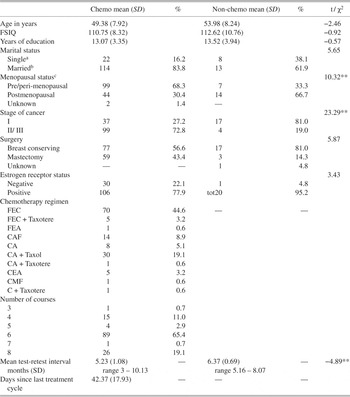
The characteristics of the two groups at baseline are shown in Table 2. Independent group t-tests yielded no significant differences in age, education and baseline FSIQ. However, the test–retest interval was found to be significantly different, with the control group having a longer interval between assessments. The χ2 analyses also found significant differences between the two groups in baseline menopausal status and stage of cancer, with women in the control group more likely to be postmenopausal and have stage 1 cancers. However, as stage of cancer is an indication of severity/ aggressiveness, differences on this variable are expected as it is a determinant for recommendations about adjuvant chemotherapy. The two groups did not significantly differ in surgery type, estrogen receptor status, or marital status. In addition, no significant differences were found in baseline cognitive, mood or QOL performance between the chemotherapy and nonchemotherapy groups (data not shown), suggesting that the two groups were matched adequately for estimated practice effect information to be extrapolated.
Demographic and treatment related characteristics of the study sample

Note
FSIQ = Full Scale IQ; F = 5-fluorouracil; E = epirubicin; C = cyclophosphamide; A = Adriamycin; M = methotrexate.
* Significant at p < .01.
** Significant at p < .001.
a Includes divorced and widowed participants.
b Includes defacto couples.
c Baseline measurement
Reliable Change Index corrected for practice (RCIp)
Published reliability coefficients for each cognitive task, as well as the means and standard deviations for both groups are presented in Table 3. Paired t-tests showed significant differences in the chemotherapy group, with significant declines found in the verbal memory measures, and significant improvements seen in the visual memory, processing speed, and attention domains. No significant changes were seen in the nonchemotherapy group (at the p < .01 level).
Means, standard deviations, and reliability estimates for Time 1 and Time 2 cognitive variables in the chemotherapy and non-chemotherapy groups

Note
Cutoff p < .01. AVLT = Auditory Verbal Learning Test; VR = Visual Reproduction; BDS = Backward Digit Span; SDMT = Symbol Digit Modalities Test; TEA = Test of Everyday Attention; MR = Matrix Reasoning; COWAT = Controlled Oral Word Association Test.
* p < .01.
** p < .001.
a Geffen, Butterworth, & Geffen, (Reference Geffen, Butterworth and Geffen1994).
b Tulsky et al., (1997).
c Waters & Caplan (Reference Waters and Caplan2003).
d Strauss et al., (Reference Strauss, Sherman and Spreen2006).
e Robertson et al., (Reference Robertson, Ward, Ridgeway and Nimmo-Smith1994).
f Golden & Freshwater, (Reference Golden and Freshwater2002).
g Delis et al., (Reference Delis, Kaplan and Kramer2001).
Table 4 shows the results of the RCIp. Only four measures showed a substantial number of participants who were classified as impaired (decline of >1.96 SD), namely AVLT-tot, AVLT8, MR, and PPassembly. “Multiple Test Decline,” defined as a reliable decline on two or more cognitive measures, was found in 16.9% of all participants who had received chemotherapy.
Classifications of impaired, no change, and improved after chemotherapy

Note
AVLT = Auditory Verbal Learning Test; VR = Visual Reproduction; BDS = Backward Digit Span; SDMT = Symbol Digit Modalities Test; TEA = Test of Everyday Attention; MR = Matrix Reasoning; COWAT = Controlled Oral Word Association Test.
Based on the results of the RCIp analyses, subjects were then dichotomized into impaired and not impaired classifications and analyzed with binary multiple logistic regression models (with backward stepwise selection). Factors included in the model were baseline menopausal status, stage of cancer, type of surgery, number of courses, estrogen receptor status, as well as change on time-variant psychological and health factors (anxiety, depression, fatigue, QOL domains, and hemoglobin). In addition, given the high number of analyses, a significance cutoff of p < .01 was used.
No health/disease, treatment, psychological or QOL factors were identified to significantly contribute to impairment on specific cognitive measures. However, the binary multiple logistic regression analysis retained two factors for the multiple test impairment. Impairment on two or more tests was jointly predicted by declines in hemoglobin level between assessments (Wald = 4.14; p < .05, odds ratio [OR] = 1.04, 95% confidence interval [CI] = 1.00–1.09) and increases in anxiety from time 1 to time 2 (Wald = 4.31; p < .05, OR = 1.15; 95% CI = 1.01–1.31) These factors together explain 11.2% of the variance in the classification of multiple test impairment (χ2 = 9.04; p = .01).
Factors associated with cognitive change irrespective of classification
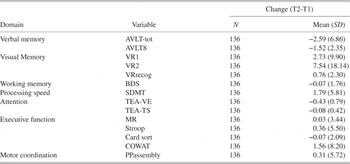
Difference scores (T2-T1) were computed for each of the cognitive variables to investigate cognitive change over the course of chemotherapy. These change scores were correlated with baseline measurements of predictor variables as well as change scores on time-variant psychological and clinical factors (anxiety, depression, fatigue, QOL domains, and hemoglobin). Means and standard deviations for these difference scores are shown in Table 5, while the means and standard deviations for baseline and change (T2-T1) psychological and health variables are presented in Table 6.
Means and standard deviations for cognitive change (T2−T1) in the chemotherapy group

Note
AVLT = Auditory Verbal Learning Test; VR = Visual Reproduction; BDS = Backward Digit Span; SDMT = Symbol Digit Modalities Test; TEA = Test of Everyday Attention; MR = Matrix Reasoning; COWAT = Controlled Oral Word Association Test.
Baseline and change (T2-T1) means and standard deviations for the psychological, health, and treatment factors in the chemotherapy group

Three cognitive tasks (SDMT, COWAT, and PPassembly) were significantly associated with age, education, and/or FSIQ, and these effects were partialled out before running the analyses. No time-variant health or psychological factors were associated with changes in cognition. However, higher levels of fatigue and depression as well as lower functional well-being at baseline were significantly associated with change in cognitive measures, with correlations shown in Table 7.
Pearson correlations between change in cognitive measures (T2-T1) and health and psychological measures

Note
TEA-TS is a timed score, therefore, a decrease in score indicates an improvement in performance. TEA = Test of Everyday Attention; COWAT = Controlled Oral Word Association Test.
* p < .01.
** p < .001.
Trends were also found between several other variables above the p < .01 cutoff: BDS with baseline emotional functioning (r = 0.21; p < .02), where decline in working memory performance was associated with poorer initial emotional functioning; estrogen receptor status with TEA-TS (r = −0.21; p < .02), where estrogen receptor negative breast cancers were associated with worse performance; and VR1 with change in hemoglobin levels (r = 0.20; p < .02), where decline in immediate visual memory was associated with decline in hemoglobin levels.
Interrelationships between predictor variables
The relationships between predictor variables were evaluated using Pearson correlations (shown in Table 8). High correlations were found between depression, anxiety, fatigue, and aspects of QOL (physical, emotional, and functional well-being). Surprisingly, changes in social well-being were relatively independent from the other self-report measures, with only a significant positive association with change in functional well-being found. Change in hemoglobin was not significantly related to any self-report measure.
Correlations between psychological and clinical change variables (T1-T2)

Note
Higher scores on anxiety and depression measures indicate higher depression and anxiety. Higher scores on fatigue and quality of life domains indicate less fatigue and better well-being. QOL = quality of life.
* p < 0.01.
** p < 0.001.
DISCUSSION
The main goal of this study was to investigate whether health/disease, treatment factors, mood, and quality of life (QOL) significantly contributed to the cognitive dysfunction that has been frequently reported after chemotherapy for breast cancer. Similar to previous research, a small proportion (16.9%) of breast cancer patients treated with chemotherapy were found to decline on multiple cognitive measures (Collins et al., Reference Collins, Mackenzie, Stewart, Bielajew and Verma2009; Quesnel et al., Reference Quesnel, Savard and Ivers2009). Consistent with our hypothesis, the cognitive domains that showed the greatest decline were verbal learning and memory, although only abstract reasoning showed any of the expected declines in the executive function domain. The observed improvement in some measures, notably in the visual memory and executive function domains, were consistent with practice effects. Surprisingly, no significant practice effects were observed in the control group, although non-significant declines were evident on the verbal memory task. This questions the utility of recruiting healthy women as controls for research of this nature, as controlling for practice effects based on this group may lead to an overestimation of patients experiencing cognitive changes.
In line with previous research, the current study found little evidence to suggest that increases in depression, and fatigue, as well as declines in well-being significantly affect cognitive functioning shortly after completion of chemotherapy (Collins et al., Reference Collins, Mackenzie, Stewart, Bielajew and Verma2009; Stewart et al., Reference Stewart, Collins, Mackenzie, Tomiak, Verma and Bielajew2008). However, it was found that decline in hemoglobin (conjointly with increases in the level of anxiety) significantly predicted impairment on multiple (two or more) cognitive measures. While these results are not overly strong, they are consistent with previous research that suggests that anemia may detrimentally affect cognitive performance (Jacobsen et al., Reference Jacobson, Garland, Booth-Jones, Donovan, Thors and Winters2004), which has been largely overlooked in the extant literature. Moreover, hemoglobin was found to be independent of self-report measures and may provide a useful clinical indicator for risk of cognitive impairment. However, caution is required when interpreting these results as the occurrence of blood transfusions was not recorded in the current study, and consequently it is not possible to determine whether the performance of patients who required blood transfusions declined more than those who did not. Nevertheless, these findings suggest that sub-clinical anemia may detrimentally affect cognitive functioning and warrants further investigation.
Multiple associations between baseline psychological and QOL factors and performance on cognitive measures were also found in the current study. Although many of the larger, prospective studies have generally not found any significant relationship between psychological variables and objective cognitive performance, our results are consistent with research that have investigated different aspects of QOL and fatigue. Two recent studies have reported significant associations between fatigue, domains of QOL, and specific cognitive domains, one of which was conducted over the same time frame as the current study (Mehlsen et al., Reference Mehlsen, Pedersen, Jensen and Zachariae2009; Mehnert et al., Reference Mehnert, Scherwath, Schirmer, Schleimer, Petersen and Schulz-Kindermann2007). Importantly, these studies differ from the majority of research as they have compared specific domains of QOL and fatigue to objective neuropsychological performance. As the current study found that social well-being was not significantly associated with other areas of QOL, and that areas of QOL may differentially affect performance on cognitive tests, it is possible that previous studies using global measures of QOL may have overlooked these subtle effects. However, these studies also contain numerous limitations such as not containing pre-chemotherapy assessments, small sample sizes, and multiple comparisons (increasing type 1 error). Notably, while the causality of results cannot be determined due to their correlational nature, these results may be useful in identifying patients at greater risk of cognitive impairment after chemotherapy.
While the overall level of impairment found in the current study is in agreement with previous research (Vardy & Tannock, Reference Vardy and Tannock2007), the significant relationships found between health and psychological factors diverge from the majority of longitudinal studies in this area. These differences may be due to sample size, with previous research mainly comprising smaller samples (range, 18–101) and possibly lacking the power to detect these associations (Hermelink et al., Reference Hermelink, Untch, Lux, Kreienberg, Beck and Bauerfeind2007; Wefel et al., Reference Wefel, Lenzi, Theriault, Davis and Meyers2004b). Alternatively, due to the large number of comparisons performed, it is possible that some of these significant associations could have arisen by chance. However, we adopted a more stringent statistical significance level, making this unlikely. A more likely explanation may be that many previous studies calculated cognitive impairment by combining the performance on cognitive tasks into one global impairment score (e.g., Schagen et al., Reference Schagen, Muller, Boogerd, Mellenbergh and van Dam2006; Tchen et al., Reference Tchen, Juffs, Downie, Yi, Hu and Chemerynsky2003; van Dam et al., Reference van Dam, Schagen, Muller, Boogerd, Wall and Fortuym1998; Wieneke & Dienst, Reference Wieneke and Dienst1995). This may have masked significant associations as the current study suggests that these health/treatment, psychological, and well-being factors may have differential effects depending on cognitive domain.
While these results are revealing, the RCIp results in particular must be interpreted with caution due to differences in the test–retest interval between groups, with the nonchemotherapy group found to have a significantly longer reassessment interval (by 1.14 months) than the chemotherapy group. This is problematic as the magnitude of the practice effects on neuropsychological tests tends to decrease with time (Lezak, Reference Lezak1995), and levels of impairment identified through the Reliable Change Index may be an overestimate of the true levels of impairment after the administration of chemotherapy. On the other hand, previous research has also reported that practice effects on neuropsychological tests do not significantly differ over a 2–16 month test–retest interval (e.g., McSweeny, Naugle, Chelune, & Luders, Reference McSweeny, Naugle, Chelune and Luders1993; Temkin, Heaton, Grant, Dikmen, Reference Temkin, Heaton, Grant and Dikmen1999), suggesting that practice effects may not decrease too much over the time periods investigated in the current study. In addition, as published practice effects generally involve very short test–retest intervals (1 week to 1 month) and the two groups were relatively well matched on demographic, cognitive, and psychological factors, the nonchemotherapy group was deemed to be the best estimate of practice effects available. Furthermore, as the RCIp is vulnerable to artifacts associated with regression toward the mean, it is currently unclear whether the current findings are due to clinically significant changes.
Strengths of the current study include its longitudinal research design, comprehensive neuropsychological assessment, large sample size, and use of specific test measurements rather than global scores. In addition, as very few differences were found between participants who did and did not withdraw, these results can be viewed as relatively representative of breast cancer patients, although there will always be selection bias due to voluntary participation in cognitive research. However, as this study focused on the acute effects of chemotherapy, some potentially important factors were not assessed such as use of adjuvant endocrine treatment and chemotherapy-induced menopause. In addition, whereas the Reliable Change Index is useful for investigating individual change, the high level of correlation and complexity within this kind of research may require more complex analyses to appropriately control for interrelationships, such as complex systems analysis.
To further elucidate the relationships identified in this study, future studies comprising clinical control groups (such as patients with chronic diseases) are required. This is particularly important as expected practice effects in the control group were not found in the current study, suggesting that other factors (disease or other treatments) can have subtle adverse effects on cognition in this population, even in the early stages. In addition, as causality between these factors and cognitive changes cannot be inferred in the current study as participants were not randomized to conditions, investigators were not blinded, and correlations were used, these results should be hypothesis-building with future experimental studies required to further investigate these relationships. Furthermore, as prognostic variables such as estrogen receptor status came close to significance, it is recommended that a sample receiving more homogeneous chemotherapy regimens should be studied to attempt to obtain a clearer view of the role of these factors.
In conclusion, the current study demonstrates associations between objective neuropsychological performance and psychological and health factors over the time period of chemotherapy administration that previously have not been reported by large studies with a pre-chemotherapy assessment. In particular, as sub-clinical declines in hemoglobin were found to significantly predict impairment on multiple neuropsychological tests, it is important to monitor declines that are above the threshold for a blood transfusion. These findings may have important implications for identification of at-risk individuals as well as rehabilitation of cognitive difficulties post-chemotherapy, with chemotherapy-induced anemia, fatigue, mood, and quality of life warranting further attention.
ACKNOWLEDGMENTS
We thank Drs. Toni Jones, Donna Spooner, and Elena Moody for their input in the design and implementation of the study. Also, thank you to all oncologists, surgeons, and research nurses who helped in the recruitment process, and the research assistants involved in recruitment and data collection. The authors thank Professor Kerrie Mengersen and Dr. Jahar Choudhury for their statistical advice. Finally, the authors thank all the women who participated in the study at such a distressing period in their life. No conflicts of interest were identified by the authors. This research was generously supported from various sources: The Wesley Research Institute (200320), the Cancer Council of Queensland and the National Breast Cancer Foundation (406900), and the Australian Research Council (LPO669670).