Introduction
Decades of research dedicated to understanding the impact of a bilingual environment on cognition have revealed that positive outcomes may extend beyond those that enable bilinguals to better communicate and engage in new social experiences. One interesting line of research has examined whether bilingual benefits emerge on tasks measuring nonverbal cognitive abilities in early life. Although the underlying cognitive processes of early bilingual advantages are still unclear, there is some empirical support suggesting that young bilinguals outperform their monolingual counterparts on tasks that impose high executive function demands – that is, those that require participants to select a response among competing alternatives while disregarding misleading information (for recent reviews, see Barac, Bialystok, Castro & Sanchez, Reference Barac, Bialystok, Castro and Sanchez2014; Bialystok, Reference Bialystok2017; Adesope, Lavin, Thompson & Ungerleider, Reference Adesope, Lavin, Thompson and Ungerleider2010). Interestingly, this effect has been reported as early as infancy, with 6- and 7-month-olds exposed to bilingual input showing better flexibility of attention than their monolingual peers (Kovács & Mehler, Reference Kovács and Mehler2009; Singh, Fu, Rahman, Hameed, Sanmugam, Agarwal, Jiang, Chong, Meaney & Rifkin-Graboi, Reference Singh, Fu, Rahman, Hameed, Sanmugam, Agarwal, Jiang, Chong, Meaney and Rifkin-Graboi2015). By 24 months of age, bilingual toddlers outperform monolinguals on inhibitory control as measured by a modified Stroop task (Carlson & Meltzoff, Reference Carlson and Meltzoff2008; Poulin-Dubois, Blaye, Coutya & Bialystok, Reference Poulin-Dubois, Blaye, Coutya and Bialystok2011). One hypothesis offered to explain this phenomenon is that bilinguals acquire more efficient regulation of inhibitory control and cognitive flexibility processes, which enable them to readily attend to relevant information while ignoring distracting details (Bialystok, Reference Bialystok2004; Bialystok, Craik & Luk, Reference Bialystok, Craik and Luk2009; Hernández, Costa, Fuentes, Vivas & Sebastián-Gallés, Reference Hernández, Costa, Fuentes, Vivas and Sebastián-Gallés2010; Singh & Mishra, Reference Singh and Mishra2012). In contrast to the findings reported above, it should be noted that other research has failed to find significant differences between bilingual and monolingual cohorts (de Bruin, Bak & Della Sala, Reference de Bruin, Bak and Della Sala2015; Goldsmith & Morton, Reference Goldsmith and Morton2018). For example, Duñabeitia, Hernández, Antón, Macizo, Estévez, Fuentes, and Carreiras, (Reference Duñabeitia, Hernández, Antón, Macizo, Estévez, Fuentes and Carreiras2014) found no evidence of a bilingual advantage in either a verbal or nonverbal Stroop task among school-aged children fluent in Spanish and Basque relative to their monolingual peers. Similarly, results from Paap and Greenberg (Reference Paap and Greenberg2013) did not suggest bilingual advantages in inhibitory control, rule-switching costs, or executive monitoring in a sample of undergraduate students who provided self-report on their proficiency in each language, and who varied in the language pairs that they spoke. These discrepancies remind us that bilinguals vary in the language pairs that they speak, in the age of acquisition of their languages, and in their relative proficiency across languages. Indeed, some have suggested that an advantage in inhibitory control is more likely in individuals with balanced proficiency across languages (Prior, Goldwasser, Ravet-Hirsh & Schwartz, Reference Prior, Goldwasser, Ravet-Hirsh, Schwartz and Schwieter2016) whereas others have suggested that it is more likely in individuals who engage in frequent language switching (Verreyt, Woumans, Vandelanotte, Szmalec & Duyck, Reference Verreyt, Woumans, Vandelanotte, Szmalec and Duyck2016). That said, evidence of a bilingual advantage has been reported in adult speakers of Spanish and Catalan (Hernández et al., Reference Hernández, Costa, Fuentes, Vivas and Sebastián-Gallés2010), proficient English–Hindi bilinguals (Singh & Mishra, Reference Singh and Mishra2012), young children acquiring Spanish and English (Carlson & Meltzoff, Reference Carlson and Meltzoff2008), and toddlers acquiring French and English (Crivello, Kuzyk, Rodrigues, Friend, Zesiger & Poulin-Dubois, Reference Crivello, Kuzyk, Rodrigues, Friend, Zesiger and Poulin-Dubois2016; Poulin-Dubois et al., Reference Poulin-Dubois, Blaye, Coutya and Bialystok2011) among others. Importantly, the subset of studies reported here examined code-switching behaviour in a dual-language context – that is, bilinguals were not constrained to speak one of the two languages. This paper follows up on this finding in French–English toddlers and explores the relation between early executive function and code-switching (shifting between languages in speech) in an ostensive single-language context.
Executive function abilities underlie our capacity to control and coordinate cognitive processes in daily life (Miyake, Friedman, Emerson, Witzki & Howerter, Reference Miyake, Friedman, Emerson, Witzki and Howerter2000). More specifically, executive functions can be broken down into three interconnected abilities: shifting between mental sets (cognitive flexibility), updating and monitoring working memory representations, and inhibiting responses or distracting stimuli (Miyake, Friedman, Rettinger, Shah & Hegarty, Reference Miyake, Friedman, Rettinger, Shah and Hegarty2001). Importantly, it appears that bilingual cognitive advantages are especially evident on conflict tasks – those that measure the ability to manage conflicting attentional demands through exercising interference suppression. Although strongest effects have been observed in older adults (e.g., Bialystok, Craik, Klein & Viswanathan, Reference Bialystok, Craik, Klein and Viswanathan2004), there is growing evidence for cognitive benefits on conflict tasks in children (e.g., Poulin-Dubois et al., Reference Poulin-Dubois, Blaye, Coutya and Bialystok2011) but no such benefits on delay tasks (i.e., motor response suppression; Carlson & Meltzoff, Reference Carlson and Meltzoff2008; Martin-Rhee & Bialystok, Reference Martin-Rhee and Bialystok2008; Poulin-Dubois et al., Reference Poulin-Dubois, Blaye, Coutya and Bialystok2011). Of note, bilingual advantages on memory tasks are generally not observed (e.g., Bialystok et al., Reference Bialystok, Craik and Luk2009; Crivello et al., Reference Crivello, Kuzyk, Rodrigues, Friend, Zesiger and Poulin-Dubois2016; Engel de Abreu, Cruz-Santos, Tourinho, Martin & Bialystok, Reference Engel de Abreu, Cruz-Santos, Tourinho, Martin and Bialystok2012), except when they impose additional demands on attention resources (e.g., Morales, Calvo & Bialystok, Reference Morales, Calvo and Bialystok2013). It is argued that this is because the specificity of the bilingual effect in younger children only emerges on tasks that require inhibition of a salient response (Poulin-Dubois, Bialystok, Blaye, Polonia & Yott, Reference Poulin-Dubois, Bialystok, Blaye, Polonia and Yott2012). Bilingual and monolingual differences are also manifested in brain structures associated with executive function, such that bilinguals demonstrate more efficient regulation of the anterior cingulate cortex during conflict tasks (Abutalebi, Della Rosa, Ding, Weekes, Costa & Green, Reference Abutalebi, Della Rosa, Ding, Weekes, Costa and Green2013). This suggests that bilingual experience can induce both behavioural and neurocognitive changes.
But why do bilinguals demonstrate more efficient regulation of interference suppression functions? Several theoretical accounts have been offered to explain this phenomenon – with the most prominent stemming from a large body of research on lexical processing showing co-activation of bilinguals’ lexical systems, even in single-language contexts (e.g., Thierry & Wu, Reference Thierry and Wu2007; Van Heuven, Dijkstra & Grainger, Reference van Heuven, Dijkstra and Grainger1998; Van Heuven & Dijkstra, Reference van Heuven and Dijkstra2010). This simultaneous activation of language systems requires selective attention and inhibition abilities in order to maintain fluency in one language while preventing speech disruptions from another (e.g., Green, Reference Green1998; Declerck, Koch & Philipp, Reference Declerck, Koch and Philipp2015; Schwieter & Sunderman, Reference Schwieter and Sunderman2008). Therefore, bilinguals are faced with an additional challenge of managing the demands of synchronizing two languages, which is thought to strengthen executive function skills. Consistent with this view, Green (Reference Green1998) developed a model that assumes that because lexical systems are co-activated and are thus competing to control output, selection of the target language requires inhibition of the non-target language. As such, bilinguals develop extensive practice regulating executive control, which inherently boosts their selective attention and inhibition functions. It is hypothesized that domain-general mechanisms underlie this inhibitory process during language processing, in that the relation between bilingualism and language switching efficiency may be modulated by a general switching ability (e.g., Stasenko, Matt & Gollan, Reference Stasenko, Matt and Gollan2017). In fact, there is evidence supporting shared mechanisms in both language and non-verbal task switching (Declerck, Grainger, Koch & Philipp, Reference Declerck, Grainger, Koch and Philipp2017a). Together, these studies suggest that bilinguals acquire important experience with language control that may generalize to non-linguistic tasks.
A bilingual experience that is thought to modulate executive function abilities is code-switching within a single-language context. Code-switching represents a unique lexical experience that permits switching between languages within a single conversation. One account stipulates that bilinguals who engage in more frequent code-switching will display more interference in task-switching performance than those who code-switch less frequently, whereas another hypothesis assumes that code-switching will enhance inhibition and suppression abilities (Prior & Gollan, Reference Prior and Gollan2011; Verreyt et al., Reference Verreyt, Woumans, Vandelanotte, Szmalec and Duyck2016). Code-switching when viewed from an insertional perspective (Myers-Scotton, Reference Myers-Scotton1997) can be considered a method of filling lexical gaps. Arguably, this would be especially relevant for children as they develop lexical competence across languages (Deuchar & Quay, Reference Deuchar and Quay2000). In fact, it has been shown in a sample of five children, that bilinguals demonstrate an ability to differentiate between languages and adapt language use to the language context (Genesee, Nicoladis & Paradis, Reference Genesee, Nicoladis and Paradis1995a). In a naturalistic setting, children tended to mix more in their non-dominant language – likely to facilitate expression in their less proficient language (Genesee et al., Reference Genesee, Nicoladis and Paradis1995a). It is proposed that a gap-filling approach may be appropriate for young bilingual language learners, in that they draw on resources from a more dominant language in order to communicate more effectively (Genesee, Reference Genesee, McCardle and Hoff2006). Indeed, it has been reported that young bilinguals switch language for words for which they do not know the translation equivalents (TEs; two lexical representations for a single concept – e.g., dog in English and chien in French; Nicoladis, Reference Nicoladis1995; Genesee et al., Reference Genesee, Paradis and Wolf1995b). Bilinguals’ acquisition of multiple lexical representations for one concept provides them with more opportunity to exercise executive function abilities – that is, suppressing one language while attending to another.
An alternate model is consistent with the idea that code-switching is a sophisticated manoeuver that requires bilinguals to inhibit one language to maintain fluency in another. Green and Wei's (Reference Green and Wei2014) control process model of code-switching assumes distinct but interconnected language networks. Output is regulated by the language task schema that specifies competitive or cooperative language coordination – coordination either restricts output to one language (i.e., competitive), or allows output from both languages (i.e., cooperative). The language task schema activates particular control processes that are aligned with the communicative goal and the language context (Green & Wei, Reference Green and Wei2014). That is, a single-language context facilitates competition among the language schemas (the target schema is activated and the non-target schema is suppressed), whereas a dual-language context facilitates cooperation among the language schemas (activation of language schemas are altered depending on the target language; Green & Wei, Reference Green and Wei2014). A bilingual speaker with the required linguistic proficiency can, in theory, produce any of three kinds of code-switching in a given interaction: insertion, alternation, or dense code-switching.
Several models have been developed to explain code-switching behaviour in relation to inhibitory control. A seminal model proposed by Green (Reference Green1998) assumes that code-switching frequency is dependent on the extent of non-target language suppression. Switching to a non-target, suppressed language is more difficult than switching to a non-target language that is not actively suppressed. Indeed, speakers incur greater switch costs (i.e., difference in reaction times between switch and non-switch trials in language-switching paradigms) associated with switching to a suppressed dominant language relative to a non-dominant language (for a review see Bobb & Wodniecka, Reference Bobb and Wodniecka2013; Declerck & Philipp, Reference Declerck and Philipp2015; Jackson, Swainson, Cunnington & Jackson, Reference Jackson, Swainson, Cunnington and Jackson2001). In unbalanced bilinguals, the dominant language is activated more strongly and thus requires greater inhibition when conversing in a non-dominant language (Litcofsky & Van Hell, Reference Litcofsky and Van Hell2017; Meuter & Allport, Reference Meuter and Allport1999; Green, Reference Green1998), whereas balanced bilinguals present with more symmetrical profiles, characterized by similar switch costs when alternating between languages (Costa & Santesteban, Reference Costa and Santesteban2004). Therefore, disparate levels of inhibition lead to asymmetrical switch costs, whereas comparable levels of inhibition elicit symmetrical switch costs (Poarch & Bialystok, Reference Poarch and Bialystok2015). It appears that switch costs arise as a result of interference between languages, and that language control is required to resolve this (Green, Reference Green1998; Philipp & Koch, Reference Philipp, Koch and Schwieter2016). Similarly, Green and Abutalebi (Reference Green and Abutalebi2013) argue that the environmental context can influence bilinguals’ activation levels of each language. The model assumes that bilinguals are sensitive to different language contexts, and switch between languages in order to match the spoken language of their interlocutor. Therefore, varying demands are placed on inhibitory control processes as a result of language switching to conform to different environments. For example, in dual-language contexts – characterized by code-switching to accommodate different speakers within one environment – bilinguals are required to more continuously switch between languages, and thus acquire more practice with interference suppression.
Indeed, it appears that code-switching may require inhibitory control as well as conflict monitoring abilities in order to co-ordinate both languages (Bialystok, Craik & Luk, Reference Bialystok, Craik and Luk2012). Despite the potential association between code-switching and executive function, there is surprisingly little direct empirical research of this hypothesis (Prior & Gollan, Reference Prior and Gollan2011). Extant research does indicate, however, that bilingual adults who engage in more balanced code-switching (i.e., code-switch equally across dominant and non-dominant languages) perform better on the traditional Flanker and Simon (conflict) tasks relative to bilinguals who engage in unbalanced code-switching (i.e., code-switch more often in non-dominant language) or no switching at all (Verreyt et al., Reference Verreyt, Woumans, Vandelanotte, Szmalec and Duyck2016). Importantly, Verreyt and colleagues (Reference Verreyt, Woumans, Vandelanotte, Szmalec and Duyck2016) revealed that language switching experience, rather than second-language proficiency, elicits enhanced executive control in adults. Therefore, it appears that language usage and proficiency yield differential effects on bilingual cognition. Luk and Bialystok (Reference Luk and Bialystok2013) emphasized the importance of quantifying bilingualism along related dimensions, namely usage and proficiency. Given that bilingualism is a dynamic construct, examining different aspects of bilingual experience would be pivotal to understanding the intersection between bilingualism and cognitive functioning (Luk & Bialystok, Reference Luk and Bialystok2013). Taken together, research indicates that variations in language speaking experience appear to differentially shape bilinguals’ executive functioning abilities. Findings, however, are limited to cross-sectional designs in adults and qualitatively different language switching types are often overlooked.
Generally, bilinguals’ code-switching is classified as intra-sentential switching (language switching within the same utterance; e.g., the garçon goes inside) or inter-sentential switching (language switching between sentences; e.g., It goes inside. Le reste aussi). Intra-sentential switching requires that words are integrated into the syntactic context of a different language and is not characterized by a large shift of one language to another (Yang, Hartanto & Yang, Reference Yang, Hartanto and Yang2016). This typology of code-switching exercises less inhibitory control and facilitates production given that the interlocutor selects a word that is most readily accessible (Gollan & Ferreria, Reference Gollan and Ferreira2009; Green & Abutalebi, Reference Green and Abutalebi2013; Green & Wei, Reference Green and Wei2014). Alternatively, inter-sentential switching is thought to be more cognitively taxing, as it requires language-set reconfiguration and increased suppression. Interestingly, both inter-sentential (Declerck, Lemhöfer & Grainger, Reference Declerck, Lemhöfer and Grainger2017b; Tarlowski, Wodniecka & Marzecová, Reference Tarlowski, Wodniecka and Marzecová2013) and intra-sentential (Declerck & Philipp, Reference Declerck and Philipp2015; Litcofsky & Van Hell, Reference Litcofsky and Van Hell2017) switching can result in switch costs. In fact, it has been demonstrated that inter-sentential code-switching is negatively associated with switch costs, whereas intra-sentential code-switching and switch costs hold a positive relation (Hartanto & Yang, Reference Hartanto and Yang2016). It should be noted, however, that code-switching frequency was measured through self-report measures in these studies. In sum, these findings suggest that more frequent inter-sentential code-switching results in lower task-switching costs in bilingual adults.
Studies that have focused on the impact of parental code-switching on children's vocabulary development have yielded conflicting results. Byers-Heinlein (Reference Byers-Heinlein2013) assessed the impact of parent code-switching (as measured by self-report) on 18- and 24-month-old infants’ vocabulary development. Bilingual parents reported integrating words from a different language when they were uncertain of a correct word choice, when an appropriate translation did not exist, or when they had difficulty with pronunciation (Byers-Heinlein, Reference Byers-Heinlein2013). Surprisingly, parents indicated that they engage in language switching when teaching their child new words (Byers-Heinlein, Reference Byers-Heinlein2013). Findings also revealed that parent code-switching negatively predicted 18-month-olds receptive vocabulary size and marginally predicted 24-month-olds productive vocabulary size (Byers-Heinlein, Reference Byers-Heinlein2013). Byers-Heinlein explained that parent language switching places additional challenges on young language learners by increasing the difficulty of identifying and classifying utterances across two different languages. In a study by Bail, Morini and Newman (Reference Bail, Morini and Newman2015), bilingual parent inter- and intra-sentential switches (as measured by parent-child discourse samples) did not have any negative effects on 18- to 24-month-old infants’ productive vocabulary size. In fact, they reported evidence of a positive relation between parent intra-sentential switching and children's vocabulary size (Bail et al., Reference Bail, Morini and Newman2015). In other words, the more often parents code-switched within utterances, the larger their children's productive vocabularies. Mixed findings can be perhaps attributed to methodological differences between the studies (i.e., code-switching as measured through parental report vs. directly through parent-child play sessions). Moreover, all bilingual parents engaged in language switches at least once in a short parent-child free-play session (Bail et al., Reference Bail, Morini and Newman2015). This finding suggests that parent code-switching may be more customary in bilingual children's language acquisition than initially thought.
The few studies that have examined language switching in young children have included cued language switching in order to examine shifting dominance patterns (Jia, Kohnert, Collado & Aquino-Garcia, Reference Jia, Kohnert, Collado and Aquino-Garcia2006; Kohnert, Reference Kohnert2002; Kohnert, Bates & Hernandez, Reference Kohnert, Bates and Hernandez1999). To our knowledge, only one study has examined children's spontaneous switching in a picture naming tasks and reported better accuracy when children can switch out of their non-dominant language (Gross & Kaushanskaya, Reference Gross and Kaushanskaya2015). Moreover, the impact of code-switching patterns on children's executive function abilities has not yet been directly examined.
In a recent longitudinal study, growth in TE acquisition (which should facilitate code-switching) was examined in order to determine if it would impact the development of executive function between 24- and 31-months of age. Consistent with previous work on bilingual and monolingual comparisons, bilingual advantages were observed on tasks measuring interference suppression, but not on a control task (measuring response inhibition; Crivello et al., Reference Crivello, Kuzyk, Rodrigues, Friend, Zesiger and Poulin-Dubois2016). Importantly, an increase in the number of TEs acquired in bilinguals’ vocabularies (over a 7-month period) predicted stronger performance on executive function conflict tasks. Overall vocabulary growth did not predict performance on such tasks, which suggests that experience – and not proficiency – in both languages is necessary to observe this cognitive advantage. More specifically, it appears that more opportunities to switch between languages are critical for bilingual advantages to emerge in young children. More robust effects are to be expected as children acquire larger vocabularies across languages and therefore produce more frequent language switches due to more opportunity for alternating languages. It should be noted, however, that the number of TEs could only be considered as a proxy for young children's language switching behaviour given that the frequency with which children switch between languages could not be documented. Thus, direct measures of language switching are necessary in order to confirm whether frequency of switches elicits bilingual advantages in interference suppression abilities.
The present study is an extension of that by Crivello and colleagues (Reference Crivello, Kuzyk, Rodrigues, Friend, Zesiger and Poulin-Dubois2016) in an older sample of bilingual children, such that it aimed to directly assess language switching and suppression through the lens of code-switching behaviour. More specifically, the present study sought to explore code-switching patterns within a single-language context in early bilingual development and its potential relation with executive function ability over a two-year time period. We sought to investigate whether concurrent and predictive proportions of intra- and inter-sentential switching would be related to stronger performance on traditional conflict tasks. Specifically, we examined whether code-switching typology would predict children's executive function performance at each wave of data collection independently, and whether growth in code-switching frequency across waves would predict executive function performance at Wave 2. This is the first longitudinal investigation of code-switching patterns in both parents and children using a direct measure. Similar to Verreyt and colleagues (Reference Verreyt, Woumans, Vandelanotte, Szmalec and Duyck2016), we also investigated whether code-switching behaviour or language proficiency would better predict favourable executive function outcomes. In line with Green's (Reference Green1998) inhibitory control model, we hypothesized more frequent code-switching in the direction of non-dominant language to dominant language in the children given their unbalanced proficiency. We also predicted more frequent child code-switching to occur as a function of higher degrees of language proficiency in both languages over time – i.e., greater syntactic, grammatical, and semantic knowledge across languages would facilitate bilinguals’ language switching. Moreover, consistent with previous work with adults, we anticipated children's performance on executive function conflict tasks to vary as a function of proportion of inter-sentential switching, such that higher degrees of inter-sentential switching would predict enhanced inhibitory control and cognitive flexibility. Based on previous findings, no link between language proficiency and executive function performance was expected (Verreyt et al., Reference Verreyt, Woumans, Vandelanotte, Szmalec and Duyck2016). Moreover, no association between code-switching typology and episodic memory was expected given that previous work with children has not shown bilingual advantages on tasks with high memory demands.
Methods
Participants
The present sample is part of a longitudinal project consisting of six waves of data collection. Participants were recruited from the fourth and sixth waves of the study, and were originally recruited from a governmental health agency in a metropolitan Canadian city. Selection criteria required that children had no auditory or visual impairments, or any birth complications. The inclusion criterion for bilingualism was exposure to a second language at a minimum of 20% from birth. Children exposed to a third language were also included if exposure from birth was at most 10%. Importantly, participants were required to meet these language criteria across both waves of the study. Participants were also required to participate in both parent-child free play sessions at each wave. A total of 61 and 44 parent-child dyads were tested at Wave 1 and 2, respectively. However, some were excluded as a result of missing one wave of data collection (n = 17), not meeting language criteria (n = 10), and missing parent-child free play sessions (n = 3) or the participating parent not being sufficiently fluent to participate in one of the free-plays sessions (n = 2). The final sample consisted of 29 French–English bilingual children who completed both Wave 1 (M age = 36.53 months, SD = 1.09) and Wave 2 (M age = 61.72 months, SD = 1.36) of testing. At Wave 1, a total of 15 children were English-dominant and 14 children were French-dominant. Whereas at Wave 2, 23 children were English-dominant and 6 children were French-dominant.
A total of 65.5% of the sample consisted of first-borns, 24.1% consisted of second-borns, and 10.3% percent consisted of third-borns. The mean number of years of maternal education was 16.35 (SD = 1.56).
Measures
Language Exposure Assessment Tool
The Language Exposure Assessment Tool (DeAnda, Bosch, Poulin-Dubois, Zesiger & Friend, Reference DeAnda, Bosch, Poulin-Dubois, Zesiger and Friend2016) was administered to assess the amount of time children were exposed to each language during all waking hours per day, on a weekly basis. Parents were administered the LEAT in the form of a semi-structured interview, whereby they were asked to estimate the number of hours their child was exposed to each language, by whom, as well as to specify the context. A global estimate of language exposure was subsequently calculated as a percentage based on such data. Data from the LEAT was used to determine whether participants met bilingual language criteria as well as to identify participants’ dominant and non-dominant languages.
Peabody Picture Vocabulary Test- Third Edition (PPVT-III) and Échelle de vocabulaire en images Peabody (ÉVIP)
The PPVT-III (Dunn & Dunn, Reference Dunn and Dunn1997) and the French adaptation, the Échelle de vocabulaire en images Peabody (Dunn, Thériault-Whalen & Dunn, Reference Dunn, Thériault-Whalen and Dunn1993) are well-established normed tests of receptive vocabulary for individuals between the ages of 2 years: 6 months and 90 years of age. The assessment tool requires that children select one of four images that best describe a target word that is verbally presented by the examiner. The test consists of a total of four practice items and 204 test items. All items are classified into 17 sets of 12 items that increase with difficulty. The task ended when the child made 8 mistakes within a predefined set of items on the PPVT, or when the child made 6 mistakes within 8 consecutive items on the ÉVIP. Raw scores on both tests were calculated and converted into standard scores. English and French (Form A) versions of the test were administered to assess participants’ proficiency in the two languages.
Code-Switching Measure
Stimuli
The participants were provided with two different sets of toys for each parent-child free play session counterbalanced across the two visits. One toy set consisted of a farmhouse and included toys such as a farmer, a tractor, and several animals, whereas the second toy set consisted of a dollhouse, which included boy and girl figurines, a car, as well as several pets. Toy sets were expected to be familiar to the children, equivalent in complexity, and to elicit parent-child discourse during play.
Coding and analysis
Two research assistants, fluent in English and French, were trained on the Systematic Analysis of Language Transcripts software (SALT; Miller, Andriacchi, Nockerts, Westerveld & Gillon, Reference Miller, Andriacchi, Nockerts, Westerveld and Gillon2012) and orthographically transcribed parent-child free play sessions from audio recordings. All coding and transcription procedures were consistent with SALT guidelines. A series of different code-switch types by both parent and child were marked with unique identifiers. Only utterances that were complete and intelligible were assigned a code. First, frequency of code-switched words was coded in a given language sample. Proper names (e.g., Mom, Peter, etc.) were not considered as a language switch. Proportion scores for each session (English and French) as well as each speaker (parent and child) were then calculated: that is, the number of intelligible code-switched words divided by the number of intelligible words uttered. Subsequently, intra- and inter-sentential switches were marked with independent identifiers depending on whether switches occurred within (i.e., intra-sentential switch) or between (i.e., inter-sentential switch) sentences. Proportion scores for each session and speaker were again calculated. For intra-sentential switches, the total number of intelligible utterances was divided by the number of intelligible intra-sentential switches. Similarly, proportion scores for inter-sentential switching was calculated by dividing the number of intelligible inter-sentential switches by the total number of utterances. Finally, proportion scores for each switch type were sorted according to parents’ and children's dominant and non-dominant languages.
Inter-rater reliability was assessed by assigning a blind coder to 25% of transcripts at each wave. Pearson correlation coefficients ranging from .94-1 were obtained, indicating excellent agreement among coders.
Executive function tasks
A total of two computerized executive function tasks, derived from the National Institute of Health (NIH; Zelazo, Anderson, Richler, Wallner-Allen, Beaumont & Weintraub. Reference Zelazo, Anderson, Richler, Wallner-Allen, Beaumont and Weintraub2013) toolbox were administered at both waves on a touch screen computer. The NIH toolbox offers a standardized set of assessment tools intended to measure longitudinal outcomes. The battery consisted of two conflict tasks. All tasks, adapted for children between the ages of 3 and 7, were administered in the child's dominant language (as determined by final language estimates on the LEAT). Administration time for each task varied depending on the child's performance – stronger performance resulted in more trials and thus longer administration times. The tasks took approximately 20 minutes to administer. Summary scores for each participant on each task were automated from the NIH toolbox software. Consistent with NIH toolbox scoring procedures, trials were excluded from analysis if reaction times were less than 500ms or greater than 3,000ms.
The Flanker Inhibitory Control and Attention Test
The Flanker Test was administered to measure participants’ inhibitory control and selective attention (Zelazo et al., Reference Zelazo, Anderson, Richler, Wallner-Allen, Beaumont and Weintraub2013). Participants were first presented with a series of fish embedded with arrows. The direction of the arrows was dependent on the trial type. Congruent trials required that the arrow on each side of the middle fish was pointing in the same direction as the others. Alternatively, the incongruent trials required that the arrow was pointing in a direction that was opposite to the others. On each trial, participants were asked to identify the direction of the middle fish by pressing on either a left or right arrow key located at the bottom of the touch screen. Participants were required to respond accurately on at least 3 of the 4 training trials in order to proceed to the testing phase. The testing phase consisted of 20 trials, including both congruent and incongruent trials. If the participant obtained more than 90% of the test trials accurately, they were administered 20 additional trials using only arrows as stimuli. Proportion scores were then calculated by dividing total number of correct (collapsed across congruent and incongruent) trials by the total number of completed trials.
Dimensional Card Sort (DCCS) task
The DCCS task was administered as a measure of participants’ cognitive flexibility. Across each trial, two images, varying along two dimensions (i.e., shape and colour) were presented. Participants were required to match a target image according to one dimension by selecting the correct image on the screen. The task began with a series of training trials consisting of 4 pre-switch and 4 post-switch trials, whereby the participant must match the target image according to two different dimensions. Participants proceeded to the test sequence (consisting of 5 pre-switch, 5 post-switch and 30 mixed trials) if they correctly responded to a minimum number of trials in the training sequence. Mixed trials consisted of alternating the dimension in which they are to match the target image from one trial to the next in a random sequence. The proportion of correct responses on test trials was calculated.
Memory task
The Picture Sequence Memory Task (PSMT) is a non-verbal episodic memory task, which served as a control task (Zelazo et al., Reference Zelazo, Anderson, Richler, Wallner-Allen, Beaumont and Weintraub2013). Like the EF tasks, this task was also administered through the NIH toolbox and consisted of three trials, which required participants to recall an increasingly difficult series of images that tell a story. The task consisted of training trials that preface the testing phase. Importantly, the sequence of images differed across waves in order to adapt the task to a level appropriate for each age group. For the PMST, computed scores were used for analysis – calculated by taking the number of adjacent picture pairs for each trial and converting it to a theta (scores range from 200 to 700).
Procedure
Participants visited the Cognitive and Language Development Laboratory at Concordia University with their parent or legal guardian on two occasions across two waves of data collection. Children therefore visited the laboratory twice at Wave 1 when they were 36 months of age, and twice at Wave 2 when they were 60 months of age. One session was conducted in English, whereas the other was conducted in French – language of the session was counterbalanced across visits. The duration of the visit in the child's dominant language was approximately an hour and a half, and the visit in a non-dominant language was approximately one hour. Of note, parents and their children were greeted in the language of the session.
During the first visit at both waves, parents completed the LEAT in the form of a semi-structured interview. At this time, a researcher played with the children in the language of the session. Children and their parents then engaged in free play. Parents were instructed to play with their children as they would at home in the chosen language of the session. The experimenter gave instructions to the parent on the spoken language of the session in order to establish a context in which to obtain an optimal assessment of the child's performance in a single-language context. Recall that dominance was determined as a function of children's relative lifetime exposure to each language with the most exposed language constituting the dominant language. The dyad sat together on a colourful mat and played with one of the designated toy sets. Although all parents reported that they spoke both English and French, those who indicated that they were most fluent in the language of the visit were asked to play with their child, given that all parents were not necessarily equally balanced across languages. Of note, parent fluency in either language was reported on the LEAT. Play sessions at Waves 1 and 2 lasted 15 and 10 minutes, respectively. At both waves, the battery of executive functioning tasks was administered only once, following the play session in the child's dominant language. For each visit, children received a gift and a certificate of merit for their participation in addition to a $30 financial compensation.
Results
Parent-child code-switching analysis
In order to examine whether code-switching differed as a function of children's dominant or non-dominant languages across waves, as well as whether differences emerged as a function of speaker (child vs. parent), a Language x Wave x Speaker repeated measures ANOVA was conducted. The proportion of code-switched words was analyzed as the dependent variable. Results revealed a main effect of Language, F (1, 28) = 18.23, p < .001, η2 = .40), such that both children and parents exhibited a larger proportion of code-switching in their non-dominant (M = .16, SD = .15) relative to their dominant language (M = .025, SD = .05) across both time points. Subsequently, results indicated a main effect of Speaker, F (1, 28) = 41.77, p < .001, η2 = .60), such that children (M = .17, SD = .13) engaged in more frequent code-switching relative to their parents (M = .01, SD = .47) across waves. No main effect of Wave emerged, suggesting that children (Wave 1: M = .18, SD = .15 & Wave 2: M = .16, SD = .18) and parents (Wave 1: M = .01, SD = .01 & Wave 2: M = .02, SD = .01) displayed similar amounts of code-switching across waves. Finally, a statistically significant Language x Speaker interaction was obtained, F (1, 28) = 18.84, p < .001, η2 = .40). Pairwise comparisons revealed that switching in the non-dominant language across waves was more frequent than in the dominant language in children (F (1, 28) = 20.33, p < .001, η2 = .39; dominant: M = .05, SD = .11; non-dominant: M = .29, SD = .25) but not in their parents (F (1, 28) = .35, p = .56; dominant: M = .001, SD = .001; non-dominant: M = .02, SD = .10). No other interaction terms were found to be statistically significant. Descriptive statistics for parents’ and children's inter- and intra-sentential switching in dominant and non-dominant languages across waves are presented in Table 1. Finally, to assess stability of code-switching over time, zero-order correlations were computed on the number of code-switched words at Wave 1 and Wave 2. All correlations were statistically non-significant, suggesting the instability of children's code-switching behaviour across waves for both dominant and non-dominant languages. In other words, how much code-switching was observed varied across sessions for a given child.
Descriptive statistics for parent and child inter- and intra-sentential switches across waves

Note. N = 29; All code-switch scores represent proportion scores.
Cross-Wave performance on executive function tasks
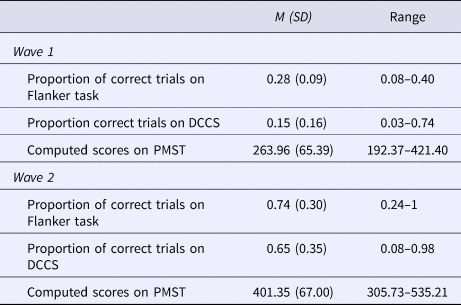
Children's performance on executive functioning tasks across waves was subsequently analysed. Means with respective standard deviations and range of values for children who completed the executive function tasks at each wave are displayed in Table 2. Separate paired-samples t-tests were computed to examine whether performance on each task improved over time. Results indicated that accuracy, as measured by proportion scores, on the Flanker task was significantly higher at Wave 2 (M = .88, SD = .20) compared to Wave 1 (M = .28, SD = .08; t (11) = -10.34, p < .001, d = 3.94). Moreover, it was shown that accuracy (proportion scores) on the DCCS task also increased over time (t (11) = -6.42, p < .001, d = 2.54), such that children performed better at Wave 2 (M = .77, SD = .31) relative to Wave 1 (M = .16, SD = .14).
Descriptive statistics for performance on executive function tasks

Cross-Wave performance on memory task
Finally, an analysis of performance on PMST indicated that, at Wave 1, only a small number of children obtained the minimum score required by the software to be converted to a computed score. In order to maximize the cross-wave sample size, PMST accuracy scores were used for analysis – calculated by taking the number of adjacent picture pairs for each trial and converting it to a theta (scores range from 200 to 700). Results indicated that children obtained higher scores over time (t (16) = -8.40, p < .001, d = 2.82; Wave 1: M = 3.35, SD = 3.16 & Wave 2: M = 11.94, SD = 2.92) consistent with our findings for the executive function tasks.
Cross-Wave analysis of children's language proficiency across languages
Descriptive statistics on children's performance on language proficiency tests, as measured by standard scores on the PPVT and ÉVIP, in dominant and non-dominant languages, are displayed in Table 3. Results from a Language × Wave repeated measures ANOVA indicated a main effect of Language, F(23) = 24.78, p < .001, η2 = .52, and Wave, F(23) = 15.63, p < .01, η2 = .41. No Language by Wave interaction emerged. This suggests that children display stronger proficiency in their dominant language relative to their non-dominant language, and that they acquire higher proficiency in both languages over time. Put another way, exposure and proficiency in this sample are yoked: children demonstrate their highest proficiency in their most exposed language. Thus, we would expect effects of proficiency and exposure in this sample to follow a similar pattern. Given these results, we next evaluate the role of proficiency in code-switching.
Descriptive Statistics on language proficiency standardized tests

Note. N = 24. Scores represent performance on PPVT and ÉVIP sorted according to children's dominant and non-dominant languages.
Relation between children's language proficiency and code-switching typology
In order to examine cross-wave relations between children's language proficiency and inter- and intra-sentential switching in a non-dominant language, a series of zero-order correlations were computed. After accounting for multiple comparisons using the False Discovery Rate method (Benjamini & Hochberg, Reference Benjamini and Hochberg1995), a negative correlation between second language proficiency and inter-sentential switching at Wave 2 was observed, r (23) = -.517, p = .02. This suggests that as children acquire higher degrees of second language proficiency, they engage in less frequent inter-sentential switches during discourse in a single-language context.
Language proficiency prediction models on executive function and memory task performance
Multiple regression models were conducted to examine whether children's proficiency in their dominant and non-dominant languages would significantly predict performance on executive functioning tasks. All predictors were entered into the model simultaneously, with performance on each executive function task included as the criterion. This analysis yielded non-significant results across all three models, suggesting that language proficiency is not predictive of executive function task performance. In fact, less than 1% of the variance in the Flanker task performance was accounted by dominant and non-dominant language proficiency, F(2, 19) = .03, p = .97, R 2=.004). Additionally, 3% of the variance in DCCS scores were accounted by the predictors of interest, F(2, 18) = .23, p = .80) and approximately 2% of the variance is accounted for in PMST scores, F(2, 17) = .17, p = .85, R 2 = .02).
Code-switching prediction models on executive function and memory task performance.
A series of multiple regression models were employed to examine whether the impact of children's differential language switching typology (i.e., proportion inter- and intra-sentential switching) would predict performance on executive function tasks concurrently. As mentioned above, children engaged in little language switching in their dominant language, therefore predictors of interest consisted of inter- and intra-sentential switches in the non-dominant language. All predictors were simultaneously included. Moreover, given that a floor effect was obtained on executive function and memory tasks at Wave 1, analysis only included performance at Wave 2 as the criterion.
It should be noted that, as expected, differences were observed in the proportions of correct congruent and incongruent trials on the Flanker task, t(25) = 3.10, p = .005, d = .86. In order to examine the predictive relations of code-switching behaviour on Flanker performance, a difference score was created (i.e., performance on incongruent trials subtracted from performance on congruent trials) to account for trial type. Inter- and intra-sentential switches accounted for 14% of the variance on Flanker performance, F(2, 21) = 1.70, p = 2.10, R 2= 1.40. However, null associations between code-switching typology in the dominant language were observed as a function of Flanker trial type, F(2, 21) = .56, p = .58, R 2 = .05. That is, neither Flanker performance on congruent nor incongruent trials accounted for observed proportions of inter- and intra-sentential switches. As a result, performance on the Flanker task was collapsed across trial type in order to take advantage of the full set of trials.
Model 1: Code-switching prediction model on Flanker task performance at Wave 2.
Results indicated that inter- and intra-sentential switches significantly accounted for 27% of the variance in children's performance on the Flanker task, F(2, 21) = 3.78, p = .04, R 2 = .27. Proportion of inter-sentential switches in a non-dominant language contributed significantly to the variance explained, such that less inter-sentential switching at Wave 2 is associated with stronger performance on the Flanker, β = -.40, t (23) = –2.15, p = .04. Moreover, intra-sentential switching did not significantly predict Flanker performance (See Table 4).
Flanker task scores regressed on inter- and intra-sentential code-switching variables in non-dominant language

Note. N = 24. Flanker proportion accuracy scores regressed on proportion of inter- and intra-sentential code-switching scores.
Model 2: Code-switching prediction model on DCCS task performance at Wave 2.
The analysis revealed inter- and intra-sentential switches do not significantly contribute to the model, F(2, 19) = .50, p = .61, R 2 = .05. In other words, the predictor variables did not account for a meaningful portion of variance in DCCS task performance (See Table 5).
DCCS task scores regressed on inter- and intra-sentential code-switching variables in non-dominant language

Note. N = 22. DCCS proportion accuracy scores regressed on proportion of inter- and intra-sentential code-switching scores.
Model 3: Code-switching prediction model on PMST performance at Wave 2.
Similar to the DCCS, predictor variables of interest did not contribute significantly to the variance explained, F (2, 18) = 1.10, p = .36, R 2 = .11. Therefore, it appears that frequency of inter- and intra-sentential switching does not predict children's PMST computed scores (See Table 6).
PMST scores regressed on inter- and intra-sentential code-switching variables in non-dominant language

Note. N = 21. PMST computed scores regressed on proportion of inter- and intra-sentential code-switching scores.
Discussion
The present study addressed two important questions in the field of early bilingual development: (i) what code-switching patterns do children engage within a single-language context? And (ii) how is code-switching related to executive function? Relatively little research has examined code-switching behaviour in childhood, and extant research is dependent on parent-report that disregards quantitatively different switch types. Moreover, although there is evidence for positive outcomes of bilingual language experience on executive control, the underlying mechanisms for this advantage are unclear. We sought to examine the impact of different dimensions of bilingualism, namely second language proficiency and language switching, on pre-schoolers’ executive functioning abilities. To our knowledge, this is the first study to document longitudinal changes in parent-child code-switching patterns and their correlates in the preschool period. This study also presents the first evidence on the relation between preschoolers’ code-switching behaviour and their inhibitory control and cognitive flexibility.
The present findings suggest that across a two-year period, children display more frequent overall switching from their non-dominant to their dominant language than vice-versa. Additionally, as children developed stronger proficiency in their second language by 5 years of age, they engaged in fewer inter-sentential switches. However, no relation between second language proficiency and intra-sentential switching emerged at either time-point. Finally, five-year-olds’ inter- and intra-sentential switches in the non-dominant language predicted their performance exclusively on the Flanker task. Of note, inter-sentential switches served as a more powerful predictor of Flanker performance – although less frequent inter-sentential switches are associated with better Flanker outcomes. Moreover, the DCCS prediction model did not yield statistically significant results – although performance was equivalent across the Flanker and DCCS. As anticipated, code-switching typology did not predict performance on a control task (PMST) and language proficiency did not significantly predict children's performance across all three tasks.
Consistent with predictions of the Inhibitory Control model (Green, Reference Green1998) and with seminal work on language switching in adults (e.g., Meuter & Allport, Reference Meuter and Allport1999; Costa & Santesteban, Reference Costa and Santesteban2004; Linck, Kroll & Sunderman, Reference Linck, Kroll and Sunderman2009; Philipp, Gade & Koch, Reference Philipp, Gade and Koch2007; Philipp & Koch, Reference Philipp and Koch2009), children displayed more frequent overall code-switching from the non-dominant to the dominant language. We initially hypothesized that as bilingual children become more proficient across languages over time, they would code-switch more readily, based on the assumption that efficient language switching requires higher mastery of the languages’ grammar, syntax, and semantics. However, increased proficiency in the non-dominant language had the opposite effect: at Wave 2, children who became more proficient in their non-dominant language also engaged in less frequent inter-sentential switching when the single-language context was the non-dominant language. What this suggests is that children were more successful at inhibiting their dominant language as they became more proficient in their non-dominant language. In the present study, in which children were observed in a single-language context, when children lacked lexical competency in their non-dominant language, they filled language gaps with sentences from their dominant language. This effect is also likely due to children's improved ability to synchronize their language use with that of an interlocutor: that is, inhibit talking in the non-target language.
This pattern of results has been previously reported in bilingual children (Genesee, Reference Genesee, Bhatia and Ritchie2004; Luk, Green, Abutalebi & Gardy, Reference Luk, Green, Abutalebi and Grady2011). In fact, Ribot and Hoff (Reference Ribot and Hoff2014) demonstrated that bilinguals balanced in expressive and receptive skills engaged in less code-switching overall, as per parent report. Therefore, it appears that bilingual code-switching in children may be linked to a lack of language competence rather than a mastery of the two languages. Given that code-switching may be indicative of language incompetence and that a greater amount of effort is required to overcome inhibition of bilinguals’ dominant language, perhaps participants experienced more frequent intrusions from their dominant language when speaking in an alternate language. The present results suggest that preschooler code-switching patterns within a single-language context is largely influenced by limited proficiency in a second language, and may not be driven by the same strategies in other language contexts or in adulthood. Consequently, this behaviour in children would suggest poorer management of the two lexical systems, and less active suppression of the dominant language. Indeed, this is confirmed by the negative relation between code-switching and Flanker task accuracy observed in the present study. Future research will be needed to determine whether this pattern of effects generalizes to conversations outside the laboratory where code-switching is less constrained. We would expect that code-switching that involves more mature management of the two lexical systems along with more balanced proficiency would be associated with cognitive inhibitory benefits.
We also obtained evidence for the continuity of child code-switching over time. Firstly, this corroborates other data on children's code-switching behaviour, such that children engage in code-switching quite frequently in conversation (Ribot & Hoff, Reference Ribot and Hoff2014). It should be noted, however, that parents were instructed to speak only in the target language of the session, discouraging them from alternating between languages during play. This was done to maximize our ability to obtain optimal estimates of the child's proficiency in each language. However, there is empirical evidence that parents code-switch more regularly in an unconstrained context. For example, Bail and colleagues (Reference Bail, Morini and Newman2015) reported that about 15% of parents’ utterances contained code-switching in a bilingual laboratory setting. Studies based on direct observation of language mixing have reported that between 10 and 20% of the parents’ utterances were mixed (Nicoladis & Secco, Reference Nicoladis and Secco2000; Tare & Gelman, Reference Tare and Gelman2011). As a result, the code-switching behaviour examined here may not fully represent this phenomenon when observed in a bilingual setting either at home or in the laboratory.
As a result of the lack of growth in children's language switching behaviour, code-switching growth prediction models on executive function ability were not computed. However, results from concurrent code-switching models at Wave 2 yielded interesting findings. As anticipated, second language proficiency models did not offer statistically significant findings, whereas child code-switching typology predicted Flanker outcomes. Our results revealed that child inter-sentential switches negatively predicted strengthened inhibitory control and selective attention functions. This code-switching typology was shown to be the only statistically significant predictor, suggesting that fewer inter-sentential switches in a non-dominant language lead to enhanced interference suppression abilities in preschoolers. Therefore, it appears that benefits are manifested when children exercise inhibitory control of shifting from one language set to another while speaking a non-dominant language. Importantly, the negative association with preschoolers’ code-switching patterns suggest that fewer language switches reflect better interference suppression and goal maintenance in the current context. This is in contrast to what was reported in a study by Verreyt and colleagues (Reference Verreyt, Woumans, Vandelanotte, Szmalec and Duyck2016) in adults, where more frequent code-switching elicited enhanced inhibitory control. Thus, code-switching may not operate in children as it does in adults – possibly because adults engage in this behaviour as a function of socio-pragmatic conditions. However, it should be noted here that adult code-switching reported by Verreyt and colleagues (Reference Verreyt, Woumans, Vandelanotte, Szmalec and Duyck2016) was examined in a context wherein there was no constraint on the language that was spoken, which may also explain these discrepant findings.
Finally, specificity of this effect on the Flanker task should be noted. Although null findings on the DCCS task cannot be attributed to poorer performance, it is possible that the nature of the DCCS task may explain our results. It has been suggested that additional abilities are required, above and beyond attentional processing and interference suppression, for successful performance (Zelazo, Muller, Frye, Marcovitch, Argitis, Boseovski, Chiang, Hongwanishkul, Schuster & Sutherland, Reference Zelazo, Anderson, Richler, Wallner-Allen, Beaumont and Weintraub2003). In particular, the ability to develop abstract representations of a hierarchy of rules is necessary (Zelazo et al., Reference Zelazo, Muller, Frye, Marcovitch, Argitis, Boseovski, Chiang, Hongwanishkul, Schuster and Sutherland2003). Thus, the task may have been confounded by additional representational demands that have been imposed. A task simply involving alerting, orienting, and conflict resolution abilities – such as the Flanker – may therefore be better suited to detect children's superior inhibitory control abilities elicited by code-switching behaviour.
The present set of findings offers first evidence of code-switching continuity in preschoolers’ discourse using a direct measure. This study is also the first to demonstrate the relation between executive function benefits and code-switching typology, most notably inter-sentential switching. This link has been indirectly reported previously when bilingual toddlers who acquired more TEs over time showed better inhibitory skills later on (Crivello et al., Reference Crivello, Kuzyk, Rodrigues, Friend, Zesiger and Poulin-Dubois2016). Future research will be needed to confirm this relation in a dual-language context in order to maximize the level of ecological validity.
Acknowledgements
This research was supported by NICHD under award #R01HD468058 to Diane Poulin-Dubois, Margaret Friend as well as Pascal Zesiger, and does not necessarily represent the views of the National Institutes of Health. A Discovery grant from NSERC awarded to Diane Poulin-Dubois (#2003–2013) also supported this research. The authors wish to thank Cristina Crivello, Rosalie Dauth, Ivana Di Criscio, Camille Labrèche, Giuditta Marinotti, and Monyka Rodrigues for their help with coding and data collection.