For years voters and political pundits have grumbled about the lack of real choice between Republicans and Democrats. Scholars have examined party behavior and suggested reasons for concern. Determining whether there is a real ideological and policy difference between U.S. political parties, and the nature of that difference, is important for political science and for democratic politics generally. Ultimately, democracy is about choices, and where choices are few, democracy is degraded. One way to examine the choices that political parties offer voters is by assessing their political platforms. Even in an era of candidate-centric politics, political party platforms spell out the general programs offered by the parties, and the platforms are heavily influenced by the policy positions of the candidates themselves. In addition, the political platform is the one document that spells out the entire program of the party. Individual candidate speeches capture only snippets (at best) of the policy choices offered to voters. Recent innovations in computerized content analysis make it possible to analyze large bodies of text such as party platforms in a systematic way by treating words as data, then analyzing them statistically.
In this article, I apply this word scoring technique to the party platforms of the Republican, Democratic, Libertarian, and Green parties during three recent election cycles: 1996, 2000, and 2004. My examination focuses on the relative left-right ideological position of each party on domestic policy. If the critics are correct, the Democratic and Republican party positions on general social and economic issues should be similar. If they are incorrect and if an increasingly polarized politics represent real choices for voters then we should find that the Democratic and Republican parties offer clear differences to voters on social and economic issues.
The editorial in the September 3, 1992, edition of the Greensboro News & Record summed up the views of many Americans when it questioned the real difference between the Democratic and Republican parties:
As the wrangling among the candidates continues, it's obvious that George Bush and Bill Clinton are different people with different personalities who don't have any really big differences in what they believe. Neither is there a lot of difference between the Democratic Party and the Republican Party in the United States. We keep demanding that the candidates have a showdown and argue out their two positions but, for the most part, they don't have any argument with each other. They have to nit-pick and invent differences. Their political parties don't have any basic philosophical differences of opinion, either. (1992)
Four years later, the San Francisco Chronicle raised the same theme in an editorial titled “GOP, Democrats: What's the Difference?” (1996). Ralph Nader launched his presidential campaign in 2000 by arguing that the Democratic and Republican parties were no different: “It was the systemic convergence of the two major parties, which is weakening all citizens' groups, that prompted me to run for president” (Reference Nader2000).
These complaints in the popular press about the lack of difference (and hence choice) between Republicans and Democrats reflect the concerns some scholars have had for years. In 1950 the American Political Science Association's Committee on Political Parties issued a report calling (in part) on the political parties to “provide the electorate with a proper range of choice between alternatives of action” (APSA 1950, 1). Scholars have also worried that the decline in voter turnout is at least partially the result of weakening allegiances to the political parties (see for example, Shaffer Reference Shaffer1981; Cassel and Hill Reference Cassel and Hill1981). In their now classic study of participation, Rosenstone and Hansen (Reference Rosenstone and Hansen1993 [2003]) link the weakening allegiances to a (at least perceived) reduction of choices (presumably, fewer choices in policies) between Democrats and Republicans and suggest that this lack of choice is contributing to a drop in participation. They summarize their findings thusly: “the better the options (from the parties) the more likely people will want to help make the choice” (Reference Rosenstone and Hansen2003, 156). Yet at the same time that allegiances to the Democratic and Republican parties have weakened and more and more voters call themselves independent, others have noted an increasing polarization of parties and partisan voters in recent elections.Footnote 1 Kimball and Gross (Reference Kimball, Gross, Green and Coffey2007) call the 2004 election the most polarized presidential election in forty years and note that the polarization appears to be elite-driven. These recent findings, then, would suggest more stark choices between the parties.
Duncan Black's (Reference Black1948; Reference Black1958) Median Voter Theorem provides the foundation for most theorizing about the behavior of political parties and voters in the United States. From Black's perspective, a particular logic governs the behavior of political parties and the policy options they offer to voters, and the result of this behavior is platform convergence, whereby with any given policy area parties will adopt positions that fall as close to the median point of the ideological continuum on that policy area as possible. This process drives parties to put forth policies that, according to this logic, will attract the median voter. If the spatial framework is accurate at helping us understand the behavior of political parties nationally, then it may explain why so many people claim there is no difference between the Democratic and Republican parties even at a time of increased partisan polarization: because both parties find themselves at similar (if not the same) places on an ideological continuum on the major policy dimensions.
In recent years, advances in our ability to use computers to analyze large bodies of text have made it much easier to estimate the parties' policy positions from political texts. In the past, political party platforms (or manifestos) have been content analyzed by hand coding (see Budge et al. Reference Budge, Klingemann, Vokens, Bara and Tanenbaum2001 and Klingemann et al. Reference Klingemann, Hofferbert and Budge1994 for examples) or by dictionary-based coding (see Bara Reference Bara and Laver2001 and Garry Reference Garry and Laver2001 for examples). However, a new approach introduced to political science by Laver, Benoit, and Garry (Reference Laver, Benoit and Garry2003) utilizes a computerized word scoring technique to extract policy positions from political texts (also see Benoit and Laver Reference Benoit and Laver2003 and Benoit et al. Reference Benoit, Laver, Arnold, Pennings and Hosli2005 for examples of this technique). At the heart of the word scoring process is the treatment of words not as textual content to be read and understood, but rather as data that represent, for the authors of the texts, positions on pre-defined policy dimensions. Thus, if a particular text represents for the authors their position on a policy dimension, then that text can be used as a reference point for placing on that same policy dimension another set of text—virgin text—of which little or nothing is known related to its position on that same policy dimension. For what they call a priori analysis, selection of reference texts is central to the word scoring approach. Thus Laver, Benoit, and Garry outline rules to follow when selecting the reference texts.
-
1. Have accurate estimates or assumptions about the positions of reference texts on the policy dimensions under investigation;
-
2. Use reference texts and virgin texts that use the same lexicon and in the same context;
-
3. Use reference texts that represent as much as possible the span of the policy dimension under study; and
-
4. Use reference texts that contain as many different words as possible since they will serve as the context in which the virgin texts are analyzed.
The computer generation of word scores involves a rather simple process. The program first generates frequencies of each word of a set of reference texts, then calculates probabilities which indicate the likelihood of reading a given reference text if reading a given word in the reference texts' word universe.Footnote 2 Then, the program generates relative frequencies for each word in the virgin text and a score for each virgin text as a whole, using these relative frequencies to weight the average score of the words found in the virgin text. This allows the position of each virgin text to be located on the same scale as the reference texts. Since the reference texts represent positions on a policy dimension, this process makes it possible to place the virgin text on that same policy dimension. The program also adjusts dispersion of the virgin text scores so that they will have a similar dispersion metric as the reference texts, and then calculates standard errors of the virgin text. The face validity of this procedure is well established.Footnote 3
Methodology of Word Scoring
This study analyzes the national platforms of the Republican, Democratic, Libertarian, and Green parties, which satisfies Laver, Benoit, and Garry's second rule. The Libertarian and Green parties' platforms are included in this analysis to approximate as closely as possible the full domestic policy span in American national politics, which satisfies Laver, Benoit, and Garry's third rule. While the Libertarians and Greens are not necessarily relevant in terms of their ability to control government through electoral success in the American two-party system, they represent important political movements in American politics and have in recent elections issued national platforms that approximate the right and left side of contemporary American national politics' policy span.
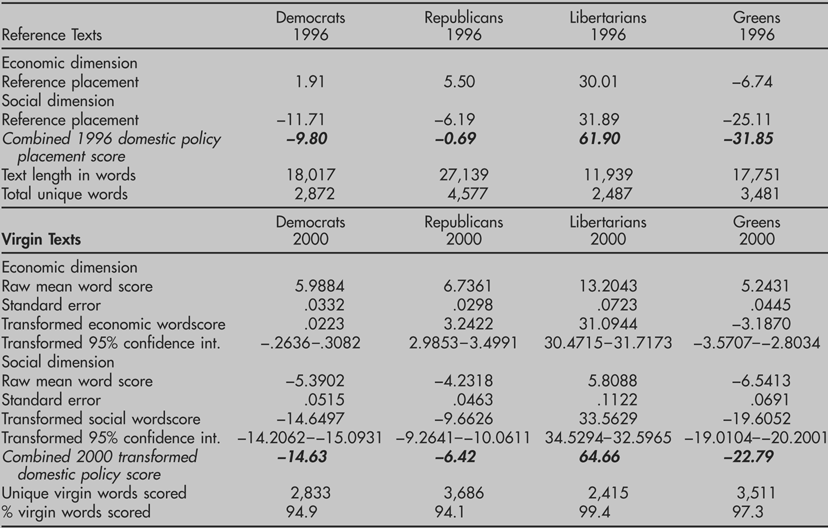
Each party platform is word scored on the economic and social policy dimensions for the years 1996, 2000, and 2004, and the combined scores for each platform in each year will represent the domestic policy position of the party during that year. Analysis begins with the 1996 platforms for two reasons. First, objective independent estimates of the positions of the Democratic and Republican parties on domestic policy are available for the 1996 presidential election, allowing us to partially satisfy Laver, Benoit, and Garry's first rule. But in addition, 1996 is the first instance in which both the Libertarian and Green parties' platforms were issued in the same year. The initial placement of the Republican and Democratic parties on domestic policy comes from Budge et al. (Reference Budge, Klingemann, Vokens, Bara and Tanenbaum2001), who report Manifesto Research Group placements of the Republican and Democratic parties on the economic and social dimensions for 1996. On the economic dimension, Budge et al. place the two parties on a scale based upon their positions relative to free enterprise and economic orthodoxy. On the social dimension, they place the two parties on a scale based upon their positions relative to social justice and welfare state expansion.Footnote 4 Thus, the expert assessments reported by Budge et al. of a party's position on the economic and social dimensions represent the reference metric for the 1996 platforms on domestic policy of the two major parties in the United States.
Since no expert ratings of the Libertarian or Green party platforms are available, and since the purpose for including them in this analysis is to approximate as closely as possible the ideological boundaries of U.S. domestic policy, I used a two-step process to estimate their placement on the reference metric relative to the Democrats and Republicans.Footnote 5 First, I analyzed the four party platforms for 1996, placing the reference position of the Greens and Libertarians at 0 (left) and 1 (right), respectively, and indicated no reference position for Republicans and Democrats. The results indicated the relative distance of all four parties from each other on a metric where the Greens and Libertarians mark the ideological boundaries of left and right. Then, based upon the results of this test, the Libertarians and Greens were repositioned on a reference metric relative to the 1996 expert scores of the Democrats and Republicans from Budge et al. (Reference Budge, Klingemann, Vokens, Bara and Tanenbaum2001). I then used this reference metric as the basis for the analysis that follows; this adjustment more fully satisfies the conditions of Laver, Benoit, and Garry's first rule. On our new spectrum, the Libertarian position marks the conservative boundary of domestic policy in support of market forces and economic orthodoxy and against social justice and welfare state expansion, and conversely, the Green position marks the liberal boundary of domestic policy against market forces and economic orthodoxy and in support of social justice and welfare state expansion.
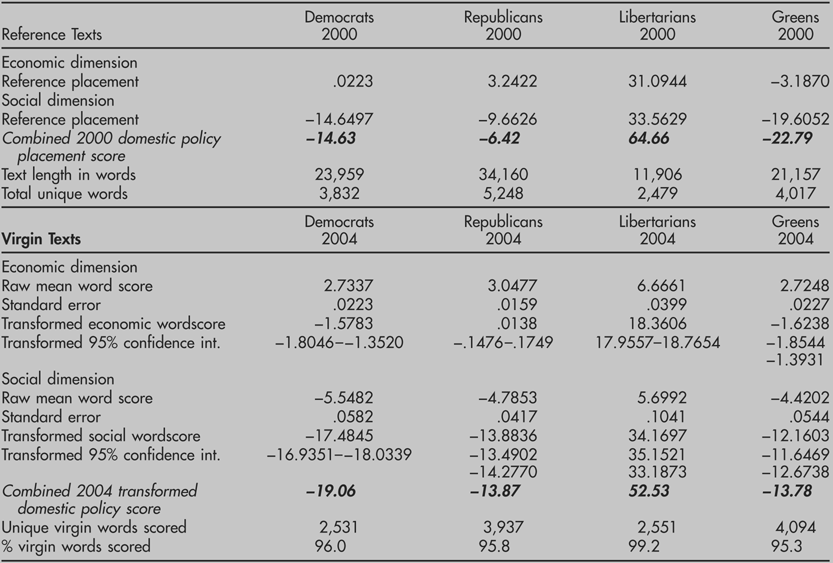
Analysis of the 2000 platforms (the initial virgin text) will be based upon the 1996 platforms (the initial reference text). However, since this study involves an analysis of multiple platforms across three election cycles, the reference text will change from cycle to cycle. Thus, analysis of the 2004 platforms (the new virgin text) will be based upon the 2000 platforms (the new reference text). If the political parties really do offer voters different policy choices, then we should find the parties occupying spatially different places on the policy spectrum across election cycles. If not, then we should find them proximate on the policy spectrum across election cycles.
Estimating Party Policy Platforms from 1996–2004
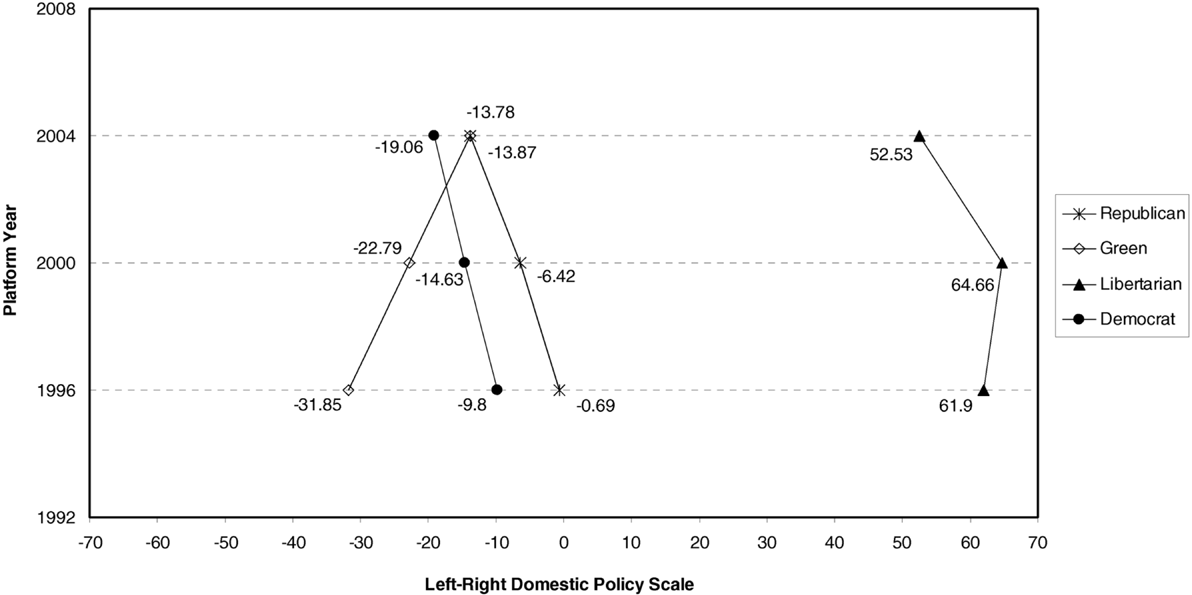
Figure 1 shows computer-generated word score estimates of the movements in party positions from 1996 to 2004 in a domestic policy space defined by support for active government involvement in economic and social issues on one end (left) and opposition to active government involvement in these issues on the other end (right). The data used to construct Figure 1 come from Tables 1 and 2 in the Appendix.Footnote 6 Both the Democratic and Republican parties became increasingly supportive (moved left on the scale) of state intervention in the economy and in favor of increased social justice and state-sponsored welfare from 1996 to 2004. The Libertarian Party occupied a position considerably more conservative (opposed to state intervention and supportive of free enterprise) than both the Republican and Democratic parties in 1996, but that position became slightly weaker by 2004. The Green Party initially occupied a more liberal position on domestic policy than both the Republican and Democratic parties in 1996 (more supportive than both parties of state intervention in both economic and social policy), but by 2004 occupied a position nearly equal to that of Republicans and more conservative than that of Democrats. The summary brief below draws on information in the Republican and Democratic party platforms in an effort to provide face validity for these empirical results.
Domestic Policy Position of Four American Political Parties, 1996–2004
Note: Domestic policy position is measured on a left-right ideological scale, with lower scores indicating support for government intervention in social and economic issues and higher scores indicating opposition to government intervention on social and economic issues.

The most surprising results of the word score estimates are those that show a substantive shift left in Republican domestic policy from 1996 to 2004, from an initial position at −0.69 to an eventual position at −13.78 on the left-right continuum. George W. Bush's candidacy marked a change in Republican politics, and that change can be summarized in two words: compassionate conservatism. The 2000 Republican Party platform characterizes compassionate conservatism as “a concept that is as old as the pioneers heading West in wagon trains, in which everyone had responsibility to follow the rules, but no one would be left behind.” On economic issues in 2000 and 2004 the Republican Party shifted toward greater state intervention from its 1996 position. While much of the state intervention in the economy described in the platform appears designed to encourage free enterprise, it is state intervention nonetheless. In 2000 Republicans promised among other things to:
-
ʼn refocus and reinvigorate government's role in promoting cutting-edge basic research and fostering research and development;
-
ʼn have government work with the private sector to ensure that the Internet is widely available;
-
ʼn have government foster an environment where innovation can flourish in the new economy; and
-
ʼn have government make home ownership possible for more people, especially poor people.
In 2004 Republicans promised among other things to:
-
ʼn create new Lifetime Savings Accounts so workers can save for a variety of needs; and
-
ʼn create the Self-Help Homeownership Opportunities Program to help low-income families purchase a home.
Relative to 1996, on social issues in 2000 and 2004 the Republican platform promised fair treatment for all people, fair distribution of resources, special protection for those in need, and bolstering social services. In 2000, Republicans promised among other things to:
-
ʼn increase federal involvement in education by tying federal aid to local schools to measured progress in student achievement;
-
ʼn fully fund and expand the Individuals with Disabilities Education Act (IDEA);
-
ʼn encourage government's role as a partner in community renewal, especially with community and faith-based providers;
-
ʼn double the child tax credit, increase the adoption credit, enact a family friendly tax code, and encourage employers to provide comp or flex time to accommodate family needs;
-
ʼn pass the New Freedom Initiative to help individuals with disabilities live independently, hold jobs, and take part in the daily lives of their communities; and
-
ʼn add new benefits and choices to the Medicare program.
In 2004 Republicans promised among other things to:
-
ʼn increase Pell grants, lower interest rates on students loans, and push for tax breaks for tuition to make college accessible to all;
-
ʼn ensure the healthcare needs of “orphan retirees” in the coal industry;
-
ʼn increase funding for new community healthcare centers; and
-
ʼn eliminate disparities in health care based upon race, ethnicity, socio-economic status, or geography.
Less surprising is the movement of the Democratic Party leftward from 1996 to 2004 from an initial position of −9.8 to an eventual position of −19.06 on the left-right continuum. While Democrats promised to balance the federal budget and keep spending under control in both 2000 and 2004, they also promised an active government program in economic matters. In 2000 Democrats promised among other things:
-
ʼn government sponsored and subsidized retirement savings “plus” plans;
-
ʼn trade adjustment assistance programs for workers displaced by free trade and negotiations for fair treatment of workers across the globe;
-
ʼn continued support for union workers including a law banning permanent striker replacement workers;
-
ʼn a crack down on corporations that evade taxes; and
-
ʼn targeted tax cuts for middle class families.
In 2004 Democrats promised among other things to:
-
ʼn raise the minimum wage;
-
ʼn end corporate welfare;
-
ʼn increase investments in the transportation system; and
-
ʼn negotiate trade agreements that recognized workers' rights and the environment.
Relative to 1996, in 2000 and 2004 Democrats also advanced a strong social justice agenda that ranged from expanding civil rights and universal health care to providing greater resources for education and greater protection for the environment: In 2000 Democrats promised among other things to:
-
ʼn pass laws banning racial profiling;
-
ʼn pass laws banning hate crimes based upon gender, sexual orientation, or disability; and
-
ʼn provide universal health coverage for all Americans.
In 2004 Democrats promised among other things to:
-
ʼn eliminate racial and ethnic health disparities;
-
ʼn fully fund No Child Left Behind;
-
ʼn strengthen Medicare so no child goes without health care; and
-
ʼn reverse the damage done to the environment and work globally for a cleaner environment.
While their chances of electoral success were almost zero, the Libertarian Party nevertheless offered policy alternatives that reflected real ideological differences between them and the three other parties, beginning at a place on the domestic policy metric that is the most orthodox (61.9) and moderating only slightly (52.53) over the 12 years under study. Greens appeared less ideologically rigid, moving away from their 1996 position at −31.85 on the left-right continuum to a position nearly identical to that of the Republican Party at −13.78 by 2004.
Discussion and Conclusion
It is important to keep in mind that the policy positions of each party presented in this analysis are relative positions; that is, in each year each party's position is relative to the positions of the other parties on that same policy dimension. The success of the computerized word scoring technique is well documented, and so on its face, these results make a lot of sense in helping us understand the contemporary state of American political parties, and perhaps some of the dissatisfaction voters have with those parties. In particular, three general conclusions can be drawn from this analysis. First, after the 2006 mid-term losses, many Republican strategists, and many conservatives in particular, argued that the Republican Party had lost its way. They argued that it was no longer the party of fiscal discipline and small government. This analysis suggests that these critics might have a point. Relative to the Democrats, Libertarians, and Greens, the Republicans have become less orthodox on economic issues and more supportive of social justice and the use of government. Indeed, as Figure 1 shows, by 2004 the Republican position on economic and social policy placed it to the left of the position that had been occupied by the Democratic Party in 1996.
Second, since the presidency of Bill Clinton, many Democratic activists, especially those on the left side of the party, have argued that Democrats had lost their way and were no longer the party of social change and economic justice. As a result, many of those critics began to wander from the Democrats, and some eventually supported Green candidates. The policy gap between the Democrats and the Greens seen in 1996 had reversed by 2004, when the two parties occupied opposite positions on domestic policy. This policy movement suggests that Democrats are making an effort to gain back those supporters who were disaffected, but it also suggests that the Greens are making an effort to better position themselves in the domestic policy mainstream, perhaps in an effort to keep those disaffected Democrats.
Finally, this analysis shows the state of the two most prominent third parties in America. The Libertarian Party appears to maintain its ideological orientation rather well across the 12 years of this analysis, becoming only slightly less orthodox and “libertarian” over time. In an ever-changing political environment, Libertarians appear to remain relatively steady. The Green Party, on the other hand, has wandered a considerable distance on the policy spectrum and in the process has moved closer to the domestic policy mainstream of American politics. Perhaps, as suggested, Greens have done this in an effort to try to keep the disaffected Democrats it has attracted.
The purpose of this study has been to apply a relatively new computer word scoring technique to evaluate the domestic policy of American political parties over a recent set of elections. The results presented here comport well with the general impression voters and political pundits seem to have with the Republican and Democratic parties, and suggest that the disaffected voters and editorial writers (and others) are on to something when they complain about a lack of difference between them.
Appendix
Estimated Combined Domestic Policy Positions in 2000 based on 1996 Reference Positions

Estimated Combined Domestic Policy Positions in 2004 based on 2000 Reference Positions