This study is in memory of Lee Sigelman, who always made me laugh.
“If you want a friend in Washington, get a dog.”
President Harry TrumanAmerican presidents have always had pets, although their political significance is vastly understudied. White House occupants have long included many species, from John Quincy Adams' pet alligator to Jefferson's pet grizzly cubs to Madison's famed parrot who attended the inaugural ball. According to one authoritative source, around four hundred pets have lived in the White House to date (Davis Reference Davis2004). In fact, if one counts horses, Barack Obama is the very first elected president to be petless.Footnote 1 Moreover, Obama's petlessness was widely publicized during the election through his public promise to his daughters of a post-election canine companion. While some pundits felt this promise only made him appear more charming to the pet-loving American public, it may have unintentionally highlighted a key point of difference between the candidate and the public. Republican John McCain, on the other hand, had a menagerie that included two dogs, a cat, two turtles, a ferret, three parakeets, and some saltwater fish. Moreover, given the attention that the campaign promise drew to pets (and Obama's lack thereof), it is not surprising that the American public was well aware of this point of difference between the two candidates.
Presidential pets, and canines in particular, have been widely acknowledged to play a significant role in the political success of their masters. Many presidential pups have become celebrities in their own right, exceeding even their masters' success in the White House. President Harding's Airedale, Laddie Boy, became a national celebrity and was given a chair at cabinet meetings. Roosevelt's black Scottie, Fala, traveled abroad and joined the president at international meetings promoting world peace. Pushinka, a fluffy little white dog given to Caroline Kennedy by Nikita Khrushchev, was long suspected of being infested with bugs. However, after an extensive Secret Service clearance process, she was allowed to have intimate relations with the Kennedy's Welsh terrier, Charlie, and the two went on to produce four pupniks (Davis Reference Davis2004). Roosevelt's dog, Fala, later gave Nixon the inspiration for his infamous “Checkers speech” about his own dog. In short, canines have clearly played an important role in presidential politics, affecting both a politician's image and effectiveness.
Despite their high profiles once in office, there is little empirical evidence as to whether or why dogs matter either to electoral prospects or to a president's success once in office. A recent poll probing the voting trends of dog owners—who comprise nearly half of all U.S. households—found significant potential for influence in local elections. A whopping 98.6% of dog owners said that a candidate's position or track record on issues such as breed discrimination, breed bans, or leash laws played a significant role in their electoral choice (My Dog Votes 2006).
Drawing on the most extensive collection of data on electoral opinion in the United States, my study examines empirical evidence from the 2008 presidential election regarding the impact of canines, and offers several potential theoretical explanations for this phenomenon. Two limitations plague research to date. First, evidence that a dog benefits or harms a given politician has tended to be anecdotal at best. In the few cases in which systematic empirical evidence has been applied to this question, the results have been examined in simple bivariate terms. Candidate A leads among pet owners, or Candidate B is the favorite among dog owners, for example. Such observations are very limited in what they can explain, because none of the many potentially spurious explanations for the observed relationship are explored or systematically ruled out.
Analyses surrounding the 2008 election have been similarly lacking in theoretical and empirical detail. Based on a June 2008 poll, the Associated Press announced that dog owners preferred McCain to Obama, 43% to 34%, respectively (Associated Press 2008). However informative these results may be, they tell us little about the role that dogs play in the formation of electoral opinion or why there is a difference in political views between the dog-owning and non-dog-owning public.
In the analyses that follow, I attempt to rule out the potential for spurious relationships by estimating a large multivariate model that predicts liking for Obama as well as pre-election vote choice. Moreover, I test the singularity of dog-ownership in its political influence, as opposed to pet ownership more generally. Most importantly, I provide two theories as to why dog owners may have turned away from Obama in 2008: group identification and pet-candidate trait congruity. Ultimately, I find that (1) the relationship between dog ownership and support for Obama survives extensive and excessive controls, and (2) there is greater support for the group identification explanation.
Early in his run for the presidency, Obama made a widely publicized promise to get his daughters a dog after the election, regardless of outcome. This gesture may have seemed superficially endearing, as campaign promises go. However, I argue that in the end, this promise backfired on Obama by raising the salience of his family's doglessness and thus alienating a significant proportion of the electorate. As Stregowski (Reference Stregowski2008) noted shortly before the presidential election, “A huge focus has been placed upon the fact that Obama does not have any pets.” In the end, election data corroborated this claim. Although dog ownership did not trump ideology or party allegiance as a predictor of support for Obama, it produced a significant impact on feelings toward Obama, as well as on vote preference.
THEORY
“A professor must have a theory as a dog must have fleas.”
H. L. MenckenGiven the lack of theoretical development in this area to date, I propose two exploratory theories as to why dog owners would not like Obama. One possibility is group identification—dog owners simply identify with other dog owners. The minimal group paradigm suggests that in-group favoritism can be stimulated even by very weak, transient, and meaningless group identifications (Tajfel et al. Reference Tajfel, Billig, Bundy and Flament1971). Thus a shared characteristic of this nature could certainly have the power to influence candidate preference. As a spokeswoman for the American Kennel Club explained, “You usually connect with things you're familiar with” (Schmid Reference Schmid2008). Or, as the founder of the Presidential Pets Museum put it, “When the first family has a dog or cat running around, the public can relate to them better” (Schmid Reference Schmid2008). Pet ownership essentially humanizes politicians, makes them appear more trustworthy and down to earth. After all, if they can tolerate the occasional poop on the living room rug, they really can't be all bad, can they?
Some take this theme even further, suggesting that it is not simply identification with other pet owners, but also the assumption that a pet-owning politician has acquired specific office-relevant skills from their experiences. As Hank Pellissier surmises,
Perhaps if you can find ticks in your cat's ears, you can eventually locate Osama bin Laden. If you can avoid dogfights, you can negotiate with the French. If you can use a pooper scooper, you can clean up the environment. If you can manage a rat's brain tumor, you can set up a universal health-care system.
(Reference Pellissier2004)Whether for symbolic or imputed substantive reasons, group identification theory suggests that, all else being equal, dog owners should be drawn to dog-owning candidates.
A second theoretical possibility is that pet owners favor politicians to the extent that the candidates' positive personal characteristics are reflected in the type of pet that potential voters own and admire. For example, dog-owning voters may like dog-owning candidates because they associate them with dog-like characteristics such as doggedness, face-licking, and crotch-sniffing. In the context of the 2008 election, one might then expect cat owners to have been drawn to Obama because of his calm, cool, reserved demeanor. Dog owners, on the other hand, might have been drawn more to the emotionally effusive McCain. As Mark Twain put it, a dog is “a blundering outspoken fellow.” Although he seldom drooled on camera, McCain's reputation as a reckless maverick who spoke his mind all too quickly could have been seen as a boon by dog lovers, who tend to value emotional transparency and straightforward displays of uncensored emotion. If one of the candidates were to jump on you at the door and lick your ear, it would surely be McCain. A smoother, more sophisticated entrance would be expected of Obama.
The empirical expectations of a congruency-oriented theory would suggest that although Obama might suffer in popularity among dog owners, that impact might be balanced by greater support from owners of more Obama-like pets reflecting his particular character strengths and personality. As Davis suggests,
Many presidents share the same personality traits as their pets. Teddy Roosevelt was playful like his rowdy menagerie; Coolidge was stubborn, loyal and quiet like his raccoon, Rebecca; Jefferson and his mockingbird were clever and shy; Franklin Delano Roosevelt and his dog Fala had star qualities; and, like his fish, Reagan was an expert swimmer.
(Reference Davis2004, 38)Whether these pet-president congruencies occur by accident or are based on underlying affinities sensed across species within the animal kingdom remains to be seen. But unlike group identification, congruency theory would suggest that although dog ownership may have negatively impacted support for Obama, other kinds of pet ownership could have had a counterbalancing positive impact.
METHODS
To examine these theories, I drew on the National Annenberg Election Study. This five-wave panel study tracked a large, randomly selected sample of respondents throughout the 2008 presidential campaign. In addition to information on pet ownership and support for the major candidates, this study provides a wealth of background information on respondents that allows us to rule out many potentially spurious interpretations of the relationship between pets and politics.Footnote 2
Although many voter characteristics were assessed over time in the panel, the high level of stability of pet ownership meant that it was impossible to capitalize on change over time in pet ownership to predict change in presidential preferences. So in order to attack this research question thoroughly with cross-sectional data, I amassed a large number of variables to represent potential confounding influences. First and foremost, these variables included traditional indicators of party membership and ideology. In addition, a second block of variables included perceptions of the economy. Given the gravity of the American economic situation and the many unfolding economic events during this period, perceptions of change in the national economy as well as changes in respondents' personal economic fortunes were included in this block.
The central independent variables were dummies representing different types of pet ownership, including ownership of one or more dogs, cats, horses, ferrets, birds, fish, reptiles, or other pets on measures of support for Obama during the general election campaign period. Two dependent variables served this purpose. A candidate's relative advantage in feeling thermometer scores is known to be the best single predictor of vote choice before an election (Bartels Reference Bartels1988). For this reason, I used the relative advantage of Obama over McCain in feeling thermometer scores as the first dependent variable. A second analysis used the postelection report of actual vote as assessed during the final wave of this panel study.
I included standard demographic controls such as age, education, income, gender, and race. But more importantly, I included variables that might also locate dog owners and their political interests in some other way. These variables included being married, owning one's own home, the presence of minor children in the home, the presence of guns in the home (to go with hunting dogs), rural versus urban/metropolitan place of residence, the extent of religiosity, whether respondents considered themselves “born again,” and household size.
RESULTS
“The world was conquered through the understanding of dogs; the world exists through the understanding of dogs.”
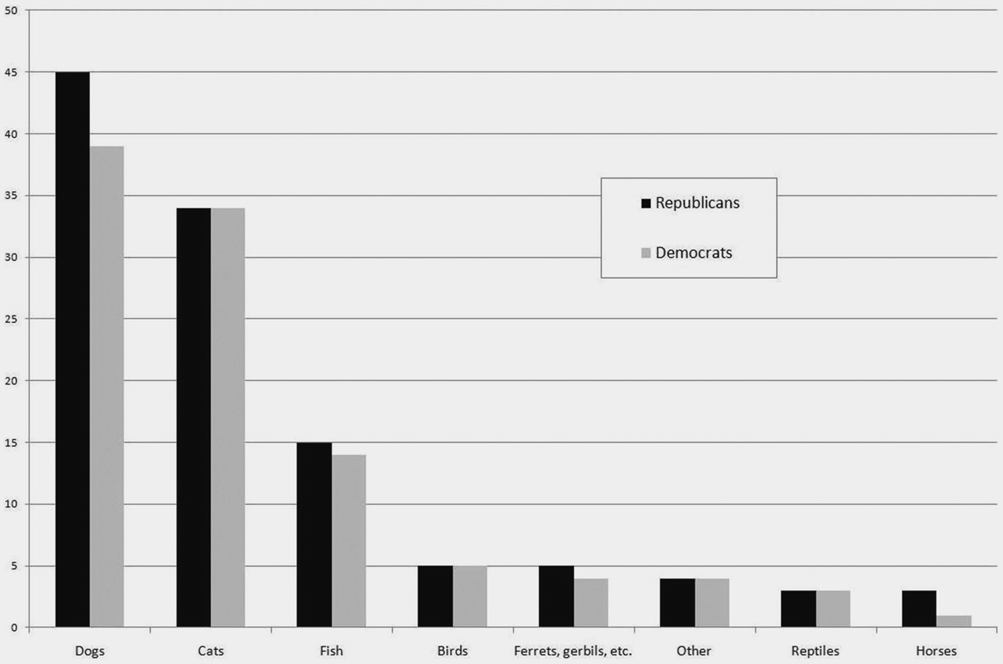
NietzcheFigure 1 illustrates the partisan profile of pet owners. Interestingly, although 35% of the public is petless, an average of 1.07 species per respondent is still reported in our representative sample. (Whether people had multiple pets of the same species was not reported.) The stereotype of a pet owner “is a more compassionate person—caring, giving, trustworthy” (Associated Press 2008). Democrats might well assume that this label was their own based on patterns of issue ownership, but Republicans appear to have cornered the market on pet ownership. As shown in figure 1, in all cases in which a difference between parties exists, it is Republicans who are more likely to own pets. Six percent more Republicans than Democrats own dogs (t = 8.90, p < .001), although there is no significant difference in cat ownership. Republicans are also significantly more likely to own fish (t = 3.61, p < .001), horses (t = 5.95, p < .001), and ferrets and rodents (t = 2.71, p < .001), although these other differences remain quite small at only 1% to 2%. More than anything else, it is dog ownership that makes Republicans stand out.
Percent of Americans Owning Pets, by Type of Pet and Political Party
Note: Respondents were asked whether they currently owned any of the above kinds of pets and checked off yes or no responses to each. Thus, individuals could report multiple species of pets, but could not report multiple pets of the same species. Significant differences between Republicans and Democrats were found for dogs (t = 8.90, p < .001), fish (t = 3.61, p < .001), horses (t = 5.95, p < .001), and ferrets/gerbils (t = 2.71, p < .001). Independents are not shown.

Of course, Republicans are different from Democrats in many other ways as well, so the question remains as to whether pet ownership truly has an independent impact on presidential vote preference. Is owning a horse correlated with supporting a Republican candidate simply because both horse ownership and Republican party identification are predicted by income? Does one candidate attract more support among dog owners because these people are home owners or in the stage of life in which dog ownership is most likely?
In the first model evaluating the impact on each dependent variable, I estimate a conservative model with only party, ideology, and economic perceptions as controls. In a second model, I include standard demographic controls as well as the litany of other potentially confounding characteristics.
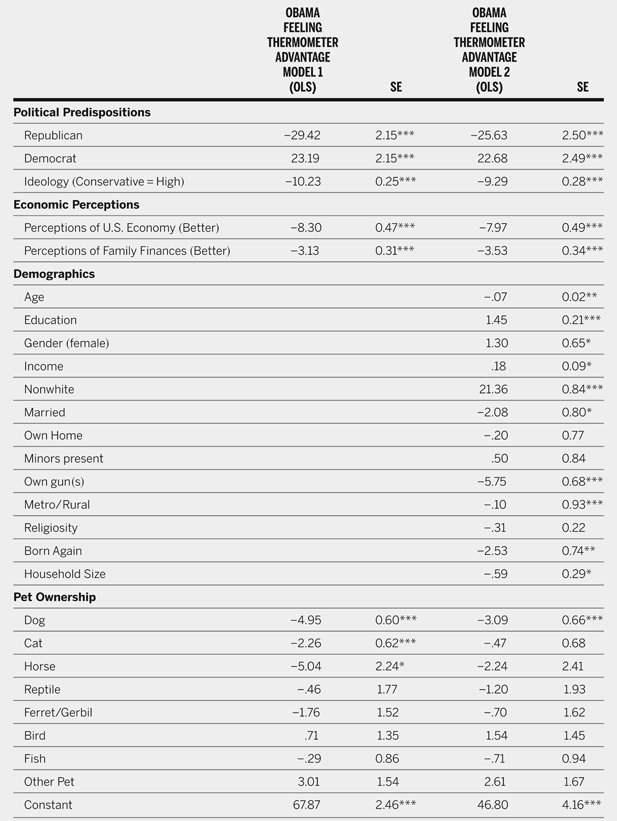
Table 1 shows the results of two OLS regression models using Obama's relative advantage on the feeling thermometer as the dependent variable. The first column provides a lean, potentially underspecified model testing the key hypotheses. Only the well known and important political and economic variables are controlled, including party, ideology, and economic perceptions. All of these variables behave as one would expect, predicting a large amount of variance in Obama's relative advantage. But despite the fact that these variables play a very powerful role in predicting presidential preference, dog ownership remains significant, accounting for 5 points of additional McCain advantage. Interestingly, cat ownership and horse ownership also have a negative impact on Obama's advantage, although cat ownership appears to have a much smaller magnitude of impact.
Effects of Dog Ownership on Obama Feeling Thermometer Advantage

Note. For Model 1, N = 17,092; adj. R 2 = .53. For Model 2, N = 14,455; adj. R 2=.56.
* p < .05,
** p < .01,
*** p < .001
Given that other ostensibly nonpolitical factors may confound the relationships observed in Model 1, a second model provides the potentially overspecified equivalent, a humongous equation leaving no stone/variable unturned, including everything but the kitchen sink as a control variable to ensure that skeptics are convinced about what remains.
Here the impact of dog ownership is reduced in magnitude but hardly obliterated. The coefficient in Model 1 is reduced from approximately five points on the thermometer scale to only three, but despite the many demographic and other variables, it remains highly significant. With the inclusion of the other controls, cat ownership, a significant negative influence in Model 1, is no longer significant, nor is ownership of any other species of pet. Dog ownership is clearly unique in its impact on political preference in 2008.
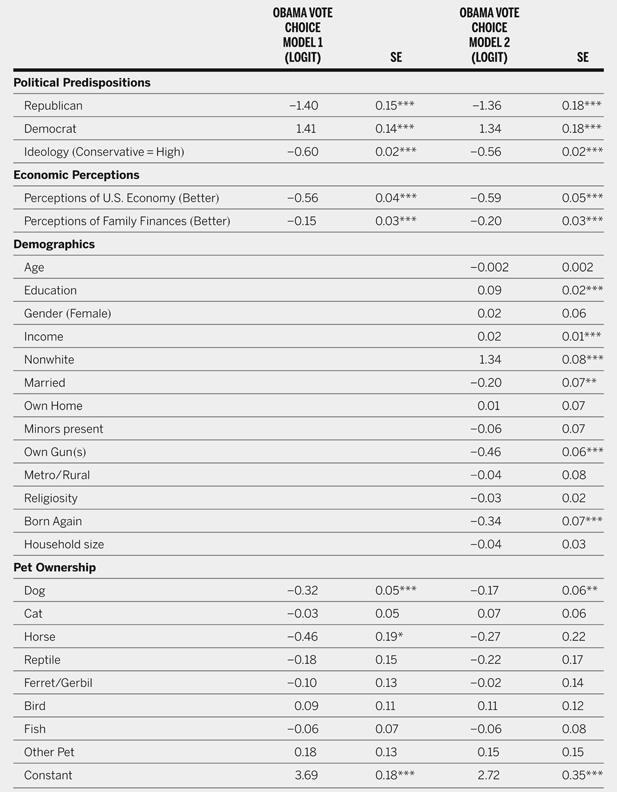
Table 2 shows the results of two logit models using vote for Obama as the dependent variable. The first model here is similar in results to Model 1 in table 1, but instead of the significant negative influence from cat ownership, only horse ownership has a negative impact on voting for Obama. The more fully specified Model 2 corroborates Table 1's findings. Even after taking on a bloated collection of control variables, dog ownership retains its significant impact. The size of the coefficient is again reduced with the inclusion of so many additional controls (from −.32 to −.17), but dog ownership remains a significant negative predictor of casting a ballot for Obama, whereas ownership of all other species is, unsurprisingly, irrelevant to vote preference.
Effects of Dog Ownership on Probability of Obama Vote

Note. For Model 1, log likelihood = −5,547.69; χ2 = 10,536.33, p < .001; pseudo R 2 = .49; N = 15,607. For Model 2, log likelihood = −4,436.68; χ2 = 9,420.76, p < .001; pseudo R 2 = .51; N = 15,189.
* p < .05,
** p < .01,
*** p < .001
DISCUSSION
“All knowledge, the totality of all questions and all answers, is contained in the dog.”
Franz KafkaWhen, on April 12, 2009, the Obama family finally acquired a dog, the headlines read, “The Obamas' Dog Has Arrived—At Last!” At last indeed! The political relevance of this event resides in just how long it took the family to get a dog. By highlighting his family's petlessness, Obama unintentionally created a point of difference between himself and many members of the voting public who had trouble identifying with a man without a canine.
The three-point difference in thermometer scores that survived an unusually extensive collection of control variables may not seem like a substantial effect at first. However, taken in context, one would be hard pressed to call this effect trivial. For example, considering oneself “born again” lowers support for Obama by less than this amount, and yet few would call this political contingent inconsequential.
In the analysis shown in table 2, with self-reported vote choice as the outcome of interest, the size of the effect was unmistakably substantial as well as statistically significant. According to the fully specified logit model, all else being equal, the odds decreased by 16% if the respondent was a dog owner. This large impact occurred despite the many other potential confounding influences controlled for in table 2. Given that the outcome of some presidential elections is decided by far less than such a margin, studies of voting behavior clearly need to take dogs and their owners more seriously.
In Obama's case, the negative impact of his petlessness is clearly driven by the dog-owning public's inability to identify with a president who didn't know FrontlineFootnote 3 from a filibuster. I found no evidence that the votes of owners of other kinds of pets with more Obama-like personalities (e.g., cats) benefited his candidacy. In fact, the impact of owning other kinds of pets was either negative or negligible throughout, thus casting greater support for canine group identification theory. The dog-owning portion of the electorate appears to agree with Calvin Coolidge's admonition that “any man who does not like dogs and want them about, does not deserve to be in the White House” (Rowan and Janis Reference Rowan and Janis1997, 3).
In short, Democrats should be wagging their tails over the arrival of Bo Obama, who could play well to potential swing voters in 2012. It is probably no accident that a seasoned politician like Ted Kennedy gave the Obamas the dog as a gift when the public was just about to give up on this long-awaited campaign promise. On the one hand, Obama supporters may feel some relief at knowing that the White House now has a canine resident, particularly in advance of the 2010 midterm elections. But if he is to reap the benefits of this change in lifestyle, President Obama would be well advised to give the pooch a much higher public profile than he has to date.
Thus far, Bo Obama has spawned a lookalike Beanie Baby and two children's books, but he has yet to manifest a strong presence among the adult, voting public. The fact that he makes so few public appearances has prompted at least one blogger to speculate that this Portuguese water dog might be a Vietnamese water torture dog instead (Broughton Reference Broughton2009). Dog owners cannot be brought on board unless they are reminded of Bo's presence. Assuming Bo does not bite (and perhaps even if he does), the president needs to parade him in front of the Washington press corps regularly to remind the American public that he, too, has a best friend.