Introduction
Children begin to productively combine words into multiword utterances around their second birthday, and even at the very start of this linguistic phase children show implicit knowledge of the word order for their native language (Brown, Reference Brown1973). The learning process involved in this linguistic achievement has been a significant area of interest for psychologists, linguists, and other cognitive scientists (Ambridge & Lieven, Reference Ambridge and Lieven2011). Various competing accounts attempt to explain how exactly children learn the grammatical rules for word order.
Generativist approaches such as the Syntactic Bootstrapping Hypothesis (Gleitman, Reference Gleitman1990; Naigles, Reference Naigles1996; Pinker, Reference Pinker and MacWhinney1987) argue that children are able to process the basic structure of sentences from very early in development, and that they draw links between semantic and syntactic cues in order to learn word meanings. This utilisation of the relationship between syntactic and semantic information has been widely supported in studies with young children (e.g., Gleitman, Cassidy, Nappa, Papafragou, & Trueswell, Reference Gleitman, Cassidy, Nappa, Papafragou and Trueswell2005; Naigles & Swensen, Reference Naigles and Swensen2007), and findings such as these have led to speculation regarding the mechanisms that underpin this syntactic bootstrapping. One such hypothesised mechanism is the ‘structure-mapping’ account; this view proposes that children focus on syntax as a reliable cue for extracting semantic information about the meaning of verbs. From a Syntactic Bootstrapping perspective, grammatical acquisition should not depend on word frequency, as it is a rule-based account rather than an item-based one. The empirical research supporting this approach typically uses methodologies that assess implicit language comprehension in very young infants, such as the intermodal preferential looking design (e.g., Candan, Küntay, Yeh, Cheung, Wagner, & Naigles, Reference Candan, Küntay, Yeh, Cheung, Wagner and Naigles2012; Fisher, Reference Fisher2002; Naigles, Bavin, & Smith, Reference Naigles, Bavin and Smith2005; Wagner, Swensen, & Naigles, Reference Wagner, Swensen and Naigles2009).
Constructivist accounts oppose the views of generativist and innateness accounts such as syntactic bootstrapping. Constructivist accounts propose that the knowledge required for children to grammatically build words into sentences is gradually constructed over the first few years of a child's life, being linked initially to a limited number of lexical units (typically verbs and nouns) which are frequent in the native language (Ambridge, Kidd, Rowland, & Theakston, Reference Ambridge, Kidd, Rowland and Theakston2015; Braine, Reference Braine1976; Ellis & Ogden, Reference Ellis and Ogden2017; Kidd, Lieven, & Tomasello, Reference Kidd, Lieven and Tomasello2006; McClure, Pine, & Lieven, Reference McClure, Pine and Lieven2006; Pine & Lieven,Reference Pine and Lieven1997; Tomasello, Reference Tomasello2003). Children then generalise across examples, allowing them to abstract the agent–patient markers and develop a more robust and internalised representation of word order grammatical conventions.
Essentially, the debate relates to whether children's acquisition of word order and agent–patient relationships is learnt or fundamentally innate (Matthews, Lieven, Theakston, & Tomasello, Reference Matthews, Lieven, Theakston and Tomasello2007). Whilst there is some support for innateness (e.g., Gertne, Fisher, & Eisengart, Reference Gertner, Fisher and Eisengart2006; Yuan, Fisher, & Snedeker, Reference Yuan, Fisher and Snedeker2012), there is an overwhelming amount of literature showing that this grammatical knowledge refines and strengthens over the first few years of a child's life, suggesting an element of learning (e.g., Chater & Christiansen, Reference Chater and Christiansen2010)
The Weird Word Order (WWO) procedure has been used in an attempt to shed light on this key debate (e.g., Akhtar, Reference Akhtar1999). In this procedure, children hear an event described (using either known or novel verbs) in a non-canonical, ungrammatical, ‘weird’ word order. Children see the event with different characters and are asked “What is happening?” The significant point of interest is whether the child describes the event using the ‘weird’ order, or whether they reorganise the sentence to fit the canonical conventions of their native language. Akhtar (Reference Akhtar1999) was the first to use the WWO paradigm. She presented native English-speaking two-, three-, and four-year-old children with novel verbs in non-canonical subject–object–verb (SOV) sentences (e.g., “Elmo the car meeking”). Akhtar found that when the two-year-old and three-year-old children were asked “What is happening?”, they were more likely to provide the SOV (‘weird’) word order rather than a canonical SVO construction. However, the four-year-old children were more likely to correct the ungrammatical construction, and to explain the event using a reorganised grammatical SVO word order. This age effect suggests gradual learning in the acquisition of word order conventions and lends support for Constructivist and data-driven accounts for grammar acquisition.
Abbott-Smith, Lieven, and Tomasello (Reference Abbot-Smith, Chang, Rowland, Ferguson and Pine2001) applied Akhtar's WWO method and manipulated the frequency of verbs and the age of participants to further examine whether word order acquisition is indeed a gradual learnt process in English-speaking children. It was found that: (a) children were more likely to revert to canonical order with frequent verbs as compared to infrequent verbs; (b) older children were more likely to correct ungrammatical constructions to grammatical orders than younger children; and (c) there was an interaction between the frequency of verbs and age group, such that younger children were less likely to reorganise ‘weird’ ungrammatical word orders with low-frequency verbs; older children showed much less of an effect of verb frequency This finding is supported by Matthews et al. (Reference Matthews, Lieven, Theakston and Tomasello2005), who also found effects of frequency and age when using the WWO method with English-speaking two- and three-year-old children. That is, older children were more likely to reorganise the WWO sentences into canonical SVO orders, and sentences containing low-frequency items were less likely to be reorganised into canonical SVO word order than those containing high-frequency items.
There appears to be clear evidence for the effects of age in the WWO paradigm for English-speaking children, as well as for the frequency of verbs, when considering the acquisition of word order. In addition to verbs, pronouns can provide English-speaking children with cues which aid the acquisition of grammatical schemas (Pine, Lieven, & Rowland, Reference Pine, Lieven and Rowland1998). The studies by Akhtar (Reference Akhtar1999), Abbot-Smith et al. (Reference Abbot-Smith, Lieven and Tomasello2001), and Matthews et al. (Reference Matthews, Lieven, Theakston and Tomasello2005) all provide evidence that English-speaking children also have some knowledge base around the grammatical word order conventions of pronoun use.
Researchers have applied the WWO paradigm to other languages to further explore the effects of age and frequency, in an attempt to better understand the development of children's word order grammatical conventions. However, the findings are much less clear than they are in studies using English-speaking children. For instance, Matthews, Lieven, Theakston, and Tomasello (Reference Matthews, Lieven, Theakston and Tomasello2007) used the WWO for native French-speaking children – a language that has a more flexible word order than English. Matthews et al. found that the children reorganised the sentences to the canonical SVO order significantly more often with frequent verbs than with infrequent ones, although no effect was found for age. Franck, Millotte, and Lassotta (Reference Franck, Millotte and Lassotta2011) also found frequency effects in French children, but their findings suggest that performance in the WWO paradigm is dependent upon the particular weird word order used. In studies using Japanese children, no frequency effects are shown; however, age does appear to have some impact on WWO performance (e.g., Chang, Kobayashi, & Amano., Reference Chang, Kobayashi and Amano2009).
To summarise, the exact nature of the acquisition of word order grammatical conventions remains unclear, particularly when cross-linguistic research is examined. The verb-frequency effect is unclear in Japanese, an SOV language allowing for null subjects. The effect is clearer in English, a strict SVO language that does not allow for null subjects, and, although it is demonstrated in French (a less strict SVO language, which does not allow null subjects), development seems to follow a more gradual pattern. With this in mind, it seems that more research is needed which explores children's understanding of agent–patient relationships in languages other than English.
The grammatical conventions of Spanish are rather unique, in that it has two diverging properties: (1) subject pronouns can be omitted, and (2) word order is extremely flexible (Kahane & Kahane, Reference Kahane and Kahane1950; Contreras, Reference Contreras1976). Three main variations of post-verbal subjects are acceptable in Spanish: VSO, VOS, and OVS, of which OVS is the least frequent. Compared to French, these word orders do not require clitic pronouns. In fact, VSO is a particularly common structure in Spanish interrogative sentences, while SVO sentences are particularly rare in questions (Aijón Oliva & Serrano, Reference Aijón Oliva and Serrano2012). Serrano (Reference Serrano2014) reviewed an oral corpus and found 101 post-verbal subjects in a total of 1,474 sentences with overt subjects (i.e., 6.9% of the subjects were placed after the verb), and 47 of them included objects (i.e., 46.5% of the post-verbal subjects consisted of full VSO sentences). VOS sentences are much less frequent (8 out of 101 cases, accounting for 7.9% of post-verbal sentences). This is explained in terms of cognitive salience and textual informativeness, such that verbs increase in informativeness, and decrease in salience, when subjects are placed in final position.
Due to the uniqueness of Spanish grammatical word order conventions and the lack of clarity from WWO studies using non-English languages, an analysis of the WWO effects with Spanish-speaking children could shed more light on the current debate surrounding the nature of children's early representations of word order. The present paper includes analyses of the order of words that Spanish children hear in child-directed speech (Study 1). In Study 2, we include a replication of the design adopted by Matthews et al. (Reference Matthews, Lieven, Theakston and Tomasello2007): Spanish children are split into two age groups and trained in two different word orders (SOV and VSO) with two levels of verb frequency (high-frequency and low-frequency).
Hypotheses stemming from the syntactic bootstrapping account would predict that, as long as the grammatical properties of this system are already available to children, SVO structures would be preferred early in development. Although constructivist positions would propose an alternative explanation, in practice a very similar effect would be predicted from this approach, since SVO is more frequent than other word orders. The only factor that could differ is the potential impact of frequency on word order. Constructivist positions predict a higher level of flexibility with infrequent verbs (i.e., word order would be less entrenched into SVO organisation) than with frequent verbs, whereas hypotheses adopting early access to grammatical knowledge would predict no (or very little) frequency effects. Finally, the effect produced by the relative frequency of verbs is predicted to gradually become less acute with age.
Method
This study used a 2 × 2 × 2 (age × verb frequency × word order) experimental design, with between-subjects variables of age group (three-year-olds vs. four-year-olds), verb frequency (high vs. low), and word order (SOV vs. VSO). This is the same method adopted by Mathews et al. (Reference Matthews, Lieven, Theakston and Tomasello2007) so that meaningful comparisons can be made. Therefore, any given child was allocated to one age group, one verb frequency condition (high or low), and one ‘weird’ word order condition (SOV or VSO).
Participants
An initial sample of 84 monolingual Spanish children participated in this study, with an equal number of boys and girls (42). Out of all 84 children, the data corresponding to nine children (10.71% of the total) were not included in the analyses due to experimental errors (e.g., wrong selection of the training sentences) on three occasions, or because children did not appear to understand the demands of the experiment (on six occasions). This left 75 children in the final analyses.
Two age groups were considered: (a) 36 younger children with an average age of 2;11 (range 2;2–3;2); and (b) 39 older children with an average age of 3;10 (range 3;3–4;5). Eleven remaining children failed to produce any of the test verbs (14.67% of the total): five in the older group (12.82%) and six in the younger (16.67%). A sample of participants of the present size requires a large effect size (η2 ⩾ 0.58) to achieve a significant effect of the main factors, assuming a power value 1- β = 0.8 (critical t = 1.67, assuming p < .05 one-tailed).
Ethical disclosure
Parental consent forms were obtained from all participants. Children were informed that participation was voluntary and that they could withdraw their participation at any point during the ‘game’ (study). Ethical approval was obtained from the research institutions (Universidad de Zaragoza and Universidad Complutense de Madrid).
Materials and stimuli
Six different animal puppets (bear, dog, duck, frog, ladybird, and monkey) were used to create 48, one-minute-long videos clips (see Aguado-Orea, Reference Aguado-Orea2016, for further details). In each video, two puppets performed four actions. There were a total of eight test verbs, four low-frequency and four high-frequency, which related to the actions in the videos. The verbs were paired, such that there was a high-frequency and a low-frequency token which matched one action (thus there were four actions depicted by the puppets, but eight verbs used to describe these actions). In total, 96 transitive sentences were constructed which combined the eight different verbs (besar ‘kiss’ / lamer ‘lick’; coger ‘take’ / atrapar ‘trap’; pegar ‘hit’ / palpar ‘palpate’; tirar ‘throw’ / lanzar ‘launch’) with the names of all six animals in either SOV or VSO word order. An example of an SOV sentence with a high-frequency verb is shown in (1), and its low-frequency alternative is shown in (2).
(1) ?mono perro besa [ = monkey dog kisses]
(2) ?mono perro lame [ = monkey dog licks]
Examples of low- and high-frequency verbs within VSO sentences are shown in (3) and (4), respectively.
(3) ?besa mono perro [ = kisses monkey dog]
(4) ?lame mono perro [ = licks monkey dog]
The frequency of the verbs was determined by the oral datasets of the CORDE corpus (Real Academia Española, 2016). Besar is more frequent (18 tokens) than lamer (1), coger (397) is more frequent than atrapar (7), tirar (296) is more frequent than lanzar (107), and pegar (294) is more frequent than palpar (6).
Procedure
The study took place in a silent room at school and had three phases.
(1) Familiarisation phase
The experimenter explained that there were some animals living in the bag, and the child could play with them as long as they said their names correctly first. She then took the animals out of the bag one by one. All children could spontaneously name these animals after being asked “What is this?” or “What animal is this?” Occasionally, these names had to be elicited by the experimenter with a construction such as: “It's a bear, isn't it? Now, say it yourself.” After establishing that the children could name the animals, the experimenter acted out all four actions with the puppets, and labelled them with either the frequent or infrequent alternatives depending on the condition. Typically, the experimenter would use the sentence “¿Sabes lo que es lamer?” ‘Do you know what to lick is?’. Children were also asked to perform the action previously demonstrated by the experimenter to further establish that they knew the actions. If the child did not show that they understood the meaning of the action correctly, the experimenter re-enacted it for the child, until it was clear that they held sufficient knowledge of all eight experimental verbs.
(2) Training phase
Two videos selected in a pseudo-random sequence were then presented to the child via a laptop computer. During the first seconds of the video, the experimenter used the sentence “Mira lo que hace X” ‘Look what X is doing’. Then, the experimental sentence chosen for that action (e.g., mono perro besa ‘monkey dog kisses’) was repeated four times by the experimenter, including prompts like “¿Has visto?” ‘Did you see?’ or “Mira” ‘Look’ to make the situation a little more natural. The sentences that the children heard matched their group allocations with regards to both verb frequency and word order. A second training video was then presented, with two different puppets performing the same action as the first training video (e.g., mariquita rana besa ‘ladybird frog kisses’).
(3) Test phase
A third silent video was presented with the two remaining puppets performing the same action as the test videos. The child was then asked “¿Qué es lo que pasa aquí?” ‘What's happening here?’, and “¿Qué ves aquí?” ‘What do you see here?’. If the child failed to answer, the experimenter would move on to the next trial.
The training and test phases were repeated three more times, until a child was tested with all four verbs for their frequency and word order group allocations. In total, children watched 12 different videos, three for each action. For example, take a child allocated to the ‘high-frequency’ verbs condition and ‘SOV’ word order condition. They would see two training videos and one test video for each of the four actions (total of 12 videos), and would hear the actions being described by the experimenter using the high-frequency verb token in an SOV word order.
Coding
Children's utterances were transcribed using audio-recordings of the sessions. Total or partial unintelligible utterances were discarded, as well as sentences without verbs. Following Matthews et al. (Reference Matthews, Lieven, Theakston and Tomasello2007), remaining sentences were classified as either: (1) matches if they included the weird word order; (2) full reversions, if the sentences had been reorganised into SVO order; and (3) one argument reversions, if one of the NPs (acting as subject or object) was missing (i.e., the child had produced an SV or VO sentence instead of a full SVO). In Spanish, children may drop the subject of the sentence whilst maintaining its grammaticality (unlike in English and French, VO is an accepted construction in Spanish). Children may also provide a clitic pronoun before the verb, as in (5). A verb preceded with only one clitic pronoun would be grammatical too, as in (6).
(5) le besa al mono [= (it) to-him kisses the monkey]
(6) le besa [= (it) to-him kisses (it)]
Clitic pronouns were not taken into account when coding sentences as either SV or VO. Therefore, the example shown in (6) was not considered for the analysis. However, the sentence shown in (5) was considered a VO partial reversion. Therefore, for the purpose of this particular analysis, we analysed whether children used clitic pronouns in their utterances or not; we did not consider whether clitic pronouns were used specifically as examples of objects or subjects.
Results
Study 1
The use of the WWO paradigm for native Spanish children is novel, and so it seemed wise to assess the extent to which the word orders used in this study (VSO and SOV) are indeed atypical for Spanish children, compared to the canonical SVO order. First, we made a preliminary search within the Orea–Pine corpus (Aguado-Orea & Pine, Reference Aguado-Orea and Pine2015) and found that 8,926 sentences (62.02% of the total) did not include overt subjects in the child-directed speech. After removing interrogative and imperative sentences from this count, there were 2,092 declarative sentences with overt subjects, of which 1,480 consisted of noun phrases (i.e., 10.28% of the sentences in the child-directed speech). In terms of word order, a considerable number of these sentences did not include objects (487 sentences; 73.23% of the total). 146 (21.95%) sentences included all three constituents in SVO word order, 32 (4.81%) consisted of VSO sentences, and no SOV sentences were observed. This therefore confirms that the ‘weird’ VSO and SOV word orders used in this study are indeed atypical for native Spanish children.
Study 2
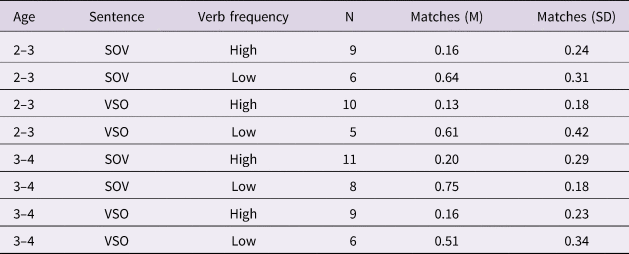
Table 1 summarises the proportion of matched sentences (relative to the number of valid responses) for all three experimental conditions (age, verb frequency, and word order). The dependent variable was the proportion of sentences matching the WWO relative to the total number of valid sentences. Three independent variables were considered, each with two levels: age (three- vs. four-year-olds), type of WWO sentence (SOV vs. VSO), and verb frequency (high vs. low). The only significant effect related to the frequency of verbs: there were more constructions matching the atypical word order (F(1,56) = 45.64, p < .001; η2 = 0.45) with low-frequency verbs (M = 0.63, SE = 0.05) than with higher-frequency verbs (M = 0.16, SE = 0.04). Similar to the results reported by Matthews et al. (Reference Matthews, Lieven, Theakston and Tomasello2007) for French (but not for English), no significant effects were found for age (three-year-olds: M = 0.38, SE = 0.05; four-year-olds: M = 0.40, SE = 0.05) (F(1,56) = 0.06, p = 0.80) and type of sentence (SOV: M = 0.44, SE = 0.05; VSO: M = 0.35, SE = 0.05) (F(1,56) = 1.48, p = .23). Additionally, there were no interactions between factors (Age*Freq: F(1,56) = 0.06, p = .81; Sentence*Freq: F(1,56) = 0.49, p = .49; Age*Sentence: F(1,56) = 0.70, p = .41; Sentence*Freq*Age: F(1,56) = 0.53, p = .47).
Proportion of matches per experimental group and condition (N = number of children contributing data per type of sentence and verb)

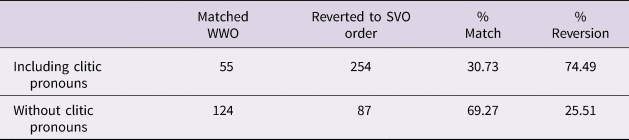
A further analysis looked at the proportion of matched sentences constructed with either noun subjects (e.g., “tira el mono a la rana”) or clitic pronouns (e.g., “que le va a tirar el mono a la rana”), and the corresponding proportion of reverted sentences constructed with nouns subjects (e.g., “el mono tira a la rana”, “el mono tira”, or “tira a la rana”) or clitic pronouns (e.g., “el mono le tira a la rana”, or simply “le tira a la rana”, or “el mono la tira”). Table 2 outlines a summary of the results.
Proportion of matches and reverted sentences including or excluding clitic pronouns

Even though the sentences the children heard during the training phase did not include clitic pronouns, the children often incorporated them during the test phase. Children were significantly more likely to use a clitic pronoun when reverting to the canonical SVO word order (74.49%), as compared to instances where they matched the WWO construction (30.73%) (Yates’ chi-square = 91.42; d.f. = 1; p = .004; Cramer's V = 0.42).
We also looked at the potential effect of verb frequency on the use of either NP or clitic arguments. Frequency of verbs had a significant effect over both constructions: when children matched the WWO and when they reverted to the conventional SVO order. When children matched the WWO, they were significantly more likely to include clitic pronouns when the test sentences contained high-frequency verbs (M = 72.3, SE = 8.09), as compared to sentences which contained lower-frequency verbs (M = 26.8, SE = 6.77) (F(1,32) = 18.61, p < .001, η2 = 0.30). No significant effect of age was observed (three-year-olds: M = 55.20, SE = 7.86; four-year-olds: M = 43.90, SE = 7.03) (F(1,32) = 1.14, p = .29). Similarly, the percentage of constructions with clitic pronouns reverted to SVO order was significantly larger with frequent verbs (M = 83.6, SE = 4.24) than the equivalent percentage of constructions with lower-frequency verbs (M = 54.8, SE = 6.36) (F(1,48) = 14.11, p < .001, η2 = 0.22). No effect of age was observed for reverted sentences with clitic pronouns (three-year-olds: M = 70.80, SE = 5.82; four-year-olds: M = 67.60, SE = 4.96) (F(1,48) = 0.18, p = .68).
Discussion
The present study found that native Spanish-speaking children were more likely to describe an event using a ‘weird’ word order when the sentence contained a low-frequency verb, as compared to a high-frequency verb. In turn, children were more likely to reorganise a sentence presented in a weird, atypical (SOV or VSO) word order to a canonical SVO order when it contained a high-frequency verb, as compared to a low-frequency verb. No significant difference was found in the proportion of matched (‘weird’) sentences and overall reversions to canonical word order between the two age groups.
Previous studies have shown an age effect in English (Matthews et al., Reference Matthews, Lieven, Theakston and Tomasello2005), where older children were more likely to reorganise WWO sentences into canonical order than younger children. This was not shown with French children (Matthews et al., Reference Matthews, Lieven, Theakston and Tomasello2007), and a striking opposite effect was found in Japanese children (Chang et al., Reference Chang, Kobayashi and Amano2009). This could indicate that the developmental path of word order acquisition in flexible word order systems (like French and Spanish) is so slow that the WWO technique fails to capture it. That is, even by the age of four (as per the ‘older’ age groups in the present study and Matthews et al., Reference Matthews, Lieven, Theakston and Tomasello2007), children speaking languages with more flexibility in their word order conventions have not yet fully internalised the relevant grammatical rules. In the case of Japanese, Chang et al. (Reference Chang, Kobayashi and Amano2009) used a robotic dog to train the sentences, and so older children could have interpreted that a playful version of Japanese was required in order to give successful instructions to the robotic dog. In addition, verbs are placed in the sentence-final position in Japanese. This could be boosting their saliency, and hence reducing the potential effect of frequency, as shown by computational models of syntax acquisition that adopt an end of sentence anchor (Freudenthal, Pine, Aguado-Orea, & Gobet, Reference Freudenthal, Pine, Aguado-Orea and Gobet2007).
With regards to verb frequency, our study replicates the results found in French (Matthews et al., Reference Matthews, Lieven, Theakston and Tomasello2007) and English (Matthews et al., Reference Matthews, Lieven, Theakston and Tomasello2005). Therefore, even though word order is somewhat flexible in Spanish, the three- to four-year-old children in this study appear to have acquired robust knowledge of the prototypical syntactic structure of Spanish sentences, since they preferred to use high-frequency verbs in SVO structures.
The second implication of these results is that the morphosyntactic knowledge of a native Spanish-speaking two- to three-year-old child is somewhat incomplete, as, although children used familiar verbs with familiar structures, they did not use unfamiliar verbs with known structures in every instance. According to Lieven (Reference Lieven2010, p. 2548), these types of experimental findings fit well with “a view of language learning as a process of developing a network of interconnected representations that will change with development, showing more or less abstraction as a function of the relative degree of entrenchment of various parts of the system”. These findings also highlight the powerful effect that NP subjects in initial position may have in the learning process, since children could be treating verb-subject-initial sentences as less acceptable than subject-object-initial sentences (Abbot-Smith, Chang, Rowland, Ferguson, & Pine, Reference Abbot-Smith, Chang, Rowland, Ferguson and Pine2017).
Another interesting finding from this study concerns the use of clitic pronouns. Children were significantly more likely to incorporate clitic pronouns with high-frequency verbs (as compared to low-frequency verbs) when reorganising a WWO sentence to a canonical SVO order, and when producing a WWO matched sentence. The tendency to include clitic pronouns in sentences with higher-frequency verbs supports the predictions of the constructivist approach. According to the classical idea of slot and frame patterns (Braine, Reference Braine1976; Pine & Lieven, Reference Pine and Lieven1997), the early combinations of lexical units (i.e., morphemes or words) are restricted to very frequent items appearing contiguously in speech production. The sentences provided by children in the present experimental setting could be the effect of either (1) combinations of clitics with frequent verbs not being fully analysed (resulting in SVO sentences, e.g., “le tira al oso”), or (2) an increasingly productive system built on frequent verbs and clitics resulting in grammatical WWO sentences (e.g., “la mariquita al oso le tira”), but not infrequent ones (e.g., “la mariquita al oso lanza”). Kail (Reference Kail, MacWhinney and Bates1989) argues that French-speaking children may rely more on clitic particles than word order as they age because they become more familiar and proficient with the flexibility permitted in their language. This certainly seems to be a plausible explanation for the current study findings, too.
To conclude, the present replication of the WWO paradigm shows that children exposed to languages with less transparent systems also display a stable preference for the SVO order, even when they are in the early stages of their language development. This study also demonstrates that this early predisposition changes gradually, subject to the probabilistic distribution of words in their languages, indicating that non-canonical SVO structures are also deemed acceptable at these early stages.