Disasters, whether natural or man-made, occur all too frequently. The terms disaster and emergency preparedness encompass various scenarios, including weather-related events, hazardous materials exposures, power outages, structural failures, active shooters, and infectious disease outbreaks/pandemics. 1 Infants and young children are a particularly vulnerable population and are routinely overlooked during disaster and emergency planning in the United States. Reference Olympia, Brady and Kapoor2 With 2 of 3 children under 5 years of age attending out-of-home child care in the United States, Reference Laughlin3 child care programs (child care centers, nurseries, preschools, and federally funded Head Start programs) must be adequately prepared for disasters and emergencies.
However, there is clear evidence that the US child care sector is ill-prepared for disasters and emergencies. Reference Hashikawa, Chang and Sielaff4 A 2010 report card published by the international organization Save the Children found that only 12 of 50 states met all 4 minimum standards of preparedness, which include requiring all licensed child care facilities to have written plans for evacuation, family reunification, and consideration of children with special needs in the event of a disaster or emergency. In 2015, the same group reported that only one-fifth of all disaster planning recommendations made after Hurricane Katrina had been fulfilled. 5,6 Other studies have found that child care centers are inadequately prepared for influenza pandemics. Reference Shope, Walker and Aird7 The child care sector faces multiple unique hurdles when planning for disasters and emergencies, including caring for a developmentally immature population, funding limitations combined with high operating costs, a scarcity of available training resources, and a lack of overarching federal guidance compared with schools.
Attempts have been made to improve child care programs’ disaster preparedness nationally and statewide. In 2014, federal funding for child care services for high-needs families (Child Care and Development Block Grant Act) was renewed and included new mandates for child care providers to undergo disaster planning and training. 8 In Michigan, having a written disaster and emergency plan became a licensing requirement in 2014. Many child care programs in Michigan also voluntarily participate in the Great Start to Quality (GSQ) Network, a nonprofit public organization created by the Early Child Investment Organization and funded collaboratively by federal, state, and private supporters. The GSQ network uses a rating system to track and report on the quality of child care in several domains. Notably, health and safety comprise only a small proportion of the rating system, and preparation for emergencies and disasters is not currently included. 9
In 2014, a statewide survey of Michigan child care programs owners and directors revealed that most programs were missing critical elements of disaster and emergency planning, including plans for multiple disasters, evacuation and relocation, family-child reunification, and children with special needs as recommended by the National Commission on Children and Disasters. Reference Chang, Bradin and Hashikawa10 It is unclear if Michigan child care programs have developed suitable emergency and disaster plans since state child care licensing regulations began requiring written preparedness plans that same year.
The goal of this 2020 study was to survey a cohort of licensed Michigan child care programs to: (1) compare responses with the 2014 survey by asking identical or similar questions to reassess the proportion of child care providers who reported having an adequate written disaster and emergency management plans that incorporated key pediatric standards, and (2) determine the impact of the COVID-19 pandemic on child care operations and providers’ perceived levels of pandemic preparedness by including COVID-19 related questions.
Methods
Study Design, Settings, and Population
Michigan has more than 12,000 registered licensed child care providers. 11 The Early Childhood Support Network (ECSN) comprises 4 larger regions within Michigan (Eastern, Northern, Southeast, and Western). The GSQ Network manages the quality rating and improvement system that supports child care programs and child care providers. 12 Each region facilitates collaboration to promote access to a coordinated early childhood system for providers and families and is funded by the Michigan Department of Education through federal Child Care Development Funds. Within these 4 regions are 10 resource centers that serve local child care providers through quality improvement coaching and professional development training. The GSQ Network routinely surveys a sample of ∼500 child care providers on various topics.
Survey Items and Distribution
In January 2020, study authors began collaborating with the Child Care Network, 1 of the 10 regional child care resource centers, to design a survey for licensed child care program providers. This survey was designed to follow up the 2014 study that assessed child care disaster and emergency preparedness in a state that had not previously required written disaster plans. Reference Chang, Bradin and Hashikawa10 The new anonymous online survey of 29 questions incorporated previously published questions about child care-specific disaster and emergency preparedness. Planning continued through March 2020 when the COVID-19 pandemic was declared; therefore, questions regarding the pandemic were developed and included as an adjunct to the original survey questions (Appendix 1). After the authors developed survey questions, the survey was submitted to GSQ Network leadership who evaluated the questions for content, appropriateness, and clarity. Minor edits were made to ensure terminology was clear to child care providers. The survey was emailed by the GSQ Network to their cohort of child care providers, the same cohort used for the 2014 study, within the regional networks within ECSN between May 26, 2020, and July 14, 2020. The University of Michigan medical school institutional review board approved an exception to informed consent.
Survey Analysis
Anonymous survey results data were collected by the Child Care Network and then sent for analysis to study authors in an electronic spreadsheet format. A convergent parallel mixed-methods design was used to collect and analyze the quantitative and qualitative components of the survey simultaneously.
Dichotomous and 5-point Likert scale responses were quantitatively analyzed. Descriptive statistics were used to analyze and report child care providers’ responses. Results from this survey were collated and compared with the 2014 survey responses (when identical questions were included in both surveys). Multivariate logistic regression analysis was performed to identify variables potentially associated with programs having a written infectious disease preparedness plan before the COVID-19 pandemic. Data analyses were performed using SAS OnDemand for Academics (SAS Institute Inc, Cary, NC).
Mixed Methods Assessment of the Effect of COVID-19
A mixed methods approach was used to identify operational changes and challenges faced by child care centers as a result of the COVID-19 pandemic. Quantitative analysis of survey questions and qualitative analysis of open-ended responses were integrated to provide a more robust understanding of the effects of COVID-19 on child care centers. Quantitative analysis of survey questions related to COVID-19 is described above.
Qualitative content analyses were applied to open-ended survey responses. A deductive approach was used by 2 research team members (E.B. and C.M.) to develop an initial codebook, which was revised as new themes emerged throughout the coding process (inductive approach). Reference Hsieh and Shannon13,Reference Bingham and Witkowsky14 Coding of the open-ended survey questions was independently performed by the 2 team members. Coding proceeded iteratively; the 2 coders debriefed then revised coding categories throughout the coding process. Codes were organized into categories and subcategories from which key themes were identified. Content analysis of the coded, open-ended responses was applied to identify major themes related to operational changes due to the COVID-19 pandemic. The investigators reviewed all surveys past the point of thematic saturation. Saturation was defined as when no new codes or themes were identified from the interviews. Integration of quantitative and qualitative results related to the effect of the COVID-19 pandemic occurred by means of merging; both sets of data were analyzed, compared, and integration was assessed for fit. Reference Fetters, Curry and Creswell15
Results
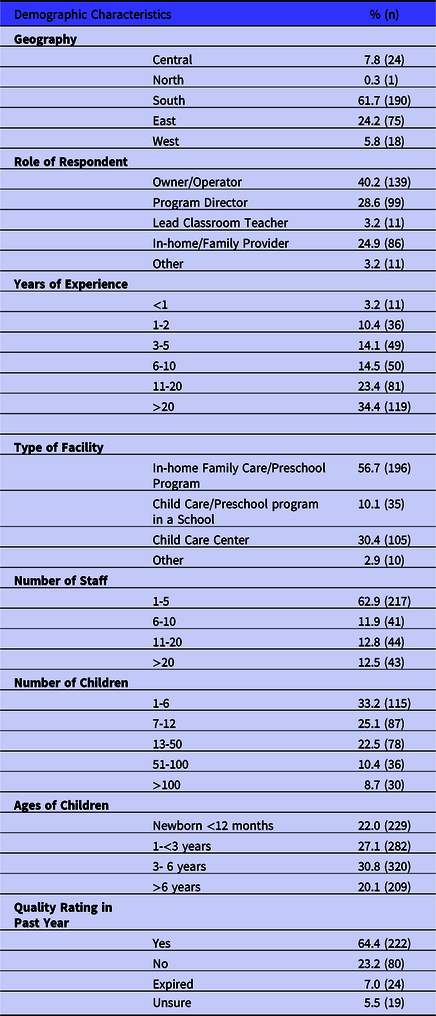
The survey was sent to licensed child care directors in Michigan through the ECSN regional networks. A total of 346 programs responded, with a response rate of 69.2%. The South and the East regions with ECSN had the highest proportion of responses at 61.7% and 24.2%, respectively (Table 1).
Demographics

Child Care Program and Director Characteristics
Center characteristics and demographic information are summarized in Table 1. Most respondents identified as owner/operators (40.2%) or program directors (28.6%), and the most common type of facility represented was an in-home program (56.7%).
Formal Disaster Plan
The vast majority (90%; n = 258) of programs reported having a formal written disaster or emergency evacuation and relocation plan, and 92% of facilities reported having a person responsible for disaster planning. The majority of respondents reported being “extremely concerned” (28%; n = 84) or “somewhat concerned” (49%; n = 145) about disasters affecting their program, with 15% of programs reporting registering with local emergency responders to facilitate their response during a disaster.
Comparing Critical Components of Disaster Planning: 2014 and 2020
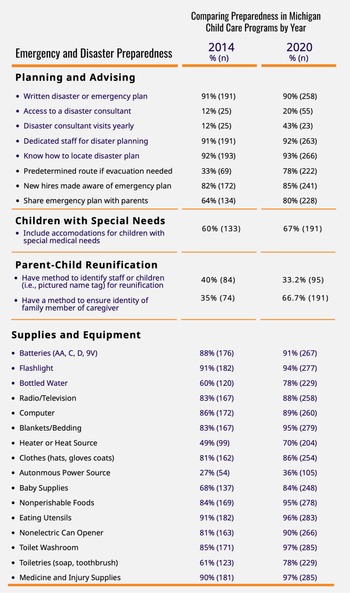
Figure 1 compares providers’ responses between 2014 and 2020. Regarding disaster plans for children with special needs, 67% of facilities reported having accommodations for children with special needs included in their plan compared with 60% in 2014. For evacuation and family-child reunification planning, 78% of programs reported having a predetermined route planned if emergency evacuation was necessary (vs 33% in 2014). Most programs (72%) incorporated a family reunification plan as part of their disaster plan (vs 49% in 2014). For child and caregiver identification, 38% of facilities had a method for identifying staff and children by means of name, tag, or picture identification (ID) badge (vs 40% in 2014). Two-thirds (67%) of respondents reported a method to ensure the validity/identity of a caregiver or family member by means of a state ID or some form of identification (vs 35% in 2014). Overall, improvements in preparedness were seen in the categories of disaster consultant visits, evacuation routes, emergency plan sharing with parents, and methods of ensuring family member identity during reunification.
Comparison of providers’ responses between 2014 and 2020.

Data regarding supplies and equipment in 2014 and 2020 are also presented in Figure 1. The 2 least available supplies in 2020 were an autonomous power source (generator) and a backup heat source, consistent with the previous study. There was, however, a slight increase in the proportion of programs with an autonomous power source (27% in 2014 vs 36% in 2020).
Regarding Emergency Information Forms (EIFs), the majority (66%) of respondents reported requiring EIF’s for children with special health care needs, and almost all facilities (98%) had a process for updating EIFs yearly. Most respondents (67%) reported not having a digital copy of EIFs stored on a cloud, disc, or computer and instead continued to rely on paper forms. Many respondents reported an interest in having a statewide standardized EIF form that all programs could use, with 41% responding “definitely yes” and 35% responding “probably yes”.
Resources and Training
Almost half (45.9%) of programs reported that before the COVID-19 pandemic, their staff did not receive emergency or disaster training. When asked to rank the most useful sources of information, the Centers for Disease Control and Prevention (CDC) was rated as the most beneficial source of information, while school districts and social media were rated as the least helpful. Online modules and in-person training were rated the most helpful, 7.4/10 and 7.2/10 on the Likert scale, respectively. Live online webinars were rated as the least helpful (6.7/10). Most facilities (90%) participated in drills for their disaster plan; 93% of respondents reported knowing where to access their disaster plans if needed; 85% of facilities reported making new hires aware of their disaster plan. Few programs (19%) reported having a disaster consultant available to advise their staff; however, 43% of those facilities reported having a disaster consultant that visited their facility yearly, an improvement from 12% in the previous study. The most common consultants reported were fire and police departments, followed by university affiliates, state licensing organizations, and child care educational networks.
COVID-19 Pandemic Preparedness and Impact
Over half of programs (58.8%) reported temporary or permanent closure due to the COVID-19 outbreak. A third of programs (33.3%) did not have a written plan of action if a child attendee tested positive for COVID-19. Over a quarter of programs (27%) reported changing their cleaning and disinfecting procedures, 25% increased supplies, and 20% decreased their child capacity. Regarding effects on staff, 19% of programs reported changes in staffing in the form of lay-offs or reduction in hours, changing staff schedules, or increasing staff due to social distancing requirements or increased cleaning procedures.
Among programs surveyed, 65% (n = 222) of programs reported not having a disaster plan for an infectious outbreak before COVID-19. Logistic regression (adjusting for program type, director experience, having a quality rating, and high-quality rating) demonstrated that child care programs that were larger (≥ 51 children), cared for infants, used a disaster consultant, or held staff disaster/emergency training were more likely to have had an emergency infectious disease outbreak plan before the COVID-19 pandemic (Table 2). Of the programs with an emergency plan, 64% found that their existing plan was helpful during the outbreak.
Odds of a child care program having an emergency written plan for infectious outbreaks prior to the COVID-19 pandemic

*Logistic regression model (stepwise) adjusted for program type [center, preschool, family], director experience, presence of star rating [yes/no] and quality rating number [high, medium, and low].
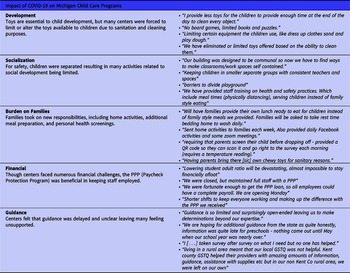
Table 3 presents qualitative analysis results from all 346 surveys, along with representative quotes from respondents. Thematic saturation was reached after 183 surveys. Respondents further elucidated ways in which the pandemic affected their operations and expanded on the impact of the pandemic on early childhood socialization and family responsibilities. Although some centers were forced to close or reduce hours, respondents identified that the Paycheck Protection Program (PPP) was critical in retaining employees and maintaining appropriate staffing. Last, respondents also identified lack of guidance from local and state agencies as a source of frustration. Five major themes related to the pandemic’s effect on child care programs were identified: (1) changes in learning, (2) changes in socialization, (3) increased burden on families, (4) center financial challenges, and (5) lack of guidance.
Impact of COVID-19 on Michigan child care programs

Discussion
While this study found improvement in programs’ disaster plans from 2014 to 2020, significant deficiencies remain. The COVID-19 pandemic further exposed these deficiencies as many programs lacked appropriate plans and training for infectious outbreaks before the pandemic. While state licensing requirements, including the requirement for written disaster plans implemented in 2014, have facilitated some progress among child care programs in Michigan, further measures must be taken to achieve optimal disaster and emergency preparedness.
The mixed method results of our study provided a richer and more complete understanding of the many challenges faced by child care centers in managing the effects of the COVID-19 pandemic. Integration of the quantitative and qualitative datasets resulted in both confirmation and expansion of the individual datasets. While many centers reported closing during the pandemic, the qualitative data identifies many of the challenges and factors contributing to this. The need to purchase extra cleaning supplies, pay staff to spend extra time cleaning, physically separate children with newly purchased partitions, and lower the student-teacher ratios all contributed to overall financial hardship. The qualitative data also highlight how many centers relied on the PPP for funding during the pandemic to keep their doors open. It also revealed that many respondents believed that there was a lack of guidance from governmental agencies during the pandemic. This analysis allows for new insights into current challenges and future ways to better address these issues. These challenges emphasize the need for having a well-developed disaster plan, as real time assistance may not be present or reliable during a disaster.
Disaster and emergency preparedness remains particularly challenging for child care programs because of the wide range of child developmental and physiologic needs, lack of a robust infrastructure, and limited financial resources. The presence of a well-developed, evidence-based disaster plan coupled with adequately trained child care providers is of vital importance for mitigating the adverse effects of disasters and emergencies in this vulnerable population. 16–Reference Ablah, Tinius and Konda20 The results of this study demonstrate a clear need for a more comprehensive approach to Michigan’s child care disaster and emergency preparedness. This should include not only legislation, but also increased guidance, standardized training for providers, additional state and federal funding, and the incorporation of disaster and emergency planning into programs’ quality rating systems.
Child care licensing requirements for disaster and emergency preparedness must be coupled with adequate guidance and training resources to ensure plans are appropriately developed, routinely updated, and effectively implemented. In this survey, many programs did not use a consultant who could advise their facility or visit annually. Use of a disaster consultant has been shown to improve written safety plans and compliance with safety standards. Reference Alkon, Bernzweig and To21,Reference Johnston, DelConte and Ungvary22 Regarding the COVID-19 pandemic, many programs did not have any staff training related to infectious outbreaks before the pandemic. While many pediatric resources are available through state licensing departments, local law enforcement, national organizations, online databases, and partnerships with local universities, there is no standardized universal disaster planning manual or training program for child care providers.
Developing an accessible repository of child care preparedness resources would allow child care programs to have reliable access to quality resources and current guidance developed by field experts. Such a repository at the state licensing level would ideally be updated in real-time to allow timely and clear communication with programs during specific emergencies or disasters. Medical providers, such as pediatricians or emergency medicine physicians, should be encouraged to provide additional consultation and guidance for child care programs to fill this critical gap in accessible pediatric disaster and emergency preparedness experts.
To implement meaningful change and improve disaster preparedness, adequate funding will be required. Funding for child care has unique challenges that are important to consider in relation to disaster and emergency preparedness. The U.S. currently spends less than 0.5% of its gross domestic product on child care and less than $550 per child, significantly less than most developed countries. Reference Miller23 Funding for child care programs is separate from the public school system and receives minimal federal funding. The COVID-19 pandemic highlights these economic challenges, with many programs forced to close, lay off staff, or rely on the PPP to remain open and staffed. Reference Hashikawa, Sells and DeJonge24 Aside from the cost of daily operations, disaster preparedness requires additional financial resources and commitment. Staff training is a time-intensive process that requires resources and financial compensation for staff’s time and effort. Paying for a disaster consultant or reimbursing staff for training may be prohibitive for organizations already operating on slim margins. Nevertheless, children’s health and wellness are at risk without adequate preparation and planning for emergencies and disasters. State and national funding initiatives should be developed to enhance disaster preparedness in child care settings to better protect this vulnerable population.
Finally, incorporating disaster and emergency planning into quality ratings may be a way to incentivize child care programs to prioritize preparedness. Many child care programs participate in the GSQ Network rating and improvement system in Michigan. Currently, emergency and disaster preparedness are not incorporated into the ranking criteria 25 and may be why no correlation was found between star rating and the presence of a pandemic plan in this study. Including emergency and disaster planning into the GSQ Network rating system could assist child care program directors and owners in recognizing the importance of emergency planning and disaster preparedness. Prospective parents often consider a center’s quality rating when selecting a potential child care center, which could be an additional incentivizing factor. 26 Including disaster and emergency and disaster preparedness as part of the formal quality rating would emphasize its importance for overall children’s health and safety. Incorporation of disaster preparedness into the rating system must include specific evidence-based requirements, such as accommodations for children with special needs. Reference Mace, Doyle and Fuchs27,Reference Mace, Doyle and Askew28 Finally, including criteria such as consultation with a disaster expert may also motivate programs to connect with these valuable resources.
Limitations
The presence or absence of disaster plans were determined by survey responses only, as we did not view or analyze actual written plans. Most respondents were concentrated in the southeast region of Michigan, a predominantly suburban population, so results may not be generalizable to other regions, including more rural areas. A large proportion of respondents represented small in-home programs, which likely represent different challenges than larger child care programs and may differ from the organizational structure in other states. Finally, child care licensing regulations vary by state, and our results may not apply to child care programs from other states with different regulations and support systems.
Conclusions
Disaster and emergency planning in child care programs is a complex task that can be challenging even for the most organized and well-resourced child care programs. This study demonstrates substantial disaster and emergency planning gaps among Michigan’s child care programs and identifies the tremendous challenges faced by programs during the COVID-19 pandemic. These results suggest that legislative requirements alone are not sufficient to provide the critical changes needed to ensure the safety of young children attending child care programs. These findings support a case for increased resources, training, and access to disaster experts. Additional funding to assist child care programs in developing robust emergency and disaster plans is also needed. These solutions must be flexible to accommodate local child care programs from diverse communities. Creating a statewide emergency online resource repository and incorporating disaster and emergency planning into the state’s child care quality rating system would be the first steps in ensuring child care programs can develop robust preparedness guidelines.
Supplementary material
To view supplementary material for this article, please visit https://doi.org/10.1017/dmp.2023.32
Conflicts of interest
None to disclose.