INTRODUCTION
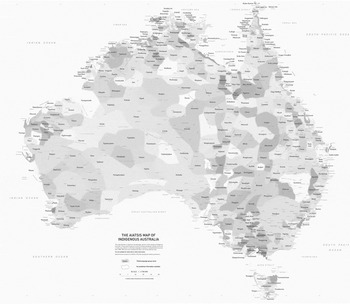
There are more than 700,000 Indigenous Australian citizens (“Aboriginal and Torres Strait Islander peoples”), Footnote 1 and approximately 250 different language groups (see Figure 1). Footnote 2 Aboriginal and Torres Strait Islander peoples have used native plants as a food source for millennia. Footnote 3 A local species may also be a family totem used to help organize social relationships Footnote 4 and be the subject matter of traditional songs, stories, and ceremonies. Footnote 5 The wild harvesting of bush foods provides people with an opportunity to pass on and refine knowledge, socialize, exercise, earn money, and carry out land and resource management activities. Footnote 6 Customary law may vest certain members of a group with rights and duties in relation to particular species or knowledge. Footnote 7 These can include rights to make decisions about species and species knowledge and responsibilities to ensure such use accords with customary law. Footnote 8
The AIATSIS Map of Indigenous Australia. This map attempts to represent the language, social or nation groups of Aboriginal Australia. It shows only the general locations of larger groupings of people which may include clans, dialects or individual languages in a group. It used published resources from 1988–1994 and is not intended to be exact, nor the boundaries fixed. It is not suitable for native title or other land claims. David R Horton (creator), © Aboriginal Studies Press, AIATSIS, and Auslig/Sinclair, Knight, Merz, 1996. No reproduction without permission. To purchase a print version visit: www.aiatsis.ashop.com.au/.

Aboriginal and Torres Strait Islander knowledge has contributed to the commercial development of over 15 bush food species, Footnote 9 including macadamia, lemon myrtle, wattle seeds, bush tomatoes, Kakadu plums, muntries, and Quandong. Footnote 10 Knowledge contributions include:
-
• land management techniques to boost plant growth;
-
• processing and cooking methods to remove toxins and promote health benefits;
-
• the selection of superior plants and harvesting and storage methods to maximize plant quality;
-
• species identity, distinctions, and characteristics; and
-
• growing habits, seasonal availability, and flavour combinations. Footnote 11
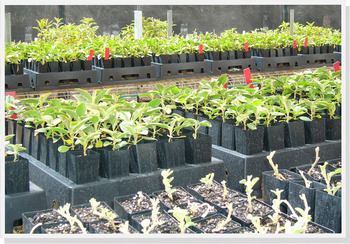
Recent estimates place the sale of raw bush food ingredients at over AUS $18 million a year (excluding macadamia), Footnote 12 with product development potentially increasing this figure “by up to 500%.” Footnote 13 Macadamia sales account for a further AUS $200 million a year. Footnote 14 Tangible products include processed ingredients, restaurant and catering meals, and gourmet sauces, jams, and pies. Footnote 15 There is emerging interest in new bush food varieties Footnote 16 as well as in the legal rights to exploit these new varieties (see Figure 2). Footnote 17 This article refers to “bush food commercialization” as the transformation of native plants into these marketable products and their sale. Footnote 18 The process differs according to the type of product under development. For example, the process of transforming raw ingredients into gourmet food products differs from the process of developing new plant varieties.
New bush tomato seedlings ready for field tests.

Although Aboriginal and Torres Strait Islander peoples share a heritage as the original inhabitants of Australia, Footnote 19 they are an eclectic society with different languages and distinct legal systems (see Figure 1). Footnote 20 Different groups, as well as the individuals within these groups, have different worldviews, social structures, political and economic motivations, personalities and capacities, and, hence, different needs and aspirations in relation to the commercialization of their local plant foods. Footnote 21 This article focuses on four categories of interests, identified in the literature and through consultation:
-
• the control of plants and knowledge in accordance with customary law;
-
• the fair sharing of benefits from plant and knowledge use;
-
• the development of enterprises and partnerships; and
-
• the transfer and maintenance of knowledge in cultural practices. Footnote 22
These interests may complement or conflict with government and commercial interests. Australia’s endorsement of the United Nations Declaration on the Rights of Indigenous Peoples in 2012 demonstrates government support in principle for each of the aforementioned interests. Footnote 23 Aboriginal and Torres Strait Islander peoples and government have an interest in conserving native plants and fostering economic opportunities for Indigenous Australians. Footnote 24 Australian governments are committed to facilitating access to plant materials for research and development purposes Footnote 25 and to sharing in the benefits of resource use. Footnote 26 Gourmet food producers may support Aboriginal and Torres Strait Islander economic development. Footnote 27 They are also likely to want efficient regulatory processes and reliable suppliers. Footnote 28
This article reviews the research on Aboriginal and Torres Strait Islander interests in bush food commercialization. It then outlines a novel method for identifying legal and institutional strategies to support the interests of Aboriginal and Torres Strait Islander peoples. The final section identifies possible strategies to achieve this goal. The article synthesizes international and domestic law, policy, and literature. The discussion is informed by stakeholder consultations, meetings, and field trips over a three-year period as well as prior research by the authors on the legal protection of Aboriginal and Torres Strait Islander heritage sites, knowledge, secrets, and stories. Footnote 29
CURRENT ACADEMIC APPROACHES TO ABORIGINAL AND TORRES STRAIT ISLANDER INTERESTS IN BUSH FOOD COMMERCIALIZATION
This section reviews the academic approaches to Aboriginal and Torres Strait Islander interests in bush food commercialization. Research prior to 2000 focused on traditional food uses and properties. Footnote 30 Some of these papers document Aboriginal and Torres Strait Islander bush food knowledge, Footnote 31 while others trace the health benefits of bush foods for Aboriginal and Torres Strait Islander peoples. Footnote 32 At the turn of this century, researchers began to look at the role of Aboriginal and Torres Strait Islander peoples in bush food commercialization. Footnote 33 For example, Geoff Miers explored the potential for Aboriginal and Torres Strait Islander landowners to grow bush foods on their lands; Footnote 34 Tony Cunningham and colleagues, Rosie Cooney and Melanie Edwards, and Jock Morse considered the capacity of remote peoples to establish bush food businesses; Footnote 35 Julian Gorman and colleagues analyzed the commercial use of plant products by remote Aboriginal and Torres Strait Islander peoples; Footnote 36 Sarah Holcombe and colleagues and Jen Cleary considered the involvement of Aboriginal and Torres Strait Islander wild harvesters in product supply chains; Footnote 37 Peter Whitehead and colleagues examined the feasibility of commercial wild harvests by remote Aboriginal and Torres Strait Islander peoples; Footnote 38 and Louis Evans and colleagues considered the capacity of Aboriginal and Torres Strait Islander peoples to preserve and exploit their bush food knowledge. Footnote 39
This research highlighted issues in relation to specific, narrow interests. For example, Cunningham and colleagues, Miers, and Morse found that wild harvest enterprises were constrained by unpredictable yields. Footnote 40 Cunningham and colleagues, Holcombe and colleagues, Cooney and Edwards, and Cleary identified the practical barriers to the development of remote businesses, including access to technology, transport, buyers, and business services. Footnote 41 Cooney and Edwards noted the legal barriers posed by restricted access to lands and resources. Footnote 42 Evans and colleagues identified the limited legal support for Aboriginal and Torres Strait Islander peoples to maintain and exploit their bush food knowledge. Footnote 43 Overall, these studies concluded that there is little support for Aboriginal and Torres Strait Islander interests in bush food commercialization. Footnote 44 Consequently, Jock Morse has suggested that Aboriginal and Torres Strait Islander peoples must rely on the goodwill of governments and developers, which is a very weak hook upon which to hang the expectations of many people. Footnote 45
A better approach possibly is to combine strategies that address specific interests or problems into a more comprehensive whole. Some possible components of such a composite have been identified in the literature. Evans and colleagues examined the use of knowledge databases, access protocols, and contract law to help Aboriginal and Torres Strait Islander peoples preserve and exploit their knowledge. Footnote 46 Altyerre-ipenhe Merne and colleagues proposed a set of ethical guidelines to foster commercial respect for Aboriginal and Torres Strait Islander peoples and their needs. Footnote 47 Jeremy Morse and Terri Janke outlined how Aboriginal and Torres Strait Islander peoples can use commercial partnerships, confidentiality agreements, and trademarks to improve exploitation opportunities. Footnote 48 Miers identified a suite of marketing, education, and regulatory measures to support Aboriginal and Torres Strait Islander landowners to develop horticultural enterprises. Footnote 49 Cunningham and colleagues proposed a set of measures to improve participation opportunities for remote Aboriginal and Torres Strait Islander peoples in bush food development. Footnote 50 These measures included wild harvest research, business skills development, improved telecommunications, knowledge registers, independent certification schemes, and statutory protections against commercial competition. Footnote 51
OTHER SCHOLARSHIP AND INTERNATIONAL DEVELOPMENTS
There is a substantial international interest in strengthening the capacity of biodiversity and intellectual property regimes to protect Indigenous interests in traditional resources and knowledge. Footnote 52 The international biodiversity regime comprises the Convention on Biological Diversity (CBD) and other instruments endorsed by the Conference of the Parties to this Convention. Footnote 53 Most countries support the CBD, Footnote 54 an instrument partially motivated by the concern that corporations were becoming the sole beneficiaries of plant-based inventions based on Indigenous biodiversity knowledge. Footnote 55 The convention addresses this concern in the following ways:
-
• Article 3 affirms “the sovereign rights of States over their natural resources”;
-
• Article 15 obliges member states to facilitate access to their genetic resources and implement measures to ensure access providers receive an equitable share of benefits arising from use; and
-
• Article 8(j) encourages member states to implement similar access and benefit-sharing provisions with regard to Indigenous and local people’s biodiversity knowledge.
These articles underpin the global access and benefit-sharing regime (ABS) encapsulated in the 2010 Nagoya Protocol on Access to Genetic Resources and the Fair and Equitable Sharing of Benefits Arising from Their Utilization (Nagoya Protocol). The Nagoya Protocol provides a framework for national ABS regimes that ensure genetic resource users share the benefits of use with the country providing the resource. Footnote 56 It also requires countries to ensure genetic resource users obtain consent to access Indigenous resources and knowledge from the Indigenous peoples who have the right to consent under national law Footnote 57 and to share the benefits of use with those Indigenous peoples. Footnote 58 The protocol responds to power imbalances affecting the fairness of negotiation processes and outcomes by calling on member states to help Indigenous communities develop engagement protocols that address their needs and expectations. Footnote 59
Australia signed the Nagoya Protocol in 2012. Footnote 60 Ten years before this, all Australian governments endorsed the Nationally Consistent Approach for Access to and the Utilisation of Australia’s Native Genetic and Biochemical Resources. Footnote 61 This policy calls on Australian governments to implement ABS regimes that are consistent with the provisions of the CBD. Footnote 62 Four of the nine Australian jurisdictions have ABS laws. Footnote 63 The laws support at best Aboriginal and Torres Strait Islander interests in two situations. First, the regimes may trigger negotiations with legally recognized Aboriginal and Torres Strait Islander landowners when researchers seek access to wild plant material from their land for the purposes of genetic research. Footnote 64 Legally recognized landowners include groups who own land Footnote 65 or groups with native title rights to exclude others from the land. Footnote 66 This does not include all people with cultural rights and responsibilities in native plants, but it is a starting point. Second, the regimes may trigger ABS negotiations with Aboriginal and Torres Strait Islander peoples who contribute knowledge to research on plants accessed under these regimes. Footnote 67 This does not include the full range of people who may have contributed knowledge, particularly where this knowledge has already entered the public domain, Footnote 68 but it is another starting point. Negotiations may lead to agreements that support the diverse interests of landowners and knowledge providers.
In practice, these negotiations are likely to be rare in bush food commercialization. Genetic research is infrequent in this context, and researchers can access plant specimens from sources that do not require negotiations with Aboriginal and Torres Strait Islander peoples, such as herbariums and seed banks (‘ex situ collections’). Footnote 69 There is a great deal of Aboriginal and Torres Strait Islander knowledge that is freely available in books and articles. Footnote 70 These practicalities may explain the lack of benefit sharing in the bush food sector. Footnote 71 The three main examples of benefit sharing in Australia have arisen in the essential oil and pharmaceutical industries because of Aboriginal and Torres Strait Islander peoples or corporate social responsibility policies, not because of any legal requirements. Footnote 72
A related treaty to which Australia is a party is the 2004 International Treaty on Plant Genetic Resources for Food and Agriculture (ITPGRFA). Footnote 73 The ITPGRFA complements the CBD by obliging member states to provide researchers with access to genetic material from a list of 64 globally important food crops Footnote 74 and to equitably share the benefits of use. Footnote 75 These obligations are unlikely to support the interests of Aboriginal and Torres Strait Islander peoples since the list of crops does not include any Australian bush food species. Footnote 76 Although the treaty calls on national governments to protect Indigenous knowledge “relevant to plant genetic resources for food and agriculture,” Footnote 77 it does not outline a framework for protection. A recent report on Australia’s obligations under the ITPGRFA links protection to the CBD’s ABS regime. Footnote 78
There is a lot of research on the inadequacy of intellectual property laws to protect the moral and material interests of Indigenous peoples in their traditional plants and knowledge. Footnote 79 The World Intellectual Property Organization (WIPO) is the UN agency responsible for coordinating the global intellectual property regime. Footnote 80 The regime includes the Agreement on Trade-Related Aspects of Intellectual Property Rights (TRIPS Agreement), Footnote 81 which establishes the international standard for intellectual property protection, and subject-specific treaties covering literary and artistic works, inventions, trademarks, and industrial designs. Footnote 82 The regime encourages national measures that vest authors, artists, and inventors with rights to control and exploit their creations for a limited time, after which the creation enters the public domain. Footnote 83 The aim of the intellectual property regime is to promote innovation and the transfer and dissemination of technology, not to protect culture or deliver social justice outcomes. Footnote 84 Time-limited rights to control and exploit intellectual creations partially reflect the universal human right to safeguard moral and material interests in “scientific, literary or artistic productions.” Footnote 85 Examples of Indigenous creations that may qualify for intellectual property protection under national law include:
-
• food production, harvesting, processing, and storage methods;
-
• recipes, stories, artworks, symbols, words, and songs; and
-
• land and resource management techniques.
The standards in the TRIPS Agreement allow domestic laws to exclude Indigenous creations from the ambit of protection and from free trade requirements. Footnote 86 The standards envisage intellectual property rights that depend upon there being an individual or corporate creator. Footnote 87 This does not encompass creations collectively developed by living and deceased peoples. Footnote 88 The standards require that intellectual property rights depend upon subject matter that “substantially differs” from pre-existing work. Footnote 89 This excludes Indigenous creations that others have published (including without consent), Footnote 90 creations that “by their very nature [are] not innovative, but rather derived from pre-existing works in a slow process of creative development,” Footnote 91 and creations “that first existed in material form thousands of years ago.” Footnote 92 Time limits to protection ignore the ongoing nature of customary rights and duties, and the requirements for tangible form may exclude creations passed from generation to generation in oral form. Footnote 93 In addition, “the material form requirement disfavours Indigenous cultural practices of keeping certain information sacred or secret, and may undermine Aboriginal customary law’s ability to use knowledge as a rite of passage.” Footnote 94 Copyright standards only require national measures that prohibit the unauthorised reproduction of protected works. They do not require measures that prohibit the commercial use of ideas or the knowledge contained therein. Footnote 95 These inconsistencies between legal and cultural standards make intellectual property laws ill suited to govern non-public Indigenous creations, which leaves Indigenous knowledge “vulnerable to exploitation and misuse.” Footnote 96
In 2000, WIPO responded to these concerns by establishing the Intergovernmental Committee on Intellectual Property and Genetic Resources, Traditional Knowledge and Folklore. Footnote 97 In 2009, the committee commenced negotiations on new international instruments to protect Indigenous people’s rights to control and exploit their intellectual creations and to clarify the relationship between intellectual property and the CBD. Footnote 98
In 2013, the committee published draft articles on traditional knowledge and expressions Footnote 99 as well as a consolidated document on genetic resources and associated knowledge. Footnote 100 The draft articles on knowledge and expressions cover tangible and intangible knowhow, skills, innovations, practices, artworks, stories, music and sounds generated, shared and transmitted “in a collective context” for not less than 50 years. Footnote 101 The articles encourage national governments to vest Indigenous peoples who create, maintain, use, and develop knowledge and expressions with “exclusive and collective” rights:
-
• to maintain, control, and develop secret knowledge and expressions for as long as they remain unknown to others outside the collective;
-
• to prevent unauthorized uses of secret knowledge and expressions;
-
• to deny access to and use of secret knowledge and expressions; and
-
• to protect against false, misleading, offensive, or derogatory uses of knowledge and expressions. Footnote 102
The articles support the rights of Indigenous peoples to attribution and remuneration for the use of knowledge and expressions that are publicly available but not widely known. Footnote 103 Alternatively, the articles allow national governments to limit the scope of protection to secret knowledge and expressions whose use poses a “reasonable apprehension of irreparable harm.” Footnote 104
The perpetual protection of secret knowledge and expressions is a shift away from time-limited intellectual property rights with subject matter entering the public domain at the expiration of protection. The domestic implementation of these draft articles may help trigger negotiations with Aboriginal and Torres Strait Islander peoples when others seek access to their secret knowledge. However, the availability of bush food knowledge from published sources may make such negotiations rare in bush food commercialization. Footnote 105 Negotiations will also not arise when developers do not seek Aboriginal and Torres Strait Islander knowledge.
The third instrument drafted by the intergovernmental committee aims to stop non-Indigenous people from securing patent rights in Indigenous innovations and to promote compliance with the CBD’s ABS regime. Footnote 106 The Consolidated Document Relating to Intellectual Property and Genetic Resources calls on national governments to require intellectual property applicants to:
-
• disclose identifiable sources of genetic resources and Indigenous knowledge related to the subject matter of the application and
-
• provide evidence of ABS arrangements with the nationally authorized providers of genetic resources or secret knowledge. Footnote 107
The limited reach of ABS regimes limits the protection available. However, the use of intellectual property laws to promote compliance with ABS regimes does affirm the need for strategies to support Indigenous peoples’ interests. Paul Martin and Michael Jeffery propose an innovative combination of four existing arrangements as an alternative to intellectual property reform. They argue:
[T]he combination of four existing areas of law: confidential information, equitable estoppel, statutory prohibitions against misleading or deceptive conduct, and unjust enrichment may in effect provide a comprehensive protection to Indigenous peoples against the misuse of [their secret] knowledge. Footnote 108
This argument indicates the potential of innovative combinations to advance Aboriginal and Torres Strait Islander interests to overcome the absence of specific statutory protection. There is no documented method for generating such combined strategies. The next section outlines a method to achieve this goal.
FORMULATING STRATEGIES IN THE COMMERCIAL DEVELOPMENT OF GOURMET BUSH FOOD PRODUCTS
As Michael Sedlockoa explains, “[i]n the area of natural resource management, research has incorporated notions of systems thinking since at least the early 1940s.” Footnote 109 System thinking “recognises that the … impact of a single product, process or practice can only be understood through an appreciation of the wider system of which it is part.” Footnote 110 For example, a law that works in one context may not work in another. Footnote 111 A holistic understanding of context can lead to solutions that respond to context-specific needs, goals, interactions, and transactions. Footnote 112
Systems mapping involves “visually mapping the system of interest” and identifying parts to change. Footnote 113 Environmental law scholars have used systems mapping to understand complex policy problems and to identify workable interventions in the area of sustainable consumption, Footnote 114 natural resource policy, Footnote 115 and biofuel production. Footnote 116 The approach we have used maps the transactions involved in the commercialization of gourmet bush food products. By understanding these transactions, it is possible to consider how to systematically adjust the legal and institutional arrangements supporting them to better reflect the interests of Aboriginal and Torres Strait Islander peoples. Footnote 117 The approach aims to help identify possibilities through four steps:
-
1. identify the commercialization stages and actions;
-
2. identify the legal arrangements influencing each action;
-
3. assess the capacity of each arrangement to support Aboriginal and Torres Strait Islander interests; and
-
4. identify the possible strategies to improve support for these interests.
We applied the approach to the development process for gourmet bush food products such as sauces, jams, pies, and chutneys.
Step 1: Identify Key Commercialization Stages and Actions
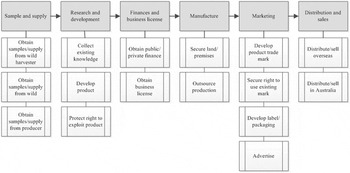
The first step is to understand the commercialization stages and actions a developer may undertake at each stage, based on a review of the commercialization literature and gourmet product development pathways and informed by discussions with pathway actors. The commercialization stages include:
-
• samples and supply;
-
• research and development;
-
• finances and business licenses;
-
• manufacturing;
-
• marketing; and
-
• distribution and sales. Footnote 118
These stages do not always occur in the order listed, and not every stage may be necessary. For example, a developer may create marketing material before manufacturing a product and have no need to secure financing.
The sample and supply stage is about securing ingredients. Possible actions include the sourcing of processed raw ingredients from wild harvesters Footnote 119 or traders who collect wild produce from Aboriginal and Torres Strait Islander peoples. Footnote 120 Other actions include applying for permits to harvest wild ingredients Footnote 121 or contracting for wild harvest. Footnote 122 A common action is the purchase of ingredients from people who cultivate bush foods on private land (“commercial growers”). Footnote 123 The research and development stage is where products are created. This might involve using knowledge from Aboriginal and Torres Strait Islander peoples, books, articles, or websites. Footnote 124 It might also involve developing product prototypes and strategies to safeguard recipes. Footnote 125 The finance and licensing stage, undertaken in preparation for manufacture, might involve applying for public or private funding and obtaining any necessary licenses to produce or market the products. Footnote 126 Preparation for manufacturing might require acquiring and setting up premises or outsourcing manufacturing. The marketing stage may involve designing trademarks, packaging, and labels Footnote 127 and registering trademarks. Footnote 128 Some developers rely on trademark schemes that permit the use of existing marks on products that comply with conditions, such as the use of “certified organic ingredients.” Footnote 129 Other marketing actions include developing brochures, flyers, and advertisements for radio, television, the Internet, magazines, and newspapers. The sales and distribution stage can sometimes involve securing permission to export products or transport products. It might also involve contracting distributors or agents and direct retail sales to international or domestic consumers. Figure 3 represents these stages.
The gourmet bush food product development system.

Step 2: Identify Legal Arrangements Influencing Each Action
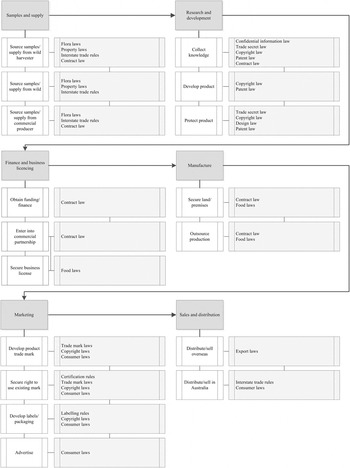
The second step is to identify the laws influencing each action. Relevant laws include those governing:
-
• wild harvest and commercial growing of native plants;
-
• interstate and international transport of plant products;
-
• contracts, confidential information, and trade secrets;
-
• food manufacturing businesses; and
-
• the use of trademarks and published information.
Figure 4 summarizes the regulatory framework.
The regulatory environment for gourmet bush food product development.

Steps 3 and 4: Identify Avenues to Support Aboriginal and Torres Strait Islander Interests
This section identifies legal and commercial possibilities to support Aboriginal and Torres Strait Islander interests at each stage and proposes measures to strengthen possible support. These possibilities have not been fully developed nor tested for feasibility or acceptability. They form a menu of possible directions rather than evaluated recommendations for implementation.
Samples and Supply
A developer may seek wild food samples or supply from commercial growers, the wild, or wild harvesters. This may require the interstate transport of plant material, to which biosecurity or conservation laws can apply.
Some laws require people to obtain a license to grow and sell native plants. Footnote 130 These do not require licensees or licensors to consider Aboriginal and Torres Strait Islander interests. Biosecurity laws regulating interstate trade help to prevent the spread of plant diseases and pests. Footnote 131 They do not aim to protect the cultural and economic interests of Aboriginal and Torres Strait Islander peoples and impose no obligation to consider these interests. Footnote 132
A federal, state, or territory flora law may require a person to obtain a permit to commercially harvest wild plants on public land. Footnote 133 These laws do not require permit grantors or holders to consider Aboriginal and Torres Strait Islander interests. Property rights require consent to access land from the person who holds the right to exclude people from it. Footnote 134 Rights holders may include Aboriginal and Torres Strait Islander peoples with freehold title Footnote 135 and Indigenous custodians with native title rights to exclude others from land. Footnote 136 Property rights can trigger the need for those who want to collect or harvest plants to have land access agreements with Aboriginal and Torres Strait Islander peoples who exercise control over nearly 30 percent of Australian land. Footnote 137 In practice, gourmet bush food developers are mostly small businesses that may prefer simple contracts of sale with commercial growers to complex negotiations with Aboriginal and Torres Strait Islander land authorities. Footnote 138 The availability of raw materials from horticultural producers reduces the demand for wild harvest produce. Footnote 139
Aboriginal and Torres Strait Islander people may harvest, grow, and sell bush foods on land they control, subject to any law or agreement to the contrary. Footnote 140 Contrary rules include prohibitions on the harvesting of threatened species and leaseholds or licenses that limit the rights of Aboriginal and Torres Strait Islander landowners to carry out specified activities. Practical constraints include:
-
• lack of transport to access lands in remote areas; Footnote 141
-
• the need for commercial harvesters without legal interests to secure landowner consent; Footnote 142
-
• the need for all people to comply with permit requirements, Footnote 143 with the possibility of being required to pay royalties on harvested material or fees for land access; Footnote 144
-
• limited access of some Aboriginal and Torres Strait Islander peoples to buyers, online markets, technology, information, and business expertise; and Footnote 145
-
• the unpredictability of wild harvest yields. Footnote 146
The analysis suggests two strategies to improve support for Aboriginal and Torres Strait Islander interests at the samples and supply stage. The first aims to support Aboriginal and Torres Strait Islander interests when developers harvest or grow bush foods on non-Indigenous land. The second aims to improve the practical ability of Aboriginal and Torres Strait Islander peoples to supply bush food produce.
Supporting Aboriginal and Torres Strait Islander Interests When Developers Harvest or Grow Plants on Non-Indigenous Land
This strategy proposes three integrated measures to increase Aboriginal and Torres Strait Islander control over traditional plants and the sharing of development benefits. The first concept is the creation of a traditional land custodian register. Public botanic gardens and herbariums have data on the natural locations of many plant species; Footnote 147 the National Native Title Tribunal has data on traditional custodians claiming or holding legal rights in land; Footnote 148 and the Australian Institute of Aboriginal and Torres Strait Islander Studies has information on the locations of different Aboriginal and Torres Strait Islander language groups. Footnote 149 Combining this data would provide a starting point for a register of traditional custodians of areas linked to the natural locations of plant species. Any group could register contact details for a nominated representative body. Registration would not create new rights to control lands or resources, but it would acknowledge the collective interests of particular groups in traditional species. This register would be the foundation for a number of proposed strategies.
The second measure would reform laws to require that non-Indigenous harvesters respect the relationships between traditional land custodians and the resources on their lands. Possible reforms include:
-
• requiring any non-Indigenous person harvesting native flora on public land to obtain a permit;
-
• requiring permit applicants to obtain consent from registered custodians, in accordance with custodian protocols; and
-
• requiring a royalty on the value of harvested materials to be wholly or partly allocated to the registered custodians.
Requirements to pay royalties and comply with cultural protocols would underpin negotiations. This could be supported by assistance to traditional groups to develop engagement protocols and template agreements. Footnote 150
The third measure aims to ensure that traditional custodians with cultural links to species share in the commercial benefits of horticultural production. It proposes the following reforms:
-
• requiring commercial bush food growers to obtain a license to grow native plants and pay a royalty (probably to a government agency) and
-
• requiring that royalties be distributed to registered traditional custodians with cultural links to the species.
Royalties could be administered through an existing agency to reduce transaction costs and maximize returns to Aboriginal and Torres Strait Islander peoples. Footnote 151 Recent estimates place the sale of raw bush food material at over AUS $215 million dollars annually, including macadamias. Footnote 152 A 2 percent production royalty could return more than AUS $430,000 to traditional owner groups each year. An alternative is for bush food businesses to pay royalties at the retail level. Retail royalties could generate greater returns than royalties collected at the production level, but the transaction costs may outweigh the financial benefits.
Building the Economic Capacity of Aboriginal and Torres Strait Islander Peoples
This strategy involves two measures to improve the capacity of Aboriginal and Torres Strait Islander peoples to sustain wild harvest businesses. The first requires reforms to threatened species laws to ensure Aboriginal and Torres Strait Islander representation on threatened species committees. These committees decide whether to list a species as threatened. A threatened species listing can have an effect on the capacity of Aboriginal and Torres Strait Islander peoples to wild harvest. For example, it has been unlawful to commercially harvest Davidson plums in New South Wales since their listing in 2001. Footnote 153 Even though Aboriginal and Torres Strait Islander peoples have an interest in these decisions, and some Aboriginal and Torres Strait Islander peoples are involved in the management of threatened populations, Footnote 154 there is no requirement to ensure their involvement in such determinations. Footnote 155 This involvement would reflect the recognized value of Aboriginal and Torres Strait Islander knowledge to the pursuit of conservation goals. Footnote 156
A second measure would involve regional Aboriginal and Torres Strait Islander land councils representing the interests of multiple traditional custodian groups to coordinate commercial harvesting. Footnote 157 Regional bodies could help secure funding, map plant habitats, predict yields, and help develop strategies to improve supply (see Figure 5). Footnote 158 To maximize market position, regional authorities might focus on supplying undeveloped species, undersupplied species, and species with export potential, such as lemon myrtle, Quandong, and finger limes. Footnote 159 A regional authority might:
-
• develop a register of harvesters with approval from traditional custodians to harvest species on their lands;
-
• contract approved harvesters to collect produce;
-
• organize logistics, including transport to and from growing locations;
-
• promote Indigenous-harvested produce in online marketplaces;
-
• create incentives for non-Indigenous developers to purchase this produce, such as by offering rights to use cultural endorsements, marks, or stories in product advertising; and
-
• distribute harvested material (see Figure 6).
This type of support might help Aboriginal and Torres Strait Islander peoples compete against non-Indigenous commercial bush food growers and encourage younger people to participate in wild harvest. Footnote 160 This could contribute to a broader social objective to help increase Aboriginal and Torres Strait Islander well-being and employment “on country.” Footnote 161
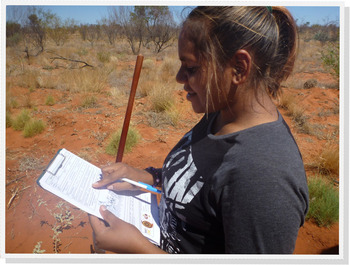
Mapping plant growing locations.

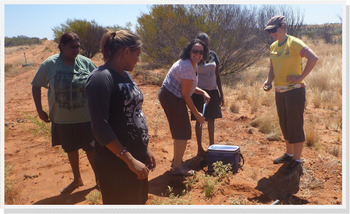
Linking with buyers.

Research and Development
During this stage, a developer may collect species knowledge, develop product prototypes, and devise strategies to safeguard his or her technical or market information. The use and protection of non-public Aboriginal and Torres Strait Islander knowledge is affected by the law. In broad terms, contract and equity can oblige users of knowledge received in confidence to comply with any express or implied use agreement. Footnote 162 However, the general availability of bush food knowledge and the difficulties of civil litigation limit the likely use of such strategies. Footnote 163 Copyright law can protect images or sets of words that Aboriginal and Torres Strait Islander peoples might use to promote their bush food products. Copyright law only prohibits the reproduction of images or words, not the use of knowledge. Footnote 164 For instance, controlling the reproduction of the words of a recipe does not stop the recipe being used to make a food product. Footnote 165
In theory, Aboriginal and Torres Strait Islander peoples may obtain patents over secret harvesting, cooking, and production methods that meet the requirements of patent law. Footnote 166 As mentioned earlier, the requirement for personal “inventiveness” severely limits this potential. Further, patent rights allow the rights holder to exclusively exploit their invention for only 20 years. Footnote 167 The rights holder must disclose the invention at the outset of protection, making it freely available at the expiration of protection. Footnote 168 In practice, few Aboriginal and Torres Strait Islander peoples are likely to have the scientific, legal, and financial resources to use patent rights unless they have a strong commercial partner. Footnote 169
Another rule affecting knowledge collection is the obligation on some researchers to obtain informed consent and to have an agreement to share the benefits of use with knowledge providers. Footnote 170 The rule only applies to plant genetic researchers under limited conditions. Genetic research does not include harvesting for production. Footnote 171 In the uncommon situation where a food product developer carries out genetic research, they can access plant samples from sources that do not require Aboriginal and Torres Strait Islander consent or benefit sharing (for example, nurseries and plant material collections), which reduces the usefulness of this mechanism. Footnote 172
Institutional policies may require publicly funded researchers to comply with ethical standards, including the Guidelines for Ethical Research in Australian Indigenous Studies. Footnote 173 These guidelines transform the UN Declaration on the Rights of Indigenous Peoples into principles relevant to academic research. Principle 10 states that Indigenous communities and individuals have a right to be involved in any research project focused upon them and their culture. Footnote 174 Research institutions have generally translated these requirements into internal requirements for ethical research, which are made binding through the employment contract. In theory, this could give Aboriginal and Torres Strait Islander peoples the opportunity to negotiate research agreements that support their unique interests. Footnote 175 In practice, these policies are of little consequence in bush food development because most developers are private enterprises that are not legally subject to ethical research conditions. Footnote 176
Federal food laws permit the commercial use of a food ingredient with a history of safe use in Australia. Footnote 177 This allows people generally to exploit the traditional foods and published knowledge of Aboriginal and Torres Strait Islander peoples. The laws regulating trade secrets offer little assistance:
Broadly speaking, any confidential business information which provides an enterprise a competitive edge may be considered a trade secret. … The unauthorised use of such information by persons other than the holder is regarded as an unfair practice and a violation of the trade secret. … While a final determination of what information constitutes a trade secret will depend on the circumstances of each individual case, clearly unfair practices in respect of secret information include industrial or commercial espionage, breach of contract and breach of confidence. Footnote 178
It would be difficult for Aboriginal and Torres Strait Islander peoples to prove this type of unfair treatment if they have never met the developer or if there is no clear link between a secret communicated by an Aboriginal and Torres Strait Islander person and the product. Even if a personal relationship can be found, the legal technicalities are daunting.
Aboriginal and Torres Strait Islander peoples could develop a gourmet food product using non-public knowledge or relatively unknown bush food ingredients. Footnote 179 However, patent, copyright and trade secret law cannot prevent others from making a similar product (perhaps at a cheaper price). This risk is exacerbated by the fact that Australian food laws require developers to disclose ingredients on product labels. Federal laws allow developers to apply for an exclusive right to exploit an ingredient under a particular brand for 15 months. Footnote 180 This does not prevent another person from exploiting the ingredient under a different brand. Footnote 181
Overall legal support for Aboriginal and Torres Strait Islander peoples to secure an economic interest or respect for their non-public bush food information is weak. A more robust support system will require either an innovative use of established rules and institutions or sui generis laws. We propose three possible strategies for the research and development stage of commercialization.
Control over Knowledge
This strategy proposes that Australian governments create two legal duties. The first would require researchers and commercial users of non-public Aboriginal and Torres Strait Islander knowledge to obtain informed consent from the Aboriginal and Torres Strait Islander knowledge provider or their representative. The second would require users of knowledge from publications that identify Aboriginal and Torres Strait Islander contributors to obtain consent to use the knowledge.
The first duty sits easily with the laws regarding the use of confidential information and existing legal obligations. Footnote 182 The second duty does not fit neatly within current law, but it is consistent with the moral rights legislation that allows authors to protect the integrity and ownership of their work. Footnote 183 It may be difficult to prove that someone has used the knowledge, Footnote 184 and the duty could create a false sense of security for Aboriginal and Torres Strait Islander peoples who publish knowledge without effective safeguards. Footnote 185 Potential liability for unauthorized use may, however, encourage bush food developers to exercise caution in negotiating and acknowledging Aboriginal and Torres Strait Islander interests. Footnote 186 The most powerful effect of such an instrument is likely to be through requirements imposed on suppliers by buyers determined to ensure ethical practices and full legal compliance, rather than legal action.
A limit on the proposed duties is that contract law requires agreements to be between legal persons (individuals or corporations). Non-specific “ownership” by an unincorporated group of people is not actionable. A problem may also arise with vesting consent rights in individuals when knowledge interests are collective and because some groups share similar knowledge. Vicky Tauli-Corpuz contends:
[Individual rights] will push unscrupulous Indigenous individuals to claim ownership over potentially profitable Indigenous knowledge which will cause the further disintegration of communal values and practices. It can also cause infighting between Indigenous communities over who has ownership over a particular knowledge or innovation. Footnote 187
The presence of individual rights does not prevent Indigenous groups from regulating individuals within the collective by social or informal means. However, as with each strategy we propose for consideration, the risk of perverse effects and abuse needs careful consideration.
Notification of Cultural Interests
The fact that many Aboriginal and Torres Strait Islander cultural traditions are unwritten limits the ability of groups to specify what knowledge is theirs and to take control of its use. Cultural secrecy requirements further restrict a group’s ability to claim interests in their knowledge. These factors mean that users of cultural knowledge or materials may claim not to be aware of the sensitivities or claimed interests. A broadly descriptive database under Aboriginal and Torres Strait Islander control that identifies the existence of cultural claims in knowledge and cultural assets could notify these interests. The aim of the database would not be to document the content of knowledge but, rather, to provide notice of interests in claimed knowledge and restrictions on use. Such a service might:
-
• broadly describe the cultural claims of Aboriginal and Torres Strait Islander peoples in specific species and indicate the types of knowledge a group may hold as well as any cultural restrictions on that knowledge;
-
• provide for the registration of claims in publically available material, where Aboriginal and Torres Strait Islander peoples claim ongoing interests or sensitivities (the specificity of claims or descriptions would be a matter for Aboriginal and Torres Strait Islander peoples to determine);
-
• indicate how people can legitimately access these cultural resources, including the identification of the proper custodians (if there is disagreement about custodianship, this would be identified);
-
• provide model policies, agreements, and protocols to help protect cultural resources and cultural sensitivities (heading towards a “cultural best practice” framework)—use of the database and best practices could be encouraged, perhaps by a certification mark; and
-
• connect the database to intellectual property right agencies to help prevent the grant of rights in creations derived from Aboriginal and Torres Strait Islander knowledge that has not been ethically obtained. Footnote 188
These services might be considered in the development of a national cultural authority. Footnote 189 Challenges include transaction costs and the potential for knowledge to become detached from people and place. Footnote 190 Databases could also prioritize registered interests over the interests of Aboriginal and Torres Strait peoples who hold similar knowledge. Footnote 191
A Window of Opportunity for New Products
The transformation of bush foods into gourmet products requires access to money, premises, technology, and buyers that many Aboriginal and Torres Strait Islander peoples generally do not have. Footnote 192 The need to overcome structural disadvantages is especially important in remote Australia where bush food businesses are one of the few prospects for economic growth. Footnote 193 A possible strategy to address these issues is a statutory right for registered traditional custodians to have a privileged legal “window” to exploit commercially undeveloped foods for a specified period, such as 10 years from the time when its commercial potential is first identified. The right to exploit a commercially undeveloped species could attach to any group with a registered cultural link to the species.
As with any of the other possibilities we have discussed, there are risks that need to be identified and managed. For example, if a number of groups with cultural links to the species held the right to license its commercial use, developers might “license shop” between groups. Another possible objection is the reduction of market competition. Footnote 194 However, competition law does allow limiting competition in the public interest or where this is authorized by statute. Footnote 195 The Organisation for Economic Co-operation and Development supports competition laws that “foster competition, innovation, economic growth and important social objectives.” Footnote 196
Business Licensing
The interests of Aboriginal and Torres Strait Islander peoples are not considerations in licenses to operate food manufactures or businesses. There are a number of ways through which this type of obligation could be extended to the business sector, including amendments to existing laws (for example, business licensing laws or corporations law) or by sui generis laws to specifically address the moral rights of traditional custodians and knowledge holders. For example, it may be possible to amend food business license conditions to require bush food developers to demonstrate compliance with ethical development guidelines, such as the Guidelines for Ethical Research in Australian Indigenous Studies.
Manufacturing
Food manufacturing laws are concerned with the safety and hygiene of premises and products. There are no special conditions that require consideration of Aboriginal and Torres Strait Islander interests or the demonstration of good practices in dealing with bush foods. Nor are there support services to address the unique challenges facing aspiring Aboriginal and Torres Strait Islander bush food developers. Footnote 197 The challenges include complex permit and licensing regimes and access to transport, markets, and start-up capital. Footnote 198 The role of Indigenous Business Australia is to help Aboriginal and Torres Strait Islander peoples establish and grow businesses, Footnote 199 but its focus is mainly on helping established businesses grow. Footnote 200 New enterprise development in the bush food sector is likely to require specialized skills and support.
It would be possible to establish a support unit with qualified staff (ideally Aboriginal and Torres Strait Islander peoples) to provide business and capacity development support for Aboriginal and Torres Strait Islander peoples. Case managers could work with Aboriginal and Torres Strait Islander entrepreneurs to develop their enterprises. Advisors could help them access training, expertise, permits, finance, technology, transport, and markets. Suitably qualified Aboriginal and Torres Strait Islander case managers may be hard to find. Another barrier is the feasibility of servicing a small number of enterprises, particularly in the short term. These are among the issues that require detailed investigation.
Marketing
Marketing may involve developing product trademarks, packaging, labels, and promotional material and negotiating the use of existing marks and advertising. The use of Aboriginal and Torres Strait Islander words and symbols to market bush food products is relevant in this commercial context as it allows the marketer to claim cultural associations that may help to sell the product. Copyright law prohibits the unauthorized use of artwork in marketing material, where the artist is still alive or has been dead for less than 70 years. Footnote 201 Trademark and consumer laws allow people to object to the “scandalous” or confusing use of words in marketing material. Footnote 202 For example, “a group of Aboriginal artists successfully opposed an attempt to trademark the slogan ‘Utopia Batik’ … arguing that the word ‘Utopia’ should be available to all artists of the region.” Footnote 203 A similar argument could prevent the unauthorized use of Aboriginal and Torres Strait Islander language words in bush food marketing.
There are some legal arrangements that might help Aboriginal and Torres Strait Islander peoples distinguish their bush food products in the marketplace. Aboriginal and Torres Strait Islander peoples might promote their products as being from a particular geographical or cultural region, using a certification of origin trademark to prevent others from outside the region from making the same claim. Footnote 204 It may also be possible to distinguish products using names or symbols that have specific cultural connections. Footnote 205 For example, one Aboriginal and Torres Strait Islander woman sought permission from her clan to use their billy goat plum name on her plum chutney products. Footnote 206 A number of strategies could help strengthen these interests.
Control of Cultural Words and Symbols
This strategy involves three measures. The first would be to amend trademark and consumer laws to prohibit the unauthorized commercial use of Aboriginal and Torres Strait Islander words or symbols. This shifts the onus from Aboriginal and Torres Strait Islander peoples to protect their own words and symbols from misuse and could help Aboriginal and Torres Strait Islander peoples distinguish their products in the marketplace. The second measure would exempt Aboriginal and Torres Strait Islander organizations from trademark registration and renewal fees, should they wish to legally protect cultural words or symbols. Under the third measure, Intellectual Property Australia would:
-
• maintain a contact list of registered Aboriginal and Torres Strait Islander organizations (currently around 5000 organisations) Footnote 207 and
-
• notify this list if a person submits an intellectual property application that involves native plants or animals or words or symbols that may be associated with Aboriginal and Torres Strait Islander peoples.
A requirement that applicants for trademarks disclose any negotiated arrangement for the use of cultural symbols or words, or any potential cultural association, would strengthen the protection of cultural associations. An additional measure could be an Aboriginal and Torres Strait Islander expert panel to advise Intellectual Property Australia on the merits of any cultural objection. Footnote 208
Sales and/or Distribution
There is some limited sales and distribution support for Aboriginal and Torres Strait Islander enterprises through Supply Nation, a national network that connects Aboriginal and Torres Strait Islander businesses with people committed to buying Aboriginal and Torres Strait Islander products. Footnote 209 This section proposes a strategy to strengthen support for the interests of Aboriginal and Torres Strait Islander peoples in the commercialization of bush food products.
Increasing Support
The strategy comprises three measures. Under the first measure, new rules would require exporters of bush food products to certify that they share development benefits with Aboriginal and Torres Strait Islander peoples. This could involve extending the role of export biosecurity agencies to include cultural protection, but this is consistent with international proposals that exporters of plant genetic material certify that they have government or Aboriginal and Torres Strait Islander consent to export native plant specimens.
The second measure involves peak bush food industry bodies (for example, the Australian Native Food Industry and the Australian Macadamia Society) implementing reconciliation action plans (RAPs). The Australian government funds Reconciliation Australia to assist entities to implement plans. Footnote 210 The plans have been effective in furthering social justice initiatives and long-term partnerships with Aboriginal and Torres Strait Islander peoples. Footnote 211 Industry-wide plans may help foster “ethical and socially responsible” development. Footnote 212 This approach is consistent with private sector voluntary regulation or co-regulation.
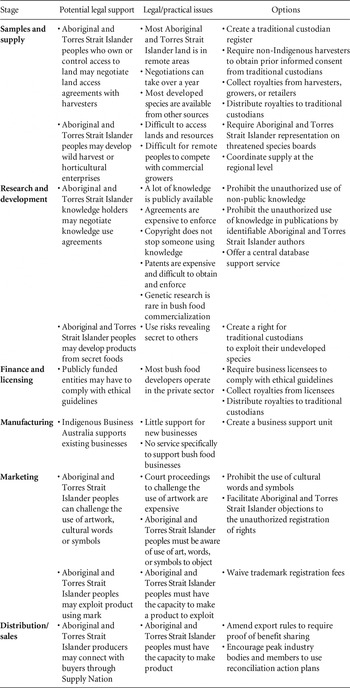
Industry bodies would encourage members to implement RAPs, potentially offering the use of a certification mark on products that comply with ethical standards. Plans could address Aboriginal and Torres Strait Islander interests, including commitments to use Aboriginal and Torres Strait Islander suppliers and to integrate ethical principles “into everyday business practices.” Footnote 213 The recent establishment of an Indigenous Advisory Committee at Australian Native Food Industry Limited, Footnote 214 and the finding that many bush food developers appreciate the “authenticity and integrity” that Aboriginal and Torres Strait Islander peoples bring to the industry, Footnote 215 suggest potential industry receptiveness to this proposal. A challenge may be securing support from commercial entities who “feel the status quo is not so bad.” Footnote 216 Table 1 summarizes the concepts that have been discussed.
Summary of current and potential support for Aboriginal and Torres Strait Islander interests at key development states

WHERE TO FROM HERE?
This article has used a systems mapping approach to identify possible new strategies to support Aboriginal and Torres Strait Islander interests in the commercial development of gourmet food products. Some options will inevitably prove more aspirational than feasible, and options that appear straightforward may, in practice, require complicated policy changes, new institutional structures, and lengthy negotiations with diverse stakeholders. However, it is clear that there are alternatives that might, separately or in combination, improve the likelihood that Aboriginal and Torres Strait Islander peoples can achieve their aspirations in bush food commercialization. While a comprehensive sui generis law might be preferred to a complex cocktail, the lack of such a law does not mean that better outcomes cannot be achieved.
This article is a first step toward systemic support for the diverse interests of Aboriginal and Torres Strait Islander peoples in their traditional foods. The proposals are possibilities. Progress will require far deeper engagement with Aboriginal and Torres Strait Islander peoples, government, and industry to identify approaches that will advance Aboriginal and Torres Strait Islander social justice and economic development through the commercialization of bush foods, with Aboriginal and Torres Strait Islander justice arguably being the most important social problem that Australians face.
SUPPLEMENTARY MATERIAL
A large-scale version of the map in Figure 1 is available as supplementary material for this article at http://dx.doi.org/10.1017/S0940739116000023.
ACKNOWLEDGMENTS:
The authors gratefully acknowledge the expertise and practical wisdom of Rayleen Brown, Pat Torres, Max Emery, Juleigh Robins, Andrew Fielke, and Slade Lee. The work reported in this publication was supported by funding from the Australian Government Cooperative Research Centres Program through the Cooperative Research Centre for Remote Economic Participation (CRC-REP). The views expressed herein do not necessarily represent the views of the CRC-REP, its managing entity Ninti One Limited, or its participants. Errors or omissions are those of the authors.