Introduction
Bipolar disorders are highly co-morbid with other psychiatric disorders and medical conditions which are linked to both the development of, and the course of, the disease. This is particularly true for bipolar disorders and substance abuse, including alcohol and drug abuse, which have been found to be associated with earlier age at onset (Lin et al. Reference Lin, McInnis, Potash, Willour, MacKinnon, DePaulo and Zandi2006; Javaid et al. Reference Javaid, Kennedy and De Luca2011; Lagerberg et al. Reference Lagerberg, Sundet, Aminoff, Berg, Ringen, Andreassen and Melle2011), suicide attempts, mixed episodes, as well as greater disability (Agrawal et al. Reference Agrawal, Nurnberger and Lynskey2011). The study by Agrawal et al. (Reference Agrawal, Nurnberger and Lynskey2011) showed that patients with a bipolar disorder are 6.8 times more likely to report a lifetime history of cannabis abuse than healthy controls. The findings above are supported by a study by Post (Reference Post2010) indicating that drug abuse may increase sensitization and vulnerability to recurrent episodes, thus driving illness progression in bipolar disorder. Indeed, a recent study by Pettinati et al. (Reference Pettinati, O'Brien and Dundon2013) showed that the lifetime prevalence rate of any bipolar disorder combined with any substance use disorder is 47.3%. A recent trial for co-morbid affective mood disorder and alcohol dependence again showed a strong link between these factors, demonstrating that combining treatment of both depression and alcohol dependence reduced depressive symptoms and excessive drinking simultaneously (Pettinati et al. Reference Pettinati, Oslin, Kampman, Dundon, Xie, Gallis, Dackis and O'Brien2010).
Individuals reporting substance abuse in adulthood also report high levels of childhood trauma experiences (Fergusson et al. Reference Fergusson, Boden and Horwood2008; Shin et al. Reference Shin, Edwards and Heeren2009). More generally, childhood abuse has also been associated with severe mental disorders, such as schizophrenia and bipolar disorder, both with increased frequency (Read et al. Reference Read, van Os, Morrison and Ross2005; Etain et al. Reference Etain, Mathieu, Henry, Raust, Roy, Germain, Leboyer and Bellivier2010; Mondelli et al. Reference Mondelli, Dazzan, Hepgul, Di, Aas, D'Albenzio, Di, Fisher, Handley, Marques, Morgan, Navari, Taylor, Papadopoulos, Aitchison, Murray and Pariante2010; Aas et al. Reference Aas, Dazzan, Fisher, Morgan, Morgan, Reichenberg, Zanelli, Fearon, Jones, Murray and Pariante2011), and been linked to clinical characteristics of the disorder (Daruy-Filho et al. Reference Daruy-Filho, Brietzke, Lafer and Grassi-Oliveira2011). In bipolar disorders childhood abuse is associated with a more severe clinical expression shown by earlier onset of the illness (Garno et al. Reference Garno, Goldberg, Ramirez and Ritzler2005), a rapid cycling course (Garno et al. Reference Garno, Goldberg, Ramirez and Ritzler2005), more psychotic features (Bebbington et al. Reference Bebbington, Bhugra, Brugha, Singleton, Farrell, Jenkins, Lewis and Meltzer2004; Janssen et al. Reference Janssen, Krabbendam, Bak, Hanssen, Vollebergh, de Graaf and van Os2004; Shevlin et al. Reference Shevlin, Dorahy and Adamson2007), a higher number of lifetime mood episodes (Nemeroff, Reference Nemeroff2004; Brown et al. Reference Brown, McBride, Bauer and Williford2005) as well as suicide ideation and attempts (Alvarez et al. Reference Alvarez, Roura, Oses, Foguet, Sola and Arrufat2011), though little is known about the mechanisms behind these associations.
As shown above, previous studies of bipolar disorders indicate that both childhood abuse and substance abuse are associated with the disorder, demonstrated by the high frequency of co-morbidity for both, as well as increasing clinical severity. The question is whether they both influence the clinical picture in bipolar disorders, or whether one is mediating the association of the other. That individuals reporting childhood abuse tend to show an increased risk of substance abuse in adulthood compared with individuals without childhood abuse (Fergusson et al. Reference Fergusson, Boden and Horwood2008; Shin et al. Reference Shin, Edwards and Heeren2009) indicates possible interaction effects. It is also possible that associations between cannabis abuse and clinical characteristics observed in bipolar disorder, such as earlier age at onset, suicide attempts, and more severe illness (Agrawal et al. Reference Agrawal, Nurnberger and Lynskey2011; Lagerberg et al. Reference Lagerberg, Sundet, Aminoff, Berg, Ringen, Andreassen and Melle2011) are not directly linked to cannabis, but rather to the underlying effect of childhood abuse on clinical characteristics. Indeed, a study in patients with schizophrenia shows that the relationship between cannabis abuse and earlier age at onset disappeared when correcting for childhood trauma, indicating that childhood trauma, and not cannabis abuse, is driving this association (Houston et al. Reference Houston, Murphy, Shevlin and Adamson2011).
To complicate this further, it is hypothesized that cannabis abuse elicits psychotic symptoms in people who otherwise would not develop a psychotic disorder. This group of people could be regarded as a selection of patients with good pre-morbid function (Ringen et al. Reference Ringen, Melle, Berg, Agartz, Spigset, Simonsen, Sundet and Andreassen2013). This group would probably have a better prognosis than the group of patients with other causes of their symptoms, e.g. neurodevelopmental abnormalities (Ringen et al. Reference Ringen, Lagerberg, Birkenaes, Engn, Faerden, Jonsdottir, Nesvag, Friis, Opjordsmoen, Larsen, Melle and Andreassen2008). Cannabis abuse may, therefore, first reduce age at onset and worsen clinical characteristics in already vulnerable patients, and, second, increase the risk of developing the illness in patients with relatively good pre-morbid function and/or possible less genetic loading for the disorder.
The current study is, to our knowledge, the first to investigate the relationship between substance abuse (cannabis and alcohol), childhood abuse and clinical expressions in bipolar disorder. Our hypotheses are as follows: (1) childhood abuse will be related to increased substance abuse in bipolar disorder; (2) substance abuse will be associated with increased clinical expression, such as earlier age at onset, rapid cycling, lifetime history of at least one suicide attempt, and mood episodes; (3) interaction, or additive effects, will be observed between childhood abuse, substance abuse and clinical expressions, in the direction of earlier age at onset, history of suicide attempts, rapid cycling and more mood episodes in patients with both childhood abuse experiences and cannabis abuse; and (4) mediation effects will be observed between substance abuse, childhood trauma and clinical expression of bipolar disorders.
Method
Participants
A total of 418 patients from France were included at three French university affiliated departments of psychiatry (Paris/Créteil, Bordeaux and Nancy). Also, 169 patients from Norway were included as part of an ongoing study of severe psychiatric disorders (Thematically Organized Psychosis Study) and recruited from psychiatric in- and out-patient units at three major hospitals in Oslo. For inclusion in the study, all patients had to have a diagnosis of a bipolar disorder (type I, II or not otherwise specified) according to Diagnostic and Statistical Manual of Mental Disorders, fourth edition (DSM-IV) criteria (APA, 1994). The Norwegian project was approved by the Regional Committee for Medical Research Ethics and the Data Inspectorate. The local institutional review boards approved the French study. Written informed consent for participation in the study was obtained from all participants.
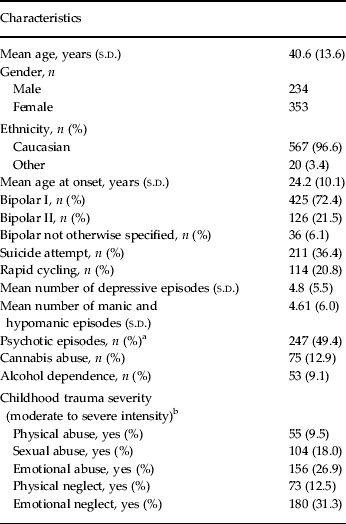
The total sample is presented in Table 1. Before merging the two samples for the analyses, comparison analyses were conducted between the two sites (see online Supplementary Table S1). A total of 13% reported cannabis abuse, and there were no differences between the two sites. Also, no differences between the groups were observed for cannabis dependence. The two samples were similar for Childhood Trauma Questionnaire (CTQ) total score (France: 41.74, s.d. = 12.88 versus Norway 44.03, s.d. = 16.43, z = 0.88, p = 0.37). Differences between the samples were found concerning alcohol dependence (Norway: 14% versus France: 7%). The French sample was also older and had a longer duration of illness than the Norwegian sample (see online Supplementary Table S1). The difference regarding lifetime alcohol dependence between the samples remained significant even when age at interview was used as a covariate. χ 2 Analysis showed no significant association between cannabis abuse (yes, no) and diagnosis (bipolar 1, bipolar II and bipolar not otherwise specified) [χ 2 = 2.29, degrees of freedom (df) = 2, p = 0.32]. Lastly, no significant difference was observed between abuse-dose score (no trauma, one trauma, two traumas, three traumas) and subtypes of bipolar disorders (χ 2 = 7.38, df = 6, p = 0.29).
Patients' demographic and clinical characteristics (n = 587)

s.d., Standard deviation.
a Having at least one psychotic episode during the course of the illness.
b 98.8% (n = 580) of the patients completed the physical abuse subscale; 99.0% (n = 581) completed the sexual abuse subscale; 98.8% (n = 580) completed the emotional abuse subscale; 98.3% (n = 577) completed the physical neglect subscale; 98.8% (n = 580) completed the emotional neglect subscale.
Clinical assessment
In each country, clinical assessment was carried out by trained psychiatrists, medical doctors and clinical psychologists. The French patients were interviewed with the French version of the Diagnostic Interview for Genetic Studies (DIGS; Nurnberger et al. Reference Nurnberger, Blehar, Kaufmann, York-Cooler, Simpson, Harkavy-Friedman, Severe, Malaspina and Reich1994), which provides lifetime DSM-IV Axis I diagnoses. French patients were euthymic at inclusion (i.e. having Mania Rating Scale and Montgomery–Asberg Depression Rating Scale scores of no more than 5). Several clinical variables were collected with the DIGS: lifetime substance abuse and dependence, history of rapid cycling (defined as in the DSM-IV criteria) and history of mixed episodes during the course of the disorder. ‘Suicide attempt’ was measured by the presence of at least one experience of lifetime suicide attempt.
A similar approach was taken in the Norwegian sample using the Structured Clinical Interview for DSM-IV Axis I disorders (SCID-I). It is an ongoing debate whether borderline personality disorder belongs to the bipolar spectrum (Coulston et al. Reference Coulston, Tanious, Mulder, Porter and Malhi2012). We know from the literature that borderline patients, similar to bipolar patients, report high levels of childhood trauma (Coulston et al. Reference Coulston, Tanious, Mulder, Porter and Malhi2012), as well as emotional dysregulation. In our study, the patients had to meet a DSM-IV SCID-I diagnosis of bipolar disorder to be included in the study, independent of possible personality disorders they may also have had.
For both samples, age at onset was defined as the age when the subject first met DSM-IV criteria for a major depressive, manic, hypomanic, or mixed episode. Duration of illness was calculated by current age at time of assessment minus age at onset.
Comparisons of DIGS and DSM criteria have shown excellent reliability scores. A two-phase test–retest (within-site, between-site) reliability study was carried out for DSM, third edition revised (DSM-III-R) criteria-based major depression, bipolar disorder, schizophrenia and schizo-affective disorder. Reliabilities using algorithms were excellent (0.73–0.95), except for schizo-affective disorder, for which disagreement on estimates of duration of mood syndromes relative to psychosis reduced reliability (Nurnberger et al. Reference Nurnberger, Blehar, Kaufmann, York-Cooler, Simpson, Harkavy-Friedman, Severe, Malaspina and Reich1994). As we only investigated bipolar disorders this was not relevant for our study. Although the study by Nurnberger et al. (Reference Nurnberger, Blehar, Kaufmann, York-Cooler, Simpson, Harkavy-Friedman, Severe, Malaspina and Reich1994) compared DIGS with an earlier version of the DSM than the one we used in this study (DSM-III-R versus DSM-IV) there is no reason to think that the reliability score should be any different for DSM-IV used in our study.
CTQ
To measure childhood adverse events we used the CTQ, a retrospective questionnaire enquiring about traumatic experiences in childhood with answers ranging from ‘never true’, ‘rarely true’, ‘sometimes true’, ‘often true’ to ‘very true’, yielding scores for a total score as well as five subscores: physical, emotional and sexual abuse, and physical and emotional neglect (Bernstein et al. Reference Bernstein, Fink, Handelsman, Foote, Lovejoy, Wenzel, Sapareto and Ruggiero1994). Reliability and validity of the CTQ have been demonstrated previously (Bernstein et al. Reference Bernstein, Fink, Handelsman, Foote, Lovejoy, Wenzel, Sapareto and Ruggiero1994). In this study the short versions (28-item version) of the CTQ translated into Norwegian (Aas et al. Reference Aas, Djurovic, Athanasiu, Steen, Agartz, Lorentzen, Sundet, Andreassen and Melle2012), or previously validated in French, were used (Paquette et al. Reference Paquette, Laporte, Bigras and Zoccolillo2004). We used the moderate-severe cut-off scores to dichotomize each subscore, to classify subjects as having/not having a history of childhood trauma in that category, as suggested by Bernstein & Fink (Reference Bernstein and Fink1998).
Statistical analyses
All statistical analyses were performed with the packages PASW Statistics 18 (release 18.0.1) and R (version 2.12.0). Continuous variables are presented as mean values and standard deviations. χ 2 Tests were used to investigate childhood trauma dichotomized using the moderate-severe cut-off scores, to classify subjects as having/not having a history of childhood trauma, as suggested by Bernstein & Fink (Reference Bernstein and Fink1998). For substance abuse, we particularly focused on the presence of lifetime DSM-IV cannabis abuse (yes/no), although separate analyses investigating lifetime alcohol DSM-IV dependence (yes/no) were also included. We chose here to focus on alcohol dependence to capture the most severe form of alcohol use. Alcohol dependence has also been more linked to psychopathology, compared with alcohol abuse. It is also less related to different social norms of different countries regarding drinking, and therefore more suitable to study across study sites (Rehm et al. Reference Rehm, Room, van den Brink and Jacobi2005). As the clinical variables were not normally distributed, non-parametric tests, such as the Mann–Whitney and Kruskal–Wallis tests, were used to investigate relationships between substance abuse and clinical variables. For the interaction and additive analyses, binary logistic regression analyses, together with multiple linear regression analyses, were performed. As the age at onset variable was skewed, it was log transformed before being added into these analyses. Post-hoc analyses were conducted controlling for possible confounders such as gender, as well as duration of illness. Bipolar subdiagnoses and research sites (France/Norway) were also added into the models, but later taken out as they did not have any significant influence and did not improve the model. We used a three-step multiple regression analysis to investigate if childhood trauma mediated the relationship between cannabis abuse and symptom severity measures (Baron & Kenny, Reference Baron and Kenny1986). In step 1, we investigated variables measuring clinical expression (age at onset, rapid cycling, mood episodes, suicide attempt and so on) one at a time, and childhood abuse as the independent variable. In step 2 we investigated variables measuring clinical expression as the dependent variable, again one at a time, and cannabis abuse (here as the mediator) as the independent variable. In step 3, we investigated variables measuring clinical expression, one at a time (as the dependent variable), with childhood abuse as an independent variable whilst controlling for the presence of cannabis abuse (i.e. both childhood abuse and cannabis abuse entered as independent variables at the same time). For the interaction analyses we used regression analyses with both childhood trauma and cannabis abuse as independent variables, together with the interaction term cannabis abuse × childhood trauma. For the additive effects between cannabis abuse and childhood abuse, the data were grouped into three groups accordingly: group one, ‘no cannabis’; group two, ‘cannabis abuse and no childhood trauma’; and group three, ‘cannabis abuse and childhood trauma’.
To avoid type 1 error we corrected for the number of childhood trauma variables tested [physical abuse, sexual abuse, emotional abuse, and abuse dose (none to three types of abuse: physical, sexual or/and emotional)], and thus used a p value of 0.01 as a marker of statistical significance after multiple testing. As this was a hypothesis-driven study, with a priori ideas on directions, we decided this was sufficient enough without the potential of losing important data.
Results
Childhood trauma and substance abuse
Cannabis abuse was significantly associated with childhood abuse, specifically, emotional abuse (p = 0.003), sexual abuse, (p = 0.006), and childhood trauma abuse-dose effect (p = 0.002) (see Table 2). A statistically significant correlation between cannabis abuse and alcohol dependence was also observed. This was statistically significant also after correcting for group site [binary logistic regression: Nagelkerke r 2 = 0.03, p = 0.003, exp(B) = 2.75. No statistical significant associations were observed between alcohol dependence and childhood abuse.
Childhood trauma and substance abuse in bipolar disorder patients a

df, Degrees of freedom.
a Percentage of patients who both abused cannabis and scored positive on childhood trauma was based on moderate to severe cut-off scores from Bernstein & Fink (Reference Bernstein and Fink1998), and cannabis abuse only; the percentage of patients having both cannabis abuse and childhood trauma is greater compared with the group with cannabis abuse only. Similar procedures were performed for alcohol dependence.
* Significant after correcting for the number of trauma subtypes.
Substance abuse and clinical characteristics of bipolar disorders
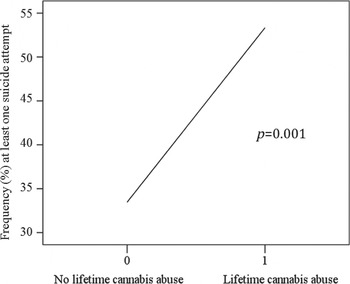
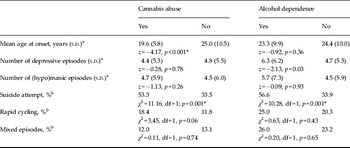
Cannabis abuse was significantly associated with earlier age at onset (p < 0.001), history of lifetime suicide attempt (yes/no) (p = 0.001), as well as a trend for rapid cycling (p = 0.06; see Table 3 and Fig. 1). No significant associations were observed between cannabis abuse and number of depressive, (hypo)manic, or mixed episodes. Alcohol dependence was significantly associated with a history of lifetime suicide attempt (p = 0.001). Alcohol dependence was also associated with increased number of depressive episodes (p = 0.03); however this was no longer statistically significant after correcting for multiple testing. No significant associations were observed between alcohol dependence, (hypo)manic or mixed episodes, rapid cycling or age at onset.
Cannabis abuse and suicide attempt (wish to die). Analysis by χ 2: ‘no lifetime cannabis abuse’, n = 368; ‘lifetime cannabis abuse’, n = 211.

Substance abuse and clinical characteristics of bipolar disorders

s.d., Standard deviation; df, degrees of freedom.
a Mann–Whitney test.
b χ 2 test.
* Significant after correcting for number of trauma subtypes.
Associations between childhood trauma, cannabis abuse and clinical characteristics
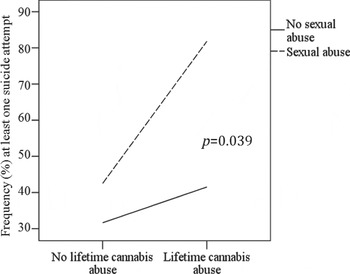
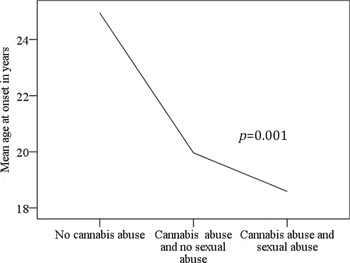
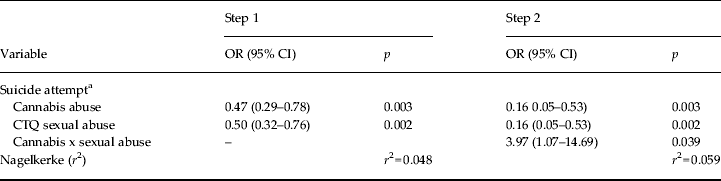
After correcting for multiple testing, a trend for interaction (p = 0.039) was observed between sexual abuse, cannabis abuse, and a history of at least one suicide attempt (see Table 4 and Fig. 2). Although this was only at trend level after correcting for multiple testing, the Nagelkerke r 2 improved when the interaction term was added into the model, indicating that cannabis abuse and sexual abuse were not only independently associated with a history of at least one suicide attempt, but also that they interacted. Adding sites and diagnosis into the model did not change the results (data not shown here). No other significant interactions were observed between childhood trauma, cannabis abuse and clinical expression. Statistically significant additive effects were observed for cannabis abuse and childhood abuse on the severity of several clinical characteristics. For age at onset, a statistically significant additive effect for sexual abuse and cannabis abuse on earlier age at onset (p < 0.001) was observed, with the earliest age at onset in the group reporting both cannabis abuse and childhood trauma [mean = 18.6 (s.d = 7.3) years, compared with no cannabis or childhood abuse: mean 25.0 (s.d. = 10.5) years, see Fig. 3]. Similar findings were observed for emotional abuse and physical abuse (p < 0.001 and p < 0.001, respectively). A significant additive effect of cannabis and childhood abuse on rapid cycling was also found. Binary logistic regression analysis indicated a significantly higher frequency of reports of rapid cycling in the group with both cannabis and childhood abuse compared with all other groups, specifically for sexual abuse [odds ratio (OR) 1.63, 95% confidence interval (CI) 1.11–2.38, p = 0.013, r 2 = 0.02] and emotional abuse (OR 1.61, 95% CI 1.13–2.30, p = 0.003, r 2 = 0.02). Binary regression analyses also showed statistically significant additive effects for cannabis abuse and childhood abuse and report of a history of at least one suicide attempt, specifically with regard to sexual abuse (OR 2.13, 95% CI 1.49–3.14, p < 0.001, r 2 = 0.04) and emotional abuse (OR 1.88, 95% CI 1.34–2.63, p < 0.001, r 2 = 0.03), as well as a trend effect for physical abuse (OR 1.00, 95% CI 1.00–1.01, p = 0.08, r 2 = 0.01). Results also remained statistically significant (p ⩽0.01) after correction for the presence of alcohol dependence.
Interaction between childhood sexual abuse, cannabis abuse and a history of at least one suicide attempt. Analysis by binary logistic regression: ‘no lifetime cannabis abuse’, n = 368; ‘lifetime cannabis abuse’, n = 211; ‘no sexual abuse’, n = 475; ‘sexual abuse’, n = 104. Sexual abuse was dichotomized into trauma versus no trauma based on moderate to severe cut-off scores of Bernstein et al. (Reference Bernstein and Fink1998).

Addictive effect of cannabis abuse and childhood sexual abuse and lower age at onset. Analysis by the Kruskal–Wallis test: ‘no lifetime cannabis abuse’, mean 24.95 (s.e.m. = 0.47) years, n = 499; ‘lifetime cannabis abuse and no sexual abuse’, mean 19.96 (s.e.m. = 0.70) years, n = 53; ‘lifetime cannabis abuse and sexual abuse’, mean 18.59 (s.e.m. = 1.57) years, n = 22.

Multivariate regression analyses, investigating childhood trauma, cannabis abuse and suicide attempt

OR, Odds ratio; CI, confidence interval; CTQ, Childhood Trauma Questionnaire.
a Logistic regression; step 1 includes cannabis abuse and sexual abuse; step 2 includes cannabis abuse, sexual abuse, and the interaction term ‘cannabis abuse × sexual abuse’.
No additive effects were observed for cannabis abuse and childhood abuse, and increased number of mood episodes. Post-hoc regression analyses conducted for all additive analyses, correcting for gender and duration of illness, showed no changes in the results above (data not shown). No mediation effects were observed. Both childhood abuse and cannabis abuse were independently significantly associated with the clinical expressions of bipolar disorders when entered into the model at the same time (for a history of at least one suicide attempt, see Table 4; for other clinical variables, data not shown).
Discussion
Our study is the first to demonstrate a trend for an interaction effect, as well as statistically significant additive effects, between childhood abuse and cannabis abuse on aspects of the clinical expression of bipolar disorders. Patients with both a lifetime history of cannabis abuse and childhood trauma had a higher frequency of reporting at least one lifetime suicide attempt, lower age at onset, and increased frequency of rapid cycling, suggesting an increased clinical severity of the bipolar disorder. Our study also demonstrates that while childhood sexual abuse and emotional abuse are significantly associated with cannabis use, they do not appear to be associated with the risk for alcohol dependence. When controlling for cannabis abuse, childhood abuse was still significantly associated with symptom load in bipolar disorder, indicating that cannabis abuse moderates, but does not mediate, the relationship between childhood abuse and increased severity of the clinical expression of bipolar disorders; similar findings were observed when childhood abuse was entered as the mediator. Based on the significant correlation between cannabis use and alcohol dependence, and the significant association between alcohol dependence and a history of at least one suicide attempt, we performed additional analyses controlling for alcohol dependence. Our results suggest that cannabis abuse is associated with increased risk of at least one suicide attempt, independently of alcohol dependence. Our data further indicate that cannabis abuse has a stronger effect on symptom levels in bipolar disorder than alcohol dependence.
The results of this study also confirm previous findings of a relationship between childhood abuse and substance abuse (Fergusson et al. Reference Fergusson, Boden and Horwood2008; Shin et al. Reference Shin, Edwards and Heeren2009), and between substance abuse and increased symptom severity in bipolar disorders (Lin et al. Reference Lin, McInnis, Potash, Willour, MacKinnon, DePaulo and Zandi2006; Javaid et al. Reference Javaid, Kennedy and De Luca2011; Lagerberg et al. Reference Lagerberg, Sundet, Aminoff, Berg, Ringen, Andreassen and Melle2011). Our study also confirms findings reported by Fergusson et al. (Reference Fergusson, Boden and Horwood2008) and Shin et al. (Reference Shin, Edwards and Heeren2009) that individuals reporting a history of childhood abuse tend to show an increased risk of substance abuse in adulthood compared with individuals without childhood abuse. One of the main questions of the present study was whether childhood abuse and cannabis abuse independently influence the clinical picture, or if the effect disappeared when adding both factors at the same time as independent variables in a multivariate regression analysis. As both childhood abuse and cannabis abuse were independently significantly associated with the clinical expression of bipolar disorders when entered into the model at the same time, our data do not support mediation effects. However, our findings support a trend for interactions and statistically significant additive effects. The significant additive effects indicate that childhood abuse and cannabis abuse may have separate effects on bipolar disorders, and the presence of both proportionally increases the risk for a more severe illness progression. Research in this area is still sparse, and future research is needed to further explore the mechanisms behind these associations. Our data support a role of childhood abuse, as well as cannabis abuse, in the development of clinical characteristics in bipolar disorder. It further highlights the importance of assessing both childhood abuse and cannabis abuse in bipolar disorder research. These should also be systematically included in the clinical assessment of the patients.
A possible mechanism behind the increased risk for a co-occurrence of childhood abuse and cannabis abuse may be linked to their suggested opposite effects on the hypothalamic–pituitary–adrenal (HPA) axis (Heim et al. Reference Heim, Newport, Heit, Graham, Wilcox, Bonsall, Miller and Nemeroff2000, Reference Heim, Newport, Mletzko, Miller and Nemeroff2008; van Leeuwen et al. Reference van Leeuwen, Creemers, Greaves-Lord, Verhulst, Ormel and Huizink2011). Childhood trauma has been linked to long-term hyperactivation of HPA activation (Heim et al. Reference Heim, Newport, Heit, Graham, Wilcox, Bonsall, Miller and Nemeroff2000, Reference Heim, Newport, Mletzko, Miller and Nemeroff2008), while cannabis abuse has been linked to a reduction in HPA activity (van Leeuwen et al. Reference van Leeuwen, Creemers, Greaves-Lord, Verhulst, Ormel and Huizink2011). Cannabis, or substance use, in individuals with childhood abuse could therefore be viewed as a form of self-medication aiming to ‘regulate’ the HPA axis.
Further studies investigating mechanisms behind the effects of substance abuse and childhood abuse on clinical expression in bipolar disorder are needed. A possible target for future research could be, for example, investigations of the effect of childhood abuse on impulsivity (Etain et al. Reference Etain, Mathieu, Liquet, Raust, Cochet, Richard, Gard, Zanouy, Kahn, Cohen, Bougerol, Henry, Leboyer and Bellivier2013), as a possible link between trauma and substance misuse and other risk behaviours.
Limitations
As in most clinical studies of this phenomenon, data on childhood abuse were obtained retrospectively with the inherent weakness of retrospective reporting designs. However, the retrospective collection of childhood abuse data in patients with severe mental disorders has been found to be a valid and reliable source of obtaining information in previous studies (Fisher et al. Reference Fisher, Craig, Fearon, Morgan, Dazzan, Lappin, Hutchinson, Doody, Jones, McGuffin, Murray, Leff and Morgan2011). Our study also fulfills the quality criteria described by Fisher & Hosang (Reference Fisher and Hosang2010), with the limitation that in the Norwegian sample no standardized assessment, but rather clinical judgment, was conducted to decide whether the patients were in a suitable mood to reliably fill in the CTQ form. All patients from the French sample were systematically assessed and defined as euthymic at inclusion. Another limitation should be acknowledged; it is supposed that cannabis abuse pre-existed a history of suicide attempts. However, this has not been rigorously verified in our sample. Also, although we assume that childhood abuse pre-existed cannabis abuse, we cannot exclude the possibility that some individuals had a cannabis abuse history prior to childhood abuse experiences. Lastly, as already mentioned, we observed a higher rate of alcohol dependence in the Norwegian sample than in the French sample, as similarly observed in the overview article by Rehm et al. (Reference Rehm, Room, van den Brink and Jacobi2005). As opposed to this, a recent report by the World Health Organization showed higher alcohol consumption per adult in France than in Norway (WHO, 2011). In our sample different instruments were used to assess alcohol dependence (DIGS in the French sample and SCID-I in the Norwegian sample). It could be that the threshold to detect alcohol dependence is higher in the DIGS than the SCID-I, or it could be that alcohol dependence is linked not only to the amount of alcohol consumed, but also to drinking style, such as binge drinking, which is more frequent in Norway.
Conclusion
Our results show a trend for interaction, as well as statistically significant additive effects, between childhood abuse and cannabis abuse on the clinical expression of bipolar disorders. These results indicate that both childhood abuse and substance abuse (and in particular cannabis abuse) should be taken into account when investigating mechanisms behind the clinical expression and prevalence of bipolar disorders. If confirmed, these results have implications for our understanding of the pathophysiological mechanisms, and treatment implications, in bipolar disorders.
Supplementary material
For supplementary material accompanying this paper visit http://dx.doi.org/10.1017/S0033291713002316.
Acknowledgements
This research was funded by INSERM (Institut national de la santé et de la recherche médicale), Assistance publique – Hôpitaux de Paris (AP-HP), Agence Nationale pour la Recherche (ANR) and Fondation pour la Recherche sur le Cerveau (FRC). These organizations had no role in the design of the study, the collection, analysis and interpretation of data, the writing of the report or the decision to submit the paper for publication. This study was also funded by grants from the Eastern Norway Health Authority (no. 2004123, 2006258) and the Research Council of Norway (no. 167153/V50).
France: This work was supported by INSERM, AP-HP, ENBREC (European Network of Bipolar Research Expert Centre), RTRS Santé Mentale (Fondation Fondamental), ANR, FRC and National Alliance for Research on Schizophrenia and Depression (NARSAD). We thank E. Abadie and J. R. Richard for their assistance. We thank the clinical psychologists who participated to the clinical assessment of patients in France (A. Raust and B. Cochet in Créteil, L. Zanouy in Bordeaux, R. F. Cohen and O. Wajsbrot-Elgrabli in Nancy). We thank the patients for their participation.
Norway: We thank the patients who took part in the study and the Thematically Organized Psychosis (TOP) study researchers who contributed to the data collection.
Declaration of Interest
None.