Introduction
Matthias et al. conducted an early investigation of potassium and sodium niobate in 1949Reference Matthias1 and reported evidence of ferroelectricity in single crystals of the binary end-members constituting (K,Na)NbO3 (KNN) solid solution. Egerton et al. pioneered research on ceramics in this system in 1959.Reference Egerton and Dillon2 In 2004, Saito et al. revealed the tremendous potential of textured polycrystals as a substitute for lead zirconate titanate (PZT) ceramics, which in turn stimulated widespread scientific interest in developing lead-free alternatives.Reference Saito, Takao, Tani, Nonoyama, Takatori, Homma, Nagaya and Nakamura3 The past decade has witnessed a surge in publications on lead-free piezoelectrics,Reference Rödel, Webber, Dittmer, Jo, Kimura and Damjanovic4–Reference Zhang, Xia and Shrout9 as well as continual enhancement of their electromechanical properties; this was further prompted by worldwide regulations restricting the use of lead and lead-containing materials.
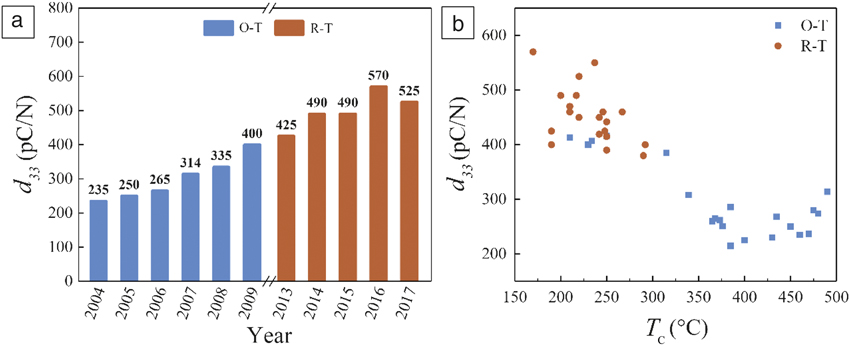
The historical evolution of the performance of KNN ceramics from the perspective of the piezoelectric constant d 33 is shown in Figure 1,Reference Guo, Kakimoto and Ohsato10–Reference Yao, Wang, Cheng, Zhang, Zhang, Zhu and Li57 where state-of-the-art KNN piezoceramics have been tailored to demonstrate properties comparable to those of PZT in certain scenarios. Strategies in terms of enhancing electromechanical properties within the KNN system mainly focus on phase-boundary engineering,Reference Wang, Wu, Xiao, Zhu, Cheng, Zheng, Zhang, Lou and Wang13,Reference Zheng, Wu, Yuan, Lv, Li, Men, Zhao, Xiao, Wu, Wang, Li, Gu, Zhu and Pennycook15,Reference Wang, Bando, Katsumata, Inaguma, Taniguchi and Itoh52–Reference Zhang, Wang, Du, Dai, Sun, Li, Hu, Thong, Zhao, Xi, Yue and Li56 domain engineering,Reference Yao, Wang, Cheng, Zhang, Zhang, Zhu and Li57,Reference Hirohashi, Yamada, Kamio, Uchida and Shichijyo58 and optimization of processing.Reference Li, Wang, Zhang and Zhang59,Reference Shen, Grüner, Eriksson, Belova, Nan and Yan60 Wu et al. observed a large d 33 of 570 pC/N in polycrystalline KNN ceramics by simultaneously shifting dual-phase transition temperatures and constructing a distinct phase structure.Reference Xu, Li, Lv, Wu, Zhang, Xiao and Zhu20 Li et al. achieved ultrahigh electromechanical properties with d 33 of 700 pC/N and a planar electromechanical coupling factor of 76% (measure of the conversion efficiency between electrical and mechanical energy) in highly textured KNN ceramics.Reference Li, Zhai, Shen, Zhang, Li, Zhu and Zhang61 In terms of d 33, KNN materials are indeed comparable to soft commercial PZT (350–700 pC/N).
(a) Evolution of d 33 in (K,Na)NbO3 (KNN)-based ceramics with different phase boundaries,Reference Guo, Kakimoto and Ohsato10–Reference Xu, Li, Lv, Wu, Zhang, Xiao and Zhu20 and (b) their d 33 and T C values as a function of different phase boundaries.Reference Saito, Takao, Tani, Nonoyama, Takatori, Homma, Nagaya and Nakamura3,Reference Wang, Wu, Xiao, Zhu, Cheng, Zheng, Zhang, Lou and Wang13,Reference Zheng, Wu, Yuan, Lv, Li, Men, Zhao, Xiao, Wu, Wang, Li, Gu, Zhu and Pennycook15,Reference Xu, Li, Lv, Wu, Zhang, Xiao and Zhu20–Reference Yao, Wang, Cheng, Zhang, Zhang, Zhu and Li57 d 33 has increased dramatically, owing to the change from the O-T phase boundary to R-T phase boundary. Note: d 33, piezoelectric coefficient; T C, Curie temperature; R, rhombohedral; T, tetragonal; O, orthorhombic.

For practical applications, d 33 and its thermal stability are considered to be the most important criteria, suggesting KNN could be used at least for certain operating regimes. KNN-based materials have certain inherent, often neglected, advantages over PZT. For example, the density of KNN is 4.5–4.8 g/cm3, much lower than that of PZT (7.5–8.0 g/cm3), resulting in superior performance for transferring ultrasound into low-density media.Reference Koruza, Bell, Frömling, Webber, Wang and Rödel5 Also, recent research has revealed the feasibility and reliability of KNN-based multilayer ceramics with nickel inner electrodes.Reference Kawada, Kimura, Higuchi and Takagi62 For PZT devices, the thermodynamic incompatibility between the metallic nickel and lead oxide during co-firing precludes the possibility of using nickel as inner electrodes for multilayer structures. Thus, there are considerable cost benefits in using KNN. Researchers from industry recently demonstrated the mass production of granulated KNN powders, a technical achievement, and were able to reproducibly produce 100 kg per batch.Reference Ohbayashi, Matsuoka, Kitamura, Yamada, Hishida and Yamazaki63 However, it should be noted that there remain many challenges, such as poor sinterability and weak reproducibility, which still hinder extensive application of these materials.
Phase-boundary engineering
In pursuit of a high piezoelectric constant d 33, a number of recent research activities have focused on modifying phase-transition temperatures to construct a phase boundary at room temperature. It is known that KNN-based materials undergo a sequential phase transition from rhombohedral (R) to orthorhombic (O) to tetragonal (T) to cubic (C) phases with increasing temperature. For pure KNN ceramics, a low piezoelectric coefficient (d 33 ∼ 80 pC/N) was reported due to the absence of phase coexistence (O-T, R-O, or R-T). To improve the piezoelectric response, it is essential to shift the phase-transition temperatures (rhombohedral to orthorhombic phase-transition temperature T R-O or orthorhombic to tetragonal phase-transition temperature T O-T) to room temperature to construct desired phase structures.Reference Li, Wang, Zhu, Cheng and Yao6 A large amount of research shows that substituting with elements such as Li, Ag, Zr, Hf, Sb, and Ta, can decrease T O-T to room temperature, resulting in the formation of an O-T phase boundary and relatively good piezoelectricity (d 33 = 200∼416 pC/N).Reference Wu, Xiao and Zhu8 On the other hand, an R-O phase boundary can be shifted to room temperature, but is accompanied by poor piezoelectricity (d 33 ≤ 250 pC/N).Reference Wu, Xiao and Zhu8 It is suggested that by selecting the appropriate substitutes, both T O-T and T R-O can be simultaneously shifted to room temperature, omitting the intermediate transition to the O phase and forming an R-T phase boundary instead.Reference Wu, Xiao and Zhu64 As a result, ultrahigh piezoelectricity (d 33 = 490∼570 pC/N) can be achieved,Reference Xu, Li, Lv, Wu, Zhang, Xiao and Zhu20,Reference Wang, Bando, Katsumata, Inaguma, Taniguchi and Itoh52,Reference Zushi, Ariizumi, Kojima, Wang and Bando53 as shown in Figure 1a. It should be mentioned that the reported high value of 700 pC/N is not included here because it was achieved for textured KNN ceramics,Reference Li, Zhai, Shen, Zhang, Li, Zhu and Zhang61 while the values shown in Figure 1 were measured using non-textured samples.
Figure 1a presents the historical (2004–2017) evolution of d 33 in KNN-based ceramics with different phase boundaries, where the highest d 33 values reported in each year are presented. The ceramics with the O-T phase boundary were widely investigated at first. In 2004, Saito et al. reported a large piezoelectric constant (d 33 ∼ 416 pC/N) in textured KNN-based ceramics by shifting the O-T phase boundary.Reference Saito, Takao, Tani, Nonoyama, Takatori, Homma, Nagaya and Nakamura3 Since then, the O-T phase boundary constructed by composition modification, such as with ion substitutions (Li, Ta, and Sb) or the addition of second compounds (LiNbO3, LiTaO3, and LiSbO3), is considered to be an effective method to enhance piezoelectricity.Reference Wu, Xiao and Zhu8 Wu et al. successfully prepared a series of high-performance KNN-based ceramics by developing the R-T phase boundary. In 2013, a large d 33 of 425 pC/N was obtained in (K,Na)NbO3-LiSbO3-BaZrO3 (KNN-LS-BZ) ceramics with the R-T phase boundary, which is the first reported value comparable to the KNN-based textured ceramics designed by Saito et al. Since 2014, successive improvements in piezoelectricity (d 33 = 460∼570 pC/N) have been achieved in non-textured KNN with the R-T phase boundary.Reference Xu, Li, Lv, Wu, Zhang, Xiao and Zhu20,Reference Qin, Zhang, Yao, Lu and Zhang26,Reference Wang, Bando, Katsumata, Inaguma, Taniguchi and Itoh52,Reference Zushi, Ariizumi, Kojima, Wang and Bando53 Figure 1b summarizes data for d 33 as a function of Curie temperature, T C, for KNN-based ceramics with different phase boundaries. The construction of the R-T phase boundary was anticipated to improve the piezoelectricity of KNN-based ceramics.
As previously discussed, the phase structure is of paramount importance for KNN-based materials, while the coexistence of O-T or R-T phases is of greatest concern. Lab-scale x-ray diffraction can be used to distinguish the O from the T phase, which makes it easy to identify the O-T phase boundary.Reference Wang and Li65 However, detailed structural analysis of the phase constitution around the R-T phase boundary remains to be achieved, resulting in controversy over the existence of the R-T phase boundary.
Temperature stability
KNN-based piezoceramics have shown electromechanical properties equivalent to those of PZT in the intermediate and low-temperature regime (25°C–200°C).Reference Xu, Li, Lv, Wu, Zhang, Xiao and Zhu20,Reference Li, Zhai, Shen, Zhang, Li, Zhu and Zhang61 Temperature-dependent properties of piezoelectrics are important as well because there are circumstances where electromechanical coupling at a high temperature is demanded (e.g., piezoelectric fuel engine injectors, ultrasonic gas velocity sensor applications, and high-power ultrasonic transducers). However, unlike the temperature-insensitive morphotropic phase boundary (MPB) in PZT, phase boundaries in KNN solid solution are tilted, known as polymorphic phase boundariesReference Dai, Zhang and Zhou66 and are temperature sensitive. High piezoelectric activities are always combined with the phase coexistence region to increase the likelihood of obtaining temperature-insensitive performance in a single phase. For many years, KNN materials were associated with a tradeoff between electromechanical performance and thermal stability.
Only recently has the issue of thermal stability been partly resolved by phase structure engineering (e.g., constructing a diffuse phase transition). Wang et al. reported a temperature-insensitive field-induced strain, which varies less than 10% when the temperature varies from room temperature to 175°C, demonstrating the great potential of lead-free piezoceramics for temperature-insensitive piezoelectric actuators in KNN piezoceramics.Reference Wang, Yao, Jo, Gobeljic, Shvartsman, Lupascu, Li and Rödel67 Yao et al. revealed the occurrence of distinct O-T phase coexistence over a wide temperature range (0°C–100°C) under an electric field stimulus.Reference Yao, Wang, Jo, Webber, Comyn, Ding, Xu, Cheng, Zheng, Hou and Li68 In situ synchrotron x-ray diffraction experiments combined with dielectric constant measurements revealed that the phase transition between O and T phases is extended, constituting a diffused phase transition. Wang et al. constructed an R-T phase boundary, where d 33 remained above 200 pm/V up to 200°C by codoping titanate and zirconate into KNN.Reference Wang, Wang, Yao, Li, Schader, Webber, Jo and Rödel55 Zhang et al. showed how the field-induced strain could be further enhanced while maintaining temperature insensitivity by doping manganese into the material.Reference Zhang, Wang, Du, Dai, Sun, Li, Hu, Thong, Zhao, Xi, Yue and Li56,Reference Zhang, Wang, Zhou, Zhou, Chu, Lv, Wu and Li69
Requirement and opportunity
The fundamental requirements for applications of KNN include not only the piezoelectric coefficient d 33, but also other properties (e.g., electromechanical coupling factor [k] and mechanical quality factor [Q m]). Similar to PZT, these properties can be modified by using either donor or acceptor doping in KNN to achieve a “softening” or “hardening” effect, respectively.Reference Hagh, Jadidian, Ashbahian and Safari70,Reference Vendrell, Garcia, Bril, Ochoa, Mestres and Dezanneau71 The tunable properties have turned the requirements into opportunities. For example, the properties can be purposely fitted for applications in the high-frequency mode, such as ultrasonic cleaning, and medical transducers, where the figure of merit is the product of k Reference Egerton and Dillon2 and Q m.Reference Li, Kakemoto, Hoshina and Tsurumi72
Another important issue concerning the application of KNN materials is cost. It has long been argued that Ta is expensive, thus KNN materials containing Ta have less potential for commercialization; however, this problem has currently been solved since compositions without Ta still show properties comparable to PZT.Reference Li, Wang, Zhu, Cheng and Yao6,Reference Matsuoka, Kozuka, Kitamura, Yamada, Kurahashi, Yamazaki and Ohbayashi73 Nevertheless, the production cost of KNN may still not be as inexpensive as that of PZT, mainly due to the use of Nb.Reference Koruza, Bell, Frömling, Webber, Wang and Rödel5
Interestingly, the cost burden of KNN can be compensated during device manufacture by the multilayer ceramic structure. By stacking more ceramic layers with smaller thicknesses, multilayer piezoelectric devices enable the enhancement of overall displacement and an effective reduction in driving voltage.Reference Gao, Guo, Zhang and Randall74 Expensive precious metals as the inner electrode materials in PZT multilayer structures are the only choice since they can withstand the cofiring process with ceramics at high temperatures.Reference Koruza, Bell, Frömling, Webber, Wang and Rödel5,Reference Gao, Guo, Zhang and Randall74 Encouragingly, KNN and the main doping elements are thermodynamically compatible with base metals such as Ni and Cu. Kobayashi et al. proved the possibility of cofiring Ni inner electrodes in KNN-LiF ceramics.Reference Kobayashi, Doshida, Mizuno and Randall75 Hayashi et al. confirmed the reliability of multilayer piezoelectric ceramics with Ni inner electrodes under many conditions (e.g., stability with respect to high and low temperatures, high humidity, thermal shock).Reference Hayashi, Kawada, Kimura, Nakai, Tabata, Shiratsuyu, Nada and Takagi76 Gao et al. demonstrated the capability of cofiring inner Cu electrodes with KNN piezoceramics through precisely controlling experimental conditions.Reference Gao, Ko, Guo, Hennig and Randall77 Thus, the thermodynamic compatibility of KNN ceramics with base metal electrodes provides a cost advantage over PZT for multilayer structures, and is therefore one of the incentives to push lead-free materials toward applications.
Remaining challenges
Several challenges still remain. KNN-based ceramics are notorious for their poor sinterability and the inability to control the microstructure ever since their discovery in the late 1950s.Reference Egerton and Dillon2 Processing-related problems have been recognized as the main reasons preventing their wide application.Reference Zhang, Xia and Shrout9
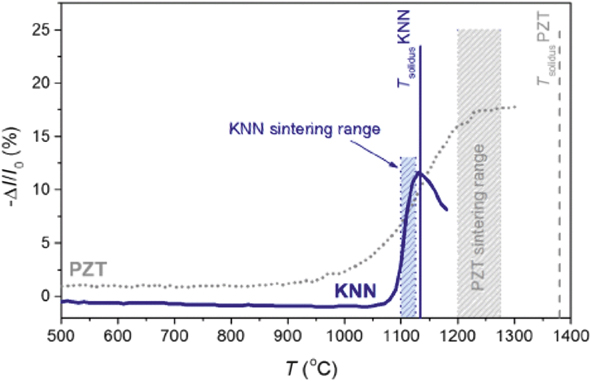
Generally, sintering of KNN ceramics is characterized by a narrow sintering range of only a few tens of degrees centigrade close to the solidus temperature of 1140°C, as shown in Figure 2.Reference Malič, Koruza, Hreščak, Bernard, Wang, Fisher and Benčan7,Reference Acker, Kungl and Hoffmann78,Reference Li, Zhen, Zhang, Zhang and Wang79 Also, it is difficult to obtain high-density KNN piezoceramics without additives at low-sintering temperatures. The addition of LiNbO3, LiTaO3, or LiSbO3 can lower the sintering temperature of KNN, but their influence on the grain-size distribution differs.Reference Saito, Takao, Tani, Nonoyama, Takatori, Homma, Nagaya and Nakamura3 Inferring from the literature, it seems that such solid solutions require less strict control of the sintering process to reach high densities as compared to KNN. In contrast to the clear role of PbO in PZT, the benefits of using excess alkalis in KNN are controversial; for example, some researchers suggest that excess alkalis can promote densification,Reference Bomlai, Wichianrat, Muensit and Milne80 while the others believe that it will hinder densification.Reference Acker, Kungl and Hoffmann78 Liquid-phase sintering aids such as Cu compounds,Reference Matsubara, Yamaguchi, Kikuta and Hirano81 (K5.4Cu1.3Ta10O29) (KCT),Reference Matsubara, Yamaguchi, Kikuta and Hirano82,Reference Park, Jang, Tran, Tai and Lee83 and germanate-basedReference Bernard, Benčan, Rojac, Holc, Malič and Kosec84 glassy phases have been effectively used to promote densification and, in some cases, lower the sintering temperature.
Sintering curves (shrinkage versus temperature, T) for a lead-free piezoelectric (K0.5Na0.5)NbO3 (KNN) and Pb(Zr0.53Ti0.47)0.98Nb0.02O3 (PZT), which is added for comparison (dashed line). The samples were heated at 5 K/min in air. While pure KNN is characterized by an extremely narrow shrinkage interval just below the solidus temperature (T solidus), PZT exhibits a much broader shrinkage interval. Note: l 0, diameter of pellet; Δl, change in diameter of pellet.Reference Malič, Koruza, Hreščak, Bernard, Wang, Fisher and Benčan7

Altering the sintering atmosphere is a feasible approach to promote densification and modulate the microstructure. KNN ceramics sintered in reducing atmospheres (75% N2–25% H2 or H2) reached higher relative densities than their counterparts sintered in air or oxygen, and have uniform and fine microstructures, which is related to an increase in the oxygen vacancy concentration and changes in the grain-boundary structure.Reference Fisher and Kang85 Feasibility of sintering in reducing atmospheres enabled realizing KNN-based multilayers with base-metal electrodes, as previously mentioned.Reference Kawada, Kimura, Higuchi and Takagi62,Reference Kobayashi, Doshida, Mizuno and Randall75,Reference Gao, Ko, Guo, Hennig and Randall77
It has been shown that the vapor pressures of alkalines over their respective niobates are a few orders of magnitude lower than the vapor pressures of PbO or Bi over respective PZT or alkali bismuth titanate materials,Reference Malič, Koruza, Hreščak, Bernard, Wang, Fisher and Benčan7,Reference Popovič, Bencze, Koruza and Malič86 meaning that packing powder is not needed to preserve the stoichiometry if the sintering time is not extended. On the other hand, losses of alkalines may occur in earlier stages of processing, including during the manipulation of humidity-sensitive alkaline reagents and solid-state synthesis.Reference Hagh, Jadidian and Safari87
The quest for functional properties of lead-free piezoelectric ceramics, which should be comparable to those of lead-based complex perovskites, has been oriented toward compositions on phase boundaries, which typically include a number of cations on the same crystallographic sites. In the case of KNN, the choice of niobium oxide reagent, orthorhombic or monoclinic, contributed to a nonhomogeneous solid solution.Reference Hreščak, Benc̃an, Rojac and Malic̃88 Similarly, different diffusion rates of sodium and potassium ions may contribute to local heterogeneities.Reference Malič, Jenko, Holc, Hrovat and Kosec89 Nonhomogeneous distribution of Nb and Ta in KNN-based prepared by conventional solid-state reaction contributed to irreproducible functional properties. This problem could be overcome by prereacting B-site ions (e.g., Nb2O5 and Ta2O5 first form a solid solution)Reference Wang, Damjanovic, Klein, Hollenstein and Setter90 or utilizing individual binary compounds,Reference Hagh, Jadidian and Safari87 or alternatively, by mechanochemical activation of the reagent mixture.Reference Rojac, Benčan, Uršič, Malič and Kosec91 In other words, each new lead-free material formulation with reliable and reproducible functional properties is also a challenge from the processing point of view.
Summary
In this article, we have reviewed milestone achievements in the development of KNN-based materials as promising lead-free piezoceramics. Research on KNN has been proven successful, and the exploration is entering a new application-oriented stage. The first batch of commercial devices using KNN materials is expected on the market soon, while extension of these materials to broad applications still requires unremitting efforts.
Acknowledgments
This work was supported by the National Nature Science Foundation of China (Grant Nos. 51572143, 51332002, and 51722208) and the Slovenian Research Agency (P2-0105 and L2-8180).

Ke Wang is an associate professor in the School of Materials Science and Engineering at Tsinghua University, China. He received his PhD degree from Tsinghua University in 2010, and was a Humboldt Postdoctoral Research Fellow at Nichtmetallisch-Anorganische Werkstoffe (NAW) in Darmstadt, Germany. In 2012, he became a faculty member in Tsinghua University. His research focuses on piezoelectric materials and devices. He has co-authored more than 60 papers on (K,Na)NbO3-based lead-free piezoelectric materials. Wang can be reached by email at wang-ke@tsinghua.edu.cn.

Barbara Malič is head of the Electronic Ceramics Department at Jožef Stefan Institute, Slovenia, and a professor of chemistry of materials at Jožef Stefan International Postgraduate School. Her research focuses on lead-based and lead-free ferroelectric and piezoelectric ceramics and thin films, electrocaloric materials, and patterning of solution-derived functional oxides by inkjet printing. She is an author or co-author of more than 200 papers, and a 2010 recipient of the Zois recognition for achievements in research of ferroelectric ceramics and films. Malič can be reached by email at barbara.malic@ijs.si.

Jiagang Wu has been a professor at Sichuan University, China, since 2015, and has served as assistant dean of the College of Materials Science and Engineering since 2017. He received his BS and PhD degrees from Sichuan University in 2003 and 2008, respectively, and worked as a Singapore Millennium Postdoctoral Fellow at the National University of Singapore (2008–2010). His research focuses on the property modification of ferroelectric/piezoelectric/multiferroic materials. He has published more than 150 papers with a Science Citation Index (SCI) of more than 3000. Wu can be reached by email at wujiagang0208@163.com.