On February 17, 2008, people spilled into the streets of Pristina to celebrate Kosovo's independence. After nearly a decade in limbo, it seemed Kosovo Albanians would finally govern themselves. The United States and most members of the European Union (EU), who effectively sustained the region's autonomy, agreed that there were no reasonable alternatives to independence. Ethnic cleansing under the Slobodan Milosevic regime and the new government's intransigence during final status negotiations had convinced them that the Albanians should not be returned to Serbian control.Footnote 1 However, not everyone supported statehood. Serbs outside the province opposed its psychic toll on national identity, while Serbs within Kosovo feared Albanian domination. Among outsiders, Russia and China also denied Kosovo's independence. They insisted any real resolution to the conflict required Serbia's consent or, in lieu of that, consensus within the United Nations Security Council (UNSC). The unilateral declaration of independence thwarted Serbia's sovereignty and the UN's mandate; the Kosovars ought not to be rewarded for their regrettable choice.Footnote 2 Further, Russia and China argued that bestowing legitimacy at this point would set a dangerous precedent for secessionists elsewhere.
Across the Black Sea, opinions about state emergence reversed. In Georgia, Russia saw independent states where the United States and EU saw Potemkin regimes. Georgia attempted to retake South Ossetia, a province legally but not effectively under its control, in August 2008. Up to that point, the territory's de facto independence had been backed by Russia, whose presence was a remnant of a prior secessionist war there in 1991–2. Ostensibly in the region to maintain a cease-fire, Russian troops countered Georgia's “offensive” attack. At the time, accounts disputed who had reinitiated the violence.Footnote 3 Regardless, just five days of combat revealed that Russia had the upper hand. Its troops restored the status quo ante and imposed large buffers around South Ossetia and Abkhazia, Georgia's other separatist region. Shortly thereafter Moscow formally recognized both territories' independence.Footnote 4
The United States and various European states condemned Russia as an instigator and aggressor. From their perspective, it was within President Mikheil Saakashvili's purview to attempt to resolve the South Ossetia problem by force.Footnote 5 Russian leaders judged Western support for Georgia hypocritical, particularly in light of their recent recognitions of Kosovo.Footnote 6 In their view, South Ossetia and Abkhazia had suffered during a decade of harsh, state-led sanctions, demonstrated strong internal support for independence and seemed to present equally viable new system members.Footnote 7 Even the most ambitious plans for Kosovo's independence required years of European assistance, whereas South Ossetia and Abkhazia had already persevered longer with significantly less outside help.
What is a state? And how are they born?Footnote 8 Recent cases show it is not straightforward, but international relations (IR) scholars give system membership surprisingly little thought.Footnote 9 Most theories take the fundamental units of political life to be exogenous. Countries either exist or do not, and how they come to be is presumed to be relatively unproblematic.Footnote 10 Therefore, we might mistakenly conclude that the latest conflicts between powerful states are semantic and that state leaders are playing politics over factual questions that could be easily resolved. Unfortunately, the prevailing wisdom is misleading. There is often little perceptible difference between states and nonstates; disagreements over the legitimate members of the international community are common; and political wrangling among strong states like these frequently determines when and whether aspiring states will succeed.
Domestic-level theories of state emergence claim internal outcomes decide independence. And for lack of a compelling, international-level alternative, IR scholars have largely adopted this bottom-up perspective.Footnote 11 Drawing on the untapped IR literature, I argue that statehood is inherently social and that external politics, not only the facts on the ground, determine state birth. Some actors have unequivocal internal sovereignty prior to being accepted as states by the international community, as existing domestic-level theories would suggest, but effective authority alone is insufficient. Independence projects falter if they cannot secure external legitimacy.Footnote 12 Moreover, effective authority is unnecessary. Most states-to-be are socially promoted and accepted as full system members before their domestic-level conflicts have concluded. In any case, it is clear that aspiring states need a quorum of the world's states to consecrate their legitimacy; they need friends in high places.
If it is true that external legitimacy “makes the state” and that politics motivate system members' acceptance, important theoretical and practical consequences follow. First, the parties in these civil conflicts will behave contrary to our expectations because existing models omit a key variable. Endogenizing external politics may suggest new strategies to prevent violence or to resolve recurring or persistent conflicts. Next, this argument suggests that state emergence is a dramatic instance of the second image reversed, wherein system-level factors not only affect states' internal organization, but actually serve to select new states.Footnote 13 Consequently, state birth may exhibit cohort effects or birth rates might change depending on international politics. For instance, during different eras the system could be predisposed to accept one type of member over others.Footnote 14 Finally, and perhaps most importantly, if political motives drive membership in spite of domestic authority, this social promotion may be setting new states up to fail and undermining the states system. Unless domestic-level authority can be secured after the fact, political recognition may be propagating new states that cannot provide basic governance at home or meet their obligations to other system members. And this persistent internal weakness can generate negative externalities that ultimately create regional or even system-wide insecurity.Footnote 15
This article begins by charting state emergence during the past two centuries and then by briefly outlining the literature on state birth. I argue that while comparative theories' results are insightful, they miss potentially important international determinants of statehood by focusing exclusively on the domestic level. To explore this possibility, a change in perspective and empirical approach are required. Next, I assemble the received domestic-level wisdom and derive new hypotheses from the IR literature. In order to test them, I compile a data set and conduct quantitative tests demonstrating external politics' considerable influence on state emergence. The article concludes with a discussion of my findings, their implications, and recommendations for future research.
State Emergence (1816–2000)
In 1816, the international system had just twenty-five members.Footnote 16 One hundred years later there were still less than fifty states (See Figure 1). State births were rare in the nineteenth century and state deaths, or violent conquests, were more frequent than they are today.Footnote 17 Colonial expansion during that time did not eliminate states because conquered governments were rarely acknowledged as legitimate sovereigns. Rather, precolonial peoples and territories were considered terra nullius, literally no man's lands, and therefore deemed free for the taking. In the middle 1800s the system peaked at forty-six members with decolonization in the Americas and then lost several states with European consolidation.
System members (1816–2002)

In sharp contrast, during the twentieth century 150 states entered the system (and very few died), quadrupling the international community's membership rolls.Footnote 18 At this point, with virtually no remaining terras nullius, any new state had to be born by cleaving-off territory from a recognized sovereign. The new states were born over four principal waves of independence. The first two occurred after the world wars as victors punished the vanquished and rewarded or reinstated their friends. The third wave occurred more gradually as empires shed their colonial holdings from the end of World War II through the 1970s. Finally, the Yugoslav and Soviet collapses created more than twenty new states as the century closed.
Still, the pattern of newly independent states does not sit comfortably with superficial temporal explanations. Not all discontented minorities received states as Wilson's “Fourteen Points” speech might have implied following World War I.Footnote 19 Nor did most systematically oppressed nations achieve the independence they demanded, colonial or otherwise, when the UN dedicated itself to the “self-determination of peoples.”Footnote 20 Several groups often vied to control the same territory or disputed the contours of their inherited boundaries. Thus, many more groups aspired to independence than actually achieved it, and these patterns remain consistent today. The number of ongoing independence projects has not dipped below fifty since World War II (See Figure 2). Of them, only a minority will become states, but their demands will generate high costs in life, wealth, and political stability.
State emergence dynamics (1931–2002)

Most states born in the twentieth century became independent following internal contests over sovereignty, that is, anticolonialism or secessionism.Footnote 21 It is an oft-repeated claim that successful secession is rare, yet during this time period more than one out of every three demands for independence was realized.Footnote 22 Only one particular type, birth following a successful war like Eritrea's independence from Ethiopia, was uncommon.
All new system members are of interest to a project on state emergence, but this article focuses on the causes of state emergence for groups who demand independence from their legitimate governors or home states. Theoretical and empirical reasons inform this choice. First, states occasionally enter the system without prior nationalist demands, but these states-to-be could not be identified a priori. They typically emerged via unilateral decolonization (at the home state's behest) or reflected territorial changes negotiated following interstate wars. At times statehood preceded widespread national identity. As d'Azeglio famously exclaimed, “We have made Italy, now we must make Italians!”Footnote 23 In other cases, a state with strong national identity was occupied, destroyed in wartime, and resurrected by the victors.Footnote 24 As Figure 3 demonstrates, the number of states born following independence demands far exceeds those born in other ways. Nearly two-thirds of states entered the system after demanding independence. Secessionism does not herald the emergence of every state, but it underlies most twentieth-century births.
State emergence (1931–2002)

Domestic-Level Explanations
Most models of state emergence come from comparative theory. The extant literature offers four potential explanations for the twentieth-century explosion in state birth: ethnonational mobilization, political institutions, relative strength, and negotiated consent. Each relies on a bottom-up causal mechanism focused exclusively on domestic politics. They presume that the same factors determining domestic authority will also lead to system membership. Politics between the aspiring state and its home state are believed to be decisive and potential external or international-level influences are not explored.
National Distinctiveness and Mobilization
One common explanation for state birth is ethnic distinctiveness.Footnote 25 Ethnic minority groups are thought to be more likely to demand states of their own and more likely to achieve statehood than other types of secessionists. It is true that secession often has an ethnic character. Of the 256 movements begun since 1931, 141 were linguistically distinct and 113 were religiously distinct from the majority.Footnote 26 Secessionist demands may be particularly acute when ethnicity coincides with sociopolitical disadvantages within the home state, and this tendency is similarly evident. One hundred and thirty-eight secession attempts since 1945 were pursued by “at risk” ethnic minority groups according to the Minorities at Risk Project.Footnote 27
Yet within the set of all ethnic groups, independence demands are highly unlikely. Ethnic politics experts note that there are thousands of ethnicities worldwide and only a minority of them even express political consciousness. Ethnic difference is not tantamount to national identity or nationalism. According to Gellner,
A mere category of persons … becomes a nation if and when the members of the category firmly recognize certain mutual rights and duties to each other in virtue of their shared membership of it. It is their recognition of each other as fellows of this kind which turns them into a nation, and not the other shared attributes … which separate that category from non-members.”Footnote 28
Put more succinctly by Emerson, “The simplest statement that can be made about a nation is that it is a body of people who feel that they are a nation; and it may be that when all the fine-spun analysis is concluded this will be the ultimate statement as well.”Footnote 29 Only a small percentage of ethnic groups consider themselves “nations” and an even smaller fraction of those groups ever demands independence. If each potential nation demanded a state, there would likely be thousands more than the 194 in the system today.Footnote 30 Therefore, theories of state emergence that improve on a null model where all ethnic groups are considered potential new states do not improve our knowledge of state emergence much because most ethnic groups are not within the set of possible states.Footnote 31
Conversely, secessionist movements' identities often confound basic ethnic categories to include common geography, historical experience, economics, or ideology.Footnote 32 Southern Sudanese and Palestinian nationalism do not lend themselves to ethnoreligious categorization, nor do the peoples within the young states of Bosnia-Herzegovina or East Timor. Studies of state emergence limiting their scope to ethnic groups overlook numerous potential and actual new states and include far too many groups without national consciousness. Analyses of mobilized ethnic groups better approximate the set of likely ethnic separatist movements but still exclude too many demands for and realized state emergence. The extent to which existing studies of ethnic mobilization capture the dynamics of state birth is thus in question.
This study aspires to a general model of state emergence. Nevertheless there are reasons to suspect that secessionist demands buttressed by mobilized minority groups should be more successful than others. In the age of nationalism, groups that are ethnically and religiously distinct from the governing elite have prima fascia evidence that their self-determination has been thwarted, or that a unique culture is being assimilated or destroyed. Even in democracies groups may face permanent minority status; although not formally excluded from politics, they may lack the power to meaningfully influence public policy. Furthermore, these groups' large-scale mobilization for independence, whether through peaceful protest or widespread countergovernmental violence, should make state emergence more likely. Mass mobilization sends a signal to government leaders that group members desire independence. At the same time, where violence is concerned it is usually employed by both sides.Footnote 33 Accordingly, large-scale violence is not only an indication of the secessionist group's mobilization, but also of their home state's countermobilization.Footnote 34 Greater violence in particular, might equally be associated with less success.
Institutional Empowerment
Some scholars assert that it is not ethnonational mobilization per se that makes state emergence more likely, but that domestic institutions empower particular groups to make and benefit from independence demands.Footnote 35 Two common institutional explanations argue state emergence is more probable for colonies or for members of ethnic federations. The colonial argument has various causal paths. First, some argue the imperial powers encountered trouble controlling distant territories, often an ocean away, so power projection problems worked to favor anticolonialism. Second, changing views within the home state might explain colonies' relative success. An expert at the time of African independence opined, “national self-determination is what the contemporary world expects; anti-colonial movements are automatically assigned to the familiar rubric of nationalism and are assumed to be serving as the agents of nations.”Footnote 36 If leaders came to believe that anticolonial movements were built on popular nationalism and that national self-determination necessarily implied independence, then state birth would be more likely as these ideas spread within home states. Coincidentally, it has been suggested that controlling far-flung territories lost strategic significance as imperial powers shifted their attention toward the technologies of war.Footnote 37 Thus anticolonial secessions were more successful because state leaders did not fight as hard to keep them.Footnote 38 Together these arguments suggest that empires lacked the capacity to thwart colonial independence, that they gradually lost the will to do so, or both.
Evidence supporting the colonial hypothesis is mixed. Unfortunately, studies of imperial decline often overlook unsuccessful secessionism. Instead, evidence of independence at all is taken as sufficient proof of their claims.Footnote 39 Frequently though, more than one group aspired to govern the same territory. Even granting the tendency favoring anticolonial secessions, we cannot explain the variation in success among them. One might ask why the Kashmiris, Sikhs, or Malayalis failed to gain independence from British India? Also, since colonialism has been discredited as a form of governance, the explanation is temporally bounded. Colonialism may provide explanatory leverage on state birth through the end of the twentieth century but is decidedly less useful today.
Recently, more precise institutional theories have been offered by scholars like Roeder who argues that groups empowered by internal, ethnic segment states are more likely to secure independence than others.Footnote 40 He observes that statehood is not only limited to large, mobilized minorities. In fact, little popular support is necessary if elites have an institutionalized mechanism of political influence at their disposal: the titular ethnic segment state. During the twentieth century, Roeder finds that three-quarters of new states were internally self-governing ethnic segment states just prior to independence. According to his theory, segment state leaders are encouraged to make escalating demands for autonomy to wrest material benefits from the home state on “the people's” behalf. This process routinely produces independence movements that, in turn, are likely to succeed because the institution helps leaders to establish political-identity hegemony, drowning out alternative, less-well-situated nationalist projects within their borders. The ethnic segment state theory overcomes many of the colonial hypothesis's limitations. If supported, it potentially explains variations in anticolonial secessions and, more recently, cases like the former Yugoslavia and Soviet Union.
Decisive Relative Strength
Probably the most widely held common wisdom regarding state emergence is that more powerful secessionist movements are more likely to secure independence. According to this intuition, coercive capacity sufficient to exclude any competing authorities within a territory makes the state, and where a fait accompli exists, it cannot be ignored.Footnote 41 Much of the literature supporting this hypothesis comes from the study of domestic violence and war.Footnote 42 Most studies to date concentrate on the causes and dynamics of secessionist wars instead of their termination and results.Footnote 43 But new research on civil war settlements finds that more durable peace follows wars in which one side wins conclusively, whereas negotiated resolutions are more likely to relapse into violence. Definitive victory creates lasting peace because it clarifies the balance of power, advising the loser against reinitiating violence in an attempt to achieve its ends, that is, if the actor's capacity for war has not been entirely destroyed.Footnote 44 Notably, Toft finds that rebel victories are particularly likely to create long, stable peace.Footnote 45 Therefore, when the secessionist movement is disproportionately powerful it ought to successfully secure independence.
Reviewing war outcomes provides a straightforward, albeit blunt means of testing whether definitively strong secessionists are more successful. Among conflicts that escalated to war, those ending in decisive victory for the secessionists ought to lead to state emergence. This is what we find. Of the forty-one secessionist wars (1931–2000), twenty-two favored the home state, fifteen favored the secessionists, and four ended indecisively. Thirteen of the fifteen secessionist victors secured independent states. Only two, the Saharawis and Chechens, did not.Footnote 46 More surprisingly, four of the twenty-two defeated groups secured independence and Abkhazia, although also defeated, may add to that total if the international community embraces its legitimacy.
War outcomes and secession (1931–2002)

The evidence shows that relatively strong movements are significantly more successful than their weaker peers, though it is not true that only the strongest become states. Most new states enter the system before securing authoritative control over their territories. Some are accepted in the midst of secessionist wars, just as many states recognized Algeria's independence as its war raged with France.Footnote 47 Others receive external legitimacy even though they do not and cannot control the people and territory they claim, like East Timor on its independence.Footnote 48 Overpowering competing authorities may be a sufficient cause of state emergence, but it is also an unnecessary one. Furthermore, an argument based on definitive strength is necessarily limited in its scope. Battlefield successes reliably predict state emergence for disputes that select into war, but do not provide insights when conflicts favor the home state, do not escalate to war or end in a draw.
Negotiated Consent
The final existing explanation for state birth is negotiated consent. In the postcolonial era, consent is the only fully legal means by which secession can regularly occur.Footnote 49 The consent of the home state is considered a definitive and necessary signal of state birth according to international law. The rule would not yield the most viable new system members, but would best preserve the home state's sovereignty. The causal argument behind the hypothesis is normative. If the home state grants independence, the international community should defer to its decision. Unless and until it does, state leaders cannot accept the newcomer because the conflict is an internal affair and leaders are legally bound to uphold each other's sovereignty; domestic authority and nonintervention are the foundational principles of the Westphalian order. Indeed, Crawford asserts empirically that, outside of anticolonial conflicts, the international community does not recognize new states without the home state's consent.Footnote 50
States occasionally emerge after negotiated settlements with their governments. Montenegro gained independence following a referendum and Serbia's consent in 2006, and many states negotiated their independences under the League Mandate and UN Trust systems. Even so, evidence supporting the consent-first requirement is equivocal. First, whether a home state willingly granted independence or was compelled into conceding it is often ambiguous. Recently, had the UNSC not intervened to ensure East Timor's plebiscite, establish order, and defend its autonomy, it is unlikely that the Indonesian government would have upheld its independence. Second, there are as many examples of outsiders flouting home states' sovereignty as those respecting it.Footnote 51 Pakistan opposed East Pakistan's secession and the separatists might have failed had India not intervened and forced Pakistan to relinquish its control. Initially state leaders condemned India's behavior and withheld legitimacy for the new state. Still, nearly fifty UN members had recognized Bangladesh by February 1972 and fully half of them did before Pakistan finally accepted independence. States do not typically withhold legitimacy in deference to the home state, even when international law unambiguously instructs them to do so.
Historically only around half of the states emerging from secession had their home state's consent by the time they entered the system.Footnote 52 Furthermore, according to the more detailed data collected for this project, two-thirds of Great Power states' recognition grants came before the home state consented to independence.Footnote 53 Consent does not appear to be a prerequisite for state birth. Nonetheless, once a home state concedes to a secessionist demand, state emergence does typically become routine.Footnote 54 When a conflict is resolved internally, there is no reason not to accept the new member. Consequently, this project examines ongoing secessionist conflicts and admits that external legitimacy granted after a conflict's formal resolution is markedly less political. This ensures that the fundamental conflict is ongoing and presents a hard test for international-level factors because they must precede a domestic resolution.
The domestic-level explanations for state birth yield three testable hypotheses:
H1: Mobilized minority groups are more likely to achieve statehood.
H2: Institutionally empowered groups are more likely to achieve statehood.
H3: Militarily stronger secessionist groups are more likely to achieve statehood.
States in International Relations
Given IR scholars' disparate views of international politics, their conceptions of the state are strikingly similar. Like domestic-level theories, though significantly less developed, IR suggests conflicts over domestic sovereignty are settled prior to state birth. Weber's classic definition of the state, focused on a monopoly of the legitimate use of physical force within a given territory, is ubiquitous.Footnote 55 According to Morgenthau, “[the territorial state] referred in legal terms to the elemental fact of [the sixteenth century]—the appearance of a centralized power that exercised its lawmaking and law-enforcing authority within a certain territory.”Footnote 56 Other theoretical traditions only make slight adjustments to this characterization. Systemic constructivism describes states as a fuzzy set whose qualities typically include: (1) an institutional-legal order, (2) an organization claiming a monopoly on the legitimate use of organized violence, (3) an organization with sovereignty, (4) a society, and (5) territory.Footnote 57 The authoritative legal definition, found within the Montevideo Convention on the Rights and Duties of States requires that, “[states] possess the following qualifications: a) a permanent population; b) a defined territory; c) a government; and d) the capacity to enter into relations with other states.”Footnote 58 Granting external legitimacy prematurely is unlawful. Liberalism and Neo-Liberal Institutionalism are closest theoretically to international law.Footnote 59 Both assert that states embody the fundamental qualities prescribed by Montevideo. Because laws reflect shared sets of norms and practices, governments generally obey them. Consequently, the Montevideo criteria should accurately characterize new states.
Unfortunately, the major paradigms' consensus about the state's defining features provides few insights into state birth. Consistent with domestic-level models, IR suggests that the state's essence lies in its internal composition and authority. And we might further deduce that if territory, population, and government distinguish states from nonstates, then securing those characteristics should be tantamount to statehood.Footnote 60 Yet far greater variety characterizes the newest members of the international system in practice. New members are often not perceptibly distinct from nonstate actors along dimensions of internal control and authority. The new states emerging from the former Yugoslavia showed wide variation in capacity at the point of membership. Slovenia decisively achieved effective authority prior to recognition; Croatia only gained full domestic authority after external acceptance; and Bosnia-Herzegovina lacks true independent authority even today.Footnote 61 In contrast, in northwest Somalia a breakaway republic called Somaliland has effectively and independently ruled for over a decade, but has been denied statehood in favor of the precarious Transitional Federal Government (TFG) in Mogadishu and Baidoa.
Successful secessions sometimes meet the definition of a state, but even then those characteristics did not exclusively determine their system membership. Indeed, the legal and theoretical standards seem to imply that Somaliland is a state and Bosnia is not, (or at least was not when it entered the system). The only meaningful difference remaining between the two actors is external legitimacy. Because Bosnia-Herzegovina has external legitimacy, including UN membership, foreign diplomatic relations and legal authority, it is deemed to be a state. The same cannot be said for Somaliland. Actors like it, without widespread recognition, inhabit a different, more violent and precarious world than system members do.Footnote 62 Somaliland's government can not gain entry into institutions like the UN or World Bank, nor are its diplomats accredited in foreign capitals. It has no treaty authority on matters of state and cannot exploit its natural resources. Finally, its laws are not considered binding by any other states. It is, for all intents and purposes, not a state. Even those secessionists with convincing domestic authority can only hope to remain apart from their home states. They are not a part of the international system.
An Alternative Model
The weight of empirical evidence suggests the international system is most accurately characterized as a community or social group.Footnote 63 As such, the existing members decide if secessionists will become states or remain on the outside. It is the mutual exchange of recognition that constitutes membership, not effective, domestic-level authority. For aspiring states, identifying with the group or sharing qualities in common with system members is not enough; they must be recognized by other members. Recognition may not be crucial to membership in groups where all are welcome, but it is critical in high status groups where admission is exclusive like the international community.
Greek fraternities provide an instructive analogy. Members are easily distinguished by their behavior: they attend organization meetings, wear clothing with Greek letters, and participate in common rituals. Yet it is difficult to identify who will become a fraternity member by assessing the whole freshman class. Once students pledge their intent to become associated with the organization, the odds of correctly predicting their membership goes up, but remain uncertain. Some pledges will have an advantage on the others: they may be legacy admits, have special talents, or show impressive endurance during hazing. Whatever the pledges' inherent qualities though, membership ultimately rests on existing fraternity members' judgments. Even the qualities deemed attractive are subject to individual tastes. Pledges cannot be brothers based exclusively on self-identification, nor can their talents or personal attributes alone secure their admission. The members must accept them. And once they become members, they will decide which new pledges receive admission in years to come.
So it is with states in the international system. New states emerge when they are widely recognized as legitimate by established members. Recognition provides members entry into organizations and permits behaviors exclusively reserved for states. Not every member needs to recognize an aspiring member before it is considered a state, but a critical mass must do so. By virtue of their material strength, the Great Powers make up the most important portion of this critical mass. Their recognition carries the greatest weight and has the greatest potential influence on others. Typically early movers, when the Great Powers agree, their decision serves as a focal point that initiates a cascade of legitimacy throughout the system's remaining members.
International Explanations
The international politics of membership provide a compelling potential explanation for the mismatch between newly accepted states and those that best conform to scholarly or legal characterizations of the state. As Horowitz rightly observes (but does not test), while secessionist aspirations may hinge on domestic factors, “whether a secessionist movement [succeeds] … is determined by the balance of forces and interests that extend beyond the state.”Footnote 64 In the following section, I present three broad categories of self-interested motives for state preferences regarding new members: external security, domestic security, and coordination. Although the list is not exhaustive, it convincingly demonstrates how external politics should influence recognition and state birth.
External Security
One potential motive behind recognition is the pursuit of external security. Survival is the most fundamental compulsion of states. Therefore, state leaders should weigh any potential grant of legitimacy with reference to their own security situations, judging how each new member would positively or negatively affect them. Given the opportunity, states should use recognition strategically to strengthen or protect themselves and to weaken their enemies. Recognition can function in much the same way that other kinds of external intervention do: it may destabilize unfriendly neighbors and/or inculcate regime change or it may be used to curry favor with secessionists on their way to victory.Footnote 65 Even the uncertainties of future relations with a new member may be preferable to a predictably hostile relationship with its more powerful home state. So, conflict with a home state should make a Great Power more likely to recognize that state's internal challengers' independence. In these circumstances, recognition constitutes an external-internal balancing of sorts because state leaders can weaken their enemies from within by subtracting the secessionists' share of territory, population, infrastructure, and natural resources.
In contrast, support for a friendly state's secessionist challengers would adversely affect security. State leaders should avoid making themselves less secure by weakening or destabilizing their friends. Greater amity or shared interests between a Great Power and a home state should make recognition of their secessionists less likely. Shared ideology is one common source of affinity between states. One of the most robust empirical literatures in IR finds that mutually democratic states' conflict behavior differs from that of mixed-dyads; in particular, that their conflicts rarely escalate to militarized violence or war.Footnote 66 One explanation for the democratic peace is that a shared liberal identity, emphasizing compromise and cooperation, allows state leaders to resolve their conflicts more peaceably.Footnote 67 Many claim shared liberal identity has even wider effects than staying interstate violence. Owen, for example, argues that liberal states “believe it is in their interest to have good relations with fellow liberal states” because their elites “believe peace is intrinsically good,” they “are more pacific and trustworthy” and because close relations will serve to “strengthen liberal institutions in their own state.”Footnote 68 As a result, democracies should be less likely to recognize new states emerging from other democracies so as not to weaken their friends, and a similar pattern may be found among mutually nondemocratic states.Footnote 69
Another common amity-based argument is that states with ethnic ties to secessionists or a home state will favor their kin as a form of pandering to their domestic constituency.Footnote 70 Turkey's recognition of the Turkish Republic of Northern Cyprus is emblematic. Unfortunately, a kinship motive for recognition is limited to states with ethnic ties to secessionists or their home states. Kin states are more likely neighbors than powerful, global opinion-leaders like the Great Powers.Footnote 71 Further, the argument only applies if ethnic linkages can be exploited at home by the recognizer; the ties must be politically salient and somehow advantageous. This limits the set of potential kinship motivated recognitions even further. It is not well-suited to explain most recognition. Still, kinship is a demonstrably important factor in local and regional interventions and is worthy of further investigation beyond the scope of this project.
Domestic Insecurity
Domestic insecurity is the second potential influence on recognition behavior. When motivated by vulnerability, state leaders may consider support for secessionists abroad to be a threat to their own domestic survival. Walter's work on reputation, war, and ethnic separatism shows that leaders are apprehensive about the potential reputational effects of bargaining with their domestic challengers (as opposed to standing firm). When the number of prospective challengers is large, state leaders will not concede in order to forestall an additional onslaught of demands. When they have fewer nascent challengers though, they are more willing to negotiate.Footnote 72 If a Great Power is beset by secessionist challengers at home, conferring legitimacy on foreign secessionists sends a similarly dangerous signal in support of separatism's legitimacy. At least, state leaders might reasonably be concerned that their domestic challengers would interpret their policies in that way.
The risk inherent in recognition might be particularly severe for states with more domestic than international security concerns.Footnote 73 Embattled leaders may quite reasonably believe that “even the slightest recognition of secession … would be as unwise as showing blood in the lion's cage.”Footnote 74 Recognition's potential negative domestic consequences should be important for relatively strong states as well though. Notably, China and Russia have faced significant challenges—China in Tibet, Taiwan, and Xinjiang and Russia in Dagestan, Ingushetia, and Chechnya—that may have stayed their support for secessionists abroad. In sum, states facing internal challenges should not recognize secessionists out of concern for domestic reputation, whereas those without domestic acrimony should confer external legitimacy more freely. The more acute the domestic threat, the more the reticence to recognize.
Coordination
The Great Powers' expansive interests often put their preferences over new members at odds. However, rather than unilaterally pursuing those interests, I argue that the Great Powers should prefer coordination in recognition whenever possible. When they disagree, the most likely result is that they uphold the status quo. Only in extraordinary circumstances should state leaders openly controvert each other and recognize competing authorities' sovereignty. In that minority of cases, state emergence may ultimately occur, but only more gradually because disinterested states will be hesitant to pick sides and no definitive, community-wide cascade will occur. In the meantime, those conflicts hold significant potential for dangerously destabilizing international violence.
Various pressures lead the Great Powers to prefer coordinated to unilateral recognition. When their interests and preferences align, they easily collude to enable or thwart state emergence. The Great Powers often have conflicting preferences over new members though, and yet they nearly always successfully resolve those disagreements without internationalizing the secessionist conflict. Why? The drive to coordinate means that most of these disagreements are resolved in favor of the status quo. Kosovo, Abkhazia, and South Ossetia are the exceptions. Only when overwhelming individual interests prompt states to directly intervene should the overriding preference for coordination break down. Indeed, Heraclides reflects that even during the Cold War the superpowers were, “hardly keen to antagonize each other in the periphery on secessionist issues.”Footnote 75 The Great Powers ought to prefer coordinated recognition to maintain their social standing and security; to maintain international stability; and to reproduce the state-centric international order.
First, unilateral recognition is risky and potentially costly because granting it flagrantly violates the home state's sovereignty. This is not only intervention and a breach of international law, but casus belli. Characteristically, when confronted with possible French or British recognition of the Confederate States of America (CSA), the United States promised war in return.Footnote 76 Furthermore, where a secession attempt is accompanied by a war, recognition effectively internationalizes the conflict, turning a civil war into an international war for the recognizing states.Footnote 77 At a minimum, unilateral recognition is cause for the home state to sever diplomatic relations with the recognizer, as Beijing routinely does for those who recognize Taiwan as the legitimate government of China. At worst, the home state will seek extensive, military retribution. The potential benefits of any new state's emergence would have to outweigh substantial, concentrated costs. Unilateral recognition also bucks an established consensus over sovereignty, potentially causing a wider conflict with other system members. For Germany, the mere appearance that it unilaterally recognized Slovenia and Croatia caused rancor and recrimination within the European Community.Footnote 78 Acting together, recognition's potential costs are lower and more diffuse.
Second, unilateral recognition is ineffective since it does not secure membership for the secessionists. Statehood can be conceptualized as conforming to a threshold model of sorts. Each individual state's recognition increases the chances that the actor will become a state. Recognition decisions mean little in isolation though, only together—and in sufficient quantity—do they constitute membership. Once a certain threshold of recognition has been reached, the secessionists are then endowed with the full rights and responsibilities of a state. The Great Powers are each influential enough to thwart a new state's membership, but they cannot constitute it alone.Footnote 79 Unilateral recognition only implies consequences for the state that has conferred it. Others will continue to uphold the home state's authority. A Great Power truly desiring a secessionist state's emergence would not recognize without the expectation that others would eventually follow, breaching the critical threshold.Footnote 80
Finally, the system's organization favors the status quo and distains overlapping sovereignty. This reluctance toward change should encourage coordination over unilateralism. Because the international order relies on exclusive territorial control and nonintervention, recognizing different authorities' jurisdiction over the same territory is destabilizing. Cases of multiple sovereignty like Kashmir and Israel-Palestine comprise some of the world's most difficult and dangerous conflicts. State leaders should resist undermining the established order because it is potentially destructive for those directly involved, but also because they derive substantial power and authority from the continued dominance and stability of the Westphalian states system.
If Great Power recognition is strategically coordinated, recognition should proceed quickly when the Great Powers' interests align in favor of a state's emergence and a new state should not be born when strong states' interests align against it. Little time should elapse between the first Great Power's recognition and the last, and recognition should become increasingly probable as recognition is granted. Coordination is only unlikely when a single power is strongly invested, usually enough to compel direct military intervention, to realize a particular outcome. In these cases, the Great Powers are not responding to opportunities presented to them, but are actively involved in creating independence or thwarting it on the ground. When powerful states become involved in secession this way, and their interests are not in sync, dangerous international instability and violence becomes more likely.
A major public break over recognition as with Kosovo and Georgia has not occurred since the Vietnam War. And even so, in the wider cases of which these three are a part (the former Yugoslavia and former Soviet Union), strong states began explicit efforts to coordinate recognition and nonrecognition before independence was imminent.Footnote 81 In most cases, these negotiations led to successful coordination among the Great Powers.
Insights from IR regarding the political motives for recognition suggest the following new hypotheses:
H4: States are more likely to recognize those who weaken their enemies.
H5: States are less likely to recognize those who weaken their friends.
H6: States beset by secessionist challenges at home are less likely to recognize others.
H7: Once one Great Power has granted recognition, the others are more likely to do so.
Data Specification
The data set for this project tracks 256 secessionist conflicts, between a secessionist movement and its home state, and each Great Power opportunity to grant formal recognition from 1931 to 2000.Footnote 82 A secessionist movement is defined as a nationalist group attempting to separate from one state in order to create a newly independent state for its people. Operationally, a movement has the following characteristics: (1) it formally declares independence from its home state; (2) it has a national flag (signaling national consciousness); (3) it claims an identifiable territory and population; and (4) its campaign lasts at least one calendar week, has greater than 100 active individuals, and claims greater than 100 square kilometers of territory. A secessionist movement begins in (1) the year that the secessionists formally demand independence, (2) the first year of violent conflict over independence, or (3) the first year of the data set where either the first or second item above occurred prior. A conflict ends in the year that secessionists (1) formally concede, (2) go five years without publicly pursuing independence, or (3) reach some resolution, short of or including independence, with their home state. In total, there were 3,725 conflict years. An observation was created for each Great Power in a given conflict year, permitting variation on the international politics variables for the system's most influential members. The Great Powers were coded according to the Correlates of War (COW) operationalization for Major Powers: the United Kingdom, the United States, and USSR/Russia: 1931–2002; China: 1950–2002; France: 1931–40, 1945–2002; Germany: 1931–45, 1991–2002; Italy: 1931–43; and Japan: 1931–45, 1991–2002.Footnote 83 To illustrate, each ongoing secessionist conflict during 1979 has an observation for each of the five Great Powers that might have granted the secessionists recognition that year: the United States, UK, France, the USSR, and China. The number of Great Powers during a given conflict year ranged from four to seven. There are 18,388 opportunities for recognition (observations) in the data set.
The dependent variable for the analysis is recyear, the year in which the Great Power formally recognizes a secessionist movement's independence. Recall, any recognition grant subsequent to a domestic-level resolution with the home state is not included; all recognition in the data set occurs while the secessionist conflict is ongoing. A Cox proportional hazards model is most appropriate to the data structure and the nature of the hypotheses presented.Footnote 84
The first, domestic-level hypothesis asserts that ethnically distinct groups, particularly large, mobilized, and aggrieved groups, are more likely to secure states. To measure ethnic dissimilarity I created an ordinal variable, distinct by summing the linguistic and religious differences between the home state majority and the secessionist group. If the groups share a language family, the indicator is coded 0; if different, then 1.Footnote 85 Religious dissimilarity compares the majority's religion to the secessionists'.Footnote 86 If the two shared a religion, the indicator is coded 0; if different, then 1. The indicators were then summed to create distinct. Thus a group coded 2 is linguistically and religiously dissimilar from its home state, a group coded 1 is distinct on one dimension and a group coded 0 shares both language and religion with the majority.Footnote 87 In order to test whether reasonably large, oppressed, and mobilized minorities are more likely to become states, a dichotomous variable mar was created. It indicates whether (1) or not (0) the secessionist group is found within the Minorities at Risk (MAR) data in a given year.Footnote 88 These secessionist groups must come from minority communities that number at least 100,000 or constitute 1 percent of their home state's total population, suffer discrimination due to their minority status, and be politically mobilized to advance or defend the group's interests.Footnote 89
The institutional hypotheses claim secessionist demands by colonies or ethnofederal units are more likely to create states. colony is a dichotomous variable indicating (1) colony or (0) not during each conflict year. Operationally, a colony is defined as a jurisdiction (people and territory) governed by a state or agents of a state that is neither geographically contiguous nor within 100 miles of its shoreline. Secondary secessions, that is, secession attempts where the home state is a former colony itself, are not coded as colonies even though they reside within units that once were. Emblematically, Bangladesh's secession from Pakistan and Biafra's attempted separation from Nigeria were not considered anticolonial. ethnicfed is also a dichotomous variable indicating whether (1) the secessionists have a state within an ethnofederal union or (0) not during each conflict year.Footnote 90ethnicfed follows Roeder's coding but drops all colonies. For example, Slovenia was a member of an ethnic federation, Yugoslavia, whereas Mozambique was a Portuguese colony. Finally, two variables related to violence were created to test whether strong challengers are more likely to secure states, and to confirm that secessionist war winners are likely to secure independence. The first, vlevel comes from the Uppsala Conflict Data Program at the Peace Research Institute, Oslo (PRIO). The variable codes no armed conflict (0), between 25 and 999 battle-related deaths (1), and at least 1,000 battle-related deaths (2) in a given year.Footnote 91 The second, warwin is a dichotomous variable coding the year in which a secessionist movement defeats its home state in a war for independence (1) and was taken from the COW intrastate war data. If the conflict is ongoing, ends in a stalemate, or ends in a loss, it is coded 0.Footnote 92
The first, international-level hypotheses focus on enmity and amity between states. Hypothesis four argues that external security motivates the recognition of new states; therefore state leaders should use recognition strategically to weaken their enemies. The variable testing this argument, taken from the Militarized Interstate Dispute (MID) data, captures whether the Great Power and home state initiate a militarized dispute (cwmid) during a given conflict year.Footnote 93 Next, a related H5 argues that state leaders will be less likely to recognize secessionists attempting to separate from a friendly home state, because it would threaten their own security in the process. To test this hypothesis, the Polity IV data's democracy and autocracy scores were used to create two dichotomous variables.Footnote 94 If the Great Power–home state dyad was mutually democratic (mutualdem) or mutually autocratic (mutualaut) during a conflict year, it was coded 1. Consistent with accepted practice, states with Polity scores above 7 were coded democracies and those with scores below −7 were coded autocracies. If the dyad was mixed during a conflict year, the variables were coded 0.Footnote 95
H6 argues that Great Powers will be reticent to recognize secessionists' independence when they face analogous challenges at home. Two variables were created to test this claim. The first, hchallenge indicates whether the Great Power has an especially high number of challengers (1) or not (0) during a given year. The variable was created by taking the number of secessionist challenges for each Great Power home state in each year of the data set and coding 1 for cases in the 90th percentile and above, which included those Great Powers with between ten and twenty-one challengers in a conflict year.Footnote 96 The second, vchallenge indicates the cumulative violence level reached in the domestic challenges that year. The intensity of violence was measured by summing the levels of violence from the PRIO data set for each Great Power's domestic secessionist challenges in a given year.Footnote 97 The resulting variable ranges from 0 (none) to 6 (violence equivalent to three full-scale civil wars).
Finally, prec was created as an initial test of whether state leaders strategically coordinate their recognition. If the Great Powers coordinate, recognition should become increasingly likely once one has granted recognition. If no coordination occurs, a single recognition should not significantly influence the probability of a second. Therefore, this variable measures whether any one of the Great Powers has recognized the secessionists' independence as of a given conflict year. It ranges from 0 to 1.Footnote 98
Results and Interpretation
An initial test of only the domestic-level hypotheses, which substituted the COW system membership date as the dependent variable, showed support for most of the existing scholarship.Footnote 99 Contrary to expectations however, neither ethnoreligious distinctiveness nor mobilized and oppressed minority groups had a greater chance of emerging than groups with more in common with the majority. This lends support to the argument that governments' institutionalization of ethnic difference makes membership more likely, not ethnic distinctiveness by itself. The remaining domestic-level hypotheses faired better. As anticipated, anticolonial movements and the members of ethnic federations were significantly more at risk of becoming system members. The level of violence in a secessionist conflict in a given year negatively influenced the chance of independence. During years of higher-level violence, movements were 26 percent less at risk of becoming members. It appears that violence levels do capture both the strength of the secessionists and the home state's will and capacity to prevent their departure. Violence only increases the risk of system membership in a year when, as warwin predicts, the secessionists defeat the home state in war. Aside from colonial status, winning a secessionist war had the greatest impact on state birth, multiplying the risk of emergence in a given year nearly sixteen times. Based on the results of this initial brush clearing, the full model incorporates the domestic-level variables that found support (institutions and relative strength) and excludes those that did not (ethnic distinctiveness and mobilization).
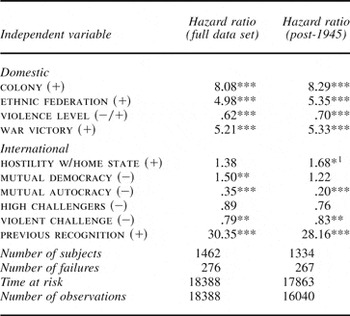
The results of the full, international and domestic, model run with recyear as the dependent variable are presented in Table 1. The signs to the right of the variable names indicate the direction of the hypothesized relationship. Hazard ratios are presented instead of coefficients because interpreting the hazard ratios is straightforward and substantively more meaningful than coefficients would have been. A hazard ratio greater than one indicates the increased risk of Great Power recognition in a year, given that the movement has not already received it. Hazard ratios below one indicate the decreased risk of Great Power recognition in a given year. The left column presents results for the entire study period, 1931–2000. The right column restricts the analysis period from 1945–2000.Footnote 100 The models clearly demonstrate that international politics have an important, underappreciated influence on recognition and, therefore, state emergence. Tests of the external politics hypotheses, external security, domestic insecurity, and coordination all had significant effects on the chance of recognition in addition to the demonstrable domestic-level effects.
Determinants of formal recognition, secessionist movement—Great Power dyads (Cox)

Notes: Hazard ratios are presented. The hazard ratio is the exponentiated form of the coefficient. All tests are two-tailed.
* p < .05;
** p < .01;
*** p < .001.
1 Significant at .058.
The external security motive produced somewhat surprising results. A militarized dispute between a home state and a Great Power did not make recognition significantly more likely during the 1931–2000 period, but after 1945 the risk of recognition increased significantly for groups attempting to secede from a Great Power's rival. Home state–Great Power hostilities increased the risk of recognition in a given year by 68 percent. The difference in findings for the post–1945 period indicates that external security considerations have become increasingly influential to the acceptance of new system members. This may be related to the precipitous decline in major violence between states.Footnote 101 Because militarized disputes have become less common, when they do occur, they may be more meaningful. Therefore interstate violence may be a better indicator of enmity between states now than before 1945, when they were more common. The pattern might also be related to the Cold War, since the two time periods overlap significantly. During the Cold War era, militarized disputes often reflected ideological conflicts that pitched the Great Powers against one another. If this is the case, from 1947–1991 MIDs should create a particularly strong risk of recognition for the USSR and the United States. Models for individual Great Powers show that this was true for the USSR, increasing the risk of its recognition by 350 percent during the Cold War, but it was not true for the United States, where no significant relationship was found. Finally, after 1945 the composition of the Great Powers also changes; France reenters the group and China enters in 1950. The individual models for China and France show that conflict did not significantly influence China's recognition, but conflict with France led to a large increase in the probability of recognition; a 10.55 hazard ratio, meaning ten times the likelihood in another year.
Amity between states influenced recognition differently depending on the regime type. As expected, mutual autocracy made a Great Power significantly less likely to recognize, decreasing the risk of recognition by 65 percent in a given year (and by 80 percent for 1945–2000). But mutual democracy made a Great Power significantly more likely to recognize a home state's secessionist challengers. A democratic home state increased the risk of democratic Great Powers' recognition by 50 percent. What might explain democratic states' willingness to grant external legitimacy to their friends' and allies' discontents? Work at the intersection of IR and law may be instructive. Some argue democratic states are more willing to oppose one another because they operate in a “zone of legitimate difference” wherein, due to their mutual liberalism, state leaders presume different policy choices simply reflect legitimate, alternative means of securing the same underlying values.Footnote 102
Particularly during the twentieth century, the United States and democratic, imperial powers like the UK, France, Portugal, Belgium, and the Netherlands often had different preferences regarding the fates of their overseas territories. Although recognizing other democratic states' challengers did make them weaker, it also arguably helped to make the colonial empires more fully aligned with liberal principles and eventually drew the states closer to each other. Furthermore, the strength of the U.S. security commitment may have allayed fears that declining power, or control over far-off territories, would inevitably create insecurity. However, mutually democratic recognition was not only—or even principally—attributable to the United States; the UK, France, Germany, and Japan all recognized the challengers of other democracies. Perhaps instead this result uncovers a corollary to the democratic peace; rather than using violence to settle scores amongst themselves, democracies wielded diplomacy and recognition to a similar effect.
Domestic insecurity, as expected, decreased the risk of that Great Power's recognition. Increasing violence at home made a Great Power 21 percent less likely to grant recognition to foreign secessionists in that year. The more acute the domestic challenge, the more carefully the Great Powers attended to foreign recognition's potential reputational effects. This is an especially convincing finding because the identification of states as Great Powers may have diluted the test. Specifically, states were not considered Great Powers during the years in which they were the most internally troubled (for example, France from 1941–44). If there was a significant relationship to be found between domestic insecurity and recognition, it would most likely be captured during precisely these years. The fact that the risk of recognition declined even without observations for the years in which the Great Powers were most domestically insecure can only increase confidence in the finding. Furthermore, it suggests that domestic vulnerability, contrary to the findings of other research, does influence outside states' intervention in secessionist conflicts under some conditions.Footnote 103
Neither an unusually high number of challengers nor the absolute number of challengers decreased the risk of Great Power recognition. However, these measures are not as compelling indicators of domestic insecurity as the intensity of internal violence is; higher numbers of demands might only constitute a low level of internal threat whereas one large and violent movement ought to loom larger. For example, in 1996 Russia's recognition behavior was likely more influenced by its one conflict in Chechnya than the United States was by its challenges in Hawaii and Puerto Rico combined.
The final hypothesis, that the Great Powers strategically coordinate their recognition, received the strongest support. When one or more Great Power granted recognition, the risk of additional Great Power recognition increased between twenty-eight (post-1945) and thirty times (1931–2000).Footnote 104 Moreover, alternative measures of coordination used as robustness checks all found positive and statistically significant results. Shared Great Power interests in system stability, the diffusion of responsibility and policy efficiency convincingly explain this pattern. The Great Powers do not make their recognition decisions in a vacuum; even where their parochial interests align in favor of a particular new member, coordination helps to ensure that state emergence occurs in an orderly, predictable, and minimally disruptive manner—at least insofar as the Great Powers themselves are concerned.
In sum, all three hypotheses received significant support. External politics have important effects on the likelihood of system membership for any aspiring state above and beyond the domestic-level. Only one finding, regarding mutual democracy's effect on the risk of recognition produced unexpected, though still significant, results.
Conclusion
How and why are states born? These questions seem essential to understanding the dynamics of the international system, yet IR has given them surprisingly little thought. The international politics of state emergence discovered herein should change the way scholars think about the system. By basing their model of the state on domestic-level theories and neglecting potential insights from their own field, IR scholars have given short shrift to the key determinant of state birth. Secessionists themselves and state practice agree: without external legitimacy, an actor can not really be considered a state. In this article I have shown that existing theories of state birth do not accurately capture its dynamics and inappropriately exclude the international level. Therefore, contrary to the claims of some comparative theorists, the second image reversed need not be “set right” when it comes to state emergence.Footnote 105 Instead, external legitimacy is the fundamental distinguishing feature between states and nonstates. Furthermore, empirical evidence demonstrates that powerful states' interests meaningfully influence who is admitted into the international community.
Acknowledging external politics' influence over the outcomes of these ostensibly internal conflicts promises better models of secession and civil war. In secessionist conflicts, actors are responding to incentives not currently specified in domestic-level models. Sensing the potential for political recognition, for example, may encourage secessionist movements to continue fighting rather than accept seemingly generous settlements from their home states. Perhaps this is why Kosovo Albanians rejected Serbia's offers of “everything but independence” and would accept “nothing but … independence.”Footnote 106 They were confident that the United States and Europe would eventually support their statehood and therefore refused to compromise. Equally, home states assured that the international community will not recognize their challengers—as was perhaps the case for Russia after the 1996 ceasefire with Chechnya—may feel emboldened to crack down on the secessionists and those presumed to be supporters. These findings have clear implications for my models and present important new considerations for diplomacy, peacekeeping, and conflict resolution.
Second, state emergence may exhibit cohort effects. States born around the same time may share additional characteristics in common due to the favorable dispositions of powerful states at that time. We should also not expect that all new states will have a uniform composition across time because different factors will motivate external acceptance during different eras. In some sense, states are not “like units.” Or, at least, are not born that way. While ethnofederal status dramatically increased the risk of external recognition in recent years, it may not do so in years to come should powerful states' interests change.
The changing composition of the Great Powers should also influence emergence patterns. For example, all other things being equal, it may be more difficult for the Great Powers to collude when there are more states whose preferences must coincide. These new states' lineage may also have important, long-term effects on international politics. Most states in the system today were born in the past fifty years; they make up a majority of states in the UN. Research should explore whether the states of generation X meaningfully differ from those of generation Y and, in turn, how those differences might influence world politics. In the most extreme case, the assumption that states perform a relatively consistent set of functional tasks vis-à-vis their populations may simply not reflect reality.
Third, this project's findings mostly reaffirm domestic-level factors' hypothesized associations with state emergence. However, the results do make plain the potential limitations of the theories explaining those relationships. Anticolonial, ethnofederal, and war-winning secessionists were found to be more at risk of Great Power recognition before their home states conceded to their independence, not only afterward.Footnote 107 This undermines the suggestion that international recognition is merely a rubber stamp for conflicts that have already been decided internally. Moreover, it lends renewed credibility to arguments suggesting international norms and other system-level motives helped to assure the end of imperialism.Footnote 108
Finally, this research shows that the Great Powers, in the service of their own parochial purposes, welcome many more members into the international community than are demonstrably sovereign at home. The incentives to coordinate usually ensure a modicum of stability among the Great Powers themselves, but these mutually agreeable membership decisions may be short-sighted. Unless these “socially promoted” states can secure domestic authority using the various benefits that system membership provides—such as development loans, legal authority, foreign aid, and foreign investment—state leaders may be complicit in the proliferation of failed states.Footnote 109 The successful functioning of the interstate system relies on its members being able to assert authority within their borders. Ultimately, where this contract is broken, it will create regional and possibly even global insecurity as the negative externalities of members' internal anarchy spread. Moreover, this will be a particularly persistent problem so long as system members insist on upholding the façade of sovereignty for states that have clearly lost authority on the ground, not allowing them to “die” or otherwise seriously endeavoring to (re)build them.Footnote 110
Returning to the controversial cases that opened this study, it is clear that the Great Powers' political jockeying over the fates of Kosovo, South Ossetia, and Abkhazia is pivotal to whether they will ultimately become members of the international community. Friends in high places could consecrate these actors' membership in the international system. But the fate of these separatists is not assured because a schism, rooted in the politics between the Great Powers themselves, has precluded a system-wide recognition cascade.Footnote 111 All three regions will remain in a perilous limbo, neither states nor nonstates, for the foreseeable future unless the outsiders can reach a consensus.
Future research into state emergence should concentrate on the dynamics of recognition among states using in-depth case studies. In particular, do strong states actively coordinate recognition through institutions like the UN and the establishment of group norms or does the system spontaneously compel it? What considerations do state leaders weigh regarding recognition? Do they attempt to persuade one another? Some promising work on norm adoption and selection will undoubtedly prove useful in this pursuit.Footnote 112 New research should also thoroughly investigate the long-term consequences of social promotion for international relations. Do states entering the system without adequate domestic authority have a greater propensity to create instability and insecurity than their more convincingly sovereign peers? Or do the differences evident at membership diminish over time? Might home states and their socially promoted progeny be predisposed to cross-border violence because their conflicts did not reach decisive, domestic-level conclusions? Or does external legitimacy create a sufficient opprobrium against revising borders and/or territorial aggrandizement that their future conflict behavior is unaffected?