INTRODUCTION
Seahorses are globally traded in large volumes in the aquarium and marine curio trade, and in traditional Chinese medicine (Lourie et al., Reference Lourie, Foster, Cooper and Vincent2004). Demersal trawl fishing has also greatly affected their habitats (Baum et al., Reference Baum, Meeuwig and Vincent2003). As a result, wild seahorse populations appear to be declining (Perry et al., Reference Perry, Lunn and Vincent2010), prompting concern and their listing in the International Union for Conservation of Nature (IUCN) Red List of Threatened Species. They are now described as endangered or vulnerable (Baillie et al., Reference Baillie, Hilton-Taylor and Stuart2004).
Malaysia is among the tropical and subtropical regions where seahorse diversity and abundance is high (Lourie et al., Reference Lourie, Foster, Cooper and Vincent2004), with at least 12 species of seahorses being found in the region along with 50 species of other related members in the family Syngnathidae (Lim et al., Reference Lim, Chong, Wong and Choo2011). Unfortunately, there are very few studies on Malaysian seahorses, particularly on their ecology. These include the first documented report on seahorse diversity and its distribution in Malaysia (Choo & Liew, Reference Choo and Liew2003, Reference Choo and Liew2004), later updated by Lim et al. (Reference Lim, Chong, Wong and Choo2011) and Lawson et al. (Reference Lawson, Foster, Lim, Chong and Vincent2014).
No studies have been conducted to determine the feeding habits of any species of seahorse or their relatives in Malaysian waters, but such studies have been conducted in other regions. However, studies conducted elsewhere have indicated that the type of food consumed by seahorses depends on the species and habitat. In the Aegean Sea, Hippocampus guttulatus Cuvier, 1829 and Hippocampus hippocampus Linnaeus, 1758 were reported to commonly feed on decapod larvae, mysids, amphipods and other unidentified prey (Gurkan et al., Reference Gurkan, Taskavak, Sever and Akalin2011). A study in north-eastern Brazil revealed that Hippocampus reidi Ginsburg, 1933 and Hippocampus subelongatus Castelnau, 1873 consumed cyclopoid copepods, amphipods and caridean shrimps (Castro et al., Reference Castro, Diniz, Martins, Vendel, Oliveira and Rosa2008). Another study in New Zealand reported the dietary items of Hippocampus abdominalis Lesson, 1847 as being largely composed of crustaceans, especially amphipods, caridean shrimps and peracarids (Woods, Reference Woods2002). The size of the seahorse's snout apparently determines the diet of the seahorse; for instance, the small snout of the lined seahorse, Hippocampus erectus Perry, 1810, is adapted to take small or slender-bodied amphipods living in seagrass and seaweed beds, such as Ampithoe longimana S.I. Smith, 1873, Gammarus mucronatus (Say, 1818) and Caprella penantis Leach, 1814 (Teixeira & Musick, Reference Teixeira and Musick2001). Diets shift significantly as seahorses move from juvenile to adult life stages. Hippocampus hippocampus, H. guttulatus, Hippocampus mohnikei Bleaker, 1854a and H. reidi prefer smaller planktonic animals as juveniles, while adults consume larger pelagic prey (Kanou & Kohno, Reference Kanou and Kohno2001; Castro et al., Reference Castro, Diniz, Martins, Vendel, Oliveira and Rosa2008; Gurkan et al., Reference Gurkan, Taskavak, Sever and Akalin2011).
Two species of seahorses, Hippocampus spinosissimus Weber, 1913 and Hippocampus trimaculatus Leach, 1814, are commonly found in Malaysian waters (Choo & Liew, Reference Choo and Liew2003; Lawson et al., Reference Lawson, Foster, Lim, Chong and Vincent2014). They are commonly traded for traditional medicine and are vulnerable to trawl fishing and habitat destruction (Choo & Liew, Reference Choo and Liew2005; Perry et al. Reference Perry, Lunn and Vincent2010). These seahorses are known to occur in variable bottom habitats from shallow (5 m) to deep waters of up to 100 m (Lourie et al., Reference Lourie, Foster, Cooper and Vincent2004). Knowledge of feeding habits for these two species can help to identify the important prey and niches of seahorses. Such knowledge can also contribute to understanding the patchy distribution of seahorse populations (Foster & Vincent, Reference Foster and Vincent2004), as well as to improve seahorse breeding according to ontogenetic development.
In this study, the hedgehog seahorse H. spinosissimus and the three-spot seahorse H. trimaculatus were examined for their diet composition which was analysed for differences due to species, ontogenetic development (juvenile, small and large adult) and location (east and west coast of Peninsular Malaysia). We hypothesize that these factors influence diet variability in the seahorses.
MATERIALS AND METHODS
Seahorse collection sites
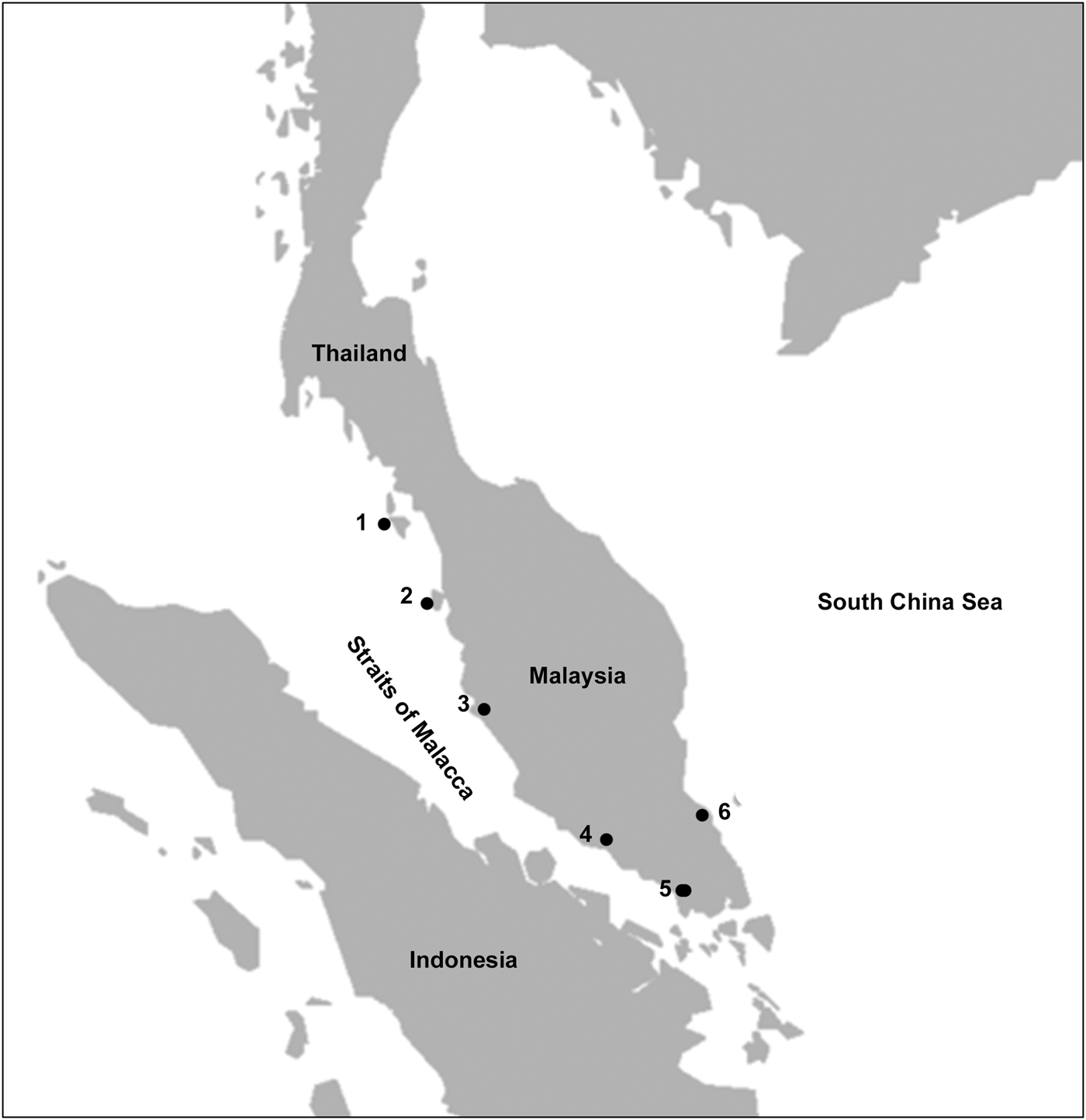
Seahorse samples were largely obtained from trawl bycatch from the east (Endau) and west (Langkawi, Teluk Bahang, Hutan Melintang, Kesang Laut, Pontian) coasts of Peninsular Malaysia (Figure 1). Bathymetric charts show that trawl vessels, which operate at least five nautical miles offshore by law, mostly fish in depths of 20–50 m on the west coast and 20–40 m on the east coast. Samples collected off Kesang Laut were seahorses collected from shallow waters (5–10 m) by artisanal fishermen using drift nets and cast nets. Bottom substrates from the northern half of the west coast, from Langkawi to Hutan Melintang, consist of muddy substrates (largely <62.5 µm grain size) (Mohammad Shaari et al., Reference Mohammed Shaari, Rauck, Ong and Tan1974). To the south of it, the sediment consist of sandy bottoms (>62.5 µm grain size) from Pangkor but progressively shifting to muddy or clayey (<4 µm grain size) substrates towards Pontian (Mohammad Shaari et al., Reference Mohammed Shaari, Weber and Liong1976). In contrast, the bottom substrates in the east coast consist of predominantly sand to the north of Endau, but the substrates progress to muddy sand to the south of it (Pathansali et al., Reference Pathansali, Rauck, Jothy, Mohammad Shaari and Curtin1974).
Known fish landing sites in Peninsular Malaysia where seahorses were collected for present study. (1) Langkawi; (2) Penang; (3) Hutan Melintang; (4) Kesang laut; (5) Pontian; (6) Endau.

Sampling of specimens
Seahorse samples from the east coast were collected in March and April 2010. On the west coast, specimens at Hutan Melintang and Pontian landing sites were collected in July and August 2013, at Teluk Bahang and Kesang Laut in June 2013, and at Langkawi in January 2013. Collected specimens were immediately fixed in 10% formaldehyde.
Seahorse measurements and gut content analysis
In the laboratory, all seahorses were sexed before morphometric measurements were made according to Lourie et al. (Reference Lourie, Foster, Cooper and Vincent2004). A total of 34 individuals of Hippocampus spinossisimus and 49 individuals of Hippocampus trimaculatus from the east coast were sampled for gut content analysis. Their heights ranged from 114.0–191.0 and 121.0–186.0 mm, respectively. On the west coast, a total of eight individuals of H. spinosissimus and 27 individuals of H. trimaculatus were sampled for gut content analysis with heights ranging from 63.0–145.0 and 121.0–186.0 mm, respectively.
A ventral incision along the keel line of the seahorse's abdomen and a horizontal incision from the anal fin towards the lateral trunk ridge were made to expose the digestive system. The start of the oesophagus and end of the rectum were cut and the entire digestive system was removed from the abdominal cavity. The total length of the gut was then measured (mm) from anterior to posterior. The ‘stomach’ was identified from a slight constriction of the foregut (at about 1/3 distance from oesophageal opening to the anus) indicative of the pyloric sphincter that separates it from the midgut or intestine. A small cut was made at the constriction, and the upper portion from it was slit open so as to extract the stomach contents for further analysis.
The entire stomach contents were gently washed out into a glass cavity block using a water jet from a glass pipette. Next, the stomach contents were pipetted out onto a gridded (10 × 10 one mm2 grid) Sedgewick rafter cell for viewing and enumeration under a stereo light microscope. Prey items were identified to the lowest possible taxonomic level and quantified. Those prey items that were partially digested and impossible to identify were not included. Quantification of each food item was done using two methods following Hyslop (Reference Hyslop1980), namely, frequency of occurrence and percentage volume. Percentage frequency of occurrence (%FO) of each food item was computed based on the proportion of examined stomachs that contained the particular food item. Percentage volumetric composition (%VO) of each food item was estimated using the eye estimation method (Chong, Reference Chong1977) by examining the number of grids occupied by each food item under the microscope.
Data analysis
The height of the fish was used to separate the sampled seahorses into three developmental stages, juvenile, small adult and large adult. Although juveniles can be distinguished from adults based on the absence of a brood pouch in the male (Perante et al., Reference Perante, Vincent, Pajaro and Morton1998; Wilson & Vincent, Reference Wilson and Vincent1998), male H. trimaculatus was reported to reach sexual maturity size at 120 mm despite having developed a brood pouch earlier (80–90 mm) (Cai et al., Reference Cai, Xu, Yu, Wu and Sun1984). Lourie et al. (Reference Lourie, Foster, Cooper and Vincent2004) also reported an average size of 120 mm for this species. Lawson et al. (Reference Lawson, Foster, Lim, Chong and Vincent2014) however reported 90.5 and 99.6 mm as the height at physical maturity (Htm) and 121.8 and 123.2 mm as height at reproductive activity (Htr) for H. trimaculatus and H. spinossisimus, respectively. Hence, for the purpose of the present study, 120 mm was considered the definite size of sexual maturity for the adult of both species. Small and large adults were arbitrarily grouped by first ordering their heights and dividing the number of individuals equally between small and large adults. This arbitrary division gave the following sizes for H. spinosissimus: small adults 120–156 mm, large adults 162–191 mm. For H. trimaculatus, small adults measured 121–158 mm, large adults 159–183 mm. Juvenile H. trimaculatus ranged from 63–110 mm height. No juvenile H. spinosissimus was sampled.
The relative gut length (RGL) was calculated by dividing the total gut length by the height (GL/H) of each fish. The preponderance index (PI) of the seahorse diet (Natarajan & Jhingran, Reference Natarajan and Jhingran1961) was calculated as follows: PI = [(%VOi × %FOi)/Σ(%VOi × %FOi)] × 100, where i indicates the ith food item. Schoener's index of diet overlap, given as C AB = 1.0–0.5 (Σ|IA,i − IB,i|), was calculated between species by developmental stage, where I is the preponderance index estimated from %VO and %FO of prey i in the diets of species A and B (Schoener, Reference Schoener1970).
Principal Component Analysis (PCA) of the preponderance index by species and developmental stage (juvenile, small and large adults) and location (west and east) was carried using CANOCO ver. 4.5 (Microcomputer Power, Ithaca, NY, USA). In CANOCO, Aitchison's (Reference Aitchison1990) log-ratio analysis of compositional data (PI) was selected by centring log-transformed data by samples as well as by species (Braak & Smilauer, Reference Braak and Smilauer2002). A t-test using Statistica 10.0 software (StatSoft Inc., Tulsa, OK, USA) (Statsoft, 2001) was conducted on prey items to test for significant difference between species.
RESULTS
Fish height and relative gut length (GL/H ratio)
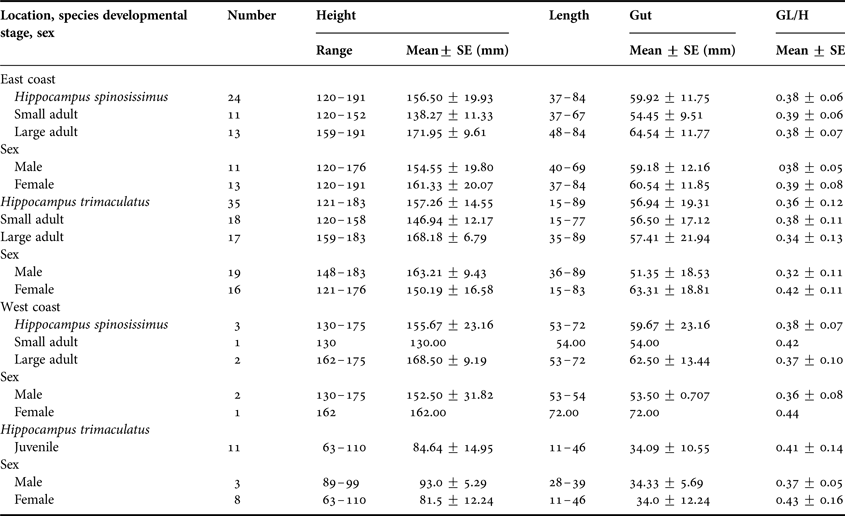
Hippocampus spinosissimus and Hippocampus trimaculatus for the east and west coast had significantly different mean heights (t (82) = 13.32, P < 0.05) tested according to developmental stage (Table 1). The mean height of adult H. spinossisimus (138 mm) was shorter than that of H. trimaculatus (147 mm). East coast specimens were generally larger than west coast specimens for both species. No juvenile of either species was sampled from the east coast, while 11 juvenile H. trimaculatus were sampled from the west coast. Out of these, six juveniles were from Kesang Laut in shallow waters, and all seahorses caught here were juveniles. No significant size difference existed between females and males for adult H. spinosissimus (t (30) = 0.92, P > 0.05), while H. trimaculatus males were larger than females (t (34) = −2.75, P < 0.05).
Descriptive statistics of the height (mm) and gut length of Hippocampus spinosissimus and Hippocampus trimaculatus by location, developmental stage and sex (Peninsular Malaysia). GL/H = ratio of gut length to height.
The mean RGLs of H. spinosissimus from the east coast and west coast were not significantly different (0.38), as were the RGLs of H. trimaculatus from the west coast (0.40) and east coast (0.36) (t (22) = 1.42, P > 0.05). When species were compared, the RGLs of H. spinosissimus and H. trimaculatus were not significantly different (t (73) = 0.42, P > 0.05).
Prey's frequency of occurrence (%FO)
Empty gut content limited sample sizes for diet analysis to 29 individuals of H. spinossisimus and 36 individuals of H. trimaculatus from the east coast. Similarly, four individuals of H. spinosissimus and 16 individuals of H. trimaculatus from the west coast with filled stomachs were analysed.
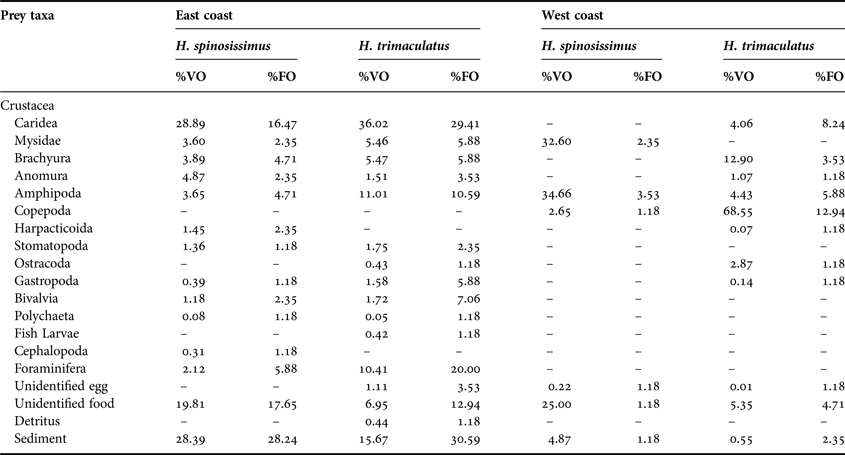
A total of 14 and 16 prey taxa were recorded from the stomachs of sampled H. spinosissimus and H. trimaculatus, respectively. Stomachs of both H. spinosissimus and H. trimaculatus from the east coast contained the highest frequency of small caridean shrimps as prey food at 16%FO and 29%FO, respectively. Other prey items were present at fairly low frequencies (Table 2). About 12–18% of the stomachs examined in both species contained unidentified food items which were either masticated or semi-digested. Also about 30% of stomachs examined invariably contained inorganic sediment in small amounts.
Stomach content of Hippocampus spinosissimus and Hippocampus trimaculatus from the East and West Coast, Peninsular Malaysia.
%VO, Percentage Volume; %FO, Frequency of Occurrence.
On the west coast, H. spinosissimus and H. trimaculatus consumed six and 13 prey taxa respectively, varying less than their east coast counterparts. Hippocampus trimaculatus from the west coast recorded the highest frequency of copepods (13%FO) followed by amphipods (6%FO) and unidentified food (5%FO), while H. spinosissimus showed the highest frequency of amphipods (4%FO), mysids (2%FO), copepod (1%FO), unidentified eggs (1%FO) and unidentified food (1%FO).
Percentage volume of food items (VO%)
Caridean shrimps dominated the food composition of both H. spinosissimus and H. trimaculatus from the east coast comprising 29 and 36% of %VO respectively. Hippocampus trimaculatus also consumed amphipods (11%VO) and foraminiferans (10%VO). The west coast's H. spinosissimus showed higher ingestion of amphipods (35%VO) and mysids (33%VO) although with a large portion of unidentified food (25%VO). In contrast, the west coast's H. trimaculatus mostly consumed copepods (69%VO) and brachyuran larvae (13%VO).
Principal component analysis of ingested stomach items
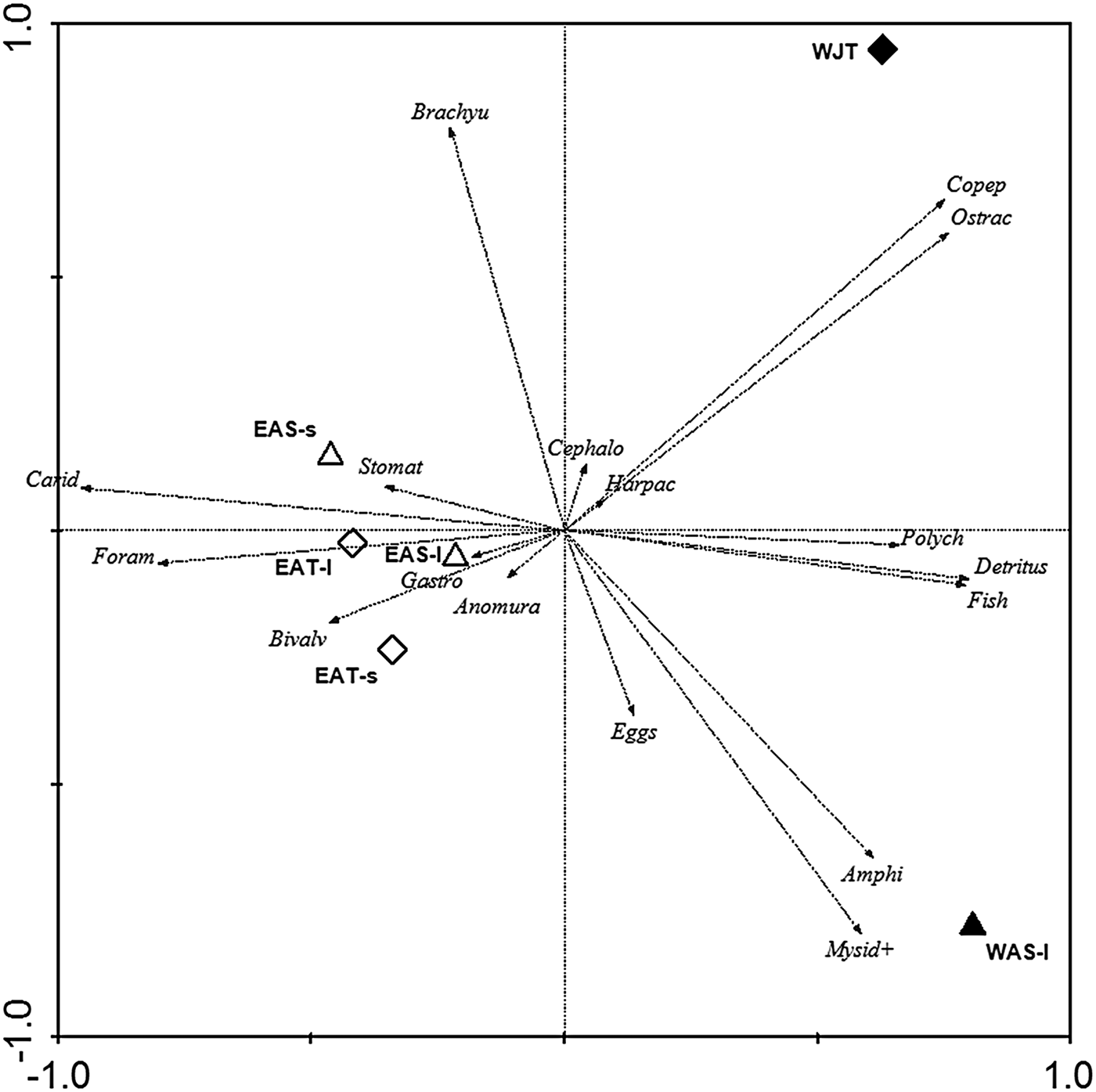
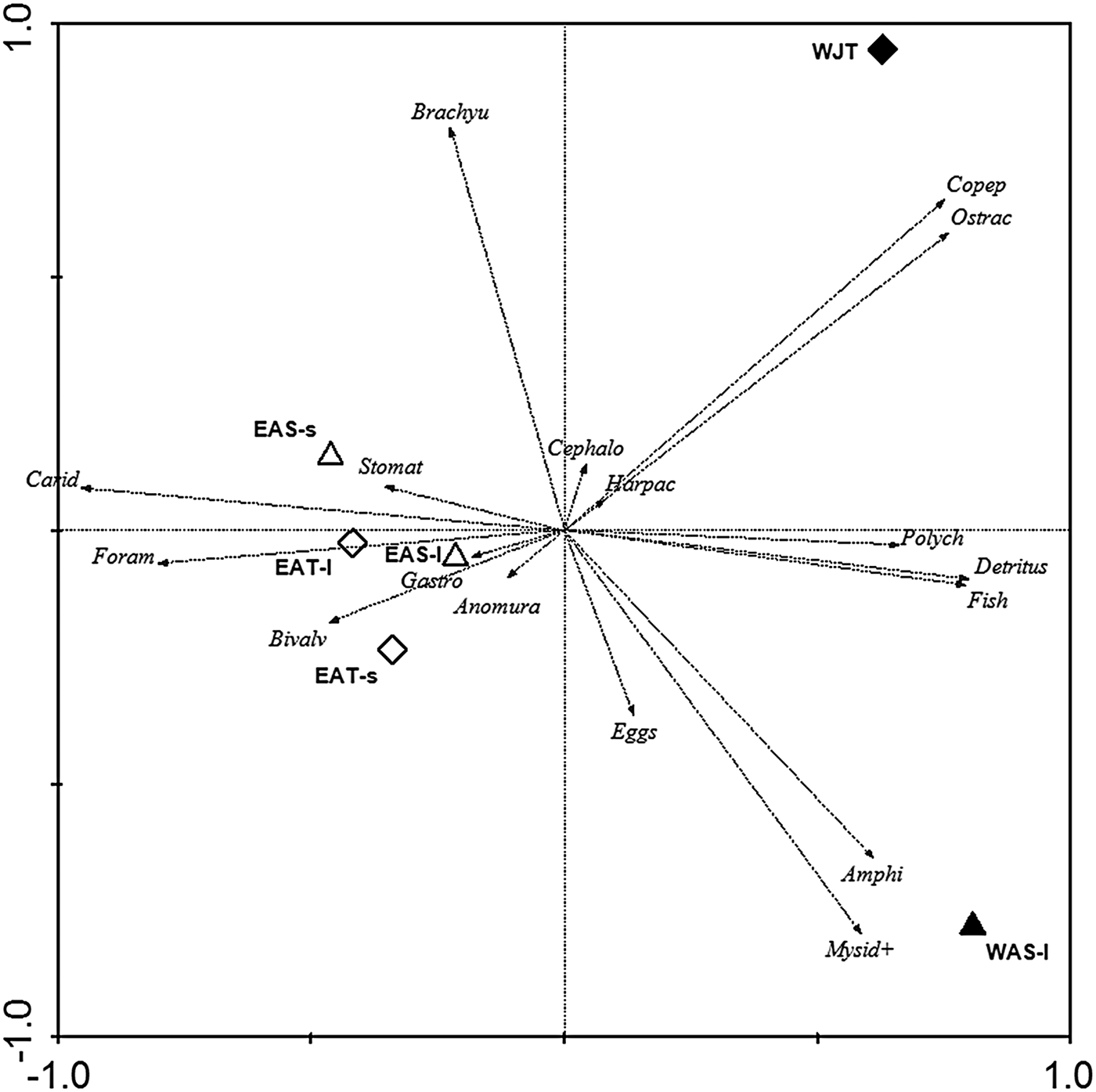
The first PCA axis (horizontal) explains 55.3% of the total variability (eigenvalue = 0.553) while the second PCA axis (vertical) explains 27.3% of the total variability (eigenvalue = 0.272); thus, the first two PCA axes accounted for 82.6% of the total variability, providing a good representation of the data structure for seahorse diets.
Both species from the east and west coast displayed different food preferences for the type and amount of prey items consumed (Figure 2). Generally, the small and large adults of both species of seahorses from the east coast had similar diet composition. Adult H. spinosissimus and H. trimaculatus from the east coast consumed seven taxa of prey animals, namely Foraminifera, Ostracoda, Stomatopoda, Caridea, Bivalvia, Gastropoda and Brachyura. The prey animals were either small organisms, or were the larvae of large forms. Small or larval stages of caridean shrimps were the most abundantly consumed by the adult seahorses. On the west coast, adult H. spinosissimus showed preference for mysid shrimps and amphipods. Juvenile H. trimaculatus tended to feed more on planktonic prey such as copepods and ostracodes.
Principal component analysis (PCA) of prey's preponderance index of Hippocampus spinosissimus (triangles) and Hippocampus trimaculatus (diamonds) from the east (unfilled symbols) and west coast (filled symbols) of Peninsular Malaysia. Arrows point to the gradient of importance (higher preponderance index) of food items: (Foram) Foraminifera; (Polych) Polychaeta; (Amphi) Amphipoda; (Harpac) Harpaticoida; (Copep) Copepoda; (Anomura) Anomuran larvae; (Stomat) Stomatopod larvae; (Carid) Caridea; (Mysid+) Mysidae & Acetes; (Brachyu) Brachyuran larvae; (Ostrac) Ostracoda; (Gastro) Gastropod larvae; (Cephalo) Cephalopod larvae; (Bivalv) Bivalve larvae; (Fish) Fish larvae; (Detritus) Detrital fragments; (Eggs) eggs of unidentified taxa. Symbol identifier: (E) =east coast, (W) =west coast, (A) =large adult (l) or small adult (s), (J) =juvenile, (T) =Hippocampus trimaculatus, (S) =Hippocampus spinosissimus.
Diet overlap
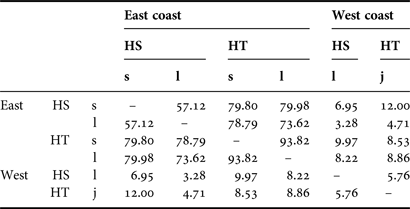
The dietary preferences for both seahorse species obtained from the east coast overlapped with one another, for both small and large adults (Table 3). The measured dietary overlap (C AB) ranged from 57–94%. Diets were most similar for small and large adults of H. trimaculatus and H. spinossisimus, as indicated by a large diet overlap. In contrast, diet differences were most distinct between east and west coast seahorses (C AB = 3–12%), even for the same species; and between juvenile and adult T. trimaculatus on the east coast (C AB = 8–9%).
Schoener's index of diet overlap for Hippocampus spinosissimus (HS) and Hippocampus trimaculatus (HT) and their developmental stage*.
* l, large adult; s, small adult; j, juvenile.
DISCUSSION
The study revealed that both species of seahorse from the east and west coast of the Malaysian peninsula consumed a wide range of prey organisms, with the widest variety of prey items being found for east coast seahorse species. Crustaceans constituted the bulk of the prey food in both species (>60%VO). Adults of Hippocampus spinosissimus and Hippocampus trimaculatus favoured epibenthic, small caridean shrimps and amphipods, while juvenile H. trimaculatus preferred copepods and other planktonic forms such as meroplanktonic larvae of crustaceans.
Small seahorses with correspondingly small snout sizes may be restricted in their ability to capture larger and more mobile prey (Teixeira & Musick, Reference Teixeira and Musick2001), explaining the differences we observed between juvenile and adult diets. A study done by Woods (Reference Woods2002) reported that smaller individuals of Hippocampus abdominalis (<13.75 mm) take in amphipods, while adults (>13.8 mm) consumed mostly caridean shrimps. A similar dietary partitioning is found in H. trimaculatus. Since the consumed copepods and brachyuran zoeal larvae are planktonic forms, we speculate that our collected juvenile H. trimaculatus came from shallow waters on the west coast; indeed, the shallow waters of Kesang Laut substantiate this. Rich diversity and abundance of copepods and other zooplankton have been recorded in shallow coastal waters (Chew & Chong, Reference Chew and Chong2011), and around offshore islands (Chew et al., Reference Chew, Chong and Ooi2008) in the Straits of Malacca. Since H. trimaculatus have been reported to inhabit shallow habitats (Lourie et al., Reference Lourie, Foster, Cooper and Vincent2004) including around reefs (Masuda et al., Reference Masuda, Amaoka, Araga, Uyeno and Yoshino1984) and muddy estuaries near mangroves (Kuiter & Tonozuka, Reference Kuiter and Tonozuka2001), presumably, the larger or adult seahorses would have moved on to offshore areas of greater depths. Hence, habitat shift in H. trimaculatus is accompanied by developmental changes and an ontogenetic shift in diet. Foster & Vincent (Reference Foster and Vincent2004) reported that seahorses undergo ontogenetic shift in their diet as a result of morphological changes that affect the snout length and diameter. Species with longer snouts are more of a specialist feeder relying on particular prey, whereas species with a shorter snout tend to be generalist with a larger prey range (Kendrick & Hyndes, Reference Kendrick and Hyndes2005; Van Wassenbergh et al., Reference Van Wassenbergh, Roos, Aerts, Herrel and Adriaens2011).
Consumed food items confirm the bottom feeding habit and behaviour of the seahorses. Interestingly, a small intact juvenile cephalopod was found in the stomach of an east coast H. spinosissimus specimen. Cephalopods like squids and cuttlefish lay egg capsules attached to bottom substrates including seaweeds, gorgonids, shells, rocks and sandstones, or even insert these capsules into the muddy substrate (Reid et al., Reference Reid, Jereb, Roper, Jereb and Roper2005; Chembian & Saleena, Reference Chembian and Saleena2011). Their newly hatched paralarvae are planktonic but may remain closer to the sea bottom for some time (Nabhitabhata, Reference Nabhitabhata1996). Seahorses have been observed to forage by orally pumping forceful jets of water onto the sediment substratum thereby suspending their prey in the water column (Foster & Vincent, Reference Foster and Vincent2004). This is followed by oral suction of the suspended prey along with the intake of water and suspended sediment. This feeding behaviour thus explains the ubiquitous presence of fine sediment in the seahorse stomachs, particularly the adults.
Various works have reported that relative gut length (RGL) is correlated with the feeding habits of fish, where carnivores are found to have a short RGL (1 or less) and herbivores or detritivores a longer RGL (>3) (Al-Hussaini, Reference Al-Hussaini1947; Horn, Reference Horn1989; Kramer & Bryant, Reference Kramer and Bryant1995). The similar RGLs (<0.4) of both species of seahorses in the present finding supports the assumption that these fish are carnivorous. The RGL also supports the need for constant prey consumption (Foster & Vincent, Reference Foster and Vincent2004), in contrast to studies that reported a digestion time of approximately 1.3–1.5 h for H. trimaculatus in captivity (Murugan et al., Reference Murugan, Dhanya, Rajagopal and Balasubramanium2009).
The present study identifies clear differences in seahorse diet depending on location. Therefore, observed differences in diet are likely due to differences in site-specific resources and availability. The substrate on the northern side of the west coast is rather homogeneous, consisting largely of mud although grain size becomes progressively coarser (sandy) towards Pangkor Island (Mohammad Shaari et al., Reference Mohammed Shaari, Rauck, Ong and Tan1974). Elsewhere on the west coast, the bottom substrate is similarly muddy (Mohammad Shaari et al., Reference Mohammed Shaari, Weber and Liong1976). On the other hand, the east coast area is characterized by a seabed overlain with mud, sandy mud, muddy sand to sandy substrates, strewn with patches of clay-mud, octocorals and giant cup sponges (Pathansali et al., Reference Pathansali, Rauck, Jothy, Mohammad Shaari and Curtin1974; Higashikawa et al., Reference Higashikawa, Chiyama, Hidaya, Nishi, Arima, Abu Khir, Ridzwan and Mohammad Azmi1986). Thus, the higher number of prey taxa that were consumed by east coast seahorses may be a reflection of their more heterogeneous habitat. The substrate type also explains the higher composition of sediment and associated foraminiferan fauna found in the stomachs of both H. spinosissimus and H. trimaculatus from the east coast. Diet variability in these seahorses may be the result of location and ontogenetic development. However, there appears not to be a distinct difference between the diet of the adults (>70% diet overlap).
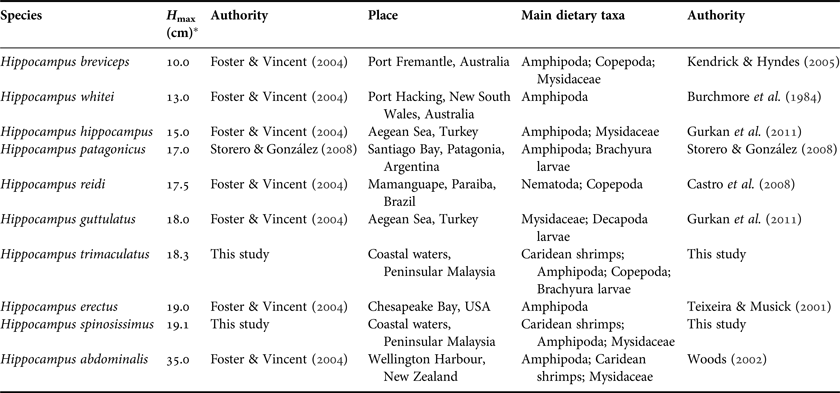
A comparison of the diet of H. spinosissimus and H. trimaculatus with other species of seahorses worldwide indicates a remarkably consistent diet of largely amphipods, mysids and caridean shrimps, with crustaceans dominating prey items (Table 4). Smaller seahorses (<15 cm) all consume amphipods, while the larger seahorses (>18 cm) were found to also consume caridean shrimps. Seahorses therefore appear to be specialists in their prey selection, focusing on slow-moving epibenthic, hyperbenthic or canopy-dwelling crustaceans. These crustaceans inhabit mud-sand bottoms and habitats in, or associated with mudflat, seagrass or mangroves areas (Zimmerman et al., Reference Zimmerman, Gibson and Harrington1979; Gore et al., Reference Gore, Gallaher, Scotto and Wilson1981; Matheson et al., Reference Matheson, Camp, Sogard and Bjorgo1999; Hanamura et al., Reference Hanamura, Seow, Chee and Faizul2008; Ramarn et al., Reference Ramarn, Chong and Hanamura2014). This suggests that juveniles of deeper water adults may be vulnerable to impacts from development, meaning that deep-water refugia may not be enough to protect these seahorses from the impacts of sea-filling (land reclamation) and development, which increasingly threaten these habitats in most tropical regions.
Comparison of the dietary habits of worldwide seahorse species.
*Maximum body height.
ACKNOWLEDGEMENTS
We are greatly indebted to Mr Choo CK (recently deceased), formerly from University Malaysia Terengganu, whose love for seahorse conservation had founded Save Our Seahorses (SOS) Malaysia. We greatly appreciate his contribution of East Coast seahorse specimens to this study. This work is supported by the University of Malaya (Malaysia) and the Project Seahorse research team located at the University of British Columbia Fisheries Centre (Canada), through usage of research facilities and funding.
FINANCIAL SUPPORT
This work was supported by the University Malaya Research Grant (UMRG) (grant number RP001H-13SUS).