1. Introduction
In The Modularity of Mind, Jerry Fodor argued that significant early portions of our perceptual systems are modular in a number of respects, including that we do not have cognitive access to their internal states and representations of a sort that would allow reportability (Fodor Reference Fodor1983; see also Pylylshyn Reference Pylylshyn2003; Sperber Reference Sperber and Dupoux2001). For example, one representation that vision scientists tend to agree is computed by our visual systems is one which reflects sharp changes in luminosity; another is a representation of surfaces (Nakayama et al. Reference Nakayama, He, Shimojo, Kosslyn and Osherson1995). Are the unreportable representations inside these modules phenomenally conscious? Presumably there is a fact of the matter. But since these representations are cognitively inaccessible and therefore utterly unreportable, how could we know whether they are conscious or not? It may seem that the appropriate methodology is clear in principle even if very difficult in practice: Determine the natural kind (Putnam Reference Putnam1975; Quine Reference Quine and Quine1969) that constitutes the neural basis of phenomenal consciousness in completely clear cases – cases in which subjects are completely confident about their phenomenally conscious states and there is no reason to doubt their authority– and then determine whether those neural natural kinds exist inside Fodorian modules. If they do, there are conscious within-module representations; if they don't, there are not. But should we include the machinery underlying reportability within the natural kinds in the clear cases? Apparently, in order to decide whether cognitively inaccessible and therefore unreportable representations inside modules are phenomenally conscious, we have to have decided already whether phenomenal consciousness includes the cognitive accessibility underlying reportability. So it looks like the inquiry leads in a circle. I will be calling this problem “the methodological puzzle of consciousness research.”
The first half of this article is about the methodology of breaking out of this circle. The second half brings empirical evidence to bear on actually breaking out of it, using the principle that other things being equal, a mesh between psychology and neuroscience is a reason to believe the theory that leads to the mesh.
2. Two illustrations
Before giving a more precise statement of the methodological puzzle, I'll give two illustrations that are intended to give the reader a feel for it.
Nancy Kanwisher and her colleagues (Kanwisher Reference Kanwisher2001; Tong et al. Reference Tong, Nakayama, Vaughan and Kanwisher1998) have found impressively robust correlations between the experience of faces and activation at the bottom of the temporal lobe, usually in the subject's right hemisphere in what they call the “fusiform face area.” One method that has been used to investigate the neural basis of face perception exploits a phenomenon known as “binocular rivalry” (see Koch Reference Koch2004, Ch. 16). Presented with a face-stimulus to one eye and a house stimulus to the other, the subject experiences a face for a few seconds, then a house, then a face, and so on. Examination of the visual processing areas of the brain while the face/house perceptual alternation is ongoing, found stronger shifts with the percept in the fusiform face area than in other areas. The fusiform face area lights up when subjects are experiencing seeing a face and not when subjects are experiencing seeing a house, despite the fact that the stimuli are unchanging. The fusiform face area also lights up when subjects imagine faces (O'Craven & Kanwisher Reference O'Craven and Kanwisher2000).
In highly constrained experimental situations, observers viewing functional magnetic resonance imaging (fMRI) recordings are 85% accurate in telling whether subjects in a scanner are seeing faces or houses (Haynes & Rees Reference Haynes and Rees2006). However, Rafi Malach and his colleagues (Hasson et al. Reference Hasson, Nir, Levy, Fuhrmann and Malach2004) have been able to get similar results from free viewing of movies by correlating activations in a number of subjects (see also Bartels & Zeki Reference Bartels and Zeki2004).
There has been some dispute as to what exactly the fusiform face area is specialized for, but these issues can be put aside here. (See Grill-Spector et al. Reference Grill-Spector, Sayres and Ress2006, Reference Grill-Spector, Sayres and Ress2007; Kanwisher 2006, 2007; Tsao et al. Reference Tsao, Tootell and Livingstone2006).
No one would suppose that activation of the fusiform face area all by itself is sufficient for face-experience. I have never heard anyone advocate the view that if a fusiform face area were kept alive in a bottle, that activation of it would determine face-experience – or any experience at all (Kanwisher Reference Kanwisher2001). The total neural basis of a state with phenomenal character C is itself sufficient for the instantiation of C. The core neural basis of a state with phenomenal character C is the part of the total neural basis that distinguishes states with C from states with other phenomenal characters or phenomenal contents,Footnote 1 for example the experience as of a face from the experience as of a house. (The core neural basis is similar to what Semir Zeki [Zeki Reference Zeki2001; Zeki & Bartels Reference Zeki and Bartels1999] has called an essential node.) So activation of the fusiform face area is a candidate for the core neural basis – not the total neural basis – for experience as of a face (see Block Reference Block2005; Chalmers Reference Chalmers and Metzinger2000; Shoemaker Reference Shoemaker1981).
For purposes of this target article, I adopt the physicalistic view (Edelman Reference Edelman2004) that consciousness is identical to its total neural basis, rather than John Searle's view that consciousness is determined by but not identical to its neural basis (McLaughlin Reference McLaughlin, Beckermann, Flohr and Kim1992; Searle Reference Searle1992). The issue of this article is not physicalism versus dualism, but rather, whether consciousness includes the physical functions involved in the cognitive accessibility that underlies reportability.
What is the total minus core neural basis? That is, what is the neural background required to make a core neural basis sufficient for a phenomenally conscious experience? There is some evidence that there is a single neural background of all experience involving connections between the cortex and the upper brain stem including the thalamus (Churchland Reference Churchland2005; Laureys Reference Laureys2005; Llinás Reference Llinás2001; Llinás et al. Reference Llinás, Ribary, Contreras and Pedroarena1998; Merker Reference Merker2007; Tononi & Edelman Reference Tononi and Edelman1998). This background can perhaps be identified with what Searle (Reference Searle2005) calls the “unified conscious field.” Perhaps the most convincing evidence is that disabling connections to the thalamus seems the common core of what different general anesthetics do (Alkire & Miller Reference Alkire and Miller2005). Although Merker (Reference Merker2007) does not make the distinction between core and total, he presents evidence that children born pretty much without a cortex can have the conscious field with little or nothing in the way of any conscious contents: that is, they have the total without much in the way of core neural bases.
Nancy Kanwisher (Reference Kanwisher2001) and Dan Pollen (Reference Pollen2003; in press) argue that activation of areas of the brain involved in spatio-temporal binding is required for perceptual phenomenology. Of course some states that have phenomenology, for example, emotions and thoughts, are not experienced as spatially located. But Kanwisher and Pollen may be right about temporal aspects of visual experience. Further, Antonio Damasio (Reference Damasio1999) and Pollen argue that all experience requires a sense of self, partly based in the posterior parietal lobe. If true, this would be part of the background.
At the risk of confusing the reader with yet another distinction, it is important to keep in mind the difference between a causal condition and a constitutive condition. For example, cerebral blood flow is causally necessary for consciousness, but activation of the upper brainstem is much more plausibly a constitutive condition, part of what it is to be conscious. (What does “constitutive” mean? Among other things, constituent: Hydrogen is partially constitutive of water since water is composed of hydrogen and oxygen.) The main issue of this article is whether the cognitive access underlying reportability is a constitutive condition of phenomenal consciousness.
Here is the illustration I have been leading up to. There is a type of brain injury which causes a syndrome known as visuo-spatial extinction. If the patient sees a single object on either side, the patient can identify it, but if there are objects on both sides, the patient can identify only the one on the right and claims not to see the one on the left (Aimola Davies Reference Aimola Davies2004). With competition from the right, the subject cannot attend to the left. However, as Geraint Rees has shown in two fMRI studies of a patient identified as “G.K.,” when G.K. claims not to see a face on the left, his fusiform face area (on the right, fed strongly by the left side of space) lights up almost as much as when he reports seeing the face (Driver & Vuilleumier Reference Driver and Vuilleumier2001; Rees et al. Reference Rees, Wojciulik, Clarke, Husain, Frith and Driver2000, Reference Rees, Wojciulik, Clarke, Husain, Frith and Driver2002b). Should we conclude that G.K. has face experience that – because of lack of attention – he does not know about? Or that the fusiform face area is not the whole of the core neural basis for the experience, as of a face? Or that activation of the fusiform face area is the core neural basis for the experience as of a face but that some other aspect of the total neural basis is missing? How are we to answer these questions, given that all these possibilities predict the same thing: no face report?
I will use the phrase “core neural basis of the experience” instead of Frances Crick's and Christof Koch's “NCC,” for neural correlate of consciousness. Mere correlation is too weak. At a minimum, one wants the neural underpinnings of a match of content between the mental and neural state (Chalmers Reference Chalmers, Hameroff, Kaszniak and Scott1998; Noë & Thompson Reference Noë and Thompson2004).
3. The puzzle
The following is a principle that will be appealing to many (though it is not to me): Whatever it is about a state that makes it unreportable, would also preclude its being phenomenally conscious. We can call this the Phenomenally Conscious→Reportable Principle, or for short, the Phenomenal→Reportable Principle. But how could we test the Phenomenal→Reportable Principle? If what we mean by a “direct” test is that we elicit reports from subjects about unreportable states, then a direct test will always be negative. And it might seem that there could not be an indirect test either, for an indirect test would have to be based on some direct method, that is, a method of investigating whether a state is phenomenally conscious independently of whether it is reportable – a method that apparently does not exist.
Here is a brain-oriented version of the point: Suppose empirical investigation finds a neural state that obtains in all cases in which a phenomenally conscious state is reportable. Such a neural state would be a candidate for a core neural basis. Suppose in addition, that we find that the putative core neural basis is present sometimes when the state is unreportable because mechanisms of cognitive access are damaged or blocked. Would that show the existence of unreportable phenomenal consciousness? No, because there is an alternative possibility: that we were too quick to identify the core neural basis. Perhaps the supposed core neural basis that we identified is necessary for phenomenal consciousness but not quite sufficient. It may be that whatever it is that makes the state unreportable also makes it unconscious. Perhaps the cognitive accessibility mechanisms underlying reportability are a constitutive part of the core neural basis, so that without them, there cannot be a phenomenally conscious state. It does not seem that we could find any evidence that would decide one way or the other, because any evidence would inevitably derive from the reportability of a phenomenally conscious state, and so it could not tell us about the phenomenal consciousness of a state which cannot be reported. So there seems a fundamental epistemic (i.e., having to do with our knowledge of the facts rather than the facts themselves) limitation in our ability to get a complete empirical theory of phenomenal consciousness. This is the methodological puzzle that is the topic of this article.
Note that the problem cannot be solved by giving a definition of “conscious.” Whatever definition one offers of this and other terms, the puzzle can be put in still other terms – there would still be the question, does what it is like to have an experience include whatever cognitive processes underlie our ability to report the experience?
The problem does not arise in the study of, for example, water. On the basis of the study of the nature of accessible water, we can know the properties of water in environments outside our light cone – that is, in environments that are too far away in space and time for signals traveling at the speed of light to reach us. We have no problem in extrapolating from the observed to the unobserved, and even unobservable in the case of water, because we are antecedently certain that our cognitive access to water molecules is not part of the constitutive scientific nature of water itself. In homing in on a core neural basis of reportable episodes of phenomenal consciousness, we have a choice about whether or not to include the aspects of those neurological states that underlie reportability within the core neural basis. If we do, then unreportable phenomenally conscious states are ruled out; if we do not, unreportable phenomenally conscious states are allowed. Few scientifically minded people in the twenty-first century would suppose that water molecules are partly constituted by our cognitive access to them (Boghossian Reference Boghossian2006), but few would be sure whether phenomenal consciousness is or is not partly constituted by cognitive access to it. It is this asymmetry that is at the root of the methodological puzzle of phenomenal consciousness.
This issue – whether the machinery of cognitive accessibility is a constitutive part of the nature of phenomenal consciousness – is the focus of this target article. I will not mention evidence concerning inaccessible states within Fodorian modules, or whether G.K. has face experience, but I do claim to show that the issue of whether the cognitive accessibility underlying reportability is part of the constitutive nature of phenomenal consciousness can be resolved empirically and that we already have evidence for a negative answer.
I now turn to a consideration of reportability, but first I want to mention one issue that will not be part of my discussion. Readers are no doubt familiar with the “explanatory gap” (Levine Reference Levine1983; Nagel Reference Nagel1974), and the corresponding “hard problem” of phenomenal consciousness (Chalmers Reference Chalmers1996): the problem of explaining why the neural basis of a given phenomenal quality is the neural basis of that phenomenal quality rather than some other phenomenal quality or none at all. No one has any idea what an answer would be, even a highly speculative answer. Is the explanatory gap an inevitable feature of our relation to our own phenomenology? Opinions differ (Churchland Reference Churchland1994; McGinn Reference McGinn1991). I argue that we can make at least some progress on solving the methodological puzzle even without progress in closing the explanatory gap.
I have been talking about consciousness versus reportability, but reportability is not the best concept to use in thinking about the puzzle.
4. Cognitive accessibility versus reportability
Empirical evidence about the Phenomenal→Reportable Principle seems unobtainable, but that is an illusion: that principle is clearly false even though another closely related principle is problematic. If a locked-in subject loses control of the last twitch, all mental states can become unreportable. There has been progress in using electrodes implanted in the brain, and less intrusively, electroencephalographic (EEG) technology to enable patients to communicate with the outside world. But if the patient is not trained with these technologies before the total loss of control of the body, these technologies may not work. (See the articles on this topic in the July 2006 issue of Nature.)
There is a distinct problem with the Phenomenal→Reportable Principle, namely that a person who is not paralyzed may lose all ability to produce or understand language, and so not have the language capacity required for reporting. In some forms of this syndrome (profound global aphasia), subjects clearly have phenomenal states – they can see, they have pain, and they can make clear what they want and don't want in the manner of a pre-linguistic child – but they are totally without the ability to report in any non-extended sense of the term. (Come to think of it, the same point applies to pre-linguistic children and animals.) And if an aphasic also had locked-in syndrome, the unfortunate conjunctively disabled person would be doubly unable to report conscious states. But there is no reason to think that conscious states would magically disappear. Indeed, given that aphasia is fairly common and locked-in syndrome, though infrequent, is not rare, no doubt there have been such conjunctive cases.
Of course there can be nonverbal reports: giving a thumbs-up and shaking one's head come to mind. But not every behavioral manifestation of cognitive access to a phenomenal state is a report, except in an uninterestingly stretched version of the term. Reportability is a legacy of behaviorism that is less interesting than it has seemed. The more interesting issue in the vicinity is not the relation between the phenomenal and the reportable, but rather the relation between the phenomenal and the cognitively accessible.
Adrian Owen and colleagues (Owen et al. Reference Owen, Coleman, Boly, Davis, Laureys and Pickard2006) report that a patient who, at the time of testing, satisfied the criteria for a vegetative state, responded to requests to imagine a certain activity in a way indistinguishable from normal patients on an fMRI scan. Her premotor cortex was activated upon being asked to imagine playing tennis, and her parahippocampal place area was activated on being asked to imagine walking through rooms in her house. Paul Matthews objected that the brain activity could have been an associative response to the word “tennis,” but Owen counters that her response lasted 30 seconds – until he asked her to stop (Hopkin Reference Hopkin2006). In an accompanying article in Science, Lionel Naccache insists on behavioral criteria for consciousness. He says, “Consciousness is univocally probed in humans through the subject's report of his or her own mental states” and notes that Owen and colleagues “did not directly collect such a subjective report” (Naccache 2006b). But the evidence is that the patient is capable of an intentional act, namely, the act of imagining something described. That should be considered no less an indication – though of course a fallible indication – of consciousness than an external behavioral act. As an editorial in Nature suggests, instead of “vegetative state” we should say “outwardly unresponsive.” (Nature, Editorial 2006).
In the rest of this article, I will be talking about cognitive accessibility instead of reportability. Reportability is a behavioristic ladder that we can throw away.
In previous papers (Block Reference Block1995b; Reference Block2001; Reference Block2005), I have argued that there can be phenomenally conscious states that are not cognitively accessible. (I put it in terms of phenomenal consciousness without access consciousness.) But I am mainly arguing for something weaker here. Cognitive accessibility could be a causally necessary condition of phenomenal consciousness without being a constitutive part of it. Bananas constitutively include CH2O molecules but not air and light. Still, without air and light, there could be no bananas – they are causally necessary. The focus here is on whether accessibility is constitutively necessary to phenomenal consciousness, not whether it is causally necessary.
5. Why the methodological puzzle matters
I will mention two ways in which it matters whether we can find out whether phenomenal consciousness includes cognitive accessibility. First, if we cannot get evidence about this, we face a fundamental limit in empirical investigation of the neural basis of phenomenal consciousness – we cannot tell whether the putative core neural basis we have found is the neural basis of phenomenal consciousness itself or the neural basis of phenomenal consciousness wrapped together with the cognitive machinery of access to phenomenal consciousness.
Second, there is a practical and moral issue having to do with assessing the value of the lives of persons who are in persistent vegetative states. Many people feel that the lives of patients in the persistent vegetative state are not worth living. But do these patients have experiences that they do not have cognitive access to? It is not irrational to regard a rich experiential life – independently of cognitive access to it – as relevant to whether one would want the feeding tube of a loved one removed.
6. Phenomenal consciousness and Awareness
We may suppose that it is platitudinous that when one has a phenomenally conscious experience, one is in some way aware of having it. Let us call the fact stated by this claim – without committing ourselves on what exactly that fact is – the fact that phenomenal consciousness requires Awareness. (This is awareness in a special sense, so in this section I am capitalizing the term.) Sometimes people say Awareness is a matter of having a state whose content is in some sense “presented” to the self or having a state that is “for me” or that comes with a sense of ownership or that has “me-ishness” (as I have called it; Block Reference Block1995a).
Very briefly, three classes of accounts of the relation between phenomenal consciousness and Awareness have been offered. Ernest Sosa (Reference Sosa, Smith and Jokic2002) argues that all there is to the idea that in having an experience one is necessarily aware of it is the triviality that in having an experience, one experiences one's experience just as one smiles one's smile or dances one's dance. Sosa distinguishes this minimal sense in which one is automatically aware of one's experiences from noticing one's experiences, which is not required for phenomenally conscious experience. At the opposite extreme, David Rosenthal (Reference Rosenthal2005) has pursued a cognitive account in which a phenomenally conscious state requires a higher order thought to the effect that one is in the state. That is, a token experience (one that can be located in time) is a phenomenally conscious experience only in virtue of another token state that is about the first state. (See also Armstrong Reference Armstrong1977; Carruthers Reference Carruthers2000; and Lycan Reference Lycan1996 for other varieties of higher order accounts.) A third view, the “Same Order” view says that the consciousness-of relation can hold between a token experience and itself. A conscious experience is reflexive in that it consists in part in an awareness of itself. (This view is discussed in Brentano Reference Brentano1874/1924; Burge Reference Burge and Burge2006; Byrne Reference Byrne and Gennaro2004; Caston Reference Caston2002; Kriegel Reference Kriegel2005; Kriegel & Williford Reference Kriegel and Williford2006; Levine Reference Levine2001, Reference Levine and Kriegel2006; Metzinger Reference Metzinger2003; Ross Reference Ross1961; Smith Reference Smith1986).
The same order view fits both science and common sense better than the higher order view. As Tyler Burge (Reference Burge and Burge2006) notes, to say that one is necessarily aware of one's phenomenally conscious states should not be taken to imply that every phenomenally conscious state is one that the subject notices or attends to or perceives or thinks about. Noticing, attending, perceiving, and thinking about are all cognitive relations that need not be involved when a phenomenal character is present to a subject. The mouse may be conscious of the cheese that the mouse sees, but that is not to say that the mouse is conscious of the visual sensations in the visual field that represent the cheese, or that the mouse notices or attends to or thinks about any part of the visual field. The ratio of synapses in sensory areas to synapses in frontal areas peaks in early infancy, and likewise for relative glucose metabolism (Gazzaniga et al. Reference Gazzaniga, Ivry and Mangun2002, p. 642–43). Since frontal areas are likely to govern higher-order thought, low frontal activity in newborns may well indicate lack of higher-order thoughts about genuine sensory experiences.
The relevance of these points to the project of the target article is this: the fact of Awareness can be accommodated by either the same order view or the view in which Awareness is automatic, or so I will assume. Hence, there is no need to postulate that phenomenal consciousness requires cognitive accessibility of the phenomenally conscious state. Something worth calling “accessibility” may be intrinsic to any phenomenally conscious state, but it is not the cognitive accessibility that underlies reporting.
The highly ambiguous term “conscious” causes more trouble than it is worth in my view. Some use the term “conscious” so as to trivially include cognitive accessibility. To avoid any such suggestion I am from here on abandoning the term “phenomenal consciousness” (which I think I introduced [Block Reference Block1990; 1992]) in favor of “phenomenology.”
In the next section, I discuss the assumption underlying the methodological puzzle, and in the section after, how to proceed if we drop that assumption.
7. Correlationism
Correlationism says that the ultimate database for phenomenology research consists in reports which allow us to find correlations between phenomenal states and features, on the one hand, and scientifically specifiable states and features – namely, neural states and features – on the other. These reports can be mistaken, but they can be shown to be mistaken only on the basis of other reports with which they do not cohere. There is no going beyond reports.
One version of correlationism is stated in David Papineau's (2002) Thinking about Consciousness, in which he says:
If the phenomenal property is to be identical with some material property, then this material property must be both necessary and sufficient for the phenomenal property. In order for this requirement to be satisfied, the material property needs to be present in all cases where the human subjects report the phenomenal property – otherwise it cannot be necessary. And it needs to be absent in all cases where the human subjects report the absence of the phenomenal property – otherwise it cannot be sufficient. The aim of standard consciousness research is to use these two constraints to pin down unique material referents for phenomenal concepts. (Papineau Reference Papineau2002, p. 187)
Consider, for example, what an adherent of this methodology would say about patient G.K. mentioned earlier. One kind of correlationist says we have misidentified the neural basis of face experience and so some aspect of the neural basis of face experience is missing. That is, either the activation of the fusiform face area is not the core neural basis for face experience, or, if it is, then in extinction patients some aspect of the total neural basis outside the core is missing. Another kind of correlationist does not take a stand on whether G.K. is having face experience, saying that we cannot get scientific evidence about it.
So there are two versions of correlationism. Metaphysical correlationism – the first version just mentioned – says that there is (or can be) an answer to the sort of question I have raised about G.K. and that answer is no. The metaphysical correlationist thinks that the cognitive access relations that underlie the subject's ability to report are a part of what constitutes phenomenology, so there could not be phenomenology without cognitive accessibility (Papineau Reference Papineau and Craig1998).
Epistemic correlationism says that G.K. might be having face experience without cognitive accessibility, but that the issue is not scientifically tractable. According to epistemic correlationism, cognitive accessibility is intrinsic to our knowledge of phenomenology but not necessarily to the phenomenal facts themselves. Epistemic correlationism is more squarely the target of this article, but I will say a word about what is wrong with metaphysical correlationism.
Why does the metaphysical correlationist think G.K. cannot be having face experience? Perhaps it is supposed to be a conceptual point: that the very concepts of phenomenology and cognitive accessibility make it incoherent to suppose that the first could occur without the second. Or it could be an empirical point: the evidence (allegedly) shows that the machinery of cognitive accessibility is part of the machinery of phenomenology. I have discussed the conceptual view elsewhere (Block Reference Block1978; Reference Block and Block1980).
The neuroscientists Stanislas Dehaene and Jean-Pierre Changeux (2004) appear to advocate epistemic correlationism. (References in the passage quoted are theirs but in this and other quotations to follow citations are in the style of this journal.) Dehaene and Changeux write:
We shall deliberately limit ourselves, in this review, to only one aspect of consciousness, the notion of conscious access … Like others (Weiskrantz Reference Weiskrantz1997), we emphasize reportability as a key property of conscious representations. This discussion will aim at characterizing the crucial differences between those aspects of neural activity that can be reported by a subject, and those that cannot. According to some philosophers, this constitutes an “easy problem” and is irrelevant to the more central issues of phenomenology and self-awareness (e.g., Block Reference Block1995b). Our view, however, is that conscious access is one of the few empirically tractable problems presently accessible to an authentic scientific investigation. (Dehaene & Changeux Reference Dehaene, Changeux and Gazzaniga2004, p. 1145–1146)
Kouider et al. (Reference Kouider, Dehaene, Jobert and Le Bihan2007) say: “Given the lack of scientific criterion, at this stage at least, for defining conscious processing without reportability, the dissociation between access and phenomenal consciousness remains largely speculative and even possibly immune to scientific investigation” (p. 2028). (Access-consciousness was my term for approximately what I am calling “cognitive accessibility” here.)
In a series of famous papers, Crick and Koch (Reference Crick and Koch1995) make use of what appears to be metaphysical correlationism. They argue that the first cortical area that processes visual information, V1, is not part of the neural correlate of phenomenology because V1 does not directly project to the frontal cortex. They argue that visual representations must be sent to the frontal cortex in order to be reported and in order for reasoning or decision-making to make use of those visual representations. Their argument in effect makes use of the hidden premise that part of the constitutive function of visual phenomenology is to harness visual information in the service of the direct control of reasoning and decision-making that controls behavior.
Jesse Prinz (Reference Prinz2000) argues for the “AIR” theory, for attended intermediate representations. The idea is that “consciousness arises when intermediate-level perception representations are made available to working memory via attention.” Because of the requirement of connection to working memory, this is a form of metaphysical correlationism.
David Chalmers (Reference Chalmers, Hameroff, Kaszniak and Scott1998) endorses epistemic correlationism. He says,
Given the very methodology that comes into play here, we have no way of definitely establishing a given NCC as an independent test for consciousness. The primary criterion for consciousness will always remain the functional property we started with: global availability, or verbal report, or whatever. That's how we discovered the correlations in the first place. 40-hertz oscillations (or whatever) are relevant only because of the role they play in satisfying this criterion. True, in cases where we know that this association between the NCC and the functional property is present, the NCC might itself function as a sort of “signature” of consciousness; but once we dissociate the NCC from the functional property, all bets are off. (Chalmers Reference Chalmers, Hameroff, Kaszniak and Scott1998)
Victor Lamme (Reference Lamme2006) gives the example of the split-brain patient who says he does not see something presented on the left, but nonetheless can draw it with his left hand. There is a conflict between normal criteria for conscious states. Lamme says that “preconceived notions about the role of language in consciousness” will determine our reaction and there is no objective truth about which view is right.” He argues for “letting arguments from neuroscience override our intuitive and introspective notion of consciousness,” using neuroscientific considerations to motivate us to define “consciousness” as recurrent processing, in which higher areas feed back to lower areas, which in turn feed forward to the higher areas again, thereby amplifying the signal. He doesn't claim the definition is correct, just that it is the only way to put the study of consciousness on a scientific footing. Although Lamme does not advocate correlationism in either its metaphysical or epistemic forms, his view depends on the idea that the only alternative to epistemic correlationism is neurally based postulation.
Often philosophers – Hilary Putnam (Reference Putnam1981) and Dan Dennett (Reference Dennett, Marcel and Bisiach1988; Reference Dennett1991) come to mind – argue that two views of the facts about consciousness are “empirically indistinguishable” – and then they in effect conclude that it is better to say that there are no such facts than to adopt epistemic correlationism. One example is Putnam's thought experiment: We find a core neural basis for some visual experience, but then note that if it occurs in the right hemisphere of a split-brain patient, the patient will say he doesn't see anything. If we restore the corpus callosum, the patient may then say he remembers seeing something. But we are still left with two “empirically indistinguishable” hypotheses, that the hypothesis of the core neural basis is correct so the memory is veridical and, alternatively, that the memory is false.
I will give an empirical argument that we can achieve a better fit between psychology and neuroscience if we assume that the perspectives just described are wrong.
8. An alternative to epistemic correlationism
The alternative I have in mind is just the familiar default “method” of inference to the best explanation, that is, the approach of looking for the framework that makes the most sense of all the data, not just reports (Harman Reference Harman1965; Peirce Reference Peirce1903, Vol. V, p. 171).
The reader may feel that I have already canvassed inference to the best explanation and that it did not help. Recall that I mentioned that the best explanation of all the data about observed water can give us knowledge of unobserved – even unobservable – water. I said that this approach does not apply straightforwardly to phenomenology. The reasoning that leads to the methodological puzzle says that inevitably there will be a choice about whether to include the neural basis of cognitive access within the neural basis of phenomenology. And that choice – according to this reasoning – cannot be made without some way of measuring or detecting phenomenology independently of cognitive access to it. But we don't have any such independent measure. As I noted, there is a disanalogy with the case of water, since we are antecedently certain that our access to information about water molecules is not part of the natural kind that underlies water molecules themselves. But we are not certain (antecedently or otherwise) about whether our cognitive access to our own phenomenology is partly constitutive of the phenomenology. Without antecedent knowledge of this – according to the reasoning that leads to the methodological puzzle – we cannot know whether whatever makes a phenomenal state cognitively inaccessible also renders it non-phenomenal.
Here is the fallacy in that argument: The best theory of all the data may be one that lumps phenomenology with water molecules as things whose constitutive nature does not include cognitive access to it. To hold otherwise is to suppose – mistakenly – that there are antecedent views – or uncertainties in this case – that are not up for grabs.
Perhaps an analogy will help. It might seem, offhand, that it is impossible to know the extent of errors of measurement, for any measurement of errors of measurement would have to be derived from measurement itself. But we can build models of the sources of measurement error and test them, and if necessary we can build models of the error in the first level models, and so on, stopping when we get a good predictive fit. For example, the diameter of the moon can be measured repeatedly by a number of different techniques, the results of which will inevitably vary about a mean. But perhaps the diameter of the moon is itself varying? The issue can be pursued by simultaneously building models of source of variation in the diameter itself and models of error in the various methods of measurement. Those models contain assumptions which can themselves be further tested.
The puzzle of how it is possible to use measurement itself to understand errors of measurement is not a deep one. As soon as one sees the answer, the problem of principle falls away, although it may be difficult to build the models in practice. I do not believe that the same is true for the methodological puzzle. One reason is the famous “explanatory gap” that I mentioned earlier. There may be reasonable doubt whether the method of inference to the best explanation can apply in the face of the explanatory gap. A second point is that with the demise of verificationism (Uebel Reference Uebel and Zalta2006), few would think that the nature of a physical magnitude such as length or mass is constitutively tied to our measurement procedures. The mass of the moon is what it is independently of our methods of ascertaining what it is. But verificationism in the case of consciousness is much more tempting – see Dan Dennett's “first person operationism” (Dennett Reference Dennett1991) for a case in point. Lingering remnants of verificationism about phenomenology do not fall away just because someone speaks its name.
The remainder of this article will describe evidence that phenomenology overflows cognitive accessibility, and a neural mechanism for this overflow. The argument is that this mesh between psychology and neuroscience is a reason to believe the theory that allows the mesh. The upshot is that there are distinct mechanisms of phenomenology and cognitive accessibility that can be empirically investigated.
9. Phenomenology overflows accessibility
George Sperling (Reference Sperling1960) showed subjects arrays of alphanumeric characters; for example, three rows of four characters, for 50 msec, followed by a blank field. Subjects said that they could see all or almost all of the characters and this has also been reported in replications of the experiment (Baars Reference Baars1988, p. 15). The phenomenology of a version of the experiment was described by William James in his Principles of Psychology: “If we open our eyes instantaneously upon a scene, and then shroud them in complete darkness, it will be as if we saw the scene in ghostly light through the dark screen. We can read off details in it which were unnoticed whilst the eyes were open” (James Reference James1890); and it may be what Aristotle was talking about when he said, “even when the external object of perception has departed, the impressions it has made persist, and are themselves objects of perception” (Aristotle in Ross Reference Ross and Ross1955, 460b).
When Sperling asked subjects to say what letters they had seen, subjects were able to report only about 4 of the letters, less than half of the number of letters they said they could see. (This result was first reported by Cattell [Reference Cattell1885] – I am indebted to Patrick Wilken [Reference Wilken2001]). Did the subjects really see all or almost all the shapes as they said? Sperling's clever idea was to test whether people really did see all or almost all of the characters and whether the phenomenology persists after the stimulus was turned off by playing a tone soon after the array was replaced by a blank. Subjects were to report the top row if the tone was high, the bottom row if the tone was low, and the middle row in case of an intermediate tone. The result was that subjects could report all or almost all the characters in any given row. Versions of this type of experiment have been done with as many as 32 alphanumeric characters with similar results (Sligte et al. Reference Sligte, Scholte and Lamme2008). An attractive picture of what is going on here – and one that I think makes the most sense of the data – is that although one can distinctly see all or almost all of the 9–12 objects in an array, the processes that allow one to conceptualize and identify the specific shapes are limited by the capacity of “working memory,” allowing reports of only about 4 of them. That is, the subject has experiences as of specific alphanumeric shapes, but cannot bring very many of them under specific shape or alphanumeric concepts (i.e., representations) of the sort required to report or make comparisons. The subject can bring them under a general concept like “alphanumeric character” – which is why the subjects can report that they have seen an array of alphanumeric characters – but not under the more specific concepts required to identify which alphanumeric character. Interestingly, Sperling found the same results whether he made the exposure of the grid as short as 15 msec or as long as 500 msec.
Sperling's experiment is often described as showing that a “visual icon” persists after the stimulus is turned off. However as Max Coltheart (Reference Coltheart1980) notes, this term is used ambiguously. In my terms, the ambiguity is between (1) phenomenal persistence and (2) persistence of accessible information concerning the stimulus. Since these are the very notions whose empirical separation is the topic of this article, the term icon is especially unfortunate and I will not be using it further.Footnote 2
The idea that one does in fact phenomenally register many more items than are (in a sense) accessible and that the phenomenology persists beyond the stimulus is further tested in a combination of a change “blindness” paradigm with a Sperling-like paradigm (Landman et al. Reference Landman, Spekreijse and Lamme2003).
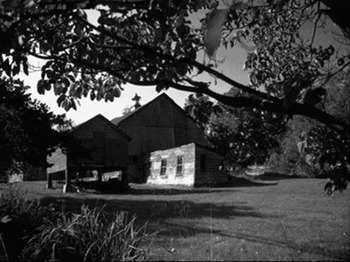
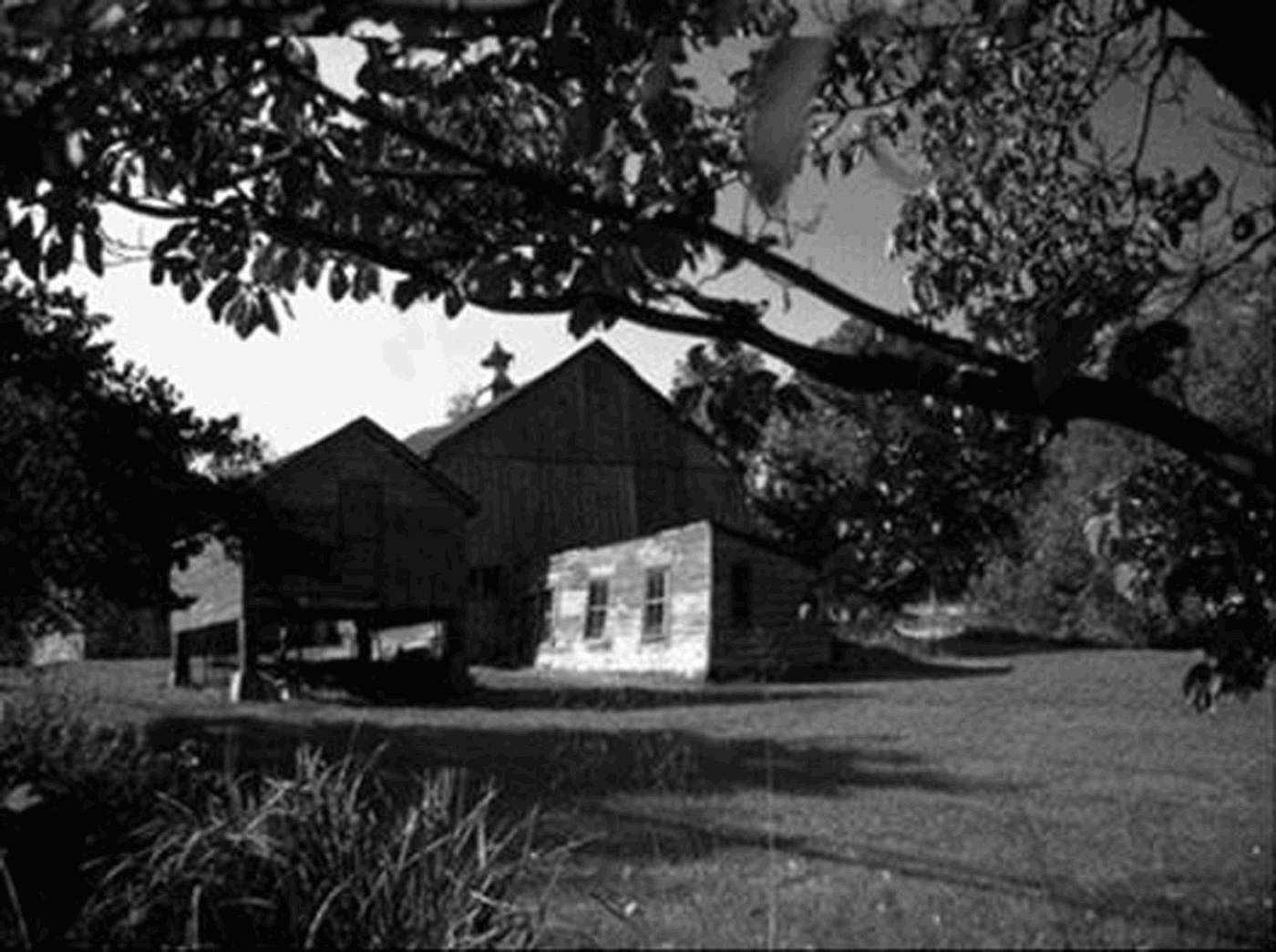
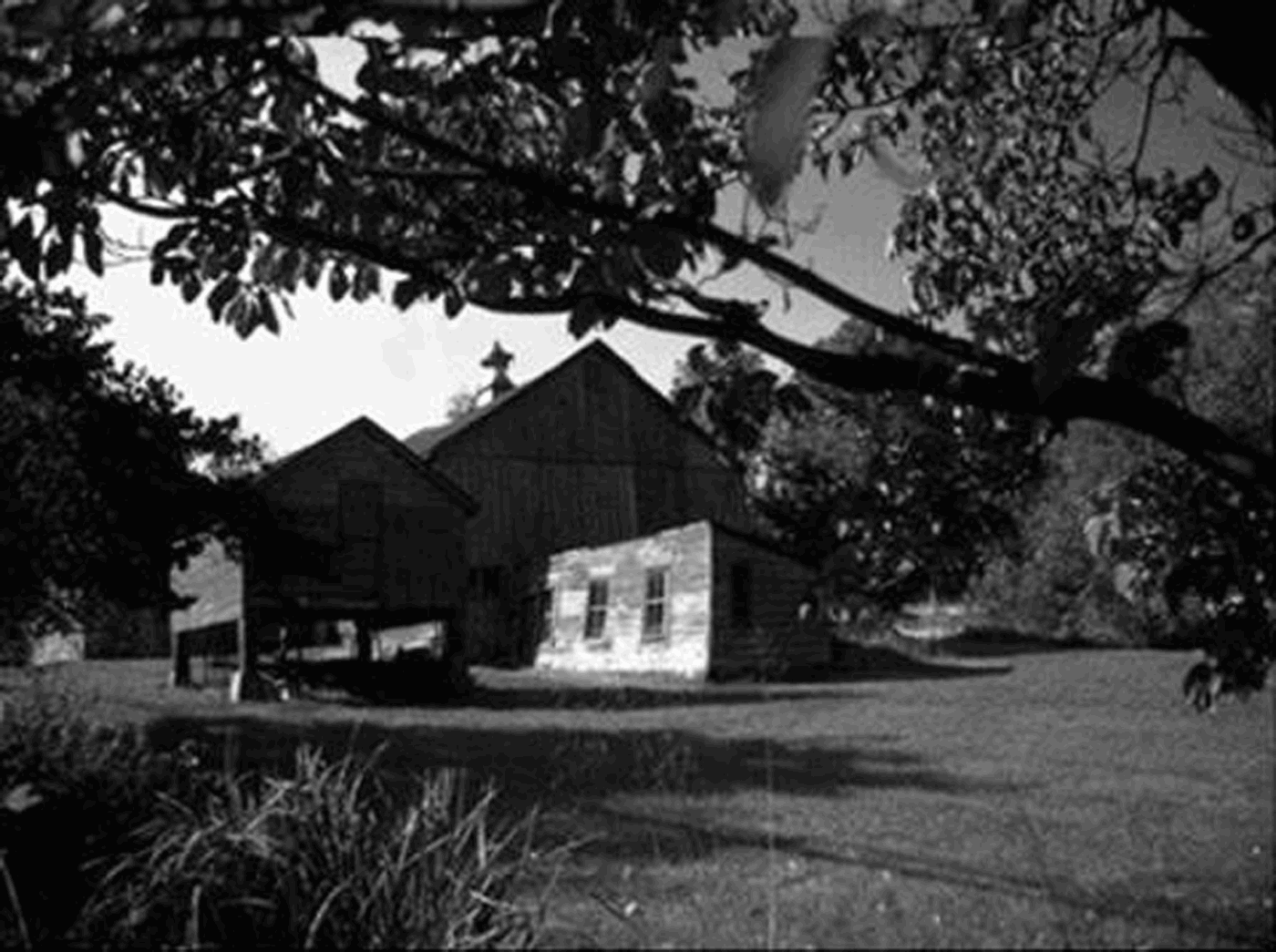
First, I will sketch the change “blindness” paradigm. In these experiments, a photograph is presented briefly to subjects, followed by a blank, followed sometimes by an identical photograph but other times by a similar but not identical photograph, followed by another blank. Then the cycle starts over. One can get the idea by comparing Figure 1 and Figure 4 (p. 494) without placing them side by side. When the two photographs differ, they usually differ in one object that changes color, shape, or position, or appears or disappears. The surprising result is that subjects are often unaware of the difference between the two pictures, even when the changed region takes up a good deal of the photographic real estate. Even with 50 repetitions of the same change over and over again, people are often unaware of the change. It is widely agreed that the phenomenon is an attentional one. The items that change without detection have been shown to be items that the subjects do not attend to. But the controversial question – to be discussed later – is whether the phenomenon is one of inattentional blindness or inattentional inaccessibility.Footnote 3
Compare this with Figure 4 without looking at the two figures side by side. There is a difference between the two pictures that can be hard to be aware of, a fact that motivates the appellation (a misnomer in my view) “Change Blindness.”

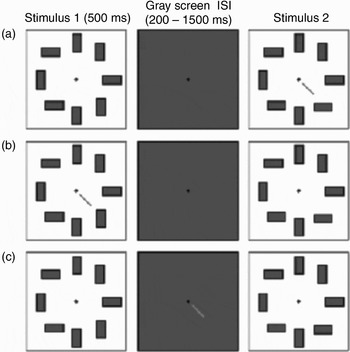
Now for the experiment by Landman et al. (Reference Landman, Spekreijse and Lamme2003). The subject is shown 8 rectangles for half a second as in (a) of Figure 2. There is a dot in the middle which the subject is supposed to keep looking at. (This is a common instruction in visual perception experiments and it has been found, using eye-tracking, that subjects have little trouble maintaining fixation.) The array is replaced by a blank screen for a variable period. Then another array appears in which a line points to one of the objects which may or may not have changed orientation. The subject's task is to say whether the indicated rectangle has changed orientation. In the example shown in Figure 2, there is an orientation change. Using statistical procedures that correct for guessing, Landman et al. computed a standard capacity measure (Cowan's K; see Cowan Reference Cowan2001) showing how many rectangles the subject is able to track. In (a), subjects show a capacity of 4 items. Thus, the subjects are able to deploy working memory so as to access only half of the rectangles despite the fact that in this as in Sperling's similar task, subjects' reported phenomenology is of seeing all or almost all of the rectangles. This is a classic “change blindness” result. In (b), the indicator of the rectangle that may or may not change comes on in the first panel. Not surprisingly, subjects can get almost all of the orientations right: their capacity is almost 8. The crucial manipulation is the last one: the indicator comes on during the blank after the original rectangles have gone off. If the subjects are continuing to maintain a visual representation of the whole array – as subjects say they are doing – the difference between (c) and (b) will be small, and that is in fact what is observed. The capacity measure in (c) is between 6 and 7 for up to 1.5 seconds after the first stimulus has been turned off, suggesting that subjects are able to maintain a visual representation of the rectangles. This supports what the subjects say, and what William James said, about the phenomenology involved in this kind of case. What is both phenomenal and accessible is that there is a circle of rectangles. What is phenomenal but in a sense not accessible, is all the specific shapes of the rectangles. I am taking what subjects say at face value (though of course I am prepared to reject what subjects say if there is evidence to that effect). Whether that is right will be taken up in the section 11.
Landman et.al.’s (2003) paradigm combining change “blindness” with Sperling's (1960) experiments on iconic memory. The rectangles are displayed here as line drawings but the actual stimuli were defined by textures. (From Lamme Reference Lamme2003.)

Subjects are apparently able to hold the visual experience for up to 1.5 seconds – at least “partial report superiority” (as it is called) lasts this long – considerably longer than in the Sperling type experiments in which the production of 3 to 4 letters for each row appears to last at most a few hundred msecs. The difference (Landman et al. Reference Landman, Spekreijse and Lamme2003) is that the Sperling type of experiment requires a good enough representation for the subjects to actually volunteer what the letters were, whereas the Landman et al. methodology only requires a “same/different” judgment. Yang (Reference Yang1999) found times comparable to Landman et al.'s, using similar stimuli.
In one variation, Landman and colleagues did the same experiment as before but changed the size of the rectangles rather than the orientation, and then in a final experiment, changed either the size or the orientation. The interesting result is that subjects were no worse at detecting changes in either orientation or size than they were at detecting changes in size alone. That suggests that the subjects have a representation of the rectangles that combines size and orientation from which either one can be recovered with no loss due to the dual task, again supporting the subjects' reports.
There is some reason to think that the longest lasting visual representations of this sort come with practice and when subjects learn to “see” (and not “look”). Sligte et al. (Reference Sligte, Scholte and Lamme2008) found long persistence, up to 4 seconds in a paradigm similar to that of Landman with lots of practice. Others (Long Reference Long1980; Yang Reference Yang1999) have noted that practice in partial report paradigms makes a big difference in subjects' ability to make the visual experience last. These experiments are hard for the subjects and there are large differences among subjects in the ability to do the experiment (Long Reference Long1985, Yang Reference Yang1999); in some cases experimenters have dismissed subjects who simply could not perform the tasks (Treisman et al. Reference Treisman, Russell, Green, Dornic and Rabbitt1975). Snodgrass and Shevrin (Reference Snodgrass and Shevrin2006) also find a difference (in a different paradigm) between “poppers” who like to relax and just see and “lookers” who are more active visual seekers.
The main upshot of the Landman et al. and the Sligte et al. experiments (at least on the surface – debunking explanations will be considered later) is along the same lines as that of the Sperling experiment: The subject has persisting experiences as of more specific shapes than can be brought under the concepts required to report or compare those specific shapes with others. They can all be brought under the concept “rectangle” in the Landman et al. experiment or “letter” in the Sperling experiment, but not the specific orientation-concepts which would be required to make the comparisons in Landman et al. or to report the letters in Sperling.
Why are subjects able to gain access to so few of the items they see in the first condition of the Landman et al. experiment (i.e., as described in [a] of Figure 2) and in the Sperling phenomenon without the tones? I am suggesting that the explanation is that the “capacity” of phenomenology, or at least the visual phenomenal memory system, is greater than that of the working memory buffer that governs reporting. The capacity of visual phenomenal memory could be said to be at least 8 to 32 objects – at any rate for stimuli of the sort used in the described experiments. This is suggested by subjects' reports that they can see all or almost all of the 8 to 12 items in the presented arrays, and by the experimental manipulations just mentioned in which subjects can give reports which exhibit the subjects apprehension of all or almost all of the items. In contrast, there are many lines of evidence that suggest that the “working memory” system – the “global workspace” – has a capacity of about 4 items (or less) in adult humans and monkeys and 3 (or less) in infants.
When some phenomenal items are accessed, something about the process erases or overwrites others, so in that sense the identities of the items are not all accessible. However, any one of the phenomenal items is accessible if properly cued, and so in that sense all are accessible. Another sense in which they are all accessible is that the subject knows that he sees them all (or almost all). The upshot is that there is phenomenology without accessibility (Block Reference Block1995a), in one sense of the term but not another (Chalmers Reference Chalmers1997; Kobes Reference Kobes1995). Of course, there is no point in arguing about which sense of the word “accessibility” to use.
The argument of this target article is thus importantly different from that of earlier works (Block Reference Block1995b; Reference Block1997), in which I claimed that the Sperling experiment directly shows the existence of phenomenal states that are not cognitively accessible – a conclusion that is not argued for here. In this article, I use the fact of overflow to argue for the conclusion that the machinery of phenomenology is at least somewhat different from the machinery of cognitive accessibility. I then argue that there is a neural realization of the fact of phenomenological overflow – if we assume that the neural basis of phenomenology does not include the neural basis of cognitive access to it as a constituent, and that is a reason to accept that assumption. The neural argument suggests that the machinery of cognitive access is not included in the machinery of phenomenology.
What does it mean to speak of the representational capacity of a system as a certain number of objects? Working memory capacity is often understood in terms of “slots” that are set by the cognitive architecture. One capacity measure that is relevant to phenomenology is the one mentioned above in connection with the Landman et al. (Reference Landman, Spekreijse and Lamme2003) and Sligte et al. (Reference Sligte, Scholte and Lamme2008) experiments – Cowan's (and Pashler's) K, which I will not discuss further. Another capacity measure relevant to phenomenology is what subjects say about seeing all of a number of items.
There are two significant remaining issues:
1. How do we know that the Sperling, Landman et al., and Sligte et al. effects are not retinal or otherwise pre-phenomenal?
2. How do we know we can believe subjects' reports to the effect that they experience all or almost all of the objects in the Sperling and the Landman et al. experiments? Perhaps subjects confuse potential phenomenology with actual phenomenology just as someone may feel that the refrigerator light is always on because it is on when he looks.
10. Is the effect retinal or otherwise pre-phenomenal?
The persistence of phenomenology is based in the persistence of neural signals. But some neural persistence may feed phenomenology rather than constitute it, and that creates a difficulty for the view that the capacity of phenomenology is larger than the capacity of working memory. It is no news that the “representational capacity” of the retina is greater than 4! Activations of the retina are certainly not part of the minimal neural basis of visual phenomenology. Rather, activations of the retina are part of the causal process by which that minimal supervenience base is activated. A minimal neural basis is a necessary part of a neural sufficient condition for conscious experience. We know that the retina is not part of a minimal core neural basis, because, for one thing, retinal activation stays the same even though the percept in the binocular rivalry experiments mentioned earlier shift back and forth. It may be said that phenomenological capacity is no greater than that of working memory, the appearance to the contrary deriving from tapping large capacity preconscious representations.
The experimental literature points to activations at all levels of the visual system during phenomenal persistence (Coltheart Reference Coltheart1980; Di Lollo Reference Di Lollo1980). However, there are clear differences between the effects of retinal persistence and persistence higher in the cortex.
One of the neatest dissections of phenomenal persistence in low level-vision from that in high-level vision comes from an experiment by G. Engel (Reference Engel1970). (The discussion of this experiment in Coltheart [1980] is especially useful.) Engel used as stimuli a pair of “random dot stereograms” of the sort invented by Bela Julesz in 1959. I can't show you an example that would allow you to experience the effect because the kind Engel used requires a stereo viewer. I can best explain what they are by telling you how they are made.
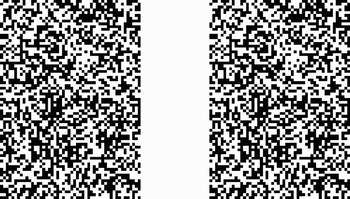
You start with a grid of, say, 100 by 200 tiny squares. You place a dot in a random location within each square in the grid. The result is something that looks a bit like snow on an old black and white TV – like one of the rectangles in Figure 3. Then you copy the grid dot by dot, but you make a certain change in the copy. You pick some region of it and move every dot in that region slightly to the left, leaving the rest of the dots alone. The right rectangle in the picture is the result of moving a square-shaped region in the middle horizontally. The resulting figure looks to the untrained naked eye just like the first rectangle, but since the visual system is very sensitive to slight disparities, if each eye is presented with one of the two rectangles in a stereo viewer (or if you can “free fuse” the images), the viewer sees a protruding square.
Random-dot stereograms. (Thanks to Júlio M. Otuyama.)

Compare this with Figure 1 without looking at the two figures side by side. There is a difference that can be hard to see.
The illusion of depth requires the two rectangles to be presented to the two eyes, but if the presentations to the two eyes are at different times, there will be no loss of the experience of depth so long as the two presentations are not separated by too much time. Suppose the left stereogram is presented to the left eye for 10 msecs, and then the right stereogram is presented to the right eye 50 msecs later. No problem: there is an experience of depth. Indeed, one can present the second stereogram up to 80 msecs later and still get the experience of depth. Monocular persistence, persistence of the signal to a single eye, lasts 80 msecs. Think about the left eye getting its stereogram and the right eye then getting its stereogram 50 msecs later. If there is no independent stereo persistence, the depth experience would expire in another 30 msecs, when the monocular persistence to the left eye runs out. But that does not happen. Depth experience goes on much longer. Engel considered the question of how long one can wait to present another pair of stereograms before the subject loses the experience of depth. He presented sequences of the left stimulus, then the right, then the left, then the right, and so on. If the initial left was followed by a right within 80 msecs, he found that the next left had to come within 300 msecs in order for the subject's experience of depth to be continuous. That is, the experience of depth lasts 300 msecs. The retina is of course completely monocular: each retinal activation depends on input to just one eye. Indeed, substantial numbers of binocular cells are not found in early vision. The conclusion: Depth requires processing in areas of the visual system higher than early vision.
So this experiment shows two kinds of persistence, monocular persistence lasting 80 msecs and binocular persistence lasting 300 msecs; and the binocular persistence is clearly phenomenal since it is a matter of the subject continuing to see depth.
Here is another item of evidence for the same conclusion. There is phenomenal persistence for visual motion, which cannot be due merely to persistence of neural signals in the retina or in early visual areas. Anne Treisman used a display of 6 dots, each of which moved in a circular pathway, either clockwise or counterclockwise (Treisman et al. Reference Treisman, Russell, Green, Dornic and Rabbitt1975). Subjects were asked to report whether the motion was clockwise or counterclockwise. Treisman et al. found a partial report advantage much like that in Sperling's experiment. (See also Demkiw & Michaels Reference Demkiw and Michaels1976.)
Why can't this phenomenon be accounted for by neural persistence in the retina or early vision? The point can be understood by imagining a moving dot that goes from left to right on a TV screen. Suppose the screen is phosphorescent so that the images leave a ghost that lasts 1.5 seconds (inspired by the Landman et al. experiment) and suppose that the initial moving dot moves across the screen in 100 msecs. What the viewer will then see is a dot on the left that expands into a line towards the right over a 100 msec period. The line will remain for 1,300 msecs and then it will shrink towards the right to a dot on the right over another 100 msec. The idea of the analogy is to point to the fact that retinal persistence of the signals of a moving object cannot be expected to create phenomenal persistence of the experience of that moving object. Phenomenal persistence has to be based in neural persistence that is a good deal higher in the visual system. As will be discussed later, there is an area in the visual system (V5) that is an excellent candidate for the neural basis of the visual experience of motion.
Perhaps the strongest evidence for cortical persistence comes from the Sligte et al. paper mentioned earlier. There is evidence that the persisting visual experience can be divided into two phases. In the first phase, it is indistinguishable from visual perception. This phase typically lasts at most a few hundred msecs, and often less than 100 msecs (unless subjects are dark-adapted, in which case it lasts longer). The persistence of the experience can be tested by many methods, for example, asking subjects to adjust the timing of a second visual stimulus so that what the subject experiences is a seamless uninterrupted visual stimulus. (See Coltheart [1980] for a description of a number of converging experimental paradigms that measure visible persistence.) In the second phase, the subject has a fading but still distinctly visual experience. The first two phases are of high capacity and disturbed if the test stimulus is moved slightly, and easily “masked” (Phillips Reference Phillips1974, Sligte et al. Reference Sligte, Scholte and Lamme2008) by stimuli that overlap in contours with the original stimulus. (Such a mask, if presented at the right lag, makes the stimulus hard to see.)
Sligte et al. (Reference Sligte, Scholte and Lamme2008) used dark adaptation to increase the strength of the first phase, producing what could be described as a positive afterimage. They also introduced a further variable, two kinds of stimuli: a black/white stimulus and a red/gray isoluminant stimulus in which the foreground and background have the same level of luminance. The idea was to exploit two well-known differences between rods and cones in the retina. Rods are color blind and also have an extended response to stimulation, whereas cones have a brief burst of activity. Rods react to isoluminant stimuli as to a uniform field. The black and white stimulus in dark adaptation will however maximize rod stimulation, producing longer visible persistence without affecting the later working memory representation (Adelson Reference Adelson1978). Sligte et al. found, not surprisingly, that the black and white stimuli produced very strong visible persistences, much stronger than the isoluminant red and gray stimuli when the cue was given just after the array of figures was turned off. (In arrays with 16 items, the subjects had a capacity of 15 for the black and white stimuli but only 11 for the red and gray stimuli.) Here is the very significant result for the issue of retinal persistence versus cortical persistence. A brief flash of light just after the array wiped out this difference. However, when the flash of light was given later after about 1,000 msecs after the array stimulus, it had no effect. Further, a pattern mask did have a huge effect at 1,000 msecs, lowering the capacity to the level of working memory. The flash of light right after the stimulus interferes with retinal persistence, whereas the pattern mask after 1,000 msecs interfered with cortical persistence.
As I mentioned, Sligte et al. used as many as 32 items instead of the 8 of Landman et al. The capacity for the black/white stimulus was close to 32 for the early cue, the capacity of the red/gray stimulus was about 17 and both fell to about 16 for the cue late in the blank space. And both fell further to somewhat over 4 – as in Landman et al. – once the new stimulus came on. If the cue was presented 10 msecs after the first stimulus (the analog of [c] in Figure 2), the black/white stimulus produced greater retention, but if the cue was presented late in the blank period (or once the new stimulus came on as in [a]), the black/white and red/grey stimuli were equivalent. The upshot is that the first phase is very high capacity and is over by 1,000 msecs; the second phase is high capacity and lasts up to 4 seconds; and the third phase has a similar capacity to the working memory phase in Sperling and in Landman et al.
The results mentioned earlier in connection with the Sperling and the Landman et al. experiments are likely to be based in central parts of the visual system, and so are not due to something analogous to “looking again” as in the imaginary dialog presented earlier. However, the question of exactly which central neural activations constitute phenomenology, as opposed to constituting input to phenomenology, is just the question of what phenomenology is in the brain; and of course the topic of this article is whether that can be empirically investigated. So it may seem that I have unwittingly shown the opposite of what I am trying to show, namely, that every attempt to give an empirical answer ends up presupposing an answer. So how can my argument avoid begging the question?
I have three responses. First, the evidence suggests neural persistence at all levels in the visual system. There is no reason to think the phenomenal level is an exception. Second, it appears as if the activations of lower-level vision are relatively brief as compared with the activations of higher-level vision. Third, as mentioned earlier, there is evidence to come that a certain kind of activation of V5 is the core neural basis of the experience of motion. We can see how experimental evidence from phenomenal persistence could dovetail with the evidence outside of memory for V5 as the neural basis for the visual experience of motion. If some version of Treisman's experiment were done in a scanner, my point of view would predict persisting V5 activations of the aforementioned kind. So the issue is not beyond investigation.
11. The Refrigerator Light Illusion
The argument of this article depends on the claim that subjects in the Sperling and the Landman et al. experiments have phenomenal experiences of all or almost all of the shapes in the presented array. One objection is that subjects' judgments to that effect are the result of an illusion in which they confuse potential phenomenology with actual phenomenology. In order to explain this allegation and defend against it, I will first have to say more about cognitive accessibility.
The dominant model of cognitive accessibility in discussions of consciousness – and one that is assumed both in this target article and by Stan Dehaene and his colleagues, the critics who I will be talking about in this section – is a model of broadcasting in a global workspace that started with the work of Bernard Baars (Reference Baars1988; Reference Baars1997) The idea is closely related to my notion of access consciousness and Dan Dennett's (Reference Dennett1993; Reference Dennett2001) notion of “cerebral celebrity” or fame in the brain.Footnote 4 Think of perceptual mechanisms as suppliers of representations to consuming mechanisms which include mechanisms of reporting, reasoning, evaluating, deciding, and remembering. There is empirical evidence that it is reasonable to think of perceptual systems as sending representations to a global active storage system, which is closely connected to the consuming systems. Those representations are available to all cognitive mechanisms without further processing. (That's why blindsight “guesses” don't count as cognitively accessible in this sense; further processing in the form of guessing is required to access the representations.) This workspace is also called “working” memory – the word “memory” being a bit misleading because, after all, one can report an experience while it is happening without having to remember it in any ordinary sense of the term.
Dehaene and colleagues (Dehaene et al. Reference Dehaene, Kerszberg and Changeux1998; Dehaene & Nacchache 2001) have given impressive evidence that our ability to report our phenomenal states hinges on such a global workspace and that the connection between perception and the workspace lies in long-range neurons in sensory areas in the back of the head which feed forward to the workspace areas in the front of the head. In past publications, I argued for phenomenology without cognitive accessibility (Block Reference Block1995a; Reference Block1995b; Reference Block2001) on the basis of the Sperling experiment. Dehaene and Naccache (Reference Dehaene and Naccache2001) replied, making use of the global workspace model:
Some information encoded in the nervous system is permanently inaccessible (set I1). Other information is in contact with the workspace and could be consciously amplified if it was attended to (set I2). However, at any given time, only a subset of the latter is mobilized into the workspace (set I3). We wonder whether these distinctions may suffice to capture the intuitions behind Ned Block's (Block Reference Block1995b; see also Block Reference Block2001) definitions of phenomenal (P) and access (A) consciousness. What Block sees as a difference in essence could merely be a qualitative difference due to the discrepancy between the size of the potentially accessible information (I2) and the paucity of information that can actually be reported at any given time (I3). Think, for instance, of Sperling's experiment in which a large visual array of letters seems to be fully visible, yet only a very small subset can be reported. The former may give rise to the intuition of a rich phenomenological world – Block's P-consciousness – while the latter corresponds to what can be selected, amplified, and passed on to other processes (A-consciousness). Both, however, would be facets of the same underlying phenomenon. (Dehaene & Naccache Reference Dehaene and Naccache2001, p. 30)
The distinction between I1, I2, and I3 is certainly useful, but its import depends on which of these categories is supposed to be phenomenal. One option is that representations in both categories I2 (potentially in the workspace) and I3 (in the workspace) are phenomenal. That is not what Dehaene and Naccache have in mind. Their view (see especially section 3.3.1 of their paper) is that only the representations in I3 are phenomenal. They think that representations in the middle category (I2) of potentially in the workspace seem to the subject to be phenomenal but that this is an illusion. The only phenomenal representations are those that are actually in the workspace. But in circumstances in which the merely potential workspace representations can be accessed at will, they seem to us to be phenomenal. That is, the subjects allegedly mistake merely potential phenomenology for actual phenomenology.
Importantly, the workspace model exposes a misleading aspect of talk of cognitive accessibility. What it is for representations to be in the workspace (I3) involves both actuality (sent to the workspace) and potential (can be accessed by consuming mechanisms without further processing). The representations that are actually in the workspace are in active contact with the consuming systems, and the consuming systems can (potentially do) make use of those representations. We might speak of the representations in I3 (in the workspace) as cognitively accessible in the narrow sense (in which consuming mechanisms make use of what is already there), and representations in the union of I3 and I2 as cognitively accessible in the broad sense. It is narrow cognitive accessibility that Dehaene et al. identify with phenomenology. When I speak of phenomenology overflowing cognitive accessibility, I mean that the capacity of phenomenology is greater than that of the workspace – so it is narrow accessibility that is at issue. In the rest of this article, I will be using “cognitive accessibility” in the narrow sense. The thesis of this article is that phenomenology does not include cognitive accessibility in the narrow sense. Here we see that as theory, driven by experiment, advances, important distinctions come to light among what appeared at first to be unified phenomena (See Block & Dworkin Reference Block and Dworkin1974, on temperature; Churchland Reference Churchland1986; Reference Churchland1994; Reference Churchland2002, on life and fire).
But what is wrong with the broad sense? Answer: The broad sense encompasses too much, at least if a necessary and sufficient condition of phenomenology is at stake. Representations in I2 can be “amplified if … attended to”, but of course uncontroversially unconscious representations can be amplified too, if one shifts attention to what they represent (Carrasco Reference Carrasco, Wilken, Bayne and Cleeremans2007). So including everything in I2 in consciousness would be a mistake, a point I made (Block Reference Block1997) in response to the claim that consciousness correlates with a certain functional role by Chalmers (Reference Chalmers1997). No doubt a functional notion that is intermediate between narrow and broad could be framed, but the challenge for the framer would be to avoid ad hoc postulation.
An experimental demonstration that shifting attention affects phenomenology to a degree sufficient to change a sub-threshold stimulus into a supra-threshold stimulus is to be found in a series of papers by Marisa Carrasco (Carrasco et al. Reference Carrasco, Ling and Read2004) in which she asked subjects to report the orientation of one of a pair of gratings which had the higher contrast. Carrasco presented an attention-attracting dot on one side of the screen or the others that subject was supposed to ignore, slightly before the pair of gratings. She showed that attention to the left made a grating on the left higher in contrast than it would otherwise have been. In subsequent work (Carrasco Reference Carrasco, Wilken, Bayne and Cleeremans2007), Carrasco has been able to show precisely measurable effects of attentional shifts on contrast and color saturation, but not on hue. This alleged conflation of potential phenomenology with actual phenomenology could be called the Refrigerator Light IllusionFootnote 5 (Block Reference Block2001), the idea being that just as someone might think the refrigerator light is always on, confusing its potential to be on with its actually being on, so subjects in the Sperling and the Landman et al. experiments might think that all the items register phenomenally because they can see any one that they attend to. In the rest of this section, I argue against this allegation.
Let us begin by mentioning some types of illusions. There are neurological syndromes in which cognition about one's own experience is systematically wrong; for example, subjects with anosognosia can complain bitterly about one neural deficit while denying another. And cognitive illusions can be produced reliably in normals (Piattelli-Palmarini Reference Piattelli-Palmarini1994). To take a famous example, doctors are more reluctant to recommend surgical intervention if they are told that a disease has a mortality rate of 7% than if they are told it has a survival rate of 93%. Moving to a cognitive illusion that has a more perceptual aspect, much of vision is serial but subjects take the serial processes to be simultaneous and parallel (Nakayama Reference Nakayama and Blakemore1990). For example, G. W. McConkie and colleagues (McConkie & Rayner Reference McConkie and Rayner1975; McConkie & Zola Reference McConkie and Zola1979) created an eye-tracking setup in which subjects are reading from a screen of text but only the small area of text surrounding the fixation point (a few letters to the left and 15 to the right) is normal – the rest is perturbed. Subjects have the mistaken impression that the whole page contains normal text. Subjects suppose that the impression of all the items on a page is a result of a single glance, not realizing that building up a representation of a whole page is a serial process. These illusions all have a strong cognitive element.
Are the results from experiments like those of Sperling and Landman et al. the result of cognitive illusions? One reason to think they are not is that the phenomena which the Sperling and the Landman et al. experiments depend on do not require that subjects be asked to access any of the items. It is a simple matter to show subjects arrays and ask them what they see without asking them to report any specific items (as was done first in Gill & Dallenbach Reference Gill and Dallenbach1926). This suggests that the analysis of subjects' judgments in the partial report paradigms as based on cognition – of noticing the easy availability of the items – is wrong. A second point is that cognitive illusions are often, maybe always, curable. For example, the framing illusion mentioned above is certainly curable. However, I doubt that the Sperling and the Landman et al. phenomenology is any different for advocates of the Dehaene view. Third, the sense that in these experiments so much of the perceptual content slips away before one can grab hold of it cognitively does not seem any kind of a cognition but rather is percept-like.
Recall, that in the Sperling experiment, the results are the same whether the stimulus is on for 50 msecs or 500 msecs. Steve Schmidt has kindly made a 320 msec demo that is available on my web site at: http://www.nyu.edu/gsas/dept/philo/faculty/block/demos/Sperling320msec.mov.
See for yourself.
The suggestion that the putative illusion has a perceptual or quasi-perceptual nature comports with the way Dan Dennett and Kevin O'Regan describe the sparse representations allegedly revealed by change “blindness” (Dennett Reference Dennett1991; O'Regan Reference O'Regan1992).Footnote 6 Their idea is that the way it seems that it seems is – supposedly – not the way it actually seems. They allege not a mismatch between appearance and external reality as in standard visual illusions but rather a mismatch between an appearance and an appearance of an appearance. We could call this alleged kind of illusion in which the introspective phenomenology does not reflect the phenomenology of the state being introspected a hyper-illusion.
But are there any clear cases of hyper-illusions? I don't know of any. One candidate is the claim, often made, that although the “self” is really a discontinuous stream of experiences, we have the illusion that it is a continuous existent (Strawson Reference Strawson2003). But this alleged hyper-illusion is suspect, being perhaps more a matter of failing to experience the gappiness rather than actually experiencing non-gappiness. Further, subjects' introspective judgments led to the prediction investigated by Sperling, Landman et al., and Sligte et al. One should have an empirical reason to judge that this experimentally confirmed introspective judgment is wrong.
Subjects in the Landman et al. experiment are looking right at the rectangles for half a second, a long exposure, and it is not hard to see the orientations clearly. It does not appear to them as if something vaguely rectangularish is coming into view, as if from a distance. In (c) of Landman et al., they see all the rectangle orientations for up to 1.5 seconds in the Landman et al. version and up to 4 seconds in the Sligte et al. version. It is hard to believe that people are wrong about the appearances for such a long period.
Dehaene et al. (Reference Dehaene, Changeux, Naccache, Sackur and Sergant2006) revisit this issue. Here are the relevant paragraphs (references are theirs):
The philosopher Ned Block, however, has suggested that the reportability criterion underestimates conscious contents (Block Reference Block2005). When we view a complex visual scene, we experience a richness of content that seems to go beyond what we can report. This intuition led Block to propose a distinct state of “phenomenal consciousness” prior to global access. This proposal receives an apparent confirmation in Sperling's iconic memory paradigm. When an array of letters is flashed, viewers claim to see the whole array, although they can later report only one subsequently cued row or column. One might conclude that the initial processing of the array, prior to attentional selection of a row or column is already phenomenally conscious. (Block Reference Block2005, Lamme Reference Lamme2003)
However, those intuitions are questionable, because viewers are known to be over-confident and to suffer from an “illusion of seeing”. (O'Regan & Noë Reference O'Regan and Noë2001). The change blindness paradigm demonstrates this “discrepancy between what we see and what we think we see” (Simons & Ambinder Reference Simons and Ambinder2005). In this paradigm, viewers who claim to perceive an entire visual scene fail to notice when an important element of the scene changes. This suggests that, at any given time, very little of the scene is actually consciously processed. Interestingly, changes that attract attention or occur at an attended location are immediately detected. Thus, the illusion of seeing may arise because viewers know that they can, at will, orient attention to any location and obtain conscious information from it. (Dehaene et al. Reference Dehaene, Changeux, Naccache, Sackur and Sergant2006, p. 210)
Dehaene and his colleagues propose to use the change “blindness” results to back up their view of the Sperling result. But the issues in these two paradigms are pretty much the same – our view of one is conditioned by our view of the other. Further, as I mentioned earlier, the first form of the Landman et al. experiment (see Fig. 2, Part [a]) is itself an experiment in the same vein as the standard change “blindness” experiments. The subject sees 8 things clearly but has the capacity (in the sense of Cowan's K) to make comparisons for only 4 of them. And so the Landman et al. experiment – since it gives evidence that the subject really does see all or almost all the rectangles – argues against the interpretation of the change “blindness” experiments given by Dehaene and his colleagues.
Dehaene et al. (Reference Dehaene, Changeux, Naccache, Sackur and Sergant2006) say, “The change blindness paradigm demonstrates this discrepancy between what we see and what we think we see.” But this claim is hotly contested in the experimental community, including by one of the authors that they cite. As I mentioned earlier (see Note 2), many psychologists would agree that initial interpretations of change “blindness” went overboard and that, rather than seeing the phenomenon as a form of inattentional blindness, one might see it as a form of inattentional inaccessibility (Block Reference Block2001). That is, the subject takes in the relevant detail of each of the presented items, but they are not conceptualized at a level that allows the subject to make a comparison. As Fred Dretske (Reference Dretske2004) has noted, the difference between the two stimuli in a change blindness experiment can be one object that appears or disappears, and one can be aware of that object that constitutes the difference without noticing that there is a difference.
Compare Figure 1 with Figure 4. It can be hard for subjects to see the difference between Figure 1 and Figure 4, even when they are looking right at the feature that changes. The idea that one cannot see the feature that changes strains credulity.
Two of the originators of the change “blindness” experiments, Dan Simons and Ron Rensink (see Simons & Rensink Reference Simons and Rensink2005a) have since acknowledged that the “blindness” interpretations are not well supported by the “change blindness” experiments. In a discussion of a response by Alva Noë (Reference Noë2005), they summarize (Simons and Rensink Reference Simons and Rensink2005b):
We and others found the “sparse representations” view appealing (and still do), and initially made the overly strong claim that change blindness supports the conclusion of sparse representations (Rensink et al. Reference Rensink, O'Regan and Clark1997; Simons Reference Simons1997). We wrote our article because change blindness continues to be taken as evidence for sparse – or even absent – representations, and we used O'Regan and Noë's influential paper ( O'Regan & Noe 2001) as an example. However, as has been noted for some time … this conclusion is logically flawed. (Simons & Rensink Reference Simons and Rensink2005b, p. 219)
I have been appealing to what the subjects say in Sperling-like experiments about seeing all or almost all the items. However, there is some experimental confirmation of what the subjects say in a different paradigm. Geoffrey Loftus and his colleagues (Loftus & Irwin Reference Loftus and Irwin1998) used a task devised by Vincent Di Lollo (Reference Di Lollo1980) and his colleagues using a 5 by 5 grid in which all but one square is filled with a dot. Loftus et al. divided the dots into two groups of 12, showing subjects first one group of 12 briefly, then a pause, then the other group of 12 briefly. The subjects always were given partial grids, never whole grids. Subjects were asked to report the location of the missing dot – something that is easy to do if you have a visual impression of the whole grid. In a separate test with no missing dots, subjects were asked to judge on a scale of 1 to 4 how temporally integrated the matrix appeared to be. A “4” meant that one complete matrix appeared to have been presented, whereas a “1” meant that two separate displays had been presented. The numerical ratings are judgments that reflect phenomenology: how complete the grids looked. The length of the first exposure and the time between exposures was varied. The Loftus et al. experiment probes persistence of phenomenology without using the partial report technique that leads Dehaene and his colleagues (2001; 2006) to suggest the Refrigerator Light illusion. The result is that subjects' ability to judge which dot was missing correlated nearly perfectly with their phenomenological judgments of whether there appeared to be a whole matrix as opposed to two separate partial matrices. That is, the subjects reported the experience of seeing a whole matrix if and only if they could pick out the missing dot, thus confirming the subjects' phenomenological reports.
To sum up: (1) the subjects' introspective judgments in the experiments mentioned are that they see all or almost all of the items. Dehaene and his colleagues (2001; 2006) seem to agree since that is entailed by the claim that the introspective judgments are illusory. (2) This introspective judgment is not contingent on subjects' being asked to report items as would be expected on the illusion hypothesis. (3) This introspective judgment leads to the prediction of partial report superiority, a prediction that is borne out. (4) The accuracy of the subjects' judgments is suggested by the fact that subjects are able to recover both size and orientation information with no loss. (5) These results cohere with a completely different paradigm – the Loftus paradigm just mentioned. (6) Dehaene and his colleagues offer no empirical support other than the corresponding theory of the change “blindness” results which raise exactly the same issues.
The conclusion of this line of argument is, as mentioned before, that phenomenology overflows cognitive accessibility and so phenomenology and cognitive access are based at least partly in different systems with different properties. I will be moving to the promised argument that appeals to the mesh between psychology and neuroscience after I fill in some of the missing premises in the argument, the first of which is the evidence for a capacity of visual working memory of roughly four or less.
12. Visual working memory
At a neural level, we can distinguish between memory that is coded in the active firing of neurons – and ceases when that neuronal firing ceases – and structural memory that depends on changes in the neural hardware itself, for example, change in strength of synapses. The active memory – which is active in the sense that it has to be actively maintained – is sometimes described as “short term” – a misdescription since it lasts as long as active firing lasts, which need not be a short time if the subject is actively rehearsing. In this target article, the active memory buffer is called “working memory”.
You may have heard of a famous paper by George Miller called “The magical number seven, plus or minus two: Some limits on our capacity for processing information” (Miller Reference Miller1956). Although Miller was more circumspect, this paper has been widely cited as a manifesto for the view that there is a single active memory system in the brain that has a capacity of seven plus or minus two “items.” What is an item? There are some experimental results that fill-in this notion a bit. For example, Huntley-Fenner et al. (Reference Huntley-Fenner, Carey and Solimando2002) showed that infants' visual object tracking system – which, there is some reason to believe, makes use of working memory representations – does not track piles of sand that are poured, but does track them if they are rigid. One constraint on what an item might be comes from some experiments that show that although we can remember only about four items, we can also remember up to four features of each one. Luck and Vogel asked subjects to detect changes in a task somewhat similar to the Landman et al. task already mentioned. They found that subjects could detect changes in four features (color, orientation, size, and the presence or absence of a gap in a figure) without being significantly less accurate than if they were asked to detect only one feature (Luck & Vogel Reference Luck and Vogel1997; Vogel et al. Reference Vogel, Woodman and Luck2001).
In the 50 years since Miller's paper, reasons have emerged to question whether there really is a single active memory system as opposed to a small number of linked systems connected to separate modalities and perhaps separate modules – for example, language. Some brain injuries damage verbal working memory but not spatial working memory (Basso et al. Reference Basso, Speinnler, Vallar and Zanobio1982), and others have the opposite effect (Hanley et al. Reference Hanley, Young and Pearson1991). And evidence has accumulated that the capacity of these working memories – especially visual working memory – is actually lower than seven items (Cowan Reference Cowan2001, Cowan et al. 2006).
The suggestion of seven items was originally made plausible by experiments demonstrating that people, if read lists of digits, words or letters, can repeat back about seven of them. Of course, they can repeat more items if the items can be “chunked.” Few Americans will have trouble holding the nine letters “FBICIAIRS” in mind, because the letters can be chunked into 3 acronyms.
More relevant to our discussion, visual working memory experiments also come up with capacities in the vicinity of four, or fewer than four, items. (For work that suggests fewer than four, see McElree Reference McElree and Ross2006). Whether there is one working memory system that is used in all modalities or overlapping systems that differ to some extent between modalities, this result is what is relevant to the experiments discussed above. Indeed, you have seen three examples in this target article itself: the Sperling, Landman et al., and Sligte et al. experiments. I will briefly mention a few other quite different paradigms that have come up with the same number. One such paradigm involves the number of items that people – and monkeys – can effortlessly keep track of. For example, at a rhesus macaque monkey colony on a small island off of Puerto Rico, Marc Hauser and his colleagues (Hauser et al. Reference Hauser, Carey and Hauser2000) did the following experiment: Two experimenters find a monkey relaxing on its own. Each experimenter has a small bucket and a pocket full of apple slices. The experimenters put down the buckets and, one at a time, they conspicuously place a small number of slices in each bucket. Then they withdraw and check which bucket the monkey goes to in order to get the apple slices. The result is that for numbers of slices equal to or smaller than four, the monkeys overwhelmingly choose the bucket with more slices. But if either bucket has more than four, the monkeys choose at random. In particular, monkeys chose the greater number in comparison of one versus two, two versus three, and three versus four, but they chose at random in cases of four versus five, four versus six, four versus eight, and, amazingly, three versus eight. The comparison of the three versus four case (where monkeys chose more) and the three versus eight case (where they chose at random) is especially telling. The eight apple slices simply overflowed working memory storage.
Infant humans show similar results, although typically with a limit more in the vicinity of three rather than four (Feigenson et al. Reference Feigenson, Carey and Hauser2002). Using graham crackers instead of apple slices, Feigenson et al. found that infants would crawl to the bucket with more crackers in the cases of one versus two and two versus three, but were at chance in the case of one versus four. Again, four crackers overflows working memory. In one interesting variant, infants are shown a closed container into which the experimenter – again conspicuously – inserts a small number of desirable objects (e.g., M&Ms). If the number of M&Ms is one, two, or three, the infant continues to reach into the container until all are removed, but if the number is more than three, infants reach into the container just once (Feigenson & Carey Reference Feigenson and Carey2003).
I mentioned above that some studies have shown that people can recall about four items including a number of features of each one. However, other studies (Xu Reference Xu2002) have suggested smaller working memory capacities for more complex items. Xu and Chun (Reference Xu and Chun2006) have perhaps resolved this controversy by showing that there are two different systems with somewhat different brain bases. One of these systems has a capacity of about four spatial locations, or objects at four different spatial locations, independent of complexity; the other has a smaller capacity depending on the complexity of the representation. The upshot for our purposes is that neither visual working memory system has a capacity higher than four.
This section is intended to back up the claim made earlier about the capacity of working memory – at least visual working memory. I move now to a quick rundown on working memory and phenomenology in the brain with an eye to giving more evidence that we are dealing with at least partially distinct systems with different properties.
13. Working memory and phenomenology in the brain
Correlationism in its metaphysical form (which, you may recall, regards cognitive accessibility as part of phenomenology) would have predicted that the machinery underlying cognitive access and underlying phenomenal character would be inextricably entwined in the brain. But the facts so far can be seen to point in the opposite direction, or so I argue.
In many of the experiments mentioned so far, a brief stimulus is presented, then there is a delay before a response is required. What happens in the brain during the delay period? In experiments on monkeys using this paradigm, it has been found that neurons in the upper sides of the prefrontal cortex (dorsolateral prefrontal cortex) fire during the delay period. And errors are correlated with decreased firing in this period (Fuster Reference Fuster1973; Goldman-Rakic Reference Goldman-Rakic and Plum1987). Further, damage to neurons in this area has been found to impair delayed performance, but not simultaneous performance, and damage to other memory systems does not interfere with delayed performance (except possibly damage to parahippocampal regions in the case of novel stimuli; Hasselmo & Stern Reference Hasselmo and Stern2006). Infant monkeys (1.5 months old) are as impaired as adult monkeys with this area ablated, and if the infant area is ablated, the infants do not develop working memory capacity. It appears that this prefrontal area does not itself store sensory signals, but rather, is the main factor in maintaining representations in sensory, sensorimotor, and spatial centers in the back of the head. As Curtis and D'Esposito (Reference Curtis and D'Esposito2003, p. 415) note, the evidence suggests that this frontal area “aids in the maintenance of information by directing attention to internal representations of sensory stimuli and motor plans that are stored in more posterior regions.” That is, the frontal area is coupled to and maintains sensory representations in the back of the head that represent, for example, color, shape, and motion. (See Supèr et al. [2001a] for an exploration of the effect of this control on the posterior regions.) The main point is that, as the main control area for working memory, this prefrontal area is the main bottleneck in working memory, the limited capacity system that makes the capacity of working memory what it is.
So the first half of my brain-oriented point is that the control of working memory is in the front of the head. The second half is that, arguably, the core neural basis of visual phenomenology is in the back of the head. I will illustrate this point with the example of one kind of visual experience of motion (typified by optic flow). But first a caution: No doubt the neural details presented here are wrong, or at least highly incomplete. We are still in early days. My point is that the evidence does point in a certain direction, and more important, we can see how the issues I have been talking about could be resolved empirically.
Here is a brief summary of some of the vast array of evidence that the core neural basis of one kind of visual experience of motion is activation of a certain sort in a region in the back of the head centered on the area known as V5Footnote 7. The evidence includes:
Activation of V5 occurs during motion perception (Heeger et al. Reference Heeger, Boynton, Demb, Seideman and Newsome1999).
Microstimulation to monkey V5 while the monkey viewed moving dots influenced the monkey's motion judgments, depending on the directionality of the cortical column stimulated (Britten et al. Reference Britten, Shadlen, Newsome and Movshon1992).
Bilateral (both sides of the brain) damage to a region that is likely to include V5 in humans causes akinetopsia, the inability to perceive – and to have visual experiences as of motion. (Akinetopsic subjects see motion as a series of stills.) (Rees et al. Reference Rees, Kreiman and Koch2002a, Zihl et al. Reference Zihl, von Cramon and Mai1983).
The motion aftereffect – a moving afterimage – occurs when subjects adapt to a moving pattern and then look at a stationary pattern. (This occurs, for example, in the famous “waterfall illusion.”) These moving afterimages also activate V5 (Huk et al. Reference Huk, Ress and Heeger2001).
Transcranial magnetic stimulation (TMSFootnote 8) applied to V5 disrupts these moving afterimages (Theoret et al. Reference Theoret, Kobayashi, Ganis, Di Capua and Pascual-Leone2002).
V5 is activated even when subjects view “implied motion” in still photographs, for example, of a discus thrower in mid-throw (Kourtzi & Kanwisher Reference Kourtzi and Kanwisher2000).
TMS applied to visual cortex in the right circumstances causes stationary phosphenesFootnote 9 – brief flashes of light and color. (Kammer Reference Kammer1999) When TMS is applied to V5, it causes subjects to experience moving phosphenes (Cowey & Walsh Reference Cowey and Walsh2000).
However, mere activation over a certain threshold in V5 is not enough for the experience as of motion: the activation probably has to be part of a recurrent feedback loop to lower areas (Kamitani & Tong Reference Kamitani and Tong2005; Lamme Reference Lamme2003; Pollen Reference Pollen2003; Supèr et al. Reference Supèr, Spekreijse and Lamme2001a). Pascual-Leone and Walsh (Reference Pascual-Leone and Walsh2001) applied TMS to both V5 and V1 in human subjects, with the TMS coils placed so that the stationary phosphenes determined by the pulses to V1 and the moving phosphenes from pulses to V5 overlapped in visual space. When the pulse to V1 was applied roughly 50 msecs later than to V5, subjects said that their phosphenes were mostly stationary instead of moving. The delays are consonant with the time for feedback between V5 and V1, which suggests that experiencing moving phosphenes depends not only on activation of V5, but also on a recurrent feedback loop in which signals go back to V1 and then forward to V5. Silvanto and colleagues (Silvanto et al. Reference Silvanto, Cowey, Lavie and Walsh2005a; Reference Silvanto, Lavie and Walsh2005b) showed subjects a brief presentation of an array of moving dots. The experimenters pinpointed the precise time – call it t – at which zapping V5 with TMS would disrupt the perception of movement. Then they determined that zapping V1 either 50 msecs before t or 50 msecs after t would also interfere with the perception of the moving dots. But zapping V5 a further 50 msecs after that (i.e., 100 msecs after t) had no effect. Silvanto et al. argue that in zapping V1 50 msecs before t, they are intercepting the visual signal on its way to V5, and in zapping V1 50 msecs after t, they are interfering with the recurrent loop. These results suggest that one V1-V5-V1 loop is the core neural basis for at least one kind of visual experience as of motion (and also necessary for that kind of experience in humans).
Recurrent loops also seem to be core neural bases for other types of contents of experience (Supèr et al. Reference Supèr, Spekreijse and Lamme2001a). The overall conclusion is that there are different core neural bases for different phenomenal characters. (Zeki and his colleagues have argued for a similar conclusion, using Zeki's notion of micro-consciousness [Pins & ffytche Reference Pins and Ffytche2003; Zeki 2001]).Footnote 10
14. Neural coalitions
But there is a problem in the reasoning of the last section. Whenever a subject reports such phenomenology, that can only be via the activation of the frontal neural basis of global access. And how do we know whether those frontal activations are required for – indeed, are part of – the neural basis of the phenomenology? Metaphysical correlationists say that they are; epistemic correlationists say we can't know. This section draws together strands that have been presented to argue that both kinds of correlationism are wrong because we have empirical reason to suppose that activation of working memory circuits are not part of the neural basis of phenomenology (not part of either the core or total neural basis).
A preliminary point: Pollen (in press) summarizes evidence that prefrontal lobotomies on both sides and other frontal lesions do not appear to decrease basic perceptual content such as luminance or color. Frontal damage impairs access but it doesn't dim the bulb (Heath et al. Reference Heath, Carpenter, Mettler, Kline and Mettler1949). Still, it could be said that some degree of frontal activation, even if minimal, is part of the background required for phenomenal consciousness, and, epistemic correlationists would allege, once there is so much frontal damage that the subject cannot report anything at all, there is no saying whether the person has any phenomenal consciousness at all.
In the rest of this section, I give my argument against this view, the one that the second half of the article has been leading up to: If we suppose that the neural basis of the phenomenology does not include the workspace activations, we can appreciate a neural mechanism by which phenomenology can overflow cognitive accessibility.
There is convincing evidence that the neural processes underlying perceptual experience can be thought of in terms of neural network models (see Koch Reference Koch2004, Ch. 2, pp. 19, 20). In visual perception, coalitions of activation arise from sensory stimulation and compete for dominance in the back of the head, one factor being feedback from the front of the head that differentially advantages some coalitions in the back. Dominant coalitions in the back of the head trigger coalitions in the front of the head that themselves compete for dominance, the result being linked front and back winning coalitions. Support for this sort of model comes from, among other sources, computerized network models that have confirmed predictive consequences (see Dehaene & Nacchache 2001; Dehaene et al. Reference Dehaene, Kerszberg and Changeux1998; Reference Dehaene, Changeux, Naccache, Sackur and Sergant2006). Furthermore, some recent experiments (Sergent & Dehaene Reference Sergent and Dehaene2004) provide another line of evidence for this conclusion that is particularly relevant to the themes of this article.
This line of evidence depends on a phenomenon known as the “attentional blink.” The subject is asked to focus on a fixation point on a screen and told that there will be a rapid sequence of stimuli. Most of the stimuli are “distractors,” which in the case of the Sergent and Dehaene version are black nonsense letter strings. The subject is asked to look for two “targets”: a white string of letters, either XOOX or OXXO, and a black name of a number, for example, “five.” One or both targets may be present or absent in any given trial. At the end of the series of stimuli, the subjects have to indicate what targets they saw. In the standard attentional blink, subjects simply indicate the identity of the target or targets. The standard finding is that if the subject saw the first target (e.g., “XOOX”), and if the timing of the second target is right, the second target (e.g., “five”) is unlikely to be reported at certain delays (so long as it is followed by distractors that overwrite the phenomenal persisting representation, as in Figure 5). In this setup, a delay of about 300 msecs makes for maximum likelihood for the second target to be “blinked.” Sergent and Dehaene used a slight modification of this procedure in which subjects were asked to manipulate a joystick to indicate just how visible the number name was. One end of the continuum was labeled maximum visibility and the other was total invisibility. (See Fig. 5.)
The Attentional Blink. A sequence of visual stimuli in which the first target is a white string of letters, either XOOX or OXXO and the second target is the name of a number. At the end of the series the subject is asked to indicate how visible target 2 was and whether target 1 was present, and if so, in which form.
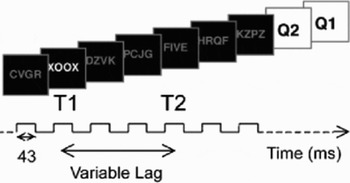
The interesting result was that subjects tended to indicate that target 2 was either maximally visible or maximally invisible: intermediate values were rarely chosen. This fact suggests a competition among coalitions of neurons in the front of the head with winners and losers and little in between. Usually, the coalition representing the number word either wins, in which case the subject reports maximum visibility, or it loses, in which case subjects report no second target and there is no cognitive access to it at all.
I have guessed (Block Reference Block2005) that there can be coalitions in the back of the head which lose by a small amount and thus do not trigger winning coalitions in the front, but which are nonetheless almost as strong as the back of the head coalitions that do trigger global broadcasting in the front. The subject sees many things, but only some of those things are attended to the extent that they trigger global broadcasting. A recent study (Kouider et al. Reference Kouider, Dehaene, Jobert and Le Bihan2007) suggests that indeed there are strong representations in the back of the head that do not benefit from attention and so do not trigger frontal activations. (See also Tse et al. Reference Tse, Martinez-Conde, Schlegel and Macknik2005 for convergent results.)
Kouider et al. contrasted a subliminal and supraliminal presentation of a stimulus, a lower-case word. In the subliminal case, the stimulus was preceded and succeeded by masks, which have the effect of decreasing the visibility of the stimulus (and, not incidentally, decreasing recurrent neural activation – see Supèr et al. Reference Supèr, Spekreijse and Lamme2001b). In the supraliminal case, the masks closest to the stimulus were omitted. The supraliminal but not the subliminal stimulus could be identified by the subjects when given a forced choice. In the key manipulation, the subject was told to look for an upper-case word, ignoring everything else. In those conditions of distraction, subjects claimed that they were aware of the lower-case stimuli in the supraliminal case but that they could hardly identify them because they were busy performing the distracting task on the upper-case stimulus (which came later). The difference between the supraliminal and subliminal stimuli in conditions of distraction was almost entirely in the back of the head (in occipito-temporal areas). Supraliminal stimuli activated visual areas in the back of the head strongly (subliminal stimuli did not) but did not activate frontal coalitions.Footnote 11 The strong activations in the back of the head did, however, modulate frontal activity.
Kouider et al. (Reference Kouider, Dehaene, Jobert and Le Bihan2007) and Dehaene et al. (Reference Dehaene, Changeux, Naccache, Sackur and Sergant2006) acknowledge that there are highly activated losing coalitions in the back of the head. They argue that such losing coalitions are the neural basis of “preconscious” states – because they cannot be reported. But the claim that they are not conscious on the sole ground of unreportability simply assumes metaphysical correlationism. A better way of proceeding would be to ask whether a phenomenal state might be present even when it loses out in the competition to trigger a winning frontal coalition.
Here is the argument that the second half of this article has been building up to: If we assume that the strong but still losing coalitions in the back of the head are the neural basis of phenomenal states (so long as they involve recurrent activity), then we have a neural mechanism which explains why phenomenology has a higher capacity than the global workspace. If, on the contrary, we assume that the neural basis of phenomenology includes workspace activation, then we do not have such a mechanism. That gives us reason to make the former assumption. If we make the former assumption – that workspace activation is not part of the neural basis of phenomenology – we have a mesh between the psychological result that phenomenology overflows cognitive accessibility and the neurological result that perceptual representations that do not benefit from attention can nonetheless be almost as strong (and probably recurrent) as perceptual representations that do benefit from attention. The psychological argument from overflow showed that the machinery of phenomenology is at least to some extent different from that of cognitive accessibility, since something not in cognitive accessibility has to account for the greater capacity of phenomenology. What the mesh argument adds is that the machinery of phenomenology does not include the machinery of cognitive accessibility.
Of course, my conclusion that the neural machinery of cognitive access is not partially constitutive of phenomenology leaves room for causal influence in both directions. And it may be that top-down causal influence is almost always involved in making the phenomenal activations strong enough. But that is compatible with the possibility of the relevant amplification happening another way, for example, by recurrent loops confined to the back of the head or even by stimulation by electrodes in the brain, and that is enough to show that top-down amplification is not constitutively necessary.
My first conclusion then is that the overlap of the neural machinery of cognitive access and the neural machinery of phenomenology can be empirically investigated. Second, there is evidence that the latter does not include the former. These points are sufficient to refute the correlationism of the sort advocated by Dehaene and his colleagues and to answer the question posed at the beginning of this article.
Further, this theoretical picture leads to predictions. One prediction is that in the Sperling, Landman et al., and Sligte et al. experiments the representations of the unaccessed items will prove to involve recurrent loops. Another upshot is that if the activations of the fusiform face area mentioned earlier in the patient G.K. turn out to be recurrent activations, we would have evidence for phenomenal experience that the subject not only does not know about, but in these circumstances cannot know about. The fact that the fusiform face activations produced in G.K. by the faces he says he doesn't see are almost as strong as the activations corresponding to faces he does see, suggests that top-down amplification is not necessary to achieve strong activations.
The mesh argument suggests that workspace activation is not a constitutive part of phenomenology. And given that actual workspace activation is not a constitutive part of phenomenology, it is hard to see how anyone could argue that potential workspace activation is a constitutive part. Further, as noted a few paragraphs back, it is doubtful that potential workspace activation is even causally necessary to phenomenology.
15. Conclusion
If we want to find out about the phenomenological status of representations inside a Fodorian module, we should find the neural basis of phenomenology in clear cases and apply it to neural realizers inside Fodorian modules. But that requires already having decided whether the machinery of access should be included in the neural kinds in clear cases, so it seems that the inquiry leads in a circle. This target article has been about breaking out of that circle. The abstract idea of the solution is that all the questions have to be answered simultaneously, tentative answers to some informing answers to others. The key empirical move in this article has been to give meshing answers to psychological and neural considerations about overflow.
ACKNOWLEDGMENTS
Earlier versions of this paper were presented at the following venues: the 2005 NYU Colloquium in Mind and Language; Georgia State University; MIT; Harvard Medical School; Dan Pollen's course at Harvard College; Dartmouth College; NYU Medical Center; Aarhus University, Denmark; Stockholm University, Sweden; Göteborg University, Sweden; Umeå University, Sweden; Indiana University, Brown University; the Pacific APA 2006; University of Western Ontario; Cal State, LA; UCLA; the Association for the Scientific Study of Consciousness; the Institut Jean Nicod; the University of Toronto; and at Katalin Balog's class at Yale. I am grateful to Thomas Nagel for his role as chief inquisitor when this material was defended at the NYU Mind and Language Colloquium and for some of his suggestions; and I am grateful to Katalin Balog, Alex Byrne, Tyler Burge, Susan Carey, Max Coltheart, Leonard Katz, Sean Kelly, Victor Lamme, Mohan Matthen, Alva Noë, Dan Pollen, David Rosenthal and Susanna Siegel for comments on a previous draft.