Introduction: Challenging Instrumental Reduction
This Element addresses the overarching theme of the Elements in Health Humanities series in exploring ‘the relationship between the humanities and health practices, theories of health, and experiences of healthcare’ with an emphasis upon medical education and practice (primarily aimed at treating the body) and psychotherapeutic education and practice (primarily aimed at treating the mind linked to emotions). It is noted that these disparate cultures are connected by two formal bridges: psychiatry bridging from medicine to psychotherapy and clinical psychology bridging from psychotherapy to medicine. The Element proceeds from a recognition that both medical and psychotherapeutic practices have transformed in recent years from vocations (tied to identity production) to professions (tied to a spectrum of competences), where education in both fields has degraded to functional training grounded in instrumental values. Here, information trumps knowledge and meaning. Such instrumental values are bolstered by economic values, where patients and clients have become customers in a competitive market economy.
As a consequence of this perceived cultural and institutional slippage, what is currently sidelined in both medical and psychotherapy education is a range of values concerns other than the instrumental and economic, notably the historical (for context), ethical (moral practice), aesthetic (a practice of qualities), political (addressing power structures, including patterns of resistance to authority) and transcendental (embracing meaning and existential concerns). How, then, to challenge and reverse this slide into a dominant instrumentalism where both medicine (including medical education) and psychotherapy (including its associated pedagogies) have become impoverished, indeed ill, displaying symptoms of lack? Here, a supplement is needed to reinvigorate medicine and psychotherapy and to stop the rot that further embraces the linear, signalling absence of the metaphoric and complex. A restorative pedagogical treatment requires a focus on the art and humanity of the biomedical and human sciences, supplied through a third medium that is rich in complexity – embracing imagination, risk and metaphor invention. That medium is lyric poetry or the wider poetic imagination.
When the poet John Berryman (1914–72) insists do you ‘wonder what Life’s for? – Wonder what life’s for?’, his answer packs a punch with a necessary reflective pause: ‘Why, just for living./ – Well, I mean more maybe’ (McCrae, Reference McCrae2025). In parallel, the paediatrician and poet William Carlos Williams (Reference Williams1955) suggests, ‘It is difficult/ to get the news from poems/ yet men die miserably every day/ for lack/ of what is found there.’ Here, we might see poetry as not simply enhancing but necessary. I return to Berryman in Sections 4 and 5 as a case study illustrating the argument presented here – that both functional or instrumental medicine and psychotherapy are professions lived in relative poverty, even misery, for lack of what metaphor and complexity can bring. But let us begin with the poet to whom both Berryman and Williams must pay homage as co-founder of modern lyrical verse.
Samuel Taylor Coleridge first made a strong link with the (English) Somerset countryside around the village of Nether Stowey on a walking tour in 1794. He made the acquaintance of a local and educated tanner, Tom Poole, who later helped the poet, his wife Sara and their young son Hartley, to find a cottage to rent. Poole introduced Coleridge to local and travelling tradespeople. The poet listened keenly not just to their broad accents that gave flavour to speech, but also to local idiosyncratic or slang terms. Coleridge noted that in everyday speech, or the vernacular, accent and rhythm were central to the quality of communication. As well as fieldworkers, Coleridge (later regularly walking with William and Dorothy Wordsworth) would have met shepherds, saddlers, wheelwrights, knife-grinders, glovers and general pedlars hawking a variety of goods (Nicolson, Reference Nicolson2019). These people were close to the earth and the seasons, where their language employed embodied metaphors such as the ‘secret ministry of frost’ (crystallising frost seen as an invisible hand at work in nature) (Berkman, Reference Berkman2020). While many of the labourers in the district were illiterate, they attended church and were familiar with biblical imagery and metaphor. In his poem ‘Frost at Midnight’, Coleridge compares the appearance of frost in nature (as a realisation of matter out of air) with the imagination’s creation of a poem, as something beautiful and ordered, crystallising out from an apparently blank canvas of the mind, where ‘The Frost performs its secret ministry’. The poet is thus borrowing the local saying.
Coleridge was to travel to Germany with his family, moving back to Somerset in January 1797, when Poole helped the family to find a rental property. William Wordsworth and his sister Dorothy visited the Coleridge family home in July 1798 and were so taken with the area that they soon rented a property only three miles away. And so began the daily walking routines for Coleridge, Wordsworth and Dorothy, during which time the poets crafted a new style of poetic diction that overhauled the taut formality of Classical poetry to introduce a looser but rhythmic style imitating everyday speech that was to become known as English Romanticism (Nicolson, Reference Nicolson2019). While Wordsworth was wholly committed to developing a poetic style that embraced the vernacular in the description of landscape and feeling, Coleridge was interested in developing an imaginative, sometimes fantastical, verse grounded in the vernacular but committed to a rule: that poetry is expressly an art form that raises (or rather deepens) the value of language through metrical style and considered choice of words. He described this as wrestling with the supernatural through natural referents. For Coleridge poetic diction was hard won – a vocation – requiring study such as eclectic and close reading, voluminous note-taking and constant drafting and re-drafting of texts (Lowes, Reference Lowes1927/1955). But the primary text is nature itself (the natural world) and the secondary, the human imagination (and observation of humans in their natural habitats). In this sense, Coleridge was a natural scientist.
What has this to do with medicine and psychotherapy? Coleridge, a hypochondriac, coined the term ‘psychosomatic’ to link body, feelings and mind. His poetry meanwhile consistently interrogated the idea that illness expressed a failing to tune the body to nature’s rhythms and cycles (as a mirror of the harmony of the cosmos as a whole). Arduous long-distance walks, including note-taking and followed by poetic composition, would temporarily restore such harmony. His hypochondria meanwhile was the ongoing symptom of a perceived failure to reach perfection in microcosmic tuning to the macrocosm (as a perfect ‘imagination’ rather than an imperfect ‘fancy’). The agony that this caused was soothed by opium, but only temporarily. The search for such harmonic mirroring was the engine for his verse (Holmes, Reference Holmes2005).
Coleridge’s ‘imagination’ is the poetic imagination, his ‘fancy’ literalism – or the lack of innovative metaphor. Where I argue that medicine and psychotherapy (and their pedagogic engines) have lost value through subscription to a dominant instrumentalism, I am also describing a loss of poetic imagination that can otherwise vivify bioscience and human science. Coleridge (Reference Coleridge1798/2015) captures such a loss of imaginative flair in ‘The Rime of the Ancient Mariner’ where the old sailor telling the tale recounts killing the albatross, leading to the tragic becalming of the ship: ‘I had killed the bird/ That made the breeze to blow.’ Again, the albatross around the neck of reductive medicine and psychotherapy is the loss of the poetic imagination.
Medicine in particular – so weighed down by a desire for grounding in reductive science – may be considered to be a kind of poetry held on a leash. Kathryn Montgomery Hunter (Reference Montgomery Hunter1993), who can be seen as the originator of ‘narrative-based medicine’, describes medicine not as a science per se but rather a ‘science-using’ praxis that embraces traditional aspects of arts and humanities such as a narrative imagination (patients tell stories, and doctors respond with their own narratives of interpretation – as diagnostic gestures based in bioscience but shaped by a literary sensibility and evident humanity). The poetry of medicine is embodied in the process of clinical reasoning that – as medical students become doctors and doctors become seasoned in specialties – engages an imagination based in pattern recognition (Bleakley, Reference Bleakley2020a). Patients present as symptoms, while symptoms present as patterns. What this does is reduce patients to abstractions even as these, in turn, are embodied as patterns (a raised skin lesion that is asymmetrical) and aphorisms (‘when you hear hoofbeats, don’t think zebras’ – or, when in doubt, go for the most obvious diagnosis).
The cognitive information that gives meaning to a patient’s presenting symptoms is a biomedical fact held in the doctor’s memory and refreshed through keeping apace of the clinical literature. This is persistently reduced to the literal through an educated attention to medical terms – for example, ‘haematemesis’ is the reductive technical term describing the action of ‘coughing up blood’. This phrase is mimetic – imitating the action itself. It is a striking embodied metaphor and distinctively poetic. It embraces what the psychoanalyst and writer Julia Kristeva (Reference Kristeva1982) terms the ‘abject’ – that which cries out to be banned, limited or exorcised as it transgresses the boundary of decency or the tolerable. Thus, while medicine is anchored in the safe harbour of the instrumental and technical – the facts of biomedical science mustered to fully explain a patient’s clinical symptoms (‘haematemesis’) – it also meets that patient’s world of the vernacular and common expression (‘vomiting blood’) that is, importantly, saturated with affect and essentially a foreign country (as abject). Vomiting blood is both a physical and emotive act, engaging surprise, anxiety and fear. Thus, medicine as care rather than cure must leave the safe harbour of instrumental science to engage the patient’s affective and apprehensive worlds. Here, concerns move from the instrumental somatic to the emotive, necessarily engaging a range of values beyond the reductive material. These include the aesthetic (what, precisely, is the sensory nature of the cough – its sound as timbre and depth, the sensations it produces in the lungs and larynx, for example?).
At this juncture, somatic medicine meets the mental and emotional worlds that engage psychotherapy (where psychiatry has a foot in both soma and psyche). As bodily based medicine and mind- and feelings-based psychotherapy (and clinical psychology) engage each other’s technical and professional worlds, we might see a common root in Coleridge’s theory of poetry. For Coleridge, poetry is both a fine art and a craft embedded in deep knowledge of language, specifically use of metaphor and poetic diction or use of a range of techniques to craft a finished product (rhythm, alliteration, consonance and so forth). In turn, such diction (an expression of the poetic imagination) embraces body, mind and emotions in an expression that, as noted, Coleridge (first coining the term) calls ‘psychosomatic’. Here, maladies (recalling again that Coleridge was a hypochondriac, partly as a side effect of opium dependency withdrawal – an irony as Coleridge’s opium habit developed as an attempt to relieve his supposed aches and pains) have simultaneous mental and physical expressions and causations.
Other Coleridgean neologisms constitute embodied metaphors that pre-date modern medical and psychological usage, grounding Coleridge’s psychosomatic outlook (in particular, the use of ‘dynamic’ to describe shifting psychological states). Freud is often seen as the founder of psychodynamics but his use of the conjoined term ‘psycho-dynamic’ (borrowed from his tutor during his first year as a medical student, the physician and physiologist Ernst Wilhelm von Brücke, who first used the term in 1874) shows an instrumental (curative) rather than poetic (agitative) application. Other Coleridge neologisms sound eerily contemporary, such as ‘actualise’ (to make something a reality). Psychologists and therapists Carl Rogers and Abraham Maslow – guiding lights for the 1960s ‘human potential’ movement – later popularised ‘actualising’ as the drive to fulfil potential. Indeed, Maslow adopted the generic term ‘self-actualising’ to describe the purpose of psychotherapy as ‘growth work’.
Coleridge also first described the personality trait of ‘narcissism’. This, nearly two centuries before Christopher Lasch’s (Reference Lasch1979) influential book on the cult of the individual The Culture of Narcissism and psychiatry’s interest in pathological narcissism as a destructive trait. Coleridge further contrasted narcissism with the neologism ‘selfless’, or altruistic. Further neologisms included androgyny as ‘bisexuality’, fantasy life as a ‘dreamworld’, information as ‘factual’ or ‘relative’ (prefiguring science’s general uses of the terms), ‘soulmate’ as a lifelong partner or friend, ‘pessimism’ as a personality trait and a series of terms now widely used in medicine and science such as ‘impact’ as a metaphor referring to an impression (e.g. a striking memory). The neologism ‘intensify’ advertises Coleridge’s poetic sensibility, in which he coined this word rather than using the established ‘to render intense’ where the latter did not fit the rhythm of the line of poetry he was writing. More, Coleridge noted that the poetic imagination requires a ‘willing suspension of disbelief’, another neologism, rather than a more logico-scientific scepticism.
What we can note from Coleridge’s fertile imagination and linguistic dexterity is the impulse to reject the reductive instrumental for a wider range of values concerns grounded in the historical (Coleridge was an avid reader), aesthetics (the desire for form or beauty above all, and the reflex to always place appreciation before explanation), ethics (the will to lead a just and moral life and to create a just community), politics (a will to democratic habits) and the transcendental (an interest in existential concerns and interrogations of meaning). Coleridge’s wider social interests and conscience should be taken into account: for example, his early support for the French Revolution and the (unfulfilled) desire to create a utopian community, or Pantisocracy (‘rule by all’ – another of Coleridge’s neologisms), in North America. The poet Paul Muldoon (Reference Muldoon1990), in the book-length poem Madoc: A Mystery, shows how poetry can amplify history as an ‘as if’. Muldoon imagines that Coleridge and his friend Robert Southey had indeed realised their aborted plan to set up a Pantisocracy or utopian, democratic community on the banks of the Susquehanna – a place chosen entirely for the poetic metricality of its name.
In short, Coleridge had already created, prior to the Freudian revolution, a pocket vocabulary and a set of habits that could be described as psychotherapeutic. But, again, his medium for change – personal and political – was poetry. Poetry was the transcendental medium that engaged immanent personal or psychological matters as well as social and community structures in a desire to live well and close to nature. This, within the wider revolution of science and technology (particularly chemistry, that became an obsession for Coleridge after meeting and forging a close friendship with the scientist Humphry Davy) and aggressive urbanisation. But the ‘As Above: So Below’ ideal that drove the poet to recreate cosmic harmony at a local (social) democratic level and personal level of balanced health was constantly challenged. For example, Coleridge agonised about bringing up his young son Hartley in a rural environment, potentially depriving him of culture while reaping the benefits of exposure to nature and local community (Berkman, Reference Berkman2020). Ironically, Hartley, educated at Oxford and a promising poet, was to later become an alcoholic, mirroring his father’s addictive personality.
Coleridge then embodied the promise of fruitful dialogue between medicine and psychology/psychotherapy, modelling how this dialogue might be magnified through poetry and the poetic imagination. Yet, today, medical students and junior practitioners learn very little about psychotherapeutic exchanges beyond instrumentalised and formulaic ‘clinical-communication skills’, while clinical psychology and psychotherapy students and trainees learn little about the aesthetics of basic biomedical science (anatomy, physiology, biochemistry and pharmaceutics) (Bleakley, Reference Bleakley2020b). Neither, of course, are exposed to poetry (in exceptional cases, medical humanities input may touch on poetry) (Bleakley & Neilson, Reference 67Bleakley and Neilson2022, Reference Bleakley and Neilson2024). This is a story of missed pedagogical opportunities incorporating transcendental values (overriding explanatory positions or ideals that facilitate exchange between disciplines, for example, trans-, circum-, or meta-disciplinary approaches).
Two revolutions have resulted in the formal incorporation of what are typically termed ‘communication skills’ (both one-to-one and in team settings) into undergraduate and postgraduate medical and surgical education. First, since the 1950s, there has been the gradual adoption of a ‘patient-centred’ medicine based on the psychologist Carl Rogers’ ‘person-centred’ approaches to counselling. This has resulted in the formal adoption of ‘communication skills’ into clinical skills in undergraduate medicine curricula (in the UK since the 1990s). Second, the global adoption of non-hierarchical team practices across surgical teams in particular since 2009. Yet such necessary aspects of human relations, which one would think are core to clinical work, are reduced to functions in medical education. Ironically, where one of the growing issues in medicine is burnout due to lack of personal care and dysfunctional teamwork, a depth psychology approach to communication is, again, glaringly absent from undergraduate curricula.
Surely, it is a basic concern to be able to read the non-verbal and semiotic communications of patients and colleagues in teams; to engage the dynamics of transference and resistance in reading clinical exchanges; and to draw on understanding of ego defence mechanisms such as resistance, projection and displacement as first described by Freud? Importantly, these communication dynamics are qualities to be appreciated before they are quantities to be measured. Their outcomes do not appear on a patient’s charts or notes from multidisciplinary team discussions, but in narrative exchanges (where the persistence of metaphor bears clinical importance as a bearer of both diagnostic and curative worth) (Bleakley, Reference Bleakley2017).
Not only are such capabilities largely ignored or reduced in medical education, but such wilful neglect infects psychiatry itself. For example, Joel Paris (Reference Paris2017) asks, ‘Is Psychoanalysis Still Relevant to Psychiatry?’ Paris notes that psychoanalysis has gained little empirical support in terms of efficacy of outcomes (treatment of neuroses), while a focus remains on tracing possible aetiology of symptoms, such as linking personality disorders to dysfunctional childhood attachment, including parental emotional abuse (Erkokera et al., Reference Erkoreka, Zamalloa and Rodriguez2022). Paris notes another trend in contemporary reflections on the purposes of psychoanalysis, such as grounding clinical practice in philosophies that do not crave empirical evidence for efficacy. We can extend this by noting that biomedicine tends to be reductive, whereas psychoanalysis is expressive, each grounded not only on differing epistemologies but also differing axiologies (value systems).
Biomedicine in psychiatry – advertised in the development of pharmaceuticals to treat psychosomatic disorders and the reduction of symptoms to neural explanations and explorations – seeks rational explanations, whereas psychoanalysis treats rational explanations or rationalisations as outward symptoms of deeper, as yet unresolved, issues. Thus, the theoretical ground differs across diagnoses: where biomedically oriented approaches see a personality disorder perhaps grounded in a synaptic dysfunction, the psychoanalyst might see a consequence of family dysfunction. Hence, axiologies differ across the two approaches, calling for values clarification. As a consequence, applying a research methodology based on a logical scientific model searching for fact-as-truth will not fit the psychoanalytic paradigm that is narrative-based (a story in time) or poetic (both discrete and connected images in space). Indeed, through a literary imagination we note that synaptic dysfunction and family dysfunction are both metaphors. The neuroscientist Santiago Ramón y Cajal called neurons ‘mysterious butterflies of the human soul’, while in Knots the psychiatrist Ronald Laing (Reference Laing1970) expresses familial (mis)communications as poetic conundrums:
But, to some more literal-minded psychiatrists, Laing’s knotty meditations are irritating – what we need in psychiatry and psychotherapy are practical interventions producing tangible, measurable results. Frustrated by the apparent fuzziness and interminable length of treatment arising from psychodynamic approaches, in 1976 the American psychiatrist Aaron Beck suggested an alternative to long-term psychodynamic therapies and behavioural approaches: short-term cognitive-behavioural therapy (hereafter ‘CBT’). Clients would be set up with a clear programme with stated goals and methods to achieve those goals. In the ascendance of CBT as a dominant paradigm in psychotherapy, uneasily fitting a reductive biomedical mould, we find rationalisations grounded in a short-term measure leading to measurable positive outcomes. This is a solution-focused or problem-solving, rather than a problematising, approach. As input is short-term and results are measurable, the economists managing health systems are attracted by approaches such as CBT. But, the outcomes themselves may suffer from ‘short-termism’, fitting the epistemological and axiological strictures already set in the method. As noted, what is disguised here is that CBT attracts economic currency – it is promoted as cost-effective, cheaper than longer-term approaches.
In contrast, psychodynamic approaches confound measurable outcome studies with their narrative aim of utilising, rather than erasing, symptoms; while adopting longer term ‘fuzzy’ goals of resolving the transference as the termination of treatment rather than simply the easing of presenting symptoms. More, the anti-psychiatry movement of the 1960s and 1970s that has morphed into celebratory support for neurodivergence (as ‘mad studies’) brazenly rejects major aims of conventional treatments (Bleakley & Neilson, Reference Bleakley and Neilson2024). Psychotherapies may be lifelong, as they are educational and supportive rather than curative. Freud (Reference Freud1937) had already pondered on an ‘interminable’ analysis as educational, where a termination of analysis is marked by the resolution of the transference and/or the management of symptoms. He famously noted that the best outcome of analysis may be to transform ‘hysterical misery’ into ‘common unhappiness’ as acceptance of the human condition’s embrace of existential angst (Freud & Breuer, Reference Freud and Breuer1895/2004).
A brief review of the family tree of CBT will serve to set a context. As the hyphenated descriptor suggests, CBT has two historical roots. First, the behavioural: the Russian neurologist and physiologist Ivan Pavlov (1849–1936), experimenting on the digestive system of dogs, noted that, of course, dogs salivate when presented with food. However, if you paired another stimulus regularly with presentation of food and then removed the food and only presented the second stimulus (such as a bell or other sound), the dogs would salivate with presentation of that stimulus in the absence of the primary stimulus of food. This was to be called ‘classical conditioning’. The American psychologist Burrhus Frederic Skinner (1904–90) progressed Pavlov’s experiments where rats could be conditioned into unnatural behaviours if they were rewarded immediately with food (‘reinforcement’), where reward was withheld for unwanted behaviours that would extinguish. Patterns of behaviour could then be shaped while other patterns would fade. Skinner thus shaped behaviour not through anticipation (Pavlov’s approach) but reward. Skinner’s psychology has no interest in unobservable cognition (where functioning is guesswork or selective thinking-out-loud), only in shaping patterns of observable behaviour. Crudely, if you want to disinhibit an alcoholic habit, you never reward drinking itself but offer reinforcement for positive behaviours closely associated with drinking.
Cognitive psychologists spot a problem here – that nothing is being done about thinking-about-drinking (such as anticipation). While thinking cannot be directly observed, it cannot be discounted as self-monitoring can report on cognitive events. Surely therapy should attend not just to the behaviour but to the associated cognitive gratification? The psychiatrist Aaron Beck (1920–2021) suggested that thoughts could be treated as behaviours and could be shaped by interventions. Symptoms could be seen as consequences of irrational, maladaptive, bad or ineffective thoughts, so therapy should aim at reshaping chronic, maladaptive thought patterns. The idea is purely instrumental and fits readily with behaviourism. While recognising that a person suffering from debilitating obsessions wants to be relieved of the suffering, simply eradicating the symptom is a purely functional approach to the issue. Psychoanalysts object to such instrumentalism, where the symptom may be serving a purpose that then remains unknown or may be grounded in patterns of distress associated with developmental issues such as childhood trauma.
Paul Gilbert (Reference Gilbert2009) notes that CBT has developed greater complexity and sophistication than the brief sketch above suggests:
Today CBT uses Socratic dialogues, guided discovery, behavioural experiments, exposures to the feared and avoided, psycho-education and teaching the skills of self-monitoring, self-reflection and self-change. CBT is not about correcting faulty thinking as is often simplistically suggested in the press; rather it is about helping people understand how they have become trapped by their attention, reasoning and safety-seeking strategies and how to find ways to develop out of those traps. The focus is on helping people find and distinguish helpful ways of thinking and behaving – not just accuracy. Thinking one will die if one falls whilst trying to escape from the top floor of a burning house might be ‘true’, but is not a helpful focus.
So, there are sophistications such as encouraging ‘helpful’ rather than congruent cognitions. Yet, it remains the case that the therapy is bottom-line linear rather than complex. And it is missing a key component of human experience – accounting for emotion, affect or feeling. Let us switch focus from psychology to linguistics to clarify this. The CBT approach relies on linear metonymy rather than the more complex trope of metaphor. The former relates to chains of associations of words or ideas where each link in the chain fails to be developed in its own right. In other words, there is a potentially open-ended linkage of signifiers without signification (e.g. blue-sky-cloud-rain-flood-wreckage). Each link substitutes for its partner, or the whole is in the part. This is how CBT works, by substitution of one set of behaviours considered ‘healthy’ for another set considered as ‘symptoms’. Where metonymy is an important linguistic device, it is limited by its linearity or is unimaginative. It is also devoid of emotional body, presenting as an engineering device or interminable wiring.
Metaphor by contrast is complex, embodied, non-linear and innovative by definition. While metaphors can be ‘tired’ or overused (the body as machine, medicine as war), metaphor invention is the core to visual, literary, musical and body-performative arts and humanities and, importantly, to innovative science and technology. In metaphor, a new and more complex meaning occurs. Where we might say ‘The UK National Health Service is teetering on the brink of collapse’, visual images may immediately spring up of a cliffside collapsing or a sinkhole opening up. Affect accompanies this as the image is emotive and sensory. If you are committed to the NHS as an institution or work in it, your level of affect increases. Poetry is a prime medium for metaphor invention (and not just the recycling of established metaphors). Medicine and psychotherapy are hotbeds of metaphor use (‘a rasping cough’, ‘the black dog’ of depression) and of metaphor invention (the poet Samuel Taylor Coleridge’s coining of ‘psychosomatic’ discussed above, or the contemporary ‘neurodivergent’).
While I have made a clear distinction between reductive and instrumental psychotherapeutic approaches based in linearity and metonymy (using CBT as the arch-example) and complex approaches of a psychodynamic persuasion based in metaphor use and invention, can one morph into the other? The transcultural depth psychiatrist Laurence Kirmayer (Reference Kirmayer, Bleakley and Neilson2024) notes that ‘Contemporary work in conceptual metaphor theory and 4E (embodied, embedded, enacted, and extended) cognitive science’ contributes greatly to understanding and treating mental and emotional distress. For Kirmayer, what is needed in such work are new ways to understand ‘illness experience and cultural idioms of distress’, before moving too quickly to supposed treatments. Kirmayer concludes that practitioners must consider ‘the deliberate use of metaphor and poiesis in clinical contexts to foster transformative processes’, because patients or clients present as embodied metaphors. Modern psychology describes cognitive territories through such embodied metaphors (Lakoff & Johnson, Reference Lakoff and Johnson1980) – including ‘intuition’ and ‘metacognition’ (Quirk, Reference Quirk2006), ‘tacit knowing’ (Polanyi, Reference Polanyi1966) and the ‘cognitive unconscious’ (Reber & Allen, Reference Reber and Allen2022) that by-pass metaphors of ‘depth’ for something that is more ‘out of reach’. Ways of knowing through tacit processes, such as linguistic analogy (Hofstadter & Sander, Reference Hofstadter and Sander2013), have been described as ‘essences’ (again rather than ‘depths’), as opposed to ‘surfaces’ – the ‘essence’ metaphor affording both primacy and body. This, again, follows the lead of Coleridge’s (Reference Coleridge1817/1983) distinction between imagination and fancy.
Hofstadter and Sander (Reference Hofstadter and Sander2013) call analogical thinking, their preferred description of metaphor use, as ‘the fuel and fire of thinking’ (and not ‘imagining’). While contemporary models of cognition return us to Freud by insisting that cognition is both deep and embodied (Varela et al., Reference Varela, Thompson and Rosch2016), they also introduce a horizontal axis to the traditional vertical metaphors of embodied depth (soul) and disembodied (angelic) aspirational thinking (spirit). These horizontally extended environmental models posit thinking as ‘situated’ in both social, artefactual and environmental contexts and niches, or local habitats (umwelten) (von Uexküll, Reference Von Uexküll1934/2010). The ‘unconscious’ is then transferred from a ‘depth’ metaphor to one of partly unknowable extension, such as a horizon. The introduction of such a continuous horizontal metaphor also challenges the modernist tradition of oppositionalist thinking (low/high, soul/spirit) that has permeated philosophical and psychological models since Descartes dogmatically split body from mind and that persists in the polarising of cognitive-behavioural and psychodynamic approaches.
The psychoanalyst Jacques Lacan (Reference Lacan1993) follows this horizon modelling in suggesting that metonymic chains or associations can morph into metaphor – if only temporarily – at a ‘quilting point’ (point de capiton). Here, the run of metonymic associations (as endless signifiers without a signified) is momentarily anchored as a signifier is linked to a signified (or meaning is made through metaphor). This is a standard technique in poetic diction and recurs through drafting and re-drafting. The analogy is with an upholstery button that holds layers of fabric together, preventing slippage. Lacan saw this buttoning down as a moment of coherent thought amongst chaotic slippage. The English metaphor for this is ‘pinning’ or ‘nailing’ something down. The social equivalent is what Lacan calls the ‘Name-of-the-Father’ as Law, logos, and convention, or the habitual and socialised. This halts or ruptures the potentially endless unfolding of a metonymic chain that we might also see as the failure of CBT to address longer term and deeper psychosomatic ills. Such a quilting point is also the clinical or psychotherapeutic consultation.
We can apply a feminist psychoanalytic reading – as a critique – to Lacan’s proposal. The ‘Name-of-the-Father’ is Lacan’s recognition of the continued hegemony of the patriarchy or logos. We see this in long-standing grand metaphors in medicine such as ‘the body as machine’ (a hangover from Vesalius) and ‘medicine as war’ (first coined by the sixteenth- to seventeenth-century poet and cleric John Donne) (Bleakley, Reference Bleakley2017). As noted, the quilting point not only acts to break the metonymic chain but also transforms the chain into a metaphor (albeit temporarily) – for example, breaking the linkages that form the dominant patriarchal chain in medicine (medicine as war, doctor as hero or dragon slayer and illness as dragon) to transform into a feminised practice (where language is no longer prescriptive and indicative but is facilitative and offered in the subjunctive mood as suggestions and open-ended questions). The solidity of the chain transforms into the liquidity of the feminised metaphor ‘medicine as care’. Quilting itself is traditionally associated with women, a trope regularly advertised by women artists. Such a quilting point shapes subjectivity, transforming, for example, doctor as independent hero to doctor as democratic teamworker. ‘Collaboration’ taken here as a feminine signified. The chain of associations has elusive meaning as it slips from one sign to another, while the introduction of metaphor, in breaking the chain, introduces a critical meaning or signification, where information is transformed into knowledge or gains meaning. But, in the feminist reading, the punctuation is a liquidity (or a poetic device). In other words, endless slippage is replaced by a paradoxical liquid traction. Here, following Lacan, a sense of subjectivity emerges, but this is not necessarily a socialised subjectivity but a protesting or resistant one bent on innovation.
This emergent fluidity chimes with the work of the feminist literary and cultural critic Jacqueline Rose (Reference Rose1992). Rose sees adulthood as a potentially repressive force on children, where ‘children’s fiction’ supposedly written for and about children is in danger of projecting adult desires onto the condition of childhood. Historians of childhood point out that in the Western European outlook the ‘child’ is a modern invention; moreover, phases of development such as the ‘juvenile’ or ‘adolescent’ are very recent phenomena. Having ‘invented’ childhood (Ariès, Reference Ariès1965) as a metaphor, after Freud we proceed to analyse it as concrete, but we also idealise childhood and project this back onto children through adult views of the child. This distorts the reality of the child’s experience (often idealising or romanticising childhood). Lacan’s key idea of psychological development is that, as adults, we are always in a condition of misidentifying subjectivity where this is established during the ‘mirror stage’ of childhood, where a child first sees an image of herself in a mirror and is thereafter confused as to which is a ‘real’ identity – the felt body or the mirror image. This confusion only grows as the child is socialised and identity is developed and confirmed in the mirror of the Other – such as ethnic, gendered or work-based identifications. These dynamics are important for psychotherapy, but also critical to medicine, where illness can deeply affect and disrupt identity. We will see – particularly from Sections 4 and 5 – that contemporary poetry, such as that of John Berryman, is a primary medium for addressing the complexities of identity in relation to illness (in Berryman’s case, chronic depression and alcohol addiction).
To return to maladapted or unstable identities in therapy, short-term, instrumental therapeutic approaches such as CBT, behavioural aversion therapies and ‘one-off’ humanistic and transpersonal immersion therapies such as Erhard Seminars Training (EST) and guided psychedelic work in New Age shamanism are manifestly critiqued by the psychoanalytic tradition that, for example, embraces the feminist revisionism introduced above. In principle, such ‘therapies’ are in fact educational values relativisation or radical acculturation. Following some tenets of Lacanian psychoanalysis, Julia Kristeva (Reference Kristeva1984), Luce Irigaray (Reference Irigaray1985) and Hélène Cixous (Reference Cixous1992), for example, revise Freud in two major ways: first, through challenging the hegemony of masculinist language and second, through de-emphasising the role of spoken and written language for the pre-verbal and semiotic. Thus, the phallic signifier as ego-strengthening psychology (the Big ‘I’) is dethroned for collaboration and collectivism, while the Oedipal dilemma (killing the Father, only to replace him with another patriarch who speaks logic) is by-passed for celebration of eros (generalised affect) rather than logos (a calculating mind) in a return to a focus on the pre-verbal or semiotic.
Such a lower-case ‘name-of-the-mother’ approach offers a sweeping and comprehensive critique of cultural hegemonies exposing the paucity of ideas shaping therapies such as CBT. The latter are masculinist and logos-based, rather than feminist and eros-based. Such critique has a practical face. Widespread violence against women and minorities in particular spills over into violence and prejudice against the Other as immigrant. These are major causes of distress calling for therapeutic intervention. Functional approaches such as CBT are not equipped to deal with these bigger cultural issues. Vulnerable, young immigrants from North African countries in particular find themselves to be the subject of prejudicial attack as they attempt to start new lives in Paris. Julia Kristeva is part of a group of psychiatrists, psychoanalysts, psychotherapists and social workers dealing with young immigrants as they battle to acquire a new sense of identity as a basis for a more settled life (personal communication). As feminism recognises – in the dominance of the patriarchy – the making of women as strangers to themselves (note Freud’s misinformed rejection of the clitoral orgasm in favour of a hypothetical ‘vaginal orgasm’, discussed later), so feminists in particular embrace the experiences of immigrants searching for a new identity in a foreign place.
Nearly two decades ago, the clinical psychologists John Marzillier and John Hall (Reference Marzillier and Hall2009) warned about striking deficiencies of CBT as this form of therapy (largely for depression and anxiety) was being promoted as primary choice across UK psychiatric, psychological and social services seeking to address widespread psychological dysfunction. They noted that a primary driver for adoption of CBT was the promise to return sick people to work within a short period of time – effectively, an efficiency drive. While recognising some value for CBT as short-term support (simply talking to a good listener is therapeutic in its own right), if the motive for offering the therapy is primarily utilitarian or economic, then ethical concerns abound. Further, where anxiety and/or depression may be the presenting symptoms, there may be complicated comorbidities such as alcohol or substance abuse, eating disorders and self-harming. In a critique of CBT, the psychoanalyst Patrick Casement (Reference Casement2009) asks ‘what may happen when the unconscious communication in symptoms is pushed aside in favour of some more immediate relief?’ This may in fact exacerbate symptoms. From a psychoanalytic perspective, where symptoms are quashed as a matter of technique (rather than seeking to understand them), the repressed may return in a distorted form. Or, as Casement suggests, there may be ‘more trouble later’.
While Freud did write about social symptoms (notably Civilization and Its Discontents), his focus is almost wholly upon the individual. His colleague Alfred Adler shifted the focus of attention for analysis to social contexts and is rightly seen as the father of social work. However, this did not embrace the socio-material, as human culture’s relationship with tools or artefacts that extend the body and mind (from stone tools and fire to the Internet). Importantly, and here public medicine must play an important preventive role, some psychotherapeutic approaches have explicitly adopted a world-orientation: eco-logical rather than ego-logical (Hillman & Ventura, Reference Hillman and Ventura1992). For example, food disorders (additives, sugars) are typically registered reductively – as eating disorders – while these are increasingly explored not as grounded in familial (mis)communications, but in pathologies as dysregulated neurological activities (specifically abnormalities in serotonin and dopamine regulation). This marks a persistent deflection away from ecological or world-oriented psychotherapies needed in a time of ecological crisis (Bleakley, Reference Bleakley2025b).
Long-standing critiques of CBT note its epistemological frailties: reductionist, mechanistic and failing to address root causes for symptom eradication (Gaudiano, Reference Gaudiano2008). These failings suggest that such a linear method cannot adequately deal with deep-seated and complex issues such as trauma survival. Further, CBT is deeply conservative where it fails to recognise value in neurodiversity, treats irrationality as a symptom rather than a resource and frames adaptive affect, such as grief, as maladaptive (cognitively inefficient). Moreover, focusing on the individual deflects from social and cultural aetiology, such as exposure to chronic racism. Tellingly, a recent study looked at comments concerning the efficacy of CBT from postings on TikTok, where CBT was reported as not only ineffective but also invalidating and even harmful for ‘individuals reporting trauma and stressor-related disorders, neurodevelopmental disorders, or systematic oppression (e.g., individuals from racial/ethnic minoritized groups)’ (Lorenzo-Luaces et al., Reference Lorenzo-Luaces, Dierckman and Adams2023).
What is not reported widely in the literature are remission rates and frequency of dropout from therapy (Emmelkamp, Reference Emmelkamp2025). These critiques have led to refinements of CBT that refuse generalisations, integrate cognitive reframing with emotional regulation and reduce the workload of ‘homework’ exercises for patients. But this merely exacerbates a root problem that, again, Coleridge had identified over two centuries ago: imagination is deeper and more powerful than fancy. Cognitive-behavioural approaches treat the surface level of fancy, whereas ‘depth’ psychology approaches by definition attempt to grapple with the more profound issues of imagination (as an excess or lack, as – respectively – symptoms of mania and aphantasia, although aphantasia is explicitly a lack of wilful visualisation and may not be generalised to all the senses).
Psychoanalysis naturally also suffers from flaws in its historical architecture. Despite Freud’s well-earned reputation as a writer (he famously won the 1930 Goethe Prize for literature but not the Nobel Prize, despite being nominated on thirty-two occasions), as we have seen, psychoanalysis at root remains stubbornly linked to ideas that show masculinist fixations. Metaphors follow such value positions: Freud (Reference 68Freud1905/2011) famously called female identity and desire ‘a dark continent’, and clitoral orgasm as ‘infantile’, ‘immature’ and even ‘masculine’ (in comparison to the fiction of a ‘vaginal orgasm’ that Freud saw as natural and superior to clitoral orgasms) – these descriptors then taking on the form of metaphor as they move reality into another register. The ‘I’ is pre-eminent as a phallic signifier where psychoanalysis opts for ego strengthening, a key aspect of its North American variants during the 1950s and 1960s in particular. Feminist writing engaging with psychoanalysis challenges the dominant masculinist tradition as we have seen. For example, Hélène Cixous (Reference Cixous1992), also an established poet, conceived a feminist writing (écriture feminine) that challenges the phallic signifier for a fluid, poetic style based on writing with an ‘invisible ink’ as a metaphor for nourishing ‘mother’s milk’. In other words, the primary therapeutic goal is bigger than the individual patient as a cultural resistance to patriarchal language in an adoption of the revolutionary ‘mother tongue’.
What I do not have space to do in this introduction is to give value to the many expressions of psychoanalysis and its idiosyncracies. For example, where CBT offers a short-term approach of fixed numbers of sessions within a linear, problem-solving frame, the psychoanalyst Jacques Lacan developed the ‘variable-length session’ configured to what he analysed as the patient’s needs. Instead of conforming to the convention of a fifty-minute-long session, Lacan would cut the consultation at a critical juncture or pivotal moment (the technique of ‘scansion’), comparing this to a literary climax or dramatic high point at which moment the novel may be put away so as to retain tension around the key moment. The ending, or resolution, to the novel must be permanently suspended. This was also a sly reference to the vicissitudes of sexual climax. As a climax may occur at any point in a session, a consultation length was necessarily variable. Also, Lacan built tension within a session by sometimes making his patients wait well after their planned starting time, his rationale being that a head of steam may build up so that the patient is ready to plunge more quickly into affectively charged matters. These kinds of organic, complex, and adaptive approaches clearly differ fundamentally from the linearity of approaches such as CBT. Their open punning on sexual tensions also casts such psychodynamic approaches as metaphorical in essence and invites primary attention to the quality of transference effects.
I argue, then, in this introduction that medicine and psychotherapy are diminished by subscription to a reductive value system of linear instrumentalism within an economic business model. Recovery to a full range of expression – embracing historical, ethical, aesthetic, political and transcendental (meaning) values – requires a complex, metaphor-rich pedagogical intervention. This is the poetic imagination, or poetry is our touchstone. In Shakespeare’s As You Like Touchstone is a character, a wise fool who acts as a point of reference for contentious acts, gestures and outlooks: is this a wise, sensible or interesting thing to do? More, he puts himself to the test through riddle, where ‘The fool doth think he is wise, but the wise man knows himself to be a fool’. Touchstones in literary and literary criticism circles are recognised historical works that debate the merit of the work. Few can match Shakespeare for depth of description and metaphor innovation. Here, Fluellen describes Bardolph to King Henry V in Henry V (first performed in 1599 and published in a corrupted edition in 1600, then revised extensively for the first Folio of 1623): ‘His face is all carbuncles, and whelks, and knobs, and flames of fire; and his lips plows at his nose, and it is like a coal of fire, sometimes blue, and sometimes red; but his nose is executed, and his fire is out.’ As noted earlier, William Carlos Williams, both doctor and poet, suggested that persons die miserably every day for lack of what poetry offers: embodied metaphor invention (‘no ideas but in things’, exhorted Williams).
1 The Clinical Encounter
1.1 First Do No Harm
After cancer, mental health is the UK’s biggest clinical issue – severe mental health issues affect half a million people – yet accounts for less than 10% of National Health Service (NHS) funding (Naughton, Reference Naughton2025). Where psychiatric and General Practice medical services are stretched, people are increasingly turning to ChatGPT for consultations. OpenAI – that runs ChatGPT – claims that only 0.07% of users show possible signs of emergency related to psychosis or mania, while 0.15% show suicidal ideation. This may not sound like a crisis until you find that there are 800 million weekly users of ChatGPT, so 0.07% represents over half a million people, as noted above (Naughton, Reference Naughton2025). This is surely a wake-up call for medicine and psychotherapy services alike to halt the slide of services into a functional, non-affective AI programme that, as yet, is unproven in ethical, aesthetic, political and transcendental domains. In its current incarnation, AI consultations offer a reductive, non-sensory form of engagement, stripped of smell, touch and unconscious or tacit awareness processing. In contrast, we can surely realise more of our human potential and imagination, turning this first towards providing adequate, inspired healthcare for all (Bleakley, Eichbaum & Ellaway, Reference Bleakley, Eichbaum and Ellaway2025). I have nothing against the ethical use of AI – for example, current incarnations allow radiologists to rapidly scroll through large volumes of images to check for pathology, liberating them from routine tasks. But can AI services really take an oath of practice? Moreover, can AI connect the dots between poetry, medicine and psychotherapy?
Ethical medical practice is grounded in a piece of ancient Greek prose: the Hippocratic Oath, whose best-known line is perhaps: ‘I will abstain from all intentional wrong-doing and harm.’ Regulation of ethical practice in psychotherapy has taken a different route. In the USA, psychotherapists have been regulated on a state-by-state basis (first established in Connecticut in 1946), with Missouri being the last state to demand regulation, in 1977. In Canada, regulation is also state-by-state, beginning in 2007 with Ontario, followed by Quebec and Nova Scotia. The province of British Columbia is only now formalising a licensure plan. It was not until 1993 that the UK Council for Psychotherapy (UKCP) launched their first national voluntary register for practice. Many counsellors – often considered a kind of ‘lower grade’ psychotherapy – still do not register, especially those of a New Age persuasion or working through social media. Specialist professions such as clinical psychology and art therapy have their own graduate qualification routes with automatic registration. Entry into classical Freudian psychoanalysis was restricted to medical professionals until 1926.
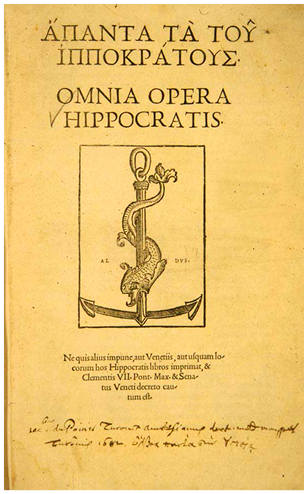
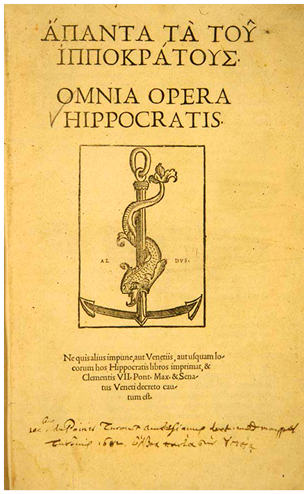
The Hippocratic Oath was written in Greece between the fifth and third centuries BC and almost certainly not by the physician and philosopher Hippocrates himself, the so-called father of medicine whose herald was a staff entwined by a single snake (Figure 1). (The better-known caduceus with double-snake is attributed to Hermes, the ancient Greek god of healing). The injunction to ‘first do no harm’ (primum non nocere) does not appear in the original oath but was added later to become a part of medical folklore. The origin of the phrase is probably the text Epidemics: Book 1 of the Hippocratic school, where this injunction appears: ‘Practice two things in your dealings with disease: either help or do not harm the patient.’ Importantly, the catchier injunction ‘first do no harm’ can be seen to afford a translation from the prosaic to the poetic. The poetic consonance of ‘First do no harm’ is striking, like a drummer hitting the snare’s skin square on the beat.
Title page of the first Greek edition of Hippocrates’ complete works, showing the single snake (and not the double serpent attributed to Hermes).
Where dissonance is tension, consonance is release; and while the phrase ‘first do no harm’ is an injunction, it acts as a release where it signals the binding rather than the dissolution of a community of practitioners in a common initiation ritual for raw medical students – the explicit mouthing of the oath. Now I have employed a metaphor (as an analogy) comparing consonance to the drummer’s art. Throughout this Element, I use the umbrella term ‘metaphor’ to encompass tropes (figures of expression) or rhetoric (figures of persuasion) such as metonymy (where one figure links to another by association, often in chains such as ‘bucket-water-drip-feed’). Embodied metonymic chains are common in medical and surgical safety protocols: for example, in surgery counting all items (swabs, sharps and instruments) at specific times – before the procedure starts, before cavity closure, before skin closure and at the final suturing.
1.2 Keeping Patients Safe in a Field of Risk
In this Element, I specifically address medical education (embracing dentists and physician assistants) rather than wider healthcare education (embracing nurses, physiotherapists, auxiliaries such as ambulance crew and dental assistants); while by ‘psychotherapy’ I also include clinical psychology and accredited counselling. Psychiatrists and clinical psychologists are crossovers. Psychiatrists are medically qualified but work with the mind, albeit characteristically within a reductive model of neurophysiology where neuro-pharmaceuticals are the primary choice of treatment and symptoms are often reduced to neuroanatomy. Clinical psychologists are oriented to psychotherapeutic talking treatments rather than pharmaceutical interventions and often work alongside psychiatrists but also with registered arts therapists.
Psychotherapists who register for professional practice are bound by an ethical code that protects patients against potential abuse, but this formal code is secondary to an inbuilt practice code that all psychotherapists should understand and obey: the dynamics of transference and resistance (the latter can be seen as an aspect of transference), first described by Freud in 1912 (Almond, Reference Almond2011). These dynamics in turn are built on understanding, enacting and interpreting defence mechanisms of the ego (Laughlin, Reference Laughlin1970). Such psychodynamic principles are often shelved in pragmatic counselling approaches derived largely from Carl Rogers’ person-centred approach. More, they are notably absent from medicine’s undergraduate training programmes (Bleakley, Reference Bleakley2020b). This is a serious omission where medicine demands face-to-face interaction not only with patients (unless you are a pathologist) but also with other health- and social-care practitioners in team settings (even for pathologists).
In short, Freud described a variety of mechanisms that prevent the ego from overstimulation or attack by raw forces of emotion from self and others. However, these ego defence mechanisms can become overused and then become examples of neurotic self-protection. Examples include denial (‘I never called you a liar’); repression (uncomfortable feelings are quashed); projection (to save one from the discomfort of raw emotion somebody else must take the blame: ‘It’s your fault that we can’t reach an agreement’); and displacement, a form of projection such as irrational blaming of another ethnic group (‘it’s all the fault of the wave of immigrants taking our jobs or receiving benefits’). In a therapeutic context such as a GP talking with an anxious and depressed patient about possible treatments, attending to defence mechanisms at play can lead to interpretations of the patient’s behaviour, but judgement must be weighed against the dynamics of transference and resistance mechanisms. For example, a woman patient suffering from anxiety and depression that is not a result of, for example, difficulties with bonding (post-partum depression), peri-menopausal bodily change, or loss in the family (natural cycle of grief) could readily be prescribed anti-anxiolytic or antidepressant drug treatment. But this would be premature without a discussion about other options related to lifestyle and social circumstance.
There may be social reasons at play, such as deprivation; or body-image reasons, such as anorectic symptoms or obesity; or interpersonal contexts, such as a failing marriage or an abusive partner; or alcohol dependency and/or substance abuse (including withdrawal effects). Other social agencies would then be invoked. Instead of pharmaceuticals, there may be a possibility for natural prescriptions such as the ‘green gym’ or ‘blue gym’ (interacting with outdoor green or ocean spaces), or social settings such as art therapy. But in the course of a consultation, the GP (who may by now be thinking of referral to a practice counsellor) should be aware, as noted, of the psychodynamics of the clinical consultation. These come to a head in the dynamics of transference and resistance.
The GP meets a patient to whom he or she is physically and emotionally attracted or, alternatively, has a strong reaction of dislike or even disgust. The patient seems to flirt or be overly sensuous, or be difficult, challenging or even obnoxious. This sets up a transference/resistance dynamic. The obnoxious patient is, for example, actually talking to the GP as if this person were his or her father or mother who was abusive. The authority figure takes the projected flack. Rather than taking this literally, the psycho-dynamically astute practitioner sees the exchange for what it might be – a case of projection and negative transference. In such circumstances, the GP does not respond naively but reads into the dynamic and interprets it, responding with professional care. As the patient ‘acts out’ they may blame the doctor for what is in fact an institutional problem, raging that they can ‘never get an appointment’ and are ‘always being brushed off’ (more projection against an uncaring parent who is now the parental organisation of the NHS).
Resistance is a little more subtle yet perhaps more telling. Patients come to doctors’ surgeries often expecting drug treatments, yet 50% of patients with chronic conditions subsequently refuse to take their medications (‘non-adherence’). Studies suggest that 17% of newly prescribed medications are not taken up (primarily corticosteroids in dermatology, where a third of prescriptions are not adhered to and discarded as waste). Traces of antidepressant and anti-anxiety drugs flushed away into sewage systems that empty into the sea are now found in fish. This is an ‘in your face’ form of refusal or resistance by patients. In the context of the consultation, patients may refuse to accept a diagnosis or suggested treatment. In turn, just as doctors can engage in counter-transference where they treat patients they like, or are attracted to, more favourably than those they are irritated by – or they find offensive or unattractive in some way – so they can engage in counter-resistance where they refuse to accept the veracity of a patient’s account, for example.
This psychodynamic supplement serves a particular function: deepening the quality of the clinical encounter. Here, the poetic imagination is invoked to increase the metaphor count. In other words, the clinical encounter is not just read literally but embraces other factors, such as allusion and the unspoken, that may be pertinent to the consultation. Importantly, the terms introduced by Freud to describe the psychodynamics of a clinical encounter should be read as metaphors and analogies as well as literalised – they point to something other than the ‘front-of-stage’ impression management of the patient or client. Transference and resistance dynamics of course include the non-verbal, and this leaks what is below consciousness, readily framed as metaphor or a deeper register of meaning. For example, in a complex or sensitive moment in a consultation, a patient drops her gaze to the floor and ‘looks lost’ while the doctor ‘hands her a lifeline’ in the way of an ‘encouraging remark’ so that she ‘disengages’ from her ‘flat affect’ to describe what is ‘really troubling her’. Each of these highlighted moments in the exchange is a metaphorical raising of value or deepening of engagement. In other words, poetry or the poetic imagination is recruited as the value of the consultation shifts from the functional (mechanical exchange leading to diagnosis and treatment or referral) to the ethical and aesthetic. Morality and beauty are present in the deeper forms of exchange.
More instrumentally focused practitioners will say that these kinds of encounters require more time or continuity in consultations. It is certainly the case that extended time and continuity help, while doctors usually crave this where the reality is too many patients and too little time. But brief therapies are common in psychotherapy and counselling circles, albeit inviting instrumental focus. In analytic circles, we might learn something from the French psychoanalyst Jacques Lacan, who, as discussed earlier, famously truncated consultations on the basis that clients typically withhold vital admissions until the very end of a session (Hewitson, Reference Hewitson2010).
Of course, a medical consultation is usually solution-focused rather than exploratory and then invites technical and efficient approaches. But this instrumental approach need not shape the consultation. While solution-focused energy passes through the encounter seeking closure, there is a parallel energy at work – an ever-receding ‘horizon’ resisting closure. This is an unknown and perhaps unknowable quality to do with the tone of the exchange and is based in the quality of communication. It embraces poetic forms such as rhythm, punctuation, emphasis (assonance), tolerance of ambiguity (dissonance) and enjambment (a suspended point that simply dangles, unresolved, but has great impact). More, it is here that imagination rather than technical reasoning is engaged. In this parallel territory of the clinical encounter there is greater production of metaphor, and the entry of poetic licence and poetic diction is signalled. This embraces close listening, deep attention, empathy and compathy, respect, eye contact and appropriate touch and intimacy.
The clinical consultation is a small part of the bigger picture of patients’ and clients’ worldly beings. Social injustice from structural inequity and inequality is a prime instigator of mental health issues globally (Kirkbride et al., Reference Kirkbride, Anglin and Colman2024). More than one in five adults in the USA have been diagnosed with a psychological disorder such as anxiety, depression and being on an autistic spectrum (59.3 million in 2022, 23.1% of the U.S. adult population) (www.nimh.nih.gov/health/statistics/mental-illness). Such diagnosed morbidity masks a bigger problem: widespread existential angst, low mood and dissatisfaction with life, aggravated relatively recently by the global Covid epidemic (Cottone, Reference Cottone2025). While life expectancy increases in high-income countries, it brings with it chronic illnesses and poor quality of life. Again, in Asphodel, That Greeny Flower the American poet and paediatrician William Carlos Williams (Reference Williams1955) famously said: ‘It is difficult/ to get the news from poems/ yet men die miserably every day/ for lack/ of what is found there.’
What does Williams mean by this? Everyday ‘news’ is contrasted with ‘the news from poems’. Poetry is an antidote to the mundane and its gossip mentality (‘the news’). Just as medicine’s intensity and imagination can be raised from the technical to another level of value, so medicine’s customers – the lay population – can increase the intensity of their own lives through what is found in poetry as a feast of embodied and inventive metaphors. But this also returns us to risk. Active engagement with life requires first an intense imagination and high anticipation. Such an imagination confounds rather than soothes. In medicine also, treatment of patients necessarily involves harm as side effects while promising to stave off disease. The reality is that medicine often hurts, displaces or shocks.
A man has a partial prostatectomy because of an enlarged prostate that is causing difficulty in urinating. While the urinary problem is fixed, the prostatectomy means that he can no longer ejaculate during sex, and his orgasms are tempered to be mild. This of course is as much a blow to his male psyche as to his ordinary pleasures. A woman has a breast removed surgically because of life-threatening tumours lurking there. She has parallel reconstructive surgery. While her life is saved, her femininity is compromised. While seeking drug prescriptions for mood disorders such as anxiety and depression – now a common part of a general practitioner’s daily work –the side effects of these drugs can be debilitating, such as vague lethargy or drowsiness, sexual dysfunction, insomnia, weight gain and dependency. Moreover, we are feeding the profit-based capitalist machine of Big Pharma, which is insatiable.
So, just as poetry confounds rather than soothes, so may medicine. But if William Carlos Williams is right, then poetry may act as medicine. Not in the sense of replacing a pharmaceutical or a surgical intervention, but as a key element in improving quality of life.
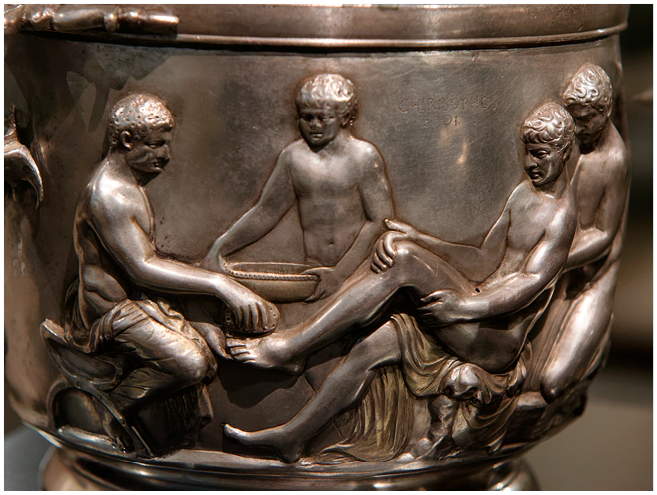
What, then, is the secret ingredient in poetry should it indeed provide the stimulus that Williams describes and that I indicate here is a mixed blessing: a pharmakon or healing poison where the best of poetry is oddly debilitating or challenging? That ingredient is, again, innovative metaphor production grounded in an agile poetic imagination. Poets are first and foremost experts in condensing language to make often inscrutable meaning from mastery of linguistic tropes (again, primarily metaphor and metonymy). Where we see a Grecian Urn in a museum, John Keats sees a ‘still unravish’d bride of quietness’ and ‘foster-child of silence and slow time’. Indeed, like all poets of note, Keats slows time down in close noticing such that time is dissolved into space. The keenest of spatial attention is paid to an object, such that what is revealed is one of the greatest insights proffered through literature: ‘Beauty is truth, truth beauty.’
1.3 Neurodivergent Sensibility
Such close attention – as brooding introspection, space-orientation rather than time-orientation and collapsing of existence into insistence such as stimming (repetitive behaviours) – is the mark of what the neurotypical imagination calls ‘autism’. Can we see poetry as a productive form of autism? Or, conversely, can we see the poetic imagination – lauded by Williams as life-saving – as a cure for unproductive, bland neurotypicality?
Given medicine’s predilection for creating the kind of discomfort necessary to the creative imagination (the grit that makes the pearl) as a by-product of ‘cure’ (despite the promise of ‘do no harm’), can medicine be seen as a kind of poetry (Bleakley & Neilson, Reference 67Bleakley and Neilson2022)? Medicine has madness in its method – the promise to stave off death in the face of entropy or the inevitable running down of the body. And, as already noted, medicine has a largely unacknowledged sadistic underbelly catalogued in debilitating side effects of treatments. This is aggravated by an ongoing catalogue of medical and surgical error partly due to systemic communication errors but also to lingering traits of narcissism endemic to heroic surgeons (albeit a dying breed in an age of teamwork and patient-centredness – i.e. collaborative, democratic medicine).
Poetry, meanwhile, attracts pathology – a parade of great modern poets with mental health issues from substance abuse, such as Dorothy Parker, Ezra Pound, Dylan Thomas, Robert Lowell, Elizabeth Bishop, Sylvia Plath, John Berryman, Theodore Roethke and Anne Sexton. As Sexton (Reference Sexton2003) says in her poem ‘The Addict’: ‘I’m on a diet from death’, ‘with capsules in my palms each night’. Ironically, ‘I’m merely staying in shape’ (for an early death), where ‘I like them more than they like me’. Tellingly, there is autistic repetition – stimming – at work, where ‘It’s a ceremony/ but like any other sport/ it’s full of rules./ It’s like a musical tennis match where/ my mouth keeps catching the ball’. Of course, the ball (as a pill) is never returned and so must be served over and over.
Institutionally, medicine manages affect and emotionality through suspension. This leads to the long-recognised symptom of emotional dampening (or withdrawal of affect) as objectification of patients coupled with intolerance of ambiguity (where affect is seen as colouring judgement). This can also be seen as an autistic gesture. The key controlling trope here is suspension of metaphor through adoption of a singular bioscientific language grounded in Greek or Latin roots, such as ‘haematemasis’ for the vernacular ‘vomiting blood’. However, such technical terms afford a front. For example, medicine can just as readily enter the metaphorical fray where it describes differing kinds of coughs as ‘dry’, ‘wet’, ‘barking’ or ‘hacking’. Slippage into reductive technical language can occur with a ‘paroxysmal’ cough (violent and uncontrolled) and a ‘croup’ cough (a barking cough where the voice takes on a rasping sound) – where the technical terms have currency only amongst the community of physicians.
Slippage between metaphor and technical descriptor is common in medicine. The repression of emotion as a professional choice can be seen as a master metaphor, an autistic gesture of withdrawal from the fray in case of being overpowered by circumstance. Autism is not a condition of loss of affect, but rather represents a different way of managing affect – privately, carefully, with repetitive certainties. While medicine can readily engage with public language and discourse to engage with its metaphoric riches, it also draws on the master metaphor of withdrawal of affect for a circumscribed technical language and a set of clinical skills, such as inserting a central line and engaging repetitive activity.
Underlying such formulaic medical diction is a shared set of knowledge that constitutes the information needed to generate the rules for medical discourse. This knowledge is anatomical and biomedical. When a physician recognises a croup type of cough, she knows that it is viral, causing swelling in the upper airway, and that it is developmental, affecting children usually below the age of five who by nature have narrow airways. Further, she knows it is contagious (when caused by a virus) usually for up to three days after the fever breaks or the symptoms show. This underlying knowledge rapidly becomes tacit, and its recovery is habitual after seeing many cases of croup. The diagnostic pathway from examination to diagnosis is again mechanistic and routine. Here too is the seasoned ophthalmologist on the 4,000th cataract operation or the interventionist cardiologist inserting thousands of stents over the years. Can we call this stimming? How the physician interacts with the child and/or the parents or carers is another matter. This needs outward taxis of feeling.
2 Metaphor in the Middle
2.1 The Poetic Imagination Feeds Medicine and Psychotherapy
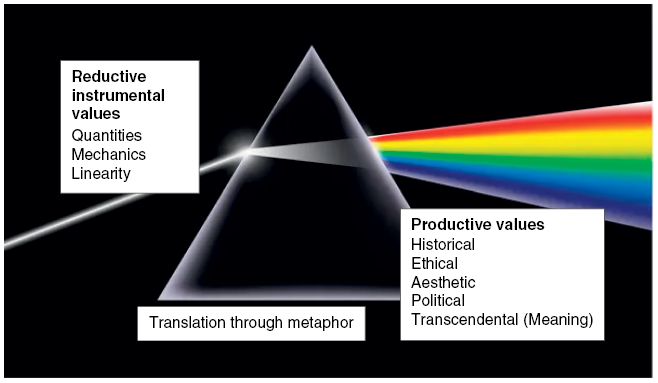
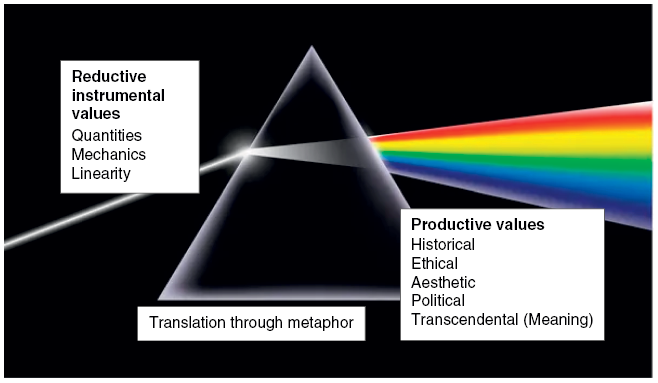
As the previous sections argue, poetry can act as a medium to raise the intensity and value of medical and psychotherapeutic work – again, from the mere technical, instrumental or functional to embrace a deeper set of values such as the historical, ethical, aesthetic, political and transcendental (Bleakley, Reference Bleakley2024). This can be modelled as a single white light source that hits a prism and is then refracted into a rainbow of colours (Figure 2). Reductive values are transformed into productive values. Or, to draw on the poet T. S. Eliot’s (Reference Eliot1934) famous descriptor, information is turned into knowledge and wisdom (or meaning).
The values prism.
Poetry then is therapeutic in the sense that it treats the condition of lack that is reduction to the instrumental. Such poetic intervention should not be read instrumentally (e.g. quantitatively), as if a dose of poetry can cure, imitating a pharmaceutical. Indeed, poetry, such as all arts and humanities, has a primary purpose to challenge conventions, upset preconceptions and to disorient, in the hope of educating a new vision and purpose. Here, poetry is the paradoxical pharmakon – both poison and cure. The arts enrich primarily not through decoration but by challenging preconceptions and feeding the imagination. This Element describes how the poetic imagination and diction can act as media through which medical and psychotherapeutic practices may be filtered to deepen the value of such practices.
To read embodied metaphor as a therapeutic quantity, or dose, is to make a fundamental category error. Metaphor, by definition, is a qualitative medium through which both thinking and activity are toned, intensified, questioned, made mysterious, deepened and thus developed. Where a person describes to a doctor a ‘hacking cough’ or to a psychotherapist a ‘brain fog’, the common work of the two metaphors is one of meaningful qualification of the condition. In these two cases, the metaphor works, paradoxically, by simultaneous contraction and expansion: contraction to a specific territory that is the named state, but expansion as nomadism and translation where that named state is intentionally porous and mobile.
Medicine and psychotherapy are two sides of a coin addressing symptoms – medicine largely dealing with the body, psychotherapy with the mind and emotion. This ‘coin’ (we are already deep into metaphorical territory) can be thought of as the ‘currency of life’ (now we are lost in the forest of metaphor) that is best explored through the arts and humanities and cannot be reduced to instrumental or functional explanations. Literature, in particular, serves us well here as an imaginative descriptor of life’s more intense features, at best posing moral dilemmas. But, more so, poetry – arguably the most concentrated art form of metaphor invention – will be our chief interrogator of medicine and psychotherapy. Poetry is rhetorical – it sets out to persuade. But its means of persuasion are gnomic, often irrational: de-familiarising (making the familiar strange) and educating for ‘slantwise’ apprehension. As the reclusive poet Emily Dickinson says: ‘Tell all the truth but tell it slant’ where ‘The Truth must dazzle gradually’.
To elaborate – remaining aware that these assumptions are generalisations – if medicine stands for the body (where emotion is bracketed out as intruding upon practice) and psychotherapy stands for emotion or feeling states (where catharsis followed by insight is psychotherapy’s general route), then poetry stands for the imagination (or soul) as a metaphor generator that inhabits both medicine and psychotherapy.
2.2 Metaphor Takes the Strain
I refer throughout to metaphor as ‘embodied’ following the linguist George Lakoff and philosopher Mark Johnson, both interested in cognitive science’s intersection with the arts and humanities (Lakoff & Johnson, Reference Lakoff and Johnson1980; Lakoff & Turner, Reference Lakoff and Turner1989). These authors argue that although metaphors are linguistic tropes, they are never abstracted from, but grounded in, matter. Or, their references are material (e.g. one slew of metaphors is spatial: ‘I don’t know where to turn’, ‘Screw your courage to the sticking post’ – an idiom from Shakespeare’s Macbeth, meaning that courage should be held firm or not waiver). For Lakoff and Johnson, ‘embodied’ is also what the rhetorician Richard Weaver (Reference Weaver1985/1953) calls a ‘god term’ (as opposed to a ‘devil term’) – a preferred way of perceiving, thinking and imagining. Indeed, there is a long tradition of screwing metaphors to the sticking post of neural substrates, ‘as if’ this provides evidence for a metaphor’s materiality and origin (Lakoff & Narayanan, Reference Lakoff and Narayanan2025), but in fact is a metaphor in itself. The tangle increases, for, of course, metaphors are not ‘facts’, but aspects of rhetoric or opinion.
‘Embodied’ metaphors suggest strength, permanence and presence rather than the seemingly weaker ‘abstract’ (as flimsy and ephemeral). Indeed, metaphors are often formed alchemically, by turning the abstract into the tangible: ‘time is a thief’ or the idiom ‘put your money where your mouth is’ – show by your actions rather than your words. The latter is an idiomatic stereotype of surgeons preferring actions over contemplation (‘don’t just stand there, do something!’, where physicians patiently seeking a definitive diagnosis are parodied by surgeons as: ‘don’t just do something, stand there!). Embodied metaphors are thus linguistic strategies that raise the value of words, phrases, gestures, signs or symbols from the mundane to the more complex, rich and ambiguous (‘time is a thief’, ‘a heart of gold’). An embodied metaphor cannot be taken literally yet is always tangible (‘he fell from grace’). Again, while poetry is the primary medium for invention and application of metaphors, medicine (‘a hacking cough’, ‘neuronal nets’) and psychotherapy (‘unconscious’, ‘resistance’) are both practices replete with embodied metaphors. The purpose of the metaphor is to deepen appreciation through a strange attraction or to introduce complexity to the otherwise linear and reductive.
Here is a living contradiction: popular culture seeks self-knowing in a long-standing tradition that goes back to classical Greek culture (as culture-specific techniques of ‘self-improvement’ including athletics and manners) (Foucault, Reference Foucault1988), but in the age of the ‘selfie’ this has become trivialised, obsessive, even grandiose as a form of narcissism. This is a thorn in the flesh for medicine where there has been a tradition of heroic individualism, seen particularly in surgery and emergency medicine. This is counter to an evidence base that collaborative, democratic teamwork affords better patient outcomes, safety and worker satisfaction. Psychotherapies, now read through the cultural lens of self-help literature and online content as rampant individualism, generally eschew socio-cultural and socio-material approaches focused on collectives, crowds, ethnicities and artefacts such as food and material culture (again, as James Hillman and Michael Ventura claim in their book We’ve Had a Hundred Years of Psychotherapy and the World’s Getting Worse (1992)).
It is important to recognise at this point that while lyrical poetry (the dominant form in modern verse) was developed by Wordsworth and Coleridge in the late eighteenth century as a way of embracing the vernacular or the common voice, such poetry has now morphed into a dominant personal-confessional style. Handled well (Walt Whitman, Robert Lowell, John Berryman, Sylvia Plath, and Dorothy Molloy) such poetry offers universal identification. But personal-confessional poetry has become the stuff of therapy workshops and untutored voices that chime with a vacuous or ephemeral culture of online self-promotion (Meta, TikTok, Instagram, YouTube, Snapchat, etc.). This is a cultural explosion that the commentator Christopher Lasch predicted in his book The Culture of Narcissism (1979) and advertises a kind of smug self-knowing dressed up as cultural anxiety that the historian Kenneth Galbraith described in his book The Culture of Contentment (Reference Galbraith1992). In the past quarter of a century in particular, we have seen an explosion in self-help literature and media content that, paradoxically, turns ‘self’ help into instrumental tips, strategies and life-courses designed by others, where ‘self’ affords capital to be exploited. The narcissist knows this territory best (Bleakley, Reference Bleakley2025a) (see Figure 3).
The so-called dark triad of personality disorders.
2.3 Towards a Therapy of Things and Circumstances
To recap, medicine and psychotherapy can benefit from drawing on the metaphor innovation that is poetry’s work or the work of the poetic imagination. Some people have a powerful poetic imagination – as metaphor inventors – while they may not be particularly good poets. This applies in particular to scientists and engineers. Born and raised in Cornwall in the UK, Humphry Davy was the most famous scientist and inventor of his age in the late eighteenth and early nineteenth centuries. Moving from Penzance to Bristol in 1798 at the invitation of Dr Thomas Beddoes, Davy became superintendent – or chief researcher – at the Pneumatic Institution, chiefly studying the medical uses of gases, such as nitrous oxide or ‘laughing gas’ (much later used as an anaesthetic, first in dentistry and then medicine). Davy taught the poets Coleridge and Wordsworth – then both living near Bristol – the rudiments of scientific experiment, later setting up an ‘entry-level’ laboratory for them in their Lake District home.
As close friends in Bristol at the close of the eighteenth century, Coleridge tried to teach Davy how to write poetry, but with little success. Davy wrote in a stilted, formulaic manner – unlike his scientific imagination that was fluid and open. While his poetry may have been stilted, even under Coleridge’s tutelage, Davy’s poetic imagination was realised as an eye for embodied metaphor informing scientific experiment. In other words, the poetic imagination can be exercised in the absence of writing poetry, where another activity, such as a scientific imagination, becomes poetic. Davy was a ‘scientist of the strange’, making the invisible in the natural world visible, such as the vicissitudes of gases such as nitrous oxide – to which he was famously addicted. It was Davy who coined the descriptor ‘laughing gas’ – an embodied metaphor – in 1799 (Figure 4) (Bleakley, Reference Bleakley2021). He famously invented the Davy miner’s lamp that afforded early detection of invisible, odourless and potentially lethal methane through colour change in the flame (turning blue) while the flame was contained by a protective gauze. The Davy miner’s lamp is not simply engineering – it is an elegant piece of embodied poetry and a product of an imaginative socio-material imagination (Figure 5).
‘A man breathing in nitrous oxide (laughing gas) and a man exhibiting its exhilarating effects.’ Wood engraving, c.1840. Iconographic Collections.
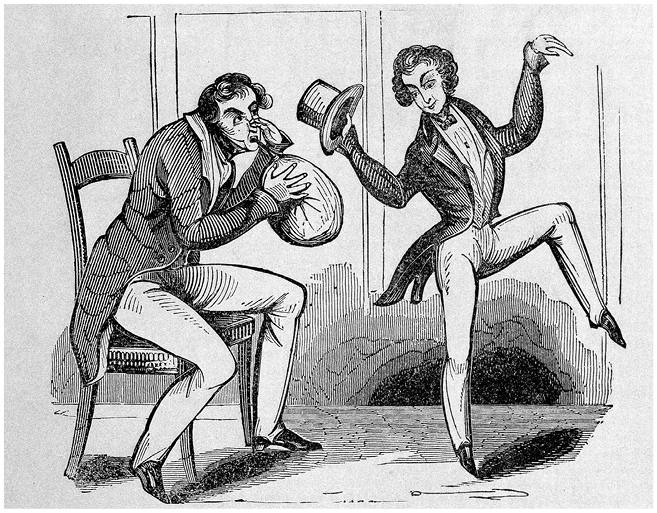
Statue of Sir Humphry Davy in Penzance, holding the miner’s safety lamp.

A historical trajectory in modern times has been described as the emergence of ‘rampant individualism’ – as a symptom rather than a benefit of the age (Bleakley, Reference Bleakley2025a). Until relatively recently – with the entry of more women into medicine and the promotion of interprofessional, democratic clinical team practices – medicine was driven by heroic, dragon-slaying individualism grounded in a twin metaphor: medicine as war and the body as machine. Medicine is then positioned firmly in the post-WWII military-industrial complex (Bleakley, Reference Bleakley2020b). In parallel, psychotherapy (embracing the wider counselling culture) – in its embrace first of ego-strengthening psychodynamic psychotherapies and then widespread adoption of short-term instrumental problem-solving approaches such as CBT – has also firmly established individualism as its primary concern. This, at the expense of social and cultural therapies, where, as Hillman and Ventura (Reference Hillman and Ventura1992) again argue, ‘we’ve had a hundred years of psychotherapy and the world’s getting worse’. The authors call for a paradigm shift away from a focus on individuals to consider how a therapy of organisations, cultures, objects or artefacts – both circumstances and things – might work. For example, should we be concentrating on fixing food disorders rather than eating disorders? Such a question impinges directly upon, for example, gastro-intestinal medicine and surgery and a range of psychosomatic eating disorders such as anorexia and bulimia.
We must ask if the poetic imagination, with its primary practice of writing and speaking verse, is up to this facilitative task: one in which the dominant discourses of medicine and psychotherapy have become voices for instrumental and functional practices (grounded in measurement) at the expense of deeper concerns – again: historical, ethical, aesthetic, political and transcendental (meaning) values. We should also remind ourselves once more that modern lyrical verse is grounded in Coleridge and Wordsworth’s experiments in use of the vernacular in confessional utterances. This reaches a peak in poets such as Walt Whitman’s (1855/1892) ‘Song of Myself’, where: ‘I celebrate myself, and sing myself,/ And what I assume you shall assume,/ For every atom belonging to me as good belongs to you.’ Whitman’s self is not at all narcissistic but advertises pan-theistic identification. Self likes to hear its echo – is loud and declarative, far from private, where the public is imagined as a group of like-minded selfies in a mass democratic experiment. Whitman (Figure 6) is contemporary in this respect, following his own country’s Constitution that exhorts tolerance of individual rights, morphs into universal human rights and settles in the USA as Kenneth Galbraith’s (necessarily illusory) ‘culture of contentment’.
Walt Whitman photographed in New York (1887) by George C. Cox.
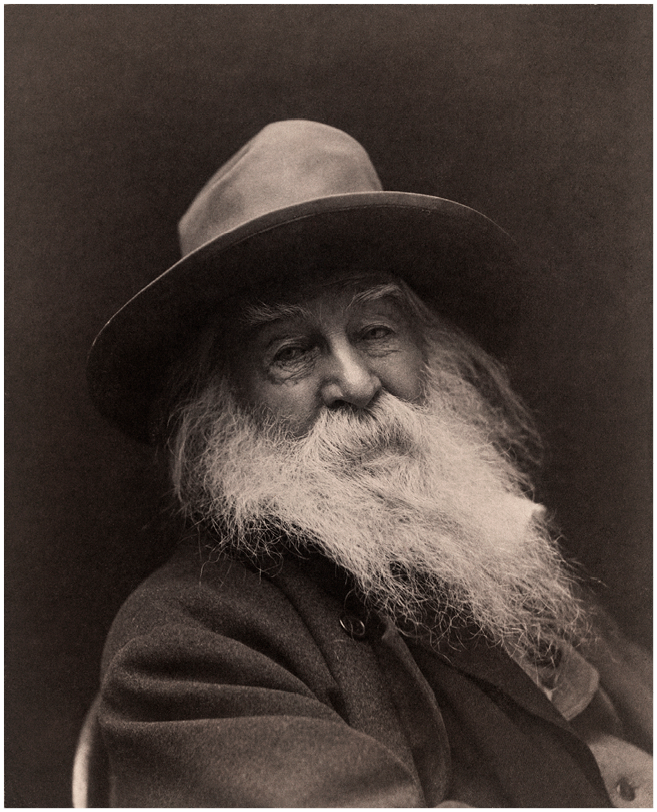
Galbraith notes that the contented well-off fail to properly address the condition of an underclass stalled in poverty on their doorstep. Medical and psychotherapeutic treatments and care are embraced by the contented but are out of reach of the underclass. Poetry then becomes politicised and used as a means of expressing outrage and resistance against inequity and inequality. The contented conservatives spoke back, as the case study of the poet Allen Ginsberg below illustrates.
The queer poet Allen Ginsberg’s (Reference Ginsberg1956) ‘Howl and Other Poems’ (Figure 7) became a significant marker for the Beat generation of the 1950s (succeeded by the Hippies of the 1960s and Punks of the late 1970s). The poem was published by Lawrence Ferlinghetti, a San Francisco-based poet and publisher who ran the innovative City Lights bookshop and publishing house. In March 1957, 520 copies of ‘Howl’ that had been printed in London were seized by Customs officials in San Francisco as they entered the United States. The press was charged with publishing obscene material. Ferlinghetti nevertheless decided to publish the book in the US, where in June of 1957 an employee in the City Lights bookshop sold a copy to an undercover cop and was arrested. Ferlinghetti was then arrested and charged with ‘disseminating obscene literature’. An ensuing trial mirrored the D. H. Lawrence’s ‘Lady Chatterley’s Lover’ obscenity trial in London. The enlightened American judge deemed that under First Amendment Rights Ginsberg’s poetry was not obscene but showed ‘redeeming social importance’ as a comment on issues of the time, and charges were dropped.
Allen Ginsberg’s Howl and Other Poems cover in the pocket-size edition that was the hallmark of City Lights Books.
The paediatrician and established poet William Carlos Williams wrote an introduction to Ginsberg’s ‘Howl’ in which he said, ‘poets see with the eyes of the angels’ or make the familiar unfamiliar, open to further scrutiny and contemplation. Moreover, poets realise beauty, often in the mundane. Williams noted that Ginsberg, in his early life, had been through ‘hell’ and that ‘Howl’ was a first-hand account of that experience, an auto-pathography. The Beat poet had been diagnosed as schizophrenic and was hospitalised as a young man, mirroring his mother’s long-term mental illness episodes – she had also been diagnosed as schizophrenic at the tender age of eighteen. As a young man Ginsberg had signed a medical form on behalf of his mother consenting to a lobotomy for the unfortunate woman.
As noted, Williams had written, and often remarked, that poetry and the poetic imagination enrich lives that would otherwise be ‘miserable’ for lack of what poetry can bring – again, lives devoid of creative imagination. As a physician he knew that it was often difficult to draw a line between the often-irascible imagination of mental illness that resulted in personal confusion and the fruits of an imagination focused through a creative medium such as poetry; what we now might celebrate as neurodiversity was, in the 1950s, seen as abnormality – a mental ‘illness’. In a book-length study of Ginsberg’s poetry based on long conversations with the poet before his death, the psychiatrist Steven Weine (Reference Weine2023) describes how, as a young man, Ginsberg had been treated through psychodynamic psychotherapy. But it was ultimately poetry that focused his being and provided a therapeutic medium. Ginsberg was to write (in ‘Howl’), with evident humour, about: ‘the concrete void of insulin metrasol/ electricity hydrotherapy psychotherapy occupational therapy pingpong & amnesia’. The oxymoronic and metaphorical ‘concrete void’ sums up the poet’s long-standing neurodiverse outlook as poetic (and therapeutic) capital. The metaphor acts as the elixir.
Further, Ginsberg’s poetry – such as his heroes William Blake and Walt Whitman – would transcend personal-confessional style to speak as a generational voice (spanning WWII and the Japanese, Korean and Vietnam conflicts). Ginsberg’s voice is primarily political, as an advocate for revolution against complacency (again, the culture of contentment) that concealed racism, sexism and homophobia. This was a voice of the lost without homes, seeking and wandering (Jack Kerouac’s ‘on the road’): ‘who wandered around and around at midnight in the railroad yard/ wondering where to go, and went, leaving no broken hearts’, yet ‘who lounged hungry and lonesome through Houston seeking jazz’. For jazz, the pinnacle of improvised music, presented an embodied metaphor for the poetic imagination transcending the reductive anchors of sheet music and strict time signatures.
Initially solo improvisations set around written group themes, modern jazz (essentially a black musical form) morphed into collective improvisation without solos as the pinnacle statement of democratic resistance: ‘No Room for Squares’ exclaimed a Blue Note album by Hank Mobley, a bop tenor player and pioneer. ‘Howl’ itself acted as a metaphor for outrage at ‘square’ culture that brought so much suffering to minorities. Ginsberg’s form of long lines (echoing Whitman) imitated improvised jazz solos. He conjured a form of poetics that is best accompanied by jazz and speaks of what has been lost in instrumental medicine and psychotherapy – the power of both individual and collective improvisation, transcending mere competence and ushering in imaginative capability.
More complex perhaps than Whitman’s naïve naturalism – a celebration of self in identification with persons and nature – is the tortured self of modern poets leading to the forming of a confessional genre. At the outbreak of WWII, the English poet W. H. Auden (Reference Auden1939) would write: ‘All I have is a voice to undo the folded lie.’ Yet Auden believed that poetry had no power to impact on politics or the vicissitudes of power. As a gay writer, however, at a time when such choices were criminalised, Auden would surely have identified with Allen Ginsberg’s later plea to literally ‘Howl’, recounted above. As noted, Ginsberg too was gay in an era of oppression of sex and gender identity choices. He ‘saw the best minds of my generation destroyed by madness’ as a result of such repression. Robert Lowell (Reference Lowell1959), whose Life Studies is seen as a benchmark for confessional verse, was an alcoholic and suffered from extreme bipolar mood swings. Sylvia Plath’s The Colossus (Reference Plath1960) admits to mood disorder and eventually she would take her own life, as did the lifelong alcoholic John Berryman (Reference Berryman2014) who won a Pulitzer Prize for his 1969 cycle The Dream Songs. I turn to Berryman at more length in Sections 4 and 5.
For many, modern lyrical poetry’s primary quality is its taxis to open or disguised confessions. Now this is fine when done well, but the genre soon disintegrates, or simply grates, in the hands of less capable writers or those merely using poetry as a convenient medium for ‘personal growth’. Confessional poetry then joins the cultural tradition of self-help that has become habitual rather than progressive (Bleakley, Reference Bleakley2025a). In this sense, such poetry must join heroic medicine and ego-strengthening psychotherapies as symptoms of an age of reduction of meaning to information, rather than opening doorways as imaginative developments. In the following sections, I will extricate confessional poetry from this symptomatic tangle to use the lyric poetic imagination as the lens through which we can rescue both medicine and psychotherapy from entrapment in instrumental concerns. First, however, we must rescue poetry in medicine from its entrapment in the coils of instrumental narrative. By this I mean narrative ‘kidnapped’ to serve the masters of medicine and psychotherapy.
3 The Narrative Trap
3.1 Whither Poetry, Medicine and Psychotherapy?
The previous section argues that we have been caught in a modernist paradoxical loop where the ingrained social habit of individualism – now morphed into the social media ‘selfie’ culture – has created the very conditions that undermine the ‘social’ such media are supposed to feed. Here, forms of narcissistic individualism cancel what the psychologist Alfred Adler called ‘fellow feeling’ for self-interest, where the ‘social’ has become an audience; the more ‘followers’ the better for associated advertising. Modern lyrical poetry’s confessional celebration of self, medicine’s history of heroic individualism and psychotherapy’s turn to ego strengthening are complicit with this historical drift.
First, poetry has its roots in collective concerns as songs written to celebrate cultural events, such as epic and tragic ancient Greek myths played out in public theatre. In the West, such epics and tragedies were appropriated by royalty and the upper classes, satisfying the cultural and academic interests of the elite. Romantic poetry (as we have seen, Coleridge and Wordsworth in particular) brought poetry back to the masses through inclusion of the vernacular, or ordinary speech, rich in embodied metaphor (Nicolson, Reference Nicolson2019). However, that very tradition – broadly, the rise of lyric poetry that allows for a confessional voice – has been appropriated by popular self-help therapies in poetry workshops or confessional voices on social media. These focus less on the quality of the poetry and more on using poetry as a medium for ‘personal growth’. Poetry has been swallowed by the ‘growth movement’ in a turn to self-help and entertainment, losing its power as a primary critical medium. Poetry has then suffered the same fate as medicine (through medical education) and psychotherapy (through training programmes) through value reduction to the instrumental. Here, the functional purpose is naked self-service.
Second, you would think that medicine, by definition, has public interest at its heart. However, preventive public ‘upstream’ medicine (primary care) has long dragged behind individually focused ‘downstream’ hospital medicine (secondary care) in terms of prestige, funding and focus for medical education (Bleakley, Reference Bleakley2020b). Medicine has a long history of heroic individualism (now at a close, as we shall see) as an almost wholly masculine profession that ossified into competitive hierarchies.
Third, psychotherapy is grounded historically in personal concerns and personality disorders associated with the birth of psychoanalysis and Freud’s enduring legacy. Freud himself tamed his own potentially wild beast of psychoanalysis to champion a safe ego psychology. He did write about the social, but the practice of psychoanalysis was based on a confidential and confessional meeting between a talker (the patient or client) and a listener and analyser (the therapist). Here, the therapist takes on a parental role, receiving and analysing transference and resistance until these dynamics are resolved. In particular, the transference is resolved as the patient weans herself off dependence on the analyst as surrogate parent, then takes responsibility for her own life: at which point a cure is achieved as the client re-embraces adulthood suffering as everyday neuroses. This story however is too neat, and ego strengthening is the last thing we need in an era of narcissism.
Deep entrenchment in the personal in psychoanalysis was first challenged by Freud’s colleague Alfred Adler, who called for acute social responsibility (‘fellow-feeling’) as an end point of therapy and was then credited as the father of social work. However, in psychotherapy the individual has long been lionised, where family, social or group therapies that aim at collective responsibility have remained in the shadow of a dominant individualism. This, again, has been exacerbated by the self-help movement – one of whose therapeutic vehicles has been ‘poetry workshops’, as noted – where the vague goals of personal growth are advertised. As psychoanalysis morphed into an educational activity for an elite, so varieties of Carl Rogers’ person-centred therapies have developed, spawning the patient-centred approach of contemporary medicine, again maintaining worship at the altar of individualism within a cult of personality. Central to this was the abandonment of the dynamics of transference and resistance, within a larger abandonment of the unconscious and its vicissitudes, in a radical simplifying of therapy’s tangled dynamics. Further, person-centred is not world-centred, where the ego-centric rather than the eco-centric dominates as we avoid the eco-crisis and collective responsibility.
It is imperative that medicine and psychotherapy/counselling challenge the habitual and dominant discourse of reductive individualism to adopt approaches directed to the social and cultural to stem their reduction to instrumentalism at the expense of other, deeper, values perspectives as noted. Here, the reader may say that I am conflating two separate issues – individualism and the narrowing of values to the technical-instrumental or functional. But they exist side by side. The cult of psychoanalytic ego-strengthening in post-WWII America goes hand-in-hand with the assumption that capitalism is the only logical form of economics. Dealing with the social is by definition more complex than dealing with the singular person, where personality is capital to be exploited through interpellation by advertising and, now, social media. It is the same taxis of withdrawal into self that feeds adoption of instrumentalism shaping both medical and psychotherapy education: education reduced to training and capabilities to competences, in turn shrinking the spheres of values influences.
In contrast is the adoption of the complex socio-cultural rather than the linear individual as unit of analysis. The socio-cultural in turn must be widened to embrace the work of objects (material artefacts and instruments from computers to pharmaceuticals) as the socio-material. The socio-material embraces a wider series of ecological niches (umwelten) than the local personal or individual. Interest widens, again, from the ego-logical to the ecological. Here, as noted, instead of concentrating on typologies and treatments of eating disorders, the focus becomes food disorders. Symptoms of food disorders include extraordinary amounts of additives such as salt, sugar, colourings and flavourings that have knock-on effects in terms of obesity and dental care. But these are addictive additions to the food controlled by ‘Alternative Pharma’ capitalist interests (or food additives as drugs). Pathologies of food include how farm animals are cared for, fed and slaughtered. When a child is diagnosed as having ‘attention deficit’ to what extent is this shaped by a world of simulacra inviting short attention spans and immediate gratification? When an adult is diagnosed with ‘anxiety’ and/or ‘depression’, to what extent is this related to extraordinarily high social expectations for achievement? As the playwright Samuel Beckett puts it, embodied in a mantra of, and metaphor for, nihilism: ‘Try again. Fail again. Fail better.’
3.2 Narrative Dominance
Biomedicine, staying true to empirical science’s principle of truth-as-evidence, seeks to explain the human, both body and psyche, by reduction to physiological and biochemical processes translated into a gross anatomical process such as breathing, walking and brain-based thinking. The more questions that are asked about the complexity of human illness, the more reductive the empiricists’ answers become. Thought must be ultimately examined as a neurological process. That language and metaphor have a neural basis is self-evident (Lakoff & Narayanan, Reference Lakoff and Narayanan2025), but adopting the neurological as a primary unit of analysis sidelines the socio-material. Despite the fact that Freud described a fantasy neurological map for the regions of the id, ego and superego, the clinical encounter occurs at the social level, embracing dynamics such as transference and resistance. These are again both bodily linguistic expressions and embodied metaphors. Where are the id, ego and superego actually located? – in language (including semiotics) of course. Furthermore, the client cannot be contained within the analytic encounter but inhabits a lifeworld with a history: culture, family, friendship groups and so forth. The person must be appreciated holistically. But also, as argued here, poetically.
There is already a considerable history of the clinical encounter being framed as a narrative event, where the patient’s ‘story’ is reframed by the clinician as a qualitative tale of illness. Where the patient’s hospital chart or health record tells a quantitative tale of symptom and treatment, illness stories provide a ‘parallel chart’ based in qualities. In a history of narrative theory in the medical humanities, Neil Vickers (Reference Vickers2025) grounds interest in narrative-based approaches to medicine in two fields that have always widened medicine beyond a narrow bioscience focus: medical anthropology and the biopsychosocial model. The latter is now often expanded to a bio-psycho-socio-immunological model. Here, again, persons are treated holistically where bioscience and cultural explorations mingle.
Medical ethics has long been established as core and compulsory in undergraduate medicine, while communication skills followed in time. Both would be enhanced by appreciation of narrative – engaging patients’ and doctors’ stories. A wider context would emerge – the establishment of a literary genre of doctors’ social-realist autobiographies/confessions, alongside an explosion of television medi-soaps and a slew of social-realism documentaries centred on complex surgery and fast-moving accident and emergency. Even historical narratives of single diseases would gain traction, where such diseases gain personalities and cult status. In time, a complex of narrative approaches in medicine would become the dominant voice in the larger field of the medical humanities, crowding out other approaches such as those based in the visual arts, music and drama.
Narrative approaches focus less on functional aspects of treatment and cure than on the meanings of illness to both patients and doctors. Doctors create stories of patients’ experiences in order to make sense of patients as a form of identification or compathy (Bleakley, Eichbaum & Ellaway, Reference Bleakley, Eichbaum and Ellaway2025). Patients create stories of their own illness experiences as a means of both making sense of their symptoms and communicating their experiences to family and close associates and to healthcare professionals. In an absence of technical understanding of biomedical terminology and medical framing of illness experiences, patients draw on the vernacular to describe and make sense of their illness experiences. A second layer appears, that of academics as ‘medicine watchers’ who interpret the illness experiences of patients, overlaying this with everyday metaphors such as ‘journey’ (birthing the infamous ‘illness journey’, even where patients may not experience their illnesses as journeys). Metaphors such as ‘illness journey’ become overworked, misapplied and overtired, and burned out, calling for reinvention or rejuvenation (Wohlmann, Reference Wohlmann2022).
These insights of medicine watchers such as anthropologists and sociologists are then circulated back to more open-minded clinicians who take on and reinforce these metaphors. The clinicians learn to retell the experiences of their patients in temporal forms, following classic structures of narrative, with character, plot-lines, escalation of plot, denouement and ending – borrowing such plot structures from literary theory. The established genre of autobiography turned into ‘life writing’ (a part of social-realist fiction) and culminates again in the pathography, or illness account (Kleinman, Reference Kleinman1989). This attempts to capture the variety of explanatory folk models for illness. ‘Story’ becomes a key word as this implies some fictional element. Even bioethics, modelling itself on objective science concerned with facts, is scrutinised as a form of fiction (Chambers, Reference Chambers1999), where case studies become ‘flash fiction’ biographies, necessarily contextualised within healthcare environments and thus blinkered to most of the lifeworld experience of patients.
At this point, I should say that narrativists by and large assume that storytelling is a natural process. But a distinction can be drawn between narrative time-based (temporal) and poetic space-based (spatial) experience (Strawson, Reference 71Strawson2004; Bleakley and Neilson, Reference 67Bleakley and Neilson2022). Temporal narrative has crowded out spatial lyric poetry, while the latter may be a more productive lens through which to examine the clinical encounter. In medical and psychotherapeutic consultations, patients or clients do not necessarily tell stories but offer disconnected accounts of events and experiences that do not invite narrative exploration. Further, in narrative-based accounts as case studies it is the practitioner as narrativist who offers the story rather than the patient or client. This can be seen as a form of imperialism working against authentic patient-centredness.
4 When the Muse Is Booze
4.1 The Lingering Odour of John Berryman
‘Starts again always in Henry’s ears/ The little cough somewhere, an odour, a chime’ says the American poet John Berryman (see Figure 8) in ‘Dream Song 29’ (Berryman, Reference Berryman2014). Within a life of heavy drinking serving to mask the pain of his chronic depression, the grip of both maladies a lifelong sentence for the poet, arises a priceless legacy – the sweet smell of his Dream Songs shaped by his alter ego (and conscience) ‘Henry’:
Later criticised for being racist in adopting a ‘blackface’ voice (‘in all them time’) in many of his Dream Songs, Berryman may not be cynical but rather adopts the historical black voice of jazz as improvised music, advertising a synthetically higher form of artistry than following a written score.
In ‘Dream Song 125’, Berryman’s opening lines eerily foretell his death:
On a bitterly cold day on 7 January 1972 in Minneapolis, Minnesota, a man jumps from a bridge to crash through an ice sheet draping the Mississippi River. He would have died instantly from shock (‘different from/ initiations now’). The soaring body, momentarily celebrating the liberation of bird flight, was that of the poet Berryman. A year later, his account of addiction treatment Recovery (Berryman, Reference Berryman1973) introduced a third alter ego – ‘Dr Alan Severance’ – a pun on the trials of disconnection from alcohol dependency through failed marriages, from conventional Christianity and from his ego through the invention of personas.
John Berryman.
On his addiction to smoking – three packs a day – Berryman (as ‘Henry’) shows us the best of his self-deprecating humour. Getting ready to give a lecture, the poet,
Berryman constantly decries himself or pokes fun at ‘Henry’. He confesses in cursive ways, with no direct hit, but with a kind of soft, organic, joined-up violence:
Dipping from ‘avocado moist with lemon’ to ‘formaldehyde & rotting sardines’, suicidal thought is never far away, thus: ‘I totter to the lip of the cliff’, continues Berryman. The cure is homeopathic: rotting food treating the rot of the poet’s liver and lungs. Berryman’s autopathography Recovery oscillates between fug and clarity, summed up by a telling line: Severance (Berryman’s sub-personality or alter ego) describes himself as being ‘in high spirits with a sinking heart’. Such duality is a running theme in the poet’s work, even in his appearance, where he switches between a full, voluminous beard (à la Walt Whitman, his poet hero) and being ‘fresh-shaven’:
Beards are a hazard, given Berryman’s proclivity to drink himself senseless, pass out, wake up and then vomit: ‘It’s easier to vomit than it was,/ beardless.’ After passing out from a drinking binge, ‘He was back in hospital. How he had got there he didn’t know’, and he was taken into a treatment centre for recovering alcoholics. Waking up fully: ‘His mind was clear as mountain air’ (Berryman, Reference Berryman1973).
Berryman doesn’t describe a split personality swinging between alcohol binges and abstention. Rather, drunkenness is now the core state, but this oscillates between debilitating (because he has to) and clarifying (because he wants to). On the former, his close friend the celebrated writer Saul Bellow describes Berryman turning up drunk for a reading in Chicago where ‘he coughed up phlegm’ and ‘looked decayed’ (Berryman, Reference Berryman1973). The reading was a disaster. Berryman muttered incoherently and intermittently shouted out passages so loud that it hurt the audience’s collective ear. After the reading, ‘he entered a waiting car, sat down, and vomited’. Later, ‘He passed out in his room … and slept through the Faculty party given in his honor. But in the morning he was full of innocent cheer. He was chirping … He was a full professor now, and a celebrity’ (Berryman, Reference Berryman1973).
Much later, Berryman was to write: ‘It seems to be dark all the time // I’m vomiting // I certainly don’t think I’ll last much longer’, so ‘pour me down a sink’. A few months after his youngest daughter was born, a witness saw Berryman, only fifty-seven years old, jump onto the icy west bank of the Mississippi River from the Washington Avenue Bridge in Minneapolis, Minnesota: a mountainous talent disappearing down the sink.
Berryman describes ‘Dr Severance’ (a second alter ego) writing a journal while in recovery. One section is headed: ‘Recognition of “Self”’ (Berryman, Reference Berryman1973). He riffs on modern immunology, developing vaccines to protect from disease, but notes that such vaccines do not touch the psycho-immunological problem of how one ‘body’ is recognised as ‘self’ and another as ‘not-self’ or ‘foreign’. This, notes Severance, is a problem haunting organ transplants: will rejection set in? Berryman here is referring metaphorically to the conversation between his three selves but also between his acute psychological insight and desperately poor respect for the body. In Recovery, he slyly describes psychologically oriented therapies he sees in recovery groups, such as Transactional Analysis (TA), gently mocking the facilitators and the process. He has a poet’s eye of course and sees such therapies – born in the peak era of ‘humanistic psychology’ – as instrumental and reductive, paradoxically dehumanising.
In TA, the client is urged to set up imaginary conversations between the Child, the Adult and the Parent (distilling psychoanalysis down to a dry essence) to act out what has not been said or is held in abeyance. This promises catharsis followed by insight. The ‘other’ as Child, Adult or Parent is often imagined as sitting on a chair opposite the client so that an imaginary conversation can be had, predictably ending in rage, sadness or affection with accompanying emotional outbursts. Again, as a poet, Berryman sees the process as an instrumental reduction – of potential metaphor production to literal acting out, equivalent to an instruction manual. Or, therapy-by-numbers. One of the recovering alcoholics, George, is asked by the group facilitator Linc:
Watching on, ‘Severance’s eyes filled with tears, his breathing was difficult’ (Berryman, Reference Berryman1973). Berryman would have identified with the separation anxiety on display. His own father shot and killed himself when Berryman was only eleven years old, as the parents were filing for divorce and the father had lost his job. Berryman struggled to come to terms with the loss.
Linc reminds George that it is eleven years since his father died, yet George is still living in his father’s shadow – that of the expectation that the son will achieve in business. Linc further reminds George that he now runs a successful business and can escape the shadow of his father’s expectations. George stands on his chair and shouts out his independence from his father’s shadow: ‘I did it! He was crowing like a cock’ (Berryman, Reference Berryman1973). The sexual double-entendre is explicit. ‘How do you feel?’ says Linc to George. ‘Okay!’ crows George. ‘It’s okay to feel okay, George. Remember that. It’s okay to feel okay’ (Berryman, Reference Berryman1973). Linc’s job is done. But, while Severance’s eyes fill with tears from identification with George’s issue, Berryman is being sly here. This is outright parody of the ‘feel-good’ therapy culture. Berryman prefers the more substantial therapy that poetry provides. Evoking his long-dead mother: ‘Thin as a sheet his mother came to him/ during the screaming evenings’, providing the conditions for the transformation of the poet, who ‘woke screaming, young & strong’ (Dream Song 129).
The finite base substance of his life – depression and alcoholism – would be transmuted into the infinite gold of poetry. While the alembic for this alchemical transformation could be seen as his academic life, the bigger vessel was his mother and the permanent memory of her presence, now idealised. Berryman admits to a feral desire of identification with his mother:
There is co-dependency between Berryman’s depression, alcohol dependency and poetry. He drinks to relieve the depression that often ventures into suicidal ideation. What keeps the boat afloat is poetry, without which a risk-free, bland sobriety would form like an enveloping mist. In black patter, Berryman’s poetic self (Henry) speaks to his poetic interlocutor ‘Mr Bones’:
Better to toast the day and keep the black dog at bay:
But the black dog bit back. The poet plunged to his death, leaving a priceless legacy – the poetic gold of his alchemical transmutations realised from the base metal of his addictions. Poetry was bigger than Berryman the individual.
4.2 Is Recovery Possible?
Swinging between genuine confession of debilitating addiction and sly mockery of addiction treatment in group settings, John Berryman’s (non)pathography helps us to better appreciate the difficulty that doctors, particularly in primary care, face when meeting patients presenting with mental health conditions often linked with somatic issues. Severance/Berryman, again is grinding down his liver through drinking (mainly bourbon) and his lungs and pharynx through smoking, but his daily battle is with depression. It is because of depression that he drinks. But then a vicious cycle of addiction sets in, where the drinking exacerbates the melancholy. Who knows whether poetry (and the life of the imagination cultivated as an academic studying and teaching literature) offered Berryman a way in to or a way out of his addiction and depression. It certainly seemed to act as a therapeutic medium. Berryman’s key work offers a conversation across three subpersonalities (Henry, Severance and Mr Bones) that advertises seams of distress and a vale of tears, but Berryman uses the verse to simultaneously plunge into his distress and distance himself from it, the latter a punning ‘veil of tiers’, a built abstraction. In Berryman’s hands, poetic diction served as an architectural blueprint for outwitting the temptation for simple confession in homage to universal existential themes.
Berryman, like Ginsberg, was a blues and modern jazz fan (hence, perhaps, his riffs on black diction). He would attend the Apollo Theatre in Harlem as an undergraduate at Columbia University to listen to black music, while his poetic style draws heavily on jazz motifs, riffing on the unexpected. There is also a sustained modal landscape in The Dream Songs where a sustained tonal centre acts as a landscape against which harmonies based on scales are played out. This creates a ‘blue’ atmosphere (rather than an atmosphere of the blues) in which continuous gentle drift dominates rather than explosive solos as punctuations:
While this ‘thing’ on Henry’s heart (chronic depression?) is ‘so heavy’ (touch), it is configured here as a synaesthetic melancholic drift: a ‘little cough’ that is also a smell (‘an odour’) and a sound (‘a chime’) that ‘Starts again always in Henry’s ears’. Moreover, it is incurable but open to management through verse. Here too is a modal landscape. Berryman himself said: ‘Being a poet is a funny kind of jazz. It doesn’t get you anything … It’s just something you do.’
If only your local GP had the poetic and musical sensibility of a Berryman to twin with their biomedical knowledge (there are of course exceptions, from the American paediatrician and poet William Carlos Williams to the Canadian poet and physician Shane Neilson). Most GPs are tuned to psychosocial issues and the intimacies of patient support and communication – this is why they chose the speciality that gives no break from a constant and varied stream of patients. But in the main they have little deep expertise in the psychotherapeutic field and no sense of how a metaphor-rich literary-psychological imagination can be developed. This, the kind of sensibility that Berryman possessed in abundance but that also had a mind of its own, somehow failing to save his character from its inevitable projection as a death wish also provided the fuel for his poetic output.
Take away the poetic genius and Berryman becomes Everyman in a global mental health epidemic. Soma-based medicine must engage better with psyche-based mental health, where psychiatrists and clinical psychologists simply cannot cope with caseloads. Primary care must step up to the plate, but here there are issues about how confident and competent GPs or family doctors are to deal with mental health issues. Meanwhile, in the UK, certainly, psychological services such as MIND are also overburdened. This picture is exacerbated as many people are living with mental health problems where their primary carer is a family member (Allard et al., Reference Allard, Wilson, Bleakley and Bleakley2020).
4.3 Some Numbers
For background, some more figures. In Norway, the number of patients presenting to their family physicians with mental health issues now rates as second only to musculoskeletal presentations. Such consultations equal in number to consultations for infections, cardiovascular and respiratory conditions combined, and exceed consultations for pain, injuries, metabolic, digestive, skin, urological, reproductive and sensory conditions. Norway’s rate of mental health presentations is around 12% of all consultations (Caspi et al., Reference Caspi, Houts and Moffitt2024). In contrast, in the UK, around 90% of individuals with mental health issues visit their General Practitioner rather than seeking help with another service, where up to 40% of a GP’s caseload will include mental health issues, often associated with somatic conditions. This has increased by 15% over five years (Song, Bachmann & Howe, Reference Song, Bachmann and Howe2023). It is over a decade since the UK’s Chief Medical Officer called for GPs to undergo a period of specific mental health training, but this is yet to materialise. Formal psychiatric education is rare in GP speciality training. Moreover, because of high workloads, GPs themselves are prone to psychological issues such as burnout. The British Medical Association (BMA) claims that over half of UK GPs are experiencing mental health issues, with ‘calls to the BMA’s counselling helpline … at an all-time high’ (Pulse, 2025).
A recent study from Greece suggests that almost half of GPs do not feel comfortable with diagnosing, referring and treating mental health issues, calling for more continuing medical education in the field (Papachristopoulos, Sazakli & Leotsinidis, Reference Papachristopoulos, Sazakli and Leotsinidis2023). To complicate matters, a London-based 2017 (HealthWatch Lambeth, 2017) study of patients’ experiences of GP consultations concerning mental health issues showed that around half of those patients felt uncomfortable about talking to a GP about their troubles, either from personal embarrassment or not having faith in the GP to help with their issues. Further, somatically educated physicians may not appreciate neurodivergent values as a plea for equity.
Of course, mental health issues are complex and embedded in a social network that needs to be appreciated as a complex system at the edge of chaos. Take John Berryman’s case. The poet is an alcoholic but regularly seeks help through Alcoholics Anonymous. He understands their code because he is a committed Catholic, but his faith is not readily encapsulated within a traditional Christian outlook. In 1972 he went through a self-confessed ‘conversion’ where he saw self as an aspect of God/God as an aspect of self (or fully interiorised) – a kind of sacred humanism or personalism, and later in life toyed with the possibility of converting to Judaism. Yet Berryman could not stop drinking (or smoking two to three packs a day). He also had a voracious, even pathological, sexual appetite and affairs contributed to the failure of three of his marriages. He often had affairs with his students. He might be seen as acting out the failed marriage of his parents and seeking an ideal replacement for his mother, with whom he had a deep emotional tie, documented in his book of over 700 letters to his mother (Kelly, Reference 69Kelly1988) that show intense love and intimacy, but also tension and conflict. His depression and anxiety continued to haunt him until his suicidal leap. And his poetic legacy documents all of this in an idiosyncratic and cultivated style. The writer Edmund Wilson described Berryman as the most important American poet since T. S. Eliot.
How will a therapist begin? We should let the poetry do the talking in the first instance as the transpersonal element in the Berryman tale. Berryman’s poetry may be a pharmakon – both poison and cure. Does his writing stimulate his symptoms or alleviate them? Either way, he cannot do without poetry but sacrifices himself at its altar. Berryman’s (Reference Berryman1972) posthumous collection Delusions, Etc. points uncannily to his death. From the poem ‘No’:
How prescient! Throwing himself into a river, ‘the sweet cold numbing upward from my burning feet’. Poetry itself as an intoxicant, without the booze.
5 Let the Wound Linger
5.1 Philoctetes’ Stinking Wound
In a blog entry on John Berryman and his poetry, the academic Paul Webb (Reference Webb2017) asks, in a politically correct age:
Does anyone read Berryman, these days? Or has he become one of those once feted poets now lost in the cracks of oblivion? Current fashions and trends do not augur well for his survival. His drunken testosterone-driven poetic rants and sentimental attachment to racial stereotypes raise every red-flag imaginable. His privileged academia-confined background reeks of entitlement in an age in which the apparent outsider is king. And yet there is still something exhilarating and liberating about reading the Dream Songs.
Yes, Berryman is very much out of fashion and more, he is presumed to be politically incorrect. And yes, his poetry, despite its outwardly autobiographical nature, somehow stands apart from the man as he becomes an objective commentator on his subpersonalities’ woes. He has been abandoned like Philoctetes (see Figure 9) in Homer’s The Iliad, with his stinking, putrid foot wound that fails to heal – causing Odysseus and his men to abandon him to his fate on the island of Lemnos as they sail on to the war at Troy. But later, because he has the magical bow of Herakles and prophecy says the war will not be won without it, Philoctetes is rescued. He joins the fight and kills Paris – who started the whole damned war in the first place by abducting Helen. Philoctetes’ wound heals in the process and he joins the Greeks in the unbelievable Trojan Horse incursion. Berryman too has been forgiven and seen as believable; rescued and resurrected as a model of confessional poetry (with Robert Lowell and Sylvia Plath) and a prime subject for psychoanalysis with his naked, unresolved Oedipus complex. As far as addiction is concerned, Berryman reputedly set out first drafts when sober, after waking and recalling his dreams. But the hard work of revision was completed as the day unfolded, where he got progressively drunk. There is then method in his madness. The poems are saturated with such unsteadiness as his drinking affords, affording a mix of strict form and unruly freeform, neologism, and self-satire and mockery. In short, like any good poet, Berryman puts himself on the couch of poetry and conducts a self-analysis later left for the public ear. Some may say it’s washing his dirty laundry in public. Commenting on The Dream Songs, Webb (Reference Webb2017) notes:
Myth has it that Berryman wrote these poems fast, one each morning, a night of dreams still fresh in his mind. He would then slip the poem under the glass top of his desk and just look at it. Then he would start in on the booze. After a few drinks, he would take the poem out again from under the glass, make a few alterations, file it away, and spend the rest of the day binge-drinking and arguing on the telephone with his ex-wives.
Approaching such a complex and unreconstructed character as Berryman, does one separate out the poet from the man, as Webb (Reference Webb2017) does in his English Lit. critical mode does so readily? In typically politically incorrect mode, an early Dream Song seems to celebrate the male gaze or rather the leer, mixing food and eroticism. Here, Berryman is in a restaurant: ‘Filling her compact & delicious body/ with chicken páprika, she glanced at me/ twice.’ Michel Foucault’s (Reference Foucault1973) distinction between the penetrating male gaze (le regard) that shaped modern medicine (‘looking into a few corpses’, referring to dissection and autopsy) and the more feminine ‘glance’ (le coup d’œil) should be borne in mind here. Webb continues, glossing in Eng. Lit. mode:
The first tercet is, as it should be, almost perfectly turned out. Beginning with the gerund ‘filling’ introduces an element of pronoun ambiguity. The grammar speaks of the woman filling her body with food but, stuck ambiguously at the beginning of the poem, the gerund also suggests right from the outset the lecherous gaze of a male onlooker imagining filling her with something else.
Here, the eroticised leering encounter is drained of affect as dry, formal literary criticism takes over the wheel. The politically incorrect emotionality described by the poet is reduced to tercet, gerund and ambiguous use of pronoun, as aspects of grammar. We would expect this perhaps from the Foucauldian clinical gaze of the doctor, as the person is reduced to patient and the patient to symptom, in an alchemical burning down to dry essences or hardtack – the grammar of medicine intact. Or, psychoanalytic grammar would reduce Berryman’s being to childhood trauma grounded in parental issues. Returning to the theme of the relationships between medicine, psychotherapy and poetry, we can see from this example of a Berryman poetry critique, where the succulent chicken of the poem itself is lost to the gristle of analysis, how the poetic imagination is vital in challenging the reduction of a potential range of rich values, interpretations and experiences to the merely functional or instrumental. Berryman is neither a tercet, gerund, nor pronoun, but a complex flesh-and-blood person with an insistent poetic imagination housed in an overbearing personality, topped with a set of addictions and prejudices.
Philoctetes washes his feet after having been bitten by a snake. Silver cup made in Capua, south Italy, in the early first century AD. Found in 1920 in the grave of a ca. thirty-year-old man in Hoby, Lolland, Denmark.
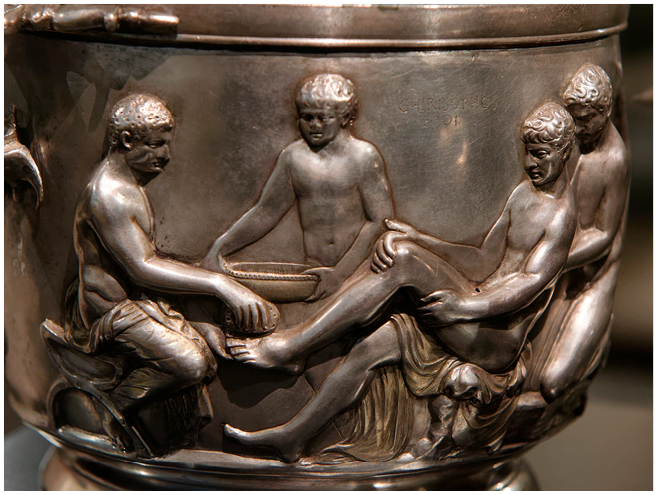
But it is the poet himself who has the last laugh, as Berryman, within the poem, catches his own lechery in the mirror. The moment of recognition is registered by his subpersonalities or alter-egos Henry (as instinct or id) and Mr Bones (as conscience or superego) as the lechery is nipped in the bud in the final stanza:
Berryman, again, cannot be reduced to either Lit. Crit. 101 or pop psychology. His virtues and vices are not simply products of the eternal struggle between the limbic system (affect) and frontal lobes (cognition and rationality); nor just products of his confused relationship with his mother, again detailed in over 700 letters published posthumously for public scrutiny; nor explained by his addictions and prejudices, including his high sex drive; nor by his extreme fluctuations between differing strands of faith and pantheism; nor by his depression and compulsion to suicide; nor by his wizardry with words. All of these are part of a complex with a receding horizon.
What is clear about Berryman, and this can be generalised to the content of this Element, is his overbearing drive to public transparency about his world: psychoanalytically a drive to exhibitionism (he displays himself as he never could to his mother). More than most poets his entire body of work is confessional, again embracing his letters to his mother (included in his archives donated by his widow Kate Donahue to the University of Minnesota’s library and published posthumously) and his account of alcohol addiction treatment in Recovery. Here, then, there is perhaps little mystery about the poet. As noted, he is already in therapy with himself, where his supervisors are public readers and academic commentators. Confidentiality be damned!
Both medicine and psychotherapy have ethical codes of conduct including patient confidentiality. James Hillman (Reference Hillman1997), writing on suicide, notes that strict codes of confidentiality leave clinical encounters as mysteries (in the ancient Greek tradition of Asklepian healing as a mystery cult). ‘Mystery’ comes from the Greek myein that refers to the closing of petals on a flower and of the human eyelids in sleep or contemplation. Unless we see alcohol as the initiatory mystery drug, it is hard to see how Berryman followed such secret methods for his world seems to be ‘eyes wide open’. Hillman (Reference Hillman1997) reminds us that ‘one cannot report about a mystery, because one cannot speak about what one is in’. In other words, abiding by an ethical code automatically ensures entry into the long historical tradition of mystery cults. Referring to ancient Greek mystery plays, Hillman (Reference Hillman1997) continues: ‘When the Gods come on stage all falls silent and the eyelids close. Dipped into oblivion by this experience, one emerges without knowing precisely what has happened; one knows only that one has changed.’
But lyrical poetry is surely one stage for simultaneously breaking and restoring this code of practice. Poetry, in its metaphor invention, simultaneously reveals and conceals. Confession, by definition, offers to the public what may be secrets in professional circles of medicine and psychotherapy. But more, such secrets made public are not necessarily made plain, but again given a gnomic quality through increasing the metaphor count. A beautiful transformation occurs when medicine and psychotherapy pass through the prism of metaphor-rich lyric poetry to emerge as entangled qualities that are deeper in meaning and quality but show gain in opacity. Just as readers will enjoy a poem for its immediate powers, so they will be bemused by possible deeper meanings that have to be excavated through close reading or background knowledge. Similarly, with medicine patients can walk away from a consultation either forgetting or still trying to make sense of what the doctor said (especially if this is offered as medicalese). Berryman’s apparent transparency through the confessional voice of his poetry is actually not at all transparent, but full of deliberate but generous dupery. Swinging between fervent idiosyncratic Catholicism and deep doubt, as noted, the poet considered converting to Judaism just prior to his suicide. Adopting the voice of a (black) preacher and conscience (‘John’ or Berryman himself, abandoning his familiar alter egos), he writes:
Cured of what? – ‘he’s a preacher, too?’ is also a question. The sun is a paradoxical lead, typically an embodied metaphor for depression, drawn from alchemical tradition, where Renaissance and Medieval alchemy was an early form of psychology drawing on embodied metaphors (Bleakley, Reference Bleakley2025b). Yet the poet strides on, animated and ‘cured’. The ‘cure’ perhaps is the curation of his poetry (this poem was published after his death), their preservation. But here we see how a symptom – the sun framed paradoxically as the lead of depression – can be a gift rather than a curse. Depression cures – it anchors; melancholia once considered to be a blessing rather than a curse as the sign of the thinker (see the character Jacques in Shakespeare’s As You Like It).
Already quoted, but worth repeating, let us return to William Carlos Williams’ (Reference Williams1955) exhortation:
What Williams means is clear, but how would we demonstrate it? Poems do not generally bring the news, although a slice of contemporary poetry does indeed comment on current affairs where there is a bigger issue at stake, such as political justice, ethnic cleansing, the climate disaster, mass migration, race and gender discrimination, neurodivergence and so forth. Yet poetry has an ingredient that is missing from many people’s lives, an absence that can cause misery. A first take might suggest that poetry brings pleasure, humour or entertainment. All of these are possible, of course, but more importantly, poetry brings complexity, challenge and verve to the imagination. Some claim that poetry can have a ‘dose effect’ where dished out as a substitute pharmaceutical – see, for example, the best-selling series The Poetry Pharmacy, anthologies that collect key poems dealing with sickness (Sieghart, Reference Sieghart2017). I think that this metaphor is misguided, equating poetry with a cure rather than seeing poetry as quintessentially upsetting or setting out to dislodge us from unproductive habits.
Even so, Rachel Kelly (Reference Kelly2023) reviews a number of studies linking writing, reading and listening to poetry with improvement in mental and physical health. For example, cancer patients found listening to poetry to increase tolerance to pain and to entrain hope. Another study showed that children reading poems showed reduction in stress and offered a medium for them to reflect on their feelings. Writing and sharing poetry can produce feelings of personal empowerment and social satisfaction. But the scientist in me says ‘where are the control groups?’ Any facilitated activity done in group contexts can potentially produce mental health benefits simply from the positive social exposure (regardless of the activity). Again, all of this soft evidence is welcome and commendable, but generally the research is technically flawed, using small samples, unreliable measures of outcome that fail to capture long-term effects and poor use of control groups where a comparison can be made between an intervention and an outcome measure using the poetry stimulus and a matched group where some other intervention is made that is not poetry. Sometimes, it is the effect of the facilitator or the setting that has an effect, rather than the poetry itself – a placebo effect. More important, however, is the prior assumption that the outcome of reading, writing and sharing poetry will be positive or uplifting – a misplaced hypothesis. Here, we are testing for gold on fool’s gold – all surface and no depth.
Rather, poetry is often opaque, irritating, demanding (requiring re-reading and close reading) or hurtful, as it touches raw wounds in the reader (better to leave the wounded beast to be, where prodding it may lead to unexpected disaster). Poetry seems set on hitting vulnerable spots, pricks our collective conscience about injustice, makes the throat catch, supports controversial issues and so forth. Poetry is ubiquitous because metaphor inhabits the vernacular – the very discovery that Coleridge and Wordsworth made as they walked the Somerset lanes to cull local lore, dialect and slang from itinerant farm labourers and tradespeople. This transformed English lyrical poetry from a stiff, formal exercise grounded in Classical and Biblical lore to a vibrant psychological form, as noted. The shift of poetry from high form to the vernacular also embraced a political will to democracy and a challenge to the ingrained English class system. Since then, subjects such as class, ethnicity and religious and racial strife have been popular topics for poets to explore. In ‘Sacred Cow Country’, the Indian poet Unnikrishnan Sivasankara Menon (Reference 70Menon2024) describes in the first stanza a Hindu versus Muslim stand-off:
The Zimbabwean female poet Fungisayi Sasa (Reference Sasa2010) writes, ‘Graveyards overflow, our country is in crisis/ And my heart is a fortress of stone.’ One would not necessarily associate the American poet Robert Frost (Reference Frost1916) with verse about injustice that makes the stomach turn, but ‘Out, Out – ’ does just that. The title references Shakespeare: Lady Macbeth’s ‘Out damn’d spot!’ after the assassination of Duncan, where there is metaphorical blood on the hands from guilt of an actual crime. Frost’s incident is a boy who has an out-of-the-blue accident with a saw that cuts off his hand, a child forced to do an adult’s job:
Most alarming is the callousness of the family, who ‘since they/ Were not the one dead, turned to their affairs’. This description of cold-hearted efficiency might be expected from ‘The doctor (who) put him in the dark of ether’, but not from his kin. Of course, whether art should primarily serve a decorative and entertaining purpose or should be a primary means for challenging preconceptions and upsetting habits is a long-standing debate. Art can do both of course. But poetry as therapy of a soothing nature is not, I fear, in the blood of great literature. Look at the epics: Gilgamesh, Homer’s The Iliad and The Odyssey, Beowulf. Here is discord, strife, battle, confrontation, the deepest of anger and retribution, as well as the lyrical.
Homer’s The Iliad in particular is the earliest text to make poetry out of conflict or extreme human suffering in war (see Figure 10). This knocks the ‘poetry as healer’ argument right out of the ballpark, because Homer, writing out what was an oral song tradition, makes poetry out of the most gruesome details of hurt and suffering, but also of healing. As Marketos and Androutsos (Reference Marketos, Androutsos and Paipetis2008) describe, The Iliad provides a source of understanding of early attention to wounds. Homer’s epic describes 147 cases of battlefield wounding, including ‘106 spear-thrust, 17 sword-chops, 12 arrow-shots, and 12 sling-shots’.
From those ‘wounded by spear, four in five died; of sling victims, about two in three; of sword victims, every one; and of arrow victims, nearly half’. Sword and spear thrusts were usually fatal, whereas arrows more often caused injuries than deaths: when he saw that ‘the arrow’s head binding and the barbs were still outside, his spirit gathered again in his breast’ as he saw that ‘the sharp arrow is not lodged in a fatal spot’. Homer describes the battlefield removal of arrowheads and javelins, followed by bandaging, compresses and use of balm and herbal medicines to aid healing. The injured are often revived with wine. In the process of describing injuries on the battlefield, Homer engages anatomical and physiological knowledge. A wound to the abdomen is described as particularly painful as this may involve a bladder or bowel injury: ‘Meriones struck him with his spear between genitals and navel, the place where death in war comes most painfully to suffering mortals.’ Other vulnerable spots include ‘where the collarbone separates neck and chest’ and ‘where the collarbones hold the join of the neck and shoulders, at the gullet, where a man’s life is most quickly destroyed.’ Here, the relationship of the clavicle to key structures such as the great vessels and the trachea must be known (Chicco, Reference Chicco2020).
The battlefield at Troy. High relief carved in wood.

Where the Homeric texts were originally sung over days by bards, memory was helped by recurring motifs (‘the wine dark sea’). Similarly, there is formulaic poetic repetition of both anatomical sites and injuries (Chicco, Reference Chicco2020). Evisceration is one recurring motif that translates well from the ancient Greek to English through alliteration: ‘all his guts gushed on the ground’, ‘the bronze let his bowels gush out’ and ‘he sank down holding his entrails in his hands’. Bodies eviscerated and splattering are described in formulaic terms, as: ‘all his brains were spattered inside,’ ‘his brains spurted from the wound’ and ‘the marrow spurted out from his vertebrae’.
There are onomatopoeic (echoic, imitative) moments: ‘he fell with a crash, the spear fixed in his heart, and the heart’s jerking made the spear quiver right to the butt’; ‘the sharp stone hit him in the space between the eyes, smashing the two brows together: the bone could not hold, and his eyes dropped to the ground in the dust right there in front of his feet’; ‘the spear passed right through the eye-socket and came out through the muscle of the neck … the heavy spear was still in the eye-socket and he lifted up the head like a poppy-head on its stalk’; and ‘he struck him on the neck below the ear, so the whole blade sank in, and only the skin held: his head fell hanging at the side.’ As Chicco (Reference Chicco2020) notes: ‘While the poetic intent of these descriptions is evident, credibility from an anatomical perspective is preserved.’
Medicine, indeed, is marinated in these vivid anatomical phrases and their metaphorical purposes – again, to raise the value of communication and understanding of the human condition from the reductive, instrumental, mechanical or functional to embrace a wider and deeper set of values. Here, we have seen how poetry related to body, mind and medicine is the generator of embodied metaphors that achieve the transition described throughout, from the merely efficient, linear and instrumental to the complex, embracing a range of values. Moreover, as we engage a poetic imagination, we find that this does not subscribe to a ‘healing’ vision of medicine but rather to a more complex medicinal immersion in pathology as a spur to the imagination. James Hillman (Reference Hillman1975) calls this a ‘pathologising’ aspect of imagination. It is the part of the human psyche that accepts the pathological as the normal, to riff on George Canguilhem’s (Reference Canguilhem1991) questioning of a traditional sharp distinction between the normal and the pathological in modern medicine. An impossible distinction, suggests Canguilhem, is easily shown to be a cultural bias of Western medicine. Pathologising takes two main forms. One is perverse – the pathology of fascination with suffering – a common theme of contemporary lyrical poetry, but as we have seen, it is seeded in the Ur-text of The Iliad.
More, there is a value judgement at work, where the pathological is devalued by medicine as a culture of cure. Psychotherapy, as we have seen, in a sense curates the pathological – not out of sadistic desire, but to give the voice of the psyche – under conditions of strain, discontent and pain – a chance to explain itself. Why these wounds at this time and what is the most suitable response? Without blood flowing, of course, we are given more opportunity in psychotherapy to listen to what wounds have to say. The other is the outlet of the imagination that allows for the rejection of idealism, a Voltaire-like realism that accepts unintentional human agency in wounding, accident, disease and the process of ageing that incurs illness and suffering.
For Hillman, again, the psyche (imagination) naturally produces pathologised images – these appear in nightmares and are cathartically dealt with through the arts – for example, in the genre of tragedy. As a literature scholar and psychotherapist, Hillman sees dangers in literalising the pathologising imagination as cruelty or violence. The point of the poetic imagination is to afford a container for pathology. But also, of course, the body is inherently pathologised – running down to death as entropy and prone to mechanical and physiological dysfunction. This is exacerbated by social and environmental factors – diet, exercise, pollution, conflict and so forth. Hillman (Reference Hillman1975) points to the history of humankind attempting to make sense of insults to body and mind through myth. Drawing particularly on ancient Greek myth, stories of both physical and psychological hurt and wounding are used as a backdrop against which to imagine everyday human encounters and pathologies.
Some figures from Greek myth are transparent – Pan, the hairy and smelly goat god gives us ‘panic’ (Figure 11). He is said to jump on one’s back just as the sun is directly overhead when we cast no shadow. Here, we are at our happiest and purest. And then panic sets in – how can things be so unblemished? Narcissus gives us narcissism or self-love. Hermes gives us hermetic – enclosed or sealed, self-sufficient. Ares and Aphrodite are lovers in myth, yet Ares is the god of war and Aphrodite the goddess of love and sensuality. One strand of their myths tells of Aphrodite taking Ares away from the battlefield and into her bed as a way of toning down his belligerence. There is a lesson here. But also, as Hillman (Reference Hillman2005) points out, humanity has a paradoxical love of war. Again, Western culture’s root epic, The Iliad, is a war book. Moreover, the Western imagination is grounded in ancient Greek myth that is poetry by any other name. How else, then, should we shape our so-called healing and helping professions – medicine and psychotherapy – other than in the image of poetry and its embodied metaphor hoard?
The ancient Greek goat god Pan.
Human psychology and psychopathology can be imagined against the backdrop of myth as it encompasses love, desire, friendship, collaboration, compassion and hospitality; but also trickery, duplicity, mockery, hate and selfishness. Here, stories and their figures afford archetypal configurations against which our personal psychodynamics can be understood. Such configurations form culture. In Francis Ford Coppola’s film ‘Apocalypse Now’ – with the Vietnam War as background and based on Joseph Conrad’s Heart of Darkness – a sadistic warmonger (Lieutenant Colonel William ‘Bill’ Kilgore) looks out at smoke rising from a charred landscape with helicopters whirring overhead and crows. Kilgore – his character embodied in his name – muses: ‘I love the smell of napalm in the morning, it smells like victory!’ This is Ares roaming the battlefield, gloating and unregulated.
James Hillman (Reference Hillman1975) also suggests, contra traditional psychotherapy, that we ask a symptom to ‘speak’ before ‘treating’ it. In other words, do not impulsively or compulsively obliterate the voice of the wound or affliction before it tells its tale. This, of course, is classic Freudian psychoanalysis, but drawing on Jung to provide the mythical touchstones. Freud drew on myth, such as the story of Oedipus to postulate an oedipal conflict. This has been properly critiqued by feminist scholars for its masculinist bias. Paradoxically, it was the arch-womaniser Carl Jung who posited a parallel feminine Electra complex. As far as psychological conditions are concerned, Hillman avoids the medicalisation of conditions as ‘disease’, but rather tries to trace how the psyche presents itself through symptoms, offering meaningful communication.
The first question in therapy is then ‘what does the symptom want?’ Symptoms configure as personal narratives that can be seen against the bigger narratives of myth for insight. For example, returning to panic, it may be that panic attacks should not be ‘treated’ but paradoxically embraced, as ways of returning us to the instinctual (hairy, dirty, smelly) aspects of our lives that we are busily repressing. Hillman encourages a ‘conversation’ with Pan to ask him what he wants – that is, what does the symptom want – before attempting to eradicate the symptom with treatment. This is not to recognise that panic attacks can be debilitating. Rather, how might we get to the root cause of the attacks (psychotherapy’s longer route) rather than simply treat the symptoms (medicine and CBT’s brief routes)?
There are many lessons from ancient Greek theatre (and then in particular advertised by Shakespeare’s plays) about how we misconstrue psychological states. A symptom is not a dysfunction, but rather a functional way that the psyche, unconscious or imagination is trying to convey a meaning. It may be that what conventional psychiatry sees as a ‘symptom’ in an effort to restore a patient to normality or neurotypicality is a neurodivergent gift, such as autism’s echolalia (repeated words or phrases) and stimming (repeated actions but with important minute variations in the activity) seen rather as efforts at precision. Recall the rescue of Philoctetes and the healing of his stinking wound. Let us not banish wounds too hastily, but first allow them to speak. This advice comes with a health warning, a steal from Samuel Beckett’s (Reference Beckett1983) famous mantra from ‘Worstword Ho!’: ‘Try Again, Fail Again, Fail Better’. Thank goodness for dark humour.
Conclusion
A patient presents to her General Practitioner with a cough. The GP notes that this is a rasping cough and not a gentle cough. This is qualified in the brief consultation where the patient is asked to describe the cough: is it persistent or infrequent, painful or painless? Is blood coughed up; is there chest pain, an accompanying fever, shortness of breath and extreme fatigue? From here, the path to a diagnosis can be laid and a treatment prescribed in time. There may be a need for further investigation such as a chest X-ray and/or referral to a pulmonologist. In short, medicine’s primary route is functional.
Another patient visits a psychotherapist with what the GP has told her is a symptom without an obvious cause, probably psychosomatic – a nagging cough and a lump in the throat (nice metaphors for truths that cannot be swallowed, such as excess of pride). The doctor is fortunate enough to have a counsellor in the practice who has some experience in psychodynamic approaches. In the very first session, the woman confesses to a failed marriage, comparing her husband to her father, who left her mother for another woman when she was six. Ever since, she said, I’ve wanted to shout at him, but I cannot bring myself to do that, especially as he’s so vulnerable and frail now. Further, as you guessed, she finds it hard to swallow her pride. Enter poetry on the back of the, albeit hackneyed, metaphor.
The second woman patient is a musician. When she coughs, uncannily, she hears the interruption of a rhythm in her breathing. The first patient is a writer. She does some research and finds that there are over 200 synonyms for ‘rasping’ in the English language, including hoarse, gruff, husky, throaty, gravelly, coarse, rusty, scratchy, grating, croaking, growling and guttural. Out of curiosity, she checks antonyms also and finds: sliding, gliding, skating, polishing, buffing and so forth. Each of these is a metaphor, packed with meaning and intent that are realised through context. For example, where rasping throws up images of a literal rasp working on wood with a scratchy sound and feeling, so sliding conjures images of smooth or unruffled liquid or slippery surfaces readily negotiated. Now we move from categories of information to categories of meaning. The patient is led to write some poetry about her symptoms and feels some relief. She introduces sly comedy through the homophones of ‘hoarse’ and ‘horse’, where she describes ‘buffing a horse’. A psychoanalyst might wonder if she has trouble swallowing her pride or swallowing a truth.
If the doctor were led into such linguistic territory, she may ponder on the fact that each of these synonyms and antonyms registered with the patient will be qualified if placed in a sentence that indicates relative severity of symptoms, length since onset, novel or re-occurring, age and relative health, occupation and place of residence (e.g. accounting for air pollution or other irritants) and so forth. The GP refers her onwards to a specialist, a pulmonologist. The patient wonders if she should discuss her musings on word associations with her pulmonologist. Here, again, can she invoke deeper meaning rather than be left simply with information from the upcoming consultation? Of course, the cough can be treated mechanically, but look at all those linguistic associations concerning the range of tensions between rough and smooth surfaces. There is more than meets the mechanical eye. The psyche is at work too. Poetry is already invoked in glossing the synonyms and antonyms for ‘rasping’. In this case, the second patient is a musician and surely will not miss that ‘rasping’ is onomatopoeic and resonant. Again, poetry is for the asking, as a variety of poetic diction (Barfield, Reference Barfield1984).
The plea here is a paradoxical one – to increase the metaphor count (therefore inviting complexity) in order to nail down some specificity (a definitive diagnosis). This entails a shift from information to meaning, implying poetically that we do not use sloppy, overused (abused), weak, vague or ‘showy’ descriptors. Isn’t this what the specialist needs in making a definitive diagnosis that will dictate the treatment plan? In describing soil that is peaty, thick and damp in appearance and feel, imprecision (it’s just ‘earth’) resists complexity, or multiplying up of descriptors as metaphors for instrumental bluntness. Again, we sit with the paradox that ‘precision’ requires initial generation of complexity (a range of descriptors) before honing in on the best descriptor. Such metaphor generation first deepens appreciation (generation of complexity in ambiguity and/or number of illustrative examples) to afford imaginative impact. From this, the best possible descriptor arises. This is poetry in a nutshell.
As an example, the poet Seamus Heaney (Reference Heaney1966) – in ‘Digging’, from his debut collection Death of a Naturalist – in describing soil, takes us there through the act of digging with a spade (surprisingly, engaging touch before vision). Here, we also get ‘the cold smell of potato mould’ and ‘the squelch and slap/ Of soggy peat’ in the act of digging (associated with memories of his father and grandfather working the land in Ireland), where Heaney’s own digging, as he describes it, is with pen on paper in facilitating the unearthing of memories. Here is a metonymic chain: squelchy peat-digging-potato smell-father-grandfather-the slap of the pen on paper-the poem dug out of memory; and a host of metaphors. But they are specific and neither vague nor showy as they recreate a memory. Of course, Heaney’s ‘Digging’ is not only a description of a remembered physical act but also a digging into the ‘deep well’ of the unconscious to retrieve the precise words for the re-creation of memory through poetry.
This Element has considered how the poetic imagination can bring depth and verve to the typically more functional practices of medicine and psychotherapy. It valorises the use of metaphors, but more, the tolerance and employment of generative contradictions. Look again at that quote from Seamus Heaney above: ‘the cold smell of potato mould’. Does he not mean ‘the cold touch of potato mould’? No, too literal and obvious. Let’s overlap the senses, generate a paradox and crank up the quality of the image. A roaming imagination and tethered protocols must operate together in medicine and psychotherapy: this is quantum thinking, where a wave and particle operate together. Poetry shows how.
Andrew Mangham
University of Reading, UK
Andrew Mangham is Professor of English Literature and Medical Humanities at the University of Reading, UK. For Cambridge University Press, he has edited the Cambridge Companion to Sensation Fiction and, with Clark Lawlor, Literature and Medicine: the Eighteenth Century and Literature and Medicine: the Nineteenth Century. He is the author of We Are All Monsters: How Deviant Organisms Came to Define Us (MIT Press, 2023), The Science of Starving in Victorian Literature, Medicine and Political Economy (OUP, 2020), Dickens’s Forensic Realism: Truth, Bodies, Evidence (Ohio State UP, 2017), and Violent Women and Sensation Fiction (Palgrave, 2007). He is also editor, with Daniel Lea, of The Male Body in Medicine and Literature (Liverpool UP, 2018) and, with Greta Depledge, The Female Body in Medicine and Literature (Liverpool UP, 2013).
Alanna Skuse
University of Reading, UK
Alanna Skuse is Associate Professor of English Literature at the University of Reading, UK. She is the author of Constructions of Cancer in Early Modern England: Ravenous Natures (Palgrave, 2016), Surgery and Selfhood in Early Modern England: altered bodies and contexts of identity (CUP, 2021) and Hurt Feelings: Wounding Oneself in Early Modern Literature (Palgrave, 2025). She has written for academic journals, edited volumes and non-academic publications on topics including Shakespeare, early modern drama, Amazons, cancer and self-harm. Her first book for popular audiences is The Surgeon, the Midwife, the Quack: how to stay alive in Renaissance England (OneWorld, 2025).
Advisory Board
Tristanne Connolly (University of Waterloo)
Liping Guo (Peking University)
Travis Chi Wang Lau (Kenyon College)
Nolwazi Mkhwanazo (University of Pretoria)
Avishek Parui (Indian Institute of Technology)
Brid Phillips (University of Western Australia)
Lindsey Row-Heyveld (Luther College)
Rohan Deb Roy (University of Reading)
Alison Schwartz (St. George’s University of London)
Hülya Yildiz (Middle East Technical University)
Byrad Yyelland (Virginia Commonwealth University)
Marie Arong (University of the Philippines Cebu)
Jurgen Pieters (Ghent University)
About the Series
This series aims to offer an accessible and influential account of the relationship between the humanities and health practices, theories of health, and experiences of healthcare in a truly global context. The humanities play a crucial part in broadening the definition of health. Stories, dance, singing, chanting, roleplaying, and artistic representation have shaped health practices all over the world for thousands of years. These Elements balance new and fresh interpretations of the field with useful overviews that will be of use to readers new to the subject. Combined, they offer a rigorous account of health humanities while taking the subject into new and diverse territories through both a truly global and radical focus, and the inclusion of sounds, images, and videos.
The series presents unprecedented coverage of the topic, exploring major health emergencies and the roles the humanities have had, and continue to have, in attempts to address them. It also considers innovative methodological approaches which seek to decolonise the subject and deconstruct its traditional associations with Western history.