I wish that I could play like José Iturbi, instead of blowing notes into a derby.
Someone who knows art takes something from Mozart to sing, instead of swing.
—“The Trumpet Player's Lament”
by Johnny Burke and James MonacoFootnote 1
African American freelance arranger Francis “Chappie” Willet (1907–76) presumably had no part in creating the lyrics for “The Trumpet Player's Lament,” a song recorded in 1938 by his frequent client Louis Armstrong.Footnote 2 But the references to European classical repertoire (the lyrics also cite Debussy and “Vesti la giubba”), its opposition to popular swing music, and even its invocation of virtuoso classical pianist José Iturbi—whose naming is programmatically accompanied by solo piano—reflected significant aspects of Willet's own career. Willet was one of many Swing Era musicians who partook in “jazzing the classics,” a tradition that has long suffered the stigma of commercialism and artistic inauthenticity within the highbrow/lowbrow discourse in American culture, despite—or perhaps due to—its consistent popularity.Footnote 3
“Jazzing”—or, in Swing Era parlance, “swinging”—the classics can be defined as the musical arrangement of, or the inclusion of explicit musical reference to, European classical repertoire in combination with syncopated dance rhythms, jazz instrumentation, or popular song forms.Footnote 4 John Howland examines a similar hybridity within U.S. popular music in the context of the “symphonic jazz” tradition, arguing that “during the 1930s and 1940s, most contemporary critics damned this miscegenation of concert hall culture, entertainment intent, jazz, dance band arranging, Tin Pan Alley tunes, and quasi-symphonic instrumentation as mongrel, middlebrow culture for the masses.”Footnote 5 Although the practice of jazzing the classics may differ from symphonic jazz in musical approach and intent—the label “symphonic jazz” is often applied to original composition, such as Gershwin's Rhapsody in Blue—it has resided in the same “middlebrow” battle zone between cultural signifiers of high and low art. In its manipulation of venerated classic texts, jazzing the classics has been read as either an irreverent poke at the establishment or as a genuine adulation of the European repertoire manifested through efforts to bring the music to a wider (popular) audience; sometimes, it appears to have involved a little of both.Footnote 6 David Stowe notes that Swing Era bandleaders were also drawn to swinging the classics “because those classics were in the public domain and could be performed without paying royalties” (an aspect highlighted by the 1941 ASCAP strike), but the tradition is not dependent on this factor alone.Footnote 7 The hybrid tactic reflects a strategy critical to many modes of entertainment designed for broad popular audiences: the juxtaposition of cultural signifiers perceived as oppositional or contradictory.
Contemporary Swing Era media provides plentiful examples of criticism surrounding jazzed classics; as Scott DeVeaux has pointed out, much of the ink spilled was clearly aimed to “boost circulation by fanning enthusiasms and controversies.”Footnote 8 Media responses to Chappie Willet's arrangement of the first movement of Beethoven's Piano Sonata, op. 13 (“Pathétique”), recorded by Jimmie Lunceford in February 1940, included some revealingly mixed (if predictably dogmatic) reactions, reflecting the high/low discourse surrounding crossings of European classics and jazz.Footnote 9 A writer for the New York Times commented, “department of bad taste: Jimmie Lunceford has perfected a swing arrangement of Beethoven's ‘Sonata Pathétique’ which ‘storms down the house whenever he plays it,’ according to his representative.”Footnote 10 In the black press, a Chicago Defender columnist wrote that “[Pathétique] doesn't fit the Lunceford aggregation, which may or may not suggest that he stick to swing and hot stuff.”Footnote 11 Another black paper, the New York Amsterdam News, ran a brief article titled “Jimmie Lunceford Knows His Musical History”: “[Lunceford] knows his swing, but he knows the classics too. During a recent air interview, a music commentator mispronounced the name of Beethoven's ‘Sonata Pathetitique.’ Jimmie politely corrected the abashed ‘expert.’ . . . Lunceford has perfected a swing arrangement of this famous classic which storms down the house whenever he plays it.”Footnote 12 The tone of these criticisms presumes an implicit understanding on the reader's part regarding the cultural boundaries of swing and classical domains: exactly why the piece “doesn't fit,” was in “bad taste,” or why Lunceford's knowledge of “the classics” or Beethoven would be newsworthy apparently needs no explanation. The commentators may never have even heard the arrangement, as Lunceford's management was clearly hyping the piece as a publicity tool to advertise the variety of his repertoire—or even to fan the media controversy themselves.
Whether the venue was a dance hall, radio studio, or theater stage, well-paced Swing Era popular music programs required a succession of pieces reflecting changes in tempo, mood, or formal design. A 1938 Billboard magazine review of a Lunceford band performance at the Kit Kat Club in midtown Manhattan celebrates the importance of variety and contrast: “[Jimmie Lunceford's] showmanship is superb, and his constantly changing style keeps one's eyes glued on the podium. Swingeroos, ballads, novelty numbers follow one another in rapid-fire succession, executed with the finesse that only first-rate swing musicians can bring to current musical modes.”Footnote 13 The performance of recognizable European classical repertoire would emerge as an especially controversial (i.e., effective) tool within this variety entertainment formula.
Later critics continued to grapple with issues of stylistic hybridity. Gunther Schuller critiqued the “jazzing the classics” tradition in provocative rhetoric,Footnote 14 characterizing it as “falling ineptly between jazz and classical music”; he criticizes Claude Thornhill's 1940s arrangements of Dvořák's “Humoresque” and Schumann's “Träumerei,” for example, as “corny and effete in the extreme.”Footnote 15 Schuller has also taken aim at Lunceford's recording of “Pathétique.” Citing this event as a key turning point in the fall of Lunceford's musical fortunes, Schuller writes:
[A]s if to underscore [Lunceford's] by now almost obsessive insistence on variety . . . the band descends to the absolute depths in an unspeakable arrangement (derangement would be a better term) of bits and pieces of Beethoven's Sonata Pathétique, a truly pathetic offering. From now on the band flounders erratically towards its ultimate decline.Footnote 16
Because Schuller did not identify the arranger—elsewhere he praised Willet's work for Armstrong and Gene Krupa—the attack appears to indicate less of a distaste for Willet's individual skills than for the broader practice of “jazzing the classics,” and even the entire middlebrow variety stage entertainment tradition (a recurring theme of Schuller's jazz history projects).Footnote 17
Schuller's attack on swing musicians’ “pitiful and naïve . . . attempts at bridging the two [classical and jazz] fields” recalls other critics’ charges of inauthenticity leveled at labels ranging from Dixieland to “smooth jazz.”Footnote 18 Yet it is difficult to identify any broad Swing Era musical commitment to “bridge” jazz and classical music, as compared to the artistic—and, yes, commercial—motivation to create material capitalizing on established cultural dichotomies like classic/popular, black/white, urban/rural, or old/new. For freelance arrangers like Willet, commercial success depended upon the development of musical fluency across a number of genres, including classics, jazz concertos, novelty songs, vocal ballads, jazz dance specials (or “swingeroos,” as described above), and exotic numbers. These genres served as vehicles for an array of signifiers referencing modernism, high art, drama, virtuosity, exoticism, or visual spectacle. Willet's legacy as a commercially successful black musician working in a segregated entertainment industry that often invoked racialized conceptions of style and creativity demands a consideration of the motivations behind some of these common Swing Era arranging strategies. This article explores Willet's career as a freelance music arranger in New York City, considers some prevalent “modernist” orchestration techniques that mark his work, and closes with an analysis of “Sonata Pathétique” as an example of “jazzing the classics” that reveals some of the commercial, political, and artistic forces at work behind these hybrid creations.
Race and Commercialism in Swing Era Arranging
Jazz critics have placed arrangers into hierarchical categories: some are dismissed as forgettable “craftsmen,” others celebrated as geniuses. In much criticism, preconceived aesthetic standards overshadow considerations of the professional requirements that may have prompted an arrangement's creation in the first place. Swing Era critic George T. Simon invokes well-established themes of jazz criticism when he divides swing dance band repertoire into categories of “stupid pop” tunes that demonstrate “mere craftsmanship” and “wonderfully fresh-sounding originals” that reveal “artistic creativity,” more often than not presented in the form of “inspiring instrumentals.”Footnote 19 Although the act of arranging has been a component of instrumental and vocal jazz since its inception, writers like Rudi Blesh and Amiri Baraka posit its very existence as a dilution of performer-centered artistic essence or cultural identity.Footnote 20 Gunther Schuller asserts that “an arranger's creativity, no matter how skillful and sensitive, falls some degree short of [compositional] totality. . .. Only in rare instances . . . can [arranging] achieve the authenticity of full creation.”Footnote 21 What is it about the legacy of arrangers, or arrangements themselves, that motivates this critical rhetoric, isolating the practice from all other components of music making? The answer seems to revolve around long-standing—if often contradictory—concerns regarding the transparency of artistic identity and cultural ownership.
Few Swing Era music stars were active composers or arrangers themselves; still fewer wrote large numbers of works for their own bands. Dance bandleaders Benny Carter, Duke Ellington, Fletcher Henderson, and Stan Kenton are among the few exceptions, but even they ultimately turned to others for arrangements.Footnote 22 Musical directors and bandleaders frequently relied on relatively anonymous freelance arrangers for much of their repertoire. Dance bands might employ printed “stock” arrangements distributed by the song's publisher, aural transcriptions based on another band's recorded performance, or individually commissioned “special” arrangements designed for a specific client or occasion, sometimes including original compositions by the arranger.Footnote 23
In addition to writing works for hire, some Swing Era arrangers were offered a type of semi-salaried position loosely referred to as a “staff arranger,” whereby they could be engaged by bandleaders at relatively low cost in exchange for the financial security of regular commissions.Footnote 24 Bandleader Gene Krupa claimed that arrangements by Chappie Willet and Jimmy Mundy “helped us achieve identity. People always said they could tell it was the Krupa band on the radio.”Footnote 25 But while devoted swing fans might go so far as to trace their attraction to a particular band to the contributions of its staff arrangers, such quests for artistic identity were not always supported by industry practices. Regarding the title of “staff arranger” itself, freelance arranger Lyle “Spud” Murphy explained:
The way it usually worked out was you would do arrangements—two or three for somebody. And if they liked them, they tried to give you as many as they could. It kind of became a staff arranger, but nobody looked at it that way. In other words, I was Goodman's “staff arranger,” but I was also Casa Loma's “staff arranger,” you know? I was also arranger for Joe Haymes. It didn't make any difference, you took whatever jobs there were. Unless somebody wanted to sign you to a contract. And nobody did, ‘cause they could get you any time they wanted anyway.Footnote 26
Such promiscuous activity could influence an ensemble's musical identity. Indeed, similar (or nearly duplicate) versions of at least five of the Willet “special” arrangements Krupa recorded during 1938–40 had been previously recorded or performed by other bands, including well-known standards (e.g., “I Know That You Know,” previously performed by Armstrong) and original compositions (e.g., “Blue Rhythm Fantasy,” previously performed by at least four other New York–based orchestras).Footnote 27 Although Willet did create some scoring variations when he provided arrangements of the same composition to multiple clients (substituting a Krupa drum break for an Armstrong trumpet break, etc.), the musical similarities usually remained overwhelming.Footnote 28 In this context, it could be argued that it was the Swing Era dance bands that were helping freelance arrangers like Willet to “achieve identity.”
In 1941, the New York Times ran a story on radio arranger Paul Baron, who complained that “the conductor and the vocalist stand up for the cheers—whether radio, vaudeville, the theatre—and the arranger slinks off to do another exacting job so that someone else can earn more cheers.”Footnote 29 Baron's perception of the “general public's lack of knowledge of the art of orchestration and arrangement” does not appear to have been the fault of contemporary media.Footnote 30 Despite the inherently backroom nature of music arranging, Swing Era press coverage championing the work of arrangers is not rare; indeed, the period stands as a golden era in terms of public recognition of the discipline. During the late 1930s, issues of trade magazine Metronome included sample arrangements with photos and brief biographical sketches of selected arrangers (“Your Arranger This Month”);Footnote 31 in 1941, Don Redman was the subject of a special tribute, highlighting the arranger's contributions as a “style-setter and a pace-maker” over the preceding twenty years.Footnote 32 Critic Leonard Feather presented biographical spotlights on arrangers in Down Beat magazine's “Men Behind the Bands” column during the early 1940s.Footnote 33 In the black press, the New York Amsterdam News embraced successful “race” arrangers like Willet and Jimmy Mundy as “the unseen power behind the throne” and “unsung heroes of swing.”Footnote 34
The descriptors “unseen” and “unsung” highlight not only the public's perception of arranging work in general, but also the position of black musicians within the white-controlled Swing Era music industry. Some historians have cited bandleaders’ crossing of color lines in their hiring of arrangers to suggest that Swing Era competition “became so intense that racial ‘segregation’ among arrangers [and client bandleaders] fell easily.”Footnote 35 But black arranger Phil Moore provided his own observations of industry practice in the September 1946 issue of Negro Digest: “there are two musicians unions in practically every principal city in the country, except New York. . .. [Jurisdiction] zones are set up more or less by the white locals. . .. Whenever a [black] man wants to get a job that pays decent money he has to be okayed by the white local.”Footnote 36
Racism and exploitation were never far beneath the surface of the mainstream Swing success story. One prevalent theme in contemporary media is reflected in a 1941 Chicago Defender feature, “Harlem's Music Arrangers Make Broadway's Tops Leaders” [sic], in which correspondent Major Robinson highlighted the dependence of “Broadway” (i.e., mainstream white entertainment) on the unheralded contributions of black arrangers and songwriters including Fletcher Henderson, Edgar Battle, and Andy Razaf. Citing the results of radio disc jockey Martin Block's nationwide orchestra popularity contest, Robinson claimed that “of the majority of topflight white bands that copped choice spots, more than 75 percent of their arranged scores are turned out by colored arrangers.”Footnote 37 The sources of Robinson's statistics are not provided, but others shared his perception. A 1939 Baltimore Afro-American column by Lillian Johnson similarly raised the issue of black arrangers writing anonymously for white bands:
I certainly disapprove of the lily white bands that use the arrangements of the colored musicians, without giving them the chance to play.
By that, I mean that if a man is a good musician and a good arranger, I feel that it is unfair to himself and to his people to go over to a white band where he will be used solely in the back room of the band, and often at a salary that is much less than that paid any other person connected with the outfit.
If he is a professional arranger and has an office for that service alone, such as Chappie Willet has, then that is a horse of another color. . ..
The white boys may not have the native ability, but they have plenty of ambition and perseverance, and that's a combination that's hard to beat.Footnote 38
The exception made for Willet is likely in deference to the arranger's well-publicized work for Krupa. A 1938 Pittsburgh Courier article announcing Krupa's invitation for Willet to join his “staff of arrangers” reveals the potential reservations behind such a relationship:
Should Willet accept the spot which is vacant for him, this will mark the first time in his career that he has done such for an ofay [white] leader. In the past he has devoted his talent to the colored field exclusively, not because of any difference of feeling said he, but just because the colored boys seemingly needed someone to devote their time to them and them alone, as everybody was doing such work for white bands.Footnote 39
Johnson's comment regarding “native ability” references long-held presumptions of blacks as possessing innate musical talent, especially for jazz. This association carried over into conceptions of race and artistic authenticity as reflected in the repertoire of dance band “special” arrangements: unpublished orchestrations portrayed as focusing on the “hot”—often read “black”—jazz idiom, highlighting rhythmic syncopation and improvisation.Footnote 40 Perhaps reflecting a corollary image of commercially published stock arrangements as the domain of white musicians, a 1941 Billboard magazine bandleader poll listed black arrangers Fletcher Henderson and Sy Oliver in the top two “best special arranger” slots, whereas all seven arrangers listed in the “best stock arranger” category were white.Footnote 41 A 1944 Billboard magazine review offered similar opinions on the provenance of “special” arrangements via claims of an exception that purportedly proved the rule: “unlike most Negro bands around, [Claude] Hopkins's doesn't depend upon fancy and over-harmonized effects. Band, instead, dishes up very commercial type of dance music with little frill, fuss or trimming. . .. Tunes in the books are current pops for the most part, another deviation from most colored jump bands around. Latter usually have plenty of specialties in the books.”Footnote 42 David Stowe offers instances of contemporary performers making distinctions between the aesthetics of black orchestras, perceived as “loose and swinging,” and white orchestras, represented by “sophisticated arrangements and precise ensemble execution . . . sweet bands not generally respected by swing critics.”Footnote 43 Likewise, the “sweet” waltz and ballad genres were “not associated with ‘race’ outfits”Footnote 44—at least in the imagination of jazz authenticity, which tended to prize up-tempo dance numbers, novel orchestration devices, or improvisational displays.
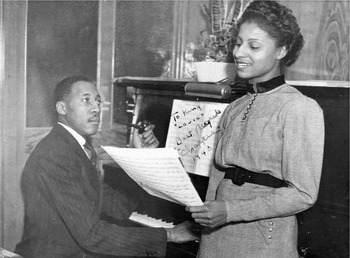
Like many freelance arrangers, black or white, Willet took work scoring stock arrangements, but he primarily marketed himself as a creator of the more prestigious (and less “commercial”) special arrangements.Footnote 45 In fact, Willet's considerable efforts to market himself throughout the Swing Era reveal a side of the arranging business that traditional performer-centric music histories have tended to obscure. The 1936 opening of the Broadway Music Clinic, Willet's midtown Manhattan offices and talent school (Figure 1)—later to include a recording studio and publishing venture—not only marked the arranger's establishment on the Times Square entertainment scene, but initiated a period of media coverage in the black press that easily rivaled that of his competitors. Just how much of this coverage was legitimate documentation of a brilliant career, or merely evidence of personal relationships Willet had carefully cultivated with influential entertainment columnists, remains open to speculation. In several instances, the publicity suggests a conscious campaign by Willet and his media champions to invent the category of celebrity arranger. For example, the 1938 Amsterdam News feature “Unsung Heroes of Swing”—just one of the generous photo spreads to hype Willet's career during this period—positions Willet first in a list of celebrated black arrangers that includes Edgar Sampson, Jimmy Mundy, and Will Vodery, among others.Footnote 46 Even a series of Amsterdam News advertisements for Harlem's Garden Barber Shop, which featured photos and endorsements from performer celebrities like Louis Armstrong and Lucky Millinder, included an unlikely endorsement from Willet (“tools always SHARP; atmosphere never FLAT; courtesy ever NATURAL”).Footnote 47
Publicity photo sent to Louis Armstrong (“To King ‘Louie’ Best Regards ‘Chappie’ 1940”); the photo probably dates to December 1937. Willet accompanies client Carrie Belle Powell (vocalist with the orchestras of Willie Bryant and Claude Hopkins) in his midtown Manhattan office, located on West 44th Street off Broadway; Powell holds a copy of the 1936 published leadsheet for Willet's (instrumental) composition “Blue Rhythm Fantasy.” Courtesy of the Louis Armstrong House Museum.

In keeping with the editorial tone of the 1930s black press, much of this publicity also frames Willet's business and artistic success as an exceptional “race” achievement within the music industry—a view that the arranger appears to have embraced. The following quote, first printed in a September 1940 Amsterdam News article, exemplifies the tenor of many Willet media statements:
“I have a great many white students,” explained Mr. Willet, “but I am here primarily to aid undiscovered talent in my own race, many of whom aren't aware of the fact that I am a Negro. It is time that we did something for our talent, instead of sitting idly by while countless white firms reap a fortune yearly from selfish exploitation of Negro entertainers. There is a great deal of new talent but white studios are not willing to train talented colored stars of tomorrow. If my efforts can do some little something to correct this present condition, I shall feel completely justified in my many sacrifices to build this organization.”Footnote 48
Regardless of his credentials to claim “native ability,” Willet prominently advertised his formal music education at West Virginia State College (WVSC; formerly the West Virginia Colored Institute), which he attended between 1929 and 1933. The affiliation allowed him to advertise an association with composer and classical violinist Clarence Cameron White, a well-connected figure in the black music community who taught at WVSC from 1924 to 1930.Footnote 49 Representative of many (if not virtually all) college music programs of the period, the instructors at WVSC appear to have trained Willet solidly in the European classical tradition. Publicity for recital performances given by Willet's music teachers list established repertoire such as Bach's Toccata and Fugue in D minor, Beethoven's Piano Sonata, op. 57 (“Appassionata”), Schumann's Romanze, op. 28, no. 2, Chopin's Prelude, op. 28, no. 22, and Liszt's arrangements of “Hark, Hark, the Lark” and “Tannhäuser March,” as well as “Juba (Dance)” (1913) by African American composer R. Nathaniel Dett.Footnote 50 A 1933 student recital included Willet's own “Binnorie,” whose European fairy-tale-inspired title suggests a work out of the European romantic tradition.Footnote 51 For his graduation piano recital, Willet performed Christian Sinding's 1896 “Marche Grotesque” (op. 32, no. 1), and a movement from Polish composer Alexandre Tansman's more recent Sonatine Transatlantique (1930).Footnote 52
Like other collegiate arrangers of his generation, Willet's exploration of the world of popular music was an extracurricular endeavor.Footnote 53 Following a brief career as a leader of college and territory dance bands (1932–34), Willet made the move to New York City, initially writing for stage shows at Harlem's Apollo Theater.Footnote 54 As the Swing Era flourished, he was called on to score the lavish stage productions of midtown Broadway venues like the Cotton Club and Café Zanzibar (typically packaging black entertainment for white patrons), in addition to providing special arrangements for Armstrong, Krupa, Lunceford, Cab Calloway, Duke Ellington, Red Norvo, and other “name” bands.Footnote 55 The range of Willet's professional experience—from rural territory tours to elite New York nightclubs, from black Harlem to white Broadway—offers significant parallels to the “variety” musical aesthetic that formed the basis of his stage show arranging reputation. Combined with an explicitly visible role as a media icon of race politics, Willet's identity as a classically trained African American jazz arranger with extensive experience in the theater world positioned his career at the nexus of Swing Era artistic, political, and commercial concerns.
The Swing Era Show Band Sound
Writing in 1939, white Broadway arranger Robert Russell Bennett claimed that “theatre orchestration was undoubtedly the main source of ideas for dance orchestras, at first in its effect on the printed arrangements from which all dance bands played and, later, as the bands elaborated on these printed arrangements, in its more imaginative combinations.”Footnote 56 Although Bennett may be biased, he does highlight the pervasive influence theater music has had on other areas of popular music, especially Swing Era dance bands. Indeed, some contemporary professionals considered musicians working in orchestral theater music to be in a vocational class “above” that of touring dance bands or smaller nightclub ensembles, a view that suggests that the “lower” class ensembles may have turned to theater-related musical forms as an exercise in upward mobility.Footnote 57 The reputation that Bennett and other white Broadway arrangers enjoyed as “composers of long classical training”Footnote 58—versus merely “arrangers”—perhaps reinforced notions of the theater world as approaching the more rarefied plane of “legitimate” music.
One of the more transparent roles for Swing Era freelance arrangers emerged when bands were engaged to perform in nightclub or theater revues—lucrative engagements integral to many dance bands’ economic survival—where the orchestra might be required to temporarily shed their own established stylistic identity in order to perform music arranged to accompany the various stage acts featured in the program.Footnote 59 By emphasizing their own musical style, stage production arrangers like Willet, Will Vodery, or Tom Whaley could provide continuity for a season-long show or tour that might cycle through a number of different backing bands.Footnote 60 Not surprisingly, some of these arrangers were sought out by dance bandleaders as a result of reputations established in the theater medium; stage show music created by Whaley and Billy Strayhorn, for example, played a major role in securing employment from Duke Ellington.Footnote 61 Willet's stage show work appears to have been a factor in impressing client Gene Krupa, who recalled: “I'll never forget how much [Willet] did for bands that had to play shows; invariably vaudeville acts brought in music that was worse to listen to than to play, and it was murder to play from those sad, cut-up, marked-up, beat-up stocks. Chappie had the knack of being able to put down on paper what the performer wanted, and yet make it sound good.”Footnote 62 Yet despite the longstanding relationship between jazz, dance, and theater, music of the stage medium has long suffered the anti-commercial rhetoric of performer-focused jazz histories. Schuller felt it necessary to ask, “How did Ellington, at first a musician with a decided leaning toward ‘show music,’ develop into one of America's foremost composers?”Footnote 63 Jazz critic Barry Ulanov criticized elements of stylistic variety in one of Ellington's Carnegie Hall concerts as reflecting a “glorified stage show.”Footnote 64
In tracing the development of urban entertainment genres combining music and theater that emerged during the early twentieth century, John Howland reclaims the term “glorified” as a specific genre identifier (not a pejorative adjective) to describe a widely prevalent popular music arranging aesthetic. Stage revues comprising song, dance, and comedy acts out of the vaudeville tradition often incorporated thematic elements emphasizing contrast and variety through programmatic tropes of high and low culture.Footnote 65 This strategy was reinforced by musical scores designed to provide supporting variations in melodic theme, tempo, key, and meter—techniques especially well suited to the creation of extended production sequences that required controlled pacing and “spectacular” climaxes reinforcing visual choreography.Footnote 66 These hybrid arrangements often promoted “black folk music idioms” in synthesis with “Euro-American classical form and style,” emphasizing the juxtaposition of popular music styles and other characteristic scoring textures.Footnote 67 By the 1930s and the arrival of big band popular music, many of these codes were easily recognized and even parodied. An especially pervasive reflection of modernism common to the works of Willet and other Swing Era composers and arrangers is precisely the combination of contemporary concert music signifiers—such as tonal chromaticism—with African American popular music signifiers—often through identifiably “jazzy” performance techniques such as blue notes, lip slurs, or growls.Footnote 68
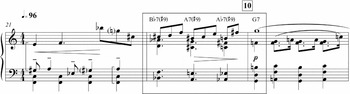
Sonatine Transatlantique: “Spiritual and Blues” mm. 21–23, by Alexandre Tansman (1930). Alphonse Leduc – Robert King, Inc. A subsidiary of Editions Alphonse Leduc (Paris). Used by Permission. Chord symbols have been added by the author.

One relevant example of this modernist approach comes from the other side of the Atlantic: Tansman's Sonatine Trantlantique. In the foreword to the score, Tansman explained that he composed the work to “record ‘the reaction’ of a European musician to contact with overseas dance rhythms,” which he had heard during a visit to the United States in the 1920s.Footnote 69 Movements titled “Fox-Trot” and “Charleston” bookend “Spiritual and Blues,” where the composer injects passages of chromaticism into textures evoking the vernacular idioms cited in the title, including a chromatic sequence of parallel descending blue note phrases (Example 2). A student reviewer of Willet's 1933 recital performance rode the hybrid theme: “‘Spiritual and Blues,’ by Tansman . . . proved to be Mr. Willett's [sic] most impressive rendition for the evening. The blending of the Negroic notes into classic brilliance portrayed Mr. Willett's individual technique very beautifully.”Footnote 70
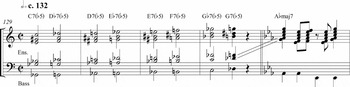
Whole-tone interlude voicings after “Stratosphere” mm. 77–83 (1:13), by Jimmie Lunceford (probably 1934, as per date of recording).

During this period, the combination of European concert music ideologies and African American jazz meant nothing less than, in Carol Oja's words, “crossing racial barriers in an era of segregation and blurring distinctions between art and entertainment.”Footnote 71 Oja identifies tonal chromaticism as an important modernist technique of composers working in New York City during the 1920s, where the device is often invoked in “juxtaposing an experimental voice . . . with a traditional one.”Footnote 72 Guthrie Ramsey posits a parallel “Afro-modernism” that emerged in urban America from the 1920s through the 1940s as a result of the Great Migration; he describes modernity as reflecting the articulation of “historical actors’ self-conscious attitudes about and their responses to the relationship among the past, the present, and the future.”Footnote 73 Among the discourses indicative of a modernist aesthetic, Ramsey identifies a purposefully “antagonistic relationship between ‘high art’ and mass culture” highlighted by a recognition or reinforcement of “cultural hierarchies.”Footnote 74 Willet likewise negotiated musical codes representing idioms of a sophisticated present or “high” European concert music (symphonic orchestration techniques, rubato tempi, or tonal chromaticism), and a quaint past or “low” African American vernacular music (syncopated jazz, ragtime marching band music, show tunes, folk songs, or spirituals), extending an emerging “middlebrow” aesthetic established by a preceding generation of black arrangers based in Harlem.Footnote 75
Whole-tone Modernism
The chromatic alteration of diatonic chords through a lowered (flatted) or raised (augmented) fifth scale degree, employed as a harmonic reference to one of the symmetrical whole-tone scales, was an especially prominent musical trope in 1920s Jazz Age and 1930s Swing Era popular music arrangements. The scale's avoidance of a clear tonal or modal center provided a recognizable foil to traditional Western harmony. In his influential 1926 text, Arranging for the Modern Dance Orchestra, Arthur Lange demonstrated examples of parallel voicings for dominant-seventh chords, dominant-ninth chords, and dominant-seventh chords with raised or lowered fifths, including voicings with the flatted-fifth degree voiced in the bass.Footnote 76 He especially praised the “psychological effect” of using chromatic augmented-fifth chords in modulation passages.Footnote 77 Corollary to Lange's observations, a number of 1930s dance band radio theme song “special” arrangements, like “Chant of the Weed” (Don Redman's orchestra), “Jazznocracy” (Jimmie Lunceford), “Uptown Rhapsody” (Teddy Hill), “Blue Rhythm Fantasy” (Willie Bryant), and “Apurksody” (Gene Krupa)Footnote 78—the last three arranged by Willet—employ the whole-tone effect at some point (if not extensively), presumably intended as an aural attention-grabber.
Historians and musicologists have shown a similar preoccupation with the use of European-identified harmonic structures, especially in their attempts to identify connections (or divisions) between jazz and classical music.Footnote 79 DeVeaux traces the lineage of the “indisputably ‘modern’” whole-tone-based effect from Debussy and Ravel to Horace Henderson's 1933 arrangement of Coleman Hawkins's whole-tone based “Queer Notions.”Footnote 80 Ken Rattenbury posits that Duke Ellington's “use of bitonal clashes and whole-tone flurries” in “Ko-Ko” (1940) evokes Debussy.Footnote 81 Lawrence Kart suggests that these techniques of “conscious modernity” are intended to be heard as “exotic exceptions to a norm that is, in effect, being reinforced.”Footnote 82
The whole-tone trope remained solidly entrenched in American dance band arranging throughout the Swing Era. Examples of its use in the type of isolated instances outlined by Lange—where whole-tone voicings are employed in an introduction, interlude, or modulation passage separating choruses built on diatonic harmony—include Will Hudson's 1934 compositions “Wild Party” (recorded by Fletcher Henderson) and “Jazznocracy” (recorded by Lunceford).Footnote 83 Lunceford's 1934 composition “Stratosphere” includes a chromatic sequence of parallel altered-fifth dominant voicings followed by unpredictable rhythmic breaks and scoring for timpani drums: devices that offer further programmatic associations with European orchestral concert music.Footnote 84 In this instance, flatted-fifth dominant chord voicings include the ninth scale degree, a common harmonic extension that also reinforces the whole-tone quality of the voicings (Example 3).Footnote 85
“After You've Gone” mm. 129–33 (1:56), arr. by Willet for Louis Armstrong (probably 1937, as per air check date). Transcription by the author.

Similar to “Stratosphere,” Willet's use of whole-tone harmony frequently takes the form of sequentially parallel augmented or flatted-fifth dominant voicings—often with the flatted-fifth degree scored in the bass, recalling Lange's examples cited earlier.Footnote 86 Willet's modulating interlude passage in a 1937 arrangement of “After You've Gone” for Louis Armstrong's orchestra (Example 4) is typical: ensemble dominant-seventh voicings with raised and lowered fifths are scored in half-note stop-time rhythm, further highlighting the passage's modulation from the key of C to E-flat by temporarily disrupting the rhythm section's established quarter-note dance rhythm.Footnote 87
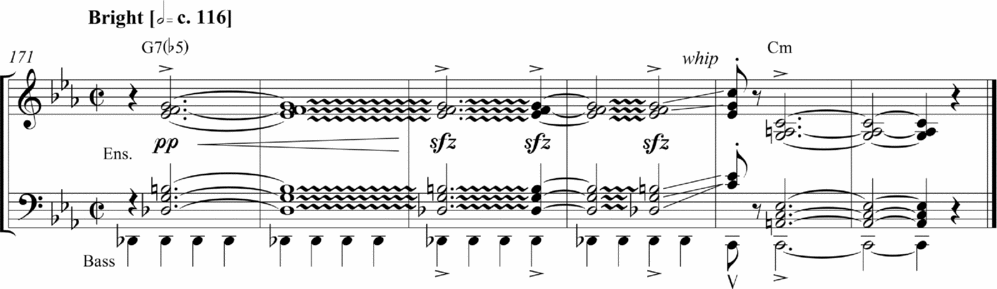
“Prelude in C-sharp Minor” mm. 171–76 (2:54), arr. by Willet for Duke Ellington (1938). Chord symbols reflect the manuscript guitar part.
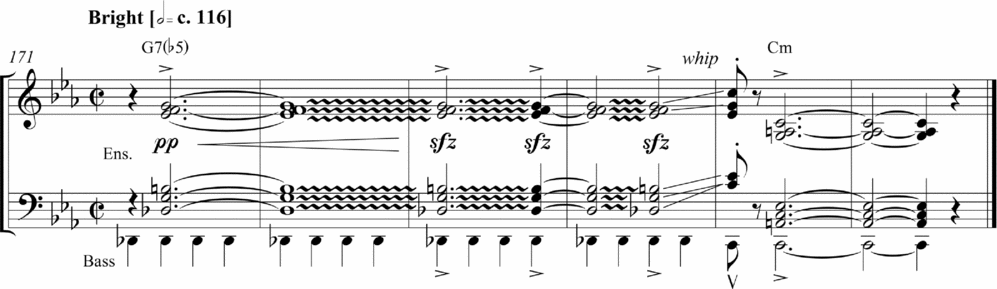
Another of Willet's whole-tone strategies is to hold or repeat a single whole-tone chord over a static pedal bass, as in his 1938 arrangement of “Prelude in C-sharp Minor” for Duke Ellington (arranged in the key of C minor)—again scored with the flatted-fifth in the bass (see Example 5).Footnote 88 As will be discussed later, this device resurfaces in “Pathétique,” where Willet employs his favored arranging techniques in a virtuosic, modernist swing interpretation of classical repertoire.
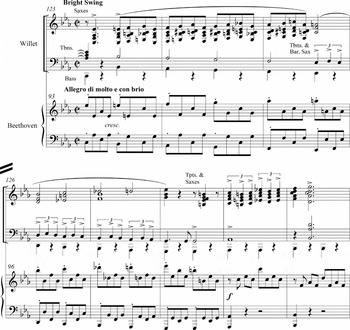
Comparison of “Sonata Pathétique” mm. 123–30 (2:10), arr. by Willet for Jimmie Lunceford (1940), and Beethoven's original solo piano score.

“To Show Off Our Musicianship”
The reputation of the Jimmie Lunceford orchestra as an exceptionally virtuosic “hot” black dance band is critical in exploring the context of Willet's “Pathétique,” elements of which were clearly designed to appeal to American audiences’ fascination with technical showmanship associated with the European classical tradition.Footnote 89 As compared to other swing dance bands (e.g., Count Basie's), Lunceford's ensemble presented “virtuoso showcase[s]” through arrangements that featured contrasting—even unpredictable—orchestral textures and ensemble dynamics.Footnote 90 European critics and African American musicians alike responded that “everything was played with the utmost precision,” or that “not many bands shared that precision.”Footnote 91 Patrick Burke argues that efforts by black “precision” swing ensembles like the John Kirby sextet worked to subvert racial stereotypes by demonstrating “to a large and diverse audience that black musicians were capable of ‘musicianly and versatile’ performances that involved ingenious arrangements and disciplined ensembles as well as inspired improvisation.”Footnote 92 Just how consciously such strategies might have applied to an individual work like “Pathétique” is difficult to assess without explicit testimony from Lunceford or Willet. But any reading of this performance requires a consideration of the style, techniques, and motivations of the musicians that created it.
Sideman trumpeter-arranger Gerald Wilson, who performed on Lunceford's “Pathétique” recording, immediately recalled the piece when asked about Willet's work for the band:
It was a classical number, and he [Willet] had done a wonderful job with it. I have the recording. . .. It was great, I loved the little trumpet trio thing they had. . .. It was so neat, ‘cause you hear all of that . . . in the classical version, of course. And it was nice playing, and it was a difficult arrangement—I mean, you had to be really on your toes. . .. We played it very fast, too. I was very interested in knowing this person [Willet]. . .. I was thrilled to death to play his music.Footnote 93
Pianist Edwin Wilcox, the featured soloist in “Pathétique,” provided an anecdote relating to one of the band's live performances:
I remember once when we were playing our concert arrangement of “Sonata Pathétique” in the Oriental Theater, Chicago. I didn't know our light man . . . was going to give the cue when I came in so that a pinpoint light hit me. . .. It shocked me so bad, I don't think I played five notes out of that first run. I felt so ashamed, but the band was tied up in knots. I had a brandy between shows and was ready the next time. It taught me a lesson, that you always had to be prepared.Footnote 94
The testimony of these sidemen reveals great pride in the technical performance of the arrangement. Lunceford himself had trained the core members of his band while teaching music in Memphis during the late 1920s. Lead saxophonist and clarinetist Willie Smith recalled the band's routines of day-long sectional rehearsals, with additional preparations for bandstand choreography and a variety of curtain bows cued by number; the group was sometimes referred to as “the trained seals.”Footnote 95
Lunceford's “trained seals” were a perfect fit for Willet's niche of the dance band arranging market in New York. Swing Era musicians have testified to Willet's reputation for creating difficult scores designed to show off a client group's technical prowess. Trumpeter Harry “Sweets” Edison, describing his 1937 tenure with Lucky Millinder's orchestra, remembered: “It took a lot of rehearsals to get what you wanted to get. And they had one guy, Chappie Willet, he used to write such hard arrangements it would take so long to get these guys together. And musicians could read in those days.”Footnote 96 Drummer David “Panama” Francis cited a 1942 “band battle” at the Savoy Ballroom, where the Millinder band “opened with one of our big flag-wavers, ‘Prelude in C-sharp Minor,’ a great arrangement by Chappie Willet, to show off our musicianship.”Footnote 97
Willet's arrangement of Rachmaninoff's Prelude was originally created for Duke Ellington's 1938 Cotton Club residency, and was later featured during Ellington's 1939 European tour.Footnote 98 It was also performed by the orchestras of Charlie Barnet and Louis Armstrong, resulting in one of Willet's more popular works; a stock publication of Willet's arrangement, scored by Lyle Murphy, was distributed by Robbins Music in 1939.Footnote 99 The favorable reception of technical display vehicles like the Prelude likely reflected a continuing socio-economic fascination with European classical virtuosity that emerged in America during the late nineteenth century, when the emergence of the home parlor piano as a cultural status symbol created a demand for publications by so-called “light classical” European composers.Footnote 100 Amateur aspirations to technical proficiency, presumably linked with notions of upward mobility, resulted in large concert audiences and commercial success for touring European piano virtuosi like Rachmaninoff, Artur Rubenstein, or José Iturbi, whose 1930 Carnegie Hall performance of Balakirev's “Islamey” (op. 18) was celebrated for its display of “breath-taking speed, clarity and virtuosity rampant.”Footnote 101 In fact, Iturbi's winter 1930–31 American tour repertoire likely influenced Willet's college recital programming of Tansman's relatively obscure Sonatine Transatlantique; Willet even selected the same “Spiritual and Blues” movement that Iturbi had featured.Footnote 102
Among more established light classical fare, Chopin's publications in particular provided short-length works attractive for amateur home piano performance; they were also relatively easy for arrangers to expand into repeating time-cycle forms for dance band arrangements.Footnote 103 Between 1939 and 1941, for example, the John Kirby sextet's trumpeter-arranger Charlie Shavers, along with arranger Evan Young, added to their repertoire Chopin's “Revolutionary Etude” (op. 10, no. 12), “Prelude in E Minor” (op. 28, no. 4; re-titled “Prelude for Trumpet”), “Minute Waltz” (op. 64, no. 1), “Fantasy Impromptu” (op. 66), and a loose interpretation of “Opus 5” (“Rondo à la Mazur”).Footnote 104 Billy Moore Jr. provided Lunceford an arrangement of Chopin's “Prelude in A Major” (op. 28, no. 7; issued as “Chopin's Prelude No. 7”) shortly after “Pathétique” was recorded. All of these arrangements share similar strategy in their extraction of one or two of the source work's themes; the themes are then modified as necessary (including changes from triple to duple meter) to produce the eight-bar phrase units comprising popular song forms.
By contrast, Willet's “classic” arrangements identified to date, including versions of Sinding's “Rustle of Spring” for Lucky Millinder (1942) and Manuel Ponce's “Estrellita”—a work popularized by Jascha Heifetz—for Lunceford (1943), tend to reflect a relatively completist approach to the original repertoire in maintaining much of the formal layout of the source works. Indeed, the substantial presentation of an eighteenth-century sonata-form movement in “Pathétique” may be unique to Swing Era dance band repertoire. If one allows for the jazz syncopations and embellishments Willet adds (discussed later) as not straying from the essential melodic and harmonic design of the original composition, the arrangement represents roughly two-thirds of Beethoven's sonata movement, in sequence.Footnote 105 (Admittedly, the exposition is not repeated.) This represents a significant effort on the part of the arranger, considering the need to reduce the movement's potential 81/2-minute duration (as performed by Vladimir Horowitz, for example) down to under 31/2-minutes for 10-inch disc release.
“Sonata Pathétique”
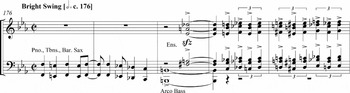
“Pathétique” also demonstrates Willet's modernist swing arranging style, juxtaposing tonal chromaticism with scoring techniques of ragtime marching bands and other vernacular idioms (not to mention Beethoven's original piano sonata). Ragtime references include trombone and baritone sax counterlines recalling brass band “bass run” fills (Example 6, mm. 125–28).Footnote 106 In one of the interlude passages that serves to replace part of the original sonata-form recapitulation, a bass run that recalls Lew Pollack's ragtime melody “That's a Plenty” is immediately followed by a sequence of parallel chromatic dominant-ninth voicings (Example 7, mm. 176–80).Footnote 107 During a tenor sax solo, a passage of rapid open-and-close “do-wa” brass mute effects (mm. 97–102; 1:53 in the recording) reflects jazz dance orchestra conventions established in the 1920s.Footnote 108
“Sonata Pathétique” mm. 176–80 (2:50), arr. by Willet for Jimmie Lunceford (1940).

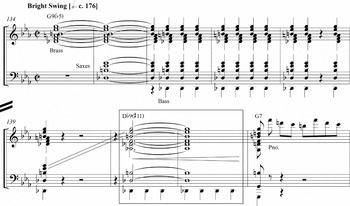
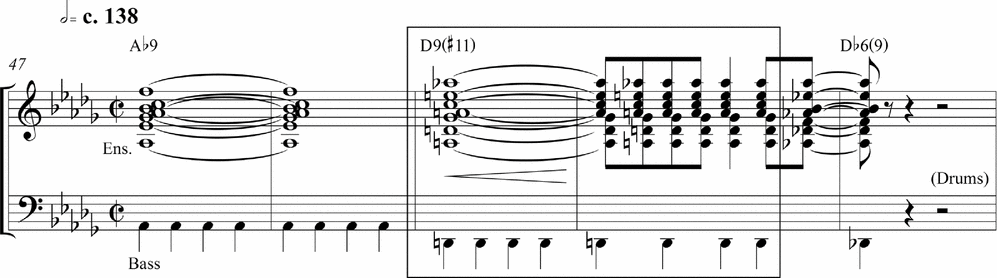
“Sonata Pathétique” mm. 134–42 (2:23), arr. by Willet for Jimmie Lunceford (1940). Chord symbols have been added by the author.

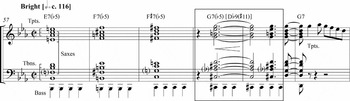
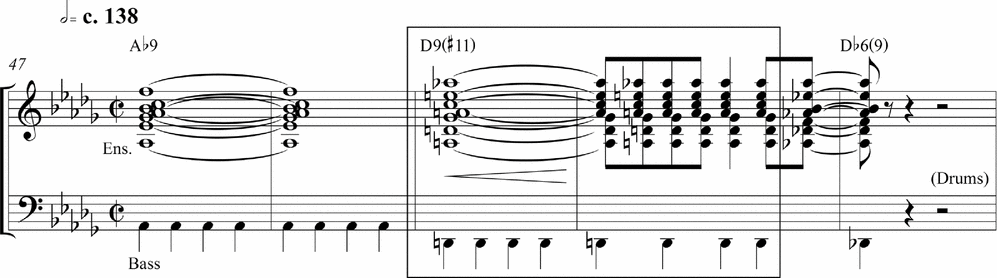
Willet's sonata “development” arrives with a repeated, percussive ensemble whole-tone chord scored over a static pedal bass (Example 8), building dramatic tension towards a climactic piano break referencing Beethoven's original scoring. As noted earlier, Willet was not alone in invoking whole-tone harmony to grab the listener's attention, but the specific chord that arrives at the close of this passage (Example 7, mm. 140–41) may be regarded as something of a personal signature.Footnote 109 A similar chord appears in both his 1938 Prelude in C-sharp Minor (Example 9, mm. 60–61) and 1942 “Rustle of Spring” (Example 10, mm. 49–50) arrangements; in all three instances, this chord emerges in climactic ensemble scoring over a pedal bass and preceding rhythm section breaks in up-tempo “classic” numbers.Footnote 110 These voicings might best be labeled as a dominant-ninth with an augmented eleventh, but in the guitar part for the Prelude Willet provides a spelling of G dominant-seventh flat-five—essentially ignoring the dissonant A-flat (the flatted-ninth degree, using Willet's G root spelling),Footnote 111 and emphasizing the flatted-fifth voice setting in the bass (there is also an augmented fifth included in the upper voices, similar to “After You've Gone”).Footnote 112 It seems likely that Willet's simplified reference to this “almost”-whole-tone voicing in “Prelude” as a flatted-fifth dominant chord reflects the arranger's broader attraction to the modernist whole-tone effect, and further connects these three passages as extensions of that device.
“Prelude in C-sharp Minor” mm. 57–62 (0:54), arr. by Willet for Duke Ellington (1938). Chord symbols reflect the manuscript guitar part.

“Rustle of Spring” mm. 47–51 (0:47), arr. by Willet for Lucky Millinder (circa 1942). Transcription by the author.
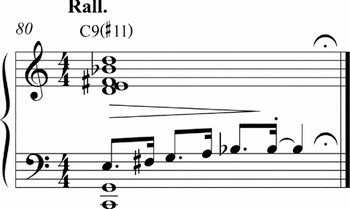
Sonatine Transatlantique: “Spiritual and Blues” m. 80, by Alexandre Tansman (1930). Alphonse Leduc – Robert King, Inc. A subsidiary of Editions Alphonse Leduc (Paris). Used by Permission. Chord symbols have been added by the author.

Although certainly not the only precedent, a tantalizingly relevant model for Willet's pet sonority can be found in the bluesy final measure of Tansman's “Spiritual and Blues” (Example 11).
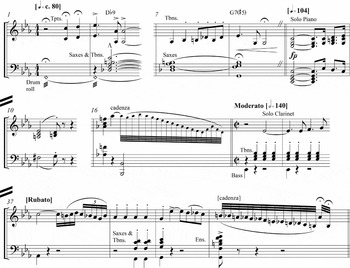
“Sonata Pathétique” excerpts from mm. 1–40, arr. by Willet for Jimmie Lunceford (1940).

Willet's insertion of his personal (or perhaps simply “bluesy”) twist on the whole-tone effect as a substitution for Beethoven's sonata-form development might be heard to serve: (1) the necessity of shortening the piece's duration; (2) as an energy-building dissonance to frame the virtuosic solo piano run that immediately follows; (3) as an exercise in the modernist juxtaposition of European concert music signifiers against vernacular jazz dance music tropes and other European concert music signifiers (including Beethoven piano sonatas); (4) as a practical harmonic substitution for the long-range dominant function of classical sonata-form developments (especially if one privileges a “G” chord spelling in the key of C minor); (5) as the portion of the arrangement where Willet veers most significantly from Beethoven's original score, perhaps highlighting a conceptual parallel between the sonata-form development and the dance band “arranger's chorus”;Footnote 113 and/or (6) as a personal tie-in to his own past and future efforts in “jazzing the classics,” stylistically uniting the freelancer's work across several years and for different clients.
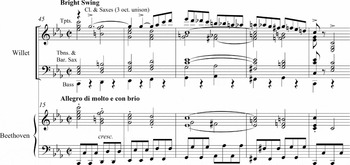
Willet also introduces a combination of devices to ensure the reception of “Pathétique” as a rendition of a classical work, independent of the audience's identification of the source text. Aside from replacing the development, one of his more conspicuous alterations is the addition of a fanfare introduction that precedes Beethoven's Grave piano theme. Harmonically, this passage serves to introduce a version of the whole-tone chord (Example 12, m. 8) heard later on; rhythmically, the opening drum roll and rubato-inducing fermatas invoke theatrical drama, immediately alerting the listener to prepare to receive something spectacular. By following this preparatory fanfare with Beethoven's original solo piano scoring of the Grave theme (m. 9), Willet caricatures the erudite atmosphere of a classical piano recital. A tempo change and rescoring for solo clarinet in the Grave variation (m. 17), including rubato cadenzas with orchestral recitative accompaniment closing the passage (e.g., mm. 37–40), suggest a symphonic concerto setting.Footnote 114 The initial phrase of Beethoven's Allegro exposition, performed by Lunceford's orchestra at a tempo clocking over 300 quarter notes per minute, is answered by Willet's own rapid-fire chromatic eighth-note embellishment (Example 13, mm. 46–49) recalling the “virtuosity rampant” prized at Carnegie Hall concerts. And in contrast to the prevailing rhythmic idiom of swung eighth notes, ensemble phrasing in quarter-note triplets injects a “legit” pomposo effect (Example 6, m. 129; Example 7, mm. 179–80).Footnote 115 Further ties to the symphonic orchestra tradition are provided in Willet's designation of climactic timpani drum rolls at the close of the piece.
Comparison of “Sonata Pathétique” mm. 45–49 (1:19), arr. by Willet for Jimmie Lunceford (1940), and Beethoven's original solo piano score.

The theatrical aspect of “Pathétique's” function was specific: Lunceford did not consider the piece as part of his standard dance repertoire. A Chicago Defender report titled “Kirby, Lunceford Turn to ‘Heavy’ Stuff on Discs,” explains that “Pathétique” was presented by the band “in their theatre engagements and on occasions of intermissions at dance engagements.”Footnote 116 Wilcox's description of “Pathétique” as a “concert arrangement” also indicates the piece's role in the band book. Audiences would presumably be seated (or at least not dancing) and focused on the performance area, perhaps observing the choreographed lighting described by Wilcox. As recorded for Columbia, Lunceford's soloists did not improvise, but played their solo parts as written.
Thought and Technique
Although popular music arrangers have generally left us with few explicit verbal or written explanations regarding their work, there are some exceptions. In Arranging for the Modern Dance Orchestra, Arthur Lange offers his opinions regarding the practice of “paraphrasing classics”:
The art of transcribing classical works for the modern dance orchestra requires more thought and technique in scoring than popular music. Therefore, the arranger must first be proficient in scoring popular dance arrangements before attempting to score classical fox-trot paraphrases.
Such works, if well constructed and well scored, may be considered works of art, but if distorted and poorly scored, they will invite unpleasant criticism. The original thought of the composer should always be respected and kept in mind when constructing and scoring.
When selecting material for classical paraphrases, the composition selected . . . should be one with which the public is familiar. . ..
The arranger should secure the orchestral score and . . . should be thoroughly familiar with every detail of the original work.Footnote 117
For Lange, the division between popular and classical is clearly retained within the practice of dance band arranging. His emphasis on “thought and technique” (which non-classical repertoire apparently requires less of) and the “original thought of the composer” (also apparently less of a concern in pop song arranging) perhaps belies elitist notions regarding the art of “classical” composition and attendant perceptions of musical training. Lange would not have been alone in these beliefs: Willet's regular citing of his own educational pedigree in his early publicity could be read as an effort to legitimize the artistic status of his work as a commercial arranger.Footnote 118 In any case, Willet's arrangement clearly reflects Lange's concern in demonstrating familiarity with Beethoven's original “Pathétique” score.
After World War II, jazz or “commercial” music education programs at Schillinger House (later Berklee College) and North Texas State College (later University of North Texas) offered formal training aimed at scoring for the dance band or jazz orchestra format.Footnote 119 Given that music programs of prior decades were much more likely to provide a traditional classical music curriculum, it is little surprise that popular music of that era includes so many references to European repertoire, especially as represented by the output of arrangers like Willet. The fascination of arranging classical works for dance band formats (or dance band works for symphonic formats) continued through the Swing Era. White bandleader Freddy Martin, for example, had a lasting hit with Ray Austin's 1941 arrangement of Tchaikovsky's “Piano Concerto No. 1,” even prompting the addition of lyrics for vocal ballad performances.Footnote 120 In 1944, Willet reportedly provided arrangements for a jazz-meets-classical concert presented by Lucky Millinder at the Apollo Theater: publicity describes an augmented thirty-piece orchestra (including two pianists) and a thirty-voice choir performing “swing versions” of excerpts from Dvořák's “New World” Symphony and (presumably Gounod's) Faust, in addition to expanded symphonic orchestrations of popular repertoire.Footnote 121
One of the “problems” that critics have had with arrangements designed to pit apparently oppositional idioms against one another is that these efforts set the otherwise veiled task of arranging front and center. In swing music, this transparency complicates traditional conceptions of the relationship between jazz performers and their subject texts. Expectations of black vernacular treatments of white industry-driven commercial idioms could only be sustained by racializing qualities of the written arrangements themselves. At the same time, Swing Era efforts to privilege the hot-jazz legacy of black bands like Lunceford, or black arrangers like Willet, appear to have only further fueled endeavors to play off of established expectations with pieces like “Pathétique.” And as suggested by contemporary critical reception, the response to these efforts was to make those cultural boundaries even more pronounced: to identify against-the-grain acts (perhaps including Willet's own “race” media promotion) as exceptions that simply reinforced the perceived norm.
Here the arranger is caught in the crossfire of the very discourses that had inspired their musical invention. In his exercise of “jazzing the classics,” Willet's background in European classical music and theater idioms is highlighted—perhaps even celebrated in its reflection of the modernist aesthetic—yet ultimately deemed less authentic, and therefore commercial. Although Willet's career thrived during the Swing Era, his legacy (along with that of his clients Lunceford and Armstrong) later ran the risk of being relegated by jazz critics to a monolithic trash heap of “variety” or “show band” music—precisely the mainstream commercial market that was often denied to black musicians.Footnote 122 The sheer volume of Willet's media publicity efforts, even if largely self-generated, only further indicates the severity of his subsequent erasure from jazz histories.Footnote 123
Like its offspring “rocking the classics,” “swinging the classics” would not have remained so prevalent a practice without audience appreciation.Footnote 124 The continual return of dance bands to this genre demonstrates how the invention of Swing Era popular music arranging—whether as a means of subverting stereotypes, or accentuating them—thrived upon the interplay between and among cultural binaries.Footnote 125 But this is only part of the story. “Pathétique” is not merely an exercise in hybridity, nor merely a vehicle to showcase the performer's technical virtuosity. It also represents the arranger's conscious assertion of musical identity, whether as one installment in a series of self-styled pieces celebrating musical education, influences, and professional experience, or—depending on how far one wishes to take the available evidence concerning the influence of Tansman or Iturbi—a personal homage to inspirations of formative years.
Efforts to group the careers and motivations of freelance music arrangers (or their clients) into a single social, economic, or stylistic category—if not outright perpetuating what Ronald Radano calls the “myth of folk authenticity”Footnote 126—entail a significant degree of peril. Whereas Duke Ellington may have felt compelled to debate “the theory that jazz cannot be written” (a crusade he continued well after the Swing Era),Footnote 127 the issue does not appear to have significantly distracted other jazz and popular music arrangers of the period. Even the clichéd conclusion of a 1937 New York Amsterdam News article championing Willet's career as testament to the music industry “bottom line” may offer legitimate insight into the economic and artistic concerns of Swing Era arrangers:
[Willet's] only formula for success is hard work—but definitely. An indefatigable person, he often puts in eighteen hours a day, sometimes going entirely without sleep if he has a “rush” job to do. He fully realizes the music business is a “tricky” affair, and the public may soon tire of “swing” or any other fad in music. So, it's his business to “keep in the know” as to what the public wants, prepare it, and serve it while it's hot—and he does.Footnote 128
Like any popular music tradition, jazzing the classics represents a broad conflation of cultural influences, motivations, and struggles that reach well beyond the epithet “commercial.” In their negotiation of industry marketing strategies, genre, class, race, and artistic voice, arrangers occupied a central but underappreciated position in American musical life. Their work too frequently dismissed, these musicians were held to an impossible standard; as no less an authority than José Iturbi asserted, “only Beethoven is worthy to match Beethoven.”Footnote 129 Yet, as the career of Chappie Willet testifies, popular music arrangers of the Swing Era should be recognized as artists in their own right whose modernist hybridity eloquently reflects the complex social discourses of their time and place.