Introduction
Photocatalysis processes have so far been demonstrated to be an effective way to tackle various environmental issues such as lack of clean water,[Reference Zhang, Zhao, Shen, Hidaka, Pelizzetti and Serpone1] increasing CO2,[Reference Woolerton, Sheard, Reisner, Pierce, Ragsdale and Armstrong2] and lack of sustainable energy storage solutions.[Reference Chu, Cui and Liu3] The benefit of photocatalysts to drive various chemical reactions by using sunlight as an energy source is very promising, however the main challenge still remains on how to increase in efficiency and lower the costs of this process.[Reference Montoya, Seitz, Chakthranont, Vojvodic, Jaramillo and Nørskov4] For example, TiO2, despite its low cost and high stability, it has a significant drawback—large band gap energy (3.2 eV), which only allows the utilization of ultraviolet (UV) region which accounts for less than 4% of the overall available solar energy on earth surface.[Reference Zhao, Chen and Ma5]
π-conjugated polymers and small molecule organic semiconductors (SMOSs) have been well studied for solar cell applications due to their low cost and flexibility.[Reference Park6, Reference Mishra and Bäuerle7] Recently, π-conjugated polymers have emerged as a new alternative for metal-free visible (Vis) light-driven photocatalysts. Although many polymer systems possess promising photocatalytic properties,[Reference Vyas, Haase, Stegbauer, Savasci, Podjaski, Ochsenfeld and Lotsch8–Reference Ma, Ghasimi, Landfester, Vilela and Zhang10] most of these explored systems suffer from a high probability of electron–hole (e–h) recombination and poor long-term stability due to the oxidation of the conjugated backbone during photocatalysis,[Reference Ghosh, Kouamé, Ramos, Remita, Dazzi, Deniset-Besseau, Beaunier, Goubard, Aubert and Remita11, Reference Xu, Gu, Wu, Yang, Song, Jiang and Dan12] which has gone on to provide significant challenges for the development of π-conjugated polymer photocatalysts. In contrast to π-conjugated polymers, SMOSs have so far been much less explored as a photocatalyst.[Reference Wang, Huang, Li, Gehrig, Blom, Landfester and Zhang13, Reference Zhang, Wang, Liu, Luo, Zhang, Jiang and Zhu14]
[6,6]-Phenyl-C61-butyric acid methyl esters (PCBM) have been widely studied as versatile N-type SMOSs for bulk-heterojunction organic photovoltaic (OPV) as they possess good solar absorption and charge-transport properties.[Reference Dang, Hirsch and Wantz15] In recent studies, PCBM has also been utilized as a sensitizer for wide band gap photocatalysts such as TiO2. However, to the best of our knowledge, the potential of just PCBM itself as a photocatalyst still has not been revealed.
PCBM has been selected as a possible Vis-light-driven photocatalyst based on the following three advantages: first, Vis light can be effectively absorbed and utilized due to the narrow band gap energy of 2.10–2.19 eV by the measurement with low-energy inverse photoemission spectroscopy[Reference Yoshida16, Reference Ie, Karakawa, Jinnai, Yoshida, Saeki, Seki, Yamamoto, Ohkita and Aso17]. Second, the electronic band structure of PCBM overlaps with the redox potential of water,[Reference Zhong, Izawa, Hashimoto, Tajima, Koganezawa and Yoshida18] which reveals the possibility to achieve total water-splitting. In addition, the relatively high lowest unoccupied molecular orbital level of PCBM suggests possible application for CO2 reduction,[Reference Tu, Zhou and Zou19] as well as to assist the photocatalytic degradation of organic dyes.[Reference Zhao, Chen and Ma5] Finally, PCBM also possesses the high charge mobility of 10−3 cm2/V s,[Reference von Hauff, Dyakonov and Parisi20] which is additionally a key important factor in achieving good charge separation toward efficient charge-transfer and higher photocatalytic efficiency. In the current study, the as-prepared PCBM nanoparticles (NPs) were fabricated using the facile reprecipitation method.[Reference Kasai, Nalwa, Oikawa, Okada, Matsuda, Minami, Kakuta, Ono, Mukoh and Nakanishi21, Reference Masuhara, Tan, Kasai, Nakanishi and Oikawa22] The photocatalytic behaviors will be discussed in detail on the basis of photodegradation of organic dye, closely relating to crystallinity of PCBM NPs.
Materials and methods
Materials
PCBM, Rhodamine B (RhB), and Methylene Blue (MB) were purchased from Wako Pure Chemical Industries, Ltd. TiO2 NPs (@P25 TiO2: ave. diameter = 30 nm, specific surface area = 50 m2/g) was supplied by Degussa Co. All chemicals were analytical reagent grade, and were used without further purification. Deionized and distilled water used was further purified up to 18.2 MΩ cm by using a water purification system (Sartorius Atrium 611 UV).
Conventional reprecipitation method for the preparation of PCBM NPs
In a typical preparation, 8 mL of PCBM (1.097 mM)–pyridine solution was injected into vigorously stirred water (200 mL) as a poor solvent at room temperature using a pulseless pump (ISCO, 260D Syringe Pump), followed by microwave irradiation for 2 min (2.45 GHz, 500 W), and then left at room temperature overnight.
Material characterization
Size and morphology of PCBM NPs were evaluated by scanning electron microscopy (SEM) and dynamic light scattering (DLS) instrument, using a JEOL JSM-6700F and Malvern Zetasizer Nano ZS, respectively. PCBM NP samples were sputtered with platinum by a JEOL JFC-1200 prior for SEM observation. The samples for high-resolution transmittance electron microscopy (HRTEM) observation were also prepared on microgrids and measured using a FEI Titan 80-300 with an image corrector under 300 kV of acceleration voltage. UV–Vis absorption spectrum was measured with a UV–Vis spectrometer (JASCO, V-550). In addition, crystalline structure of PCBM NPs was evaluated by using a powder x-ray diffractometer (XRD) (Bruker, D8-advance x-ray diffractometer).
Photocatalytic evaluation
The initial dispersion concentration of PCBM NPs is fixed at 0.04 mg/mL (0.044 mM). A 3.0 mL of PCBM NP dispersion liquid was mixed with 12 µL of RhB aqueous solution (5.12 mM) in a quartz cell with an optical path length = 10 mm, resulting in 0.010 mg/mL (2.1 × 10⁻⁵ M) of the initial concentration of RhB. On the other hand, the initial concentration of MB was 6.7 × 10⁻³ mg/mL (2.1 × 10⁻⁵ M). The mixed sample was stirred for 30 min under dark conditions to ensure an equilibrium state, and then irradiated for a given time at 25 °C by UV, Vis, and UV–Vis light, using a xenon lamp (500 W) equipped with suitable optical filters as follows: UV: λ = 300–400 nm (filters: HA50 + U330), Vis: λ = 420–700 nm (filters: HA50 + L42), UV–Vis λ = 300–700 nm (filter: HA50), and then photocatalytic degradation of organic dyes was monitored by the UV–Vis absorption spectral changes measured with a UV–Vis spectrometer. When an inert and non-oxidizing condition was required, N2 gas (>99.99%) was purged through the mixed dispersion liquid for 2 h prior to light irradiation. The photocatalytic degradation of RhB induced by the state-of-the-art P25 TiO2 NPs was monitored in a similar manner. The following scavengers were added to investigate the photocatalytic degradation mechanism of RhB by PCBM NPs: 0.01 mM Cu2+ (CuSO4·5H2O), 0.1 M MeOH, and 0.01 mM benzoquinone. In the dependence of photocatalytic activity of PCBM NPs on wavelength, Vis light with selected wavelength was employed as an optically band-pass filtered light source (450, 500, 550, 600, 650, and 700 nm). The irradiation intensity of Vis light was set at about 38 mW/cm2 at any wavelength.
Results and discussion
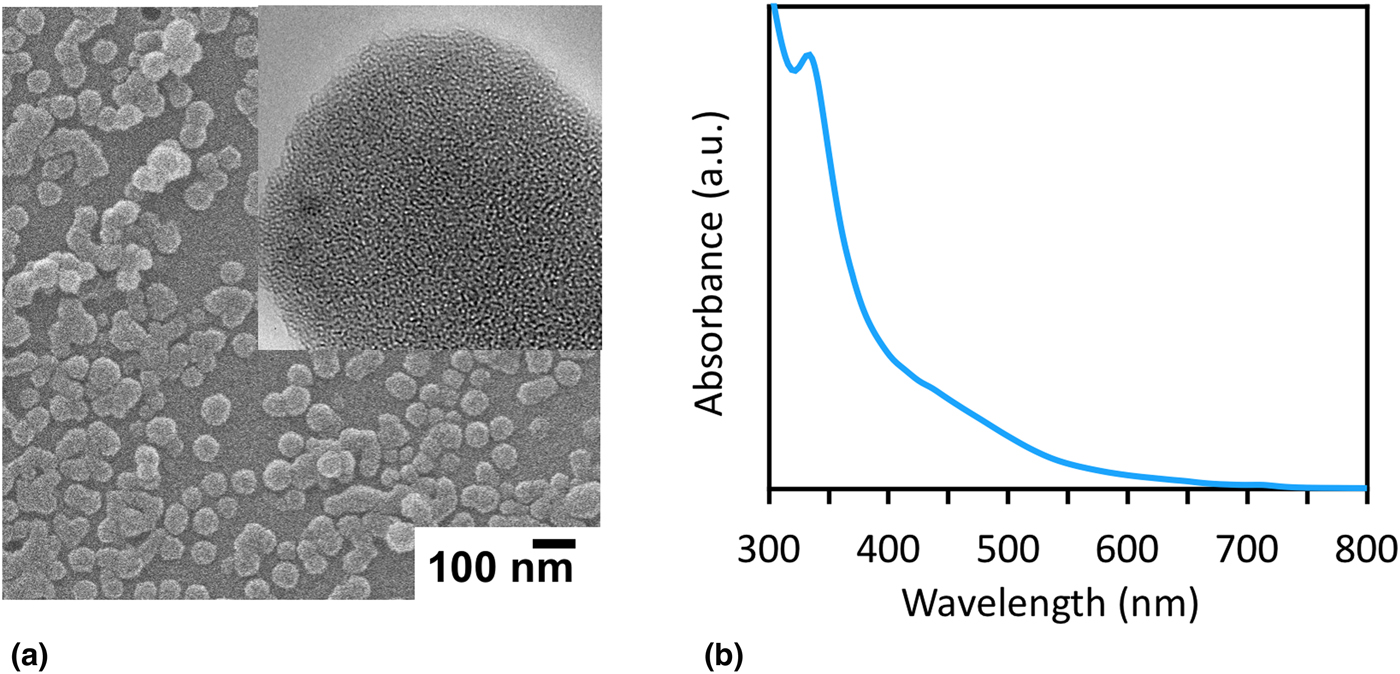
Figure 1(a) shows SEM and HRTEM images of the as-prepared PCBM NPs. The SEM image and DLS measurements indicated the almost uniform spherical PCBM NPs with the diameter of 38.82 ± 10.16 nm (Polydispersity index (PDI): 0.05) in size (Fig. S1). The HRTEM image presents a homogeneous inner structure of PCBM NPs, not shown heterogeneous and/or boundary structure at the present space resolution in HRTEM observation. The resulting PCBM NPs dispersed in an aqueous medium has deep yellow color (Fig. S2), and the UV–Vis absorption spectra (Fig. 1(b)) indicate monotonically decreasing and/or tailing of absorbance in the UV–Vis region.
(a) SEM and HRTEM (inset) images, and (b) UV–Vis absorption spectrum of the as-prepared PCBM NPs in aqueous dispersion.

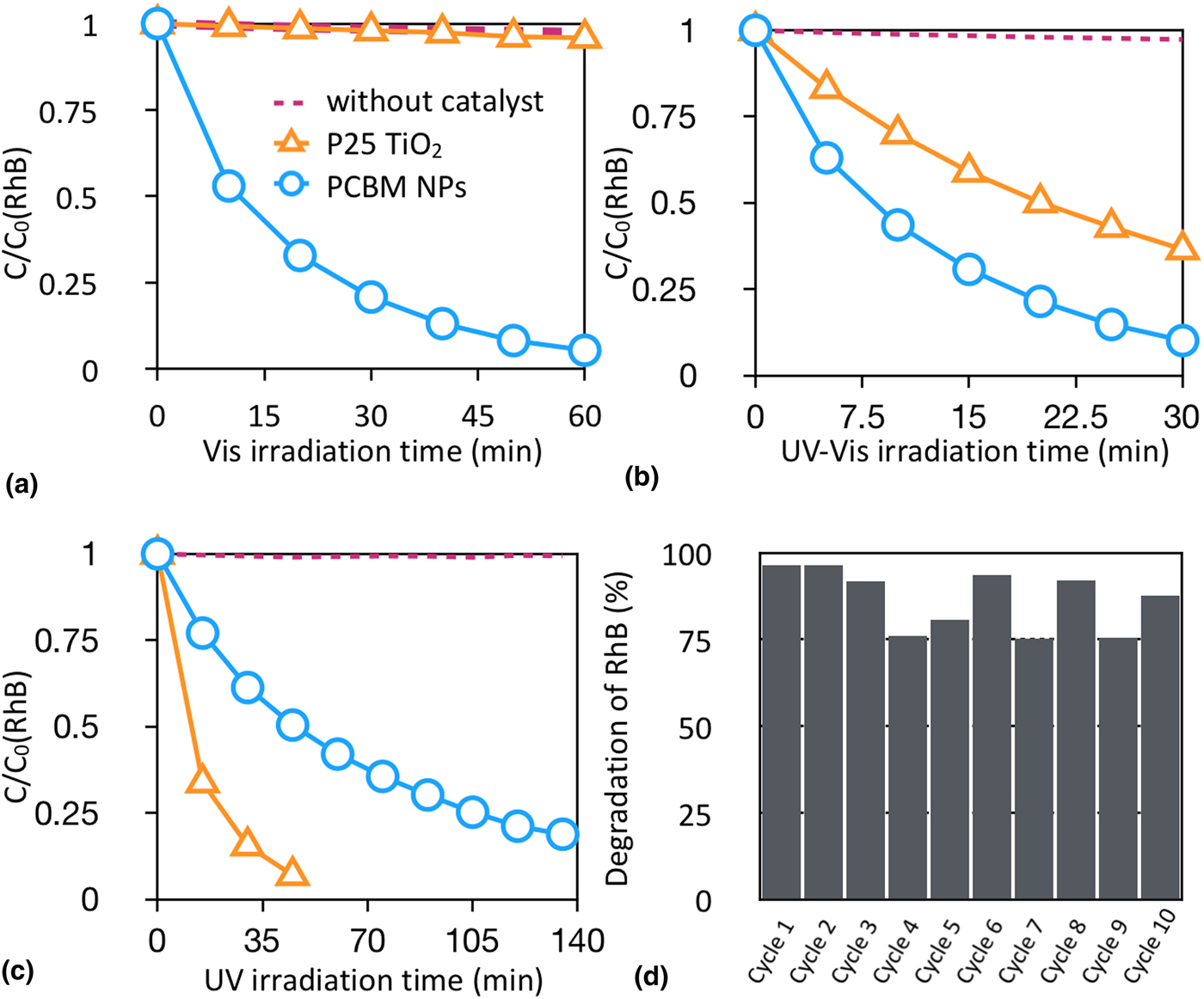
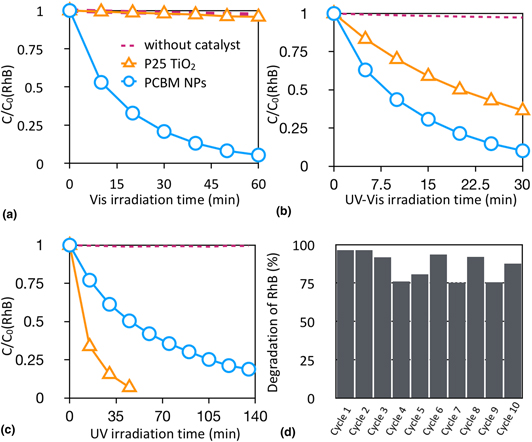
The photocatalytic activity of the as-prepared PCBM NPs has been first investigated using the photocatalytic degradation of RhB under different light irradiation conditions, compared with the state-of-the-art P25 TiO2 (Figs. 2(a)–2(c)). Under Vis light (420–700 nm) irradiation (Fig. 2(a)), P25 TiO2 demonstrated almost no sign of photocatalytic function, while PCBM NPs could degrade a half amount of RhB within just 10 min. The required time that PCBM NPs take to degrade half amount of RhB under UV–Vis light (300–700 nm) irradiation was approximately 7 min (Fig. 2(b)), while the time for TiO2 to perform under the same conditions was 20 min (Fig. 2(b)). The above result clearly indicated the remarkable photocatalytic activity of PCBM NPs under Vis and UV–Vis regions, even when compared with commercially available P25 TiO2. As expected, under UV light (300–400 nm) irradiation (Fig. 2(c)), TiO2 NPs, which is well known to be very active in the UV region, show considerably faster degradation of RhB than PCBM NP case. These facts indicate that PCBM NPs can especially be driven under Vis light irradiation conditions. In addition to the superior photocatalytic properties, PCBM NPs also demonstrated excellent performance for up to at least 10 recycle uses (Fig. 2(d)). There were hardly any significant changes in the particle size distribution, powder XRD patterns, and UV–Vis absorption spectra of PCBM NPs within experimental errors before and after the present recycle experiments (Figs. S1 and S3). The result of the good stability of PCBM NPs is consistent with previous reports.[Reference Sommer, Kruse and Roth23, Reference Pont, Foglia, Higgins, Durrant and Cabral24]
Relative concentration (C/C 0) of residual RhB photodegraded by the as-prepared PCBM NPs and/or P25 TiO2 NPs as photocatalysts under (a) Vis light (420–700 nm), (b) UV–Vis light (300–700 nm), and (c) UV light (300–400 nm) irradiation conditions. (d) Degree of photocatalytic degradation of RhB up to repeatedly 10 recycled experiments under Vis light irradiation for 30 min. The added concentrations of the as-prepared PCBM NPs and P25 TiO2 NPs dispersed in an aqueous medium were 0.04 mg/mL. The initial concentrations of RhB (C 0) were 2.1 × 10⁻⁵ M. The legends in (b) and (c) are the same as symbols in (a).

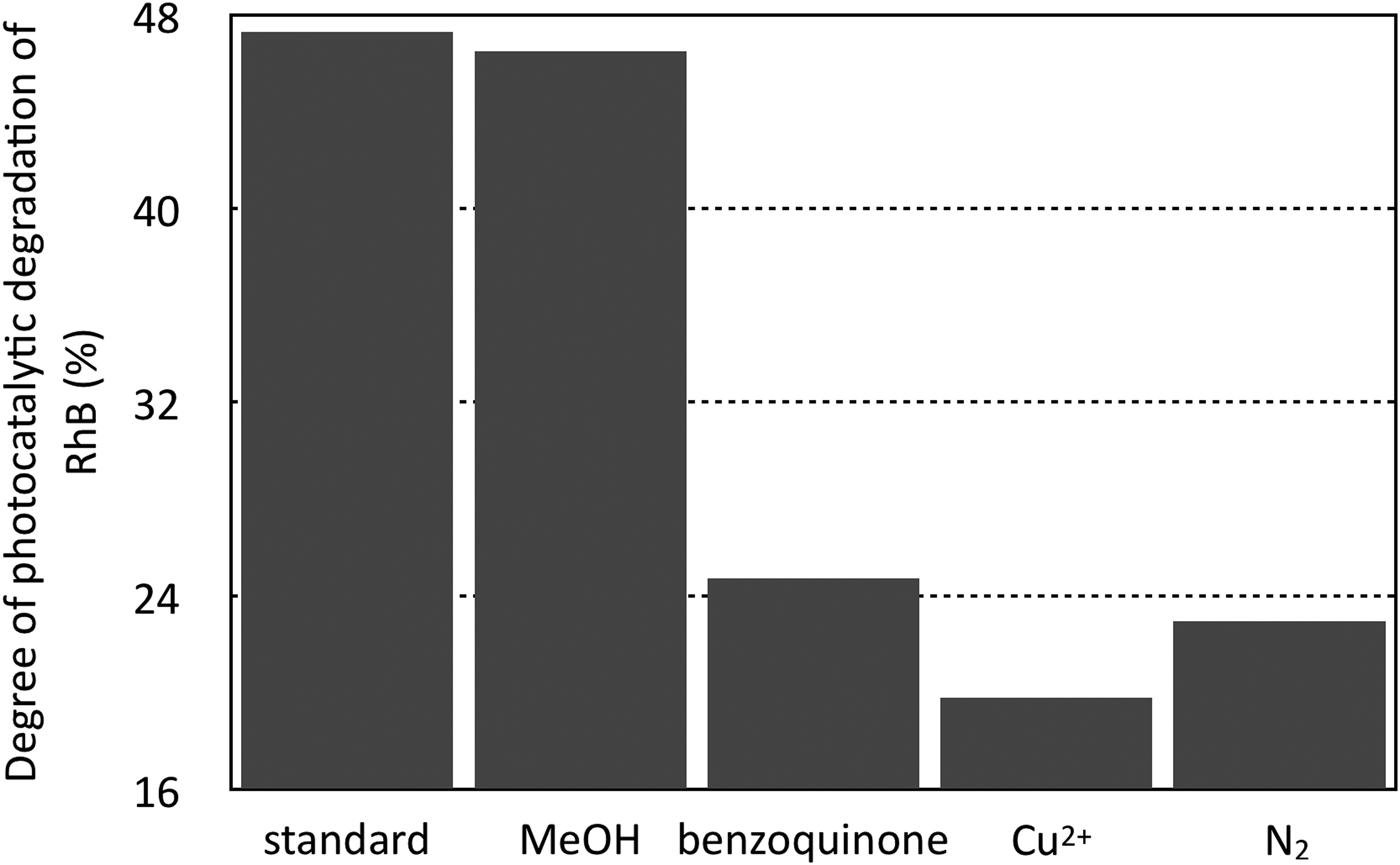
It is well known that reactive oxygen species (ROS) such as OH• and O2•− are mainly responsible for the photocatalytic degradation of pollutants by TiO2.[Reference Konstantinou and Albanis25] In order to qualitatively identify the major ROS in the present case, some chemicals were employed as scavengers as shown in Fig. 3: MeOH (hydroxyl radical OH• scavenger),[Reference Chen, Yang, Wang and Lou26] benzoquinone (superoxide radical O2•− scavenger),[Reference Zhang, Zhang, Tang and Xu27] and Cu2+ (e− scavenger).[Reference Ghosh, Kouame, Remita, Ramos, Goubard, Aubert, Dazzi, Deniset-Besseau and Remita28] In addition, the sample that is purged with N2 gas for 2 h was investigated (Fig. 3). The resulting reduction of the degree of photocatalytic degradation of RhB suggests that O2•− is the main ROS, and that e− photogenerated in PCBM NPs may reduce O2 molecules. That is, the presence of O2 is crucial in this photocatalytic process.[Reference Zhang, Zhang, Tang and Xu27, Reference Ghosh, Kouame, Remita, Ramos, Goubard, Aubert, Dazzi, Deniset-Besseau and Remita28]
Degree of photocatalytic degradation of RhB by the as-prepared PCBM NPs in the presence of various scavengers and/or N2 purging treatment. The data were measured after 10 min of Vis light irradiation.

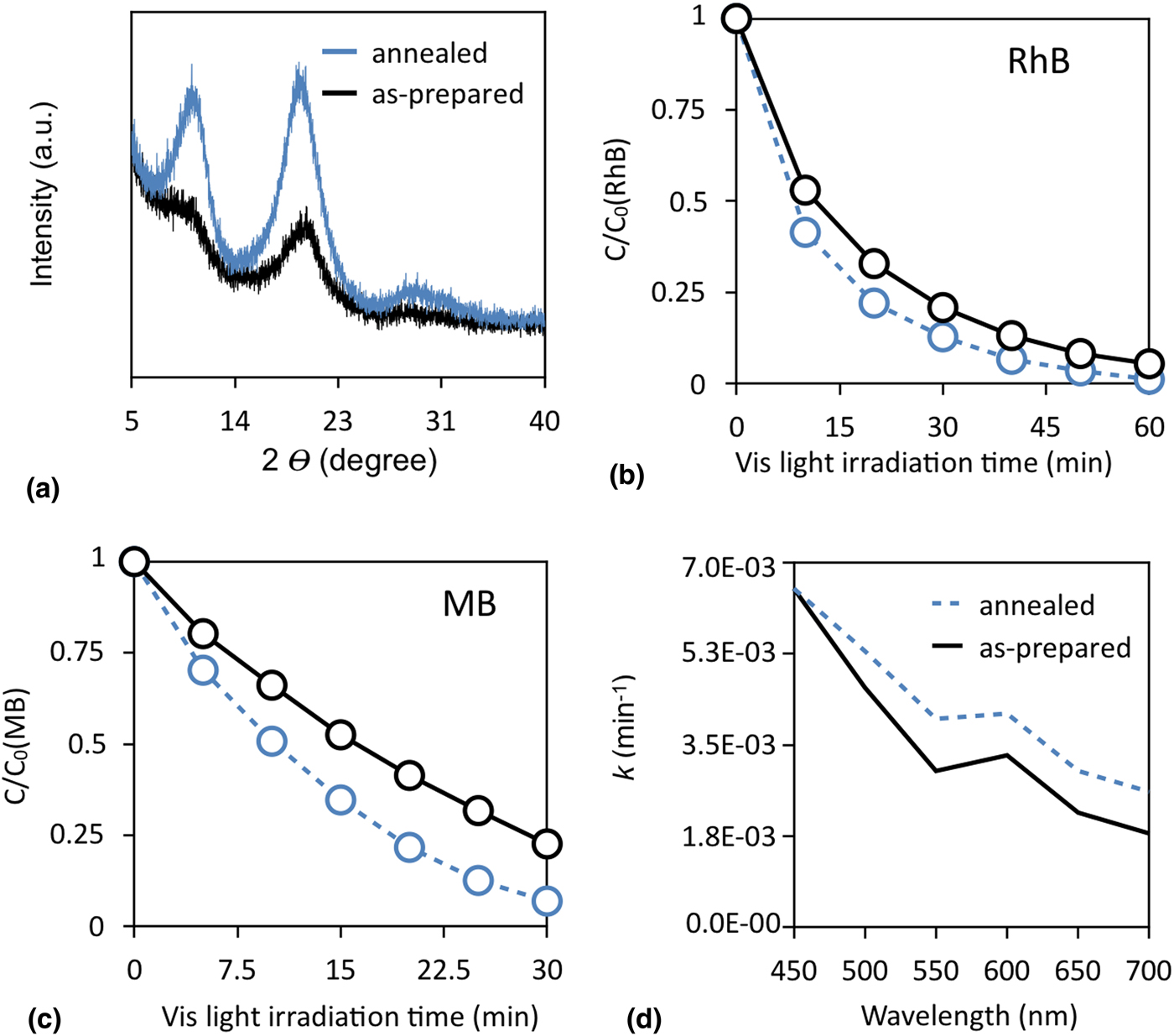
Next, we have investigated the annealing effect on the as-prepared PCBM NPs and their corresponding photocatalytic activity. The annealing treatment was done in an air-tight container which was autoclaved for 30 min at 120 °C. Before and after annealing treatment, powder XRD intensity was enhanced as shown in Fig. 4(a), which suggests the increase in crystallinity or formation of ordered structure in annealed PCBM NPs. There were, however, no significant changes in UV–Vis absorption spectra, HRTEM image, and particle size distribution (Fig. S4). Figures 4(b) and 4(c) indicate the relative concentration changes (C/C 0) of residual organic dyes such as RhB and MB as a function of Vis light irradiation time, and were analyzed by fitting the pseudo-first-order model,[Reference Li, Sun, Ma, Ouyang and Yan29] C/C 0 = exp(−k t), where k is the apparent first-order rate constant. As a result, the k value considerably increased from 2.08 × 10⁻² to 3.04 × 10⁻²/min, and from 2.10 × 10⁻² to 3.81 × 10⁻²/min for RhB and MB cases, respectively, when annealed PCBM NPs were used. Perhaps, annealed PCBM NPs with high crystallinity possess a better charge-transport property and thus reduce e–h recombination during photocatalysis as compared with the as-prepared ones. The similar phenomena have been observed in the PCBM/P3HT OPV device where the annealed sample shows better performance than without annealing.[Reference Clarke, Ballantyne, Nelson, Bradley and Durrant30, Reference Kim, Nelson, Zhang, Cook, Durrant, Kim, Park, Shin, Nam and Heeney31]
(a) Powder XRD pattern of the as-prepared and annealed PCBM NPs, (b) and (c) relative concentration changes (C/C 0) of residual RhB and MB photodegraded by the as-prepared (solid line) and annealed PCBM NPs (dotted line) as a function of Vis light irradiation time, and (d) plots of apparent rate constant (k) versus wavelength in the Vis region.

Finally, we have further investigated the k values for the as-prepared and annealed PCBM NPs by monitoring the wavelength dependence in the Vis region as shown in Fig. 4(d). These results also exhibited that annealed PCBM NPs are superior to the as-prepared ones throughout the Vis region.
Conclusions
We have successfully demonstrated the potential of SMOSs as Vis-light-driven photocatalysts and the importance of crystallinity in SMOSs photocatalysts. The newly developed SMOSs such as highly crystalline PCBM NPs showed excellent photocatalytic activity for the photocatalytic degradation of organic dyes, even when compared with P25 TiO2. As demonstrated, the crystallinity of PCBM NPs could be tuned by a simple annealing process, which goes on to play a crucial role in the catalytic performance. The present demonstration could provide a better understanding for the future development of SMOS-based photocatalysts toward the real-world applications.
Supplementary material
The supplementary material for this article can be found at https://doi.org/10.1557/mrc.2018.229.
Acknowledgment
This work was supported by JSPS KAKENHI Grant Number JS18K05227, and Dynamic Alliance for Open Innovation Bridging Human, Environment and Materials from Ministry of Education, Culture, Sport, Science and Technology of Japan (MEXT).
Conflicts of interest
There are no conflicts to declare.