1. Introduction
The past thirty years have seen a steeply increasing interest in the topic of bilingualism in aging. Indeed, a Google Scholar search for relevant terms on this topic reveals an exponential increase in the scientific literature; see Figure 1.
Hits in Google Scholar for terms related to the topic of aging and bilingualism/multilingualism/second language (Retrieved June 14, 2020). A similar pattern is also found when controlling for the overall number of scientific papers from a given period.

This increase is hardly surprising. First, average global life expectancy has tripled over the course of human history (Wilmoth, Reference Wilmoth2000). In many countries, increases in life expectancy are explained in large part by decreasing death rates among the elderly (Mathers, Stevens, Boerma, White & Tobias, Reference Mathers, Stevens, Boerma, White and Tobias2015; Wilmoth, Reference Wilmoth2000). In other words, not only is the global population increasing overall, but there is also a disproportional increase in the number of older adults. Second, we are living in an increasingly globalized world, and speaking more than one language is the norm these days (Baker & Prys Jones, Reference Baker and Prys Jones1998; Harris & Nelson McGhee, Reference Harris, Nelson McGhee and Harris1992; Tucker, Reference Tucker1999).
As a consequence, there is now a greater number of older people and of bilingual people in the world than ever before, rendering bilingualism in aging an important research topic. However, a closer look at the scientific literature on aging and bilingualism reveals that the lion's share of this work has investigated this topic from a ‘cognitive reserve’ angle, examining the cognitive abilities of aging bilinguals. These studies focus on the question of whether speaking more than one language confers benefits for non-language aspects of cognition in late life, such as attention or cognitive control (Abutalebi et al., Reference Abutalebi, Guidi, Borsa, Canini, Della Rosa, Parris and Weekes2015; Bak, Nissan, Allerhand & Deary, Reference Bak, Nissan, Allerhand and Deary2014; Bak, Vega-Mendoza & Sorace, Reference Bak, Vega-Mendoza and Sorace2014; Bialystok, Craik & Klein, Reference Bialystok, Craik and Klein2004; Bialystok, Craik & Luk, Reference Bialystok, Craik and Luk2013; Borsa et al., Reference Borsa, Perani, Della Rosa, Videsott, Guidi, Weekes and Abutalebi2018).
In contrast, far fewer empirical studies have assessed the effects of aging on language itself in bilinguals. Moreover, theories of bilingual language processing have focused on language in younger individuals rather than in older adults or in aging. Thus, a comprehensive review of age effects on language in bilingualismFootnote 1 may provide an impetus for such models to be extended to aging. In this review I focus on two critical aspects of language in aging bilinguals, lexicon and grammar, specifically the representation and processing of simple words and of complex words (morphology) and sentences (syntax)Footnote 2.
I will distinguish between age effects on language performance (section 2), and on the mechanisms underlying language processing (section 3). The first type of age effect addresses to what extent chronological age influences how rapidly and accurately individuals perform in language tasks. In particular, it is concerned with whether older second-language (L2) speakers are overall slower/faster and less/more accurate than younger L2 speakers at language tasks (i.e., effects of age for L2 speakers), and how these effects of age on speed and accuracy in L2 compare to those found in native (L1) speakers. The second type of age effect is concerned with how language is processed in aging bilinguals. That is, to what extent does chronological age affect the mechanisms that are involved in L2 processing, and do the mechanisms employed by aging L2 speakers become more or less similar to those employed by age-matched L1 speakers? Specifically, do L1/L2 differences in processing mechanisms that may (or may not) exist at earlier stages in life persist, decrease, or increase in aging?
This distinction between performance and the mechanisms underlying performance can be thought of as the distinction between explanandum (i.e., a phenomenon to be explained) and explanans (i.e., the reasons for the phenomenon). The notion that age may differentially affect these two may seem surprising. However, as we will see, there are in fact remarkable differences in the extent to which chronological age affects measures of performance, on the one hand, and their underlying mechanisms, on the other.
2. The effects of aging on measures of language performance
In order to examine the effects of aging on language performance (RTs and accuracy), I will first lay out the principles and theories that lead to predictions for how aging affects performance in bilingual language (section 2.1). Second, I will examine to what extent the existing evidence lines up with these predictions (section 2.2).
2.1. The effects of aging on measures of language performance: principles and predictions
Across many domains of cognition, aging can be characterized as exerting two competing forces on performance, which can largely (though perhaps not completely) be captured under the terms crystalized and fluid abilities. On the one hand, the additional exposure and experience related to aging yield increased (crystalized) knowledge. Though traditionally viewed mainly in terms of factual knowledge, this could also be skill-based knowledge (see, e.g., Veríssimo, Verhaeghen, Goldman, Weinstein & Ullman, Reference Veríssimo, Verhaeghen, Goldman, Weinstein and Ullmanunder review). On the other hand, as people age, various underlying (fluid) abilities that aid problem solving under novel conditions – such as processing speed, cognitive control, attention, and working memory – generally decline, largely due to deterioration in the underlying neural substrates (Fjell, Sneve, Grydeland, Storsve & Walhovd, Reference Fjell, Sneve, Grydeland, Storsve and Walhovd2017; Hasher & Zacks, Reference Hasher, Zacks and Bower1988; Mather & Harley, Reference Mather and Harley2016; Raz, Ghisletta, Rodrigue, Kennedy & Lindenberger, Reference Raz, Ghisletta, Rodrigue, Kennedy and Lindenberger2010; Salthouse, Reference Salthouse1996). Stine-Morrow (Reference Stine-Morrow2007) applied this concept of a “dynamic interplay between gains and losses” to (native) language performance in aging (p. 299).
These two principles should also hold for second language abilities: all else being equal (e.g., age of L2 acquisition, amount and type of daily exposure to the L1/L2), an older bilingual speaker as compared to a younger bilingual speaker both garners the benefits of increased language-related knowledge and is faced with declines in various neurocognitive abilities underlying language.
I address the two principles in the following two sections (2.1.1: increasing knowledge; 2.1.2: declining cognitive abilities) separately. In each section I first lay out the relevant principle, and then how the principle has been tied to performance measures in language tasks in younger adults (citing evidence from both younger monolinguals and younger bilinguals), yielding corresponding predictions for language abilities in aging in L2.
2.1.1. Age-related increases in language knowledge
Increasing age yields increasing lexical knowledge in both monolingual and bilingual speakers, due to greater cumulative exposure to the target language. Such lexical knowledge increases are generally measured as age-related increases in vocabulary size (Bialystok & Luk, Reference Bialystok and Luk2012; Burke & Shafto, Reference Burke, Shafto, Craik and Salthouse2008; Facal, Juncos-Rabadán, Rodríguez & Pereiro, Reference Facal, Juncos-Rabadán, Rodríguez and Pereiro2012; Stine-Morrow, Loveless & Soederberg, Reference Stine-Morrow, Loveless and Soederberg1996).
In younger adults, increases in vocabulary size (in both monolinguals and bilinguals) have been tied to improvements in lexical performance measures – faster responses and/or greater accuracy – in a wide range of tasks, including lexical decision (Mainz, Shao, Brysbaert & Meyer, Reference Mainz, Shao, Brysbaert and Meyer2017; Yap, Balota, Sibley & Ratcliff, Reference Yap, Balota, Sibley and Ratcliff2012), verbal fluency (Bialystok, Craik & Luk, Reference Bialystok, Craik and Luk2008b; Hedden, Lautenschlager & Park, Reference Hedden, Lautenschlager and Park2005; Shao, Janse, Visser & Meyer, Reference Shao, Janse, Visser and Meyer2014; Unsworth, Spillers & Brewer, Reference Unsworth, Spillers and Brewer2011), picture naming (Bialystok et al., Reference Bialystok, Craik and Luk2008b; Rodríguez-Aranda & Jakobsen, Reference Rodríguez-Aranda and Jakobsen2011), reading aloud (Gilhooly, Reference Gilhooly1984; Yap et al., Reference Yap, Balota, Sibley and Ratcliff2012), spoken word recognition (Banks, Gowen, Munro & Adank, Reference Banks, Gowen, Munro and Adank2015), and lexical prediction (Federmeier, McLennan & De Ochoa, Reference Federmeier, McLennan and De Ochoa2002).Footnote 3
Thus, together the two factors – i) the observed age-related vocabulary increases and ii) the evidence from younger adults indicating a positive relation between vocabulary size and lexical performance measures – yield the prediction that aging in bilinguals (as well as monolinguals) could result in performance improvements in lexical tasks.
Turning to grammar, as we will see, there has been less work that has investigated either i) the effect of age on grammatical (rule) knowledge, or ii) whether the extent of grammatical knowledge is correlated with performance in grammatical tasks in younger adults.
One reason for this may be that the operationalization of grammar knowledge is less straightforward than that of lexical knowledge. Grammaticality judgments are one reasonable measure of grammar knowledge (e.g., see Juncos-Rabadán, Reference Juncos-Rabadán1994). However, these should be untimed, since timed judgments might bias against older adults due to age-related processing speed decreases. A large-scale study by Gathercole et al. (Reference Gathercole, Thomas, Kennedy, Prys, Young, Viñas Guasch and Jones2014) examined (apparently untimed) grammaticality judgments across the lifespan, in monolingual English native speakers and Welsh–English early bilinguals living in England and Wales, respectively. The study found that older adults performed better than younger adults on English sentences, though no difference between the age groups was found for Welsh sentences. This suggests that grammatical knowledge may be stable or improve in aging, in both bilingual and monolingual speakers.
Another method that may capture ‘general’ grammar knowledge is the use of proficiency or placement tests (e.g., Oxford Placement Test, Goethe Test), especially if they are untimed and do not focus much on lexical abilities. Keijzer (Reference Keijzer2013) assessed age effects on performance at the ‘C-Test of Proficiency’, a cloze test designed specifically to assess grammar proficiency in L1 and L2 speakers. Participants were middle-aged, young-old, and old-old L1-English speakers and L1-Dutch/L2-English speakers, all living in Australia. All participants were given a C-Test in English, and the Dutch speakers were also given the test in Dutch. Proficiency in all cases decreased with increasing age, consistent with decreasing grammatical knowledge in aging, despite older adults’ much longer exposure to the two languages.Footnote 4 Nevertheless, it remains unclear whether these findings are generalizable, given that a) the C-Test was administered under time pressure (biasing against the oldest group) and b) education was negatively correlated with age (again biasing against the oldest group).
Thus, some evidence from grammaticality judgments suggests that grammar knowledge increases or remains unchanged with age, in both bilinguals and monolinguals, though the picture remains somewhat unclear.
What might be the effects of grammar knowledge on grammatical task performance? Within young-adult L2 speakers, performance in placement or proficiency tests (as well as length of exposure to an L2) has been shown to correlate positively with overall performance measures in various tests involving grammatical skills, including timed grammaticality judgments (Bruhn De Garavito & White, Reference Bruhn De Garavito, White, Pérez-Leroux and Liceras2002; Foote, Reference Foote2010; Han & Ellis, Reference Han and Ellis1998; Sagarra & Herschensohn, Reference Sagarra and Herschensohn2010, Reference Sagarra and Herschensohn2012), sentence repetition (Meir, Walters & Armon-Lotem, Reference Meir, Walters and Armon-Lotem2016), sentence production (Blom & Baayen, Reference Blom and Baayen2013; Perpiñán, Reference Perpiñán2015), structurally-guided prediction (Dussias, Valdés Kroff, Guzzardo Tamargo & Gerfen, Reference Dussias, Valdés Kroff, Guzzardo Tamargo and Gerfen2013; Leal, Slabakova & Farmer, Reference Leal, Slabakova and Farmer2016), and tasks tapping (morpho-)syntactically-guided comprehension (Montrul, Reference Montrul2011; White, Valenzuela, Kozlowska-MacGregor & Leung, Reference White, Valenzuela, Kozlowska-MacGregor and Leung2004). However, given that it is still unclear whether grammatical knowledge improves, remains static, or even decreases in aging, it is difficult to make strong predictions about potential age-related changes in grammatical performance measures based on such knowledge.
Having discussed the (potentially) positive effects of older adults’ increased knowledge on performance in lexical and grammatical tasks, I will now turn to the (potentially) negative effects of declining cognitive abilities on performance in these tasks.
2.1.2. Declines in age-sensitive cognitive abilities
Increasing chronological age during adulthood is associated with declines in numerous cognitive abilities, many of which underlie performance in lexical and grammatical tasks, at least in younger adults. Perhaps most dramatically, aging leads to various types of slowing, including of perceptual speed, cognitive speed, and motor speed (Kail & Salthouse, Reference Kail and Salthouse1994; Salthouse, Reference Salthouse1996; Salthouse & Kail, Reference Salthouse, Kail, Baltes and Brim1983). Within younger adults, faster performance in tasks assessing processing speed has been linked to faster performance in lexical tasks (Hertzog, Raskind & Cannon, Reference Hertzog, Raskind and Cannon1986; Jardim de Paula, de Souza Costa, Laiss, de Miranda & Malloy-Diniz, Reference Jardim de Paula, de Souza Costa, Laiss, de Miranda and Malloy-Diniz2013; Madden, Reference Madden1992; Unsworth et al., Reference Unsworth, Spillers and Brewer2011), leading to the prediction that age-related slowing may also yield slower performance for older adults in language tasks, in both first and second language.
Similarly, executive functioning, cognitive control, and working memory have generally been found to decline as adults age (Burke & Osborne, Reference Burke, Osborne, Gorfein and MacLeod2007; Carpenter, Miyake & Just, Reference Carpenter, Miyake, Just and Gemsbacher1994; Dobbs & Rule, Reference Dobbs and Rule1989; Foos, Reference Foos1989; Hasher & Zacks, Reference Hasher, Zacks and Bower1988; Hedden & Park, Reference Hedden and Park2001; Kramer & Kray, Reference Kramer, Kray, Craik and Bialystok2006; Light & Anderson, Reference Light and Anderson1985; Pliatsikas et al., Reference Pliatsikas, Veríssimo, Babcock, Pullman, Glei, Weinstein and Ullman2018; but see McDonough, Wood & Miller, Reference McDonough, Wood and Miller2019; Veríssimo et al., Reference Veríssimo, Verhaeghen, Goldman, Weinstein and Ullmanunder review). In turn, lower performance in all of these abilities has been associated with worse performance in tasks assessing lexical and grammatical abilities in younger monolinguals and bilinguals (Jackson & Bobb, Reference Jackson and Bobb2009; Jardim de Paula et al., Reference Jardim de Paula, de Souza Costa, Laiss, de Miranda and Malloy-Diniz2013; Linck, Osthus, Koeth & Bunting, Reference Linck, Osthus, Koeth and Bunting2014; Shao et al., Reference Shao, Janse, Visser and Meyer2014; Shao, Meyer & Roelofs, Reference Shao, Meyer and Roelofs2013; Shao, Roelofs & Meyer, Reference Shao, Roelofs and Meyer2012; Unsworth et al., Reference Unsworth, Spillers and Brewer2011). Thus, it is reasonable to predict that age-related declines in such cognitive functions should lead to lower performance for older adults in language tasks that depend on these functions.
Further, one of the hallmarks of healthy aging is declines of declarative (episodic) memory (De Chastelaine, Mattson, Wang, Donley & Rugg, Reference De Chastelaine, Mattson, Wang, Donley and Rugg2015, Reference De Chastelaine, Mattson, Wang, Donley and Rugg2016; Nyberg, Lövdén, Riklund, Lindenberger & Bäckman, Reference Nyberg, Lövdén, Riklund, Lindenberger and Bäckman2012; Park et al., Reference Park, Lautenschlager, Hedden, Davidson, Smith and Smith2002; Prull, Gabrieli & Bunge, Reference Prull, Gabrieli, Bunge, Craik and Salthouse2000). A growing literature has linked declarative memory to performance measures in language tasks, such as lexical prediction (i.e., the anticipation of upcoming words) and lexical recall (Covington & Duff, Reference Covington and Duff2016; Davis & Gaskell, Reference Davis and Gaskell2009; Duff & Brown-Schmidt, Reference Duff and Brown-Schmidt2012, Reference Duff, Brown-Schmidt, Hannula and Duff2017; Hamrick, Lum & Ullman, Reference Hamrick, Lum and Ullman2018; Reifegerste et al., Reference Reifegerste, Russell, Balota, Luta, Meinzer, Rugg, Shattuck, Turkeltaub, VanMeter, Veríssimo and Ullman2020a; Ryskin, Qi, Covington, Duff & Brown-Schmidt, Reference Ryskin, Qi, Covington, Duff and Brown-Schmidt2018; Ullman, Reference Ullman2001a, Reference Ullman2004, Reference Ullman, Hickok and Small2016; Warren, Rubin, Shune & Duff, Reference Warren, Rubin, Shune, Duff, Rizzo, Anderson and Fritzsch2018). Thus, these aspects of language may be negatively impacted in aging as well.
Lastly, both visual and auditory acuity decline during adulthood (Lindenberger & Baltes, Reference Lindenberger and Baltes1994; Madden & Whiting, Reference Madden, Whiting, Costa and Siegler2004; Schneider & Pichora-Fuller, Reference Schneider, Pichora-Fuller, Craik and Salthouse2000; Scialfa, Reference Scialfa2002). In younger adults, these perceptual abilities have been implicated in mono- and bilingual language performance, including in tasks tapping word recognition and syntactic and morphological skills (Breadmore, Reference Breadmore2007; Brysbaert & Nazir, Reference Brysbaert and Nazir2005; Coppens, Tellings, Van der Veld & Schreuder, Reference Coppens, Tellings, Van der Veld and Schreuder2012; Kachlicka, Saito & Tierney Reference Kachlicka, Saito and Tierney2019; Kelly, Reference Kelly1993, Reference Kelly1996; O'Regan, Lévy-Schoen, Pynte & Brugaillère, Reference O'Regan, Lévy-Schoen, Pynte and Brugaillère1984; Saito et al., Reference Saito, Sun, Kachlicka, Carvayal Alayo, Nakata and Tierneyunder review; Wauters, Van Bon & Tellings, Reference Wauters, Van Bon and Tellings2006). Thus, perceptual declines in aging might likewise be expected to negatively impact language abilities in aging.
2.1.3. Summary
To summarize, aging is associated with changes that may exert opposing forces on language performance: increases in lexical and perhaps grammatical knowledge that should improve language performance, versus decreases in cognitive and sensory abilities that should instead negatively impact language. The actual outcomes of these forces on lexical and grammatical abilities in aging bilinguals are an empirical issue, and could in principle lead to improvements, declines, no changes, or (nonlinear) combinations thereof.
2.2. The effects of aging on measures of language performance: findings from aging bilinguals
In this section, I will discuss the empirical evidence regarding the role of age on performance in language tasks, in the context of the predictions laid out in the previous section. I will separately address tasks tapping lexical skills and tasks tapping grammatical skills (with the latter including both sentence-level and morphological tasks). In each case, I will first compare younger versus older bilinguals’ performance, before examining how these age effects for bilinguals compare to corresponding age effects found for monolinguals. That is, do younger bilinguals perform better or worse than older bilinguals, and how does this difference compare to corresponding age effects for monolinguals? Additionally, I will also discuss the role of language dominance, drawing on the results of studies that have assessed the age trajectories of both languages within each participant (rather than comparing monolingual and bilingual speakers on the same target language).Footnote 5
Note that (consistent with the vast majority of research on cognitive aging) all of the L2 studies discussed in this article examine age as a between-subjects variable. Moreover, the majority of studies operationalize age as a dichotomous rather than as a continuous variable, contrasting groups of younger adults (usually between 18 and 35 years of age) and older adults (usually above age 55 or 60). Thus, the terms ‘aging’ or ‘increasing age’ in fact refer to differences between different age groups.
2.2.1. Simple words
In tasks tapping lexical abilities, early and late bilingual speakers’ RTs increase with increasing age (e.g., lexical decision: Johns, Sheppard, Jones & Taler, Reference Johns, Sheppard, Jones and Taler2016; Reifegerste, Elin & Clahsen, Reference Reifegerste, Elin and Clahsen2019; picture naming: Gollan, Montoya, Cera & Sandoval, Reference Gollan, Montoya, Cera and Sandoval2008). These age-related slowdowns mirror those found for (functionally) monolingual L1 speakers across lexical tasks (lexical decision: Balota, Cortese, Sergent-Marshall, Spieler & Yap, Reference Balota, Cortese, Sergent-Marshall, Spieler and Yap2004; Myerson, Ferraro, Hale & Lima, Reference Myerson, Ferraro, Hale and Lima1992; Ratcliff, Thapar, Gomez & McKoon, Reference Ratcliff, Thapar, Gomez and McKoon2004; reading aloud: Balota et al., Reference Balota, Cortese, Sergent-Marshall, Spieler and Yap2004; Morrison, Hirsh & Duggan, Reference Morrison, Hirsh and Duggan2002; picture naming: Feyereisen, Demaeght & Samson, Reference Feyereisen, Demaeght and Samson1998; Mortensen, Meyer & Humphreys, Reference Mortensen, Meyer and Humphreys2006). Few studies have directly compared the magnitude of these age-related slowdowns between L1 and L2 speakers – that is, whether the difference between younger and older bilingual speakers is smaller or greater than the difference between younger and older monolingual L1 speakers. The studies that did test for such an interaction between language group and age group did not find one, suggesting parallel age-related slowing for L1 speakers and bilinguals (Gollan et al., Reference Gollan, Montoya, Cera and Sandoval2008; Johns et al., Reference Johns, Sheppard, Jones and Taler2016; Reifegerste et al., Reference Reifegerste, Elin and Clahsen2019).
Accuracy shows a more nuanced pattern of results regarding bilingual speakers’ lexical abilities in aging. The evidence suggests that effects of age on accuracy in lexical tasks may at least in part depend on the task in question. First of all, of the three lexical-decision studies on bilingual aging I am aware of, two found no accuracy differences between younger and older bilinguals (Goral, Libben, Obler, Jarema & Ohayon, Reference Goral, Libben, Obler, Jarema and Ohayon2008; Johns et al., Reference Johns, Sheppard, Jones and Taler2016), while one reported greater accuracy for the older than the younger group of late bilinguals (Reifegerste et al., Reference Reifegerste, Elin and Clahsen2019). Of these studies, two compared the size of the age effect for their bilingual group with that of an L1 control group, and both found parallel age effects (Johns et al., Reference Johns, Sheppard, Jones and Taler2016; Reifegerste et al., Reference Reifegerste, Elin and Clahsen2019). Indeed, such findings of age-related accuracy improvements or stability have commonly been found in L1-only lexical-decision studies (Allen, Madden & Crozier, Reference Allen, Madden and Crozier1991; Allen, Madden, Weber & Groth, Reference Allen, Madden, Weber and Groth1993; Allen, Sliwinski & Bowie, Reference Allen, Sliwinski and Bowie2002; Carroll, Warzybok, Kollmeier & Ruigendijk, Reference Carroll, Warzybok, Kollmeier and Ruigendijk2016; Ratcliff et al., Reference Ratcliff, Thapar, Gomez and McKoon2004; Reifegerste, Meyer & Zwitserlood, Reference Reifegerste, Meyer and Zwitserlood2017; Robert & Mathey, Reference Robert and Mathey2007).
Second, a handful of studies have assessed how (early) bilinguals’ ability to name words from their meanings (e.g., in picture naming) might change across the lifespan. The results from such studies have been mixed. Two studies found no age differences in younger versus older bilinguals’ accuracy at naming pictures (Bialystok, Craik & Luk, Reference Bialystok, Craik and Luk2008a; Johns et al., Reference Johns, Sheppard, Jones and Taler2016), whereas one reported age-related declines (Gollan et al., Reference Gollan, Montoya, Cera and Sandoval2008). All three studies found analogous aging patterns for monolingual/L1 speakers: that is, either age-invariance (Bialystok et al., Reference Bialystok, Craik and Luk2008a; Johns et al., Reference Johns, Sheppard, Jones and Taler2016) or declines (Gollan et al., Reference Gollan, Montoya, Cera and Sandoval2008). The L1 age-invariance reported in two of these picture-naming studies is surprising, as it contrasts with numerous studies reporting reliable age-related declines in picture-naming tasks in monolingual/L1 speakers (e.g., Barresi et al., Reference Barresi, Nicholas, Connor, Obler and Albert2000; Connor et al., Reference Connor, Spiro, Obler and Albert2004; Feyereisen, Reference Feyereisen1997; Gollan et al., Reference Gollan, Montoya, Cera and Sandoval2008; Mortensen et al., Reference Mortensen, Meyer and Humphreys2006). One reason for this discrepancy might be that both studies reporting age invariance (Bialystok et al., Reference Bialystok, Craik and Luk2008a; Johns et al., Reference Johns, Sheppard, Jones and Taler2016) used the Boston Naming Test (BNT; Kaplan, Goodglass & Weintraub, Reference Kaplan, Goodglass and Weintraub1983), which, while useful in clinical settings (Duchek, Balota, Storandt & Larsen, Reference Duchek, Balota, Storandt and Larsen2007; Howieson et al., Reference Howieson, Dame, Camicioli, Sexton, Payami and Kaye1997), is not always sensitive to word-retrieval declines in healthy aging (LaBarge, Edwards & Knesevich, Reference LaBarge, Edwards and Knesevich1986; Schmitter-Edgecombe, Vesneski & Jones, Reference Schmitter-Edgecombe, Vesneski and Jones2000; but see Ross et al., Reference Ross, Lichtenberg and Christensen1995). This overall pattern is in line with Gollan et al. (Reference Gollan, Montoya, Cera and Sandoval2008), who did not use the BNT and reported age-related accuracy declines in both monolinguals and bilinguals.
Verbal fluency tasks are also commonly used to assess language abilities. In these tasks participants name as many words as they can, either from a specific semantic category such as animals (category fluency), or starting with a specific letter such as the letter s (letter fluency). Because the dependent measure in these tasks is the number of correctly named words in a given amount of time, such tasks assess a combination of both accuracy and speed of word retrieval. Older bilingual speakers usually name fewer words in semantic fluency tasks in their L2 than younger bilingual speakers (Bialystok et al., Reference Bialystok, Craik and Luk2008a; Johns et al., Reference Johns, Sheppard, Jones and Taler2016). The picture is less clear for letter fluency, with one study again finding a disadvantage for older bilinguals as compared to younger bilinguals (Bialystok et al., Reference Bialystok, Craik and Luk2008a), while another reported similar performance for younger and older bilinguals (Johns et al., Reference Johns, Sheppard, Jones and Taler2016). None of these verbal fluency studies found an interaction between language group and age group, suggesting similar developmental trajectories during aging for L1 and L2. Overall, the observed pattern for verbal fluency in aging bilinguals is in line with studies focusing on L1 speakers, which have generally reported reliable and substantial age-related declines for category fluency, while letter fluency usually shows smaller and/or less reliable declines in aging (Brickman et al., Reference Brickman, Paul, Cohen, Williams, Macgregor, Jefferson and Gordon2005; Meinzer, Flaisch, et al., Reference Meinzer, Flaisch, Seeds, Harnish, Antonenko, Witte and Crosson2012; Meinzer, Seeds, et al., Reference Meinzer, Seeds, Flaisch, Harnish, Cohen, McGregor and Crosson2012; Meinzer et al., Reference Meinzer, Wilser, Flaisch, Eulitz, Rockstroh, Conway and Crosson2009; Tombaugh, Kozak & Rees, Reference Tombaugh, Kozak and Rees1999).
A handful of studies has also examined the aging trajectories of lexical abilities for two languages within bilinguals – that is, do the two languages within a bilingual speaker's mind show the same changes (or lack thereof) from young into old adulthood? Such studies have mainly focused on whether language dominance might play a role in the extent to which age affects lexical performance (Birdsong, Reference Birdsong2014; Gollan, Weissberger, Runnqvist, Montoya & Cera, Reference Gollan, Weissberger, Runnqvist, Montoya and Cera2012; Köpke & Schmid, Reference Köpke, Schmid, Schmid, Köpke, Keijzer and Weilemar2004). These studies suggest that age-related declines are more pronounced in the nondominant than the dominant language. For example, Gollan et al. (Reference Gollan, Weissberger, Runnqvist, Montoya and Cera2012) tested younger and older Spanish–English early bilinguals, who rated themselves as either Spanish-dominant or English-dominant, on Spanish and English versions of a picture-naming task, with accuracy as the dependent variable. Results for Spanish-dominant speakers revealed numerically better performance for older participants as compared to younger participants in the Spanish version of the task, but worse performance in the English version; the English-dominant speakers showed the reverse pattern. Statistical analyses of these comparisons were not provided.
The same group also examined picture-naming latencies and accuracy rates in younger and older English-Spanish early bilinguals (Gollan et al., Reference Gollan, Montoya, Cera and Sandoval2008). The authors contrasted frequency effects between younger and older participants’ dominant (English) and nondominant (Spanish) languages, seeking to characterize the role of exposure on the speed and accuracy of lexical access in the two languages. Younger adults showed smaller frequency effects (less of a performance difference between lower- and higher-frequency items) in their dominant than in their nondominant language – for example, smaller RT differences between octopus and house than between their Spanish equivalents pulpo and casa. Older adults, however, showed no such difference in frequency-effect size between the two languages. Instead, their frequency effects for both English and Spanish were of similar magnitude to those that younger adults showed for their dominant language English. The authors concluded that extended use of both languages during one's lifetime allowed the nondominant language to “catch up” with the dominant language, yielding comparable frequency effects in the two languages.
Note that whether the L1 or the L2 is considered dominant may differ from person to person as a function of different variables, including the age-of-acquisition of each of the two languages, their ultimate levels of attainment, and the degree and type of experience (or lack thereof) with the languages on a daily basis, among others. Moreover, across a person's lifespan, which of their two (or more) languages a person considers their dominant language may shift, as people move to another country, marry a person with a different language background, or work in a different language environment. This dynamic ‘wax and wane of languages’ (Grosjean, Reference Grosjean2010, p. 85), which might also include the attrition of one's L1, further complicates the picture. See, for example, Chamorro, Sorace and Sturt (Reference Chamorro, Sorace and Sturt2016), Goral (Reference Goral2004), Kasparian and Steinhauer (Reference Kasparian and Steinhauer2017) and Tsimpli, Sorace, Heycock and Filiaci (Reference Tsimpli, Sorace, Heycock and Filiaci2004), for theoretical and empirical work on L1 attrition across the adult lifespan.
Finally, the evidence overall indicates that L2 and L1 performance measures in lexical tasks are similarly affected by aging. I suggest that these effects may indeed by explained by age-related cognitive declines as well as increases in knowledge, though I know of no study that has directly examined this issue.
Across studies, we have seen that reliable RT increases are found with increasing age, in both monolinguals and early and late bilinguals. Though none of the bilingual lexical studies independently measured non-linguistic processing speed, it is likely that such age-related RT increases in lexical tasks are at least in part the result of general age-related slowing. Indeed, some research has linked age-related lexical slowdowns in L1 to processing speed (Kail & Salthouse, Reference Kail and Salthouse1994; Salthouse, Reference Salthouse1996, Reference Salthouse1998; Salthouse, Pink & Tucker-Drob, Reference Salthouse, Pink and Tucker-Drob2008; but see Finkel, Reynolds, Mcardle & Pedersen, Reference Finkel, Reynolds, Mcardle and Pedersen2007; Lawrence, Myerson & Hale, Reference Lawrence, Myerson and Hale1998), and it is likely that the same holds for slowing in bilinguals.
Accuracy rates show a more complex pattern, which appears to be affected by the nature of the task. Specifically, lexical-decision tasks yield either stable accuracy rates or age-related increases in accuracy in bilingual speakers, while tasks involving recall from meaning (e.g., picture naming or category fluency) yield age-related accuracy declines. As with age effects on RTs, the exact reasons for such age-related declines in bilingual lexical accuracy have not been directly assessed. Nevertheless, various accounts have suggested roles for age-related declines in cognitive functions such as executive function in word-retrieval declines in L1 (see section 2.1.2; see also Burke & Shafto, Reference Burke, Shafto, Craik and Salthouse2008, and Diaz, Rizio & Zhuang, Reference Diaz, Rizio and Zhuang2016, for discussion of the role of cognition in L1 lexical abilities in aging). It is likely that such factors similarly affect age-related declines of L2 lexical abilities, notwithstanding potential cognitive reserve in older bilinguals’ executive abilities. Age-related increases in accuracy, on the other hand, are most likely a consequence of increased exposure to the language under study, resulting in larger vocabularies. Note that it has been argued that increases in vocabulary size are associated with improved performance especially for lower frequency words (Burke & Shafto, Reference Burke, Shafto, Craik and Salthouse2008; Caza & Moscovitch, Reference Caza and Moscovitch2005; Gomez, Reference Gomez2002), which can also help explain the positive role for age-related exposure in lexical-decision tasks but not picture-naming tasks, since lexical-decision tasks often include items of lower average frequency than picture-naming tasks.
Interestingly, when examining the trajectories of the two languages within-participants, we have seen that studies report differences in the trajectories of the dominant versus the nondominant language, again consistent with a role for exposure. However, the exact nature of such possible exposure effects will need to be clarified in future work – it appears that exposure benefits lexical performance, but is it more beneficial for the dominant or the nondominant language? Several studies have suggested less of an age-related decline in the dominant language (and even numeric age-related accuracy increases in the dominant language in one picture-naming study; Gollan et al., Reference Gollan, Weissberger, Runnqvist, Montoya and Cera2012), but at least one study found the nondominant language to “catch up”, with older early bilinguals responding faster to low-frequency words in their nondominant language than younger bilinguals (Gollan et al., Reference Gollan, Montoya, Cera and Sandoval2008).
2.2.2. Sentences and complex words
Only two studies have assessed whether age affects bilingual speakers’ performance measures (RTs, accuracy) in tasks targeting complex words and sentences (i.e., grammatical skills). I will therefore address these studies in a little more detail.
Reifegerste, Jarvis and Felser (Reference Reifegerste, Jarvis and Felser2020b) examined syntactic agreement across the adult lifespan in L1-German speakers and highly proficient L1-English/L2-German speakers. Participants performed a binary-choice sentence-completion task: they indicated whether a sentence preamble such as The letter from the diplomatic lawyers should be followed by a singular or a plural verb form. L1 speakers’ accuracy rates were generally at ceiling across conditions over the whole age range (though they did become more susceptible to a specific type of agreement error; see section 3.2 below). In contrast, L2 accuracy improved with increasing age – there was no difference in accuracy levels between the oldest L1 and L2 participants (aged 60+), whereas at younger ages accuracy was lower for L2 than L1. At the same time, L1 speakers’ RTs increased with increasing age, whereas L2 speakers showed no signs of slowing in the task; instead, their RTs remained stable across the adult lifespan. Interactions between age and language group confirmed the different age trajectories for both accuracy rates and RTs in the two groups. The authors argued that increasing exposure to the target language increased L2 speakers’ accuracy and offset any speed declines that may have occurred as a consequence of age-related slowing. L1 speakers’ performance, in contrast, was already at ceiling in young adulthood and could therefore not increase. It is worth noting that agreement computation, the grammatical phenomenon of interest in this study, has been claimed to be notoriously difficult for L2 speakers (Chen, Shu, Liu, Zhao & Li, Reference Chen, Shu, Liu, Zhao and Li2007; Grüter, Lew-Williams & Fernald, Reference Grüter, Lew-Williams and Fernald2012; Keating, Reference Keating2009; Lardiere, Reference Lardiere1998; Sato & Felser, Reference Sato and Felser2010; Shibuya & Wakabayashi, Reference Shibuya and Wakabayashi2008; VanPatten, Keating & Leeser, Reference VanPatten, Keating and Leeser2012), while it is generally relatively error-free for L1 speakers (Bock, Reference Bock and Ross2004), allowing L2 speakers substantial “room for improvement” over the course of the lifespan.
The other study, by Juncos-Rabadán (Reference Juncos-Rabadán1994), compared performance at various language abilities between healthy younger, middle-aged, and older bilingual participants, in both of their early-acquired languages (dominant: Spanish; nondominant: Galician), using the Bilingual Aphasia Test (BAT; Paradis, Reference Paradis1987). The results yielded robust age-related declines across the three age groups in accuracy in several syntactic tasks (syntactic comprehension, sentence production, grammaticality judgment) and in a morphological task (tapping derivational morphology), in both languages. Moreover, the two languages showed similar aging trajectories, with the exception of the morphological task, in which participants were asked to produce an adjective from its derived noun (e.g., claridad ‘clarity’ → claro ‘clear’). This task instead yielded greater age-related declines for the nondominant as compared to the dominant language (see interaction in Table 3 in the paper), though it is not clear whether the declines for the dominant language were just smaller or nonexistent.
What conclusions can we draw from these two studies? Crucially, it appears that age affects bilingual speakers’ measures of performance in grammatical tasks (i.e., speed and accuracy), as is also the case for lexical tasks. In contrast to lexical abilities, in which L1 and L2 performance show largely similar lifespan trajectories, L1 and L2 grammar performance appears to show at least somewhat different aging patterns. Reifegerste et al. (Reference Reifegerste, Jarvis and Felser2020b) found generally stable accuracy and increasing RTs for L1 speakers’ grammatical skills across the adult lifespan, but accuracy improvements and stable RTs for the L2 group. Although Juncos-Rabadán (Reference Juncos-Rabadán1994) reported similar aging trajectories for the dominant and nondominant language in several grammatical tasks, a morphological production task showed different patterns in the two languages, with greater declines for the nondominant language than for the dominant language.
Why do these two studies show different patterns? One reason for the apparent discrepancy might be differences in the ages-of-acquisition (AoAs) of the languages being examined. In the study by Reifegerste and colleagues (Reference Reifegerste, Jarvis and Felser2020b), L2 speakers had an L2-AoA of at least 15 years of age, rendering these participants truly late bilinguals. The participants in Juncos-Rabadán (Reference Juncos-Rabadán1994), on the other hand, were living in Galicia, a bilingual region of Spain, where they presumably grew up exposed to both languages, though no specific AoA information was provided. As such, the declines in grammatical abilities displayed by participants in Juncos-Rabadán's (Reference Juncos-Rabadán1994) study for both languages may be best understood as resembling the declines that are often found for L1 speakers in grammatical tasks (Kemtes & Kemper, Reference Kemtes and Kemper1997; Kwong See & Bouchard Ryan, Reference Kwong See and Bouchard Ryan1995; Peelle et al., Reference Peelle, Troiani, Wingfield and Grossman2010; Reifegerste & Felser, Reference Reifegerste and Felser2017; Stine-Morrow et al., Reference Stine-Morrow, Ryan and Leonard2000; Waters & Caplan, Reference Waters and Caplan2001; but see Altmann & Kemper, Reference Altmann and Kemper2006; Davidson, Zacks & Ferreira, Reference Davidson, Zacks and Ferreira2003), which were, to an extent, also found in L1 by Reifegerste et al. (Reference Reifegerste, Jarvis and Felser2020b). The L2 findings in Reifegerste et al. (Reference Reifegerste, Jarvis and Felser2020b), on the other hand, reflect the trajectory of measures of grammatical abilities of a late-learned L2, for which performance at younger-adult ages may lag behind that of L1 speakers, and for which additional exposure leading to increased knowledge can yield performance increases.
A similar account may help explain why grammar shows different aging patterns in L1 and L2, whereas the L1/L2 patterns are similar for lexical abilities. In particular, the acquisition of (certain aspects of) grammar tends to lag behind the acquisition of lexical items during L2 acquisition (DeKeyser, Reference DeKeyser2005), which can result in younger-adult L2 speakers not yet performing at ceiling in grammar tasks, especially if the L2 was learned relatively late in life. This allows age-related performance declines in the L2 (that are in fact apparent for native speakers) to be offset by performance increases due to increased exposure to the target language.
Given the evidence presented in this section for age-related changes to outcome measures of bilingual language performance, we may ask whether similar changes are found for the linguistic processing mechanisms that underlie this performance. That is, are the age effects on speed and accuracy in language tasks laid out in this section due to age-related changes in how language is processed? Or is it perhaps the case that the same underlying processing mechanisms are at play for younger versus older bilinguals, but at a different speed and/or with different success? In the next section I address this issue.
3. The effects of aging on underlying linguistic processing mechanisms
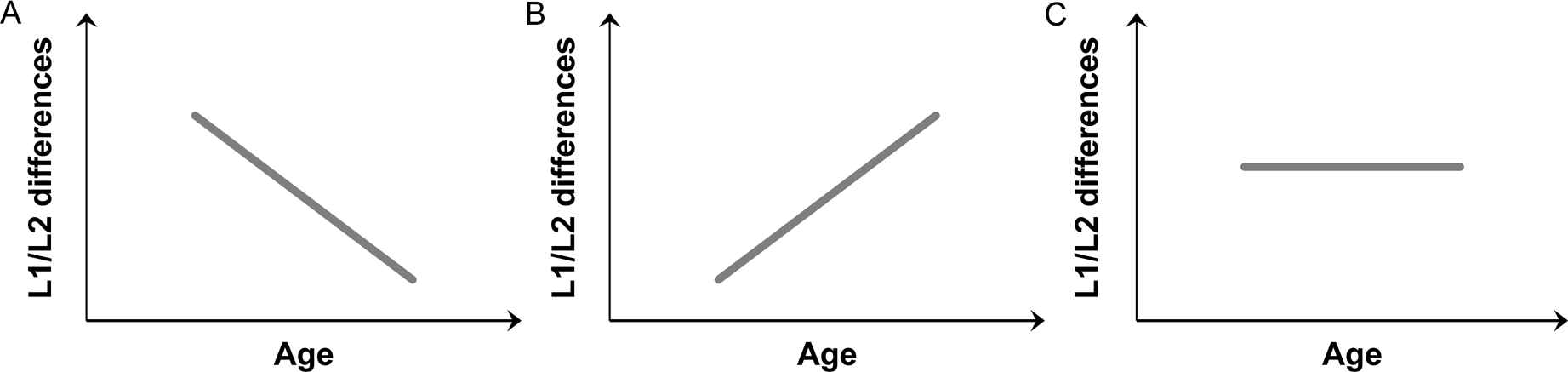
Here I will discuss whether aging affects the underlying linguistic processing mechanisms in L2, and how such aging effects (or lack thereof) may tie in with different theories of bilingual language processing. For measures of language performance (see previous section), there is a clear “optimum” that one might strive for: correct responses that are given as fast as possible. The situation is less clear for the linguistic mechanisms underlying language performance, as there is not necessarily a best way to process any given linguistic input or output. For example, there is nothing inherently “better” about decomposing an inflected word into its morphological constituents, as compared to whole-word retrieval from memory. Thus, the critical comparison here with regards to processing mechanisms will be the extent to which L2 processing appears to differ from L1 processing, and how such L1/L2 differences might be affected by aging. Potential outcomes fall into three broad categories (laid out in Figure 2): processing differences that are postulated to exist between L1 and L2 speakers may decrease in extent with increasing age (panel A); differences may increase (or emerge) with increasing age (panel B); or differences may persist and stay relatively stable across the lifespan (panel C). Note that changes in processing differences between L1 and L2 during aging could come about due to changes within a given mechanism (e.g., increasing difficulties with lexical access) and/or changes regarding which underlying processing mechanisms are relied on (e.g., decomposition vs. whole-word retrieval).
Broad outcomes of likely age trajectories of L1/L2 processing differences (e.g., as suggested by differences in morphological priming effects): decreasing differences (A), increasing differences (B), or differences (or lack thereof) that persist (C). Combinations of these trajectories are of course also possible (e.g., decreases followed by increases), yielding nonlinear effects. These may be revealed by future studies using continuous age designs across the adult lifespan with nonlinear analyses, rather than studies employing categorical designs that contrast younger versus older adult groups. Moreover, newer statistical approaches, such as generalized additive mixed models (GAMM; Baayen et al., Reference Baayen, Vasishth, Kliegl and Bates2017), which are not yet widely used in research on language in aging, will likely reveal more complex patterns.

3.1. The effects of aging on underlying linguistic processing mechanisms: theories and predictions
In this section, I will discuss each of the three broad possible trajectories outlined above, along with the theories of bilingual language processing that each pattern appears to be most consistent with. In each case, I will briefly outline the theories, which have thus far addressed processing in young-adult bilinguals, together with relevant supporting findings. I will then discuss their implications for language in aging bilinguals,
First, L1/L2 differences in effects such as morphological priming or agreement attraction at young-adult ages may decrease with increasing age, suggesting that the processing mechanisms employed by L2 speakers become more native-like. Such an outcome may be most in line with experience- or usage-based models of L2 processing. Here I discuss two such models.Footnote 6
One model with such implications is the Declarative Procedural (DP) model (Ullman, Reference Ullman2001a, Reference Ullman2001b, Reference Ullman and Sanz2005, 2016, 2020). According to the DP model, language learning and processing depends on two general-purpose learning and memory systems: declarative memory and procedural memory. In L1 speakers, declarative memory is posited to underlie arbitrary aspects of language, such as idiosyncratic lexical knowledge and irregular morphology, while procedural memory subserves rule-based aspects of language, such as in syntax and regular morphology. In contrast, in L2 speakers both lexical and grammatical processing are posited to rely heavily on declarative memory, in particular during early stages of L2 acquisition. Greater experience, however, is argued to lead to more native-like behavioral and neurocognitive grammatical processing, as grammatical knowledge becomes proceduralized – that is, as grammar is learned increasingly in procedural memory. Converging neurocognitive evidence appears to support the model in young adults (Ullman, Reference Ullman, VanPatten, Keating and Wulff2020). According to this view, we may predict that, all else being equal, older L2 speakers, who have had more L2 experience than younger L2 speakers, should have proceduralized the grammar to a greater extent than younger individuals, and thus should be more L1-like in their processing. Moreover, declarative memory, along with its neural substrates (medial temporal lobe structures, including the hippocampus), shows reliable declines as people age (see section 2.1.2), while procedural memory does not (at least with regards to learning simple structures; Frensch & Miner, Reference Frensch and Miner1994; Howard, Dennis, Howard, Yankovich & Vaidya, Reference Howard, Dennis, Howard, Yankovich and Vaidya2004; Howard & Howard, Reference Howard and Howard1989, Reference Howard and Howard1992). This further strengthens the prediction that L2 grammatical abilities should rely more on procedural than declarative memory with aging, and thus should be more L1-like.
A pattern of age-related decreases in L1/L2 processing differences might also be in line with models that hypothesize that a key locus of L1/L2 differences is L2 speakers’ particular difficulties with lexical access – rather than assuming different mechanisms of grammatical processing, as the DP model does. In particular, the Lexical Bottleneck hypothesis (Hopp, Reference Hopp2014) proposes that lexical access is less automatized in L2 speakers as compared to L1 speakers, and thus is more effortful, which in turn leads to fewer cognitive capacities being available for L2 syntactic processing. Indeed, within young adults, L2 speakers who display greater lexical access automaticity (e.g., as a function of L2 proficiency) show diminished sentence-processing differences as compared to L1 (Hopp, Reference Hopp2014).
Consistent with such experience-based models, behavioral and brain evidence suggests that young-adult L2 speakers with greater experience and/or proficiency show grammatical processing patterns that are more L1-like (Bel, Sagarra, Comínguez & García-Alcaraz, Reference Bel, Sagarra, Comínguez and García-Alcaraz2016; Bowden, Steinhauer, Sanz & Ullman, Reference Bowden, Steinhauer, Sanz and Ullman2013; Friederici, Steinhauer & Pfeifer, Reference Friederici, Steinhauer and Pfeifer2002; Herbay, Gonnerman & Baum, Reference Herbay, Gonnerman and Baum2018; Morgan-Short, Finger, Grey & Ullman, Reference Morgan-Short, Finger, Grey and Ullman2012; Morgan-Short, Sanz, Steinhauer & Ullman, Reference Morgan-Short, Sanz, Steinhauer and Ullman2010; Morgan-Short, Steinhauer, Sanz & Ullman, Reference Morgan-Short, Steinhauer, Sanz and Ullman2012; Perani et al., Reference Perani, Paulesu, Galles, Dupoux, Dehaene, Bettinardi and Mehler1998; Sagarra, Sánchez & Bel, Reference Sagarra, Sánchez and Bel2019; Steinhauer, Reference Steinhauer2014; Steinhauer, White & Drury, Reference Steinhauer, White and Drury2009). Thus, on this view it is reasonable to predict that with increasing L2 experience in aging, lexical access should become more automatized, and thus grammatical processing should become increasingly L1-like.
Second, it is possible that any L1/L2 processing differences observed in young adulthood increase as people age, or that differences not present in younger adults start to emerge with increasing age. Such findings appear to be in line with models of bilingual language processing proposing that on-line L2 grammatical processing (e.g., sentence or morphological processing) is inherently more cognitively demanding than L1 grammatical processing (Cunnings, Reference Cunnings2017; Foote, Reference Foote2011; Hopp, Reference Hopp2006, Reference Hopp2010; McDonald, Reference McDonald2006; McDonald & Roussel, Reference McDonald and Roussel2010; Sagarra & Herschensohn, Reference Sagarra and Herschensohn2010). According to most such capacity- or resource-based models, the processing mechanisms underlying native and non-native language processing are inherently similar, but L1/L2 differences come about as a consequence of the L2 imposing greater cognitive demands: for example, on working memory (Coughlin & Tremblay, Reference Coughlin and Tremblay2013; Herbay et al., Reference Herbay, Gonnerman and Baum2018; McDonald, Reference McDonald2006; Service, Simola, Metsänheimo & Maury, Reference Service, Simola, Metsänheimo and Maury2010), speed (Kaan, Ballantyne & Wijnen, Reference Kaan, Ballantyne and Wijnen2015), or perceptual phonological decoding abilities (Kilborn, Reference Kilborn and Harris1992; McDonald, Reference McDonald2006; McDonald & Roussel, Reference McDonald and Roussel2010). It has also been argued that L2 speakers might experience greater interference than L1 speakers when retrieving information from memory during sentence processing (Cunnings, Reference Cunnings2017). Evidence for such accounts in young-adult L2 speakers comes from studies reporting correlations between measures of cognitive resources and grammatical performance (McDonald, Reference McDonald2006; McDonald & Roussel, Reference McDonald and Roussel2010). Similarly, in a study in which L1 speakers were put under cognitive stress (e.g., increased cognitive load or noise), their grammatical performance mirrored that shown by L2 speakers (McDonald, Reference McDonald2006). Moreover, it appears that certain grammatical phenomena are more prone to interference from limited cognitive capacity than others, in both younger L1 speakers under cognitive stress and younger L2 speakers; for example, regular inflectional morphology seems to be more vulnerable in both such circumstances than word order (Blackwell & Bates, Reference Blackwell and Bates1995; McDonald, Reference McDonald2006).
Given well-established age-related declines in such cognitive abilities (see section 2.1.2), one implication of these models might be that L1/L2 grammatical processing differences should increase with aging – at least to the extent that L2 speakers’ cognitive abilities decline to the same extent and in a similar manner as L1 speakers’, which some evidence suggests (Anderson, Saleemi & Bialystok, Reference Anderson, Saleemi and Bialystok2017; Antón, García, Carreiras & Duñabeitia, Reference Antón, García, Carreiras and Duñabeitia2016; Cox et al., Reference Cox, Bak, Allerhand, Redmond, Starr, Deary and MacPherson2016; Gathercole et al., Reference Gathercole, Thomas, Kennedy, Prys, Young, Viñas Guasch and Jones2014; Kirk, Fiala, Scott-Brown & Kempe, Reference Kirk, Fiala, Scott-Brown and Kempe2014; Kousaie & Phillips, Reference Kousaie and Phillips2012; Kousaie, Sheppard, Lemieux, Monetta & Taler, Reference Kousaie, Sheppard, Lemieux, Monetta and Taler2014; Nichols, Wild, Stojanoski, Battista & Owen, Reference Nichols, Wild, Stojanoski, Battista and Owen2020). In this case, we would expect that older L2 speakers’ grammatical processing differs more from that of age-matched L1 speakers, as compared to L1/L2 differences found at younger age. This may hold especially for aspects of grammatical processing that have been shown to be particularly taxing for cognitive abilities, such as inflectional processing (Blackwell & Bates, Reference Blackwell and Bates1995; McDonald, Reference McDonald2006). Further, these models would predict that measures of older L2 speakers’ language processing abilities should correlate particularly with individual-differences measures of cognitive abilities, such as working memory.
Third, the extent of L1/L2 processing differences may remain unchanged with increasing age. In this case, any differences in processing that exist between L1 and L2 speakers persist into old age. A persistence of L1/L2 differences is largely in line with the Shallow Structure Hypothesis (SSH; Clahsen & Felser, Reference Clahsen and Felser2006a, Reference Clahsen and Felser2006b, Reference Clahsen and Felser2006c, Reference Clahsen and Felser2018), which assumes the existence of two different grammatical processing routes: a full parsing route that yields fully-specified syntactic representations of the input on the one hand, and a shallow, ‘good enough’ route using other sources of information (e.g., distributional properties of the language, discourse-level/pragmatic cues, lexical-semantic information, associative patterns) on the other. It is argued that L2 speakers rely less on grammatical parsing and more on ‘good enough’ processes. Reasons for this differential reliance might include insufficient grammatical knowledge (e.g., absent or differently weighted constraints) or differences in L2 versus L1 processing (e.g., greater L2 reliance on non-grammatical information).Footnote 7
Evidence in favor of the SSH comes from studies of younger adults suggesting that even highly proficient L2 speakers (including those with high working-memory abilities; Felser & Roberts, Reference Felser and Roberts2007) show less reliance on fully-specified structural representations or grammatical parsing than L1 speakers during online processing – even though their untimed offline performance (e.g., in comprehension questions) often resembles that of native speakers (Felser & Roberts, Reference Felser and Roberts2007; Felser, Sato & Bertenshaw, Reference Felser, Sato and Bertenshaw2009; Marinis, Roberts, Felser & Clahsen, Reference Marinis, Roberts, Felser and Clahsen2005). Instead, L2 speakers in these studies have been found to rely, for example, on lexical-semantic cues during ambiguity resolution (Felser, Roberts, Marinis & Gross, Reference Felser, Roberts, Marinis and Gross2003; Papadopoulou & Clahsen, Reference Papadopoulou and Clahsen2003) and long-distance wh-movement (Marinis et al., Reference Marinis, Roberts, Felser and Clahsen2005), on discourse-pragmatic information during anaphor resolution (Felser et al., Reference Felser, Sato and Bertenshaw2009), or on whole-word processing of morphologically complex inflections (Veríssimo, Heyer, Jacob & Clahsen, Reference Veríssimo, Heyer, Jacob and Clahsen2018). Thus, according to the SSH, L1/L2 processing differences are not necessarily due to a relative lack of exposure or greater cognitive demands. Therefore, studies that find that L1/L2 grammatical processing differences do not change with increasing age may be particularly in line with this theory.
To summarize, when assessing the effects of aging on the mechanisms that underlie L2 processing, with the critical measure being the extent to which L1 and L2 processing differ from one another, it appears that different aging trajectories of L1/L2 processing differences are broadly consistent with different models of L2 processing. To the best of my knowledge none of these models in their current forms has made explicit predictions about effects of chronological age on L2 processing, let alone tested such predictions. Thus, any inferences made for bilingual aging here are strictly logical extensions of these models, rather than claims made by the models themselves.
3.2. The effects of aging on underlying linguistic processing mechanisms: findings from aging bilinguals
In this section I will discuss findings from empirical research examining the effects of age on the processing mechanisms underlying L2, as compared to L1, and how these empirical findings line up with the trajectories outlined in section 3.1. As in the previous section, I focus here on grammar, including both syntax and morphology, as I am not aware of any study that has assessed age effects on the mechanisms involved in L2 (vs. L1) lexical processing.
3.2.1. Syntax
As regards syntax, a study by Reifegerste et al. (Reference Reifegerste, Jarvis and Felser2020b) (see also section 2.2.2), which tested L1-German and L1-English/L2-German speakers, suggests some interesting insights into sentence-level processing in a late-learned L2 across the adult lifespan. The study investigated agreement attraction errors, a syntactic phenomenon in which the verb of a clause agrees not with the subject noun phrase (NP) of that clause but rather with a “distractor NP” (e.g., *The key to the cabinets were rusty). Though L1 agreement computation is relatively error-free in general, both younger and older L1 speakers do sometimes make and fail to notice such attraction errors (Bock & Miller, Reference Bock and Miller1991; Pearlmutter, Garnsey & Bock, Reference Pearlmutter, Garnsey and Bock1999; Reifegerste, Hauer & Felser, Reference Reifegerste, Hauer and Felser2017; Wagers, Lau & Phillips, Reference Wagers, Lau and Phillips2009). These errors are more common in clauses with singular subject NPs and plural distractors (*The key to the cabinets were…) than in clauses with plural subject NPs and singular distractors (*The keys to the cabinet was…) (Bock & Cutting, Reference Bock and Cutting1992; Bock & Eberhard, Reference Bock and Eberhard1993; Bock & Miller, Reference Bock and Miller1991; Haskell & MacDonald, Reference Haskell and MacDonald2005). Reifegerste et al. (Reference Reifegerste, Jarvis and Felser2020b) replicated this asymmetry for L1 speakers across the adult lifespan. However, L2 speakers of all ages instead displayed a symmetric attraction pattern in their accuracy rates, with attraction effects of similar size for singular-plural and plural-singular preambles. The authors argued that one explanation for the different patterns might lie in differences in how the L1 speakers and the L2 speakers encoded the subject NPs. The asymmetric pattern displayed by L1 speakers is often argued to be a consequence of different representations of singular versus plural NPs. For example, it has been proposed that the latter's plural feature renders it more likely to overwrite the number feature of the (unmarked) singular subject NP than vice versa (Bock, Reference Bock and Ross2004; Eberhard, Reference Eberhard1997; Eberhard, Cutting & Bock, Reference Eberhard, Cutting and Bock2005; Pearlmutter et al., Reference Pearlmutter, Garnsey and Bock1999), or that plural NPs are more salient in memory than singular NPs (Phillips, Reference Phillips2013; Staub, Reference Staub2009). L2 speakers’ symmetric attraction pattern across the lifespan then suggests that (in contrast to L1 speakers) their representations of singular NPs and their representations of plural NPs are similar to one another, and that this did not appear to change with increasing age. This could come about, for example, because both younger and older L2 speakers are more likely to assign (equally) shallow structures to singular and plural NPs, in contrast to L1 speakers’ more full-fledged hierarchical representations.
Interestingly, the older L2 participants in this study are the same as those mentioned in section 2.2.2, whose overall accuracy rates were on par with those displayed by age-matched L1 speakers. Yet, their particular accuracy pattern was different from that of age-matched L1 speakers, suggesting L1/L2 differences in the underlying grammatical processing mechanisms. Moreover, as we have seen, these patterns did not appear to be modulated by age across the adult lifespan, suggesting that the processing mechanisms were not affected by aging in either L1 or L2.
A second key finding from this study concerns the involvement of (age-sensitive) cognitive abilities. The size of the symmetric attraction effect displayed by the L2 speakers was modulated by measures of both non-linguistic working memory and non-linguistic interference control. That is, there were smaller attraction effects for L2 participants with greater working-memory spans and better interference control. For L1 speakers, on the other hand, none of the various individual-differences measures assessed (including also processing speed and short-term memory) modulated the size of the attraction effect. These findings suggest a greater involvement of cognitive functions, such as working memory or interference control, in L2 sentence-level processing, as compared to L1 processing, across the adult lifespan.
3.2.2. Morphology
A handful of studies by Clahsen and Reifegerste have assessed the mechanisms underlying L1 and L2 regular morphological processing in aging. Such studies tap the effect of age on grammatical processing at the word level. In a masked priming study, Reifegerste et al. (Reference Reifegerste, Elin and Clahsen2019) investigated derivational and regular inflectional priming in younger and older L1-German speakers and participants who had learned German as a late-learned L2. Whereas both the L1 and L2 speakers showed significant derivational priming (e.g., Warnung – warnen, ‘warning’ – ‘to warn’), only the L1 speakers showed an inflectional priming effect (e.g., gewarnt – warnen, ‘warned’ – ‘to warn’). Crucially, the respective priming patterns displayed by L1 and L2 speakers were not affected by chronological age. The authors argued that, in line with previous studies (e.g., Veríssimo et al., Reference Veríssimo, Heyer, Jacob and Clahsen2018), a person's ability to extract inflectional rules from the input during language acquisition becomes progressively compromised after childhood, and thus even several decades of additional exposure to the target language are not sufficient to lead to native-like inflectional processing in adult L2 learners who acquired the target language after childhood. Such findings of relative age invariance in regular morphological priming effects were also reported by Clahsen and Reifegerste (Reference Clahsen, Reifegerste, Libben, Goral and Libben2017), who found no effects of age on L1 and L2 speakers’ respective cross-modal priming effect sizes for regular German participles.
Lastly, an fMRI study by Prehn, Taud, Reifegerste, Clahsen and Flöel (Reference Prehn, Taud, Reifegerste, Clahsen and Flöel2018) assessed the neural substrates of morphological processing as older L1 and L2 speakers performed grammaticality judgments on correctly or incorrectly inflected regular and irregular German participles. Despite having learned their late-acquired L2 to high proficiency, older L2 speakers showed particular difficulty at rejecting incorrect forms (of either regularity type). This difficulty was mirrored by increased activation in the bilateral medial superior frontal gyrus (SFG) when older L2 speakers responded to incorrectly (vs. correctly) inflected participle forms, as compared to the L1 control group. In previous studies, this area has been associated with task monitoring in general (du Boisgueheneuc et al., Reference du Boisgueheneuc, Levy, Volle, Seassau, Duffau, Kinkingnehun and Dubois2006; Schel et al., Reference Schel, Kühn, Brass, Haggard, Ridderinkhof and Crone2014). Moreover, it is part of/proximal to an area of the brain thought to underlie language control, which includes the dorsal anterior cingulate cortex (dACC) and the pre-supplementary motor area (pre-SMA), among other regions (cf. the Language Control model and Adaptive Control Hypothesis; Abutalebi & Green, Reference Abutalebi and Green2016; Green & Abutalebi, Reference Green and Abutalebi2013). The authors suggest that L2 morphological processing in aging requires the recruitment of additional executive control resources, as compared to L1 processing. However, the study did not include a young-adult control group, so it is not clear whether such an increased demand of executive control during L2 morphological processing would be equally present throughout adulthood; whether it might come about at later stages (perhaps as a function of such abilities declining); or whether it might decrease with older age (due to increasing exposure facilitating processing).
3.2.3. Summary and implications for theories of bilingual language processing
In sum, one study examining the role of chronological age in L2 versus L1 sentence-level processing, and a handful of studies investigating the processing of complex words in aging L2 and L1 speakers, suggest that age does not seem to substantially affect underlying grammatical processing mechanisms, in either L1 or L2. Thus, these studies indicate that even several decades of (often immersive) exposure to a (late-learned) L2 do not render an L2 speaker's underlying processing mechanisms native-like. Rather, processing differences that existed in early adulthood persist during aging.
Interestingly, the age-related persistence of processing mechanisms discussed above for both agreement and inflectional morphology may in fact be related to the processing of regular inflection, in both nouns and verbs (e.g., keys and warned). It has often been argued that whereas such forms are generally compositional in L1 speakers (e.g., [key]+[-s] or [warn]+[-ed]) (Clahsen, Reference Clahsen1999; Clahsen, Eisenbeiss & Sonnenstuhl, Reference Clahsen, Eisenbeiss and Sonnenstuhl1997; Pinker, Reference Pinker1999; Pinker & Ullman, Reference Pinker and Ullman2002; Sonnenstuhl, Eisenbeiss & Clahsen, Reference Sonnenstuhl, Eisenbeiss and Clahsen1999), they are assumed to be stored and processed as whole words (potentially without any morphosyntactic structure; e.g., [keys] or [warned]) in L2 (Clahsen & Felser, Reference Clahsen and Felser2006c; Ullman, Reference Ullman2001b, Reference Ullman, VanPatten, Keating and Wulff2020). Crucially, as we have seen, this distinction appears to persist across the L2 adult lifespan (Jacob, Fleischhauer & Clahsen, Reference Jacob, Fleischhauer and Clahsen2013; Jacob, Heyer & Veríssimo, Reference Jacob, Heyer and Veríssimo2017; Reifegerste et al., Reference Reifegerste, Elin and Clahsen2019), and may help explain not only the inflectional morphological findings (section 3.2.2) but also the results from syntactic agreement (section 3.2.1). Such age invariance, as well as this particular pattern, seems to be line with predictions of the Shallow Structure Hypothesis (Clahsen & Felser, Reference Clahsen and Felser2006a, Reference Clahsen and Felser2006b, Reference Clahsen and Felser2006c, Reference Clahsen and Felser2018), which posits that L2 speakers are more likely than L1 speakers to assign shallow or “flat” structures (rather than full-fledged hierarchical structures) to complex grammatical representations.
In contrast, the findings presented above are not obviously consistent with experience- or usage-based models such as the Declarative/Procedural model or the Lexical Bottleneck hypothesis, which may expect that increased exposure to the language leads to more native-like processing. It remains unclear why such models have substantial explanatory power in younger adult L2 speakers, for whom greater experience and/or proficiency are associated with greater L1-like grammatical processing (see section 3.1), even while such changes are not observed during aging.
Interestingly, some evidence from the studies discussed above also suggests that L2 grammatical processing across the adult lifespan yields greater involvement of cognitive abilities, such as working memory and cognitive control, as compared to L1 processing (Prehn et al., Reference Prehn, Taud, Reifegerste, Clahsen and Flöel2018; Reifegerste et al., Reference Reifegerste, Jarvis and Felser2020b). At first blush, this may appear to be in line with capacity- or resource-based models, which argue for a greater need for such limited resources during L2 than L1 grammatical processing. However, while Reifegerste et al. (Reference Reifegerste, Jarvis and Felser2020b) found that L2 speakers’ performance at the working-memory and interference-control tasks was inversely correlated with attraction effects in the agreement-processing task, high levels of performance at these non-linguistic cognitive tasks did not yield a native-like pattern at the agreement-processing task in L2 speakers: across all levels of such cognitive abilities, L1 speakers showed an asymmetric attraction pattern, while L2 speakers showed a symmetric attraction pattern (see section 3.2.1). This suggests that capacity- or resource-based models cannot fully account for L2 grammatical processing mechanisms across the lifespan.
More research on the effect of aging on bilingual grammar processing is clearly needed. Of particular importance here is to extend this line of work to older early bilinguals – all studies that assessed the linguistic mechanisms employed by older bilinguals investigated participants who started acquiring the L2 in their teens or later. This is particularly critical as previous work has highlighted the role of AoA for grammatical processing in young and middle adulthood (e.g., Birdsong & Flege, Reference Birdsong and Flege2001; Flege, Yeni-Komshian & Liu, Reference Flege, Yeni-Komshian and Liu1999; McDonald, Reference McDonald2000; Veríssimo et al., Reference Veríssimo, Heyer, Jacob and Clahsen2018); see also section 2.2.2. Future research should assess the generalizability of the findings presented in this section, in order to refine the picture of age effects on the linguistic mechanisms involved in bilingual grammatical processing.
4. Conclusion
4.1. Summary
Here I summarize the main points of this article, focusing first on general measures of performance and then on underlying linguistic processing mechanisms. Regarding performance measures of language (RTs and accuracy; section 2), we have seen that age-related improvements, declines, and an absence of changes are all observed in bilingual speakers. These patterns are likely due to a combination of the opposing forces of increasing experience and cognitive declines. For measures of lexical skills, the bilingual performance changes (or lack thereof) generally parallel those found in monolinguals. In contrast, L1 and L2 lifespan trajectories may diverge for grammatical skills. In particular, some evidence suggests that grammatical phenomena that are difficult in a later-learned L2, such as agreement computation, show no declines or even improved performance with aging, in the face of relative declines in L1. A likely reason for this is the additional exposure to the L2 that comes with increasing age, which in such cases may be especially beneficial. Strikingly, these improvements observed in older L2 speakers can even lead to accuracy or RT performance that is indistinguishable from that of age-matched L1 speakers.
In contrast, such age-related changes in grammatical outcome measures in L2 speakers do not appear to be due to changes in the underlying linguistic processing mechanisms. Rather, the evidence suggests that grammatical processing mechanisms remain the same between younger and older adulthood, in both L1 and L2. Indeed, even decades of immersion to the target language and the achievement of high proficiency in the L2 do not render a (late) bilingual's grammatical processing mechanisms native-like. Interestingly, L2 grammatical processing across the lifespan appears to incur greater demands on age-sensitive cognitive abilities, such as working memory or interference control, as compared to L1 processing – though even L2 speakers with high levels of performance at such abilities still do not show native-like processing.
How might these processing patterns be best interpreted? Though none of the major theories of second-language processing have made explicit predictions regarding L2 in aging, the findings seem to be consistent with the implications of the Shallow Structure Hypothesis (Clahsen & Felser, Reference Clahsen and Felser2006a, Reference Clahsen and Felser2006b, Reference Clahsen and Felser2006c, Reference Clahsen and Felser2018), which claims that even highly proficient L2 speakers are likely to rely on ‘good-enough’ processing in on-line grammatical tasks, in contrast to the structural grammatical parsing employed by L1 speakers. Evidently, this strategy does not appear to change with more exposure to or experience with the L2.
4.2. Future directions
The reader may have noticed that there is need for more studies investigating the effects of age on language in bilingualism. This holds particularly for certain areas, such as age effects on L2 grammar (performance measures as well as processing mechanisms) or on L2 lexical processing mechanisms.
Future studies should ideally employ a continuous-age design, rather than contrasting groups of younger and older adults, to elucidate the (potentially nonlinear) trajectories of language abilities across the lifespan. In fact, the oft-ignored period of middle-age may well constitute a highpoint of aspects of L1 and L2 language performance, since during this period the positive effects of exposure may not yet be substantially counteracted by declining cognitive abilities. Moreover, some studies assessing L1 in aging have begun to combine cross-sectional and longitudinal sampling (Connor et al., Reference Connor, Spiro, Obler and Albert2004; Nyberg et al., Reference Nyberg, Lövdén, Riklund, Lindenberger and Bäckman2012; Rönnlund, Nyberg, Bäckman & Nilsson, Reference Rönnlund, Nyberg, Bäckman and Nilsson2005). Such an approach should be particularly useful when examining L2, as it would help hold constant the many language-related and other variables that are at play in such research, such as AoA, the type and amount of language experience, and even sociological and biological factors such as socioeconomic status and genotype (Noble, Houston, Kan & Sowell, Reference Noble, Houston, Kan and Sowell2012; Ullman, Reference Ullman, VanPatten, Keating and Wulff2020; Wong, Ettlinger & Zheng, Reference Wong, Ettlinger and Zheng2013; Wong, Morgan-Short, Ettlinger & Zheng, Reference Wong, Morgan-Short, Ettlinger and Zheng2012; Wong, Vuong & Liu, Reference Wong, Vuong and Liu2017).
Identifying contributions of age-related cognitive declines and experience-based improvements can be problematic in L2 studies, particular for the latter. On the one hand, since older adults show a great deal of variability in their cognitive abilities, it is possible to largely disentangle the effects of chronological age and age-related cognitive declines. In contrast, this often does not hold for age and exposure, since most studies sample their younger and older bilinguals from a population that is relatively homogenous in age-of-acquisition or age-of-arrival as well as in the type of subsequent L2 experience (e.g., immersion). This commonly leads to a high degree of collinearity between age and the amount and type of exposure (younger adults = little exposure, older adults = lots of exposure), which makes it difficult to assess their independent roles in language abilities. Future studies seeking to explore the role of exposure should address this issue: for example, by examining groups such as late-life migrants (i.e., older adults with little L2 exposure).
Though in this paper I focused on behavioral studies, examining the neurobiological bases of bilingual/second language in aging should also elucidate the nature of this process. Thus far, there has been little direct empirical work on this topic (see Rossi and Diaz, Reference Rossi and Diaz2016, for a relevant discussion), and most imaging research on aging bilinguals has focused on the effects of bilingualism on cognitive measures and their neural substrates (Abutalebi et al., Reference Abutalebi, Guidi, Borsa, Canini, Della Rosa, Parris and Weekes2015; Borsa et al., Reference Borsa, Perani, Della Rosa, Videsott, Guidi, Weekes and Abutalebi2018; Gold, Kim, Johnson, Kryscio & Smith, Reference Gold, Kim, Johnson, Kryscio and Smith2013; Olsen et al., Reference Olsen, Pangelinan, Bogulski, Chakravarty, Luk, Grady and Bialystok2015). Note that behavioral differences are often not found where differences in underlying brain activation are in fact observed (Morgan-Short, Steinhauer, et al., Reference Morgan-Short, Finger, Grey and Ullman2012; Tokowicz & MacWhinney, Reference Tokowicz and MacWhinney2005), underscoring the likely utility of this approach to assess language processing mechanisms in aging bilinguals.
Lastly, although I argue that the current empirical picture is most compatible with the SSH, this article is not intended to determine which of the several theories of bilingual language processing is (most) correct regarding bilingualism in aging. Such a conclusion would be premature, considering the still relatively small amount of published research on this broad topic. Moreover, none of the theories presented here have yet made explicit predictions for L2 in aging. I am hopeful that, given the increasing interest in this field, future iterations of these accounts will address aging.
4.3. In closing
In this paper I have outlined the current status of empirical research examining the effects of aging on second language and bilingualism, with a focus on the lexicon and on grammar, and have attempted to interpret these findings in the context of principles and theories of aging and of L2 processing. Overall, the evidence suggests that aging can yield multifaceted outcomes in measures of language performance, with improvements as well as no changes and declines, even while the underlying linguistic processing mechanisms involved in L1 and L2 processing appear to remain relatively unchanged. I hope this paper serves as a call for further research in the area of bilingualism and aging, particularly considering the globally aging population and the prevalence of bilingualism.
Acknowledgments
I am grateful to Michael Ullman for many fruitful discussions and very valuable input. Funding was provided by the Deutsche Forschungsgemeinschaft (DFG) ‘German Research Foundation’ (411781424).