INTRODUCTION
Nereididae inhabit several soft and hard substrata in littoral and sublittoral environments. They dwell, more or less permanently, in a secreted tube often encrusted by sediment debris. Their eversible jawed apparatus enables nereidids to exploit several trophic sources, so that they behave as selective deposit feeders up to herbivores and carnivorous/scavenging macrophages (Fauchald & Jumars, Reference Fauchald and Jumars1979). Many species of the genera Ceratonereis, Eunereis, Neanthes, Nereis and Platynereis, which reach a remarkable individual size, constitute an important loop in the benthic food web (Núñez, Reference Núñez and Ramos2004).
Neanthes rubicunda (Ehlers, Reference Ehlers and Engelmann1868), since the date when it was synonymized with Neanthes irrorata (Malmgren, 1867) and Neanthes nubila (Savigny, Reference Núñez and Ramos1822), has an unclear distribution, with fragmentary records in the Mediterranean Sea. Its nearest relative N. irrorata, now accepted as Neanthes nubila (Savigny), has a boreal distribution in the east Atlantic Ocean, from the Canary and Azores Islands to the North Sea (Fauvel, Reference Fauvel1914; http://www.marbef.org/data/aphia.php?p=taxdetails&id=130389). It was also reported in the Mediterranean Sea, from the Aegean (Arvanitidis, Reference Arvanitidis2000; Ergen et al., Reference Ergen, Çinar and Ergen2000; Simboura & Nicolaidou, Reference Simboura and Nicolaidou2001) and Levantine (Fauvel, Reference Fauvel1937; Çinar, Reference Çinar2005) Seas to the Adriatic and Tyrrhenian basins, except for the southern Ionian and Levantine areas (Cantone, Reference Cantone2003; Castelli et al., Reference Castelli, Bianchi, Cantone, Çinar, Gambi, Giangrande, Lanera, Licciano, Musco, Sanfilippo and Simonini2008). Neanthes rubicunda, originally described in the Adriatic Sea as Nereis irrorata (Ehlers, Reference Ehlers and Engelmann1864–1868), was proposed to be a separate species by Núñez (Reference Núñez1995). Neanthes rubicunda, originally described from the northern Adriatic (Ehlers, Reference Ehlers and Engelmann1864–1868; Fauvel, Reference Fauvel1914, Reference Fauvel and Lechevalier1923), occurs along the Atlantic Iberian coasts up to the Alboran Sea and on the western side of the Balearic Isles (Núñez, Reference Núñez and Ramos2004). Quite similar to N. rubicunda is the tropical Neanthes gisserana (Horst, 1924), reported from the Indian Ocean (Núñez & Brito, Reference Núñez, Brito, Sardá, San Martín, López, Martin and George2006); a supposed, but not proved, synonymy with this latter tropical species has been discussed in Núñez (Reference Núñez1995). Neanthes rubicunda, which is often associated with current-exposed coralligenous bottoms, coarse-medium sands and maërl (Núñez, Reference Núñez and Ramos2004; Núñez & Brito, Reference Núñez, Brito, Sardá, San Martín, López, Martin and George2006), shows a deeper bathymetric range and a different biotopic distribution with respect to the sympatric N. nubila (Muir et al., Reference Muir, Smith and García-Alonso2014).
The present paper, which includes the first report of N. rubicunda for the Italian coasts, aims: (i) to define its local distribution in the Strait of Messina (central Mediterranean); (ii) to describe its settlement in a steep bottom habitat; (iii) to provide first data on feeding habit and gardening behaviour; and (iv) to provide some preliminary data on its size and fertility with respect to the other Mediterranean and Atlantic populations.
MATERIALS AND METHODS
Study area, sampling and determinations
The Strait of Messina, which directly connects the eastern and western Mediterranean basins, is characterized by a tidal regime which induces strong currents and upwelling phenomena. Such peculiar hydrology determines lower surface temperatures and a higher primary production with respect to the adjacent oligotrophic basins (Azzaro et al., Reference Azzaro, Decembrini, Raffa and Crisafi2007). The usual Mediterranean benthic zonation is here modified, with a deeper distribution of algal assemblages that show high growth rate below 50 m depth (Drew et al., Reference Drew, Ireland, Muir, Robertson and Robinson1982). The local benthic community distribution, preliminarily described by Di Geronimo & Giacobbe (Reference Di Geronimo, Giacobbe, Barrier, Di Geronimo and Montenat1987), has been improved by ship surveys carried out in October–November 1993 and 1995 along 20 transects from 5 up to 75 m depth, for a total of 115 sampling stations. Both Van Veen grab (0.25 m2 surface, 113 samples) and epibenthic dredge with a 60 cm mouth (2 samples) were employed. The total dredged area of 342 m2 (DG1-2) and 204 m2 (DG3) was estimated by the starting and final coordinates. The other 12 samples were carried out along the north-west–south-east axis of the Strait of Messina between 90 m and 1200 m depth, by means of 20 dm3 box corer (Figure 1). The samples, washed out on-board on 1 mm mesh sieves, provided numerous specimens of N. rubicunda that allowed for an assessment of local distribution. Based on the available distribution data, direct SCUBA sampling and observation were carried out in May and June 2007 (three surveys) and in July 2008 (one survey), from 20 to 38 m depth, to assess the small scale distribution and life-position of specimens. Depth, temperature and sea-floor typology were contextually recorded. Stones and boulders, which hosted N. rubicunda, were lifted up from the sediment and the upper and lower surfaces were examined in situ. Specimen position was recorded by means of a field compass, according to four equivalent sectors (upper, lower, right and left sides) with respect to the bottom slope. Each dwelled tube was successively removed and put into a labelled plastic vial. In the laboratory, the specimens were anaesthetized with MgCl2 4% solution, to prevent autotomy, and fixed with a 5% formaldehyde buffered isotonic solution. Morphometric assessment under a light stereomicroscope equipped with a micrometer (resolution 0.01 mm) was performed for the following characteristics: (a) total number of segments; (b) the length from the prostomium (palp base) to the 5th chaetigerous segment; (c) the peristomium length; (d) the peristomium width; and (e) total body length. For those specimens whose pharyngeal apparatus was extruded, the more variant (d) parameter was corrected with respect to specimens of a comparable size. The gut content was obtained by specimen dissection with a ventro-sagittal cut in a count chamber equipped with millimetric area of 400 mm2, taken by means of micro-forceps and dispersed in 70% ethanol and glycerine (2:1). The gut content of each individual was spread over the millimetric surface and the main recognizable food typologies were sorted as follows: (i) algal thalli (recognizable taxa or morphological groups); (ii) algal thalli (unrecognizable taxa); (iii) organic macrodetritus (shells and bryozoans); (iv) organic microdetritus (unrecognizable matter and benthic foraminifers); and (v) inorganic debris (sand grains). The gut status was classified according to the categories: empty (0); less than 20% full (1); 20% to 50% full (2); and more than 50% full (3). The relative percentage for each feeding typology was assessed. Percentage fractions were transformed by arcsin√, in order to approximate normality (Sokal & Rohlf, Reference Sokal and Rohlf1995). The fertile status of the coelomic cavity was also checked for some of the large specimens after dissection. Microphotographs were performed by both a stereomicroscope (16× and 20× magnifications) equipped with Zeiss AxioCam ICc3 (3.3 Mpixel), and by an inverted light microscope (100× and 250× magnifications) equipped with the Canon EOS 400D digital photocamera (10.1 Mpixel). In order to assess possible differences in feeding behaviour with respect to the size of the animal, the specimens were a posteriori sorted into three-dimensional classes (upper level included) according to the measure at point (b): 2.6 to 3.6 mm (small, N = 8); 3.6 to 4.8 mm (medium, N = 8); and 4.8 to 7.0 mm (large, N = 9). The frequency of the food items was assessed within each class.
Sampling grid in the Strait of Messina (left pane), with transects of grab samples (straight lines), coastal dredging (dashed lines) and deep sediment corers (black circles). Local distribution and density of Neanthes rubicunda (right pane). Empty squares (□) ≤ 0.6 ind m−2; half-full squares (◘) ≤ 4 ind m−2; full squares (■) ≤ 16 ind m−2.

Data analysis
The frequency of specimen position under the stones was tested by the χ² method. Bray–Curtis similarity was computed for the gut content and the triangular matrix was employed to display the clusters and the non-metric multidimensional scaling pattern in the plane for the two years (2-d MDS). Permutation test of similarity (SIMPROF) and percentage analysis (SIMPER) were employed to assess the effectiveness of the observed clusters for each feeding typology as well as its relative contribution and seasonality. Analyses were performed with STATISTICA v.7.0 StatSoft Italia and with PRIMER-E v.6 Plymouth Marine Laboratory, UK software packages.
RESULTS
Body size and pharyngeal morphology
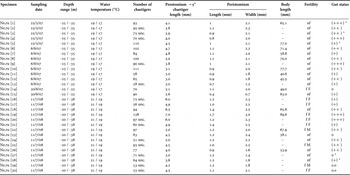
In the Strait of Messina, Neanthes rubicunda had an average body size of 63.56 ± 6.62 standard error mm for 90 up to 128 chaetigers, and an average peristomial width of 2.03 ± 0.16 mm (Table 1). Palps and pharynx were big-sized; heavily sclerotized arc-shaped jaws bore up to 7–9 robust teeth. The maxillary ring had the following formula: Area I (0) – Area II (one row of 7–8 big-sized conical paragnaths) – Area III (sparse group of 11–15 conical paragnaths of variable size) – Area IV (arc-shaped group of 10–12 smaller conical + 4–5 larger ‘pointed-bar’ paragnaths). The oral ring had the formula: Area V (0) – Area VI (4–5 conical paragnaths in two small transversal rows) – Areas VII + VIII (7–8 big-sized conical paragnaths in one single transversal row). Specimen morphology well agreed with other descriptions from the Canary and Balearic Archipelagos (see Núñez, Reference Núñez1995 figures 4E & 5G; and Núñez, Reference Núñez and Ramos2004 figure 135). The paragnaths formula and morphology, and a marked uniform red-brown live pigmentation clearly distinguished this species from the closely related N. nubila (sensu Núñez, Reference Núñez and Ramos2004), which bears two rows of more numerous paragnaths of different size in the oral ring, and a white-spotted reddish pigmentation.
Environmental and biological features of the nereidid Neanthes rubicunda specimens (Ne.ru), sampled from spring to early summer 2007 and 2008 under stones in a gravelly pre-coralligenous bottom of Torre Faro, the northernmost part of the Strait of Messina (Italy). fF, ovigerous female; fM, spermigerous male; nf, non-fertile specimen; inc., incomplete or fragmented specimen; *, specimen with extruded pharynx. For the gut status numbers, see the Materials and Methods section.

Distribution and site selection
Neanthes rubicunda in the Strait of Messina was represented by 77 specimens (from 7 grab and 2 dredge sampling stations), collected along the Calabrian (1993) and Sicilian coasts (1995), between 4 m and 60 m depth; no specimen was found in the deeper sediment corers. On the Sicilian side, the species was mainly found in the central and northern areas, whereas on the Calabrian side the species showed a prevalent distribution in the central and southern areas. Such an asymmetrical distribution with respect to the whole area of the Strait of Messina was underlined by the presence of a dense population on the northernmost Sicilian coasts, that provided further 30 specimens collected by SCUBA divers during the 2007–2008 survey (Figure 1). As shown by grab and dredge samplings, and confirmed by SCUBA direct observations, N. rubicunda settles preferentially on steep sea floors characterized by gravels, cobbles and sparse builders, encrusted by epilithic organisms and colonized by photophilic algae.
In general, the specimens were not highly aggregated, depending on the availability of stones and boulders to anchoring tube. The average population density, according to the normalized sampled surfaces, was estimated as 4.1 ± 2.7 ind. m−2. Less dense patches with a minimum of 0.15 ind. m−2 were observed at shallower depths; maximum density reached up to 16 ind m−2 in the deeper sites.
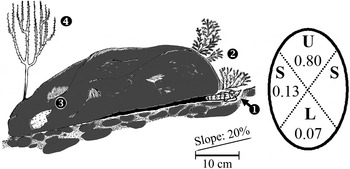
The SCUBA observations carried out on the northernmost Sicilian side showed that the local population was confined beyond 20 m depth (Table 1), beneath the isotherm of 19°C in spring, and 21°C in early summer. The unconsolidated steep bottom, with 20% mean slope, was characterized by mixed coarse sands, gravels and boulders, and hosted a variegated assemblage of both photophilic and sciaphilic taxa, with the characterizing presence of the gorgonian Eunicella singularis (Esper). The N. rubicunda specimens were always found under larger boulders, more than 20 cm of mean diameter (Figure 2). With respect to worm size, each boulder was inhabited only by one adult; two small-sized specimens were less frequently observed beneath the same boulder. The orientation of dwelled tubes appeared not to be casual; a frequency of 80% specimens was observed underneath the upper side of the boulder (Figure 2), whilst 13% living tubes were attached to the lateral sides under the stone surface, and only about 7% tubes were attached to the lower part of the inferior stone surface. The comparison of the observed frequencies with respect to the binomial distribution gave a highly significant χ² statistic for the upper location of 25.27 (P < 0.001; df 1) with respect to the other sides.
Schematic drawing of the location preference of Neanthes rubicunda (1) in its habitat (Torre Faro, Strait of Messina): on the left, the preferential life position of the worm under the boulders (ventral side adhering to the inner surface, dorsal side to the underlying sediment), in the gravelly coralligenous bottom. Turfs of brown algae Sphacelariaceae (2), encrusting and branched Corallinales (3), and a colony of Eunicella singularis (4) are common; on the right, the observed frequency of tube orientation beneath the boulder (as ‘ellipse’) with respect to the slope of the sea bottom is shown. U, upper; S, side; L, low-orientation.

Tube features
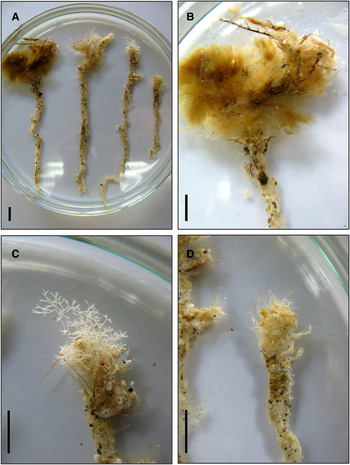
The tubes, which did not visibly emerge from the boulder, were made of a silky matrix, consolidated by sparse sand granules of variable size and adorned with algal turf fragments on the outer part of the tube opening (Figure 3). These turfs belonged to the seaweeds Halopteris filicina (Grateloup) Kützing, Halopteris scoparia (Linnaeus) Kützing (Phaeophyta: Sphacelariaceae) and Jania rubens (Linnaeus) J.V. Lamouroux (Rhodophyta: Corallinaceae), which were also observed living on the boulder surface. The larger specimens showed big algal turfs on tube openings, often with a certain mixture of seaweeds (Figure 3A − C); the small-sized tubes appeared less covered by algae, especially branched J. rubens (Figure 3D). The tube opening appeared also well camouflaged with respect to the environmental background.
(A) Tubes of Neanthes rubicunda from small-sized (right) to large-sized specimens (left). The tube structure and the different ‘gardening’ extent at the tube opening are shown; (B–C) Halopteris gardening, in most of the adult specimens (B), often associated with Jania rubens (C); (D) tube of a young specimen with few small thalli of J. rubens. Scale bars 1 cm.

Gut content
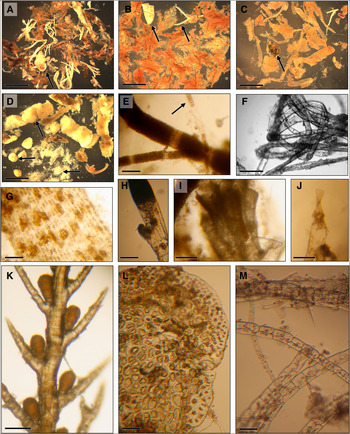
Twenty-five out of 30 worms showed variable amounts as well as particle dimensions of feeding residuals in the gut (Table 1). These residuals were found mainly at the level of the mid-gut, whilst they were more or less strongly elaborated in the hind-gut; the pharynx and fore-gut were empty. The feeding canal of nine specimens was less than 20% full, and contents consisted mainly of heavily elaborated vegetal fragments, unidentifiable organic micro-residuals, and inorganic detritus. Almost one-third of the specimens had half or more of the feeding canal full of more or less recognizable fragments of algal thalli (up to 90%) and organic/inorganic debris (up to 10%). Table 2 and Figure 4 show the main feeding groups found with their relative frequency. The most frequently ingested seaweeds were Halopteris filicina (Gratel.) Kütz and Halopteris scoparia (L.) Kütz. (Phaeophyta: Sphacelariaceae), but Jania rubens (L.) J.V. Lamouroux (Rhodophyta: Corallinaceae) and Cladophora sp. (Chlorophyta: Cladophoraceae), together with other filamentous algal aggregates were moderately frequent. Other Rhodophyta, such as Acrosorium cf. venulosum (Zanar.) Kylin, Asparagopsis cf. armata, Rhodomelaceae sp. gen., Ceramiaceae sp. gen. and brown algae of the family Dictyotaceae were found in almost one-sixth of the sampled specimens. Unidentified organic debris together with calcareous tests of benthic foraminifers were present in more than half of the samples, whereas residues of living colonies of Bryozoa (both soft-bodied Ctenostomata and calcareous Cyclostomata) and shells of mollusca (Alvania sp. and Musculus sp.) were found in one-fifth of the specimens. Inorganic debris, recognizable as clasts of quartz and micas minerals, was also frequent with low abundance. The most representative feeding contents are shown in Figure 5.
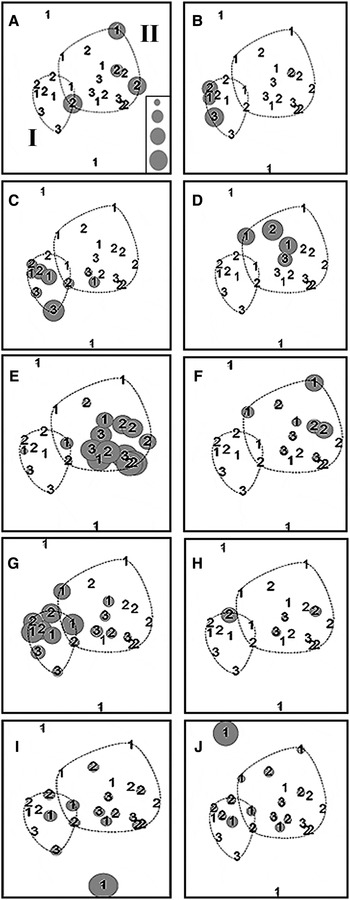
Non-metric multidimensional scaling dispersion (2d-Stress level 0.16) of ten observed feeding groups from Neanthes rubicunda (N = 25). Bold capital letters are those of Table 2. Bubble scale: arcsin-transformed frequencies 0.16; 0.64; 1.12; 1.16. Clusters at 25% Bray–Curtis’ similarity between 2007 and 2008. Gut status numbers are explained in the Materials and Methods section.

Main feeding typologies of Neanthes rubicunda (specimen number in square brackets and sampling date): (A–D) whole gut content at low magnification (16/20×); (E–M) some representative components at high magnification (100/250×); (A) [7]-11/07/08. Recognizable thalli of the Phaeophyceae Halopteris sp. from the bases to the tips (magnified in K); the Florideophyceae Jania (magnified in E); in the centre, living shell of the Rissoidae Alvania punctura (arrow) (scale bar 2.0 mm); (B) [5]-11/07/08. Prevalent Halopteris sp. and a juvenile branch of Jania (arrow) (scale bar 2.0 mm); a shell fragment of the Mytilidae Musculus costulatus is recognizable (arrow); (C) [10]-11/07/08. Prevalent thalli of Dictyiotaceae sp. gen. (magnification in pane G) with small Jania, other vegetal aggregates and an inorganic granule of quartz (arrow) (scale bar 2.0 mm); (D) [2]-06/06/07. More or less compacted filamentous algal aggregates (magnified in F and M); inorganic granules and a Foraminifera Miliolidae test (left arrow) (scale bar 2.0 mm); (E) [7]-11/7/08. Young articulate thallus of Jania and thread of the red-blue alga Oscillatoria erythraea (arrow) (scale bar 100 µm); (F) [2]-06/06/07. Cladophora sp. treads (scale bar 250 µm); (G) [4]-11/07/08. See pane C (scale bar 100 µm); (H) [4]-06/06/07. Reproductive apex of red algae (scale bar 100 µm); (I) [7]-11/07/08. Fragment of a hard-bodied live Cyclostomata colony (Bryozoa) (scale bar 300 µm); (J) [3]-11/07/08. Extruded zooid of a soft-bodied Ctenostomata (Bryozoa) (scale bar 300 µm); (K) [4]-11/07/08. The tip of Halopteris with reproductive tetraspores (scale bar 200 µm); (L) [1]-06/06/07. Thallus of the Delesseriaceae Acrosorium (scale bar 100 µm); (M) [2]-25/05/07. See pane D (scale bar 100 µm) (pictures A–D: Dr A. Potoschi Jr; E–L: Dr A. Saccà A).

Frequency and Bray–Curtis dissimilarity percentage contribution (δ) of the feeding groups (bold upper case letters) in gut contents of Neanthes rubicunda (N = 25). Un., unidentified content. Bold δ-numbers indicate highly significant values in the 2007–2008 dissimilarity percentage contribution (see Figure 4).

Multivariate similarity comparisons are shown in two-dimensional nm-MDS (stress 0.16; Figure 4). The lowest threshold at the 25% level significantly discriminated the two point clouds I and II at statistic π = 2.58 (P level = 0.017). Cluster I grouped six samples of 2007 and two of 2008; cluster II grouped seven samples of 2007 and eight of 2008; one sample point for each year was scattered outside both the clouds. The gut of these two latter specimens contained very small amounts of feeding residuals and may be considered as outliers. The average similarity was also comparable within the two years, S’2007 = 27.46 (three sampling times) and S’2008 = 38.64 (one sampling time). This pattern confirmed the feeding preference of N. rubicunda as an obligate macro-herbivore, and supports the hypothesis of a moderate seasonal or annual influence on its diet, probably combined with some influence of small-scale patchiness of algal distribution from boulder to boulder. The ‘bubble’ size shows some grade discrimination likely due to interannual variability, small-scale seaweed patchiness, and at some extent to individual feeding preference. The group Asparagopsis, Acrosorium and Rhodomelaceae–Ceramiaceae occurred only in 2007 (26.6% of samples); Cladophorales and undetermined filamentous algae prevailed in the first year (53.1%) with respect to the second year (6.6%); Sphacelariaceae were found with equal frequency in each sampling year (53.3%), whereas Jania rubens prevailed in the 2008 samples (20% and 40% for two years respectively); Dictyotaceae were found only in the latter sampling period (26.6%). In terms of dissimilarity in percentage contribution, the most discriminating macroalgae were the Cladophora-type species plus other unidentified filamentous algae, and the Sphacelariaceae–Dictyotaceae group (Table 2; Figures 4 & 5).
Feeding and growth stage
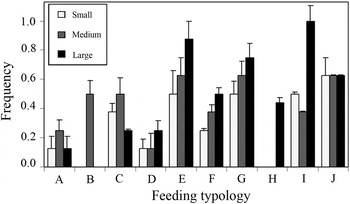
Paired t-test between the size categories, using a lower significance level of 0.01 as correction for multiple comparisons, did not detect any statistical difference in the gut content, although the feeding group cumulative frequencies showed some indicative trends that may be related to the growth stage of N. rubicunda (Figure 6). Almost all categories were present in the three size-classes, whereas Asparagopsis was found in medium-sized specimens only, and organic macrodebris such as mollusc conchs and bryozoan thecae were present in the large-sized specimens. Cladophorales and thread-like thalli were more frequent in small specimens. Turf-forming thalli of Halopteris spp., branched calcareous Jania plus other unidentified seaweeds and organic microdetritus increased according to body size. Acrosorium sp. and other red algae groups occurred in all three classes with similar frequencies. Inorganic debris were also evenly present at all growth stages; their constant occurrence, though at a very low amount (up to 3% on average), was indicative of the feeding behaviour of this nereidid species, which entirely grazed the thallus up to the base, frequently swallowing inorganic debris from the bottom sediments. Moreover, the clear presence of the remains of other live animals, such as motile gastropods and sessile polyzoa, suggest a rapid ingestion of the vegetal food with scarce selection behaviour towards the feeding algal mass and a consequent possible phenomenon of ‘accessory’ predation.
Bar plot of cumulative frequencies (± standard error) of the main feeding typologies in relation to three size-classes of Neanthes rubicunda. An increasing trend is suggested for Sphacelariaceae, articulate calcareous Corallinaceae and other unrecognizable algal thalli. Low amounts of inorganic debris evenly occur in all size-classes; organic debris (shells and bryozoan thecae) is found in larger worms for possible ‘accessory’ predation. Upper case letters are those of Table 2 and Figure 4.

Fertility
One fertile female appeared at the end of May (seawater temperature from 17 to 19°C), and ovigerous as well as spermigerous individuals were frequently observed in July samples, with the temperature not exceeding 21°C (Table 1). Egg diameter ranged from 10 to 30 µm. Despite that the ‘heteronereis’ stage is known for N. rubicunda, none of the sampled specimens showed any epitocal modification of the body during the sampling period. Live ovigerous females did not produce faecal pellets in the sampling vials and their feeding canal was empty or almost empty after dissection.
DISCUSSION
Spatial distribution and size
The observed asymmetrical distribution of N. rubicunda well agreed with the main upwelling zones of Levantine Intermediate Waters (LIW), which are located along the north-western Sicilian coast and the south-eastern Calabrian coast (Azzaro et al., Reference Azzaro, Decembrini, Raffa and Crisafi2007). In this context, the gradual modification of the sea bottom features may also explain such a distribution, because the south-eastern Sicilian side changes to a more uniform sandy–gravelly sea floor, whilst the north-western Calabrian side changes to a steep wall of submerged rocks; deeper sands and muds are likewise unsuitable for this species. In the Strait of Messina N. rubicunda is associated with the coralligenous and pre-coralligenous bottoms, similar to what was reported by Núñez (Reference Núñez and Ramos2004) and Núñez & Brito (Reference Núñez, Brito, Sardá, San Martín, López, Martin and George2006). The (pre-)coralligenous sea bottom of the Strait of Messina covers a wider vertical depth range with respect to the known general distribution in the Mediterranean basin (Giaccone, Reference Giaccone, Barrier, Di Geronimo and Montenat1987; Ballesteros, Reference Ballesteros2006). In the investigated population, chaetigers were more numerous and the mean body size was up to 20–30 mm longer with respect to other Mediterranean populations recorded by Fauvel (Reference Fauvel and Lechevalier1923) and Núñez (Reference Núñez and Ramos2004). It is likely that the Strait of Messina population of N. rubicunda, which similarly shows a mean shallower distribution with respect to the other western Mediterranean populations, could be driven towards the shallower euphotic zone also favoured by the greater availability of algal feeding sources.
Algal gardening behaviour
The feeding biology of polychaetes was widely investigated in the past, with a special focus on trophic guild definition (Fauchald & Jumars, Reference Fauchald and Jumars1979; Maurer & Leathem, Reference Maurer and Leathem1981; de Paiva, Reference De Paiva1993) and eco-evolutionary implications (Dales, Reference Dales1962; Tzetlin & Purschke, Reference Tzetlin and Purschke2005). Nonetheless, recent studies on behavioural and feeding strategies have mainly focused on large-sized shallow littoral annelids with applicative or ecological relevance, such as in fouling, aquaculture, or water/sediment processes. In this respect, Nereididae (Goerke, Reference Goerke1971; Tsuchiya & Kurihara, Reference Tsuchiya and Kurihara1979; Cammen, Reference Cammen1980; Olivier et al., Reference Olivier, Desrosiers, Retiere and Brethes1993; Riisgård, Reference Riisgård1994; Fidalgo e Costa et al., Reference Fidalgo e Costa, Oliveira and Da Fonseca2006), Glyceridae (Wilson & Ruff, Reference Wilson and Ruff1988), Nephtydae (Caron et al., Reference Caron, Desrosiers, Olive, Retière and Nozais2004) and Eunicida (Mangum et al., Reference Mangum, Santos and Rhodes1968; Mangum & Cox, Reference Mangum and Cox1971; Pardo & Amaral, Reference Pardo and Amaral2006) have been the most investigated, besides several species of sedentary suspension/deposit feeders, including Spionidae (Taghon et al., Reference Taghon, Nowell and Jumars1980; Dauer et al., Reference Dauer, Mahon and Sardá2003), Terebellida (Grémare, Reference Grémare1988) and Sabellida (Jordana et al., Reference Jordana, Duchene, Charles, Grémare and Amouroux2000, Reference Jordana, Charles, Grémare, Amouroux and Chrétiennot-Dinet2001; Nash & Keegan, Reference Nash and Keegan2003; Licciano et al., Reference Licciano, Stabili and Giangrande2005). In all these taxa, the alimentary behaviours make food uptake more efficient in relation to the local environmental constraints and changes (Miller et al., Reference Miller, Bock and Turner1992). Several spionids and some genera of fan worms are able to switch from suspension to surface deposit feeding (Taghon & Greene, Reference Taghon and Greene1992); the crawling Hediste diversicolor (O.F. Müller) may choose between the scavenging of macrodetritus and microphagous suspension feeding (Esselink & Zwarts, Reference Esselink and Zwarts1989); and Alitta succinea (Leuckart) may opportunistically change from deposit feeding to omnivory or carnivory (Dauer, Reference Dauer1980). Among the Onuphidae, both the crawling quill worms Hyalinoecia spp. and the sedentary Diopatra spp. show variable levels of feeding opportunism, even for those species with a prevalent herbivorous habit (Fauchald & Jumars, Reference Fauchald and Jumars1979). This generalized alimentary plasticity often contrasts with other highly specialized feeding adaptations, such as ‘algal gardening’. Within the subclass Palpata, some tube-dwelling jawed nereidids (Woodin, Reference Woodin1977) and onuphids (Berke & Woodin, Reference Berke and Woodin2008) usually detach algal thalli from the nearby substrate or directly catch drifting bentho-pleustophytes, which are subsequently fixed to the tube opening with buccal secretions. Algal fragments still continue to survive and grow, thus providing a more constant food supply to the ‘farmer’ worm. Moreover, the algal coverage consolidates the tube opening, has a camouflage function, and may contribute to dampen rapid environmental changes in temperature, salinity, or respiratory gases (also reviewed in Branch et al., Reference Branch, Harris, Parkins, Bustamante, Eekhout, John, Hawkins and Price1992). The deep infralittoral and circalittoral N. rubicunda shows evidence of a similar strategy from the shallower to deeper sublittoral current-exposed sea bottom. The assumption that the more frequently an algal type is found on the tube opening, the more likely it is to be found in the worm gut was confirmed for the brown turf-forming seaweeds H. filicina and H. scoparia, and to a lesser extent for Jania rubens. This nereidid is, therefore, tied to the photophilous algae for its maintenance and exploits what is available in the strict proximity of the boulder surface it inhabits, likely exerting some grade of algal preference, which culminates in the gardening behaviour of the most preferred thalli. Although the data strongly support N. rubicunda as being an obligate macrograzer, gut content analysis has showed some variability among the algal typologies as a potential food source, probably due to the patch availability of the species on the boulder surface and in the sea bottom proximity. Interannual changes may also exert some influence. Otherwise, part of this variability may be explained by the growth stage of the worms, because some differences in the frequencies of the feeding categories and in gardening behaviour seem to be affected by body size. Younger specimens, whose jaws and pharyngeal paragnaths are not robust enough to cut and graze some thick basal thalli of Spacelariaceae, feed preferentially on soft monostromatic or thread-like seaweeds. Difference on feeding preference due to growth stage has been experimentally demonstrated for Platynereis dumerilii (Audouin & Milne-Edwards), another obligate grazer that relies on erect epiphytic seaweeds on Posidonia oceanica medows (Gambi et al., Reference Gambi, Zupo, Buia and Mazzella2000). Food elaboration and assimilation efficiency in N. rubicunda might thus influence the feeding preferences of the juvenile with respect to adult individuals, as experimentally demonstrated for H. diversicolor (Olivier et al., Reference Olivier, Desrosiers, Caron, Retière and Caillou1997). Jaw robustness, in association with the low number of large conical and ‘P-shaped’ paragnaths in both the oral and maxillary rings supports for a strict macro-herbivory of N. rubicunda, with respect to other shallower relatives (see Bakken et al., Reference Bakken, Glasby and Wilson2009 for an updated terminology of the maxillary apparatus), such as Neanthes caudata (Delle Chiaje), which has a higher number of dispersed small paragnths and a more generalist deposit feeding habit. Moreover, the constant occurrence of inorganic debris in such a selective macrograzer could be explained by some function in the digestive process, e.g. for facilitation in chopping and peristalsis of greatly fibrous feeding mass. The non-sporadic presence of bryozoan colonies (see Figure 5 I, J) as well as mollusc shells, benthic Foraminifera and unidentified detritus (Figure 5 A − D) also suggests that this species actively scrapes off the episediment to complement its vegetarian diet, similar to the more specialized deposit-feeder A. succinea (Pardo & Dauer, Reference Pardo and Dauer2003). Such an ‘accessory predation’ may corroborate the hypothesis of moderate polyphagy for this species, within the context of prevalent macroherbivory that might be assessed by stable carbon/nitrogen isotope analysis (e.g. Carlier et al., Reference Carlier, Riera, Amouroux, Bodiou and Grémare2007).
Tube location and self-protection behaviour
Almost the whole sublittoral area of the Strait of Messina on both the Sicilian and Calabrian sides, in which N. rubicunda is abundant, is characterized by steep bottom profiles from 15% to over 35% slope, with rocky as well as incoherent substrates of highly variable grain size. This environment, characterized by a complex regime of vertical (both up- and down-welling) and horizontal (tidal and weather-induced) currents, is also affected by active geo-tectonic dynamics. The steep sea floor of the Strait of Messina is frequently affected by sediment dislodgements to which macrofaunal species and assemblages may respond in different ways (see Cosentino & Giacobbe, Reference Cosentino and Giacobbe2006). Small dislodgements of the ‘house-boulder’ due to storms, strong current oscillations, or microseismic perturbations are very likely in such an environment; they may be frequent and strong enough to obliterate the tube opening of N. rubicunda with its ‘algal garden’, but may be less effective for those tubes that are positioned upwards or laterally. The observed non-casual location of N. rubicunda beneath the boulder supports the capability of this sedentary species to actively select the proper site to build up its tube, as a behavioural adaptation towards unstable and current-swept substrata. Moreover, this nereidid species may be able to quit its transient tube and to construct a new one in a better position whenever necessary, as demonstrated by numerous empty tubes observed under the boulders. Therefore, N. rubicunda appears to be particularly suited to such environmental constraints. Its presence beneath only large-sized boulders, with enough interstitial space underneath, and its probable preference for an upright location, are cues to an active site selection, probably accomplished by the competent metamorphosing larvae, and subsequent orientation of juveniles, in order to reduce the risk of tube opening shading, occlusion, or collapse as a consequence of the boulder sliding.
The algal gardening could also exert a camouflage effect. Even though this hypothesis has been criticized by Berke & Woodin (Reference Berke and Woodin2008), the mimicry by algal covering could not be excluded for N. rubicunda, although its refuge under heavy boulders is probably a sufficient protection from predation.
ACKNOWLEDGEMENTS
We are very obliged to Professor Giuseppa Genovese and to Dr Marina Morabito (PhD) for the diagnosis of algal thalli. We also wish to thank Dr Andrea Jr Potoschi (Messina) and Dr Alessandro Saccà (PhD) for their support in taking microscopy images of gut content, and Dr Giusy Scarfì for her support in SCUBA diving procedures. This research was partially supported by the PRA 2008/2009 Program.