
I. INTRODUCTION
Photocatalytic degradation is a promising purification technology for the organic pollutant elimination in water.Reference Mehrjouei, Müller and Möller1–Reference Chong, Jin, Chow and Saint5 Under light irradiation, the excited photocatalysts produce photogenerated electrons (e−) and holes (h+). Subsequently, some of the separated carriers can be converted into hydroxyl radicals (˙OH) and superoxide radicals (˙O2−) with strong oxidation ability. These oxidizing species, such as h+, ˙OH, and ˙O2−, play important roles in photocatalytic degradation. However, the photocatalytic activity of the photocatalysts is generally limited by two facts of weak visible light response and rapid charge carrier recombination. It is crucial to construct a photocatalytic system with wide spectral response and high charge carrier separation efficiency. Meanwhile, the expected photocatalysts must be stable, inexpensive, easily available, and environment friendly.Reference Chen, Ma and Zhao2
Bismuth oxide (Bi2O3) is one of the chemically stable metal oxides with six different polymorphs including α-, β-, γ-, δ-, ω-, and ε-polymorph.Reference Xiong, Chen, Yuan, He, Luo, Au and Yin6,Reference He, Zhou, Fu, Zhang and Jiang7 Among them, α- and β-Bi2O3 are mostly investigated due to their visible light response ability and high thermal stability.Reference Jiang, Liu, Wang, Li, Lin and Ye8–Reference He, Cao and Yu10 The band gap of α- and β-Bi2O3 is about 2.8 and 2.5 eV corresponding to the absorption band edge of 440 and 500 nm, respectively. Moreover, Bi2O3 is one of the representative oxidation type semiconductors. The conduction band (CB) and valance band (VB) of β-Bi2O3 is +0.33 and +3.17 V versus NHE,Reference Xiong, Chen, Yuan, He, Luo, Au and Yin6 respectively, suggesting its strong oxidation and weak reduction ability due to the relatively positive CB and VB position. Recently, metal-free graphite carbon nitride (g-C3N4) has attracted a broad attention since Wang et al. first find that g-C3N4 can generate hydrogen via photocatalytic water splitting under visible light irradiation.Reference Wang, Maeda, Thomas, Takanabe, Xin, Carlsson, Domen and Antonietti11 The band gap of g-C3N4 is 2.7 eV corresponding to the absorption band edge of 460 nm. Comparing to Bi2O3, g-C3N4 is one of the representative reduction type semiconductors because of its relatively negative CB (−1.13 V versus NHE) and VB (+1.60 V versus NHE) position.Reference Wang, Maeda, Thomas, Takanabe, Xin, Carlsson, Domen and Antonietti11 Both Bi2O3 and g-C3N4 are visible-light-driven photocatalysts with the features of stable chemical structure, low cost, easy preparation, and environment safety, showing a wide application potential in environmental remediation.Reference He, Cao and Yu10,Reference Zhao, Sun and Dong12–Reference Luo, Wang, Yu, Cao, Ma, Pu, Zou, Tang, Gao and Dong14
Unfortunately, the photocatalytic activity of single Bi2O3 or g-C3N4 is very poor due to the rapid charge carrier recombination.Reference Fu, Zhu, Jiang, Cheng, You and Yu15,Reference Fu, Yu, Jiang and Cheng16 Considering their matched energy band structure, it is a feasible way to establish a heterojunction photocatalytic system between Bi2O3 and g-C3N4 to promote the charge carrier transfer and separation. There are two possible heterojunctions between reduction and oxidation photocatalysts, namely traditional type-II and Z-scheme heterojunction.Reference Fu, Yu, Jiang and Cheng16–Reference Wu, Li, Liu and Zhang20 In the former case, the excited electrons are transferred from the CB of reduction type photocatalysts to that of oxidation type photocatalysts, and the excited holes are correspondingly migrated from the VB of oxidation type photocatalysts to that of reduction type photocatalysts. As a result, the separated electrons and holes show decreased redox ability, which is not beneficial for the chemical reaction though the separation efficiency of charge carriers is improved. In the latter case, the remained electrons and holes are gathered on the CB of reduction type and VB of oxidation type photocatalysts, respectively. Based on Z-scheme heterojunction, photocatalysts can not only promote the charge carrier separation but also effectively utilize carriers with stronger redox ability during the photocatalytic process.Reference Zhou, Yu and Jaroniec21 Though Bi2O3/g-C3N4 heterojunctions have been established in the previous reports,Reference Xiong, Chen, Yuan, He, Luo, Au and Yin6–Reference Zhang, Lu, Hoffmann, Wang, Cong, Wang and Jin9,Reference Chen, Wu, Fang, Lu, Zhou, Feng, Yang, Chen and Fang22–Reference Zhang, Hu, Jiang, Chen, Meng and Fu27 the actual separation and transfer routes of charge carriers are still in debate. It is significant to further investigate the photocatalytic mechanism in Bi2O3/g-C3N4 heterojunctions.
In this work, we successfully couple oxidation type Bi2O3 semiconductor with reduction type g-C3N4 semiconductor by one-step thermal calcination method. Profiting from the one step route, Bi2O3 particles are formed in the interlayer of g-C3N4 sheets with a compact contact. The as-prepared Bi2O3/g-C3N4 composites exhibit an enhanced photocatalytic activity toward methylene blue (MB) degradation under visible light irradiation. The influences of Bi2O3 deposition content on the phase structure, physical properties, chemical properties, and photocatalytic activity of the composites are discussed in detail. The trapping experiments indicate that the main active species in the photocatalytic degradation system of Bi2O3/g-C3N4 composites are mainly h+, ˙OH, and ˙O2−. Accordingly, a direct Z-scheme mechanism is revealed for Bi2O3/g-C3N4 composites, which dominantly contributes to the photoactivity enhancement in Bi2O3/g-C3N4 composites. This work provides an efficient approach to design and construct g-C3N4-based Z-scheme heterojunction photocatalysts for the application in water purification and solar energy conversion.
II. EXPERIMENTAL SECTION
A. Material syntheses
All chemicals applied in this study were of analytically grade and utilized without any further purification. Deionized water was used throughout the experiment process. Bi2O3/g-C3N4 nanocomposites were prepared by an in situ one-step calcination method. In detail, 10 g melamine (C3H6N6) was first dissolved in 50 mL CH3OH solution with adding different amounts of bismuth nitrate pentahydrate [Bi(NO3)3·5H2O]. The suspension mixture was continually stirred for 2 h at room temperature and then transferred to a vacuum drying oven at 80 °C for 24 h. Subsequently, the white precursor mixture was grounded and filled into a corundum crucible with a cover. Finally, the precursor mixture was heated in muffle furnace to 500 °C for 4 h with a rate of 5 °C/min. When the usage amount of Bi(NO3)3·5H2O is 0.049, 0.074, 0.098, 0.197, and 0.295 g, the obtained yellow solids were correspondingly labeled as xBOCN, where x (x = 0.5, 0.75, 1, 2, and 3) represented the theoretical weight percentage content of Bi2O3 to g-C3N4. Meanwhile, the pure g-C3N4 and Bi2O3 was prepared by the same method without adding Bi(NO3)3·5H2O and C3H6N6, respectively.
B. Characterization
X-ray diffraction (XRD) patterns of the samples were obtained on an XRD spectrometer (Bruker D8, Bruker Corp., Karlsruhe, Germany) with Cu Kα irradiation in the 2 theta range from 10° to 80°. Field emission scanning electron microscopy images were taken on a scanning electron microscope (JSM-6360LV, JEOL Ltd., Tokyo, Japan). Transmission electron microscopy (TEM) and high-resolution TEM (HRTEM) images were obtained on a microscope (Tecnai G2F20 S-TWIN, FEI, Hillsboro, Oregon) with an accelerating voltage of 200 kV. The X-ray photoelectron spectroscopy (XPS) measurement was performed to confirm the element status of the samples on an ultra-high-vacuum electron spectrometer (VG ESCALAB 250Xi, Thermo Fisher Scientific, Waltham, Massachusetts). Fourier transform infrared spectroscopy (FTIR) was measured on a spectrometer (Nicolet iS5, Thermo Fisher Scientific, Waltham, Massachusetts) The N2 adsorption and desorption isotherm curves were obtained on Micromeritics equipment at 77 K (Autosorb-Iq-MP, Quantachrome Instruments, Boynton Beach, Florida). The specific surface area was calculated by the Brunauer–Emmett–Teller (BET) equation with the adsorption data at P/P 0 = 0.05–0.3. All the samples were degassed at 150 °C prior to the nitrogen adsorption measurements. The pore size distribution was determined by the Barrett–Joyner–Halenda (BJH) method. The UV-visible diffusion reflectance spectra were recorded on a spectrophotometer (UV-2550, Shimadzu, Kyoto, Japan) with BaSO4 as the reflectance standard. Photoluminescence (PL) emission spectra were performed on a fluorescence spectrophotometer (F-7000, Japan). The thermal stability properties of the samples were investigated on a thermogravimetry and differential thermal analysis (TG-DTA) analyzer (STA 449 F5, Netzsch, Selb, Germany).
C. Photocatalytic activity test
MB was used as the probe molecule of model organic pollutants and the photocatalytic activity of the prepared samples was evaluated by MB degradation under visible light irradiation. A 300 W Xenon lamp with a 420 nm cut-off filter was used as visible light source. All the activity tests were conducted in water bath at 25 °C. The reactor was a glass vessel with 12 cm diameter and the vertical distance between light source and MB solution is 30 cm. 50 mg of the sample was suspended in the reactor containing 50 mL MB aqueous solution (1.5 × 10⁻⁵ mol/L). Prior to light irradiation, the suspension was continuously stirred for approximately 1 h in the dark and the adsorption/desorption equilibrium between MB molecules and photocatalysts was built. During the illumination, about 3 mL suspension was sampled from the reactor to measure the absorbance at regular intervals and then poured back to the reactor to remain the invariant solution volume. Meanwhile, commercial TiO2 (Degussa P25, Evonik Degussa GmbH, Essen, Germany) was used as references for photocatalytic activity comparison. To evaluate the photocatalytic stability of the photocatalyst, a three-cycling test was conducted as the same procedure. After each test, the sample was collected and then washed and dried for the further test. The radical scavenger measurements were carried out by the same method except for adding tri-ethanolamine (TEOA, 0.01 mol/L), isopropanol (IPA, 0.02 mol/L), or benzoquinone (BQ, 0.1 mol/L) as a scavenger for photogenerated holes (h+), hydroxyl radicals (˙OH), or superoxide radicals (˙O2−), respectively. The degradation kinetics was fitted by equation ln(C/C t) = kt, where k is the apparent rate constant, t is the sampling time, and C and C t are the MB concentrations at initial and different sampling time, respectively.
III. RESULTS AND DISCUSSION
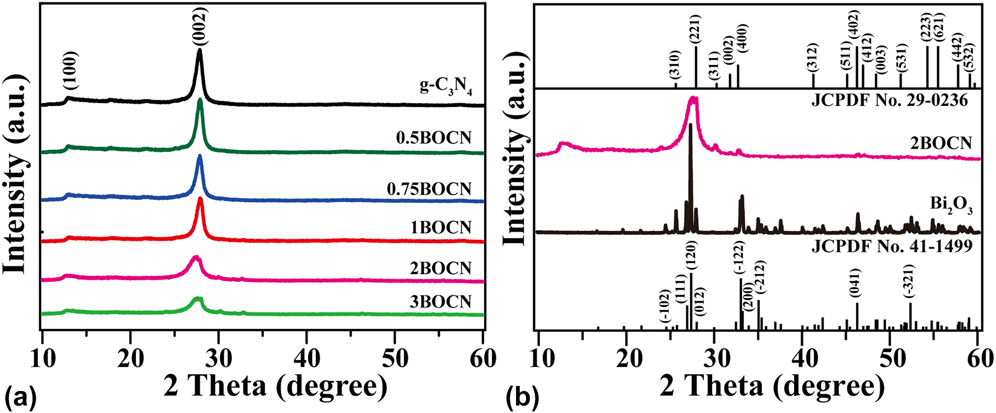
XRD was used to identify the phase structure of all samples. As shown in Fig. 1, pure g-C3N4 shows two distinct diffraction peaks at 13.7° and 27.4° corresponding to (100) and (002) crystal planes of g-C3N4, respectively.Reference Wang, Maeda, Thomas, Takanabe, Xin, Carlsson, Domen and Antonietti11 Pure Bi2O3 exhibits good crystallinity and all the diffraction peaks can be well indexed as the monoclinic α-Bi2O3 (JCPDF No. 41-1449).Reference Zhang, Lu, Hoffmann, Wang, Cong, Wang and Jin9 No diffraction peaks belonging to Bi2O3 can be detected for 0.5BOCN, 0.75BOCN, and 1BOCN composites due to the low content of Bi2O3 and/or high dispersion of Bi2O3 in composites. As the content of Bi2O3 further increases, three weak peaks at 24.6°, 33.0°, and 33.2° appear in 2BOCN and 3BOCN composites, which are attributed to (−102), (−122), and (200) crystal plane of α-Bi2O3. The other weak peak at 30.3° belongs to the tetragonal β-Bi2O3 (JCPDF No. 29-0236),Reference Dang, Zhang, Chen, Dong, Wang, Ma, Zhang, Ma and Xue26 suggesting the coexistence of α- and β-Bi2O3 in composites. Because the phase transition temperature from β-Bi2O3 to α-Bi2O3 is about 435 °C and the polymerization of melamine is an endothermic process,Reference Liu, Lu, Zhang, Li, Feng and Li28,Reference Yan, Chen and Xu29 it is not surprising that metastable phase β-Bi2O3 is obtained in the case of heating Bi(NO3)3·5H2O with melamine at 500 °C for 4 h. It is noted that the diffraction peak intensity of g-C3N4 obviously decreases with increasing Bi2O3 weight content from 0.5 to 3%, indicating a possibility that the polymerization of melamine and the stacking (crystallization) of g-C3N4 sheets are inhibited due to the presence of Bi(NO3)3·5H2O.Reference Li, Lv, Ho, Dong, Wu and Xia30 On the other hand, the deposition of Bi2O3 on the surface of g-C3N4 can also weaken the diffraction peak intensity of g-C3N4.Reference Zhu, Xia, Li, Ho and Yu31–Reference Chen, Hu, Meng and Fu33
XRD patterns of pure g-C3N4 and xBOCN (x = 0.5, 0.75, 1, 2, and 3) composites (a), and pure Bi2O3 and 2BOCN composites (b).

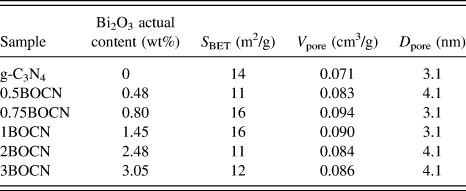
The TG–DTA curves of the obtained samples were used to investigate the thermal stability of photocatalysts and estimate the weight ratio of each component. As shown in Fig. S1(a), pure g-C3N4 shows a sharp weight loss with a broad endothermic peak ranging from 550 to 750 °C, meaning the decomposition of g-C3N4 into nitrogen and ammonia fragments.Reference Yan, Li and Zou34,Reference Huang, Xu, Li, Li, Cheng, Xia, Xu and Cai35 However, a sharp weight loss with a narrow endothermic peak at 650 °C can be seen for 1BOCN composites, suggesting the lower decomposition temperature and thermal stability of g-C3N4 after g-C3N4 coupling with Bi2O3. This can be further demonstrated by the weight loss of samples shown in Fig. S1(b). The mass constant temperature of xBOCN (x = 0.5, 0.75, 1, 2, and 3) is generally lower than that of pure g-C3N4 and decreases form 750 to 570 °C with increasing Bi2O3 weight content from 0.5 to 3%. This is inconsistent with the XRD results that the presence of Bi(NO3)3·5H2O lowers the crystallization and decreases the thickness of g-C3N4. Considering that pure Bi2O3 has no obvious weight loss even at high temperature, the finial weight loss of xBOCN (x = 0.5, 0.75, 1, 2, and 3) composites mainly results from the absolute decomposition of g-C3N4 and can be used to determine the actual content of Bi2O3 in composites.Reference Li, Wu, Huang, Xu, Zhang, Qu, Gao and Li25 As shown in Table I, the determined actual content is very close to the theory content of Bi2O3.
Physical properties of pure g-C3N4 and xBOCN (x = 0.5, 0.75, 1, 2, and 3) composites.

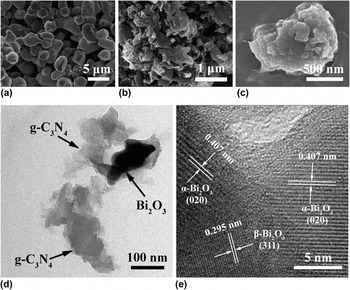
Figure 2 shows the morphology investigation results of the obtained samples. As presented in Fig. 2(a), pure Bi2O3 is the irregular particles with an average particle size of 200–500 nm. Pure g-C3N4 exhibits the bulk structures composed of abundant aggregated sheets with many wrinkles in Fig. 2(b). Two different morphologies from pure Bi2O3 and g-C3N4 can be observed for the 1BOCN composite, in which many particles are covered by thin sheets, indicating the successful deposition of Bi2O3 particles on the surface of g-C3N4 sheets in Fig. 2(c). Further morphology investigation is given by TEM images. Due to the heavier atomic mass of Bi than that of C and N, it is difficult for electron beam to penetrate Bi2O3 instead of g-C3N4. This can be used to distinguish Bi2O3 and g-C3N4 in TEM images because the former shows darker images than the latter.Reference Cui, Chen, Zhong, Wooley and Pochan36 As shown in Fig. 2(d), the transparent and sheet-like structure is assigned to g-C3N4, while the dark and particle-like structure is ascribed to Bi2O3. This can be further demonstrated by the HRTEM image in Fig. 2(e), in which the lattice space of 0.407 and 0.295 nm corresponds to (020) and (311) crystal planes of α- and β-Bi2O3, respectively. It is worth noting that there is an intimate interface between Bi2O3 particles and g-C3N4 sheets, which is beneficial for the interfacial charge transfer.Reference Fu, He, Wu, Wu and Wu37,Reference Chai, Zou and Chen38
SEM images of pure Bi2O3 (a), pure g-C3N4 (b), and 1BOCN composites (c), and TEM (d) and HRTEM (e) images of the 1BOCN composite.

The chemical structure of the samples is investigated by FTIR characterization and the corresponding spectra are shown in Fig. S2. For pure Bi2O3, two peaks at 843 and 1393 cm−1 are attributed to vibration of Bi–O bonds of BiO3 units and Bi–O stretching vibration,Reference Xiong, Chen, Yuan, He, Luo, Au and Yin6 respectively. For pure g-C3N4, a typical sharp peak located at 801 cm−1 is assigned to triazine units, and the characteristic peaks located at 1200–1600 cm−1 are attributed to the different vibrations of CN heterocycles, while the broad absorption region at 3200–3600 cm−1 is ascribed to H2O and N–H bands.Reference Zhu, Xia, Ho and Yu39,Reference Zhou, Hou and Chen40 The 1BOCN composite exhibits the similar shape spectrum with pure g-C3N4, indicating the main g-C3N4 composition in the 1BOCN composite. However, no peaks belonging to Bi2O3 can be found in the 1BOCN composite due to the low content of Bi2O3 and/or some peaks overlapping with g-C3N4.
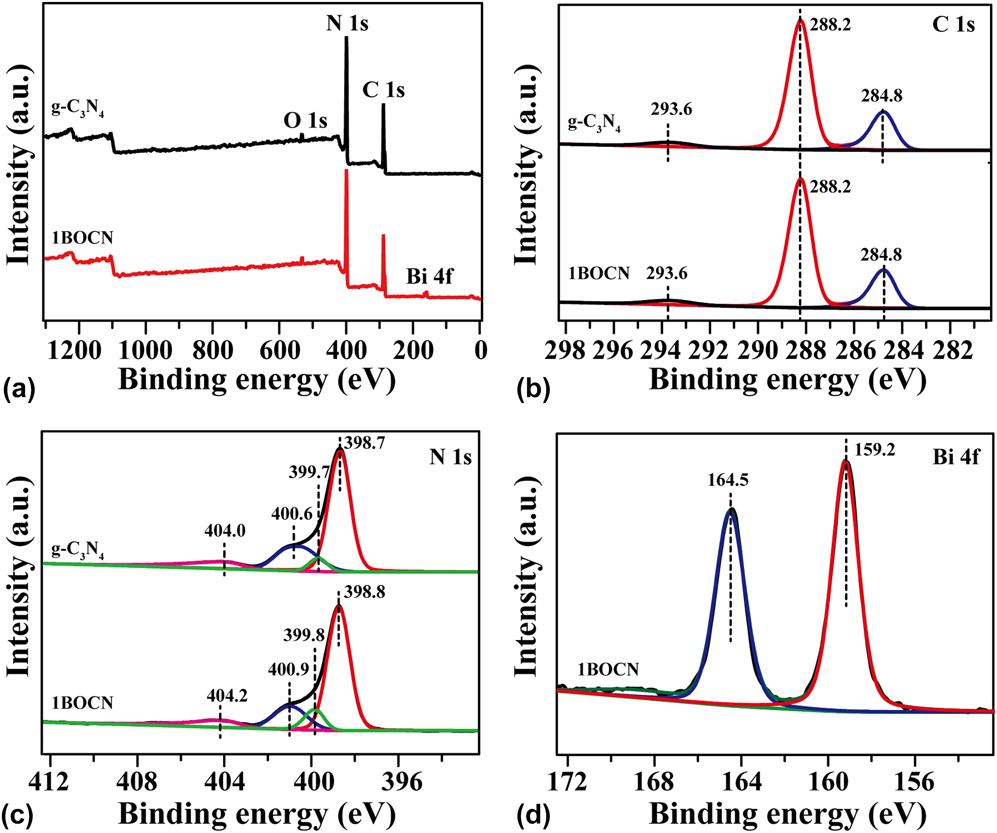
XPS was used to analyse the surface element composition and chemical state of the obtained samples. As shown in Fig. 3(a), the survey spectrum of pure g-C3N4 exhibits clear peaks of carbon (C 1s), nitrogen (N 1s), and oxygen (O 1s), and the 1BOCN composite shows not only C 1s, N 1s, and O 1s but also bismuth (Bi 4f), further proving the presence of Bi element in the 1BOCN composite. The high-resolution C 1s spectra of both pure g-C3N4 and 1BOCN composites show three peaks at the binding energies of 284.8, 288.2, and 293.6 eV [Fig. 3(b)], which represent exotic C–C bonds resulting from the instrument, sp 2-hybridized carbon in C–C=N coordination and the surface absorbed function groups (C=O), respectively.Reference Xu, Cheng, Yu and Liu41 The high-resolution N 1s spectra of pure g-C3N4 show four peaks at 398.7, 399.7, 400.6, and 404.0 eV [Fig. 3(c)], which can be assigned to the sp 2-hybridized nitrogen in C–N=C, the tertiary nitrogen N–C(3), the amino groups (–NH2), and π-excitation, respectively.Reference Wang, Fang, Tang, Zhang, Huang, Liu and Wu42,Reference Fu, He, Wu and Wu43 However, the high-resolution N 1s spectra of the 1BOCN composite show four peaks at 398.8, 399.8, 400.9, and 404.2 eV [Fig. 3(c)], which slightly shift to higher binding energies due to the transfer of net electrons from g-C3N4 to Bi2O3, suggesting the strong interaction between Bi2O3 and g-C3N4.Reference Akple, Low, Wageh, Al-Ghamdi, Yu and Zhang44–Reference Feng, Zeng, Chen, Ma, Zhao, Jin, Lu, Wu and He46 Meanwhile, the major peaks for the high-resolution Bi 4f spectrum of the 1BOCN composite are located at 159.2 and 164.5 eV [Fig. 3(d)], corresponding to Bi 4f 7/2 and Bi 4f 5/2, respectively, which are the characteristic peaks of Bi3+.Reference Wang, Fang, Tang, Zhang, Huang, Liu and Wu42,Reference Xu, Hai, Zhang, Zhang and He47
XPS survey spectra (a) and the corresponding high-resolution XPS spectra of C 1s (b) and N 1s (c) of g-C3N4 and 1BOCN samples, and Bi 4f (d) spectra of the 1BOCN composite.

The nitrogen adsorption–desorption isotherms of pure g-C3N4 and 1BOCN composites are shown in Fig. S3. The isotherms of the obtained samples belong to type IV, indicating the presence of mesopores (2–50 nm).Reference Yu, Wang, Xiao and Cheng48 This can be further proven by the pore size distribution curves shown in the inset, in which the pore size of pure g-C3N4 and 1BOCN composites mainly centers at 20 and 30 nm, respectively. At low relative pressure (below 0.4), the isotherms exhibit the characteristics of adsorption capacity tending to ascend. When the relative pressure is in the range of 0.4–1.0, the obvious hysteresis loops ascribing to type H3 can be observed in the isotherms, suggesting the existence of slit-like mesopores associated with the aggregation of primary g-C3N4 nanosheets. Table I lists the physical properties containing special surface area, pore volume, and average pore size of the obtained samples. It is found that all the samples show the similar special surface area, which can be excluded from the effect on the photocatalytic activity.
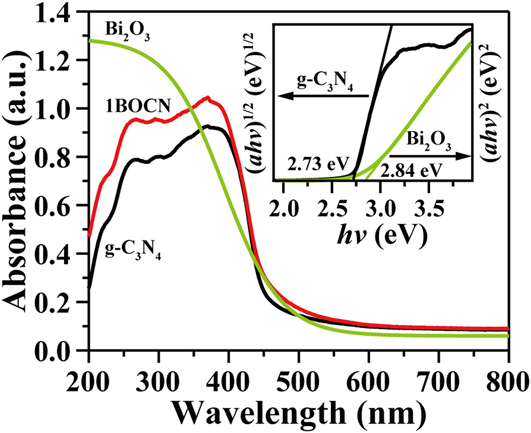
The light absorption property of the samples was measured by UV-visible diffuse spectroscopy. As shown in Fig. 4, pure g-C3N4 and Bi2O3 show an obvious absorption edge at 450 and 500 nm, respectively. The band gaps (E g) can be calculated by Kubelka–Munk function as follows:
 $${\left( {\alpha h\nu } \right)^n} = A\left( {h\nu - {E_{\rm{g}}}} \right)\quad ,$$
where α, hν, A, and n are the absorption coefficient, photon energy, proportionality constant, band gap, and index (n = 2 and 1/2 for direct and indirect band gap semiconductors, respectively). The estimated band gap of pure g-C3N4 and Bi2O3 is 2.73 and 2.84 eV, respectively. Compared with pure g-C3N4, the light absorption of the 1BOCN composite has a little increase in the range of 450–500 nm due to the introduction of Bi2O3, which is helpful to the enhanced photocatalytic activity. In addition, the light absorption edge of 1BOCN has no obvious change comparing to pure g-C3N4, further suggesting the unchanged main structure of g-C3N4 and the simple deposition of Bi2O3 on the surface of g-C3N4 in the 1BOCN composite.
UV-Vis diffuse reflectance spectra of pure g-C3N4, Bi2O3 and 1BOCN composites, and the inset is the corresponding band gap calculation.

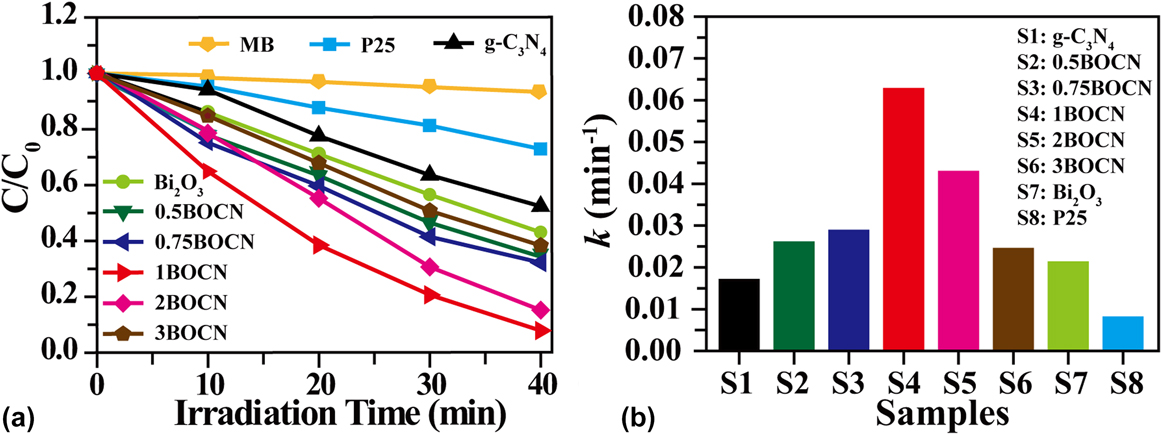
The photocatalytic activity of the obtained samples towards MB degradation was evaluated under visible light irradiation (λ > 420 nm). The blank experiment without adding any photocatalysts shows no obvious decrease of MB concentration under visible light irradiation for 40 min, indicating a negligible MB self-degradation. Pure g-C3N4, Bi2O3, and P25 samples exhibit low photocatalytic activity. P25 has a weak visible light absorption due to the existence of 25% rutile TiO2 with the absorption band edge of 413 nm, as a result, P25 shows photocatalytic activity under visible light irradiation. Meanwhile, the sensitization of MB dye is also related to the visible light photocatalytic activity of P25. Compared with single g-C3N4 or Bi2O3, all xBOCN (x = 0.5, 0.75, 1, 2, and 3) composites show enhanced photocatalytic performance in Fig. 5(a). For xBOCN samples, the photocatalytic activity improves with increasing Bi2O3 weight content, and the 1BOCN composite has the highest apparent rate constant (k) of 0.063 min−1, which is 3.0, 3.7, and 7.9 times that of Bi2O3 (0.021 min−1), g-C3N4 (0.017 min−1), and P25 (0.008 min−1) [Fig. 5(b)], respectively. Besides, the photocatalytic stability of the 1BOCN hybrid is also investigated. As presented in Fig. S4, no obvious deactivation is observed after three cycles, suggesting the good photocatalytic stability of the 1BOCN composite.
Photocatalytic activity of the obtained samples toward MB degradation under visible light irradiation (λ > 420 nm) (a) and the apparent rate constant of the obtained samples calculated from first-order kinetics equation (b).

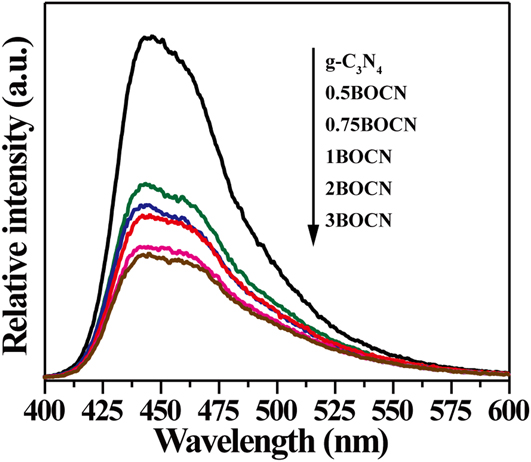
PL emission is a common and useful technique to survey the separation efficiency of the photogenerated charge carriers for a semiconductor photocatalyst. Generally, the weaker PL emission intensity means the lower recombination efficiency of photogenerated electrons and holes.Reference Xu, Cheng, Cao and Yu49 As shown in Fig. 6, all the obtained samples have the similar PL emission spectra as pure g-C3N4, which shows the high PL intensity due to the rapid recombination of photogenerated charges. However, the PL intensity of xBOCN (x = 0.5, 0.75, 1, 2, and 3) composites strongly decreases even introducing a small number of Bi2O3 (0.5 wt%) and gradually weakens with increasing the weight content of Bi2O3. This means the recombination inhibition of photogenerated charges in the composite system, which is significant to enhance the photocatalytic activity of photocatalysts.Reference Zhang, Wang, Xiao, Liu, Xu and Du50,Reference Liu and Zhang51 However, the photocatalytic activity of the composite decreases with increasing the weight content of Bi2O3 larger than 1%. This phenomenon may result from the facts that the photocatalytic activity depends on not only charge separation efficiency but also light absorption ability of composites, the excess Bi2O3 on the surface may shield light absorption of g-C3N4.Reference Wang, Fang, Tang, Zhang, Huang, Liu and Wu42 As a result, the photocatalytic activity of 2BOCN and 3BOCN composites is lower than the 1BOCN composite although the formers have the weaker PL intensity.
PL emission of pure g-C3N4 and xBOCN (x = 0.5, 0.75, 1, 2, and 3) composites.

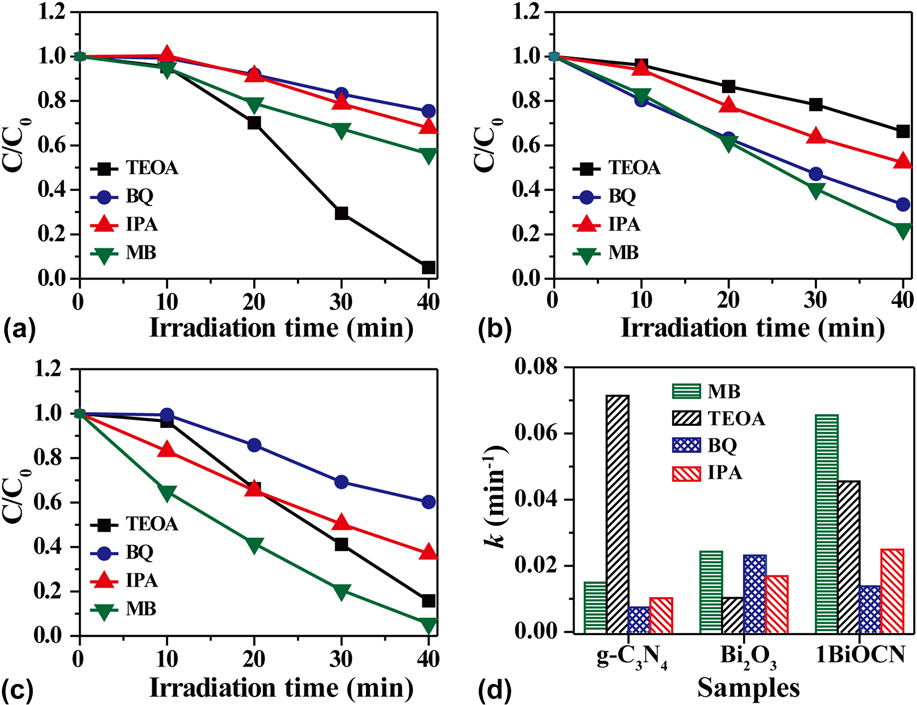
The radical scavenger measurement was carried out to determine the active species participating in the photocatalytic reaction and the results are shown in Figs. 7(a)–7(c). To better describe the effect of radical scavenger addition on photocatalytic activity of the samples, the apparent rate constant was calculated and shown in Fig. 7(d). For pure g-C3N4, the photocatalytic activity largely increases after TEOA addition, strongly suggesting that h+ is not the active species. When BQ or IPA exists, the photocatalytic activity of pure g-C3N4 decreases, indicating that the active species of g-C3N4 are ˙O2− and ˙OH. Because the CB potential (−1.13 V versus NHE) of g-C3N4 is more negative than O2/˙O2− potential (−0.28 V versus NHE),Reference Xu, Cheng, Zhang, Wang, Yu and Ho52 electrons in the CB could be trapped by O2, forming ˙O2−. However, it is impossible for g-C3N4 to produce ˙OH through the H2O oxidation by h+ in the VB since the VB potential (+1.6 V versus NHE) of g-C3N4 is less positive than ˙OH/H2O potential (+2.27 V versus NHE).Reference Xu, Cheng, Zhang, Wang, Yu and Ho52 Thus, the ˙OH formation is derived from the further reduction of ˙O2− by CB electrons of g-C3N4. For pure Bi2O3, both h+ and ˙OH are the active species, and ˙OH is mainly originated from H2O oxidation by h+ in the VB due to the more positive VB potential (+3.17 V versus NHE) of Bi2O3 than ˙OH/H2O potential. But, it is difficult for Bi2O3 to form ˙O2− because the CB potential (+0.33 V versus NHE) of Bi2O3 is less negative than that of O2/˙O2− potential. Interestingly, for the BOCN composite, all h+, ˙O2−, and ˙OH are the active species and play a dominant role in the photocatalytic degradation, suggesting the strengthened redox ability of the composite and the unusual transfer route of charges. The photocatalytic activity of pure g-C3N4 is largely enhanced in the presence of TEOA, which is used as the h+ sacrificial agent and subsequently improves the carriers’ separation of pure g-C3N4, and more electrons could participate in the MB degradation reaction directly or indirectly.Reference Challagulla and Roy53–Reference Fujishima and Zhang55 However, Bi2O3 is one of the oxidation type photocatalysts with strong oxidation ability of h+, thus the photocatalytic activity of Bi2O3 decreases after adding TEOA. Surprisingly, a decreased phtocatalytic activity can also be observed for the Bi2O3/g-C3N4 composite in the presence of TEOA, implying that photogenerated holes are gathered on the VB of Bi2O3 rather than that of g-C3N4 in composites.
Radical scavenger measurement of pure g-C3N4 (a), Bi2O3 (b), and 1BOCN composites (c), and the corresponding k value calculation (d).

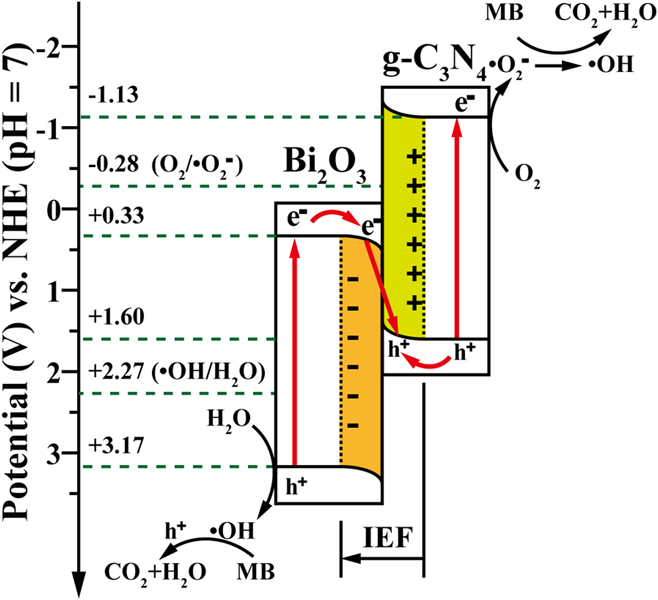
According to the band structure that the CB and VB levels of g-C3N4 are respectively more negative than those of Bi2O3, there are two possible heterojunctions for the 1BOCN composite. One is the traditional type-II heterojunction and another is the Z-scheme heterojunction. The former induces the photogenerated electrons transferring from the CB of g-C3N4 to that of Bi2O3, and the photogenerated holes migrating form the VB of Bi2O3 to that of g-C3N4. As a result, it is difficult to produce h+, ˙O2−, and ˙OH active species simultaneously in the photocatalytic degradation system, which is obviously in agreement with the radical scavenger measurement results. Consequently, a direct Z-scheme heterojunction is proposed and the photogenerated charge transfer route in the 1BOCN composite is demonstrated in Fig. 8. Both Bi2O3 and g-C3N4 are n-type semiconductors and the Fermi level is close to the CB position, meaning that the Fermi level of g-C3N4 is higher than that of Bi2O3. At the intimate contact interface between Bi2O3 particles and g-C3N4 sheets, net electrons thermodynamically flow from the CB of g-C3N4 to that of Bi2O3 to achieve the Fermi level equivalence. The net electron redistribution leads to band bending, and net electrons and holes are accumulated on the side of Bi2O3 and g-C3N4, respectively, inducing an internal electric field (IEF) with a direction from g-C3N4 to Bi2O3.Reference Liu, Cheng and Yu56,Reference Yu, Chen, Shang, Chen, Gu and Peng57 Under visible light irradiation, both Bi2O3 and g-C3N4 are excited and the photogenerated electrons on the CB of Bi2O3 recombine with the photogenerated holes on the VB of g-C3N4 driven by IEF. Meanwhile, the photogenerated electrons on the CB of g-C3N4 and holes on the VB of Bi2O3 are separated and participate in the MB degradation reaction directly or indirectly.Reference Shen, Zhao, Qian, Peng and Fu58 It is the effective photogenerated charge separation and the stronger redox ability that is beneficial to an enhanced photocatalytic activity for Bi2O3/g-C3N4 composites, comparing to pure g-C3N4 and Bi2O3.
Direct Z-scheme photocatalytic mechanism of the 1BOCN composite.

IV. CONCLUSION
Visible-light-driven Bi2O3/g-C3N4 composite photocatalysts are prepared by the one-step calcination method, which induces an intimate contact interface between Bi2O3 particles and g-C3N4 sheets. Bi2O3/g-C3N4 composites exhibit higher photocatalytic activity than pure g-C3N4 and Bi2O3. When the weight content of Bi2O3 to g-C3N4 is 1%, Bi2O3/g-C3N4 composites have the highest photocatalytic activity with an apparent rate constant of 0.063 min−1, which is 3.0, 3.7, and 7.9 times faster than that of Bi2O3, g-C3N4, and P25, respectively. The radical scavenger measurement demonstrates that h+, ˙O2−, and ˙OH are the main active species, suggesting a Z-scheme separation and transfer mechanism of photogenerated charges in the composite system. This work provides a feasible approach to design and construct g-C3N4-based Z-scheme heterojunction photocatalysts for the application in water purification.
Supplementary Material
To view supplementary material for this article, please visit https://doi.org/10.1557/jmr.2018.67.
ACKNOWLEDGMENTS
This work was supported by the NSFC (51402025 and 51172031). Also, this work was financially supported by the Scientific Research Fund of Hunan Provincial Education Department (16B027) and Hunan Provincial Natural Science Foundation of China (2018JJ2456).