


Introduction
The Asian citrus psyllid (ACP), Diaphorina citri Kuwayama is a key pest of citrus in Asia and the Americas, due primarily to its role as vector of ‘huanglongbing’ (HLB) or citrus greening disease (Grafton-Cardwell et al., Reference Grafton-Cardwell, Stelinski and Stansly2013). The causal agent of HLB in these regions is considered to be Candidatus Liberibacter asiaticus, a phloem-limited Gram-negative bacterium. HLB reduces tree health, productivity and fruit quality. Infected trees without intervention decline and become unproductive within 5–10 years (Bove, Reference Bove2006).
First detections of HLB in America occurred in Brazil in 2004 and a year later in Florida (Halbert, Reference Halbert2005; Belasque et al., Reference Belasque, Bassanezi, Yamamoto, Ayres, Tachibana, Violante, Tank, Di Giorgi, Tersi, Menezes, Dragone, Jank and Bove2010) raising the status of ACP to key pest in the two main citrus producing areas of the world. By 2012, the disease had spread throughout most of the Caribbean region and Mexico with detections in Texas and California. A recent study estimated total economic impact of $4.54 billion in Florida from 2006 to 2011, including loss of 8257 jobs (Hodges & Spreen, Reference Hodges and Spreen2012).
Host plant resistance is expected to provide the ultimate long-term solution to HLB. However, with nothing yet on the immediate horizon, short-term measures are needed to maintain economic production levels in endemic areas. Vector control is considered essential, along with rogueing of symptomatic trees (Bove, Reference Bove2006) or therapeutic applications of foliar nutrients to mitigate effects of the disease in high incidence areas (Stansly et al., Reference Stansly, Arevalo, Qureshi, Jones, Hendricks, Roberts and Roka2013). The challenge with vector control is integrating insecticide programs with the potentially important component of vector suppression offered by beneficial insects and mites (Michaud, Reference Michaud2004; Qureshi & Stansly, Reference Qureshi and Stansly2009).
Insecticidal control of the vector still is an important component of HLB management (Qureshi & Stansly, Reference Qureshi and Stansly2008, Reference Qureshi and Stansly2010; Rogers et al., Reference Rogers, Stansly and Stelinski2012). However, fear and severity of HLB have driven implementation of intensive insecticide programs to control the psyllid vector (Belasque et al., Reference Belasque, Bassanezi, Yamamoto, Ayres, Tachibana, Violante, Tank, Di Giorgi, Tersi, Menezes, Dragone, Jank and Bove2010; Rogers et al., Reference Rogers, Stansly and Stelinski2012), that could exert important side effects against beneficial arthropod fauna in citrus agroecosystems (Qureshi & Stansly, Reference Qureshi and Stansly2007). Consequently, insecticide strategies that maximize ACP control while maintaining natural enemy diversity and ecological stability are being developed and promoted (Qureshi & Stansly, Reference Qureshi and Stansly2010). These strategies include foliar sprays of broad-spectrum insecticides applied during the dormant period of plant growth, or at the end of the growing season when natural enemy activity declines, sampling techniques to monitor ACP populations, and guides for the use of selective insecticides during the growing season (Hall et al., Reference Hall, Hentz and Ciomperlik2007; Qureshi & Stansly, Reference Qureshi and Stansly2008, Reference Qureshi and Stansly2010).
D. citri requires tender plant tissue to complete its life cycle in citrus. Adult females lay eggs on new growth shoots (referred to as flush) upon which all nymphal stages develop (Shivankar et al., Reference Shivankar, Rao and Shyam2000). Plant phenology is therefore a key factor influencing D. citri life history and seasonal demography. Major flushing periods during the growing season provide ACP with abundant resources for reproduction. Biological control mainly affects pre-imago stages which are exclusively on new flush. Therefore, the regulatory role exerted by biological control on pest demography in citrus would normally be greatest during periods of new foliage growth.
The principal parasitoid attacking D. citri is Tamarixia radiata Waterston (Hymenoptera: Eulophidae), established throughout Florida but with limited impact on ACP, due presumably to insecticide use and low survival in winter (Qureshi et al., Reference Qureshi, Rogers, Hall and Stansly2009). Programs are in place to evaluate the effectiveness of augmentation, especially in spring when parasitism levels tend to be lowest (Qureshi et al., Reference Qureshi, Rogers, Hall and Stansly2009). In contrast, certain naturally occurring species of ladybeetle (Coleoptera: Coccinellidae), lacewings (Neuroptera: Chrysopidae), spiders (Araneae) and other generalist predators have been seen to inflict up to 100% mortality on cohorts of D. citri nymphs during the growing season in Florida (Michaud, Reference Michaud2004; Qureshi & Stansly, Reference Qureshi and Stansly2009). These and several other natural enemies, including predaceous arboreal ants of the genus Pseudomyrmex, also suppress and prevent a wide range of citrus pests in Florida from causing economic damage (McCoy et al., Reference McCoy, Nigg, Timmer, Futch and Rogers2009). Given that naturally occurring biological control provides a valuable service, it is paramount to document costs incurred when beneficial arthropods are suppressed by pesticides, specifically impacts derived from intensified insecticidal spray programs targeting ACP.
We evaluated populations of key predator guilds in large untreated citrus blocks compared to blocks subjected to monthly sprays of selective and broad-spectrum insecticides targeting ACP. We also used predator exclusion techniques on nascent colonies of immature ACP in these blocks to estimate the impact of foliar sprays on ACP biological control and natural enemies. The insecticide strategy followed in the treated plots was designed to minimize pesticide resistance and side effects on beneficial arthropod fauna. Our hypothesis was that continuous insecticide applications for ACP control, even using selective pesticides, may have deleterious and cumulative effects on biological control of this pest. The information obtained could be used to discern ways to improve management programs that optimize ACP control, in part by reaping maximum benefit from pest suppression provided by predaceous insects.
Material and methods
Study site and experimental design
Experiments were conducted in a 10.3 ha commercial citrus grove located near LaBelle (Hendry County, FL, USA) (26°41′04″N, 81°26′20″W). The grove was planted December 2001 with sweet orange, Citrus sinensis (L.) Obseck ‘Early Gold’, bud-grafted to ‘Carrizo’ citrange rootstock at a density of 231 trees ha−1. Trees were irrigated by micro-sprinklers and conventional cultural practices were followed (Jackson, Reference Jackson1999). However, foliar nutrition was intensified with a HLB nutritional remediation program consisting sprays of 1.24 kg ha−1 N; 7.73 kg ha−1 K2O; 2.14 kg ha−1 P2O5; 1.11 kg ha−1 [Zn]2+; 0.94 kg ha−1 [Mg]2+; 3.05 kg ha−1 [Mn]2+; 59.54 g ha−1 Na2MoO4; and 0.77 kg ha−1 [B]3+ during the major flushing periods of the year (Stansly et al., Reference Stansly, Arevalo, Qureshi, Jones, Hendricks, Roberts and Roka2013). Two ACP management treatments: calendar sprays of insecticides to control ACP (‘calendar’) and untreated control (‘no insecticide’) were tested in a randomized complete block design with four replications. The ‘calendar’ treatment was aimed at maintaining ACP densities as low as possible while still conserving natural enemies by generally avoiding broad-spectrum insecticides during the growing season. Plot dimensions (length×width) were 38×170 m containing approximately 144 mature trees and several resets. Treated and untreated plots were randomly distributed through the 10.3 ha commercial citrus grove. Minimum distance between sampling areas in untreated plots and treated plots was of 27 m in the case of adjacent plots and 62 m in the case that a treated and an untreated plot were not adjacent.
Pest and disease management
Monthly insecticide applications directed against ACP were initiated in July 2010 (table 1). Broad-spectrum products (organophosphates, carbamates and pyrethroids) were generally restricted to the winter and the end of the summer, and more selective insecticides were used preferentially during the growing season. Nine different groups of insecticides were selected and rotated to avoid inducing resistance in D. citri to any particular one. The untreated control was not sprayed for ACP. The entire block was sprayed three times in 2011 and two times in 2012 with copper-based products to control citrus canker, Xanthomonas axonopodis pv. citri. In addition, a liquid sulfur formulation was applied once in 2011 and 2012 and abamectin in 2012 over the whole block to control citrus rust mite, Phyllocoptruta oleivora (Ashmead) (Acari: Eriophyidae).
Spray application dates, products, % active ingredient, rates, objective, treatments included and schedule of exclusion experiments conducted in a commercial sweet orange citrus grove. Treatments: calendar Asian citrus psyllid (ACP) insecticide applications (1), untreated (2). ‘Nutrients’ refers to foliar nutritional remediation sprays applied to mitigate deficiencies associated to huanglongbing (HLB).

*** indicate that no active ingredient % and Rate are provided in the table for nutrients.
‘x’ under ‘Exclusion experiments’ indicates when the exclusion experiments were conducted with respect to the sprays dates provided in the first column ‘Dates’.
Citrus flush density
Density of emerging shoots (flush) suitable for colonization by ACP was estimated every 2 weeks from 4 April 2011 to 3 April 2013 in all plots by counting the total number of trees needed to find ten new shoots in an approximately 1.5 m×1.5 m area of the canopy of 20 trees. When more than three new shoots were found in the 150 cm×150 cm area of the first four trees, a 0.8 m2 PVC (Polyvinyl chloride) square was randomly placed over the canopy of 12 trees per plot, and the total number of new shoots falling within the square was counted. Daily mean temperatures and rainfall for the same period of time from the University of Florida weather station in Immokalee, 25 km to the south were used to interpret tree phenology data.
Monitoring ACP adults
Population of ACP adults were monitored approximately 2, 4 and 6 weeks before and after each major flushing period by conducting two stem tap samples on two sides of 20 randomly selected trees in each plot. Adults were counted that fell on a clipboard covered with a 22×28 cm laminated white sheet held horizontally under a randomly chosen branch struck three times with a length of PVC pipe to make one ‘tap’ sample (Qureshi & Stansly, Reference Qureshi and Stansly2007).
Monitoring natural enemies
Population of natural enemies were assessed every 2 weeks from March 2011 to March 2013 using the stem tap samples described above. Spiders (Araneae), arboreal ants (Hymenoptera: Formicidae, Pseudomyrmecinae), lady beetles (Coleoptera: Coccinellidae) and lacewings (Neuroptera) previously identified as key natural enemies of ACP or other important citrus pests by Michaud (Reference Michaud2001, Reference Michaud2004), Qureshi & Stansly (Reference Qureshi and Stansly2009) and Xiao et al. (Reference Xiao, Qureshi and Stansly2007) were counted. Data were pooled according to meteorological seasons (spring: March, April, May; summer: June, July and August; autumn: September, October and November; winter: December, January and February) and cumulative numbers for each predatory group and season were calculated.
Exclusion experiments
Exclusion experiments were repeated eight times over a 2-year period, and initiated 25 May, 6 July, 23 August 2011 and 10 February, 10 May, 10 July, 9 September 2012 and 1 February 2013 or twice during each major flushing period. Synchronous cohorts of D. citri nymphs were established for each experiment by first caging each emerging shoot suitable for ACP oviposition with six ACP adults obtained from a greenhouse colony maintained on orange jasmine Murraya paniculata since 2005. A total of 72 cages, nine per plot, were set out each experiment. Exclusion cages were made of transparent polyethylene terephthalate cylindrical plastic jars 10.5 cm in diameter and 25 cm in height (CPS Inc. ID, USA). Top and bottom sections of the jars were removed and six additional 9.2 cm×9.2 cm windows were cut in the sides. The resulting frames were all initially covered in a fine mesh organdy sleeve and fixed to the stem branch by three wires (30 cm long and 1.5 mm diameter) attached to the base of the plastic frame (fig. 1a). D. citri adults were removed from the cages after a 3-day oviposition period (4-day in February experiments) and branches containing shoots that had between 20 and 60 ACP eggs (34.6±0.8) were selected for the experiments.
Experimental units used for the exclusion experiments. (a) Closed cage: plastic frame containing the new flush is enclosed in organdy mesh to prevent natural enemies from reaching the Diaphorina citri colonies. (b) Open cage: organdy was cut from four 3.8 cm2 holes in the six lateral windows as well as the entire top and bottom of the plastic cylinder to provide access to predators while maintaining as similar as possible environmental conditions as in open cages.
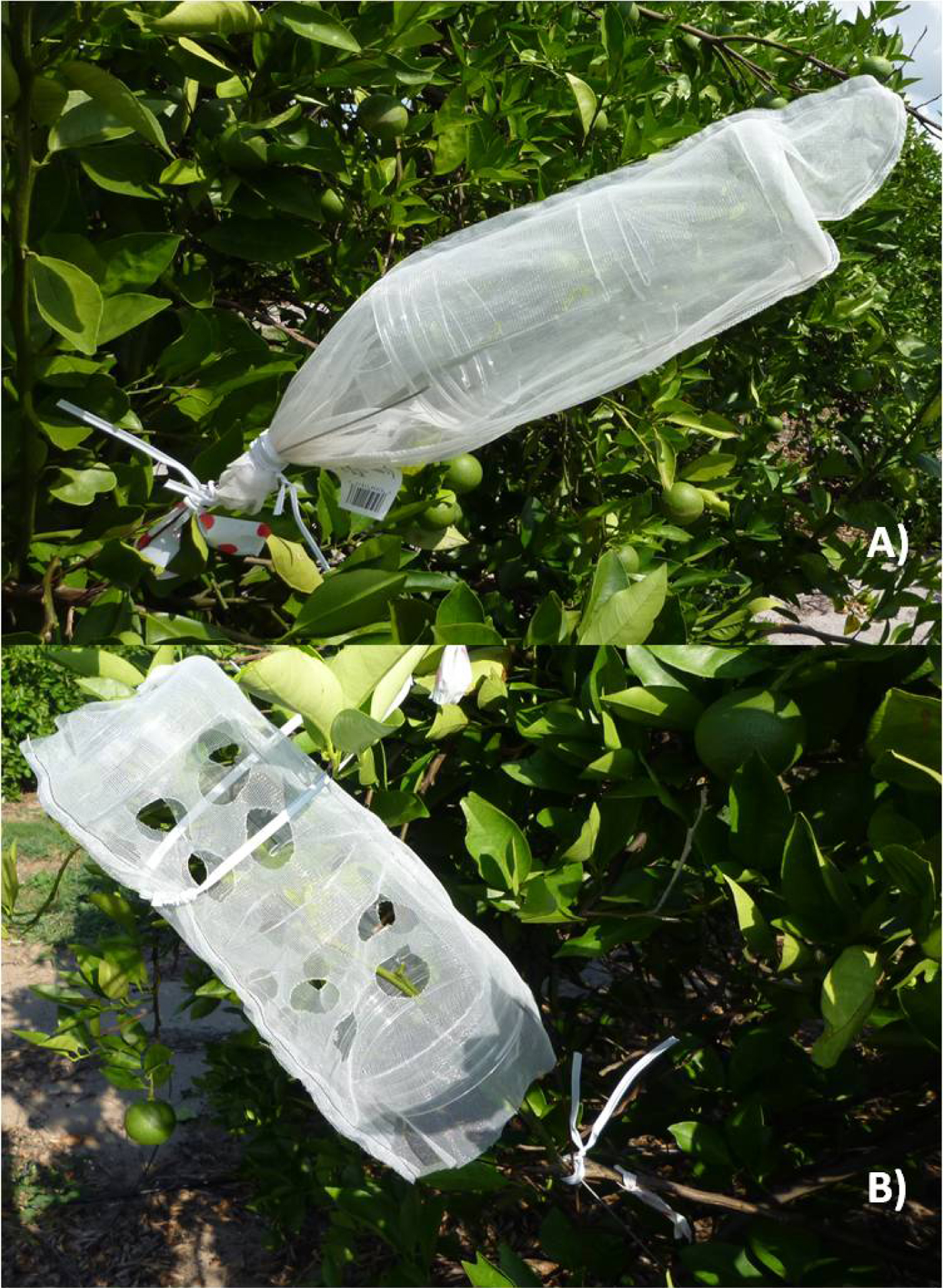
Four open and four closed cages were randomly assigned to the established colonies in ‘calendar’ or ‘no insecticide’ plots for a maximum of 64 colonies across four replicates (eight per exclusion treatment and plot). Closed cages were as above but open cages had circular holes cut in the organdy sleeve corresponding to the six windows in the frame and representing 26.4% of the total area of the cage to allow access by predator insects and mites (fig. 1b). All cages were removed from colonies after 7 days by which time most of the predation has occurred (Michaud, Reference Michaud2004; Qureshi & Stansly, Reference Qureshi and Stansly2009). Caged shoots hosting colonies were taken to the laboratory and the number of live D. citri nymphs remaining on each counted under a stereoscopic microscope.
Statistical analysis
Similarities in seasonal flush density patterns between ‘calendar’ and ‘no insecticide’ plots were analyzed using Spearman rank correlation. Differences in beneficial arthropod abundance between ACP management treatments for each meteorological season and differences in the seasonal abundance pattern for each natural enemy group and between ‘calendar’ and ‘no insecticide’ treatments were studied by linear mixed model repeated measures analysis, where ACP management treatment was considered as a fixed factor and ‘block’ as random factor. Several covariance structures were tested and a heterogeneous autoregressive structure was selected for spiders, arboreal ants and lacewings based on the Akaikei and Bayesian information criteria, respectively. Both criteria favor models that maximize goodness of fit while minimizing number of parameters. Ladybeetle data did not meet normality and homoscedasticity assumptions so the Kruskal–Wallis non-parametric test was used to determine seasonal and treatment effects on cumulative numbers.
Nymphs recovered at the end of each experiment were compared against the initial number of eggs in each colony in open or closed cages to calculate reduction in numbers. Percentage mortality in open cages corrected for mortality in closed cages was estimated for each plot using the Henderson and Tilton formula (Henderson, Reference Henderson1955).
 $$\hskip-3pt\eqalign{\left(\! {1\! -\! \displaystyle{{{\rm eggs}\;{\rm in}\;{\rm exclusion}\;x\;{\rm nymphs}\;{\rm in}\;{\rm no}\;{\rm exclusion}} \over {{\rm nymphs}\;{\rm in}\;{\rm exclusion}\;x\;{\rm eggs}\;{\rm in}\;{\rm no}\;{\rm exclusion}}}} \right) \times 100}$$
Corrected mortality attributed to predation was then compared between ‘calendar’ and ‘no insecticide’ treatments using linear mixed model repeated measures analysis. Changes in nymphal biotic reduction throughout the season as well as differences in seasonal biotic reduction patterns between the two ACP management treatments were also evaluated. A heterogeneous Toeplitz covariance structure was selected for analysis by the criteria mentioned above.
The effect of presumed predation during each major flushing period on ACP population growth rate (λ) was estimated by comparing stem tap results from ‘no insecticide’ plots before and after each flushing period (n=3) using
 $${\rm \Delta ACP}\# = {\rm \lambda} = \displaystyle{{{\rm ACP}\;\# \;{\rm after} - {\rm ACP}\;\# \;{\rm before}} \over {{\rm ACP}\;\#\; {\rm before}}}$$
Values of λ would be positive if numbers increased over the interval, negative if they decreased and 0 if remained the same. Results for each of the eight major flushing periods were correlated using non-linear least-squares regression to the corresponding corrected mortality values (r) for each of the eight major flushing periods evaluated. Data were fitted to a negative exponential equation (3) by using the Newton–Raphson iterative estimation procedure
 $${\rm \lambda} = ab^{ - r} + c$$
Results
Citrus flush density
Four major flushing periods (more than 5 flushes m−2) were registered between April 2011 and April 2013 with similar patterns for both treatments (Spearman's rho48=−0.96, P<0.0001). The greatest flush density was observed in the first major flushing period that followed the coolest and driest period of the year (fig. 2). In 2012, the first major flushing period occurred in February (338.5±10.3 flushes m−2) whereas in 2013 it began earlier, in January (264.1±7.2 flushes m−2) and was more prolonged, following unseasonable mild temperatures and moderate rainfall (fig. 2). Less intense major flushing periods (between 7.6±0.9 and 61.4±5.7 flushes m−2) occurred in late spring, mid and late summer, apparently in response to rainfall.
Average citrus flush density (mean±SE) measured as number of new shoots per square meter, from April 2011 to April 2013 in the citrus grove where exclusion experiments were conducted. Mean temperatures (°C) and rain (mm) registered in Immokalee FAWN Weather Station, 25 km south of the study site.

Natural enemies
Spiders and arboreal ants of the subfamily Pseudomyrmecinae were the most frequently encountered natural enemies in the stem tap samples (n=1312 and 832, respectively) whereas lacewings and lady beetles were seen only sporadically (n=88 and 79, respectively). Spider abundance varied throughout the year (F 7,34.4=31.06, P<0.0001) and was greatest during autumn and least in spring 2011 (fig. 3a). Pseudomyrmesines also varied significantly over seasons (F 1,10.9=21.48, P<0.0007) and were most abundant in summer (fig. 3b). Numbers of lacewings also varied seasonally (F 7,32.4=5.22, P=0.0005) and were most abundant in winter and least in spring (fig. 3c). Ladybeetle numbers showed no consistent seasonal patterns (fig. 3d) nor significant seasonal variation (Kruskal–Wallis, H 7=10.58, P=0.1577 or H 7=5.2375, P=0.6310 for unsprayed or sprayed plots, respectively).
Comparison between the two Asian citrus psyllid (ACP) management strategies tested, insecticide ‘calendar’ applications and ‘no insecticides’, in cumulative number per meteorological season of different natural enemies groups (mean±SE) collected by stem tap sampling 20 trees per plot in plots where the exclusion experiments were performed: (a) Araneae, (b) Pseudomyrmecinae, (c) Neuroptera and (d) Coccinellidae. Black columns with the same upper case letter above represent predator abundance in treated plots that are not significantly different. White columns with the same lower case letter above represent predation rates in untreated plots that are not significantly different (LSMEANS P<0.05 for all except Kruskal–Wallis test for Coccinellidae). Asterisks within a white column indicate differences between treatments during the respective season (two stars, P<0.05, one star, P<0.10).

Insecticide sprays significantly reduced the cumulative number of spiders observed over all seasons (F 1,10.7=29.79, P=0.0002) and every season except spring 2011 and summer 2012 (fig. 3a). However, the interaction of treatment and season was significant (F 7,34.4=8.9, P<0.0001) indicating seasonal patterns depended on the effect of treatment and vice versa. In general, there was less variation in spider density within treated compared to untreated plots. For instance, the greatest spider incidence in untreated plot occurred during autumn 2011, whereas spider densities were not significantly different in treated plots from summer through autumn 2011 and spring through autumn 2012.
Similar patterns were seen with ant abundance: significant depression of populations in treated plots over all seasons (F 1,10.9=21.48, P<0.0007) and every season except spring 2011 and winter 2012 (fig. 3b). Again, the interaction of treatment and season was significant (F 7,35=6.72, P<0.0001) indicating different seasonal effects depending on the ACP management treatment and vice versa. Plots that did not receive insecticides showed the highest arboreal ant densities in summer and the lowest densities in winter, whereas ‘calendar’ plots did not show much seasonal variation.
No treatment effects (F 1,7.64=0.31, P=0.5951) or treatment interactions with season (F 7,32.4=0.89, P<0.5228) were seen with lacewing abundance (fig. 3c). However, ladybeetle abundance was greater in ‘no insecticide’ plots than in ‘calendar’ plots in autumn 2011, winter 2011, spring 2012, summer 2012 and winter 2012 (fig. 3d).
Exclusion experiments
Estimated predation of ACP varied significantly with season (F 7,41.3=30.09, P<0.0001). In general, higher predation rates were found in spring and summer compared to late winter within the first flushing period of the season (fig. 4).
Corrected mortality on ACP (mean±SE) calculated by Henderson–Tilton formula for two ACP insecticide management strategies, ‘calendar’ sprays and ‘no insecticide’, during the major flushing periods of 2011 and 2012 seasons in a commercial citrus grove. Black columns with the same letter above represent predation rates in treated plots that are not significantly different. White columns with the same letter above represent predation rates in untreated plots that are not significantly different (LSMEANS P<0.05 for both). Stars inside a white column indicate differences between treatments on the respective date (two stars, LSMEANS P<0.05, one star, LSMEANS P<0.10).

Corrected mortality presumed to predation of ACP colonies across all eight repetitions of the experiment ranged between 0 and 87.95±6.28% for the ‘calendar’ treatment and 14.50±9.85 and 91.29±4.42 in untreated blocks, and was significantly higher for the ‘no insecticide’ treatment (F 1,4.85=22.89, P=0.0053). The interaction between spray treatment and season was significant (F 7,41.3=2.76, P=0.0189) indicating differences in insecticide use depended on seasonal pattern and vice versa. Nevertheless, no significant treatment effects on predation rates were seen until the second year, in February 2012 (t 22=−2.31, P=0.0306) and May 2012 (t 25=−3.83, P=0.0008) and again in February 2013 (t 19.1=−1.86, P=0.0779). Predation rates in the calendar treatment were either very low on these dates or zero on the last date; i.e., no difference between open and closed cages (F 1,16=2.71, P=0.1191).
ACP growth rates
The negative exponential distribution effectively modeled the relationship in ‘no insecticide’ plots between predation rates on the one hand (r) and the ACP population growth rate (λ) obtained from monitoring ACP adult populations before and after major flush cycles (F 2,5=84.94, P=0.0001; r 2=0.97) (fig. 5). The model predicted ACP population growth rates of λ=3.98 in insecticide treated plots compared to λ=0.56 in no insecticide plots based on estimated ACP predation rates (r) during the major flushing periods in the first year (table 2). Predicted values for λ the second year were much higher, 14.6 and 4.15 for insecticide treated and not treated, respectively.
Negative exponential relationship between the estimated predation values (r) obtained by exclusion techniques in the plots that did not received insecticide applications to control D. citri in 2011 and 2012 major flushing periods and the corresponding ACP adult growth rates from before to after each major flushing period (λ), when most of ACP adult recruitment occurs, fit by non-linear least-squares regression (r 2=0.97).

Estimated predation rates (r) on ACP immature stages during the four major flushing periods of 2011 and 2012 seasons obtained by exclusion experiments, and their corresponding ACP adult growth rates (λ) obtained by the means of the least-squares non-linear regression estimated negative exponential equation: λ=37.49×1.058−r −0.53.

Bold numbers indicate the average values for the whole year (‘First year’ and ‘Second year’ in the first column of the table).
Discussion
Arboreal spiders were the most frequently encountered predators using stem tap sampling. Spiders are recognized as a key predacious arthropod group in agriculture (Sunderland, Reference Sunderland1999). However, their generalist predatory behavior, low numerical response to specific prey and typically long life cycle have generally led to an underestimation of the services they provide in agroecosystems (Riechert & Lockley, Reference Riechert and Lockley1984; Sunderland, Reference Sunderland1999; Symondson et al., Reference Symondson, Sunderland and Greenstone2002). Ecotoxicology studies on this group are scarce, comprising only 3% of the total according to a recent review (Pekar, Reference Pekar2012). We found significant reduction of spiders and an advance of their seasonal activity peaks in response to monthly insecticide treatments (fig. 3a). Effects of insecticides on spiders can depend on active ingredient, targeted guild or species (Mansour et al., Reference Mansour, Rosen and Shulov1980; Mansour & Nentwig, Reference Mansour and Nentwig1988; Pekar, Reference Pekar1999; Amalin et al., Reference Amalin, Peña, Yu and McSorley2000; Pekar, Reference Pekar2002). Pyrethroids, organophospahtes and carbamates can be highly toxic to spiders both in laboratory and field studies (Mansour et al., Reference Mansour, Rosen and Shulov1980; Amalin et al., Reference Amalin, Peña, Yu and McSorley2000; Fountain et al., Reference Fountain, Brown, Gange, Symondson and Murray2007). These modes of action were used every fall and winter plus 4 other times in 2011 (table 1) which could explain why spider populations were at their lowest ebb in treated plots compared to untreated plots during the winters of 2011 and 2012. Treatment effects on spiders in winter might also explain reduced predation rates the following spring. In contrast, spirotetramat, spinetoram and diflubenzuron used later in the year are considered non-toxic to spiders, and abamectine or foliar imidacloprid are reported as only moderately toxic (Hassan et al., Reference Hassan, Bigler, Bogenschutz, Boller, Brun, Calis, Coremans-Pelseneer, Duso, Grove, Heimbach, Helyer, Hokkanen, Lewis, Mansour, Moreth, Polgar, Samsoe-Petersen, Sauphanor, Staubli, Sterk, Vainio, Van De Veire, Viggiani and Vogt1994; Amalin et al., Reference Amalin, Peña, Yu and McSorley2000; Bajwa & Aliniazee, Reference Bajwa and Aliniazee2001). The use of more selective active ingredients in 2012 could explain the apparent recovery of spider populations in sprayed plots during summer 2012, although species composition could still have remained altered by pesticides (Pekar, Reference Pekar2012).
Arboreal ants of the genus Pseudomyrmex were the second predatory group in abundance. Behavior of these ants is recognized to be almost exclusively predatory (Larsen & Philpott, Reference Larsen and Philpott2010). In citrus, they are considered potential predators of citrus leafminer (Xiao et al., Reference Xiao, Qureshi and Stansly2007). However, the importance of arboreal ants as biological control agents has been lately ignored despite the early example of the weaver ant Oecophylla smaragdina used for biological control on citrus in China (Chen, Reference Chen1962). To our knowledge, the role of Pseudomyrmex spp. as predators of ACP has not been assessed although we have observed workers carrying off ACP nymphs, as did Michaud (Reference Michaud2004). In our study, insecticide sprays had a strong negative effect in population of these ants almost from the onset of treatments. There are no published reports of pesticide side effects on this group, but most of the products used are generally considered prejudicial to ants or other hymenopteran families. Further research on foraging and feeding behavior of Psedomyrmex species in citrus would be required to elucidate their function in the agroecosystem.
Lacewings are recognized as important beneficial insects in agriculture (McEwen et al., Reference McEwen, New and Whittington2007). Different broad-spectrum products affect this group differently. Carbamates are known to be harmful (Michaud & Grant, Reference Michaud and Grant2003), but effects of organophosphates and pyrethroids vary depending on the insecticide and the targeted group or species (Pree & Hagley, Reference Pree and Hagley1985; Schuster & Stansly, Reference Schuster and Stansly2000; Giolo et al., Reference Giolo, Medina, Grützmacher and Viñuela2009). Newer, more selective active ingredients can be less harmful (Schuster & Stansly, Reference Schuster and Stansly2000; Giolo et al., Reference Giolo, Medina, Grützmacher and Viñuela2009). Furthermore, the trash-bearing species of Ceraeochrysa that are most common in Florida citrus and elsewhere are considered less sensitive than non-trash-bearing species (Schuster & Stansly, Reference Schuster and Stansly2000). We saw no significant difference in lacewing abundance between sprayed and unsprayed plots even when activity peaked and broad-spectrum products were used. This result could reflect either their relative tolerance to these insecticides or their ability to rapidly recolonize treated areas (Duelli, Reference Duelli1980). Porcel et al. (Reference Porcel, Ruano, Cotes, Peña and Campos2013) observed changes in species composition rather than numerical effects from insecticide applications in olive orchards. Therefore, species-level studies may be necessary to detect insecticidal impacts on biological control of ACP by lacewings.
Coccinellid beetles are another key beneficial group extensively linked to biological control (Hagen et al., Reference Hagen, Mills, Gordh, McMurtry, Bellows and Fisher1999). Species such as Curinus coeruleus Mulsant, Olla v-nigurm Mulsant, Harmonia axyridis Pallas and Cycloneda sanguinea have been described as important natural enemies of ACP (Michaud, Reference Michaud2004; Qureshi & Stansly, Reference Qureshi and Stansly2009). However, we found ladybeetles to be generally scarce in tap samples with no treatment differences seen until autumn 2011. Qureshi & Stansly (Reference Qureshi and Stansly2009) found greater abundance of coccinellid beetles in spring with declining numbers later in the year. However, we did not observe any particular seasonality and consequently were not able to attribute seasonal variations in presumed predation of ACP immature stages specifically to ladybeetles. The absence of seasonal fluctuations was probably due to their relative low numbers detected compared to previous reports using other sampling techniques. However, it is also possible that intensive area-wide spraying for psyllids has resulted in significant depression of lady beetle populations. A reduction of the lady beetle metapopulations would delay re-colonization processes even in unsprayed areas.
We observed differences in survivorship from spring to fall of 50–90% between caged and uncaged cohorts of D. citri that were presumably due to predation. These results are in concert with previous studies that documented the importance of predation on nymphs as a key source of mortality inflicted on D. citri populations (Michaud, Reference Michaud2001, Reference Michaud2004; Qureshi & Stansly, Reference Qureshi and Stansly2009). The estimated reduction in net ACP reproductive rate (R 0) ranged from 3- to 178-fold over 16 cohort exclusion studies in southwest Florida with no survivorship observed in the 17th (June) experiment (Qureshi & Stansly, Reference Qureshi and Stansly2009). Unfortunately, this mortality was insufficient to stop the rapid spread of HLB in the region, necessitating insecticidal control (Qureshi & Stansly, Reference Qureshi and Stansly2008, Reference Qureshi and Stansly2010). Nevertheless, it is important to assess the impact of different insecticidal programs on this natural enemy component as a step toward integration of biological and chemical control.
The calendar insecticide program we used for ACP management made minimal use of broad-spectrum insecticides in an effort to conserve natural enemies. Still, it caused significant reductions of predation rates to ACP cohorts during February both years and in May 2012. Super-abundance of young flush in late winter provided opportunity for rapid growth of the ACP population (high λ) where biological control was negatively impacted by insecticides, an effect which carried into late spring in 2012 (table 2). In contrast, no significant treatment differences in presumed predation rates were observed during summer or autumn in spite of significant reduction of key natural enemy population by insecticides during that time (fig. 3a–d), possibly due to generally low finite rates of increase (λ) of ACP due to lack of flush during those periods (fig. 1, table 2). While the system has proven itself resilient to insecticidal insult over the short term, continuous use is likely to take its toll over medium and longer terms as indicated by generally lower predation rates observed in this compared to a previous study (Qureshi & Stansly, Reference Qureshi and Stansly2009). The cumulative effect of spraying could also be seen in the latter study, where no effects were seen on ACP predation until spring 2012 following a year of monthly sprays.
In conclusion, 2 years of an intensive insecticide program for ACP management resulted in a reduction in abundance and in some cases a modification of seasonal patterns within some key predatory groups of the citrus agroecosystem. Deleterious effects of insecticides on citrus predatory assemblages had direct consequences on the natural occurring biological control of ACP early in the growing season when spring flush provided the greatest opportunity for population growth. At that time, even small differences in biological control could translate into rapid ACP population increase. Dormant season sprays have been shown to suppress overwintering populations of ACP with minimal impact on key natural enemies (Qureshi & Stansly, Reference Qureshi and Stansly2010). While this allows predation to help control ACP later in the year, direct or sub-lethal effects of continuing sprays may reduce functionality of natural enemy populations in the medium- or long-term (Desneux et al., Reference Desneux, Decourtye and Delpuech2007; Biondi et al., Reference Biondi, Mommaerts, Smagghe, Viñuela, Zappala and Desneux2012). The results obtained in this study may therefore underestimate the negative consequences of insecticides on beneficial arthropod populations over a long-term scenario, and highlight how fewer and more selective insecticide applications during critical periods could be favorable for overall ACP management.
Acknowledgements
Funding: Citrus Research and Development Foundation; location and grove care: Bob Paul Inc., Di grove manager; technical assistance: SWFREC entomology program staff; review: A. Urbaneja, J. P. Michaud and two anonymous reviewers.



