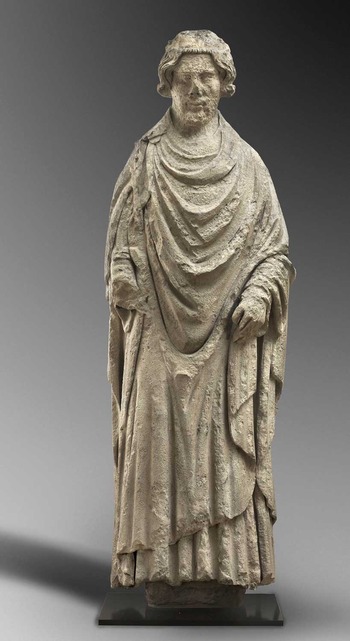
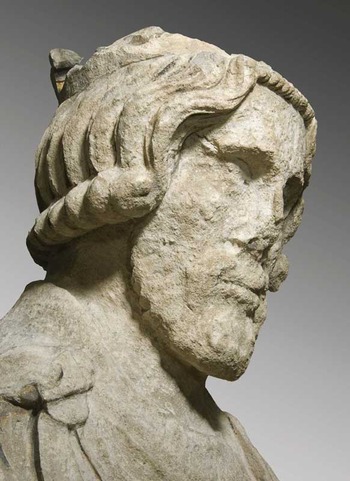
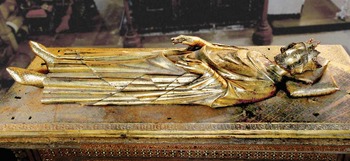
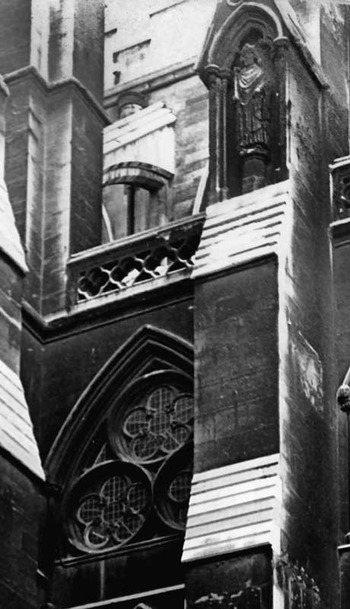
The figure of King Henry, crowned and bearded, stands 2.02m tall (figs 1 and 2). The position of his arms suggests he once held a sceptre in each hand. The remains of the right-hand sceptre can be made out running in a straight line upwards from hand to shoulder, where his mantle is fastened with a brooch identical to that of Henry's tomb effigy (figs 3 and 16). There is damage to the nose and beard; the front of the crown is lost; the left hand missing; and some of the ‘V-folds’ of the upper drapery have clumsy cement repairs. A pair of round holes in the sides of the sculpture provided purchase for the scissor hoist by which it was grasped and lifted into place in a niche at the top of one of the nine buttresses supporting the north wall of the nave. The statue is recognizable in photographs from the 1890sFootnote 1 until 1979,Footnote 2 the eve of Foster's restoration (fig 4). It stands in the easternmost of the buttresses, which are numbered one to nine westwards for the present purpose. In these photographs it seems Henry still had his sceptre and the front lobes of his crown. Both were probably damaged when the statue was removed during Peter Foster's repairs. Damage and decay contribute to the difficulty of dating the figure on purely stylistic grounds, leaving the documentary evidence as paramount.
Henry iii. Photograph: courtesy of Richard Philp

Henry iii: head. Photograph: courtesy of Richard Philp

Tomb effigy of Henry iii. Photograph: © Dean and Chapter of Westminster Abbey

Henry iii in situ in 1979. Photograph: © Dean and Chapter of Westminster Abbey

The abbey's records show that Peter Foster began his restoration of the north front with the five western bays of the nave, turning then to the transept before completing the remaining bays of the nave. Falling masonry from a previous major restoration in the late nineteenth century had already caused concern in 1927 when the then Surveyor, William Lethaby, reported to the Dean and Chapter that
the piece of stone which fell recently at the west end of the Church was Chilmark stone, part of the restoration of the N.W. corner buttress by the late Mr. Pearson about 1890. The same stone was used in the restoration of the north transept, where it also appears to be rapidly decaying.Footnote 3
John Loughborough Pearson's use of Chilmark stone had been condemned at the time by one architect who was ‘surprised and pained to find that in the restoration now proceeding at the abbey both science and experience are being disregarded by the use of a stone that is very pleasing in appearance but utterly untrustworthy’.Footnote 4
Of the thirty-two decaying statues facing Peter Foster from the niches of the north transept, fourteen had been carved by Nathaniel Hitch between 1878 and 1890.Footnote 5 Foster considered them not worth keeping. At a site meeting with the contractors he agreed that some could be sold off,Footnote 6 later informing the Dean and Chapter that:
The remains of the original statues have been disposed where possible for a modest return to the Abbey Restoration costs. One statue, however (St Dunstan), was sent to the Smithsonian Institute in America, who desired an example of this kind of statuary to fill a niche in their own building.Footnote 7
According to one of the carvers working on the north transept,Footnote 8 the statues were stored for a while between two buttresses, but subsequently disappeared overnight. More worryingly, the carver recalls this dismissive attitude towards nineteenth-century work was extended to medieval finds. Masons demolishing one buttress discovered several carved fragments used to fill its core. They included a capital, a foot and part of a draped figure. These important fragments may have been related to the abbot's head found during Pearson's rebuilding of the same buttresses in 1887–8, now in the Abbey Museum.Footnote 9 When the contractors became aware of the medieval finds, they feared historical enquiry would delay their work.Footnote 10 The fragments were consigned to a skip beneath a padlocked tarpaulin and the carvers forbidden to investigate the contents of the skip under pain of dismissal. What happened to these medieval finds is unknown. Assuming this disregard prevailed as restoration progressed to the north front of the nave, the reported rescue from a skip of the statue of Henry iii, medieval or not, has the ring of truth.
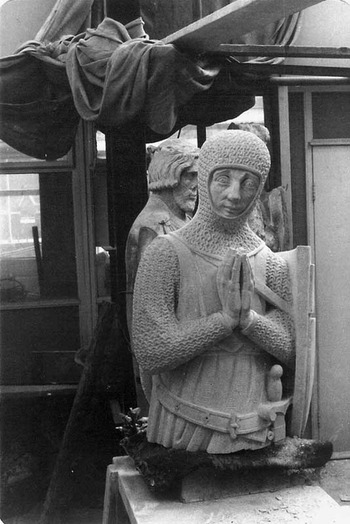
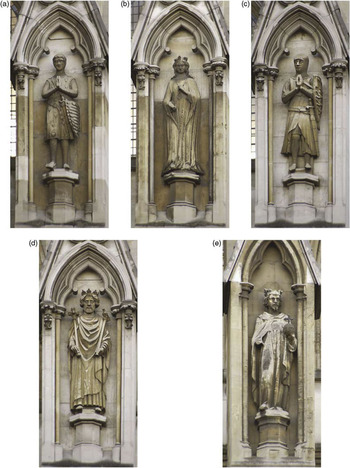
With scaffolding moved to the north nave, Foster was in a position to assess the statues on buttresses one to four: ‘Two are in reasonable condition and with some repair will last for many years,’ he told the Dean and Chapter, ‘but the other two are badly decayed and I propose to replace them using cream Ketton stone.’Footnote 11 The two statues for repair were those of Eleanor of Castile, consort of Edward i, and William de Valence. Those for replacement were Edmund Crouchback and Henry iii. Blocks of Ketton stone arrived on site in September of 1980,Footnote 12 and the carving of the first copy had begun by the following January.Footnote 13 The sculptor was Arthur Ayres, then in his late seventies. A contemporary photograph taken in the masons’ yard shows the newly carved Edmund Crouchback with the head of the original Henry iii clearly visible over his shoulder (fig 5). Foster had established a modus operandi using clay to build up missing parts of the old statues for the purpose of transferring accurate measurements with a pointing ‘machine’ to the new carvings, but he encouraged the sculptors ‘to make their own statues bolder in form so that with the inevitable erosion of time, the effect would still be pleasing’.Footnote 14 Marks caused by the pointing were visible on the surface of the figure of Henry iii before restoration by the present owner. Ayres completed the second statue in May 1981.Footnote 15 Three months later, the masonry work on the north front had been completed and the scaffolding removed.Footnote 16 Foster did not, however, replace the statues in their original order: he exchanged the positions of Henry iii and William de Valence, promoting the repaired William to buttress one (fig 6a) and moving the new Henry down to buttress four (fig 6d). In between, Eleanor and the new Crouchback were returned to their previous positions in buttresses two and three respectively (figs 6b and 6c). What happened to the discarded statue of Edmund Crouchback is not known; presumably, he suffered the fate from which Henry was rescued.
Arthur Ayres's carving of Edmund Crouchback with Henry iii behind. Photograph: courtesy of Richard Philp

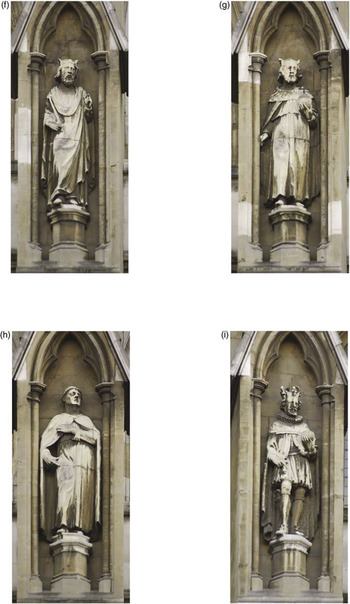
Westminster Abbey: statues in the buttresses on the north front. (a): buttress one, William de Valence; (b): buttress two, Eleanor of Castile; (c): buttress three, Edmund Crouchback; (d): buttress four, Henry iii; (e): buttress five, king with orb; (f): buttress six, (?) Edward the Confessor; (g): buttress seven, (?) Henry iii; (h): buttress eight, (?) Abbot Islip; (i): buttress nine, James i. Photographs: author

(continued)

Could the surviving figure of Henry iii be medieval? It is more than likely that a statue was raised at Westminster Abbey to commemorate its greatest benefactor at some time during the medieval period; but if it were in the thirteenth century its original home could not have been in buttress one. The first five bays of the nave westward from the crossing were completed before Henry's death in 1272, after which major building work came to a halt for over a century.Footnote 17 Henry's ordering of a life-size statue of himself would have shown uncharacteristic hubris; and since its design closely reflects that of his tomb effigy, the surviving figure must have been copied either from the tomb itself or from a model common to both. Henry's gilt-latten tomb effigy is well documented as being made by the London goldsmith, William Torel, commissioned by Henry's son, Edward i, at the same time as two full-size effigies of Edward's deceased wife, Eleanor.Footnote 18 In May of 1292, Edward ordered the royal treasurer ‘to deliver to William Torel, maker of the latten effigy of the late king, the necessities for making the effigy’.Footnote 19 The effigy of Queen Eleanor was probably in place at Westminster by October of that year, when Edward donated six manors to the abbey on condition that the whole convent attended an annual vigil with ‘one hundred cierges being lighted about the queen's tomb’.Footnote 20 This determines 1292 as the earliest possible date for the surviving statue of Henry iii and invites us into a warren of speculation.
In addition to the life-size tomb effigies, three smaller effigies of Queen Eleanor were created for the burial place of her entrails at Lincoln Cathedral and of her heart in the London convent of Black Friars. These were cast by William of Suffolk, who was paid ‘pro factura imaginum de metallo’.Footnote 21 Like the larger effigies, they were produced by the ‘lost wax’ method, which involves taking a cast from an original wax carving. A second payment was made to one ‘Magistro Alexandro Imaginatori’ for providing William with those wax models.Footnote 22 This Alexander has been identified with Alexander of Abingdon,Footnote 23 undoubtedly one of the leading sculptors of his time since he was chosen to carve the statues of Queen Eleanor on several of the Eleanor Crosses that marked the route of her funeral cortège from Lincoln to Westminster. One of these figures, from the cross at Waltham, is now in the Victoria and Albert Museum.Footnote 24 Like other Eleanor Cross statues, the pose is similar to that of Eleanor's tomb effigy: her left hand grasps the loop of cord fastening the mantle round her neck. This pose almost certainly derives from her royal seal,Footnote 25 though the hand gesture is shared with other tomb effigies of royal and noble women.Footnote 26 It has been suggested that the same Alexander who carved the smaller wax figures for William of Suffolk may also have made the wax figures for Torel's life-size effigies of Eleanor.Footnote 27 If so, Alexander should be considered the true creator of her tomb effigy. It would also be likely that he made the wax figure for the casting of Henry iii's tomb effigy. Such a figure may have served as a model for the surviving stone statue, or even have been taken from it. The discovery of a hitherto unknown statue by Alexander of Abingdon would be remarkable indeed.
Unfortunately, this hypothesis has a difficulty. Where would the statue have stood? By the 1290s, major building work at the abbey had ceased for twenty years. No new architectural statuary was required. The second campaign of construction, which achieved the ground storey of the rest of the nave, did not begin until 1388 under Abbot William of Colchester. Pamela Tudor-Craig has suggested that unused carved features stored in the masons’ yard at the end of the first building phase may have provided conveniently ready-made elements when work resumed. Some of the label-stop heads of the fourteenth-century interior nave walls have a distinctly thirteenth-century appearance.Footnote 28 However, a life-size statue of a king, then almost a hundred years old, would have been more difficult to incorporate into the new work.
The nave of the abbey was not completed until 1497, when Abbot John Esteney built the high vaults over the fifth and sixth bays. By then the older stonework was already crumbling. Weather and the corrosive atmosphere were unremitting. Henry VII's Chapel would need repairs within fifty years of its completion in 1519. Negligence played its part, too. A meagre £40 a year was set aside at the end of 1603 to cover the cost of all the stone, timber, lead and other materials necessary for maintaining the abbey fabric. No repairs were to be made on the church or the domestic buildings without the express consent of the Dean, Lancelot Andrewes.Footnote 29 Small wonder the decay continued unabated. By the time John Williams became dean in 1620, ‘all that passed by, and loved the honour of God's House, shook their heads at the stones that dropped down from the pinnacles’. According to the biographer of Dean Williams, John Hacket, ‘the great buttresses were almost crumbled to dust with the injuries of the weather’.Footnote 30
Dean Williams set about reversing years of neglect. The buttresses ‘he re-edified with durable materials, and beautified with elegant statues, so that 4500 pounds were spent in a trice upon the workmanship’.Footnote 31 All this was carried out at the Dean's own expense, an act so generous it was doubted by many. Rumour spread, saying the money had been siphoned ‘out of the diet and bellies of the prebendaries and revenues of our said church’, a slander that was formally repudiated by the Chapter in December 1628.Footnote 32 The statues commissioned by Dean Williams must have been in place by 1637, when he was suspended from his post and imprisoned after being found guilty of subornation of perjury.Footnote 33 The sculptor is not recorded, but a possible candidate is Maximilian Colt, maker of the tomb effigies of Queen Elizabeth and the two daughters of James i who died in infancy. Colt had been awarded the post of King's Master Carver in 1608. Four figures from this time, carved in Ketton stone, still stand in buttresses six to nine. They were evidently intended to represent figures considered important in the history of the abbey. In 1818, Brayley and Neale described them as ‘Abbot Islip, James the First, and two other Sovereigns, probably, Edward the Confessor and Henry the Third’.Footnote 34 Ten years later, John Britton made the same identifications.Footnote 35 The tentative naming of Henry iii suggests that no other statue of the king was then recognizable on the north front.
Today, the statue of James i stands out most clearly, his knee-breeches and ruff distinguishing him from figures dressed in a medieval style (fig 6i). He has a Van Dyck beard and holds an orb in his left hand. Two of the other statues are also kings, crowned and with full beards. One has the remains of a sceptre in his right hand and raises his left arm. This must be the figure identified as Edward the Confessor, holding up the ring which, according to legend, he gave to St John the Evangelist in the guise of a beggar (fig 6f). The Confessor was depicted in this way by a statue standing on a column beside his shrine and elsewhere.Footnote 36 By elimination, the second king, carrying an orb in his left hand, is the figure assumed to be Henry iii (fig 6g), and the fourth figure, that of Abbot Islip (fig 6h). Though weathered, the statue of Henry displays a distinctive gap in his moustache, shaved beneath the nose, like that in the king's tomb effigy. There may have been renewed interest in King Henry around 1627, when Sir Robert Cotton published A short view of the long life and raigne of Henry the Third King of England: Presented to King James, though the portrait Cotton gives is not a flattering one. The example set by Dean Williams stimulated a more responsible attitude towards the fabric of the church, even during his enforced absence. In June 1640, the Sub-Dean and Chapter resolved to provide materials for the repair of five buttresses annually.Footnote 37
From the mid-seventeenth century onwards we have the visual record to inform us, but it is of limited reliability. On reviewing the drawings, paintings and prints of Westminster Abbey, it is apparent that artists displayed an almost complete lack of interest in the north-front buttress statues.Footnote 38 When the figures do appear in general views of the abbey, they are almost always reduced to small conventionalized squiggles, defying individual identification. Furthermore, the urge to improve upon reality means some degree of artistic licence must always be taken into account. Although we know the lower parts of the north front were obscured by domestic buildings, the abbey is commonly depicted as bordering on an airy, open green with, perhaps, a graceful tree and a scattering of leisurely gentlefolk: no stables, wash-houses or privies.
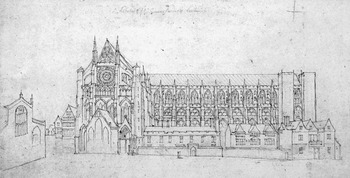
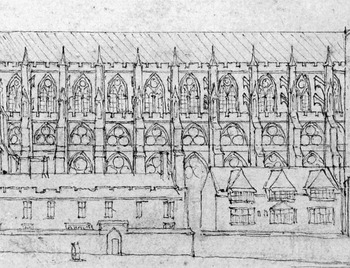
The drawing by Wenceslaus Hollar in the Pepys Library is an early exception (fig 7a).Footnote 39 Dating from the mid-seventeenth century, it shows three houses built against the north front, one of which must be the former home of Canon Buckley.Footnote 40 Curiously, Hollar's drawing omits everything east of the north transept, leaving instead a distant prospect of timber-framed houses. Hollar indicates statues in niches on the north transept but all nave buttress niches are shown empty (fig 7b). It would be tempting to suppose the drawing was made early enough in the seventeenth century to pre-date the figures erected by Dean Williams. However, Hollar did not arrive in England until 1637. By contrast, the ubiquitous 1654 engraved version of his view, made first for William Dugdale's Monasticon, gains in translation: as well as the missing east end of the abbey, it has a figure in every one of the buttress niches (figs 8a and b). To add further confusion, later editions of the print show the first three buttresses with vacant niches.Footnote 41 The houses crowding the north of the abbey also appear in a group of paintings made between 1735 and 1740; foremost among them are three attributed to Pieter Fabris.Footnote 42 Figures are suggested in all the buttress niches (figs 9a and b). However, a fourth painting in this group, by Antonio Joli, shows only four.Footnote 43 The intent of the Fabris paintings was not documentary: they were idealized ‘artist's impressions’ of the changes planned by Sir Christopher Wren, including the western towers and the unachieved central spire.
Drawing by Wenceslaus Hollar. Photograph: © Pepys Library, Magdalene College, Cambridge

Detail of drawing by Wenceslaus Hollar. Photograph: © Pepys Library, Magdalene College, Cambridge

Engraving by Wenceslaus Hollar from Dugdale's Monasticon Anglicanum (1693). Photograph: author

Detail of engraving by Wenceslaus Hollar from Dugdale's Monasticon Anglicanum (1693). Photograph: author

Westminster Abbey, by Pieter Fabris. Photograph: © Dean and Chapter of Westminster Abbey

Detail from Westminster Abbey, by Pieter Fabris. Photograph: © Dean and Chapter of Westminster Abbey

Wren became Surveyor to the abbey in 1698, inheriting a building ‘in so Crazy a Condition that it was hard to tell which part to goe about repairing first’, according to a memorandum in Dean South's notebook recalling a dinner with Sir Christopher in 1690.Footnote 44 In 1699, emergency repairs were ordered to a butting arch and two buttresses on the north front and two other unspecified buttresses, ‘judged to stand dangerously’, at an estimated cost of £235.Footnote 45 However, Wren prioritized work on the south side of the abbey. Twenty-three years after his shock dinner-table revelation, he reported to the Chapter that ‘little can be done to make the north front magnificent, whilst it is so much incumbered with private tenements, which obscure and smoke the fabric, not without danger of firing it’.Footnote 46 Some of the houses would be taken down towards the end of 1740;Footnote 47 others were not demolished until 1804, when the Gentleman's Magazine declared that ‘every man of taste, and lover of the antiquities of this country, would rejoice to see the low shabby buildings at the south-west corner of the entrance front undergo a similar fate’.Footnote 48
When Wren died in February of 1723, work was continued by his assistant, now his successor, Nicholas Hawksmoor. That year, the scaffolding against the north front forced John Dart to apologize to readers of his book for using an engraving ‘taken from a curious Draught made before these new Repairs, it being impossible to take a new Draught while the scaffolding remain'd’.Footnote 49 Dart's engraving, by J Cole, is closely related to Hollar's 1654 engraving, perhaps the ‘curious Draught’ to which he referred. However, it has significant differences in some details: all niches, on both the north nave and the north transept, are empty. Writing in 1754, John Newbury recorded the survival of the figures erected by Dean Williams: ‘next the towers on the north side, some of these statues are still standing’.Footnote 50 However, their condition was precarious: ‘The mouldering Stone Statues in their lofty Niches seem, as it were, to totter to their fall’, wrote the anonymous author of the notes accompanying Select Views of London and Westminster published in 1795.Footnote 51 The evidence suggests, therefore, that the eighteenth century neither added to, nor subtracted from, the line-up of statues on the buttresses of the nave north front.
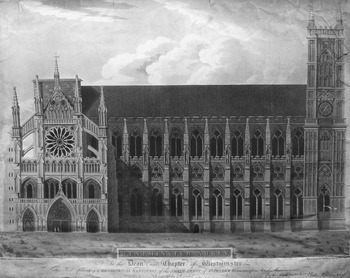
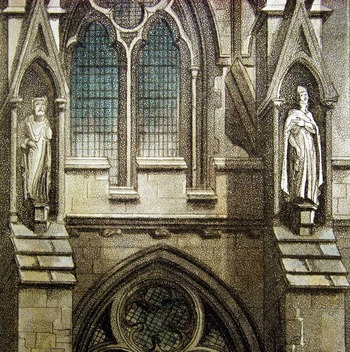
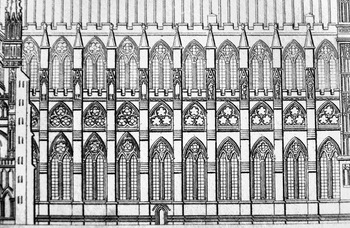
Untrustworthy as the visual evidence can be, and despite a very few exceptions, a general pattern does emerge: views of the north front show either statues in all the buttresses, in the four western buttresses, or in none at all. Nine figures was probably artistic licence; none, artistic laziness; and four, the truth. Two of the views showing four statues do attempt to differentiate between them. The first is Joseph Collyer's 1796 engraving of a drawing by John Thomas Groves;Footnote 52 the second, clearer still, is an aquatint of 1801 ‘representing a Geometrical Elevation of the North Front of St Peter's Westminster from Actual Measurement … accurately delineated by Charles Middleton’ (figs 10a and b).Footnote 53 The statue of James i can be identified in both, but standing in buttress eight, rather than buttress nine, as it does today. Since it is unlikely both artists would have misplaced the distinctive figure of King James, some rearrangement of the statues must have occurred during later restorations, perhaps with the intention of setting them in chronological order. The clearest representation of any of the buttress statues appears in Rudolph Ackermann's History of the Abbey Church of St Peter's, Westminster of 1812. One plate offers a hand-tinted aquatint by Thomas Sutherland from paintings by Augustus Welby Pugin.Footnote 54 It shows a selection of details of the nave north front. These include two isolated pairs of buttress niches, one pair empty and the other with those figures tentatively identified as Edward the Confessor and Abbot Islip (fig 11) – further evidence of later rearrangement, since these two are now separated by the insertion of the supposed Henry iii between them. Overall, it must be concluded that the visual and printed records from the seventeenth to the first part of the nineteenth century provide no convincing evidence for any figure sculpture on the north front dating from earlier than the 1620s.
Westminster Abbey: north front, by Charles Middleton (1801). Photograph: author

Westminster Abbey: detail from north front, by Charles Middleton (1801). Photograph: author

Detail of Fragments, Windows, Doors etc. in Ackermann and Coombe (1812). Photograph: author

During conservation of the rediscovered statue of Henry iii in 2008, a cross-section of a surface sample was analysed by Catherine Hassal. She reported: ‘The cross-sections show that the black is a paint, and that it is resting on clean, undamaged stone. It is therefore either original, or a very early painting scheme … On top of the black paint are the remains of later white limewashes.’Footnote 55 This has been taken to infer a medieval date for the figure. However, medieval paint was more usually applied to sculpture after it had been prepared with a ground, not directly on bare stone. No traces of any other colour were found. The ‘paint’ is composed mostly of carbon black with a quantity of iron-oxide particles. It is more likely to be the product of pollution than of art. The limewash that overlays it was indeed a medieval technique for preserving stonework, but the practice was resurrected under the Surveyorship of William Lethaby, in 1911,Footnote 56 and used again by Peter Foster, in 1979.Footnote 57 A further problem in accepting the statue as medieval work is the stone from which it is carved. Analysis by Dr Kevin Hayward, of Reading University, identified it as a compact oolitic limestone from the south Cotswold outcrop between Corsham and Bath.Footnote 58 Bath stone was brought to London during the Roman period, but its use afterwards is rare until its transport by canal was possible. Bath stone was not employed in quantity at Westminster Abbey until the extensive repair of Henry VII's Chapel by James Wyatt from 1807 to 1822, when stone from Combe Down was used.Footnote 59
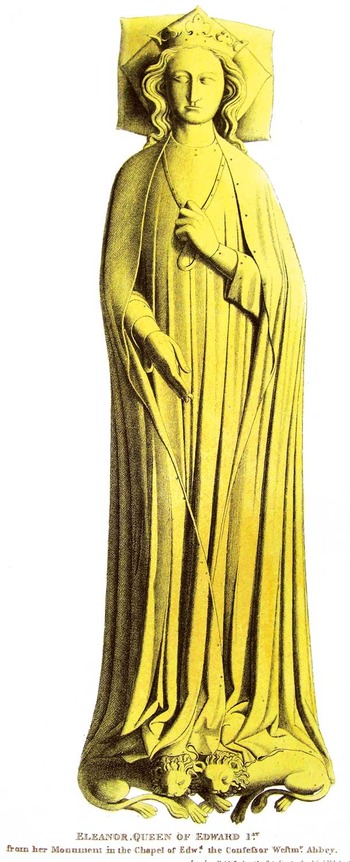
In May 2010, the statues on the north front were examined from a hydraulic platform.Footnote 60 Although there are some stylistic differences between the recovered statue of Henry iii and the figure of Queen Eleanor (fig 6b) still in situ, there are strong similarities: both are copied from tomb effigies in the abbey; they have lifting holes in the same positions;Footnote 61 both share the same flattened-oval horizontal cross-section; and both have repairs in Portland cement mixed with brick dust, a characteristic of later nineteenth-century conservation.Footnote 62 The stylistic variance may be ascribed to differences between their original models: the shallower drapery folds of Eleanor's tomb effigy (fig 12) suggest finer fabrics than the heavier robes worn by Henry. Further difference is observable in the working of the backs of the heads. Henry's is carved all the way round, while Eleanor's is significantly less well detailed, usually taken as an indication of nineteenth-century economy of effort. However, the thirteenth-century statue of the Angel Gabriel in the abbey's Chapter House also has a poorly defined back to its head; and the carving of the back of Henry's head, which has clearly defined tooling marks from a claw chisel, is perhaps less convincingly medieval in style than the more weather-worn exposed parts. The figure of Eleanor appears less weathered than Henry's, but this is almost certainly due to repair, and perhaps re-cutting, by Arthur Ayres in 1981.Footnote 63 Moreover, a sample of stone taken from the Queen Eleanor figure during the recent inspection matches that of Henry so closely that analysis concluded that ‘the stone may have been quarried at the same time as the Henry III sculpture’.Footnote 64 Clearly the two statues have a shared history.
Tomb effigy of Queen Eleanor, drawn and etched by Charles Stothard (1812). Photograph: author

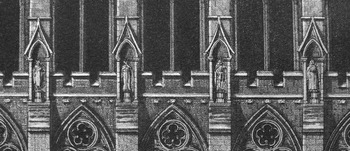
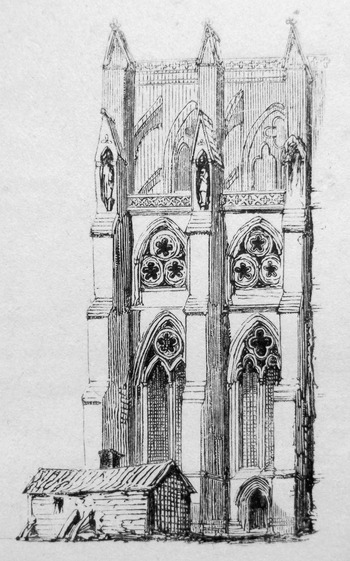
Returning to the visual evidence, the observed pattern of depicting nine statues, four statues, or none disappears by the middle of the nineteenth century. Thereafter drawings and prints, then photographs, always have a full complement of figures. The last view to show just four statues in the western buttresses appears in the second volume of John Britton's Illustrations of the Public Buildings of London of 1828 (fig 13).Footnote 65 It was taken from a drawing made by Pugin, probably late in 1823.Footnote 66 In 1842, Sir Henry Cole's guidebook to the abbey was published under his usual pseudonym, Felix Summerly, with ‘fifty-six embellishments on wood engraved by ladies’. One of these shows two bays of the north nave with a ramshackle hut in the foreground.Footnote 67 Statues are shown clearly in the niches of buttresses three and four, and possibly five (fig 14). This suggests that the eastern statues, including the figure of Henry iii, must have been set in place between 1823 and 1842. Fortunately, this period is well documented in the abbey's muniments.
Westminster Abbey: north front, from a drawing by A W Pugin. Photograph: author

Westminster Abbey: north front, from Henry Cole's Hand-Book (1842). Photograph: author

While Pugin's drawings were being engraved for Britton's book, the abbey appointed a new surveyor. In 1827 Benjamin Dean Wyatt, who had done little to distinguish himself in the post, was succeeded by Edward Blore.Footnote 68 Although Blore achieved major works at the abbey, including the choir stalls and screens, his reputation was tainted by bad press towards the end of his tenure. The Daily News disapproved of the new interior arrangement: ‘it is clear that a more incompetent person than Mr Blore for such work could hardly be found’.Footnote 69 The Ecclesiologist, mouthpiece of the Cambridge Camden Society, applauded his resignation in 1849: ‘It is with extreme satisfaction that we announce that Mr Blore has resigned the post of Surveyor of the Fabric of Westminster Abbey and that Mr Scott has been appointed to succeed him. We wish that the change had taken place much sooner.’Footnote 70 George Gilbert Scott wasted no time in listing the problems he had inherited and changing ways of working. It is quite usual, of course, for new brooms to sweep clean – and leave the dirt at the feet of their predecessors.
The abbey expressed no reservations about the quality of Blore's work. He became a close friend of Dean Ireland and the Sub-Dean, Lord John Thynne. On hearing of his intention to resign early in 1848, Thynne wrote to persuade him to defer his retirement: ‘you have had the trouble and anxiety of designing the greatest work which has been executed in the Abbey for generations. It is not quite complete and I should not like to see any other hand introduced to put the finishing stroke – the whole credit should be yours.’Footnote 71 Any doubts as to Blore's abilities as an accurate draughtsman and talented artist are easily dispelled by any one of the forty-eight volumes of his drawings and watercolours held by the British Library.Footnote 72 Through a lifetime of making these topographical, architectural and monumental studies, Blore assimilated the Gothic sensibility. Thomas Rickman, the major figure in defining the styles of medieval architecture, often corresponded with Blore, seeking his opinions and asking for drawings.Footnote 73 Blore's Monumental Remains of Noble and Eminent Persons, the culmination of his many years’ study of medieval monumental sculpture, was published the year before his appointment as Surveyor.
When Blore arrived at the abbey, a restoration of the west side of the north transept was already under way. Wyatt had employed John and William Johnson as his master masons,Footnote 74 but there had been wrangling over bills and complaints about the time scaffolding had been left standing.Footnote 75 Once the Johnsons’ contract had been worked out and paid,Footnote 76 Blore looked to a new mason, William Clarke of Pimlico, to continue the restoration. By cross-referencing the minutes of Chapter meetings with fabric vouchers, contracts and correspondence, it is possible to reconstruct a detailed picture of the progress of the work, including the making of the statue of Queen Eleanor and, by association, that of Henry iii.
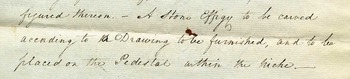
The Dean and Chapter took the decision to extend the restoration westwards from the north transept in February 1828, ordering the repair of the two bays that formed the corner between the transept and nave and the first of the nave buttresses, work that would cost in excess of a thousand pounds.Footnote 77 A contract was agreed with William Clarke and signed on 31 March 1828. Not only does it stipulate the use of ‘the best Bath Stone free from all flaws and defects’, but it also specifies ‘a stone effigy to be placed on the pedestal within the niche to be worked agreeably to the drawings furnished for the same and of the dimensions marked thereon’.Footnote 78 The work was to be completed by the following November. In April, however, the Chapter decided to confine the restoration to the two bays and defer repairs to the buttress.Footnote 79 The accounts of the Treasurer, Thomas Causton, show Clarke was paid for the bays in three instalments, the last in September.Footnote 80 Staffing problems may have played a part in halting the restoration: the Chapter ordered that ‘Mr Blore be requested to provide a competent Clerk of the Works before any new contract is made for further repair of the Abbey’.Footnote 81 Alexander Phillips was replaced by Richard Carter.
The postponed restoration of the buttress was authorized to proceed on 1 March 1831,Footnote 82 and a contract signed the next day ‘for the Repairing of the Eastern Buttress and Pinnacle of the North Aisle of the Nave’.Footnote 83 As a gesture of goodwill, the Dean and Chapter paid Clarke's half of the cost of drawing up the contract ‘in consideration of the work having been postponed and Mr Clark in consequence having had to re-erect the scaffold for the said work’.Footnote 84 Once again the contract specified the use of Bath stone and the carving of a statue. The buttress was to be completed by the end of June.
Further work on the north front was delayed for three years, in part by the coronation of William iv, which took place on 8 September 1831. Although William's ‘penny’ coronation eschewed the excesses of George iv's extravagant coronation,Footnote 85 it nonetheless involved much expense and disruption at the abbey. Blore was preoccupied with designing stages and galleries for the ceremony.Footnote 86 The cost of building materials remained a subject of bitter dispute between the Dean and the Government for many months after the event.
Restoration of the north front resumed in August 1834, when the Chapter accepted a tender from William Clarke ‘to repair the buttress and baye of the Abbey next the eastern buttress of the western part of the north side at the price of £1383.1.8.’Footnote 87 A contract was drawn up the following week with the same specifications as the first buttress, including the provision of another carved figure.Footnote 88 In December, Blore wrote ‘to certify that Mr Clarke has completed the work on the Bay and Buttress of Westminster Abbey in a good and workmanlike manner and to my entire satisfaction’.Footnote 89 A few days later, Clarke's third payment on the contract was released,Footnote 90 and Elizabeth Wilford, who supplied masons and labourers to the abbey, presented her bills for carting away the scaffolding and surplus stone.Footnote 91
Contracts for restoring a bay and buttress followed, with almost identical wording, on 24 April 1835, 8 April 1836 and 13 August 1838, the last being delayed by the need for urgent and costly replacement of lead on the nave roof, it being ‘ordered that during this process the renovation of the north front be suspended’.Footnote 92 These five contracts, spread over ten years, provided the five figures which, with the four credited to Dean Williams, completed the line-up of buttress statues.
The 1835 contract is of particular interest in the present context: it describes the buttress to be restored, buttress three, as ‘next to the buttress containing the effigy of Queen Eleanor’.Footnote 93 This description is confirmed in the minutes of Chapter Meetings,Footnote 94 and by a receipt for the drawing-up of the contract by the Clerk to the Chapter, George Giles Vincent.Footnote 95 From this, we can conclude that the figure of Queen Eleanor was carved for the buttress restored the previous year, that is, buttress two. Blore would have had no difficulty in preparing a suitable drawing for William Clarke: Eleanor's tomb was close at hand; he had already drawn its effigy for an engraving in his Monumental Remains;Footnote 96 he had drawn Eleanor's royal seal;Footnote 97 and he was familiar with her statues on the Waltham Cross from making two watercolour studies and a drawing for an engraving of 1822.Footnote 98
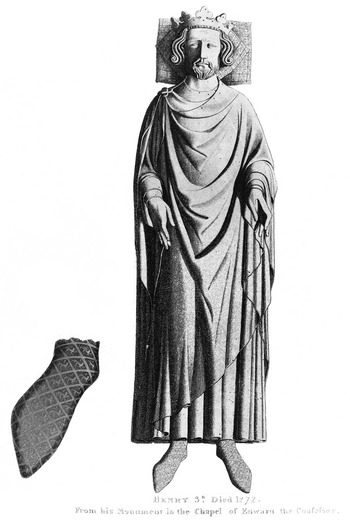
Since the recovered statue of Henry iii stood in buttress one, the buttress restored immediately before Eleanor's, it must be the unnamed ‘stone effigy’ commissioned in the contract of 2 March 1831 (fig 15). The effigy was ‘to be carved according to a drawing to be furnished’.Footnote 99 It is not clear whether this drawing was one of those referred to in the original contract of 1828 or even whether Blore had made a drawing specifically for the purpose. No designs for the buttress figures are to be found in the extensive collection of working drawings for the abbey by Blore and his assistants, now in the Victoria and Albert Museum.Footnote 100 Instead, the busy Surveyor might have found it more expedient to refer the sculptor to the image of Henry iii's tomb effigy drawn and etched by Charles Alfred Stothard in 1812 for his Monumental Effigies of Britain, published in 1817 (fig 16). The Abbey Library has a copy of the volume, though its date of acquisition is not known.
Detail of mason's contract for buttress repair. Photograph: © Dean and Chapter of Westminster Abbey

Tomb effigy of Henry iii, drawn and etched by Charles Stothard (1812). Photograph: author

William Clarke's contract of 1836 refers to the bay ‘next to the buttress containing the effigy of Edmund Crouchback, Earl of Lancaster’.Footnote 101 This means the knight's figure must have stood in buttress three, on the western side of Queen Eleanor. A loose sheet of paper in the abbey's muniments reads: ‘Effigies on the buttresses, 1 Henry 3, 2 Eleanor, 3 Amy de Valence, 4 Wm de Valence’.Footnote 102 The sheet is unsigned and undated; the hand is recognizable, however, as that of George Vincent, the Chapter Clerk, and the date cannot be earlier than the paper's watermark of 1839.Footnote 103 Although he confuses Edmund Crouchback with Aymer de Valence, and omits the fifth statue, Vincent does confirm the positions of Henry iii and Queen Eleanor in the first and second buttresses. When the north transept was restored later in the nineteenth century, the statues carved by Nathaniel Hitch followed an iconographic programme mainly devised by Canon Brooke Foss Westcott.Footnote 104 No such programme can be discerned in the placing of Blore's statues. In none of the masons' contracts do the Dean and Chapter specify a figure in advance. So it would seem the choice and positions of the statues were entrusted to Edward Blore and William Clarke. Since the contracts only identify figures retrospectively, the fifth and final statue, a king carrying an orb (fig 6e), remained unnamed. This may be the reason the Chapter Clerk, who drew up the contracts, could list only four statues.
After centuries of restoration and rearrangements, the statues now standing in the nave buttresses of the abbey's north front may be summarized, from east to west, as follows:
William de Valence, 1836, carved under the direction of Blore
Queen Eleanor of Castile, 1834, under Blore
Edmund Crouchback, 1981, carved by Ayres under Foster
Henry iii, 1981, Ayres under Foster
Unknown king with an orb, 1838, Blore
Edward the Confessor (?), 1620s, under Dean Williams
Henry iii (?), 1620s, Williams
Abbot Islip (?), 1620s, Williams
James i, 1620s, Williams
In conclusion, documentary evidence reveals that the recently rediscovered statue of Henry iii from Westminster Abbey was made between March and June of 1831 by William Clarke, or one of his carvers. The figure was derived from the tomb effigy of Henry iii, the sculptor working from a reference provided by Edward Blore: either a drawing of his own, now lost, or the 1812 etching by Charles Stothard. The tomb effigy was cast by William Torel, perhaps from an original wax model by Alexander of Abingdon. This design pedigree, coupled with Blore's supervision of the carving, informed by a lifelong study of monumental sculpture, goes some way towards explaining the medieval quality of what remains an imposing piece of sculpture.
Acknowledgements
My thanks go especially to Christine Reynolds, Assistant Keeper of Muniments, for steering me through the Westminster Abbey archives. I am also grateful for the assistance of Warwick Rodwell, FSA, Paul Williamson, FSA, Karen Impey, Pamela Tudor-Craig, FSA, and Phillip Lindley, FSA, for valuable discussion and advice. Any mistakes are, of course, my own.
Abbreviations and Bibliography
- Abbreviations
- Acts
Acts of the Dean and Chapter of Westminster
- BL
British Library, London
- LMA
London Metropolitan Archive
- HMC
Royal Commission on Historical Manuscripts
- HMSO
His/Her Majesty's Stationery Office
- RIBA
Royal Institute of British Architects
- SAL
Society of Antiquaries of London
- V&A
Victoria and Albert Museum, London
- WAM
Westminster Abbey Muniments, London
- WCA
Westminster City Archive, London