Summations
-
There is a decrease in the activity of cytochrome c oxidase enzyme in the group affected by AD in all Cox quantification methods in the Alzheimer’s animal model.
-
In humans, Cox decreased with the pooled methods and this decrease was not statistically significant in the meta-analysis of the isolated spectrophotometry method.
-
Cox enzyme should be investigated as a possible new biomarker for the disease, a possible treatment target or as another complementary diagnostic method.
Considerations
-
Some of the main limitations are the lack of data of some articles, the authors did not answer the doubts of the e-mails referring to the missing data of the articles. Therefore, these studies had to be excluded.
-
The diversity of the articles, units of measurement, methods of quantification of Cox activity as well as the outcomes observed resulted in high heterogeneity amongst studies.
-
Thus, in this study, the priority is concentrated in the direction of the difference between the affected and unaffected groups, that is, in the decrease or not of Cox activity and not exactly in the size of this decrease.
Introduction
Alzheimer’s disease (AD) is the most common cause of dementia (Oms, 2017). It can be of two types: sporadic and familial. The first is the clinically predominant form, which tends to have a late onset and is not hereditary (Avetisyan et al., Reference Avetisyan, Samokhin, Alexandrova, Zinovkin, Simonyan and Bobkova2016). The familial form is hereditary, has an early onset and is caused mainly by mutations in specific genes, namely the beta-amyloid precursor protein (APP) gene, the presenilin 1 (PS-1) and presenilin 2 (PS-2). These mutations alter the metabolism of APP, increasing the production and deposition of peptides, such as the beta-amyloid peptide (Aß-42) (Freitas et al., Reference Freitas, Py, Cançado, Doll and Gorzoni2013).
In AD patients, there is an accumulation of Aβ peptide in the mitochondria even before its extracellular deposition, resulting in increased oxidative stress by the production of reactive oxygen species (ROS) and inhibition of mitochondrial enzymes. As a result, there is a loss of organelle function and an impaired production of adenosine triphosphate (ATP) as well as damage to mitochondrial DNA (Gibson et al., Reference Gibson, Sheu and Blass1998; Readnower et al., Reference Readnower, Sauerbeck and Sullivan2011). The impairment of mitochondrial functions such as cellular respiration and ATP production may contribute to damage in synaptic transmission and neuronal death, which are observed in AD and other neurodegenerative diseases (Cavallucci et al., Reference Cavallucci, Ferraina and D’Amelio2013).
The complex IV of the respiratory chain, also called cytochrome c oxidase (Cox), is a key enzyme mitochondrial enzyme involved in the processes of neuron energy production (Malmström, Reference Malmström1990). Cox consists of various subunits (Warburg & Negelein, Reference Warburg and Negelein1929), which are encoded in mitochondrial DNA or as nuclear gene products (Pierron et al., Reference Pierron, Wildman, Hüttemann, Markondapatnaikuni, Aras and Grossman2012; Kadenbach & Hüttemann, Reference Kadenbach and Hüttemann2015). The Cox subunits catalyses the electron transfer reaction from cytochrome C to oxygen in the last step of the respiratory chain (Rak et al., Reference Rak, Bénit, Chrétien, Bouchereau, Schiff, El-Khoury, Tzagoloff and Rustin2016). In mammals, the largest and evolutionarily conserved subunits are 1, 2 and 3. They form the catalytic nucleus of the enzyme and contain the heme and copper-oxide-reduction centres. The ADP/ATP-binding site is important for the allosteric regulation of enzyme activity, which modulates the bioenergetic state of the cell (Srinivasan & Avadhani, Reference Srinivasan and Avadhani2012).
Considering the major importance of Cox for proper cell functioning, reduction in the activity enzyme may lead to several pathological processes (Rak et al., Reference Rak, Bénit, Chrétien, Bouchereau, Schiff, El-Khoury, Tzagoloff and Rustin2016), including low ATP production, increased formation of ROS in mitochondria and lactic acidosis (Srinivasan & Avadhani, Reference Srinivasan and Avadhani2012). Accordingly, several pathological conditions, including AD have been linked to Cox, with possible loss of enzyme subunits, defects in their assembly, inhibition enzyme activity and disassembly of the supercomplex (Paradies et al., Reference Paradies, Ruggiero, Petrosillo and Quagliariello1993; Sohal, Reference Sohal1993). A primary loss of the Cox may have effects on the organisation of the respiratory chain, causing the biochemical changes associated with AD (Diaz et al., Reference Diaz, Fukui, Garcia and Moraes2006; Saada et al., Reference Saada, Edvardson, Shaag, Chung, Segel, Miller, Jalas and Elpeleg2012).
Aims of the study
The aim of the present study was to test the hypothesis that Cox activity reduction is associated with AD, applying the concepts and tools of systematic review and meta-analysis. The articles were separated into two categories according to the experimental subjects, namely in studies using humans and studies using experimental animals. We considered this distinction important since they use different approaches to investigate the biology of AD, as human studies are based on the natural progression of the disease, whereas studies with experimental animals employ specific interventions to model AD.
Materials and methods
Search strategy
The searching and exclusion criteria as well as the analytical protocols were established a priori, as presented in the specific session below. Next, we performed literature searches on the databases PubMed, Scopus, MEDLINE, Lilacs, Eric and Cochrane with the following combinations: Alzheimer’s AND Cox AND mitochondria; Alzheimer’s AND Cox AND mitochondria; Alzheimer’s AND complex IV AND mitochondria. Original articles published up to 2016 were included if they address Cox activity in AD in humans or animals. Thus, in this study, the priority is concentrated in the direction of the difference between groups, that is, in the decrease or not of Cox activity, and not in the size of this decrease. When the necessary information in any article was missing, we contact the senior authors. In absence of responses, the articles were excluded. The software EndNoteTM Basic Virtual Version (http://endnote.com/product-details/basic) from Thomson Reuters was used for allocating abstracts and articles.
Inclusion criteria
Studies were included in our analyses if they were (i) original studies since we aimed to extract data from primary sources; (ii) written in English since we aimed at selecting only articles that could have extensively reach the scientific community; (iii) involving an evaluation of the activity of the mitochondrial Cox enzyme since this was the focus of our working hypothesis; and (iv) using biological samples (brain, blood and heart tissues) from AD individuals or animal models of AD since we wanted to collect data from both clinical and experimental studies.
Exclusion criteria
Studies were excluded from the analysis if (i) the Cox data were not expressed as enzymatic activity; (ii) they were not related to AD; (iii) they reported any treatment or experimental intervention that could interfere with Cox activity; (iv) the reference was retrieved duplicated in the database; (v) no animal models or biological samples obtained from humans were used; (vi) they were review articles, letters to the editor, book chapters, case report (i.e. sample size equal to one); and (vii) the data were not properly reported, without a clear description of sample size and standard deviation.
Data extraction
The data extracted from each experimental group were the sample sizes, means and standard deviation of the mean. In case the study reported the standard error of the mean, this was used to calculate the standard deviation. In some studies, these values were obtained directly from the text. In case they were not explicit, numerical values were calculated from graphs. The sizes of the bars representing the means and the standard deviations (or standard errors) of the control and affected groups were measured through a ruler. The data extracted were organised in ExcelTM spreadsheets and organised based on two criteria, namely the subjects studied (humans with AD or animal models) and the method used for the dosages of Cox enzyme activity (spectrophotometry, colorimetry and polarography). Statistical analysis was performed and forest plots were elaborated for each of these subgroups. The data flowchart is shown in Fig. 1 and the attributes of each study included in the analysis are presented in Table 1.
Data search flowchart.

Characteristics of the studies included in the meta-analysis

Statistical analysis
The studies included were evaluated through a meta-analysis using the RevManTM sofware version 5.3 (http://tech.cochrane.org/revman/). In each case, effect size was calculated by the differences in means of Cox activity in groups of AD-affected individuals and unaffected (control). Since the selected studies used different methods to measure Cox’s activity, with various scales and units of measurements, the effect size was expressed by the standardised mean difference (SMD), that is, the difference in mean between the groups divided by the variability (Rodrigues & Ziegelmann, Reference Rodrigues and Ziegelmann2010). The overall difference measured was calculated using a random effects model, whose assumption is that the effect of interest is not the same for all studies (Whitehead, Reference Whitehead2002). After the calculation of the overall effect, a hypothesis test was performed, in which the null hypothesis is the absence of difference between groups. The estimate of the overall difference between the AD-affected and non-affected groups is a weighted average of the individual studies, in which the weights are the inverse of the variability of each study.
The forest plots were obtained, in which (1), (2), _1, _2, indicate different comparisons between the control group and the respective AD-affected group. The term ‘experimental’ refers to the AD-affected group, whereas the term ‘control’ the non-affected. In addition, the expression ‘favours experimental’ means lower Cox activity in AD-affected individuals and ‘favours control’ means that Cox activity is lower in controls. The global difference between the groups is represented by a diamond in which the location (midpoint of the horizontal line) and the size of the horizontal direction represent, respectively, the point estimate of that difference and the precision of the estimate. The vertical line, also called the null line, represents the absence of difference between the groups. Z-test was used to measure whether or not this global difference is significant (Borenstein et al., Reference Borenstein2009). χ2 test was used to measure the homogeneity of the effect size between studies. The I 2 test quantified the heterogeneity between the studies, regardless of the scale on which the measurements were taken, and measures the proportion of the observed variation that is due to heterogeneity (ranging from 0% to 100%).
Results
Search retrieval and data exclusion
A total of 1372 studies were retrieved, from which 707 were from PubMed, 646 from Scopus, 19 from MEDLINE and 0 from Eric, Lilacs and Cochrane. A total of 6 studies were excluded from the analysis due to the lack of relevant information and 1 was excluded due to lack of sample size. The raw data obtained from these studies are available upon request.
Evaluation of the cox activity considering only data from animal models
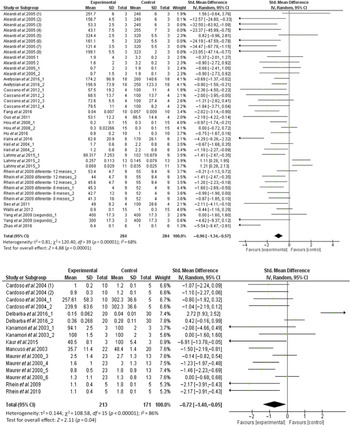
The meta-analysis was performed with data obtained from 35 studies. There were 35 comparisons between the activity of the Cox enzyme in the affected and unaffected (control) group. Fig. 2, upper panel, refers to the graph that included the articles in the meta-analysis that met the inclusion criteria and that used the methods of spectrophotometry, colorimetry and polarography, in which only the animal model was used. The overall difference between the groups was negative, indicating a decrease in the activity of the enzyme in the group affected by AD. There were 29 studies with a decrease in enzyme activity in the affected group, 4 studies with increased enzyme activity in the affected group and there was no difference in enzyme activity between the groups in 2 studies. The overall difference between the groups was negative, with an SMD of −0.96 (95% CI: −1.34 to −0.57), indicating a decrease in the activity of the enzyme in the group affected by AD. This difference is statistically significant (Z = 4.88, p-value < 0.00001). The hypothesis of homogeneity between studies was rejected (χ2 = 120.40, p-value < 0.00001). The I 2 = 68% value indicates that 68% of the variation observed is due to the heterogeneity amongst the studies (Fig. 2).
Upper panel: Data of Cox activity in experimental and control groups. Meta-analysis was performed with 35 studies. Global chart including the articles in the meta-analysis that used the method of spectrophotometry, colorimetry and polarography, considering only data from samples of animal models. Lower panel: Data of Cox activity in experimental and control groups. Meta-analysis was performed with 16 studies. Global chart including the articles in the meta-analysis that used the method of spectrophotometry, colorimetry and polarography, considering only data from samples of humans.

Evaluation of the Cox activity considering only data from human studies
The meta-analysis was performed with data obtained from 16 studies. There were 16 comparisons between the activity of the Cox enzyme in the affected and unaffected (control) group. Fig. 2, lower panel, shows data obtained using spectrophotometry, colorimetry and polarography for measuring Cox activity in samples from AD individuals. There were 12 studies with a decrease in enzyme activity in the affected group, there were 2 studies with increased enzyme activity in the affected group and there was no difference in enzyme activity between the groups in 2 studies. The overall difference between the groups was negative, with an SMD of −0.72 (95% CI: −1.40 to −0.05), indicating a decrease in the activity of the enzyme in the group affected by AD. This difference is statistically significant (Z = 2.11, p-value =0.04). The hypothesis of homogeneity between studies was rejected (χ2 = 108.58; p-value < 0.00001). The I 2 = 86% value indicates that 86% of the variation observed is due to the heterogeneity between the studies (Fig. 2).
In both cases, human and animal model, the heterogeneity found can be considered substantial (68% and 86%). In order to verify possible sources of heterogeneity, the analyses were repeated subdividing the animal group according to the methods of quantification of Cox activity (polarography, spectrophotometry and colorimetry). In the human group, the meta-analysis was repeated withdrawing the study Kaur et al. (Reference Kaur, Dhiman, Perez-Polo and Mantha2015), because it was the only one using polarography. The two studies in this group that used colorimetry showed identical results (Rhein et al., Reference Rhein, Baysang, Rao, Meier, Bonert, Müller-Spahn and Eckert2009 and Rhein et al., Reference Rhein, Giese, Baysang, Meier, Rao, Schulz, Hamburger and Eckert2010). The results with the subdivisions are presented in the next session and in the respective forest plots.
Evaluation of the Cox activity considering articles that use the polarography method from samples of animal models
The meta-analysis was performed with nine studies. There were nine comparisons between the activity of the Cox enzyme in the affected and unaffected (control) group. Fig. 3 refers to the graph that included the articles in the meta-analysis that met the inclusion criteria and that used the polarography method, considering only the animal model. There were seven studies with a decrease in enzyme activity in the affected group and there were two studies with increased enzyme activity in the affected group. The overall difference between the groups was negative, with an SMD of −4.83 (95% CI: −9.09 to −0.57), indicating a decrease in the activity of the enzyme in the group affected by AD. This difference is statistically significant (Z = 2.22, p-value = 0.03). The hypothesis of homogeneity between studies was rejected (χ2 = 42.34, p-value < 0.00001). The I 2 = 81% indicates that 81% of the variation observed is due to the heterogeneity between the studies (Fig. 3).
Data of Cox activity in experimental and control groups. Meta-analysis was performed with nine studies. Graph including the articles in the meta-analysis that used the method of polarography, considering only data from samples of animal models.

Evaluation of the Cox activity considering articles that use the spectrophotometric method from samples of animal models
The meta-analysis was performed with 20 studies. There were 20 comparisons between the activity of the Cox enzyme in the affected and unaffected (control) group. Fig. 4 refers to the graph that included the articles in the meta-analysis that met the inclusion criteria and that used the spectrophotometry method, considering only the animal model. There were 18 studies with a decrease in enzyme activity in the affected group and there were 2 studies with increased enzyme activity in the affected group. The overall difference between the groups was negative, with an SMD of −0.96 (95% CI: −1.45 to −0.47), indicating a decrease in the activity of the enzyme in the group affected by AD. This difference is statistically significant (Z = 3.82, p-value = 0.0001). The hypothesis of homogeneity amongst the studies was rejected (χ2 = 63.25, p-value < 0.00001). The I 2 = 70% value indicates that 70% of the variation observed is due to the heterogeneity between the studies (Fig. 4).
Data of Cox activity in experimental and control groups. Meta-analysis was performed with 20 studies. Graph including the articles in the meta-analysis that used the method of spectrophotometry, considering only data from samples of animal models.

Evaluation of the Cox activity considering articles that use the colorimetry method from samples of animal models
The meta-analysis was performed with 10 studies. There were 10 comparisons between the activity of the Cox enzyme in the affected and unaffected (control) group. Fig. 5 refers to the graph that included the articles in the meta-analysis that met the inclusion criteria and that used the colorimetric method, considering only the animal model. There were nine studies with a decrease in enzyme activity in the affected group and there was no difference in enzyme activity between the groups in one study. The overall difference between the groups was negative, with an SMD of −0.95 (95% CI: −1.30 to −0.60), indicating a decrease in the activity of the enzyme in the group affected by AD. This difference is statistically significant (Z = 5.31, p-value < 0.00001). In this group, homogeneity amongst studies was confirmed (χ2 = 8.93, p-value = 0.44). In this case, the use of a fixed effects model would be equivalent to that used (random effects) (Fig. 5).
Data of Cox activity in experimental and control groups. Meta-analysis was performed with 10 studies. Graph including the articles in the meta-analysis that used the method of colorimetry, considering only data from samples of animal models.

Evaluation of the cox activity considering articles that use the spectrophotometric method from human studies
The meta-analysis was performed with 13 studies. There were 13 comparisons between the activity of the Cox enzyme in the affected and unaffected (control) group. Fig. 6 refers to the graph that included the articles in the meta-analysis that met the inclusion criteria and that used the spectrophotometric method, considering only the human. There were nine studies with a decrease in enzyme activity in the affected group, there were two studies with increased enzyme activity in the affected group and there was no difference in enzyme activity between the groups in two studies. The overall difference between the groups was negative, with an SMD of −0.49 (95% CI: −1.19 to 0.21), indicating a decrease in the activity of the enzyme in the group affected by AD. However, this difference is not statistically significant (Z = 1.37, p-value = 0.17). That is, it is not possible to reject the null hypothesis that the difference between groups is non-existent. The hypothesis of homogeneity amongst the studies was rejected (χ2 = 96.77, p-value < 0.00001). The I 2 = 88% value indicates that 88% of the variation observed is due to the heterogeneity between the studies (Fig. 6).
Data of Cox activity in experimental and control groups. Meta-analysis was performed with 13 studies. Graph including the articles in the meta-analysis that used the method of spectrophotometry, considering only data from samples of humans.

Discussion
In the present study, we performed a meta-analysis to test the hypothesis that there is a decrease in Cox activity in AD. We analysed studies with data obtained from experimental animals and human beings, using different methods to quantify enzyme activity (spectrophotometry, colorimetry and polarography). Overall, there was a decrease in Cox activity in studies with AD patients, suggesting the importance of this enzyme as a possible new biomarker, diagnostic method or potential treatment target for this disease. Moreover, a similar result was found in data obtained from studies in experimental animals. Notwithstanding the important progress in elucidating AD pathogenesis, treatment options are still limited (Fang et al., Reference Fang, Zhang, Li, Yu, Douglas, Bratasz, Kuppusamy and Yan2016). Thus, experiments with laboratory animals are of major importance for understanding the pathological bases of AD (Du et al., Reference Du, Guo, Fang, Chen, Sosunov, McKhann, Yan, Wang, Zhang, Molkentin, Gunn-Moore, Vonsattel, Arancio, Chen and Yan2008).
Regarding results from human studies, results show that Cox activity and mitochondrial function can be impaired along the ageing process (Beal, Reference Beal1995). Post-mortem analysis observed that Cox enzyme activity decreased by 25–30%, in several regions of the cerebral cortex of AD patients and in the platelets of these individuals (Mutisya et al., Reference Mutisya, Bowling and Beal1994). In patients with sporadic AD, there is a low expression and/or an insufficient number of subunits in Cox (Parker et al., Reference Parker, Parks, Filley and Kleinschmidt-DeMasters1994; Maurer et al., Reference Maurer, Zierz and Möller2000). In the study by Delbarba et al. (Reference Delbarba, Abate, Prandelli, Marziano, Buizza, Arce Varas, Novelli, Cuetos, Martinez, Lanni, Memo and Uberti2016), the decrease in enzyme expression was correlated with the cognitive decline, characteristic of AD patients, measured by the MMSE test. In addition, a decrease in Cox activity was linked to a reduction in cellular energy, deposition of Aβ and phosphorylation of the tau protein. Other authors have shown, using histochemical methods, a decrease in enzyme activity in the dentate gyrus, CA1, CA3 and CA4 regions of the hippocampus in AD (Simonian & Hyman, Reference Simonian and Hyman1993).
Considering studies from experimental animals, a reduction in Cox activity and mitochondria dysfunction has also been linked to ageing (Bowling et al., Reference Bowling, Mutisya, Walker, Price, Cork and Beal1993) and to cognitive decline (Greilberger et al., Reference Greilberger, Koidl, Greilberger, Lamprecht, Schroecksnadel, Leblhuber, Fuchs and Oettl2008). In the rat hippocampus, region affected by AD disease, there was a marked increase in oxidative stress (Meunier et al., Reference Meunier, Ieni and Maurice2006). Moreover, Avetisyan et al. (Reference Avetisyan, Samokhin, Alexandrova, Zinovkin, Simonyan and Bobkova2016) demonstrated that AD-type neurodegeneration in mice is accompanied by mitochondrial impairment in the neocortex and hippocampus, which occurred along with decreased activity Cox activity and inhibition of the respiratory chain, which are typical in brain tissues of patients with the disease. The possible mechanisms entail increased ROS and mitochondrial dysfunctions. The overproduction of ROS induces membrane lipid peroxidation, which may alter Cox subunits and impair enzyme activity (Paradies et al., Reference Paradies, Ruggiero, Petrosillo and Quagliariello1998; Bobba et al., Reference Bobba, Amadoro, Valenti, Corsetti, Lassandro and Atlante2013), triggering the production of Aβ and further mitochondrial impairment, resulting in a vicious cycle that leads to neurodegeneration (Rettberg et al., Reference Rettberg, Yao and Brinton2014; Swerdlow et al., Reference Swerdlow, Burns and Khan2010; Yao et al., Reference Yao, Rettberg, Klosinski, Cadenas and Brinton2011). One plausible hypothesis is that Cox inhibition can be caused by mitochondrially accumulated Aβ peptide (Crouch et al., Reference Crouch, Blake, Duce, Ciccotosto, Li, Barnham, Curtain, Cherny, Cappai, Dyrks, Masters and Trounce2005; Pedrós et al., Reference Pedrós, Petrov, Allgaier, Sureda, Barroso, Beas-Zarate, Auladell, Pallàs, Vázquez-Carrera, Casadesús, Folch and Camins2014), resulting in electron transport chain dysfunction, activating amyloidogenesis and lipid peroxidation (Hernández-Zimbrón & Rivas-Arancibia, Reference Hernández-Zimbrón and Rivas-Arancibia2015; Jiao et al., Reference Jiao, Zhang, Wei, Liu, An and Guo2012). Indeed, the Aβ1-42 oligomer impaired Cox activity (Kalra et al., Reference Kalra, Kumar, Majeed and Prakash2016), possibly due to a direct interaction between specific subunits of this enzyme (Crouch et al., Reference Crouch, Barnham, Duce, Blake, Masters and Trounce2006).
For the accomplishment of the systematic review and meta-analysis, we had some limitations, such as lack of data of some articles and an absence of any response for e-mails referring to the missing data of the articles. Therefore, these studies had to be excluded. Moreover, the diversity of the articles, units of measurement, methods of quantification of Cox activity as well as the outcomes observed in the studies resulted in a high heterogeneity amongst them. Thus, in this study, the priority is concentrated in the direction of the difference between the affected and unaffected groups, that is, in the decrease or not of Cox activity and not exactly in the size of this decrease. Additional limitations include the lack of previous protocol registration and quality assessment of primary studies and the fact that data search, screening and extraction was performed by only one reviewer.
To verify the publication bias, the Egger regression test was used. For studies involving humans, Egger’s test null hypothesis of no bias was not rejected (p-value = 0.1484). For studies using an animal model, the test indicated the presence of publication bias (p-value = 0.007). In order to quantify the impact of this bias on the analysis performed, an iterative procedure was used to estimate the value of the global effect size without publication bias, known as the trim-and-fill method (Shi & Lin, Reference Shi and Lin2019; Duval & Tweedie, Reference Duval and Tweedie2000). There was little oscillation in the estimate of the global effect [−0.569 (−0.951; −0.186)], without however altering the conclusion of reduction in Cox activity in affected individuals (Z = 2.91, p-value = 0.004).
Despite some limitations, the present study can serve as a guide for future work, both in clinical studies and basic science, aimed at the treatment and/or diagnosis of AD. Indeed, Cox appears to be a key enzyme related to mitochondrial dysfunction, neurodegenerative processes and neural loss in the brain.
Acknowledgements
The authors thank the Secretariat of the Graduate School of Neuroscience from the Federal University of Minas Gerais.
Authors contributions
FMM performed the literature search and the statistical analysis; AMR and FAM supervised the literature search; PVGS supervised the statistical analysis. All authors participated in the writing of the paper and agreed with the final version.
Financial support
FMM was a recipient of a fellowship from the Coordenação de Aperfeiçoamento de Pessoal de Nível Superior – Brasil (Capes). FAM is a recipient of a productivity fellowship (level 2) from Conselho Nacional de Desenvolvimento Científico e Tecnológico (CNPq).
Conflict of interest
The authors declare no conflict of interest.