During the summer of 2010, Representative Michele Bachmann (R-MN) received authorization from the leadership of the House of Representatives to create a “Tea Party Caucus.” In doing so, Bachmann gave the first institutional voice to the Tea Party movement, arguably the most significant mass political movement since the election of Barack Obama in 2008.
According to Representative Bachmann, the Tea Party Caucus was intended to serve the policy interests of constituent supporters of the Tea Party movement. As she wrote in a letter to Speaker Nancy Pelosi (D-CA):
This caucus would do nothing more than promote the timeless principles of our founding, principles that all members of Congress have sworn to uphold …. The Tea Party Caucus is strictly issue-based in nature, promoting policies of fiscal responsibility and limited government with strict adherence to our Constitution…. The Tea Party movement has become synonymous with these principles, and a caucus taking theses values to heart would work to advance them
(Herzenhorn Reference Herzenhorn2010).The Tea Party Caucus immediately attracted several dozen members, all from the Republican Party. Although the stated goals of the caucus were policy-oriented, there is a clear partisan tinge to the group's membership. In the aftermath of the Republican victories (and takeover of the House of Representatives) following the 2010 election, the Tea Party Caucus and its members have become increasingly prominent. Senator-elect Rand Paul (R-KY) called for a joint Tea Party Caucus that would include senators; Republican state legislators in Texas created their own state-level Tea Party Caucus. In January of 2011, Supreme Court Justice Antonin Scalia made a rare appearance on Capitol Hill as he spoke to a Tea Party Caucus event for members of Congress, and Michelle Bachmann became a serious candidate for the Republican Party's presidential nomination (Milbank Reference Milbank2010).
The Tea Party movement remains controversial; what impact the movement had on the midterm elections in 2010 is unclear. Some argue that the Tea Party movement was responsible for a number of House victories, while others point to Senate races that might have gone to the Republicans had a Tea Party candidate not been on the ballot (Zernike Reference Zernike2010c). In this article, we seek to develop a better understanding of the movement by examining the membership of the most prominent institutional manifestation of the movement, the Tea Party Caucus. More specifically, we assess the extent to which caucus members are distinctive from their fellow Republicans in the House. We ask the following questions:
• Are caucus members more conservative than other House Republicans?
• Are caucus members more or less likely to hold leadership positions?
• Do caucus members serve more or less competitive congressional districts?
• Do caucus members serve districts with more or less racial and ethnic diversity?
• Is there a regional slant to the caucus? Do members tend to come from the Mountain West? The South?
• Are caucus members more or less senior than their fellow Republicans?
• Do caucus members serve congressional districts that are more or less economically stressed than their fellow Republicans?
In addressing these questions, we also hope to understand both the policy orientations of the organized Tea Party (in its caucus manifestation) and the institutional strength of the caucus's membership. If we find an ideologically oriented caucus predominantly peopled with senior members from safe congressional districts, we should expect it to play a far more prominent role in determining the policymaking orientation of a Republican-led House than if the caucus is filled with more junior members from more competitive districts with ideological dispositions that range across the Republican spectrum. This work helps us understand why some Republicans in the House joined the caucus while others did not, and it could help us understand the likely role (and significance of the role) of the caucus in the 112th Congress.
BRIEF HISTORY OF THE TEA PARTY MOVEMENT
Before we examine the Tea Party Caucus membership in more detail, here is a brief review of the broader movement's history. The Tea Party movement came into the public eye in the aftermath of the passage of the 2009 stimulus package as an amorphous, grassroots, bottom-up, antigovernment (and, more specifically, “anti-Washington”) crusade. The movement began as a series of small rallies and local organizations protesting government spending, and was eventually coordinated by several national umbrella organizations, such as the Tea Party Patriots and Tea Party Nation. With the aid of the libertarian advocacy organization FreedomWorks, headed by former GOP House Majority Leader Dick Armey, the movement became a force in election activism and mobilization. Although Tea Party supporters and organizers trumpeted the nonpartisan nature of the movement from the start, the movement also stressed its goals of “purging” the Republican Party of members deemed not conservative enough—primarily focusing on the 2010 midterm elections (New York Times 2011; Zernike Reference Zernike2010a, Reference Zernike2010b).
Throughout its short existence, the Tea Party movement has vilified President Obama and congressional Democrats, protesting their economic, environmental, and health care agendas. In its endeavor to block Democratic efforts and “cleanse” the Republican Party, the Tea Party drafted and supported GOP primary challengers for numerous national and state offices. These efforts to boost the number of conservative candidates in the general election often led to clashes with candidates backed by the Republican establishment. At the same time, some GOP members currently serving in Congress joined the Tea Party Caucus to identify with the movement and take advantage of the energy generated by the Tea Party supporters (New York Times 2011).
The movement is often characterized as united by fiscal conservatism and a belief that “out of control” Washington spending has strayed far from the Founders' constitutional principles. The Tea Party has also been identified as a “blank screen” on which supporters project their many frustrations with politics and the direction of the country. The racial, socioeconomic, and gender homogeneity of the movement—Tea Party supporters tend to be older, wealthier white males (Zernike and Thee-Brenan Reference Zernike and Thee-Brenan2010)—has led to its identification with numerous socially conservative views. Questions surrounding the true convictions of the movement (if they exist) has led to speculation as to whether members of the Tea Party Caucus can or will tackle some of their more ambitious and controversial agendas, such as the reduction or elimination of Medicare and Social Security benefits and the abolishment of the US Department of Education (Zernike Reference Zernike2010c). To better gauge the future direction of the caucus, we need to understand why legislators join its ranks.
EXPLAINING CAUCUS MEMBERSHIP
The literature on caucus membership provides several different explanations for why members of Congress join legislative caucuses. Members join different types of caucuses for different reasons. In Congressional Caucuses in National Policy Making (Reference Hammond1998), Hammond provides a useful typology of congressional caucuses. She divides caucuses into the following categories:
• party
• personal interest
• national constituency
• regional
• state or district
• industry
Regional, state or district, and industry caucuses tend to focus on district constituency issues. These may be issues that are common to a region (such as the Sunbelt or Rustbelt regions). State or district caucuses tend to focus on issues that are particular to certain types of states or districts, such as farming areas, rural areas, or urban areas. Industry caucuses focus on issues that are specific to particularly commercial endeavors; members often join these caucuses to protect or foster the business prospects of particular segments of their geographic districts. As Hammond (Reference Hammond1998) notes, these segments often may be small but economically significant.
National constituency caucuses attract members interested in policy issues that have substantial national constituencies, ranging from veterans' affairs to women's issues, and they tend to draw members from both political parties. Personal-interest caucuses deal with broad national issues that often relate to the activities of a number of legislative committees. Hammond (Reference Hammond1998) argues that membership in these caucuses is driven by the personal political orientation and interests of the individual legislators rather than the characteristics of their constituencies. The same can be said for party caucuses; what matters are the policy interests and ideological orientations of the members, not the demographic characteristics or the economic circumstances of their constituencies.
In the context of this typology, the Tea Party Caucus is most appropriately characterized as a party caucus. First, the Tea Party Caucus has, to date, drawn no members from the Democratic Party, and, of the various types of caucuses, only the party caucus is consistently limited to a single party. We know of no formal institutional restrictions against Democratic representatives joining the Tea Party Caucus, but none have. Because no Democrats have joined, the few Democrats who might consider joining the caucus now face prohibitively high political costs. Second, the Tea Party movement is widely perceived to be ideologically oriented, and it is just this sort of ideological orientation that we would expect in a party caucus during a period of polarized parties. One explanation for members' decisions to join the caucus is that members with more conservative policy objectives sought an organized outlet to further the policies associated with their ideologically oriented agenda: the agenda often associated with the Tea Party movement includes lower taxes, smaller government, and greater respect for (and protection of) individual liberties.Footnote 1 For these members, the caucus serves both advertising purposes and, potentially, credit claiming purposes, depending on the future policy productivity associated with the caucus.Footnote 2
If this characterization of the caucus is accurate we would expect that the likelihood of membership in the Tea Party Caucus is positively associated with the level of conservatism manifest in members' recent roll-call voting behavior. This conservative policy activity might result from members' own political orientations, members' representation of their constituencies—particularly their primary and personal constituencies (see Fenno Reference Fenno1978)—or some combination of these factors. Recent research on the representative relationship between House members and their constituencies also suggests that ideological extremism (relative to the orientation of the geographic constituency) is relatively common (Bafumi and Herron Reference Bafumi and Herron2010) and that the penalties for ideological extremism are far less severe than partisan extremism (Carson, Lebo, and Young Reference Carson, Lebo and Young2010).
Aside from members' ideological orientations, what other factors might lead them to join (or not join) the Tea Party Caucus? The literature also includes different perspectives on the factors that lead members to participate in caucus activities more generally. One strain of the literature suggests that caucus membership is inversely related to seniority. According to Hammond, “The more senior a member, the less likely he or she is to be a caucus member” (Reference Hammond1998, 66). Conversely, more recent work suggests that caucus participation is actually more prevalent among senior members. Recent research by Victor and Ringe (Reference Victor and Ringe2009) that uses network analysis to evaluate the relative participation rates of members of Congress in caucus activity finds that:
… caucuses are not organizations used by junior representatives, rank-and-file legislators, electorally marginal members, or women and minority legislators to increase their legislative influence. Instead, our research confirms our expectations that caucuses are institutions that favor legislative leaders, senior members, and those who are electorally safe. These legislators are both more central and more connected in the caucus network
(Reference Victor and Ringe2009, 25).Although the literature does not always provide consistent expectations, based on the results from the most prominent recent research, we should expect Tea Party Caucus members to be relatively more senior, relatively more likely to serve in leadership posts, and less likely to hail from marginal districts. As there are many congressional caucuses, it is certainly possible that the membership of any particular caucus—especially a new caucus—will not be significantly different than the rank-and-file membership on these dimensions. At the very least, we must control for these factors in our analyses.
Although the Tea Party Caucus appears to fit most obviously in the party caucus category, we cannot ignore the possibility that the influence of the broader geographic constituency might also have an impact on a member's decision to join (or not) the Tea Party Caucus.Footnote 3 The two key constituency characteristics are racial or ethnic context and economic context. In both cases, the existing literature suggests contrasting hypotheses. If membership in the Tea Party Caucus is, in part, driven by the racial or ethnic conservatism of a member's constituency, then we might reasonably expect to find, first, that Tea Party Caucus members tend to serve relatively less heterogeneous districts (and thus do not need to be responsive to racial/ethnic minorities) or second, that Tea Party Caucus members serve relatively more heterogeneous districts (and thus have more racially/ethnically conservative white populations because of perceived racial threat).
Likewise, we might reasonably expect Tea Party Caucus membership to be directly related to economic conditions in a member's district. The inverse relationship between economic circumstances and the likelihood of membership in the Tea Party Caucus is more obvious (and straightforward): In economically stressed districts (particularly during the economic recession contemporaneous with the development of the Tea Party movement) it could be reasoned that anger toward the government and public officials in Washington is likely to develop; and individuals in such districts are more likely to develop more extreme, atypical views. Furthermore, these views are reflected in the policymaking actions and orientations of their representatives.
In contrast, it can also be hypothesized that economically distressed constituencies would be far more open to and supportive of economic policies that contrast with the views of the Tea Party movement, such as extended unemployment benefits and stimulus packages. In this scenario, districts with relatively better economic conditions are more likely to produce members of the Tea Party Caucus because the constituencies of those districts are less likely to view benefit programs as aiding them.
DATA AND METHODS
Our sample includes all House Republicans from the 111th Congress. Our dependent variable is coded “1” for the 52 Republican members of the 111th House who explicitly opted to become part of the Tea Party Caucus at its launching in July of 2010 and “0” otherwise.Footnote 4 To gauge the level of conservatism of each Republican member of the 111th Congress, we used the DW-Nominate and W-Nominate scores developed by Poole and Rosenthal (Reference Poole and Rosenthal1991, Reference Poole and Rosenthal2001), as well as ideology scores calculated by the National Taxpayers' Union (NTU) and the American Conservative Union (ACU). Of all the measures, the 2011 NTU scores, which consist of every vote concerning taxes, spending, and debt during the 111th Congress, most closely associate with the Tea Party's ideological orientation. As the Tea Party movement is primarily concerned with fiscal issues, using measures that also incorporate votes on other issues, such as social and cultural policy, foreign affairs, and national defense, would bias downward the extent to which Tea Party Caucus members are different from mainstream Republicans. Thus, the NTU scores, as pure measures of fiscal conservatism, are most appropriate to test our hypothesis.
Seniority was operationalized using the year a member entered Congress,Footnote 5 and positions in the Republican House leadership and major committee chairmanships were included in the model. We also included the district unemployment rate and the district poverty rate for each district.
Because of the binary nature of the dependent variable, we estimate a set of logit models. We report standard errors clustered by state. Note that the use of robust standard errors has no significant effect on the results. Note also that we find no evidence of significant multicollinearity.Footnote 6
RESULTS
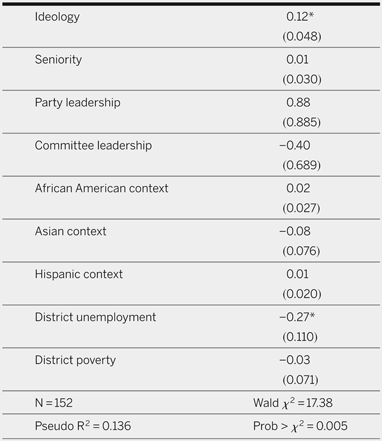
Based on our analysis, displayed in table 1, Republican House members who joined the Tea Party Caucus tend to be more conservative than the average Republican member of the House; however, perhaps more interestingly, members of the Tea Party Caucus come from districts more economically well-off, even when controlling for member ideology. Although district-level poverty has no effect on GOP members joining the caucus, district-level unemployment does—and substantially so. We find no evidence of a relationship between racial or ethnic context, seniority, or leadership status and Tea Party Caucus membership.
Explaining Tea Party Caucus Membership

Entries are coefficients; robust standard errors in parentheses.
* p < .05,
** p < .01 (one-tailed tests where appropriate)
Our estimates suggest that members who serve districts with below average (9.4%) unemployment are far more likely to join the Tea Party Caucus. As shown in figure 1, a 2% drop in the unemployment rate—less than a sample standard deviation—from 9% to 7% nearly doubles the likelihood that the representative joined the Tea Party Caucus. Although we must be careful in our interpretation of the effects at the ends of the sample range (just over 4% and 15%), it appears that members who serve districts with particularly low unemployment are more likely than not to be members of the Tea Party Caucus. In contrast, members who serve districts with particularly high unemployment are very unlikely to be members of the caucus.
Effect of District Unemployment Rate on Members' Likelihood of Joining Tea Party Caucus

Note that the rather surprising effects of district economics on members' decisions to join the Tea Party Caucus are not an artifact of our model specification. These probability estimates are also borne out in the raw data. Republicans who joined the Tea Party Caucus served districts with an average unemployment rate less than 8.4%. Republicans who did not join the caucus served districts with an average unemployment rate over 9.7%. While we are not surprised at the presence of a gap between the economic prosperity of the districts of caucus members and the districts of their colleagues, the magnitude of the disparity is unexpected. Nearly a third of Republicans who serve districts with below-average unemployment are members of the Tea Party Caucus. Caucus membership is far less common—less than 15%—among Republicans who serve districts with above-average unemployment. Clearly, district-level economics is a driving force when it comes to participation in the Tea Party Caucus.
DISCUSSION AND CONCLUSIONS
Our analysis sheds some light on what contributes to membership in the inchoate Tea Party Caucus, not only to provide a better understanding of the caucus itself, but of the wider Tea Party movement it is said to represent. Currently, because the caucus is the only true institutional representation of the Tea Party in the federal government, it is fundamental to understand what proclivities are behind its membership. Adding perhaps more curiosity to this task is the focus on incumbent members of the House who joined the caucus as there is, presumably, some risk for members who join. For a member to join the caucus, certain conditions must exist in the member's district, or the move would not be beneficial. Our goal has been to elucidate those conditions.
Most significantly, even in the presence of a variety of ideological controls—even controls closely tied to the orientation and goals of the Tea Party movement—district-level economic context is a critical determinant of Tea Party Caucus membership. At the congressional level, membership is strongly associated with a robust district-level economy. Healthy economic conditions, specifically relatively low-unemployment rates, seem to be a markedly significant factor in GOP members' decision to join or not join. Thus, if we were asked to render who we thought the “average” Tea Party Caucus member might be, describing a Republican member who is slightly more fiscally conservative than the average member and is from a prosperous district is a good way to start.
The effect of economic conditions on caucus membership is notable in that it ex facie seems to contrast with what we would expect from Hammond's typology of party caucuses. Furthermore, as the economic circumstances of members' constituencies are one of the driving factors in membership, even when controlling for the extent of members' conservatism. However, it can be argued that the comparatively stable economic conditions of some districts in notably unstable economic times allow members of those districts to be ideological on fiscal issues when others cannot. Thus, the label of party caucus still fits the Tea Party Caucus. Our analysis also strongly suggests that voters' “anger,” which is widely presumed to drive the movement, is not so much a reaction to desperate economic circumstances but a reaction to government spending in response to the economic downturn. Rather than serving the districts hardest hit by the recession, caucus members serve the districts that are paying for the projects, programs, and payments to more depressed areas. This situation might be forcing the issue, yet framing the caucus as being dominated by one party and focused on national ideological-oriented issues (the reduction of federal spending, the elimination of federal programs and departments, and so forth) is a useful description and consistent with Hammond's (Reference Hammond1998) typology of a party caucus.
What can be taken away from this article is a clearer understanding of what is the Tea Party Caucus—a collection of Republican members who tend to be more fiscally conservative than the average Republican and tend to be from prosperous congressional districts. There is no evidence that the Tea Party Caucus members have greater seniority or greater institutional stature than their Republican colleagues who are not members of the caucus. Looking forward, it is likely that the caucus will push for fiscally conservative legislation in 112th Congress, but this push would not be due to members' fiscal conservatism alone. This likely manifestation of fiscal conservatism also will rest on the relative prosperity of the constituencies of Tea Party Caucus members.
APPENDIX