

Significant outcomes
• Paliperidone palmitate long‐acting injection (PP‐LAI) (Xeplion®) is cost‐effective when compared with olanzapine pamoate (OLZ) (Zypadhera®) for treating chronic schizophrenia in Norway.
• Using PP to replace OLZ may save money for the Norwegian health system.
• The addition of PP to the formulary in Norway would have only a modest effect on the drug budget.
Limitations
• We did not examine the entire spectrum of schizophrenia, only stable outpatients. Results may differ when examining those in hospital with relapses.
• As well, the time horizon was 1 year; another option would be to analyse over the lifetime of the patient.
• We considered only direct costs of care. There are other substantial (indirect) costs that were not captured, such as those of the criminal justice system or the burden due to lost productivity.
Introduction
Schizophrenia is a major health problem throughout the world, affecting about 1% of the population and exerting an enormous economic impact Reference Karagianis, Novick and Pecanek1. Especially, troublesome is the chronic nature of the disease, which has prompted the search for newer products with clinical advantages. A major addition in the 1960s was the introduction of the LAIs. LAIs have a number of advantages in treating chronic schizophrenia, especially for enhancing adherence Reference Möller2, Reference Kane, Eerdekens, Lindenmayer, Keith, Lesem and Karcher3, Reference Nasrallah4. For example, they are dosed much less often, providing fewer opportunities for non‐adherence. As well, the long duration of action prevents both intentional and unintentional non‐adherence. As well, they provide more stable blood levels with fewer peaks and troughs, which may reduce adverse events.
Another advance was the development of the second‐generation (atypical) antipsychotic agents, which target both the positive and negative aspects of schizophrenia. These drugs have become preferred over the first‐generation drugs due to favourable efficacy and safety profiles. In an examination of data from 13 600 persons with schizophrenia in Denmark, Nielsen et al. reported that the percentage receiving second‐generation drugs increased from 15.3% in 1996 to 89.2% in 2005 Reference Nielsen, Le Quach and Emborg5.
It was not until 2002 that there was a second‐generation LAI available. Risperidone (RIS) LAI became the first depot atypical antipsychotic agent to be marketed Reference Möller2, Reference Kane, Eerdekens, Lindenmayer, Keith, Lesem and Karcher3. Although effective, RIS‐LAI must be injected every 2 weeks, necessitating frequent physician or clinic visits for drug administration 6. Subsequently, two newer atypical LAIs have been developed which can be injected every 4 weeks, providing a clinical advantage. The first to gain approval in Europe was OLZ‐LAI in 2008 7 and the second was PP‐LAI in 2010 8. The clinical profiles and acquisition costs of these three products are somewhat different. For example, OLZ‐LAI is associated with post‐injection delirium/sedation syndrome Reference Detke, Mcdonnell and Brunner9, but PP‐LAI is not Reference Alphs, Gopal and Karcher10. Such clinical differences can impact costs and patient outcomes.
Few studies have examined the pharmacoeconomics of these drugs together. Recently, Furiak et al. Reference Furiak, Ascher‐Svanum and Klein11 published a pharmacoeconomic analysis that included these drugs as well as haloperidol‐LAI and oral OLZ. They used a 1‐year micro‐simulation model in the United States. Little else in the form of full articles has appeared in the peer reviewed literature comparing these two newer products.
Aim of the study
This research was undertaken to compare costs and outcomes (i.e. to determine the cost‐effectiveness) of PP‐LAI and OLZ‐LAI in treating schizophrenia in Norway. The target audience consisted of healthcare decision makers and clinicians caring for patients with chronic schizophrenia.
Methods
Patient population
We examined the costs and consequences of treating persons with chronic schizophrenia who had a history of multiple relapses and hospitalisations (i.e. at least twice in the past). Such patients are often referred to as ‘revolving door patients’ due to their frequent readmission to the hospital Reference Glazer and Ereshefsky12. At baseline, they were outpatients with stable disease receiving average doses of medication and had no other chronic or acute diseases. Because they had problems with adherence to prescribed regimens which resulted in frequent relapses, they were administered LAIs Reference Nasrallah4.
Drugs of interest
The drugs of interest were PP‐LAI and OLZ‐LAI. PP‐LAI is dosed monthly 13 while OLZ‐LAI may be administered every 2 or 4 weeks 14.
Model and base case
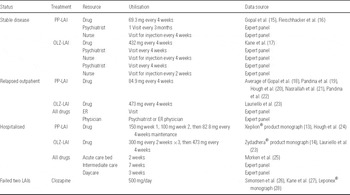
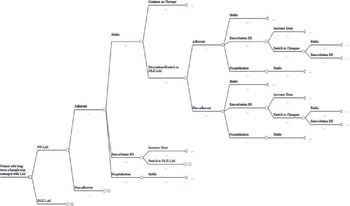
To guide the project, we enlisted the assistance of a panel of clinical experts from Norway who provided input into all aspects of patient management and the local healthcare system. The steps encountered by patients are described in Table 113, 14, Reference Gopal, Vijapurkar, Lim, Morozova, Eerdekens and Hough15, Reference Fleischhacker, Gopal and Lane16, Reference Kane, Detke and Naber17, Reference Gopal, Hough and Xu18, Reference Pandina, Lane and Gopal19, Reference Hough, Lindenmayer and Gopal20, Reference Nasrallah, Gopal and Gassmann‐Mayer21, Reference Pandina, Lindenmayer and Lull22, Reference Lauriello, Lambert, Andersen, Lin, Taylor and Mcdonnell23, Reference Hough, Gopal, Vijapurkar, Lim, Morozova and Eerdekens24, Reference Morken, Widen and Grawe25, Reference Simonsen, Friis and Opjordsmoen26, Reference Kane, Honigfeld and Singer27, 28. We used a decision analytic model, with a 1‐year time horizon based on the work done by Glazer and Ereshefsky Reference Glazer and Ereshefsky12 and modified with input from the expert panel. Figure 1 depicts the model structure.
Clinical management of patients

Model used for the pharmacoeconomic analysis.

The base case starts with an average patient having chronic schizophrenia which is currently stable and treated with a LAI antipsychotic agent. Patients can be either adherent or non‐adherent, with probability determined consequences that include stable disease, relapse requiring hospitalisation and relapse not requiring hospitalisation [i.e. managed via the hospital emergency room (ER)]. Patients could have subsequent relapses that necessitate repeat ER visits or hospitalisations. Table 1 provides a partial list of the steps involved in patient management.
Patients who remain in a stable condition receive maintenance therapy. Alternately, their condition could deteriorate resulting in exacerbation and patients would be taken to hospital. Some would be managed in the ER while others would be hospitalised, with both options requiring a change in medications under two scenarios. We assumed an equal proportion for each scenario. The first was discontinuation of the first treatment due to intolerance or adverse events. In that case, backup therapy would be used; OLZ‐LAI would be used as backup when PP‐LAI failed and OLZ‐LAI would be replaced by PP‐LAI. These drugs would be started with recommended loading doses, as shown in Table 1. If there was another failure with the second drug, patients would be given clozapine in doses of 500 mg daily Reference Simonsen, Friis and Opjordsmoen26, Reference Kane, Honigfeld and Singer27. It was assumed that about half of the patients would respond and half would relapse Reference Simonsen, Friis and Opjordsmoen26, Reference Wahlbeck, Cheine, Essali and Adams29. Those who relapsed were hospitalised and administered 750 mg/day for 1 week, then returned to the maintenance dose Reference Kane, Honigfeld and Singer27, 28. In the second scenario, patients could discontinue their first treatment due to lack of efficacy or other patient related problems. Half of those patients would be titrated to the maximum dose and the others would be switched to backup treatments in the ER or admitted to hospital and treated as in the previous scenario.
Clinical inputs
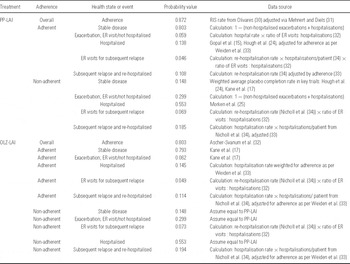
Clinical management of patients was determined by their status (i.e. stable disease, relapsed outpatient or hospitalised). All rates were derived from the literature and are presented in Table 2Reference Gopal, Vijapurkar, Lim, Morozova, Eerdekens and Hough15, Reference Kane, Detke and Naber17, Reference Hough, Gopal, Vijapurkar, Lim, Morozova and Eerdekens24, Reference Morken, Widen and Grawe25, Reference Olivares, Peuskens and Pecanek30, Reference Mehnert and Diels31, Reference Ascher‐Svanum, Faries and Zhu32, Reference Weiden, Kozma and Grogg33, Reference Nicholl, Akhras and Diels34. Where possible, rates were obtained from placebo controlled randomised clinical trials dealing with patients having chronic schizophrenia treated with LAIs. In the absence of specific data, rates were adapted from available sources.
Clinical variables, assigned probabilities and their sources

Cost inputs
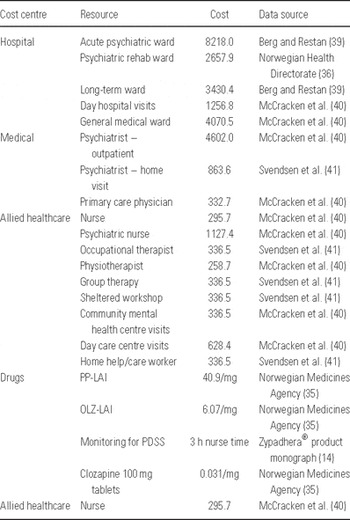
The analysis was done from the perspective of the government as payer. We included only direct costs of care; indirect costs were not considered. Drug prices were obtained from the Norwegian Medicines Agency 35, costs associated with health services were obtained from the Norwegian Health Directorate 36 and other costs were derived from published articles. All costs were converted to Norwegian kroner (NOK) using current exchanges rates 37, and then inflated to 2010 NOK via the consumer price index 38. Table 3 lists the resources used and the unit prices used in the analysis 14, 35, 36, Reference Berg and Restan39, Reference McCracken, Dalgard and Ayuso‐Mateos40, Reference Svendsen, Myhr and Nyland41. Because the time horizon for the model was 1 year, discounting was not done.
Resources consumed and their costs (2010 NOK)

PDSS, post‐injection delirium sedation syndrome.
PDSS occurs only with OLZ. Requires at least 3 h of constant supervision by a specially trained nurse 14.
Analysis and outputs
The average cost per patient treated was calculated for each drug, as were days in remission and quality‐adjusted life years (QALYs). QALYs were calculated using literature‐based estimates for the preference‐based utilities associated with the health states of interest, which were stable disease, exacerbation (outpatient treated in the ER) and hospitalised. Whenever possible, estimates derived from patients or their healthcare workers were used. We used a simple average of estimates derived from five studies that provided preference‐based utility values Reference Briggs, Wild and Lees42, Reference Cummins, Stevens and Kisely43, Reference Lenert, Sturley and Rapaport44, Reference Oh, Lanctôt and Mittmann45, Reference Revicki, Shakespeare and Kind46. The utility score for stable disease was 0.890 (range 0.83–0.94; SD = 0.156), 0.659 (range 0.61–0.76; SD = 0.291) for non‐hospitalised exacerbation and 0.490 (range: 0.42–0.56; SD = 0.14) for hospitalisation. The primary pharmacoeconomic outcome was the incremental cost per QALY gained.
Sensitivity analyses
To test the robustness of the results with respect to alterations in model inputs, one‐way sensitivity analyses were carried out for all of the important inputs such as drug acquisition cost, adherence rates, rate and duration of hospitalisation and rates of relapse. As well, we conducted a probabilistic Monte‐Carlo simulation using 5000 iterations, varying all input variables across plausible ranges of values.
Budget impact
As a final step, we estimated the effect that adopting PP‐LAI in Norway would have on the government drug budget. The drug portion of the expected cost per patient treated was determined for each drug. To estimate the target population, we used literature sources. The population of Norway was 4 953 000 47, of whom 1% have schizophrenia Reference Karagianis, Novick and Pecanek1, with 69% being chronic Reference Faerden, Waal and Rønnow48. Among those with chronic disease, approximately 15%, or 5021 would be treated with LAIs. Currently, 86% of these patients are treated with atypical agents, of which OLZ‐LAI comprises 25.7% and RIS‐LAI 74.3% (IMS data).
The difference between those costs multiplied by the utilisation rates of drugs currently funded and the rate of adoption would describe the impact. An assumption was made that PP‐LAI would be used by 2% of the patients receiving depots in the first year, 10% in the second and 20% in the third year. We obtained utilisation data from IMS for the current year to facilitate calculations.
Results
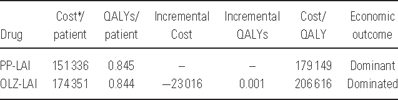
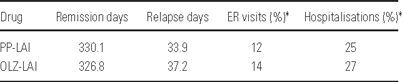
Outcomes for the base case analysis appear in Tables Table 4 and Table 5. Overall, PP‐LAI had the lowest cost of 151 336 NOK, which consisted of 34 515 NOK (23%) for drugs, while medical care cost 35 039 NOK (23%) and hospital and other institutional care cost 81 829 NOK (54%). The costs for OLZ‐LAI had a similar pattern; 21% of the 174 351 NOK was due to drugs, 28% medical care and 51% hospital care. As well, PP‐LAI was associated with the highest numbers of QALYs (Table 4); therefore, it dominated OLZ‐LAI in the base case. Additionally, patients receiving PP‐LAI experienced more days in remission and made fewer visits to the ER or hospital than did those treated with OLZ‐LAI.
Pharmacoeconomic outcomes
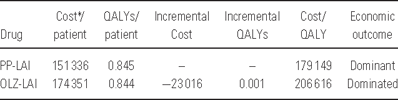
*All costs are in 2010 NOK (€1 = 7.8 NOK; USD $1 = 5.4 NOK).
Clinical outcomes
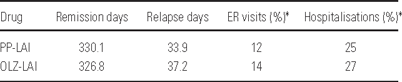
*Proportions of patients experiencing the outcome.
The acquisition cost of PP‐LAI was robust against changes. PP‐LAI remained dominant over OLZ‐LAI up to a cost/mg of 85.89 NOK (i.e. an increase of 110%) and was dominant even when the OLZ‐LAI cost was reduced to zero. Using a cost‐effectiveness threshold of 180 000 NOK, which is roughly equivalent to the lower limit of £20 000 used by NICE 49, 50, PP‐LAI was cost‐effective over OLZ‐LAI up to a price/mg of 86.05 (i.e. a 110.4% increase). It therefore appears insensitive to alterations in price.
However, adherence rates were sensitive to relatively minor changes. When the adherence rate of OLZ‐LAI was kept constant, PP‐LAI remained dominant until its adherence rate reached 84.8%, a decrease of 2.7%. Conversely, with the PP‐LAI rate constant, it lost dominance when the OLZ‐LAI rate rose 3.5–83.1%. Rates of hospitalisation were associated with similar results. PP‐LAI remained dominant only until it increased from 13.8 to 15.9% or until the rate for OLZ‐LAI decreased from 15.9 to 11.6%. Overall, the model did have a certain degree of robustness. In 54.5% of the 5000 Monte Carlo simulations comparing PP‐LAI to OLZ‐LAI, PP‐LAI dominated OLZ‐LAI (Figure 2).
Cost‐effectiveness results for PP‐LAI versus OLZ‐LAI after 5000 Monte Carlo simulations plotting difference in QALYs (x‐axis) against difference in costs (y‐axis).
Budget impact
The drug cost per patient over the year (including backup treatment after failure or intolerability) was 34 515 NOK for PP‐LAI and 36 456 NOK for OLZ‐LAI. Therefore, PP‐LAI would be cost saving to the healthcare system if it replaced OLZ‐LAI (1941 NOK/patient, or €250). Using our market projections, we estimated an approximate cost impact of 194 000 NOK (€25 000) in the first year, 970 00 NOK (€125 000) in the second and 1.95 million NOK (€250 000) in the third year. The maximum estimated impact was 10 million NOK (€1.25 million) per year if PP‐LAI were used for 100% of the depots. That amount includes a savings of 2.1 million NOK (€270 267) if all of the patients currently on OLZ‐LAI were switched to PP‐LAI.
Discussion
Every attempt was made to provide reasonable inputs into the model. Whenever possible, rates utilised in the model were derived either from large randomised trials or from large database studies which represent actual practice. All steps were verified by clinical experts. Care was taken to avoid biases and a conservative approach was taken. For example, we used a 4‐weekly dosing regimen for OLZ‐LAI, while it may be dosed every 2 or 4 weeks. Mehnert and Diels Reference Mehnert and Diels31 showed that there were substantial differences in adherence of 5–10% between LAIs dosed at 2‐week and monthly intervals. In the 8‐week trial of acute care patients by Lauriello et al. Reference Lauriello, Lambert, Andersen, Lin, Taylor and Mcdonnell23, 67% were dosed every 2 weeks as were 47% of those in the longer trial by Kane et al. Reference Kane, Detke and Naber17. Thus, our inputs were conservative.
The other published pharmacoeconomic analysis comparing different LAIs Reference Furiak, Ascher‐Svanum and Klein11 produced results that differed substantially from the present research for a number of reasons. First, those authors did not use data for PP‐LAI that was specific to the drug; rather, they used data from RIS‐LAI and assumed the drugs to be equal. That assumption was based on information from a poster of a non‐inferiority study comparing PP‐LAI with RIS‐LAI that presented 13‐week results for patients with acute exacerbations of schizophrenia Reference Pandina, Lane and Gopal51. In contrast, their analysis focused on stable outpatients maintained over a 1‐year period. Second, we used drug doses taken from actual trials, whereas Furiak Reference Furiak, Ascher‐Svanum and Klein11 used defined daily doses (the theoretical amount the average patient takes). The dose of 100 mg PP‐LAI that they used was 30% higher than the weighted average dose 69.3 mg used in the two long‐term trials by Gopal et al. Reference Gopal, Vijapurkar, Lim, Morozova, Eerdekens and Hough15 and Fleischhacker et al. Reference Fleischhacker, Gopal and Lane16. At the same time, the 411 mg used for OLZ‐LAI was 5% lower than the dose of 432 mg used in the maintenance trial by Kane et al. Reference Kane, Detke and Naber17. Third, a large cost component for PP‐LAI in that analysis was treatment emergent hyperprolactinaemia, with a (treated) rate of 51.7% for PP‐LAI and 14% for OLZ‐LAI. The rate used for OLZ‐LAI was about half of what was reported in the European Union Report 7 and that for PP‐LAI (assumed to be equal to RIS‐LAI) was substantially higher than the 38.8% actually found in randomised trials of 3172 patients treated with PP‐LAI Reference Einarson, Hemels and Nuamah52. As previously mentioned, although reported rates of hyperprolactinaemia are high with all of these drugs, few of them represent adverse events and the requirement for treatment is rare Reference Einarson, Hemels and Nuamah52. The clinical experts confirmed that such aggressive intervention with elevated prolactin levels is not undertaken in Norway. Thus, results differ between this analysis and that of Furiak and colleagues Reference Furiak, Ascher‐Svanum and Klein11.
In the base case, we did not consider adverse events for a number of reasons. Only a few have substantial economic impact. In their assessment of OLZ‐LAI, the All Wales Medicines Strategy Group concluded that the model was relatively insensitive to either adverse event costs or utility losses due to side‐effects 53. The analysis by Furiak and colleagues Reference Furiak, Ascher‐Svanum and Klein11 included seven adverse events, one of which was specific to OLZ‐LAI. The others were extrapyramidal symptoms, weight gain, diabetes, hyperlipidemia, hyperprolactinaemia and tardive dyskinesia. However, these adverse events should not impact the analysis to any appreciative extent. In a report comparing atypical antipsychotics olanzapine and RIS for the Canadian Agency for Drugs and Technologies in Health, Farahati et al. Reference Farahati, Boucher and Moulton54 also concluded that these side‐effects did not result in substantial cost implications, due to low incidences. They also stated that weight gain from olanzapine was not clinically or economically significant. The literature supports that conclusion. Tenback et al. Reference Tenback, van Harten, Slooff and van Os55 concluded that both extrapyramidal symptoms and tardive dyskinesia were uncommon with atypical antipsychotics. On the other hand, they found a 25% rate of tardive dyskinesia and 17–30% rates of extrapyramidal symptoms in patients who had never been medicated with antipsychotics, making attribution difficult. Our clinical experts confirmed that tardive dyskinesia is seldom seen in Norway. Finally, although some of these adverse events may be clinically relevant, they are accounted for since they exert an impact through reducing adherence, which results in a relapse or medication change. When we did examine these costs in a sensitivity analysis, the overall results remained relatively unchanged.
It appears that PP‐LAI has a good clinical and economic profile, since it dominated OLZ‐LAI in the base case. On the other hand, the clinical benefits are quite similar, making that dominance quite unstable. A head‐to‐head trial would be required to establish if any real differences actually exist. As well, it had a lower overall cost to the healthcare system; therefore, its adoption would appear to be reasonable.
This analysis does have some limitations. We did not examine the entire spectrum of schizophrenia, only stable outpatients. Results may differ when examining those in hospital with relapses. As well, the time horizon was 1 year; another option would be to analyse over the lifetime of the patient. Comorbid conditions were not considered, nor were other indications such as schizoaffective disorder.
Furthermore, we considered only direct costs of care. There are other substantial costs that were not captured, such as those of the criminal justice system. Many persons with chronic schizophrenia are often involved with police, courts and prisons Reference Honkonen, Henriksson, Koivisto, Stengård and Salokangas56, Reference Laajasalo and Hakkanen57. In addition, lost productivity can be burdensome as can indirect costs incurred by family and friends helping to care for these patients Reference Boye, Bentsen and Ulstein58.
Conclusions
PP‐LAI is cost‐effective when compared with OLZ‐LAI in treatment of revolving door patients with chronic schizophrenia in Norway, but sensitive to changes in adherence and hospitalisation rates. Replacing OLZ‐LAI with PP‐LAI would be cost saving for the Norwegian healthcare system.
Acknowledgements
This work was supported by Janssen Pharmaceutica NV, Beerse, Belgium. The authors would like to thank Dr J. Johnsen of Vestre Viken hospital and Dr M. S. Selle from Oslo, Norway for medical advice and clinical input into this project. Thomas Einarson received funding from the sponsor for this research. He has also received travel funding to present a portion of these results at the Latin American ISPOR conference in Mexico City, 2011. Statistical analyses were done by Roman Zilbershtein with input from Dr T. R. E. Decision tree modelling and plotting of results performed by Pivina Consulting Inc., Canada. C. V. received funding from the sponsor for this research. Dr C. P. received funding from the sponsor for this research. R. Z. received funding from the sponsor for this research. .