Introduction
With China becoming increasingly more powerful, the succession of the Chinese Communist Party (CCP) leaders has not only attracted the attention of world powers, but has also been influential on an international level, including international political, economic, social, and environmental issues, and also relates directly to each individual. Furthermore, the environmental and generational issues of global climate change might also be affected by changes in top CCP members, especially those selectorates who have the power to affect the leadership section. With a narrow selectorate, the Chinese policy outcomes may be highly predictable (Shih et al., Reference Victor, Shan, Mingxing, Carson, Gallagher, Lieberthal and Manion2010: 52). As a result, the succession of CCP leaders is a major global event that is second only to the US presidential election, and its mechanisms and struggles should be at the core of research on China. The succession of CCP political and military leaders has a more direct and fundamental impact on the politics and economies of neighboring Asia-Pacific countries. In recent years, China's hardline stance on maritime and territorial disputes has influenced the integration of the Asia-Pacific region, whereas its increasingly powerful military force has changed trilateral relations among the United States, China, and Japan. Moreover, its robust economic force has become an engine driving global economic and trade development. If other countries are able to focus not only on the succession of CCP leaders, but also on the prediction of the CCP's future echelon, they may well be better prepared for the changes brought by shifts in the CCP regime.
The central political organization of the CCP includes the National Congress of the CCP, the Central Committee, the Politburo and its Standing Committee, the General Secretary of the Central Committee, the Secretariat of the Central Committee, the Central Military Commission (CMC), and the Central Commission for Discipline Inspection (CCDI). Among these, the National Congress of the CCP is the highest leading body in China, and the Central Committee is the party's highest organ of authority when the National Congress is not in session. The Politburo and its Standing Committee exercise the authority of the Central Committee when the latter is not in session, and the CMC is the party's highest military leading organ (Pu et al., Reference Pu, Shen, Hong and Hu, Chin2002: 404–07). Nominally, the CCP appears to have a separation of powers between the executive, legislature, and judiciary branches, but, in reality, it is a one-party system and there is usually a lack of distinction between the party and the government. As the representative of the Central Committee, the Politburo, and its Standing Committee, acts not only as the core power of the CCP, but also the central power that controls the legislature – the National People's Congress (NPC), which leads the government and commands the army (Kuo, Reference Kuo1999: 12). For example, within the 18th Politburo, there are altogether 25 members, seven of whom are members of the Politburo Standing Committee (PSC members). Although some of the PSC members do not hold any official titles, since the Chinese government is dominated by the CCP, PSC members are more influential than other political offices. Indeed, the PSC is considered the most powerful decision-making body in China. As ‘the party's highest military leading organ’, the main function of the CMC of the CCP is to lead the armed forces of the country directly. Its members are decided upon by the Central Committee, with one Chairman, several Vice-Chairmen, and other members, and the membership is almost identical with that of the CMC of the People's Republic of China (PRC). There are four General Headquarters under the CMC, namely the General Staff Department (GSD), the General Political Department (GPD), the General Logistic Department (GLD), and the General Armament Department (GAD).
Personal promotion is always influenced by cultural beliefs and constrained by institutions. The succession of politicians can reflect the profound influence of culture and the institutions. Contrasting the societies of China and the US, conventional wisdom suggests that Chinese employees are more likely to be hired or promoted through personal ties (guanxi) (Trompenaars, 1994; Huang, Reference Hwang2009; Chen et al., Reference Chen, Chen and Huang2013). However, Liu et al. (Reference Liu, Keller and Hong2014) found that Chinese people perceived the hiring of moderately qualified employees through personal ties as unfair, while they perceived the hiring of unqualified candidates with stakeholder ties as profitable. In the business field, there is not much difference between people in China and the US in their perceptions on hiring employees with personal ties. But in the political arena, the channels through which politicians acquired power are totally counter to conventional wisdom. Elected by the people, US Presidents can appoint cabinet members from personal ties, campaign staff, or recommendations from staff. The acquisition of power is based totally on quanxi or rule of man. Although, nepotism is still common at various levels of Chinese society and in the selection of local party leaders, institutional mechanisms have been increasingly and effectively implemented in choosing higher ranking political and military leaders (Huang, Reference Huang, Kou and Zang2014; Li, Reference Li and Joseph2014). On the other hand, the Politburo succession in the Chinese Communist Party is based on experience, performance, and evaluation. In this way, the Chinese system seems more institutionalized than the US system. Since it is more institutionalized, the predictability of power succession in the CCP Politburo may be greater than in the US.
Since the Deng Xiaoping era, the succession of CCP leaders has proceeded smoothly through an established plan, and the new leaders have made progress in institutionalizing power succession (Zheng, Reference Yongnian2004: 190). Following the Tiananmen Square protest in 1989, Jiang Zemin was appointed as General Secretary of the CCP, while Deng Xiaoping had already designated Hu Jintao as Jiang's future successor. At the first plenary session of the 14th Central Committee in October 1992, Jiang Zemin, Li Peng, Qiao Shi, Li Ruihuan, Zhu Rongji, Liu Huaqing, and Hu Jintao were nominated as PSC members. This symbolized the beginnings of an institutionalized succession system for the CCP. Although there remained disputes during the election process for the PSC members, consensus was reached in most cases. This phenomenon seems to mark the stabilization and comprehensiveness of the CCP's core power succession plan. The retirement of Hu Jintao and the succession of Xi Jinping, in particular, further demonstrate the apparent comprehensiveness of the succession system. China is not a democratic country, and its top leaders are not elected but nominated, based on an existing system and previous performance evaluation. With the gradual institutionalization of the succession system for CCP leaders, there is the probability of predicting future PSC members according to their previous experience. In other words, one may predict the CCP's future political and military leaders through understanding of the design of its system and the importance of the positions, or predict a general outline based on the career path of previous Politburo members. Compared to the Politburo, there are fewer disputes in the selection of CMC members. Most CMC members are expected to have military experience, thus indicating a clear pattern of promotion. In order to better understand the characteristics of CCP's political and military succession system, this study used the career paths of PSC and CMC members who have been in power since 1992 to establish networks. The purpose was to analyze the features and spatial distribution of the networks, and calculate the relevant network indices to mark the importance of certain positions for the promotion to a central position in the power hierarchy. In addition, the characteristics of positions and regions of previous PSC members were also analyzed, with the intention of discerning the hidden structure of political groups, and predicting future successors for top political positions.
Research methodology
Data collection and collation
Since the CCP gradually began to institutionalize its succession system, it has exercised performance evaluations on its future leading members, as well as requiring career experience. So far, the career paths of past PSC and CMC members seem to be the best samples that could serve the purpose of this study. This information can be acquired through online searches. This paper used the official Chinese websites ‘xinhuanet.com’ and ‘china.com.cn’ as main sources for data collection. Information collected from these two websites was almost identical. In cases where information was missing from both websites, other websites such as ‘baike.baidu.com’, ‘baike.com’, ‘hinews.cn’, ‘qq.com’, and ‘takungpao.com’ were consulted. Due to the fact that earlier members of the Politburo were mainly veterans from the Chinese Civil War and therefore were involved in the founding of the PRC, the succession system was extremely complicated, not institutionalized, with little possibility of predicting future leaders. Therefore, this study only used data from the 14th (1992) to the 18th (2012) Politburo. Data were categorized into three eras, namely Jiang's era, Hu's era, and Xi's era. Data from the members of the PSC, the Politburo, and the CMC were analyzed for each era in order to better understand the evolution of the structure of their career paths. Each core member of the political and military powers had a unique career path. However, when members attained proximity to more central power structures, they began to hold a wider range of important positions. Hence, their career changed from a linear path to a multi-branched path, until they finally reached the Politburo or the CMC. Due to the vague distinction between the CCP's party and government positions, network mapping required that a member who held either a party position or public office in the same municipality or province at the same time be considered to have a single career node, which was labeled using the municipality or province. Given that most members of the government have had a very rich range of experience, in order to effectively present a clear network, the early career development of certain individuals was not included in the study. Non-executive positions were marked as (1), whereas executive or senior leadership positions were marked as (2). Thus, the career path of most Politburo members began with an executive position in a province or city and ended with PSC membership or higher, whilst CMC members started out the Division Commander (or similar) level and ascended to CMC membership.
Mapping the career network
A career network was mapped using the information collected. The main career path of Wu Guanzheng, one of the 16th PSC members, is described below as an example:
1959–1965: Student of Thermal Measurement and Automatic Controls, Department of Thermal Engineering, Tsinghua University; Secretary of Communist Youth League of China (CYLC).
1965–1965: Master of Thermal Measurement and Automatic Control, Department of Thermal Engineering, Tsinghua University; Deputy Party Branch Secretary.
1968–1975: Technician, Deputy Chief of Technology Section, Head of Plant Workshop, Member of CCP Party Committee, and Deputy Chairman of Revolutionary Committee at Gedian Chemical Plant, Wuhan, Hubei province.
1976–1982: Deputy Director of the Science and Technology Committee and Member of the Party Committee; Vice-Chairman of the China Association for Science and Technology and Member of the Party Committee; Deputy Chief and Head of Innovation, Transformation and Potential-Tapping Headquarters; Chairman of the Center for Engineering Science and Technology and Party Secretary, Wuhan, Hubei province.
1982–1983: Member, Standing Committee, CCP Wuhan Municipal Committee, Hubei province.
1983–1986: Secretary, CCP Hubei Provincial Committee (no First Secretary position at that time); Mayor, Wuhan.
1986–1995: Deputy Secretary, CCP Jiangxi Provincial Committee; Vice-Governor; Acting Governor; Governor, Jiangxi province.
1995–1997: Secretary, CCP Jiangxi Provincial Committee.
1997–2002: Member, Politburo, CCP Central Committee; Secretary, CCP Shandong Provincial Committee; President, Party School, Shandong province.
2002–2007: Member, PSC, CCP Central Committee; Secretary, CCDI.
As the positions Guanzheng held before Wuhan Municipal Committee in 1982 were comparatively less important, they were excluded from the analysis. The high-ranking positions (italic) were mapped chronologically as per Figure 1. As shown in the graph, the degree of the career network was directed. The links pointing from the current position to the next position are known as out-degrees, whilst the links connecting the previous positions to the current position are known as in-degrees. When Wu Guanzheng held the Jiangxi provincial position, there was one in-degree and two out-degrees, giving a total degree of three. The Shandong provincial-level position also had one in-degree and two out-degrees; however, according to the definition of the eigenvector (Newman, Reference Newman2010: 169), the eigenvector of the position of Jiangxi was higher than that of the Shandong provincial position. Thus, the Jiangxi provincial position was higher in importance and held more promise of promotion. Moreover, the Jiangxi provincial position was the only channel in Wu Guanzheng's career path that led from positions at a regional level to those at a central level. Hence, this position had the highest betweenness centrality and formed bridges in Guanzheng's career network.
Network of Wu Guanzheng's career path

Network power and selected important indices
The collected data were collated and converted into a career network, where connections between positions were links and each position was a node. Indices of the network were calculated by inputting the information of the links and nodes into UCINET (Borgatti et al., Reference Borgatti, Everett and Freeman2002), and Netdraw was used to generate the network graphs. Although the number of Politburo and PSC members is not high, networks remained complex due to overlapping positions held by different members. Since this study designated the Politburo as the necessary destination of members’ career paths, Politburo and PSC positions are in the center of the networks when analyzing the various indices of the network, and only positions before these are more important and needed to be discussed. There are many indices used in network theory to quantify the characteristic of nodes, but most are used to describe interpersonal relations. Since the purpose of this study was to discover the importance and power of positions in the network, only the following indices were used:
(1) In-degree
The links from other positions to current position were defined as in-degrees,4 indicating the number of links received by current position. A position with a high in-degree means that many lower-level positions resulted in promotion to this position, which indicates the importance and desirability of the position. The fact that many positions seek a connection with this current position highlights its prestige.
(2) Eigenvector
When the positions connected to a given position were very important (i.e., high degree), or when a given position was connected with many other positions, the given position was considered to have a high eigenvector (Newman, Reference Newman2010: 169). Since the eigenvector between two connected positions was determined by their adjacent positions, the calculation of this index included the overall network. The eigenvector reflects the importance of other positions that share links with a given position. The greater the number and importance of previous positions, the more power and importance the given position has.
(3) Betweenness centrality
Betweenness represents the importance of a node based on its role as a bridge between other nodes. In the case of the political sphere, it shows the percentage of personnel from lower-level positions being promoted to a higher level through a given position. When there is no other link available, removal of the given position would cause a scission in the promotion path. Therefore, the more positions that rely on the given position to reach the next level, the higher the betweenness centrality the given position has.
Network brokerage
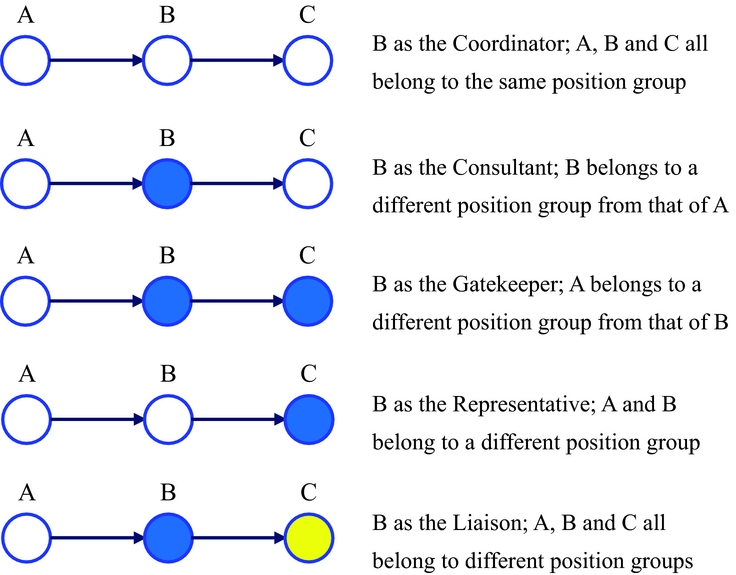
Whether a position dominates access towards the power center depends on how much the adjacent positions rely on it. The role a position plays in the career network can be described by using its brokerage features to clarify how a node acts as a mediator between adjacent nodes within an Ego Network (Gould and Fernandez, Reference Gould and Fernandez1989: 89–126). The relationship among three adjacent positions can be summarized via the five brokerage types, as illustrated in Figure 2.
Five brokerage types

Since all CMC positions relate to the military and have no brokerage functions, only positions in the Politburo network were categorized. Based on the characteristics of the positions, positions were categorized into seven groups: (1) the Politburo and PSC members; (2) the CCP Central Organizations (such as Secretariat or Organization Department); (3) Ministries under State Council (such as the Ministry of Culture or the Ministry of Public Security); (4) the CCP Provincial or Municipal Governments (such as Shanghai or Fujian province); (5) Military Positions; (6) State-owned enterprise; (7) Others (such as education, newspaper publication, science and research, or trade unions). UCINET was used to calculate the brokerage indices of each position group, to acquire the ranking for each position. Because this research only included Politburo members’ core experience and not all their previous positions, differences in level of detail for individual members may have affected the overall ranking. Moreover, since the roles of coordinator, gatekeeper, consultant, and liaison were mainly used to describe interpersonal relationships, they were not calculated in this study. Only representatives were calculated and ranked in this study, which is an index that summarizes how a position representing a certain group proceeded to the next important position. In political terms, this is the result of screening by CCP top leaders for a given group, which represents whether members from that group will receive promotions.
The above four indices helped to quantify the political and military positions of the CCP, in order to understand their importance, power level, and network position, to further explore the succession pattern of CCP leaders.
Results
PSC and Politburo members
This study included samples from the 14th to the 18th Politburo, giving a total of 69 Politburo members with 195 previous positions, and 21 PSC members with 102 previous positions. For the CMC, excluding cases where the Chairman of the CMC was also the General Secretary of CCP Central Committee, there was a total of 29 members with 89 military positions held in the past between them. When compiling the career paths of all sample members, since different members might have taken same or similar positions, the nodes and edges were linked together to compose a network. Moreover, in order to present the spatial evolution of CCP core members’ career network, this study further marked career paths on a map using the Geographic Information System (GIS) to show the geographic or spatial distribution of individual positions. By observing clusters of positions, this study attempted to discern whether geographic location was also a factor in candidate selection. The geographic analysis was also divided into two groups: Politburo and CMC. The results present a network indicating geographical distance. Aside from presenting a clear view of geographical location, this network could also provide reference for any existing imbalance in spatial congregation. With the combination of a non-graphic career network and a graphic geographical allocation, the result should present a better overview for the promotion route of CCP's core members.
The Politburo is the power center of the CCP Central Committee, and PSC members are not only the core members of the CCP, but also the central leaders of China. Therefore, this study first established the career network of previous PSC members, then that of Politburo members. In-degree, eigenvector, and betweenness were calculated and ranked for each network, and key positions that led to the Politburo and PSC were summarized. Consequently, the brokerage role as representative was calculated and ranked for Politburo members to discover the representative position of each group, which are the most important positions at each level.
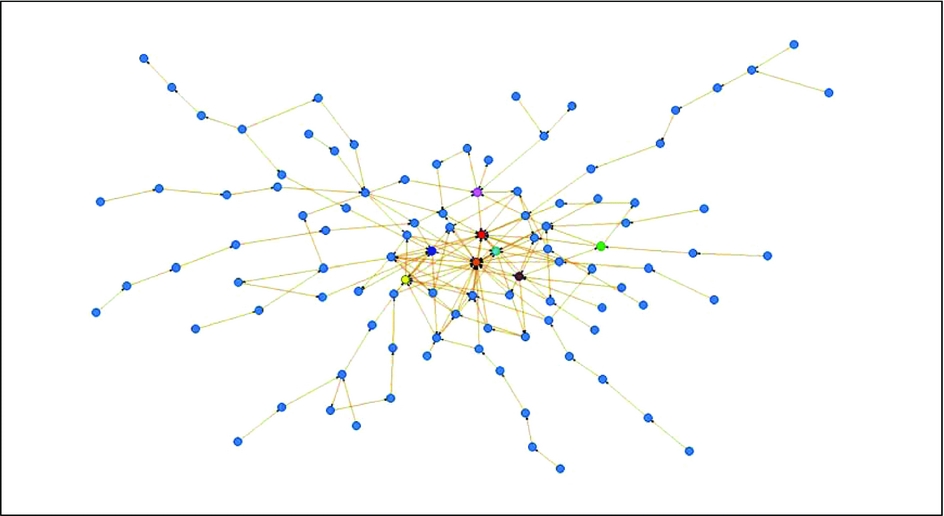
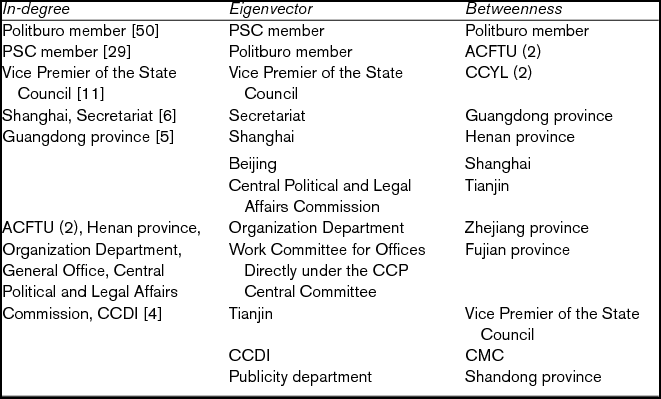
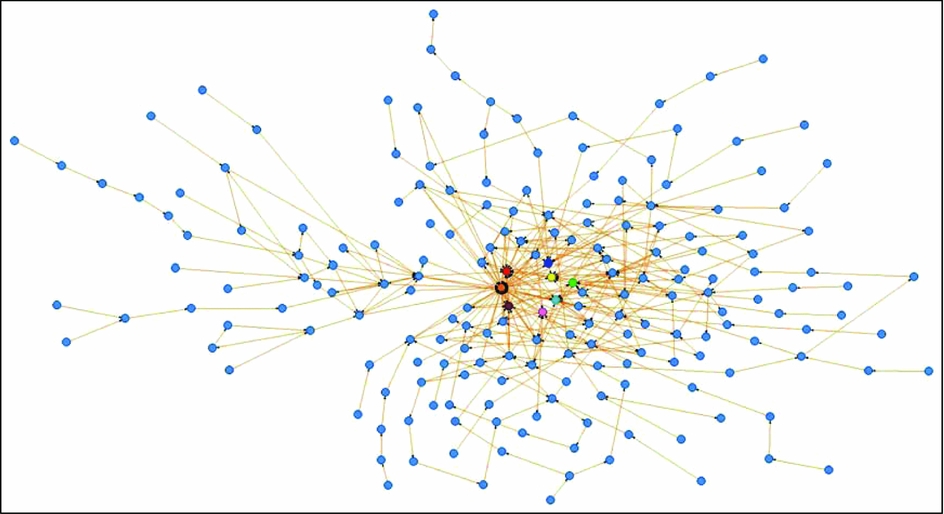
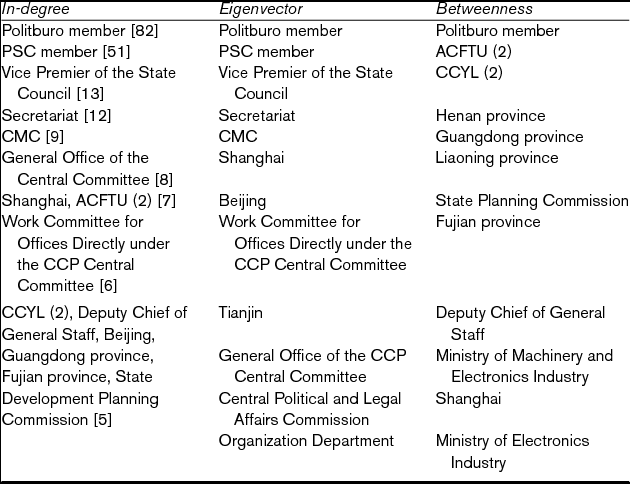
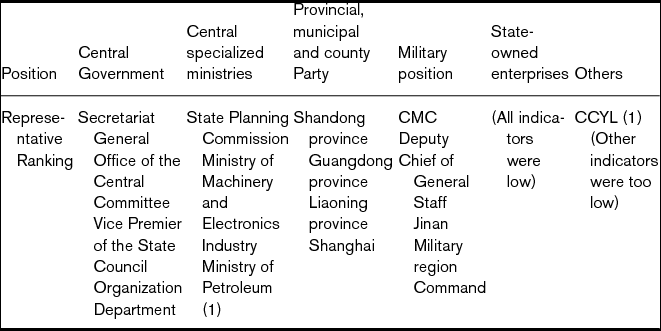
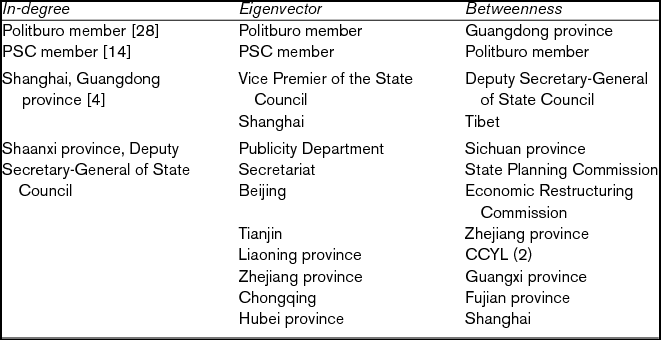
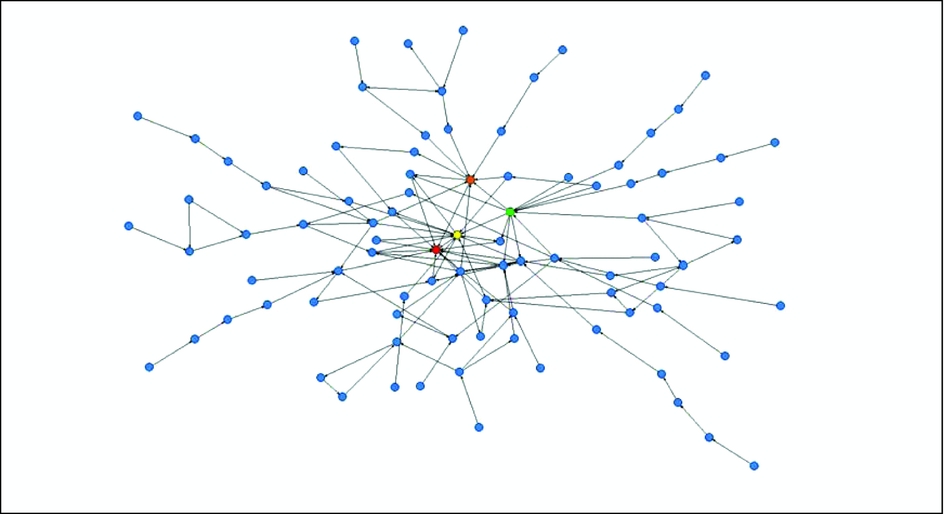
After imputing the data into UCINET, the Career Network of PSC members was constructed as shown in Figure 3, with indices and their ranking listed in Table 1. That of Politburo members is shown in Figure 4, and Table 2 lists related indices and rankings. The representative index of Politburo members are ranked and listed in Table 3.
Career network diagram of PSC members

Ranking of network indices for PSC members

Career network diagram of Politburo members

Ranking of network indices for Politburo members

Ranking on representative index

There was little difference between the network indices of PSC members and Politburo members (Table 1 and Table 2). If positions in Politburo and PSC are excluded, the Vice-Premier of State Council position and leading positions in the Secretariat of the CCP Central Committee and those at Shanghai Municipality government are the three positions with both high in-degree and eigenvector scores. This means that many members were promoted to these three positions; thus, they were core nodes in the path towards the power center. On the other hand, it is a general requirement that there should be military representatives in the Politburo, hence serving in the CMC was also shown to be an important experience factor of Politburo members. However, this was not the case for PSC members, as the majority of military officers are not selected as PSC members. The betweenness values, however, were very different. Leading positions at the All-China Federation of Trade Union (ACFTU), the Chinese Communist Youth League (CCYL), Guangdong province, or Henan province seemed to be bridges toward the Politburo, indicating that many Politburo and PSC members used to serve in these positions. Unexpectedly, ACFTU ranked second while CCYL ranked third for this index. This could mean that the ACFTU and the CCYL serve as important talent training grounds for the CCP. As an organization that controls industrial unions, and the only official nation-wide federation of unions, ACFTU has the right to assist and supervise the organization, interests, and activities of industrial workers. There were 280 million union members in 2012. Politburo members such as Wang Zhaoguo, Sun Chunlan, and Yu Jianxing all served as its leaders. The Youth League (CCYL) is an organization the CCP uses to reinforce its ideological education and attract younger generations for its future development. There were 78.58 million league members in 2008, mainly students and industrial workers. Politburo members such as Hu Jintao, Li Keqiang, Wang Zhaoguo, and Hu Chunhua all used to be leaders in the Youth League, who were referred to as ‘the China Youth League faction’ (tuanpai) by others. These two organizations were once tools utilized by the CCP to control industrial workers and youths in its early ages. Based on the observations on the evolution in the career path of recent Politburo members, the two organizations seemed to have become less important in recent years. In terms of provincial and municipal leading positions, Guangdong province Shanghai, Beijing, and Tianjin had higher scores. This indicates that positions that were geographically closer to the power center can be bridges towards it. Although positions in Guangdong province and Shanghai might not be the most important, they proved to be key paths towards the power center. The Secretariat of the CCP Central Committee seemed to be another powerful node in the network. The Secretariat is a body supporting the Politburo and PSC. The Politburo makes decisions and gives directions, while the Secretariat is responsible for carrying out concrete operations. In summary, the ‘Center’ of the CCP is the Secretariat, and as it is the place where national affairs are handled, information is communicated, and day-to-day political decisions are made. Since it controls the political direction of the CCP, it is sure to be the cradle of Politburo members.
By analyzing the ranking of representative indices (Table 3), we were able to discover the final destination of each position, that is, the final position in which each group ended up in the Politburo. Since each PSC member is in charge of important functions or tasks, the representative index helped to quantify the background of previous PSC members and could be used as a reference for predicting future PSC members. The Secretariat and General Office of the CCP Central Committee were the last routes towards positions in the Politburo. The State Planning Commission controls the development of the nation, and is the representative of the Ministries. Shandong and Guangdong were the representatives of provincial and municipal positions. Shanghai should have been ranked first; however, as many Politburo members were promoted directly from positions in Shanghai, it lost its leading place for this index. In Group 7, the CCYL was the representative, whilst other organizations were of insignificant importance. Among the 26 PSC members, only the previous positions of Yu Jianxing and Jia Qinglin were not listed as representatives in Table 3. Two of the PSC members each had three past positions listed in Table 3, while ten PSC members had two past positions listed in Table 3. The positions listed in Table 3 showed a prediction rate of 92.3% for future PSC members. In other words, most previous positions held by PSC members were listed in Table 3, which showed that these positions were not only popular, but also definitive promotion routes towards positions in the Politburo.
Evolution of Politburo members
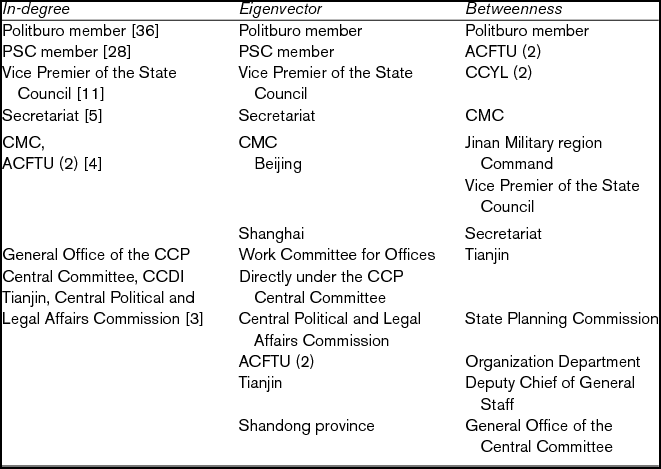
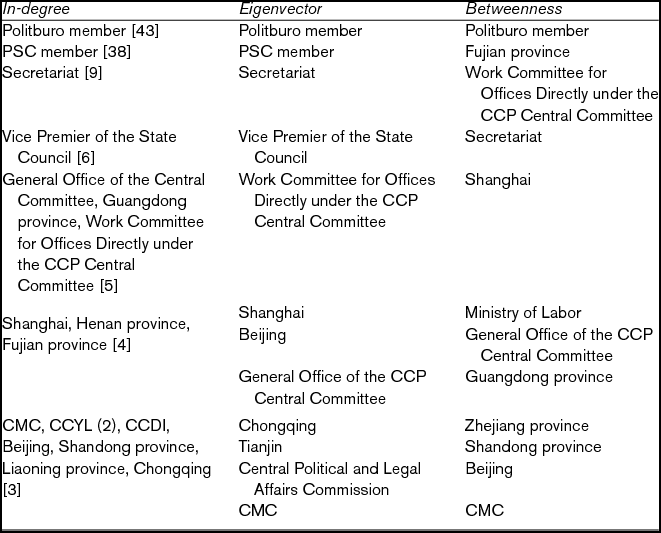
The changes in the composition of past Politburo also represents the evolution of thought that occurs when CCP leaders select future successors. Since there are many factors to be considered, it is difficult for outsiders to understand the compromises or disputes involved in the selection process. However, the previous positions of Politburo members represent the process of their training and performance evaluation. This should be one of the important factors during the selection process. Therefore, in order to understand the evolution of the talent selection process, this study further divided the samples of Politburo members into three groups, representing Jiang's era, Hu's era, and Xi's era. By calculating the in-degree, eigenvector, and betweenness of each era, the next section is able to describe the chronological changes of the position groups in the network, allowing an understanding of how the political implications of the Politburo changed over time. A ranking of Network Indices for Politburo members in Jiang's era, Hu's era, and Xi's era is listed in Tables 4, 5, and 6.
Ranking of network indices for Politburo members in Jiang's era

Ranking of network indices for Politburo members in Hu's era

Ranking of network indices for Politburo members in Xi's era

Although members from the 14th to the 18th Politburo were divided into three eras, there were multiple overlaps in members across eras, which led to a slow evolution process. However, obvious changes were discovered after the analysis. Firstly, there was an obvious difference between Politburo members’ career paths in Jiang's era and Xi's era. In Jiang's era, most Politburo members were selected from key positions from the Central Government or Central Committee, whereas in Xi's era, most were promoted directly from provincial or municipal positions. In Hu's era, the tendency of selection was between the two, which might be due to remnant influences from Jiang's power within Hu's power center, thus the Politburo of Hu's era was a result of a compromise in power distribution for both a primus inter pares and the interests with the party (Fewsmith, Reference Fewsmith2008: 284). Moreover, a comparison between Jiang's era (Table 4) and all Politburo members (Table 2) showed a high degree of overlap, which indicates that the influence of Jiang's power had extended to three generations, dominating the organization of CCP's power center until Xi's era, when a clearer promotion system was put in place. Whether the selection of future successors from regional positions will be the norm in the CCP promotion system still awaits planning by the next generation of CCP leaders. Since there has only been one session in Xi's era, there were fewer links of positions in this era compared with the previous two eras. If the members of the future 19th Politburo have similar career paths as those of the 18th, then this demonstrates that at least in Xi's era, regional positions would be the main source for the selection of future Politburo members. If this trend were to be mainstream in the future, provincial and municipal positions would be the arena for CCP's power competition, especially positions in Shanghai, Guangdong province, Beijing, and Tianjin.
Central Military Commission
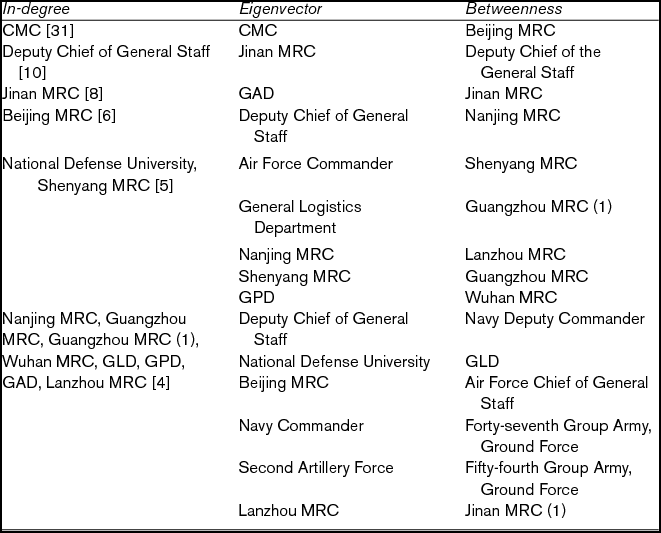
The same methodology and process applied to analyze the career path of the Politburo was also applied to the 14th to 18th CMC members. The overview of CMC members’ career path network is presented in Figure 5. Since all military careers ended at the CMC, it is clear that the CMC had a central position in the network. There were not many CMC members and most had similar levels of past positions. Therefore, they were not divided into three eras, but analyzed as a whole. The ranking of network indices is listed in Table 7. Similar to the role played by the Vice-Premier in the career path to the Politburo, the Deputy Chief of General Staff was shown to play an important role on the path towards the CMC, with a high ranking for all indices. The Chief of Staff and Deputy Chief of General Staff positions were highest for betweenness, and served as a central link and important route on the way towards the CMC, or towards the Chief of General Staff or even Minister of National Defense positions. These were followed by leading positions of each Military Region Command (MRC). Most military leaders were first members of CMC, and then promoted to Chief of General Staff and Minister of National Defense, so the Chief of General Staff became a less prominent node in the network. Leading positions at the MRC were found to be unavoidable experiences in military careers. The links of these positions were low because they were divided into regions. If only the MRC was used to represent positions in all regions, a high score of betweenness could certainly be uncovered, as it is a necessary experience for senior military officers to have actual practice in leading military troops. Another discovery was the importance of leading positions at Jinan MRC, which not only had high in-degree values but also high betweenness. This MRC division is in charge of military affairs of Shandong and Henan provinces, and their surrounding areas, and is the only MRC that has no direct borders with other countries among the seven MRCs (Nanjing MRC is considered to border Taiwan). Further discussion is needed to see if the importance of Jinan MRC can be discovered through network analysis. The positions in the MRCs had higher betweenness among all military positions, especially the Beijing MRC, as it had the highest betweenness value, indicating that past positions and subsequent positions were all important and acted as the main bridge leading towards the CMC.
Career network diagram of CMC members

Ranking of network indices for CMC members

Geographical career distribution of PSC members
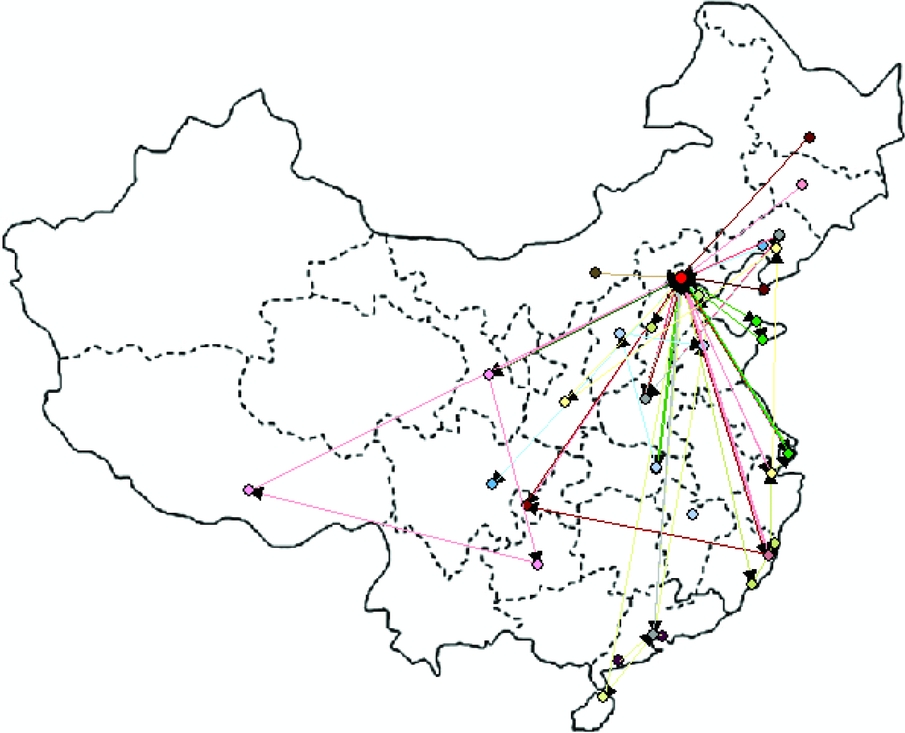
By connecting the past positions taken by Politburo members chronologically (indicated by an arrow) and marking the network on a map of China (Figure 6), it was obvious that Beijing, the base of the Central Government of China, was the focal point and destination of Politburo members’ career paths, thus further analysis was unnecessary. Therefore, the focus of the study was on areas with high density clustering outside of Beijing, in order to discern whether leading members of these areas were being promoted into the power center. As illustrated by the career spatial distribution of PSC members, there were higher exchanges among coastal regions than those among coastal-inland regions. This could mean more focus was placed by the CCP on developed regions, but could also mean that it would be easier for officers of those areas to demonstrate their performance, which was an advantage for promotion. From the number of promotions directly from provincial or municipal leading positions to the Central Government or Committee (listed in Table 8), the regions with direct connections to the Central Government were, in order, Shanghai, Henan province, Tianjin, and Guangdong province, which showed the importance of provincial and municipal positions.
Geographical career distribution graph of PSC members

Direct promotion from provincial or municipal leading positions to the Central Government or Committee

Geographical career distribution of CMC members
As shown in the geographical career network of CMC members (Figure 7), other than Beijing, the MRCs acted as the focal point. Since there were fewer MRCs than provinces and cities, there were more frequent exchanges among positions in the MRCs. The ranked importance of MRCs is listed in Table 9. Lanzhou and Jinan MRCs seemed to be the most important, followed by that of Liaoning, Guangzhou, and Nanjing. The strategic value of each MRC could potentially indicate its relevance to the promotion path towards the CMC. Among them, Lanzhou MRC is not located close to the coast and is in charge of the military affairs of Xinjiang province and the north-west area, with the largest juristic area among the seven.
Geographical career distribution diagram of CMC members

Number of promotions directly from the MRCs or regional military department to the CMC

Conclusions
There are four approaches to research on Chinese elite politics: totalitarianism (from the establishment of the PRC in 1949); factional politics (from the late period of the Cultural Revolution in the 1970s); generational politics (from the late period of the Cultural Revolution in the 1970s); and technocracy (after the CCP implemented reform of the cadre system) (Kou, Reference Kou2004: 1–21). The leaders of the CCP are not selected in the same manner as democratic countries, where leaders are elected by the public. All cadres above the Vice-governor level are assessed and managed by the CCP Central Committee. The Central Committee has the power to assess, appoint, and relieve officers from a position in order to ensure the most loyal candidates with appropriate educational backgrounds, necessary experience, and strong belief in the Party are selected for leading positions (Pu, Reference Pu and Chang2007: 179–96). Therefore, the Central Committee believes it is necessary to train and educate the cadres, as well as to conduct a thorough background inspection, before they can be recommended to the power center of the nation. Pu pointed out in his study that one of the distinguishing features of the 17th Politburo members was that most had economic and trade backgrounds, as well as experience in a southeastern province, which could also explain the clustering in the southeastern regions. Wang (Reference Wang2006) noted that a person with the following qualities might have an advantage in attempting to enter the power center: (1) having served in at least two administrative regions; and (2) currently the first leader of an economically developed province or municipality, such as Secretary of Beijing Municipal Committee, Shanghai Municipal Committee, Guangdong Provincial Committee, or Shandong Provincial Committee. Moreover, being in the right political sects would also increase chances for promotion, for example the Jiang faction (Shanghaibang) and the Hu faction (Tuanpai) era, or Xi's gang of princelings (Lam, Reference Lam2015: 5–14). Lampton (Reference Lampton2014: 61–8) induced that there are three features in CCP's leadership evolution: (1) Juvenilization of Politburo members over years – the average age of Politburo members was remarkably down from 72 in 1982, 62 in 2007 to slightly over 61 in 2012. The retreat of gerontocracy may imply the institutionalization of CCP's political power succession. (2) The exercising authority and holding power of leadership has transformed from traditional authority (Mao Zedong and Deng Xiaoping) to strongman appointment (Jiang Zemin and Hu Jintao), and finally to legal-rational authority (Xi Jinping). (3) Leaders’ goals evolve from Transformational to Transactional. Deng Xiaoping's goals were typical transformational and Jiang Zemin's were in between. Hu Jintao was classified as a Transactional leader. Xi Jinping is yet to be identified. These three evolutionary trends somehow confirm the calculated results of position network analysis, which suggest that the CCP's power succession as being more institutionalized and the leadership style was becoming more pragmatic.
This study used network theory to analyze the characteristics and structure of the career paths of CCP's top leaders. The results show that the trends in CCP's talent selection can be categorized into three eras. In Jiang's era, the Politburo members were mostly selected from positions in the Central Government, such as the Vice-Premier, Members of the Secretariat, or CMC. This may be because Jiang took over directly after the Tiananmen Square Protest, a period in which the primary task was to consolidate the power of CCP. Therefore, the method in which talents were selected during that period served the purpose of maintaining the power of the Central Government. Hu Jintao was appointed by Deng Xiaoping as the successor of Jiang. Due to the lingering influences of Jiang, in Hu's era members from the Central Government or Committee remained candidates for the Politburo. However, there were also several provincial representatives promoted to the power center. The structure of the Politburo at that time was the result of compromises. When Hu decided to retire and was succeeded by Xi and the 18th Politburo, there was an obvious structural difference compared with the previous two eras. More provincial representatives were promoted and there seemed to be a trend in the decentralization of the power distribution. Although CCP is authoritarianism, it has the most decentralized political and economic system (Landry, Reference Landry2008: 3–9). Most of the government budget was allocated to provincial or municipal authorities. Therefore, compared to officers in the Central Government, local officials had a better chance of showing their ability, and their achievements were more easily noticed. Therefore, outstanding municipal leaders had a better opportunity to become Politburo members, or even to be a part of the PSC. The above career network trends outlined the overall succession system of the Politburo. Unless special events occur in the future, the trend of promoting local talents will be irreversible, and even form an unwritten system. However, whether the rise of regional power will change the ecology of CCP's political power remains to be seen.
In-degree, eigenvector, and betweenness were used to indicate the characteristics and importance of different positions in the career network. The Vice-Premier, the Member of the Secretariat, the CMC, and Shanghai municipal leaders ranked highly on in-degree and eigenvector scores in the network towards the Politburo and PSC members, indicating they were promotion hotspots for seats in the Politburo. They were also the focus of distribution in the network graph, except for positions in the Politburo and the PSC. The ACFTU, the CCYL, and the provincial and municipal positions scored high on betweenness, indicating their role as significant bridges of further promotion. Furthermore, the quantified representative index provided a reliable method to assess the hub position, as listed in Table 3. Although some of the results overlapped with the results of the previous three indices, some of the position groups were valuable references to predict the future candidate for some representative positions in the Politburo, and were especially valuable for indicating future positions in the PSC.
The geographical distribution of the PSC members’ career paths had an obvious pattern. These focused at coastal areas, other than Beijing where the Central Government is located. The southeast coast seemed to have the highest density of clustering. Shanghai, Tianjin, and Guangdong provinces were the cradle for PSC members. Compared to the earlier days when most PSC members had either military or engineering backgrounds, there seemed to be an increase in members with financial, economic, legal, or political backgrounds. This indicated that more focus on one's ability to handle economic and trade-related affairs related to Taiwan, Hong Kong, and Macao would be key in selecting PSC members. This also indicated a trend in the rise of pragmatism. As it was difficult to present the in-degree and time order of positions on the geographical graph, only the repetitions of identical geographical locations were counted. It was also difficult to present the importance of promotion hubs, because some key positions in Central Government had nation-wide power coverage, which could not be marked based on its actual location. Nevertheless, the graph can be used to compare the importance of regional positions in the succession system.
There still might not be an institutionalized succession system for the training and promotion of the CCP's future leaders. Diverse and complex factors might need to be considered, such as factions, social relationships, functions, importance, and political achievement. However, previous experience and performance would nonetheless remain as key requirements since they are all embedded in the positions. Therefore, the research in the political career position is one of most important subjects in studying autocratic regimes (Kenneth and Oksenberg, Reference Kenneth and Oksenberg1988: 60–6). Due to the difference among positions of the party, the government, and the military, some positions were shown repeatedly on the career paths of past leaders, and hence can be considered necessary experience for future PSC or CMC members. Some special positions stood out in the network, such as leaders of the ACFTU and the CCLY on the political side, and the Deputy Chief of the General Staff and leaders of the Forty-seven Group Army, which might indicate their special functions and meanings in the career network. On the other hand, the personnel information of CCP members acquired might not be complete, as there could be some undisclosed, sensitive, but important information. This may be one major limitation of this network analysis. If future studies can collect more comprehensive information, the results of this analysis might have even higher precision in the prediction of the CCP's succession system. Moreover, one cannot predict CCP's future successors based on information from a single channel. The network analysis result of this study cannot be the only clue for prediction. Nonetheless, it is one of the most scientific indicators produced to date. The effectiveness of this analysis can be verified when the next generation of CCP leaders are selected.
As Xi newly ascended to the Presidency of the People's Republic and as General Secretary of the CCP, the Western world has high expectations (or even believed) that Xi will undertake economic and political reform (Kroeber, Reference Kroeber2013; Moses, Reference Moses2013; Simpson, Reference Simpson2013). However, as Xi has consolidated his power, he has weakened collective leadership mechanisms, allowing a personal cult to develop (The Economist, 2016a). He is also showing an inclination toward dictatorship (The Economist, 2016b; Lam, Reference Lam2015; Beech, Reference Hannah2016). The foundation of Xi's power is built on the balance and sharing of power among cadres. The recent promotion of cadres from his own faction has established that the institutions are firmly followed. For example, Xi newly promoted Chen Miner [陳敏爾] as Secretary of Guizhou province, Chen Shiju [陳世炬] as Deputy Director of the General Office of the CCP Central Committee, Hu Heping [胡和平] as Governor of Shaanxi province, Lin Duo [林鐸] as Governor of Gansu province, and Chen Xi [陳希] as Deputy Minister of the Central Organization Department. These posts are all important nodes in the career networks, indicating that the institutions selecting cadres remain intact even as Xi has become the strong man after Deng Xiaoping. This political institutional trend has lasted for more than 20 years. To reverse this trend will engender enormous resistance from political powers from different levels and factions. Xi may not be able to or may not want to fight this resistance.
With the outcomes of this study, we may able to speculate on the potential PSC slots in the 19th Party Congress scheduled for 2017 based on career network analysis. Among the 11 most highly noted candidates (Hu Chunhua [胡春華]; Li, Yuanchao [李源潮]; Li, Zhanshu [栗戰書]; Liu Qibao [劉其葆]; Sun Chunlan [孫春蘭]; Sun Zhengcai [孫政才]; Wang Huning [王滬寧]; Wang Yang [汪洋]; Xu Qiliang [許其亮]; Zhang Chunxian [張春賢]; and Zhao Leji [趙樂際]) (World Journal, 2016), in addition to being CCP Politburo member, 9 have experienced key career posts (listed in Table 1). If those potential candidates were elected as a PSC member, the methodology and results of this research will be justified. This suggests that some key posts play indispensible roles in incubating future top leaders. Thus key posts are worthy of scrutinizing not only for their function in governance but for their implications in the Chinese power succession system. The key posts that stand out may become more prominent in the trend towards political institutionalization.
About the author
Shyh-Chyang Lin is an associate professor at the Department of Civil Engineering and Engineering Management at National Quemoy University in Taiwan. His research has been evolving from applied mechanics, engineering materials, to ecological engineering, island studies, and finally to social networking. The broad spectrum of his research interests allows him to explore deeper ecological, social, economical, and political issues. Currently, his research focuses on applications of social network technology, and scale issues of small islands. He was a recipient of Presidential Award for Environmental Conservation in 2005.