

Introduction
Metabolic syndrome (MS) is a cluster of cardiovascular risk factors that include hypertension, hyperglycaemia, hypertriglyceridaemia, low high-density lipoprotein and abdominal obesity (1). The prevalence of MS increases with age (Reference Ford2). The age-adjusted prevalence of MS among US adults in the National Health and Nutrition Examination Survey reports reached about 34.5% between 1999 and 2002 (Reference Ford2,Reference Hildrum, Mykletun, Hole, Midthjell and Dahl3) and reached about 29.6% measured by the International Diabetes Federation (IDF) definition. It is well known as a risk predictor for type 2 diabetes (Reference Razay, Vreugdenhil and Wilcock4), cardiovascular disease (Reference Galassi, Reynolds and He5) and stroke (Reference Li, Ma and Liu6). Although several cardiovascular risk factors, such as diabetes, blood pressure, obesity and high cholesterol level, have been independently associated with a higher risk of developing cognitive decline or dementia (Reference Biessels, Staekenborg, Brunner, Brayne and Scheltens7–Reference Kivipelto, Ngandu and Fratiglioni9), the effect of MS on cognitive decline has not been extensively investigated (Reference Yaffe10). In the cross-sectional studies, the patients with MS have a higher risk of cognitive impairment or dementia (Reference Vanhanen, Koivisto and Moilanen11–Reference Lee, Jang, Chung, Chung, Oh and Hong18). However, these studies cannot resolve the question of whether MS predicts cognitive decline or dementia. A few prospective studies on the association of MS and cognitive disorders have also been published in recent years (Reference Kalmijn, Foley and White19,Reference Yaffe, Kanaya and Lindquist20). In a 25-year follow-up study, cardiovascular risk factors were associated with the risk of vascular dementia (VD), but not Alzheimer's disease (AD). A recent prospective study showed a relation between MS and cognitive impairment (Reference Yaffe, Weston, Blackwell and Krueger21). Another study indicates that only persistent MS was associated with lower cognitive performance (Reference Akbaraly, Kivimaki and Shipley22). In contrast, a few studies have suggested that MS is not associated with an increased risk of cognitive decline or dementia (Reference Muller, Tang, Schupf, Manly, Mayeux and Luchsinger23,Reference van den Berg, Biessels, de Craen, Gussekloo and Westendorp24). Thus, the association between the MS and the risk of cognitive decline remains unclear. If MS is associated with cognitive impairment, the early identification and management of MS may prevent cognitive decline. Consequently, in this article, we systematically review studies on the risk of cognitive disorders in patients with MS to determine the strength of the association between MS and cognitive decline.
Methods
Search strategy and study selection
Two researchers independently identified studies through searches of the MEDLINE (1966 to December 2009), EMBASE (1988 to December 2009), the China Biological Medicine Database (1989 to December 2009) and China National Knowledge Infrastructure (1979 to December 2009). The ‘MS', ‘insulin resistance syndrome', ‘syndrome X', ‘cognition', ‘cognitive difficulty', ‘cognitive impairment', ‘cognitive disorder', ‘cognitive decline', ‘AD', ‘vascular dementia' and ‘dementia' were used for searching relevant data. The search was restricted to human studies and reported in English or Chinese. The bibliographies of relevant articles were screened. Only studies that met the following criteria were included: (a) the study was performed at population level; (b) prospective study design and (c) using cognition as an outcome event associated with MS. The titles and abstracts were screened and potentially relevant articles were retrieved and assessed according to the criteria mentioned above. Discrepancies for inclusion between the researchers were resolved by discussion.
Data extraction and quality assessment
Data were independently extracted from the included studies using standardised forms by two researches. For each study, we recorded the title, first author's name, source and year of publication, country of origin, characteristics of participants (sample size, age, sex and race distribution), duration of follow-up, definitions and criteria for MS, confounders and measurements of cognition. We performed quality assessment using the Newcastle–Ottawa Scale (NOS) (Reference Wells, Shea and O'Connell25) for cohort studies. The NOS uses a ‘star' rating system to judge quality based on three aspects of the study: (a) selection of participants, (b) comparability of study groups and (c) outcome of interest. The maximum number of stars a study may receive in each of these three categories is 4, 2 and 3, respectively. The highest quality study receives nine stars. We did not perform a quantitative analysis and only reviewed and analysed the data descriptively, because of the variations in study characteristics.
Results
Results of the search
Our initial search identified 2852 relevant articles, which were narrowed by preliminary review to 42 potentially relevant original articles. A total of 33 were excluded, because of review (n = 17), case cross-sectional study design (n = 9), control study design (n = 2), hospital-based study (n = 2), retrospective cohort study (n = 1), non-MS (n = 1) and no data available (n = 1). Ultimately, nine prospective population-based studies, comprising 19 876 participants, were included in this systematic review.
Characteristics of included studies
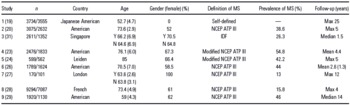
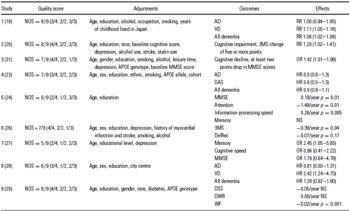
The characteristics of these studies and their participants are shown in Table 1. Among the nine studies, five were performed in the United States, three in Europe and one in Asia. The number of participants ranged from 101 to 7087. The National Cholesterol Education Program Adult Treatment Panel III (NCEP ATP III) definition was used in seven studies, the IDF definition was used in one study and self-defined definition was used in one study. The prevalence of MS varied from 13 to 54.8%. The follow-up ranged from 1.5 to 25 years. Age and education were adjusted for as a confounding factor in all studies. The Mini-Mental State Examination (MMSE) was the most widely used scale of cognitive declines. The most commonly used criteria for dementia and AD are DSM (III or IV) and National Institute of Neurological and Communicative Disorders and Stroke–Alzheimer's Disease and Related Disorders Association, respectively. The number of stars of studies assessed by NOS ranged from 5 to 8 (Table 2).
Characteristics of included studies

N, no MS; Y, have MS.
Characteristics of included studies

3MS, modified MMSE; DAS, dementia associated with stroke; DelRec, delayed word-list recall; DSS, digital substitution test; DWR, delayed word recall; NS, non-significant; RR, the risk of dementia per SD increase in the z-score sum; WF, word fluency.
The results of association on MS and cognition
The risk of cognition function associated with MS in each study is shown separately (Table 2). All studies but two indicate that the MS is associated with cognitive disorders (from one to more than two-fold increase in risk). One study that focussed on the oldest of the elderly (≤85 years) found a link between the syndrome and decelerated cognitive decline, but this result may have been related to a survival bias. Another study involving multiethnic elderly showed that the MS was not associated with an increased dementia risk.
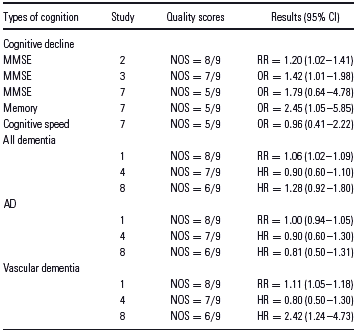
The effect of the MS on the risk of different subtypes of cognition is also shown (Table 3). It seems that the MS may be associated with cognitive impairment (positive results in three of five) and vascular dementia (positive results in two of three) although there was discrepancy. Of note, three studies involving patients with AD did not find the association between MS and AD.
Risk of cognitive disorders in patients with different types of cognition
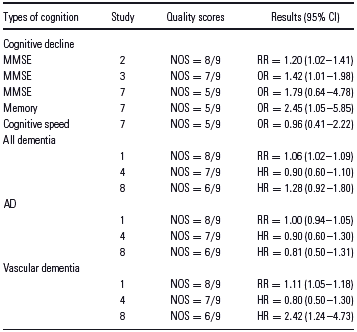
RR, the risk of dementia per SD increase in the z-score sum.
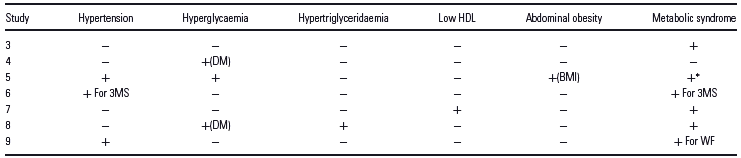
When examining the association of the individual risk factors of the MS and cognition (Table 4), glucose (three studies) and blood pressure (three studies) most likely associated with cognition function, while the other three indicators also were supported by three studies, respectively. In the included studies, all studies but one support the association between MS and cognition function. It seems that MS as a cluster of vascular risk factors may have a synergistic effect on the cognitive disorders, which need to be confirmed in further studies.
Components of MS on cognition
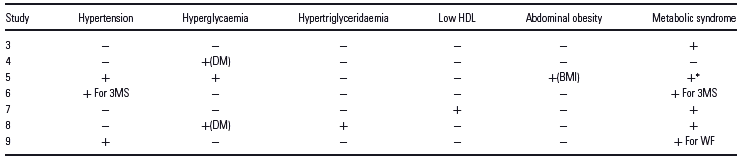
3MS, modified MMSE; BMI, body mass index; DM, diabetes mellitus; HDL, high-density lipoprotein; WF, word fluency.
* This study showed that the MS was associated with decelerated cognitive decline in the oldest old.
Discussion
In this systematic review of population-based studies, it brings together the evidence on the risk of cognition function in patients with MS, which indicates that the MS may be associated with cognitive impairment and vascular dementia but not for AD, although there is discrepancy. MS may have a synergistic effect on the cognitive disorders, which needs to be further investigated.
This study has some limitations and strengths. First, we did not perform a quantitative analysis of included studies due to the limit studies and the variations in study characteristics, but using meta-analysis in cohort studies is controversial. Second, we only included studies published in English or Chinese, which could introduce bias; however, high-quality studies will be published in English priority. The strengths of our study were we only included prospective population-based study, which can elaborate the causality between MS and cognitive decline and we also perform strict quality assessment of studies to explore the discrepancy in different studies for improving further study. So far as we know, there is no systematic review of current evidences on association between MS and cognitive decline.
Implications for practice
There are currently no therapies – other than lifestyle modification – that specifically address the MS and each individual risk factor requires separate treatment. Modification of metabolic risk factors at middle age may reduce not only the risk of cardiovascular or cerebrovascular disease but also the most prevalent neurodegenerative disease of old age, cognitive decline.
Implications for research
The association between MS and cognitive decline is still controversial so far; consequently, further studies exploring the association between MS and cognitive decline should pay much attention to the points as follows:
1 Study design: Limitations of the cross-sectional design are unable to address directionality of associations. To clarify whether the MS could cause cognitive decline, the suitable study design is the population-based prospective cohort studies, namely the investigator identifies patients with MS and patients without MS, each a cohort, and then starts the follow-up and waits for the cognitive decline to occur. If there is an association between MS and cognitive decline, the MS is a risk predictor of cognitive decline. Furthermore, the period of follow-up was different and it was possible that a longer follow-up could have revealed an association between the MS and cognitive disorders.
2 Population selection: There is increasing evidence that in very old persons, the major components of MS, such as blood pressure (Reference van den Berg, Biessels, de Craen, Gussekloo and Westendorp24), cholesterol and body weight, are reversely associated with increased risk of dementia. The relation of MS to cognitive dysfunction can be age-dependent. It is speculated that persons surviving until old age may have protective factors for vascular disease. Consequently, the further studies should separately explore the relationship between MS and cognitive decline according to age. In addition, the definition of individuals of components of MS should vary by ethnic groups (Reference Muller, Tang, Schupf, Manly, Mayeux and Luchsinger23). For example, Asians are more susceptible to the effects of obesity than others. Whether ethnic or genetic or environmental factors account for the difference should be considered in future studies. In addition, the sex difference also be considered. Vanhanen et al. found no significant association between the MS and risk of AD among men, but found an association among women.
3 Definition of MS: The current definitions of the MS are in some way arbitrary. The difficulty in arriving at MS criteria is reflected by the fact that over the years at least six different definitions (World Health Organisation, European Group for Study of Insulin Resistance, ATP III, American Association of Clinical Endocrinologists, American Heart Association and IDF) have been developed. So we must resolve this problem before starting large-scale clinical and epidemiological research.
4 Cognitive assessments: The MMSE scale was the most widely used scale of cognitive declines, but it may be insensitive to detect mild cognitive impairment and also does not allow for a comprehensive examination of different domains of cognition, whether specific areas of cognition are more affected than others. So a broad range of cognitive function examination should be considered in future studies (Reference Segura, Jurado, Freixenet, Albuin, Muniesa and Junque30). Furthermore, it was difficult to determine whether there was a stronger association between MS and cognitive decline from AD or vascular disease. How to differentiate the effect of MS on AD or VD or AD with cerebrovascular disease should be studied first.
5 Confounders adjustment: The confounders adjusted differed between the studies included in this review. This might have led to heterogeneity in the results. Age and education were adjusted for as a confounding factor in all studies. However, other important risk factors do not include family history, socioeconomic status, ethnicity, current treatment and important behavioural variables such as smoking and physical activity.
6 Others: The association between MS and cognitive disorders might indeed be underestimated because subjects with MS were more likely to die from cardiovascular disease before developing dementia (Reference Kalmijn, Foley and White19). It would be of interest to explore the causes of death in patients with MS, especially in the elderly.
7 Finally, the synergistic effect of MS beyond single-risk factors and the importance of each risk factor for cognitive disorders deserve further investigation, especially single-risk factors should be investigated in priority, such as diabetes, hypertension or hyperlipidaemia.
Conclusion
Our study found that the MS may be associated with cognitive impairment and vascular dementia but not for AD, which need to be further investigated with high-quality studies.