Introduction
Under a state-sponsored programme, 400,000 Muslim Bengalis were resettled in the PahariFootnote 1 populated region of the Chittagong Hill Tracts (CHT) in Bangladesh between 1978 and 1984.Footnote 2 While natural migration to the CHT has been a historical phenomenon that did not disturb the demographic balance, the population transfer in the 1970s/1980s significantly increased the population of the CHT and altered its demographic composition. As the 1981 and 1991 Bangladesh Censuses showed, the Bengali population had increased to 38.93 per cent and 48.57 per cent respectively from less than 5 per cent in 1947.Footnote 3 Indeed, the population transfer to the CHT is not unique; it has taken place in a variety of contexts in various parts of the world.Footnote 4
But, why do states move people? Scholars posit that they do this to alter the demographic ‘facts on the ground’ (demographic engineering) in contested areas in order to establish territorial control so as to avert internal rebellion or external threat.Footnote 5 O’Leary calls the process whereby states resettle people belonging to the majority ethnicity (‘preferred people’) in areas where minority ethnicities are predominant as ‘right-peopling’.Footnote 6 The chief aim of the right-peopling policy is to neutralize the ability of an ethnic group to challenge the sovereignty and territorial integrity of the state by altering the demographic balance in a given area.
In some cases, however, states go beyond right-peopling and adopt a policy of uprooting the existing inhabitants or rendering them non-existent through a variety of tactics, i.e. expulsion, ethnic cleansing, conversion, etc. A recent case of seeking to uproot a population is the violent expulsion of Muslim Rohingyas from the Rakhine state of Myanmar.Footnote 7 To understand such state practices, this article borrows Noam Chomsky’s concept of ‘unpeopling’ in which people become ‘unpersons’ or non-existent.Footnote 8
So, two approaches are generally applied in demographic engineering—right-peopling and unpeopling—to establish territorial control over contested territories. In the former, the approach is to alter the demographic balance, while in the latter the aim is to ‘unpeople’ the existing inhabitants and populate the area with ‘preferred people’. But, when do states adopt a right-peopling policy and when do they opt for an unpeopling approach? On this, the existing theoretical literature is unclear. Indeed, the current scholarship does not go beyond the general assertion that states move people to establish territorial control over a contested area. So, an intriguing theoretical question in demographic engineering is: how do states establish territorial control over a contested territory? In other words, do states seek to establish territorial control through right-peopling or by unpeopling the existing population and when do they adopt a particular approach? This article seeks to address this theoretical lacuna in the study of population resettlement by exploring the case of demographic engineering in the CHT.
It is argued in this article that states deploy the right-peopling and unpeopling policies simultaneously to establish territorial control over contested areas, and the two policies function as a continuum in which right-peopling is the key initial approach that embeds the motivation for unpeopling. In due course, once the right-peopling goal is attained, the unpeopling policy becomes central. Contextualizing this argument in the case of the CHT, this article explains that in the initial years of its statehood Bangladesh pursued an assimilationist policy towards the Pahari people which led to the rise of resistance that turned into full-blown insurgency. The Bangladesh authorities responded by militarizing the region and undertaking a state-sponsored resettlement programme. In undertaking this programme, initially the policy of right-peopling was deployed with the chief aim of altering the area’s demographic composition in order to counter the insurgency. However, it embedded the unpeopling motivation. Once the right-peopling goal was achieved, state policy shifted to the unpeopling of the existing inhabitants. Many incidents of eviction, land grab, religious conversion, massacre, etc. took place in the CHT,Footnote 9 which could be construed as unpeopling techniques. The case of the CHT has enormous potential to contribute to the fledgling theory of demographic engineering by drawing insights from the case.
The article is divided into six sections (excluding the Introduction and the Conclusion). The first section delves into the theoretical literature of demographic engineering. Two objectives underscore the essence of this section. First, it will place the article within a broader context. Second, it will set the line of argument with key concepts to explore the case of the CHT. The second section explores the demographic dynamics in the pre-Bangladesh CHT to help create an understanding of the dynamics of demographic change in the Bangladesh period. The third section illustrates the rise of Bangladesh as an independent state and constitution-making in the new state to explain how the stage was set for undertaking population resettlement in the CHT in later years. The fourth section sets out how a policy of assimilation, primarily deriving from the 1972 Constitution, was framed towards the Pahari people and how it led to the rise of an insurgency. Further, it explains the Bangladesh government’s counter-insurgency strategy in the forms of militarization and population resettlement. It provides an in-depth analysis of the right-peopling and unpeopling policies deployed by the Bangladesh government. The fifth section discusses the CHT accord, which was signed in 1997 to end violence, and the politics of peace and surreptitious population resettlement in the wake of the accord. The final section illustrates how the right-peopling policy transited to the unpeopling policy and its dynamics in the post-accord era. The article concludes by illuminating the theoretical implications of the CHT case.
Theory of demographic engineering: Why do states move people?
Notwithstanding the ubiquity of state-sponsored resettlement of preferred people, a robust theory of demographic engineering is yet to be built. Haklai asserts that systematic comparative and theoretical literature on population settlement is still in its ‘infancy’.Footnote 10 As the following brief discussion will indicate, while some progress has been achieved,Footnote 11 more work is needed to build a robust theory on population resettlement.
Territorial control
In the context of this article, population resettlement is defined as a ‘political action involving the organized movement of a population belonging to one national group into a territory in order to create a permanent presence and influence the patterns of sovereignty in the settled territory’.Footnote 12 The chief aim of population resettlement is to establish ‘territorial control’ in a contested ethnoterritory.Footnote 13 McNamee argues that in a disputed frontier region, co-ethnics are viewed as loyal to the state and are helpful to rapidly consolidate control over a contested territory.Footnote 14
Perceived security threats prompt states to resettle preferred people to consolidate state control over the area and its resources by establishing ‘demographic facts on the ground’.Footnote 15 This movement of population is done either to thwart external threat or internal rebellion. Population resettlement is organized by offering free or heavily subsidized land, often expropriated or purchased from the existing minority groups. In some cases, it is supplemented by offers of good housing or jobs or reduction of taxes. Military installations are also built to provide security to the settlers; it is an inducement or incentive for settlement.
States are fearful of frontier areas if they are populated by minority ethnic groups. To secure non-natural frontiers, states coercively pursue demographic engineering in areas populated by minority groups who are co-ethnics with elites in a hostile power.Footnote 16
While the territorial control argument is generally valid, what is not clear is how states establish territorial control over the contested territory. This issue needs greater illumination for a robust theory on population resettlement.
The nation-state and ethnic interests
Some scholars have focused on the character of the ‘nation-state’ to explain demographic engineering. The nation-state is essentially a homogenizing agent. Mylonas asserts that nationalism instigates a ‘homogenizing imperative’ and ‘nation-building’ is ‘not considered complete until there are no threatening noncore groups within their state’.Footnote 17 For this, states deploy various strategies, but three approaches stand out: (i) assimilation of the minority ethnicities with the core group; (ii) resettlement of preferred people in order to neutralize the challenges of the minorities; and (iii) ethnic cleansing.
Nation-states are composed of multiple ethno-national groups who have different and sometimes opposing ethnic interests. As the dominant group generally sits at the helm of state power and controls state institutions, state policies are framed to promote that group’s interests at the expense of the others, thus turning nation-states into ethnocracies.Footnote 18 Bookman asserts that the majority group exercises ethnic power while formulating state policies that are informed by their interests, and pursues policies such as assimilation, transfer of desired populations in contested ethno-territories, non-recognition of group identity, ethnic cleansing, expulsion, forced migration, religious conversion, elimination of ‘undesirables’ from a given area, manipulation of the population levels, distortion of the census data, formation of pro-natalist policies, boundary changes, economic pressure, etc.Footnote 19 The nation-state creates the enabling conditions to pursue those policies. Bookman further notes that states ‘resettle population of a particular ethnic group in order to dilute the different ethnic population of the receiving region’.Footnote 20 In other words, states resettle preferred people to reduce the ability of the latter group to challenge state authority.
Morland divides demographic engineering into two categories: hard and soft. The first category entails policies such as manipulation of fertility and mortality, migration, and, in some cases, expulsion and genocide to alter the demographic balance. Soft demographic engineering, on the other hand, entails non-demographic means such as boundary changes, shifts in census categories that affect the relative size or strength of particular ethnic groups, and ‘politically-driven measures taken to change the allegiance and identity of a population within a territory’.Footnote 21
While state-sponsored settlement of preferred people in contested ethnoterritories is the key focus of this article, it should be noted that people also move naturally which has an impact on the demographic balance of an area. Such migration took place during the colonial and post-colonial eras and the process was influenced by power relations between the central authority and the indigenous communities. In the post-colonial era, bureaucratic expansion and state formation took place through the logics of ‘development’, ‘conservation’, and ‘security’, and they informed state policy for resource extraction, displacement, and replacement.Footnote 22 Those logics drive population settlement, both natural and state-sponsored, in the post-colonial context.
The above brief survey highlights the multi-dimensional nature of the evolving theory of demographic engineering. While territorial control is identified as the chief aim of the state to move people, there is little clarity on how states do it or which approach/es states adopt to pursue demographic engineering. It is unclear whether states seek right-peopling or unpeopling to establish territorial control in a contested area. For a robust theory of demographic engineering, this issue needs greater clarity. This article seeks to address this issue contextualizing the case of population resettlement in the CHT.
Demographic dynamics and its determinants in pre-Bangladesh CHT
During the colonial time, the CHT was an overwhelmingly Pahari-populated area and the population grew naturally and at a stable pace. The colonial administration placed restrictions on the settlement of outsiders (non-Paharis) in the CHT and allowed self-rule to a large extent.Footnote 23 It promulgated the Chittagong Hill Tracts Regulation 1900 (popularly known as the Hill Tracts Manual) at the beginning of the twentieth century.Footnote 24 Under this regulation, an outsider needed consent from the circle chief and the deputy commissioner (DC) of the district to permanently settle in the CHT.Footnote 25 This measure kept the CHT an overwhelmingly Pahari-populated area until the end of the colonial rule in 1947. Evidence for this can be found in the fact that the Pahari people constituted more than 98 per cent of the CHT’s population in 1947 when colonial rule ended.Footnote 26
Political demography came to the fore with the dawn of the nation-state system in the Indian subcontinent following the end of the colonial rule. In the eastern part of the subcontinent, the creation of boundaries and inclusion of the CHT in Pakistan created contested ethnoterritories. It is noteworthy that Pakistan was created for the Muslims of the Indian subcontinent and comprised the Muslim-majority areas, based on the ‘Two-Nation’ theory.Footnote 27 Led by Jana Samity (Peoples Organisation), the Paharis opposed the inclusion of the CHT in Pakistan.Footnote 28 The Bengal Boundary Commission Report cited geographical proximity and economic closeness between the CHT and the adjacent Chittagong region as key reasons for the former’s inclusion in Pakistan.Footnote 29 Many analysts, however, disputed this, pointing out that the CHT was awarded to Pakistan to compensate for the adjustment of boundaries in the Sylhet-Assam region where the Muslim-majority Karimgang area was given to India.Footnote 30
The Bengal Boundary Commission Report was issued on 17 August 1947, three and two days respectively after Pakistan (14 August) and India (15 August) became independent. On 15 August, Paharis hoisted the Indian flag in Rangamati (district headquarter) to celebrate independence, assuming that as a non-Muslim majority area the CHT had been included in India. But on 17 August, it was found that the CHT had been awarded to Pakistan. Paharis protested against this and demanded its reversal.Footnote 31 Pakistani authorities sent a contingent of the Baloch Regiment to the CHT which swiftly took control of the district.Footnote 32 As is discussed below, the Partition controversy would have long-term consequences for state-CHT relations and the area’s demographic evolution.
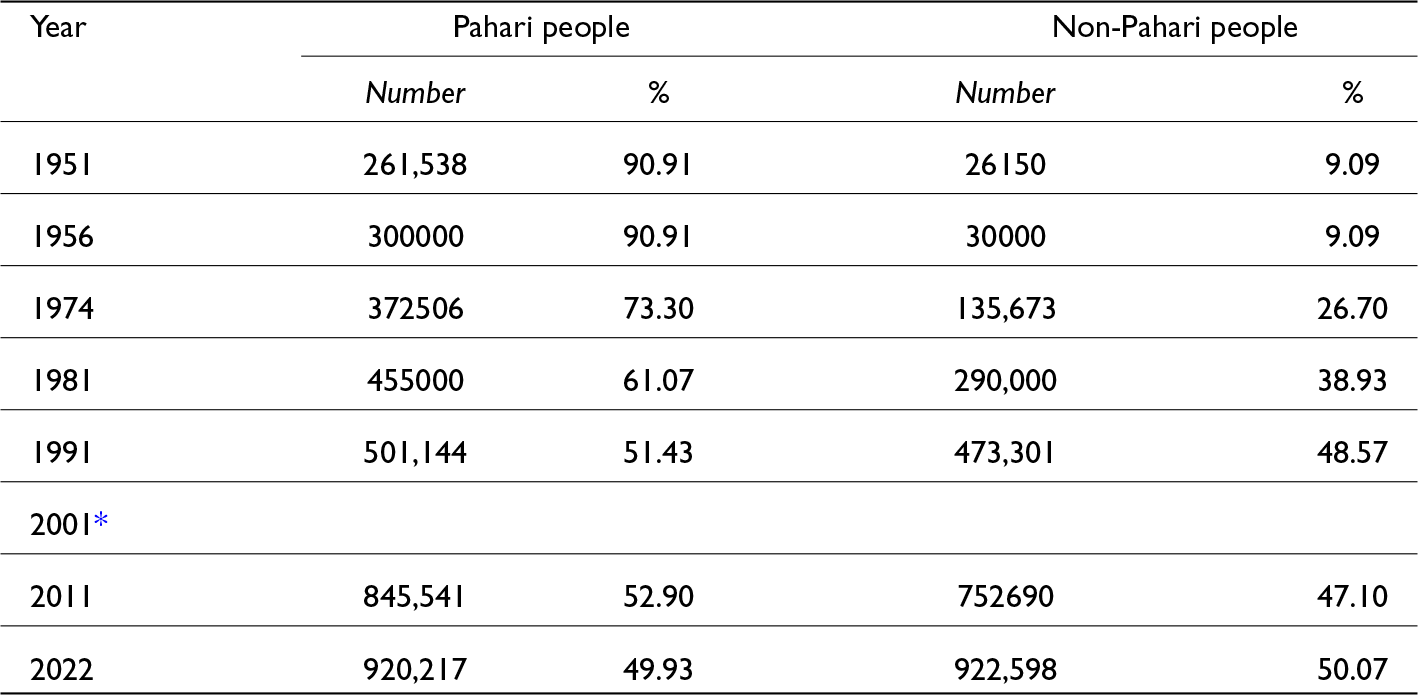
The Bengali population of the CHT rose to 9.09 per cent in 1951 (see Table 1) from less than 2 per cent at the end of the colonial rule.Footnote 33 This was primarily due to the settlement of Bengalis who migrated from India to Pakistan during the time of Partition. The East Pakistan authorities disregarded the fact that this contravened the CHT Regulation 1900. Indeed, evidence shows that steps were taken by the Pakistani authorities to undermine the Regulation. Various colonial-era safeguards instituted to protect the Paharis from the influx of non-Pahari people were gradually abolished. For example, the indigenous police force, which was created during the colonial time as part of the region’s self-rule, was abolished in 1951. Also, the exclusive land rights of the Paharis in the CHT were gradually curtailed.Footnote 34
CHT population: Pahari and non-Pahari people (1951–present).

Sources: Compiled from multiple sources: various population censuses of Bangladesh and Pakistan; Shapan Adnan, Migration, Land Alienation and Ethnic Conflict: Causes of Poverty in the Chittagong Hill Tracts of Bangladesh (Dhaka: Research and Advisory Service, 2004), p. 15.
* The 2001 Census does not provide data separately on Pahari people and non-Pahari people in the CHT. \,The data are based on religion, but this does not provide a clear picture on the sizes of the Pahari and non-Pahari populations.
The Pakistani government constructed the Kaptai Dam in the early 1960s on the Karnafuli River to produce hydro-electricity. It brought multifarious changes in the life, livelihood, culture, environment, and demography of the CHT. The dam inundated 54,000 acres of prime agricultural land (40 per cent of the district’s total cultivable land) and displaced 100,000 people (one-fourth of the CHT population).Footnote 35 Adequate compensation was not arranged for the affected people and proper rehabilitation was not undertaken, which had a profound impact on the livelihood of the Pahari people.Footnote 36 In 1964, a communal riot occurred in the Khagrachari area of the CHT involving Bengalis and the Paharis.Footnote 37 The displacement caused by the construction of the Kaptai Dam and the communal riot led 30,000 Chakmas to migrate to India; they were subsequently resettled in Arunachal Pradesh by the Indian authorities.Footnote 38 Importantly, this exodus affected the demographic composition of the CHT.
During the time of Pakistan (1947–1971), natural migration to the CHT occurred through bureaucratic expansion, nation-building projects, or by the ‘logic of development’. While no state-sponsored resettlement took place during this period, it did occur, as will be illustrated below, following the emergence of Bangladesh as an independent state in 1971.
Rise of Bangladesh and constitution-making: Setting the stage for demographic engineering
Bangladesh emerged as a sovereign state in 1971 after a bloody secessionist war.Footnote 39 Compared to the previous era, the CHT experienced a rapid demographic change in the Bangladesh period. The new state set off by adopting a mono-national constitution in 1972. It was immensely consequential because it set the stage for state-sponsored population resettlement in the CHT in later years. While this section focuses on the making of the 1972 Constitution, at the outset, it briefly discusses CHT’s demographic dynamics in the early years of Bangladesh statehood.
The demographic composition of the CHT began to change markedly soon after Bangladesh emerged as an independent state. It began with the settlement of repatriated Bengalis in the CHT who had fled to India during the course of the 1971 secessionist war.Footnote 40 In the process of repatriating those refugees after the war, some Bengalis settled in the CHT, ‘in some cases expelling the Hill People from their homesteads and grabbing their agricultural lands’.Footnote 41 About 50,000 Bengalis settled in the CHT in the immediate aftermath of the war.Footnote 42 It is noteworthy that settlement in the wake of the war was not sponsored by the state nor did it take place to alter the region’s demographic balance. Also, settlement in the early 1970s was not driven by the logics of ‘development’, ‘conservation’, or ‘security’; rather its specificity was the event of the 1971 war. Its impact on CHT’s demographic composition was not enormous; rapid demographic change would only occur in later years.
The process of drafting a constitution began soon after gaining independence. In it, majority nationalism emerged as the defining factor in constitution-making because the war was fought on the basis of ‘Bengali nationalism’. As Prime Minister Sheikh Mujibar Rahman stated in the National Assembly:
Our ideology is clear. This ideology has inspired us to attain independence and this ideology shall constitute the basis of this state. Nationalism—Bengali nationalism—shall be the main pillar of this state. Bengali nationalism encompasses Bengal’s culture, Bengal’s heritage, its land and above all the sacrifice made by the Bengalis.Footnote 43
Such an orientation of constitution-making in the new state was opposed by CHT representative Manabendra Naryan Larma in the Jatiyo Sangsad (National Assembly). During the debates on a citizenship bill in the National Assembly on 31 October 1972, he stated that the Paharis had their own identities, distinct from that of the Bengalis, and if Bengali identity was imposed on the Chakmas, ‘the Chakma nation will be extinct’.Footnote 44
The Paharis (and other minority ethnicities) failed to obtain constitutional recognition of their identities in 1972. A mono-national constitution was eventually adopted, thus establishing the dominance of the majority group within the state structure. It led Bangladesh towards an ethnocratic system.
Various articles of the constitution highlighted the mono-national character of the state. Three articles are particularly noteworthy.
Article 9 stated that ‘Bengali nation’ would form the core of the state, it read:
The unity and solidarity of the Bengali nation, which deriving its identity from its language and culture, attained sovereign and independent Bangladesh through a united and determined struggle in the war of independence shall be the basis of Bengali nationalism.Footnote 45
Article 6 in Part 1 said that all the citizens of Bangladesh would be known as ‘Bangalee’ (the ethnic identity of the majority group). By inserting this article in the constitution, minorities were denied the right to their own identities and the reality of cultural diversity within the state was completely ignored.Footnote 46 It implied that minority ethnicities either did not exist or they needed to be assimilated within the Bengali nation. As will be discussed in the next section, the constitution, particularly this article, paved the way for the pursuit of an assimilationist policy towards the minority ethnicities.
Article 3 in Part 1 stated that Bangla (the mother tongue of the majority ethnicity) would be the state language. Minority languages were not mentioned in the constitution, implying that the state failed to provide language rights to the minority ethnicities. It is pertinent to note that the foundation of Bangladesh’s independence struggle was rooted in the language rights movement,Footnote 47 but such rights were denied to the minority ethnicities in independent Bangladesh. It primarily had to do with the mono-national character of the constitution and the emerging ethnocratic system in the new state.
On reassessment, many analysts find that it was wrong to adopt such a constitution. Kamal Hossain, the architect of the 1972 Constitution, has stated that the decision to adopt such a constitution was ‘impulsive and ill-judged’ and if he were to write it again, he would not produce a mono-national constitution that rejected the identity of the minority groups.Footnote 48
The 1972 Constitution had long-term consequences for state-CHT relations. An analyst has maintained that it was based on a ‘majoritarian notion of national identity’ and ‘constitutional patriotism’ which denied the indigenous identity of the minority ethnicities; their exclusion during the founding moment formed a ‘generic defect’ from which Bangladesh is yet to fully recover.Footnote 49
This section has analysed the founding moments of Bangladesh’s statehood, focusing particularly on the making of the 1972 Constitution. As analysed, it ensured the rise of a hegemonic group and generated ethnocratic impulses within the system. Ethnocracy created a permissive condition that allowed the pursuit of an assimilationist policy towards the Pahari people. As we will see, the Paharis would rebel against the state in reaction to the policy of assimilation and the Bangladesh authorities would respond with a counter-insurgency strategy. In the vortex of insurgency–counter-insurgency, demographic engineering would occur in the CHT.
Assimilation, insurgency, and counter-insurgency: Population resettlement
The Mujibar Rahman government adopted a policy of assimilation towards the Pahari people,Footnote 50 which was primarily an outgrowth of the 1972 Constitution. It led to the rise of insurgency in the CHT. In reaction, the Bangladesh authorities deployed a counter-insurgency strategy to quell the Pahari rebellion, which had two key elements: military mobilization and population resettlement under a state-sponsored programme. This section illuminates this sequence of developments which culminated in demographic engineering and analyses how the state authorities sought to establish territorial control over the contested ethnoterritory.
Immediately following independence, Paharis sought to secure their distinct identities and cultural rights. As the constitution of the new state was being drafted, a delegation of the Pahari people led by M. N. Larma met with Prime Minister Sheikh Mujibar Rahman in February 1972 and presented a charter of 15 demands, four of which were particularly important:
1) autonomy of the Chittagong Hill Tracts with its own legislature;
2) retention of the Regulation 1900 in the constitution of Bangladesh;
3) continuation of circle chiefs’ offices; and
4) a constitutional provision restricting the amendment of the Regulation 1900 and imposing a ban on the influx of the non-Hill people.Footnote 51
The Pahari delegation sought a constitutional guarantee of those demands. But the prime minister instantly rejected their demands and advised them ‘to forget their ethnic identities’ and merge with the ‘Bengali nation’.Footnote 52 He also said that if those demands were to be repeated, he would annihilate the Paharis by settling thousands of Bengalis in the CHT.Footnote 53 The prime minister further stated that if such a policy were to be followed, the Paharis would have no place to hide because the Indians were his friends.Footnote 54
To realize those demands, the Pahari leaders formed a regional political party, the Parbatya Chattagram Jana Samhati Samiti (United Peoples Organization of the Chittagong Hill Tracts; PCJSS, popularly known as the JSS), in April 1972.Footnote 55 Meanwhile a guerrilla force—the ‘People’s Liberation Army’ (PLA)—was constituted in February 1972 headed by Jyotirindra Bodhipriya Larma, alias Santu Larma (younger brother of M. N. Larma), which later came to be known as Shanti Bahini (Peace Force; SB).Footnote 56 In the years ahead, the JSS would be at the forefront of political mobilization in the CHT.
M. N. Larma was elected to the East Pakistan Provincial Assembly from the CHT in the 1970 Pakistan general election and later became a member of the Jatiya Sangsad by winning a seat in the CHT constituency in 1973 Bangladesh general election. As an elected representative, he demanded on various occasions in the Jatiya Sangsad that the Pahari identity and cultural rights should be protected in the constitution. Larma reminded National Assembly colleagues that the Paharis had a separate identity from that of the Bengalis.Footnote 57 His demands went unheeded and no accommodation was made on the Pahari identity question. Instead, the Mujibar Rahman government adopted a policy of assimilation towards the Pahari people.Footnote 58
Prime Minister Sheikh Mujibar Rahman demonstrated a keen interest in pursuing the assimilationist policy. At a pre-election meeting in 1973 in Rangamati (district headquarters of the CHT), the prime minister declared that from that time onwards the Pahari ethnic people would be known as ‘Bangalee’ and they would have no other identity.Footnote 59
The constitutional pathway to protect the cultural rights and the distinct identities of the Paharis came to an abrupt end in 1975 when a bloody military coup toppled the civilian administration and replaced it with a military regime.Footnote 60 The constitution was suspended and political activities were banned by the military regime. In such a context, M. N. Larma abandoned the constitutional pathway in favour of a guerilla campaign to uphold Pahari rights and protect their identity. As armed conflict began between the state security forces and the SB guerrillas, the military regime took the development as a serious threat to the security and territorial integrity of the state. It was amplified by the concern that India might provide assistance to the SB guerrillas in view of their hostility towards Dhaka following the 1975 coup that removed the pro-India Awami League (AL) government from power. Dhaka’s assumption was borne out as India was subsequently found to have provided substantive material help and sanctuaries to the SB guerrillas.Footnote 61
The military regime geared up the previous government’s policy of assimilation and specifically responded to the rise of insurgency by adopting a two-pronged counter-insurgency strategy: militarization of the area and demographic engineering. As the armed conflict began to escalate, Bangladesh authorities massively increased their military presence in the CHT. Military deployment peaked in the 1980s when 115,000 military personnel were deployed, which meant one soldier for every five–six Paharis.Footnote 62 According to Barua, in the 1980s the CHT turned into ‘a vast military camp’.Footnote 63 Massive military operations were carried out in the 1980s to flush out the insurgents.
The militarization of the CHT was also extended to civilian and development administrations. Indeed, they were placed under the control of the armed forces in order to execute the counter-insurgency strategy.Footnote 64 While a civilian set-up did exist, it worked in close coordination with or under the guidance of the military. In a similar fashion, the development administration of the CHT was put under the military’s control.Footnote 65 In 1976, the Zia military regime established the Chittagong Hill Tracts Development Board (CHTDB) whose primary aim was ‘the socio-economic uplift of the region’.Footnote 66 However, CHTDB projects were used to counter the insurgency. The chairman of the CHTDB was the General Officer Commanding (GOC) of the Chittagong Division of the Bangladesh armed forces until the signing of the 1997 accord. A ‘close examination of the CHTDB development projects reveals that more than 80 per cent of the CHTDB development budgets are spent on building a military infrastructure through construction of military camps, roads and bridges, office buildings, sports complexes (stadiums), mosques, cluster villages …’.Footnote 67
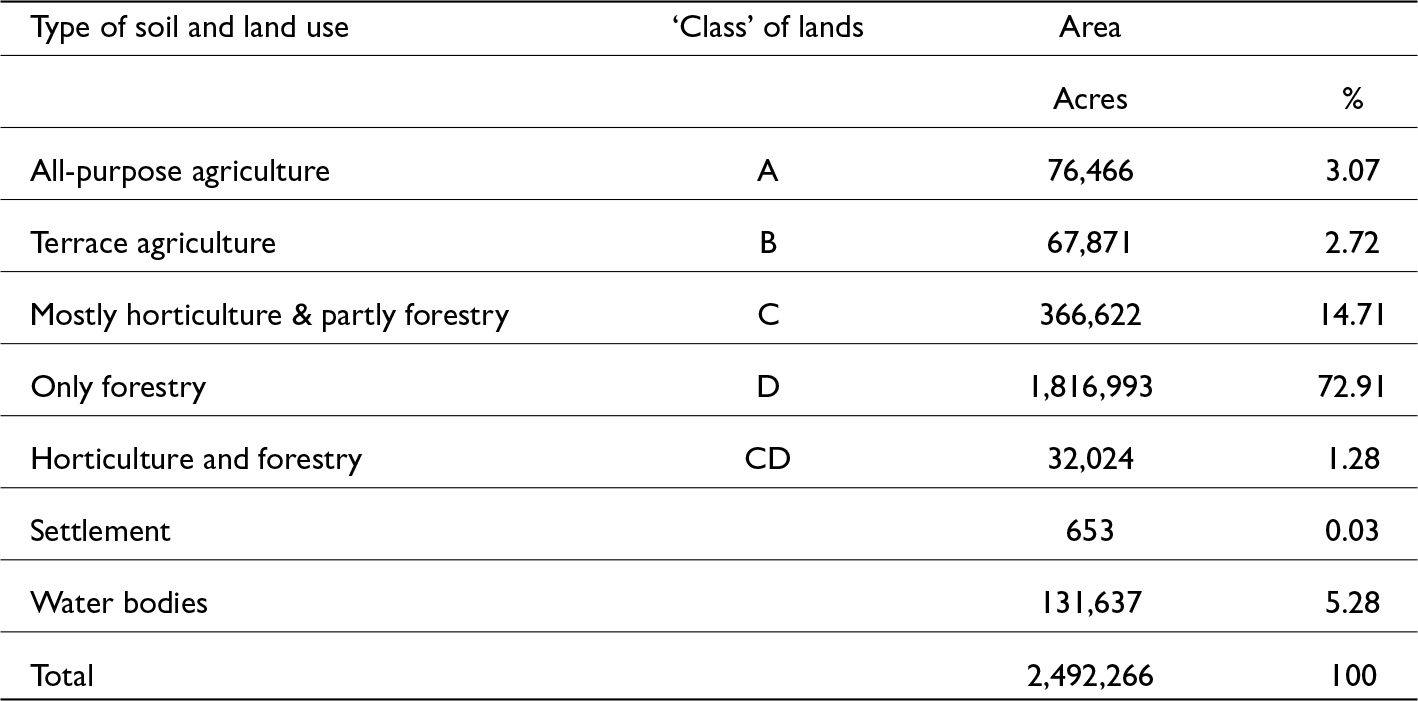
The second leg of the counter-insurgency strategy was demographic engineering through population resettlement from the country’s plainland to the CHT. Before embarking on a discussion on population transfer, it is pertinent to offer a clarification on the issue. It is generally posited that the CHT is a sparsely populated area in one of the most densely populated countries of the world, occupying about 10 per cent of the country’s landmass with less than 2 per cent of its population; for this reason, it was conceived that people could, and should, move to the CHT. While the geographical size of the CHT is relatively large, it is important to note that the area is basically a land of hills and forest and has scarce cultivable land (only 3.07 per cent is ‘all-purpose agricultural land’; see Table 2) which makes it less suitable for resettlement. Furthermore, the problem was compounded by the construction of the Kaptai Dam which inundated 40 per cent of the district’s agricultural land, as noted above. Additionally, the population transfer was questionable due to its political nature. Settlement in the CHT can be divided into two categories: natural and political.Footnote 68 People from outside the CHT historically moved for farming, business, jobs, and other natural reasons. In the context of the other category, the Bangladesh government moved people for political reasons, i.e. the resettlement programme of the 1970s and 1980s when 400,000 people were moved. It is not that natural reasons were totally absent in this population transfer; indeed, from the standpoint of the settlers, the decision to move was primarily due to their poverty and landlessness caused by flood and river bank erosion, etc.Footnote 69 However, what is in question here is the state’s objective in moving people for demographic engineering. This point will be further elaborated below.
CHT soil type and land use.

Source: Adnan, Migration, p. 112.
As the armed conflict between the SB guerrillas and state security forces began to intensify in the late 1970s, the Zia military regime initiated a resettlement programme in order to alter the demographic balance of the region. A classified official document reveals that hundreds of thousands of Muslim Bengalis would be transferred to the CHT and each settler family would receive five acres of hilly land, four acres of mixed land, and two-and-a-half acres of paddy land.Footnote 70 Deputy commissioners (DCs) of plain districts (particularly in the adjoining districts of Chittagong and Noakhali) were instructed to select people from their administrative areas for resettlement. Some DCs opposed the plan, considering its adverse consequences on the socio-economic patterns and the natural environment of the CHT.Footnote 71 Other DCs, however, followed the government’s instructions and rounded up people for resettlement. With the support of the civilian administration in the CHT, the resettlement programme was implemented by the military.
The Bangladesh government has not officially disclosed the number of people that were resettled in the CHT under the programme. According to the CHT Commission, 400,000 Muslim Bengalis were moved to the CHT for permanent settlement from 1978–1984 and the figure was corroborated by government officials.Footnote 72
The immediate goal of the programme was to populate the CHT with the ‘right people’ (i.e. Muslim Bengalis) and establish demographic ‘facts on the ground’. This would reduce the support base of the SB guerrillas which would contribute to the defeat of the insurgency. Initially, settlers were placed in a ‘Guccha Gram’ (cluster village) following the American ‘strategic hamlet’ idea deployed in the Vietnam War.Footnote 73 Afterwards, they were moved to different locations for permanent settlement. Settlements were organized in such a manner so as to restrict the movement of and support for the SB guerrillas, thus helping to contain the insurgency. From their arrival, the settlers were provided with security and supported with rations under a programme called ‘Santakaran’ (Pacification); this programme continues to this day, albeit on a more limited scale than previously.
The initial goal of right-peopling and changing the demographic facts on the ground was largely achieved following the completion of the programme in 1984. It was reflected in the 1991 population Census, as Table 1 shows.
As can be seen, the Bengali population in the CHT had increased to nearly 50 per cent by 1991 (although many people thought the figure could be higher as I found in interviews conducted during field trips). Importantly, the armed activities of the SB guerrillas started to decrease by the late 1980s. By that time the JSS had become more responsive to negotiations to end the conflict. Substantive initiatives were undertaken for a negotiated settlement of the insurgency in early 1990s which culminated in the signing of an accord in 1997.Footnote 74
While the population settlement was undertaken with the initial goal of right-peopling to counter the ongoing insurgency, it embedded an underlying goal of unpeopling the existing inhabitants in order to establish territorial control and influence the ‘pattern of sovereignty’ over the contested area. At a later stage, the unpeopling goal, as will be discussed below, would become central in the counter-insurgency strategy. The embedded goal of unpeopling the Paharis in the period from late 1970s to the early 1990s was accomplished in three ways: (1) land dispossession; (2) massacre; and (3) conversion.
Land dispossession
Since the late 1970s, Pahari land dispossession has gradually increased.Footnote 75 Notably, it was accelerated with the arrival of settlers under the 1978–1984 population transfer programme as settlers were given ‘legal land ownership by the state’ and also because of the ‘illegal possession of [Pahari] lands, through steady encroachment and outright grabbing’.Footnote 76
Arguably, Pahari land dispossession was a consequence of the population transfer programme because the CHT did not have enough land to resettle the number of people that were brought in under the resettlement programme. As an area of hills and forest, the CHT has limited cultivable lands as Table 2 shows.
The population transfer programme was accomplished despite the unavailability of lands in the CHT shown in Table 2. As noted earlier, it was planned to allocate five acres of hilly land, four acres of ‘mixed’ land, and two-and-a-half acres of paddy land to each settler family. As 400,000 people (or roughly 100,000 families if we calculate four persons in a family) were brought in, the different types of land requirements to accomplish the programme are shown in Table 3.
Required lands for settlement.

As can be observed, there was not enough cultivable land to resettle population in the CHT (76,466 acres availability against the requirement of 250,000 acres), notwithstanding its relatively large geographical size.Footnote 77 As the Chakma Circle Chief Raja Devasish Roy has maintained:
If we now look at the man to land ratio in the 1970s, i.e. before the settlers were brought in, and then look at the requirements for just the first of several batches of settlers that eventually came to the CHT, we get a very dismal picture. There simply were no paddy lands that were not already under the plough.Footnote 78
Hence, the government failed to provide the cultivable land to the settler families that was promised. Consequently, they began to usurp Pahari lands by evicting the Paharis from their homes and lands; in so doing, settlers received support from the security forces.Footnote 79
Importantly, such eviction and usurpation of Pahari lands continued even after the conclusion of a peace accord in 1997.Footnote 80 Thousands of Pahari people were displaced during the course of the armed conflict between the security forces and the SB guerrillas. Many Paharis moved to urban areas from villages for shelter.Footnote 81 Some even crossed the international border and took shelter in India.Footnote 82 In most cases both internally displaced people and international refugees who returned following the conclusion of the 1997 accord did not get back their lands.Footnote 83
The dispossession of Pahari lands has set them in a process of gradual unpeopling. It is pertinent to note that land/territory is integral to their identity as a people and it is important for cultural and spiritual as well as other mundane reasons.Footnote 84 As more settlers arrived, more land dispossession occurred, thus accelerating the process of unpeopling. Notably, the unpeopling process appears to be consistent with the statement of the Chittagong Division’s commanding officer of Bangladesh armed forces in which he said that ‘We want the land and not the people (of CHT).’Footnote 85
Massacres and ‘creeping genocide’
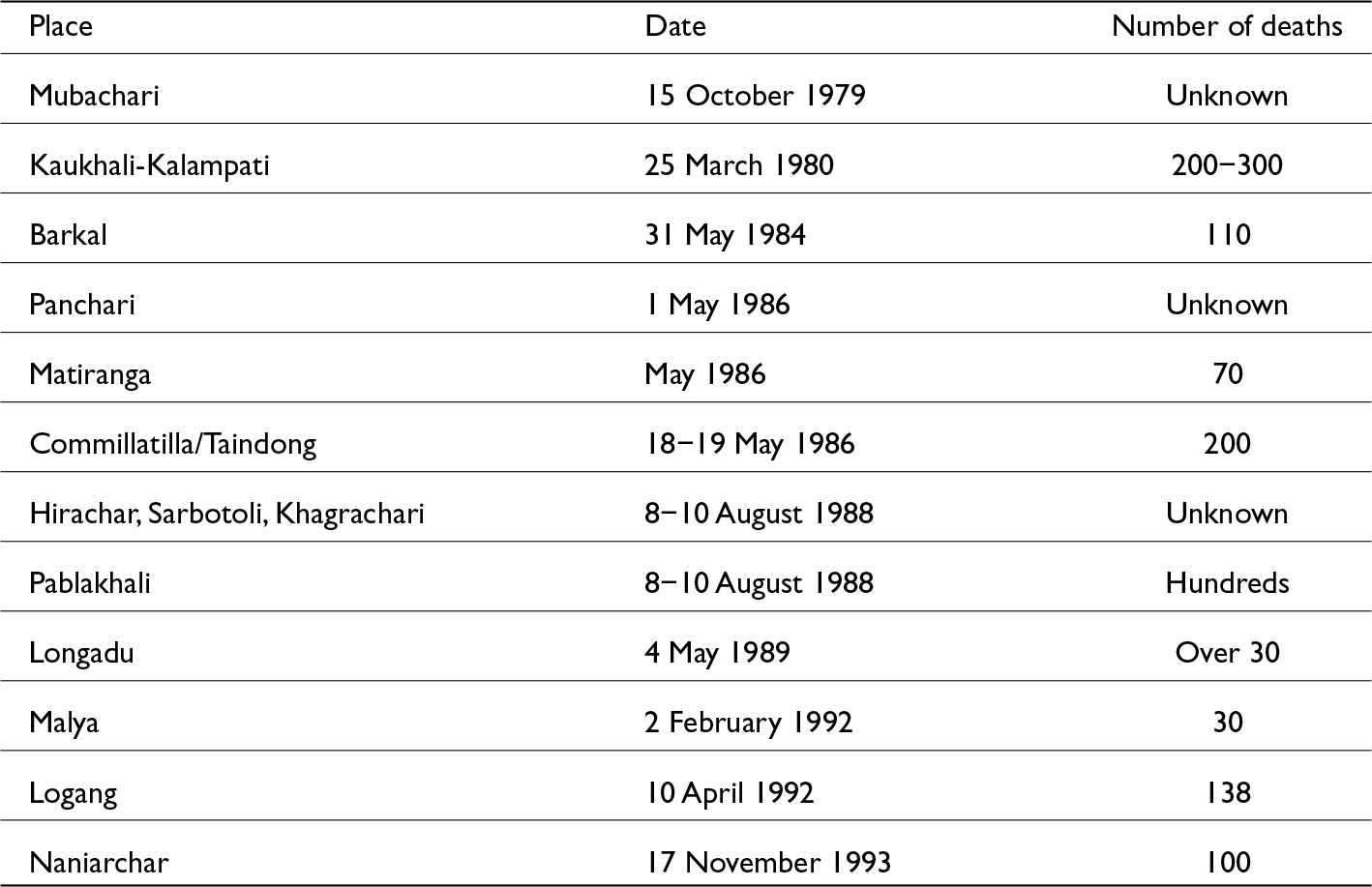
If land dispossession represented an indirect and gradual process of unpeopling, a more direct approach could be observed in 13 massacres that occurred between the late 1970s and the early 1990s as Table 4 highlights.
Massacres in the Chittagong Hill Tracts.

Sources: Compiled from various sources, including The CHT Commission, ‘Life is Not Ours: Land and Human Rights in the Chittagong Hill Tracts, Bangladesh’, The Report of the Chittagong Hill Tracts Commission, May 1991 and updates; Amnesty International, Bangladesh: Unlawful Killings and Torture in the Chittagong Hill Tracts (London: Amnesty International, 1986);\, Amena Mohsin,\, The Politics of Nationalism:\, The Case of the Chittagong Hill Tracts, Bangladesh (Dhaka: University Press Ltd., 1999); Jenneke Arens, ‘Genocide in the Chittagong Hill Tracts, Bangladesh’, in Genocide of Indigenous Peoples: A Critical Bibliographic Review, (eds) Samuel Totten and Robert K. Hitchcock (New York: Routledge, 2011).
As can be seen, the first massacre took place in Mubachari on 15 October 1979 following the arrival of initial groups of settlers. It was carried out jointly by the settlers and the security forces.Footnote 86 It was followed by another such incident at Kaukhali-Kalampati village in March 1980, which marked the start of a pattern of such incidents. In Kaukhali-Kalampati, on the day of the massacre, the area commander of the Bangladesh Army invited the Pahari villagers to reconstruct the crumbling Buddhist temple. Once the villagers assembled, the security forces began to shoot indiscriminately. Scores of Paharis died instantly; those who fled were attacked by settlers waiting outside the village where many more were killed.Footnote 87
Thirteen incidents of organized killings in 14 years from 1979 to 1993 highlight a pattern in terms of frequency and objectives. Levene argues that the massacres of the 1970s and 1980s constituted the ‘crossing of the Rubicon from a genocidal process’ to ‘active genocide’.Footnote 88 While those incidents manifested a direct approach to unpeopling, it was accomplished in the context of the initial goal of right-peopling to defeat the insurgency. Through such massacres, the Bangladesh security forces primarily sought to discourage the Paharis from supporting the SB guerrillas. As can be discerned, right-peopling and unpeopling objectives were intertwined at this stage in the pursuit of demographic engineering.
Conversion
While religious conversion has been a historical phenomenon in the Indian subcontinent, what has made conversion in the CHT problematic is its political character and motivation. In the case of the CHT, ‘forced religious conversion’ has been used as a policy of assimilation in which the Jamaat-i-Islami (a national political party) and the military have played an important role.Footnote 89 Young Muslim women have been encouraged to marry Pahari men after converting them to Islam.Footnote 90 In a similar fashion, Bengali men and military personnel have been encouraged to marry Pahari women and convert them to Islam.Footnote 91
Islamic non-governmental organizations (INGOs) played a key role in this context, for which they received support from various state institutions. In the 1980s, NGOs were not allowed to operate in the CHT, except Al Rabita, a Saudi and Kuwaiti government-funded Islamic mission. It operated extensively in various parts of the CHT with the blessing of state institutions.Footnote 92 Al Rabita used financial and employment inducements to convert poor Pahari people to Islam.Footnote 93 Indeed, the Islamization of the CHT has been a growing trend from the early 1980s onwards.Footnote 94
The analysis in this section reflects that the mono-national constitution in 1972 facilitated a state policy of assimilation towards minority ethnicities which led to the rise of insurgency in the CHT. The Bangladesh government deployed a two-pronged counter-insurgency strategy—militarization of the CHT and demographic engineering. While the immediacy of militarization, which aimed to counter the insurgency can be discerned, population resettlement was a strategic choice that had far-reaching consequences. As analysed, right-peopling or changing the demographic balance was the initial goal of population resettlement in order to contain the insurgency. This was achieved by the late 1980s after which there was a downturn in insurgency. The right-peopling element of the counter-insurgency, however, embedded an element of unpeopling which was accomplished in three ways—land dispossession, massacres, and conversion. In other words, right-peopling and unpeopling policies were deployed simultaneously and in an intertwined fashion. But in later years the priority would shift to the unpeopling policy, as will be discussed below.
The politics of peace and surreptitious population settlement
After engaging militarily for more than two decades (1975–1997), the Bangladesh government and the PCJSS signed an accord on 2 December 1997 to bring the armed conflict in the CHT to an end. The accord raised hope for lasting peace in the conflict-torn region and resolution of long-standing issues such as the land dispute, Bengali settlement, regional autonomy, etc. Those expectations, however, have remained largely unfulfilled even though more than two-and-a-half decades have passed since the signing of the accord. The process of building peace in the past 27 years has produced what analysts have dubbed ‘violent peace’.Footnote 95 Indeed, conflict has not only persisted in the post-accord CHT, the conflict spectrum has widened and become increasingly complex.Footnote 96
The key questions, then, that come to the fore are: (1) why has the 1997 accord failed to build durable peace?, and (2) why has conflict not only persisted but widened in an era of peace building? Addressing these questions is important because they relate to the CHT’s demographic politics and the pursuit of an unpeopling policy in the post-accord era.
There are multiple reasons for the failure of peace and the widening of the conflict spectrum in the post-accord CHT, but three sets of reasons stand out: (1) non-implementation of the accord; (2) legacies and continuation of past policies deployed in the pre-accord era by the Bangladesh government; and (3) intra-Pahari conflict.
Non-implementation of the accord
According to the University of Notre Dame’s peace accord database, the CHT accord scored 49 in terms of implementation after ten years (1997–2007) and since then updates have not indicated any change to the 2007 implementation status.Footnote 97 Indeed, the accord has not been implemented fully and, more importantly, key clauses of the accord have remained unimplemented.Footnote 98
Before addressing non-implementation of the accord, it is pertinent to illuminate two issues with the document. First, the accord has a major structural weakness. It is not a time bound agreement and, more critically, it does not have constitutional validity. The Awami League government did not take any steps in this regard following the conclusion of the accord. Lack of constitutional validity made it vulnerable to the wishes of future governments, which might not comply with the accord or might even abrogate it. This weakness became apparent when the Bangladesh Nationalist Party (BNP) and Jamaat-i-Islami (JI) coalition government pursued a policy of wilful neglect towards the accord after assuming power in 2001. For one thing, the two political parties had opposed the accord when the AL government signed it in 1997. After forming the government in 2001, they neither took steps to implement the agreement nor did they repeal it altogether.
Another drawback of the accord was that it failed to address the core issues of the CHT problem. Of these, two issues stood out: (1) land rights of the Pahari people; and (2) Bengali resettlement.Footnote 99 While the former issue was noted in the 1997 accord and a mechanism was devised to settle land disputes,Footnote 100 the latter issue was not even mentioned. JSS leaders later claimed that the two sides had reached an informal agreement on the issue of Bengali settlers: there would be no more Bengali settlement and those who had settled would be gradually withdrawn.Footnote 101 However, the Bangladesh government denied reaching such an understanding.Footnote 102 Therefore, the accord failed to address core issues of the CHT problem. It largely explains why durable peace could not be built and why conflict persisted in the post-accord era.
Second, the Bangladesh government was neither honest in signing the accord nor has it been sincere in implementing the key provisions of the document. At the time of signing the accord, government negotiators were aware that some clauses of the document would not be implemented. Hangsha Dhash Chakma, the chief of the liaison committee, later said that the Bangladesh government signed the accord ‘instinctively’ and never meant to fully implement it.Footnote 103 A member of the government’s own advisory committee has asserted that the Bangladesh government undertook a ‘fakkarami’ (deceitful act) because they signed the accord knowing that some clauses would not be implemented.Footnote 104
Consequently, the accord has not be implemented in 27 years and it is questionable whether this will ever occur. Most importantly, its important clauses have remained unimplemented.Footnote 105 Some of the key issues within those clauses are as follows.
One, as per the accord, the temporary military camps would be closed down; as of late 2024, this has not occurred.Footnote 106 To date the CHT remains a heavily militarized area. As the Economic and Social Council of the UN has reported: ‘with its pervasive power and influence … the army continues to oppose any substantive progress on the implementation of the Accord … [R]ather than a diminishing of the powers of the military in the region in accordance with the Accord there has been a further strengthening of the control of the military’.Footnote 107
Two, the accord provided for the creation of a land commission to settle land disputes. Although the Chittagong Hill Tracts Land Dispute Resolution Commission was established in 1999 and the national parliament passed a law in this regard in 2001 (amended in 2013), it has not functioned thus far. Indeed, the Commission is yet to resolve any land dispute of the 27,000 pending cases.Footnote 108
Three, it was agreed in the accord that the police force in the CHT would be reformed and power to manage the force would be devolved to the local councils in the CHT. This provision remains unimplemented and ‘… relevant power according to this provision has not been transferred to Hill District Councils’.Footnote 109 It does not appear that this will happen in the foreseeable future. The key implication is that the composition of the police force is imbalanced and this is key to why communal violence in the CHT cannot be tackled properly.Footnote 110
Four, no election has taken place thus far for local institutions, as agreed in the accord. For example, the Regional Council, which was created under the terms of the accord, has been running on an ad hoc basis without elections for the past 27 years. Similarly, the three Hill district councils (Rangamati, Khagrachari and Bandarban), which were created in 1989, have yet to hold an election. These councils were meant to be representative bodies under the terms of their creation.
Therefore, durable peace has largely failed to take hold as was expected following the signing of the accord. The non-implementation of the accord is a key reason why conflict has persisted in the post-accord CHT, complemented by and linked to the continuation and legacies of past government policies as explained below.
Counter-insurgency and population settlement: Continuation and legacies
The continuation and legacies of past policies pursued in the 1970s and 1980s played an important role in the failure of peace and the persistence and gradual increase in conflict in the post-accord CHT. Two specific policies are noteworthy in this context. The first is that counter-insurgency has been largely maintained as the state approach in the CHT even after the signing the peace accord. The second is the legacies of population resettlement and surreptitious continuation of settlement in the post-accord era.
Notwithstanding the signing of the CHT accord in 1997, the area has remained under the control of the armed forcesFootnote 111 and the military continues to operate its counter-insurgency strategy.Footnote 112 This approach has not helped to build peace on the basis of the 1997 accord. Instead, the security forces and their mode of operation in the CHT have turned into what has been characterized as a ‘spoiler problem’.Footnote 113 The continuation of the counter-insurgency strategy is manifested in numerous ways. Military deployment today remains almost similar to the 1980s level and temporary military camps have not been closed down as agreed in the accord.Footnote 114 Military check-posts have remained the same as they were during the days of insurgency in the 1980s.Footnote 115 However, a distinction needs to be noted between the approaches of the counter-insurgency strategy of the pre- and post-accord eras. In the former right-peopling was the priority, but in the latter unpeopling is the key goal.
The legacy of the population resettlement programme of 1978–1984 and its long-term consequences have been a major source of conflict in the post-accord CHT. The programme generated conflict over land between the Paharis and the settlers which increased over time and spilled over into a range of areas of the conflict spectrum, i.e. social, cultural, gender, economic, political, etc. In particular, social tension, inter-community mistrust, and competition for jobs have increased in the post-accord era.Footnote 116
Although no state-sponsored resettlement programme has been initiated in the post-accord era (indeed, since the mid-1980s), population settlement has continued in three ways: (i) as an outgrowth of the 1978–1984 resettlement programme; (ii) driven by the INGOs; and (iii) the initiation of public and private development projects (‘logic of development’).
Outgrowth of the 1978–1984 programme
After ceasing state-sponsored transmigration in the mid-1980s, settlement continued as an outgrowth of the 1978–1984 programme. These settlers subsequently brought in their families and encouraged relatives and friends to come to the CHT. Settlers were provided with rations (under the ‘Santakaran’/Pacification programme), employment, and security, which constituted significant incentives for many poor and landless Bengali peasants and people uprooted by natural disasters such as cyclones and riverbank erosion to permanently settle in the CHT. Many others were encouraged to come to the CHT to establish shops and other small businesses.
Resettlement by INGOs
Following the cessation of the state-sponsored resettlement programme in the mid-1980s, INGOs have played a key role in surreptitiously sponsoring settlement in the CHT. In the 1980s, only Al-Rabita, as noted above, was allowed by the government to operate in the area. Since the early 1990s, many INGOs have set up in the CHT. While no systematic data are available on INGO-sponsored surreptitious population resettlement, anecdotal evidence suggests such settlements have been taking place. During a visit, this author met a rickshaw puller in Khagrachari who arrived the day before and was given shelter at a mosque. He said that he was given a rickshaw by an INGO and would bring his family once he settled down with support from that INGO.
Government and private development projects and business enterprises
Settlement in the CHT has also occurred through neoliberal economic processes. The Bangladesh government has initiated many development projects in the CHT in recent decades in various sectors such as tourism, education, horticulture, etc., which has facilitated settlement from outside the CHT. Concerns have arisen over the demographic implications. The PCJSS opposed the implementation of big projects such as the establishment of the Rangamati University of Science and Technology and the Rangamati Medical College, etc. due to concerns that they would facilitate settlement and make the Paharis a minority in their own land.Footnote 117 Tourism projects implemented by the government and private companies have raised similar concerns. In addition, there is disquiet that those projects would lead to the eviction of the Paharis from their homes and lands. The controversy over the construction of a five-star hotel in Bandarban is a case in point as eviction would be needed to accomplish the project.Footnote 118 The implications of the neoliberal economic process is a cause of the gradual unpeopling of the Paharis, particularly through land dispossession.Footnote 119
Therefore, settlement has continued in three ways in the post-accord era and, importantly, it has occurred when a peace-building process has been underway. Although not state-sponsored initiatives, they have implications for the demographic dynamics of the CHT and gradual unpeopling of the Paharis through land dispossession, which is explored in greater detail in the next section.
Intra-Pahari conflict
Conflict between various Pahari political groups has been a key factor in the failure of peace in the CHT.Footnote 120 Following the signing of the accord in 1997, the United Peoples Democratic Front (UPDF) announced that it opposed the accord because it failed to address key issues of the CHT people.Footnote 121 It triggered a rivalry between the JSS and the UPDF which continues to this day. Subsequently, both groups split, giving rise to two factions—the JSS (Reform) and UPDF (Democratic). The four political groups have been embroiled in turf wars and many of their members have been killed in violence.Footnote 122 Two other political groups—the Mogh Party and Kuki-Chin National Front (KCNF)—have joined the fray in recent years.Footnote 123
However, Paharis claim that these groups are propped up by the Bangladesh Army and the intelligence agencies.Footnote 124 Rights activists, NGO workers, and civil society members claim that the Bangladesh military has divided and subdivided the Pahari political groups and armed them to fight against each other.Footnote 125
Transition from right-peopling to unpeopling
When the 1978–1984 settlement programme was implemented, the initial goal and policy orientation was right-peopling or populating the CHT with preferred people in order to change the demographic balance so that the ongoing insurgency could be countered. The policy, however, had an element of unpeopling or making the existing inhabitants non-existent. In other words, both right-peopling and unpeopling policies were deployed simultaneously, although the former had priority. Once the right-peopling goal was largely achieved by the late 1980s, the focus gradually shifted towards the goal of unpeopling. This transition can particularly be observed in the wake of the signing of the 1997 accord. The key reason for pursuing the policy of unpeopling even after signing the 1997 accord is that the state sought to curtail the ability of the Paharis so that the earlier style rebellion would not occur in the future and also to thwart the possibility of external intervention either from the foreign government/s or co-ethnics living on the other side of the border. The theoretical implication of this transition is that state objectives for demographic engineering may shift from one goal to another and it occurs in the context of changing circumstances.
So, how do we know the focus has shifted and what techniques are being used to pursue the goal of unpeopling after the 1997 accord? Based on the information collected from the two fieldwork trips, the following techniques can be observed.
Surreptitious population settlement
While no state-sponsored population transfer has been undertaken since the mid-1980s, there has been significant population migration, as discussed in the preceding section. Particularly noteworthy in this context is unofficial population transfer by the INGOs in which the security forces and civilian administration are tacitly complicit.Footnote 126 It implies that the state authorities are supportive of further altering the demographic balance in the CHT which will result in the gradual unpeopling of the Paharis as discussed below.
Slow-motion unpeopling
No organized killing has taken place in the CHT since 1994. Instead, a slow-motion, low-key unpeopling process has been underway resulting from surreptitious settlement, land dispossession, growing Islamization, etc.Footnote 127 More settlement means more Pahari land dispossession due to purchase or usurpation.Footnote 128
Paharis were displaced during the years of insurgency, their homes and lands taken over by settlers. A mechanism was devised to decide the land disputes in the 1997 accord, but no land dispute has yet been resolved, as discussed above. Land dispossession has created a process of slow-motion unpeopling in the post-accord CHT. Growing land dispossession has induced a situation of uncertainty among the Paharis about their future. Hence, many Paharis are leaving the country and moving to India,Footnote 129 thus accelerating the process of the unpeopling of the Paharis.
Islamization
The Islamization of the CHT has been a growing trend in the past few decades through INGO-driven surreptitious population settlement and conversion.Footnote 130 Indeed, ‘forced marriages to Bengali Muslims, involving religious conversion and rape are common in the CHT’.Footnote 131 Furthermore, INGOs use inducements such as financial help, job offers, free education, etc. to convert poor Paharis and their families to Islam.Footnote 132 In some cases such inducements have been controversial; for example, many poor Pahari families agreed to send their children away from home for free education, who were then placed in madrasas.Footnote 133 There were no Pahari Muslims before 1980, but in recent decades several Muslim organizations for new converts such as Upajatyo Muslim Kalyan Sangstha (Tribal Muslim Welfare Organisation), Upajatyo Muslim Adarsha Sangstha (Tribal Muslim Ideal Organisation), etc. have emerged.Footnote 134 It reflected a growing trend of Islamization in the CHT. It is pertinent to point out that conversion and Islamization means the loss of Pahari identity and as a people in the context of the CHT.
The politics of population statistics
Manipulation of population data, a theoretically explainable variable in demographic engineering, can be observed in the case of the CHT.Footnote 135 Evidently, the Bangladesh authorities manipulated population data at various stages of demographic engineering in the CHT to realize the objectives of right-peopling and unpeopling. Indeed, the Bangladesh authorities began to manipulate CHT’s population data from the mid-1980s onwards following the completion of the 1978–1984 population transfer programme. As noted earlier, the population data of the 1991 Census, which showed the Pahari-Bengali population ratio at 51.43 per cent and 48.57 per cent respectively (see Table 1), is disputed because the percentage of the latter group should be higher following the resettlement programme. Since then, the Pahari-Bengali population ratio has changed marginally in the data of the subsequent censuses. The 2001 Census did not provide separate data on the population size of the Paharis and the Bengalis, although it did provide population data on the basis of religion. But that does not give a clear picture of the Pahari-Bengali population ratio.Footnote 136 In the 2011 Census, the Pahari-Bengali ratio was shown at 52.90 per cent and 47.10 per cent respectively. It meant that Pahari population had grown at a higher rate than the Bengali population in the preceding two decades since the 1991 Census. This is disputed because surreptitious population settlement, as discussed above, continued after mid-1980s following the completion of the state-sponsored population resettlement programme. The provisional data of the 2022 Census show the Pahari-Bengali ratio at 49.93 per cent and 50.07 per cent respectively.Footnote 137 As can be seen, the Bengali population has a marginal edge over the Pahari population. The Bengali population in Khagrachari and Bandarban districts has overtaken the Pahari population, although the latter group remains slightly larger in the Rangamati population data. The data sets are contested by many people as this author found during field research in the CHT.Footnote 138
Therefore, the population data in various censuses have been manipulated. There were at least two reasons for this. First, the government feared the reaction of Western countries if actual population data were revealed. It was concerned that Western countries could apply pressure to withdraw Bengali settlers. It also feared that Western countries could cut foreign aid which would have a serious impact on the country’s economy.Footnote 139 Second, the government did not want to show that a programme of demographic engineering was underway. The manipulation of the CHT population data was primarily intended to hide the state’s intention regarding the CHT.
Conclusion
Demographic engineering is a fledgling theory which focuses on a state’s decision and goal to transfer populations from one part of the country to the other. In its current state of development, it is asserted that states decide to move people to gain territorial control over a contested area generally inhabited by minority ethnicities. But what is not clear in the current scholarship is what policy approaches states deploy to establish territorial control. To be precise, it is not clear in the contemporary theoretical literature whether states seek to gain territorial control by pursuing a policy of right-peopling (altering demographic balance) or by applying an approach of unpeopling the existing inhabitants. This article has addressed this theoretical lacuna by exploring the case of demographic engineering in the CHT.
Political demography in the Indian subcontinent began to take firm hold with the rise of the nation-state system at the end of colonial rule in 1947. New boundaries and various ethno-areas in the new states became contested ethnoterritories. The CHT was one such area, initially in Pakistan and later in Bangladesh. The area became even more contested as the Bangladesh state had a tendency to homogenize and pursued a policy of assimilation towards the Pahari people in order to subsume them into the Bengali nation. An armed rebellion flared up in the CHT against the assimilationist policy.
To quell the armed rebellion, the Bangladesh authorities adopted a two-pronged counter-insurgency strategy: massive military mobilization and demographic engineering through population resettlement in the CHT from other parts of the country. The second element of the strategy was implemented by moving 400,000 Muslim Bengalis (preferred people) between 1978 and 1984 in order to alter the demographic balance of the area and counter the ongoing insurgency. The theoretical implication of this decision is that states move people and pursue demographic engineering against an internal rebellion. While internal threat was the primary cause of moving people, it had an external element, i.e. the possibility of intervention from India and/or Myanmar or co-ethnics living on the other side of the border. This concern was indeed proved right when it was found that Indian authorities secretly aided the Pahari guerrillas in the 1980s and gave them sanctuary.
Dhaka’s internal and external threat perception in relation to the CHT still persists. This is reflected in the construction of a 1,036 km long road along the CHT-India and CHT-Myanmar borders. Importantly, the project has been implemented by the Bangladesh military, although it was authorized by the Ministry of Road Transport and Bridges.Footnote 140 The long border road has been constructed to prevent the possibility of future rebellion in the CHT and thwart external intervention in the contested ethno-territory. Therefore, external threat was at least partially a factor for demographic engineering in the CHT.
There are two pathways for states to gain territorial control through demographic engineering: right-peopling and unpeopling. As explained, the initial objective of the Bangladesh authorities to move preferred people to the CHT was right-peopling or altering the demographic balance of the area and defeating the insurgency. However, it embedded an element of unpeopling the existing inhabitants or making them ‘non-existent’. This was manifested in growing Pahari land dispossession, incidents of massacre, and religious conversion. Of course, the process of unpeopling, as analysed, has been aided by the ‘logic of development’, primarily the neo-liberal economic process in contemporary times.
The attainment of the right-peopling goal—alteration of demographic balance and containment of insurgency—was achieved by the late 1980s/early 1990s. By that time, the focus of the government’s demographic engineering was shifting from right-peopling to unpeopling, which eventually took a firm hold following the conclusion of the 1997 CHT accord. In the post-accord era, an unpeopling policy has been pursued through surreptitious population settlement, land dispossession, Islamization, and population data manipulation. Importantly, the earlier technique of organized killing has been abandoned in favour of a slow-moving unpeopling approach. The transition from a right-peopling to an unpeopling policy is due to changed circumstances. The key reason for pursuing the unpeopling policy in the post-accord era is to reduce the ability of the Paharis to challenge the sovereignty of the state in the future. Notably, the unpeopling goal has been pursued even though a peace-building process has been underway following the signing of the 1997 accord.
As the insights from the CHT case highlight, states generally pursue a right-peopling policy at the initial phase of demographic engineering, although it embeds the motivation for unpeopling. The initial emphasis is on countering internal rebellion and/or external threat from foreign governments and/or co-ethnics living on the other side of the border. Once the right-peopling goal is achieved, the priority of demographic engineering shifts to the unpeopling of the existing inhabitants to erode their ability to rebel against the state in the future. So, right-peopling and unpeopling policies and their associated goals are pursued simultaneously in the initial phase of demographic engineering. But it functions as a continuum and moves from right-peopling to unpeopling with a change of circumstances. These insights from the case of the CHT can be useful to explain such population settlement initiatives elsewhere.
Funding statement
Funding for two field trips for this article was provided by the Social Sciences and Humanities Research Council (Canada) under a research project ‘Population Settlement and Territorial Control’ led by Professor Oded Haklai of Queens University, Canada. I am grateful to the SSHRC and Professor Haklai for the funding.
Competing interests
The author declares none.