



Introduction
Heleomyzidae is a small family of mostly saprophagous acalyptrate Diptera that is found in all biogeographic regions except Antarctica (Woźnica and Kirk Spriggs Reference Woźnica2021). There are a few recorded instances of species of Heleomyzidae being introduced outside their native range. The Nearctic Pseudoleria pectinata (Loew) and P. placata (Hutton) have been introduced to the Oceanian region (McAlpine Reference McAlpine1984), and the former has also been introduced to the Old World (Woźnica Reference Woźnica2020). Prosopantrum flavifrons (Tonnoir and Malloch) was introduced from Oceania or South America into South Africa (Cogan Reference Cogan1971) and Europe (Stuke and Merz Reference Stuke and Merz2004). None of the above species are known to be pests of crops or food. However, El-Sayed (Reference El-Sayed2023) lists three European species of Suillia Robineau-Desvoidy as invasive pests outside Europe: two “truffle flies” Suillia gigantea (Meigen) and S. pallida (Fallén) (as Helomyza lineata (Robineau-Desvoidy)) and the “garlic fly” S. lurida (Meigen). Furthermore, the widespread Holarctic Tephrochlamys rufiventris (Meigen) was recently reported as a food pest in the United States of America, developing in stored blue cheese (Kimsey et al. Reference Kimsey, Kimsey and Gaimari2018). Here, we report the presence and distribution of three Palaearctic species of Heleomyzidae, Suillia variegata (Loew), Tephrochlamys flavipes (Zetterstedt), and Tephrochlamys tarsalis (Zetterstedt), in the United States of America and Canada.
Methods
Our data were derived in part from the online citizen science project, iNaturalist. On the iNaturalist website or using a mobile app, members upload photographs or audio recordings (known as “observations”) of organisms they have observed for identification by the community. Photographic observations were identified by C.S.A. and A.J.W., who referred to keys and descriptions from Collin (Reference Collin1943), Gill (Reference Gill1962), Gill and Peterson (Reference Gill and Peterson1987), and Gorodkov (Reference Gorodkov1989) in making their determinations. Observations on iNaturalist with a consensus species-level identification suggested by at least two identifiers are designated “Research Grade” and are automatically uploaded to the Global Biodiversity Information Facility database, from which we downloaded our iNaturalist data set (Global Biodiversity Information Facility 2024). Additional records include three photographs uploaded to the website, BugGuide.net (Elliott Reference Elliott2010a, Reference Elliott2010b; Stark Reference Stark2016), and two personal communications sharing photographs of S. variegata (Michael Davis, personal communication; Martin Hauser, personal communication).
We supplement the photographic data with additional DNA barcode–based records downloaded from the Global Biodiversity Information Facility (2024). These barcode data originated from the International Barcode of Life Project (hosted by the National Museum of Natural History, Smithsonian Institution, Washington, DC, United States of America), the Centre for Biodiversity Genomics at the University of Guelph (Guelph, Ontario, Canada), and the International Nucleotide Sequence Database Collaboration (https://www.insdc.org). Maps were produced using the web application, SimpleMappr (Shorthouse Reference Shorthouse2010).
Results
Suillia variegata (Loew)
Previously, only nine species of Suillia (including Allophyla Loew) were reported from the Nearctic region (Gill Reference Gill1962; Gill and Peterson Reference Gill and Peterson1987). The newly reported species, S. variegata, is most easily distinguished from all native species by its wing pattern, which consists of a dark subapical cloud and a pale wing tip (Fig. 1). Furthermore, no American species shares the combination of setae on the anepisternum with a tall oval eye and narrow gena. In Gill’s (Reference Gill1962) key to Nearctic Suillia species, S. variegata keys to couplet 3 but can be keyed no further.
Wing pattern of Suillia variegata. Specimen collected in East Yorkshire, United Kingdom. Photograph by Ian Andrews.

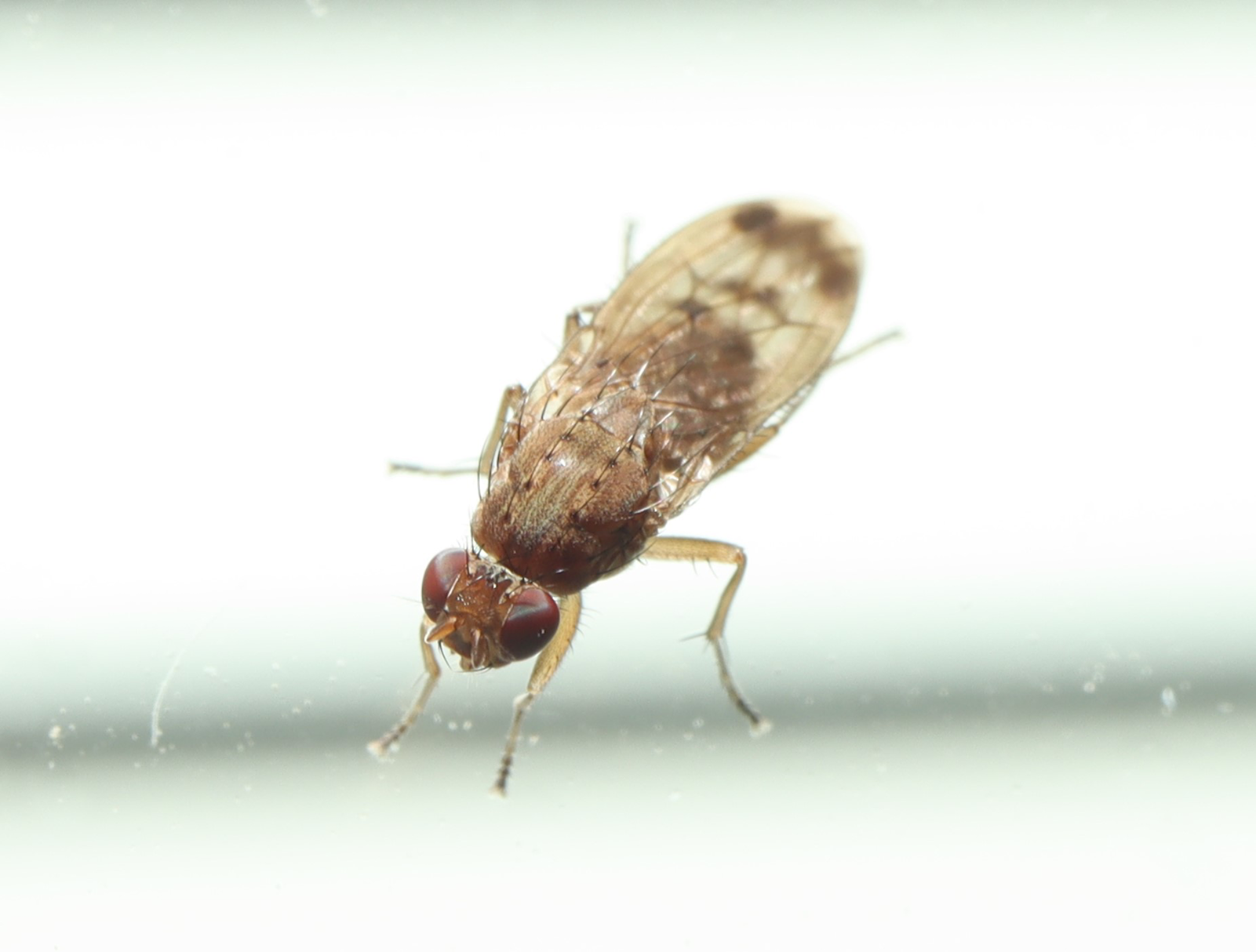
The presence of S. variegata in North America was first brought to our attention by a single fly photographed by Michael Davis in Portland, Oregon, United States of America, on 20 March 2020 (Fig. 2), who privately sent the photograph to A.J.W. for identification. Subsequent exploration by the authors of observations on iNaturalist and BugGuide revealed several earlier observations of this species in Oregon. The earliest known Nearctic record of S. variegata is a photograph taken in Portland on 18 May 2015 and uploaded to BugGuide by Stark (Reference Stark2016). Since then, the species has been recorded in other areas of Oregon and Washington, with the geographic range of reports increasing through time (Fig. 3).
Habitus of Suillia variegata photographed in Portland, Oregon, United States of America, on 20 March 2020. Photograph by Michael Davis.
Geographic distribution of observations of Tephrochlamys flavipes (blue triangles) and Suillia variegata (red circles) in the United States of America between 2010 and 2023. Each observation represents one or more photographs or specimens of an individual fly at a given time. The 2014 record of T. flavipes is based on DNA barcode data.

In August and October 2022, photographs of S. variegata taken in San Francisco, California, were uploaded to iNaturalist (Fig 3). In 2023, there were several additional reports of this species in California, not only in San Francisco but also further north, in Sue-meg State Park, Humboldt County. Furthermore, on 7 September 2023, a male and female of this species were collected in Napa County and submitted for identification to the Plant Pest Diagnostics Branch, California Department of Food and Agriculture (Sacramento, California), where they were examined by Martin Hauser. Hauser brought them to the attention of the second author, who also examined the specimens. These specimens in the California State Collection of Arthropods serve as vouchers for the presence of S. variegata in North America generally and in California more specifically.
To aid in the recognition of this species, we provide the following alterations to the key to Suillia species north of Mexico (Gill Reference Gill1962). Note that although Gill (Reference Gill1962) treated Allophyla as a separate genus in his revision, it is now considered a junior synonym of Suillia (Gorodkov Reference Gorodkov1965). Therefore, we have added an additional couplet to the beginning of the key distinguishing the species formerly placed in Allophyla. Suillia, in the broad sense, can be differentiated from the other Nearctic genus of the subfamily Suilliinae, Porsenus Darlington, by the presence of five pairs of dorsocentral setae (Porsenus has only one pair). A thorough treatment of Nearctic Suillia and a revised key to species will be presented in a future study.
Revised key to Suillia spp. north of Mexico
-
1A. Postpronotal seta absent 1
-
–. Postpronotal seta present “Allophyla” species
-
1. Mesopleuron [anepisternum] with setae or hairs (may be confined to posterior edge) 2
-
–. Mesopleuron [anepisternum] bare 5
-
2. Scutellum with hairs of dorsum confined to the lateral edges, mostly bare…Suillia apicalis (Loew)
-
–. Scutellum with hairs widely distributed on dorsum2A
-
2A. Cheek–eye ratio 0.25 or less; wing pattern consisting of a dark subapical cloud and a pale wing tip (Figs. 1–2) Suillia variegata (Loew)
-
–. Cheek–eye ratio 0.3 or greater; wing with a different pattern or mostly hyaline 3
Tephrochlamys flavipes (Zetterstedt)
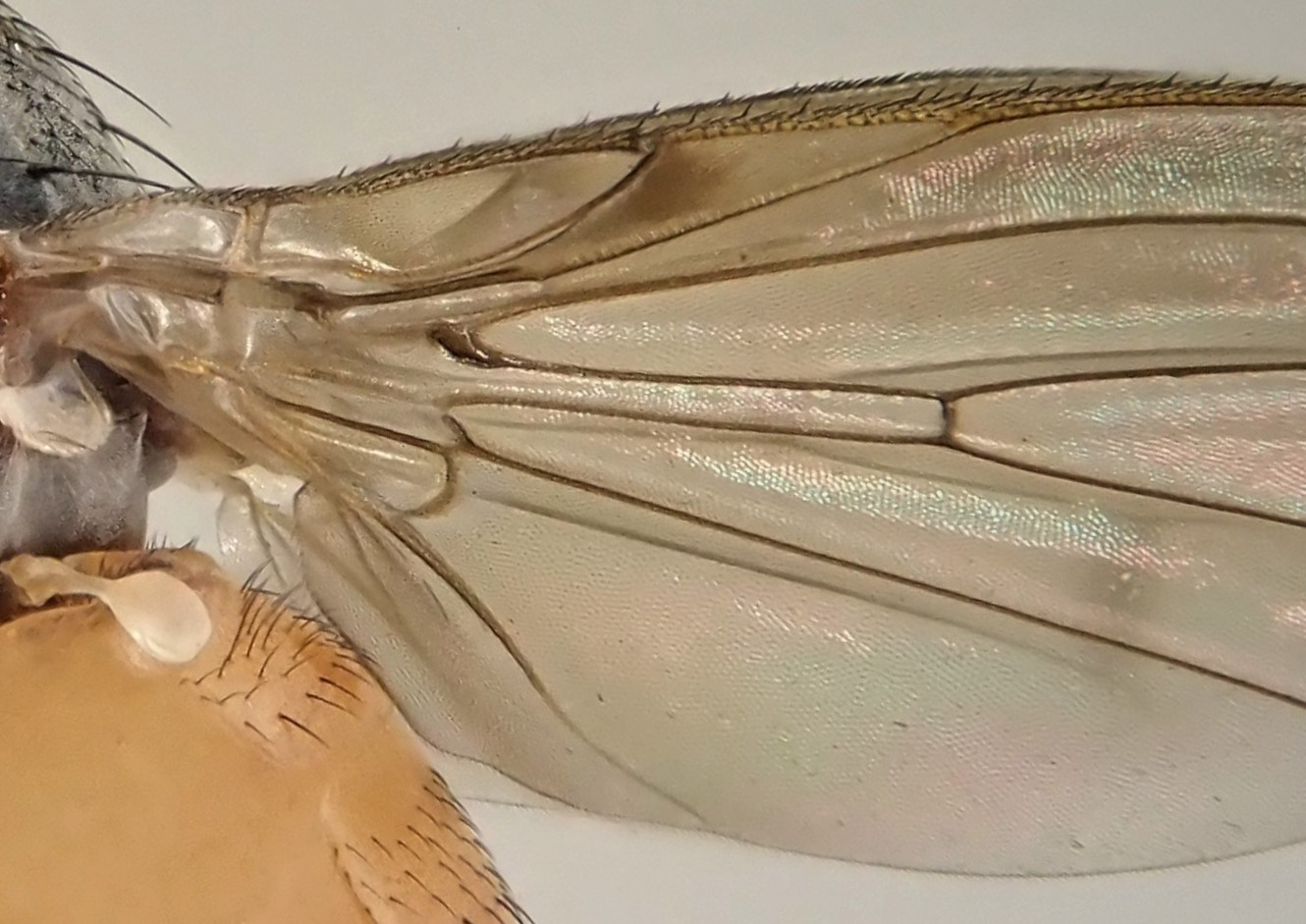
The second species of heleomyzid fly newly recorded in North America is Tephrochlamys flavipes (Zetterstedt). Only two species of Tephrochlamys Loew had previously been reported from the Nearctic region: T. rufiventris and T. flavitarsis Darlington (Gill Reference Gill1962; Gill and Peterson Reference Gill and Peterson1987). Two individuals from an aggregation of Tephrochlamys were photographed by Lynette Elliott in Bonney Lake, Washington, United States of America, on 20 March 2010 (Fig. 4) and uploaded to BugGuide (Elliott Reference Elliott2010a, Reference Elliott2010b). These flies were identified as two different species by A.J.W., with one being T. flavipes (Fig. 4A; Elliott Reference Elliott2010b) and the other T. tarsalis (Fig. 4B; see the following section). Tephrochlamys flavipes can easily be distinguished from T. rufiventris and T. flavitarsis by its wing pattern, consisting of a dark cloud in the basal half of the subcostal cell (Collin Reference Collin1943; Figs. 4A, 5), whereas the wing is entirely transparent in both T. rufiventris and T. flavitarsis (Gill Reference Gill1962). In addition, the anterior dorsocentral bristles of T. flavipes are closer to the second pair of dorsocentrals than to the transverse suture of the mesonotum (Fig. 4A), whereas those distances are equal in T. rufiventris (Fig. 4A; Gorodkov Reference Gorodkov1989). Tephrochlamys flavipes can be distinguished from T. tarsalis (Zetterstedt), another Palaearctic species with similar wing infuscations, by its pale gena and face (dark grey in T. tarsalis) and gently curved lower facial margin (sharply concave in T. tarsalis; Collin Reference Collin1943; Gorodkov Reference Gorodkov1989; Fig. 4A). In Gill’s (Reference Gill1962) key to Nearctic Tephrochlamys species, T. flavipes keys out to T. rufiventris.
Habitus of two Tephrochlamys species photographed in Pierce County, Washington, United States of America, on 20 March 2010: A, T. flavipes, anterior view, showing facial margin (main), dorsocentral bristles (inset, top right) with anterior dorsocentral indicated, and wing pattern (inset, bottom right) with subcostal cell indicated; B, T. tarsalis, dorsolateral view, showing the wing pattern and colouration of the fore femur. Photographs by Lynette Elliott.

Wing pattern of Tephrochlamys flavipes. Specimen collected in East Yorkshire, United Kingdom. Photograph by Ian Andrews.
We are aware of three subsequent reports of T. flavipes in the Nearctic (Fig. 3). A specimen was detected in 2014 in British Columbia, Canada, by the International Barcode of Life project, and in 2019 and 2023, iNaturalist users posted observations of this species from Seattle and San Juan Island, Washington, respectively. Thus, T. flavipes has persisted in the Pacific Northwest but appears not to be as abundant or widespread in the Nearctic as S. variegata is.
Tephrochlamys tarsalis (Zetterstedt)
The second species photographed in 2010 by Lynette Elliot in Bonney Lake, Washington, United States of America, was Tephrochlamys tarsalis (Fig. 4B; Elliott Reference Elliott2010a). This species was not reported again until 12 October 2023, when one specimen of Tephrochlamys tarsalis was photographed by Kevin Toomer on Galiano Island, British Columbia, Canada, and uploaded to iNaturalist (Figs. 6, 7; Toomer Reference Toomer2023). Subsequently, two iNaturalist users also observed this species in Washington in November 2023. As mentioned above, T. tarsalis has the basal half of the subcostal cell infuscated (Figs. 4B, 6B), similar to T. flavipes (Fig. 5), but can be differentiated by its dark grey gena and face (Fig. 6A) and its sharply concave facial margin. In addition, T. tarsalis has a distinct dark dorsal line on the fore femur (Figs. 4B, 6B) and the third segment of the arista is enlarged in the male.
Habitus of Tephrochlamys tarsalis photographed on Galiano Island, British Columbia, Canada, on 12 October 2023: A, lateral view, showing dark grey gena; B, dorsal view showing wing pattern and dark dorsal line on the fore femur. Photographs by Kevin Toomer.

Distribution of records of Tephrochlamys tarsalis in Canada from 2010 to 2023, based on genetic barcodes (blue circles) and new photographic evidence (green squares).

Tephrochlamys tarsalis has previously been reported from across Canada, based on DNA barcode records. In 2010, the species was reported in Manitoba and Labrador, and it has since been recorded from coast to coast (Fig. 7; Global Biodiversity Information Facility 2024). The 2010 BugGuide record and 2023 iNaturalist records we identified provide clear, verifiable evidence of the presence of T. tarsalis in Canada.
To aid in the recognition of these two newly reported species, we provide a revised key to the known Nearctic species of Tephrochlamys.
Key to Tephrochlamys species in the United States of America and Canada
-
1. Basal half of subcostal cell infuscated (Figs. 4B, 5, 6B) 2
-
–. Subcostal cell entirely hyaline 3
-
2. Gena and face pale (Fig. 4A); facial margin gently curved; fore femur without distinct dark grey dorsal line Tephrochlamys flavipes (Zetterstedt)
-
–. Gena and face dark grey (Fig. 6A); facial margin sharply concave; fore femur with distinct dark grey dorsal line (Figs. 4B, 6B)……………Tephrochlamys tarsalis (Zetterstedt)
-
3. Scutellum, postpronotum, and legs yellow………Tephrochlamys flavitarsis Darlington
-
–. Scutellum and postpronotum grey, concolorous with remainder of the thorax; fore femur darkenedTephrochlamys rufiventris (Meigen)
Discussion
The place, timing, and means of the initial introductions of Suillia variegata, Tephrochlamys flavipes, and T. tarsalis to the Nearctic cannot be known for certain. However, the natural history of these species and the distribution of their Nearctic records give some clues.
First, as to the means of their introduction to North America, air or sea transport of eggs or larvae in soil, plants, or fungi is plausible for all three species. When their larval natural history is known, Suillia species are reported to develop underground in plant roots and fungi (Garnett and Foote Reference Garnett and Foote1967; Chandler Reference Chandler1978; Smith Reference Smith1989). Suillia variegata in particular is noted as a generalist, developing in many species of fungi, as well as in roots of Aster Linnaeus (Asteraceae) and Cirsium palustre (Linnaeus) Scopoli (Asteraceae) and seed heads of Allium ursinum Linnaeus (Amaryllidaceae) (Chandler Reference Chandler1978; Rotheray Reference Rotheray2012). Likewise, T. flavipes and T. tarsalis are recorded from a variety of fungi, including agarics, polypores, and truffles (Tuber Micheli ex Wiggers; Tuberaceae) (Chandler Reference Chandler1978). Accordingly, any of these species may have been introduced from Eurasia through human dissemination of plants or fungi, either through intentional trade or inadvertent transport (e.g., Lemmond et al. Reference Lemmond, Sow, Bonito and Smith2023).
An alternative possible avenue of introduction is the action of migrating birds. Adults of Suillia variegata, Tephrochlamys flavipes, and T. tarsalis have been collected in bird nests (Chandler Reference Chandler1978; Smith Reference Smith1989; Rotheray Reference Rotheray2012), and migratory birds are known to occasionally cross the Atlantic Ocean as vagrants (e.g., Elkins Reference Elkins1979; McLaren et al. Reference McLaren, Lees, Field and Collins2006; Howell et al. Reference Howell, Lewington and Russell2014). Therefore, it is conceivable that one or more species of Heleomyzidae were brought from Europe to North America in the form of eggs or larvae attached to a bird. Introduction by transatlantic vagrant birds is most plausible for T. tarsalis because it has been reported in eastern North America (Fig. 7), unlike T. flavipes and S. variegata. Nevertheless, when considering the length of such a journey and the environmental conditions that eggs or larvae would experience while attached to a migrating bird, human-aided introduction seems more likely.
Suillia variegata was first recorded in Portland, Oregon, in 2015, and it was sporadically seen in Oregon for several years before it was recorded in Washington (2020) and California (2022; Fig. 3). This pattern may suggest dispersal from an initial introduction in Oregon, although other explanations are possible. The steady increase in use (and thus taxonomic and geographic coverage) of the iNaturalist platform over time (Seltzer et al. Reference Seltzer, Iwane, Misraraj and Loarie2020) may have contributed to the appearance of spread. It is also possible that the species was introduced elsewhere and was only detected after it had reached Portland. In fact, S. variegata may even have been introduced multiple separate times in different locations, giving the illusion of more rapid dispersal. Nevertheless, the data presented here certainly indicate the persistence of S. variegata in the northwestern United States of America.
Although we cannot infer precise times and places of introduction from these data, it is likely that S. variegata arrived in California after it was established in Oregon, given the seven-year lag between the first records in each state. However, the means of its introduction to California is unknown. The earliest sightings of S. variegata reported in San Francisco, California, are approximately 600 km away from the previous southernmost observation in Oregon (Fig. 3). This disjuncture could represent an independent introduction event to San Francisco or human-aided dispersal from another pre-existing Nearctic population. However, as California is more sparsely populated north of San Francisco, it is also conceivable that a gradual southward range expansion began in 2020 or 2021 but was unreported. In 2023, a single individual was recorded in Humboldt County, northern California, but it is impossible to say whether this indicates a single contiguous population of S. variegata ranging from Washington to San Francisco.
It is curious that reports of S. variegata in North America have so far been limited to areas with relatively mild climate conditions. The species has apparently not spread northwards into British Columbia, nor eastwards (Fig 3). In the Palaearctic, S. variegata ranges widely, from areas of northern and eastern Europe with long snow cover (Collin Reference Collin1943; Gorodkov Reference Gorodkov1984; Woźnica and Rutkowski Reference Woźnica and Rutkowski2015) to northern Africa and the Middle East (Gorodkov Reference Gorodkov1984; Koçak and Kemal Reference Koçak and Kemal2014). If the introduced population originated from a more temperate location, it may not be well adapted to the colder areas of North America. Another possible limit on the spread of this species is the presence of suitable larval host fungi and plants. Whether, and how quickly, this population spreads east into the Cascade Mountains or north into British Columbia will be a clue to understanding its ecological tolerances and propensity to spread farther in North America.
In contrast to S. variegata, T. flavipes has been observed only in a restricted range, in the Salish Sea region of northern Washington and southern British Columbia (Fig. 3). In the Palaearctic, T. flavipes is primarily found in northern Europe (Gorodkov Reference Gorodkov1984). Therefore, its Nearctic range may extend farther north into Canada (or could in the future), where it is less likely to be detected.
Tephrochlamys tarsalis has previously been reported from across Canada, based on DNA barcode records (Fig. 7). However, barcode-based identification can fail to differentiate among related species, depending on the gene sequenced and the taxon in question (e.g., Meier et al. Reference Meier, Shiyang, Vaidya and Ng2006; Whitworth et al. Reference Whitworth, Dawson, Magalon and Baudry2007; Giordani et al. Reference Giordani, Tuccia, Martín-Vega, Angell, Pradelli and Vanin2023), so these records must be considered as equivocal, pending their validation based on examination of specimens. A comprehensive sampling effort of Canadian insects recorded one specimen identified as T. tarsalis (BOLD: SSBAA5552-12; Hebert et al. Reference Hebert, Ratnasingham, Zakharov, Telfer, Levesque-Beaudin and Milton2016); however, the specimen image associated with this record in the BOLD database shows a hyaline subcostal cell and pale gena and appears to be T. rufiventris. If previous reports turn out to be accurate and T. tarsalis ranges widely throughout Canada, it is unlikely that this species is a recent introduction. Instead, it is more likely that it either was introduced from Eurasia decades ago or is a naturally Holarctic species that has escaped notice because it mainly lives in sparsely populated Arctic and subarctic regions.
In conclusion, we have provided evidence of the introduction of three species of Heleomyzidae from the Palaearctic to the Nearctic region, all of which have apparently persisted in western North America for several years. Of the three, Suillia variegata has been observed most commonly and widely, and its apparent success could be related to its highly polyphagous ecology (Chandler Reference Chandler1978; Smith Reference Smith1989; Rotheray Reference Rotheray2012). Neither S. variegata, T. flavipes, nor T. tarsalis are known pests to humans, but there are agricultural and food pests in the same genera (Chandler Reference Chandler1978; Kimsey et al. Reference Kimsey, Kimsey and Gaimari2018; El-Sayed Reference El-Sayed2023). Furthermore, in Europe, T. flavipes is associated with species of truffles, which are economically important fungi (Chandler Reference Chandler1978). Like any introduced species, they may also have unnoticed effects on native ecosystems where they persist. This case study highlights the value of community science projects, such as iNaturalist and BugGuide, for monitoring the introduction and spread of nonnative species.
Acknowledgements
The authors sincerely thank Ian Andrews, Michael Davis, Lynette Elliott, and Kevin Toomer for sharing their photographs and data. They also thank Martin Hauser, California State Collection of Arthropods, Sacramento, California, for bringing the then-unidentified Suillia species to the second author, which turned out to be the Napa County, California, record for Suillia variegata. They are grateful to the BugGuide and iNaturalist platforms for aggregating community-sourced biodiversity data and to all the community members who share their natural history observations there. Finally, they extend their thanks to two anonymous reviewers whose comments improved the manuscript.
Competing interests
The authors declare that they have no competing interests.



