1. Introduction
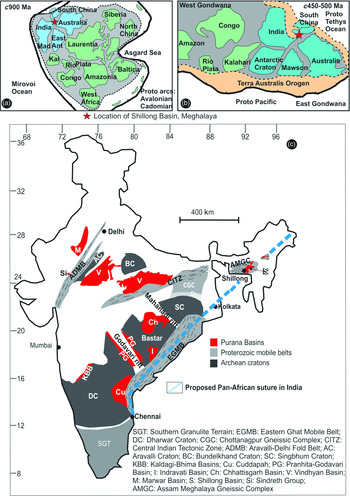
The Neoproterozoic Era witnessed global continental reorganization, resulting in the two major supercontinental assemblies of Rodinia (Fig. 1a; through the Grenvillian Orogeny) and Gondwana (Fig. 1b; through the Pan-African Orogeny) (Collins & Pisarevsky, Reference Collins and Pisarevsky2005; Li et al. Reference Li, Bogdanova, Collins, Davidson, De Waele, Ernst and Karlstrom2008; Rino et al. Reference Rino, Kon, Sato, Maruyama, Santosh and Zhao2008; Bradley, Reference Bradley2011; Cawood et al. Reference Cawood, Wang, Xu and Zhao2013; Arora et al. Reference Arora, Pant, Pandey, Chattopadhyay, Greenbaum, Siegert and Bhandari2020). Meso- to Neoproterozoic amalgamation of Rodinia took place between 1100 and 900 Ma (Kröner & Cordani, Reference Kröner and Cordani2003; Li et al. Reference Li, Bogdanova, Collins, Davidson, De Waele, Ernst and Karlstrom2008; Gregory et al. Reference Gregory, Meert, Bingen, Pandit and Torsvik2009; Cawood et al. Reference Cawood, Wang, Xu and Zhao2013; Jing et al. Reference Jing, Yang, Evans, Tong, Xu and Wang2020), and it eventually broke apart during 750–720 Ma (Fig. 1a) (Gregory et al. Reference Gregory, Meert, Bingen, Pandit and Torsvik2009; Jing et al. Reference Jing, Yang, Evans, Tong, Xu and Wang2020). The Gondwana supercontinent merged following the break-up and dispersion of Rodinia’s constituents between 750 and 530 Ma during the Pan-African Orogeny (Collins & Pisarevsky, Reference Collins and Pisarevsky2005) (Fig. 1b). However, transitional phases of Rodinia break-up and Gondwana amalgamation in the rock record are scarce and can only be traced back to a limited extent from stable crustal deposits within Neoproterozoic basins.
(a) Position of India and Shillong Basin in Rodinia (modified after Cawood et al. Reference Cawood, Wang, Xu and Zhao2013) and (b) Gondwana configuration (modified after Cawood et al. Reference Cawood, Wang, Xu and Zhao2013). (c) Proterozoic map of India highlighting the distribution of major Archean cratons, Proterozoic mobile belts and Neoproterozoic basins (modified after Mishra, Reference Mishra2015). The blue dotted line in the eastern part is the proposed Pan-African suture from the EGMB to the Shillong Basin in the NE.

In India, Archean cratons in the north (Aravalli and Bundelkhand) and south (Bastar, Singbhum and Dharwar) were accreted through Proterozoic mobile belts to form a stable continental mass that primarily represents the Proterozoic framework (Fig. 1c). The volcano-sedimentary association of the mobile belts surrounding the Archean nucleus (Central Indian Tectonic Zone, Assam Meghalaya Gneissic Complex, Chottanagpur Gneissic Complex and Estern Ghats Mobile Belt) was episodically metamorphosed and deformed from 2500 to 1000 Ma, reaching complete stability during late Mesoproterozoic time (1000 Ma) during the Rodinia amalgamation (Bhowmik, Reference Bhowmik2019). The Mesoproterozoic and Neoproterozoic evolutionary histories of Indian tectonic belts are separated by intense tectonothermal activity at 1000 Ma (Chaudhuri et al. Reference Chaudhuri, Mukhopadhyay, Deb and Chanda1999). The opening up of rifted ocean basins along the periphery of Archean–Proterozoic stable crusts indicates a short spell of tectonic instability during early Neoproterozoic time (Fig. 1c) (Kale & Phansalkar, Reference Kale and Phansalkar1991; Chaudhuri et al. Reference Chaudhuri, Mukhopadhyay, Deb and Chanda1999; Chakraborty et al. Reference Chakraborty, Tandon, Roy, Saha and Paul2020).
The Neoproterozoic basins of India are represented by the Rewa and Bhander Group of the upper Vindhyan Basin, the Kurnool Group of the Cuddapah Basin, the Sullavai Group of the Pranhita–Godavari Basin, the Marwar Supergroup and the Sindreth Group of western India, Bhima Group of Bhima Basin and the Badami Group of the Kaladgi basin (Fig. 1c) (Chaudhuri et al. Reference Chaudhuri, Mukhopadhyay, Deb and Chanda1999; Nagarajan et al. Reference Nagarajan, Madhavaraju, Armstrong-Altrin and Nagendra2011; George & Ray, Reference George and Ray2017; Schöbel et al. Reference Schöbel, Sharma, Hörbrand, Böhm, Donhauser and de Wall2017; Joy et al. Reference Joy, Patranabis-Deb, Saha, Jelsma, Maas, Söderlund and Krishnan2019). The Neoproterozoic basins of India feature a common evolution pattern in which the basins first opened up with rifting and subsequently evolved into a stable platformal condition. (Chaudhuri et al. Reference Chaudhuri, Mukhopadhyay, Deb and Chanda1999). The consistent base of the Neoproterozoic basins of peninsular and extra-peninsular India is represented by a typical conglomerate and/or tuff of fan delta deposits, while basin fill sediments show a fining-upwards sequence associated with a major transgression (Chaudhuri et al. Reference Chaudhuri, Mukhopadhyay, Deb and Chanda1999; Joy et al. Reference Joy, Patranabis-Deb, Saha, Jelsma, Maas, Söderlund and Krishnan2019). The lower sections of all the Neoproterozoic basins show traces of tectonic upheaval, but the upper sections retain rather stable shallow-water deposits (Chaudhuri et al. Reference Chaudhuri, Mukhopadhyay, Deb and Chanda1999).
The evolution of Neoproterozoic basins in India is comparable to that of other east Gondwana basins (the Officer Basin, Savory Basin, Adelaide Basin of Australia, Nanhua Basin of South China and Beardmore Group of East Antarctica), where all basins are riftogenic in origin and linked to Rodinia break-up (Walter et al. Reference Walter, Veevers, Calver and Grey1995; Chaudhuri et al. Reference Chaudhuri, Mukhopadhyay, Deb and Chanda1999; Goodge et al. Reference Goodge, Myrow, Williams and Bowring2002; Zhou et al. Reference Zhou, Wang and Qiu2009; Bose et al. Reference Bose, Banerjee, Jain, Dasgupta and Bajpai2020; Kumar et al. Reference Kumar, Kumar, Sharma and Singh2020; Lloyd et al. Reference Lloyd, Blades, Counts, Collins, Amos, Wade and Drabsch2020).
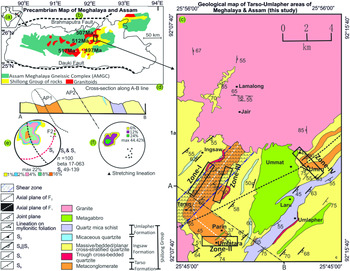
We focus on the tectonic evolution of the Shillong Basin of Meghalaya, which represents an isolated Proterozoic basin in NE India (Fig. 2b). It unconformably overlies the high-grade basement (i.e. Assam Meghalaya Gneissic Complex). According to a number of publications, the Shillong Basin is very close to the tectonic margins of the Rodinia and Gondwana supercontinents (Collins & Pisarevsky, Reference Collins and Pisarevsky2005; Cawood et al. Reference Cawood, Wang, Xu and Zhao2013; Pant & Dasgupta, Reference Pant and Dasgupta2017; Arora et al. Reference Arora, Pant, Pandey, Chattopadhyay, Greenbaum, Siegert and Bhandari2020), and could therefore be a key link in reconstructing Proterozoic geodynamic processes. However, little is known about the evolutionary history of the Shillong Basin. We therefore evaluate the evolution of the Shillong Basin by detailed mapping (220 km2), deformation fabric analysis, petrography, geochemistry and the incorporation of existing geochronological data, as well as considering its possible link to the Rodinia and Gondwana supercontinents. Accordingly, we focused on the west-central section of the Shillong Basin, which preserves the entire litho package, as well as diastrophic and non-diastrophic structures that assisted in its evolution.
(a) Location of Meghalaya within India; (b) simplified Precambrian geology of Meghalaya, with published (Kumar et al. Reference Kumar, Rino, Hayasaka, Kimura, Raju, Terada and Pathak2017) Neoproterozoic geological constraints from the intruding granites to the Shillong Basin superimposed; (c) geological and structural map of Tarso-Umlapher areas (this study); (d) the first and second axial planes of the folds, AP1 and AP2, along the geological cross-section A–B, showing the assumed structural disposition of the beds at depth; (e) stereographic projection of the poles of beddings (S0) and early foliations (S1) showing the nature of regional fold (F2); triangular marks are the measured F2 axis; and (f) stereographic projection of the myllonitic foliations and stretching lineations measured from the Tarso Transpression Zone.

2. Geological settings
The Assam Meghalaya Gneissic Complex (AMGC) is an isolated, tectonically detached Archean–Proterozoic block located in the northeastern part of India in Meghalaya (Fig. 2a, b). It has been described as an uplifted horst-like feature that is bordered in the south by the E–W-aligned Dauki Fault and in the north by the Brahmaputra Fault (Bilham & England, Reference Bilham and England2001; Nandy, Reference Nandy2001) (Fig. 2b). Younger low-grade metasediments overlie the older AMGC and constitute the Proterozoic mosaic of the Meghalaya (Yin et al. Reference Yin, Dubey, Webb, Kelty, Grove, Gehrels and Burgess2010) (Fig. 2b). Meta-mafic rocks (Ray et al. Reference Ray, Saha, Koeberl, Thoni, Ganguly and Hazra2013) and Cambrian granitoids (Kumar et al. Reference Kumar, Rino, Hayasaka, Kimura, Raju, Terada and Pathak2017) intrude the former sequence. The Cretaceous Sylhet Trap, ultramafic–alkaline–carbonatite complex and Cretaceous–Tertiary sedimentary rocks cover the southern part of the plateau (Nandy, Reference Nandy2001).
The Neoarchean–Mesoproterozoic high-grade basement rocks of AMGC is represented by para- and ortho-gneisses (Lal et al. Reference Lal, Ackermand, Seifert and Haldar1978; Bidyananda & Deomurari, Reference Bidyananda and Deomurari2007; Chatterjee et al. Reference Chatterjee, Mazumdar, Bhattacharya and Saikia2007; Chatterjee et al. 2015; Kumar et al. Reference Kumar, Rino, Hayasaka, Kimura, Raju, Terada and Pathak2017; Neogi et al. Reference Neogi, Kar and Toshilila2017). These basement gneisses exhibit at least three stages of deformation and related metamorphisms (Lal et al. Reference Lal, Ackermand, Seifert and Haldar1978; Ray et al. Reference Ray, Saha, Ganguly, Balaram, Krishna and Hazra2011, Reference Ray, Saha, Koeberl, Thoni, Ganguly and Hazra2013; Neogi & Pal, Reference Neogi and Pal2021). D1 imprints are rarely preserved and are transposed by D2 deformation, with E–W-aligned chains of D2 antiforms and synforms dominating the map pattern (Lal et al. Reference Lal, Ackermand, Seifert and Haldar1978; Chatterjee et al. Reference Chatterjee, Mazumdar, Bhattacharya and Saikia2007; Neogi & Pal, Reference Neogi and Pal2021). Different areas of the AMGC have shown peak metamorphism at around 750°C and 5–6 kbar (Lal et al. Reference Lal, Ackermand, Seifert and Haldar1978; Neogi et al. Reference Neogi, Kar and Toshilila2017). Monazites (U–Th–Pb age) associated with AMGC metasediments revealed three stages of thermal growth at: 1600–1400, 1200–1000 and 500–450 Ma (Chatterjee et al. Reference Chatterjee, Mazumdar, Bhattacharya and Saikia2007; Neogi et al. Reference Neogi, Kar and Toshilila2017; Borah et al. Reference Borah, Hazarika, Mazumdar and Rabha2019).
The deformed, NE–SW-oriented Shillong Basin is exposed in the east-central Meghalaya Plateau, unconformably overlying the AMGC (Nandy, Reference Nandy2001) (Fig. 2b). The Tyrsad–Barapani Shear Zone marks the western boundary of the AMGC, Cretaceous–Tertiary sedimentary rocks cover the southern portion, the Shillong Basin has an unconformable contact with the basement (AMGC) in the east, and the northern contact lies below the Brahmaputra Quaternary (Fig. 2b) (Nandy, Reference Nandy2001). The Shillong Basin was mapped for the first time by Oldham (Reference Oldham1858). The low-grade metasedimentary strata and associated volcanic rocks were named “Shillong Series” by Medlicott (Reference Medlicott1869), which was later termed the Shillong Group by Mazumdar (Reference Mazumdar1976). It has been further classified under two-fold (Barooah & Goswami, Reference Barooah and Goswami1972; Ahmed, Reference Ahmed1981; Bhattacharjee & Rahman, Reference Bhattacharjee and Rahman1985; Anonymous, 2009; Sarma, Reference Sarma2014) and three-fold schemes (Khonglah et al. Reference Khonglah, Khan, Karim, Kumar and Choudhury2008). The Shillong Group metasedimentary rocks show polyphase deformation with a dominant NE–SW-aligned fabric (Murthy et al. Reference Murthy, Mazumder and Bhaumik1976; Mitra, Reference Mitra1998; Khonglah et al. Reference Khonglah, Khan, Karim, Kumar and Choudhury2008) and greenschist facies metamorphism (Mitra, Reference Mitra1998; Devi & Sarma, Reference Devi and Sarma2010; Sarma, Reference Sarma2014). Many models have been proposed to characterize the Shillong Basin, including: (1) a linear Mio-geosynclinal basin (Mazumdar, Reference Mazumdar1986); (2) a sag basin (Nandy, Reference Nandy2001); (3) an extensional basin (Kakati & Sarma, Reference Kakati and Sarma2013); and (4) a transtensional or pull-apart basin (Sarma, Reference Sarma2014).
3. Methodology
3.a. Structural mapping
A total of 220 km2 of geological mapping has been completed by taking suitable geological traverses along and across the strike in the west-central part of the Shillong Basin, located in the NE Indian states of Assam and Meghalaya. The structural mapping was performed in the field by measuring the deformation fabrics. Fresh-surface and open-pit samples were collected from each lithounit discussed.
3.b. Analytical technique
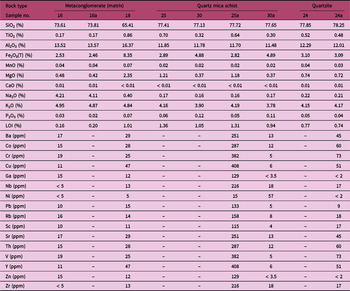
The selected samples were analysed for major and trace elements at the Geological Survey of India, Shillong, using a sequential wavelength dispersive X-ray flourometer (WDXRF; Bruker S8 Tiger) equipped with a Rh tube. Fresh, unaltered samples were collected and chipped using a jaw crusher, cleaned with an ultrasonic vibrator, dried and powdered in a vibratory disc mill. The rock samples were crushed and pulverized to pass through a −200 micron mesh, then coned and quartered to ensure homogeneous mixing. The fusion beads and pressed pellets were then prepared for analysis. The pressed pellets were made from 4.5 g of finely ground sample (−200 mesh) and 1.13 g of cellulose binder. Because there is no calibration programme available for samples with such a matrix, the data were generated from pressed pellets using the standardless software Quant express. The generated results were then analysed and corrected using loss on ignition (LOI) and dilution factors. Certified international standards were used during the analysis. The precision for SiO2 and Al2O3 is 2 wt%, and 0.3 wt% for the other major oxides and trace elements. Table 1 summarizes the representative geochemical data for each of the nine samples.
Bulk-rock chemistry (major oxides and trace elements) of different units of Shillong Group.

4. Results
4.a. Geological mapping
4.a.1. Lithology
The field area exposes various Shillong Group units and intrusive gabbro and granitoids (Fig. 2c). The Shillong Group metasedimentary rocks are made up of a basal metaconglomerate, a middle quartzite and a quartz mica schist at the top (Fig. 2c). The meta-gabbros are intrusive to the sedimentary units, which are then intruded by granite. As the relative disposition of the Shillong Group of metasedimentary rocks is modified by deformation, we will discuss the geographical and temporal heterogeneity of the lithounits in relation to their position in regional folds (online Supplementary Table S1, available at http://journals.cambridge.org/geo).
The bottom-most unit of the Shillong Group in the study area is a meta-conglomerate, which is exposed within the core of an antiform (Fig. 2c). When unfolded, the thickness of the conglomerate is 400–500 m. Along and across its strike, the conglomerate showed considerable compositional change (in terms of clast and matrix). The mapped region has therefore been classified into four domains to explain the variety of clasts and matrixes (Fig. 2c).
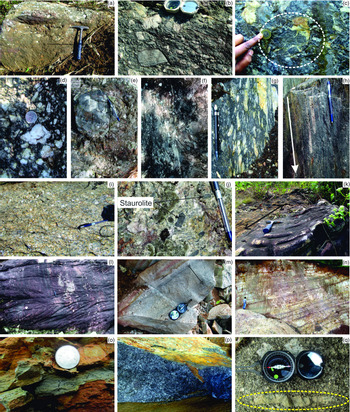
Zone I. Near Tarso (Fig. 2c, Zone I), it consists of a fine-grained siliceous matrix with granite and vein quartz clasts (Fig. 3a). Clasts are poorly sorted, where extreme shearing has changed the initial roundness and sphericity. Clasts size varies from 1 mm to > 20 cm. Alternate clasts-rich and clasts-poor zones define the bedding, which is also gradational (Fig. 3a). However, the stratigraphic top could not be deciphered from the gradation due to deformation. The individual bed thickness ranges from a few centimetres to more than 5 m (online Supplementary Table S1). The conglomerate at the east of Tarso is more of a gritty quartzite and grades laterally into pebbly horizons.
Field photographs showing (a) massive, graded bedding in basal conglomerate; (b) conglomerate with clasts of vein quartz and granite set in a siliceous matrix; (c) boulder of biotite gneiss within conglomerate; (d) very poorly sorted vein quartz clasts floats in a siliceous and ferruginous matrix; (e) large rounded boulder of quartz mica schist within the argillitic matrix of basal conglomerate near Ummat; (f) clasts of various compositions and shapes scattered within the phyllitic matrix of conglomerate near Ummat; (g) extremely sheared and stretched pebbles of the conglomerate with very fine matrix near Tarso; (h) down-plunging stretching lineations over the steeply dipping mylonitic foliation in conglomerate near Tarso; (i) poorly sorted argillitic matrix-bearing conglomerate; clast size reduces dramatically with crenulated foliations; (j) random, idioblastic staurolite growth over the argillitic matrix of the conglomerate in contact with metagabbro intrusives near Ummat; (k) trough cross-stratified quartzite at contact with basal conglomerate near Ingsaw; (l) herringbone cross-stratified quartzite at the east of Ingsaw; (m) planar cross-stratified quartzite with reverse younging direction; (n) thick pile of quartzite and micaceous quartzite intercalation; (o) outcrop of magnetite-bearing quartz mica schist; (p) exposure of metagabbro; and (q) outcrop of Kyrdem Granite with xenoliths of quartzite from Ingsaw Formation.

Zone II. Zone II (Fig. 2c) conglomerate has a siliceous and ferruginous matrix (Fig. 3b, d), and the clasts are poorly sorted (Fig. 3b, d). Clasts are mostly vein quartz with varying shapes (e.g. tabular, triangular and rhombic), roundness (e.g. angular, sub-angular and sub-rounded) and low sphericity (online Supplementary Table S1). Angular vein quartz clasts are dominant (Fig. 3d) and graded locally.
Zone III. Zone III conglomerate (Fig. 2c) is polymictic, with clasts of vein quartz, biotite gneiss and granite gneiss in an argillaceous matrix (Fig. 3f, i). The proportion of gneiss clasts to vein quartz clasts is c. 2–3%. Clasts with varying degrees of angularity are poorly sorted and range in size from 5 mm to 7 cm (online Supplementary Table S1). The matrix is highly foliated in this section, with muscovite and biotite defining the foliation.
Zone IV. The diversity of clasts composition increases in Zone IV (Fig. 2c) compared with other areas. Large gneiss boulders (> 50 cm) are found within the micaceous matrix (Fig. 3c, e). The relative abundance of gneiss clasts is greater than 5% in Zone IV, including quartz mica schist, biotite gneiss and vein quartz. The angular to sub-rounded poorly sorted clasts range in size from 5 mm to 1 m (online Supplementary Table S1).
Large (2–5 cm), idioblastic garnet and staurolite (Fig. 3j) growth is observed within the micaceous conglomerate at the margins of basic intrusives (Fig. 2c, Zone II and III).
Quartzite overlies the meta-conglomerate, forming NE–SW-aligned steep long ridges. Because of the low outcrop density, the proper litho contact between conglomerate and quartzite was not observed, but a gradational contact is inferred from the discrete outcrops. The quartzite has well-developed facies variation. The lowermost quartzite (2–5 m thick) is cross-bedded with thick bedding (10–30 cm) (Fig. 3k). However, the orientation of the original troughs has been too heavily modified by complex folding to infer the palaeo-flow direction. The lower quartzite is hard, bouldery, and has rounded cavities and iron staining in most cases. The upper herringbone cross-stratified quartzite is in gradational contact with the trough cross-bedded quartzite (Fig. 3l). Due to extreme weathering, the herringbone structure is only found in outcrops of 1–2 m width in this study. The mid-erosional surface between the foresets of the herringbone cross-beds has been preserved irregularly (Fig. 3l).
The middle quartzite is dominated by planar and tabular cross-beds that overlie the lower quartzite (Fig. 3m) but are mostly in direct contact with the meta-conglomerate (Fig. 2c). It is intercalated with micaceous quartzite (Fig. 3n) and, on rare occasions, with thin carbonaceous phyllite. However, it appears massive and friable, with irregular bedding in many outcrops. Numerous overturned planar cross-beddings are identified, indicating a stratigraphic inversion caused by deformation (Fig. 3m).
In comparison to the middle quartzite, the uppermost quartzite is trough cross-bedded and relatively hard. On occasion, ripple drift cross-laminations were observed. Ripple marks or casts are observed in nearby areas but not recorded in the mapped area. These have a low-amplitude and a moderate wavelength, as well as a nearly straight crest line and rounded troughs.
Magnetite-bearing quartz mica schist is the uppermost unit of the Shillong Group. It is greyish, hard and forms a prominent NE–SW-aligned ridge in the central part of the mapped area (near Umlapher) (Fig. 2c). The rock is made up of 25% quartz, 50% mica, 20% feldspar and 5% magnetite. Magnetite grains are scattered throughout the unit (Fig. 3o), and it is finely laminated. Muscovite defines the foliation and runs parallel to the bedding.
Metagabbro occurs as NE–SW-aligned linear intrusives in the lower elevated parts of the study area (near Ummat, Laru) that run sub-parallel to the axial plane of the regional folds (F2) (Fig. 2c). It is very coarse near the centre of the pluton and relatively fine towards the margin, and it is composed of amphibole (40–45%), plagioclase (50–55%) and magnetite (1–2%). It retains a relic interlocking texture with undeformed grain boundaries (Fig. 3p). However, at the edge of the plutons, it is crudely foliated.
Granite is found in two intrusive plutons in the northern and southern parts of the study area. The Kyrdem Granite is to the SW, and a portion of the Nongpoh Granite is to the north (Fig. 2c). The Kyrdem Granite is coarse, pink, porphyritic and composed of quartz (50%), K-feldspar (30%), plagioclase (15%), biotite (5%), pyrite and magnetite (Fig. 3q). Plagioclase dominates over K-feldspar. The phenocrysts are of K-feldspar (2 mm to 7 cm in size) and plagioclase, while the groundmass is of quartz, K-feldspar, plagioclase, biotite, pyrite and magnetite. Mafic microgranular enclaves (MME) of various shapes and sizes, as well as xenoliths of Shillong Group rocks (Fig. 3q), are common.
The Nongpoh Granite is fine-grained and non-porphyritic near the edge of the pluton, but coarse-grained and porphyritic in the centre. Quartz, K-feldspar, plagioclase, biotite and magnetite contribute to the groundmass, whereas phenocrysts are euhedral K-feldspar and plagioclase. The size of the MMEs is unlike those found in the Kyrdem Granite and is relatively smaller.
4.a.2. Structure
The repetition of the lithounits demonstrates deformation in the metasedimentary rocks (Fig. 2c, d). Rocks are doubly folded in areas where bedding (S0) became sub-parallel to early foliation (S1). The dominant fabric of the study area is bedding (S0) with early foliation (S1), and the foliation is also axial planar to the rarely preserved first folds (F1). The microlithon and cleavage domains of S1 consist of quartz (or feldspar) and micaceous layers (muscovite with little biotite), respectively. Because the prominence of S1 is dependent on the availability of mica within the rocks, S1 is rarely developed in quartzite. The overall bedding and foliation (S1) trend of the rocks is NE–SW with a moderate to low southerly dip (except in the hinges).
F1 folds are rootless and tight with low interlimb angles. Broadly rounded hinges, a high amplitude and short wavelength are the characteristics of these folds. The geometry of the F1 folds varies from reclined to recumbent to upright on different parts of the late fold (F2) profile. However, due to a lack of data, the F1 plunge and pole of axial planes are not considered for statistical analysis.
F2 is represented by the regional chain of overturned antiforms and synforms. Mesoscopic, congruous F2 folds are close, upright, moderately NE-plunging with SE-dipping axial plane. F2 folds within the micaceous units are crenulated, whereas quartzite display outcrop-scale folds. Characteristically, F2 folds are flexural slip folds with interlayer slips and tension gashes. The statistically defined fold axis (ß) of F2 plunges 17° towards 63° and the dip of the axial plane is 49° towards 138° (Fig. 2e). Axial planar S2 (defined by the alignment of muscovite) is weakly developed within the micaceous units as a crenulation cleavage. It is sub-parallel to S0 and S1 near the limb of F2, and at a high angle at the hinge.
The closure near Umlatara (SW part) represents the closure of a first-generation fold (F1), whereas the closure near Umru is a congruous higher-order F2 fold (Fig. 2c). F1 and F2 plunge in the same direction; however, the F1 axial plane is folded, and F2 axial surface is flat (Fig. 2c). Superposition of F2 over F1 is coaxial, and a hook-shaped morphology has resulted from it. Moreover, the mapped area displays a NE–SW-aligned F2 antiform, where the F1 antiform lies on the western limb of the F2. The overall southeastern dip of S0 or S1 indicates the overturned nature of F2. Stratigraphic inversion is further supportive of overturned F2 (Fig. 3m).
S3 is the last regional deformation within the Shillong Group sedimentary rocks, and is a broad warp on map scale. The wide-spaced axial planar fracture is NNW–SSE-aligned and steeply dipping towards the ESE.
A NE–SW-aligned, wide, crustal-scale transpression superimposed on the early deformation fabrics is reported from the southern part of the study area (Fig. 2c). Throughout the zone, extreme grain size refinement, significant mylonitic foliation and well-defined downdip stretching lineations have been seen (Fig. 3g, h). The map width of the shear zone varies from 1 to 1.5 km with a maximum thickness reported near Tarso. The shear zone is mostly confined within the metaconglomerate and further extends along the NE, where it cuts the bottom quartzite (Fig. 2c). In metaconglomerate, the maximum instantaneous stretching axes of the deformed clasts lie in the downdip direction (Fig. 3h). The trend of the mylonitic foliation varies from 25 to 60° E and dips moderately (40–55°) towards the SE. Stretching lineations plunge moderately (50–55°) to the SE (Fig. 2f) and create an angle of > 80° with the deformation zone boundary measured on a plane parallel to the foliation and parallel to the lineation. On a plan view, tension gashes show both sinistral and dextral asymmetries. Few of the quartz veins are intruded parallel to the myllonite foliation. Moreover, a horizontal movement with a vertical stretching lineation is characteristics of the Tarso transpression zone.
4.b. Petrography
A total of 30 representative thin-sections from different lithounits were studied to understand their mineralogy and texture.
4.b.1. Meta-conglomerate
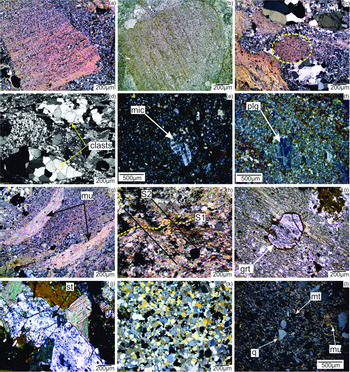
The siliceous matrix-bearing metaconglomerate is medium grained, and poorly sorted with quartz (70–75%), feldspar (10–15%) and secondary muscovite (alteration product of K-feldspar) (10–20%) as major mineral phases (Fig. 4d). Clasts of vein quartz within the matrix exhibit undulose extinction. Occasional large, fresh K-feldspar (Fig. 4e) and plagioclase (Fig. 4f) are preserved. The crude/strong external foliation of the matrix (S1) is defined by muscovite and/or rare biotite that abut against the internal foliation of the clasts (Fig. 4d). Graded bedding often remains on a micro-scale within the matrix.
Photomicrographs showing (a) rectangular clast of quartz mica schist within siliceous matrix of conglomerate; (b) clast of quartz biotite schist within micaceous matrix of conglomerate; (c) clasts of vein quartz and feldspathic material, now converted to secondary muscovite in conglomerate; (d) oval-shaped vein quartz clasts with siliceous matrix in conglomerate; (e) fresh crystal of microcline within the siliceous matrix of conglomerate; (f) unaltered, the euhedral crystal of plagioclase within a siliceous matrix of conglomerate; (g) elongated clasts, now altered to secondary muscovite within phyllitic matrix of the conglomerate; (h) the early foliation (S1) of the phyllitic matrix of conglomerate is crenulated, axial planar foliation of those crenulations are S2; (i) post-tectonic garnet, superimposed over the early foliation of the phyllitic matrix of conglomerate; (j) large post-tectonic staurolite within the phyllitic matrix of conglomerate; (k) overall texture and mineralogy of quartzite; feldspar within the intergranular spaces of quartz is altered to secondary muscovite; and (l) overall mineralogy and texture of the magnetite-bearing quartz mica schist. The shape of the quartz grains is crescent, triangular and elliptical. Mineral abbreviations after Kretz (Reference Kretz1983).

In the micaceous matrix, the relative proportion of muscovite (and biotite) is much higher (> 50%) than the abovedescribed type. The rock is poorly sorted with a varying degree of angularity and roundness (Fig. 4h). Muscovite and biotite define a developed, well-defined foliation within the matrix, and in many occasions the foliation is crenulated (Fig. 4h). Most of the idioblastic muscovites are secondary. The growth of magnetite, staurolite and garnet superimposed the early foliations (S1) and postdate it (Fig. 4i, j).
Clasts of vein quartz and quartz-feldspar rock are prevalent near Tarso and surrounding regions (Zone I) (Fig. 4d). These clasts are poorly sorted with size ranging from < 1 mm to > 15 cm. However, original shapes of the clasts are modified by the shear deformation. Clasts of Zone I are of various shapes, sizes and most are of vein quartz. In Zone III, clasts are highly angular, randomly oriented and are mainly of vein quartz with occasional quartz-muscovite schist (Fig. 4g). In Zone IV, clasts are mainly of vein quartz, quartz biotite schist, quartz muscovite schist and granite gneiss (Fig. 4a–c).
4.b.2. Quartzite
The quartzite is medium- to coarse-grained, angular- to sub-rounded with siliceous cement (Fig. 4k). Quartz (80–85%) and feldspar (10–15%) are the major constituents with minor muscovite (< 5%). Secondary overgrowth, recrystallization and granulation of quartz along the margins are commonly observed. Grain boundaries are sutured with deformed and undulose extinctions. Feldspars are mostly decomposed and altered to clay minerals and muscovite (Fig. 4k). The lower part of the quartzite is dominantly arkosic (> 25% feldspar), but the middle and the top parts are micaceous. Magnetite and rutile are accessory phases. In the more micaceous quartzite, micas are aligned to define the S1 foliation.
4.b.3. Magnetite-bearing quartz mica schist
This is a medium-grained, foliated rock, composed of quartz, feldspar, muscovite, biotite and magnetite (Fig. 4l). Quartz represents c. 25% of the total composition and feldspars are mostly altered to muscovite. The quartz grains are triangular-shaped, crescent-shaped and sub-angular (Fig. 4l), deformed with undulose extinction and very poorly sorted. Muscovite defines a strong foliation (S1) while euhedral magnetites are randomly scattered.
4.c. Geochemistry
The SiO2 content of the representative conglomerate matrix ranges from 65.41 to 73.61 wt%, while the Al2O3 value varies from 13.52 to 16.37 wt% (Table 1). FeO has a wide range of concentration varying from 2.53 to 8.53 wt%. MgO and Na2O exhibit significant variation, ranging from 0.48 to 2.35 wt% and 0.4 to 4.21 wt% respectively. K2O has little variation and is c. 4.8 wt%.
Quartzite is composed of 78 wt% SiO2, 12 wt% Al2O3, and minor amounts of FeO (3%) and K2O (4%). (Table 1).
The quartz mica schist is chemically uniform, with SiO2 (78 wt%) and Al2O3 (12 wt%) accounting for 90% of the bulk composition (Table 1). Apart from that, a minor amount of FeO (2.82–4.88 wt%), MgO (0.37–1.21 wt%) and K2O (3.90–4.19 wt%) contribute to the overall composition.
4.d. Metamorphism
The preservation of primary sedimentary structures within the Shillong Group metasedimentary rocks suggests that limited recrystallization occurred during thermal metamorphism. The Shillong Group’s peak metamorphic mineral assemblages (chlorite, muscovite and/or biotite) indicate a lower greenschist facies. Because these rocks lack metamorphic index minerals, estimating the precise peak metamorphic condition using published ion-exchange thermo-barometers is difficult. Similarly, the preservation of primary igneous texture in metagabbro does not support a prograde metamorphism event; rather, these are metsomatized or altered during regional tectono-thermal events.
Localized garnet and staurolite growth are purely post-tectonic to regional foliation (S1) (Fig. 4i, j) and are the result of contact metamorphism during basic rock emplacement. This interpretation is supported by the limited appearance of garnet and staurolite at the intrusive contact.
5. Discussion
5.a. Stratigraphy of the Shillong Group
The Shillong Group stratigraphy is debatable. The main constraints to describing the Shillong Basin stratigraphy are a lack of exposure continuity, marker horizons and compiled geological maps. The polyphase deformation of the units complicates the description and interpretation of the entire litho package. Many attempts were made to classify the Shillong Group (Medlicott, Reference Medlicott1869; Barooah & Goswami, Reference Barooah and Goswami1972; Ahmed, Reference Ahmed1981; Bhattacharjee & Rahman, Reference Bhattacharjee and Rahman1985; Khonglah et al. Reference Khonglah, Khan, Karim, Kumar and Choudhury2008; Devi & Sarma, Reference Devi and Sarma2010). Khonglah et al. (Reference Khonglah, Khan, Karim, Kumar and Choudhury2008) and Devi & Sarma (Reference Devi and Sarma2010) proposed threefold and twofold classifications, respectively (see online Supplementary Fig. S1). The Shillong Group was subdivided into a Lower Metapelitic Formation (LMF) and an Upper Quartzitic Formation (UQF) in the twofold classification scheme (see online Supplementary Fig. S1). The threefold classification of Khonglah et al. (Reference Khonglah, Khan, Karim, Kumar and Choudhury2008) subdivides the group into a lower Mawlyndep Formation, middle Umium Formation and upper Nongpiur Formation. The Mawlyndep Formation is defined by basal polymictic conglomerate followed by quartzite. The Umium Formation is dominated by phyllite, black shale, meta-acid volcanic rocks and tuff. The Nongpiur Formation starts with a basal polymictic conglomerate accompanied by quartzite (see online Supplementary Fig. S1).
According to Devi & Sarma (Reference Devi and Sarma2010), the Shillong Group was deposited unconformably over basement gneisses (AMGC). On the other hand, Khonglah et al. (Reference Khonglah, Khan, Karim, Kumar and Choudhury2008) argued for the presence of the Umsning Schist Belt (USB) between the AMGC and the Shillong Group (see online Supplementary Fig. S1) and reported that the USB was the Shillong Group’s oldest member. Neither the twofold nor the threefold classification is represented on any regional map of Meghalaya or the Shillong Basin (Fig. 2b). Both schemes also fail to explain the regional distribution of the Shillong Basin in a deformed terrain.
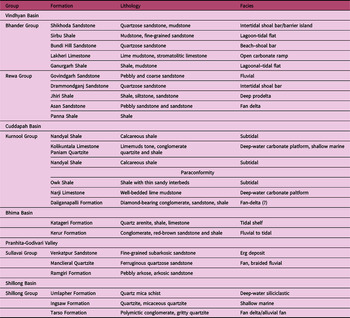
In the present study, the Shillong Group litho-package is represented by a thick matrix-supported polymictic metaconglomerate at the base, followed by quartzite–micaceous quartzite interlayers and magnetite-bearing quartz mica schist at the top (see online Supplementary Fig. S1). The basement, however, is not exposed in the mapped area, but is recorded from further east where the metaconglomerate lies just above the biotite gneiss basement. As a consequence of compressive deformation, the entire sediment package repeats on either side of the basal metaconglomerate (Fig. 2c, d). The polymictic metaconglomerate was therefore used as the marker horizon to regionally compare the stratigraphy, which indicates excellent regional control (see online Supplementary Fig. S2). It is worth noting in this section that Chaudhuri et al. (Reference Chaudhuri, Mukhopadhyay, Deb and Chanda1999) considered a bottom non-repetitive polymictic conglomerate marker for interbasinal connections of India’s Neoproterozoic basins (Table 2). Based on the observations of published articles and the current study, a basal polymictic conglomerate horizon is proposed for correlating unreported (if any) lowermost Neoproterozoic strata of India.
Stratigraphic subdivisions of some of the Neoproterozoic basins of India including present study (after Chaudhuri et al. Reference Chaudhuri, Mukhopadhyay, Deb and Chanda1999; Joy et al. Reference Joy, Patranabis-Deb, Saha, Jelsma, Maas, Söderlund and Krishnan2019)

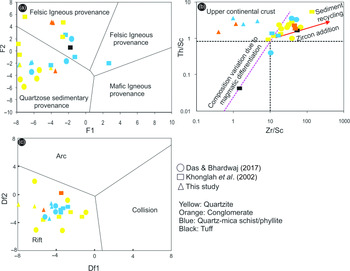
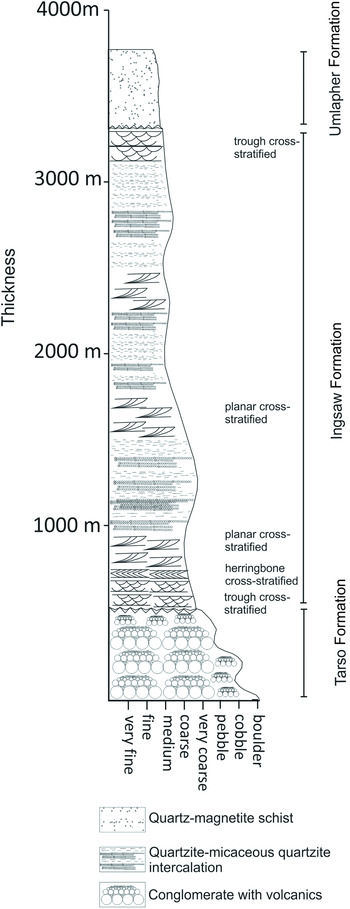
The detailed mapping, petrography, structural analysis and regional correlation during the present study conclude a very simple stratigraphy of Shillong Group, with three formations. For the lower, middle and upper formations, we propose the names ‘Tarso’, ‘Ingsaw’ and ‘’Umlapher’, respectively. Tarso Formation comprises a mixture of thick polymictic conglomerate and gritty quartzite. The major-oxide and trace-element geochemistry of the conglomerate samples indicates a mixed volcano-sedimentary source (sedimentary along with felsic volcanics) (Fig. 5a). However, the current study has limited scope for exploring the volcanogenic characteristics of the Shillong Basin metasediments. The conglomerate is occasionally graded and spatially variable in clast and matrix composition. Moreover, a texturally and minerologically immature conglomerate is the characteristic of the Tarso Formation. The Ingsaw Formation is dominated by a quartzite–micaceous quartzite intercalation. The top and bottom part of the Ingsaw Formation is dominated by hard quartzite, whereas micaceous quartzite prevails in the middle part. The lowermost part of the unit is herringbone and trough cross-stratified, but the lower middle part is planar cross-stratified. Micaceous quartzite from the middle of the unit preserves occasional primary structures. The upper quartzite is cross-stratified. The uppermost Umlapher Formation consists of quartz mica schist (Fig. 6). It is very thinly bedded and devoid of internal structures. The occurrence of felsic volcanics (tuff breccia, lapilli tuff, tuff and ignimbrite of rhyolitic to dacitic composition) in the upper Shillong Group has already been reported by Naik et al. (Reference Naik, Theunuo, Goswami, Khonglah, Pal and Tripathy2020) from several sections of the Shillong Basin. The lowermost Tarso Formation of our study is partly correlatable with the Mawlyndep Formation, while the Umlapher Formation is comparable to the Umiam Formation of Khonglah et al. (Reference Khonglah, Khan, Karim, Kumar and Choudhury2008).
(a) Discrimination diagrams for the origin of the sedimentary rocks of the Shillong Group using major oxides (after Roser & Korsch, Reference Roser and Korsch1988). F1 = −1.773 TiO2 + 0.607 Al2O3 + 0.76 Fe2O3(total) – 1.5 MgO + 0.616 CaO + 0.509 Na2O – 1.224 K2O + 9.09; F2 = 0.445 TiO2 + 0.07 Al2O3 – 0.25 Fe2O3(total) – 1.142 MgO + 0.438 CaO + 1.475 Na2O + 1.426 K2O – 6.86. (b) Shillong Group rocks plotted on a Th/Sr versus Zr/Sc bivariate diagram (after McLennan et al. Reference McLennan, Hemming, McDaniel and Hanson1993); average protolith compositions are of Proterozoic age (after Condie Reference Condie1993). (c) Major oxide chemistry of all the representative samples of Shillong Group plots in rift setting in DF1 versus DF2 plot of Verma & Armstrong-Altrin (Reference Verma and Armstrong-Altrin2013). DF1 = 0.263 ln(TiO2/SiO2) + 0.604 ln(Al2O3/SiO2) + 1.725 ln(Fe2O3 t/SiO2) + 0.66 ln(MnO/SiO2) + 2.191 ln(MgO/SiO2) + 0.144 ln(CaO/SiO2) + 1.304 ln(Na2O/SiO2) + 0.054 ln(K2O/SiO2) + 0.33 ln(P2O5/SiO2) + 1.588; DF2 = 1.196 ln(TiO2/SiO2) + 1.064 ln(Al2O3/SiO2) + 0.303 ln(Fe2O3 t/SiO2) + 0.436 ln(MnO/SiO2) + 0.838 ln(MgO/SiO2) + 0.407 ln(CaO/SiO2) + 1.021 ln(Na2O/SiO2) − 1.706 ln(K2O/SiO2) − 0.126 ln(P2O5/SiO2) − 1.068. Data source: Das & Bhardwaj (Reference Das and Bhardwaj2017) and Khonglah et al. (Reference Khonglah, Khan and Kumar2002).

Lithostratigraphy of Shillong Group of metasediments.

In our observation, the Umsning Schist Belt of Khonglah et al. (Reference Khonglah, Khan, Karim, Kumar and Choudhury2008) does not exist; instead, it is part of the Shillong Group repeating after the metaconglomerate due to folding (see online Supplementary Fig. S2). The metaconglomerate rests directly over the basement gneisses in the southwestern border, whereas quartzite lies directly over the basement 1 km away (Haokip et al. Reference Haokip, Shijoh, Srivastava and Soraisam2016). The basement cover relationship is therefore exposed either at the margin of the deformed basin or deeply eroded places (see online Supplementary Fig. S2).
5.b. Depositional environment
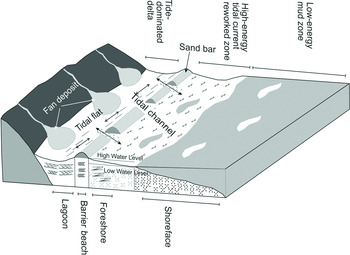
Deposition of the Tarso Formation started with a texturally and minerologically immature matrix-supported polymictic conglomerate. The matrix is micaceous at places (altered feldspar), and siliceous in others. The unfolding of the conglomerate gives an idea of lateral and vertical facies variation. The composition of the clasts varies along the strike length, depending on the variation in the protolith along the long axis of the rifted basin. The trace-element chemistry (Zr/Sc versus Th/Sc) of most of the samples suggests that Shillong Group sediments are recycled multiply from the provenance (Fig. 5b). Very poorly sorted angular clasts of the conglomerate indicate very short transportation and deposition in a sudden slope break (Fig. 7). It is quite similar to the modern slope wash/alluvial fan deposit. A comparable alluvial fan deposit characterizes the lowermost section of the Neoproterozoic Vindhyan, Cuddapah, Pranhita–Godavari, Marwar, Bhima and Kaladgi sub-basins of India (Table 2) (Chaudhuri et al. Reference Chaudhuri, Mukhopadhyay, Deb and Chanda1999; Patranabis-Deb et al. Reference Patranabis-Deb, Bickford, Hill, Chaudhuri and Basu2008; Saha & Patranabis-Deb, Reference Saha and Patranabis-Deb2014; Joy et al. Reference Joy, Patranabis-Deb, Saha, Jelsma, Maas, Söderlund and Krishnan2019). Most likely deposition of the Shillong Basin began with continental rifting. This is further substantiated by the major oxide chemistry of the metasediments, where the entire samples plot in the rift settings in the tectonic discrimination diagram (Fig. 5c) of Verma & Armstrong-Altrin (Reference Verma and Armstrong-Altrin2013).
Depositional environment for the Shillong Group of metasediments.

The sequence of graded bedding across the strike is indicative of either seasonal supply of sediments or fluctuation of flow strength. Naik et al. (Reference Naik, Theunuo, Goswami, Khonglah, Pal and Tripathy2020) reported the existence of felsic volcanic rocks in the Shillong Group at various stratigraphic levels. However, the current study is not particularly focused on this aspect, and more concrete evidence is concerned with future investigation. Major oxide chemistry of the conglomerate matrix also shows a mixed provenance of quartzo sedimentary and felsic igneous rock (Fig. 5a); contribution from volcanic rocks during the initiation of rift is therefore possible. However, the major oxide chemistry supports sediment recycling (Fig. 5b), that is, re-deposition of the basement’s ortho and paragneisses. A comparable rift-controlled passive margin deposition is reported from the Neoproterozoic basins of East Gondwana (Powell et al. Reference Powell, Preiss, Gatehouse, Krapez and Li1994; Chaudhuri et al. Reference Chaudhuri, Mukhopadhyay, Deb and Chanda1999; Tack et al. Reference Tack, Wingate, Liégeois, Fernandez-Alonso and Deblond2001; Wang & Li, Reference Wang and Li2003; Jing et al. Reference Jing, Yang, Evans, Tong, Xu and Wang2020; Lloyd et al. Reference Lloyd, Blades, Counts, Collins, Amos, Wade and Drabsch2020). In the Neoproterozoic Officer Basin, the Savory Basin, the Adelaide Basin of Australia and the Nanhua Basin of China, the conglomerate is known to be a tillite deposit (Walter et al. Reference Walter, Veevers, Calver and Grey1995; Zhou et al. Reference Zhou, Wang and Qiu2009; Lloyd et al. Reference Lloyd, Blades, Counts, Collins, Amos, Wade and Drabsch2020). Despite the fact that the proposed continents were near to each other throughout the period under consideration, Chaudhuri et al. (Reference Chaudhuri, Mukhopadhyay, Deb and Chanda1999) observed that glacial deposits from the lowermost section of India’s Neoproterozoic basins had not been documented. As a result, a more in-depth investigation in this area is required to explain why tillite deposits have not been found in the majority of India’s Neoproterozoic basins.
The conglomerate is followed by a discrete thin layer of trough cross-bedded quartzite and herringbone cross-stratified quartzite of the Ingsaw Formation. In the present context, the association of trough and herringbone cross-bedding above the conglomerate indicate a transitional marine condition where the initial fluvial state was interrupted by a tidal flat deposit of marginal sea (Fig. 7). Encroachment of the sea is apparent by the presence of herringbone structure, and the occurrence also marks a marine transgression at that period. The post-glaciation marine transgression during that span is recorded in all Neoproterozoic basins in East Gondwana (Walter et al. Reference Walter, Veevers, Calver and Grey1995; Zhou et al. Reference Zhou, Wang and Qiu2009; Lloyd et al. Reference Lloyd, Blades, Counts, Collins, Amos, Wade and Drabsch2020). Hence, sagging of the basin followed by sediment load finally caused entrance of seawater in a narrow linear basin. It was therefore an epeiric sea, partially enclosed within the continent. The fluctuation of current strength and direction in the tide-dominated delta in the lower part of the formation is evident from bipolar current movements and reactivation surface of herringbone cross-stratification. However, due to complex deformation, the preserved palaeocurrent direction is of little use in this study, although it can be used after cautious unfolding. The tidal sand ridges are noticeable from coarsening facies that pass from heterolithic beds upwards into planar/tabular cross-bedded sandstone. Herringbone cross-stratification is also restricted to certain places, which indicates occasional dissection of sand ridges by tidal channels recording the bipolar current (Fig. 7). The presence of mud drapes (micaceous layers) is also indicative of tide-dominated shore. The middle and upper part of the quartzite is micaceous and, in places, thick layers of micaceous quartzite are preserved that probably indicate water-level fluctuation. Periodic water-level fluctuation is one of the common characteristics of Indian Neoproterozoic basins (Kale & Phansalkar, Reference Kale and Phansalkar1991; Chaudhuri et al. Reference Chaudhuri, Mukhopadhyay, Deb and Chanda1999). The presence of a significant amount of feldspars within the quartzite can be explained by the following factors: (1) cold climate; (2) physical disintegration exceeding chemical decomposition in the provenance; (3) rapid suspension-dominated transportation after disaggregation from the provenance bedrock and quick deposition; and (4) the proximal distance of the source. The rivers from the high altitude of the rifted basin might have contributed a considerable amount of deposit at high speed to the shelf. Again, the uppermost part of the formation is trough cross-stratified and coarse grained, indicating a drop in water level possibly caused by regression. The majority of India’s Neoproterozoic basins show indications of a transgression in the early stage, followed by a regression (Chaudhuri et al. Reference Chaudhuri, Mukhopadhyay, Deb and Chanda1999).
The top Umlapher Formation is composed of micaceous quartzite, where the proportion of quartz is < 50% and indicates a low supply rate of clastic sediments. The secondary muscovites are a metamorphosed product of mud. In the present sedimentary environment, such facies are expected from distant shores where the supply of clastics is restricted. The Th/Sc ratio of the samples ranges from 2.5 to 3.5, implying an input from a felsic igneous component. When the current study is combined with the report of Naik et al. (Reference Naik, Theunuo, Goswami, Khonglah, Pal and Tripathy2020) on the presence of felsic volcanics (metatuff of rhyolitic to dacitic composition) in the upper Shillong Group, it is possible to infer the significance of volcanic falls during deposition. However, the scope of this studydoes not include a detailed investigation of Shillong Group volcanic rocks. Moreover, in both cases the starvation of clastic sediments indicates deposition in relatively deeper-water facies (Fig. 7).
The above lithology and depositional environment show a fining-upwards sequence and shallow-water deposition throughout, implying that at the mature stage of evolution, the rate of subsidence was accompanied by the rate of deposition. Similarly, a thick terrestrial and shallow-marine sequence was deposited in a series of Neoproterozoic intracratonic rift basins of peninsular and extra-peninsular India (Table 2), South China (Nanhua Basin), Western and Southern Australia (Adelaide Basin), and Eastern Antarctica (Kale & Phansalkar, Reference Kale and Phansalkar1991; Walter et al. Reference Walter, Veevers, Calver and Grey1995; Chaudhuri et al. Reference Chaudhuri, Mukhopadhyay, Deb and Chanda1999; Zhou et al. Reference Zhou, Wang and Qiu2009; Rainbird et al. Reference Rainbird, Cawood, Gehrels, Busby and Azor2012; Lloyd et al. Reference Lloyd, Blades, Counts, Collins, Amos, Wade and Drabsch2020).
5.c. Structural evolution of Shillong Basin
Mitra (Reference Mitra1998) discussed four phases of deformations in the Shillong Group of rocks, whereas Khonglah et al. (Reference Khonglah, Khan, Karim, Kumar and Choudhury2008) and Mero et al. (Reference Mero, Imlishila, Sougrakpam and Praveen2016) argued for five and three stages of deformation, respectively. The detailed mapping of Shillong Group rocks in this study indicates two stages of coaxial folding caused by NE–SW compressional deformation. A progressive deformation caused tightening of the early folds, transposition of the early fabrics and, finally, plunging overturned, regional chains of antiform and synform (F2). Western limbs of the regional/mapped scale F2 are overturned with moderately SE-dipping axial plane. The Shillong Group metasedimentary rocks are thrusted over the basement (AMGC) and the deformation patterns of both units are entirely different (except in the basin margin). The dominant fabric of the Shillong Group is NE–SW, but E–W for AMGC (Lal et al. Reference Lal, Ackermand, Seifert and Haldar1978; Mitra, Reference Mitra1998; Chatterjee et al. Reference Chatterjee, Mazumdar, Bhattacharya and Saikia2007; Khonglah et al. Reference Khonglah, Khan, Karim, Kumar and Choudhury2008; Devi & Sarma, Reference Devi and Sarma2010; Ray et al. Reference Ray, Saha, Koeberl, Thoni, Ganguly and Hazra2013). The possible oblique compression during basin closing has resulted in a NE–SW-aligned fold–thrust belt and steep shear zones (transpression) with down-plunging stretching lineations. The NE–SW sub-parallel transpression zones are themselves a small-scale replica of the collisional suture.
5.d. Geodynamic settings
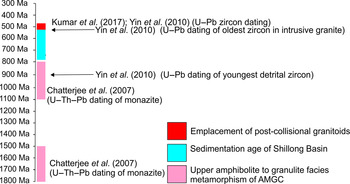
Initiation of the basin is itself controversial (Mitra & Mitra, Reference Mitra and Mitra2001; Bidyananda & Deomurari, Reference Bidyananda and Deomurari2007; Yin et al. Reference Yin, Dubey, Webb, Kelty, Grove, Gehrels and Burgess2010). Mitra & Mitra (Reference Mitra and Mitra2001) suggested that the early sedimentation of the Shillong Group started before 1550 Ma, based on the Pb–Pb age of syn-sedimentary galena. However, based on the report of the 900-Ma-aged population from the detrital zircons of the Shillong Group, Yin et al. (Reference Yin, Dubey, Webb, Kelty, Grove, Gehrels and Burgess2010) concluded that deposition began after that. Many workers have carried out extensive studies on the metamorphic evolution and thermal events of the AMGC (Lal et al. Reference Lal, Ackermand, Seifert and Haldar1978; Chatterjee et al. Reference Chatterjee, Mazumdar, Bhattacharya and Saikia2007; Yin et al. Reference Yin, Dubey, Webb, Kelty, Grove, Gehrels and Burgess2010; Kumar et al. Reference Kumar, Rino, Hayasaka, Kimura, Raju, Terada and Pathak2017; Neogi et al. Reference Neogi, Kar and Toshilila2017), and all concluded that the AMGC underwent three significant metamorphic (chemical dating of Monazites) and igneous events (U–Pb zircon dating), namely, at 1800–1500, 1100–800 and 500–450 Ma. The grade of metamorphism for the first two events (1800–1500 and 1100–800 Ma) was upper amphibolite to lower granulite facies (Lal et al. Reference Lal, Ackermand, Seifert and Haldar1978; Chatterjee et al. Reference Chatterjee, Mazumdar, Bhattacharya and Saikia2007; Neogi & Pal, Reference Neogi and Pal2021) (Fig. 8). The Shillong Group, on the other hand, only witnessed greenschist metamorphism. High-grade metamorphism and accompanying deformations would be expected if deposited before 800 Ma. However, sedimentation before 800 Ma tends to be countered by the absence of basement deformation fabrics and high-grade metamorphism in the Shillong Group. The compiled geochronological data therefore indicate that deposition within the Shillong Basin commenced after c. 800 Ma (Fig. 8).
Chronological evolution of Shillong Basin.

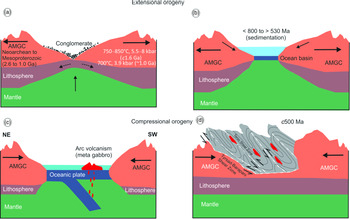
According to 900 Ma palaeomagnetic evidence from India, the Shillong Basin was quite close to Australia, Antarctica and South China during the Rodinia amalgamation (Cawood et al. Reference Cawood, Wang, Xu and Zhao2013; Pant & Dasgupta, Reference Pant and Dasgupta2017) (Fig. 1a), and was very close to the orogenic front between the continents indicated. As a result, we believe that the intracontinental rifting (by possible underplating of magma or asthonoshperic rise) in this section (the opening of the Shillong Basin) began during the Rodinia break-up (> 900 Ma) between Australia, South China and India. However, the current study does not report the concrete evidence of mafic magmatism from the lower section of Shillong Group rocks, which needs to be investigated further. However, the proposed impacts (plume-driven rifting) have been recorded across the entire belt, including the Adelaide Basin of Southern Australia, the Officer and Savory basins of Western Australia, the Beardmore Group of East Antarctica, Nanhua Basin of South China and Chungcheong Basin of South Korea (Walter et al. Reference Walter, Veevers, Calver and Grey1995; Goodge et al. Reference Goodge, Myrow, Williams and Bowring2002; Zhou et al. Reference Zhou, Wang and Qiu2009; Bose et al. Reference Bose, Banerjee, Jain, Dasgupta and Bajpai2020; Kim et al. Reference Kim, Kee, Santosh, Cho, Hong, Ko and Jang2020; Kumar et al. Reference Kumar, Kumar, Sharma and Singh2020; Lloyd et al. Reference Lloyd, Blades, Counts, Collins, Amos, Wade and Drabsch2020). As a result, in this study we assume that passive riftiting via extension and the resulting astheospheric rise is a plausible mechanism for the opening of the Shillong Basin (Fig. 9).
Stepwise evolution of the Shillong Basin. (a) The basin was formed by rifting induced by lithospheric thinning caused by crustal extension, which resulted in asthenosphere rise. Rifting soon resulted in slope wash conglomerate deposition over the long basin axis. (b) Basin sagging followed by deposition caused encroachment of the sea in a landlocked condition and the deposition of shallow clastic sediments. (c) Initial collision during basin closing caused subduction of oceanic plate and emplacement of mafic rocks. (d) Finally, the collisional orogeny resulted in a fold–thrust belt at the mature stage of the orogeny.

The upper age of the Shillong Basin is fixed (535–480 Ma) from U–Pb zircon dating of intrusive Cambrian granitoids (Yin et al. Reference Yin, Dubey, Webb, Kelty, Grove, Gehrels and Burgess2010; Kumar et al. Reference Kumar, Rino, Hayasaka, Kimura, Raju, Terada and Pathak2017). So the entire episode of basin initiation, deposition, closing and associated deformation–metamorphism must have completed by that time (during 800–530 Ma) (Fig. 9). The closing of the Shillong Basin was responsible for the deformation as well as the metamorphism of the sedimentary rocks. It triggered the northwestern thrust of the sedimentary rocks over the basement with a tectonic contact, folding and low-grade metamorphism. The closing must therefore have initiated during the Gondwana amalgamation with initial subduction of the bottom oceanic crust, followed by late thrusting and folding of sedimentary rocks (Fig. 9). However, no obducted oceanic crust has been reported from the area so far, necessitating more research. Surprisingly, no comparable oceanic suture has been found throughout East Gondwana’s collision belts (Powell & Pisarevsky, Reference Powell and Pisarevsky2002). Due to the lack of subduction-related magmatism, Powell & Pisarevsky (Reference Powell and Pisarevsky2002) proposed an oblique sinistral transcurrent collision between India and Australia during the amalgamation of Gondwana. Sedimentation ended with the Pan-African Orogeny and widespread granite emplacement in all Neoproterozoic basins of India, Australia, Antarctica and South China (Goodge et al. Reference Goodge, Myrow, Williams and Bowring2002; Ghosh et al. Reference Ghosh, Fallick, Paul and Potts2005; Rainbird et al. Reference Rainbird, Cawood, Gehrels, Busby and Azor2012; Cawood et al. Reference Cawood, Wang, Xu and Zhao2013; Valdiya, Reference Valdiya2016; Kumar et al. Reference Kumar, Rino, Hayasaka, Kimura, Raju, Terada and Pathak2017). As a result, the interval between the opening and closing of the Shillong Basin was calculated to be no more than 300 Ma.
An extensive field study, petrography, geochemistry, deformation fabric analysis and comparative study with other Eastern Gondwana Neoproterozoic basins suggest the continuity of the Gondwana Suture within the linear Shillong Basin, and we propose extending the Pan-African suture from the Eastern Ghat Mobile Belt (EGMB) in the south to the Shillong Basin in the NE (Fig. 1b).
6. Conclusion
-
(1) The Shillong Basin, located in NE India, is an isolated Neoproterozoic basin with deformed and low-grade metamorphosed siliciclastic rocks.
-
(2) The Shillong Group rocks are classified in the current study as lower Tarso Formation (conglomerate, gritty quartzite sequence), middle Ingsaw Formation (quartzite–micaceous quartzite sequence) and upper Umplapher Formation (magnetite-bearing quartz mica sequence).
-
(3) The deposition of the Shillong Basin began with a polymictic conglomerate that was accompanied by shallow-marine sediments. The geochemistry of the metasediments indicates a rift-related setting for the deposits.
-
(4) A preliminary stream-fed fan deposit converted to shallow-marine tidal flat and shelf deposit with multiple water-level fluctuations.
-
(5) The integration of available geochronological data with field geology, petrography and geochemistry indicates that the Shillong Basin was opened up by rifting during Rodinia break-up (> 800 Ma, separation of India from Australia and South China), resulting in an epiric sea condition.
-
(6) The evolutionary history of the Shillong Basin is comparable to that of reported Neoproterozoic basins in peninsular and extra-peninsular India, Western Australia, Antarctica and South China (east Gondwana), all of which are rifrogenic in origin and record shallow-marine clastic and/or non-clastic deposits (Walter et al. Reference Walter, Veevers, Calver and Grey1995; Chaudhuri et al. Reference Chaudhuri, Mukhopadhyay, Deb and Chanda1999; Goodge et al. Reference Goodge, Myrow, Williams and Bowring2002; Zhou et al. Reference Zhou, Wang and Qiu2009; Joy et al. Reference Joy, Patranabis-Deb, Saha, Jelsma, Maas, Söderlund and Krishnan2019; Bose et al. Reference Bose, Banerjee, Jain, Dasgupta and Bajpai2020; Kim et al. Reference Kim, Kee, Santosh, Cho, Hong, Ko and Jang2020; Kumar et al. Reference Kumar, Kumar, Sharma and Singh2020; Lloyd et al. Reference Lloyd, Blades, Counts, Collins, Amos, Wade and Drabsch2020).
-
(7) Basin closure was associated with the Pan-African collisional orogeny during Gondwana amalgamation, and the orogeny finally culminated with the intrusion of post-orogenic granitoids.
Supplementary material
To view supplementary material for this article, please visit https://doi.org/10.1017/S0016756821001230
Acknowledgements
The authors would like to thank the Director General of the Geological Survey of India and the Additional Director General of the Northeastern Region for their administrative assistance. Part of the work was completed during the GSI Field Season Program during 2017–2018. Michiel de Kock and Sojen Joy provided helpful feedback on the manuscript. We would also like to thank Olivier Lacombe for his efficient handling of the manuscript, and Sri Badu and Maiban for their assistance during fieldwork.
Declaration of interest
None.