INTRODUCTION
Several authors argue that small- and medium-sized enterprises (SME) have a predominant role in economic growth and employment creation for countries in general, and, in particular, for countries facing an economic recovery (Beck & Demirguc-Kunt, Reference Beck and Demirguc-Kunt2006; Honjo & Harada, Reference Honjo and Harada2006).
Various studies conclude that SME are more vulnerable to the duration of the distinct stages of economic cycles. In this context, SME facing financing restrictions may reduce the implementation of growth opportunities, with negative effects for reaching the minimum efficient scale, which ensures firm survival. In the context of financial markets with imperfect information, the insufficiency of internal finance may restrain the growth opportunities and increase the cost of capital (Aggarwal & Zong, Reference Aggarwal and Zong2006). Consequently, financing decisions and investment decisions probably are not independent, mainly for SME, which are often financially restrained due to obstacles in obtaining external finance (Almeida, Campello, & Weisbach, Reference Almeida, Campello and Weisbach2011; Khramov, Reference Khramov2012; D’Espallier & Guariglia, Reference D’Espallier and Guariglia2015). The low level of diversification of external financing sources for SME implies an over-reliance on cash flow, followed by bank debt, for funding growth opportunities.
The results of the European Central Bank ([ECB] 2013) study show that SME faced more restrictions in accessing debt finance than large firms, mainly in periods of financial crisis and recessive economic cycles.
The global financial crisis, beginning at the end of 2007 significantly contributed to reducing the availability of credit to SME in the Eurozone to which Portugal belongs (Vermoesen, Deloof, & Laveren, Reference Hartarska2013).
Around this financial crisis, the combination of the conservatism of the banks together with the financial fragmentation of the Eurozone, caused a serious worsening of the terms of finance available to SME, especially from 2010.
In Portugal, SME represents 99.9% of total firms, account for 79% of total employment and 66% of value added, contributing significantly to economic growth, job creation and innovation (European Commission, 2014). Given the importance of SME in the context of the Portuguese economy, the current study seeks to analyze the determinants of SME growth, taking into account the effects of the financial crisis and of the austerity measures. To achieve this goal, we use the generalized methods of moments (GMM) system (1998) dynamic estimator panel data as the estimation method and the data were obtained for a sample of 1719 SME for the period 2003–2012. The results indicate that internal finance is a determinant stimulating growth, whereas external finance, that is debt, is a determinant restricting SME growth. These results reinforce those of previous studies showing the importance of cash flow for SME growth, as well as the negative consequences of debt for growth in small firms.
The rest of the article consists of the following: the second section presents a brief characterization of Portuguese SME, financial sector and the effects of the global financial crisis; third section reviews the literature on endogenous and exogenous factors that determine SME growth, presenting the research hypotheses; fourth section presents the econometric method and the results, followed by the fifth section referring to their subsequent discussion; lastly, sixth section concludes and provides implications of macro and micro policies directed to SME growth.
The global crisis of financial sector and Portuguese SME
In 2012, SME accounted for 99.9% of the entire Portuguese business sector—of which 95.9% were micro-firms—representing more than 78% of employment in the private business sector. In the period 2008–2012, the funding of non-financial companies was mainly through external capital, a characteristic common to all sectors of activity (Instituto Nacional de Estatística [INE], 2014).
The recent global economic crisis showed the obvious limits of a business financing model where high debt based on bank credit is combined with a very limited use of capital market. One of the greatest difficulties faced by SME, which has worsened in the recent period of financial instability, is access to bank loans. This is to satisfy short-term financing requirements as well as meeting their investment needs. The fall in investment has coincided with a fall in credit to enterprises. With the exception of Germany and Austria, where credit growth to European Union (EU) non-financial corporations has been largely unaffected by the crisis, credit growth has slowed down or fallen sharply in the rest of the EU since 2008. Recent research by the ECB highlights that firms with higher levels of debt reduce investment more than low-debt firms, which represents a challenge for medium-term investment prospects (ECB, 2014).
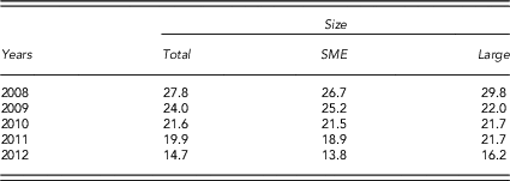
It is of note that in the Portuguese case, in what concerns the non-financial sector, the rate of investment in fixed assets has shown a substantial reduction, as in 2012, the corresponding percentage was around half of that observed in 2008 (see Table 1).
Non-financial firms’ rate of investment: total and by size

Note: SME=small- and medium-sized enterprises.
Source: PORDATA (Reference Schaller2016)—Firms’ Demography.
Portugal and Italy are among the EU countries most affected by the crisis that emerged as a result of the 2008–2009 international recession. Like Greece and Ireland, in May 2011, Portugal had to resort to international financial assistance in order to avoid debt default following the rise in public debt interest rates. The Portuguese government had to implement severe austerity policies, which accentuated the economic recession and the growth of unemployment. Between 2008 and 2012 real interest rates increased in Portugal and gross domestic product (GDP) moved back to levels never reached before the 2000s.
Following the global crisis, and particularly the financial fragmentation of the Eurozone from 2010, the terms of finance for Portuguese companies and families deteriorated sharply. Average interest rates and spreads faced by Portuguese firms increased dramatically in 2011 and 2012, to become around 3.5% higher than the interest rates faced by French or German firms and 2% above those borne by Spanish, Italian and Irish firms.
Despite the monetary policy measures implemented by the ECB, which has historically low-interest rates, this was not reflected in the interest rates faced by firms in southern Europe, and particularly those in Portugal. Following the sovereign debts and financial fragmentation of the Eurozone, bank credit for firms and families was severely reduced between 2010 and 2014. Loans to Portuguese companies increased significantly between 2010 and 2013. For that reason, Portuguese companies were faced with interest rates considerably higher than those of their European competitors, with a negative impact on investment and competitiveness.
Portuguese and Greek firms pay the highest interest rates on new loans compared with other Eurozone countries. The average interest rate in Portugal in 2013 was 5.5%, whereas in Spain and Germany in 2013 it was 3.5% and 1.9%, respectively. It is of note that even in the other countries that faced great financing difficulties and problems in their financial system (such as Ireland, Spain and Italy), interest rates on loans to firms are significantly lower and closer to those set in France and Germany. Between 2011 and 2013, despite the heavily restricted supply of bank credit, credit to large firms increased. This means that the sharp reduction in credit during this period is due to diminished credit being granted to SME.
Terms of finance are a fundamental variable in investment decisions. The evidence suggests that credit restrictions are limiting the competitiveness of Portuguese companies and investment in the transactional goods sector. Total investment fell sharply between 2008 and 2013, contracting by around 37% (Gabinete de Planeamento, Estratégia, Avaliação e Relações Internacionais, Reference Gilchrist, Himmelberg and Huberman2014). More worrying is the fact that business investment in industry, which is a sector strongly focused on exports, diminished sharply between 2008 and 2013 (INE, 2014).
These restrictions had repercussions for the smallest companies without access to the capital market, finding themselves severely limited in their capacity to manage their finances. Moreover, they were hindered by banks’ enormous difficulties in being able to capitalize and dispose of liquid means of finance, while simultaneously needing to reduce their leverage due to the greater demands on own capital (Mateus, Reference Mills, Morling and Tease2015).
Although many companies have undertaken internal restructuring processes in order to reduce their dependence on external sources of finance, especially those originating in the banking sector, the severe restrictions regarding access to credit has meant that in recent years the balance in terms of finance markets has been characterized by an excessive demand for finance (Luzio, Reference Mateus2015).
Some reasons for this are, for example the low level of capitalization of Portuguese firms, especially SME; high exposure to debt; banks’ high levels of impairment; requirements regarding capital ratios; and stricter criteria in risk management. All these factors have led banks to prefer to invest in sovereign debt and large firms rather than in SME (Confederação Empresarial de Portugal, 2014).
As is the case in most European countries, the Portuguese financial sector is dominated by banks, since these are heavily involved in dealing with the savings and gross financing needs of the non-financial private sector, including SME and families. Taking as a reference the data available in the Bank of Portugal—Banco de Portugal (BP) (2009)—report, the sharp fall in firms’ sales and services since the last quarter of 2008 caused negative effects on the financial sector’s operational profitability, which is likely to continue. Aggregate failure rates in the non-financial company sector have already exceeded the maximums recorded since the creation of the Eurozone, and it is anticipated that they will continue to increase.
DETERMINANTS OF SME GROWTH
Endogenous factors
Compared with large firms, SME are more exposed to problems of information asymmetry, which imply obstacles in accessing to external finance. In addition, SME have restricted access to the stock market and so their financing sources are little diversified. Various studies conclude that small firms use internal funds as far as possible, and only when these are insufficient do they typically incur debt.
Gertler and Gilchrist (1994), Gilchrist and Himmelberg (Reference Gertler and Gilchrist1995) and Moyen (Reference Moyen2004) argue that younger, smaller firms tend to invest more using their cash flow. Concerning the relationship between the size variable and firm growth, the results of empirical studies diverge. Some studies identify a positive relationship between firm size and growth (Samuels Reference Vermeulen1965; Prais Reference Sutton1976; Aces & Audretsch, Reference Aces and Audretsch1990), while others conclude a negative relationship between size and firm growth (Dunne & Hughes, Reference Dunne and Hughes1994; Becchetti & Trovato, Reference Becchetti and Trovato2002). Beck, Demirgüç-Kunt, Laeven, and Maksimovic (Reference Beck, Demirgüç-Kunt, Laeven and Maksimovic2006) defend firm age is a proxy for the financial restrictions they face in funding their investment. The authors also argue that, as firms come through the first years of their life, the barriers they face in getting finance for funding their investment become fewer.
Devereux and Schiantarelli (Reference Devereux and Schiantarelli1990) and Oliner and Rudebusch (Reference Peterson and Rajan1992) conclude that young firms show greater investment sensitivity to cash flow, suggesting that the youngest firms face greater obstacles in obtaining external finance.
Gilchrist and Himmelberg (Reference Gertler and Gilchrist1995) and Fazzari, Hubbard, and Petersen (Reference Fazzari, Hubbard and Petersen1988) argue that regardless of the high level of investment of the youngest and smallest firms, this investment very much depends on the availability of cash flow. Fagiolo and Luzzi (Reference Fagiolo and Luzzi2006) corroborate these arguments, concluding that liquidity restrictions create a negative effect on firm growth, with the smallest firms growing more after overcoming these restrictions.
Based on the previous arguments, the following research hypotheses are formulated:
Hypothesis 1 : Size is negatively related to SME growth.
Hypothesis 2 : Age is negatively related to SME growth.
Several previous studies (Evans & Jovanovic, Reference Evans and Jovanovic1989; Gertler & Gilchrist, 1994; Gilchrist & Himmelberg, Reference Gertler and Gilchrist1995; Hartarska, Reference Hartarska2001; Beck et al., Reference Beck, Demirgüç-Kunt, Laeven and Maksimovic2006; Brown, Fazzari, & Peterson, Reference Brown, Fazzari and Peterson2009) identify firm investment sensitivity of firms investment to cash flow that increases for SME, and consequently the growth of these firms will be dependent on cash flow generated through the firms’ activity.
Insufficient internal finance implies that SME will resort to external finance, which frequently refers to credit obtained from suppliers and banks. However, the strong dependence of SME on debt finance, namely bank loans, implies the payment of principal and interests, consequently a reduction of cash flow. In turn, decreasing cash flow implies greater difficulties for firms to meet their commitments with creditors and a reduction of internal finance. This reduction in the availability of financial resources has negative effects on firm investment.
SME frequently suffer from a shortage of know-how, which in turn means they lack a reputation with creditors. Consequently, lenders increase the cost of capital in order to minimize the risk of granting credit to those firms (Diamond, Reference Diamond1989; Brennan & Subrahmanyam, Reference Brennan and Subrahmanyam1996; Easley & O’Hara, Reference Easley and O’Hara2004). In turn, there is a greater likelihood of bankruptcy associated with SME, which contributes to increased risk for potential creditors (Pettit & Singer, Reference Samuels1985; Mueller & Zimmermann, Reference Mueller and Zimmermann2009).
The ECB (2013) concludes that the difficulties in obtaining bank loans restrain the investment and growth in European SME. Problems in accessing credit frequently affects SME’s survival, as these firms may not be able to come through periods of economic recession, especially when the bank system is not operating as normal (Collignon & Esposito, Reference Collignon and Esposito2013).
The financial crisis beginning at the end of 2007 led banks to frequently cancelling credit to SME, who consequently were left with a lack of funds to meet their investment and growth needs. SME especially those of micro-size, dominate the business world in the different countries of Europe, and revealed less capacity to increase their investment in the period following the financial crisis beginning in 2008 (ECB, 2013). According to Collignon and Esposito (Reference Collignon and Esposito2013), this fact is not only related to firm size, but also to the of lack economic stability, particularly the uncertainty concerning demand.
In the European context, more than 70% of external finance is provided by banks and under 30% by the financial market. This composition of financing sources has consequences for the process of adjustment to cope with financial crisis, making it slower and with less recourse to a bond issue compared with what occurs in the United States. This situation penalizes SME particularly, as they do not turn to bond loans due to the high costs and their lack of collateral, meaning reduced investment.
Furthermore, according to Collignon and Esposito (Reference Collignon and Esposito2013), the fragmentation of financial markets in peripheral European countries has been particularly negative for SME, due to the high cost of finance and “anaemic” economic growth, which has contributed to accentuating SME’s problems in terms of access to external finance. In turn, this has contributed to the drastic reduction in productive investment (International Monetary Fund [IMF], 2013).
In the Portuguese case, the collapse in domestic demand, aggravated by reduced credit and the adoption of austerity measures in a short space of time (between 2011 and 2014), contributed to the bankruptcy of a large number of Portuguese firms, particularly small ones.
Although the monetary policy implemented by the ECB has been marked by maintaining historically low-interest rates, this was not reflected in the interest rates applied to firms in Southern Europe, and in Portugal in particular (Leão, Martins, & Gonçalves, Reference Luzio2014).
The financial fragmentation of the Eurozone has not allowed monetary policy to act anti-cyclically, as would be ideal in a context of crisis and severe budget restrictions. Following the evolution of the weight of sovereign debt and financial fragmentation of the Eurozone, the bank credit granted to firms and families recorded severe contraction in the period between 2010 and 2014 (Leão, Martins, & Gonçalves, Reference Luzio2014). The interest rate spreads of new loans to Portuguese firms increased very substantially between 2010 and 2013. For that reason, Portuguese firms faced interest rates considerably above those of their European competitors (Leão, Martins, & Gonçalves, Reference Luzio2014).
Based on the above arguments, we formulate the following research hypotheses:
Hypothesis 3 : Cash flow is positively related to SME growth.
Hypothesis 4: Debt is negatively related to SME growth.
Exogenous factors
The macro-economic environment has a strong influence on SME growth, and for that reason exogenous factors such as GDP and the interest rate are analyzed as possible determinants of those firms’ growth (Higson, Holly, & Kattuman, Reference Higson, Holly, Kattuman and Platis2002; Higson, Holly, Kattuman, & Platis, Reference Honjo and Harada2004; Beck et al., Reference Beck, Demirgüç-Kunt, Laeven and Maksimovic2006).
Bernanke and Gertler (Reference Bernanke and Gertler1989) and Gilchrist, Himmelberg, and Huberman (Reference Gilchrist and Himmelberg2005) defend a connection between monetary policy and investment, as the effect that policy causes on the cost of capital ends up influencing firms’ investment, so that the fall in the level of investment can provoke a propagation of shocks through the credit channel.
Gilchrist, Himmelberg, and Huberman (Reference Gilchrist and Himmelberg2005) find a negative relationship between interest rates and capital. Changes in monetary policy, namely in terms of the interest rate, influence firms’ investment and debt capacity through the effect on cash flow. Indeed, the cash flow of highly indebted firms will show greater sensitivity to alterations in the interest rate than the cash flow of firms with a minimum level of debt (Mills, Morling, & Tease, Reference Moyen1995).
Therefore, we can expect the effect of interest rates to be more pronounced on SME investment, since these firms are more sensitive to changes in the cost of credit, compared with the case of large firms. In fact, according to Wagenvoort (Reference Wagenvoort2003), the interest rate tends to be considerably higher for SME, due to the greater risk of bankruptcy of this type of firm.
Pandit, Mittal, Roy, and Ghosh (Reference Pettit and Singer2006) found that the investment of the youngest SME is more vulnerable to monetary contractions. Therefore, the negative relationship between the interest rate and investment is expected to be even more pronounced, in that the information asymmetry implicit in the relationships formed between SME owners/managers and creditors is of greater relevance, contributing to the increased cost of credit compared with what is found in the context of older SME.
Authors such as Bernanke and Gertler (Reference Bernanke and Gertler1989), Gertler and Gilchrist (1994), Oliner and Rudebusch (Reference Peterson and Rajan1992), Bernanke, Gertler, and Gilchrist (Reference Bernanke, Gertler and Gilchrist1996) and Vermeulen (Reference Hyytinen and Väänänen2002) argue that firms that are restricted financially and operate in imperfect markets, as is the case of SME, are more affected by an economic recession, in this way increasing their financial limitations.
In an economic recession (as the one that led to the adoption of austerity measures) we can expect external capital markets to be more restrictive, as far as the granting of credit is concerned, which affects investment in a given economy, in general, and SME investment in particular. In the situation described above, SME are pushed towards a reliance on cash flow, which may have experienced severe reduction due to the above-mentioned economic recession (Kaufmann & Valderrama, Reference Kaufmann and Valderrama2008). In situations of economic growth, on the one hand, SME have easier access to credit, and on the other they present higher levels of cash flow, which is an element facilitating investment. In addition, the highly uncertain climate characteristic of economic recessions also has negative repercussions on investment, inasmuch as SME tend to postpone investment options, in the expectation of future economic growth (Fuss & Vermeulen, Reference Fuss and Vermeulen2004).
In periods of economic growth, characterized by greater growth opportunities, SME can take advantage of those opportunities by investing in profitable projects, resorting for this purpose to their cash flow or credit, where access will be more favourable at such times (Atanasova, Reference Atanasova2003).
Based on these arguments, the following research hypotheses are formulated:
Hypothesis 5 : The austerity measures are negatively related to SME growth.
Hypothesis 6 : The negative relationship between debt and SME growth is stronger in the period following the financial crisis.
Hypothesis 7 : The positive relationship between cash flow and SME growth is stronger in the period following the financial crisis.
Hypothesis 8 : The interest rate is negatively related to SME growth; and
Hypothesis 9 : GDP is positively related to SME growth.
EMPIRICAL APPROACH
Data set
The present study uses data gathered from the AMADEUS database, supplied by Bureau Van Dijk. This contains economic and financial information on European firms. In this study, the firms forming the research samples meet the definition of a small firm established by the European Commission (Recommendation 2003/36/CE), according to which, a business unit is considered a small firm, when: (i) it employs fewer than 50 people; and (ii) its turnover or annual balance sheet total does not exceed €10 million. Also, according to the European Commission’s recommendation, a firm is considered medium-sized when at least two of the following criteria are met: (i) having between 50 and 250 employees; ii) total assets between €10 million and €43 million; and (iii) turnover between €10 million and €50 million. Based on these criteria, 3008 SME were obtained and data was collected for the period between 2003 and 2012.
Arellano and Bond (Reference Arellano and Bond1991) conclude that the use of dynamic panel estimators implies that the units subject to analysis are included in the sample for at least 4 consecutive years. This is due to the need to include all units of analysis in the second-order autocorrelation test, which is essential to validate the results obtained with the dynamic estimators. We obtained a research sample with an unbalanced structure and composed of 1719 SME. The use of unbalanced panels, which allows for both firm entry and exit, partially mitigates potential selection and survivor bias. It should be noted that all estimations include annual dummy variables in order to measure the effects of the economic situation on variations in SME investment.
In addition, in all the estimations carried out, we also consider industry sector dummy variables to measure the impact of potentially different relationships between determinants and investment, according to SME belonging to different industry sub-sectors. We consider the following industry sector dummy variables: (1) agriculture, forestry and fishing; (2) construction; (3) manufacturing; (4) transport, storage and communication; (5) wholesale and retail; and (6) services.
Econometric method and variables
Regarding the econometric method, the GMM system (1998) dynamic estimator was used.
Using the GMM system (1998) estimator, the relationships between factor determinants and SME growth can be presented as follows:
 $$\eqalignno{ GROW_{{i,t}} \,& \,{\equals}\,{\rm \beta }_{0} {\plus}{\rm \beta }_{1} GROW_{{i,t{\minus}1}} {\plus}{\rm \beta }_{2} CF_{{i,t{\minus}1}} {\plus}{\rm \beta }_{3} LEV_{{i,t{\minus}1}} {\plus}{\rm \beta }_{4} SIZE_{{i,t{\minus}1}} \cr & {\plus}{\rm \beta }_{5} AGE_{{i,t{\minus}1}} {\plus}{\rm \beta }_{6} IR_{{t{\minus}1}} {\plus}{\rm \beta }_{7} GDP_{{i,t}} {\plus}S_{S} {\plus}d_{t} {\plus}v_{i} {\plus}e_{{i,t}} , $$
where
 $$v_{i} $$
is the non-observable individual effects; and
 $$e_{{i,t}} $$
the error; d
t
corresponds to the year dummies; and, S
s
the industry sector dummies.
The variables used in this study were measured as follows:
 $$GROW_{{i,t}} $$
is the growth, given by the ratio of net total assets variation in the current period to total assets in the previous period;
 $$GROW_{{i,t{\minus}1}} $$
is the lagged growth variable;
 $$CF_{{i,t{\minus}1}} _{{}} $$
is cash flow in the previous period, given by the ratio of earnings before taxes plus amortizations and depreciations in the previous period divided by total assets in the previous period;
 $$LEV_{{i,t{\minus}1}} $$
is debt in the previous period, given by the ratio of total debt in the previous period to total assets in the previous period;
 $$SIZE_{{i,t{\minus}1}} $$
is size in the previous period, given by the logarithm of total assets in the previous period;
 $$AGE_{{i,t{\minus}1}} $$
is firm age in the previous period, given by the logarithm of the number of years of existence of the firm in the previous period;
 $$IR_{{i,t{\minus}1}} $$
is the market interest rate in the current period, represented by the Euribor 3-month interest rate; and
 $$GDP_{{i,t}} $$
is gross domestic product in the current period, given by the logarithm of gross domestic product.
The model (1) was rewritten to allow the assessment of a hypothetical moderating effect of the financial crisis and especially in terms of SME’s financing sources:
 $$\eqalignno{ GROW_{{i,t}} & \,{\equals}\,{\rm \beta }_{0} {\plus}{\rm \beta }_{1} GROW_{{i,t{\minus}1}} {\plus}{\rm \beta }_{2} CF_{{i,t{\minus}1}} {\plus}{\rm \beta }_{3} LEV_{{i,t{\minus}1}} {\plus}{\rm \beta }_{4} SIZE_{{i,t{\minus}1}} \cr & {\plus}{\rm \beta }_{5} AGE_{{i,t{\minus}1}} {\plus}{\rm \beta }_{6} IR_{{i,t{\minus}1}} {\plus}{\rm \beta }_{7} GDP_{{i,t}} {\plus}{\rm \beta }_{8} D_{{aust}} {\plus}{\rm \beta }_{9} D_{{aust}} {\times}CF_{{i,t{\minus}1}} {\plus}{\rm \beta }_{{10}} D_{{aust}} {\times}LEV_{{i,t{\minus}1}} \cr & {\plus}S_{S} {\plus}v_{i} {\plus}e_{{i,t}} , $$
where the dummy variable
 $$D_{{aust}} $$
and interaction variables are defined as follows:
 $$D_{{aust}} $$
is the dummy variable representing the period that begins with the financial crisis, that is 2008 until 2012;
 $$D_{{aust}} $$
×CF
i,t−1 is an interaction variable measuring the strength of the relationship between CF
i,t−1 and
 $$GROW_{{i,t}} $$
; and
 $$D_{{aust}} $$
×LEV
i
,
t−1 is an interaction variable measuring the strength of the relationship between LEV
i,t−1 and
 $$GROW_{{i,t}} $$
.
Dynamic panel estimators
Given the dynamic nature of firm growth (DeMarzo & Fishman, Reference DeMarzo and Fishman2007), use of dynamic estimators is more appropriate than other estimation methods such as fixed or random effect panel models or ordinary least square regressions. In order to estimate the relationships between determinants and SME growth, dynamic panel estimators are used, namely the GMM system (1998) dynamic estimator.
Compared with static panel models, dynamic estimators present the following advantages (Arellano & Bond, Reference Arellano and Bond1991): (1) greater control of endogeneity; (2) greater control of the collinearity of explanatory variables; and (3) greater efficiency in controlling the effects of the absence of important explanatory variables in explaining the dependent variable. In addition, dynamic estimators have the advantage of correctly estimating the relationship between the dependent variable in the current and previous periods.
Estimating relationships between determinants and growth using static panel models (fixed or random effect models or ordinary least square regressions) would lead to bias of the estimated parameters as a consequence of the correlation between
 $$v_{i} $$
and
 $$GROW_{{i,t{\minus}1}} $$
, and between
 $$e_{{i,t}} $$
and
 $$GROW_{{i,t{\minus}1}} $$
. Resorting to dynamic panel estimators, as a consequence of estimating Equations 1 and 2 in first differences, the correlation between
 $$v_{i} $$
and
 $$GROW_{{i,t{\minus}1}} $$
is eliminated. Using lags of growth and the explanatory variables of growth creates orthogonal conditions between
 $$e_{{i,t}} $$
and
 $$GROW_{{i,t{\minus}1}} $$
, eliminating the correlation between those variables.
However, the results obtained with the GMM system (1998) estimator can only be considered valid on the following conditions: (1) if the restrictions, due to using the instruments, are valid; and (2) if there is no second-order autocorrelation.
To test the validity of the restrictions we use the Hansen test. The null hypothesis proposes the validity of the restrictions imposed by using the instruments. Rejecting the null hypothesis, we conclude that the restrictions are not valid, and so the results obtained cannot be considered robust.
In addition, we test for the existence of first- and second-order autocorrelation. The null hypothesis is non-existence of autocorrelation. Rejecting the null hypothesis of non-existence of second-order autocorrelation, we conclude that the results obtained cannot be considered robust.
In brief, for the results to be considered valid and consequently open to economic interpretation, the restrictions imposed by using the instruments have to be valid and there can be no second-order autocorrelation.
RESULTS
Descriptive statistics and correlation matrix
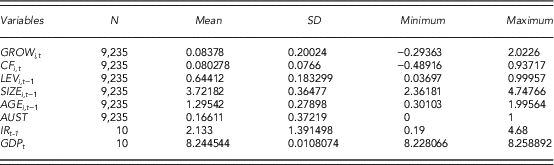
The descriptive statistics of the variables used in this study are presented in Table 2.
Descriptive statistics

Bearing in mind the standard deviations presented in Table 2, we can conclude that the growth variable shows the greatest volatility, which could indicate greater instability of underlying growth in SME, particularly when they are exposed to economic recession.
We also find that SME present an average level of debt in the order of 64.4%, while their average cash flow is around 8%. These statistics suggest high debt in Portuguese SME, which may be the consequence of low levels of profitability, possibly confirmed by the low average value of cash flow.
Regarding average size, firms in the sample are small, as the average value is around five million Euros, taking the total value of assets as a reference. Firms’ average age is relatively high, that is, ~20 years. Concerning the volatility of the interest rate and GDP, we find this to be quite insignificant, as the standard deviations of the two exogenous variables are considerably below the average values.
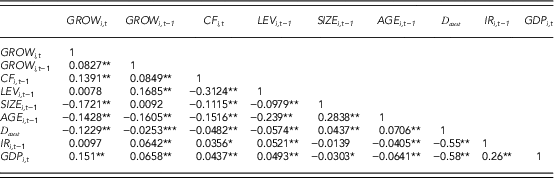
Table 3 presents the correlation matrix of the variables used in this study.
Correlation matrix

Note: *, **Statistically significant at 1% and 5% level, respectively.
Gujarati and Porter (Reference Gujarati and Porter2010) conclude that the problem of collinearity between explanatory variables could be particularly relevant when correlation coefficients are above 30%. Besides, the correlations between the variables IR
i,t−1 and GDP
i,t
and the dummy variable
 $$D_{{aust}} $$
are above 30%. In general, the correlation coefficients indicate that the problem of collinearity between explanatory variables may not be particularly relevant in this study.
Determinants of SME Growth
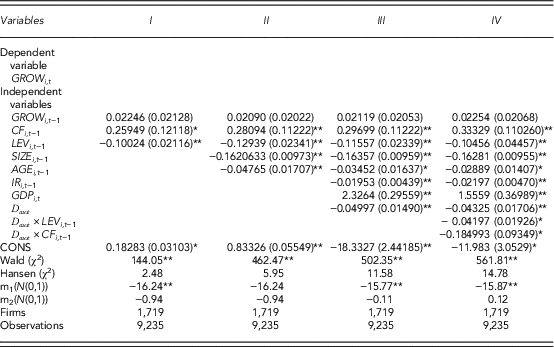
We now present the results obtained for estimations of the relationships between determinants and SME growth, using the GMM system (1998) estimator (Table 4).
Determinants of small- and medium-sized enterprises growth

Notes: SD in parentheses.
The estimates include sectoral dummy variables, which are not shown. The estimates include time dummy variables, which are not shown.
*, **Statistically significant at 1% and 5% level, respectively.
The results of the Hansen test indicate we fail to reject the null hypothesis of non-validity of the instruments used. Moreover, the results of the second-order autocorrelation tests indicate we cannot reject the null hypothesis of absence of second-order autocorrelation. Based on these results, we can consider the results obtained as valid and consequently open to economic interpretation.
We find that: (1) cash flow and GDP are positive determinants of growth; (2) debt, size, age and the interest rate are determinants restricting growth; and (3) the post-2008 period, considering the financial crisis and implementation of austerity measures, in the Portuguese context, has a negative effect on Portuguese SME growth. The coefficients associated with the interaction terms reveal that both debt and cash flow are of less importance for SME growth, compared with the period before the onset of the financial crisis, that is, 2003–2007. It is also found, considering the negative coefficient of the interaction variable
 $$D_{{aust}} {\times}CF_{{i,t{\minus}1}} $$
that cash flow is of less important for SME growth in the period following the start of the financial crisis, which may be justified by the effects of the financial and economic crisis and austerity measures that contributed to a contraction of SME growth.
DISCUSSION OF THE RESULTS
Size is a factor restricting SME growth and so, as firms increase in size, their growth diminishes, although to a considerable extent this is typically a proportionately effect. This being so, we cannot reject the previously formulated Hypothesis 1. The results of this study corroborates those of various others (Evans, Reference Evans1987; Dunne & Hughes, Reference Dunne and Hughes1994; Becchetti & Trovato, Reference Becchetti and Trovato2002) which point to a negative relationship between size and growth, concluding that as SME reach a minimum efficient scale that ensures their survival, they start to register negative growth rates. The negative relationship between size and growth indicates that SME have higher growth rates than larger firms, since their goal is to reach a minimum efficient scale for allowing their survival (Sutton, Reference Wagenvoort1997; Audretsch, Klomp, Santarelli, & Thurik, Reference Audretsch, Klomp, Santarelli and Thurik2004).
The results obtained reveal that the oldest SME grow less than new and young firms and so we cannot reject the previously formulated Hypothesis 2. The majority of SME in the first years of activity have not yet reached a size that allows survival and, therefore, these firms tend to show higher rates of growth. Later, as SME come closer to that minimum scale of efficiency, the rate of growth diminishes.
As mentioned by Fagiolo and Luzzi (Reference Fagiolo and Luzzi2006), younger, smaller firms should have greater growth opportunities, as they are still at the beginning of their life and faced with multiple growth opportunities, which means greater levels of growth. We find that cash flow is a determinant factor stimulating SME growth, and therefore we do not reject the previously formulated Hypothesis 3. It is confirmed that Portuguese SME are prone to financial restrictions, namely concerning access to credit, which forces them to finance their growth based on their cash flow, in agreement with the results of the studies by Evans and Jovanovic (Reference Evans and Jovanovic1989), Gertler and Gilchrist (1994), Gilchrist and Himmelberg (Reference Gertler and Gilchrist1995), Beck et al. (Reference Beck, Demirgüç-Kunt, Laeven and Maksimovic2006) and Brown, Fazzari, and Peterson (Reference Brown, Fazzari and Peterson2009). This result shows the relevance of internal sources of finance for growth in Portuguese SME, as a possible consequence of problems of information asymmetry in the relationship between shareholders/owners and creditors, corroborating the arguments of Petersen and Rajan (1994), Peterson and Rajan (Reference Prais1995) and Hyytinen and Väänänen (2006). For SME, cash flow is a critical success factor to maintain and renew their vitality, in terms of growth, at the same time as recourse to cash flow, according to Alti (Reference Alti2003), gives them a way to get around the problem of uncertainty and initial survival in the market, which is of critical importance in the activity of this type of firm.
Debt is found to be a restrictive determinant of SME growth and so we cannot reject the previously formulated Hypothesis 4. This result is in line with the empirical evidence obtained by Schaller (Reference Vermoesen, Deloof and Laveren1993), Budina, Garretsen, and Jong (Reference Budina, Garretsen and Jong2000), Honjo and Harada (Reference Honjo and Harada2006) and Mueller and Zimmermann (Reference Mueller and Zimmermann2009). Honjo and Harada (Reference Honjo and Harada2006) find that debt is not relevant in explaining the growth of young Japanese SME. Contrary to what is found in the case of young Japanese SME, debt is a relevant determinant for growth in Portuguese SME (Nunes, Serrasqueiro, & Leitão, Reference Petersen and Rajan2010).
For Portuguese SME, debt seems to restrict growth. SME represent a greater risk for creditors, due to lack of experience and know-how, contributing to an image of weakness and little credibility. On the one hand, so as to minimize the risk of granting credit to these firms, creditors increase the cost of capital and thus make it more difficult for them to access debt. On the other hand, SME do not disclose information to the market. As a result potential investors do not know the true value of these firms and entrepreneurs frequently adopt an opportunistic behaviour aiming to maximize the value of their utility function. This situation leads to access to credit depending above all on the capacity to provide collaterals.
Given the use of dynamic panel estimators, we determine the relationships between growth in the previous period and growth in the present period. We find that the relationship between those two variables is not statistically significant. This result suggests that for Portuguese SME, growth is not continuous, which is a characteristic that is not confined to Portuguese SMEs. This result can be related to the financial crisis, beginning in 2008, and austerity measures implemented following adoption of the EU/IMF programme of financial assistance for Portugal, as well as the deleveraging of banks, having raised greater barriers to SME accessing credit, thereby contributing to increasing the negative impact of debt on growth in Portuguese SME in the period following the start of the crisis (BP, 2011).
Moreover, the effect of austerity measures on SME growth denotes a statistically significant negative coefficient, so as expected we fail to reject the Hypothesis 5. Overall, these results suggest that, in the period following the start of the financial crisis, access to debt became more difficult in terms of amount, cost and contract conditions for Portuguese SME, leading them to reduce their investment, and consequently growth.
Reduced growth in Portuguese SME seems to be a consequence of these firms’ weakness, regarding exposure to credit from third parties, especially banks. In addition, it may be a consequence of the instability of the macro-economic variables that these firms were subject to, namely the great uncertainty of especially domestic demand. The result was an increase in pressure on them to export and to find new markets.
Indeed, the interaction term between the post-2008 period (corresponding to the beginning of the financial crisis) and austerity measures, and SME debt, shows a negative, statistically significant coefficient, revealing that the negative effect of debt on Portuguese SME growth is greater in the period of austerity, so we cannot reject the previous formulated Hypothesis 6.
It is also of note that, in the austerity period, the importance of cash flow for Portuguese SME growth showed a sharp fall, due to diminished internal demand having a negative effect on their profitability, thereby creating a reduction in cash flow and therefore less capacity to implement their growth opportunities, so we reject Hypothesis 7.
In addition, a downturn in the economic cycles that create uncertainties in demand imply less capacity for self-funding and there is a lower probability of firms generating a healthy cash flow that can be used to finance SME’s needs.
Higher interest rate contributions can also reduce SME growth and as a result the empirical results obtained in this study do not allow rejection of the previously formulated Hypothesis 8. Increased interest rates push SME, particularly the youngest ones, into turning to their cash flow to service the debt. This, in turn, reduces the liquidity funds that could be directed towards investment. This empirical evidence is in line with the previous findings of Pandit et al. (Reference Pettit and Singer2006), which state that the smallest, youngest firms are more vulnerable to a restrictive monetary policy. It also stands out that the interest rate contributes more significantly to reducing the likelihood of SME’s survival.
Higher values of GDP are also found to contribute to increased growth and so we cannot reject the previously formulated Hypothesis 9. Therefore, SME adjust their growth as a function of different stages of economic cycles, corroborating the conclusions of Bernanke and Gertler (Reference Bernanke and Gertler1989), Oliner and Rudebusch (Reference Peterson and Rajan1992), Gertler and Gilchrist (1994), Bernanke, Gertler, and Gilchrist (Reference Bernanke, Gertler and Gilchrist1996) and Vermeulen (Reference Hyytinen and Väänänen2002), which point towards SME being more susceptible to financial restrictions and the different stages of economic cycles, principally recession.
In times of recession, the particularly adverse market conditions may contribute to creditors making firms’ access to credit more difficult which, combined with the difficulties SMEs have in holding on to cash in a recession (Kaufmann and Valderrama, Reference Kaufmann and Valderrama2008), may mean diminished growth.
CONCLUSIONS
The aim of this study is to analyze the determinants of SME growth, specifically the importance of SME’s sources of finance, considering in an innovative way the assessment of the moderating effects of austerity measures adoption, following the financial crisis beginning in 2008. To reach this goal, we use panel data and, as estimation method, we use the GMM system (1998) dynamic estimator for a sample of 1,719 SME in the 2003–2012 period. The results indicate that the firm’s internal finance is a determinant stimulating growth, whereas external finance, that is, debt, is a determinant restricting SME growth. These results reinforce those of previous studies that show the importance of cash flow for SME growth, as well as the negative consequences of debt for growth in this type of firms.
However, in assessing the moderating effects of the post-2008 period, with the subsequent adoption of austerity measures, we find debt has a greater negative effect, while cash flow produces a smaller positive effect on SME growth. These results suggest, first, lower levels of productivity due to a fall in domestic demand, and second, more unfavourable terms faced by SME in accessing credit, above all from banks, which lead these firms to lower levels of growth. As a result, factors exogenous to the firm, such as the uncertainty of demand, difficulties imposed by banks and additional austerity measures, particularly those regarding tax policy, meant a substantial increase in the tax burden borne by firms (with the consequent reduction in investment) and by families (with the associated effect of reduced consumption). These factors are important for a better understanding of the evolving negative trajectory of SME growth after the onset of the global financial crisis.
The majority of SME’s experience obstacles in accessing external finance, which, in cases of insufficient internal finance, may restrain their potential growth.
Therefore, in order to prevent the inefficient destruction of investment opportunities and boost SME growth we make the following suggestions to policy-makers:
-
(A) Macro- and industrial-level interventions, through:
-
(i) implementing progressive austerity policies applicable over a longer period; and
-
(ii) applying measures that give greater effective protection to budding or incumbent business units, with greater responsibilities as employers; and
-
(B) Micro and financing sources interventions, through:
-
(i) developing competitive surveillance mechanisms for forecasting bankruptcy, using early warning indicators;
-
(ii) introducing greater flexibility in mechanisms of controlled risk management;
-
(iii) ensuring competitive access to sources of finance;
-
(iv) providing loan guarantees to encourage creditors to make more debt finance available to SME;
-
(v) supporting SME in bond issue, to reduce dependence on bank credit; and
-
(vi) developing a truly competitive and accessible SME’s stock market exchange.
Regarding future research guidelines and in order to improve the capacity to monitor and assess SME performance. These are critical indicators of innovation and growth around which an early warning system comprising such indicators can be developed. This could be supplemented by measures of profitability and competitiveness. In this domain, the inclusion of five demanding and multidimensional levels of analysis, namely: (I) profitability; (II) liquidity; (III) innovative capacity; (IV) growth (high growth vs. non-high growth); and (V) research and development (R&D) intensity; which can be considered according to location, sector of economic activity, profile of technological intensity and characteristics of industrial dynamics (size: micro; small; medium-sized; and large; industrial concentration, entry barriers, competition, entry, exit, business turbulence, inward and outward foreign direct investment, clusters, entrepreneurial and innovative ecosystems, etc.).
For future studies, it is also suggested that different alternatives of SME growth determinants are considered simultaneously, specifically: (1) macro-economic factors (indicators of the economic climate, public subsidies, geographical location, population density, sector of economic activity, regulation, corruption, transparency, accountability, quality of life and quality of institutions); (2) firm factors (age, size, internal and external finance and intangible assets including intellectual property rights, patents, designs, brands and others); (3) strategic factors (strategic alliances, competition relationships, joint-ventures, IP licensing and R&D consortia); and (4) individual factors (academic qualifications of founders/managers, gender, experience of co-working, previous insolvency, unemployment condition and other individual characteristics still unexplored).
Acknowledgements
The authors are pleased to acknowledge financial support from Fundação para a Ciência e a Tecnologia: Zélia Serrasqueiro (grant UID/ECO/04007/2013) and FEDER/COMPETE (POCI-01-0145-FEDER-007659).