1. Introduction
Since the end of the dot com boom, the institutions for financing high-growth technology companies have changed dramatically. Prior to 2002, new high-potential companies in technology-intensive industries typically received financing from a handful of individual angel investors – people who invest their own money in private companies owned and operated by others who are neither their friends nor family members – who were geographically proximate to them, followed by money from venture capital firms – investment funds that seek capital from investors needing long term returns, such as pension funds and university endowments.
Since 2001, however, the institutions of early-stage finance have changed substantially. Innovation in software and computing has lowered the cost of bringing new software projects to the market. These changes have given rise to the emergence of new early-stage finance institutions. The fraction of the population that invests in early-stage companies has increased. The magnitude of the average investment has declined. Angels have invested further afield from their locations. Four institutions in the world of financing high-potential early-stage companies have either started or grown: angel groups, business accelerators, micro venture capital funds and equity crowdfunding platforms.
This paper focuses on chronicling these significant institutional changes in detail, but also offers some speculative explanations for how these phenomena relate to theories of institutional change. Technological change, particularly the dramatic decline in the cost of bringing new software products to market, has undermined the traditional venture capital model, which has shrunk substantially since 2001. It has also led to the growth of angel investment activity, and innovations in the institutions of early-stage finance described above. While other trends – the generation of great wealth among angel investors in Silicon Valley and legal changes that made equity crowdfunding possible, and the declining cost of capital – also occurred during this period, a careful look at the data suggests that the decline in the cost of bringing new products to market was the primary source of the changes seen in the market for early-stage finance.
This article proceeds as follows: The next section describes fundamental changes in the process of bringing new software products to market and explains how these changes have altered the institutions of early-stage venture finance. The third section describes how these new institutions, in turn, have altered the venture capital industry. The fourth section describes how these changes have altered the angel capital market. The fifth section concludes.
2. The effect of changes in software innovation on early-stage finance
To understand how the system for financing early-stage high-potential companies has changed since the start of the new millennium, we need to look at the way that innovation has changed in the primary industry that these investors fund. Since the early 1980s, investors have put more money into early-stage high-potential software companies than businesses in any other industry (Center for Venture Research, 2015; National Venture Capital Association, 2016). Because software companies have historically received such a large share of early-stage investments and investment dollars, changes to the process of software innovation cannot help but influence the process of financing new early-stage companies.
The process of developing new software products has changed profoundly since 2001. Two of these changes – the dramatic decline in the cost of bringing a new software product to market and the tremendous rise in the capability of software to automate many very-difficult-to-measure activities and to connect disparate people – have dramatically changed the world of financing early-stage companies.Footnote 1 We deal with each of these changes in turn.
Back in the late 1980s it cost more than $20 million in today's dollars to bring a new software product to market (Lambert, Reference Lambert2016). Companies needed to spend heavily on infrastructure to develop their new products and to market and sell the product to customers (Suster, Reference Suster2012). With this capital-intensive model of innovation, start-ups raised money by going to traditional venture capital firms in places like Sand Hill Road and pitching their business ideas to them (McClure, Reference McClure2014).
The rise of angel groups
Over time, the cost of bringing new software products to market dropped systematically, falling to about $5 million at the time of the dot com bubble bursting in 2001 (Lambert, Reference Lambert2016). This decline in the cost of software development made it possible for angel investors to begin to compete directly with venture capitalists as a source of financing for early-stage software companies. While individual angels could not provide the kind of capital necessary to finance early young software companies on their own, by working with other investors, individual angels could begin to reach the levels of financing necessary to fund the initial round of money needed by software start-ups. As a result, the early 2000s witnessed a period of rapid rise of angel groups – collectives of accredited investors meeting on a regular basis to hear entrepreneurs’ pitches for funding and often conducting due diligence and investing collectively.
Lerner and Schoar (Reference Lerner and Schoar2016: 3) explain, ‘Beginning in the mid-1990s, angels began forming groups to collectively evaluate and invest in entrepreneurial ventures’. But angel group numbers did not begin to take off until the start of the current millennium. Data from the Angel Capital Association, the trade association for angel groups, show that in 1999, there were fewer than 100 American angel groups. By 2013, that amount had more than tripled, to 385 (Hudson, Reference Hudson2016).
The birth of business accelerators
The declining cost of bringing new software products to market in the 1990s was only the beginning of the process of cost reduction. Between 2000 and 2004, the cost of developing new software products continued to decline. Salesforce.com introduced the process of delivering enterprise applications over the internet. Amazon web services began in 2002, and open source software began to drive down the cost of developing new software products. On the marketing side, the formation and growth of Google in internet searches, SMS technology on mobile phones, and PayPal in payments, led to further cost reductions. By 2004, the cost of bringing a software product to market had shrunk to about $3 million (Lambert, Reference Lambert2016).
The decline in the cost of bringing new software products to market also began further to strain the traditional venture capital model. Traditional venture capital firms cannot provide much assistance and mentoring to more than a handful of start-up company founders. Traditional venture capital firms do not invest in large numbers of companies. Moreover, much of the time of venture capitalists is spent monitoring their investments and sitting on boards. Traditional venture capitalists (VCs) could not easily provide hands-on assistance to many software start-ups.
The shrinking cost of bringing software to market led some forward-looking folks to introduce a new innovation in the market place, the business accelerator, which began with the formation of Y Combinator in 2005. Accelerators are organizations that provide early-stage companies with mentoring, capital and access to investors in return for equity.
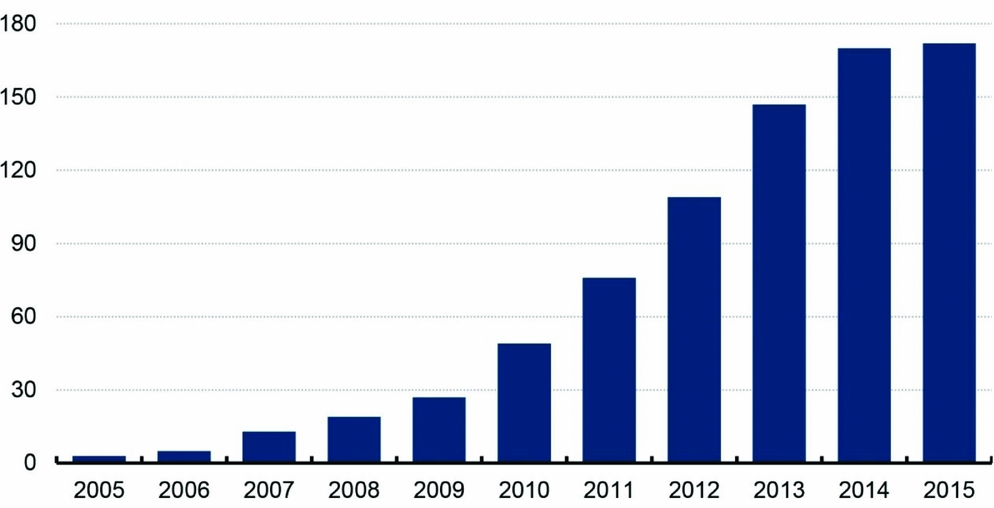
Since 2005 accelerators have become one of the most rapidly growing institutions in early-stage finance. AngelList, an online platform that matches high-potential start-ups with investors and employees, currently indicates 578 accelerators in operation, up from one in 2005. As Hathaway (Reference Hathaway2016) explains, and is shown in Figure 1, the number of accelerators began to rise rapidly in 2007 and continued expanding until about 2014.
United States accelerator pool by year.

The emergence of micro venture capitalists
The cost of bringing new software products to market has continued to fall over time, declining to about $1 million in 2010 (Lambert, Reference Lambert2016). According to Suster (Reference Suster2011), open source computing, horizontal computing and Amazon web services have driven down computing and operating costs by about 90% since 2001 (Suster, Reference Suster2011). The notable innovations in software development that have reduced the cost of bringing new software products to market include Ruby on Rails, open source software that was introduced in 2004. Also beginning in 2006, Amazon made it possible for small companies and individuals to rent computers to run their own applications.
Costs also began to fall on the marketing and distribution side of the equation. Facebook began in 2004, YouTube in 2005, and Twitter started in 2006. All of these new companies dramatically reduced the cost of reaching customers. The opportunity to reach customers on mobile devices also emerged in this period. Smartphones began to be sold in significant numbers in 2007, with Apple's introduction of the iPhone. The development of the App Store and Google Play has further reduced the cost of reaching customers (Goetz, Reference Goetz2016).
The declining amount of capital required to build and bring new companies to market has led to a dramatic rise in the number of people who were willing to try to start software companies (McClure, Reference McClure2014). The increase in the number of businesses experimenting with minimum viable products and business models has made it more difficult for investors to engage in the process of selecting new companies to back. At this very early stage in the life of a company, the ability to differentiate winners from losers is nearly impossible. These investors needed to make a philosophical shift in their process of managing uncertainty. Rather than trying to identify winners, they began to think that massive diversification was the only solution. They would invest small amounts of money in a large number of companies and then invest further in those that showed traction (McClure, Reference McClure2014).
When companies need $100,000 to $200,000 to test a product idea, the traditional venture capital model breaks down. Traditional venture capital is too labour-intensive for fundraising efforts of less than $1 million, let alone for the first financing rounds of less than $250,000 that had become common for software start-ups. Traditional VCs are structured to make a handful of several-million-dollar investments every year. Their transaction costs are too high; they raise too much money; and they have processes that are too labour-intensive to invest tiny amounts in a large number of companies.
As a result, a new innovation in the financing process, micro venture capital funds, began to emerge in around 2008. These are limited partnerships that raise money from their own investors that then make $100,000 to $200,000 investments in early-stage companies (Suster, Reference Suster2011). To operate effectively making a large number of small investors, these entities needed to change the venture capital process. These investors began to routinize activities, positing that customized term sheets and sitting on boards were too cumbersome for the new type of early investment in start-up companies. They also changed how they approached due diligence, leaving many questions about downstream activities unanswered until later and began to use data to select ventures and set valuations.
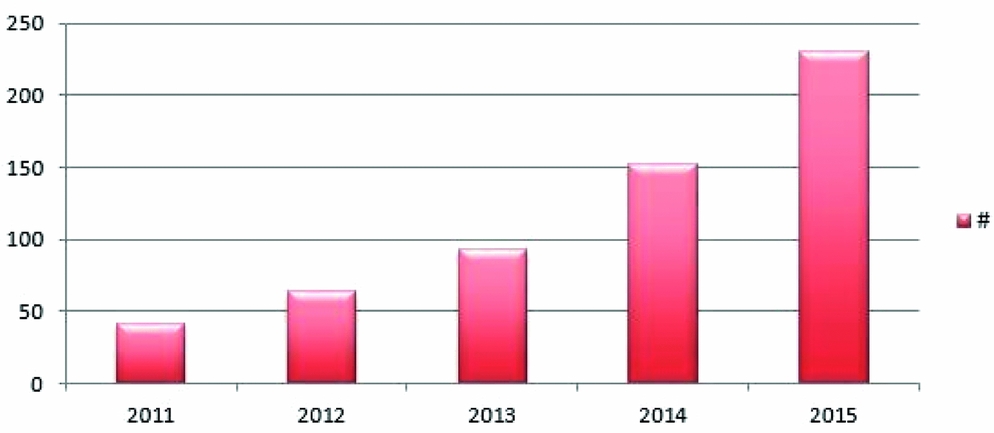
The number of micro venture capital firms – funds that raise money from limited partners to invest small amounts of money in a large number of very early-stage companies – has grown dramatically in recent years. From fewer than 50 funds in 2011, the numbers swelled to nearly 250 by 2015 (See Figure 2).
Numbers of active micro venture capital firms.

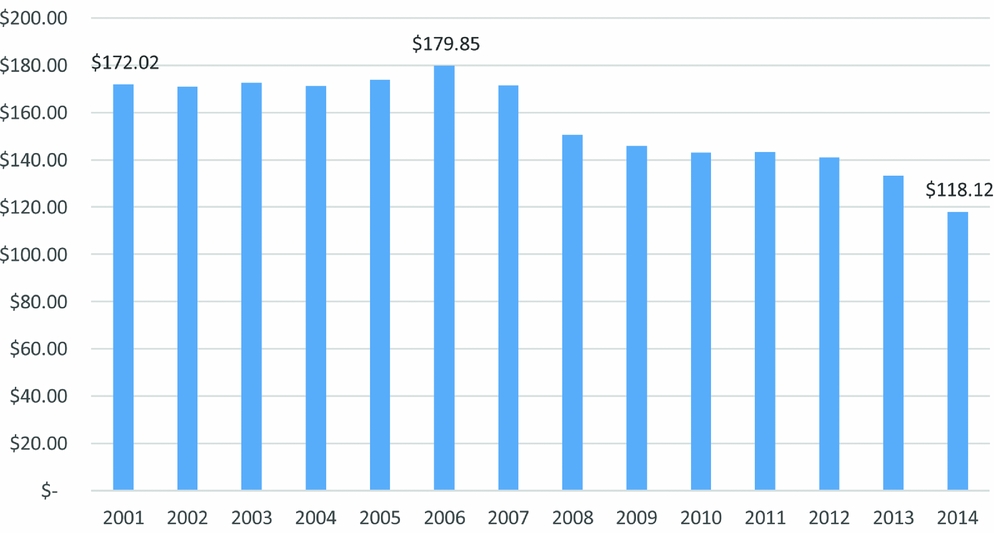
The introduction of micro venture capital funds to the venture capital mix has had a dramatic effect on the composition of venture capital funds. Since 2007 the size of the average venture capital fund has declined significantly when measured in inflation-adjusted terms, as tiny funds were added into the pool with mega funds (see Figure 3).
Average fund size (millions of 2008 dollars).

The growth of online platforms
Advances in software continued to change the world of venture finance after 2010. The cost of bringing a new software product to market continued to decline. By 2014, the cost was estimated to be as low as $200,000, and by 2016 this cost had fallen to around $100,000 (Lambert, Reference Lambert2016) with further expansion of open source computing, horizontal computing and Amazon web services on the development side and lower cost search, social networking and media advances (e.g. Instagram and Snapchat) on the marketing and distribution side (McClure, Reference McClure2014).
As the volume of start-ups seeking tiny amounts of money at very early stages in their lives began to grow, other innovations became necessary. Of particular importance has been the post-2010 introduction of online tools to facilitate investment in young companies. Different platforms – Gust, AngelList, Seedinvest, Crowdfunder, Wefunder, CircleUp, CB Insights, Crunchbase, and Pitchbook – began to emerge to overcome several obstacles in making tiny investments by large numbers of people in very early-stage businesses.
Some innovations, like AngelList, made it possible to bring together investors very quickly and to provide the back office process of managing investments. AngelList is a marketplace that allows the buyers (angels) and sellers (start-ups) to come together. It facilitates introductions, saving on the time spent setting up meetings and travelling to pitch sessions, as well as syndicating deals and managing the process of making investments, reducing legal and organizing costs (Willis, Reference Willis2014).
Other platforms, like Gust, Pitchbook, CB Insights and Crunchbase allow more quantitative approaches to early-stage investing by providing access to data about valuations, company traction and investment management (McClure, Reference McClure2014). Gust, for instance, provides the back-end collaboration tools needed to invest on a large scale, while Pitchbook and CB Insights provide information about trends in valuation and exits.
Still other platforms like in FundersClub, CircleUp and SeedInvest provide individual investors with access to deal flow unimaginable in 2001. Beginning with the Jumpstart our Business Startups Act in 2010, early-stage investors could learn about companies seeking financing on websites devoted to this purpose. As a result, finding out about deals was no longer a local operation. Massolution (2015), for instance, estimates that global equity crowdfunding has jumped from just $400 million in 2013 to $2.6 billion in 2105.
3. Changes in venture capital since 2001
The institutional change in the market for early-stage finance described above has changed the venture capital industry in three significant ways. First, the venture capital industry has shrunk in size. Second, traditional venture capitalists have moved later in the start-up lifecycle, with a large number of early-stage investors and a small number of very large late stage investors. Third, the industry has become increasingly concentrated in the one region where the traditional model remains strong – Silicon Valley.
The industry has shrunk
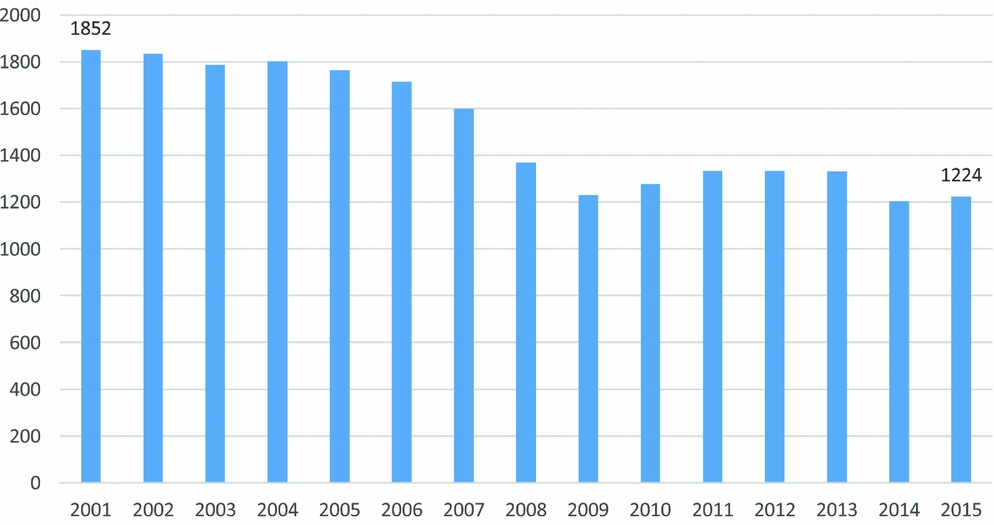
Venture capital activity has shrunk since the end of the dot com boom in 2001. One measure of this decline is the number of venture capital firms. Fewer active venture capital firms exist now than in 2001 and fewer of those firms are actively raising funds. As Figure 4 shows, between 2001 and 2015, the number of active venture capital firms decreased from 1,852 to 1,224, a decrease of more than one-third. Similarly, the number of venture capital firms raising a new fund in the previous eight years had fallen from 923 in 2001 to 798 in 2015, data from the National Venture Capital Association (NVCA) indicates. The number of venture capital professionals decreased from 14,777 in 2003 to 5,891 in 2013 (Cook, Reference Cook2014).
Number of active VC funds.

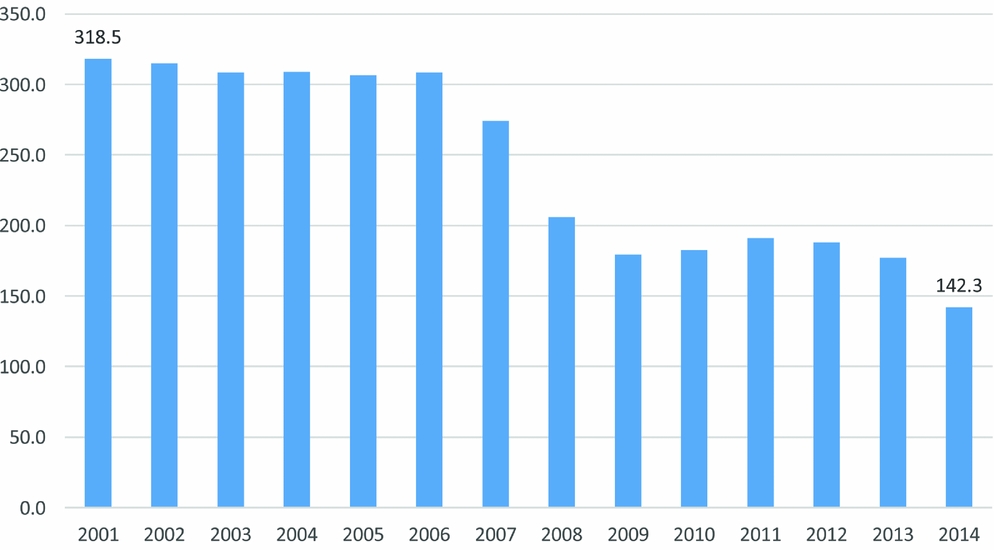
Another measure is capital under management. Venture capitalists are managing substantially less capital than they did in 2001. Figure 5 shows the amount of capital that venture capital firms have under management measured in inflation-adjusted terms. In 2001 the amount of capital under VC management was $319 billion (in 2008 dollars). By 2014, it had declined to $142 billion (in 2008 dollars). Both for venture capital funds and capital under management, 2006 appears to be the point at which substantial decline began.
Capital under management (billions of 2008 dollars).

The industry has moved to later stage
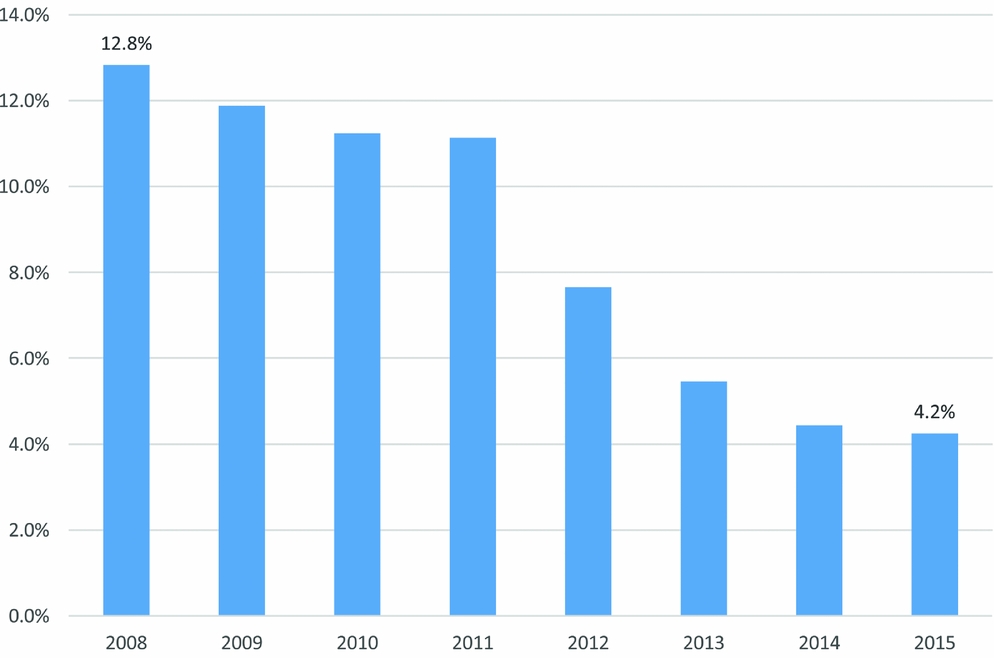
Traditional venture capital firms have moved away from investments at the earliest stages in the life of companies (see Figure 6). In 2008, 12.8% of venture capital investments occurred at the seed and start-up stage. By 2015, that fraction had fallen to 4.2%. In 2001, venture capital firms put $1.1 billion (in 2015 dollars) into 282 seed or start-up stage deals. In 2015, they put $1 billion into 186 companies, a 9% decline in dollars and a 34% decrease in the number of companies backed.
Seed and start-up stage share of venture capital deals.

4. Changes in angel investing since 2001
Angel investing has changed substantially since 2001. In contrast to what has happened in venture capital, angel investment activity – efforts by individuals to finance private companies owned and operated by people who are neither their friends nor their relatives – has grown. Moreover, angel investment activity has become less geographically concentrated now that it has moved online to a sizeable extent.
Angel investment activity has grown
In contrast to the decline in venture capital activity in recent years, angel investment activity has increased substantially. Since 2002, a period in which the number of venture capital firms shrank by one-third, the number of angel investors has risen by 52%, according to data from the Center for Venture Research (CVR) at the University of New Hampshire.
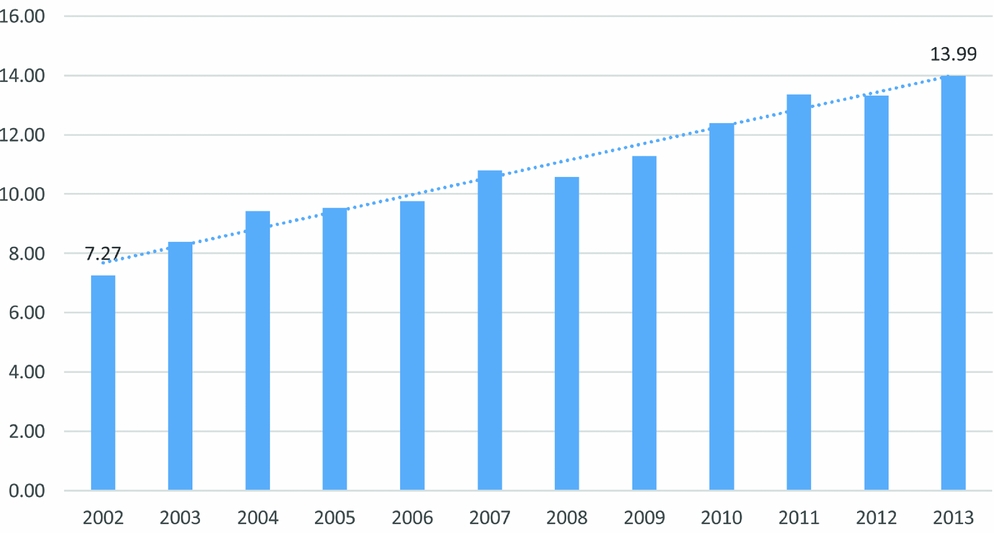
Moreover, angel investment activity has increased relative to the stock of businesses and people in the economy. Figure 7 compares CVR data with data from the US Census Bureau on the number of US businesses with employees to provide a measure the trend in the rate of angel investment activity in the economy since 2002. As the figure shows, the change is substantial. In 2013, there were 13.99 angel-backed businesses per thousand employers, nearly double the ratio of 7.27 in 2002.
Angel-backed ventures per thousand US businesses with employees.

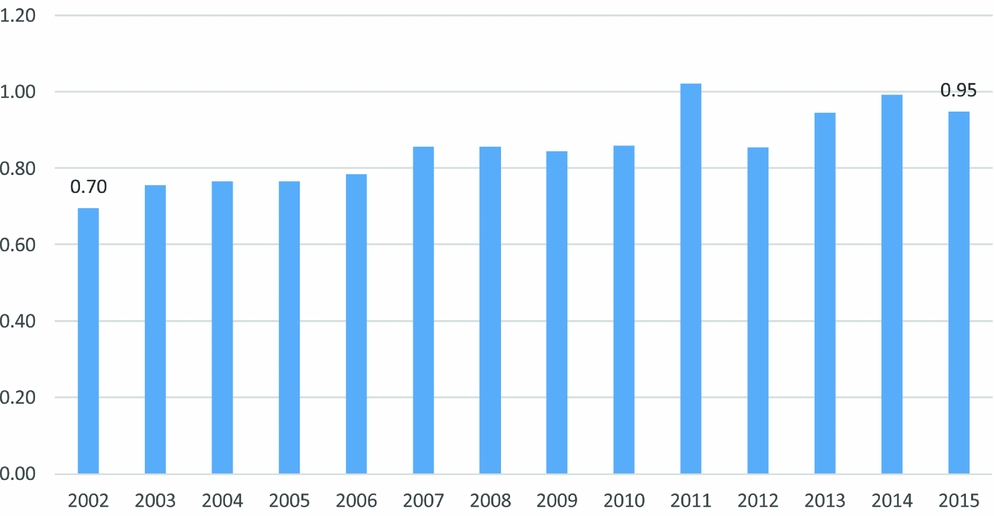
Unfortunately, no data since 2013 are available on numbers of employer businesses. But we can compare the number of angel investors to the population to get a different measure of the rate of angel investment activity. Figure 8 shows that comparison. As the figure reveals, in 2015 the ‘active angel’ fraction of the US population was 36% higher than it was in 2002.
Active angel investors per thousand Americans.

As would not be surprising from the above discussion of the trends in both angel investment and venture capital activity, angel investment activity has increased relative to venture capital. In 2002, there were 13.3 angel-backed companies for every venture capital-financed business in the United States, as a comparison of NVCA and CVR data shows. By 2015, that ratio was 19.2. Similarly, in 2002 there were 108.9 active angels for every venture capital fund in operation. In 2015, there were 249.1 active angels per VC fund.
In short, since 2002, angel investment activity in the United States has risen, both in terms of the number of angel investors and the number of companies they finance. Moreover, angel investment activity has increased relative to venture capital activity, which has declined over the same period.
Angel investments in start-up companies have become smaller
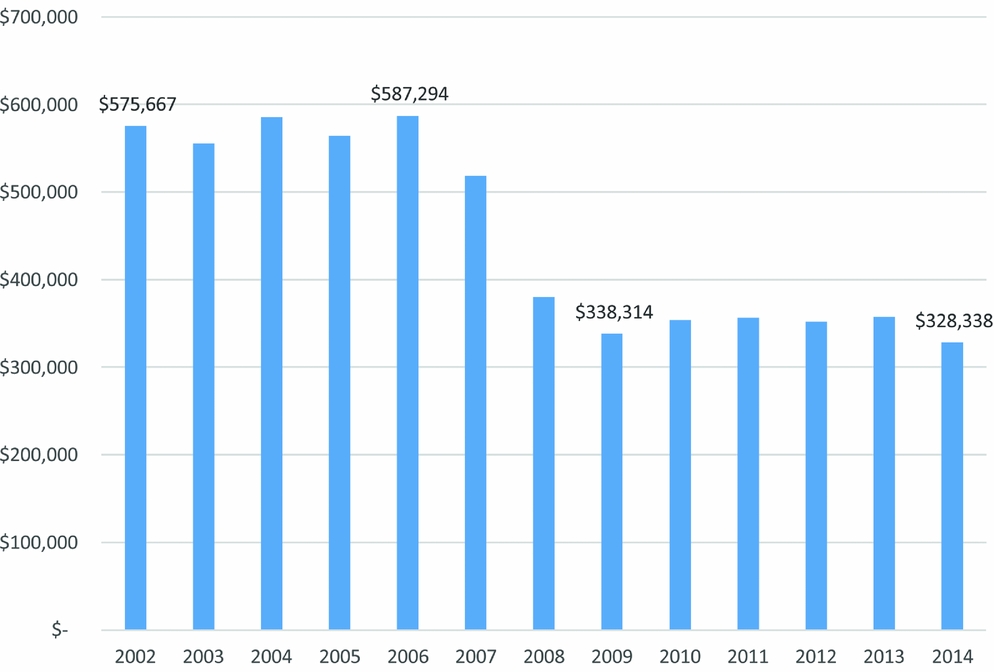
While the amount of angel investment activity has increased since 2002, the size of the average angel company raise has shrunk. Data from the CVR show that the average angel-backed company received 42.3% less money in 2014 than in 2002, when measured in inflation-adjusted terms. In 2002, the average angel-backed venture received nearly $576,000 in angel money (when measured in 2014 dollars). But in 2014, the average angel-financed business received only $328,000 (see Figure 9).
Real dollars per venture.

This decline in funding comes from two sources. First, the average amount invested per angel today is nearly 27% smaller than it was in 2002, when measured in inflation-adjusted terms. Second, the number of active angels per angel-backed company has also declined, falling from 5.6 to 4.3 between 2002 and 2014.
Angel investment has become less geographically concentrated
Historically, one of the rules of thumb about early-stage investment is that angels invest in companies no more than a two-hour drive from their location. Investing locally, the theory holds, provides better information about entrepreneurs and facilitates the monitoring of portfolio companies.
That rule of thumb has been changing. The Angel Capital Association (ACA) reports that accredited angel investors are more willing to invest in geographically distant start-ups than they once were. The March 2015 ACA Member Group Survey of 106 angel groups (Angel Capital Association, 2015) revealed that less than 13% of groups preferred to invest in start-ups located within a two-hour drive of their homes. In 2008, that fraction was nearly 28%.
One reason for this shift is the rise of online platforms. A comparison of the number of angels who are members of ACA-listed angel groups and the number of angels on online platforms such as Seedinvest and AngelList indicates that the number of angels on each of the platforms now exceeds the total membership of all ACA-affiliated angel groups. While being a member of an angel group and being on an online platform are not mutually exclusive, the numbers indicate that online platforms are a key way that many angels are now finding deals.
5. Implications for understanding institutional change
Four new institutional arrangements have emerged or have grown in the world of early-stage venture finance: angel groups, business accelerators, equity crowdfunding platforms and micro venture capital funds. As these new institutions have emerged, we have seen a subtle rotation in the world of early-stage finance. Traditional venture capital has declined, while angel investment activity has increased. This section considers how economic theories for institutional change might account for these new arrangements.
One might view the market for early-stage finance as a case study in institutional change. Institutional change involves alteration of the ‘rules of the game in a society’ (North, Reference North1990). A shift in production technology – the declining cost of developing new software products – has led to shifts in the institutional arrangements of early-stage finance in ways consistent with economic theories that depict technological change as a key driver of institutional change (e.g. Ayres Reference Ayres1944; Kingston and Cabellero, Reference Kingston and Caballero2009; Nelson Reference Nelson2005). The shift appears to have occurred in software and information technology and not in the biomedical side of early-stage finance. In addition, the timing of the shift appears to be more the result of technological change than a shift in attitudes or a decline in the cost of capital.
Technical changes can affect institutions by changing transactions in early-stage finance. For example, the automation of investment activities in micro venture capital significantly reduced measurement costs in the valuation and selection of new ventures (Barzel, Reference Barzel1982). What was once unquantifiable has become more quantifiable, leading to new and more efficient institutional arrangements, such as crowdsourcing platforms, that economize on the costs of cognition. Furthermore, the emergence of information technologies has reduced the search, negotiation and enforcement costs involved in connecting geographically dispersed agents and investors in early-stage finance. The declining cost of software development has reduced the capital needs of early-stage software companies, and has made large venture capital institutions inefficient for handling very early-stage start-ups. As a result, these entities have shifted to making later-stage investments.
Changes in production technology have also reduced the costs of particular market-making activities, such as acquiring information about the valuation of very early start-ups. As a result, they support new investment management strategies (e.g. equity crowdfunding platforms making very small investments in a large number of very early-stage start-ups) (Ahlers et al., Reference Ahlers, Cumming, Gunther and Schweizer2015; Casson Reference Casson1982). These technological developments reduced the obstacles to market-making at every stage: contact-making between investor and start-up entrepreneurs; specification of the ‘deal’; negotiation (by providing benchmarks for similar early-stage finance transactions); monitoring and so on.
The changes in information technology and institutional arrangements have together lowered information costs, increased capital mobility and allowed investors to spread risk through greater portfolio diversification. In turn, these changes have led investors and entrepreneurs to adopt new financial instruments, such as Structured Agreements for Future Equity (SAFEs) and convertible notes (North, Reference North1990).
Both institutional evolution and processes of deliberate design appear to be present in these institutional changes. A large literature views institutional change as an evolutionary process (Kingston and Caballero, Reference Kingston and Caballero2009). The emergence of new institutions has been largely self-generating and bottom-up (Stringham, Reference Stringham2002), as entrepreneurs and investors have pursued profitable opportunities through the processes of variation, selection, and retention (Nelson, Reference Nelson2005). The new institutions of angel groups, business accelerators, micro VC funds and online crowdsourcing platforms have largely emerged spontaneously through trial-and-error processes, have proved successful and profitable and have spread by imitation and replication.
However, the demarcation between spontaneous and deliberately designed institutional formation is not clear-cut. Individual actors consciously designed and created the rule systems that constitute online equity crowdfunding platforms and accelerators (Ahlers et al., Reference Ahlers, Cumming, Gunther and Schweizer2015; Guenther et al., forthcoming), but once established, a spontaneous network of connections among investors and start-ups emerged and coalesced around these deliberately designed rule systems.
The paper also illustrates the speed of adjustment of institutional change in finance markets. New institutions have emerged in a short timeframe – less than a decade. The low degree of asset specificity involved in venture financing may account for the fast speed of response to parametric changes in software development costs (Hodgson, Reference Hodgson2015). Financial markets are very supple at generating new governance arrangements and institutional structures. They did not get stuck in a ‘sub-optimal equilibrium’, nor did they require legislation or political entrepreneurship to adapt to new circumstances.
This paper has offered a detailed case study of changes in institutional structure within modern capitalism. It illustrates the mutual interactions between economic actors and institutional structure. However, much about this topic remains unexplored. Future research would do well to better identify co-evolutionary processes between institutions in early-stage financing and new technology, describing the pathways through which the four institutional changes feed back into or stimulate other technological changes. Similarly, future research should examine how informal rules, social norms, conventions, and organizational routines might have changed in early-stage financing. Identifying the sources of inertia among established large venture capitalists and path-dependence in the processes would also be valuable. Finally, future work should also explore the extent to which the four main institutional changes are contingent upon the existence of an effective public legal framework that protects private property and enforces contracts and the significance of legal changes (such as the Jumpstart Our Business Startups Act 2010) relative to other changes.
6. Conclusions
The period since the end of the dot com boom has been one of tremendous innovation in markets for early-stage finance. Four new institutional arrangements have emerged or have grown in the world of early-stage venture finance: angel groups, business accelerators, equity crowdfunding platforms and micro venture capital funds. As these new institutions have emerged, we have seen a subtle rotation in the world of early-stage finance. Traditional venture capital has declined, while angel investment activity has increased. Ever so subtly the balance of investment dollars has moved from big institutional funds that invest money raised from university endowments, insurance companies and pension funds towards dollars invested directly by individual angel investors.
While the generation of wealth from previous generations of entrepreneurs has played a role in this transformation, as did regulatory changes such as the Jumpstart Our Business Startups Act, those changes have been complementary shifts to a more fundamental technological change. As Suster (Reference Suster2011) McClure (Reference McClure2014), Lambert (Reference Lambert2016) and others have pointed out, the massive decline in the cost of bringing a new software product to market – from $20 million in the mid-1980s to about $100,000 today – has made it virtually impossible for traditional venture capital firms to fund very early-stage companies. Moreover, the increase in the number of people seeking to start high-potential companies that has resulted from this decrease in the cost of bringing new products to market has created a need for investors to make a very large number of small investments in very young companies.
Making large numbers of small investments in very early-stage companies is facilitated by a shift at the margin from traditional venture capitalists who make large bets slowly to angel investors who make small bets more quickly (Simeonov, Reference Simeonov2011). It has also been facilitated by the development of four new institutional arrangements in early-stage venture finance – angel groups, business accelerators, micro venture capital funds, and online platforms.