1. Introduction
Financial globalization in the form of foreign capital flows has been on the rise in recent times (Gaies et al., Reference Gaies, Goutte and Guesmi2019). Foreign direct investment (FDI) has been one of the most dominant forms of foreign capital flows mainly because of its stability compared to, for example, portfolio investments and debt flows (World Development Indicators, 2019) and have as such become a major focus for development. Aside from their relative stability, FDI inflows present numerous benefits to recipient or host economies. Several empirical studies have confirmed the benefits of FDI to host economies (Lee et al., Reference Lee, Hong and Makino2020; Lihn et al., Reference Linh, Ha and Sen2019; Orbes et al., Reference Orbes, Dang and Eapen2019). These benefits include improved managerial techniques, economic growth/development (Dellis et al., Reference Dellis, Sondermann and Vansteenkiste2017), employment generation (Kurtishi-Kastrati, Reference Kurtishi-Kastrati2013), higher tax revenues (Udeh and Odo, Reference Udeh and Odo2017), technological spillovers (Loukil, Reference Loukil2016; Navas, Reference Navas2019) amongst others. However, several other studies have highlighted either a negative or no effect of FDI on host economies (Al-Saleh and Allen, Reference Al-Saleh and Allen2019; Chen et al., Reference Chen, Yao and Malizard2017; Ndikumana and Sarr, Reference Ndikumana and Sarr2019; Uddin and Yousuf, Reference Uddin and Yousuf2016). The latter results have largely been attributed to the exclusion of measures for absorptive capacity, indicating that FDI can benefit host economies in the presence of absorptive capacity. Of these factors, institutions have been projected to play a major role in facilitating the impact of FDI on host economies, with good institutions facilitating FDI inflows (see Agbloyor et al., Reference Agbloyor, Gyeke-Dako, Kuipo and Abor2016; Kwabi et al., Reference Kwabi, Boateng and Du2020).
One measure of institutions that plays a major role in determining FDI inflows is central bank independence (CBI). An independent central bank is a key economic institution countries put in place to increase the credibility of monetary policy (Warjiyo et al., Reference Warjiyo, Juhro, Warjiyo and Juhro2019) and to promote price stability (Bodea and Higashijima, Reference Bodea and Higashijima2017), which guarantees the preservation of the value of investors' funds. CBI can be a signal to investors about the future course of policy. It can also lower sovereign borrowing costs (e.g. Polillo and Guillen, Reference Polillo and Guillén2005) which can ultimately lead to price stability. Thus, CBI signals certainty and reliability to foreign investors that the central bank is committed to following more credible monetary policy. Given that many governments in Sub-Saharan African countries are coming up with policies to attract FDI, it is important for studies on the drivers of FDIs to be carried out. As much as several studies have investigated the role institutions play in driving FDI, none has concentrated on the impact of CBI on FDI. This study fills in the gap by first examining the empirical relationship between CBI and FDI.
Second, the study also investigates the conditions under which CBI flows promote FDI. Our main argument is that political institutions are an essential channel for CBI to promote FDI flows. We argue that political institutions are an important channel through which CBI flows promote FDI. Bodea and Hicks (Reference Bodea and Hicks2015), for example, note that, sometimes, countries reform their central banks for reasons that have little to do with the expected consequences of such reforms. As CBI becomes a standard of macroeconomic governance, countries may change central bank legislation following practices of social peers without having in place institutional constraints that make CBI credible. Therefore, there are certain conditions under which investors find central bank reforms informative and one is the presence of strong political institutions which result in respect for CBI provisions. This gives credibility to the CBI arrangement and makes it effective in achieving the set objective of an independent central bank. This suggests that strong political institutional arrangements are needed for CBI to have a more desirable effect on FDI flows.
Third, the relationship between FDI and CBI should not be one way. Indeed, the literature shows that foreign investments have effects on the host country, including, for example, effects on the development of the domestic banking system and stock market (see e.g. Agbloyor et al., Reference Agbloyor, Abor, Adjasi and Yawson2013). We hypothesize that FDI will have a positive influence on central bank reforms and CBI for a number of reasons. Foreign investors would want to see improved CBI and its attendant effects such as macroeconomic stability (Shah, Reference Shah2017) before trooping into a host country. Also, policy makers would want to retain the investors that they have attracted by putting in place policies that enhance the value of their investments. Thus, increasing FDI should bring about the adoption of reforms such as CBI that makes economic institutions more likely to produce and sustain the economic environment suitable for foreign enterprises in investment destinations. This brings us to our third objective.
Fourth, it is also interesting to note that the quality of political institutions may affect the impact of FDI on CBI. With regards to the impact of political institutions on the FDI–CBI relationship, we argue that in strong political institutional environments, respect for the rule of law creates the necessary political and economic environment for foreign investors to do business and to seek to influence economic policies that preserve the value of their investments. Consequently, FDI is likely to lead to higher CBI in an environment of higher political institutions because it creates a more favourable environment for foreign investors to exert influence on domestic economic policies such as promoting CBI. This is important, from the perspective of foreign investors because lack of CBI can lead to price instability and a depreciation of the local currency, thus leading to a fall in the value of their investments. Hence, our fourth objective examines how strong political institutions enhance the effect of FDI on CBI.
We contribute to literature by looking at the bi-causal relationship between FDI and CBI. We also look at how strong political institutions can enhance this relationship in both ways. The study uses data on CBI from Garriga (Reference Garriga2016) which covers the years 1970–2012 and presents a larger number of data points helpful in testing the hypothesis of this study. We also utilize central bank governor turnover rates as proxies for CBI as it has been found to be a more effective measure of CBI in developing countries. This sets this study apart from that of Bodea and Hicks who focus on non-OECD countries.
Africa provides an interesting case study for our empirical experiment for a number of reasons. Firstly, policy makers in Africa are now viewing FDIs as an important tool to achieving economic development and to meeting the sustainable development goals (Dhahri and Omri, Reference Dhahri and Omri2020). Secondly, Africa has experienced very high levels of price instability which have been shown by previous studies as a main deterrent for FDI flows (see e.g. Ambaw and Sim, Reference Ambaw and Sim2018; Mustafa, Reference Mustafa2019). Price instability has been shown to be higher in countries with less independent central banks (Agoba et al., Reference Agoba, Abor, Osei and Sa-Aadu2017; Garriga and Rodriguez, Reference Garriga and Rodriguez2020). Thirdly, the data (Appendix IFootnote 1) suggests a positive correlation between CBI and FDI flows in Africa. Consequently, given the high level of CBI reforms in Africa and improving quality of political institutions in the region, we propose to test the observed positive correlation more formally using econometric approaches suitable for such an empirical investigation.
Using both de jure and de facto CBI data from Garriga (Reference Garriga2016), the study finds that in Africa while legal CBI does not have a significant impact on FDI, high central bank governor turnover rates have a significant negative impact on FDI inflows. However, higher levels of political institutions significantly enhance the impact of legal CBI on FDI inflows and dampen the impact of high central bank governor turnover rates on FDI inflows. The study also shows that, higher FDI inflows have a significant positive impact on both legal and de facto CBI. This impact is accelerated in environments with higher levels of political institutions. The rest of the paper is structured as follows. Section 2 provides stylized facts on FDI, CBI and political institutions; Section 3 provides a literature review on FDI, CBI and institutions; Section 4 details the methodology adopted in examining the objectives of the study. In Section 5, we analyse the findings in line with literature and provide our conclusion and recommendations in Section 6.
2. Stylized facts on FDI, CBI and political institutions
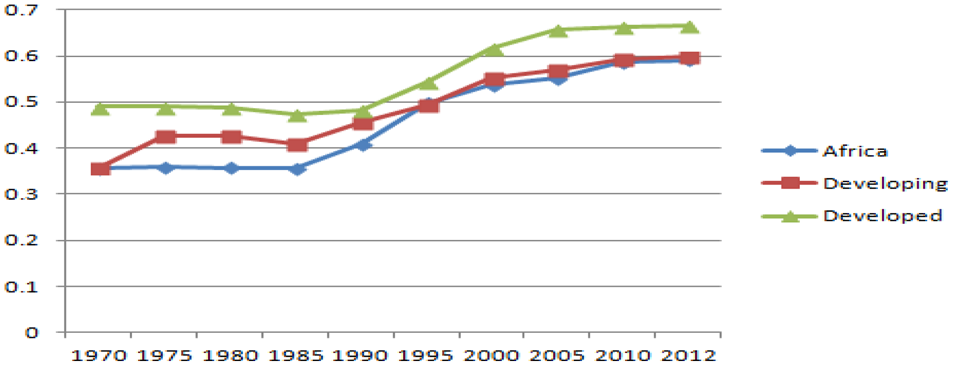
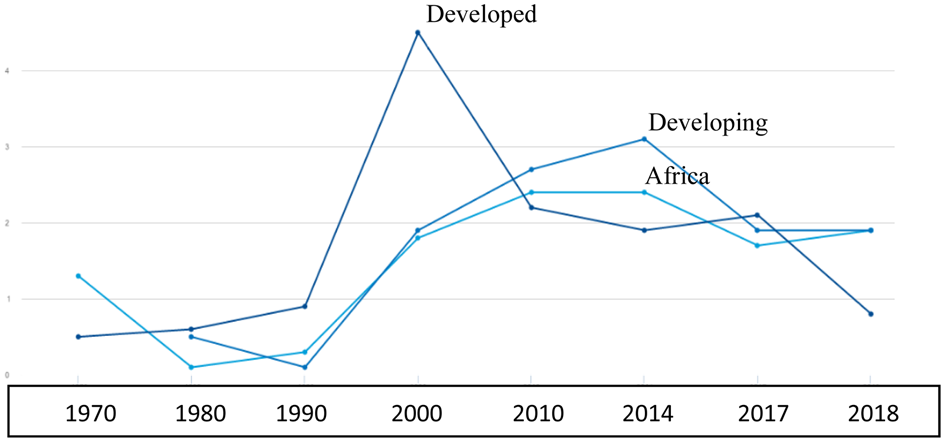
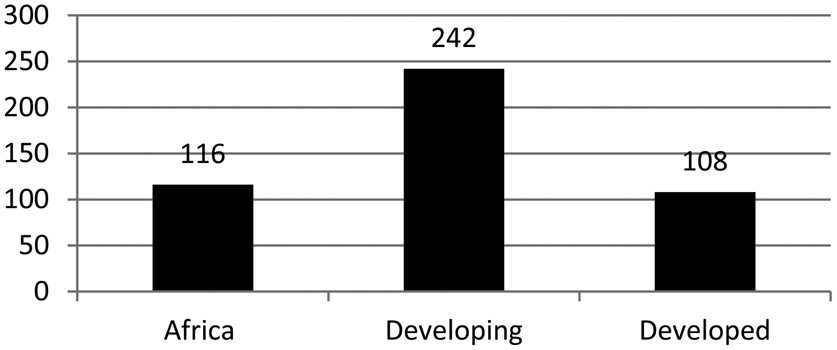
In this section, we present some stylized facts on FDI, CBI and political institutions. In Figure 1, we see that out of the 350 CBI reforms, 242 took place in developing countries, with 116 of that being recorded in Africa and 108 took place in developed countries between 1970 and 2014. This means that globally, most CBI reforms have taken place in developing countries. Among developing countries also, a significant portion of CBI reforms occurred in Africa. As seen in Figure 2, average de jure CBI has increased across Africa, other developing countries and
Averages of de jure CBI in Africa, other developing and developed countries.

FDI as % of GDP in Africa, developing and developed countries1970–2018.

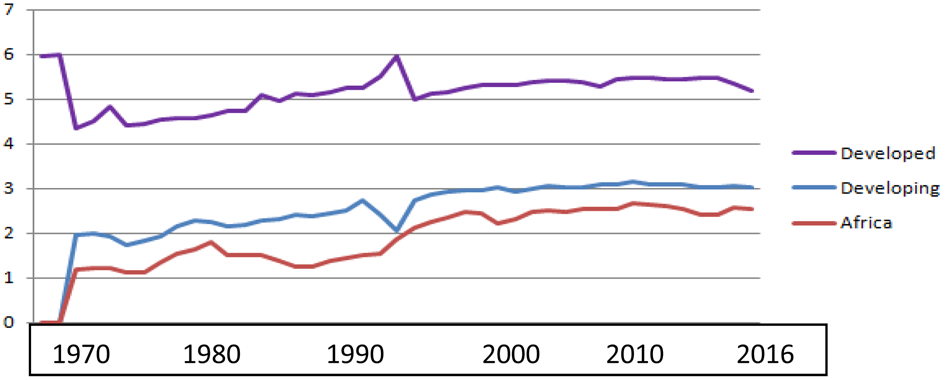
The stylized facts show that FDI, CBI and political rights have all generally been on the increase since the 1970s. This motivates us to examine the empirical relation between FDI, CBI and political rights in Africa (Figures 3 and 4).
Number of CBI reforms from 1970 to 2014.

Political rights (rescaled 0–6), 1970–2016.

We consequently formulate the following hypothesis:
Hypothesis 1: De jure CBI (legal CBI) positively influences FDI inflows.
Hypothesis 2: The effect of de jure CBI (legal CBI) on FDI inflows is higher in countries with greater political rights.
Hypothesis 3: De facto CBI (higher central bank governor turnover) is negatively related to FDI inflows.
Hypothesis 4: The effect of de facto CBI (higher central bank governor turnover) on FDI flows is lower in countries with greater political rights.
Hypothesis 5: FDI positively influences de jure CBI (legal CBI).
Hypothesis 6: The effect of FDI on de jure CBI (legal CBI) is higher in countries with greater political rights.
Hypothesis 7: FDI is negatively related to de facto CBI (higher central bank governor turnover).
Hypothesis 8: The effect of FDI on de facto CBI (central bank governor turnover) is higher in countries with greater political rights.
3. Literature review
3.1 Effect of CBI on FDI flows
Earlier studies on the determinants of FDI have largely focused on economic factors, domestic political institutions and legal constraints, as well as international agreements. A recent study by Jia and Ren (Reference Jia and Ren2017) on the impact of economic institutional factors including the interest rate policy, exchange rate policy, property rights, institutional change and the degree of economic marketization concludes that the factors above will influence short-term international capital flows. Little attention however has been paid to the effect of economic institutions such as CBI and how this affects globalization. In competing for foreign investment or multilateral lending, governments pursue strong currencies and lower inflation, in order to advance their countries' global prestige and attractiveness (McDowell and Steinberg, Reference McDowell and Steinberg2017). One way of achieving this is through CBI. In the presence of CBI, policymakers focus on the long-term, and on few occasions, react to short-term bumps in inflation using interest rate hikes. Credible CBI also responds to output drops, without tick-ups in inflation (Adolph, Reference Adolph2013). The control of these variables by an independent central bank gives assurance to foreign investors about the preservation of the value of their investments.
Where multinationals invest for export purposes for instance and use host countries as export platforms, they prefer low inflation and strong exchange rate countries in order to protect their purchasing power and investments (Ahmed et al., Reference Ahmed, Daniel and Kayode2018) and make their exports more competitive (Moran, Reference Moran2018; Polillo and Guillen, 2005). An independent central bank, as a major veto player, can contribute to having broad institutional stability and the protection of investor property rights. This is evident in the work by Banaian and Luksetich (Reference Banaian and Luksetich2001) who show that countries with more independent central banks tend to have greater economic freedom. Though this does not provide direct evidence of less expropriation given more independent central banks, central banks, if independent, can form part of what Elkins et al. (Reference Elkins, Guzman and Simmons2006: 827) call ‘institutions and practices that are favourable to investors as they are transparent and predictable’. Consequently, CBI can promote FDI flows.
Given credible CBI, it is expected that cost of foreign capital will be low and therefore lead to higher FDI inflows and private investment in general. For example, Maxfield (Reference Maxfield1997) found that higher levels of de jure CBI led to higher shares of private investment to GDP. However, there exist mixed results on the impact of CBI on cost of capital. Earlier studies by Alesina and Summers (Reference Alesina and Summers1993) and Cukierman and Buckle (Reference Cukierman and Buckle1993) find that CBI does not reduce risk premia on real interest rates. However, in 1998, Speigal found that a reform of the Bank of England, making it more independent, resulted in a reduction in inflation expectations which reflected in lower long-term bond yields. Studies that followed later such as that by Moser and Dreher (Reference Moser and Dreher2010) find that central bank governor turnover rates had a significant positive impact on sovereign bond spreads in developing countries.
3.2 Effect of FDI on CBI
According to literature, there are two sources of external factors that affect CBI: (1) international coercive pressures that affect countries, including their dependency on foreign trade, investment and multilateral lending; and (2) cross-national international influences that operate through the network of bilateral trade ties in the forms of cohesion and role equivalence effects. This study focuses on the first channel. Having an independent central bank has increasingly been part of the International Monetary Fund (IMF) lending conditionality terms with the understanding that these help countries signal credibility to the international financial community. Securing this credibility depends not only on having short-run macroeconomic management by an existing set of institutions, but also on the quality of the institutions themselves. These could include ‘budgetary institutions, the central bank (covering independence, competence, etc.), the regulatory regime governing banks and financial markets, and so on’ (Chang, Reference Chang2011; Khan and Sharma, Reference Khan and Sharma2001: 20–21). This means that foreign capital inflows can lead to CBI reforms that guarantee these conditions desirable to foreign investors. This is because an independent central bank is in a better position to pursue policies that preserve the value of the investments of both domestic and foreign investors.
According to Kirakul (Reference Kirakul2012), low public investment is a concern in terms of a country's medium-term growth potential that will come back to affect revenue collection, increase the budget deficit and further fuel the uptrend in public debt. In order to increase revenues, governments promote investments by foreign investors who mostly have huge capital, which is largely unavailable in most developing countries such as Africa. Ugochukwu et al. (Reference Ugochukwu, Amah and Onoh2013), for example, empirically established that FDI positively and significantly affects tax revenues, especially tax on income and profits in West Africa. In this regard, increasing FDI should have an impact on the independence of the central bank. This is because as more FDI comes in, businesses are set up, expanded, jobs created and profits made. These generate tax revenues should be able to finance government expenditure and reduce reliance on central bank finance. In measuring the independence of the central bank, limits on central bank lending to government is one of the key factors. We argue that, central bank lending to government is high where there are higher deficits as a result of lower revenues. In this regard, generating higher revenues from FDI inflows would mean lower need for deficit financing by the central bank, thus making it more independent of government control. Based on this theoretical relationship, the study examines the impact of FDI on CBI in Africa.
3.3 Moderating effect of political institutions in the FDI/CBI relationship
The effectiveness of CBI in terms of achieving domestic outcomes such as low inflation, currency stability and fiscal discipline depend on the quality of political institutions. Political institutions expressed in terms of the rule of law, for example, ensure credibility of the central bank arrangement as CBI provisions are expected to be respected in such jurisdictions. Stronger political institutions ensure that foreign investors operate in an environment where cost of doing business is low due to the absence of corruption and political unrest. Also, in low corruption environments, tax revenues from FDI are used for value of money projects which reduce pressure on the central bank for inflationary finance as well as curtail excessive credit to government which fuels fiscal indiscipline (Agoba et al., Reference Agoba, Abor, Osei and Sa-Aadu2020a, Reference Agoba, Abor, Osei, Sa-Aadu, Amoah and Dzeha2020b; Bodea, Reference Bodea2013). This ensures that the benefit of FDI inflows inure to guaranteeing more independence of the central bank. In stronger political institutional jurisdictions, where political rights are expected, foreign investors can easily participate in commenting on government actions that threaten the credibility of monetary and fiscal policies that threaten their investments. They are therefore more effective in policing the credibility of the central bank arrangement compared to countries where this freedom is limited.
According to Broz (Reference Broz2002), strong political institutional environments, where there are transparent decision-making processes, enable CBI to achieve price stability. Keefer and Stasavage (Reference Keefer and Stasavage2003) also show that, in political systems where there are multiple veto players with distinct preferences, CBI is credible. Bodea and Hicks (Reference Bodea and Hicks2012) further reiterate that having an independent central bank and strong political systems exert a disciplining effect on money growth rates. Santiso (Reference Santiso2013) shows that analysts and economists at major investment banks downgrade their recommendations for Latin American debt purchases in those countries whose policies are deemed not credible. Lack of credibility comes from fears of expansionary fiscal or monetary policies and abandoning CBI. Fund managers also flee countries lacking credible policies and institutions. Thus, in the presence of higher institutional quality, CBI should encourage higher FDI inflows.
4. Methodology
4.1 Sample
To investigate the interdependence between CBI and FDI, and the impact of political/legal institutional quality on this relationship, we utilize panel data from 1970 to 2012 on 48 African countries. The selection of countries and study period is based on data availability as the CBI data are limited to 1970–2012 for all 48 African countries.
4.2 Model and estimation technique
4.2.1 Model
One main objective of this study is to examine the impact of CBI on FDI inflows and the impact of FDI inflows on CBI. We also examine the impact of the quality of political institutions on these relationships. Our preferred model is based on Agbloyor et al. (Reference Agbloyor, Abor, Adjasi and Yawson2013, Reference Agbloyor, Abor, Adjasi and Yawson2014) and Bodea and Hicks (Reference Bodea and Hicks2015). The empirical models can be summarized as follows:


To capture possible unobserved heterogeneity, and to analyse the impact of political institutions on the CBI–FDI nexus, we specify the following models which include the interaction terms:


To properly interpret the interaction terms, we must include the level of political institutions (Brambor et al., Reference Brambor, Clark and Golder2006). For example, based on equation (3), the effect of a change in CBI on our FDI is given by:

where i denotes the country and t denotes the time, ɛ it is the error term.
In equation (3), the dependent variable FDI it is the net FDI inflows divided by GDP. Data are obtainable from the World Development indicators. Net FDI, according to the World Bank, are the net inflows of investments made to acquire a lasting management interest, which is usually 10% or more of voting rights, in a business functioning in an economy and not that of the investor. It is arrived at by summing equity capital, reinvestment of earnings, other long-term capital and short-term capital, all depicted in the balance of payments. We include the first lag of FDI in the model. This is to capture the argument that FDI flows are reinforcing. That is, previous FDI flows positively influence current FDI flows. CBI it is the central bank independence measured as firstly de jure CBI which is the Cukierman, Webb and Neyapti (CWN) legal CBI index from Garriga (Reference Garriga2016) and de facto CBI which is proxied by the central bank governor turnover rate (CBGToR). This study uses a CBI index (to capture de jure CBI) as given by Garriga (Reference Garriga2016), who compute an updated CWN index for a large set of countries using the IMF's Central Bank Law Database. The CWN CBI index is based on a weighted aggregation of 16 legal indicators in four categories regarding the tenure of the bank's governor, policy formation, objectives and limitations on lending to the government, using the criteria and weights in CWN. The index varies between 0 and 1, with larger values indicating greater independence. A central bank is legally more independent when the governor's term in office is longer; the appointment and dismissal procedures are more insulated from the government; the mandate is more focused on price stability; the formulation of monetary policy lies squarely with the central bank; and the provisions on direct central bank lending are restrictive. We also measure CBI as CBGToR which represents the rate of central bank governor turnover over a 5-year period. This measures de facto CBI and is also provided by Garriga (Reference Garriga2016). Higher CBGToR rates imply lower CBI. While CBGToR has been argued to capture the real independence of the central bank, the CBI index captures what level of independence the law guarantees for the central bank, which in low institutional-level environments may not reflect how independent the central bank is in reality. We expect that higher levels of de jure CBI will have a positive impact on FDI. We also expect that higher levels of de facto CBI will have a negative impact on FDI.
PolInst it is the measure of political/legal institutional quality proxied by the rescaled political rights and civil liberty scores. In this study, as a measure of political/legal institutional quality (PolInst it), we use the civil liberties score variable obtained from Freedom House database. The score for the variable ranges from 1 to 7, with 7 representing the least rating and 1 the highest. Following Bodea and Higashijima (Reference Bodea and Higashijima2017), we rescale the original score to range from 0 to 6, so that lower scores now correspond to lower civil liberties/political rights rating and higher scores correspond to higher civil liberties/political rights rating. In order to do this, we use the formula −1×(PolInst–7), where PolInst is the civil liberties/political rights score as given by Freedom House. The civil liberties variable captures the extent to which there is freedom of expression, assembly, association, education and religion. The political rights variable captures the extent to which the electoral process is free and fair, the state of political pluralism and participation, and the functioning of government. We expect a positive sign for the political institutions variables namely political rights and civil liberties.
We also include a set of control variables in equation (3). The control variables are market size, trade openness, natural resources, financial openness and infrastructure. MktSz it represents market size and is measured as per capita GDP. The data were obtained from the World Bank. Market size is expected to have a positive effect on FDI. This is because countries with a large market are more likely to receive FDI flows because demand for the MNC products is likely to be higher (see e.g. Amponsah et al., Reference Amponsah, Garcia-Fuentes and Smalley2019; Kahouli and Maktouf, Reference Kahouli and Maktouf2015; Medvedev, Reference Medvedev2012). This is especially the case for market-seeking FDI where MNCs invest to serve the domestic market.
TrdOpen it is trade openness. A country's trade openness is the extent to which its business regulatory environment enhances or discourages businesses in investing, creating employment and increasing productivity (Asiedu, Reference Asiedu2006). It is measured as the sum of exports and imports as a percentage of GDP and is sourced from the World Development indicators. We expect that more trade openness will lead to more FDI inflows as investors are encouraged to invest in these destinations from where they can export their products and import raw materials or inputs. The expected coefficient is positive. NatRes it represents natural resources whose data are available from the World Development indicators. Natural resources are measured as total natural resources rent as a percentage of GDP. According to Asiedu (Reference Asiedu2006), countries that are endowed with natural resources attract more FDI. We therefore expect a positive impact of natural resources on FDI inflows. FinOpen it is financial openness and is measured as the Chinn-Ito index; an index measuring a country's degree of capital account openness. We expect a positive coefficient since more financially open countries would encourage more FDI.
Infrast it is infrastructure. It is the number of telephone lines by 100 of the population. Infrastructural development is able to motivate FDI as it facilitates access to resources and markets in line with resource-seeking and market-seeking motivations for FDI. It also helps efficiency-seeking multinationals whose costs of production can be reduced significantly by the availability of road networks, Internet and telecommunication (Asiedu, Reference Asiedu2006; Erdal and Mahmut, Reference Erdal and Mahmut2008; Khadaroo and Seetanah, Reference Khadaroo and Seetanah2010). We therefore expect a positive sign for this variable.
In equation (4), we also include the first lag of CBI. This suggests that CBI is a dynamic process.
We also examine the direct and indirect effects of FDI on CBI where the direct effects are captured by the FDI variable and the indirect effects are captured by the interactive term. For equation (4), the control variables are fiscal balance, market size, inflation, trade openness, financial development and financial openness. FisBal it is fiscal balance to GDP and is obtained from the IMF and the World Bank. It is measured as government revenue minus government expenditure. We expect that countries with higher fiscal balance would grant more independence to their central banks, while those with lower or negative balance would want the central bank to be less independent in order to rely on the bank to finance the deficit (Agoba et al., Reference Agoba, Abor, Osei and Sa-Aadu2020a). This leads to a positive expected coefficient for impact on de jure CBI and negative coefficient for impact on de facto CBI (central bank governor turnover rate). LGDPC it is the log of per capita GDP and proxies for the level of development of an economy. Highly developed economies are more likely to have independent central banks as tax revenues on incomes are high and therefore there is little need of control of the central bank in order to have access to seigniorage revenue. The data are obtained from the World Development indicators database. Infl it is the modified inflation rate computed as LOG(1 + π GDPDf) where π GDPDf is the annual percentage change in GDP deflator and is accessible from the World Development indicators. Higher inflation rates will cause countries to seek for more independent central banks. We therefore expect a positive impact of inflation (lagged) on de jure CBI and negative impact on central bank governor turnover rate. TrdOpen it is trade openness and is measured as the sum of exports and imports as a percentage of GDP and is sourced from the World Development indicators. We expect that more trade openness will lead to more CBI as it encourages the adoption of similar quality of institutions with developed trade partners who would want a stable macro economy in the jurisdictions of their trade partners in order to guarantee lower prices for imports and exports that are affordable to their trade partners.
FinDev it is the financial development variable measured as private credit to GDP ratio which measures the extent of financial intermediation in a country and a gauge of the extent to which the banking sector is developed. It measures private credit, which captures the value of all credit issued by financial intermediaries to the private sector as a share of GDP. It excludes credit given to public corporations and other agencies of government which may not be allocated based on expected return. According to Levine et al. (Reference Levine, Loayza and Beck2000), higher levels of private credit indicate ‘higher levels of financial services and therefore greater financial intermediary development’. Higher levels of financial development increase the pressure on central banks to serve the interest of financial institutions and market participants who are negatively affected by inflation and poor regulation of the financial sector as it happens with dependent central banks. Therefore, central banks are expected to be more independent given higher levels of financial development. FinOpen it is financial openness and is measured as the Chinn-Ito index; an index measuring a country's degree of capital account openness. It is based on the binary dummy variables that codify the tabulation of restrictions on cross-border financial transactions reported in the IMF's Annual Report on Exchange Arrangements and Exchange Restrictions (AREAER). In the binary variable, 1 equals the presence of financial controls, and 0 otherwise. Countries that allow the flow of capital will face more pressure to retain capital which would include ensuring that inflation levels are low in order to preserve the value of investments. We therefore expect a positive impact of financial openness on de jure CBI and a negative impact on central bank governor turnover rates.
4.2.2 Estimation technique
This study makes the assumption that current values of FDI and CBI may be impacted by their past values. We therefore require the use of the lag of FDI and CBI as explanatory variables. Doing so will help avoid low precision of point estimates as a result of higher variances when lags are omitted – due to a specification error (Blackwell et al., Reference Blackwell, Honaker and King2017). We apply the GMM dynamic panel data estimation to avoid Nickell bias and address the issues of endogeneity of all explanatory variables in a dynamic formulation, and mitigate potential biases induced by fixed effects (Arellano and Bond, Reference Arellano and Bond1991; Arellano and Bover, Reference Arellano and Bover1995; Blundell and Bond, Reference Blundell and Bond1998). Specifically, the study adopts the two-step System Generalized Method of Moments (SGMM) estimator, with Windmeijer (Reference Windmeijer2005) corrected standard errors since this is asymptotically more efficient than the one-step estimator. Adopting this approach however presents a risk of large instrument count relative to the sample size (Roodman, Reference Roodman2006). The possible effect if this happens is an over-fitting of endogenous variables. We will then be unsuccessful in eliminating their endogenous components which leads to having biased coefficient estimates. The autocorrelation test and the robust estimates of the coefficient standard errors assume no correlation across individuals in the idiosyncratic disturbances.
We collapse the instrument matrix as suggested by Roodman (Reference Roodman2009) and Bontempi and Mammi (Reference Bontempi and Mammi2015). This is in order to deal with the issue of instrument proliferation. In doing this, we obtain higher point estimates and lower number of instruments. It also produces a more reliable Hansen test, consistently characterized by a lower p-value. Though the sign and significance of some of the control variables change (compared to earlier estimations where collapse of instruments matrix was not applied), the sign and significance of the main variables of interest (CBI, financial development, political institutional quality and their interactions) do not. According to Bontempi and Mammi (Reference Bontempi and Mammi2015), this shift in the sign of some of the control variables is not directly driven by the reduction in the number of instruments. Rather, it is due to the restrictions imposed on the instrument matrix.
This study reports two standard specification tests: The Hansen test of over-identifying restrictions, which is a test of the overall validity of the instruments. Failure to reject the null hypothesis gives support for the model and the choice of endogenous variables. We also conduct the Arellano–Bond test for AR (2) in first differences to test whether the residuals from the regression in differences is second order serially correlated. Failure to reject the null hypothesis supports the model specification. As suggested by Bazzi and Clemens (Reference Bazzi and Clemens2013), the study also reports the number of instruments.
5. Results
5.1 Effect of CBI and political institutions on FDI
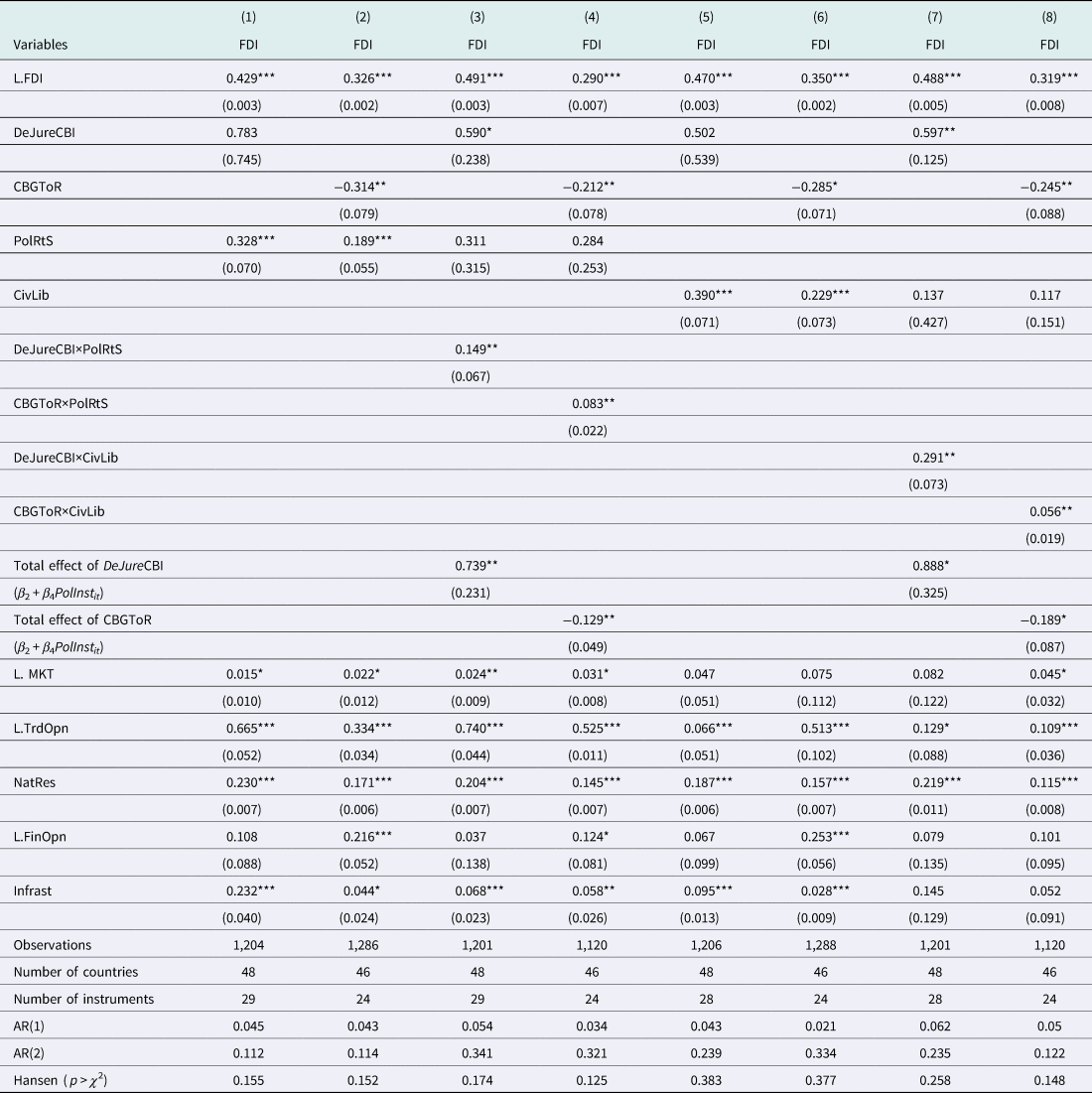
A brief description of our key variables as seen in Appendix II shows that FDI to GDP ratio ranges from 5.5% to 30.2%, with a mean of 19%. This is high compared to the average Chinese FDI of 3%. CBI measured as de jure CBI averages 0.5 with central bank governor turnover rates being about 0.42. We first present results from Table 1 on the determinants of FDI inflows and more specifically the impact of CBI and political institutions on FDI inflows in Africa. On the impact of CBI on FDI, first measuring CBI as the CWN index (DeJureCBI), we see that it has no significant impact on FDI inflows, though the signs are positive (see model 1). We however see a significantly positive impact in models 3 and 7 after the introduction of the interactive term between CBI and civil liberties, our proxy for political institutions. The insignificant impact on FDI can be as a result of the ineffectiveness of CBI provisions in many Africa jurisdictions as seen in the literature on the impact of CBI on inflation and fiscal policy (Agoba et al., Reference Agoba, Abor, Osei and Sa-Aadu2017, Reference Agoba, Abor, Osei and Sa-Aadu2020a, Reference Agoba, Abor, Osei, Sa-Aadu, Amoah and Dzeha2020b). This has been attributable to disregard for CBI provisions, thereby making CBI reforms ineffective in achieving price stability, effectively regulating financial markets, and contributing to achieving fiscal discipline through restrictions on lending and policy interest rates hikes. Once CBI is not credible and ineffective in creating the necessary domestic conditions to attract FDI, we would not see a significant inflow of investments attributable to CBI.
Effect of CBI and political institutions on FDI

Standard errors in parentheses ***p < 0.01, **p < 0.05, *p < 0.1.
FDI is net FDI inflows divided by GDP. DejureCBI is the CWN legal CBI index from 0 to 1. CBGToR is the annual central bank governor turnover rate measure of a country's central bank independence over a 5-year period. MKT is GDP per capita. FinDev is measured as the ratio of private credit to GDP which is proxy for financial development. PolRtS is rescaled political rights score (0–6) which is proxy for institutional quality. CivLib is rescaled civil liberties score (0–6) which is proxy for institutional quality. Trade Openness is defined as sum of exports and imports in relation to GDP. FinOpn is Chinn and Ito's financial openness variable. Infras is the number of telephone lines by 100 of the population. Institutions is proxied with the civil liberties index.
We however see a significant and negative impact of CBI measured as the central bank governor turnover rate (CBGToR) on FDI inflows. This means that higher levels of central bank governor turnover rate, which signifies low levels of CBI, minimizes or reduces the inflow of foreign capital in the form of FDI into African countries. This is because, high turnovers usually signal lack of independence of the central bank leading to the exit of the governor due to political pressures. This usually signals low central bank credibility and ineffectiveness in ensuring macroeconomic stability in terms of low inflation, proper regulation of financial markets and stable interest rates. It also leads to uncertainty in the business environment as different central bank governors come with their own policies.
We also see that political institutions measured as political rights (PolRtS) and civil liberties (CivLib) have a significant and positive impact on FDI inflows in Africa (see models 1, 2, 5 and 6). In institutional environments where the rule of law is respected, foreign investors expect that their investments will be safe, cost of litigation will be low and the right of creditors and property owners will be guaranteed. Further, there will be lower corruption which leads to a lower cost of doing business thus spurring FDI flows.
In order to examine the impact of political institutions on CBI's impact on FDI, we interact the two measures of CBI with the two measures of political institutions separately.
Firstly, we interact the legal CBI measure (DejureCBI) with political rights in model 3. We see that the interactive variable is significant and positive at 5%. Similarly when we interact DeJureCBI with CivLib, we obtain a significantly positive coefficient in model 7. This means that, higher levels of political institutions enhance the impact and effectiveness of CBI on FDI inflows. Independent central bank provisions are more respected in strong institutional environments. This strengthens the central bank's credibility in the eyes of foreign investors, thereby resulting in lower cost of capital for foreign investors who desire to invest in an African country leading to higher FDI inflows. Credibility reduces the risks of macroeconomic instability and therefore minimizes the chances of loss of capital and inability to pay back loans taken or recoup investments. Further, in situations whereby regulators experience political interference, they may not be able to objectively deal with problematic institutions which have political support. This can create serious problems for the economies in which multinationals function. However, in strong political environments, independent central banks regulate objectively with little interference, issue licenses to qualified applicants and supervise financial institutions more effectively. This enables effective functioning of the financial systems, which encourages foreign investments.
When we proxy CBI with central bank governor turnover rate (CBGToR), and interact it with political rights (PolRtS), and then with civil liberties (CivLib), we see a significant and positive impact on FDI. This means that higher levels of political institutions minimize the negative effect of high central bank governor turnover rates (i.e. lower CBI) on FDI inflows. High central bank turnover rates, which are not in consonance with the tenure of the governance, signal that the central bank is not very independent. However, the presence of strong political institutions constrains the government in terms of the influence that it can have on the central bank. Thus, investors have more confidence in an economy when political institutions are high because they serve as a check on the government.
Overall, CBI has a positive impact on FDI as shown by equation (5).
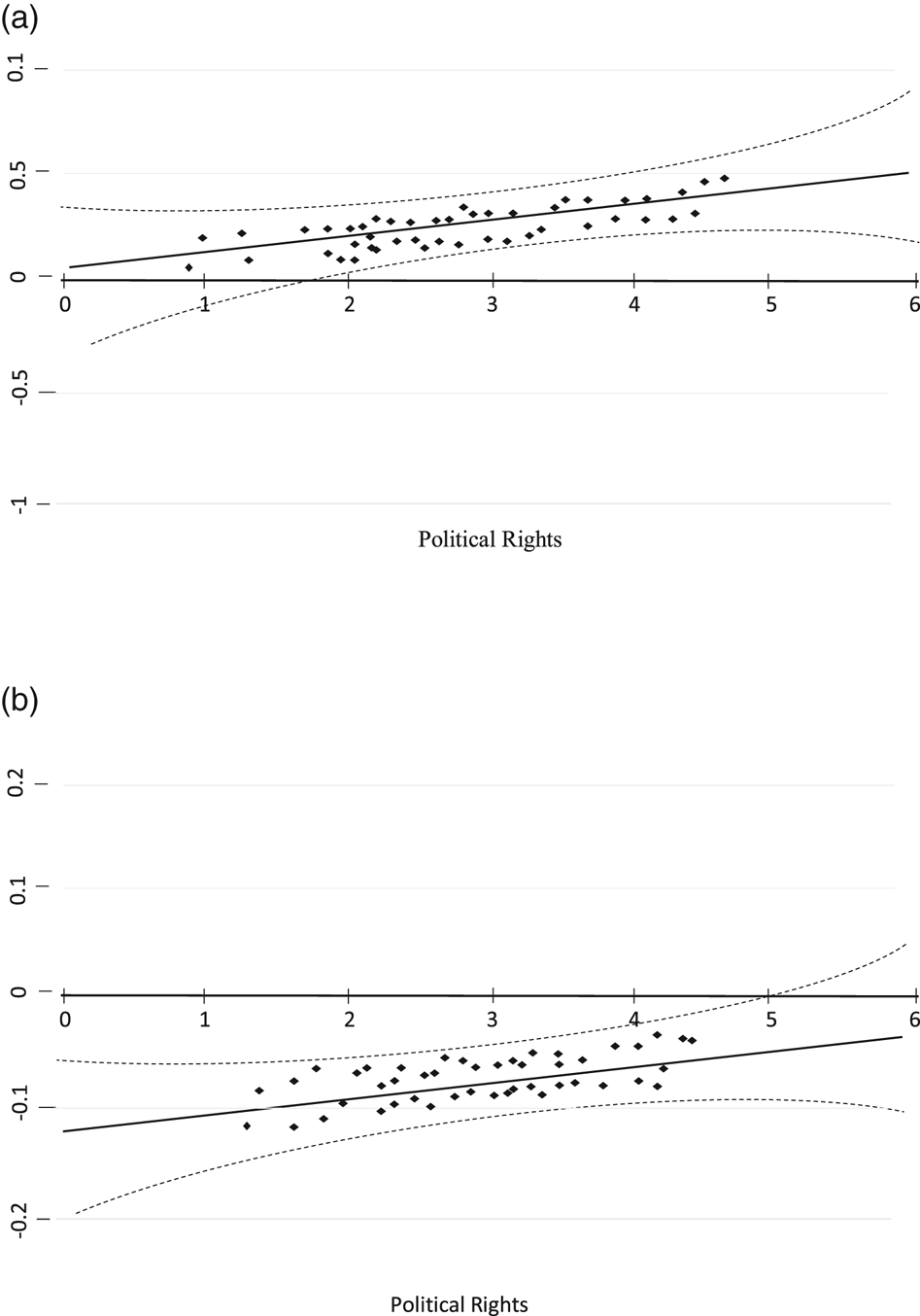
Given the inclusion of interactive terms, the coefficients are not informative of the effect of CBI on FDI at different levels of institutional quality. Figure 5 (a and b) shows the joint effect of these variables, and allows a proper interpretation of the results (Brambor et al., Reference Brambor, Clark and Golder2006). It is apparent that CBI's (de jure CBI) impact on FDI increases significantly at higher levels of political institutions >2, while the negative impact of higher central bank governor turnover rate on FDI is significantly minimized at higher levels of political institutional quality except from political rights levels <5. We can see that most of our data points lie within the areas of significant impact. The control variables namely trade openness, financial openness, natural resources and infrastructure have the expected significant impact on FDI.
(a) Marginal effects of de jure CBI on FDI at different levels of institutional quality. (b) Marginal effects of Central Bank Governor Turnover rate on FDI, at different levels of institutional quality.

5.2 Impact of FDI and political institutions on CBI
In this section, we examine the impact of FDI on CBI. We use two measures of CBI namely the de jure or legal CBI index captured from the central bank charters using the CWN criteria. Next is the de facto CBI which captures the rate of central bank governor turnover. In the results shown in Table 2, the dependent variable is de jure CBI (DeJureCBI) from model 9 to 12. Then in models 13–16, the dependent variable is central bank governor turnover rate.
The effect of FDI and institutions on central bank independence

Standard errors in parentheses ***p < 0.01, **p < 0.05, *p < 0.1.
FDI is net FDI inflows divided by GDP. De jure CBI is the CWN legal CBI index from 0 to 1. CBGToR is the annual central bank governor turnover rate over a 5-year period measure of a country's central bank independence. FinDev is measured as the ratio of private credit to GDP which is proxy for financial development. Pol.Rights is rescaled political rights score (0–6) which is proxy for institutional quality. Civ.Lib is rescaled civil liberties score (0–6) which is proxy for institutional quality. FinDev is financial development measured as the ratio of private credit to GDP which is proxy for financial development. TrdOpen is defined as sum of exports and imports in relation to GDP. FisBal is government revenue less government expenditure as a percentage of GDP. FDI is foreign direct inflows divided by GDP. FinOpen is Chinn and Ito's financial openness variable. Inf variable is the modified inflation rate computed as: LOG(1 + π GDPDf) where π GDPDf is the annual percentage change in GDP deflator. L.GDPC is the log of measure of the ratio of real Gross Domestic Product divided by total population.
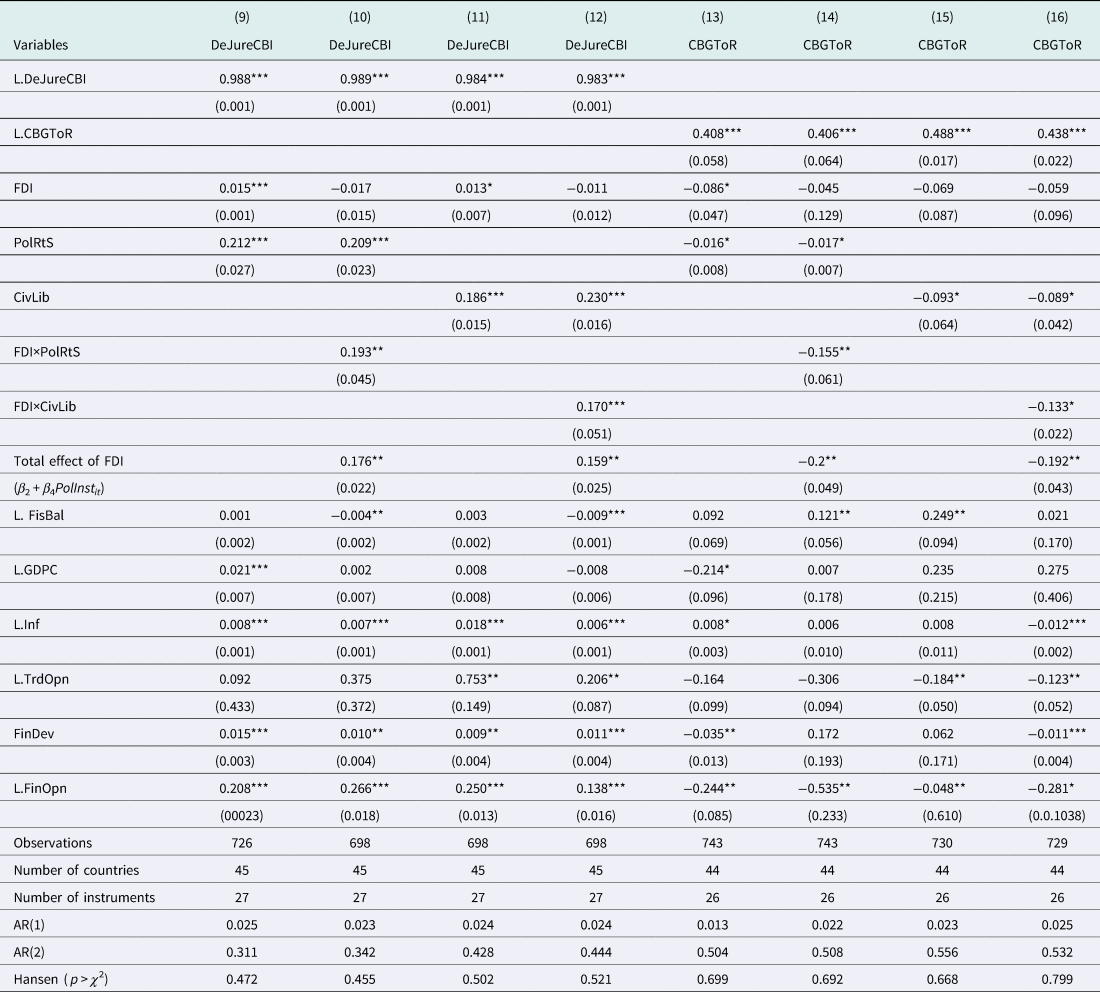
We find that FDI significantly and positively impacts de jure CBI in models 9 and 11 in Africa. This means that higher FDI inflows lead to higher independence of central banks. This confirms the theoretical argument made in the literature that higher FDI inflows lead to higher CBI. Similarly, higher FDI reduces central bank governor turnover (see model 13). That is, higher FDI leads to greater CBI. Foreign investors want to see credible CBI as it promotes macroeconomic stability and preserves the value of their investments. They are therefore more likely to use their influence to urge the government and key stakeholders such as the central bank to maintain CBI. Policy makers are therefore more likely to promote CBI so as to attract and retain foreign investors. Consequently, increasing globalization brings about the adoption of reforms such as CBI that make economic institutions more likely to produce and sustain the economic environment suitable for foreign enterprises in their host nations.
Political institutional quality measured as political rights and civil liberties has a significant and positive effect on de jure CBI (in models 9–12). This indicates that higher levels of political institutions lead to higher CBI. This can be explained as being so as a result of the fact that such institutions lead to strong lobbying for independent central banks. Here, central bank laws are respected as a result of the rule of law. Secondly, democracies in such environments lobby for socially optimal policies such as an independent bank to ensure price stability which in the long run ensures improved societal welfare. In models 13–16, we examine the impact of political institutions on central bank turnover rate. This is significant and negative for both political rights and civil liberties. This means that higher political rights reduce central bank governor turnover. This confirms the earlier findings in models 9–12, as stronger political institutions enhance CBI.
When we interact FDI with the political institutional proxies of civil liberties and political rights, we see a significant positive impact on de jure CBI and a significant negative impact on central bank governor turnover rate in models 10 and 12 and 14 and 16, respectively. This means that the impact of FDI on CBI is enhanced more in stronger political institutional environments. As explained earlier, FDI is likely to lead to higher CBI in an environment of higher political institutions because it creates a more favourable environment for foreign investors to exert influence on domestic economic policies such as promoting CBI. This is important from the perspective of foreign investors because lack of CBI can lead to price instability and a depreciation of the local currency, thus leading to a fall in the value of their investments.
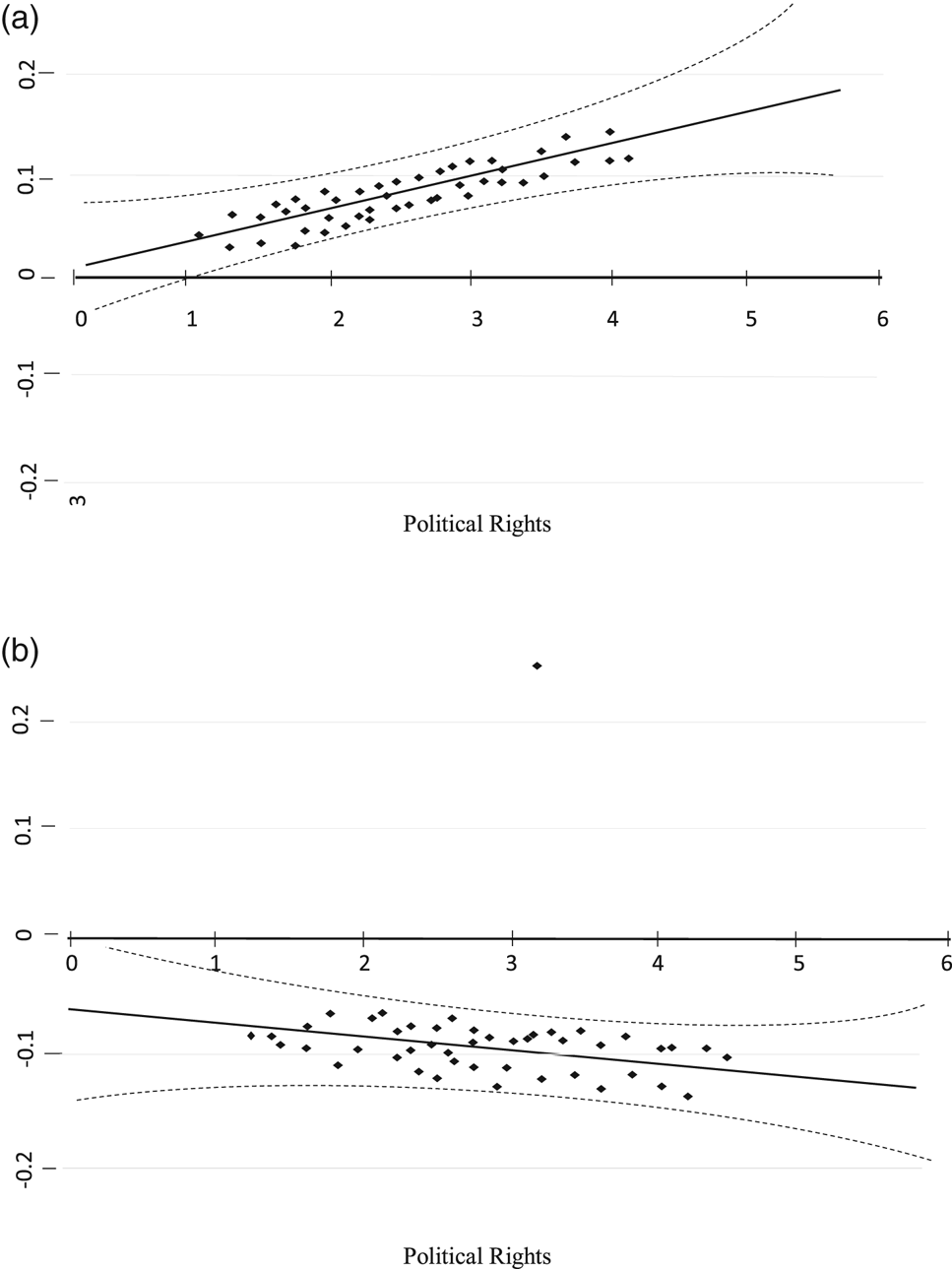
Figure 6 (a and b) shows the joint effect of FDI and political institutions on CBI, and allows a proper interpretation of the results (Brambor et al., Reference Brambor, Clark and Golder2006). It is apparent that FDI's impact on de jure CBI increases significantly at higher levels of political institutions >1, while its impact on central bank governor turnover rate also increases at higher levels of political institutions significant at all levels of political institutions.
(a) Marginal effects of FDI on de jure CBI on at different levels of institutional quality. (b) Marginal effects of FDI on Central Bank Governor Turnover rate at different levels of institutional quality.

Focusing on the control variables, higher levels of financial development significantly lead to more independent central banks (models 9–12) and less central bank governor turnover rate (models 13–16). Higher levels of per capita income lead to higher CBI as seen in models 1 and 5. Trade openness also improves CBI significantly in models 11 and 12 and 15 and 16. Higher fiscal balance leads to less independent central banks. This is seen in models 10 and 12 and 14 and 15. Higher inflation rates also lead to more independent central banks. Finally, we also see a significant positive impact of financial openness on de jure CBI and a significant negative impact on central bank governor turnover rate.
5.3 Robustness checks
OLS estimations also confirm our findings that political institutions enhance the impact of CBI on FDI and improve the impact of FDI on CBI. This is shown in Appendix IV.
Also, using quantile regressions (not reported), our results indicate that an increase in CBI in the 25th and 50th percentile results in a 0.0134 (1.34%) and 0.012 (1.2%) increase in FDI. In the 75th percentile, there is no significant impact of CBI increment on FDI. This seems to further confirm the argument by Bodea and Hicks (Reference Bodea and Hicks2015) that as more countries adopt CBI, CBI becomes less of a separating signal, and this could explain the insignificant impact of CBI in our main regressions.
When we proxy institutions using a measure of democracy from Polity2, the results confirm our findings using political rights and civil liberties. Thus, we find that in Appendix III, political institutions significantly impact the effect of CBI on FDI and the effect of FDI on CBI.
5.3.1 Accounting for the effect of Chinese FDI into Africa
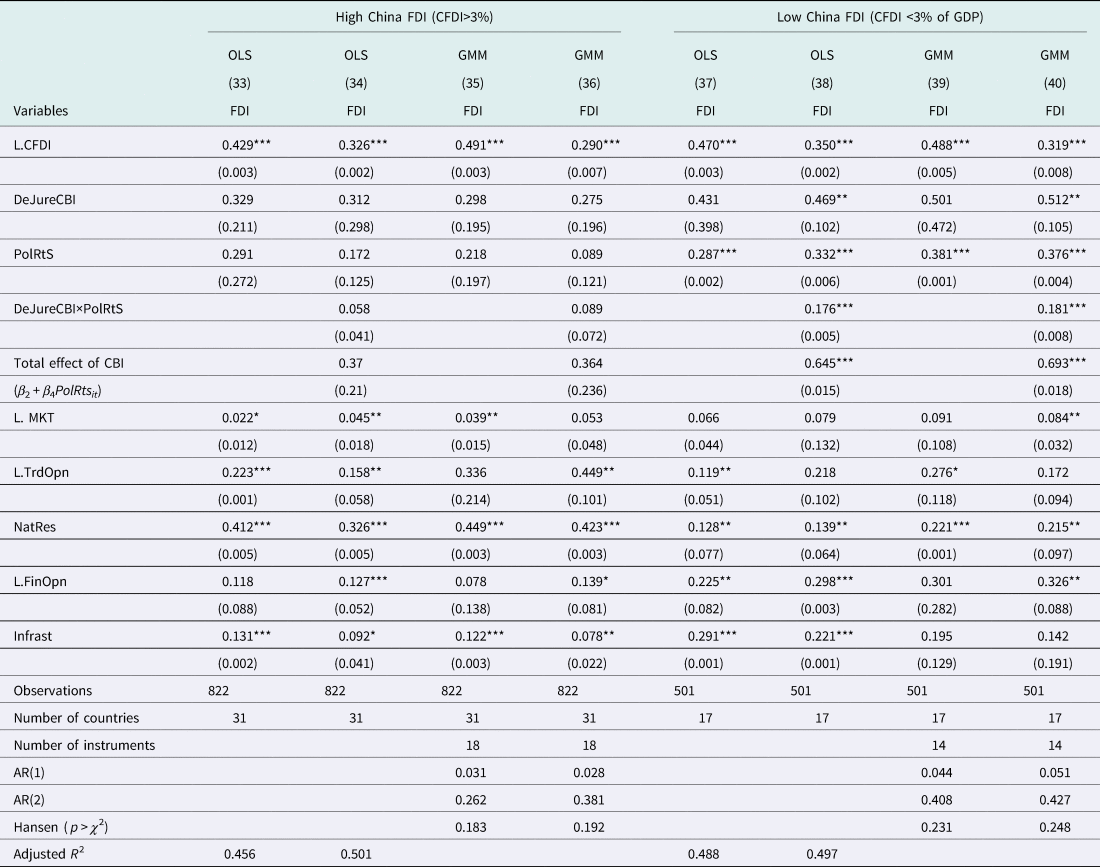
Africa also is tricky in terms of FDI because of China's interest. There is the perception (if not the reality) that China is a huge player in Africa and that they do not care as much about political rights or civil liberties. It will finance projects or acquire companies but then send its own workers so there are fewer benefits for the host countries. We estimate separate models for countries that receive high Chinese FDI (countries with Chinese FDI more than 3% of GDP) and countries that receive low Chinese FDI (countries with Chinese FDI less than 3% of GDP). The basis of separation is the average Chinese FDI in Africa as a percentage of GDP. The results are reported in Table 3, using data covering the period 2003–2012, from the UNCTAD. We see that CBI does not have a significant impact on FDI inflows in countries with high Chinese FDI compared to countries with low Chinese FDI where CBI's impact is significant. Political institutions do not improve CBI's impact on FDI inflows in countries that receive high Chinese FDI. However, in countries with low Chinese FDI inflows, CBI's impact on FDI is significantly higher in stronger political institutional environments. This means that CBI and political institutions are not key determinants of Chinese FDI into Africa as other factors such as natural resources may be more important. This is further supported by the fact that there is no significant correlation between political institutions measured as civil liberties and high Chinese FDI (Table 3).
CBI, institutional quality and China FDI

Standard errors in parentheses ***p < 0.01, **p < 0.05, *p < 0.1.
FDI is net FDI inflows divided by GDP. De jure CBI is the CWN legal CBI index from 0 to 1. CBGToR is the annual central bank governor turnover rate over a 5-year period measure of a country's central bank independence. FinDev is measured as the ratio of private credit to GDP which is proxy for financial development. Pol.Rights is rescaled political rights score (0–6) which is proxy for institutional quality. Civ.Lib is rescaled civil liberties score (0–6) which is proxy for institutional quality. FinDev is measured as the ratio of private credit to GDP which is proxy for financial development. TrdOpen is defined as sum of exports and imports in relation to GDP. FisBal is government revenue less government expenditure as a percentage of GDP inflows divided by GDP. FinOpen is Chinn and Ito's financial openness variable. Inf variable is the modified inflation rate computed as: LOG(1 + π GDPDf) where π GDPDf is the annual percentage change in GDP deflator. L.GDPC is the log of measure of the ratio of real Gross Domestic Product divided by total population.
6. Conclusion
In this study, we examined CBI in relation to global finance and primarily modelled investors' actual decisions as a function of CBI. Secondly, the study examined government decisions to reform central bank legislation to a perceived need to attract capital in the form of FDI. These findings emphasize the importance of political institutions in determining the strength of the relationship between international capital inflows and economic institutional reforms. The findings imply that strong political institutions must be developed in order to harness the full potential of independent central banks in attracting foreign capital into African countries. Furthermore, strong political institutions would create the needed environment to ensure that FDI inflows inure to the benefit of countries. While high Chinese FDI inflows seem not to be influenced by CBI or political institutions, these institutional characteristics are important for other forms of FDI with different origins from China. This could have implications for the motivation of African countries to improve the quality of the central banks and political institutions if they desire to seek more Chinese FDI than FDI from other countries. Unlike the findings from similar studies by Bode and Hicks (2015), this study finds that improving political institutions does have a significant effect on the impact of FDI on CBI and the impact of CBI on FDI. It does not necessarily have a significant impact in more democratic countries. This should encourage undemocratic countries to strive to improve their institutions as it has benefits for all. Future studies can explore the impact of CBI on foreign portfolio investments in Africa and consider the impact of political institutions on this relationship.