




No CrossRef data available.
Psychological, autonomic, and serotonergic correlates of parasuicide among adolescent girls
Published online by Cambridge University Press: 12 December 2005
Abstract
Although parasuicidal behavior in adolescence is poorly understood, evidence suggests that it may be a developmental precursor of borderline personality disorder (BPD). Current theories of both parasuicide and BPD suggest that emotion dysregulation is the primary precipitant of self-injury, which serves to dampen overwhelmingly negative affect. To date, however, no studies have assessed endophenotypic markers of emotional responding among parasuicidal adolescents. In the present study, we compare parasuicidal adolescent girls (n = 23) with age-matched controls (n = 23) on both psychological and physiological measures of emotion regulation and psychopathology. Adolescents, parents, and teachers completed questionnaires assessing internalizing and externalizing psychopathology, substance use, trait affectivity, and histories of parasuicide. Psychophysiological measures including electrodermal responding (EDR), respiratory sinus arrhythmia, and cardiac pre-ejection period (PEP) were collected at baseline, during negative mood induction, and during recovery. Compared with controls, parasuicidal adolescents exhibited reduced respiratory sinus arrhythmia (RSA) at baseline, greater RSA reactivity during negative mood induction, and attenuated peripheral serotonin levels. No between-group differences on measures of PEP or EDR were found. These results lend further support to theories of emotion dysregulation and impulsivity in parasuicidal teenage girls.
This work was supported by grants from the Seattle Children's Hospital and Regional Medical Center, the Pediatric Clinical Research Center at Seattle Children's Hospital (M01-RR 00037), and the National Foundation for Suicide Prevention to Cindy J. Smith, and by a grant from the National Institute of Mental Health to Theodore P. Beauchaine (R01 MH63699). We express thanks to Trevor Aerts, Anna Amen, Tyson Bailey, Jordan Campbell, Breyen Engelhardt, Ashleigh Freize, Jennifer Gross, Barbara Kleine, Dana Kovalchick, Jenna Lee, Eileen Magill, Elise Mallman, Emily Miller, Andrea Moore, Seamus Morrone, Shelby Soike, and Aubriana Teeley.
Information
- Type
- Research Article
- Information
- Copyright
- © 2005 Cambridge University Press
Parasuicidal behavior, including all nonfatal acts of deliberate self-harm (Kreitman, 1977), is among the most troubling and dangerous manifestations of psychological distress, and the most reliable predictor of later suicide (Comtois, 2002). Conservative estimates place the risk of eventual completed suicide among attempters at approximately 15% (Bongar, 2002). Among those previously hospitalized for suicidal behavior, an estimated 8.6% will eventually complete (Bostwick & Pankratz, 2000). Furthermore, 30–47% of those who commit suicide report having previously engaged in parasuicidal behavior (Gunnell & Frankel, 1994), with 20–25% reporting an episode of parasuicide in the year before their death (Foster, Gillespie, & McClelland, 1997).
As of 1999, suicide was the third leading cause of death among youth between the ages of 15 and 24 (US Public Health Service, 1999). Moreover, in a 2001 national survey, 19% of high school students described seriously considering suicide, 14.8% described a specific plan to attempt suicide, 8.8% made a suicide attempt, and 2.6% made a suicide attempt serious enough to warrant medical attention (Grunbaum et al., 2002). Each year, approximately 1,600 teenagers in the United States die by suicide (Gould, Greenberg, Velting, & Shaffer, 2003). Accordingly, suicide and nonfatal self-injury have been identified as serious public health problems, particularly in adolescent and young adult populations (Grunbaum et al., 2002; US Public Health Service, 1999; World Health Organization, 2002).
Most adolescents who engage in parasuicide meet criteria for one or more psychiatric disorders. Although mood disorders are the most prevalent diagnoses, impulse control problems, anxiety disorders, substance abuse disorders, and conduct disorder are all common psychiatric conditions associated with parasuicidal behavior (Kingsbury, Hawton, Steinhardt, & James, 1999; Rudd, Joiner, & Rajab, 1996; Shaffer et al., 1996). Moreover, comorbid psychiatric disorders appear to be particularly common in this population. In a recent article, Haw, Hawton, Houston, and Townsend (2001) reported that 36.7% of their sample presented with two or more psychiatric disorders, and 10.0% presented with three or more. Cognitive and personality factors also distinguish parasuicidal adolescents from those do not engage in self-harming behaviors. These include severely pessimistic, dysfunctional attitudes (Meyer et al., 2003), hopelessness (Shaffer et al., 1996), poor executive functioning (Keilp, Sackeim, Brodsky, Oquendo, Malone, & Mann, 2001), poor interpersonal problem-solving abilities (Rotheram–Borus, Trautman, Dopkins, & Shrout, 1990), impulsive temperament (Maser et al., 2002), low self-esteem (McGee, Williams, & Nada–Raja, 2001; Overholser, Adams, Lehnert, & Brinkman, 1995), emotion dysregulation (Esposito, Spirito, Boergers, & Donaldson, 2003; Zlotnick, Donaldson, Spirito, & Pearlstein, 1997), and neuroticism and self-criticism (Enns, Cox, & Inayatulla, 2003).
Although these studies have provided descriptive insights into the psychological and cognitive correlates of suicide risk among adolescents, considerable work remains toward understanding specific etiological mechanisms through which parasuicide is expressed. One school of thought is that the emergence of such behaviors is partially explained by the numerous developmental challenges confronting adolescents, including maturational changes in psychological and biological functioning, evolving social roles, and conflicting expectations regarding autonomy and dependency (Angold, Costello, & Worthman, 1998; Dahl, 2001; Giedd et al., 1999; Steinberg et al., in press). Yet, most adolescents are able to navigate this period of transition successfully, and many who are described by the characteristics outlined above do not engage in self-injurious behaviors. For others, however, parasuicide appears to be associated with repeated adaptational failures in confronting the task demands of normal development. Moreover, such failures may foreshadow continued maladaptation into adulthood (Cicchetti & Rogosch, 2002). Indeed, parasuicidal behavior in adolescence may be a risk factor for psychopathology in adulthood (e.g., Birmaher et al., 1996) including borderline personality disorder (BPD). In turn, borderline features in young adults prospectively predict impairment in interpersonal relations, academic achievement, and occupational functioning, over and above risk conferred by other psychiatric conditions (Bagge et al., 2004).
A Developmental Psychopathology Framework
The developmental psychopathology perspective offers a unique framework for understanding the emergence of borderline pathology. This approach emphasizes individual patterns of adaptation and maladaptation, and how transactions between early adaptation, maturation, and environmental challenge shape later development, contributing to both typical and pathological outcomes (Cicchetti, 1990; Rutter & Sroufe, 2000; Sroufe & Rutter, 1984). Psychopathology is therefore viewed as the consequence of biological and psychological vulnerabilities that compromise one's ability to negotiate developmental milestones. From this perspective, maladaptive development is best understood when juxtaposed with normal development, both of which are viewed as complex processes involving multiple biological, psychological, and environmental determinants. An integrated approach to the study of normal and pathological development is therefore necessary; one that incorporates genetic, neurobiological, psychological, and social–contextual influences (Cicchetti & Cannon, 1999).
Given such developmental complexities, it is unlikely that any single vulnerability leads to BPD. Indeed, personality disturbance is likely to emerge from interactions among multiple neurobehavioral systems (Depue & Lenzenweger, 2005), the long-term functioning of which are shaped by salient environmental challenges including abuse, neglect, and maltreatment (Macfie, Cicchetti, & Toth, 2001; Pollak, Klorman, Brumaghim, & Cicchetti, 2001). As outlined by Depue and Lenzenweger (2005), these neurobehavioral systems underlie the expression of both normal and pathological personality, with disorders such as BPD representing the functional extremes of continuously distributed neurologically based traits. According to this conceptualization, personality is largely determined by the interaction of four such higher order traits, including agentic extraversion, affiliation, anxiety, and nonaffective constraint. The respective neurobiological systems underlying these traits include the mesolimbic dopamine (DA) system, the μ-opiate receptor complex, the central and peripheral corticotropin-releasing hormone systems, and the serotonin (5-HT) system. Although Depue and Lenzenweger offer limited predictions about how these neurobehavioral systems interact to produce the specific characteristics of those with borderline pathology, their discussion is important because it provides a testable model of personality. Furthermore, given that the foundations of adult personality are constructed at earlier developmental stages, studying early manifestations of borderline traits among adolescents may allow for prospective identification of developmental trajectories that place individuals at risk for adult personality disturbance. Finally, assessing specific behavioral traits and their biological substrates among developmental samples may provide insights into mechanisms of multifinality through which at-risk individuals reach different pathological and nonpathological outcomes.
Following from this discussion, the overriding objective of this study was to characterize parasuicidal adolescent girls, both on measures of psychological functioning and on biological markers of neurologically based traits that may underlie the expression of BPD. In the sections to follow, we outline several traits that have been either empirically or theoretically linked to risk for borderline pathology. These sections are followed by our rationale for choosing the specific endophenotypic markers of each trait that were used in this study.
Emotion Dysregulation and Parasuicide
Currently, research addressing parasuicidal behavior among adolescents is in a nascent stage of development. Thus, considerable debate exists regarding the developmental precursors and sequelae of adolescent self-harm. Theoretical conceptualizations of BPD in adulthood, however, suggest that emotion dysregulation is the core precipitant of parasuicidal behavior, which serves to dampen overwhelmingly negative affect (Linehan, 1993). Although it is unknown whether the same factors that underlie self-harming behavior among adults with BPD also do so among parasuicidal adolescents, a handful of self-report studies have provided preliminary support for the emotion dysregulation hypothesis (Nixon, Cloutier, & Aggarwal, 2002; Zlotnick et al., 1997). In particular, the most common reasons for which adolescents report attempting suicide are to release unbearable tension (Nixon et al., 2002), to attain relief from a terrible state of mind (Rodham, Hawton, & Evans, 2004), to escape from an impossible situation (Boergers, Spirito, & Donaldson, 1998), and to put an end to an unbearable consciousness (Kienhorst, De Wilde, Diekstra, & Wolters, 1995). There are also several studies in which adolescents have described high levels of emotion dysregulation on self-report measures (Esposito et al., 2003; Zlotnick et al., 1997). Finally, suicidal adolescents have reported significant reductions in anger and hopelessness after making a suicide attempt (Negron, Piacentini, Graae, Davies, & Shaffer, 1997).
Each of these findings suggests that parasuicide represents a dysfunctional emotion regulation strategy. However, emotion regulation is still a poorly understood construct, despite its recent emergence as a popular topic of inquiry in the developmental psychology literature. Furthermore, given the diverse range of phenomena to which the term has been applied, and given that emotion regulation is often inferred from the absence of behavior, some authors have questioned its utility as a scientific construct (e.g., Cicchetti, Ackerman, & Izard, 1995; Cole, Martin, & Dennis, 2004). Although the precise definition of emotion regulation and how it should be measured remain matters of debate, there is considerable agreement that healthy emotion regulation skills are integral to normative development (Cole, Michel, & Teti, 1994; Fox, 1994).
The development of emotion regulation is closely tied to numerous intrinsic and extrinsic factors. According to Fox and Calkins' (2003) developmental model of emotional self-control, intrinsic factors contributing to a child's reactivity to the environment include temperament, attention, effortful processes, and executive functioning. Individual differences in temperament, particularly with respect to negative affectivity, appear to impact the ability to regulate emotions (Calkins & Dedmon, 2000). For example, infants who are more easily frustrated (Fox & Henderson, 2001), or who are anxious and inhibited (Kagan, 1999) often fail to develop adequate emotion regulation strategies. Evidence suggests that right frontal EEG asymmetry, a marker of trait negative affectivity (see Davidson, 2000), is one biological marker of poor emotion regulation strategies, whereas left frontal EEG asymmetry may protect against the impact of negative affectivity through greater access to attention and inhibitory skills (Henderson, Fox, & Rubin, 2001). Emotion regulation is also likely to be dependent on the ability to allocate attention to modulate emotions (Perez–Edgar & Fox, 2005), the ability to inhibit prepotent responses in the service of goal directed activity (Vaughn, Kopp, & Krakow, 1984), and the capacity to anticipate and respond appropriately to circumstances requiring regulation strategies (Dodge, 1991). Finally, the quality of the parent–child relationship may contribute to differences in the ability to regulate emotions throughout development (Cicchetti, Ganiban, & Barnett, 1991). For example, mother–child interactions in which the reciprocal and synchronous regulation of emotional responding occurs are likely to result in the development of better emotion regulation skills (Cole, Teti, & Zahn–Waxler, 2003; Dumas, LaFreniere, & Serketich,1995; Feldman, Greenbaum, & Yirmiya, 1999).
As the above discussion indicates, the development of effective emotion regulation involves multiple interacting and overlapping capabilities. Thus, the emotion dysregulation characteristic of borderline pathology is likely attributable to failures to meet the adaptational demands of development across numerous areas of functioning, including interpersonal relationships, self-image, affect, and self-control. Although specific developmental precursors to BPD have yet to be described, borderline-like traits have been studied in children and adolescents, which may provide some insight into the potential pathways leading to the development of the disorder. For example, the preschool years may be the most likely time for dissociative symptoms to emerge (Putnam, 1993). According to one model of the development of dissociation (Macfie et al., 2001), maltreatment during the preschool years leads to an increasingly fragmented sense of self. This dissociative pattern may emerge because of a failure to develop secure attachments and problems in early self-development. Thus, the emergence of a coherent sense of self requires the successful navigation of these earlier developmental stages. Moreover, dissociative symptoms in childhood may also be related to difficulty coping with losses and separations (Irwin, 1994; see also Macfie et al., 2001).
Those studying links between emotion dysregulation and borderline pathology among adolescents and adults have generally focused on evaluating Linehan's (1993) theory, and on the efficacy of dialectical behavior therapy (DBT). DBT was formulated with the objective of increasing emotion regulation skills, thereby reducing emotional reactivity and suicidal impulses. These studies have provided preliminary evidence suggesting that DBT reduces self-harming behaviors among parasuicidal adolescents (Katz, Cox, Gunasekara, & Miller, 2004; Katz, Gunasekara, & Miller, 2002; Rathus & Miller, 2002). Furthermore, evidence from several studies conducted with adults suggests that borderline probands are more sensitive to emotional stimuli, and experience such stimuli more intensely than controls. For example, in one investigation, individuals with BPD recalled more borderline-relevant words (e.g., abandon, despise, suicidal) in a directed forgetting task than controls (Korfine & Hooley, 2000). The authors suggested that this occurred because of an inability of those with BPD to inhibit the rehearsal of negative stimuli. This interpretation is consistent with the hypothesis of heightened sensitivity to emotional cues. Similarly, adults with BPD show increased sensitivity to negative facial expressions, particularly expressions of fear (Wagner & Linehan, 1999). Neuroimaging results also provide support for Linehan's emotion dysregulation model. Compared with controls, adults with BPD exhibit increased bilateral activation of the amygdala when viewing emotionally aversive slides, suggesting heightened emotional sensitivity (Herpertz et al., 2001). At present, however, it is unknown whether these findings generalize to adolescent populations.
Anxiety and Parasuicide
In addition to deficiencies in emotion regulation, some authors have suggested that parasuicidal adolescents are more anxious than other teens. Clinical reports indicate that parasuicide may serve to reduce intolerable anxiety, which has led to the development of tension reduction models of repetitive self-harm (e.g., Carr, 1977). There is some evidence indicating that anxiety is a risk factor for parasuicide. Specifically, Ohring and colleagues (1996) found that both state and trait anxiety are risk factors for suicidal behavior among adolescents, and that trait anxiety predicts suicidal behavior even after controlling for depression. Risk for suicide has been studied independently in a number anxiety disordered populations, including those with panic disorder (Noyes, 1991; Pilowsky, Wu, & Anthony, 1999; Weissman, 1991; Weissman, Klerman, Markowitz, & Ouellette, 1989) and social phobia (Cox, Direnfeld, Swinson, & Norton, 1994; Weissman et al., 1996). However, links between these disorders and suicide are not well established (Valentiner, Gutierrez, & Blacker, 2002), and may be accounted for by the presence of comorbid diagnoses (Overbeek, Rikken, Schuers, & Griez, 1998; Vickers & McNally, 2004; Warshaw, Dolan, & Keller, 2000). However, despite findings indicating that panic disorder does not confer specific risk for suicide (Beck, Steer, Sanderson, & Skeie, 1991), research suggests that panic attacks and severe panic symptoms may precede acts of self-harm among some anxious and depressed adults (Fawcett, 1992; Fawcett et al., 1990; Lepine, Chignon, & Teherani, 1993). Unfortunately, the literature relating anxiety to parasuicide among adolescents is limited, perhaps in part because anxiety is difficult to differentiate from depression, particularly in young samples (Cole, Truglio, & Peeke, 1997). Thus, further research is needed to characterize the relationship between anxiety and parasuicide among teens. One objective of the present study was to examine relations among parasuicidal behavior and self-report, informant-report, and physiological measures of trait anxiety.
Impulsivity and Parasuicide
An additional trait that has been consistently associated with parasuicide is impulsivity (Apter, Gothelf, Orbach, Weizman, & Ratzoni, 1995; Kingsbury et al., 1999; Maser et al., 2002). In fact, research has indicated that impulsivity is more strongly associated with suicidal behavior than is the severity of depression (Mann, Waternaux, Haas, & Malone, 1999). In most neurobiological models of motivation, impulsivity can arise from either or both of two sources (e.g., Beauchaine, 2001; Beauchaine, Gatzke–Kopp, & Mead, in press; Brenner, Beauchaine, & Sylvers, 2005; Cloninger, Svrakic, & Svrakic, 1997; Corr, 2004; Depue & Lenzenweger, 2005; Gray & McNaughton, 2000). One source is the mesolimbic DA system, which includes projections from the ventral tegmental area to the nucleus accumbens of the ventral striatum. This pathway is activated during approach behaviors, and has been implicated in disorders characterized by impulsivity, including attention-deficit/hyperactivity disorder, conduct disorder, and substance dependences (see, e.g., Berridge & Robinson, 2003; Gatzke–Kopp & Beauchaine, in press; Sagvolden, Johansen, Aase, & Russell, in press). Depending on the author, the behaviors/traits that are mediated by this system have been referred to as behavioral approach (Gray & McNaughton, 2000), behavioral activation (Fowles, 1980), novelty seeking (Cloninger et al., 1997), and agentic extraversion (Depue & Lenzenweger, 2005). Early theories of mesolimbic dysfunction in disorders characterized by impulsivity posited overactivation of the central DA system (e.g., Fowles, 1988; Quay, 1993). However, in recent years it has become evident through both neuroimaging and autonomic nervous system studies that underactivation of the mesolimbic DA system is one etiological pathway to impulsivity (see, e.g., Beauchaine et al., in press; Bush et al., 1999; Vaidya et al., 1998). Unfortunately, no studies have been conducted to date in which markers of mesolimbic DA activity have been assessed in adolescent female samples, much less parasuicidal adolescent female samples.
A second source of impulsivity derives from the central 5-HT system, a point also agreed upon by numerous authors (e.g., Beauchaine, 2001; Cloninger et al., 1997; Depue & Lenzenweger, 2005; Gray & McNaughton, 2000). According to Gray and McNaughton's conceptualization, serotonergic projections of the septohippocampal system, which receives direct input from the amygdala, exert inhibitory effects on behavior when conflicting goals are present. These inhibitory effects result from anxiety, which serves to halt ongoing prepotent behaviors so that decision making can be optimized. Thus, individuals low on trait anxiety due to a deficiency within this system are less likely to stop ongoing behavior when environmental cues indicate danger or a better behavioral alternative. This provides a second direct pathway to impulsivity. Depending on the author, the behaviors/traits that are mediated by this system have been referred to as behavioral inhibition (Gray & McNaughton, 2000), harm avoidance (Cloninger et al., 1997), and nonaffective constraint (Depue & Lenzenweger, 2005). Importantly, most authors acknowledge that the central 5-HT system can also modulate and potentiate the central DA system. This results in complex interactions among systems in producing behavioral traits, sometimes resulting in “double jeopardy,” with afflicted individuals' impulsive behaviors deriving from both neurobiological sources (see Beauchaine et al., in press).
Endophenotypic Markers of Emotion Regulation, Anxiety, and Impulsivity
As noted above, the overarching objective in conducting this study was to characterize parasuicidal behavior among adolescent girls within a multimethod framework. Thus, we used carefully chosen self-report, informant-report, and endophenotypic measures. Endophenotypes, which are usually biological markers, fall along the continuum between genotype and phenotype, and can be advantageous in developmental psychopathology research for a number of reasons (Beauchaine & Marsh, in press; Castellanos & Tannock, 2002). First, they are often more precise than behavioral measures because they can usually be assessed with less measurement error. Second, they can aid in identifying sources of heterogeneity in the behavioral phenotype when there is more than one pathway to a particular disorder or condition. Third, they can be used to target specific neurobiological sources of underlying symptoms when there is more than one biological substrate for a given phenotype, as is the case for impulsivity (see above). We review below our rationale for selecting the particular set of endophenotypes used in this study. Technical details about each can be found in the Methods section.
Emotion regulation
We used a number of autonomic measures in this study, each of which was chosen based on established empirical relations with a specific trait of interest. RSA, an index of parasympathetic-linked cardiac activity often referred to as vagal tone, has been shown in numerous studies to mark individual differences in emotion regulation capabilities (see Beauchaine, 2001; Beauchaine et al., in press). Consistent with this formulation, Rottenberg, Wilhelm, Gross, and Gotlib (2002) recently reported that RSA was negatively correlated with suicidal ideation among depressed adults. By assessing both baseline RSA and RSA reactivity during emotion evocation, we sought to extend these findings to parasuicidal adolescents.
Anxiety
A second potentially useful autonomic measure with this population is EDR, which has been linked consistently with both trait and state anxiety (see Beauchaine, 2001). Highly anxious people often exhibit electrodermal lability, whereas individuals low on trait anxiety, including disinhibited, aggressive, and psychopathic populations, are electrodermally under responsive (Beauchaine, Katkin, Strassberg, & Snarr, 2001; Fowles, 2000; Katkin, 1965; Lorber, 2004). To date, at least two studies have suggested electrodermal under responding among self-harming samples (Haines, Williams, Brain, & Wilson, 1995; Wolfersdorf, Straub, Barg, Keller, & Kaschka, 1999). Because these findings appear to be inconsistent with high trait anxiety models of self-harm, and because generalization of these studies is restricted to either all adult or all adult male samples, EDR was also assessed.
Impulsivity
Given the two pathways to impulsivity noted above (mesolimbic DA and 5-HT), separate markers of each were used. The first was cardiac pre-ejection period (PEP), an index of sympathetic nervous system linked cardiac activity. Lengthened baseline PEP, which signifies attenuated sympathetic tone, has been demonstrated in several studies of impulsive children and adolescents (Beauchaine et al., 2001, in press; Crowell, Beauchaine, Sylvers, Mead, & Gatzke–Kopp, in press). More importantly, PEP appears to mark central nervous system reward sensitivity to incentives. This argument is based on several functional and phylogenetic considerations. First, behavioral approach requires expenditures of energy, and the functional role of the SNS has traditionally been viewed as one of mobilizing resources to meet environmental demands. Second, increases in cardiac output required for behavioral approach are mediated by sympathetically induced changes in the contractile force of the left ventricle (Sherwood, Allen, Obrist, & Langer, 1986; Sherwood et al., 1990). Third, infusions of DA agonists into the ventral tegmental area, the neural substrate of the mesolimbic DA system, result in sympathetically mediated increases in blood pressure and cardiac output (van den Buuse, 1998). Fourth, our previous work with children, adolescents, and adults has demonstrated shortened PEP in normal participants specifically during reward (Beauchaine et al., 2001, in press; Crowell et al., in press), but not during extinction or mood induction (Brenner et al., 2005). Such PEP shortening is not observed among children or adolescents with conduct problems. Despite theories of common etiologic mechanisms for both antisocial and borderline traits (Goldman, D'Angelo, & DeMaso, 1993; Norden, Klein, Donaldson, Pepper, & Klein, 1995; Paris, 1997), and despite the high rates of conduct disorder observed among self-harming samples, no studies have examined PEP among parasuicidal adolescents or adults.
The second biological measure of impulsivity used was peripheral serotonin level. Deficits in serotonergic functioning have been consistently observed in cases of both suicide and impulsive aggression (Kamali, Oquendo, & Mann, 2002). In the 30 years since Asberg, Traskman, and Thoren (1976) first reported lower levels of 5-hydroxyindoleacetic acid (5-HIAA), a 5-HT metabolite, in the cerebrospinal fluid (CSF) of individuals who attempted suicide, measures of 5-HT in postmortem brain tissue, CSF, and blood platelets have provided consistent evidence of serotonergic hypofunctioning in suicidal patients (Cremniter et al., 1999; Meyer et al., 2003; van Heeringen et al., 2003). However, methodological problems in studies conducted to date make it unclear whether serotonin levels are reduced in adolescents with parasuicidal behavior (Pandey et al., 2002).
Method
Participants
The participants included 23 parasuicidal adolescent girls, ages 14–18, and 23 age-matched controls. The mean age of both groups was 15.3 (SD = 1.1). Although four parasuicidal males were also enrolled in the study, their data are omitted because too few were available to conduct analyses by gender. The sample was 74% Caucasian (n = 34), 7% Latina (n = 3), 4% African American (n = 2) and 15% (n = 7) of mixed racial/ethnic heritage. Mean family incomes, in thousands, were 63.2 (SD = 36.3) for the parasuicide group and 81.7 (SD = 32.1) for controls. The difference in income was not significant, F (1, 44) = 3.30, p = .08, η2 = .07. Parasuicidal participants were recruited through brochures that were distributed to service providers at Seattle area inpatient and outpatient facilities. Prospective participants were included if they had engaged in three or more parasuicidal behaviors in the past 6 months, or five or more parasuicidal events in their lifetime. Exclusion criteria included mental retardation or a diagnosis falling within the schizophrenia spectrum. Control participants were recruited through fliers distributed in high school classes throughout the Seattle School District. Exclusion criteria for this group included mental retardation, lifetime parasuicidal events, current substance or alcohol abuse/dependence disorders, psychotropic medications, or any lifetime Axis I disorder. Because of the impact of certain medications on electrodermal and cardiac psychophysiology, participants in both groups were excluded if they were currently taking benzodiazepines, beta blockers, or mood stabilizers. Because so many parasuicidal adolescents are prescribed antidepressants, however, participants were not excluded based on this criterion. Nevertheless, antidepressant status was recorded for later statistical control in analyses of the autonomic and serotonergic data (see below). Antidepressant use was analyzed as a dichotomous covariate, both because several different selective serotonin reuptake inhibitors were being used by study participants, and because of inherent difficulties in verifying exact dosages taken by the adolescents. Participants who met the above criteria were invited to Seattle Children's Hospital and Regional Medical Center for a 2–3 hr assessment. The invitation included a $50 monetary incentive. The study was approved by the Institutional Review Board at Children's Hospital and Regional Medical Center, and all participants and their parents provided written informed assent and consent, respectively.
Procedure
After consent and assent forms were signed, adolescents and their parents were escorted separately to quiet rooms where they each completed a packet of questionnaires. Adolescent measures included the Youth Symptom Inventory (YSI; Gadow et al., 2002), the Positive and Negative Affect Schedule (PANAS; Watson, Clark, & Tellegen, 1988), the Children's Depression Inventory (CDI; Kovacs, 1992), the Youth Self-Report (YSR; Achenbach, 1991c), and a substance use questionnaire that assessed the frequency of the adolescent's use of several major substance classes. Parent measures included the Adolescent Symptom Inventory (ASI; Gadow et al., 2002), and the Child Behavior Checklist (CBCL; Achenbach, 1991a). Participant's teachers completed the Teacher Report Form (TRF; Achenbach, 1991b). Details about each measure appear below.
The 120-item ASI is a parent-report checklist that yields dimensional scores and diagnostic cutoffs for many Axis I disorders listed in Diagnostic and Statistical Manual of Mental Disorders (American Psychiatric Association, 2000). Symptoms are rated on 4-point scales (0 = never, 1 = sometimes, 2 = often, 3 = very often), with ratings of 2 or higher considered positive for a given diagnostic criterion. The YSI is the self-report version of this instrument. Sensitivity and specificity of both the ASI and YSI are adequate to excellent (Gadow et al., 2002). The PANAS is a trait measure of positive and negative affectivity that is self-administered and scored on 5-point Likert scales. Participants were asked to indicate how they feel in general or on average. The PANAS consists of 10 negative affect items (e.g., “irritable,” “nervous”) and 10 positive affect items (e.g., “interested“, “enthusiastic“). Reliability of the PANAS is excellent (Watson et al., 1988). The CDI is a 27-item measure of depressive symptoms that includes five subscales and an overall depression score. In the present paper, the overall score was used. Psychometric properties of the CDI are adequate (Kovacs, 1992). The CBCL is a 112-item parent-report measure of child behavior problems that yields several psychopathology subscales and both internalizing and externalizing scores. The CBCL is a well-validated measure with excellent psychometric properties (Achenbach, 1991a). The YSR and TRF are self-report and teacher-report versions, respectively, of the CBCL. Finally, the substance use measure included adolescent ratings of both frequency of use and age of first use for alcohol, tobacco, marijuana, cocaine, heroin, amphetamines, hallucinogens, and inhalants. Frequency of use was rated on an 8-point Likert scale (1 = never used the substance, 8 = more than once a day).
Following completion of the questionnaire measures, parasuicidal adolescents and their parents were interviewed separately with the Lifetime Parasuicide Count (LPC; Linehan & Comtois, 1996), a structured, face to face interview for assessing information regarding lethality, intention to die, level of medical treatment received, and specific details of the adolescent's first, most recent, and most severe episodes of parasuicide. Participants were also asked to count the number of times that the adolescent engaged in different types of parasuicidal behavior in the last year (e.g., cutting, burning, overdosing), and prior to the last year. Both the adolescent and her parent were interviewed with this measure because each provides unique information. Adolescents are typically able to provide a more accurate count of the number and lethality of parasuicide episodes, whereas parents may be better able to remember dates of events and the nature of medical attention received. Control participants did not complete this interview.
Psychophysiological assessments were conducted after the adolescent completed all questionnaire and interview measures. Recordings of cardiac and electrodermal activity were completed in a quiet, dimly lit room that was monitored with a video camera and microphone. Psychophysiological activity was first measured during the last minute of a 10-min resting baseline. Next, participants watched a 3-min film clip from “The Champ,” which portrays a scene of a boy with his dying father. This film clip has been found to evoke sadness in previous studies, and may be particularly relevant for assessing reactions to separation themes (Gross & Levenson, 1995). Physiological recording continued for 10 min of recovery following the end of the movie. After watching the film, all electrodes were removed and the adolescent was immediately taken to an adjacent room where a registered nurse drew a small sample (4 mL) of blood. The sample was assayed for levels of whole-blood serotonin. Adolescents did not have a snack or meal until after both the physiological recordings and the blood sample were complete.
Psychophysiological measures
EDR
The EDR signal and all other psychophysiological measures were recorded continuously using a Biopac MP100 system (Goleta, CA) with appropriate signal conditioners and amplifiers at a sampling rate of 1 kHz. EDR was measured using two standard 0.8-cm2 Ag–AgCl electrodes that were adhered to the thenar eminence of the participant's nondominant hand with masking collars and 0.05 molar NaCl electrolyte solution. Nonspecific skin conductance responses (SCRs) were scored as fluctuations exceeding 0.05 μS.
RSA
Vagal influences on cardiac activity were assessed using spectral analysis (see Berntson et al., 1997). This involves decomposing the electrocardiographic (ECG) R-wave time series into component heart rate variability frequencies using fast Fourier transformations. The resulting components are expressed in a spectral density function, which specifies the amount of spectral power within given frequency bands. Spectral power was divided into low- to midfrequency variability (<0.15 Hz) and high-frequency variability (>0.15 Hz). Parasympathetic influences on heart rate, including RSA, are observed primarily in the high-frequency range (e.g., Akselrod et al., 1981). The validity of RSA as an index of parasympathetic activation has been established via pharmacologic (cholinergic) blockade (see Berntson et al., 1997). Spectral analyses were conducted using a software package developed by Richard Sloan and his colleagues at Columbia University. High-frequency spectral densities were calculated in 30-s epochs to examine trends in responding at baseline, during mood induction, and during recovery. As is customary with spectral data, all reported values were normalized through log transformations.
PEP
Sympathetic influences on cardiac activity were assessed from both ECG and impedance cardiographic (ICG) signals. These were used to extract PEP, or the time between the ECG Q-wave and the dZ/dt B-wave (McCubbin, Richardson, Langer, Kizer, & Obrist, 1983; Sherwood et al., 1990). PEP values were ensemble averaged (Kelsey & Guethlein, 1990) in 30-s epochs using Biopac's AcqKnowledge software. The ECG and ICG signals were obtained using a spot electrode configuration described by Qu, Zhang, Webster, and Tompkins (1986). Two additional electrodes were placed on the left ankle and the right wrist to obtain the ECG signal. The validity of PEP as an index of sympathetic activation has been established via pharmacologic (beta adrenergic) blockade (Sherwood et al., 1986).
Results
Psychological data
LPC
Descriptive statistics from the LPC are summarized for the parasuicide group in Table 1. As indicated, there was a wide range of lifetime self-harm events reported by both probands (11–839) and parents (0–285), with a correspondingly wide range of intended lethality. Nevertheless, 87.0% of participants (n = 20) reported intent to die on at least one self-harm occasion. Parents reported fewer self-harm events than adolescents in all categories except events requiring medical attention, where they reported more. Parent–child agreement varied considerably, with correlation coefficients across raters of .94 (p < .001) for events with intent to die, .66 (p < .001) for total self-harm events, .41 (p < .05) for events requiring medical attention, .33 (p = .06) for events with ambivalence, and .07 (p = .38) for events without intent to die. Thus, parents appeared to be especially aware of more lethal self-harm episodes. There was no difference in the age of first self-harm event reported by adolescents (M = 13.2, SD = 1.8) versus parents (M = 12.8, SD = 1.8). The sample consisted primarily of self-mutilators, with 81.8% (n = 18) of adolescents reporting that cutting was their preferred method of self-harm. Of the other participants, 9.1% (n = 2) engaged in head banging and 4.5% (n = 1) used another method of self-harm. The one participant who was coded as other typically engaged in a combination of cutting and overdosing. Although cutting was the preferred method of self-harm in this sample, all but one participant had harmed herself by multiple methods, with puncturing and overdosing being the next most common methods of self-harm.
Incidents reported on the Lifetime Parasuicide Count by self-harming participants

Measures of psychopathology
Parent-report, self-report, and teacher-report measures of psychopathology are summarized in Table 2. Because of the large number of contrasts, only effects significant at p < .01 are interpreted. Compared with controls, participants in the self-harm group scored consistently higher on the Achenbach scales, regardless of the informant source. In fact, across 30 contrasts spanning all scales, all but 2 (self-report social problems, teacher-report delinquent behavior) were significant at p < .01. This pattern emerged despite the fact that teacher-report data were available for only about half of the sample. Examination of T scores revealed that self-harm probands were at or near the clinical cutoff (T = 70, 98th percentile) on most of the parent-report and self-report scales. Thus, symptoms of psychopathology were both pervasive and clinically significant.
Parent, self-, and teacher reports of psychopathology by group

Analyses of the parent- and self-report DSM-IV scales also indicated significant impairment in the parasuicide group. For the self-report data, probands scored significantly higher on all scales. Moreover, despite reduced power resulting from missing parent-report data (the ASI was added to the battery midway through the study), parasuicidal participants scored higher than controls on 5 of 10 diagnostic categories. Nevertheless, self-report ratings of psychopathology were generally higher than parent report, with at least half of the self-harm sample meeting criteria for dysthymia (63.6%), major depression (63.6%), and generalized anxiety (50.0%). Furthermore, roughly one-third of the self-harm sample met criteria for anorexia (36.4%), social phobia (36.4%), and panic attacks (31.8%).
On measures of both depression and trait affectivity for which only self-report data were available, probands also differed from controls. Self-harm participants reported significantly higher depression scores (M = 24.6, SD = 7.4) than controls (M = 5.2, SD = 3.8) on the CDI, F (1, 44) = 124.2, p < .001, η2 = .74. Moreover, parasuicidal participants scored higher on PANAS-rated trait negative affectivity (M = 30.4, SD = 8.7) than controls (M = 18.7, SD = 7.6), F (1, 44) = 28.2, p < .001, η2 = .39. On PANAS-trait positive affectivity, the difference between self-harm participants (M = 28.1, SD = 10.0) and controls (M = 33.3, SD = 7.6) approached statistical significance, F (1, 44) = 4.0, p = .05, η2 = .08.
Substance use
To assess group differences in substance use, a multivariate analysis of variance (MANOVA) was conducted in which rates of exposure to each of eight substance classes (alcohol, tobacco, marijuana, cocaine, heroin, amphetamines, hallucinogens, and inhalants) were entered as a dependent variable set, with group as the predictor. The corresponding Wilks' λ (.59) was significant, indicating that 41% of the variance in substance use was accounted for by group membership. Rates of use and age of first use for each substance class are reported in Table 3 along with follow-up univariate tests of significance. Self-harm participants reported higher rates of use for all substances except heroin. On average, self-harm participants reported using alcohol, tobacco, and marijuana multiple times per month, compared with less than monthly use rates for controls.
Rates of use and age at first use for specific substances by group

Physiological data
Each psychophysiological measure was assessed using repeated measures ANOVA, computed across 30-s epochs during baseline, mood induction, and recovery. Only the last 1 min of baseline data were recorded, as the objective of the long duration (10 min) was to allow participants to become acclimated to the surroundings. Both the mood induction and recovery data were recorded across six epochs (3 min). Because departures from the sphericity and compound symmetry assumptions of repeated measures ANOVA are common with psychophysiological data (Vasey & Thayer, 1987), all F statistics involving a repeated measure (main effects and interactions) were computed with Greenhouse–Geisser corrected degrees of freedom.1
Greenhouse–Geisser corrected degrees of freedom were not computed when there were only two time points in the repeated measure, because such data are not subject to the sphericity or compound symmetry assumptions.
RSA
All RSA values are expressed in units of log(beats/min2/Hz). Analysis of RSA at baseline indicated a significant group difference, F (1, 42) = 14.3, p < .001, η2 = .25, with greater high-frequency spectral power for controls (M = 7.3, SD = 0.8) than for self-harm participants (M = 5.9, SD = 1.6). This effect remained significant when controlling for antidepressant status in an analysis of covariance (ANCOVA), F (1, 41) = 15.4, p < .001, η2 = .27. Thus, attenuated parasympathetic tone was observed in the parasuicide group. Analyses of RSA data during mood induction yielded a significant Group × Trials interaction, F (5, 205) = 2.4, p < .05, ε = .86, η2 = .06, which is depicted in Figure 1. This effect also remained significant when controlling for medication status in an ANCOVA, F (5, 200) = 3.6, p < .01, η2 = .08. Follow-up single degree of freedom linear trend analyses indicated reduced RSA across epochs for the self-harm group, F (1, 42) = 9.4, p < .01, η2 = .18, but not for the control group, F (1, 42) = 0.2, p = .66, η2 < .01. Finally, analyses of RSA during recovery also yielded a significant group difference, F (1, 38) = 20.2, p < .001, η2 = .35, which remained significant when antidepressant status was statistically controlled, F (1, 37) = 23.2, p < .001, η2 = .39. For these analyses, data were missing for three participants in each group. Self-harm participants averaged lower high-frequency spectral power (M = 5.5, SD = 1.7) than controls (M = 7.3, SD = 1.0). A nonsignificant trials effect indicated that both groups returned to baseline immediately following the mood induction, with no further reductions across epochs.

The respiratory sinus arrhythmia values (log[beats/min2/Hz]) across the six 30-s epochs of mood induction for self-harm participants and controls.
EDR
Analysis of EDR at baseline indicated no difference between groups, F (1, 42) = 0.4, p = .52, η2 = .01. Self-harm participants averaged 1.3 (SD = 1.4) SCRs/min compared with 1.8 (SD = 1.6) SCRs/min for controls. Analysis of EDR across the six mood induction epochs also yielded no difference between groups, F (1, 42) = 0.02, p = .86, η2 < .01. Self-harm participants averaged 3.4 (SD = 4.1) SCRs/min compared with 3.6 (SD = 3.8) SCRs/min for controls. A single degree of freedom contrast comparing SCRs during baseline and mood induction indicated significantly greater EDR for both groups during the latter condition, F (1, 42) = 24.8, p < .001, η2 = .37. Finally, analyses of EDR during recovery also yielded no group difference, F (1, 38) = 0.4, p = .52, η2 = .01. For this analysis, data were missing for three participants in each group. Self-harm participants averaged 2.1 (SD = 3.6) SCRs/min compared with 2.8 (SD = 3.2) SCRs/min for controls. The nonsignificant trials effect indicated that both groups returned to baseline immediately following the mood induction, with no further reductions across epochs.
Cardiac PEP
Analysis of PEP at baseline indicated no difference between groups, F (1, 42) = 0.1, p = .76, η2 < .01. Self-harm participants averaged PEP values of 118.7 ms (SD = 13.2) compared with 119.8 (SD = 10.0) for controls. Analysis of PEP across the six mood induction epochs also yielded no difference between groups, F (1, 42) = 0.001, p = .98, η2 < .01. Averaged PEP values for self-harm participants were 119.2 (SD = 12.6) compared with 119.1 (SD = 10.8) for controls. A single degree of freedom contrast comparing PEP during baseline and mood induction indicated no significant change across conditions for either group, F (1, 42) = 0.01, p = .91, η2 < .01. Because this indicated no reactivity, analyses of recovery data were not conducted.
Peripheral serotonin
Analyses of peripheral serotonin were conducted with a one-way ANOVA. Serotonin values are expressed in units of nanograms per milliliter. As expected, self-harm participants had significantly lower levels of peripheral serotonin (M = 49.9, SD = 54.7) than controls (M = 134.4, SD = 46.7), F (1, 42) = 30.4, p < .001, η2 = .42. Furthermore, this effect remained when controlling for antidepressant treatment in an ANCOVA, F (1, 41) = 11.7, p = .001, η2 = .22.
Discussion
Despite an accumulation of diverse sources of data suggesting that emotion dysregulation, anxiety, and impulsivity may underlie self-harm behavior, few studies have explored endophenotypic markers of these traits among parasuicidal adolescents. In the present study, psychological, psychophysiological, and serotonergic correlates of self-harm behavior were explored in a sample of parasuicidal girls. Our findings of reduced RSA and whole-blood serotonin provide evidence in support of emotion dysregulation and impulsivity models of parasuicide. However, given that we found no significant differences on measures of EDR, theories that a biological predisposition toward trait anxiety may underlie adolescent parasuicide were not supported in our sample.
Attenuated RSA among parasuicidal adolescents is consistent with theories that emotion dysregulation is a precipitant of self-harm behavior. Both the theoretical and empirical literatures suggest that RSA is a particularly useful biological marker of emotion regulation (Beauchaine et al., 2001, in press; Porges, 1995, 1997, 2001). RSA measures parasympathetic nervous system influences on cardiac activity, which are mediated by vagal projections to the heart that originate in the nucleus ambiguous of the ventral vagal complex. Source nuclei within this medullary network regulate both the facial expressions of emotion and parasympathetic efference to the heart. Thus, expressions of emotion are accompanied by concomitant changes in RSA (Porges, 1995). Accordingly, reduced RSA marks poor emotion regulation across a wide range of psychiatric disorders, including anxiety disorders, depression, panic disorder, and conduct disorder (Beauchaine, 2001). Although the literature on parasuicidal adults with BPD has emphasized emotion dysregulation as a precipitant of self-harm (Linehan, 1993), this formulation is based largely on the subjective reports of borderline patients (e.g., Brown, Comtois, & Linehan, 2002). A similar approach characterizes the adolescent literature, which consists almost entirely of descriptive accounts of the reasons for engaging in self-harm (e.g., Boergers et al., 1998). Thus, the present study is unique in that it included an objective, biological marker of emotion regulation as well as self-report measures.
In addition to attenuated RSA at baseline, parasuicidal adolescents evidenced reductions in RSA across the six film epochs. This physiological response to sad mood induction lends further support to emotion dysregulation models of parasuicide. Specifically, reductions in RSA during the emotional challenge suggest that parasuicidal adolescents experienced the task as more evocative than their typically developing peers. As we have written elsewhere (Beauchaine, 2001; Beauchaine et al., in press), excessive vagal reactivity may predispose individuals to subjectively overwhelming levels of emotion, and initiate active avoidance of emotionally evocative stimuli. According to Linehan's (1993) theory, self-harm behavior may serve this active avoidance function.
Although the pattern of RSA reactivity observed among parasuicidal adolescents supports the emotional sensitivity hypothesis, probands did not exhibit a slower return to physiological baseline than controls following the mood induction. Yet, slow return to emotional baseline is also a component of Linehan's (1993) theory. One interpretation is that the slow return to baseline hypothesis is incorrect. However, it remains a possibility that more intense emotional stimuli are associated with a longer recovery among self-harming samples. For ethical reasons, we were reluctant to expose participants to stimuli of this nature. Finally, it is possible that subjective experiences of emotion among self-harming samples diverge from autonomic response patterns. Although we did not collect data on participants' subjective responses to the mood induction, future research might address this question directly.
Parasuicidal adolescents did not differ from controls on measures of EDR, an often reliable peripheral index of trait anxiety. This is perplexing given that half of the parasuicidal adolescents (50.0%) met criteria for generalized anxiety according to self-report, and roughly one-third met criteria for social phobia (36.4%) and panic attacks (31.8%). Interestingly, reduced rather than heightened EDR is a fairly consistent finding in the limited literature on the physiology of parasuicide. One early study found low EDR among violent suicide attempters (Edman, Asberg, Levander, & Shalling, 1986), leading the authors to describe a subgroup of patients with low CSF 5-HIAA and electrodermal nonreactivity. Moreover, in their sample, patients who later died by suicide were more likely to have been classified as EDR nonreactive. Similar findings were also reported by Wolfersdorf and Straub (1993, 1994), who described a relation between EDR nonreactivity and the violence level of both suicide and suicide attempts. Wolfersdorf and colleagues later replicated these findings in a large sample (n = 504) of adult depressed inpatients (Wolfersdorf et al., 1999). Furthermore, similar results were reported in a sample of borderline adults, where Herpertz and colleagues (Herpertz, Kunert, Schwenger, & Sass, 1999) found that those with BPD exhibited reduced EDR compared with both normal controls and a comparison group with avoidant personality disorder. However, these studies have examined EDR reactivity to suicide scripts or to auditory stimuli, and all were conducted with adults. Thus, our data are not directly comparable. Nevertheless, given documented relations between (a) trait anxiety and electrodermal lability, (b) self-harming behavior and trait anxiety, and (c) violent self-harm and electrodermal hypoactivity, it is possible that there are subgroups of self-harming adolescents; one that engages in self-harm as a means of coping with chronic overwhelming anxiety and another that does so in a more impulsively violent manner. Consistent with this possibility, research suggests reduced EDR among individuals who are both impulsive and aggressive. Such an interpretation should be considered as speculative, however, particularly when considering that almost all data linking impulsive aggression to attenuated EDR have been derived from male samples. Although our sample size was too small to test for the presence of two distinct groups, four of our self-harm participants evidenced a complete lack of EDR, similar to that seen among aggressive male adolescents (Beauchaine et al., 2001; Gatzke–Kopp, Raine, Loeber, Stouthamer–Loeber, & Steinhauer, 2002).
As with EDR, no differences in cardiac PEP were found between parasuicidal adolescents and controls. Lengthened baseline PEP, which has been demonstrated in several studies of externalizing children and adolescents (Beauchaine et al., 2001; Beauchaine & Gatzke–Kopp, in press; Crowell et al., in press), was not found in the current sample despite significantly higher rates of both externalizing and aggressive behaviors on parent, self-, and teacher-report measures. Lengthened PEP might also be expected in parasuicidal adolescents given speculation of shared etiological risk for the development of borderline and antisocial pathologies. This line of research has developed in part because of the inverted gender distribution for the two disorders, with more females meeting criteria for BPD and more males meeting criteria for antisocial personality disorder (ASPD). Thus, even though BPD and ASPD have approximately the same prevalence rates in community samples, roughly 80% of those with ASPD are male and roughly 80% of those with BPD are female (Paris, 1997). Furthermore, there is some diagnostic overlap between the two disorders, including impulsivity, anger/irritability, and aggression. Although aggression is generally expressed toward others in ASPD and is typically self-directed in BPD, those with ASPD have been known to harm themselves (Valliant, 1975; Yochelson & Samenow, 1976) and those with BPD may engage in physical fights (American Psychiatric Association, 2000). Moreover, in a recent discussion of this issue, Paris (1997) identified several overlapping risk factors for the development of ASPD and BPD, including the high heritability of traits common to both disorders (impulsivity, affective instability, cognitive deficits), reduced serotonin, family dysfunction, and a histories of abuse. These risk factors are also seen among parasuicidal adolescents (Brent et al., 2002; Brodsky et al., 2001; Hawton, Haw, Houston, & Townsend, 2002) and among adolescents with disruptive behavior disorders (e.g., Pollak, 2003). In light of the considerable overlap between parasuicidal and aggressive samples, and given the presence of similar risk factors for the development of BPD and ASPD, similar physiological profiles might be expected. With respect to both PEP and EDR, however, our findings argue against this interpretation.
Finally, our finding of reduced peripheral serotonin levels is consistent with earlier research suggesting that suicidal behavior is associated with 5-HT dysregulation (Cremniter et al., 1999; Meyer et al., 2003; van Heeringen et al., 2003). These results provide further support for hypotheses that impulsivity is related to reduced serotonin levels in parasuicidal patients. Indeed, a similar finding was recently reported in a sample of adult suicide attempters, where low 5-HTT was associated with impulsivity among suicidal participants but not among controls (Lindstrom et al., 2004). Furthermore, research suggests that the risk for suicidality, independent of depression, is transmitted familially (e.g., Hawton et al., 2002), and may be accounted for by the double-short allele of the serotonin transporter gene (Joiner, Johnson, & Soderstrom, 2002). Thus, a genetically transmitted tendency toward greater impulsivity (Cremniter et al., 1999) may predispose emotionally dysregulated adolescents to engage in self-harm in response to negative life events.
In terms of the two alternative pathways to impulsivity outlined in the introduction of this article, failure to find differences in PEP, combined with clear differences in peripheral serotonin levels, suggest that mesolimbic DA dysfunction may not be the neurobiological substrate of disinhibition among parasuicidal adolescent girls. Rather, amygdalar–septohippocampal dysfunction is the more likely candidate. However, we consider these conjectures preliminary pending confirmation in future studies, including those using neuroimaging technologies.
Implications for the development of borderline pathology
Given the paucity of longitudinal studies of adolescent parasuicide, it is unknown what portion of self-harming teenagers will go on to develop further borderline pathology. However, our findings indicate that parasuicidal adolescents, like borderline adults, present with multiple clinical diagnoses, and may therefore be at increased risk for the development of further psychopathology as they transition into adulthood. In turn, borderline features in adulthood are known to predict continued impairment in interpersonal relations, academic achievement, and occupational functioning (Bagge et al., 2004).
Our findings of attenuated RSA and low peripheral serotonin levels lend support to the assertion that parasuicidal adolescents are both emotionally dysregulated and impulsive, features that also characterize adults with BPD. Recently, we have speculated that emotion regulation capabilities, indexed by RSA, may be socialized within families during development (Beauchaine et al., in press; Crowell et al., in press). Although high-risk externalizing preschoolers show sympathetic deficiencies (PEP, EDR) characteristic of older antisocial samples, deficiencies in parasympathetic functioning (RSA) do not emerge until the middle school years. It is well known that emotional lability is shaped by negative reinforcement contingencies in the families of children with conduct problems (Patterson, 1982; Snyder, Edwards, McGraw, Kilgore, & Holton, 1994; Snyder, Schrepferman, & St. Peter, 1997), and that the same children exhibit deficiencies in RSA. Repeated escalatory and evocative exchanges between parents and children are likely to elicit coercive behavior patterns, emotional lability, and autonomic reactivity. Over time, these coercive exchanges increase in frequency and intensity until they become an automated response pattern for obtaining desired ends. This further disrupts parenting efforts and also places the child at risk for poor interpersonal relationships because of ineffective modulation of affect in social situations. Although there has been no test of the coercion model among parasuicidal adolescents, common etiological pathways have been described for conduct disorder/ASPD and BPD (e.g., Norden et al., 1995; Paris, 1997).
Behavior genetics studies indicate that RSA, which is proving to be increasingly useful as a peripheral marker of emotional lability, is about 50% heritable and 50% determined by environmental inputs (Kupper, Willemsen, Posthuma, de Boer, Boomsma, & de Geus, 2004). Future research might examine whether successful treatment with DBT, the efficacy of which has been demonstrated in several studies, confers measurable changes in RSA.
Despite the importance of developmental research, few studies have explored the developmental history of individuals with borderline pathology. Although research with parasuicidal adolescents represents one means of understanding the development of BPD, studies of younger children at risk for borderline pathology are also needed. A number of variables have now been identified that may be risk factors for later emergence of Axis II psychopathology and suicidality (Rudd, Joiner, & Rumzek, 2004). Specifically, Rudd et al. (2004) found that adults who had made multiple suicide attempts reported having more Axis I psychopathology in their childhood, with early-onset depressive and anxiety disorders distinguishing multiple attempters from ideators and single attempters. Unfortunately, this study used retrospective reports of childhood symptoms. Thus, although the early emergence of mood disorders will likely confer increased risk of later psychopathology, it is unclear whether such symptoms could prospectively identify individuals at heightened risk for suicidality.
The current study is limited by the small number of participants (n = 23/group), by the correlational nature of the research, and by the lack of a clinical comparison group. Thus, further longitudinal studies of parasuicidal adolescents are needed to develop a more complete model of the development of BPD. Although some parasuicidal teenagers will overcome the challenges of adolescence and adapt successfully to the task demands of adulthood, it is clear that many will continue to struggle with adaptational failures. Therefore, longitudinal studies spanning adolescence and adulthood are needed if we are to understand which adolescents are at risk for developing more severe psychopathology, and what protective factors allow others to transition successfully into adulthood. Additionally, given evidence that emotion regulation skills can be taught, and given the hypothesis that mastery of such skills will result in concomitant changes in autonomic functioning, pre- and posttreatment physiological assessments are essential. By including objective, biological measures in future studies of parasuicide it will be possible to corroborate or refute current theories of self-harm that are based largely on the subjective accounts of study participants.
References
REFERENCES
Achenbach, T. M.
(1991a).
Manual for the Child Behavior Checklist/4–18 and 1991
Profile.
Burlington, VT:
University of Vermont, Department of Psychiatry.
Achenbach, T. M.
(1991b).
Manual for the Teacher's Report Form and Profile.
Burlington, VT:
University of Vermont, Department of Psychiatry.
Achenbach, T. M.
(1991c).
Manual for the Youth Self-Report and Profile.
Burlington, VT:
University of Vermont, Department of Psychiatry.
Akselrod, S.,
Gordon, D.,
Ubel, F. A.,
Shannon, D. C.,
Barger, A. C., &
Cohen, R. J.
(1981).
Power spectrum analysis of heart rate fluctuation: A quantitative of
beat-to-beat cardiovascular control.
Science
213,
220–222.Google Scholar
American Psychiatric Association.
(2000).
Diagnostic and statistical manual of mental disorders.
Washington, DC:
Author.
Angold, A.,
Costello, E. J., &
Worthman, C. M.
(1998).
Puberty and depression: The role of age, pubertal status, and
pubertal timing.
Psychological Medicine
29,
1043–1053.Google Scholar
Apter, A.,
Gothelf, D.,
Orbach, I.,
Weizman, R., &
Ratzoni, G.
(1995).
Correlation of suicidal and violent behavior in different diagnostic
categories in hospitalized adolescent patients.
Journal of the American Academy of Child and Adolescent
Psychiatry
34,
912–918.Google Scholar
Asberg, M.,
Traskman, L., &
Thoren, P.
(1976).
5-HIAA in cerebrospinal fluid: A biochemical suicide
predictor.
Archives of General Psychiatry
33,
1193–1197.Google Scholar
Bagge, C.,
Nickell, A.,
Stepp, S.,
Durrett, C.,
Jackson, K., &
Trull, T. J.
(2004).
Borderline personality disorder features predict negative outcomes 2
years later.
Journal of Abnormal Psychology
113,
279–288.Google Scholar
Beauchaine, T. P.
(2001).
Vagal tone, development, and Gray's motivational theory: Toward
an integrated model of autonomic nervous system functioning in
psychopathology.
Development and Psychopathology
13,
183–214.Google Scholar
Beauchaine, T. P.,
Gatzke–Kopp, L., &
Mead, H. K.
(in press).
Polyvagal theory and developmental psychopathology: Emotion
dysregulation and conduct problems from preschool to adolescence.
Biological Psychology.
Beauchaine, T. P.,
Katkin, E. S.,
Strassberg, Z., &
Snarr, J.
(2001).
Disinhibitory psychopathology in male adolescents: Discriminating
conduct disorder from attention-deficit/hyperactivity disorder through
concurrent assessment of multiple autonomic states.
Journal of Abnormal Psychology
110,
610–624.Google Scholar
Beauchaine, T. P., &
Marsh, P.
(in press).
Taxometric methods: Enhancing early detection and prevention of
psychopathology by identifying latent vulnerability traits. In
D. Cicchetti &
D. Cohen (Eds.),
Developmental psychopathology
(2nd ed.).
Hoboken, NJ:
Wiley.
Beck, A. T.,
Steer, R. A.,
Sanderson, W. C., &
Skeie, T. M.
(1991).
Panic disorder and suicidal ideation and behavior: Discrepant
findings in psychiatric outpatients.
American Journal of Psychiatry
148,
1195–1199.Google Scholar
Berntson, G. G.,
Bigger, T.,
Eckberg, D. L.,
Grossman, P.,
Kaufman, P. G.,
Malik, M.,
et al.
(1997).
Heart rate vatiability: Origins, methods, and interpretive
caveats.
Psychophysiology
34,
623–648.Google Scholar
Berridge, K. C., &
Robinson, T. E.
(2003).
Parsing reward.
Trends in Neuroscience
26,
507–513.Google Scholar
Birmaher, B.,
Ryan, N.,
Williamson, D. E.,
Brent, D. A.,
Kaufman, J.,
Dahl, R. E.,
et al.
(1996).
Childhood and adolescent depression: A review of the past 10 years.
Part I.
Journal of the American Academy of Child and Adolescent
Psychiatry
35,
1427–1439.Google Scholar
Boergers, J.,
Spirito, A., &
Donaldson, D.
(1998).
Reasons for adolescent suicide attempts.
Journal of the American Academy of Child and Adolescent
Psychiatry
37,
1287–1293.Google Scholar
Bongar, B.
(2002).
The suicidal patient: Clinical and legal standards of care
(2nd ed.).
Washington, DC:
American Psychological Association.
Bostwick, J. M., &
Pankratz, V. S.
(2000).
Affective disorders and suicide risk: A reexamination.
American Journal of Psychiatry
157,
1925–1932.Google Scholar
Brenner, S. L.,
Beauchaine, T. P., &
Sylvers, P. D.
(2005).
A comparison of psychophysiological and self report measures of BAS
and BIS activation.
Psychophysiology
42,
108–115.Google Scholar
Brent, D. A.,
Oquendo, M.,
Birmaher, B.,
Greenhill, L.,
Kolko, D.,
Stanley, B.,
et al.
(2002).
Familial pathways to early-onset suicide attempt: Risk for suicidal
behavior in offspring of mood-disordered suicide attempters.
Archives of General Psychiatry
59,
801–807.Google Scholar
Brodsky, B. S.,
Oquendo, M.,
Ellis, S.,
Haas, G. L.,
Malone, K. M., &
Mann, J. J.
(2001).
The relationship of childhood abuse to impulsivity and suicidal
behavior in adults with major depression.
American Journal of Psychiatry
158,
1871–1877.Google Scholar
Brown, M. Z.,
Comtois, K. A., &
Linehan, M. M.
(2002).
Reasons for suicide attempts and nonsuicidal self-injury in women
with borderline personality disorder.
Journal of Abnormal Psychology
111,
198–202.Google Scholar
Bush, G.,
Frazier, J. A.,
Rausch, S. L.,
Seidman, L. J.,
Walen, P. J.,
Jenike, N. A.,
et al.
(1999).
Anterior cingulate cortex dysfunction in
attention-deficit/hyperactivity disorder revealed by fMRI and the
counting Stroop.
Biological Psychiatry
45,
1542–1552.Google Scholar
Calkins, S. D., &
Dedmon, S. E.
(2000).
Physiological and behavioral regulation in two-year-old children
with aggressive/destructive behavior problems.
Journal of Abnormal Child Psychology
28,
103–118.Google Scholar
Carr, E. G.
(1977).
The motivation for self-injurious behavior: A review of some
hypotheses.
Psychological Bulletin
84,
800–816.Google Scholar
Castellanos, F. X., &
Tannock, R.
(2002).
Neuroscience of attention-deficit/hyperactivity disorder: The
search for endophenotypes.
Neuroscience: Nature Reviews
3,
617–628.Google Scholar
Cicchetti, D.
(1990).
A historical perspective on the discipline of developmental
psychopathology. In
J. Rolf,
A. S. Masten,
D. Cicchetti,
K. H. Nuechterlein, &
S. Weintraub (Eds.),
Risk and protective factors in the development of
psychopathology (pp.
2–28).
New York:
Cambridge University Press.
Cicchetti, D.,
Ackerman, B. P., &
Izard, C. E.
(1995).
Emotions and emotion regulation in developmental
psychopathology.
Development and Psychopathology
7,
1–10.Google Scholar
Cicchetti, D., &
Cannon, T. D.
(1999).
Neurodevelopmental processes in the ontogenesis and epigenesis of
psychopathology.
Development and Psychopathology
11,
375–393.Google Scholar
Cicchetti, D.,
Ganiban, J., &
Barnett, D.
(1991).
Contributions from the study of high-risk populations to
understanding the development of emotional regulation. In
J. Garber &
K. A. Dodge (Eds.),
The development of emotion regulation and dysregulation (pp.
69–88).
Cambridge:
Cambridge University Press.
Cicchetti, D., &
Rogosch, F. A.
(2002).
A developmental psychopathology perspective on adolescence.
Journal of Consulting and Clinical Psychology
70,
6–20.Google Scholar
Cloninger, C. R.,
Svrakic, N. M., &
Svrakic, D. M.
(1997).
Role of personality self-organization in development of mental order
and disorder.
Development and Psychopathology
9,
881–906.Google Scholar
Cole, D. A.,
Truglio, R., &
Peeke, L.
(1997).
Relation between symptoms of anxiety and depression in children: A
multitrait–multimethod assessment.
Journal of Consulting and Clinical Psychology
65,
110–119.Google Scholar
Cole, P. M.,
Martin, S. E., &
Dennis, T. A.
(2004).
Emotion regulation as a scientific construct: Methodological
challenges and directions for child development research.
Child Development
75,
317–333.Google Scholar
Cole, P. M.,
Michel, M. K., &
Teti, L. O.
(1994).
The development of emotion regulation and dysregulation: A clinical
perspective.
Monographs of the Society for Research in Child Development
59(Serial No. 240),
73–100.Google Scholar
Cole, P. M.,
Teti, L. O., &
Zahn–Waxler, C.
(2003).
Mutual emotion regulation and the stability of conduct problems
between preschool and early school age.
Development and Psychopathology
30,
1–18.Google Scholar
Comtois, K. A.
(2002).
A review of interventions to reduce the prevalence of
parasuicide.
Psychiatric Services
53,
1138–1144.Google Scholar
Corr, P. J.
(2004).
Reinforcement sensitivity theory and personality.
Neuroscience and Biobehavioral Reviews
28,
317–332.Google Scholar
Cox, B. J.,
Direnfeld, D. M.,
Swinson, R. P., &
Norton, G. R.
(1994).
Suicidal ideation and suicide attempts in panic disorder and social
phobia.
American Journal of Psychiatry
151,
882–887.Google Scholar
Cremniter, D.,
Jamain, S.,
Kollenbach, K.,
Alvarez, J.-C.,
Lecrubier, Y.,
Gilton, A.,
et al.
(1999).
CSF 5-HIAA levels are lower in impulsive as compared to nonimpulsive
violent suicide attempters and control subjects.
Biological Psychiatry
45,
1572–1579.Google Scholar
Crowell, S. E.,
Beauchaine, T. P.,
Sylvers, P. D.,
Mead, H., &
Gatzke–Kopp, L.
(in press).
Autonomic correlates of attention-deficit/hyperactivity disorder
and oppositional defiant disorder in preschool children.
Journal of Abnormal Psychology.
Dahl, R. E.
(2001).
Affect regulation, brain development, and behavioral/emotional
health in adolescence.
CNS Spectrums
6,
1–12.Google Scholar
Davidson, R. J.
(2000).
Affective style, psychopathology, and resilience: Brain mechanisms
and placticity.
American Psychologist
55,
1196–1214.Google Scholar
Depue, R. A., &
Lenzenweger, M. F.
(2005).
A neurobehavioral dimensional model of personality
disturbance. In
M. F. Lenzenweger &
J. F. Clarkin (Eds.),
Major theories of personality disorder
(2nd ed., pp.
391–454).
New York:
Guilford Press.
Dodge, K.
(1991).
Emotion and social information processing. In
J. Garber &
K. A. Dodge (Eds.),
The development of emotion regulation and dysregulation (pp.
159–181).
Cambridge:
Cambridge University Press.
Dumas, J. E.,
LaFreniere, P. J., &
Serketich, W. J.
(1995).
“Balance of power“: A transactional analysis of control
in mother–child dyads involving socially competent, aggressive, and
anxious children.
Journal of Abnormal Psychology
104,
104–113.Google Scholar
Edman, G.,
Asberg, M.,
Levander, S., &
Shalling, W.
(1986).
Skin conductance level, habituation, cerebrospinal fluid
5-hydroxiindole acetic acid in suicidal patients.
Archives of General Psychiatry
43,
586–592.Google Scholar
Enns, M. W.,
Cox, B. J., &
Inayatulla, M.
(2003).
Personality predictors of outcome for adolescents hospitalized for
suicidal ideation.
Journal of the American Academy of Child and Adolescent
Psychiatry
42,
720–727.Google Scholar
Esposito, C.,
Spirito, A.,
Boergers, J., &
Donaldson, D.
(2003).
Affective, behavioral, and cognitive functioning in adolescents with
multiple suicide attempts.
Suicide and Life-Threatening Behavior
33,
389–399.Google Scholar
Fawcett, J.
(1992).
Suicide risk factor in depressive disorders and in panic
disorder.
Journal of Clinical Psychiatry
53,
9–13.Google Scholar
Fawcett, J.,
Scheftner, W.,
Fogg, L.,
Clark, D. C.,
Young, M. A.,
Hedecker, D.,
et al.
(1990).
Time-related predictors of suicide in major affective
disorder.
American Journal of Psychiatry
147,
1189–1194.Google Scholar
Feldman, R.,
Greenbaum, C. W., &
Yirmiya, N.
(1999).
Mother–infant affect synchrony as an antecedent of the
emergence of self-control.
Developmental Psychopathology
35,
223–231.Google Scholar
Foster, T.,
Gillespie, K., &
McClelland, R.
(1997).
Mental disorders and suicide in Northern Ireland.
British Journal of Psychiatry
170,
447–452.Google Scholar
Fowles, D. C.
(1980).
The true arousal model: Implications of Gray's two-factor
learning theory for heart rate, electrodermal activity, and
psychopathy.
Psychophysiology
17,
87–104.Google Scholar
Fowles, D. C.
(1988).
Psychophysiology and psychopathology: A motivational
approach.
Psychophysiology
25,
373–391.Google Scholar
Fowles, D. C.
(2000).
Electrodermal hyporeactivity and antisocial behavior: Does anxiety
mediate the relationship?
Journal of Affective Disorders
61,
177–189.Google Scholar
Fox, N. A.
(1994).
Dynamic cerebral processes underlying emotion regulation.
Monographs of the Society for Research in Child Development
59(Serial No. 240),
152–166.Google Scholar
Fox, N. A., &
Calkins, S. D.
(2003).
The development of self-control of emotion: Intrinsic and extrinsic
influences.
Motivation and Emotion
27,
7–26.Google Scholar
Fox, N. A., &
Henderson, H. A.
(2001).
Continuity and discontinuity of behavioral inhibition and
exuberance: Psychophysiological and behavioral influences across the first
four years of life.
Child Development
72,
1–21.Google Scholar
Gadow, K. D.,
Sprafkin, J.,
Carlson, G.,
Schneider, J.,
Nolan, E. E.,
Mattison, R. E.,
et al.
(2002).
A DSM-IV-referenced adolescent self-report rating
scale.
Journal of the American Academy of Child and Adolescent
Psychiatry
41,
671–679.Google Scholar
Gatzke–Kopp, L., &
Beauchaine, T. P.
(in press).
Central nervous system substrates of impulsivity: Implications for
the development of attention-deficit/hyperactivity disorder and
conduct disorder. In
D. Coch,
G. Dawson, &
K. Fischer (Eds.),
Human behavior and the developing brain: Atypical
development.
New York:
Guilford Press.
Gatzke–Kopp, L. M.,
Raine, A.,
Loeber, R.,
Stouthamer–Loeber, M., &
Steinhauer, S. R.
(2002).
Serious delinquent behavior, sensation seeking, and electrodermal
arousal.
Journal of Abnormal Child Psychology
30,
477–486.Google Scholar
Giedd, J. N.,
Blumenthal, J.,
Jeffries, N. O.,
Castellanos, F. X.,
Liu, H.,
Zijdenbos, A.,
et al.
(1999).
Brain development during childhood and adolescence: A longitudinal
MRI study.
Nature Neuroscience
2,
861–863.Google Scholar
Goldman, S. J.,
D'Angelo, E. J., &
DeMaso, D. R.
(1993).
Psychopathology in the families of children and adolescents with
borderline personality disorder.
American Journal of Psychiatry
150,
1832–1835.Google Scholar
Gould, M. S.,
Greenberg, T.,
Velting, D. M., &
Shaffer, D.
(2003).
Youth suicide risk and preventive interventions: A review of the
past 10 years.
Journal of the American Academy of Child and Adolescent
Psychiatry
42,
386–405.Google Scholar
Gray, J. A., &
McNaughton, N.
(2000).
The neuropsychology of anxiety.
Oxford:
Oxford University Press.
Gross, J. J., &
Levenson, R. W.
(1995).
Emotion elicitation using films.
Cognition and Emotion
9,
87–108.Google Scholar
Grunbaum, J. A.,
Kann, L.,
Kinchen, S. A.,
Williams, B.,
Ross, J. G.,
Lowry, R.,
et al.
(2002).
Youth risk behavior surveillance—United States 2001.
MMWR Surveillance Summaries
51,
1–64.Google Scholar
Gunnell, D., &
Frankel, S.
(1994).
Prevention of suicide: Aspirations and evidence.
British Medical Journal,
308,
6938.Google Scholar
Haines, J.,
Williams, C. L.,
Brain, K. L., &
Wilson, G. V.
(1995).
The psychophysiology of self-mutilation.
Journal of Abnormal Psychology
104,
471–489.Google Scholar
Haw, C.,
Hawton, K.,
Houston, K., &
Townsend, E.
(2001).
Psychiatric and personality disorders in deliberate self-harm
patients.
British Journal of Psychiatry
178,
48–54.Google Scholar
Hawton, K.,
Haw, C.,
Houston, K., &
Townsend, E.
(2002).
Family history of suicidal behaviour: Prevalence and significance in
deliberate self-harm patients.
Acta Psychiatrica Scandinavica
103,
387–393.Google Scholar
Henderson, H. A.,
Fox, N. A., &
Rubin, K. H.
(2001).
Temperamental contributions to social behavior. The moderating roles
of frontal EEG asymmetry and gender.
Journal of the American Academy of Child and Adolescent
Psychiatry
40,
68–74.Google Scholar
Herpertz, S. C.,
Dietrich, T. M.,
Wenning, B.,
Krings, T.,
Erberich, S. G.,
Willmes, K.,
et al.
(2001).
Evidence of abnormal amygdala functioning in borderline personality
disorder: A functional MRI study.
Biological Psychiatry
50,
292–298.Google Scholar
Herpertz, S. C.,
Kunert, H. J.,
Schwenger, U. B., &
Sass, H.
(1999).
Affective responsiveness in borderline personality disorder: A
psychophysiological approach.
American Journal of Psychiatry
156,
1550–1556.Google Scholar
Irwin, H. J.
(1994).
Proneness to dissociation and traumatic childhood events.
Journal of Nervous and Mental Disease
182,
456–460.Google Scholar
Joiner, T. E.,
Johnson, F., &
Soderstrom, K.
(2002).
Association between serotonin transporter gene polymorphism and
family history of attempted and completed suicide.
Suicide and Life-Threatening Behavior
32,
329–332.Google Scholar
Kagan, J.
(1999).
The concept of behavioral inhibition. In
L. A. Schmidt &
J. Schulkin (Eds.),
Extreme fear, shyness, and social phobia: Origins, biological
mechanisms, and clinical outcomes. Series in affective science (pp.
3–13).
New York:
Oxford University Press.
Kamali, M.,
Oquendo, M. A., &
Mann, J. J.
(2002).
Understanding the neurobiology of suicidal behavior.
Depression and Anxiety
14,
164–176.Google Scholar
Katkin, E.
(1965).
Relationship between manifest anxiety and two indices of autonomic
response to stress.
Journal of Personality and Social Psychology
2,
324–333.Google Scholar
Katz, L. Y.,
Cox, B. J.,
Gunasekara, S., &
Miller, A. L.
(2004).
Feasibility of dialectical behavior therapy for suicidal adolescent
inpatients.
Journal of the American Academy of Child and Adolescent
Psychiatry
43,
276–282.Google Scholar
Katz, L. Y.,
Gunasekara, S., &
Miller, A. L.
(2002).
Dialectical behavior therapy for inpatient and outpatient
parasuicidal adolescents. In
L. T. Flaherty (Ed.),
The Annals of the American Society for Adolescent Psychiatry
(pp.
116–178).
Hillsdale, NJ:
Analytic Press.
Keilp, J. G.,
Sackeim, H. A.,
Brodsky, B. S.,
Oquendo, M. A.,
Malone, K. M., &
Mann, J. J.
(2001).
Neuropsychological dysfunction in depressed suicide
attempters.
American Journal of Psychiatry
158,
735–741.Google Scholar
Kelsey, R. M., &
Guethlein, W.
(1990).
An evaluation of the ensemble averaged impedance cardiogram.
Psychophysiology
27,
24–33.Google Scholar
Kienhorst, I. C. W. M.,
De Wilde, E. J.,
Diekstra, R. F. W., &
Wolters, W. H. G.
(1995).
Adolescents' image of their suicide attempt.
Journal of the American Academy of Child and Adolescent
Psychiatry
34,
623–628.Google Scholar
Kingsbury, S.,
Hawton, K.,
Steinhardt, K., &
James, A.
(1999).
Do adolescents who take overdoses have specific psychological
characteristics? A comparative study with psychiatric and community
controls.
Journal of the American Academy of Child and Adolescent
Psychiatry
38,
1125–1131.Google Scholar
Korfine, L., &
Hooley, J. M.
(2000).
Directed forgetting of emotional stimuli in borderline personality
disorder.
Journal of Abnormal Psychology
109,
214–221.Google Scholar
Kovacs, M.
(1992).
Children's Depression Inventory.
Niagara Falls, NY:
Multi-Health Systems.
Kreitman, N.
(1977).
Parasuicide.
London:
Wiley.
Kupper, N.,
Willemsen, G.,
Posthuma, D.,
de Boer, D.,
Boomsma, D. I., &
de Geus, E. J. C.
(2004).
Genetic and environmental contribution to ambulatory heart period,
respiration rate, respiratory sinus arrhythmia, and their
covariance.
Manuscript submitted for publication.
Lepine, J. P.,
Chignon, J. M., &
Teherani, M.
(1993).
Suicide attempts in patients with panic disorder.
Archives of General Psychiatry
50,
144–149.Google Scholar
Lindstrom, M. B.,
Ryding, E.,
Bosson, P.,
Ahnlide, J.-A.,
Rosen, I., &
Traskman–Bendz, L.
(2004).
Impulsivity related to brain serotonin transporter binding capacity
in suicide attempters.
European Neuropsychopharmacology
14,
295–300.Google Scholar
Linehan, M.
(1993).
Cognitive–behavioral treatment of borderline personality
disorder.
New York:
Guilford Press.
Linehan, M., &
Comtois, K. A.
(1996).
Lifetime Parasuicide Count.
Unpublished manuscript.
Lorber, M. F.
(2004).
Psychophysiology of aggression, psychopathy, and conduct problems: A
meta-analysis.
Psychological Bulletin
130,
531–552.Google Scholar
Macfie, J.,
Cicchetti, D., &
Toth, S. L.
(2001).
The development of dissociation in maltreated preschool-aged
children.
Development and Psychopathology
13,
233–254.Google Scholar
Mann, J. J.,
Waternaux, C.,
Haas, G. L., &
Malone, K. M.
(1999).
Toward a clinical model of suicidal behavior in psychiatric
patients.
American Journal of Psychiatry
156,
181–189.Google Scholar
Maser, J. D.,
Akiskal, H. S.,
Schettler, P.,
Scheftner, W.,
Mueller, T.,
Endicott, J.,
et al.
(2002).
Can temperament identify affectively ill patients who engage in
lethal or near-lethal suicidal behavior? A 14-year prospective
study.
Suicide and Life-Threatening Behavior
32,
10–32.Google Scholar
McCubbin, J. A.,
Richardson, J. E.,
Langer, A. W.,
Kizer, J. S., &
Obrist, P. A.
(1983).
Sympathetic neuronal function and left ventricular performance
during behavioral stress in humans: The relationship between plasma
catecholamines and systolic time intervals.
Psychophysiology
20,
102–110.Google Scholar
McGee, R.,
Williams, S., &
Nada–Raja, S.
(2001).
Low self-esteem and hopelessness in childhood and suicidal ideation
and early adulthood.
Journal of Abnormal Child Psychology
29,
281–291.Google Scholar
Meyer, J. H.,
McMain, S.,
Kennedy, S. H.,
Korman, L.,
Brown, G. M.,
DaSilva, J. N.,
et al.
(2003).
Dysfunctional attitudes and 5-HT 2 receptors during depression and
self-harm.
American Journal of Psychiatry
160,
90–99.Google Scholar
Negron, R.,
Piacentini, J.,
Graae, F.,
Davies, M., &
Shaffer, D.
(1997).
Microanalysis of adolescent suicide attempters and ideators during
the acute suicidal episode.
Journal of the American Academy of Child and Adolescent
Psychiatry
36,
1512–1519.Google Scholar
Nixon, M. K.,
Cloutier, P. F., &
Aggarwal, S.
(2002).
Affect regulation and addictive aspects of repetitive self-injury in
hospitalized adolescents.
Journal of the American Academy of Child and Adolescent
Psychiatry
41,
1333–1341.Google Scholar
Norden, K. A.,
Klein, D. N.,
Donaldson, S. K.,
Pepper, C. M., &
Klein, L. M.
(1995).
Reports of the early home environment in DSM-III-R
personality disorders.
Journal of Personality Disorders
9,
213–223.Google Scholar
Noyes, R.
(1991).
Suicide and panic disorder: A review.
Journal of Affective Disorders
22,
1–11.Google Scholar
Ohring, R.,
Apter, A.,
Ratazoni, G.,
Weizman, R.,
Tyano, S., &
Plutchick, R.
(1996).
State and trait anxiety in adolescent suicide attempters.
Journal of the American Academy of Child and Adolescent
Psychiatry
35,
154–157.Google Scholar
Overbeek, T.,
Rikken, J.,
Schuers, K., &
Griez, E.
(1998).
Suicidal ideation in panic disorder patients.
Journal of Nervous and Mental Disease
186,
577–580.Google Scholar
Overholser, J. C.,
Adams, D. M.,
Lehnert, K. L., &
Brinkman, D. C.
(1995).
Self-esteem deficits and suicidal tendencies among
adolescents.
Journal of the American Academy of Child and Adolescent
Psychiatry
34,
919–928.Google Scholar
Pandey, G. N.,
Dwivedi, Y.,
Rizavi, H. S.,
Ren, X.,
Pandey, S. C.,
Pesold, C.,
et al.
(2002).
Higher expression of serotonin 5-HT 2a receptors in the postmortem
brains of teenage suicide victims.
American Journal of Psychiatry
159,
419–429.Google Scholar
Paris, J.
(1997).
Antisocial and borderline personality disorders: Two separate
diagnoses or two aspects of the same psychopathology.
Comprehensive Psychiatry
38,
237–242.Google Scholar
Patterson, G. R.
(1982).
Coercive family process.
Eugene, OR:
Castalia.
Perez–Edgar, K., &
Fox, N. A.
(2005).
A behavioral and electrophysiological study of children's
selective attention under neutral and affective conditions.
Journal of Cognition and Development
6,
89–118.Google Scholar
Pilowsky, D. J.,
Wu, L., &
Anthony, J. C.
(1999).
Panic attacks and suicide attempts in mid-adolescence.
American Journal of Psychiatry
156,
1545–1549.Google Scholar
Pollak, S. D.
(2003).
Experience-dependent affective learning and risk for psychopathology
in children.
Annals New York Academy of Sciences
1008,
102–111.Google Scholar
Pollak, S. D.,
Klorman, R.,
Brumaghim, J., &
Cicchetti, D.
(2001).
P3b reflects maltreated children's reactions to facial displays
of emotion.
Psychophysiology
38,
267–274.Google Scholar
Porges, S. W.
(1995).
Orienting in a defensive world: Mammalian modifications of our
evolutionary heritage. A polyvagal theory.
Psychophysiology
32,
301–318.Google Scholar
Porges, S. W.
(1997).
Emotion: An evolutionary by-product of the neural regulation of the
autonomic nervous system.
Annals New York Academy of Sciences
807,
62–77.Google Scholar
Porges, S. W.
(2001).
The polyvagal theory: Phylogenetic substrates of a social nervous
system.
International Journal of Psychophysiology
42,
123–146.Google Scholar
Putnam, F. W.,
(1993).
Dissociative disorders in children: Behavioral profiles and
problems.
Child Abuse and Neglect
17,
39–45.Google Scholar
Qu, M.,
Zhang, Y.,
Webster, J. G., &
Tompkins, W. J.
(1986).
Motion artifact from spot and band electrodes during impedance
cardiography.
IEEE Transactions on Biomedical Engineering
33,
1029–1036.Google Scholar
Quay, H. C.
(1993).
The psychobiology of undersocialized aggressive conduct disorder: A
theoretical perspective.
Development and Psychopathology
5,
165–180.Google Scholar
Rathus, J. H., &
Miller, A. L.
(2002).
Dialectical behavior therapy adapted for suicidal
adolescents.
Suicide and Life-Threatening Behavior
32,
146–157.Google Scholar
Rodham, K.,
Hawton, K., &
Evans, E.
(2004).
Reasons for deliberate self-harm: Comparison of self-poisoners and
self-cutters in a community sample of adolescents.
Journal of the American Academy of Child and Adolescent
Psychiatry
43,
80–87.Google Scholar
Rotheram–Borus, M. J.,
Trautman, P. D.,
Dopkins, S. C., &
Shrout, P. E.
(1990).
Cognitive style and pleasant activities among female adolescent
suicide attempters.
Journal of Consulting and Clinical Psychology
58,
554–561.Google Scholar
Rottenberg, J.,
Wilhelm, F. H.,
Gross, J. J., &
Gotlib, I. H.
(2002).
Respiratory sinus arrhythmia as a predictor of outcome in major
depressive disorder.
Journal of Affective Disorders
71,
265–272.Google Scholar
Rudd, M. D.,
Joiner, T., &
Rajab, M. H.
(1996).
Relationships among suicide ideators, attempters, and multiple
attempters in a young adult sample.
Journal of Abnormal Psychology
105,
541–550.Google Scholar
Rudd, M. D.,
Joiner, T. F., &
Rumzek, H.
(2004).
Childhood diagnoses and later risk for multiple suicide
attempts.
Suicide and Life-Threatening Behavior
34,
113–125.Google Scholar
Rutter, M., &
Sroufe, L. A.
(2000).
Developmental psycopathology: Concepts and challenges.
Development and Psychopathology
12,
265–296.Google Scholar
Sagvolden, T.,
Johansen, E. B.,
Aase, H., &
Russell, V. A.
(in press).
A dynamic developmental theory of
attention-deficit/hyperactivity disorder (ADHD) primarily
hyperactive/impulsive and combined subtypes.
Behavioral and Brain Sciences.
Shaffer, D.,
Gould, M. S.,
Fisher, P.,
Trautman, P.,
Moreau, D.,
Kleinman, M.,
et al.
(1996).
Psychiatric diagnosis in child and adolescent suicide.
Archives of General Psychiatry
53,
339–348.Google Scholar
Sherwood, A.,
Allen, M. T.,
Fahrenberg, J.,
Kelsey, R. M.,
Lovallo, W. R., &
van Doornen, L. J. P.
(1990).
Committee report: Methodological guidelines for impedance
cardiography.
Psychophysiology
27,
1–23.Google Scholar
Sherwood, A.,
Allen, M. T.,
Obrist, P. A., &
Langer, A. W.
(1986).
Evaluation of beta-adrenergic influences on cardiovascular and
metabolic adjustments to physical and psychological stress.
Psychophysiology
23,
89–104.Google Scholar
Snyder, J.,
Edwards, P.,
McGraw, K.,
Kilgore, K., &
Holton, A.
(1994).
Escalation and reinforcement in mother–child conflict: Social
processes associated with the development of physical aggression.
Development and Psychopathology
6,
305–321.Google Scholar
Snyder, J.,
Schrepferman, L., &
St. Peter, C.
(1997).
Origins of antisocial behavior: Negative reinforcement and affect
dysregulation of behavior as socialization mechanisms in family
interaction.
Behavior Modification
21,
187–215.Google Scholar
Sroufe, L. A., &
Rutter, M.
(1984).
The domain of developmental psychopathology.
Child Development
55,
17–29.Google Scholar
Steinberg, L.,
Dahl, R.,
Keating, D.,
Kupfer, D. J.,
Masten, A. S., &
Pine, D.
(in press).
The study of developmental psychopathology in adolescence:
Integrating affective neuroscience with the study of context. In
D. Cicchetti &
D. Cohen (Eds.),
Handbook of developmental psychopathology
(2nd ed.).
New York:
Wiley.
U.S. Public Health Service.
(1999).
The surgeon general's call to action to prevent suicide.
Washington, DC:
Author.
Valentiner, D. P.,
Gutierrez, P. M., &
Blacker, D.
(2002).
Anxiety measures and their relationship to adolescent suicidal
ideation and behavior.
Anxiety Disorders
16,
11–32.Google Scholar
Valliant, G. E.
(1975).
Sociopathy as a human process.
Archives of General Psychiatry
32,
178–183.Google Scholar
van Heeringen, C.,
Audenaert, K.,
Van Laere, K.,
Dumont, F.,
Slegers, G.,
Mertens, J.,
et al.
(2003).
Prefrontal 5-HT receptor binding index, hopelessness and personality
characteristics in attempted suicide.
Journal of Affective Disorders
74,
149–158.Google Scholar
Vaidya, C. J.,
Austin, G.,
Kirkorian, G.,
Ridlehuber, H. W.,
Desmond, J. E.,
Glover, G. H.,
et al.
(1998).
Selective effects of methylphenidate in attention deficit
hyperactivity disorder: A functional magnetic resonance study.
Proceedings of the National Academy of Sciences
95,
14494–14499.Google Scholar
van den Buuse, M.
(1998).
Role of the mesolimbic dopamine system in cardiovascular
homeostasis: Stimulation of the ventral tegmental area modulates the
effect of vasopressin in conscious rats.
Clinical Experimental Pharmacology and Physiology
25,
661–668.Google Scholar
Vasey, M. W., &
Thayer, J. F.
(1987).
The continuing problem of false positives in repeated measures ANOVA
in psychophysiology: A multivariate solution.
Psychophysiology
24,
479–486.Google Scholar
Vaughn, B. E.,
Kopp, C. B., &
Krakow, J. B.
(1984).
The emergence and consolidation of self-control from eighteen to
thirty months of age: Normative trends and individual differences.
Child Development
55,
990–1004.Google Scholar
Vickers, K., &
McNally, R. J.
(2004).
Panic disorder and suicide attempt in the national comorbidity
survey.
Journal of Abnormal Psychology
113,
582–591.Google Scholar
Wagner, A. W., &
Linehan, M. M.
(1999).
Facial expression recognition ability among women with borderline
personality disorder: Implications for emotion regulation?
Journal of Personality Disorders
13,
329–344.Google Scholar
Warshaw, M. G.,
Dolan, R. T., &
Keller, M. B.
(2000).
Suicidal behavior in patients with current or past panic disorder:
Five years of prospective data from the Harvard/Brown Anxiety Research
Program.
American Journal of Psychiatry
157,
1876–1878.Google Scholar
Watson, D.,
Clark, L. A., &
Tellegen, A.
(1988).
Development and validation of brief measures of positive and
negative affect: The PANAS scales.
Journal of Personality and Social Psychology
54,
1063–1070.Google Scholar
Weissman, M. M.
(1991).
Panic disorder: Impact on quality of life.
Journal of Clinical Psychiatry
52,
6–8.Google Scholar
Weissman, M. M.,
Bland, R. C.,
Canino, G. J.,
Greenwald, S.,
Lee, C. K.,
Newman, S. C.,
et al.
(1996).
The cross-national epidemiology of social phobia: A preliminary
report.
International Clinical Psychopharmacology
11,
9–14.Google Scholar
Weissman, M. M.,
Klerman, G. L.,
Markowitz, J., &
Ouellette, R.
(1989).
Suicide ideation and attempts in panic disorder.
New England Journal of Medicine
321,
1209–1214.Google Scholar
Wolfersdorf, M., &
Straub, R.
(1993).
Electrodermal activity in depressive men and women with violent and
non-violent suicide attempts.
Schweizer Archiv fur Neurologie und Psychiatrie
144,
173–184.Google Scholar
Wolfersdorf, M., &
Straub, R.
(1994).
Electrodermal reactivity in male and female depressive patients who
later died by suicide.
Acta Psychiatrica Scandinavica
89,
279–284.Google Scholar
Wolfersdorf, M.,
Straub, R.,
Barg, T.,
Keller, F., &
Kaschka, W. P.
(1999).
Depressed inpatients, electrodermal reactivity, and suicide—A
study about psychophysiology of suicidal behavior.
Archives of Suicide Research
5,
1–10.Google Scholar
World Health Organization.
(2002).
World report on violence and health.
Geneva:
Author.
Yochelson, S., &
Samenow, S.
(1976).
The criminal personality.
New York:
Aronson.
Zlotnick, C.,
Donaldson, D.,
Spirito, A., &
Pearlstein, T.
(1997).
Affect regulation and suicide attempts in adolescent
inpatients.
Journal of the American Academy of Child and Adolescent
Psychiatry
36,
793–798.Google Scholar
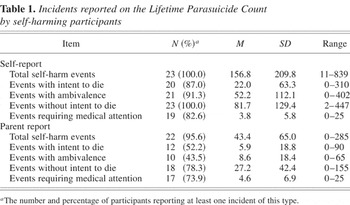
Incidents reported on the Lifetime Parasuicide Count by self-harming participants
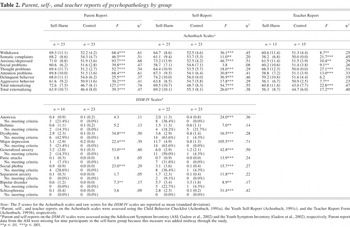
Parent, self-, and teacher reports of psychopathology by group
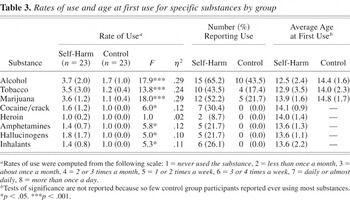
Rates of use and age at first use for specific substances by group
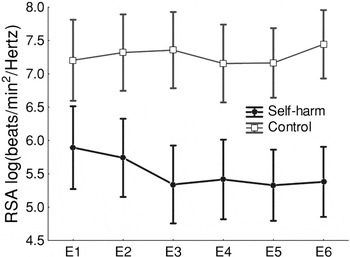
The respiratory sinus arrhythmia values (log[beats/min2/Hz]) across the six 30-s epochs of mood induction for self-harm participants and controls.
 You have
Access
- 159
- Cited by