Implications
The intrauterine life may offer a critical window for the potential enhancement of carcass composition and meat quality. Methyl donor, due to its possible critical role during this phase, was supplemented during gestation to understand its role in the control of offspring pork quality. Moreover, prenatal exposure of bisphenol A, a chemical compound inducing abnormal methylation in genes, was used to test whether bisphenol A induced impairment of pork quality could be counteracted by methyl donor intervention. Finally, maternal methyl donor affected glycogen synthase and lactate dehydrogenase expression via DNA methylation, thereby resulting in persistent effects on offspring pork quality.
Introduction
Emerging evidence has revealed that an adverse nutritional environment in utero can lead to permanent changes of foetal gene and protein expression via epigenetic modifications, especially that of DNA methylation, to exert long-term effects on growth, development and disease susceptibility later in life (Lillycrop and Burdge, Reference Lillycrop and Burdge2012; Wang et al., Reference Wang, Wu, Li, Li, Dindot, Satterfield, Bazer and Wu2012). Recently, the Meat Science and Muscle Biology Symposium titled ‘In utero factors that influence postnatal muscle growth, carcass composition, and meat quality’ was held to highlight the importance of maternal nutrition on the postnatal carcass traits of offspring (Bowker, Reference Bowker2013). However, it is still unclear whether DNA methylation mediates the effects of maternal nutrition on pork quality of the offspring.
S-Adenosyl methionine (SAM) acts as a universal methyl substrate in methylation reactions, and is critical for the regulation of the extent of methylation (Calvisi et al., Reference Calvisi, Simile, Ladu, Pellegrino, De Murtas, Pinna, Tomasi, Frau, Virdis and De Miglio2007). Synthesis of SAM specifically depends on the supply of dietary methyl donors (MET) such as folate, choline and betaine, all of which can be converted to SAM through transfer of methyl groups (Anderson et al., Reference Anderson, Sant and Dolinoy2012). Consequently, maternal dietary supplementation with a MET results in a global or tissue-specific modification of DNA methylation in the developing foetus, and further modulates foetal gene and protein expression, resulting in diverse phenotypes in later life (Anderson et al., Reference Anderson, Sant and Dolinoy2012). Therefore, it is important to address whether DNA methylation could mediate the effects of maternal MET supplementation on offspring meat quality.
On the contrary, bisphenol A (BPA), an endocrine disrupting compound, has been demonstrated to induce a reduction in DNA methyltransferase expression in vivo (Chao et al., Reference Chao, Zhang, Chen, Pan, Zhang, Li, Sun, Shi and Shen2012) and in vitro (Laing et al., Reference Laing, Viana, Dempster, Trznadel, Trunkfield, Webster, van Aerle, Paull, Wilson and Mill2016), resulting in global DNA hypomethylation. Studies have shown that BPA exposure in utero reduces methylation levels globally and in specific genes of offspring (Dolinoy et al. Reference Dolinoy, Huang and Jirtle2007; Ma et al., Reference Ma, Xia, Wang, Wan, Xu, Chen, Li and Xu2013). Therefore, we assumed that gestational exposure of pigs to BPA causes the opposite effect as that of MET on the meat quality of offspring.
Energy supply to muscles is deposited primarily in the form of glycogen, which can be converted to lactate to generate ATP via anaerobic glycolysis postmortem (Scheffler and Gerrard, Reference Scheffler and Gerrard2007). Subsequently, lactate accumulation results in a rapid decline in muscle pH, and further affects meat colour and water holding capacity (Bertol et al., Reference Bertol, Braña, Ellis, Ritter, Peterson, Mendoza and McKeith2011). It is well established that glycogen synthase (GS) and lactate dehydrogenase (LDH) are rate limiting in the synthesis of glycogen and lactate, respectively (Kruszynska et al., Reference Kruszynska, Ciaraldi and Henry2011). Because they are affected by DNA methylation, GS and LDH in pigs could be considered as target genes to mediate the effects of maternal nutrition on the meat quality and glycolytic potential of offspring. Therefore, the goals of the present study were to assess whether gestational consumption of BPA could induce a persist alternations of DNA methylation in GS and LDH that could lead to impairment of pork quality, and if so, whether those alternations in pork quality and methylation at the promoters in GS and LDH genes could be reversed by maternal MET consumption.
Material and methods
Animals and diets
This study was approved by the Animal Ethics Committee at the Sichuan Agricultural University. Slaughter and sampling procedures followed the Guidelines on Ethical Treatment of Experimental Animals (2006) No. 398 of the Ministry of Science and Technology of China. A total of 50 Landrace×Yorkshire crossbred sows (initial BW 221.14±2.57 kg) with equal parity (parity 3 to 5) were artificially inseminated upon observation of oestrus with the pooled semen obtained from two littermate boars. After insemination, sows were randomly assigned to receive one of four diets during gestation: basal diet (CON, n=13); control diet supplemented with MET (MET, n=12); control diet supplemented with BPA (BPA, n=13); and control diet supplemented with BPA and MET (BPA+MET, n=12). Control sows were fed a basal diet (Supplementary Table S1) containing 3.05 Mcal digestible energy/kg diet and 14% CP, which completely met the recommendations of the National Research Council (NRC) (2012). A MET-supplement premix was added to the control diet containing 3 g/kg betaine (98% betaine hydrochloride; Hangzhou Healthy Husbandry Sci-tech Co. Ltd, Hangzhou, P.R. China), 400 mg/kg choline (50% choline chloride; Shandong Enbei Group Ltd, Bin zhou, P.R. China), 15 mg/kg folic acid (Sigma-Aldrich, St Louis, MO, USA), and 150 μg/kg vitamin B12 (Sigma-Aldrich), based on the levels used by Guay et al. (Reference Guay, Matte, Girard, Palin, Giguère and Laforest2002), Matte et al. (Reference Matte, Guay and Girard2006), Stockland and Blaylock (Reference Stockland and Blaylock1974) and van Wettere et al. (Reference van Wettere, Smits and Hughes2013). The basal diet consisted of 482 g/kg betaine, 1,250 mg/kg choline, 1.3 mg/kg folate and 15 μg/kg vitamin B12, which met the recommended levels of choline, folate and vitamin B12 (NRC, 2012). Sows fed the BPA diet were supplemented with 50 mg/kg diet of BPA (Sigma-Aldrich), as proposed by Dolinoy et al. (Reference Dolinoy, Huang and Jirtle2007). The study began with 56 sows, 14 sows/treatment. Four sows were culled because of failure to conceive, and two sows were culled because of postpartum paralysis.
During gestation, sows were provided with 2.28 kg/day of feed from days 1 to 90, and 2.72 kg/day of feed from day 91 until farrowing, based on NRC (2012) recommendations. Gestating sows were fed twice per day at 0800 and 1400 h, and were allowed water ad libitum. All sows were housed in individual feeding stalls on a 12 : 12 h light: dark cycle, with temperature maintained at 18°C to 25°C. During lactation, sows received the same diet (Supplementary Table S2) three times per day (i.e. 0800, 1200 and 1500 h) and allowed water ad libitum. The amount of feed was progressively increased during the first 5 days of lactation, and subsequently lactating sows were fed ad libitum until weaning on day 28. A heating light and pads were provided for nursing piglets. Standard husbandry practices (ear-notching, clipping needle teeth and tails and injection with dextran iron) were performed for nursing piglets.
In the present study, the litter size was affected by maternal dietary treatments (Mou et al., Reference Mou, Wang, Liu, Chen, Che, Fang, Xu, Lin, Feng, Li and Wu2017). After weaning, six litters, with similar litter size (9 to 11 piglets/litter) and average BW, were selected to continue feeding with the same diet (Supplementary Table S2) until the finishing stage at ~110 kg BW. Each litter was housed in an individual pen, with 24 pens at the weaning, growing and finishing stages.
Sample collection
At birth, 12 piglets/treatment (48 piglets in total) were euthanised before suckling. A sample of the longissimus thoracis (LT) muscle at the 10th rib on the left side of the carcass was immediately resected and frozen in liquid nitrogen until further analysis. At the end of the feeding trial, six pigs per treatment group (one pig with from each litter) with BW approximating the mean (110 kg), that were fasted from 1800 h onwards in the previous day, were selected from sample collection. The slaughter house, about 50 m away from feeding facility, is connected to feeding facility by a corridor specially designed for guiding pigs. Beginning at 0730 h in the morning, pigs were guided to the slaughter house and were then caged individually in a pen (1.8×2 m) where water was provided freely. Pigs were showered for 1 min with a small water jet, and were then electrically stunned, exsanguinated, dehaired and eviscerated, and quickly transferred to a chilling room at 4°C. Hot carcass weight was recorded immediately postmortem. Ham and hip (cut at the end of 6th lumbar vertabra along the abdomin), omental fat, leaf fat and the visceral organs and tissues were removed and weighed. Dressing percentage, as well as the ham and hip yield and rate of ham and hip weight to carcass weight were calculated. Backfat depth at the first rib, last rib and last lumbar vertebrae were recorded. The LT area at the 10th rib on the left side was measured by tracing the outline of LM onto transparent paper and then measuring the area using a planimeter and the average of the three measurements was calculated. A sample of the LT muscle at the 10th rib on the left side of the carcass was immediately resected and frozen in liquid nitrogen until further analysis. To determine glycogen and lactate content, and meat quality, LT muscle samples were resected from the area of the 10th to 13th rib on the left side of the carcass at 45-min and 24-h postmortem.
Meat quality measurements
The LT samples from the 10th to 13th left ribs were used in the following order: (1) 3.0-cm slice to measure meat colour; (2) 3.0-cm slice to measure meat pH; (3) 4.0-cm slice (~120 g) to measure cooking loss; 4) 2×2×6-cm slice to measure drip loss; and 5) 1×1×3-cm slice to measure shear force.
Meat-quality measurements were performed 45-min and 24-h postmortem. Meat pH was determined in the central area of the LT using a pH meter (pH-STAR; SFK-Technology, Herlev, Denmark) calibrated at pH 4.0 and 7.0. Each sample was measured in triplicate and the mean of three random readings was used. Moreover, the colour of the LT was assessed at three points on the LT surface using a Minolta Chroma meter (CR-300; Minolta Camera, Osaka, Japan) calibrated with pure white. After a 1-h bloom period at 4°C, the lightness (L*), redness (a*), and yellowness (b*) values were measured in triplicate under artificial light, and the average of three random readings was used. The drip loss percentage was measured according to the plastic bag method described by Zhang et al. (Reference Zhang, Luo, Yu, Zheng, Huang, Mao, He, Yu, Chen and Chen2015). In brief, a LT sample (~50 g) was removed, immediately weighed, and hung in hermetically sealed plastic bags for 24 h at 2°C to 4°C. The LT sample was re-weighed and drip loss was calculated as follows: drip loss (%)=((initial weight−final weight)/initial weight)×100%. To assess cooking loss, LT muscle samples were weighed and cooked for 30 min on a double boiler. Cooked samples were cooled at room temperature for 15 min, blotted dry and re-weighed. Cooking loss was calculated as the percentage weight change from the pre-cooked weight. To determine shear force, LT samples were thawed overnight at 4°C and heated to 70°C in a thermostatic water bath. After cooling at room temperature, the samples were removed to a refrigerator at 4°C for 20 h. Three cores measuring 1×1×3 cm were then cut parallel to the orientation of the muscle fibres and used to determine shear force with a TA-XTPlus Texture Analyser (Stable Micro Systems, Co., Godalming, England). Each measurement was conducted for ten replicates and the average was calculated.
Chemical analysis
Lactate and glycogen content of the LT muscle were determined at 45-min and 24-h postmortem, respectively, as described by Lebret et al. (Reference Lebret, Meunier-Salaun, Foury, Mormede, Dransfield and Dourmad2006). For glycogen analysis, frozen samples were powdered in liquid nitrogen and 0.5 g of those powdered samples were subjected to hydrolysis by amyloglucosidase. The glycogen content was calculated using glucose determination value. Another 1.0 g of frozen muscle powdered with liquid nitrogen was homogenised in 0.55 M perchloric acid, and the resulting supernatants after centrifugation were used for glucose, glucose-6-phosphate and lactate analysis. The glycolytic potential was calculated as glycolytic potential=2((glycogen)+(glucose)+(glucose-6-phosphate))+(lactate), according to Monin and Sellier (Reference Monin and Sellier1985). The results were reported as μmol/g of wet tissue. To determine protein concentration and enzyme activity, LT muscle samples were homogenised in ice-cold saline solution using a mechanical tissue disrupter. After refrigeration and centrifugation for 10 min at 1500×g, the supernatant was collected for further analysis. The protein content of the LT muscle was measured by the biuret method. LDH enzyme activity was determined using a commercial kit (Nanjing Jiancheng Bioengineering Research Institute, Nanjing, China) according to the manufacturer’s instructions.
Detection of gene expressions
All primers for targeted genes were designed by Primer 5.0 software and are presented in the Supplementary Table S3. Total RNA were isolated from frozen LT samples using Trizol reagent (Invitrogen, Carlsbad, CA, USA) according to the manufacturer’s protocol. The RNA samples were treated with DNase-I (Takara Biotechnology Co., Ltd, Dalian, China) to remove trace genomic DNA. The quality of RNA was evaluated by agarose gel electrophoresis, and the purity of RNA was determined by the absorbance at 260 and 280 nm with a nucleic acid and protein analyzer (Beckman DU-800; Beckman, Fullerton, CA, USA). Reverse transcription was then performed for synthesis of the complementary DNA with a commercial kit (Takara Biotechnology Co., Ltd) according to manufacturer’s guidelines. Gene expression was determined using fluorescence quantitative reagent (SYBR Premix; Takara Biotechnology Co., Ltd). Amplification and relative Ct values were determined using an ABI PRISM 7900HT (Applied Biosystems, Foster City, CA, USA) sequence detection system. Gene expression was quantified relative to β-actin and fold change determined using the
 $$2^{{{\minus}\Delta \Delta C_{t} }} $$
method.
Quantitative analysis of DNA methylation
The CpG island (%G+C>50%, Obs/Exp CpG > 0.6) of GS (chr6: 50 078 446 to 50 094 061) and LDH (chr2: 43 898 284 to 43 909 453) promoters were identified using the University of California, Santa Cruz (UCSC) genome browser (http://genome.ucsc.edu/), from 2000 bp upstream of the transcriptional start point. Only one section of the CpG island was detected in either the GS or LDH promoter. The length of the CpG island in the GS promoter was 391 bp (Supplementary Figure S1), which covered 25 CpG sites and successfully generated 17 CpG sites using the Sequenom EpiDesigner (Sequenom, San Diego, CA, USA) software. The length of the CpG island in the LDH promoter was 485 bp (Supplementary Figure S2), which covered 46 CpG sites and successfully generated 31 CpG sites. The primer sequences and the locations are presented in Table 1. Deoxyribonucleic acid methylation was measured by the MassARRAY EpiTYPER protocol as described below.
Sequences of MassARRAY primers and positions relative to the translational start codon for the assays used to analyse DNA methylation of glycogen synthase (GS) and lactate dehydrogenase (LDH)

Total DNA was extracted from the LT tissue of newborn and finished pigs with a commercial DNA kit (Takara Biotechnology Co., Ltd) according to the instructions of the manufacturer. Bisulfite conversion of genomic DNA was performed using an EZ DNA Methylation kit (Zymo Research, Orange, CA, USA) as per the manufacture’s protocol. Subsequently, 1 μl of bisulfite-treated DNA was used for PCR amplification. PCR conditions consisted of 94°C for 4 min, followed by 45 cycles of 94°C for 20 s, 52°C to 62°C for 30 s, and 72°C for 3 min. The PCR products were confirmed by agarose gel electrophoresis before quantitative gene expression analysis (Sequenom). The PCR cocktail was comprised of 1 μl DNA, 2 μl of each primer; 0.04 μl deoxy-ribonucleoside triphosphate, 0.04 μl enzyme, 0.25 μl MgCl2, 0.25 μl buffer and 1.42 μl ddH2O. The PCR products were treated with shrimp alkaline phosphatase (Sequenom), which was used for in vitro transcription and RNase cleavage reactions as per the manufacturer’s instructions. Transcription cleavage products were dispensed onto a 384-element SpectroCHIP bioarray, and the mass spectra were collected using of a MassARRAY mass spectrometer (Sequenom). The methylation ratios were calculated using the EpiTYPER TM software v1.0 (Sequenom).
Statistical analysis
Statistical analyses were performed using the SPSS 20.0 software (IBM, Armonk, NY, USA), and experimental data were arranged in 2×2 factorial designs. Data were analysed as a mixed model with BPA and MET diets as fixed effects, and the interactions of BPA×MET were also considered as fixed effects. The litter was included as a random effect in each experiment, using the MIXED procedure in SPSS. Duncan’s multiple range tests were conducted to determine differences among the treatments. The results were expressed as means±standard error of mean. Statistical significance was considered at P<0.05, and trends were considered at 0.05⩽P<0.10.
Results
Carcass traits and meat quality
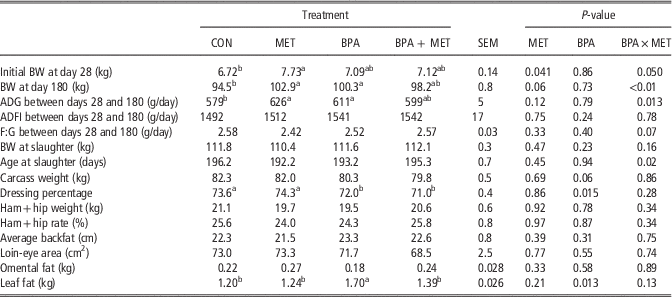
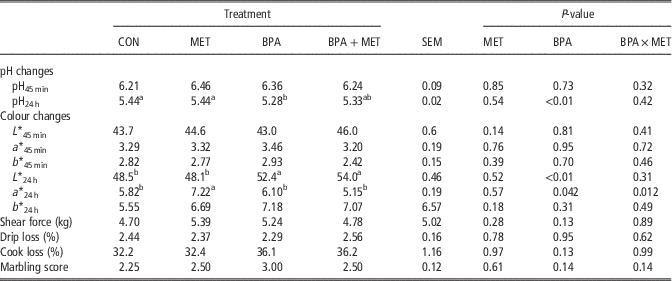
The dressing percentage was reduced (P=0.01) and leaf fat weight (P=0.01) of pigs at slaughter was increased by prenatal exposure to BPA (Table 2), but not by MET or the interaction between BPA and MET. Other carcass traits, including carcass weight, ham weight, ham rate, average backfat, loin-eye area and omental fat were not affected by different maternal dietary treatments. As shown in Table 3, the pH at 24-h postmortem, but not that at 45-min postmortem, was lower in pigs with prenatal exposure to BPA (P<0.01), but the pH at 24-h postmortem in pigs with maternal MET supplementation was reversed to similar level compared with that of CON pigs. The muscle a* value at 24-h postmortem was affected by maternal BPA (P=0.04) and the interaction between MET and BPA (P=0.01), which was greater in MET group than the other groups (P<0.05). The L* values at 24-h postmortem (P<0.01) was greater in pigs with prenatal BPA exposure, but was not affected by MET or the interaction between BPA and MET. The shear force, drip loss, cook loss and marbling score were not affected by MET, BPA or interaction between MET and BPA.
Effect of maternal methyl donor or bisphenol A (BPA) supplementation during gestation on carcass characteristics of offspring pigs

CON=control; MET=methyl donor; BPA+MET=bisphenol A supplemented with methyl donor; ADG=average daily weight gain; ADFI=average daily feed intake, F:G=ratio of feed to gain.
a,b Means within a row with different superscript letters are significantly different (P<0.05), n=6 in each group.
Effect of maternal methyl donor or bisphenol A (BPA) supplementation during gestation on meat quality of offspring pigs

CON=control; MET=methyl donor; BPA+MET=bisphenol A supplemented with methyl donor. Meat colour (L*, a* and b* value) were measured follow a 1-h bloom period after the samples taken out at 45-min and 24-h postmortem.
a,b Means within a row with different superscript letters are significantly different (P<0.05), n=6 in each group.
Glycogen and lactate content and glycolytic potential
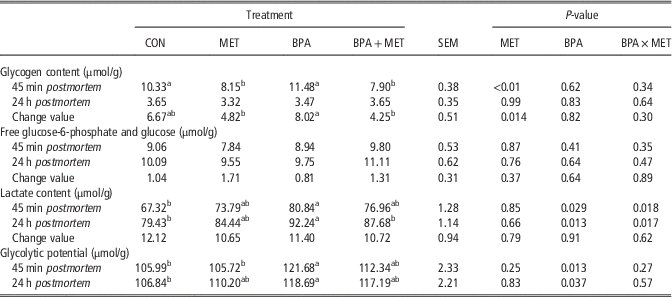
Maternal MET supplementation reduced muscle glycogen content at 45-min postmortem in offspring (P<0.05). Muscle lactate content at 45-min and 24-h postmortem was affected by interaction between BPA and MET (P<0.05). Glycolytic potential at 45-min and 24-h postmortem were affected by maternal BPA (P<0.05, Table 4). The glycogen content at 45-min postmortem, lactate content at 45-min and 24-h postmortem, glycolytic potential at 45-min and 24-h postmortem were greater in BPA than CON group (P<0.05), but those level of BPA+MET groups was reversed to the similar level of that in CON group (P>0.05). The glucose and glucose-6-phosphate content were not affected by diets (P>0.05).
Effect of maternal methyl donor or bisphenol A (BPA) supplementation during gestation on glycogen, lactate content and glycolytic potential in the longissimus thoracis muscle of offspring pigs

CON=control; MET=methyl donor; BPA+MET=bisphenol A supplemented with methyl donor.
a,b Means within a row with different superscript letters are significantly different (P<0.05), n=6 in each group.
Expression of glycogen synthase and lactate dehydrogenase and enzyme activity
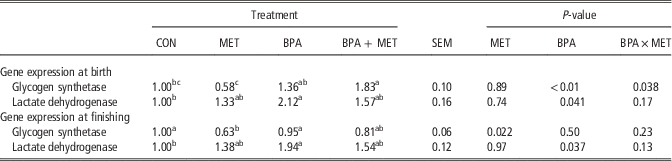
Lactate dehydrogenase enzyme activity was higher (P<0.05) in the LT muscle of the BPA group than the CON group (Table 5). Furthermore, the mRNA level of GS was downregulated in the LT muscle of MET pigs at birth (P=0.09) and the finishing stage (P<0.05), whereas the mRNA level of LDH was upregulated in the LT muscle of BPA pigs at birth (P<0.05) and the finishing stage (P<0.05) in comparison with the CON group (Table 6). No significant differences were observed in the expression levels of GS and LDH mRNA between the CON and BPA+MET groups.
Effect of maternal methyl donor or bisphenol A (BPA) supplementation during gestation on enzyme activities of lactate dehydrogenase (LDH) in the longissimus thoracis muscle of offspring pigs

CON=control; MET=methyl donor; BPA+MET=bisphenol A supplemented with methyl donor.
a,b Means within a row with different superscript letters are significantly different (P<0.05), n=12 at birth in each group, n=6 at finishing in each group.
Effect of maternal methyl donor or bisphenol A (BPA) supplementation during gestation on gene expression of glycogen synthetase and lactate dehydrogenase in the longissimus thoracis muscle of offspring pigs

CON=control; MET=methyl donor; BPA+MET=bisphenol A supplemented with methyl donor.
a,b Means within a row with different superscript letters are significantly different (P<0.05), n=12 at birth in each group, n=6 at finishing in each group.
Gene expressions were expressed as fold change of that in CON group.
Methylation levels at the glycogen synthase and lactate dehydrogenase promoters
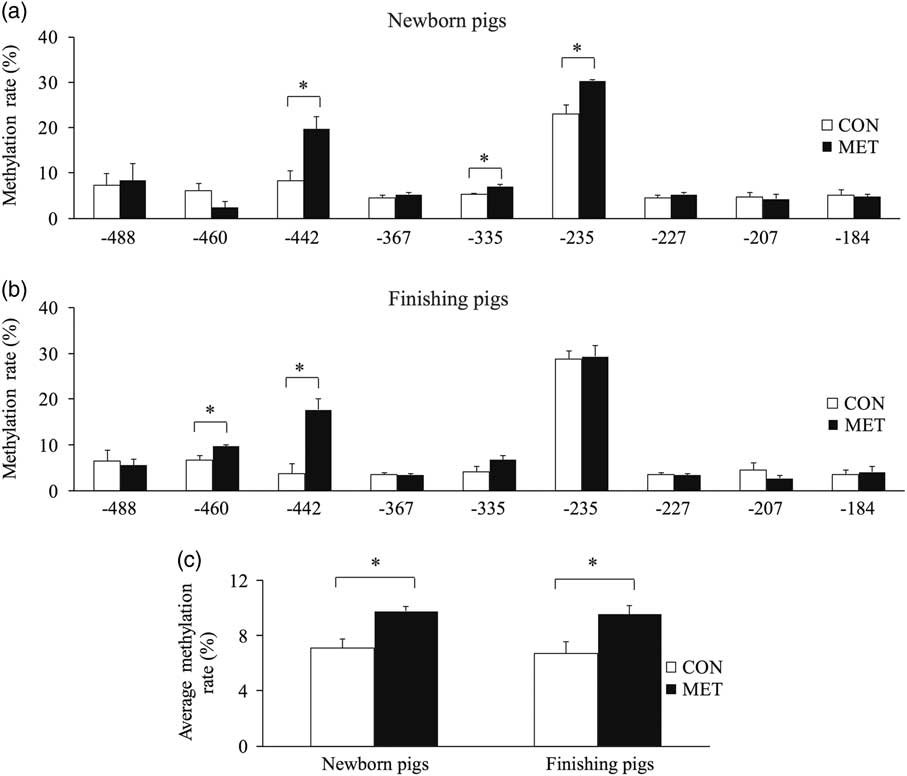
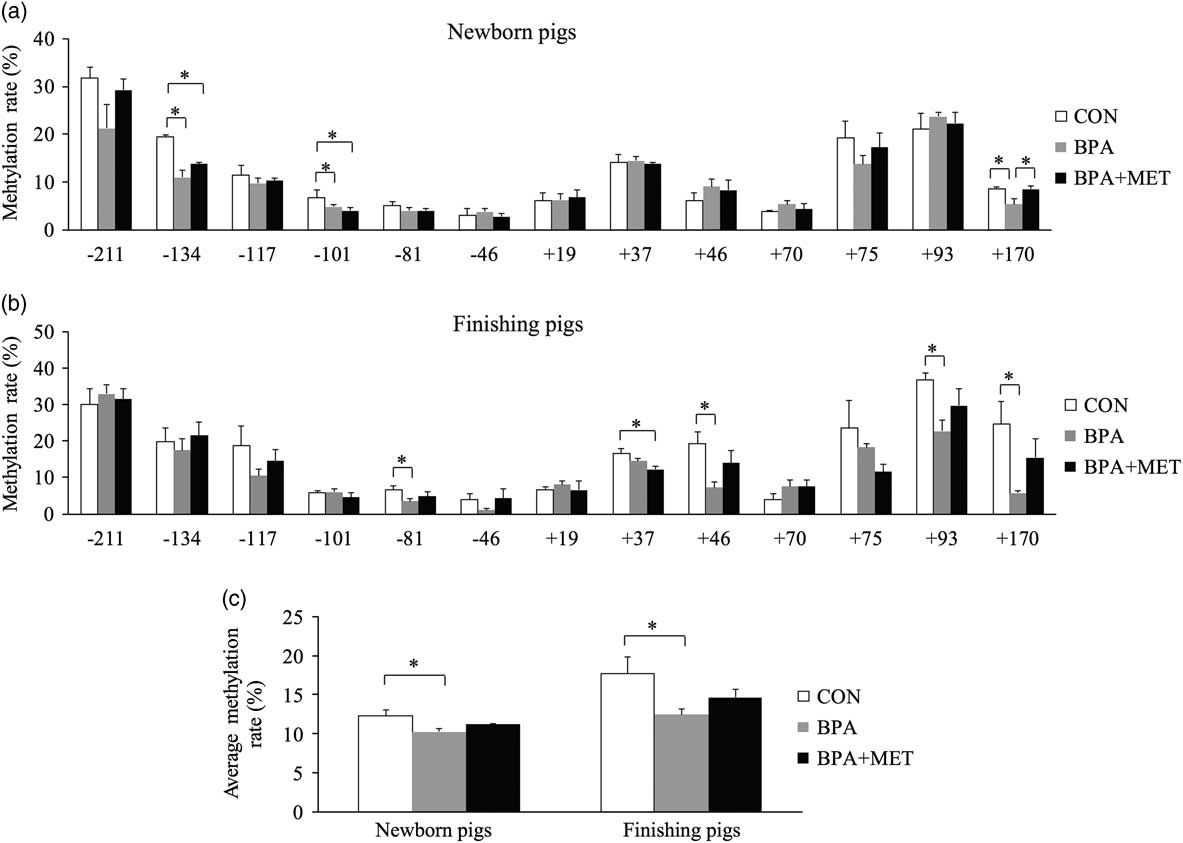
Compared with CON pigs (Figure 1), the methylation ratios of MET pigs at birth were significantly increased at the −442, −335 and −235 sites in the GS promoter (P<0.05), whereas they were significantly increased at the −460 and −442 sites in the GS promoter of MET pigs at the finishing stage (P<0.05). Furthermore, methylation levels at the −134, −101 and +170 sites were reduced in the LDH promoter of BPA pigs at birth, whereas those at the −81, +37, +46, +93 and +170 sites were reduced in the LDH promoter of BPA pigs at the finishing stage (Figure 2). Compared with CON pigs, the average methylation level in MET pigs at the GS promoter was significantly increased at birth (P<0.05) and the finishing stage (P<0.05), and the average methylation level at the LDH promoter was significantly decreased in BPA pigs at birth (P<0.05) and the finishing stage (P<0.05). No significant differences in methylation at the LDH promoter were observed between CON and BPA+MET groups.
Methylation of individual CpG sites at the glycogen synthetase promoter region in the longissimus thoracis of pigs at birth (a) and finishing (b), and comparison of the percentage of mean methylation among treatments (c). Values are expressed as mean ± SE, n=4/treatment. CON=control group; MET=methyl donor group. *Values are significantly different between treatments (P<0.05).

Methylation of individual CpG sites at the lactate dehydrogenase promoter region in the longissimus thoracis of pigs at birth (a) and finishing (b), comparison of the percentage of mean methylation among treatments (c). Values are expressed as mean ± SE, n=/4treatment. CON=control group; BPA=bisphenol A group; BPA+MET=bisphenol A group supplemented with methyl donor. *Values are significantly different between treatments (P<0.05).
Discussion
In the present study, the principle objective was to evaluate if maternal MET derived changes of DNA methylation in specific genes could contribute to altered pork quality in the offspring. Bisphenol A, despite supplemented at a level higher than environmental exposure, was supplemented to maternal diet to establish a model of tissue specifically reduced DNA methylation at the promoters of specific genes. Subsequently, this model allowed us to evaluate whether maternal MET supplementation, which are known to modulate postnatal phenotype through DNA methylation, could prevent the intrauterine effects on pork quality via promoter methylation of specific genes.
Glycogen greatly contributes to the regulation of lactate formation, pH decline and meat colour in postmortem pork, and elevated glycogen stores would likely result in increased lactate accumulation and decreased pH values in the LT muscle (Leheska et al., Reference Leheska, Wulf and Maddock2002); however, we found that dietary supplementation with MET did not significantly alter these parameters. These results might be related to LDH, an enzyme that catalyses the formation of lactate (Kruszynska et al., Reference Kruszynska, Ciaraldi and Henry2011), which was not affected by dietary MET. Interestingly, an elevated a* value indicated increased redness in the LT muscle of MET pigs, which is a desirable characteristic for meat. Redness is usually positively correlated with muscle myoglobin content (Suman and Joseph, Reference Suman and Joseph2013), which can be disrupted by increased muscle glycogen stores, as a consequence of pigment denaturation (Mancini and Hunt, Reference Mancini and Hunt2005). As expected, the a* value was elevated, associating with lower glycogen content in the LT muscle of MET pigs. Targeted disruption of the GS gene in muscle is strongly linked to glycogen deficiency, which is rate limiting for glycogen deposition (Pederson et al., Reference Pederson, Schroeder, Parker, Smith, DePaoli-Roach and Roach2005). Consistent with the trends observed in glycogen content, we found that expression of the GS gene was persistently downregulated in the LT muscle of MET pigs at birth and the finishing stage. These findings suggest that maternal MET supplementation during gestation exerts long lasting effects on transcription silencing of the muscle GS gene. These persistent changes might serve to reduce muscle glycogen content and thereby affect the meat quality of offspring.
In the present study, a significant increase in the methylation rate at the CpG islands (CGIs) of the GS promoter was observed in the LT muscle of MET pigs, at both birth and the finishing stage. Hypermethylation at the GS promoter is consistent with the progressive decline in transcription of muscle GS in MET pigs at birth and the finishing stage. Typically, most CGIs are not methylated if located upstream of the transcription start sites, and these unmethylated CGIs facilitate the activation of gene transcription (Jones, Reference Jones2012). However, once CGIs at the promoter regions are methylated by external environmental factors, these methylated CGIs can result in stable repression of the linked genes, by preventing them from binding to transcription factors (Schübeler, Reference Schübeler2015). Thus, our findings suggest that the reduced levels of CGI-methylation at the GS promoter persist throughout the life of the offspring and persistently silence the muscle GS gene, thereby leading to altered glycogen deposition in later life. Furthermore, the differences observed in the levels of methylation were mainly influenced by the individual CpG site −442 of the GS promoter, and exhibited consistent decline in the LT muscle of MET pigs at birth and the finishing stage. In particular, myogenic differentiation 1 (MyOD1), a transcription factor involved in the regulation of muscle growth and development, was predicted to bind at site −442 of the GS promoter. The MyOD1 DNA binding domain is known to be involved in transcriptional activation of a muscle-specific gene (Berkes and Tapscott, Reference Berkes and Tapscott2005). Hence, we speculated that maternal MET supplementation persistently increases methylation at CpG site −442 of the muscle GS promoter in offspring, which might prevent it from binding to MyOD1, and thereby repress transcription of the GS gene. In addition, CpG islands at the GS promoter region also contain other potential transcription factor binding sites, including those for STAT3a and USF2, located at the −460 and −335 sites of the GS promoter, respectively. In the present study, we observed a significant increase in methylation at the CpG −460 site at birth and at the CpG −335 site at the finishing stage in the GS promoter of MET pigs. However, significance of the altered methylation at these sites on the pork quality needs further investigation. Besides, the methylation of GS promoter appeared to have an age-dependent changes on the sites at −460, −335 and −235, suggesting that some of the biomarkers of prenatal MET intervention might be erased during postnatal phase.
Moreover, BPA, as an oestrogenic toxin that is widely ubiquitous in our environment, might influence the methylation of genes and phenotype (Rubin, Reference Rubin2011). As expected, we found that exposure to BPA during gestation had long-term effects on the meat quality of offspring pigs, as evidenced by reductions in dressing percentage, muscle pH, and increased muscle L* values. Typically, L* values can be used as reliable indicators of pale, soft, exudative (PSE) and/or dark, firm, dry (DFD) pork, and pork with high L* and low a* values is often associated with poor pork quality (Brewer et al., Reference Brewer, Zhu, Bidner, Meisinger and McKeith2001). Furthermore, lower pH values in postmortem skeletal muscle, can result in a paler colour and lower-water holding capacity of pork (Bertol et al., Reference Bertol, Braña, Ellis, Ritter, Peterson, Mendoza and McKeith2011). As expected based on the lower pH value, pigs exposed to BPA in utero presented a paler, lighter coloured meat, as evidenced by comparatively higher L* values and lower a* values. These results suggest that developmental exposure to BPA in utero might increase the incidence of unqualified pork products.
The decline in pH and the ultimate pH value depend considerably on the glycogen stores and lactate accumulation in postmortem muscle (Leheska et al., Reference Leheska, Wulf and Maddock2002). Generally, the glycolytic potential is used to predict muscle glycogen and lactate status, which are both reflective of the primary intermediates of glycogenolysis and glycolysis in postmortem muscle, which could contribute to a lower ultimate pH value (Hamilton et al., Reference Hamilton, Miller, Ellis, McKeith and Wilson2003). Thus, consistent with the observed pH values, BPA pigs exhibited increased lactate content and glycolytic potential in the LT muscle at 45-min and 24-h postmortem, although glycogen content was not significantly affected. Lactate dehydrogenase activity, which promoted the formation of lactate, was increased in the LT muscle of BPA pigs. Furthermore, LDH gene expression was persistently upregulated both at birth and the finishing stage. These findings suggest that exposure to BPA in utero exerts permanent effects on transcriptional activation of the LDH gene in the LT muscle of offspring. These persistent alterations might help to increase both the muscle lactate content and glycolytic potential, thereby leading to poor meat quality. These findings suggest that maternal supplementation of MET alleviated the negative effects induced by BPA on pork quality in the offspring.
Deoxyribonucleic acid methylation is susceptible especially during early prenatal development, but once the DNA methylation pattern has been established, it can be stably inherited throughout life (Law and Jacobsen, Reference Law and Jacobsen2010). In the present study, the methylation levels at the CGI regions of the LDH promoter were persistently reduced in the muscle of BPA pigs at the newborn and finishing stages. As expected, this reduction was negatively correlated with the observed increase in expression of the LDH gene in the LT muscle of BPA pigs because hypomethylation at promoter regions can facilitate gene transcription (Jones, Reference Jones2012; Schübeler, Reference Schübeler2015). Maternal supplementation of MET likewise negated the BPA-induced DNA hypomethylation in offspring, as CpG methylation at the LDH promoter was not significantly different between CON and BPA pigs treated with MET in utero. Thus, these findings suggest that maternal nutrition can counteract adverse environmental toxicant effects in utero, such as BPA-induced DNA hypomethylation.
Specifically, we found that methylation in the muscle LDH promoter of BPA pigs was reduced at CpG sites −134 and −101 at birth, whereas they were reduced at CpG site −81 at the finishing stage. In particular, specificity protein 1 (SP1) was predicted to bind at the CpG sites −134 and −101, whereas Myc was predicted to bind at CpG site −81. Methylation has been shown to occur in proximity to the SP1 and Myc binding sites, where it inhibits the binding of SP1 and Myc to DNA (Liu, et al., Reference Liu, Lam, Chow, Xu, Lam, Moon and Wang2008). Therefore, altered binding of SP1 or Myc to DNA might be responsible for increased expression of the muscle LDH gene in pigs with prenatal BPA exposure. Furthermore, we observed that methylation at CpG site +170 of the first exon was reduced in BPA pigs at birth, whereas methylation at CpG sites +37, +46, +97 and +170 of the first exon was reduced in BPA pigs at the finishing stage. Brenet et al. (Reference Brenet, Moh, Funk, Feierstein, Viale, Socci and Scandura2011) performed genome-wide analyses of methylation and gene expression of human DNA, and found that methylation of the first exon was closely associated with transcriptional silencing. This finding is consistent with evidence that DNA methylation of exons promotes the retention of alternative exons, thereby silencing the gene (Oberdoerffer, Reference Oberdoerffer2012). Therefore, our results implied that hypomethylation of the first exon of the muscle LDH gene plays an important role in the upregulation of LDH transcription in BPA pigs. Although differences in methylation at individual CpG sites were inconsistent at birth and the finishing stage, these changes might have been reflective of short- and long-term adaptive responses to nutritional environmental cues after birth.
Collectively, our results indicate that maternal MET or BPA supplementation during gestation could influence the pork quality of the offspring, possibly via altered methylation at the GS and LDH promoter, thus shed light on the intrauterine-derived DNA methylation in the control of the offspring pork quality.
Acknowledgements
This research was supported by National Natural Science Foundation (31472111) of P.R China, the Academy of Kechuang Feed Industry in Sichuan (2013NZ0056), and the Program for Changjiang Scholars and Innovative Research Team in University (IRT13083).
Supplementary material
To view supplementary material for this article, please visit https://doi.org/10.1017/S175173111700252X