For decades, debates over Hezbollah have generated intense discussion among scholars, media pundits, and politicians, especially in the wake of the Ta'if Accord (1989) and subsequent developments, namely Israel's unilateral withdrawal from South Lebanon in 2000, the withdrawal of Syrian troops from Lebanon in 2005, and most recently, Hezbollah's involvement in the Syrian civil war. The participants in the debates over Hezbollah within Lebanon and across the world have variously categorized the group as a social movement, a resistance organization, a political party, or a terrorist organization (see Daher Reference Daher2020, 2–3 for an extensive discussion on Hezbollah). A proper understanding of the heated debate over Hezbollah, its political discourse, and armed activities in Lebanon and beyond, especially in Syria, requires analysis of the perceptions of Lebanese people about this Shi‘a organization. There is an almost consensus that Hezbollah serves the interest of the Shi‘a community in Lebanon as well as Iran's regional interests (El Husseini Reference El Husseini2010; Norton Reference Norton2014). This belief, amplified by (mostly western) media, leads to the perception that support in Lebanon comes almost entirely from Shi‘a, with other sectarian groups giving only negligible support to an organization known for its ideologically driven militancy.
This study instead reexamines these assumptions and asks how various Christian denominations, Sunnis, Druze, and others, that is to say non-Shi‘a sectarian groups in Lebanon, perceive Hezbollah and its activities in the region. This question has rarely been investigated (rare exceptions include Haddad Reference Haddad2005, Reference Haddad2006, Reference Haddad2013). The existing literature overlooks both the fact that this movement has garnered significant popularity from other sectarian groups like Maronites, Druze, and Sunnis, albeit to differing degrees, as well as the larger question of what drives this support, which has from time to time extended well beyond Lebanon. For instance, according to Pew Research polls in 2007, the general-secretary of Hezbollah, Hassan Nasrallah, was one of the most popular leaders in the MENA region after the 2006 war with Israel.
Since then, there has been a significant decline in positive attitude toward Hezbollah, across countries and people with Sunni identities, juxtaposed with a rise in positive attitudes across members of Christian denominations.Footnote 1 Looking at the period between 2010 and 2014, favorable views toward Hezbollah in Lebanon among already skeptical Sunnis declined from 12 to 9% in 2014, whereas the prevalence of such views jumped from 20% in 2010 to 31% in 2014 among Christians.Footnote 2 Changes in perception toward Hezbollah over time and survey findings of views on Hezbollah among non-Shi‘as in 2015 suggest that we cannot understand popular views toward this movement through static identity approaches or recent studies emphasizing the impact of ethnic/national and religious identity on foreign policy behaviors (e.g., Ciftci Reference Ciftci2013, Telhami Reference Telhami2013; Köse, Özcan, and Karakoç Reference Köse, Özcan and Karakoç2016). These approaches unfairly attribute the political attitudes and behaviors of citizens of Lebanon and other Middle Eastern countries to approaches embracing seemingly static identities,Footnote 3 whether ethnic, religious, or sectarian, at the expense of other factors emanating from domestic and international events.
If sectarian identity does not (completely) filter people's view toward domestic and international actors, then what explains a substantial change in favorable attitudes toward Hezbollah among non-Shi‘as? Discerning the determinants of Lebanese attitudes toward Hezbollah requires a close look at the dynamic relationship between domestic and international politics, which leads ordinary citizens in Lebanon occasionally to re-assess their positions on political movements as well as regional and international actors. The rise of new political and military threats at home and in the region molded Lebanese attitudes with different religious denominations to protect political status quo in the country.
This study first argues that the perception of Hezbollah as a resistance organization against Israel and the United States in the region garners support from (non-Shi‘a) Lebanese citizens. Second, political coalitions that cross-cut sectarian identities are important in maintaining the balance of power in the country. These coalitions significantly influence attitudes toward Hezbollah, independent of sectarian identities. Based on this argument, one would expect non-Shi‘a supporters of an electoral/political coalition that includes Hezbollah, that is to say, the supporters of the March 8 Block (MB8, the political group composed mainly of Shi‘a parties and the Maronite Free Patriotic Movement) to view Hezbollah favorably. Finally, the security challenges Lebanon faces at home and as a result of the Syrian conflict generate positive attitudes toward the organization because it is the most powerful military organization in the country able to overcome these challenges that can radically alter the social, political, and economic status quo, especially with respect to Christian denominations.
To test these hypotheses, we employed a local polling organization to conduct an original nationally representative face-to-face survey with 1,200 individuals in Lebanon between October 2nd and October 26th, 2015.Footnote 4 We used multivariate statistical analyses to test our hypotheses. The results suggest that those who hold unfavorable views of the United States are likely to view Hezbollah in a positive way while those who view Israel as the major challenge for Lebanon exert a statistically insignificant impact on Hezbollah. Those non-Shi‘a who support the political alliance of which Hezbollah is part, and those who support the political status quo in Syria are likely to have a positive perception of Hezbollah and its activities. On the other hand, in contrast to our expectation, viewing militant groups as a domestic security threat does not appear to be a determinant factor with respect to non-Shi‘a views on Hezbollah.
This study, which seeks to go beyond identity-oriented analyses of political actors in the region, discloses several important findings. First, Hezbollah has been successful in branding itself as an anti-imperialist movement challenging the United States, even among non-Shi‘as. Second, the political alliance across sectarian groups, as well as physical and political insecurity caused by international armed groups such as Sunni militant groups and the Islamic State of Iraq and Levant (ISIS), moderates people's views toward Hezbollah. Third, it highlights the fact that although attitudes toward Hezbollah in Lebanon are divided among non-Shi‘as, they are also subject to major events and regional conflicts with implications for Lebanese society and politics. That is why these findings should be assessed within a particular political context in the region.Footnote 5
WHAT DOES LEBANESE PUBLIC OPINION MAKES OF HEZBOLLAH WITH DUAL IDENTITY?
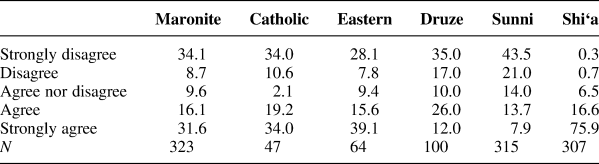
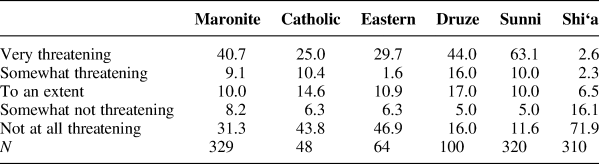
First, we would like to present the answers of the respondents in our survey to capture popular attitudes toward Hezbollah across all sectarian groups. We asked respondents two questions regarding normative assessment of both the political legitimacy and the activities of Hezbollah in the region. This is because many critics argue that Hezbollah cannot be both a militant armed group and act as a political party, and they claim that if Hezbollah wants to be a political party then it must disarm. Despite these objections and demands, however, Hezbollah has not given up this dual identity. Rejecting calls for disarmament, it has also remained a potent political actor in Lebanese politics. It has never held fewer than 10 seats in Parliament since the 1992 elections and “a minimum of two ministers in every Lebanese government since 2005” (Daher Reference Daher2016, 1). The first question asks respondents to what extent they would agree with the view “Hezbollah is a legitimate political organization in Lebanon.” The responses range from “strongly disagree/disagree/neither agree nor disagree/agree/strongly agree.” The second question asks “how threatening are the activities of Hezbollah in the region for Lebanon?,” and the respondents chose from “very threatening/somewhat threatening/somewhat not threatening/not at all threatening.”
Table 1, based on the first question, displays the divided nature of Lebanese society over Hezbollah. We merged the strongly agree and agree categories for the sake of simplicity in presenting our results: 48% of Maronites, 53% of Catholics, and 55% of Eastern Orthodox view Hezbollah as a legitimate political organization in Lebanon. As for Sunnis and Druze, the percentage of those agreeing with the statement is 22 and 38% respectively, much lower than Christian denominations. The Shi‘a overwhelmingly (92.5%) support Hezbollah as a legitimate political actor. Those who do not view Hezbollah as a legitimate political actor constitute 1% of Shi‘a, 43% of Maronites, 45% of Catholics, and 36% of Eastern Orthodox. Among Sunnis and Druze, the proportion reaches 64 and 52% respectively.
Is Hezbollah a legitimate political organization? (%)

The responses to the second question in Table 2 display a similar tendency toward Hezbollah, but with some uneasiness toward its activities.Footnote 6 A total of 39.5% of Maronites, about 50% of Catholics, 53% of Eastern Orthodox but only 21% of Druze and 17% of Sunnis regard Hezbollah as an organization non-threatening (merging somewhat not/not at all threatening categories). In contrast, 88% of Shi‘as view the organization's activities as not threatening. Negative assessments on its activities are more prevalent among Maronites, compared to Catholics and Eastern Orthodox. Similar to our findings in Table 1, the most skeptical are Druze and Sunnis.
Perception of Hezbollah's activities in the region (%)

Can we explain the relationship between support for Hezbollah and sectarian identities by social identity or other related theories that prioritize ethnic or religious identity over other factors (e.g., Tajfel Reference Tajfel1981; for the Middle East, Ciftci Reference Ciftci2013)? Taking a first glance at Shi‘as, one's answer might initially be affirmative. The findings of Tables 1 and 2 on other sectarian identities belie this relationship, however, as Christian denominations, Sunnis and Druze significantly vary in their attitudes toward Hezbollah. The latter two Muslim denominations have much lower positive attitudes toward it, compared to Christian denominations that also show striking differences. The significant differences in attitudes toward Hezbollah within and across denominations led us to investigate the importance of non-identity related factors discussed below, and we argue that they exert a significant influence on public opinion.
HEZBOLLAH AS A RESISTANCE MOVEMENT
Within the fragile and fractured political and socioeconomic atmosphere of Lebanon, the emergence of Hezbollah can be attributed to several factors, including the politicization of the Lebanese Shi‘a community; the Iranian Revolution in 1979; the Israeli occupation of Lebanon in 1982; and the schisms that have developed within Shi‘a political groupings (Saouli Reference Saouli2014; Szekely Reference Szekely2017). In the wake of independence in 1943, the Shi‘a population of Lebanon was underrepresented among the educated and wealthier segments of society. They benefited least from public services, including healthcare and education, predominantly resided in Bekaa (Valley) and South Lebanon and engaged in farming. In several decades following independence, they moved in huge numbers to the suburbs of Beirut and some of them even moved abroad (Pearlman Reference Pearlman2013).
During this era, Musa al Sadr's role was crucial in the resurgence of the Shi‘a community and its gradual politicization in Lebanon. After all, he was the figure who initiated community activism among Lebanese Shi‘as from the 1960s and formed the Movement of the Dispossessed (Harakat al Mahrumin) in 1974 (Norton Reference Norton2014). With the outbreak of civil war in Lebanon in 1975, an armed group emerged from various Shi‘a groups, namely the “Afwaj al-Muqawamah al-Lubnaniyah” (Lebanese Resistance Detachments, AMAL). After Sadr's “disappearance” in Libya in 1978, secular elites' discourse did not match the zeitgeist of the time, during which the Islamic revolution in Iran appealed to the masses with its pan-Islamist discourse and promises of good governance and justice across the MENA region. AMAL had become the most dynamic Shi‘a force in Lebanon after the Israeli occupation of Lebanon in 1982 and played a central role in Shi‘a politics in the country.Footnote 7 However, the 1982 Israeli invasion of Lebanon resulted in a split within AMAL, creating a new militia, joined by other militant groups, to resist the Israeli occupation. Later on, this group constituted the nucleus of Hezbollah, which formally declared itself in February 1985 with its famous manifesto emphasizing its anti-imperialist identity and loyalty to Iran (Saouli Reference Saouli2014). This manifesto, entitled “An Open Letter: The Hezbollah Program,” defined Hezbollah as a resistance organization dedicated to expel the United States and its regional partner Israel from Lebanon, “putting an end to any colonialist entity on our land” (Hamzeh Reference Hamzeh1993; El Husseini Reference El Husseini2010, 805).
Like other major Islamist movements, Hezbollah has defined colonialism and imperialism as the reason for the political and economic subjugation of the Muslim world. It blamed western countries, especially the UK, the United States, and France and their double-standards that supported dictatorships in the region while purporting to support democracy. By describing American policies in the region as a form of colonialism, Hezbollah points to the American-Zionist project that aims to destroy Palestine (Harb and Leenders Reference Harb and Leenders2005). After the deaths of over 220 U.S. Marines and dozens of other personnel in the wake of Hezbollah's suicide bombings against the U.S. military barracks in Beirut in 1983, Hezbollah's armed militia overwhelmingly targeted Israel and Israeli interests, but only its verbal attacks have been directed against the United States (El Husseini Reference El Husseini2010).
In 1989, Hezbollah became an important political actor, taking part in local and general elections. Along with participating in parliamentary politics, Hezbollah continued its resistance against Israel in south Lebanon. The Ta'if Accord of 1989, which put an end to the civil war, empowered Syria and the Syrian military in Lebanon. Hezbollah has become a vehicle for Syria's policies in the country, reducing the organization's autonomy in political discourse and military operations. Nevertheless, thanks to its relatively successful battles against Israel, and despite the attendant human and material destruction, Hezbollah has gained local and regional sympathy.
Between 1992 and 2000, Israel's attacks, including its “Grapes of Wrath” campaign, and Hezbollah's resistance, engendered significant cross-sectarian sympathy toward Hezbollah. Its charities and social and economic organizational networks have solidified its support among its social base, the Shi‘as. Its dense network of social and economic organizations has assisted displaced people, and provided health-care services, mostly to Shi‘as but to some non-Shi‘as as well. Facing fierce resistance from Hezbollah, Israel decided to withdraw from South Lebanon in 2000. Hezbollah claimed to have defeated the Israel Defense Forces (IDF), which elevated its legitimacy and popularity across sectarian groups in Lebanon and the MENA region. However, even after the Israeli withdrawal from South Lebanon, Hezbollah continued to raise the issues of Lebanese prisoners in Israeli prisons and the refusal of Israel to share a map of mines in Southern Lebanon and the 15-mile square Sheb'a farms as the reason of Hezbollah's keeping its arms. Hezbollah continued to assert itself to Lebanese society as a resistance force that refused to lay down its arms.Footnote 8
To avoid the same classification as al-Qaida in the post-9/11 era, Hezbollah's leaders have consistently asserted that they are a national resistance organization with no relation to attacks or killings in other countries. Moreover, it repeatedly condemned the bombing of the Twin Towers in New York, and denied “having training camps for Palestinians” or any links to al-Qaida (Harb and Leenders Reference Harb and Leenders2005, 178). By doing so, it aspired to avoid a designation as a terrorist organization by other countries and to prevent sanctions or bans on the organization.Footnote 9 Hezbollah maintained a consistent discourse regarding its activities as a “resistance-muqawama,” against occupation. Although seen by local people as a resistance organization against the policies of Israel and the United States, the conditions of world politics after 9/11 put Hezbollah in the international spotlight. Its pro-Palestinian and anti-American positions have not changed much. Hassan Nasrallah, Hezbollah's general-secretary, in his public speeches and interviews often called the party “the vanguard of Palestinian armed struggle,” and often stated “our slogan is and remains death to America” (Harb and Leenders Reference Harb and Leenders2005).
Hezbollah pursued assertive policies to legitimize itself and its militias and eventually succeeded amid the political turbulence Lebanon has been facing following the Cedar Revolution in 2005. When the parliament passed a motion to create a mixed Lebanese and international tribunal in December 2005 to investigate the Hariri assassination in February 2005, Hezbollah stepped away from the government, stalling it for two months.Footnote 10 UN Security Council Resolution 1559 sponsored by France and the United States, called for the disarming of all militias, especially targeting Hezbollah, and there was much support for this resolution among parties in the Lebanese parliament (Norton 2014, 130–1). In order to return to government, among other conditions, Hezbollah successfully required that the Siniora government refer to it as a “national resistance group” not “militia.”Footnote 11
The outbreak of the July 2006 war as a result of cross border raids by Hezbollah into Israel and the Israeli response of intensive bombardment of Lebanon, changed the dynamics once again. Hezbollah did not keep its promise to refrain from any operation against Israel so as not to harm tourism in the summer season, but tried to justify its decision that it was not Hezbollah but Israel that had been planning this attack months before. Despite the catastrophic impact in terms of human and military losses on Hezbollah, the withdrawal of the IDF without fully eliminating the threat that Hezbollah posed, led the organization to emerge burnishing a newfound image as a victorious Arab paramilitary force against the United States and its foremost ally in the Middle East, Israel. Thus, this war encouraged Hezbollah to embolden its position since it was seen as a just and pan-Arab cause (Hokayem Reference Hokayem2007, 44). Since then, numerous bombardments of Israel in Lebanon, and small-scale clashes between two sides, along with the U.S.'s support for Israel have consolidated Hezbollah's anti-imperialist discourse. Thus, we expect that Hezbollah's reputation as a formidable resistance organization against western domination, especially the United States and Israel, enables it to project a positive image across Lebanese society, beyond the Shi‘a community.
H1: Those who have negative views about Israel and the United States are likely to hold positive attitudes toward Hezbollah.
HEZBOLLAH AS A POLITICAL ALLY
Although positioning itself as a resistance movement against western domination and Israel in Lebanese politics, as a “Janus-faced organization” Hezbollah has continued to participate in local and national elections since 1989. In the mid of formative events in 1989, such as the Ta'if Accord, the end of Cold War, and the death of Supreme Leader Ruhollah Khomeini, then Secretary General Sayyed Abbas al-Musawi offered a new party program to reconcile with former foes within Lebanon (El Husseini Reference El Husseini2010, 807). Since then, not ideology but pragmatic political calculations have driven the Hezbollah in the post-war era (Harb and Leenders Reference Harb and Leenders2005, 184).
Since the early 1990s, Hezbollah has renounced the goal of the establishment of an Islamic state in Lebanon and remained silent about this goal. Accepting the reality of Lebanon's diverse confessional system, it called for dialog with the Christians (Hamzeh Reference Hamzeh2000). It then participated in the 1992 parliamentary elections and gained eight seats as a result not only of its social services or religious networks, but also its coalition with major tribes and families (Hamzeh Reference Hamzeh1993). The Hezbollah leadership opted to run for parliament but refused to join any government until 2005. The decision to join the government aimed at preserving a legislative role for its armed struggle against Israel. More visible since 2000s, Hezbollah aimed at recasting itself not as an ideologically motivated Shi‘a organization but rather as a pragmatic Lebanese nationalist group using violence in defense of the state (Szekely Reference Szekely2017, 176). The movement has been gradually “Lebanonised,” increasingly employed the language of ordinary politics, focused on the country's social, economic, and cultural issues, and aimed at establishing alliances. Participating in the sectarian political system in Lebanon, however, has reduced the inter-sectarian support of Hezbollah over time. In order to continue to appeal to different segments of Lebanese society, the armed wing of the movement continued limited and inconsequential military operations against Israel in the Sheb'a farms (Avon and Khatchadourian Reference Avon and Khatchadourian2012, 57–58).
Hezbollah's external ties to Syria and Iran were the key in remaining an important political party in Lebanese politics. Relationship between the Syrian regime and Hezbollah during the time of Hafez al Assad was mostly tactical, whereas it became a robust and strategic one since Bashar al Assad came to power (Daher Reference Daher2016, 179). In 2004, the UN Security Council Resolution 1559 demanded the withdrawal of Syrian forces from Lebanon. After the passage of this resolution, several assassination attempts took place against politicians and journalists critical of Syrian control in Lebanon (Hourani Reference Hourani2013, 48).
With the assassination of former Lebanese Prime Minister Rafiq al Hariri on February 14th, 2005, there were mass protests against Syrian interference in Lebanon. This murder turned the majority of Sunnis against Syria and brought the Christians back into the political arena (Saouli Reference Saouli2011, 934). This period saw domestic friction between different political groupings in Lebanon. Saad Hariri's Future Movement aimed at re-establishing control over institutions after the withdrawal of Syrian forces, which is opposed by the Shi‘a parties represented by Hezbollah and Amal. This rivalry resulted in the further politicization of every domestic issue along sectarian lines (Salloukh Reference Salloukh2017, 66).
To demonstrate their support for Syria, mostly supporters of Hezbollah and Amal converged in central Beirut on March 8th, 2005. This gathering prompted a counter-protest by groups opposing Syria on March 14th. Sunni, Druze, and even supporters of Michel Aoun—who later joined the March 8th Block (M8B) and signed the 2006 Memorandum of Understanding with Hezbollah as a reaction against his exclusion from government in the aftermath of the May 2005 election—protested the Syrian presence in Lebanon (Norton 2014). These protests culminated in the emergence of two opposing political groups: the pro-Syrian March 8 Block (M8B) and the anti-Syrian March 14 Block (M14B). The alliance between Aoun's Free Patriotic Union and Hezbollah might seem surprising given the fact that Aoun had lived in Syrian-imposed exile since 1989 and took an anti-Syrian position when he returned to Lebanon in 2005. Politically outmaneuvered by the anti-Syrian M14B, he approached the Shi‘a parties Hezbollah and Amal to act as a counterforce. Aoun's move toward the pro-Syrian bloc went virtually unopposed by the Maronite community. Feelings of victimization in terms of their (under) representation in the political sphere and because of the unresponsive nature of the system for various reasons, are prevalent among Maronite and other Christian communities in the post Ta'if era (Ghosn and Khoury Reference Ghosn and Khoury2011, 389; Norton 2014).
With the withdrawal of Syrian forces from Lebanon in June 2005, Hezbollah has had to adapt to the new reality to protect its political power. In this environment, Hezbollah was no longer a card in Syria's hand; it has become a partner with considerable autonomy in Lebanon (Hokayem Reference Hokayem2007, 44). Being aware of distrust toward itself among non-Shi‘as, Hezbollah promulgated a new declaration in 2009 that reduced “its references to Islamic republic in Lebanon,” and stated “the consensual democracy constitutes an appropriate political formula to guarantee true partnership” (Norton 2014, 806–7).
The collaboration of Hezbollah and the parties associated with Christian denominations did not start with the 2005 revolution, but actually goes back to the municipal and then legislative elections in 1989 and 1992. Since then, Hezbollah and Amal's candidates stood with Christian ones on the same electoral list since the first election in which Hezbollah took part (Harik Reference Harik2005, 75). Support for Hezbollah's candidates by Maronites and other Christian groups, or vice versa, for Christian candidates by Shi‘a groups, is not a novel phenomenon. Political alliances of elites across sectarian identities have been instruments for parties built upon those identities. This time, however, the durability of this alliance is striking. The alliance between Hezbollah and Aoun's party was effective in terms of their political influence in the Lebanese system since they were able to dictate certain conditions to the government. In particular, this alliance of M8B, which is composed of groups with differing backgrounds, became a durable one with the aim of limiting the power of Sunni groups in the country. Thus, non-Shi'ites who support M8B are expected to hold positive attitudes toward Hezbollah.
H2: Those who support M8B are likely to develop positive attitudes toward Hezbollah.
HEZBOLLAH AS A SECURITY PROVIDER
Hezbollah's armed clashes with Sunni militias within the country and their armed involvement in the Syrian conflict, siding with the Assad regime, has increasingly affected sectarian relations and shaped public opinion toward Hezbollah. The armed clashes between militant Sunni groups and the Lebanese Army since 2006 were already a source of significant concern, especially among the non-Sunni population in the country. When the Saad Hariri government moved to dismantle Hezbollah's independent surveillance network at the airport, the movement responded by occupying west Beirut. The crisis came to an end with the Doha Agreement in May 2008. With this agreement, Hezbollah and its allies had enough seats in the parliament to wield veto power. Armed clashes also increased concerns that Hezbollah would not hesitate to turn its weapons against its fellow citizens to protect its military assets (Salloukh Reference Salloukh2017, 67), while fostering a degree of sympathy toward Hezbollah among those Maronite and other Christian denominations that view it as a security asset against their Sunni and Druze rivals (Norton 2014).
With the onset of the Arab Uprisings, Hezbollah welcomed anti-regime demonstrations in Tunisia and Egypt because these regimes were viewed as pro-United States. With the eruption of the protests for regime change in Syria, however, it faced a difficult choice. M14B aimed at changing the terms of Syrian hegemony in Lebanon to its advantage. In addition to this, there was the possibility of toppling the regime in Damascus, which would deprive the movement of a pivotal ally and its main access to weaponry and supply lines to Iran.
In the early days of the conflict in Syria, contrary to the arguments that they were assisting the Syrian regime, Hezbollah officials accused M14B of providing Sunni opposition groups in Syria with funding and weapons (Daily Star 2012). In October 2011, Nasrallah rejected the validity of news reports concerning deployment of its fighters in Syria (Daher Reference Daher2016, 181). Hezbollah's military involvement in Syria evolved over time beginning with criticizing Sunni Lebanese groups fighting alongside the Syrian opposition, then giving political support to the Syrian regime, moving to technical and logistical support for the establishment of Syrian Shi‘a groups' self-defense militias, helping the Lebanese Shi‘as living in the Syrian side of the border and overt involvement in the battle of Qusayr on the side of the regime (International Crisis Group 2014, 1). To start with, Nasrallah claimed their fighters who had died in Syria were there to defend villages close to the border with Lebanon. This involvement grew over time, and the number of Hezbollah members fighting in Syria has been estimated at between 7000 and 9000, including different types of deployment throughout the conflict (Daher Reference Daher2016, 186). Their presence in different conflict zones in Syria provided an important source of support for the success of the regime against opposition groups (Jones and Markusen Reference Jones and Markusen2018, 3).
Hezbollah's intervention in Syria was presented to its supporters as an existential battle against takfiri groups mostly from the northern Lebanon, such as the Takfir wal Hijrah, the Fatah al-Islam, whereas to the rest of the country for keeping national security (Daher Reference Daher2016, 182–83).Footnote 12 The rise of takfiri groups in the region have emerged a reaction to the repressive authoritarian Arab regimes and their policies toward Sunni religious groups, interference of western powers, and rise of Shi‘a groups in the Middle East (Kadivar Reference Kadivar2020, 19). As for Lebanon, problems with the political representation after the assassination of Rafiq Hariri and increasing influence of Hezbollah within Lebanon along with the declining job opportunities provided the fertile ground for emboldening of Takfiri groups. Hezbollah's intervention came when the regime's survival seemed jeopardized in the summer 2012 and party officials argued that sending Hezbollah fighters was a “strategic necessity” (International Crisis Group 2014, 3). This strategic necessity corresponded to claims about Bashar Assad's support for resistance to Israel and to the effect that a Salafi-jihadi takeover of Syria would endanger Lebanon and its fragile political stability (Salloukh, 69). Nasrallah admitted the presence of Hezbollah fighters in Syria in May 2013 and defended it as a way to protect the Sayyida Zeinab Shrine, while blaming the United States, Israel, and Takfiris for the war (Phillips and Valbjorn Reference Phillips and Valbjorn2018, 423). According to Nasrallah, support for the Syrian regime was not only on behalf of the Shi‘a community and Hezbollah, but also for Lebanon and all its various religious communities against the threats of takfiri forces (Daher, 181). Although the former argument would not appeal to Christians as much as Shi‘as or Sunnis because Christians tend not to harbor such entrenched anti-Israeli attitudes (Haddad Reference Haddad2001), the latter appeals to almost all, except for those who support militant Islamist groups, including ISIS.
Although these messages directly coming from Hezbollah may have some limited resonance among Christians, changes in the Maronite Church also helped Hezbollah to find some support among Maronites. During his patriarchy, Patriarch Sfeir often called for the withdrawal of Syrian troops and emphasized sovereignty by referring to the Ta'if Accord (McCallum Reference McCallum2007, 934; Baroudi and Tabar Reference Baroudi and Tabar2009). However, this changed after he resigned in 2010, and his successor, al-Rahi, was chosen in March 2011. Al-Rahi changed the direction of the previous Patriarch's discourse on the Assad regime and Hezbollah. He lent his support to both, pointing to the threat posed by a government of Islamist movements in Syria and other Arab Uprising countries (Daily Star 2011). Therefore, in addition to the political alliance between Hezbollah and Aoun's Free Patriotic Movement, uncertainty due to a possible regime change in Syria and militant offshoots in Lebanon caused Maronites and members of other groups to reassess their position toward the movement and the Assad regime.
As the conflict in Syria became more sectarian, especially after the massacres by Shabiha groups in Homs in February 2012, Sunni Lebanese showed more interest in fighting alongside their brethren in Syria. Economic deprivation and calls from the radical Salafi sheiks led to a steady influx of Salafi militants from northern Lebanon into Syria. These militants fought against the regime in Syria; their connections in Lebanon resulted in some armed attacks against Iranian targets in Lebanon, such as a cultural center and the embassy (Salloukh, 70).
Pointing at the attacks carried out in Lebanon, Hezbollah officials claimed that these takfiri groups are threats to various segments of Lebanese society, be it Christian, Sunni, or Shi‘a, and gave the Iraqi case as an example of the threat that Lebanon is facing (International Crisis Group 2014, 5). Right after Nasrallah openly declared Hezbollah's flagrant military support for the Assad regime on May 25th, 2013, the Islamist groups that called for jihad against Assad increased their rhetoric not only against Assad but also Hezbollah. The growing tensions resulted in two days of heavy clashes between the Lebanese Army supported by Hezbollah, and an Islamist armed group linked to the radical Salafi Sheikh Ahmed Al-Assir.
ISIS's kidnappings and killing of Christians in Syria and their rhetoric against non-Muslims heightened security concerns among these groups as well as Sunnis that do not share ISIS’ or other militant groups political agenda. Conscious of these concerns, and eager to appeal to Lebanese society in August 2013, Nasrallah's speech was candid: “You are fighting in Syria and we are fighting in Syria. Let us fight there. Do you want frankness more than this? Let us fight there. Let us put Lebanon aside. Why should we fight in Lebanon? There are different viewpoints, different visions, and different diagnoses of duty. That is OK; but let us keep Lebanon away from the fighting, conflict, and bloody confrontations” (Norton 2014, 187). Similarly, Hezbollah's foreign affairs official Ammar Almousavi confirmed this strategy by saying that they are not fighting Sunni Muslims but “extremists” and “fundamentalists” to diminish the threat they are posing to Lebanon. Their involvement in Syria is framed to fit to the realities of multisectarian Lebanon (Nilsson Reference Nilsson2018, 653).
Recalling negative memories of past civil wars, these arguments, which were directly conveyed to Lebanese society, show that Hezbollah aimed at gaining the support of non-Shi‘a segments of the society by arguing that they are trying to keep Lebanon away from conflict. This also shows that Hezbollah leaders are cognizant of the social psychology of Lebanon and aware of the fragile balances in the country.
The message of Hezbollah was clear: the movement will fight ISIS and other Salafi groups, whether in Lebanon or beyond its borders, and will protect Lebanon's borders, as the Lebanese army was not strong enough to do so itself. Furthermore, if ISIS or Salafi groups took over power, then not only would non-Sunnis become secondary citizens of Syria, but also this new Syrian regime would empower its radical allies in Lebanon. In other words, the fall of the Syrian regime would not only endanger Shi‘as, Christian, Druze, and secular Sunnis, but also affect the political equilibrium at the expense of non-Sunnis in Lebanon. As a result, non-Shi‘as, even though they may have concerns regarding the armed wing of Hezbollah, may view the movement positively, due to its military involvement against takfiri groups in Lebanon and ISIS in Syria.
H3: Insecurity due to the rise of militant Sunni groups in Lebanon are likely to boost positive attitudes toward Hezbollah.
H4: Those who are concerned about the victory of the ISIS and a regime change in Syria are likely to develop positive attitudes toward Hezbollah.
RESEARCH DESIGN
Data
We conducted face-to-face interviews in Lebanon between October 2nd and 26th, 2015 with a sample of 1,200 adults over the age of 18. The sample covered surveys in all Lebanese regions. Beirut (10%), Mount Lebanon (40%), North (20%), South (16%), and Beqaa (12%). A total of 1,361 districts were chosen from all these five regions. Within these 1,361 districts, using the probability proportional to size (PPS) sampling technique we selected 153 clusters, which is our primary sampling unit. Each cluster includes 100–150 households. PPS sampling guarantees obtaining unbiased estimators for the parameters of interest. We then chose 8–10 households from each cluster. Using a Kish table, we chose random respondents. The respondents were visited three times at most. If they were not accessible because they were unwilling to respond, or the interviewers were not able to reach them after three attempts, we randomly chose the next household to visit. Our sample is representative of Lebanese socioeconomic and confessional distribution (CIA Factbook, the Arab Barometer (2013)). Taking into account the design effect due to cluster sampling rather than simple random sampling, the margin of error for this survey is ±3%.
Dependent Variables
We have two dependent variables that aim to evaluate individuals' attitudes toward Hezbollah. These are the same questions presented in Table 1. To iterate, we asked respondents about their opinion regarding the statement, “Hezbollah is a legitimate political organization in Lebanon” and on their views of the question, “how threatening you think the activities of Hezbollah in the region are for Lebanon.” The options, along with “I do not know,” were “strongly agree” to “strongly disagree” for the former and “very threatening” to “not threatening at all” for the latter.
Main Independent Variables
For our first hypotheses, we ask “What is the most important problem Lebanon faces currently?” and then ask “What is the second most important challenge for the country currently?” If the respondents say “Israel” for either question, we coded as 1; if Israel is not mentioned in either, coded as 0. To measure “attitudes toward the US,” we asked “Now I would like to ask your opinion about some countries below: Please tell me if you have a very unfavorable, somewhat unfavorable, neither unfavorable nor favorable, somewhat favorable or very favorable opinion of the US.” We recoded this variable, 1 being a very favorable to 5 being a very unfavorable.
The second major independent variable of this study is political alliance, M8B and M14B. These two groups participated in the 2009 election, but political instability and the postponement of the elections increased disillusionment toward these two political blocs. When we asked respondents which political party they would vote if there were an election the next day, a substantial number of voters stated either that they would not vote for either alliance, or would not vote. Therefore, our political alliance variable dummies include M8B, M14B, Neither Alliance, and Nonvoter. The reference category is M14B in our analysis.
In order to test the third hypothesis, we designed one question related to domestic politics: “I will ask you your opinion on several issues. To what extent you would agree with this view? Please tell me if you strongly agree, agree, disagree or strongly disagree.” And we included the following statement: “The main security threat facing Lebanon is the militant groups.” Another question related to the Syrian civil war is as follows: “I will read you a list groups engaging in civil war in Syria. Please tell me if you have a very favorable, favorable, neither favorable nor unfavorable or very unfavorable opinion of Assad Regime.” Those who are concerned about instability due to the civil war are expected to favor the Assad regime, which may foster positive opinions toward Hezbollah and its actions.Footnote 13
Other Variables
One of our key independent variables is each respondent's self-reported ethnic/sectarian identity. We dummy out each sectarian identity, namely Shi‘a, Sunni, Maronite, Catholics, Eastern Orthodox, Druze, and others and employ them separately in the analysis as binary variables. The reference category in the analysis is Sunni variable.
Some could raise the concern that people may not disclose their sectarian affiliation due to the tense nature of relations between various sectarian groups; however, this is not warranted in our research. The social and political system is based on sectarian identity; the political system allocates each sect particular seats in the parliament through a proportional representation system. Therefore, we are not concerned about underreporting or misreporting of sectarian identity. Distribution of sectarian groups based on our survey is as follows: 27% of the population is Sunni, 26% is Shi‘a, and 28% Maronite.Footnote 14 The Druze make up 8% of our sample, 5% are Orthodox, 4% Catholic, and 2% others.Footnote 15 We also include religiosity, which is an ordinal measure of the self-perceived importance of religion in the individual's daily life, ranging from 0 (not religious) to 2 (very religious).
We include age, gender, education, and socioeconomic status (SES) variables as demographic control variables. Gender is coded as female = 1, male = 0. Education ranges from 1 (primary school or less) to 5 (college degree and above). SES ranges from 1 (low income group) to 4 (upper middle income group).Footnote 16 Another important variable is whether one resides in the border districts (qaḍāʾ) with Syria. Those who reside in these districts may be more concerned about the ISIS threat and may witness Hezbollah's military activities and thus develop positive attitudes toward Hezbollah, which claims to contain it. Cammett and Issar (Reference Cammett and Issar2010) rise an important issue of whether sectarian parties, including Hezbollah, provide the health and other welfare services to out-group members in a given district, which may affect people's attitude toward Hezbollah. However, as they discuss, compared to others, Shi‘as tend to live with co-religionists where Hezbollah's services prioritize the families of martyrs and other members of their sect. See the Appendix for the descriptive statistics and the operationalization of the questions asked for our models.
RESULTS
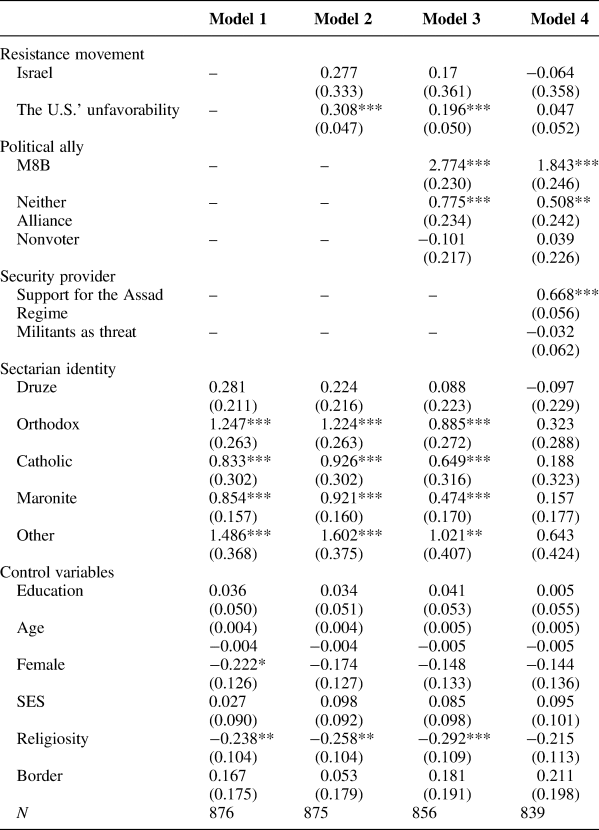
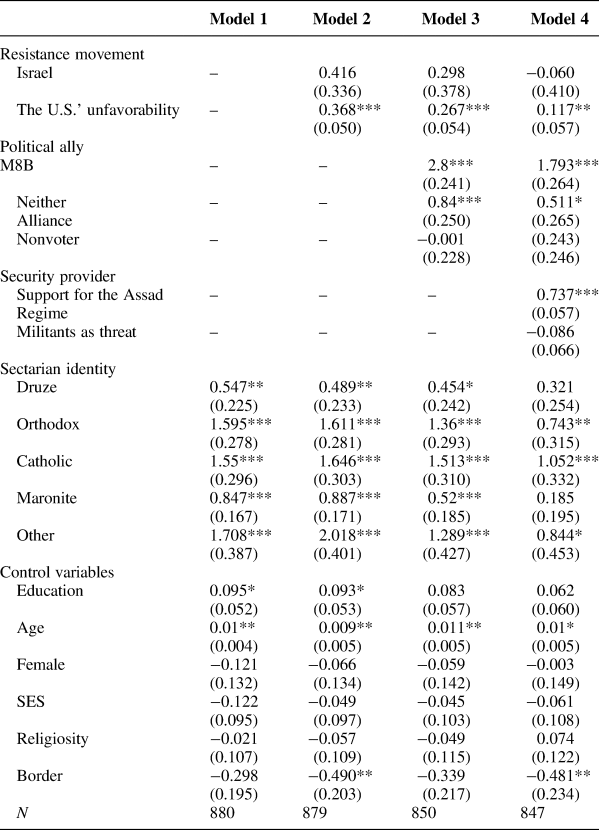
We employed an ordered logit estimation, due to our two categorical dependent variables. We also used the probit model as a robustness test, which yields to almost the same result. Tables 3 and 4 display the findings of the models that test the determinants of viewing Hezbollah as a legitimate political actor and its activities positively. We present the models by starting with the base models for both dependent variables to show how each variable associated with one hypothesis affect one another. Model 1 (for both dependent variables in Tables 3 and 4) presents basic demographic variables, sectarian identities, and the variable measuring those residing in the border district (qaḍāʾ). Model 2 adds the variables associated with the first hypothesis, those who view Israel and the United States negatively; model 3 adds variables for the political alliance in the elections. Model 4 adds the variables associated with our third hypothesis, supporting the political status quo in Syria, thus presents the full model, upon which we base our discussion.
Attitudes toward Hezbollah as a legitimate political organization

Standard errors in parentheses; ***p < 0.01, **p < 0.05, **p < 0.1.
Reference categories are Sunni (for sectarian identity); M14B (for Political ally variables).
Finding Hezbollah's activities in the region as non-threatening

Standard errors in parentheses; ***p < 0.01, **p < 0.05, **p < 0.1.
Reference categories are Sunni (for sectarian identity); M14B (for Political ally variables).
From the base model to model 3 in Table 3, the findings are consistent: members of all sectarian groups but Druze (compared to Sunnis, our reference category), individuals who hold unfavorable attitudes toward the United States, and the supporters of M8B as well as neither block supporters (compared to the reference category, supporters of M14B) do view Hezbollah a legitimate political organization. Those who view Israel as the main challenge for Lebanon do not differ from the rest of the people in terms of their attitudes toward Hezbollah.Footnote 17 As for residing in the border districts (qaḍāʾ), it did not have any statistically significant impact on viewing Hezbollah as a legitimate political organization. Religious people are less likely to view Hezbollah as a legitimate political organization across the first three models. Model 4 in Table 3 suggests that the inclusion of the two variables associated with Hezbollah as a security provider in our models removed the statistical significance from the U.S.’ unfavorability variable.Footnote 17 The full model also suggests that support for the status quo in Syria (the Assad regime) is associated with positive attitudes toward Hezbollah, while those who feel insecure due to domestic militant Sunnis do not differ from the rest.Footnote 19
Turning to the second dependent variable, the base model to model 3 in Table 4 shows similar findings in terms of statistical significance, but one difference. Relative to Sunnis, Druze join in with other sectarian groups that view Hezbollah's activities as non-threatening. Model 4 in Table 4 also shows that it is not feelings of insecurity due to militant Sunni groups in Lebanon, but supporting the political status quo in Syria, that is associated with viewing Hezbollah's activities positively. Negative views of the United States exert a significant impact on the positive perception of Hezbollah's activities. Those who live in border districts with Syria are likely to view Hezbollah's activities as threatening.Footnote 20
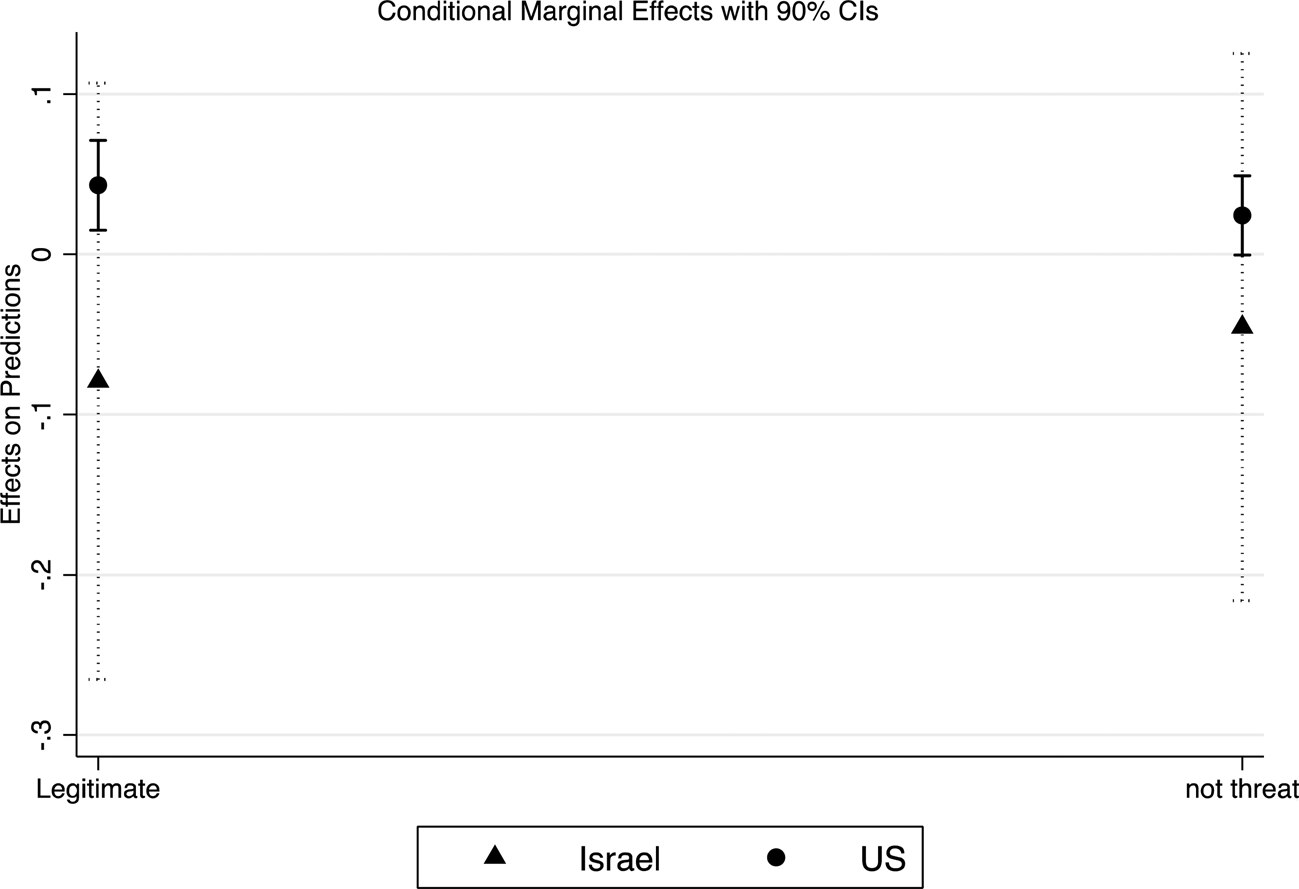
Presenting the results of ordered logit models is a challenge, especially with five outcome categories. To make the interpretations easier to understand and see the size of their impacts, we calculated the average marginal effects for each hypothesis for both dependent variables, holding all variables except for the key two variables in the models at their mean. For the sake of simplicity, we re-ran the entire models by creating dichotomous dependent variables, and calculated the marginal effects. Figures for the marginal effects are based on model 4 in Tables 3 and 4. Figure 1 shows that for both dependent variables, the marginal effects of the Israel variable is almost zero, with no statistical significance. However, as the unfavorability ratings of the United States increases, the likelihood that one views Hezbollah as a legitimate political actor and its activities as unthreatening rises.Footnote 21 The marginal effects on predicted probabilities are 0.04 and 0.02, that is to say, additional increase in the United States unfavorability ratings increased the probability of viewing Hezbollah a legitimate organization and its activities as non-threatening by 4 and 2% points, respectively.
Hezbollah as a resistance movement against Israel and the United States. Note: Solid lines are the confidence intervals for the United States.

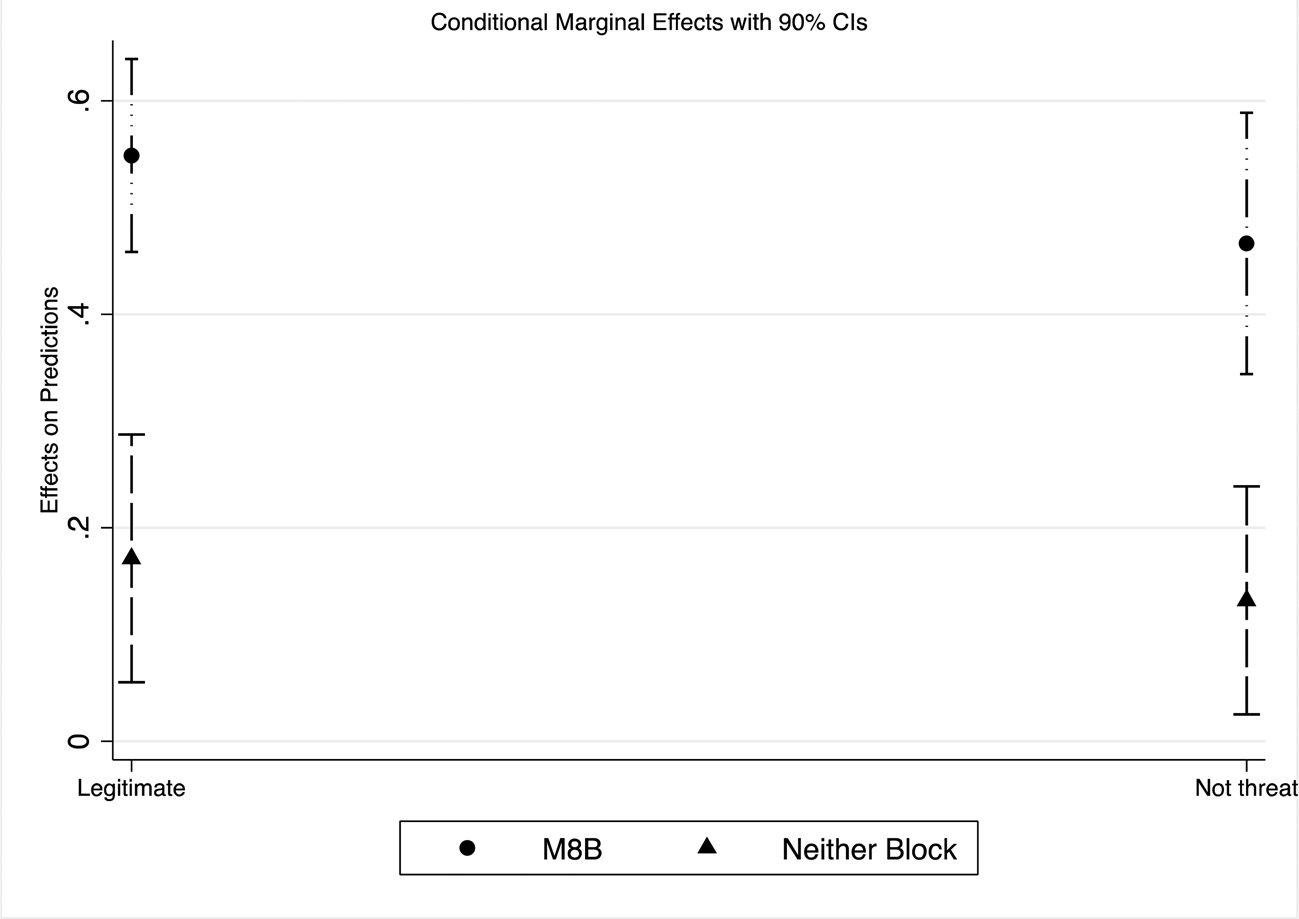
Turning to our second hypothesis, Figure 2 shows that, compared to M14B supporters, M8B supporters and those who support neither M8B nor M14B are likely to view Hezbollah as a legitimate political actor and its activities as non-threatening. The marginal effects are substantial, supporting M8B increases the predicted probability of viewing the organization as legitimate and its activities non-threatening by 54 and 46%, respectively. The predicted probabilities are 14 and 12% for the supporters of the “neither” bloc. A diagnostic analysis suggests that neither bloc's supporters were mostly ex-M14B supporters in the 2009 elections, those disappointed with the parties under the M14B and its performance in government and parliament. The results suggest that support for a particular political alliance affects one's position on Hezbollah, controlling for sectarian identity. Supporting a political alliance, which exerts influence over public goods (including security) and policy choices in Lebanon, determines one's attitudes toward Hezbollah, even if it has an armed wing.
Hezbollah as a political ally.

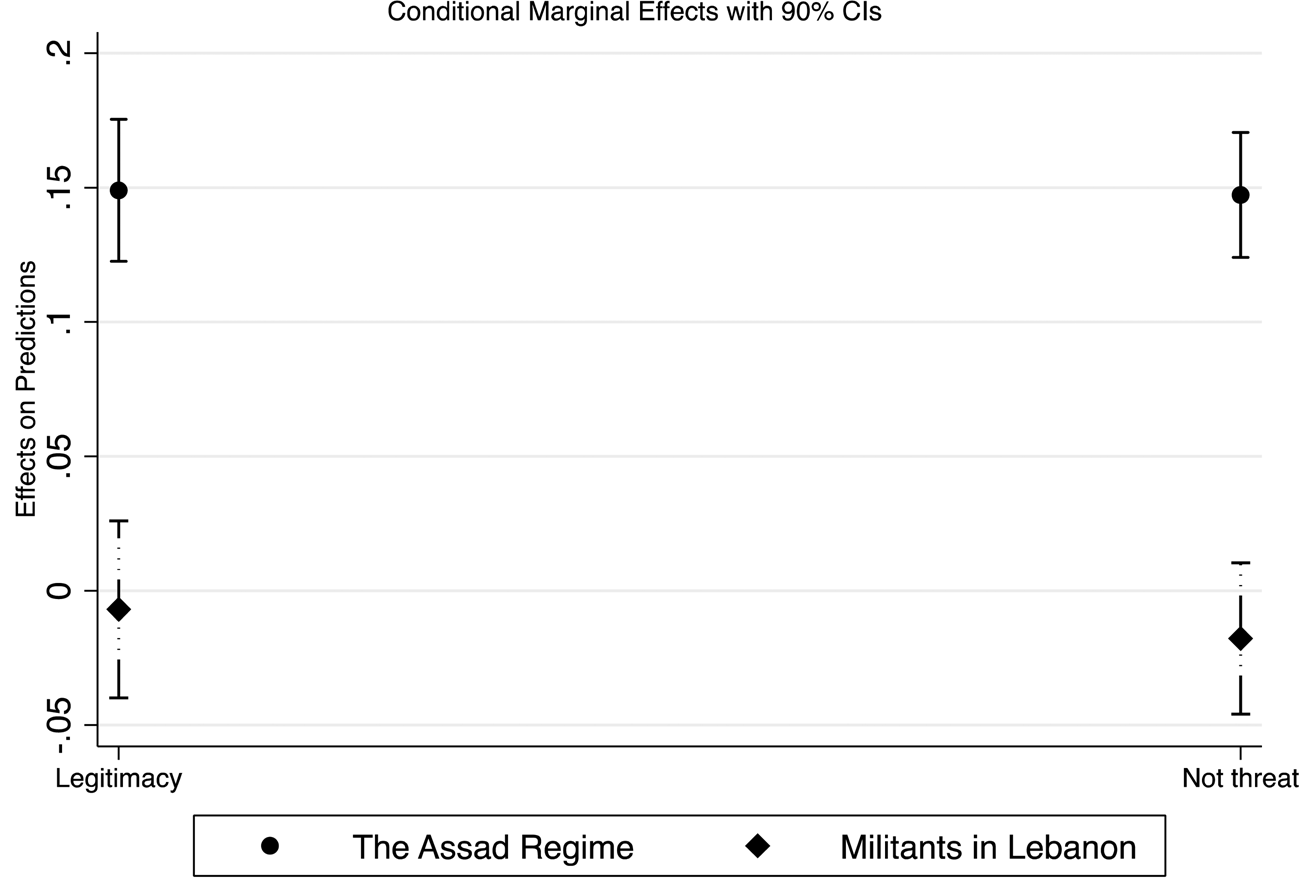
Figure 3, based on Tables 3 and 4's full model, illustrates this finding. The marginal effects for having concerned about the militant groups are statistically insignificant, −0.007 and −0.017 for the perception of Hezbollah as a legitimate political organization and its activities, respectively. On the other hand, supporting the political status quo, that is to say, favoring the Assad regime in the Syrian civil war, exerts more positive impacts on both dependent variables. Substantively speaking, an additional increase for favoring the Assad regime increases the predicted probability for both dependent variables in the same order in our presentation by 12 and 11% points.
Hezbollah as security provider.

A close look at the full models suggests, strikingly, that the direction and size of the coefficients associated with sectarian identities showed significant change when we introduce our variables associated with Hezbollah's military activities in Lebanon and Syria. Druze and Maronites in the “legitimate” models and Orthodox, Maronites, Catholics, and others in the “non-threatening” models lost their statistical significance. These findings suggest the transformative effect of our security and political status quo-related factors on attitudes of individuals with different sectarian identities in various degrees.
CONCLUSION
This research argues that identity may matter, but it is not the only determining factor in shaping one's political attitudes and behaviors in the Middle East, contrary to what scholars such as Huntington (Reference Huntington1996), Kedourie (Reference Kedourie1994), and others have long argued. It adds to the burgeoning literature that cross-sectarian political alliances are not foreign to the actors in the Middle East; Lebanese society embodies the effects of such cross-sectarian alliances and the formal and informal cooperation that shapes their opinion toward one another (Ghosn and Khoury 2011).Footnote 22 Citizens assess third countries' policies by considering their ethnic or religious brethren's physical and political well-being in a conflict zone (Tokdemir Reference Tokdemir2020). Still, as this research showed, they prioritize their survival and keep the political status quo when they assess warring actors in a conflict. In this respect, it provides further evidence to studies emphasizing the dominance of non-identity related factors such as physical and economic insecurity in shaping attitudes of minorities in the Middle East (e.g., Belge and Karakoç Reference Belge and Karakoç2015).
Overall, this research suggests that the Lebanese population evaluates the actions of political actors according to their priorities at that time; researchers should not take for granted their sectarian identities for particular attitudes. In this respect, the findings here contribute to the debate on the relationship between identity and political attitudes in the Middle East. It goes beyond the discussion on favorability or foreign policies of particular countries and shows that identity does not impede the formation of favorable opinions toward a militant organization formed by a rival sectarian organization that reduces physical and political insecurity, even if they fought against one another during the civil war. In this respect, priorities like protecting the country from a bigger conflict and balancing a long-standing, and larger, rival with new alliances play a role.
Political preferences surpass religious bonds and affect perceptions about other political groups inside the country. The support from some segments of Christian communities in Lebanon toward Hezbollah is very striking in that respect. Avoiding the instability and possible change of political equilibrium in the country affected attitudes of some members of the Christian community toward Hezbollah. Despite pressure from the United States on Aoun's Free Patriotic Movement to distance itself from Hezbollah, the economic protests in Lebanon in 2019, the COVID-19 crisis, and the big blast in Beirut in August 2020, we have not yet witnessed major changes in political alliances.Footnote 23 The protests by the educated and unemployed segments of society toward the elites created a hope for change in the political system and a decline in the role of existing political figures and movements. These protests, however, may not herald in emergence of a new political system in Lebanon. For example, Hezbollah may still command a positive perception from some members of the Christian community as a security provider and a political ally, given the lack of state capacity in the country. However, these are speculations; whether recent events have transformed Lebanese public has to be tested with a current survey data.
Supplementary material
The supplementary material for this article can be found at https://doi.org/10.1017/S1755048321000018.