Introduction
Various studies have highlighted the effects of severe to profound deafness on the acquisition and development of spoken language in children, particularly with regard to developmental milestones in language acquisition and mastering (Caselli, Maragna & Volterra, Reference Caselli, Maragna and Volterra2006; Spencer & Marschark, Reference Spencer and Marschark2006). Approximately 219,000 people worldwide received cochlear implants (CI). In the United States, roughly 28,400 children have received CI and this number is increasing (NIH, 2011). Similar estimates are not available for Italy. The overall linguistic skills of children with CI show great individual variability, which can be attributed to diverse factors, including age at diagnosis of deafness (e.g., Blamey, Barry, Bow, Sarant, Paatsch & Wales, Reference Blamey, Barry, Bow, Sarant, Paatsch and Wales2001; Rinaldi, Baruffaldi, Burdo & Caselli, Reference Rinaldi, Baruffaldi, Burdo and Caselli2013), age at CI activation (e.g., Geers, Moog, Biedenstein, Brenner & Hayes, Reference Geers, Moog, Biedenstein, Brenner and Hayes2009), family environment (e.g., Spencer, Reference Spencer2004; Szagun & Stumper, Reference Szagun and Stumper2012) and language(s) the child is acquiring (for a recent review on languages other than English, see Crowe & McLeod, published online February 8, Reference Crowe and McLeod2013). Moreover, outcomes differ for different linguistic subsystems. Children seem to do particularly well in tests of vocabulary and less well in tests of productive syntax and morphology (Caselli, Rinaldi, Varuzza, Giuliani & Burdo, Reference Caselli, Rinaldi, Varuzza, Giuliani and Burdo2012b; Duchesne, Sutton & Bergeron, Reference Duchesne, Sutton and Bergeron2009; Geers et al., Reference Geers, Moog, Biedenstein, Brenner and Hayes2009; Niparko, Tobey, Thal, Eisenberg, Wang, Quittner & Fink, Reference Niparko, Tobey, Thal, Eisenberg, Wang, Quittner and Fink2010).
Some studies have shown that deaf children with CI reach higher linguistic skills than deaf children with traditional hearing aids in receptive language outcomes (Baldassari, Schmidt, Schubert, Srinivasan, Dodson & Sismanis, Reference Baldassari, Schmidt, Schubert, Srinivasan, Dodson and Sismanis2009) and similar to that of hearing children whose chronological age corresponds to the time elapsed since CI activation (Caselli et al., Reference Caselli, Rinaldi, Varuzza, Giuliani and Burdo2012b).
Exposure to signs has been identified as a factor that influences spoken language outcome. Children can be exposed to signs in various ways, such as the use of signs to support spoken language, as in Total Communication programs, or their use as a complex linguistic system, namely, a sign language. If a deaf child is exposed to both sign language and spoken language, he/she could be considered as bimodal bilingual, which differs from unimodal bilingualism because the languages are perceived and produced through different modalities, that is, the spoken language is perceived through the ears and mainly produced through the voice, and the sign language is perceived through the eyes and mainly produced through the hands. Among unimodal and bimodal bilingual children, characteristics such as the time of onset of bilingualism, the amount of exposure to each language and the settings in which each language is acquired and used can vary greatly. The language that is strongest or dominant may depend on age, learning opportunities, subcomponents of language proficiency (e.g., comprehension, production, syntax), the specific topics being discussed, and context (e.g., school, home). Bilingual persons can also shift from one language to another depending on the specific individual with whom they are communicating, the context, and the purpose of communication (for a review on this topic, see Rinaldi, Caselli, Onofrio & Volterra, Reference Rinaldi, Caselli, Onofrio, Volterra, Tang, Knoors and Marschark2014). Moreover, contacts between the languages frequently occur, which is referred to as “code-mixing phenomena”. For unimodal bilingualism, the languages usually interact in a sequential manner (referred to as “code-switching”), whereas for bimodal bilingualism the languages often interact in a simultaneous manner (“code-blending”), which is unique to bimodal bilingualism, and the code-blends are generally semantically equivalent (Donati & Branchini, Reference Donati, Branchini, Biberauer and Roberts2013; Emmorey, Borinstein, Thompson & Gollan, Reference Emmorey, Borinstein, Thompson and Gollan2008; Emmorey, Petrich & Gollan, Reference Emmorey, Petrich and Gollan2012).
In Italy, as in many other countries, only 5–10% of deaf children are native signers, that is, they acquire sign language from deaf signing parents (Caselli et al., Reference Caselli, Maragna and Volterra2006). Compared to non-native signers, these children benefit from a more homogeneous language experience, although sign-language skills can vary greatly even within deaf signing families, as a result of the factors mentioned above. These differences are greater for non-native signing children because it is more difficult for their families to expose them to sign language beginning at birth. The growing number of deaf children who receive CI at an early age is not exposed to a bimodal bilingual educational approach. Indeed, some clinicians consider sign language as unnecessary (or even harmful) to the acquisition of spoken language (Percy-Smith, Cayé-Thomasen, Breinegaard & Jensen, Reference Percy-Smith, Cayé-Thomasen, Breinegaard and Jensen2010; for a recent debate on this topic, see Humphries, Kushalnagar, Mathur, Napoli, Padden, Rathmann & Smith, published online by BioMed Central Ltd., April 2, Reference Humphries, Kushalnagar, Mathur, Napoli, Padden, Rathmann and Smith2012; Knoors & Marschark Reference Knoors and Marschark2012). For this reason, most deaf children with CI are enrolled in speech therapy programs in which only spoken language is used; in other cases, deaf children are exposed to signs in Total Communication programs or programs in which sign language is used only as support for spoken language.
A number of studies have been carried out to explore the impact of the mode of communication on spoken language outcomes. Two studies compared two groups of deaf children of 8–9 years of age who had received CI before 5 years of age and were enrolled in Total Communication programs or auditory-oral programs (Geers, Spehar & Sedey, Reference Geers, Spehar and Sedey2002; Tobey, Rekart, Buckley & Geers, Reference Tobey, Rekart, Buckley and Geers2004). In the first study (Geers et al., Reference Geers, Spehar and Sedey2002), in which 27 deaf children were evaluated longitudinally, the children who primarily used speech showed greater auditory speech perception, speech intelligibility, and comprehension and use of English syntax than did the children who mainly relied on manual communication. In the second study (Tobey et al., Reference Tobey, Rekart, Buckley and Geers2004), which was conducted among 131 deaf children, those enrolled in Total Communication programs had lower speech intelligibility scores than children enrolled in auditory-oral programs. In a subsequent longitudinal study with the same objective (Wie, Falkenberg, Tvete & Tomblin, Reference Wie, Falkenberg, Tvete and Tomblin2007), which involved 79 deaf children with CI who used different modes of communication – i.e., Norwegian sign language (NSL) only (and written Norwegian); NSL as the first language and spoken language as the second language; spoken language as the first language and NSL as the second language; spoken language with sign support; and spoken language only – speech recognition and its rate of growth were positively associated with the level of focus on, and use of, spoken language.
Studies conducted on the linguistic skills of children with CI who grew up in a bimodal bilingual environment (spoken language and sign language) have reported different results from those mentioned above. In one study (Hassanzadeh, Reference Hassanzadeh2012), speech perception, speech production and language development after CI were compared in seven deaf children with deaf parents (exposed to Persian Sign Language since birth and to spoken Persian after CI) and seven deaf children with hearing parents (raised in a monolingual spoken Persian environment); the author found that the bimodal bilingual children performed better than the other children and concluded that the acquisition of sign language as the child's first language supports later learning of a spoken language. Similar results were reported in another study (Jiménez, Pino & Herruzo, Reference Jiménez, Pino and Herruzo2009) in which language development was studied both before and after CI in 18 deaf children between 4 and 8 years of age. The children were divided into two groups according to the educational environment (bilingual: spoken Spanish and Spanish Sign Language; and monolingual: spoken Spanish only); the monolingual children showed better skills in terms of pronunciation, oral comprehension and use of grammatical rules, whereas the bimodal bilingual children showed better skills in terms of verbal fluency in a task using picture stimuli, as they were able to evoke a greater number of words.
Davidson and colleagues have recently compared spoken language development of American native signing preschool children with CI and of hearing children with deaf signing parents (Davidson, Lillo-Martin & Chen Pichler, published online October 21, Reference Davidson, Lillo-Martin and Chen Pichler2013). All children had been exposed since birth to American Sign Language (ASL) and raised in a bimodal bilingual environment (ASL and spoken English). Hearing children had been exposed to spoken English since birth, while deaf children had been exposed to spoken English since their CI activation. Results showed comparable spoken language skills between the two groups. Furthermore, deaf children exposed since birth to ASL showed a better performance in spoken language than previously reported in studies on deaf children with CI growing up in a monolingual environment and not exposed to sign languages, with comparable age of implantation and years of CI use.
According to studies on the developmental changes that occur in each language and in the relationship between the two, most children who have been exposed to a sign language from a very young age and who then received a CI demonstrate a modality shift from the sign language to the later acquired spoken language. In a study on three preschool children who had been exposed to American Sign Language at an early age and had received a CI before the age of three, the children shifted from signed communication to oral communication (Yoshinaga-Itano, Reference Yoshinaga-Itano2006). A shift to spoken language was also reported in a study on 176 children, which found that the shift was more marked for children who had received their CI before the age of three (Watson, Archbold & Nikolopoulos, Reference Watson, Archbold and Nikolopoulos2006). The reasons for this change toward a greater use of spoken language could be attributed to increased exposure to sound or to the fact that spoken language becomes the dominant form of communication in the child's environment after CI activation, also because CI is often chosen by parents with the goal of spoken language development (Archbold, Sach, O'Neill, Lutman & Gregory,Reference Archbold, Sach, O'Neill, Lutman and Gregory2006) and because the majority of habilitation programs after CI mainly focus on the development of auditory and oral skills. In children that display a modality shift, the acquired sign language is, however, retained and used, which some authors have explained as a means of “back-up” when communication breakdown occurs, notwithstanding the child's speech proficiency (Spencer & Bass-Ringdahl, Reference Spencer and Bass-Ringdahl2004; Watson, Hardie, Archbold & Wheeler, Reference Watson, Hardie, Archbold and Wheeler2008).
Notwithstanding findings documenting the positive effect of bimodal bilingualism (sign language and spoken language) even in children with CI, the jury is still out on the positive outcomes of this coexistence, in part because the results of studies can be affected by the different means of collecting data, the different linguistic environments in which the children grow up, and the characteristics of the study participants themselves. For these reasons, further investigations on language acquisition processes in bimodal bilingual deaf children with CI are needed to understand better this particular kind of bilingualism and the impact of the exposure to sign language on linguistic development.
In the present study, we evaluated the early phases of language development in a deaf child with hearing parents who had been exposed from an early age to both Italian sign language (LIS) and spoken Italian and who had received CI at 2 years 5 months (2;5) of age. The specific objectives were to study the following: (i) lexical development in relation to both language comprehension and production, for both LIS and spoken Italian; (ii) the rate of vocabulary growth in spoken Italian, in comparison to hearing peers; and (iii) the relationship between the two languages (in terms of shift from one language to another and code-mixing strategy), taking into account the time elapsed since CI activation.
Methods
Participant
Our participant, whom we shall call Giulio, was diagnosed with severe bilateral sensory neural deafness when he was one year old; at one year and eight months (1;8 years) of age he received digital hearing aids and began speech therapy with a bimodal approach. This approach is different from bimodal bilingual education. Indeed, bimodal speech therapy relies on simultaneous communication, which consists of the spoken language and the simultaneous use of lexical signs from sign language (in our case, LIS), yet following the grammatical structure of the spoken language (in our case, spoken Italian).
At 2;5 years of age he received a CI, which was activated after one month. Giulio has always lived in a bilingual environment. In fact, at the time of diagnosis his parents decided to bring him to a bilingual daycare center where LIS and spoken Italian were used. He was exposed to LIS by one deaf teacher and his deaf classmates and to spoken Italian by his hearing teachers and hearing classmates. Giulio has one older brother and one older sister, both hearing children; his brother was sent to the same bilingual school and his mother and sister started studying LIS. Even after having received CI and well beyond kindergarten, Giulio continued to attend bimodal speech therapy and to live in a bilingual environment. His parents believed that it would be very helpful for him to attend a bilingual school, as this would allow their child to be in contact with deaf culture and sign language. However, after Giulio's CI was activated, his family mainly used spoken language; and in the family environment LIS was used only in a limited number of contexts (e.g., when Giulio was not wearing the CI or when he needed to understand concepts that his parents defined as “complex”).
Materials
We evaluated various aspects of Giulio's linguistic skills using the age-appropriate tools described below.
Leiter International Performance Scale-R
We administered the brief version of the Leiter International Performance Scale-R (four of the ten subtests: Figure Ground, Form Completion, Sequential Order and Repeated Patterns), which is a nonverbal cognitive test yielding a Brief IQ (Roid & Miller, Reference Roid and Miller1997). This test is particularly appropriate for deaf children, in that it consists of nonverbal tasks with nonverbal instructions.
Il Primo Vocabolario del Bambino Sordo, PVB-s (The First Vocabulary of the Deaf Child)
The PVB-s is a parental report questionnaire for the evaluation of communication and language development in deaf children (Caselli & Rinaldi, Reference Caselli and Rinaldi2005; Rinaldi & Caselli, Reference Rinaldi and Caselli2009). It is used to evaluate spoken language and sign language or “home signs” and is an adaptation of the Italian version of the MacArthur-Bates Communicative Development Inventories (MB-CDI – Caselli, Pasqualetti & Stefanini, Reference Caselli, Pasqualetti and Stefanini2007; Fenson, Marchman, Thal, Dale, Reznick & Bates, Reference Fenson, Marchman, Thal, Dale, Reznick and Bates2007). In this study, we used the vocabulary checklist of the Words and Sentences Short Form. The checklist consists of 100 items, and parents are asked to tick their child's comprehension and production of each lexical item, whether spoken and/or using a gesture or LIS. Parents are instructed not to record meanings expressed by a pointing gesture, unless explicitly requested, such as for body parts (e.g., eyes) or pronouns (e.g., me). The lexical items are the same as those used in the short form for hearing children.
Various studies have found that MB-CDIs are effective in characterizing children's early language skills (Caselli, Rinaldi, Stefanini & Volterra, Reference Caselli, Rinaldi, Stefanini and Volterra2012a; Dale, Bates, Reznick & Morisset, Reference Dale, Bates, Reznick and Morisset1989; Fenson et al., Reference Fenson, Marchman, Thal, Dale, Reznick and Bates2007; Thal, O'Hanlon, Clemmons & Fralin, Reference Thal, O'Hanlon, Clemmons and Fralin1999;). It has been used in populations with typical development (e.g., Dale, Dionne, Eley & Plomin, Reference Dale, Dionne, Eley and Plomin2000; Farrar & Maag, Reference Farrar and Maag2002; Feldman, Dollaghan, Campbell, Colborn, Janosky, Kurs-Lasky, Rockette, Dale & Paradise, Reference Feldman, Dollaghan, Campbell, Colborn, Janosky, Kurs-Lasky, Rockette, Dale and Paradise2003), as well as in those with atypical development, including deaf children (Mayne, Yoshinaga-Itano & Sedey, Reference Mayne, Yoshinaga-Itano and Sedey2000; Mayne, Yoshinaga-Itano, Sedey & Carey, Reference Mayne, Yoshinaga-Itano and Sedey2000; Rinaldi & Caselli Reference Rinaldi and Caselli2009; Rinaldi et al., Reference Rinaldi, Baruffaldi, Burdo and Caselli2013; Stallings, Gao & Svirsky, Reference Stallings, Gao and Svirsky2002; Thal, DesJardin & Eisenberg, Reference Thal, DesJardin and Eisenberg2007; Yoshinaga-Itano, Snyder & Day, Reference Yoshinaga-Itano, Snyder and Day1998). For the Words and Sentences Italian version, norms are available for hearing children between the ages of 18 and 36 months (Caselli et al., Reference Caselli, Pasqualetti and Stefanini2007).
Picture Naming Game
The Picture Naming Game (PiNG) (Bello, Giannantoni, Pettenati, Stefanini & Caselli, Reference Bello, Giannantoni, Pettenati, Stefanini and Caselli2012) is a test for the assessment of lexical comprehension and production in preschool children. PiNG consists of four subtests: Noun Comprehension (NC), Noun Production (NP), Predicate Comprehension (PC) and Predicate Production (PP), each of which consists of 20 lexical targets and two training items. Only the NP subtest was administered. Norms are available for hearing children between 19 and 37 months of age (Bello et al., Reference Bello, Giannantoni, Pettenati, Stefanini and Caselli2012).
Peabody Picture Vocabulary Test – Revised
The Peabody Picture Vocabulary Test – Revised (PPVT-R) (Stella, Pizzoli & Tressoldi, Reference Stella, Pizzoli and Tressoldi2000) is a test for the evaluation of comprehension based on standard Italian. The items are presented in a multiple-choice format. The examiner provides a vocabulary word and the child points to the black and white picture that corresponds to it. Depending on the child's age, there are different starting points. The test ends when the child makes six errors within eight consecutive items. Norms are available for hearing children between 3;9 and 11;6 years of age.
Boston Naming Test
The Boston Naming Test (BNT) (Kaplan, Goodglass & Weintraub, Reference Kaplan, Goodglass and Weintraub1983; Riva, Nichelli & Devoti, Reference Riva, Nichelli and Devoti2000) is a picture naming test frequently used to evaluate the expressive skills of school-aged children and of adults with aphasia. Each of the 60 items is a black and white drawing; the child is asked to name them. Norms are available for hearing children between six and ten years of age and for adults. The score expected for six-year-old hearing children in spoken Italian is 26 (standard deviation = 8). This test has been used to evaluate the lexical skills of older Italian deaf signing children (Tomasuolo, Fellini, Di Renzo & Volterra, Reference Tomasuolo, Fellini, Renzo and Volterra2010). Although normative data on Italian preschool children are not available, we decided to use this test because there are no other standardized tests for evaluating lexical skills in this age group. The scores obtained are discussed in terms of developmental changes across the different observations.
Procedures
Giulio was followed from 2;6 years of age to 5;1 years of age (i.e., from immediately before CI activation to two and a half years after activation). Study sessions took place every 5–8 months and were aimed at evaluating lexical comprehension and production in both LIS and spoken Italian.
The evaluations were classified as either “evaluation in LIS” or “evaluation in spoken Italian”, depending on the hearing status of the examiner (deaf or hearing) and the language that the examiner used when administering the tests (LIS or spoken Italian). In other words, when the tests were administered to the child in sign language by a deaf signer (with good skills in spoken Italian), the observation was considered to be “in LIS”; when the tests were administered to the child in spoken Italian by a hearing examiner (with good skills in LIS), it was considered to be “in spoken Italian”. This differentiation was possible only for the lexical comprehension tests and not for lexical production, because during all of the observations Giulio was free to use the language he preferred or to switch from one language to the other; all of his lexical productions were accepted, regardless of the language used and the examiner's hearing status, and he was not asked to produce them in the “other” language. All observations were videotaped and later transcribed and analyzed.
For the evaluation of lexical comprehension with PiNG, adult deaf native signers were asked for their advice as to whether or not the sign was acceptable, given that there can be more than one correct sign for a single item and that the test had never been administered to deaf children; for each item, the sign corresponding to the target and the correct formal execution were identified. For the evaluation of lexical comprehension with PPVT-R, the adaptation in LIS was available because this test has already been used in previous studies with deaf children and adolescents (Pizzuto, Ardito, Caselli & Volterra, Reference Pizzuto, Ardito, Caselli, Volterra, Marshark, Clark and Karchmer2001; Tomasuolo, Valeri, Di Renzo, Pasqualetti & Volterra, Reference Tomasuolo, Valeri, Renzo, Pasqualetti and Volterra2013).
Regarding the assessment of lexical production in LIS (PiNG and BNT), no adaptation was necessary. The signs produced by the child were analyzed with an adult deaf native signer who evaluated the accuracy of the productions with respect to the targets.
Normative data on deaf children or on bilingual children are not available for any of the tools used. Therefore, we will refer to normative data on hearing monolingual Italian children.
In accordance with recent studies on lexical production in bilingual children, we considered the Total Conceptual Vocabulary (TCV) (Bedore, Peña, García & Cortez, Reference Bedore, Peña, García and Cortez2005; Pearson, Fernandez & Oller, Reference Pearson, Fernandez and Oller1993). TCV focuses on the number of “concepts” the child produces, regardless of the language used, counting only once the lexical items produced with a word and with a sign. This procedure has been widely used to assess vocabulary in unimodal bilingual children (Bedore et al., Reference Bedore, Peña, García and Cortez2005; Marchman, Fernald & Hurtado, Reference Marchman, Fernald and Hurtado2010; Onofrio, Rinaldi & Pettenati, Reference Onofrio, Rinaldi and Pettenati2012; Patterson, Reference Patterson2004; Pettenati, Vacchini, Stefanini & Caselli, Reference Pettenati, Vacchini, Stefanini and Caselli2011), as well as in bimodal bilingual deaf children (Rinaldi, Reference Rinaldi2008). In our study, as was done for the indirect observations through PVB-s, we counted the total number of lexical items produced by the child in spoken Italian only, in LIS only, and in both (e.g., the parent ticks the child's production for the word “dog” and for the LIS sign for “dog”); the latter counted only once.
As for direct observations through PiNG and BNT, we counted the total number of lexical items produced by the child in spoken Italian only, in LIS only, and in both (e.g., if the child, while viewing the picture of a dog, correctly answered by stating “dog” and also produced the LIS sign for “dog”); the latter counted only once.
For lexical comprehension evaluated using PVB-s, it was not possible to determine whether the child understood a sign or whether he understood a word in spoken Italian, given that the questionnaire does not distinguish between the two. Thus the parent was asked to tick the box for lexical comprehension if the child demonstrated that he understood the given concept, regardless of the mode of presentation (i.e., word, sign, word and sign).
Results
Cognitive development
During the longitudinal study, cognitive development was evaluated only once, when Giulio was three years old. Since his IQ was within normal limits (IQ = 104), no further cognitive evaluation was performed.
Lexical skills between ages of 2;6 and 3;5
PVB-s
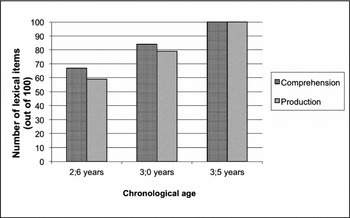
The number of lexical items from the vocabulary checklist of the MB-CDI that Giulio understood and produced over time is reported in Figure 1. In assessing production, we considered the TCV.
Number of lexical items understood and produced, evaluated using PVB-s at the ages of 2;6, 3;0 and 3;5.

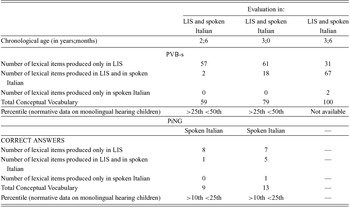
For both comprehension and production, a growth in the lexical repertoire was evident. In lexical comprehension (for which we were not able to distinguish between spoken Italian and sign language, and normative data for this age are not available), Giulio's repertoire increased by 17 labels between the first and second evaluations and by another 16 labels between the second and third evaluations. In lexical production, at the first evaluation, when Giulio was 2;6 years old and had been attending speech therapy sessions for 10 months, he produced 59 labels, regardless of the language used. When comparing his TCV with normative data from monolingual hearing peers, Giulio's performance was between the 25th and 50th percentiles. At the second evaluation, he produced 79 labels, and his TCV remained between the 25th and 50th percentiles, based on normative data on monolingual hearing three-year-olds. At the third evaluation, when Giulio was 3;5 years old, the questionnaire was at its ceiling in both lexical comprehension and production (100 labels understood and produced). Data are shown in Table 1. Normative data are not available for this age.
Child's score and percentiles in the evaluation at 2;6, 3;0 and 3;6 with PinG and PVB-s.

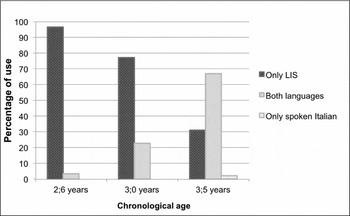
Subsequent analyses were performed to check the rate of lexical development in spoken Italian and to study the relationship between spoken Italian and LIS. The number of words produced (in spoken Italian) increased from 2 at the pre-implant evaluation to 18 at the evaluation performed five months after CI activation. These findings are very similar to those observed in a cross-sectional sample of hearing peers using the same vocabulary checklist (Caselli et al., Reference Caselli, Pasqualetti and Stefanini2007). In fact, the 50th percentile of word production at 30 and 36 months corresponded to 75 and 92 words, respectively, meaning that monolingual hearing children expand their vocabulary by 17 words in the six months between 30 and 36 months of age. It can be argued that Giulio, who expanded his vocabulary by 16 words between 30 and 36 months, had the same vocabulary growth of his hearing peers. Ten months after CI activation, the increase in the number of words produced was remarkable: Giulio had expanded his vocabulary by 51 words (he produced 69 words) and partially bridged the gap with his hearing peers. The percentage of lexical elements produced with a word only, with a sign only and with both, over time, is reported in Figure 2.
Percentage of lexical items produced only with signs, only with spoken words and with signs and spoken words, evaluated using PVB-s at the ages of 2;6, 3;0 and 3;5.

In the first two evaluations Giulio mainly used LIS, and all of the words produced in spoken Italian were accompanied by the corresponding sign. In the third evaluation, a high percentage of production in LIS still remained, but an increase in the percentage of spoken words produced with the corresponding sign was observed, so that a shift in the mode of communication was already evident, from signed modality to bimodal bilingual productions.
PiNG
The results of PiNG, which was administered twice (at 2;6 and 3 years), in spoken Italian, are shown in Table 1. On both occasions, Giulio's performance was between the 10th and 25th percentiles and thus within normal limits.
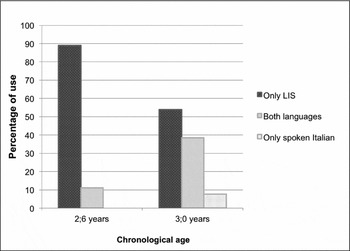
Regarding the mode of communication used, the percentage of items named with a word only, with a sign only, and with both are shown in Figure 3.
Percentage of lexical items produced only with signs, only with spoken words and with signs and spoken words, as evaluated through Ping at the ages of 2;6, and 3;0.

At 2;6 years of age, about 90% of the correct answers were expressed only in LIS; no correct answer was expressed only in spoken Italian; and only one item was expressed in both. At 3 years of age, the percentage of correct answers produced with bimodal production (spoken Italian and sign) had grown to 46%, and one answer was provided in spoken Italian alone.
As already shown by indirect observations in the same period, there was a gradual shift in the mode of communication. In fact, Giulio mainly used sign language, though the number of words produced together with the corresponding sign gradually increased.
Lexical comprehension and production between ages of 3;11 and 5;1
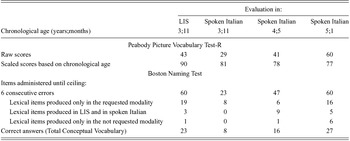
Six months after the last observation with the PVB-s, lexical comprehension and production were evaluated three times in spoken Italian, at 6–8-month intervals (at 3;11, 4;5 and 5;1 years of age), and once in LIS, when the child was 3;11 years old. The results of the PPVT-R and BNT are reported below.
PPVT-R
The scores obtained in lexical comprehension are reported in Table 2. Regarding the administration in LIS, when the child was 3;11 years old, we calculated the scaled score by comparing the raw score obtained with the normative data available on hearing children (performing the test in spoken Italian). The scaled scores provided in the test's manual have a mean value of 100 and a standard deviation of 15 (Stella et al., Reference Stella, Pizzoli and Tressoldi2000). The scaled score obtained by Giulio in LIS was 90, which is within normal limits. The scaled scores obtained in the three administrations in spoken Italian were stable, lower than that in the administration in LIS, and between the first and the second standard deviation below the mean, thus slightly below normal.
Results at the PPVT-R (lexical comprehension) and BNT (lexical production) between ages of 3;11 and 5;1.

BNT
The results from the BNT are shown in Table 2. In the evaluation in LIS, when the child was 3;11 years old, the criteria for interruption were not reached; thus all 60 items were administered. The raw score was 23. With regard to the three evaluations in spoken Italian, an improvement in Giulio's performance over time was evident at three different levels: i) the number of correct responses, regardless of the language used, increased from 8 to 16 to 27; ii) the number of correct responses in spoken Italian (whether accompanied or not by the corresponding sign) increased from 8 to 15 to 21; iii) the number of items administered before reaching the ceiling increased from 23 to 47 to 60. Both in the evaluation in LIS, when Giulio was 3;11 years old, and in the last evaluation in spoken Italian, when he was 5;1 years old, the scores were very close to the Italian norms for 6-year-old hearing children who had performed the test in spoken Italian.
With regard to the language used in the first two administrations, one in LIS and the other in spoken Italian, Giulio primarily responded in the language in which the test was administered, whereas in the two later administrations (both in spoken Italian), he mainly used bimodal production. When he was 4;5 years old, more than half of the correct answers were provided in both languages, and when he was 5;1 years old, about 18% of the correct answers were bimodal productions and about 22% were only in sign language.
Discussion
We evaluated lexical development in comprehension and production in a deaf child with CI, born from hearing parents and exposed from an early age to both spoken Italian and LIS. We also studied the rate of vocabulary growth in spoken Italian and the relationship between spoken Italian and LIS, taking into account the time elapsed since CI activation.
With regard to spoken Italian, the growth rate in lexical comprehension and production was very similar to that observed in the child's hearing peers. This was evident both in the early evaluations (from 2;6 to 3 years of age, immediately after CI activation) and at later ages (from 3;11 to 5;1 years of age, which corresponded to 1;4–2;6 years after CI activation), as shown by the finding that the child obtained very similar scaled scores at different ages. Lexical comprehension was slightly below the normal range. In lexical production, when considering TCV, Giulio's skills were at the same level as those of his monolingual hearing peers. In accordance with studies on unimodal bilingualism, our data demonstrate that fully evaluating both languages could help better to estimate the linguistic skills of bilingual children (Onofrio et al., Reference Onofrio, Rinaldi and Pettenati2012; Pearson et al., Reference Pearson, Fernandez and Oller1993; Pettenati et al., Reference Pettenati, Vacchini, Stefanini and Caselli2011). However, the extraordinary heterogeneity of experiences and proficiency of bilingual children present some formidable challenges for researchers who wish to develop procedures and standardized norm-referenced measures appropriate for any particular group of dual-language learners, especially when the bilingualism includes a sign language. In fact, methodologies and tools that could allow for a more reliable evaluation of the acquisition of sign languages, as well as the relationship between spoken language and sign language, have been developed only recently and not for all sign languages (Haug, Reference Haug2012; Rinaldi et al., Reference Rinaldi, Caselli, Onofrio, Volterra, Tang, Knoors and Marschark2014). In studying language development in bilingual children, the assessment of skills in each of the languages must in fact be integrated with the observation of the relationship between the two languages, in order to analyze the changes that occur over time.
Studies on unimodal bilingualism have shown that language shift from a minority language to the majority language often occurs in bilingual individuals. The amount of contact with native speakers (in particular peers) of the majority language and the motivation to use the majority language are the most important factors related to the language shift (May, Reference May2005; Michel, Tizmann & Silbereisen, Reference Michel, Tizmann and Silbereisen2012). Changes in mode of communication from sign (minority) language toward spoken (majority) language were observed also in deaf children after CI activation, and thus after systematic exposure to spoken language (Watson et al., Reference Watson, Archbold and Nikolopoulos2006; Watson et al., Reference Watson, Hardie, Archbold and Wheeler2008). In our study, before CI activation, sign language was clearly dominant: Giulio used this language almost exclusively and produced only two words in spoken Italian, both of which were accompanied by the corresponding sign. Later, 5–10 months after CI activation, sign language was still dominant, yet the child began to increase his lexical repertoire in spoken Italian, although the words were always accompanied by the corresponding sign. Finally, approximately one and a half years after CI activation, Giulio began to differentiate more effectively between the two languages and their contexts of use: words were produced also without the corresponding signs, yet he still used many bimodal productions, particularly in the second and third evaluations in spoken Italian. What appears to have been a reverse trend when the child was shifting toward spoken Italian (i.e., an increase in the use of a sign alone) probably could be explained by the fact that in the second and third evaluations in spoken Italian a higher number of items were administered and the difficulty of the test increased; for this reason, the child may have been relying on sign language both to “help” himself find the word corresponding to the item and to name items for which the corresponding words were not yet known. We can thus conclude that early exposure to sign language in a bilingual environment allowed the child to express ideas and concepts that he was not yet able to speak, opening a window onto new potential learning in spoken language (Lillo-Martin, Quadros, Koulidobrova & Chen Pichler, Reference Lillo-Martin, Quadros, Koulidobrova, Chen Pichler, Costa, Castro, Lobo and Pratas2010).
Some studies have shown that deaf children with CI exposed to spoken language only had better performance in certain linguistic outcomes compared to children with CI exposed to signs, in particular when signs support the spoken language, as in Total Communication programs. However, for Giulio, the signs are part of an actual language (i.e., sign language), which the child acquired as his first language and on which the acquisition of his second language (i.e., spoken Italian) was based.
In conclusion, although our results were obtained from a single child, they suggest that the use of signs (through early exposure to sign language) can promote the construction of conceptual representations and support the acquisition of the spoken language. Encouraging deaf children to communicate in sign language from a very early age, before CI, appears to improve their ability to learn spoken language after cochlear implantation (Hassanzadeh, Reference Hassanzadeh2012). Thanks to exposure to sign language, Giulio has had the opportunity to understand what is going on around him, asking questions and getting answers in a language he can understand and produce. We can also speculate that, especially in the early stages of Giulio's development, this stimulated his curiosity and fed his intelligence, allowing him to establish good and communicative relations with others (e.g., family members, deaf educators, and speech therapists). Since cochlear implantation (and also thanks to speech therapy), Giulio has had the opportunity to learn spoken Italian in what could be argued to be a much more “natural” way than other deaf children with limited access to linguistic elements.
Our results support the findings of other studies (Boudreault & Mayberry, Reference Boudreault and Mayberry2006; Mayberry, Reference Mayberry2007) which have found that the acquisition of first and second languages is interdependent. The proper acquisition of the first language, regardless of the specific modality through which it is expressed and perceived, is a critical factor in child development, including further language development. It is thus essential to provide all deaf children, once diagnosed, with the opportunity to acquire sign language (even if the family plans for cochlear implantation) and spoken language, both of which are necessary for the child's development and enable the child to interact easily with hearing people and other deaf people.