Introduction
Data collected at mass-gathering events (MGEs) and then documented in the literature create a picture of what is currently considered important for MGE research and evaluation. Mass-gatherings events such as marathons and music festivals are characterized by the concentration of people at a specific location for a specific purpose over a set period of time. These events have the potential to strain health planning and response resources of the country or community involved.1 Mass-gatherings events occur frequently, and having an understanding of the complexities of MGEs is important to inform health services planning and to understand how service delivery can be improved or enhanced.Reference Ranse and Hutton2
In 2004, ArbonReference Arbon3 proposed a model for data collection related to health outcomes for MGEs. In this paper, the authors identify that there may be further considerations that impact the health of audience members and participants at MGEs, and that these elements also need to be considered when collecting data that determine patient presentations to health services. The aim of this paper is to propose additional domains for integration within the Arbon model for the development of healthy outcomes for those who attend and/or participate in MGEs.
Background
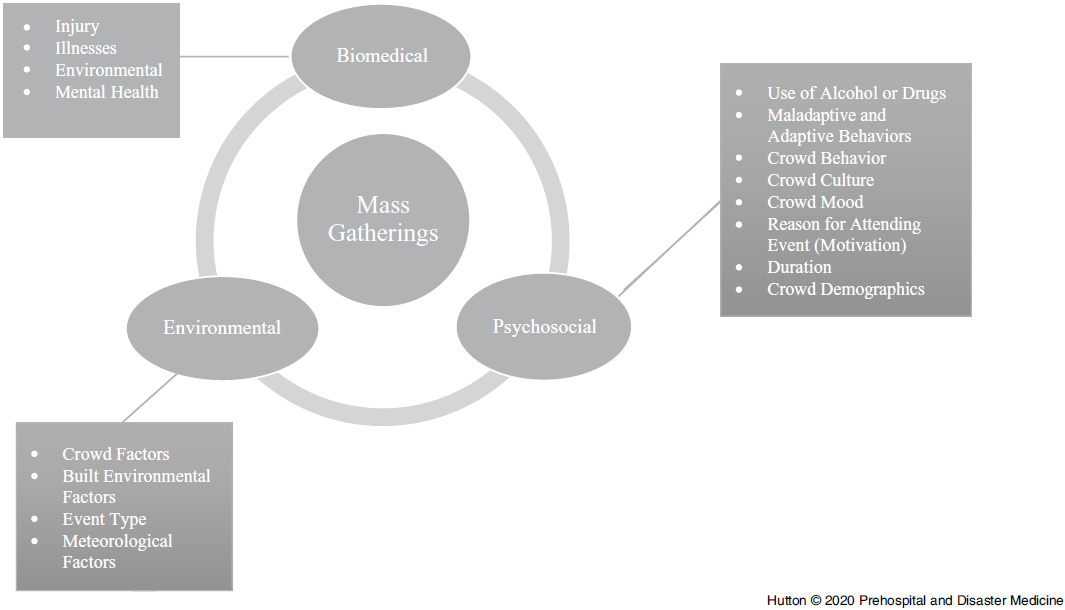
The three domains of biomedical, environmental, and psychosocial are inter-related to provide an understanding of health usage and outcomes related to MGEs. The biomedical data set proposed by Ranse and Hutton in 20122 included patient demographics, presentation types (including injury, illness, and mental health), location, and environmental considerations. A subsequent paper by Ranse, et alReference Ranse, Hutton and Turris4 added further biomedical elements to this data set with the overarching categories remaining the same. In 2004, Arbon conceptualized the environmental domain as including the built space, meteorological aspects, and the presence of alcohol and drugs at the MGE.Reference Arbon3 Subsequently in 2019, Hutton, et alReference Hutton, Ranse and Gray5 conducted a review of the literature and found that built environment, meteorological factors, and the type of event have since been included in this domain in the reported literature. The psychosocial domain has traditionally included crowd type, crowd mood, and crowd behavior. However, a recent review of the literature identified maladaptive and adaptive behaviors relating to alcohol and other drugs were included.Reference Hutton, Ranse and Gray6 In addition, data collection items such as crowd behavior, mood, and type widened to include crowd culture, reason for attending event (motivation),Reference Hutton, Ranse and Munn7 duration of event, and crowd demographics.Reference Hutton, Ranse and Gray6
In summary, these reviews have identified that the biomedical factors remain stable, whereas the environmental and psychosocial elements have expanded (Figure 1).
Expanded Environmental and Psychosocial Domains.

Discussion
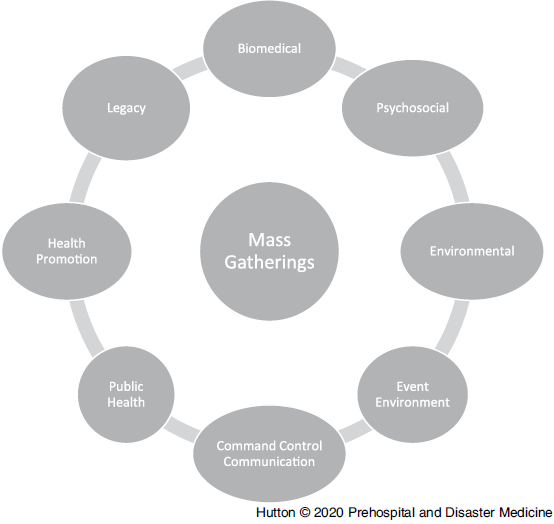
It is important for mass-gathering health research that hazards and risks are contained and proactively managed.Reference Roberston, Hutton and Brown8 Currently, the majority of research relates to the biomedical outcomes at MGEs. This is not surprising given that mass-gathering medicine is still new and has grown from an initial proximity model (biomedical, environmental, and psychosocial).Reference Arbon3 Even though the three domains of this model have remained steadfast, as indicated above in the four previous reviews,Reference Ranse and Hutton2,Reference Ranse, Hutton and Turris4–Reference Hutton, Ranse and Gray6 there have been many additions to these three categories; but there are many other elements of MGEs that can impact on the biomedical presentations at MGEs. Using Public Health for Mass Gatherings: Key Considerations 9 as a guide, other elements must also be captured, including the event environment; command, control, and communication (C3); public health; health promotion; and legacy of the event (Figure 2).
Further Elements that Impact on Biomedical Presentations.

The Event Environment
Outdoor music festivals are now starting to produce their own codes of conduct to influence crowd behaviour.10–12 Guidelines such as these provide an expectation of behavior for the attendees/participants, outlining expected norms and a series of consequences for behavior outside of the stated norms. Examples such as these may indicate a shift from a purely occupational health and safety perspective on safety to the use of a social/behavioral lens.
Event planners and designers intend their events to be positive and provide meaning for those who attend.Reference Getz13 Events can be celebratory, providing the audience with a unique way of seeing, thinking, and knowing that leads to a positive experience, a shared meaning, and to a shared experience or “communitas” (that is, a shared belonging that removes the individual from the everyday).Reference Hutton, Brown and Verdonk14 Yet the space, design, and environment of the event can impact on the health of those attending or participating. Guidelines such as these provide an expectation of behavior to the participants, outlining expected norms and a series of consequences during the event. The inference being that poor behavior will not be tolerated; however, there is no framework for how this poor behavior will be managed. Examples such as this indicate a move from an occupational health and safety perspective on safety to a more behavioral lens. Even so, the physical environment can be easily controlled through legislation, safety guidelines, and event design; however, human behavior is more complexReference Hutton, Savage, Ranse, Finnell and Kub15 and further work needs to be done in this space to mitigate risk and reduce presentations to on-site medical care.
Command, Control, and Communication
Mass-gathering events do not happen in isolation, they often occur in public spaces such as stadiums, ovals, and park lands. These events can be considered soft targets for acts of deliberate harm, such as vehicles being used for terrorist-related activities.Reference Marty and Health Organization16 Therefore, MGE health needs to be seen as a whole event, and security is an important part of a safe MGE. The World Health Organization’s (Geneva, Switzerland) Key Considerations state that planning and response to public health risks are achieved through C3: command, through the efficient use of resources; control refers to organizing resources to respond to event demands in a timely manner; and communication, whereby there is a coordinated dissemination of information before, during, and after the event.Reference Marty and Health Organization16 These three tenets require cross-disciplinary cooperation to rapidly recognize and manage incidents as they occur at an MGE. The key issue for MGEs is the scalability of C3 as they relate to the event. Additionally, there is a need for each stakeholder to be aware of their key responsibilities. For example, security is an important part of crowd control, which if not managed effectively has the ability to lead to poor health outcomes at an MGE.
Public Health
Public health aspects of MGEs have been a consideration for event planning for decades.Reference Endericks and Health Organization17 Of particular importance to public health at MGEs is surveillance of communicable disease and other illnesses. Such surveillance can assist in the identification of illness sources, such as food outlets with contaminated food resulting in gastroenteritis-like symptoms, and therefore action to prevent public health emergencies from an MGE. They can also be used to identify the incidence of influenza-like illnesses and subsequent impact upon the greater community.Reference Rainey, Phelps and Shi18 This is of new importance in the context of COVID-19. Public health research and evaluation of MGEs are often reported related to specific events, such as the Commonwealth Games or Olympics,Reference Severi, Heinsbroek and Watson19,Reference Qiu, Crilly and Zimmerman20 or related to specific communicable diseases such as Dengue.Reference Lowe, Barcellos and Coelho21,Reference Qiu, Crilly and Zimmerman22 However, the integration of public health principles for research and evaluation are seldom reported in the literature alongside the biomedical, environmental, and psychosocial domains. An integration of public health research and evaluation, such as surveillance systems used, reporting governance, and governance of local public health units with in-event health services and the broader health service, is important for a comprehensive understanding of the nature of MGEs. This would also serve to inform decision making on how MGE organizers should respond to communicable disease outbreaks or public health emergencies of international concern.
Health Promotion
Public health and health promotion as overarching concepts are missing from the mass-gathering literature, with researchers focusing on medical care and response, valuing a reactive rather than proactive approach to health care at these events.Reference Hutton, Brown and Health Organization23 Hutton, Ranse, and MunnReference Hutton, Ranse and Munn7 assert that health promotion and the provision of public health information should be at the core of each MGE, which works alongside and compliments the medical response. Understanding the audience and how health messages can be communicated is an important part of health promotionReference Hutton, Ranse and Munn7,Reference Hutton, Brown and Verdonk14 and can add to the civic responsibility of an event through community engagement mechanisms.Reference Roberston, Hutton and Brown8 Currently during music festivals around the globe, health messaging is used to reach audience members, ranging from crowd control to avoid crushes to messages about looking after friends and drinking responsibly when alcohol is being served.Reference Hutton24 Health promotion not only reinforces healthy behaviors, but also promotes social cohesion and can improve health outcomes both in and out of the event.Reference Hutton, Ranse and Munn7,Reference Roberston, Hutton and Brown8,Reference Harrison and Health Organization25
Legacy
Despite limited evidence, it is generally viewed that hosting an MGE can influence improvements in health processes brought upon by shared conversations and agreed upon objectives.Reference Endericks and Health Organization17 Agreed upon objectives allow for measurable outcomes, which ultimately lead to the improvement of an MGE. Many times, improvements are made anecdotally and become part of the day-to-day quality improvement processes of an MGE. However, these improvements are the legacy of the event, and once documented in the literature, can contribute to the argument that MGEs are an important part of developing and honing knowledge in this space.Reference Endericks and Health Organization17,Reference Witt, Kotlhar and Mesquita26
An important outcome of knowledge development in this space is having a clear plan at the beginning of the next event to allow for consistency in the provision of written reports and associated intelligence. This information leads to the collection of evidence-based data that support management strategies of future events. Consistency of reports assist in the assessment of harm minimization approaches at outdoor music festivals, thus providing a more reliable picture of the effectiveness of policies on the health and safety of audience members at these events. Record keeping of this type is important in modifying and enhancing strategies that are currently in place. This type of activity also assists in maintaining good collaborative practice amongst all participating organisations.Reference Hutton24 Finally, the main role of legacy is to produce better patient outcomes at each event and decreased patient presentation rates following the event – in the local community or in the following year if the event is held again.
Conclusion
This work has shown that elements of the event environment, C3, public health, health promotion, and legacy all contribute to decision making for a comprehensive understanding of biomedical presentations at MGEs. It is recommended that these are added and considered for data collection to the established domains of biomedical, environmental, and psychosocial. Through these new understandings, each professional group working within the MGE have an opportunity to learn about each other’s roles and responsibilities at the MGE and how what they do then contributes to the safety of the participants. The proposed additional domains also contribute to opportunities for formal evaluation of the event, which in turn will inform the future knowledge and skill development for the wider event management group.
Acknowledgments
The authors wish to acknowledge the contribution of Sheila Turris, Adam Lund, and Brendan Munn in this publication.
Conflicts of interest
none