Introduction
Hydroids, the polyp stage of hydrozoans, comprise an important marine benthic group attached to hard substrata throughout the oceans. They are assumed to be carnivores, capturing prey using nematocysts on their tentacles (Gili & Hughes, Reference Gili and Hughes1995), and they play an important role in regulating the zooplankton population and transferring energy from the plankton to the benthos (Barange & Gili, Reference Barange and Gili1988).
Morphological examination of enteron contents indicates that the diets of hydroids are mainly composed of pelagic zooplankton with high species diversity. The athecate hydroids Ectopleura crocea, E. larynx and Eudendrium racemosum were reported to consume zooplankton including the larvae and adults of copepods and other crustaceans (Barange, Reference Barange1988; Barange & Gili, Reference Barange and Gili1988; Gili et al., Reference Gili, Hughes and Alvà1996a; Orejas et al., Reference Orejas, Gili, López-González and Arntz2001; Fitridge & Keough, Reference Fitridge and Keough2013). The thecate hydroids Obelia dichotoma and Campanularia everta were found to prey on small particles (30–80 μm in diameter) including zooplankton fecal pellets, phytoplankton, crustacean eggs and other organic matter (Coma et al., Reference Coma, Gili and Zabala1995; Orejas et al., Reference Orejas, Rossi, Peralba, García, Gili and Lippert2013). Marine benthic organisms have also been recorded in hydroid diets. Benthic diatoms were observed to take up more than 95.0% and 62.3% of the prey items captured by the hydroids Silicularia rosea and Ectopleura crocea, respectively (Gili et al., Reference Gili, Alvà, Pagès, Klöser and Arntz1996b, Reference Gili, Duró, García-Valero, Gasol and Rossi2008; Genzano, Reference Genzano2005). In the diet of the hydroids Eudendrium racemosum and Hydractinia echinata, benthic nematodes, polychaetes and turbellarians were common (Christensen, Reference Christensen1967; Barange, Reference Barange1988). In a hydranth (3 mm length) of the hydroid Turritopsoides marhei, a large partially digested polychaete (4 mm length) was found (Maggioni et al., Reference Maggioni, Stefania, Galli, Seveso and Montano2017).
Although representing a dominant benthic group, molluscs and their developmental stages were rarely found in hydroid coelenterons. In the diet of Eudendrium racemosum, Barange & Gili (Reference Barange and Gili1988) found that gastropod individuals of unknown species and unknown developmental stages make up 8%; while Di Camillo et al. (Reference Di Camillo, Betti, Bo, Martinelli, Puce, Vasapollo and Bacestrello2012) found that pediveligers (the last veliger stage prior to settlement) of the bivalve Mytilus galloprovincialis make up 43.5%. Fitridge & Keough (Reference Fitridge and Keough2013) also found pediveligers of the bivalve M. galloprovincialis in the diet of the hydroid Ectopleura crocea.
Almost all of the above prey items had smaller dimensions than the polyps. It is known that hydroids can prey on large mollusc larvae approaching metamorphic competence (Di Camillo et al., Reference Di Camillo, Betti, Bo, Martinelli, Puce, Vasapollo and Bacestrello2012; Fitridge & Keough, Reference Fitridge and Keough2013). However, there is no formal evidence such as a video documentation that polyps can prey on individuals even several times larger than themselves, e.g. early juvenile gastropods. In general, the feeding behaviour of hydroids has not been studied extensively (Miglietta et al., Reference Miglietta, Tommasa, Denitto, Gravili, Pagliara, Bouillon and Boero2000; Bouillon et al., Reference Bouillon, Gravili, Pagès, Gili and Boero2006). Only a few species, e.g. Stauridiosarsia producta, Eudendrium racemosum and the freshwater genus Hydra have been studied in some detail (Rushforth & Hofman, Reference Rushforth and Hofman1972; Orlov, Reference Orlov1996; Puce et al., Reference Puce, Bavestrello, Arillo, Azzini and Cerrano2002).
In the present study, an unexpected massive death of juveniles of the ivory shell Babylonia areolata (Mollusca: Gastropoda: Babyloniidae) caused by the predation of an unknown hydroid in an aquaculture farm in China caught the authors' attention. This ivory shell species is one of the most important economic maricultural gastropods in East Asia, with an annual economic benefit up to US$35 million in the Hainan province of China in the year 2013 (Lü et al., Reference Lü, Ke, Fu, You, Luo, Huang and Yu2016). An integrative approach was adopted to describe the hydroid and its interaction with the molluscan prey. This is the first report of hydrozoan polyps preying on gastropod juveniles, indicating a previously unknown threat in the aquaculture of molluscs including ivory shells. Several practical management strategies are suggested to mitigate this newly recognized threat.
Materials and methods
Sample collection and laboratory culture
A serious breeding failure of the ivory shell Babylonia areolata occurred in an aquaculture farm located in Zhangpu, Fujian, China (24.21°N 118.02°E) in July 2018. It was attributable to hydroid (Figure 1) predation on the early (first week after finishing metamorphosis) gastropod juveniles (Figure 2). Hydroid colonies were collected from the hatching pond during this large-scale breeding failure. One-week-old gastropod juveniles (Figures 2 & 3) were selected from another subsequent normal breeding batch with the same developmental stage. Both hydroids and gastropod juveniles were transferred to the Aquarium Laboratory in the Xiang'an Campus of Xiamen University. The samples were reared in seawater (salinity of 32‰) at room temperature (26–28 °C) and kept stable with central air-conditioning. Hydroid colonies (Figure 1E) were temporarily cultured in a 30 l barrel and fed with Artemia twice a week. Living ivory shell juveniles (7 days after metamorphosis; Figures 2 & 3) were selected for further feeding experiments.
Morphology of the hydrozoan Eirene sp. Newly released medusa after 2 (A) and 7 (B) days respectively; (C) Hydroid hydrocaulus and (D) hydrorhiza. (E) Two hydroid hydranths. (F) A polyp contracts during predation. (G) Hydroid intertentacular web. (H) A filiform tentacle with nematocysts. Scale bars: A, 500 μm; B, 100 μm; C, 200 μm; D, 1 mm; E, 500 μm; F, 100 μm; G, 100 μm; H, 200 μm.

The continuous predation process on the juveniles of Babylonia areolata by Eirene sp. (A–E) The first polyp (polyp 1) starts to prey on the gastropod juvenile, see details in the video (Supplementary Video S2, time duration: 00:00:00–00:00:36). Note the polyp turning its everted hypostome back so that tentacles which were covered by hypostome before can reach out to prey. (E, F) Another polyp (polyp 2) bends towards the gastropod juvenile (video 00:00:36–00:00:38). (G, H) Two polyps prey on the same gastropod juvenile. The polyps bite on the gastropod (G), and the gastropod struggles violently, drags both polyps into its shell, then stops moving (H), see in the Supplementary Video (00:00:38–00:01:09). Finally, polyp 2 (I–L) and polyp 1 (M–P) leave the shell after feeding (video 00:01:20–00:01:58). Scale bar: 2 mm.

Morphological changes of Eirene sp. hydroids. (A–D) Solitary hydranths prey on the gastropod juveniles like worms. (A, B) The hydranth bends to attack the gastropod juvenile. Another hydranth contracts (C) and stretches (D) like a worm to prey on the gastropod juvenile (Supplementary Video S2, time duration: 00:02:32–00:03:15). (E–I) A solitary hydranth expulses waste out of its gastric cavity. (E, F) The hydranth contracts with mouth opening and undigested food is eliminated through mouth. Then the hydroid contracts (G) and elongates (H), then opens its mouth again (I). Scale bar: A–D, 1 mm; E–I, 2 mm.

Feeding experiments
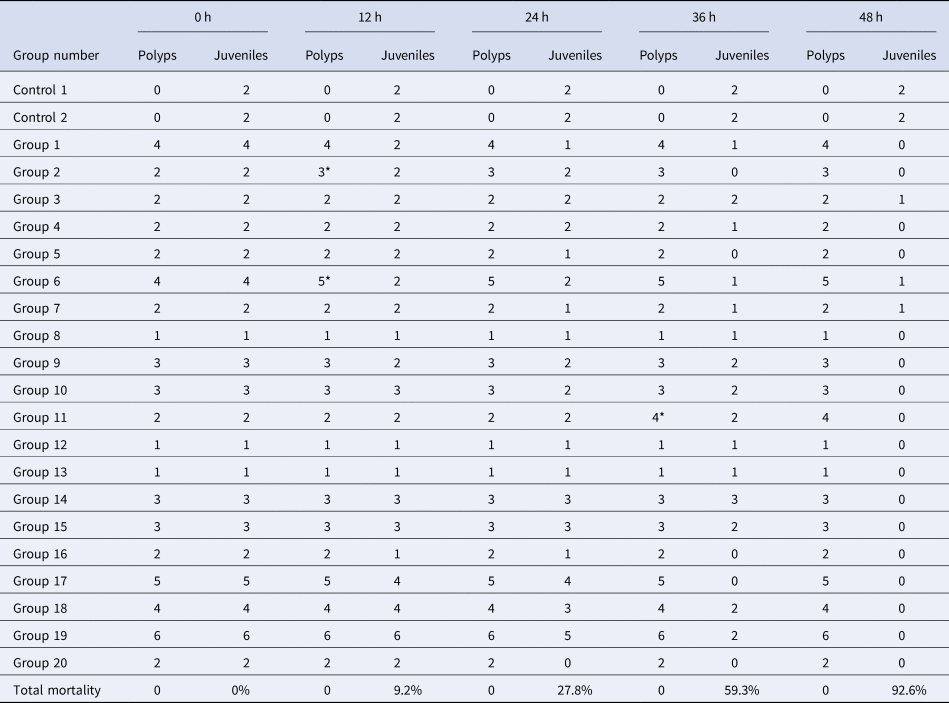
Fifty-four active hydroid polyps were randomly selected from several colonies using needles under a stereomicroscope. Partial stolon was retained for each polyp (Figure 2 & 3E–I). These polyps were then transferred to 20 plastic Petri dishes (diameter 10 cm). Each experimental group in a Petri dish contained 12 ml 0.45 μm filtered seawater (FSW). The number of polyps in each group ranged from one to six. Two control groups were also set up to exclude other potential factors that might enhance gastropod mortality. In each control group, only two gastropod juveniles were kept without adding any polyps. Before the feeding experiment, polyps were starved for 72 h. Then the same number of gastropod juveniles and polyps were kept together in each Petri dish for 48 h. The number of living individuals of the polyps and gastropods were recorded every 12 h. The mortality of gastropod juveniles was calculated by subtracting the percentage of living individuals from 100% (Table 1).
Statistics for the number of surviving individuals during predation by the polyps of the hydrozoan Eirene sp. on the gastropod juveniles of Babynolia areolata

‘*’ indicates hydroid colonies with newly regenerated polyps.
Morphological images and videos
The predation process of polyps on gastropod juveniles was recorded by two digital cameras (LeicaMC170HD and Leica DFC495) connected to an inverted microscope (Leica DM IL) and a stereomicroscope (Leica M165C), respectively. Suitable images were selected to prepare three figure plates (Figures 1–3) using Adobe Photoshop CC V19.0. Several videos showing the feeding behaviour were edited, annotated and concatenated to a single video (Supplementary Video S2, 20 M) using Adobe Premiere Pro CC V12.0. A high-resolution video (243 M) of Supplementary Video S2 is available on the Morphobank Database (http://morphobank.org/permalink/?P3629).
DNA barcoding
DNA extractions for the hydrozoan polyps were carried out according to Song et al. (Reference Song, Gravili, Wang, Deng, Wang, Fang, Lin, Wang, Zheng and Lin2016). Partial sequences of the COI, 16S rRNA, 18S rRNA and 28S rRNA genes were amplified using the primers listed by Song et al. (Reference Song, Gravili, Ruthensteiner, Lyu and Wang2018). DNA sequencing was performed by Thermo Fisher Scientific (Shanghai, China). Sequences of the polyps used in the present study were deposited in GenBank with accession numbers (COI, MN604392; 16S, MN595901; 18S, MN595899; 28S, MN595902). All sequences were uploaded to GenBank BLAST for species identification (http://blast.ncbi.nlm.nih.gov). The BLAST results are shown in Supplementary Table S1.
Results
Breeding failure
The mortality of the ivory shells in the failed breeding batch of the aquaculture farm was preliminarily evaluated. Initially, about a million hatched larvae were reared. From experience with several other paralleled rearing batches, it was estimated by the author J. Fu that 80% of the rearing larvae should become competent for settlement and metamorphosis. However, sampling examination indicated that only 160,000 gastropod juveniles survived until one week after metamorphosis. This implies that about 640,000 out of 800,000 early gastropod juveniles did not survive. The hydroid colonies were too small (1–5 mm in height) to be noticed in the aquaculture farm. However, after examination under the microscope, large quantities of empty juvenile shells were observed being tangled together with hydroid colonies on the bottom of the rearing pond. It can thus be assumed that the massive outbreak of hydroids was the main cause of breeding failure.
DNA barcoding
GenBank BLAST search results using the newly generated sequences from the polyps indicated that this hydrozoan species was most similar to the genus Eirene (Hydrozoa: Eirenidae). The taxa with the highest genetic similarity of each gene are: COI–Eirene lacteoides (GenBank accession number: FJ418661) and Tima formosa (JQ716166), genetic similarity, both 100%; 16S–E. lacteoides (FJ418650), 99.37%; 18S–Eirene kambara (KF962263), 99.28%; 28S–E. kambara (KF962353.1), 97.75% (Supplementary Table S1).
SYSTEMATICS
Class HYDROZOA Owen, 1843
Subclass HYDROIDOLINA Collins, 2000
Order LEPTOTHECATA Cornelius, 1992
Family EIRENIDAE Haeckel, 1879
Genus Eirene Eschscholtz, 1829
Eirene sp.
Diagnosis
Polyps: colonies erect, with stolons and hydrorhiza forming an irregular network; hydranth naked, cylindrical, borne on short pedicels (Figure 1E); hydrotheca definite, surrounding stolons and hydrorhiza (Figure 1C, D); tentacles filiform type, with intertentacular membrane (Figure 1F) and scattered cnidocyst (Figure 1H). Early medusa (Figure 1A, B): four perradial tentacles, with two or three statocysts between two successive tentacles; distinct and short gastric peduncle; one manubrium with simple lips; four simple radial canals; gonads absent.
Taxonomic remarks
The generic diagnoses of the family Eirenidae are partially based on mature medusa with gonads (Bouillon et al., Reference Bouillon, Gravili, Pagès, Gili and Boero2006). Unfortunately, the laboratory culture for mature medusa failed in this study. The polyp and the early medusa obtained here resemble some species of the genus Eirene. The early medusa (Figure 1A, B) resembles Eirene lactea described by Brinckmann-Voss (Reference Brinckmann-Voss1973). Its polyp is characteristic of an intertentacular web and filiform tentacles which were also observed in Eirene ceylonensis and Eirene viridula (Günzl, Reference Günzl1984; Bouillon et al., Reference Bouillon, Boero and Seghers1988).
Predation experiment
As shown in Table 1, the gastropod juveniles in both control groups remained alive throughout the experiment. Accordingly, the increased mortality rate of gastropods in experimental groups was mainly caused by polyp predation. All polyps remained alive and active for 48 h. Four newly regenerated polyps were observed in three groups after 12 h (Table 1). In contrast, mortality of gastropod juveniles increased consistently. At 36 h, more than 50% gastropod juveniles died. At the end of the feeding experiment (after 48 h), the mortality had risen to 92.6%. Noticeably, mortality of gastropod juveniles increased more rapidly after 24 h (0–12 h, increased 13.0%; 12–24 h, 14.8%; 24–36 h, 27.8%; 36–48 h, 37.0%). These results suggest that these hydroids are capable of preying on the juvenile gastropods, and the predation by hydroids is lethal. The observations in the aquaculture farm suggest that the reproduction and colonization of the hydroids may be amplified by the presence of abundant gastropod juveniles and the hydroid population can increase rapidly.
Predation process
A complete predation process on the gastropod juveniles by the polyps was recorded on video (Figures 2 & 3; Supplementary Video S2). Each successful predation lasted for half an hour to three hours and was performed by two or three polyps together. It included four stages: detecting, attacking, feeding and leaving.
(1) At first, the tentacles of the hydranth extend in all directions so that they can detect and touch at least one gastropod juvenile in the surrounding area. Immediately after detection, the polyp bends its body towards the prey (Figure 2F; Supplementary Video S2, 00:00:36–00:00:38).
(2) At the attacking stage, the polyp begins to turn its intertentacular web forward and stretches its tentacles out towards the gastropod (Figure 2A–E; Supplementary Video S2, 00:00:00–00:00:36). At this stage the shape of the polyp changes dramatically (Figure 3A, B). The polyp connects to the soft tissue of the gastropod; the gastropod subsequently struggles and tries to shake off the polyp (Figure 2G, H; Supplementary Video S2, 00:00:38–00:00:56).
(3) A successful attack ends when the gastropod stops moving (Figure 2H). Then the polyp starts to feed by performing a contracting and stretching motion activity along the extent of its body (Figure 3C, D).
(4) After feeding, the hydranth contracts and stretches repeatedly, and finally leaves the gastropod shell. In other cases, the polyp simply leaves the gastropod by bending the body away, or the gastropod sometimes revives and shakes the polyp off. In the case when the polyp has left, the gastropod starts to move again, but appears to be less active than prior to the attack. Several rounds of predation could result in the death of most gastropod juveniles during the experiment. Food egestion by polyps was also recorded (Figure 3E–I; Supplementary Video S2, 00:03:17–00:03:57). The peristaltic motion of the polyp is similar to that when it is feeding.
Discussion
DNA barcoding and taxonomic diagnosis
DNA barcoding is believed to be efficient for species delimitation in hydrozoans with limited morphological distinction features and high phenotypic plasticity (e.g. Zheng et al., Reference Zheng, He, Lin, Cao and Zhang2014; Cunha et al., Reference Cunha, Collins and Marques2017). Schuchert (Reference Schuchert2018, Reference Schuchert2019) used this method to link the polyp and medusa stage of several hydrozoans. The polyps in the present study shared the same COI haplotype with that extracted from one medusa collected in an unknown region of the Chinese coast which was identified as Eirene lacteoides in GenBank (accession number, FJ418661, direct submission). Unfortunately, no morphological data of that medusa is available from GenBank. Hence, the hydrozoan species in the present study was provisionally identified as Eirene sp. It certainly seems desirable to clarify its systematic affinities by a laboratory culture covering the whole life history.
Feeding pattern
The feeding patterns of hydroids were generally divided into three categories: passive, active and random (Miglietta et al., Reference Miglietta, Tommasa, Denitto, Gravili, Pagliara, Bouillon and Boero2000). The hydroids in the present study seem to utilize a mixture of the passive and active pattern. They passively use long tentacles to be touched by any gastropod juveniles moving around, and then actively bend the hydranths towards the gastropods to enter their shells for feeding.
Clark & Cook (Reference Clark and Cook1986) found that small prey (Artemia salina nauplii) are usually captured by one single hydranth in the hydroid Pennaria disticha. However, in the present study, the gastropod juvenile could easily escape from the attack by one polyp. The cooperative predation by several polyps in the present study shows an alternative feeding strategy, which may assist the polyps in capturing prey much larger than themselves. The polyp is much thinner than the gastropod juvenile (Figures 2 & 3), and the diameter of the body column of the polyps and the width of the gastropod juveniles is 0.2–0.4 and 1.8–2.0 mm, respectively. Cooperative predation behaviour of polyps was also recorded in the coral Astroides calycularis by Musco et al. (Reference Musco, Fernández, Caroselli, Roberts and Badalamenti2018). In that study, a video recording showed several polyps capturing one Pelagia noctiluca jellyfish which was several times larger than the polyps.
Peristaltic feeding behaviour
The investigated hydroid is colonial; it has stolons and hydrorhiza forming an irregular network on hard substrata (Figure 2). Interestingly, some polyps could detach from the colony and become solitary hydranths before or after they preyed on the gastropods (Figure 3C). The detachment of polyps may be caused by the physical struggle of the gastropod juveniles. After the polyp attaches itself to the soft tissue of the gastropod, it begins to feed by regularly elongating and contracting its body. Similar peristaltic feeding behaviour was also found during expulsion of food waste through the coelenteron and mouth. During the feeding experiment, some solitary polyps were found re-attached to the Petri dishes by their distal ends. It was assumed that the solitary hydranths can survive and grow up into new hydroid colonies by asexual regeneration. Reattachment was also observed in the solitary polyps of Eugymnanthea inquilina by Kubota (Reference Kubota1979). The reattachment of hydrocaulus fragments (1–3 mm in length) was also observed in Pennaria disticha and Ectopleura crocea, and was considered as an important survival strategy against negative physical factors or damage to hydroid colonies (Song, Reference Song2006).
Hydroids as a previously unknown threat to gastropod breeding
Hydroids are known to be harmful in shellfish aquaculture as they can smother shellfish, cause recession of shell growth, and disrupt the feeding of shellfish (Fitridge et al., 2012). Several bivalve-inhabiting hydrozoans of the family Eirenidae were reported to cause serious effects on the aquaculture of the bivalve Mytilus galloprovincialis (Kubota, Reference Kubota1992; Piraino Reference Piraino1992; Mladineo et al., Reference Mladineo, Petrić, Hrabar, Bočina and Peharda2012).
Concerning ivory shell captive breeding, the most common damage documented was infections by the bacterium Vibrio harvey and parasitism by the protozoans Zoothamnium sp. and Haplosporidium sp. (Peng et al., Reference Peng, Ge, Li, Zhou, Zhao, Xu and Xie2011; Wang et al., Reference Wang, Wang, Su, Wu, Guo, Jiang, Liu and Zhao2013). Predation on pelagic bivalve larvae by the hydroids Eudendrium racemosum and Ectopleura crocea has been reported (Di Camillo et al., Reference Di Camillo, Betti, Bo, Martinelli, Puce, Vasapollo and Bacestrello2012; Fitridge & Keough, Reference Fitridge and Keough2013). The present study provides the first report of hydroid predation on early gastropod juveniles resulting in a massive failure in breeding.
Aquaculture management practices
The local captive breeding season of ivory shells in Fujian, China lasts a relatively long time. It starts in mid-April and lasts until mid-September (field observations of the author J. Fu). Under laboratory conditions (temperature 25–27°C) in Fujian, the developmental duration of the congeneric gastropod Babylonia formosae habei, from newly spawned egg capsules to metamorphosed carnivorous juveniles, took 15 days (Chen et al., Reference Chen, Ke, Zhou and Li2004). According to experiences in breeding at local aquaculture farms (J. Fu), the developmental timing of Babylonia areolata is similar to that of B. formosae habei in Fujian. An entire early culturing period in B. areolata lasts up to one month, including the spawning, hatching and metamorphosis plus two additional weeks for the rearing of early juveniles. As the hydroid population could grow rapidly by asexual regeneration with an abundant food supply (Gili & Hughes, Reference Gili and Hughes1995), even a few hydroid colonies could lead to breeding failure within a one-month culturing round. Potential predation threats by other hydroid species should also be considered a possibility.
Accordingly, the most effective management practice to mitigate hydroid predation would be to prevent the introduction of hydroid and medusa into the breeding system. Six aquaculture management practices that are suitable for intervention are listed here. (1) The surface of the aquaculture ponds should be disinfected before breeding, e.g. using 5–10 mg l−1 potassium permanganate. (2) Avoid intake of seawater from regions with a hard sediment bottom and large areas of artificial facilities where hydroids and medusae may be abundant. Use stored seawater within a week before or after the landing of typhoons which can generate abundant solitary hydroid fragments. (3) A key point, is that seawater should be sand-filtered and at least 70% of the seawater should be replaced daily to keep the water clean. (4) The protective bursiform outer layers of unhatched gastropod egg capsules should be examined for hydroid attachment. If contaminated on the outside, e.g. by Eirene sp., egg capsules should be discarded, or cleaned manually, or kept intensely monitored (depending on overall costs). (5) Avoid overfeeding the parent ivory shells, the larvae and early juveniles to avoid water eutrophication and the subsequent boosting of plankton including medusae. (6) Monitor the species composition and biomass of hydroids and medusae in the breeding pond at least twice a week.
Conclusion
A large-scale breeding failure of the early juveniles of the ivory shell Babylonia areolata was recorded in a local aquaculture farm in Fujian, China in July 2018. It was mainly caused by the predation of a millimetre-sized colonial hydroid identified as Eirene sp. A laboratory feeding experiment showed that hydroid predation led to the overall mortality rate of up to 92.6% of ivory shell juveniles after 48 h. The complete predation process was recorded on video. Several management practices were suggested to avoid the appearance of this new hydrozoan threat.
Supplementary material
The supplementary material for this article can be found at https://doi.org/10.1017/S0025315420000788.
Acknowledgements
We thank Dr Bernhard Ruthensteiner (Zoologische Staatssammlung München, Germany) for revision of the content, Brooke Curtis, Sean Van Newkirk and Hana Palazzo (The University of Maine, USA) for revision of the language and writing.
Author contributions
JF discovered the prey phenomenon; XS designed the study; YS and JF conducted the laboratory feeding experiments. YH, YS and YW conducted morphological and molecular analyses. YH, XS and QC prepared the manuscript drafts; QC revised the language with the help of the Writing Center of the University of Maine during her exchange study; all authors wrote the paper. The authors declare that they have no conflict of interest.
Financial support
XS and JF was supported by the Natural Science Foundation of Fujian Province of China (2019J01019), the National Natural Science Foundation of China (41876180), the China Postdoctoral Science Foundation (2018T110647, 2018M632579) and the MEL Postdoctoral Scholarship. YH, YS, YW, QC was supported by the Undergraduate Innovation and Entrepreneurship Training Programs at Xiamen University (2018X0715, 2019X0820). This is the authors' scientific research report QT07.