INTRODUCTION
Potamon fluviatile (Herbst, Reference Herbst1785) is one of four species of freshwater crab (all Potamon species) to be found in the Balkan Peninsula (Brandis et al., Reference Brandis, Storch and Türkay2000). Maurakis et al. (Reference Maurakis, Grimes, McGovern and Hogarth2004) have recently reviewed its status in Greece, where they found this species to be ‘widely distributed in mainland Greece south and west of the Axios River in the Macedonian prefecture’. An accompanying distribution map indicated that there was a single record for Corfu, and further investigation revealed that this related to specimens currently held in the Vienna Natural History Museum (P.J. Hogarth, personal communication) the details of which are provided: ‘one female specimen, carapace length 36 mm, from Mesaria, and two juveniles, location north-east Kapsocholades, Corfu’, with identifications confirmed by Malicky in 1977 (Pretzmann, Reference Pretzmann1980). Both locations are adjacent at a locality in the north-western part of the island, in the catchment area of the Melissoúdi River which meets the coast at Sidari. These records are described as ‘Erstnachweis fur Korfu’ implying that there are no earlier records for this species. Potamon fluviatile has been recorded from two other Ionian islands: Lefkas (at Neo Vasiliki) and Kefalonia (at Neo Charaktion, Kulurata and Pastra) (Pretzmann, Reference Pretzmann1980).
In addition to Greece, the global distribution of P. fluviatile includes: Italy, Sicily, Malta, and the Dalmatian and Albanian regions of the Balkan Peninsula (Charmantier, Reference Charmantier1992). Maurakis et al. (Reference Maurakis, Grimes, McGovern and Hogarth2004) have attributed Bulgarian records of this species (Bechev, Reference Bechev2000) to Potamon ibericum, which replaces P. fluviatile in north-eastern Greece.
HABITAT AND LIFE HISTORY
Potamon fluviatile spends its life in freshwater lakes, rivers and streams and does not require a saline environment for successful reproduction. In common with some crayfish, this species does not complete an external larval stage and the large eggs laid by the female in late summer produce juveniles which resemble smaller versions of the adults, which have been known to attain carapace widths of up to 185 mm (E. Maurakis & D.V. Grimes, unpublished data). The adults, who have nocturnal habits, leave the water to search for food on land when conditions are sufficiently humid, and will burrow deeply to prevent desiccation when conditions are unfavourable. They are omnivorous and are known to feed on a wide variety of animal and plant material, including worms, insects, shrimps, small fish and amphibians, algae and mosses (Gherardi et al., Reference Gherardi, Guidi and Vannini1987, Reference Gherardi, Micheli, Monaci and Tarducci1988).
Results from a study of a variety of lotic stream factors (stream order, width and depth, pH, water temperature, and distance from river mouth) by Maurakis et al. (Reference Maurakis, Grimes, McGovern and Hogarth2004) suggested that water temperature played a key role in dictating the limits of the observed distribution of Potamon species in Greece.
OCCURRENCE OF POTAMON FLUVIATILE IN CORFU
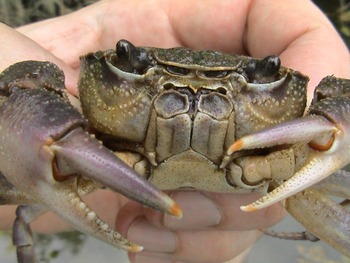
In addition to the records described above, Potamon fluviatile (Figure 1) was discovered at a second locality in Corfu close to the southern tip of the island. During a survey of the herpetofauna of Corfu, a small stream which leaves the island at Cape Koundouris was investigated along its upper reaches between Kavos and Spartera. Two large adult crabs were observed in a small dammed area which produced a pool approximately 0.5 m deep and 1.5 m radius. The pool was rich in aquatic life including dragonfly and other insect larvae, several adult newts (Triturus vulgaris ssp. graeca), small frogs and freshwater shrimps. The adults were present in the margins of the pool and there was no evidence of burrowing activity above or below the waterline, with the exception of smaller burrows in adjacent waterlogged silty soil which were found to be made by the adults and nymphs of mole crickets Gryllotalpa sp. The crabs were photographed at the site (Figure 1) and subsequently identified by E.G. Maurakis as Potamon fluviatile.
Freshwater crab Potamon fluviatile.

Regarding the possibility of finding P. fluviatile elsewhere on the island, it is interesting to note that a recent survey of otters in Corfu, which were detected at 19 sites across the island, showed no evidence of freshwater crab predation (Ruiz-Olmo, Reference Ruiz-Olmo2006). The diet of otters feeding in freshwater environments was found to include cyprinid fish, frogs, small mammals, insects, and reptiles including lizards and dice snake Natrix tesselata. Otters whose habitats included coastal lagoons were found to prey on decapods, but these were species typical of saline environments.
THE FUTURE
All four of the Potamon species found in Greece are under threat from a variety of factors. The freshwater habitats that they occupy are vulnerable to pollution which appears to be an increasing problem across the region. In Corfu, confirming the author's observations, Ruiz-Olmo (Reference Ruiz-Olmo2006) noted that, ‘rubbish was present to a high degree in most of the rivers, including the high mountain streams’, and also noted that chemicals and pesticides (the use of which merited the provision of warning signs for the public) were contributing to this problem.
Many of the problems which face organisms living in freshwater environments in Corfu are mirrored across the region, and include: the degradation and loss of freshwater habitats through excessive water abstraction (Hadjibiros et al., Reference Hadjibiros, Economidis, Koussouris and Van de Kraats1998; Bobori et al., Reference Bobori, Economidis and Maurakis2001), the corresponding threat of desertification (Yassoglou & Kosmas, Reference Yassoglou and Kosmas2000), disturbance and habitat destruction through building development (Ruiz-Olmo, Reference Ruiz-Olmo2006), the increasing desiccation of sites in response to climate change (E. Maurakis & D.V. Grimes, unpublished data), and ultimately, the inappropriate management of aquatic resources through lack of strategic planning, including unsustainable agricultural practices which have led to the loss of the majority (75%) of Greek wetlands since 1900 (OECD, 2000). In the light of this, it is unsurprising that the Potamon species facing the brunt of these changes will increasingly disappear from habitats as they become unsuitable. A measure of how quickly this can take place is provided by Gherardi et al. (Reference Gherardi, Micheli, Monaci and Tarducci1988), who have documented the rapid decline of this species from the Granchio River system in Italy. Elsewhere across their range, many formerly healthy populations of Potamon species are known to have been lost.
Maurakis & Grimes (unpublished data) have recently highlighted the habitat protection needs of all four Potamon species, and suggested the implementation of a plan of action to address the problems described above. This, together with recognition of the fact that Potamon species should be used as indicators of the health of the freshwater environments in which they are found, may pave the way to halting the decline of these remarkable and increasingly threatened crabs.
ACKNOWLEDGEMENTS
Sincere thanks to Eugene Maurakis and Peter Hogarth for kind provision of information regarding the current status of Potamon species in Greece, and Ken Lambert for invaluable assistance with fieldwork.