Introduction
Memory strategies are strategies used to focus attention and memorize information; they notably include acronyms generated in order to remember lists of words (Castel, Reference Castel2007). Until now, the knowledge and use of such strategies by the elderly has been poorly documented. Nonetheless, memory is a cognitive faculty that is essential for several everyday activities and it has been shown that memory strategies can significantly contribute to the improvement of daily functioning (Reuter-Lorenz and Cappell, Reference Reuter-Lorenz and Cappell2008; Schmitter-Edgecombe et al., Reference Schmitter-Edgecombe, Woo and Greeley2009).
The population of seniors aged 65 and over in Quebec (Canada) approached 1.5 million in 2016. From this number, around 450,000 of them were still living at home (Statistics Canada, 2016). No less than 22% of community-dwelling seniors say that they frequently forget essential information and this proportion tends to increase as they age (Camirand and Fournier, Reference Camirand and Fournier2012). The natural decline in memory may have several origins: the slowing of the nerve impulse, which hinders the carriage of information (Taconnat, Reference Taconnat2008; Tocze et al., Reference Tocze, Bouazzaoui and Taconnat2012), the decrease in neuronal resources available in the cerebral reserve, which varies from individual to individual (Lemaire and Bherer, Reference Lemaire and Bherer2005; Kolb and Whishaw, Reference Kolb and Whishaw2009) as well as a normal alteration in the efficiency of executive functions supporting voluntary behaviors (e.g. inhibition, flexibility, problem solving) (McFarland and Glisky, Reference McFarland and Glisky2011; Hess et al., Reference Hess, Auman, Colcombe and Rahhal2003).
However, it is important to point out that there are several types of memory and that these are not uniformly affected by age (Lemaire et al., Reference Lemaire and Bherer2005). On the one hand, research shows that normal aging spares semantic and procedural memories, which are used to manage the knowledge related to our environment and to carry out activities in an implicit manner (Bäckman et al., Reference Bäckman1997; Cabeza, Reference Cabeza2001). On the other hand, episodic memory, which is consciously used to refer to past events that has a spatiotemporal origin, is more likely to be affected by aging (Chauvel et al., Reference Chauvel, Maquestiaux, Didierjean, Joubert, Dieudonne and Verny2011). Authors state that, in general, episodic recall is a challenge for seniors (Souchay and Isingrini, Reference Souchay, Isingrini and Syssau2000; Lemaire et al., Reference Lemaire and Bherer2005; Tocze et al., Reference Tocze, Bouazzaoui and Taconnat2012). According to Albert et al., (Reference Albert, Heller and Milberg1988), the difficulties concerning the recall of information could be more significant after 70 years old.
In order to optimize their memory performance and support, in particular, their independence in daily activities, seniors can count on memory strategies which are also frequently used by younger individuals (Intons-Peterson and Fournier, Reference Intons-Peterson and Fournier1986). Examples of such strategies include making lists, consulting a calendar, setting alarms, making associations with semantic knowledge, or using a routine. The understanding and implementation of these strategies are governed by executive functions and metamemory which enables the individual to be aware of his own memory capacities (Hultsch et al., Reference Hultsch, Hertzog, Dixon, Davidson, Howe and Brainerd1988).
There is no consensus yet on the classification of memory strategies. Some researchers distinguish internal strategies (associations, procedural, or metacognitive methods) from external strategies (taking advantage of the physical or social environment) (Verhaeghen et al., Reference Verhaeghen, Geraerts and Marcoen2000; Baddeley et al., Reference Baddeley, Kopelman and Wilson2004). Others, such as Seron and Van der Linden (Reference Seron and Van der Linden2000), dissociate the strategies that directly facilitate memory functions, such as mental imagery (e.g. visualization, face-name association, Loci) or verbal strategies (e.g. using acronyms, making rhymes), from those that compensate for deficient functions, such as external strategies (e.g. asking for help, writing a note).
Research about the knowledge of memory strategies highlight that the acquisition and the daily application of these strategies require a great deal of time, effort, attention, understanding, and motivation, especially among seniors (Seron et al., Reference Seron and Van der Linden2000; Chauvel et al., Reference Chauvel, Maquestiaux, Didierjean, Joubert, Dieudonne and Verny2011). Studies have shown that, in order to memorize a list of words, older people benefit more from environmental and organizational support than younger adults (Kahana and Wingfield, Reference Kahana and Wingfield2000; Brooks et al., Reference Brooks, Friedman and Yesavage2003; Brehmer et al., Reference Brehmer2008). The aging population would be more confident with external strategies than younger people (Birren et al., Reference Birren2013). Also, Boron et al. (Reference Boron, Rogers and Fisk2013) found that some individual factors were associated with better knowledge of various “compensatory” strategies in elderly people who are taking medications: high level of education, multiple prescriptions, concerns about adherence to treatments, and feeling of self-effectiveness. In addition, for seniors, knowledge of a wider variety of strategies helps them make a more appropriate choice depending on the situation (Kinsella et al., Reference Kinsella2016). Moreover, other authors have shown that the elderly have a repertoire of memory strategies that are essentially similar to those of younger adults (Reese and Cherry, Reference Reese and Cherry2004). However, in the same study, authors found that differences could be seen between the younger and older adults concerning the ability to remember certain types of information. For example, information related to a routine, like taking out the trash every Monday, was more difficult to remember for younger adults, while older adults reported having more difficulties with name recall. The choice making process is apparently also more difficult for seniors (Hertzog et al., Reference Hertzog, Lovden, Lindenberger and Schmiedek2017). Finally, a few articles discussed the self-referencing and self-generated strategy for the memorization of words or pictures in older adults. Those techniques have been proven to be relatively effective in supporting the encoding process (Hamami et al., Reference Hamami, Serbun and Gutchess2011; Yang et al., Reference Yang, Truong, Fuss and Bislimovic2012; Dirette, Reference Dirette2015).
In summary, the available evidence on memory strategies used or known by seniors indicates that they choose more often external and personalized strategies to answer self-questionnaire about how they remember stuff or to learn lists of words. The literature also indicates that education may influence the knowledge and application of memory strategies and that certain types of learning are more complex for seniors. However, most studies have been carried out using non-functional tasks, such as memorizing a list of words, and in artificial contexts. Self-reported use or knowledge of memory strategies in everyday life and the diversity of these means are poorly documented. In addition, there is a limited quantity of evidence about the relevance of strategies which are suitable for activities of daily living and also on the variables influencing their choice. Enhancing this knowledge could guide the development of cognitive intervention programs incorporating educational activities centered on strategies adapted to task specificities and individual profiles.
This study aims to better understand the spontaneous choice of memory strategies by community-dwelling seniors, in relation to common situations of everyday life. More specifically, the objectives were (1) to explore the categories of memory strategies reported to be used by seniors; (2) to document the diversity of such strategies; (3) to analyze the relevance of these strategies; and (4) to explore potential relationships between participants’ characteristics and categories, diversity, and relevance of reported strategies.
Methods
Design and context
This project was nested in a larger study whose primary goal was to assess and explore the impacts of a community-based program aiming to promote seniors’ cognitive vitality (Bier et al., Reference Bier, Lorthios-Guilledroit, Nour, Parisien, Ellemberg and Laforest2015). The research protocol was approved by the ethics committee of Université de Montréal. The present project draws on the data collected from participants when they entered the program, during the pre-intervention phase.
Population
The sample consisted of 294 seniors living independently in the community. They were recruited between 2009 and 2011 through 23 community organizations in Montreal and its surroundings. Participants met the following criteria: be 60 years of age or older, speak French, accept to take part in a cognitive health promotion program of ten sessions and have not participated in a similar project in the past year (Bier et al., Reference Bier, Lorthios-Guilledroit, Nour, Parisien, Ellemberg and Laforest2015). When seniors reported they had received a diagnosis of a cognitive deficit by a healthcare professional, they were excluded.
Data collection
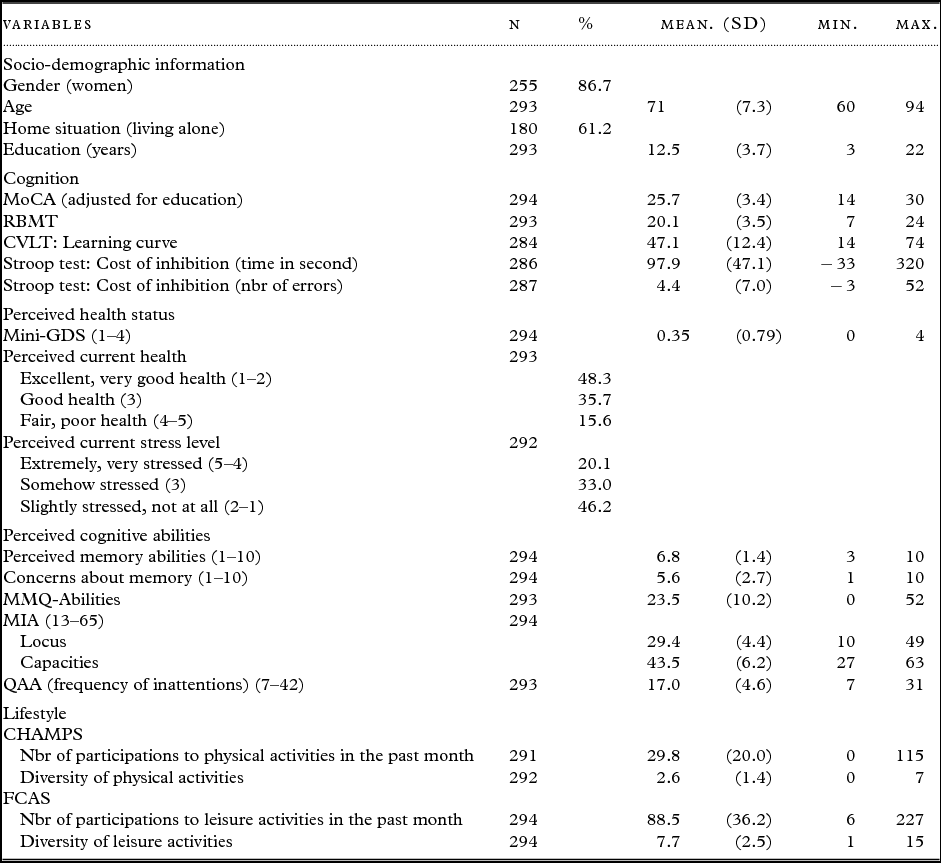
Potential participants were first invited to confirm inclusion and to share socio-demographic information through a telephone interview. After this preliminary step, a longer interview was conducted by a trained interviewer without a specific professional title in order to assess cognitive abilities, perceived health status, perceived cognitive abilities, lifestyle, and knowledge about memory strategies (Bier et al., Reference Bier, Lorthios-Guilledroit, Nour, Parisien, Ellemberg and Laforest2015). The questionnaires used to collect the data are briefly described below and results are shown in Table 1.
Characteristics of participants

Socio-demographic information
Socio-demographic questions were taken from surveys conducted by the Quebec Institute of Statistics (Daveluy et al., Reference Daveluy, Pica, Audet, Courtemanche, Lapointe and Côté1998). Multiple-choice and short-term questions were used to collect the following information: date of birth, gender, life situation (living alone or not), and the number of years of education.
Cognitive abilities
The Montreal Cognitive Assessment (MoCA) was administered. It is a standardized screening tool, containing 11 subtests. A score below 26 indicates a higher risk of having a cognitive impairment (Nasreddine et al., Reference Nasreddine2005). The score for this test was adjusted according to respondents’ level of education. One point was added if the participant had less than 12 years of education.
Cognitive performance in everyday situations was assessed using the validated French version of the Rivermead Behavior Memory Test (RBMT) (Vanier and Lemyse, Reference Vanier and Lemyse1994). The total score varies between 0 and 24 and characterizes respondent's increasing ability to perform the requested tasks (e.g. remembering names, courses) (Wilson et al., Reference Wilson, Cockburn, Baddeley and Hiorns1989; Lezak, Reference Lezak1995).
The California Verbal Learning Test II (CVLT-II) evaluates participants’ ability to learn and remember verbal information by categorizing words (Delis et al., Reference Delis, Kramer, Kaplan, Thompkins and Ober1987). A list of 16 words is repeated by the interviewer five times; after each trial, the respondent is asked to recall as many words as he can. The sum of the words retrieved in the five attempts quantifies the subject's ability to learn. This variable was used in this study.
The Stroop Test (ST) measures attentional and inhibitory performance, first by measuring the time required for the performance of two interference-free cognitive tasks (1: name the color and 2: read the word). Then, the time spent in a third task which involves interfering cognitive processes is measured (read the name of colors printed in discordant colors) (Stroop, Reference Stroop1935). In the current study, the difference between the time taken to perform the interference task and the second interference-free task was calculated. The difference between the total number of errors for the interference task and the second interference-free task was also noted.
Perceived global health status
Depressive symptoms were detected with the French version of the four-questions Geriatric Depression Scale (Mini-GDS). A score higher or equal to one indicates a positive screening (Clément et al., Reference Clément, Nassif, Léger and Marchan1997).
The perceived current health status was measured using an ordinal scale (grades going from 1 = excellent health, to 5 = poor health) (Daveluy et al., Reference Daveluy, Pica, Audet, Courtemanche, Lapointe and Côté1998). Perception of the stress level was measured similarly (grades going from 1 = not stressed at all, to 5 = extremely stressed) (Daveluy et al., Reference Daveluy, Pica, Audet, Courtemanche, Lapointe and Côté1998).
Perceived cognitive abilities
The level of concerns regarding memory abilities was measured using a non-standardized numeric scale graded from one (not at all concerned) to ten (very concerned). Appreciation of memory capacities was also assessed with the same type of measurement, with a score of one meaning that the person thinks that he/she has a very bad memory and ten, an excellent memory.
The French version of the multifactorial memory questionnaire (MMQ-Abilities) was chosen to quantify the self-reported frequency of memory lapses in particular situations. It uses an ordinal scale ranging from zero (never) to four (always) (Fort et al., Reference Fort, Adoul, Holl, Kaddour and Gana2004).
An adapted version of the self-assessment attention questionnaire (Questionnaire d'Auto-évaluation de l'Attention, QAA) was used to assess participants' opinion about their attention in daily life, based on seven scenarios describing moments of distraction. Results were collected with an ordinal scale according to the occurrence of the situation (1 = Never to 6 = Always) (Coyette et al., Reference Coyette, Arno, Leclerq, Seron, Van der Linden and Grégoire1999). The score could vary from 7 to 42.
Sense of self-efficacy and internal control in memory tasks were evaluated with two subscales of the metamemory in adulthood (MIA-Capacity and MIA-Locus) (Dixon et al., Reference Dixon, Hultsch and Hertzog1987). For the present study, the selected questions were translated into French (13 questions for MIA-Capacity and 9 questions for MIA-Locus). For each statement, a five-level scale, ranging from “I strongly agree’’ (1) to “I strongly disagree’’ (5) was proposed. The total score could range from 9 to 65.
Lifestyle
Participants’ involvement in physical activities was assessed using questions from the community healthy activities model program for seniors (CHAMPS) (Stewart et al., Reference Stewart, Mills, King, Haskell, Gillis and Ritter2001). Frequency of participation in physical activities during the last month and diversity of these activities were compiled.
Participants also responded to an adapted form of the Florida cognitive activities scale (FCAS) to document the frequency of participation in intellectually and socially stimulating leisure activities practiced during the last month. The number of different leisure activities (diversity) was also calculated (Schinka et al., Reference Schinka, Mcbride, Vanderploeg, Tennyson, Borenstein and Mortimer2005).
Memory strategies
An adapted version of the memory situation questionnaire (MSQ) was chosen to evaluate the knowledge of seniors about memory strategies (Troyer, Reference Troyer2001; Troyer et al., Reference Troyer, Murphy, Anderson, Moscovitch and Craik2007). This test consists of five open-ended questions about everyday situations (remembering appointments, things to bring, phone numbers, names, and things to buy). The main question is as follows: Here are some situations of everyday life that involve memory. For each, name the strategies you could use to facilitate memorization. The five sub-questions are:
-
1. You set an appointment with a friend. What could you do to avoid missing the appointment?
-
2. You want to bring a book (or another object) to a friend. What could you do to remember to bring it to him at the appointment?
-
3. You have just moved. What could you do to remember your new phone number?
-
4. You take part in a new group of leisure activities. What could you do to remember the names of the other participants?
-
5. You have to go shopping. What could you do to remind you what you have to buy?
Each participant can provide up to three responses per situation. The original questionnaire contains six questions that can be asked by an interviewer, or be self-administered. Its inter-rater reliability is excellent (r (20) = 0.97) (Troyer et al., Reference Troyer, Murphy, Anderson, Moscovitch and Craik2007).
Analysis
The data were processed using SPSS software version 23 and Microsoft Excel 2013. Descriptive analyses and generalized linear models, including intra-subject contrast tests, were used to verify the categories of memory strategies reported by seniors and to assess the diversity and relevance of their answers. Only results showing significant differences were reported (p ≤ 0.05).
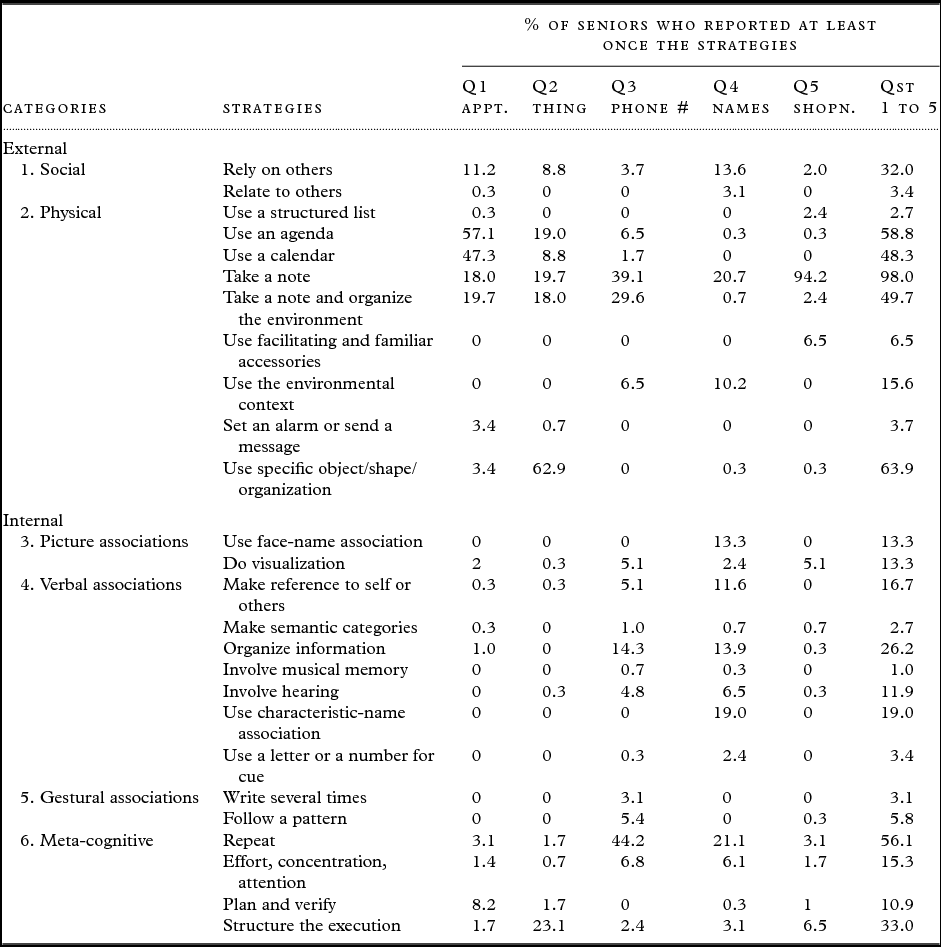
The first objective was to explore the categories of memory strategies. A specific nomenclature was developed based on a brief review of the literature and consultation of an expert committee in order to classify the strategies named by participants who answered the MSQ. The review was carried out in the PubMed and PsycInfo databases, as well as in the gray literature for articles published after 2000. Monographs were also consulted. The expert committee was composed of a neuropsychologist and two occupational therapists. Just like many authors have suggested in their work, memory strategies were here divided into two primary groups: external and internal strategies. External strategies refer to strategies which involve material (physical) or human (social) resources; these include strategies like asking someone else to remember information, sticking a note on a strategic place (e.g. on a door) or visually highlighting it. Internal strategies contain strategies mainly based on cognitive resources; they consist in associating information with pictures, words, or gestures. Strategies involving a significant contribution of metamemory for the parameterization of information encoding are also considered as internal strategies. See Table 2 to see all strategies.
Individual strategies and categories of mnemonics reported at least once by seniors for each question and for all questions

For the second objective which consisted to calculate the diversity of memory strategies participants reported, each different answer for a same question was worth one point. The total diversity score could go up to 15.
The third objective was to analyze the relevance of memory strategies. A scoring grid was created from the original questionnaire published by Troyer (Reference Troyer2001). The new tool was modified based on an expert consensus and on a review of the literature about memory strategies. The main adaptations of the original grid consist in an increase in the range of possible answers and a partial modification of its terminology: the term “effectiveness” was replaced by “relevance.” This tool allocates one point to strategies which are relevant, specific, and used independently (without physical or verbal assistance from someone else). Half a point is assigned to strategies which are less relevant, non-specific, or used with the help of another person. Strategies deemed irrelevant, non-responses and duplicate responses for the same situation receive a score of zero. For each question, the maximum number of points is three and the total relevance score can reach no more than 15.
For the fourth objective, bivariate correlation tests were used to verify the relationship between individual characteristics and the reported strategies, their diversity and relevance. To do so, socio-demographic variables and the 18 other individual variables (Table 1) were divided into five groups using a maximum likelihood analysis with an oblique data rotation (delta = 0). The following groupings were considered: socio-demographic information, cognition, perception of health, perception of cognitive skills, participation in physical activities, and leisure activities.
Results
Characteristics of the population
Characteristics of respondents are reported in Table 1. They were mostly retired women (86.7%) living alone and having around 13 years of education. The average age was 71 years. Concerning objective and subjective measures of memory and attention, the results suggest an uncertainty about the feeling of competency (MIA-Capacities: 43.5/65) and control (MIA-Locus: 29.4/45) over memory, occasional memory lapses (MMQ-Abilities: 23.5/80) and a good ability to remember lists of words (Learning curve, CVLT: 47.1/80). Results from the QAA show that participants were rarely distracted. The average MoCA (25.7/30) score was slightly below the cut-off point of 26, which is the cognitive integrity threshold (Julayanont et al., Reference Julayanont2015). Seniors scored their level of concerns about their memory 5.6 on 10. They also rate their perception of their memory abilities 6.7 out of 10. Data about lifestyle indicated that these individuals generally engaged in around two different physical activities and seven different leisure activities within a month.
Objective 1–Categories of reported memory strategies
Table 2 shows the 26 different strategies reported by participants for five situations of daily living. These strategies were grouped by categories as previously explained. It is observed that the most popular strategy for all questions is note taking (mentioned at least once by 98% of participants). Other strategies in the same category were also frequently mentioned, such as using a diary or a calendar (59% and 48%, respectively), most of the time to remember an appointment. The use of a special object or organization in the environment as a reminder (64%) was also a frequently reported strategy. Approximately one out of three answers involved an external physical strategy. The implication of musical memory was the least reported answer (1%).
In terms of categories, while physical and metacognitive strategies were named by the largest number of participants (100% and 73.8%), gestural associations, an internal strategy used, for example, to associate phone numbers to a particular path on the handset's keypad, was the least reported one (8.2%). Just over half of the participants mentioned at least one internal strategy of verbal associations (57.5%), while social and picture association categories were respectively reported by 35% and 24.5% of subjects. From a more general perspective, out of an average of about eight answers per participant, five were external strategies (
 ${\rm{\bar{X}}}$
= 5.44, SE = 0.10), while three were internal strategies (
 ${\rm{\bar{X}}}$
= 2.61, SE = 0.09), which is a significantly lower number (F(1–293) = 357.3, p ≤ 0.001).
Objective 2–Diversity of reported memory strategies
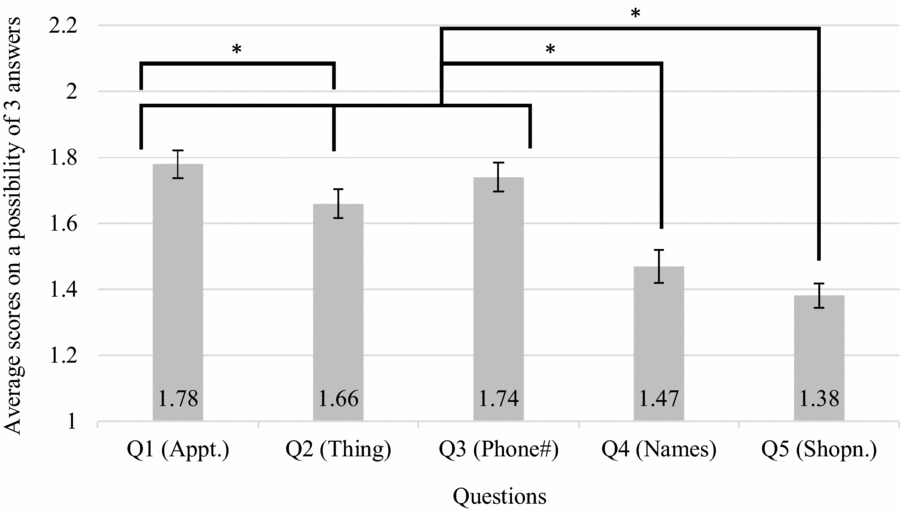
Out of a range of 26 different strategies, respondents said that they would use 6.14 (SD = 1.71) different memory strategies to memorize information across the five proposed situations of daily living (upto three possible answer per situations). This diversity varies between 2 and 11 different strategies among seniors. The number of different memory strategies reported by participants for each question is provided in Figure 1. Seniors knew a significantly greater variety of strategies for the task “remembering an appointment” than for “bringing something to a friend” (F(1–293) = 4.37, p ≤ 0.001). Elders also reported significantly more diverse answers for “remembering an appointment” (F(1–293) = 26.9, p ≤ 0.001), “remembering to bring something” (F(1–293) = 10.4, p ≤ 0.001) or “remembering a phone number” (F(1–293) = 23.6, p ≤ 0.001) than for “remembering a name.” Similarly, participants knew significantly more strategies for “remembering an appointment” (F(1–293) = 55.4, p ≤ 0.001), “remembering to bring something” (F(1–293) = 28.7, p ≤ 0.001) or “remembering a phone number” (F(1–293) = 49.2, p ≤ 0.001) than for “remembering things to buy.”
Mean diversity of mnemonics reported by seniors for each question. *Indicates statistical difference between scores.

Objective 3–Relevance of reported memory strategies
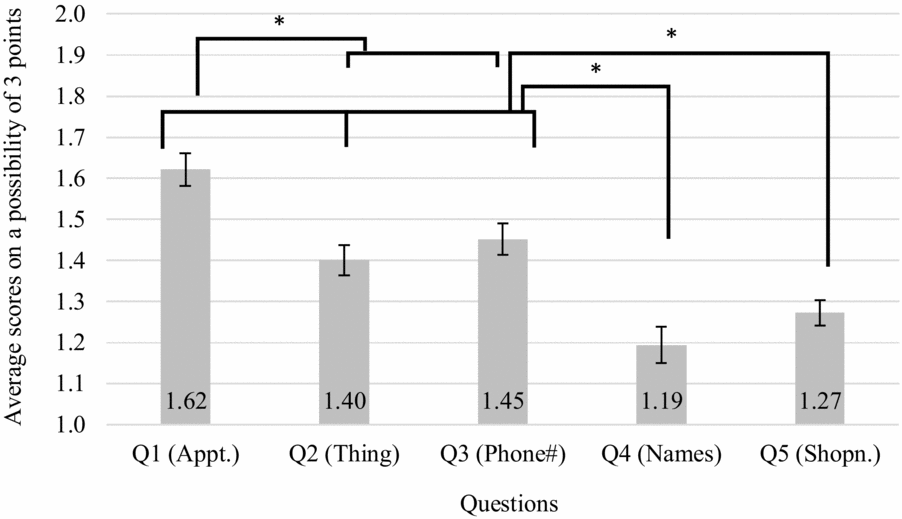
The mean total score concerning relevance of all reported memory strategies was 6.94/15 (SD = 1.80). This indicates that strategies named by seniors were fairly relevant. Figure 2 shows the average relevance scores for strategies reported for each situation. Results tell that the relevance is significantly higher for strategies mentioned for the tasks “remembering an appointment” (F(1–293) = 59.6, p ≤ 0.001), “remembering something to bring” (F(1–293) = 15.8, p ≤ 0.004) or “remembering a phone number” (F(1–293) = 26.2, p ≤ 0.001) than for “remembering a name.” In the same way, memory strategies reported for “remembering an appointment” (F(1–293) = 52.6, p ≤ 0.001), “remembering to bring an object” (F(1–293) = 8.54, p ≤ 0.004) or “remembering a phone number” (F(1–293) = 15.7, p ≤ 0.001) were significantly more relevant than those stated for “remembering things to buy.” The relevance of answers for the task “remembering an appointment” was also statistically superior to the relevance obtained for “remembering to bring an object” (F(1–293) = 18.1, p ≤ 0.001) or “remembering a phone number” (F(1–293) = 10.5, p ≤ 0.001).
Mean relevance of mnemonics reported by seniors for each question. *Indicates statistical difference between scores.

Objective 4–Correlations between participants’ characteristics and reported strategies
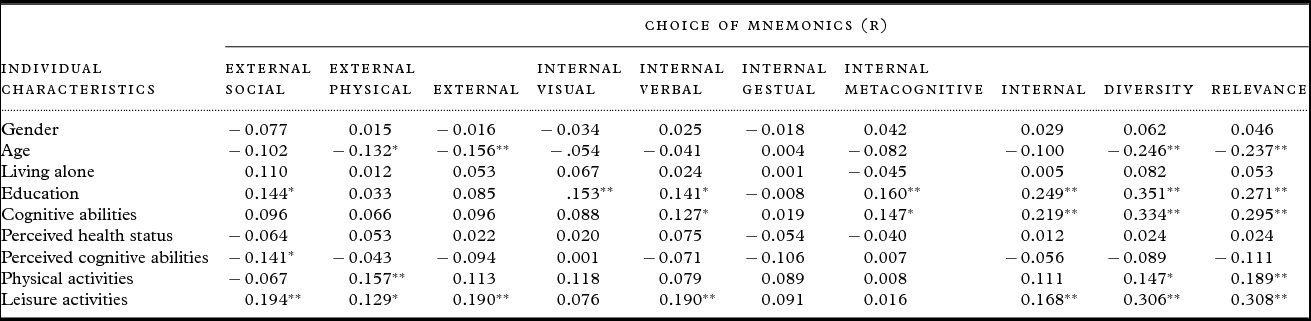
Table 3 shows results of bivariate correlation tests that were carried out to identify relationships between characteristics of respondents and categories, diversity and relevance of reported memory strategies. For each pair that was tested, the correlation coefficient (R) was computed and the p value threshold was set at 0.05. It was observed that associations were generally weak (R = 0.00 to 0.39) (Evans, Reference Evans1996).
Correlations between individual characteristics and categories, diversity, and relevance of reported mnemonics

N = [273; 294].
*p ≤ 0.05 **p ≤ 0.001.
R = 0.00−0.19 → very weak, R = 0.20-0.39 → weak, R = 0.40-0.59 → moderate, R = 0.60-0.79 → strong, R = 0.80-1.0 → very strong (Evans, Reference Evans1996).
Evans (Reference Evans1996). Straight forward statistics for the behavioral sciences. Pacific Grove, CA: Brooks/Cole Publishing.
In the first place, socio-demographic data showed that level of education and age were correlated with relevance of answers (R = 0.351, p ≤ 0.01). Cognitive ability was significantly and positively correlated to diversity of answers (R = 0.334, p ≤ 0.01). Compared to the practice of physical activity, a regular and diversified practice of cognitive and social leisure activities was more strongly correlated with diversity (R = 0.306, p ≤ 0.01) and relevance of strategies (R = 0.308, p ≤ 0.01).
Discussion
The objectives of this study were to analyze the categories, diversity, and relevance of memory strategies known by community-dwelling seniors and to explore the factors that may influence their choice of strategies. The next sections discuss these four aspects.
Categories of strategies
The results indicate that the vast majority of seniors participating in the study knew at least one physical strategy (e.g. take a note on a post-it and place it strategically, turn the action into a routine, use a flyer or a recipe) or metacognitive strategy (e.g. be ready in advance, mentally repeat information, systematically consult an diary every morning). The first category uses visible and concrete cues, objects, or places, while the second involves the ability of individuals to be conscious of their skills and to structure their learning process (Hultsch et al., Reference Hultsch, Hertzog and Dixon1987; Hess et al., Reference Hess, Auman, Colcombe and Rahhal2003). These strategies were mostly reported for remembering an appointment, something to bring to a friend or a phone number. Just as Brooks, Friedman and Yesavage (Reference Brooks, Friedman and Yesavage2003) found, our results suggest that physical and metacognitive strategies would be complementary for specific activities.
It should be noted that the category of physical strategies was reported at least once by all participants, and constituted one third of all answers. The concrete and tangible nature of these strategies could explain their popularity with elderly people. In line with this finding, it has been demonstrated in previous studies that this population actually uses more external aids than internal strategies (Devolder and Pressley, Reference Devolder and Pressley1992; Sohlberg and Mateer, Reference Sohlberg and Mateer2001; Birren et al., Reference Birren2013). Internal categories may be less spontaneously mentioned since their use need a great contribution of complex cognitive functions that tend to deteriorate with age (Salat et al., Reference Salat2005).
The results also show that strategies involving some organization process were mentioned by a large number of participants (e.g. highlighting an object in order to remember to do a certain activity, classifying items of a list with semantic clusters, note down an appointment on the calendar with large characters). In fact, Brehmer et al. (Reference Brehmer2008) found that a structured environment helps seniors to optimize their memory abilities. As problem-solving skills are decreasing with age, seniors might increasingly rely on environmental rather than mental resources to compensate for their difficulties (Piguet et al., Reference Piguet2002; Tournier et al., Reference Tournier, Mathey and Postal2012).
In contrast, memory strategies belonging to the categories of social assistance and picture associations were less reported. The low rate for external social aids supports the results of Ford and colleagues (Ford et al., Reference Ford, Haug, Stange, Gaines, Noelker and Jones2000) which pointed out that if healthy, seniors maintain a good level of independence without the presence of a caregiver at home. Since picture associations strategies strongly rely on episodic memory which, naturally diminishes through time, it is not surprising that participants knew less strategies from this category (Mormino et al., Reference Mormino2009).
Diversity of strategies
As regards the diversity of memory strategies, the findings indicate that the respondents reported, on average, six different strategies in their answers to the five questions. This result tells that the elderly involved in the study knew at least one strategy to address each situation (at least five), but that their repertoire wouldn't be sufficiently large to target enough alternative strategies (more than 10). According to Elliott (Reference Elliott2003) and Tournier et al. (Reference Tournier, Mathey and Postal2012), seniors could be cognitively less flexible and quite attached to their habits. Thereby, they may tend to choose strategies that suit them best, for example, according to their personality or the context they are in. The results of the present study also reveal that participants reported a significantly greater variety of strategies for remembering an appointment, something to bring or a phone number, compared to remembering a name or things to buy. This suggests that strategies to support memory in the last two tasks are less common or obvious than for other situations. This could be due to the complexity or the large amount of information that needs to be memorized when learning names or remembering things to buy. In fact, unlike common words, proper names cannot be associated with any given semantic category. It is therefore more difficult for young people as for older adults to remember them (Perfect and Lindsay, Reference Perfect and Lindsay2013). Researchers have found that difficulties with learning names is one of the main subjective memory problems expressed by the elderly population (Leirer et al., Reference Leirer, Morrow, Sheikh and Pariante1990; Montejo et al., Reference Montejo, Montenegro, Fernández and Maestú2011). Regarding the memorization of purchases to be made, almost all participants mentioned that they would make a list. This result is not surprising, because this socially anchored strategy allows the person to note down during the week what she needs and to find the articles she was looking for on the day she goes shopping. The retention of a large number of elements is also increasingly difficult with age because of the limited capacity of working memory (Baddeley and Hitch, Reference Baddeley and Hitch1974).
Relevance of strategies
The participants obtained, on average, a total relevance score of 6.94/15 (SD = 1.80) for their answers. This suggests that each question was answered with at least one relevant strategy, which was maximally rated. Memory strategies suggested by seniors were significantly less relevant for remembering a name than an appointment. As mentioned earlier, names are difficult to remember for the aging population, whereas an appointment can be easily retrieved if it has been written in a diary or on a calendar, for example. Knowing a single but highly relevant strategy for a specific memory task may be sufficient to effectively remember information, especially for seniors, whose ability to manage several pieces of information decreases over time (Sohlberg et al., Reference Sohlberg and Mateer2001). Castel (Reference Castel2007), Flavell and Wellman (Reference Flavell and Wellman1977) notably reported that there is no “better” strategy for learning, and that characteristics related to the person or his/her environment are decisive factors for the choice of a relevant strategy.
Participants’ characteristics associated with reported memory strategies
Lastly, clusters of selected individual characteristics were weakly correlated with categories, diversity, and relevance of reported strategies. As explained by Paquette et al. (Reference Paquette, Beaulieu and Lavoie2009), a wide variety of factors may influence the choice of memory strategies. Thus, the selected variables for the current study are not likely to be the only ones that can explain the participants’ selection of strategies.
First, among the selected socio-demographic characteristics, education and age were the variables that showed a significant relation with categories, diversity, and relevance of reported memory strategies. These findings are consistent with those of Saczynski et al. (Reference Saczynski, Rebok, Whitfield and Plude2007), who demonstrated that a higher level of education was effectively associated with a greater repertoire of such strategies among seniors. In fact, the quantity of learned items is proportional to the level of education and to the person's capacity to manage this information. Indeed, people with more education tend to acquire better knowledge of internal strategies as well as higher problem-solving capacities (Wilson et al., Reference Wilson, Hebert, Scherr, Barnes, De Leon and Evans2009). These assets would also help seniors to choose strategies that are more relevant to specific situations (Badham et al., Reference Badham, Hay, Foxon, Kaur and Maylor2016; Kinsella et al., Reference Kinsella2016). In addition, authors found that intrinsic resources tend to decrease with age (Lemaire et al., Reference Lemaire and Bherer2005). In the present study, while younger participants were more educated, a younger age was positively associated with a greater diversity and even quality of memory strategies.
Second, objective measures of cognitive skills, such as memory and attention, appeared to be correlated with the mention of internal categories, diversity, and relevance of strategies. On the one hand, knowing a wider variety of relevant strategies could facilitate the performance on memory tasks. On the other hand, the results also suggest that a sufficient amount of memory and attentional resources would be associated with a more frequent use of internal strategies. As Glisky and Glisky (Reference Glisky, Glisky, Stuss, Winocur and Robertson2008) have outlined, this suggests that internal strategies would in fact require more cognitive resources than external strategies.
Also, seniors’ perceptions of their health and cognitive abilities correlated with few of the dependent variables analyzed in the present study. Perception of cognitive abilities were only negatively correlated with the mention of external social strategies. Thus, the more seniors have confidence in their cognitive skills, the less they would rely on others to remember information about everyday activities.
Finally, participation in intellectual and social leisure activities is the aspect of lifestyle that has shown a constant and predominant relationship with categories, diversity, and relevance of memory strategies. The findings suggest that a varied and frequent practice of this type of activities exposes the elderly to a wider range of situations in which they would probably be encouraged to choose more diverse strategies. In addition, the positive effects of leisure activities on cognitive functions such as problem solving has already been demonstrated (Verghese et al., Reference Verghese2003). This benefit would allow the individual to instinctively choose the strategy that is better suited to the context, and that could explain the relation between practicing various leisure activities on a regular basis and the relevance of reported memory strategies.
In sum, correlation results showed interesting associations between participants’ characteristics and answers. However, some variables such as level of education, cognitive skills, and leisure activities seemed to be more influential than others.
Strengths and limits
The findings should be interpreted with caution. First, the studied sample was mainly composed of women who voluntarily decided to become involved in a program promoting cognitive vitality which was offered by an organization in their community. Also, the main results on memory strategies were generated from an adapted version of an existing questionnaire and were analyzed using a rating grid which was modified based on a literature review and an experts’ consensus. Despite the rigor of the process to adapt the original tools, it would be interesting to measure the psychometric properties of these new versions in future studies. Thus, the qualitative nature of the questionnaire about memory strategies allowed respondents to provide more spontaneous and realistic answers than if they were forced to choose among predetermined strategies. Nevertheless, further work is needed to study the strategies that seniors actually use in their daily lives.
Implications for practice and research
The results of this research could guide the development of recommendations for seniors concerning the choice of memory strategies to sustain their memory in their activities of everyday life. As the healthy life expectancy increased in the last decades, the number of seniors living at home will also increase. This situation forces them to compensate for their age-related deficits to remain independent. The current study suggests that seniors already know a sufficient number of relevant memory strategies. As discussed by other authors (Kliegel and Altgassen, Reference Kliegel and Altgassen2006; Hamami et al., Reference Hamami, Serbun and Gutchess2011), it is preferable to seek to automate, customize, or adapt known strategies rather than teach new ones. This can guide the creation of community-based programs which can be better suited to the needs and reality of seniors. In this regard, it would be interesting to know whether such programs could optimize seniors’ choice of memory strategies, through an increase in the repertoire or relevance of the strategies they report.
Conclusion
This study aimed to better understand the memory strategies reported by seniors living in the community. Participants generally knew a large number of relevant external strategies, which were more or less diverse. Level of education, cognitive skills, and participation in cognitive leisure activities seemed to partially influence the choices and quality of mentioned strategies. Future studies are needed, however, to evaluate memory strategies that seniors actually use in everyday living, which could contribute in the development of community-based programs that address the specific needs of the growing aging population.
Conflict of interest
None.
Description of authors’ roles
Marie-Michèle Haché designed the study, carried the statistical analysis, and wrote the paper. Maxime Lussier was responsible for the statistical design and assisted with writing the paper. Nathalie Bier co-developed the research protocol, supervised the statistical analysis, and assisted with writing the paper. Manon Parisien supervised the collection of data, designed the study, participated in the interpretation of the data, and assisted with writing. Francis Langlois participated in the development of assessment tools used within this study.
Acknowledgments
This research was funded by the Canadian Institutes of Health Research. N. Bier is supported by a salary award from the Fonds de la Recherche du Québec – Santé. The authors want to thank the seniors and the community organizations who participated in this project. We would also like to thank Michel Fournier, Sophie Laforest, and Kareen Nour for their contribution.