Introduction
The term ‘Maroon’ derives from the Spanish word cimarrón, which first appeared in the Spanish language in the early 16th century. The term, possibly of indigenous origin, was first used to describe domestic cattle that fled to the hills. It was later applied to fugitive indigenous people and subsequently to black runaway slaves (Arrom and García-Arévalo Reference Arrom and Garcia Arévalo1986; Price Reference Price1996). While a secluded and far-off physical environment was typically implicated in the Spanish use of the word ‘Maroon’, the overriding connotation was a state of disorder as people and things were out of place. Under colonialism, the term was a legal and social category that was imposed on individuals by colonialists and was not always espoused by the labelled group. This category had palpable material and social ramifications for black runaway slaves and it is critical to unpack the colonial suppositions that informed this label and understand it from the point of view of the individuals who were labelled Maroons.
This article re-evaluates Spanish colonial material and spatial understandings as well as the spatial practice of Maroons in colonial Veracruz. The material records of escaped slaves from sugar plantations during the late 18th century, including testimonies and the archaeological record of a Maroon faction that settled a colonial town, demonstrate that Maroons were defined, and defined themselves, by social and material experiences that were not constrained by space. In reconsidering the colonial Maroon social category, this article challenges common colonial understandings of Maroons which have been inadvertently repeated by present-day academics. Maroon groups used colonial space in ways that defied the expectations of colonial officials. The relative visibility of the colonial geographic landscape was not a natural fact and at times the hacienda cloaked Maroons more than the dense vegetation of the mountains did. Maroons did not evade the colonial hacienda and accessible lands of Veracruz in favour of the mountains and the Maroons who settled Amapa did not cease to be Maroons despite their legal and spatial repositioning. ‘Natural’ and built landscapes were actively re-created by Maroons and other groups through perception, experience and inexperience. These environments were contested terrains (Cronan Reference Cronan1996) in which different spatial and material understandings and practices often clashed, and where, in 1769, the conflict extended to the tidy town of Amapa.
Colonial sugar plantation slavery, marronage and reducción
In 1618, the villa de Córdoba was founded as a ‘frontier against the black Maroons’ who ‘infested the Royal Road killing and robbing passengers and transients’ (AHC, Volumen 10, fs. 73va).Footnote 1 The villa's foundation initiated the sugar industry in colonial Veracruz and by the end of the century the majority of the region's plantations were in operation and relied almost exclusively on black slavery (Naveda Reference Naveda Chàvez-Hita1987). Local colonialists had absolute power to punish their slaves and regularly exerted the threat and actual force of this capacity. Black slaves on sugar haciendas responded to this brutality with flight, or marronage, and full-blown rebellion. Major slave revolts in the region were reported in 1725, 1735, 1741, 1749, 1756 and 1768 (AGN, Indiferente Virreinal, Caja 2506, Exp. 002, fs. 171va). The 1735 uprising was the largest, in terms of rebel numbers and wreckage. One Córdoba plantation owner recalled feeling that they were starting anew, as though they had just conquered the region (AGN, Tierras 3543, Book I). According to colonialists, runaway slaves sought refuge in runaway settlements, or palenques, located ‘in the impenetrable denseness of the mountains’ (AGN, Indiferente Virreinal, Caja 2506, Exp. 002, fs. 36va).Footnote 2
Just over thirty years later, several slaves who escaped during the 1735 rebellion would settle the reducción, Nuestra Señora de Guadalupe de los Morenos de Amapa. Reducción was a common Spanish colonial civilizing practice that was both a process designed to transform indigenous groups into colonial subjects with an embodied Christian and urban way of life, and the place in which this transformation was to take place (Cummins Reference Cummins, Lyons and Papadopoulos2002; Hanks Reference Hanks2010). According to the first monolingual Spanish-language dictionary, reducir meant to convince and its past tense, reduzido, meant ‘convinced, and returned to a better order’ (Covarrubias Orozco Reference Covarrubias Orozco1611, R:5). When applied to Maroons, however, the term reducción was militaristic and it involved conquest and surrender (Las Leyes de Recopilación, Libro VII, Titulo V).
Fifty-two individuals, including men, women, and children born in marronage, appealed for the reducción in 1767 (AGN, Tierras 3543, Book I, fs. 7–8va). The project was debated through written petitions which were authored by the Maroon leader, Fernando Manuel; their chief sponsor, Andres Otañez (who was also a local executive officer); and numerous plantation owners and witnesses who were for or against the reducción. Those in favour argued that the Maroons would be shaped into a ‘Christian political life’ in and through Amapa.Footnote 3 Part of this new life would involve apprehending Maroons and aiding the colony's coloured militia when called on (ibid., Book III, fs. 4). After two consecutive years of written negotiations, the reducción was constructed in August 1769 approximately 116 kilometres south-east of Córdoba.
The Amapa reducción was peculiar for colonial Veracruz, and perhaps for the entire Spanish colonies, in three ways. First, it was the first meticulously argued case for a reducción of black Maroons. Instead of reinstating order through arms, Amapa was an artful and diplomatic attempt to eliminate marronage in the region. Second, ecclesiastical officials did not initiate the Amapa reducción, rather local colonial administrators and the Maroons themselves proposed the project. The Maroons civilly petitioned their civility and asserted that the reducción would fix their consciences and help them obtain the salvation of their souls (AGN, Tierras 3543, Book I, fs. 1va). The ideological language and practice of reducción was therefore not only a technique used by colonial officials and applied to colonized groups. Reducción, along with Christian patronage in general, was mobilized by Maroons in colonial Mexico for various ends and with varying levels of success.Footnote 4
Lastly, Amapa contrasts with reducciones of indigenous groups in its spatial and architectural constitution. Reducción typically had a radial spatial layout where indigenous populations were resettled into towns built around monastic centres (Hanks Reference Hanks2010). A reducción was a mimesis of an urban town where indigenous groups received instructions on colonial social and material life. It was a stride toward a future civil and self-governing life in an independent town. The Amapa reducción, by contrast, did not approximate a town, it was a town that had come into being before its inhabitants had been reduced.
Despite these disparities, Amapa mirrored indigenous reducciones in its perceived disappointment. In the late 1770s, the Amapa residents were indicted by their neighbours for reducing their town to rubble, and accused of moral ruin. The neighbouring residents and officials who filed these written complaints saw a lack of commensurability between the people and the built environment in Amapa. Despite the former Maroons’ voluntary, and perhaps skilful, submission to a Spanish urban and social organizational model, they remained outsiders. The Amapa settlement undoubtedly unsettled the colonial order of material and social categories as ‘uncivil’ Maroons occupied the paragon of white civility, a colonial town, as opposed to the untamed mountains.
Maroon archaeology in a colonial town
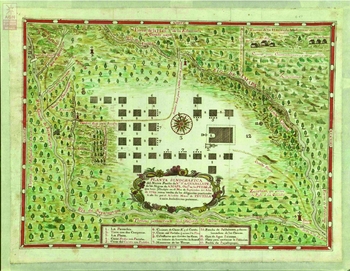
In February 1770, Amapa's chief sponsor had a map of the town created (AGN, Tierras 3543, Book II, fs. 100–2va). Colonial urban images were a well-established pictorial genre by the time the Amapa map was produced, and based on the title of the document, it was an iconographic plan, or planta ignografica. These ground maps typically required mathematical training and the use of survey instruments (Kagan Reference Kagan2000). While it is debatable whether the map was a representation of reality, it was unarguably a representation of power. The map was a representation of a dominant social and material reality which had specific consequences for Amapa's social relations (Coronil Reference Coronil1996). The plan illustrates rows of houses organized around a plaza, an administrative building, and a church (AGN, Mapas e Ilustraciones 280; see figure 1). The town was further systematized with labels as each structure had a specific function, i.e. house, or casa. This spatial layout was emblematic of the Spanish gridiron used in colonial urban planning. Architecture was the built image of civility and the Amapa reducción exhibited several unambiguous material markers: a church, a plaza and a civil spatial arrangement, the gridiron (Hale Reference Hale1994; Low Reference Low, Rotengberg and McDonogh1993). The 1770 map of Amapa represented the ideal reducción and the Maroons would be habituated into colonial urban life in and through this disciplined space.
Figure 1

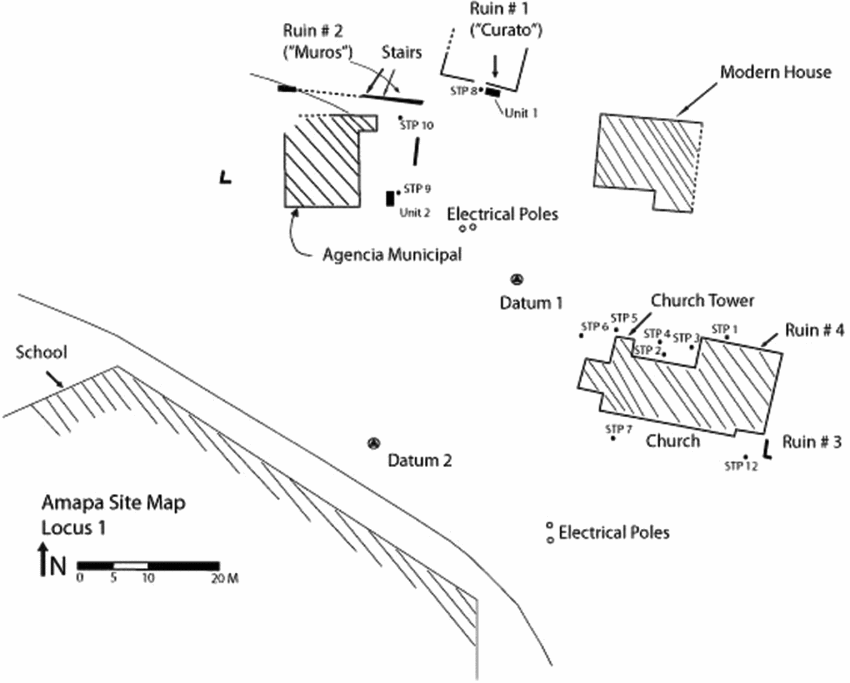
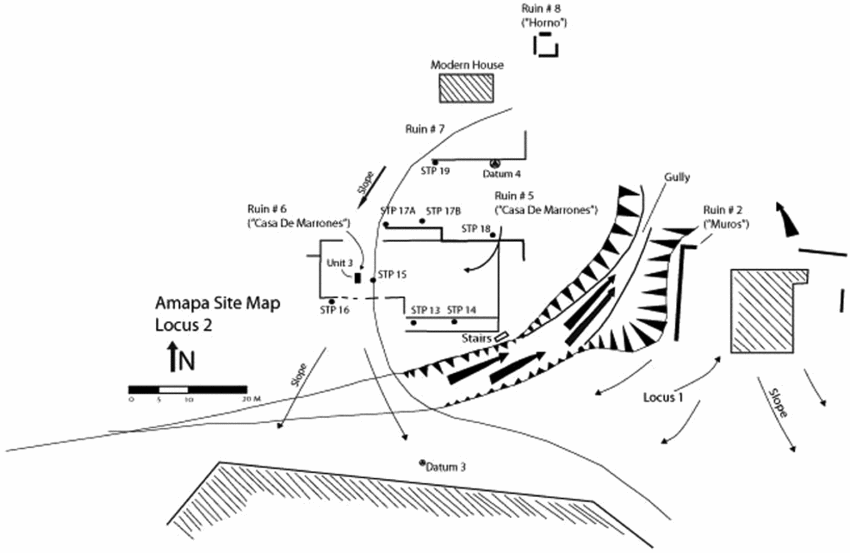
In 2013, archaeological investigations were carried out in Amapa.Footnote 5 The 1770 map was geographically referenced and tested, and excavations targeted the areas of the ‘ideal’ town as depicted by the map. This idyllic town was the starting point and base for comparison to the ‘lived town’ which would be exposed archaeologically. The Amapa historic site was divided into two areas, or loci. These loci reflect a geographical cut in the landscape, caused by erosion, which splits the zone in which the historic town was constructed into two foothills. Today, the area where historic Amapa was constructed is intermingled with Republican-period (post-1821) above-ground ruins and contemporary houses that were built around these ruins. Amapa's ruins coincide with areas where the reducción was constructed, according to the map. Nineteen 50 × 50 cm test pits were placed decisively in and around the historic ruins. Three 1 × 2 m excavation units were placed near test pits that had significant artefact yields or were significant segments of the ideal town (see figures 2 and 3).
Amapa site map, Locus 1 (map produced for the author by James Wallace).

Amapa site map, Locus 2 (map produced for the author by James Wallace).

Unit 1 was placed immediately outside the facade of a ruined structure erected above the town's foundation-period administrative house. The unit was excavated 35 centimetres below the surface and produced a mid- to late 19th-century trash deposit that was nestled between an assemblage of collapsed materials and a natural sandstone floor. Unit 2 was excavated within a ruined structure that was constructed above the foundational plaza. While the test pits in this area evidenced soil disturbance, it was important to test a larger area given the idealized and concrete centrality of the plaza. The larger unit confirmed heavy disturbance as a result of historic architectural collapse and recent construction activities. Unit 3 provided the first evidence of prolonged and intense settlement in Amapa. The unit was excavated within the ruins of a Republican-period house that was erected above foundation-period houses. The unit was 75 centimetres deep with seven separate occupation levels dated to the mid- to late 19th century. The majority of ceramic fragments excavated from this unit were locally produced coarse earthenware and common lead-glazed vessels. Mass-produced pottery formed a smaller portion of the assemblage and included Mexican majolica and English as well as other unidentified European refined earthenwares. Majolica vessels were limited to Unidentified Polychrome Majolica and Tetepantla Black on White, both produced in Mexico during the 1800s.
No excavation unit produced conclusive material evidence from Amapa's foundation period or from the colonial period in general. Test pits located around the northern periphery of the present-day church, which coincides with the area immediately outside the foundation-period church entrance, may have produced the town's earliest materials. Test pits 1 to 3 and 6 had shallow deposits approximately 13 centimetres in depth with exclusively locally produced unglazed coarse earthenware domestic pottery and an absence of mass-produced objects. Based on this absence, these occupation levels likely recorded the earliest historic-period activities at the Amapa site, or possibly foundation-period.
The lack of foundation-period materials excavated from Amapa in 2013 can have several straightforward explanations. The 1770 map is not a representation of Amapa's foundation-period spatial and material composition, for example. The material absence can also speak to erosional processes and taphonomic destruction. Some of the areas sampled through test pits did evidence considerable erosion. Another explanation is one of sampling. The 2013 excavations simply missed colonial-period and foundation-period deposits, but these occupation levels can still be encountered within the ideal town.
However, it is important to carefully consider the potential significance of absence in Amapa's archaeological record. All units and test pits were positioned within marked areas of the ideal town, or areas where domestic and public architecture were depicted on the map. The sparse locally produced domestic ceramics encountered in the area outside the foundation-period church suggest that the Maroons who settled Amapa did not use this area regularly, nor for strictly religious purposes. The absence of foundation-period materials from Unit 3, and from the STPs in this vicinity, similarly denotes that the first settlers did not engage in daily domestic activities in the areas in which these were meant to transpire. The 2013 evidence raises questions about the efficacy of colonial civilizing programmes, at least in the areas that were tested, as well as common understandings of Maroons. Amapa's thin archaeological record must be explained in relation to Maroon and Spanish colonial material and spatial practices.
Colonialist spatial and material conceptions
Local colonial officials in Veracruz produced the natural landscape in terms of broader segregations of space and spatial practice. Under Phillip II, various legal instructions for urban planning were codified in 1573, in The Ordinances for the Discovery, New Settlement, and Pacification of the Indies (Kinsbruner Reference Kinsbruner2005). According to the Ordinances, cities and towns existed at ground level and consisted of inhabitants engaging in their determined roles. Towns materially and spatially produced, structured and enabled these determined roles. Towns also ordered people by linking them to governmental and ecclesiastical structures (Morse Reference Morse and Hardoy1975). These settlements also ordered expansive space as one major city was hierarchically envisioned with several lesser replicas. In Europe, urban living and civility were entwined at the beginning of the 16th century, and Spanish colonial towns were synonymous with civility and order. According to the Ordinances, ‘places of great elevation’ were perceived as impractical for civic development. Empty of enlightened urban development, Spanish colonials estranged ‘unusable’ spaces from official political and material infrastructure. Spanish colonialists did not typically explore and certainly did not populate space that was sensed to be unworkable. Consequently the negative Spanish colonial fantasy of the backwoods simultaneously validated law and was validated by law.
Mountains and jungles were among the spaces unsuitable for urban development and were spaces colonialists readily associated with Maroons. Similar to Gaston Gordillo's (Reference Gordillo and Stoler2013) assessment of the Gran Chaco region of colonial Argentina, colonialists in New Spain viewed the far-flung spaces associated with Maroons as a void representing the palpable limits of conquest. These were not only the uncharted fringes of Spanish colonization, but also the edge of colonial deductions as reason morphed into sweeping imagination. Bloodthirsty Maroons, along with bizarre creatures and witches, ironically inhabited these uninhabitable voids. Maroons therefore embodied disorder as they were dislocated from their appropriate enslaved place and inhabited disordered spaces. Though in practice these spaces were only among the places Maroons inhabited, Spanish colonialists could not conceptualize Maroons inhabiting places that were a part of the rational colonial configuration.
The distinction colonialists made between urban and rural marronage also exposes their simple understandings of social and spatial geographies. In mid-19th-century Havana, for example, officials primarily preoccupied themselves with rural, as opposed to urban, marronage because it was reportedly more disruptive to the plantation economy (Deschamps Chapeaux Reference Deschamps Chapeaux1983). However, the urban–rural Maroon dichotomy was illusory since ‘rural’ marronage was sustained by networks between free blacks and slaves living in Havana. Maroons were so commonplace and extensive that Havana was called a true palenque (ibid., 54). In 1728 the governor of New Orleans complained about the large Maroon population that blended into the city (Dawdy Reference Dawdy, Pierce and Rao2006), and even earlier, in 1602, colonial administrators in Veracruz began to document the need to capture ‘the black Maroons that tend to come to the old and new city of Veracruz’.Footnote 6 The reality of a metropolitan palenque, as opposed to one simply located in a natural, remote environment, challenges colonial notions of Maroons, as well as our present-day academic understandings, which has constructed them as occupants of geographical margins such as swamps and jungles.
Maroon studies and the paradox of inaccessibility
Maroon studies have expanded our insight of these social formations with critical ethnographic, historic and archaeological studies (e.g. Deagan and Landers Reference Deagan, Landers and Singleton1999; Thompson Reference Thompson2006; Price Reference Price1983). The archaeology of marronage was developed in the 1950s and 1960s, and through a combined analysis of material assemblages and historical documentation, studies have shown that these groups were cosmopolitan associations with multiple, shifting, political ties to other colonial groups (Agorsah Reference Agorsah, Ogundiran and Falola2007; Allen Reference Allen and Funari1998; Baram Reference Baram2012; La Rosa Corzo Reference La Rosa Corzo, Curet, Dawdy and La Rosa Corzo2005; Ferreira Reference Ferreira and Marshall2015; Orser and Funari Reference Orser and Funari2001; Kusimba Reference Kusimba and Marshall2015; Marshall Reference Marshall and Marshall2015; Ngwenyama Reference Ngwenyama2007; Sayers, Burke and Henry Reference Sayers, Burke and Henry2007; Sayers Reference Sayers2014; Weik Reference Weik1997; Reference Weik2012). Archaeological studies of Maroons have nonetheless been few since many Maroons formed small nomadic groups whose intention was to be materially imperceptible, making them difficult to detect with conventional archaeological approaches (Norton and Espenshade Reference Norton and Espenshade2007), and established themselves in places seemingly as inconvenient for archaeologists as they were for colonial officials (Weik Reference Weik2012; Baram Reference Baram2012)
Although an aim of Maroon scholarship has been to present these groups ‘on their own terms’ by providing an emic perspective at the expense of the European or colonial one (Price Reference Price1996, 5), a view of Maroon communities as perceived from the outside, using a dominant colonial discourse and understandings of space and place, has unwittingly been maintained. Despite the important revelations that have resulted from Maroon scholarship, a depiction of Maroon groups as socially connected but geographically disconnected persists. The notion of Maroon groups’ geographical ‘remoteness’ has yet to be deconstructed and ‘inaccessible’ areas, such as swamps and mountains, continue to be listed as a prime characteristic of these social groups (e.g. Agorsah Reference Agorsah1994; Heuman Reference Heuman1986; Pérez Reference Pérez2000; Pike Reference Pike2007; Price Reference Price1996; Campbell Reference Campbell1990; Lockley Reference Lockley2009; Roberts Reference Roberts2015; Smith Reference Smith2008; Thompson Reference Thompson2006).
The British anthropologist Edwin Ardener points out that while there are unquestionably topographical features that are important in the notion of remote places, topography is not the principal feature. A paradox of remoteness is a one-way invisible barrier. While, from the outside, ‘remote’ places are perceived as inaccessible, such inaccessibility might not be borne out from the inside looking outwards (Ardener Reference Ardener and Chapman1989). Maroon groups’ spatial experience and daily negotiation of ‘remote’ terrains, while colonial officials remained estranged from these places, is what enabled them to prevail. Maroon groups have been geographically essentialized and binding Maroons to a specific and uncritical view of space has ultimately restricted our understandings of this colonial social category. Instead of being fixed in space, Maroons were existentially and, because of their very essence, ontologically mobile. Maroons’ social geographies in colonial Veracruz forces scholars to reassess the temporal, spatial and conceptual boundaries constructed for Maroons. Maroon lifeways, including those practised in a geographically accessible colonial town, challenge forthright understandings of Maroons and geographic space.
Maroon spatial and material conceptions and practices
When colonial administrators in Veracruz began to recognize the failure of their military campaigns against Maroons, they resorted to strategies of intelligence gathering that anticipated, however clumsily, modern forms of counterinsurgency. Veracruz officials became interested in collecting data and transforming culture into strategic knowledge that could be applied instrumentally to suppress resistance. In 1752, colonial officials began to systematically interrogate apprehended Maroons instead of relying exclusively on military attacks. This tactical shift set in motion Amapa's foundation nearly 20 years later.
Colonialists implemented the interview stratagem on three occasions. In the first instance, authorities questioned Maroons who willingly surrendered themselves to the Córdoba church (AGN, Indiferente Virreinal, Caja 2506, Exp. 002, fs. 70va). In 1760, an armed conflict took place in the Mazateopan mountains within a Maroon group that split politically. The victorious faction, the old, or antiguos, signed over the defeated new faction, or nuebos, to Córdoba authorities, who then interrogated the group (ibid., fs. 86). Many of the future founders of Amapa were involved in this battle as members of the triumphant old faction. Lastly, colonial administrators investigated Maroons in 1762 during the first organized attempt to reduce the future Amapa residents (ibid., fs. 118).
The process of disclosure took the form of question and answer, or declaración. The practice of recording declaraciones was an established legal practice in colonial New Spain. However, the interrogations enumerated above marked the induction of a more qualified and quantified manner through which to approach marronage in central Veracruz. Córdoba officials instituted a set of questions that included inquiries into the demographics and location of Maroon settlements. Declaraciones ultimately charted marronage and the answers given by Maroons speak to a radical difference in spatial consciousness and practice in comparison to colonialists.
In 1760, the defeated Maroon faction revealed that a palenque was in fact an expansive place that encompassed various physical and social terrains, connecting places that were typically perceived as antithetical. Estanzuela, a nearby cattle hacienda, was one place that constituted the Maroons’ larger geopolitical landscape. Maroons reported working a few days a week at Estanzuela and having an amicable relationship with its owner. Other Maroons testified to travelling directly to the hacienda, where they encountered palenque members who introduced them to the extended Maroon spatial world. In 1762, Maroons revealed that the proprietor of Estanzuela also owned the mountains where they established their palenques. Amapa was in fact constructed approximately 35 kilometres north-east of Estanzuela and the Maroons continued their social and political ties to this establishment after the reducción. Sanctioned and unlicensed colonial spaces were practised in consent in other colonial settings, and plantation-owner support of marronage has also been noted in Cuba (La Rosa Corzo and González Reference La Rosa Corzo and González2004). The relationship between Maroons and the plantation was always political, although not always pacific, as Maroons also raided plantations for provisions and potential members (Price Reference Price1996; AGN, Indiferente Virreinal, Caja 2506, Exp. 002, fs. 20–22va). The plantation was perhaps also a symbolic part of Maroons’ social landscapes as a site of commencement. According to a Saramaka Maroon from Surinam, the plantation was the place where their backs were first broken (Price Reference Price1983).
Many of the Veracruz Maroons also mentioned parajes, places or spots, in their interviews. Maroons testified to arriving first at the paraje Mandinga or Palacios, where members of the Maroon group again met them. Maroons also reported that their fishing, hunting and planting grounds were detached from the places they regularly resided in. These places reported by the Maroons suggest that there was no direct route from hacienda to palenque and that a palenque was a geographically disarticulated place. A palenque was both bordered and borderless as it was composed of socially and politically connected segments, each with decipherable spatial limits and practices, though they were not geographically contiguous. Moreover, their palenques were pliable as Maroons attested to their ability to vacate portions of their extended built environment when they were under threat by Spanish officials. Borrowing from Alfred Gell, a palenque was a distributed landscape, or a spatially and temporally dispersed social and geographical terrain formed ‘by historical accretion (and deletion) via a network of social relations’ (Gell Reference Gell1998, 221). A Maroon distributed landscape was not unique to colonial Veracruz and this notion has been hinted at in other colonial contexts in which Maroons’ extensive spatial practices spanned colonial borders (e.g. dos Santos Gomes Reference dos Santos Gomes2002) or were partly determined by kinship (e.g. Handler Reference Handler1997).
Scholars of Amapa have disregarded the variation of places mentioned by the Maroons, including Estanzuela, parajes, and palenques (Carroll Reference Carroll1977; Corro Ramos Reference Corro Ramos1951; Naveda Chàvez-Hita Reference Naveda Chàvez-Hita and Cáceres2001; Pereira Reference Pereira and Agorsah1994; Proctor Reference Proctor2010). Although clearly these places were interdependent, the parajes and palenques have been collapsed into one simple settlement in the mountains and the role and importance of ranches and haciendas is completely omitted. The Maroons who finally settled Amapa circulated across an extended geographic region that included the present-day borders of three Mexican states – Puebla, Oaxaca and Veracruz – as well as a variety of spaces, both colonial and anti-colonial. Before the reducción, the Maroon group testified to life in a mountainous palenque, parajes by the cattle hacienda, and even military quarters in the port city of Veracruz (AGN, Tierras 3543, Book I, fs. 1; Indiferente Virreinal, Caja 2506, Exp. 002, fs. 123).
What is profound and insurgent about Maroon spatial practice is that it typically took place within sanctioned colonial space and it reshaped built environments through practices that were illegible in Spanish colonial geographies. Spanish colonialists did not have the conceptual framework to conceive and consequently acknowledge the actual spatial practices of Maroons. Maroon spatial practices were unthinkable and acknowledging these would entail collapsing colonial ontological foundations that organized the world and its inhabitants (Trouillot Reference Trouillot1995).
An anthropology of absence
Instead of impulsively viewing presence as something material and palpable, the dearth of foundation-period artefacts excavated in 2013 can suggest the routine conservation of a Maroon way of life. While the Amapa reducción was not located in the remote mountains and its inhabitants were no longer legally Maroons, officials nevertheless protested that ‘the black vecinos of said town Amapa, still conserve their depraved customs’ (AGN, Tierras 3543, Book III, fs. 10va).Footnote 7 The sparse material evidence excavated from Amapa does echo the limited artefacts reported on other Maroon sites (Chowdhury Reference Chowdhury and Wilson2014; La Rosa Corzo Reference La Rosa Corzo, Curet, Dawdy and La Rosa Corzo2005; Deagan and Landers Reference Deagan, Landers and Singleton1999; Sayers, Burke and Henry Reference Sayers, Burke and Henry2007; Weik Reference Weik2012). The lack of conclusive evidence of a colonial urban presence, as expressed by the lack of, and shallow, colonial-period deposits, perhaps suggests that the Amapa residents’ widespread social and geographic scope pre-reducción was among their ‘depraved’ customs. Perhaps Amapa was only one of the places its residents inhabited and this explains the lack of foundation-period materials encountered in 2013. The lack of evidence of colonial urban settlement can also represent an aggressive absence (Fowles Reference Fowels, Bille, Hastrup and Sørensen2010) that records a manifest rejection of that which is not present, namely colonial ideological norms and their material correlates. Or a practical, lived critique of colonial ontology.
Absence can influence perception and provoke thought (Bailey Reference Bailey, Renfrew and Morley2007; Fuery Reference Fuery1995). Those who perceive absence will draw understandings about what is lacking, often interpreting what is absent as more important than what is present (Bailey Reference Bailey, Renfrew and Morley2007). Absence is also notable in Amapa's documentary record, as the perceived absence of civility and continued presence of Maroon practices governed outsiders’ perceptions of the town. In 1776, the district's new executive officer charged Amapa for its ‘bad mode of government’,Footnote 8 and compiled a case to extinguish, or extinguir,Footnote 9 Amapa, which included testimonies from political officials, neighbouring residents and priests (AGN, Tierras 3543, Book III). Witnesses accused Amapa residents of material and moral ruin, citing in particular that its church was ‘very deteriorated’ and in a ‘miserable state’.Footnote 10 Another witness added that Amapa's church had ‘more the appearance of a room for beasts than a place where the holy sacrifice of Mass is celebrated’.Footnote 11 According to witnesses, the town's collapsed architecture was due to Amapa's residents’ derelict work ethic and to having ‘no other devotion than to the drink’ (ibid., Book III, fs. 20).Footnote 12 Although intoxicating drink was distinctly prohibited at the time the town was founded, witnesses reported that alcohol was both sold and consumed in Amapa (ibid., fs. 4va). Even Amapa's chief patron, Otañez, felt that his project had collapsed, and to combat the town's decadence he petitioned the viceroy to allow any race, or casta, to live in Amapa (AGN, General de Parte, Exp. 75, fs. 48).
While Amapa's initial archaeological investigations provided evidence for the minimal use of the town, the accusations of moral and material disorder were not materially validated. Chaotic material assemblages or large quantities of durable alcoholic receptacles were not encountered, for example. Nevertheless, six years into the social experiment to transform a group of Maroons into Christian political subjects, the project had failed from the outside looking in and the inhabitants of Amapa remained Maroons. The marked difference of the Amapa Maroons is not singular. In the early 20th century, for instance, outsiders marked the distinction of a black Seminole group in the Bahamas based on their migrant and enigmatic ways (Howard Reference Howard2002). Present-day Maroons in Jamaica are also marked by difference, or by debate over and the search for palpable difference by their larger society (Bilby Reference Bilby2005). Critics reported that Amapa was geographically distant from other colonial centres, which echoed the ‘remote’ descriptions of palenques. But, more importantly, outsiders constructed alterity in Amapa using townspeople's specific bodily, material and temporal characteristics. Amapa residents were not fixed to their town, either through their participation in sanctioned regional politics, investment in municipal architecture or residence. These characteristics were also noted in official, white terms as the witnesses were either peninsular Spanish men or Creole men of Spanish descent who lived in administrative ‘centres’, the majority holding civil or religious positions.
The social and material practices developed by the Amapa residents under marronage were racialized, naturalized and read on the bodily practices of the Amapa residents by their critics. ‘Identity’ did not prove fluid as Amapa's neighbours did not allow the residents of the town to regenerate themselves from the perceived ruins of marronage. The practices of the Amapa residents were surely unlike those of their neighbours and differences were likely palpable to both groups. But Amapa residents were unlikely to have understood these social and material divergences as their critics did. Three of Amapa's political representatives, including an individual who was a Maroon corporal before the reducción, in fact gave practical explanations in response to the accusation of bad government. They did not, for example, attend the induction of the new executive officer since they did not know the exact date of the event and bad weather kept them from visiting the political centre afterwards (AGN, Tierras 3543, Book III, fs. 2). Their responses to the accusations of incivility were either never recorded or never requested.
While Maroons were officially criminal and ordinarily viewed as ‘savages’, they had a distinct view of this legal and social category. The individuals who were interviewed by colonial officials, including founders of Amapa, testified that abuse motivated their decision to flee (e.g. AGN, Indiferente Virreinal, Caja 2506, Exp. 002, fs. 131, 132va, 135va, 148). What Fellows and Delle (Reference Fellows, Delle, Funari and Orser2015) term spatial sovereignty in addition to the command of one's own body in space was fundamental to the interviewed Maroons. For those interviewed, marronage meant the freedom to control one's body in space by overthrowing the command wielded by owners and overseers who overworked, and irrationally applied violence to, slave bodies. To quote Fernando Manuel, ‘as long as treatment on the sugar plantations lacked the equity demanded by prudent and Christian consideration . . . and while the neighbouring mountains continued to exist, there will always be black fugitives’ (AGN, Tierras 3543, Book I, fs. 102v–103).Footnote 13 The sign of alterity in Amapa was that settlers continued to practise the spatial and corporal power that was fundamental to their experience as Maroons and which possibly included non-traditional settlement patterns.
Conclusions
Although Amapa's material record is unsettled, its residents did not simply cease to be Maroons after inhabiting the flat lands of a Spanish colonial town. Not only do material cultures shape social categories, or they are intended to (Card Reference Card2013), but social categorizations also shape material cultures. Critics of Amapa perceived a disjoint between the people who resided in Amapa and their material setting, and consequently objected to the town's existence. The novel attempt to purge colonial society of Maroons and the reducción itself failed as a result of colonialists’ resolute associations between perceived biological race and colonial spatial and material practices. To outsiders of Amapa, the Maroons were unfruitful entities and the reducción could therefore never succeed despite having sound material foundations.
While the absence of foundation-period materials suggests that the Maroons did not use the town's space as colonial officials calculated, how the Maroons actually did inhabit and shape Amapa is unclear. If the town was used in alternative ways by the Maroons, in contrast to colonial prescriptions, then all test pits and units, which were positioned within marked areas of the ideal town in 2013, would have clearly missed foundation-period occupational levels. Amapa's second archaeological field season will therefore focus on how the Maroons may have structured their material and social practices within Amapa. The subsequent field seasons will target the potentially autoconstructed (Holston Reference Holston2008) areas of Amapa by testing the spaces between the officially constructed expanses of the town.Footnote 14 Rather than reinscribing Maroons in colonial Veracruz with the roles of rebels or pawns, the region's documentary and archaeological record presents an opportunity to examine Maroon groups as self-constructing architects of a colonial built environment, as people constructing their histories within a world of power they did not completely control, but whose limits they nonetheless partially integrated.