There is a global concern about the environment in current times. In the wake of climate change risks, there is a growing debate about the role of the state and non-state organisations in tackling the problem at hand. Due to the nature of the environmental concerns, large-scale efforts are expected out of nations and organisations. However, common people also find solutions to tackle environmental degradation around them. The focus of this article is on understanding how common people react to environmental degradation. Any response to environmental degradation, pollution, or similar issues might require expert knowledge to untangle the scientific or descriptive nuances of the problem and its solutions (Fischer, Reference Fischer, Boström and Davidson2018, p. 261). Even when many concerned individuals do not necessarily possess this body of knowledge, they are many a time successful in reclaiming the ecological value of the concerned environment. There are many examples of decentralised, democratic social movements driven by common people that enhance or protect the ecosystem or environment in a successful manner. This article is an attempt to understand these efforts through three such cases from India. The article uses the intellectual category of property rights to explain the actions of individuals involved in improving the quality of the environment. There is ample evidence to suggest that the nature of property rights plays an important role in degradation of the environment (Hardin, Reference Hardin1968, p. 1245). There are many theories which suggest solutions to the problem of environmental degradation and pollution by focusing on property rights. It is interesting to observe how common people, who are not especially trained as environmental lawyers, economists, or sociologists, attempt to heuristically follow the path of valuing the environment in the face of ecological crisis and develop a negotiated solution to mammoth-scale environmental problems. To unravel the aforementioned negotiation, this article attempts an analysis of three cases from India where three environmentally different types of common pool resources are successfully managed by following a few nuanced property rights-based strategies. These cases deal with three unique ecosystems, offer three diverse situations, and thus were chosen to deduce theoretical insights.
The article in the following sections attempts to analyse the theoretical background of property rights vis-à-vis the environment, and subsequently explain the process of individual/group action towards environmental governance. Section 1 starts by detailing some of the ways in which property rights are thought about in legal and economic literature. The literature covered is not exhaustive as the article does not focus on the theoretical debate on property rights. Rather, the purpose of this exercise is to develop a working understanding of how property rights over environmental goods are thought about in legal and economic literature, and to understand the problems or prospects of property rights-based approaches to improve environmental quality. Sections 2, 3, 4, detail the three cases one by one to collate important observations to make deductions about the nature of heuristics attempted by lead individuals.
In the latter half of the article, the nature of qualitative negotiation over property rights is analysed to observe whether actions by individuals in the interest of environmental improvement align with the theoretical solutions suggested.
1. Property rights and environment
While social scientists and legal experts have spent a lot of time and effort to understand the relationship between property rights and governance of the environment, individuals in their local setting do not necessarily have these insights readily available to them. However, for us to make sense of individual heuristic efforts towards the betterment of environment, we need to situate their actions within the framework provided by these very experts. The purpose of this section is to analyse these frameworks and construct ideas for answering the following questions:
-
1. What do economics and law suggest about the role of property rights in the governance of the environment?
-
2. What solutions do economics and law suggest for governance of the environment?
-
3. Do individual actors or group of volunteers follow some of these solutions based on property rights in the social process of improving environmental quality? If yes, how and to what extent?
To unravel the first two questions, this section focuses on the relationship between property rights and governance of the environment from legal and economic perspectives. The third question takes us to the three case studies in the following sections.
Within the legal sphere, a well-accepted approach to think about property rights is the “Bundle of Rights” approach. This approach has developed over the centuries through contestations over rights in the legal realm. Therefore, the development of Property Law has contributed immensely to this particular way of thinking on property rights. The “Bundle of Rights” approach “is an abstract notion that analytically describes property as a collection of rights vis-à-vis others, rather than rights to a ‘thing,’ like a house or a piece of land.” (Johnson, Reference Johnson2007, p. 247). The “Bundle of Rights” approach is grounded in the structural analysis of rights by W.N. Hohfeld and further developed through the work of A.M. Honoré, which unravelled the various fragments inherent in the concept of ownership. Hohfeld’s analysis enabled scholars to think about rights in terms of correlative duties. It also enabled scholars to break down rights and duties into constituent fragments.
Hohfeld constructed an elaborate scheme of ‘jural relations’ in which ‘right’ and ‘duty’ are jural correlatives, so that in order to establish a ‘right’ (as opposed to some other, lesser, interest) one must be able to identify some corresponding duty that someone else possesses. In Hohfeld’s system, to claim that an industrial facility has a right to emit noxious substances into the air would necessarily be to claim that others have an enforceable duty not to interfere with their polluting activity. A legally enforceable right presumes a corresponding legally enforceable duty. (Cole and Grossman, Reference Cole and Grossman2002, p. 318).
An important characteristic of the legal concept of property rights, in general, emerges naturally here through Hohfeld’s system, which indicates that the important question dealt by judges would more often than not be around the permissibility of interference in anyone’s property. The predominantly negative duty (non-interference)-based nature of rights in law is inherent in the Hohfeldian understanding. This will create limitations on the legal approach when it comes to addressing acts such as cleaning the environment. The only legal way to approach this would be to search for legality and enforceability of prohibiting all polluting activities. This leads us to think about the predominant legal way of dealing with environmental governance with respect to property rights. The negative duty-based conceptual framework ensures that if enjoyment of property rights leads to environmental damage, the remedy is to regulate property. Hohfeld had a similar understanding of law in general which is reflected in the following passage:
Hohfeld maintained that the answer to the question (about permitting interferences in property) did not follow from any logic inherent in the rights themselves; rather, whatever policies society decided to promote dictated the answer. He wanted ‘to highlight and clarify the social and political dimensions’ that underlie legal decisions that recognize, or fail to recognize, a privilege or a right in any person. Put another way, his method of analysis exposed that the legal rules surrounding property are not a matter of neutral deductive reasoning that followed from the fact of ownership itself, but from a policy determination forced by a conflict between competing interests. (Johnson, Reference Johnson2007, p. 251).
Thus, if society and politics want to promote environmental value, law will adapt to generate a balance between individual rights and the requirements of the society from an environmental perspective. Property may get regulated in this process. We do see traces of these ideas in environmental law. A legal understanding of environmental goods, and rights over environmental goods, may similarly be seen in a more nuanced way. “From a doctrinal perspective, property rights largely fall within the realm of private law, and contemporary environmental law is more aligned with public law, albeit with some elements of private law” (Grinlinton, Reference Grinlinton2023, p. 202). Individual owners of any resource may be regulated by law to have certain duties associated with the use of that resource based on an understanding of environmental law.
(P)roperty rights were never ‘absolute’ and it was understood that they must give way to current social needs and imperatives. These include the specific rights of neighboring owners, planning laws and environmental protection measures imposed in the interests of society at large… (Grinlinton, Reference Grinlinton2023, p. 204).
One example of this could be environmental regulations and laws, which limit the use of designated areas as protected forests, and in the process, curtail the rights of original individual inhabitants and other individuals to these designated areas.
This regulation of property further leads to thinking about property in the form of “bundles” to identify which bundle is leading to environmental damage. Regulation of property to promote social or environmental value from a legal perspective will require a balancing act between competing claims and that in turn requires “smaller parcels” of property rights. A much more detailed analysis of “bundles,” as attempted by Honoré, sheds more light on the sub-constituents of the overall “right to property.”
In the early 1960s, A. M. Honore wrote an essay on ownership in which he attempted to list the incidents of ownership that have come to be known as the bundle of rights. Honore claimed that his list of incidents of full ownership were “common to all ‘mature’ legal systems” (Johnson, Reference Johnson2007, p. 253).
Honoré’s “Bundle” included “the right to possess,” “the right to use,” “the right to manage,” “the right to income,” “the right to capital,” “the right to security,” “the right to transmissibility,” “the absence of term,” “the prohibition of harmful use,” “Liability to execution,” and “Residuary character” (Johnson, Reference Johnson2007, p. 253). These constituents of the “Bundle of Rights” over property indicates the more qualitative nature of looking at property in legal thought as opposed to the more efficiency-related concerns in economic thinking which focused on the physical allocation of property initially.
This inherent flexibility in the legal concept of property rights, emanating from the need for resolving competing claims over the years, provides an important qualitative nature to the legal notion of property. This intellectual and practical flexibility is utilised later by economists such as Elinor Ostrom when thinking about governing environmental resources by introducing the category of Common Pool Resources. A legal understanding of property as a bundle of rights comprising various subsets of ownership in the form of use, claim, management, and disposal provide for possibilities of regulation of usage of property in the real world. This flexibility makes it possible to even think about ways in which people who do not have a right to exclude others from consumption (the economic way of thinking) might still influence ways in which the property in question is being used, by emphasising their particular “bundles.”
Property Rights are important intellectual tools in Economics too. “… (A)ssumptions of well-defined property rights underlie all theoretical and empirical research about (well) functioning markets…when rights are not clearly defined, market failures result. The meaning of property rights is, thus, central to the language of economics” (Cole and Grossman, Reference Cole and Grossman2002, p. 317). The economics fraternity has tried to reason about the definition of property rights early on with “Alchian (1965) and Demsetz (1967) each… (noting)… that social consent and concomitant duties of noninterference are central to the definition of property” (Cole and Grossman, Reference Cole and Grossman2002, p. 322). Even when their point of view is somewhat wider, a dominant view in economics has been towards thinking of property in terms of the ability of the owner to “exclude others” from privately owned goods. It is only after the acceptance of club goods and common pool resources that economic thinking is infused with a wider understanding of property (Ostrom, Reference Ostrom2010, p. 23).
Initially in economics, there was a twofold distinction between goods/property. “In his classic definitional essay, Paul Samuelson (1954) divided goods into two types…Pure Private goods and Public Goods” (Ostrom, Reference Ostrom2010, p. 2). Later, James Buchanan added another category of “Club Goods” in 1965 and Elinor Ostrom and Vincent Ostrom added the fourth category of Common Pool Resources in the year 1977 (Ostrom, Reference Ostrom2010, p. 4). Thus, now in economics, there is a clear distinction of goods, with the help of the criteria of consumption, into four categories—private goods, public goods, common resources, and club goods (Table 1). This categorisation theoretically suggests different ways in which these goods can be efficiently produced and provided. Private goods can be produced and sold by private players (or individuals), as it is possible to price these goods. Public goods need some form of state or a third party, as pricing is a problem because of the existence of free rider problem. The category of interest for this article is common resources, wherein lie most environmental goods. If there is any improvement in the environment, all will share its consumption, and usually it is not possible to exclude anyone from enjoying it. The possibility of rivalry and non-exclusion in consumption is an important characteristic of environmental goods. It is possible to consume these resources without obstacles, but production (or improvement in quality) is not completely appropriable. Private effort guided only by pecuniary interests will not work, as all players consume the improvements produced by one player.
Categories of goods in economics (Ostrom, Reference Ostrom2010 and Author’s compilation)

Most of our environmental resources can be thought of as an example of common pool resources. “Forests, water systems, fisheries, and the global atmosphere are all common-pool resources of immense importance for the survival of humans on this earth” (Ostrom, Reference Ostrom2010, p. 5). Clean air, ground water table, forests, and beaches are all non-excludable from consumption of those people who choose to consume. This means that it is either impossible or extremely expensive to device exclusion mechanisms, as all players own these resources. On the other hand, consumption of these resources is rival in nature meaning others cannot consume that one unit that is consumed by any one person. If I pollute a unit of clean air, others cannot consume it anymore as clean air. The challenge of managing environmental resources arises from the nature of their consumption. The “Tragedy of Commons” is a natural extension of the nature of environmental goods (Hardin, Reference Hardin1968, p. 1245). No one has the incentive to manage these resources, and everyone has the possibility of making private gains; thus, extraction is fast-paced in the absence of proper management, and the quality of the resource degrades.
There are four theoretical directions for managing common pool resources in economics literature. One set suggests the involvement of the State especially based on the idea suggested by A.C. Pigou of internalising external costs by taxing the consumption or production of goods generating negative externalities (Mankiw, Reference Mankiw2018, p. 196). Another set of theories find place in the “Tragedy of Commons” literature, which suggests that in the absence of private property rights, commons will face degradation. To counter degradation, one needs to create private property rights, which in turn will create necessary incentives for private players to manage their portion of common in accordance with their private benefits (Hardin, Reference Hardin1968, p. 1245).
Hardin’s brief article crystallized the modern interest in the characteristics of commonly-held resources; while Ostrom’s ‘Governing the Commons’ responded that the commons need not be tragic at all, particularly in cases in which a community can manage a commons of limited scope (Rose, Reference Rose2020, p. 557).
Ostrom suggests that rule-based collective action can lead to management and/or governance of Commons for local communities. With respect to governance of Commons, Ostrom’s approach is one of the most developed and widely adopted approaches. This approach is also important from the perspective of merging of the legal “Bundle of Rights” approach to property and the widened perspective of economists with respect to property. Ostrom suggests the following five property rights that individuals using a common pool resource may have:
(i) access—the right to enter a specified property, (ii) withdrawal—the right to harvest specific products from a resource, (iii) management—the right to transform the resource and regulate internal use patterns, (iv) exclusion—the right to decide who will have access, withdrawal, or management rights, and (v) alienation—the right to lease or sell any of the other four rights (Ostrom, Reference Ostrom2010, p. 11).
Another theoretical direction is that of the Coase Theorem, which suggests that if parties associated with pollution/source of external cost can internalise the external cost, then efficient allocation can be achieved without troubling third parties. “With regard to externalities, economists often point to Coase’s famous theorem that holds that when there are no transaction costs, problems of externalities can be overcome through bargaining, independent of the initial distribution of property rights” (Herzog, Reference Herzog2021).
In all these theoretical directions, the State, Market, and Community as the solution provider is dominating. Pigou’s approach favours the State, “Tragedy of Commons” approach favours privatisation, Ostrom suggests the key role of community, and Coase beckons us to design Markets. However, environmental problems and their solutions are both becoming increasingly complex and interwoven with many layers of players and causal factors. In such a scenario, intermixing of roles of the three super players, i.e. State, Market, and Community should ideally present better results.
An economic understanding of goods/property provides us with the knowledge of the difficulty in the production and maintenance of common pool resources at the level of the individual, and the legal understanding of property provides us with possibilities in which property can be moulded into smaller parcels of rights for management. The economic understanding can be termed as a quantitative approach, as it concerns itself with production in an efficient manner, and the legal understanding can be termed as qualitative in approach as it provides the ability to balance private and public benefits from the use of property. On the one hand, the economic approaches discussed in the earlier part of this section offer their counterparts in the legal and policy realm. For example, the Coase Theorem-based understanding of solutions for environmental problems as negative externalities, suggests the creation of markets for negative externalities. Carbon trading is a policy tool developed from that approach. On the other hand, the legal approach provides the ability to look at smaller bundles, like carbon emerging from a property, and think about their allocation. Thus, economic thinking is useful in producing solutions, but the nature of these solutions seem to be conducive for quantitative allocation. The “Bundle of Rights” approach provides the theoretical feasibility of qualitative change in the usage of property. This specific ability is important for environmental governance of property.
Therefore, to answer the initial two questions raised at the beginning of this section, we can observe that environmental law and economics, both suggest that property rights are important in governance of the environment. Environmental law assigns property rights to environmental resources in varied formats through various principles like res communes (common to all) and res nullius (property of no one). Similarly, Economics divides environmental goods into the category of common property resources and open access resources.
Environmental law attempts to resolve environmental issues by regulating private property more often than not. It restricts the “right to use” of private players to promote public good or it stops division of property to protect its social/environmental value. “Bundle of Rights” approach helps environmental law in thinking about various bundles to promote these solutions. There are principles like “public trust doctrine” and “polluters pay principle,” which are the bedrock of environmental jurisprudence, which have property rights as its core intellectual tool. Economics also similarly suggests ways in which environment can be protected or improved by exchange of property rights or governance of property rights.
We can observe from the discussion above that economists desirous of understanding the nuances of property have utilised and enriched the “Bundle of Rights” approach further. When we look at property as a “Bundle of Rights,” comprising of various kinds and degrees of rights, we are able to focus on factors beyond quantitative allocation of property rights. The sheer vastness of most environmental and ecosystem-related property resources ensures that there are multiple right holders with varied levels of rights. Thus, the interdisciplinary approach of looking at property in a detailed fashion through the lens of “Bundle of Rights” is going to be useful in understanding any heuristics applied to improve environmental outcomes.
How do our individual actors respond to this? The next three sections attempt to observe the qualitative/quantitative change in property rights, when individuals attempt to improve the quality of environment around them. The objective of this exercise is to understand the process of this change around property rights over environmental goods/resources.
2. Versova: Beach clean-up
The beach clean-up in Versova was initiated by a young lawyer named Afroz Shah and his elderly neighbour Harbansh Mathur in the year 2015 (UNEP.org, 2016). He involved local fisher folks also in the clean-up, and slowly a lot of volunteers joined in the effort to clean up the beach. The movement became a successful volunteering activity, and thousands of people including students, celebrities, and public figures contributed in cleaning up the beach. Many other similar volunteer-driven clean-ups have started taking place in many other parts of Mumbai and elsewhere. This beach clean-up has also inspired plastic ban in the state of Maharashtra, as plastic is the most dominant beach pollutant. So far, the Versova Beach clean-up has resulted in picking up 4000 tons of waste from the 2.5 km-long stretch of the beach (UNEP.org, 2016).
The method used by Afroz Shah and his neighbour is remarkably simple. They initiated the clean-up by simply picking up and discarding the waste material from the beach one piece at a time. Later, Afroz started involving more people in the act by talking to the local community by visiting their homes.
Afroz, being a lawyer himself, could have chosen to involve the judiciary and seek a government-led resolution for the beach clean-up. But he stated that people’s involvement is important to improve the environment. Afroz says that “(T)his problem of pollution is created by us. … If this huge ocean is in a problem, we will have to rise up in huge numbers.” (Toner, Reference Toner2019).
In India, the National Green Tribunal (NGT) has been very active in matters related with pollution and environment. It has taken on the mantle of deciding upon cases related with environment in a fast-track manner. Various Public Interest Litigations (PILs) and NGT decisions have led to development of a very sound environmental jurisprudence in the country (Gill, Reference Gill2014, p. 185). But, even after that it has been observed that the nature of judicial intervention is limiting, as it does not necessarily lead to resolution of pollution-causing factors on ground. We might try to develop a legal right to environment, but there is going to be limitation of the courts in implementing the duty related with that right. “It appears that the aspirational right to environment through judicial interpretation may only ascribe a value or status to an entitlement which may or may not be implemented” (Gill, Reference Gill2014, p. 195). Afroz seems to have some inkling of this understanding when he impresses above that participation by people in huge numbers is the way out to resolve the environmental problem faced by the beach ecosystem around Versova Beach. The following statement provides another important insight into his thought process:
Beaches are like nets. They trap the plastic. The ocean is telling us, ‘Take it – take it away.’ So, as the beach gets clean, the ocean is also getting clean. There’s a dual purpose. Volunteers who come to pick up are also getting trained to handle plastic. Anybody who sees plastic here will not buy plastic later. They’ll say, ‘No, no we don’t want this! We had to clean up so much!’ So, it’s creating awareness. (Toner, Reference Toner2019).
In the statement above, one can observe the thought process followed by Afroz. He has, with his action-led thinking, identified the crucial environmental role played by the common property resource in question. The beach here is observed as a filter or net for the ocean, and he is involving volunteers not only to clean the beach but also with the intent that once they clean a beach, they will understand the functioning of the beach–ocean relationship and will not indulge in creating plastic pollution. A nuanced understanding of the common pool resource has taken place via the action-oriented approach of this team, and a qualitative negotiation with interested volunteers and other public is underway by demonstrating an alternate usage of the common property resource to improve its quality.
Afroz further observes that “(T)here is a difference between sitting within closed spaces and making policy decisions for an environmentally sustainable future and actually going to the ground, digging your hands in dirt and separating plastic from sand. I chose the latter,” (Chatterjee, Reference Chatterjee2017). One can observe here that he is choosing action on the ground over policy-making, to create a difference in the quality of environmental resources. It seems that the choice of Afroz and the team in going with volunteering-based on-ground cleaning emerges from the will to tap into the usefulness of this approach over the policy/judiciary-based approach in terms of creating awareness and training on the ground for thousands of volunteers. In this process, the “right to use” bundle is getting qualitatively improved or negotiated.
Two additional points that need to be emphasised upon with respect to the Versova Beach clean-up are as follows:
-
One, the start of the cleanup is individual led but quickly gets converted into a volunteers led activity as the task is mammoth. Afroz, set up a volunteer organization initially with 40 volunteers from the local community and later utilized social media to attract more like-minded people into the clean up by sharing the updates of the cleanup. People contributed by volunteering their labor and or by providing resources like Indian film celebrity, Mr. Amitabh Bachchan contributing machinery to the clean-up campaign.
-
Two, even the Local Municipal Corporation joined in the act. BMC provided their labor and other resources in the cleaning process. This indicates the state is also joining the clean-up activity. Something that judicial intervention might have induced, germinates organically by the pressure of public participation.
Afroz expresses his views about property rights over the beach and ocean in a speech given at Earth Optimism Summit, 2017. About the pollution at the Versova Beach, he says that:
…as a lawyer should I go to the High Court and invite the chief justice or should I complain on the social media and invite the attention of the world…or…do what I thought I was very competent to handle…(i.e.) wear your gloves and go on the beach… it’s my planet, it’s my neighborhood, it’s my beach, it’s my ocean… (Smithsonian National Museum of Natural History, 2017).
It is evident in the emotional speech here that Afroz has a sense of ownership of the beach even without any legal entitlements. He is using his “right to access,” “right to use,” and “right to manage” bundle of rights in a qualitatively different manner. In general, individuals think of common pool resources in a similar fashion. However, the major difference in Afroz’s thinking is that he owns the common pool resource not just for consumption but also to care for it and manage its quality. The mere “usage right” can be scaled up to a “management right,” if the value system at individual level is in alliance with environmental concerns.
Another important fact about the volunteering efforts of Afroz and his fellow environmentalists is that the focus is not just on cleaning solid waste; one of their aims is also to train people in handling plastic pollution and creating awareness about the circular economy. Afroz, in one of his tweets, claims to have trained hundreds of thousands of people in handling plastic pollution and circular economy. Volunteering, thus, is generating clean beaches, trained human capital, and environmentally conscious leaders to tackle the problem of climate justice and other environmental issues.
For the Versova Beach case, one can observe that the entire beach front was meeting a fate predicted by the “Tragedy of Commons” approach, wherein the beach was being utilised by individuals as a dump yard. When Afroz and Harbansh initially start their acts of cleaning, they are looking at the beach as a potential common pool resource providing a variety of ecosystem services and not just as a parcel of land, which is used for throwing their garbage. This intellectual act is the key difference between them and others and is potentially the harbinger of the mammoth volunteering task initiated by them. They are in this process converting the lost quality of the beach. The beach, in the process of being polluted, lost its quality of being a common pool resource. The acts of Afroz and his neighbour initially, and a larger community later, are restoring this lost quality by cleaning the beach in small parcels, respectively. A transition in the quality of the property of course is taking place via the ability of volunteers to have the “right to access.” This “right to access” was earlier being used to pollute, and it is now being used to clean. When instances of the “right to access” for cleaning are greater than for polluting, there would be growth in cleanliness. There is a transformation in the quality of “right to access” which is leading to a transformation in the overall property regaining natural stature as a common pool resource and providing various ecological services. The negotiations, transformation, bargain, etc. that take place in the process are at the level of transforming the quality of the “right to access” the property. A qualitatively better “right to access” bundle is generating a qualitatively better “right to use” bundle and a “right to manage” bundle.
3. Laporiya village: Water conservation
Laxman Singh of Laporiya village in Rajasthan has over the years created an environmental movement of improving availability of water for the villagers by organising collective action involving the local community. This is another interesting case where the local community has been successful in improving the environmental quality of the common pool resource. In this case, the concerned common pool resources are the ground water table and pastures of the village Laporiya. The main motive with respect to this conservation activity is to generate a reliable supply of water for irrigation and drinking purposes so that the local community does not need to migrate.
Even after receiving very less amount of rainfall, this village is not deficient in water resources, as they have utilised water conservation and controlled consumption to tide over this natural water scarcity (Civil Society Online, 2023). This village, over the last three decades, has managed its pastures by utilising the technique of chauka Footnote 1 system, which entails digging shallow rectangle/square holes in the ground to allow for the seepage of rainwater into the ground. This activity along with planting of trees has enabled the village to increase the ground water levels and has ensured constant availability of grass for their animals (Civil Society Online, 2023). Many nearby villages have also adopted the same system to manage their water availability.
The ingenuity of the chauka system needs to be underlined. It ensures that the village pastures do not get converted into water bodies and are still used for recharging ground water. The shallow holes ensure water is captured and percolates to the ground water table, while maintaining space for grass to grow. This system ensures efficient utilisation of pastures for both the main requirements—water recharging as well as availability of grass for animals (Civil Society Online, 2023).
We wanted a system that would not just trap water but also promote microbial activity that would make the topsoil rich. Every year fresh grass should grow. Every year the ecosystem should go through its cycles. Every year our animals should get fresh grass to eat. Cows and goats eat different kinds of grass. Birds and butterflies draw on different kinds of flowers. We wanted all this diversity to continue, says Laxman Singh (Civil Society Online, 2023).
The pursuit of villagers to protect their livelihood has led to a solution which is quite nuanced and generates maximisation of biodiversity variety given the local environmental constraints. One can observe here again that the villagers led by Laxman Singh have tried to understand the nature of the common pool resource and utilised their access to the commons to alter the way they use this resource, thereby leading to an improvement in the quality of the common resource or rather restoration of the common pool resource.
One important aspect of the collective effort of this community of Laporiya village is that the coming into force of this mammoth task has taken place in an organic manner. Almost three decades ago, Laxman Singh started off this movement by repairing a water-harvesting structure and later few people joined him, and when villagers saw these few people (6–7) working tirelessly towards doing something which will benefit all, more people joined in the effort. “As the movement gained momentum, more people started joining the cause…an organization (Gram Vikas Navyuvak Mandal) was formed by motivated individuals to encourage people to offer Shramdaan and improve the village’s condition” (Government of India, 2020). It is important to note the word Shramdaan which is a Hindi word and means “donation of physical labour.” This can be seen as synonymous with volunteering. In this case also, one can see the importance of volunteering. Villagers are volunteering their time and effort to improve environmental outcomes by directly helping manage a common pool resource via some agreed technique and rules. The common pool resource is to be used in a particular way, and villagers are helping in creating chaukas, which will improve the quality of two common pool resources—the pastures and the underground water table. One can see the existence of a negotiation that is taking place where villagers are agreeing to use the pastures in a particular manner and helping in restoring their ecological value so that better quality resources can be enjoyed by all. A qualitative negotiation has taken place over how to use the common property resource.
In the process of creating various water-harvesting structures in the village with the active, voluntary, and physical involvement of villagers, there is also taking place a lot of learning of conservation activity. This learning is an important part of the overall negotiation where villagers are bidding with their action and volunteering for improving and managing the quality of their common pool resources. A transfer of this learning is also successfully taking place to nearby villages via word of mouth, visits to the village, and water conservation padyatras Footnote 2 organised by Laxman Singh. Many villages in Rajasthan have adopted these practices to improve the quality of their common pool resources.
The ideation process (for water harvesting) developed and experimented in a small village has been transmitted to 58 villages which have their own success stories. The positive externalities are enjoyed not only via knowledge sharing but also water sharing. Excess water conserved is shared with neighbouring villages (Jain and Jain, Reference Jain and Jain2020, p. 541).
In the case of Laporiya village, a few individuals led by Laxman Singh initially tried to improve the quality of the water table by creating a few structures on the common land. They are later joined by many of the remaining villagers, who eventually might have agreed to the use of common land for creating the ground water recharging structures. Negotiation is again taking place via action related with conservation, and those who agree are joining the movement via Shramdaan. While all the villagers earlier were using “commons” for their own individual purposes, the intellectual act of Laxman Singh and a few initial volunteers attempting a heuristic of improving the quality of the common pool resource has led to a change in the quality of usage of “common” towards conservation activity. “Chauka are implemented on common grazing land, and also specifically addressing the unique low slope and saline conditions of this Salt Lake region of Rajasthan” (Everard and West, Reference Everard and West2021, p. 80). In the case of Laporiya, this qualitative change eventually leads to a nuanced design of water conservation structures. There is low rainfall in the region, villagers also need common land for grazing, and thus very deep structures would not be ideal. They thus design the chaukas which are shallow and lead to two improvements in the environment; first by slowing down the pace of water flow and thus recharging ground water and second, as the structure is shallow, grass grows once water percolates thereby providing nutritious grass for the animals reared by the villagers. There are certain rules in place for this system to work successfully.
A participatory approach that seeks to provide for local needs is an important aspect of chauka design, maintenance and consensual agreements about use to optimize benefits for the community as a whole. Agreements include leaving cow dung in situ to rebuild organic matter and nutrient content, refraining from grazing the chaukas for one-and-a-half months following the monsoon to enable the grass to flourish and produce seed, promotion of native trees, and annual maintenance to which every villager contributes (Everard and West, Reference Everard and West2021, p. 62).
It can be observed that the “common pastures” are being governed under a rule-based system. The “right to access” bundle, the “right to use” bundle, “the right to income” bundle, are all getting transformed under a collective “the right to manage” bundle.
This qualitative change is so pronounced and useful that many other villages also adopt (thereby join the negotiations) the practice developed by the villagers of Laporiya. A small parcel of common land was worked upon by initial volunteers, when others agreed with this qualitative change, they worked upon other small parcels of land, thereby leading to most of the common land of Laporiya coming under some sort of qualitative change in terms of usage. Later, when other villages also observed and agreed to this qualitative change, more and more parcels of common land across villages came under change in quality of usage.
4. SAI Sanctuary: Creating a forest
Another relevant example from India is that of a couple (Anil Malhotra and Pamela Gale Malhotra) creating a first-of-its-kind Private Forest Reserve in the Kodagu district of the Coorg region in the state of Karnataka. Starting in 1991, the couple bought 300 acres of denuded coffee and cardamom plantations in southern Kodagu, in Karnataka, and has turned it into a wildlife sanctuary under the Save Animals Initiative (SAI) trust. This private wildlife sanctuary uses green energy systems (solar panels and windmills) and has eco-friendly buildings (Nandakumar, Reference Nandakumar2016). In one of the interviews given by Mr. Anil Malhotra to a media outlet in India, he expressed his thinking process behind this initiative. He said that “(R)ich corporate and individuals can do their bit to prevent an impending freshwater crisis by simply buying land and allowing it to grow into a natural forest” (Nandakumar, Reference Nandakumar2021).
Anil and Pamela started off their private forest sanctuary by buying out land from private individuals who were finding it difficult to maintain the commercial plantations which existed there earlier and had loans to pay off to banks. Anil who had some amount of experience in real estate business carried out the legal transfer of the property and chose the trust-owned method, as there are limits to the amount of land that can be owned by a particular person or family in the state of Karnataka. They also chose to buy a piece of land, which was in a secluded and far off place, as it offered more value for money at the time of purchase. Another condition they had in mind was the availability of a fresh water source, which was essential for the development of the overall forest ecosystem with freshwater playing an important part in attracting and sustaining wildlife, which in turn is essential for regeneration of the forest. This couple, in pursuit of building a private forest, ended up with a simple method of creating a big parcel of land. They asked the initial seller of 55 acres of land to connect them with other neighbours, and it so happened that these neighbours also had loans to pay off and/or were not finding it commercially viable to carry on with plantation activity.
As time went by, more and more people approached us to buy their lands. Virtually all the lands involved had been abandoned by their owners as ‘unproductive’. The funds we gave them for their parcels, in many cases, were reinvested in agricultural lands in drier, more productive areas of the district. Some former owners faced dire financial problems…the money given helped each of the previous landowners in their hours of need, while we were able to add more lands to our sanctuary for protection and preservation. (Malhotra, Reference Malhotra2022, p. 386).
They also incorporated an ingenious yet very simple method to release some of the government land which was encroached upon by some people.
In some cases, we gave individuals money for them to leave government lands they had illegally encroached upon, thereby giving them adequate funds to legally purchase land elsewhere. We never did anything to these newly liberated government lands, other than to protect them from fires, poachers, loggers, or any other illegal encroachers. In this way, nature could take her natural course in reforesting and rewilding them on her own… (Malhotra, Reference Malhotra2022, p. 386).
They chose to live within this private forest sanctuary by building an eco-friendly house and using renewable resources of energy like solar, wind, and hydro for powering the house. Their immense love, respect, and concern for nature is revealed by their acts, and it is evident that they derive more value from protecting nature than from commercial utilisation of this huge piece of land, as they have restricted agricultural activity for self-sustenance purposes only.
Their efforts have resulted in huge environmental benefits for the region. One study has estimated that local stakeholders (other plantations in the 5 km radius) are net beneficiaries and private stakeholders (SAI Sanctuary trustees and management) are bearing the net cost (especially via the opportunity cost of not using the land for agro-forestry) (Hounshell, Reference Hounshell2016, p. 243, p. 251). SAI Sanctuary also proved to be an important carbon sink.
For example, in 2015, SAI Sanctuary stored an aggregated 77,404.69477 metric tons of carbon dioxide in total… SAI Sanctuary not only acts as a carbon sink, but it also provides a range of ecosystem services while harboring biodiversity and producing natural capital. (Hounshell, Reference Hounshell2016, p. 249)
The SAI Sanctuary example represents a very different kind of approach as compared to the other two examples discussed earlier. Here, one can observe a private initiative towards management of environment as opposed to collective action in the other two cases. The uniqueness of this private initiative is not limited to the number of players; it is also unique, as it is creating an environmental common pool resource in the form of a contiguous patch of forest. This land was earlier used for coffee and cardamom plantation. By buying and pooling together this piece of land, and later reviving and replenishing it via a few interventions, such as planting native trees, they have succeeded in recreating a forest. In the process, many benefits such as carbon sinks, natural capital generation, knowledge generation for management of environment, are generated for everyone around.
For the SAI Sanctuary case, the property is regenerated via the mechanism of private property rights. One can witness an act of conservation being committed while creating a private forest reserve. One needs to imagine what this private forest reserve would be like without the couple buying the entire land parcel and converting it into what it is today. It would be property owned by various people using it the way they deem fit, someone using it for agriculture, someone for recreation, someone keeping it fallow. And as these private parcels were owned individually, there was no way to find a solution via a Versova-type volunteering effort. This parcel of land would not be a contiguous forest with regenerative properties, providing the ecosystem services it is providing now to the community of humans, flora, and fauna of the region. The qualitative shift this time round is brought about by excluding others from deciding the fate of this parcel of land and reserving it as a private forest. Private property rights of various people have been converted into private property rights of a few and more importantly, the quality of the private property rights has changed towards conservation over extraction of any kind. Negotiation, bargain, transformation, etc. is of the right to private property in its full form (right to access, manage, transfer, sell, etc.), not any particular bundle, and the result of the negotiation is a change in the quality of the right to private property. An important observation to be underlined here is that even after a successful privatisation of an environmental resource (a quantitative economic type bargain), if the nature of usage and access is not changed in favour of environmental value generation by controlling how this piece of land will be used, the maximisation of generation of ecosystem services might not take place.
5. Characteristics of qualitative change in property rights
5.1. Motivation for heuristics
Many scholars, especially Elinor Ostrom, have identified that individuals who are attempting any governance of common pool resources may be thought of as following heuristics as the strategy (Ostrom, Reference Ostrom2010, p. 8). They are not completely rational and do not have all the information with them about various strategies and may be thought of as being “bounded rational.” Thus, they attempt trial and error and may keep improving their strategy as they move forward. To understand the motivation and causation behind qualitative change in property rights, we need to focus on the thought process behind attempting heuristics in the examples discussed so far. A traditional utility maximisation orientation as propounded in economic literature is probably not the ideal form for understanding heuristics. When trial and error is attempted, the costs of action and returns from such action are going to mismatch in such a manner that net returns many a times would be negative. One way to explain why people like Laxman, Afroz, and the Malhotras would keep attempting heuristics is to look at their actions from the perspective of volunteerism. Theoretical attempts to explain voluntary action tries to define voluntary action as acts that result in net costs for the actor (Handy et al., Reference Handy, Cnaan, Brudney, Ascoli, Meij and Ranade2000, p. 45). Our environmental actors who are restoring the quality of polluted common pool resources are similarly ending up probably with a net cost at their end. Monetarily, their returns are negative. The restored ecosystem service is not appropriated completely by them, as it is a public good with everyone else having access to it. “The individual motivation for reducing (environmental) problems is weak as gains of such actions are spread over many others, (also called) the…free rider problem” (Vatn, Reference Vatn2018, p. 171). Another way to understand the motivation for these heuristics is to assume that the goal of these attempts is to maximise environmental value. In environmental economics, there are well-developed concepts around environmental valuation. Environmental value is seen as a multidimensional concept and incorporates use value, non-use value, and existence value as well (Costanza et al., Reference Costanza, de Groot, Farberk, Grasso, Hannon, Limburg, Naeem, Paruelo, Raskin, Suttonkk and van den Belt1997, p. 255). The efforts of our volunteers may be compensated for by the environmental value that these efforts generate in the process of conservation and development of environmental property/goods.
5.2. Process of qualitative change
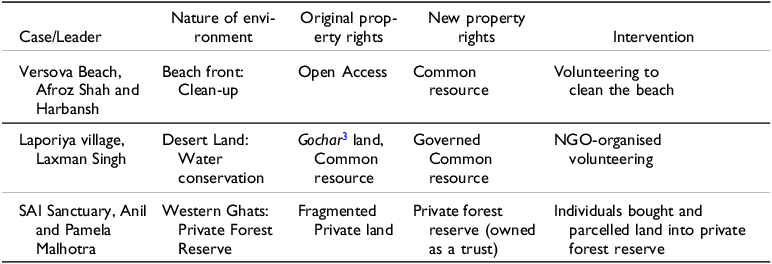
Another point to focus on is the process of qualitative change (Table 2). The bargain or negotiation over how to use the degraded or polluted piece of land is taking place amongst the various people who have access to it. For the private reserve, it is a simple Coasean bargain. The Malhotras value private property more than others, and they end up buying the private property rights to the forest and are now utilising it as a private forest reserve. However, in the overall management of the reserve, they will be facing a situation of net costs. Their act is characterised by voluntarism, as they are bearing the opportunity cost of not making use of the ecosystem services monetarily; they are not appropriating the pecuniary value by converting the private forest into a mindlessly commercial ecotourism site. They are using it only to an extent that they are able to compensate the cost of maintaining the property with no expectation of financial returns (Malhotra, Reference Malhotra2022, p. 495).
Qualitative change in the nature of property rights (Author’s compilation)

In the case of the Versova Beach, the bargain is more interesting, as it is completely open-ended. All the various people who use the beach in various forms are part of the bargain. Initially, when Afroz and a few others start the voluntary acts of cleaning, they kick start the process of bargain. These acts of individual volunteers cleaning the beach are like bids. They demonstrate that a small portion of the beach is now clean (Lack, Reference Lack2022, p. 537). When people stop dirtying that clean portion or when they join in as volunteers, they agree with Afroz, Harbansh, and other volunteers with respect to the use of the beach as a common pool resource with potential ecosystem services rather than as a garbage bin. This bargain via voluntary acts of cleaning transforms how people look at the beach. It is a long-term and arduous bargain where a continuous stream of voluntary action, communication, awareness creation, demonstration, etc. establishes the best possible use of the property as a continuous common pool resource in place of segmented, smaller parcels of land used as dustbins.
Imagine if Afroz and the team wanted to clean up with the purpose of making a beachside hotel or any other similar personally beneficial usage. There would be immediate resistance or if not resistance, nonparticipation, and the bargain would stop. The long-term bargain is somewhat successful, because of the voluntary acts, acts that have net costs on actors. Over the three years, an increasing number of volunteers are joining the volunteering effort (Lack, Reference Lack2022, p. 550). They share the net cost of volunteering effort as they agree with using the beach for its all-glorious environmental quality.
Thus, one can observe that the process of qualitative change in property rights is important for successful environmental governance. If property rights are used to pollute, then that leads to degradation. On the one hand, qualitative change in the bundles of property rights in the wrong direction converts common pool resources into lower-quality property. On the other hand, qualitative change in bundle/s of property rights in the right direction symbolically or physically converts the one-dimensional usage, i.e. polluting, to a variety of usages and restores the symbolic private parcels back to a full-fledged common pool resource. Property rights emerge when property becomes more valuable than before, and the returns are more than the cost of creating and upholding property rights (Demsetz, Reference Demsetz1966, p. 64). In the cases discussed in this article, a qualitative change is taking place in property rights, and the value and returns created are not pecuniary but environmental.
5.3. Property rights at the centre of heuristics
Another characteristic of this qualitative change is that it does not use any one formal rule or law to undertake this transformation. There are various ways through which property rights can be generated, examples include mixing labour with the property or by possession of a property (Rose, Reference Rose1985, pp. 73–74). The way players in each case use their varied degrees of ownership rights (from mere access to management to absolute ownership) is an indication of the nature of these properties. Versova Beach’s mammoth volunteering effort, Laporiya villagers’ nuanced effort, and SAI Sanctuary’s sacrificial effort are all like an indication to other users about the nature of property in question. It is an indication of how the property is to be used. Property rights are attempted to be established by using language or signs, like keeping a chair in a parking slot to claim the ownership of the parking slot (Rose, Reference Rose1985, p. 81). In this voluntary action, physical labour and similar actions are being used to show how to use this property.
The rights of individual players to use common property resources in a certain manner are getting altered in all three cases discussed so far. What matters for a better environmental outcome is not just how property is owned physically, but also how it is used. Privatisation might not lead to the restoration of the environmental function of a common pool resource, as that can only be done by restoring the common pool resource as a common pool resource, in its size, scale, and function. Environmental resource may be owned privately or collectively, but its sustenance requires that it be managed and used in ways that respect and promote the environmental function of the resource. Usage rights, a particular bundle of the entire gamut of property rights, are being negotiated to transcend the environmental resource towards better quality even when the resource is privately owned.
5.4. Interweaving of theoretical approaches: Coasean bargain, Hardin’s privatization thesis, and Ostrom’s rule-based governance
How are individuals faring with respect to this social process of finding a negotiated usage of property rights over environmental resources? Is their bounded rationality and heuristic approach mimicking some of our legal, economic theoretical solutions? This section tries to develop an answer to these questions.
There are famously two ways in which a bargain can take place in the absence of transaction costs to internalise external costs:
-
1. Polluter Pays—polluter pays to keep polluting.
-
2. Pollutee Pays—pollutee pays the polluter to stop polluting (Deryugina, Moore and Tol, Reference Deryugina, Moore and Tol2021, pp. 85–86).
One possible variation that can be seen to be operational in a few of the cases discussed is where both Polluter and Pollutee pay—both types of parties bear costs of cleaning the environmental common resource in question.
In the case of the Versova Beach front clean-up, the polluters are not localised in any one area, but the pollutees are localised. In the case of the Rajasthan village Laporiya, polluters and pollutees are localised and are generally from the same village. (Pollution here is thought of as extraction beyond bearing capacity of the ecosystem). In the case of the SAI Sanctuary, polluters are localised (pollution here is converting more and more land into agro-forestry and agriculture) and pollutees are spread out in the entire region. Private property rights over fragmented pieces of land have now been converted into private property rights over a contiguous piece of land. The change involves both ownership of land, and how the land is owned. In this transformation, quality of usage is changing. The nature of the bargain that is taking place does not necessarily involve trading property rights, but at times just a change in the quality of the property right. This bargain is taking place at a micro level, but huge groups are involved in iteration at a macro level as well.
Volunteers involved in the act of cleaning can be polluters and/or pollutees and thus the cost of volunteering represents some cost on both types of property rights holders. Thus, both are paying in some form or the other. Those who are not volunteering and are polluters might still end up paying a little bit. One example is where, in the case of SAI Sanctuary, plantation owners saw increased costs because of increased wildlife visits (Hounshell, Reference Hounshell2016, p. 240).
Engaging more and more people into volunteering generates some sort of network effect and is going to disperse the cost being borne by a few and will also increase the likelihood of more equitable distribution of cost between polluters and pollutees. Coasean bargains at the level of groups can be counterintuitive, as a larger number of players translates to larger transaction costs and the probability of successful bargain reduces. Dixit and Olson argue that even for large number of players, bargains are possible:
While it is admitted that transaction costs will increase when the number of people in the group impacted by the externalities or served by the public good are large, the argument is that in Coase’s idealized world of zero transaction costs, efficient outcomes can be achieved no matter how large the numbers. Thus, Coase’s argument applies to public goods for large numbers as well as to local externalities (Dixit and Olson, Reference Dixit and Olson2000, p. 309).
Additionally, if welfare losses due to pollution are more burdensome than transaction costs to the potential participants, then there exists ground for them to initiate these impossible-looking bargains as they would end up in some sort of a beneficial position even after investing a lot of time, energy, and resources to the acts of volunteering. They might value better environmental resources (including non-use value of environment) more than the higher transaction costs.
The act of volunteering is very important in this overall bargain. In all three cases, volunteering is central to establishing this successful bargain. Afroz Shah–Harbansh, Laxman Singh, and Anil–Pamela are epitomes of volunteering, as they are individuals with huge net costs in these three instances. Many other volunteers join in, directly or indirectly, this cause of environmental protection, especially in the Versova and Laporiya example. Volunteering helps mitigate transaction costs, leading to the development of a central theme for interaction amongst the individuals involved. These individuals are working like a community to mitigate the problem at hand at all costs. Anil and Pamela, even when they are creating a private forest, seem to be thinking like a community or for a community in their efforts towards creating a contiguous forest. This forest provides the benefits of a common pool resource, even under private ownership and management. Thus, the environmental benefits are public, while costs are mostly private. This community-based volunteering effort is the central force behind successful qualitative bargains between polluters and pollutees and leads to a qualitative change in the way property rights, either private or collective, are used to extract from the common resources. In a way, the qualitative Coasean bargain is leading to the kind of rule-based collective governance that Ostrom is suggesting in her work.
The qualitative Coasean bargain in these cases as elucidated in the section above is taking place at the micro level. Cleaning of the beach, management of the gauchar, and construction of the private forest takes place not in one go, as a collective, but slowly, piece by piece, involving probably not all parties in one go, but a few players for that particular micro template of property. This part of the bargain successfully reflects the privatization thesis presented by Hardin as a solution of the “Tragedy of Commons.” The volunteering-induced qualitative change over usage is taking place in small parcels via changes in the “right to access,” “right to use,” bundle of rights as per the privatization thesis proposed by Hardin. Later, the formation of a community of environmentally minded, “bounded rational” individuals are protecting these, now clean small parcels by accessing their “right to manage” bundle to promote rule-based governance as per Ostrom’s thesis. These two subparts of the process, collectively, are leading to an overall successful bargain (Coase) over how these common pool resources will get allocated. Therefore, an intermingling of theoretical directions is observed in the heuristic attempts of individuals in pursuit of environmental governance. Heuristic individual efforts are seen to be in accordance with multidisciplinary theoretical solutions developed by experts, if the overall template of these efforts are analysed through a qualitative lens.
6. Conclusion
The aim of this article was to understand and observe how common people tackle environmental degradation around them. To understand these attempts, the intellectual category of property rights is focused upon. In this article, three instances are discussed where, despite the property rights-based complexity, the quality of the environment was restored. The enablers of this process were heuristic strategies followed by individuals, and a decentralised understanding of property rights. These strategies resonate with theoretical frameworks suggested by experts. As environmental value becomes important, property rights over environmental goods are being qualitatively restructured. The flexibility provided by the legal understanding of property rights as “bundles of rights” helps in observing these qualitative changes. Economists have also incorporated changes in their analysis of property rights by adapting the “bundles of rights” approach. In this article, it has been argued that common people follow heuristic strategies to generate environmental value by qualitatively altering “bundles of rights” over common pool resources, open access resources, and private property, alike. In this process of environmental upgradation, the motivation of these common actors is explained with the help of volunteering. They are ready to bear net costs to improve environmental quality, which they cannot even appropriate completely for themselves. In this process of negotiating the quality of property rights, heuristic strategies adopted by common people are found to be analogous to the theoretical possibilities suggested by experts for better environmental outcomes.
Acknowledgements
The author would like to acknowledge the fruitful discussions with Dr. Indrani De, Prof. Jaivir Singh, and Dr. Aloke Prabhu that have helped in carrying out this research. The author would also like to acknowledge the contribution of constructive comments received from anonymous referee/s in improving this article. The author is grateful for the guidance and support provided by the editorial team of Asian Journal of Law and Society.