Introduction
The decline in physical functioning associated with aging constitutes a major threat to healthy and successful aging, disability-adjusted life expectancy, and health-related quality of life (HRQL) (Anand and Hanson, Reference Anand and Hanson1997). Many older people suffer from physical dysfunctions including pain, mobility impairment and lowered HRQL (Bergner, Reference Bergner1989; Stewart and King, Reference Stewart and King1991; Brown, Reference Brown1992; Rejeski et al., Reference Rejeski, Brawley and Shumaker1996; McAuley et al., Reference McAuley, Konopack, Motl, Morris, Doerksen and Rosengren2006b) that restrict independent living, even when such dysfunctions are not fatal (Fried and Guralnik, Reference Fried and Guralnik1997; Brach et al., Reference Brach, van Swearingen, Newman and Kriska2002). Because South Korea has the most rapidly increasing aging population in the world, healthy aging has been recognized as a national issue affecting the sustainable social structure of the country (Korea National Statistical Office, 2007).
The physical functioning of elders is related to such factors as age, sex, physical and psychological characteristics, diseases and living environment. In addition, discrepancies between the objective and subjective variables related to physical functioning should not be overlooked in determining the physical functions required for independent living for an individual or for a population. Subjective qualities such as sense of self-efficacy and confidence, and psychological factors that relate to participating in certain activities, have been underscored as influencing or interacting with objective dimensions of functioning (McAuley and Blissmer, Reference McAuley and Blissmer2000; McAuley et al., Reference McAuley, Konopack, Morris, Motl, Hu and Doerksen2006a; Filiatrault et al., Reference Filiatrault2007). In particular, gender differences have been considered to be major determinants of physical functioning because these differences are involved in both physical and psycho-sociocultural aspects of functioning (Arber and Cooper, Reference Arber and Cooper1999; Guallar-Castillón et al., Reference Guallar-Castillón, Sendino, Banegas, López-García and Rodríguez-Artalejo2005). However, such assertions remain controversial. Some studies have suggested that men have stronger perceptions of self-efficacy than women (Grembowski et al., Reference Grembowski1993; Bowling, Reference Bowling2007), but other studies have found no association between perceived self-efficacy and actual physical performance among either males or females (Seeman et al., Reference Seeman, Unger, McAvay and Mendes de Leon1999; Scholz et al., Reference Scholz, Dona, Sud and Schwarzer2002) Furthermore, among the subjective variables, confidence in being able to perform an activity may represent a crucial factor in assessments of geriatric problems and in plans for appropriate interventions because this factor plays a role in physical functioning and in falling (Hatch et al., Reference Hatch, Gill-Body and Portney2003; Brouwer et al., Reference Brouwer, Musselman and Culham2004; Salbach et al., Reference Salbach, Mayo, Robichaud-Ekstrand, Hanley, Richards and Wood-Dauphinee2006; Rejeski et al., Reference Rejeski2008). To date, the relationship between confidence and physical functioning, especially the extent to which this relationship might be mediated by gender, remains uncertain.
In this study we investigated discrepancies between subjective and objective assessments of physical functioning among Korean elders according to sex and age, and then examined the primary factors leading to these gaps or discrepancies. We hypothesized that women elders would experience larger gaps between subjective and objective measures of physical functioning; in other words, older women would report less confidence in their abilities to perform activities even when their objectively-assessed functioning enabled independent living.
Methods
Participants
This study was part of the Korean Longitudinal Study on Health and Aging (KLoSHA), which was designed as a population-based prospective cohort study of the health, aging, and common geriatric diseases in Korean elders aged 65 years or older, residing in Seongnam, Korea (Park et al., Reference Park, Soo, Jae-Young, Kwang-Il and Moon-Ku2007). The baseline study of the KLoSHA was conducted from September 2005 to September 2006. The total population of Seongnam was 931,019 in 2005, of whom 61,730 (6.6%) were aged 65 years or older. The KLoSHA subjects were drawn from two different cohorts: a random sample of those aged 65 or older and a sample of volunteers aged 85 or older. A simple random sample (N = 1118) was drawn from the roster of 61,730 persons aged 65 years or older residing in Seongnam on 1 August 2005, and all of the sampled subjects were invited via letter and telephone call to participate in the study. Of the 1,118 subjects, 714 agreed to participate in the baseline study of the KLoSHA (a response rate of 63.9%). Because information about the oldest Koreans is very limited, all residents aged 85 or older in Seongnam (N = 3166) were invited via letter and telephone to participate and 286 subjects agreed to participate in the KLoSHA. In total, 1,000 subjects participated in the KLoSHA cohort at baseline. All subjects were fully informed regarding study participation and they provided written informed consent themselves or through their legal guardians. The study protocol was approved by the Institutional Review Board of Seoul National University Bundang Hospital (SNUBH).
Measures
The baseline study of the KLoSHA focused on determining the prevalence of and risk factors for common geriatric disorders and on establishing a comprehensive database on the general health and functional status of community-dwelling Koreans elders. General health and functional status represented the major target health-related parameters of the KLoSHA; these parameters included such age-related phenomena as cognition and balance, health-related behaviors (e.g. exercise, diet, smoking, alcohol use, and leisure activities), health-related situational factors (e.g. socioeconomic status and social support systems), and subjective reports of health and functional status. In this study, we focused on the parameters related to physical functioning.
Mobility and Activity
The Activities-specific Balance Confidence Scale (ABC) was designed to evaluate confidence in activities related to balance (Powell and Myers, Reference Powell and Myers1995; Myers et al., Reference Myers, Fletcher, Myers and Sherk1998). Balance confidence represents an important assessment because the balance function is essential in daily activities. The ABC scale, presented in questionnaire format, includes 16 items representing basic tasks involved in daily living (walking around the house and going up and down stairs) and more difficult tasks performed in the community (walking in a crowded shopping center and using an escalator) (Jang et al., Reference Jang, Cho, Ou, Lee and Baik2003). Respondents provide ratings on a continuous scale from 0% (no confidence) to 100% (complete confidence) based on the following question: “How confident are you that you will not lose your balance or become unsteady when you [list of items]”. With its ability to represent various levels of difficulty, the ABC scale seems well-suited to assessing psychological constructs related to experiences with falling within populations with diverse levels of functioning, including high-functioning community-dwelling seniors (Myers et al., Reference Myers, Powell, Maki, Holliday, Brawley and Sherk1996).
The Performance-Oriented Mobility Assessment (POMA) scale, developed by Tinetti and first published in 1986, is a widely used tool for assessing mobility and fall risk in older people (Tinetti et al., Reference Tinetti, Leon, Doucette and Baker1994). The total POMA scale (POMA-T) consists of a balance scale (POMA-B) and a gait scale (POMA-G). The POMA-B leads the subject through positions and changes in position that reflect typical tasks related to daily activities. In the POMA-G, several qualitative aspects of locomotion patterns are examined. Each item is scored on a two- or three-point scale, resulting in a maximum score of 28 on the POMA-T, including maximum scores of 16 and 12 on the POMA-B and the POMA-G, respectively.
To assess limitations in activities involved in daily living, the Korean Activities of Daily Living Scale (K-ADL) was administered. This instrument, used for clinical purposes, was developed to measure the activities of daily living performed by elderly patients. It comprises seven items: dressing, washing (face and hands), bathing, eating, transferring, toileting, and continence (Won et al., Reference Won, Rho, Kim, Cho and Lee2002b). In addition, we used the Korean Instrumental Activities of Daily Living (K-IADL) scale to evaluate the range and level of daily activities. This measure consists of 10 items: grooming, performing housework, preparing meals, doing laundry, taking short trips, using transportation, shopping, managing money, using the telephone, and taking medicine (Won et al., Reference Won, Rho, Sunwoo and Lee2002a).
Pain-related disabilities
We used the WOMAC (Western Ontario and McMaster Universities) scale to assess disabilities related to lower limb functions. The WOMAC contains 24 questions presented in a self-administered questionnaire; the questions are categorized into three subscales (Pain, Stiffness, and Physical Function)(Bae et al., Reference Bae, Lee, Yun, Kim, Yoo and Kim2001). In this study, we used a five-point Likert scale format. Scores for each subscale were determined by summing the scores of the component items within that subscale (possible score range, Pain: 0–20, Stiffness: 0–8, Physical function: 0–68). The final total aggregated scores (possible score range: 0–96) were determined by summing the scores for each subscale. The Oswestry Disability Index (ODI) was used to evaluate the physical dysfunction caused by spine problems. This measure consists of 10 items that assess the level of pain and the degree to which pain related to spinal disorders interferes with several physical activities. Scores for each section can range from zero to five, with higher values indicating more severe impact (Kim et al., Reference Kim2005). The Disabilities of the Arm, Shoulder, and Hand (DASH) questionnaire was used to measure the functional status and symptoms associated with different degrees and levels of upper-extremity disability (Hudak et al., Reference Hudak, Amadio and Bombardier1996). The DASH questionnaire consists of 30 items, each of which has five possible responses. Twenty-one items ask about the degree of difficulty involved in performing different physical activities, six ask about symptoms, and the remaining three ask about psychosocial effects of spine problems (Lee et al., Reference Lee, Lim, Oh and Ko2008).
Psychological variables
The Korean version of the Geriatric Depression Scale (GDS-K) and the Hasegawa Dementia Scale (HDS) were used to assess depression and cognitive functioning. The GDS represents one of the most widely used instruments for screening elderly persons for depression (Montorio and Izal, Reference Montorio and Izal1996; Bae and Cho, Reference Bae and Cho2004). This scale involves a 30-item easy-to-administer inventory and has been widely used to assess elderly people residing in both communities and institutions, including hospitals and nursing homes. A simple memory scale, HDS (Hasegawa, Reference Hasegawa and Bergener1983) is a useful screening tool for dementia (Yang et al., Reference Yang2004). The highest total score on the HDS is 32.5, and the results are divided into four levels: those with total scores ranging from 31 to 32.5 are classified as non-demented (or normal); those scoring between 22 and 30.5 are classified as below-normal; those scoring between 10.5 and 21.5 are classified as having early dementia; and those scoring between zero and 10 are classified as having dementia.
Data analysis
We summarized descriptive statistics and independent-samples t-tests by sex according to demographic characteristics and measures of physical functioning. In addition, the correlations between the ABC and other variables were analyzed by Pearson's correlation coefficient. To assess the extent to which education, limitations in the activities of daily living (K-ADL, K-IADL), pain-related disability (WOMAC, ODI, DASH), balance (POMA), depression, and cognitive functioning (GDS-K, HDS) affected outcomes on the ABC, multiple linear regression models were built with scores on the ABC as the dependent variables. Statistical analyses were conducted using SPSS 15.0 (SPSS Inc., Chicago, Illinois). Factors affecting the confidence with which activities are performed were analyzed by sex and age.
Results
Physical functions
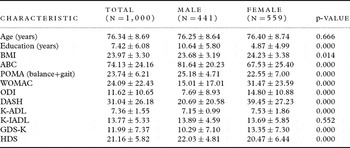
Measurements of demographic characteristics and physical functioning are summarized in Table 1, which shows mean scores by sex. Of the 1,000 participants, 559 were women and 441 were men. The average age was 76.34 ± 8.69 (women: 76.40 ± 8.74, men: 76.25 ± 8.64), and the population per age group was as follows: 531 respondents were aged 65–74 years, 167 respondents were aged 75–84 years, and 302 respondents were aged 85 years or older. Male elderly subjects tended to have more years of education, on average (women: 4.87 years, men: 10.64 years). The mean body mass index (BMI) was 24.23 ± 3.38 in women and 23.68 ± 3.19 in men.
Demographic characteristics and physical functioning by sex

Notes: p-value for Student's t-test between two groups; BMI = Body Mass Index; ABC = Activities-specific Balance Confidence Scale; POMA = Performance-Oriented Mobility Assessment; WOMAC = Western Ontario and McMaster Universities,; ODI = Oswestry Disability Index; DASH = Disability of Arm, Shoulder and Hand; K-ADL = Korean Activities of Daily Living Scale; K-IADL = Korean Instrumental Activities of Daily Living Scale; GDS-K = Korean version of the Geriatric Depression Scale; HDS = Hasegawa Dementia Scale.
The POMA mean scores for balance and gait were similar for women and men (women: 22.55 ± 7.00, men: 25.18 ± 4.71), whereas men had much higher balance confidence scores on the ABC than did women. The mean ABC score was 67.53 ± 25.40 in women and 81.64 ± 20.23 in men. Both POMA and ABC scores showed statistically significant differences by sex. The mean score for women in regard to pain-related disability was approximately twice as high as that of men. However, the mean scores regarding limitations in activities of daily living (K-ADL and K-IADL) did not show significant differences between women and men. Depression and cognitive functioning (GDS-K, HDS) were also significantly different between women and men.
The POMA and ABC
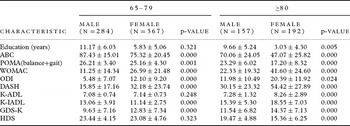
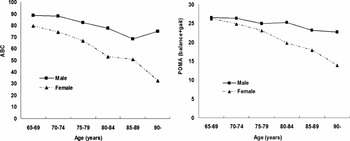
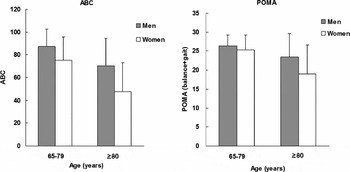
Scores on both the POMA and ABC tended to decline with age. However, we detected differences between scores on the POMA and on the ABC by sex and age (Figure 1). We found women and men under the age of 80 obtained similar scores on the POMA, an objective measurement of physical functioning. However, the POMA scores of women over the age of 80 were substantially lower than those of men. Results of the ABC, one of the subjective measures of physical functioning, showed significant differences by sex among those under the age of 80. In addition, scores on the ABC decreased greatly among women over the age of 80 (Figure 2, Table 2). We found that women under 80 years old had low confidence in regard to their balance during basic activities, even though their mobility functioning was nearly equal to that of their male peers. Women under the age of 80 could perform at nearly the same level as men in regard to ADLs and IADLs, but the level at which women performed ADLs decreased significantly more than did that of men among those 80 years old and over. Gender differences with regard to pain-related disabilities and psychological variables did not change significantly between the two age groups (Table 2).
Physical and psychological functions by sex and age (under 80 vs over 80)

Notes: p-value for Student's t-test between two groups; ABC = Activities-specific Balance Confidence Scale; POMA = Performance-Oriented Mobility Assessment; WOMAC = Western Ontario and McMaster Universities; ODI = Oswestry Disability Index; DASH = Disabilities of Arm, Shoulder and Hand; K-ADL = Korean Activities of Daily Living Scale; K-IADL = Korean Instrumental Activities of Daily Living Scale; GDS-K = Korean version of the Geriatric Depression Scale; HDS = Hasegawa Dementia Scale.
Both POMA and ABC scores tended to decline with age. However, significant differences were found between POMA and ABC scores by gender and age.

Significant differences in ABC scores by sex were found among those under the age of 80. In addition, the scores on the ABC decreased greatly among women over the age of 80. Women and men under the age of 80 showed similar scores of in regard to POMA, but the POMA scores of women over the age of 80 significantly decreased compared to those of men.

Correlation of physical functions with ABC
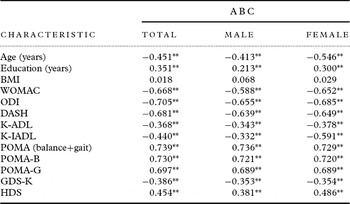
We found significant relationships between scores on the ABC and other variables measuring physical functioning, with the exception of BMI, by correlation analysis (Table 3). Psychological variables were also correlated with ABC scores. In particular, pain-related disability, balance, and gait showed higher correlations than other variables with scores on the ABC. The differences by sex were not evident in the correlations between these variables and scores on the ABC.
Correlation of physical and psychological functioning with ABC scores

Notes: Pearson's correlation coefficient; ** p < 0.01;
ABC = Activities-specific Balance Confidence Scale; BMI = Body Mass Index; WOMAC =Western Ontario and McMaster Universities Scale; ODI = Oswestry Disability Index; DASH = Disabilities of Arm, Shoulder and Hand; K-ADL = Korean Activities of Daily Living Scale; K-IADL = Korean Instrumental Activities of Daily Living Scale; POMA = Performance-Oriented Mobility Assessment; POMA-B = balance scale; POMA-G = gait scale; GDS-K = Korean version of the Geriatric Depression Scale; HDS = Hasegawa Dementia Scale.
Factors affecting balance confidence by gender and age
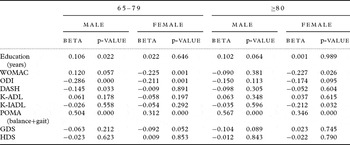
Table 4 presents the results of multiple regression analyses according to age and sex using scores on the ABC as a dependent variable and measures of physical and psychological functioning as independent variables. Irrespective of sex and age, POMA was closely associated with scores on the ABC. Elderly men were characterized by more linear relationships between scores on the POMA and ABC than were female elders (M/F ratio = 0.504/0.304). Educational history had a significant effect on ABC scores among men under the age of 80, but these relationships were quite low, and no significant relationships were found for women elders in this regard. Neither K-ADL nor K-IADL scores affected ABC for most groups; significant relationships were found only among women over 80 years old. In terms of pain-related disability, ODI and DASH scores showed significant relationships for men under the age of 80, and no variables were related to ABC scores for men over 80 years old. However, WOMAC and ODI scores were closely related to ABC scores for women under 80 years old, and only WOMAC scores (b = −0.227) showed this relationship in women over the age of 80. Variables related to depression and cognition functioning (GDS-K and HDS) scarcely affected scores on the ABC.
Multiple regression analyses: ABC scores by physical and psychological functioning correlated with ABC scores by gender and age

Notes: Dependent variable: ABC;
ABC = Activities-specific Balance Confidence Scale; WOMAC = Western Ontario and McMaster Universities Scale; ODI = Oswestry Disability Index; DASH = Disabilities of Arm, Shoulder and Hand; K-ADL = Korean Activities of Daily Living Scale; K-IADL = Korean Instrumental Activities of Daily Living Scale; POMA = Performance-Oriented Mobility Assessment; GDS = Geriatric Depression Scale; HDS = Hasegawa Dementia Scale.
Discussion
In this study, we found discrepancies between subjective and objective assessments of physical functioning according to sex and age in Korean elders. The activity-based level of confidence expressed by aged women was significantly lower than that expressed by aged men, even when the physical performances and functioning were nearly equal early in the aging process. Disabilities related to hip and knee pain were strongly associated with reduced activity confidence in women but not in men.
Many cohort and longitudinal studies on aging have reported that older individuals differ in terms of physical functioning according to sex. For instance, a male who survived until old age would be expected to be healthier because men are more likely to die of severe chronic diseases when young and middle-aged. Moreover, men maintain muscle strength and muscle bulk, whereas women continuously decline in regard to both bone density and muscle strength. A cohort study among elders found that gender differences in disability were small but apparent when respondents were as young as 65 years of age, and this gap continued into old age (Murtagh and Hubert, Reference Murtagh and Hubert2004). On the other hand, it has been reported that aging women can protect their physical health by avoiding socioculturally masculine behaviors as drinking and smoking. Above all, we need to pay attention to the differences in ABC mean scores according to sex. Although older women in this study showed a lack of confidence in their balance (ABC), they also maintained their physical functioning (POMA) until the age of 80. These phenomena may be explained in terms of a patriarchal society's impact on the mental health of women (Arber and Cooper, Reference Arber and Cooper1999; Takeda et al., Reference Takeda2004). Women may be under pressure to maintain the activities of daily living in order to perform their expected roles. Gender differences in depressive symptoms and suicidal ideation among elderly Koreans was interpreted as resulting from an intensification of the traditional social burdens carried by women later in life (Jeon et al., Reference Jeon, Jang, Rhee, Kawachi and Cho2007). In addition, the lives of women are severely restricted according to the cultural values associated with Confucianism (Chun et al., Reference Chun, Doyal, Payne, Cho and Kim2006).
In view of the paradox whereby women show higher morbidity rates while men show higher mortality rates, we can anticipate that women elders are more likely to live with lower functioning for longer periods of time. However, we did not find that aging women showed reduced performance or independence with regard to daily living compared to men, at least until the age of 80. Therefore, can discrepancies in balance confidence be explained by actual differences caused by sex itself? Irrespective of gender and age, the physical functioning measured by POMA was consistently closely associated with balance confidence. However, there are several interesting discrepancies in regard to sex and aging. Data obtained from elderly men showed more linear relationships between POMA and ABC scores than did those obtained from women (M/F ratio = 0.504/0.312). This might indicate that decreases in activity confidence are more closely linked with decreases in performance or functioning among older men than among older women. Pain-related disabilities, such as those reflected in the ODI and DASH, were not related to ABC scores among older men. In summary, there were no definite discrepancies between the objective and subjective variables related to physical functioning among aged men. On the other hand, such disabilities were closely related to the ABC scores among women both under and over 80 years old. Furthermore, psychological variables, such as those measuring depression and cognitive functioning (GDS-K, HDS), did not affect ABC scores. The balance confidence of women elders might be more affected by other variables, such as pain-related dysfunctions, than by factors measured by the POMA. Thus, gender differences in activity confidence did not develop because of gender per se but, more frequently, developed because of musculoskeletal pain and the higher prevalence among women of such chronic mobility-related illnesses as osteoarthritis. It has been reported that the persistent decline of balance confidence through the life course negatively influences the health-related quality of life among elderly women (McAuley et al., Reference McAuley, Konopack, Motl, Morris, Doerksen and Rosengren2006b). In this study, older women showed a rapidly declining level of physical functioning after age 80. Indeed, gender differences found among the oldest group are particularly remarkable. Low confidence may lead to decreased functioning in the long term.
A prior study focused on falls among elders and found that those older persons with previous falls tend to restrain their level of functioning and daily activities or avoid previously performed activities because of the fear of falling (Tinetti et al., Reference Tinetti, Leon, Doucette and Baker1994; Vellas et al., Reference Vellas, Wayne, Romero, Baumgartner and Garry1997; Reference Vellas, Wayne, Garry and Baumgartner1998). However, at times, aged people demonstrate either good physical functioning with lower balance confidence or poor physical functioning with higher balance confidence. Prolonged discrepancies between objective physical functioning and balance confidence would increase the risk for falls in both groups. Consequently, we suggest that the first step in an intervention is to manage pain among those under 80 years of age who preserve basic physical functioning (e.g. an exercise or a self-help program). This effort, directed particularly at lower limbs, would be aimed at the preservation of mobility, the prevention of falls, the improvement of physical performance and the enhancement of balance confidence. Such a program would be intended to sustain physical functioning and confidence among the oldest elders of the population. A second step would be to implement a strategy for overcoming those factors that cause the decline in physical functioning. Several reports have suggested that physical activity might serve a protective role in preventing the emergence of functional limitations leading to disability (Keysor, Reference Keysor2003). Furthermore, interventions involving physical activity are central to developing beliefs about self-efficacy and to enhancing feelings of satisfaction related to functioning among older adults (Rejeski et al., Reference Rejeski2008). A variety of behavioral strategies involving physical activity have proved effective in attenuating functional decline and improving the quality of life and psychological well-being of the elderly (Rejeski and Mihalko, Reference Rejeski and Mihalko2001; McAuley et al., Reference McAuley, Konopack, Motl, Morris, Doerksen and Rosengren2006b).
This study had some limitations. Caution is needed when interpreting changes in physical functioning according to age. In this study, all evaluations with the exception of POMA were performed dependent on self-reported measures. Indeed, we should consider Beta (recalibration) response shift (Armenakis, Reference Armenakis1988; Daltroy et al., Reference Daltroy, Larson, Eaton, Phillips and Liang1999). An older person might be less likely to report difficulty than a younger person in performing a given activity because the internal calibration that measures the difficulty of performance has changed over time. This response shift may influence discrepancies between subjective and objective measures of physical functioning. In addition, the association between sociocultural variables and physical functioning or balance confidence should be interpreted carefully, because we could not consider sociocultural variables adequately per se. In particular, insufficient attention was paid to the features of Korean society and culture. The results of this study were attained cross-sectionally based on the baseline information of a population based cohort study. Further study using a longitudinal design is needed to confirm the relationships between physical functioning and balance confidence according to sex and age.
In conclusion, elderly women have low balance confidence even when their physical performances and functioning are nearly equal early in the aging process. These discrepancies between balance confidence and physical performance were closely associated with disabilities related to hip and knee pain in women. Therefore, these findings suggest that a lack of confidence is not merely because of gender per se but, more frequently, because of the higher prevalence among women of such chronic mobility-related illnesses as osteoarthritis. Future investigations should focus on assessing the effect of enhancing confidence and controlling pain as a means of preventing disability and maintaining health in elders.
Conflict of interest
None.
Description of authors' roles
Ko Y. M. was responsible for the statistical design of the study and for carrying out the statistical analysis and wrote the paper. Park W. B. collected the data. Lim J. Y. designed the study, supervised data collection and wrote the paper. Kim K. W. and Paik N. J. were involved in the concept and design of this study.
Acknowledgments
This work was supported by an Independent Research Grant (IRG) from Pfizer Global Pharmaceuticals (grant no. 06-05-039) and a Grant for Developing Seongnam Health Promotion Program for the Elderly from Seongnam City Government in Korea (grant no. 800-20050211).