Introduction
The genus Cladonia belongs to one of the most morphologically diverse and species-rich genera of lichens (Stenroos et al. Reference Stenroos, Hyvönen, Myllys, Thell and Ahti2002). Based on morphological and chemical characters, Sandstede (Reference Sandstede and Zahlbruckner1931) accepted 69 species of Cladonia in central Europe. Furthermore, these were divided into a vast range of morphotypes. Improvements in the analysis of lichen chemistry increased the number of species recognized in subsequent years and made it increasingly difficult to distinguish taxa on the basis of morphological features or simple spot tests. In addition, the variability observed in chemical features raised doubts about the taxonomic status of several chemically defined species. These may, in fact, represent chemical strains (Lamb Reference Lamb1951; Leuckert et al. Reference Leuckert, Ziegler and Poelt1971). The idea was then widely accepted in central Europe and applied to the so-called “Cladonia pyxidata group”. Within this group, Wirth (Reference Wirth1994) included under the name C. pyxidata ssp. grayi (G. Merr. ex Sandst.) V. Wirth the following chemically different taxa: C. cryptochlorophaea Asahina, C. grayi G. Merr. ex Sandst., C. merochlorophaea Asahina and C. novochlorophaea (Sipman) Brodo & Ahti. For other species, Goward (Reference Goward1999) and Ahti & Hammer (Reference Ahti, Hammer, Nash, Ryan, Gries and Bungartz2002) included under the name C. humilis the chemically different C. humilis (With.) J. R. Laundon and C. innominata Lendemer [syn. C. conista (Nyl.) Robbins]. Spier & Aptroot (Reference Spier and Aptroot2007) recently united C. subulata (L.) F. H. Wigg. and C. rei Schaer. under the name C. subulata.
On the other hand, other studies indicated that the biogenetic pathway of secondary lichen products could reflect phylogenetic relationships (Culberson Reference Culberson1986), and that the range of morphologically and chemically distinguished taxa could be extended by a range of molecular sibling species (Stenroos et al. Reference Stenroos, Hyvönen, Myllys, Thell and Ahti2002; Vondrák et al. Reference Vondrák, Říha, Arup and Søchting2009).
The concepts of Cladonia subulata and C. rei changed over time. Vainio (Reference Vainio1887) classified species known currently as C. coniocraea (Flörke) Spreng., C. humilis, C. ochrochlora Flörke, C. subulata and C. rei as varieties or formae of C. fimbriata (L.) Fr. Later, Sandstede (Reference Sandstede and Zahlbruckner1931) accepted C. coniocraea, C. fimbriata, C. ochrochlora, C. rei and C. subulata (syn. C. cornutoradiata) at the species level, as well as C. major (K.G. Hagen) Sandst., which is currently included in C. fimbriata. Sandstede understood C. cornutoradiata Coem. (including f. subulata) to be a morphologically variable taxon reacting P+ red (fumarprotocetraric acid) and UV− (or + bluish) in contrast to C. nemoxyna (Ach.) Arnold (= C. rei), reacting P− (no fumarprotocetraric acid) and UV+ white (homosekikaic acid). This means that fumarprotocetraric acid-containing individuals of C. rei were regarded as C. cornutoradiata, a practice followed also by Ozenda & Clauzade (Reference Ozenda and Clauzade1970). Nevertheless, Zopf (Reference Zopf1908) had already found in specimens of Cladonia fimbriata var. cornuto-radiata f. nemoxyna (Ach.) Vainio (= C. rei) an acid he named nemoxynic acid, found to be identical to homosekikaic acid by Asahina (Reference Asahina1938). Asahina noticed that C. nemoxyna frequently contains fumarprotocetraric acid as an accessory component. The name “Cladonia rei Schaer. 1823” came into common use rather late. Østhagen (Reference Østhagen1976) showed that C. nemoxyna is a synonym of C. rei and that the type material of C. rei contains both homosekikaic and fumarprotocetraic acids. Although the type material of C. nemoxyna contains only homosekikaic acid, Østhagen (Reference Østhagen1976) pointed out that he found no differences in morphology between the fumarprotocetraric acid-containing and fumarprotocetraric acid-lacking species. These were therefore regarded as chemotypes. Detailed studies on the chemical differentiation of C. rei were carried out by Suominen & Ahti (Reference Suominen and Ahti1966), Paus et al. (Reference Paus, Daniels and Lumbsch1993), Paus (Reference Paus1997), Günzl & Fischer (Reference Günzl and Fischer2004) and Syrek & Kukwa (Reference Syrek and Kukwa2008). They discovered that the fumarprotocetraric acid-containing chemotype of C. rei is the most common chemotype in Central Europe. They also found that all content-gradients of fumarprotocetraric acid are represented, and, in most cases, small amounts of sekikaic acid as well that are not correlated with any morphological trends. Paus et al. (Reference Paus, Daniels and Lumbsch1993) revealed that C. rei prefers bare soil and is quite frequently found in disturbed sites often associated with C. chlorophaea (Flörke ex Sommerf.) Spreng., whereas C. subulata has a wider ecological amplitude, preferring more stable, humus-rich soils and acidic sand. In dry grassland communities, both species can occur together (Dolnik Reference Dolnik, Bültmann, Fartmann and Hasse2005) but they can also show preferences for certain other communities (Biermann Reference Biermann1999; Fischer Reference Fischer2003). A high tolerance of C. rei on sites heavily contaminated with metals was found by Coppins & van den Boom (Reference Coppins and van den Boom1995) and Cuny et al. (Reference Cuny, Denayer, de Foucault, Schumacker, Colein and van Haluwyn2004) near zinc works, by Ernst (Reference Ernst1995) under galvanized crash barriers along roads, and by Hadjúk & Lisická (Reference Hadjúk and Lisická1999) in the vicinities of copper smelters.
After extended morphological and chemical investigations of European material, Spier & Aptroot (Reference Spier and Aptroot2007) synonymized C. rei with C. subulata. They demonstrated an overlapping morphology of distinguishing features such as a corticated base of podetia, presence of squamules, and development of cups. They also argued that secondary lichen substances, such as fumarprotocetraric and homosekikaic acid are taxonomically of minor importance. We tested this hypothesis by analysing molecular, chemical, and morphological differences in C. subulata and C. rei from several European countries. We used the sequence from the internal transcribed spacer (ITS) of the nuclear rDNA gene cluster that was also used by Stenroos et al. (Reference Stenroos, Hyvönen, Myllys, Thell and Ahti2002) for their extended phylogenetic analysis of the genus Cladonia. The hypotheses we tested were that: 1) C. subulata and C. rei are distinct species; 2) C. rei includes two chemical races, which are neither morphologically nor molecularly distinct; and 3) C. subulata is more closely related to C. ochrochlora, C. coniocraea and C. fimbriata containing only the fumarprotocetraric chemosyndrome than it is to C. rei and C. novochlorophaea containing the homosekikaic chemosyndrome.
Material and Methods
Material
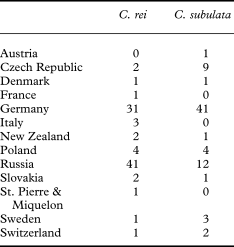
The morphological investigations were based on 90 samples of Cladonia rei, chemically defined by the presence of homosekikaic acid and traces of sekikaic acid (regardless of whether fumarprotocetraric acid is present or not), and 75 samples of C. subulata, chemically defined by the presence of fumarprotocetraric acid and absence of homosekikaic acid. All samples were analysed by thin-layer chromatography. Taking into account their large morphological variability and geographical distribution range in Europe, seven samples of C. rei and eight samples of C. subulata were chosen for molecular analysis. The origin of the material used in the chemical analysis is summarized in Table 1. Samples of C. nemoxyna (n = 12) and C. cornutoradiata (n = 52), determined by Johann Heinrich Sandstede (1859–1951) and deposited in Munich (M), were analysed in addition to the herbarium material collected by the authors. Specimens of C. cornutoradiata with the chemosyndrome of C. rei were revised and regarded as C. rei (n = 4). Specimens are deposited in Munich (M), Kiel (KIEL), Poznań (POZ) and in the private herbarium of C. Dolnik. All molecularly analysed samples are stored in M. A complete list of all specimens analysed is available from the corresponding author.
Origin of chemically analysed specimens of Cladonia subulata (n = 75) and Cladonia rei (n = 90)

To test the relationship between C. rei and C. subulata, other members of the section Cladonia were also analysed. These included C. coniocraea (6 samples), C. fimbriata (3), and C. ochrochlora (1), all of which are sorediose and have slender podetia. The wide scyphose and chemically divergent C. merochlorophaea (2), C. novochlorophaea (2), C. humilis (2) and C. innominata (1) were also included.
Cladonia humilis was chosen as an out-group species, as it belongs to a sister clade in Cladonia section Cladonia (Stenroos et al. Reference Stenroos, Hyvönen, Myllys, Thell and Ahti2002). Stenroos et al. (Reference Stenroos, Hyvönen, Myllys, Thell and Ahti2002) follow a broad species concept of C. humilis including C. humilis s. str. (containing fumarprotocetraric acid and atranorin) and C. innominata (fumarprotocetraric and bourgeanic acids); both chemotypes were included in our analysis.
Morphological and chemical analyses
Paus et al. (Reference Paus, Daniels and Lumbsch1993) and Spier & Aptroot (Reference Spier and Aptroot2007) demonstrated that features currently used to distinguish Cladonia rei from C. subulata are unreliable. Therefore, we compared other features such as cup proliferation and form of apothecia. As young podetia of C. rei and C. subulata are morphologically indistinguishable, we used only well-developed podetia to describe the characteristics of each sample.
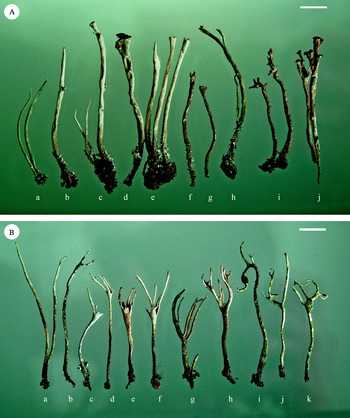
According to Spier & Aptroot (Reference Spier and Aptroot2007), more than half of the samples of C. rei and C. subulata bear cups. We distinguished between: 1) cups with and without short-stalked proliferations (Fig. 1A, e–g); 2) cups with long-stalked proliferations (Fig. 1B, c–f). According to Sandstede (Reference Sandstede and Zahlbruckner1931), prominent apothecia are typical for C. rei so we distinguished between: 1) prominent apothecia wider than the scyphus occurring at the end of a slender scyphus or short-stalked cup proliferations (Fig. 1A, j) or at the blunt end of stout podetia, where they are as wide as the podetium tip (Fig 1A, c & d); and 2) without apothecia or minute ones (Fig. 1A, a & b, e–i, Fig. 1B).
Morphology of Cladonia species. A, Cladonia rei, morphological variability characterized by simple podetia (a), by stout podetia with short branching patterns (b, c, h, i, j) or narrow cups (e, f, g, h, j), by no (g) or only short proliferations (e, f, h, j) and often prominent apothecia (c, d, j); B, Cladonia subulata, morphological variability characterized by simple subulate podetia (a), by podetia with narrow cups with long and subulate proliferations (c, d, e, f), or by antler-like branching patterns without cups (b, g, h, i, j, k) and mostly minute apothecia. Scales: A & B = 1 cm.

Chemical analysis (thin-layer chromatography, TLC) was carried out with solvent system A according to Culberson & Ammann (Reference Culberson and Ammann1979), using standard Merck silica gel 60F254 plates and C. symphycarpia (Flörke) Fr. (Öland population/Sweden, containing atranorin, norstictic and bourgeanic acid) as control. Since the amount of homosekikaic acid can vary within one scyphus, we used the upper part of large podetia or an entire podetium for our analysis.
DNA extraction, PCR and sequencing
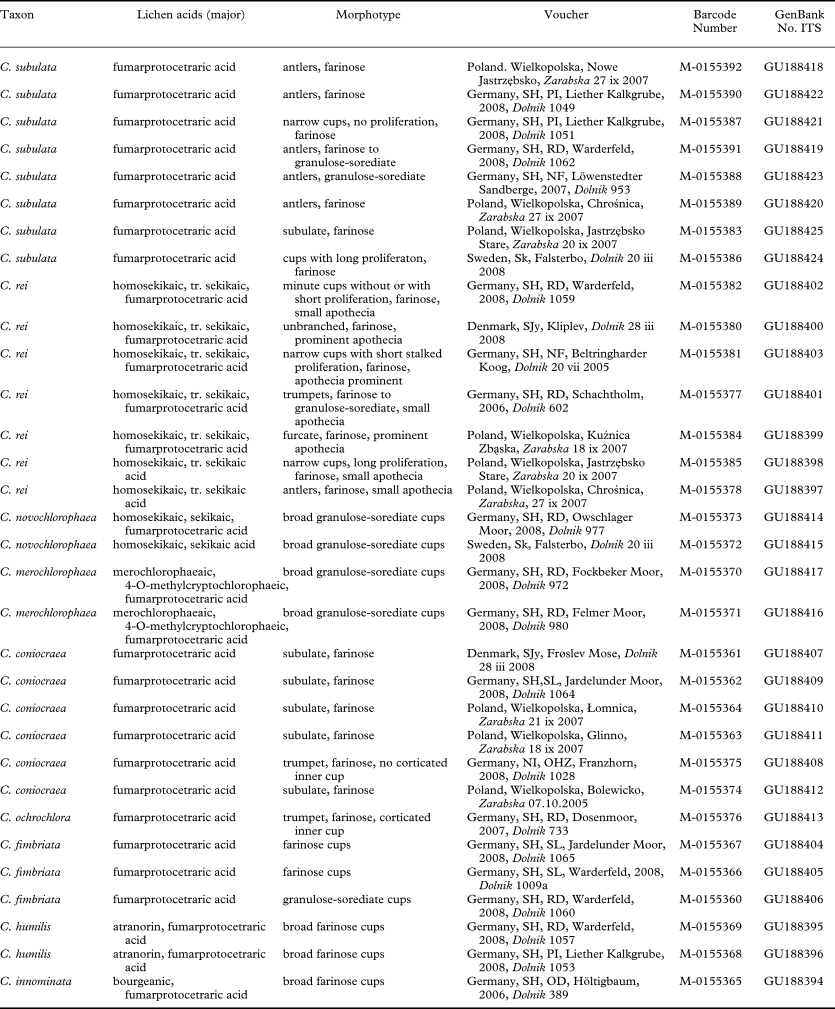
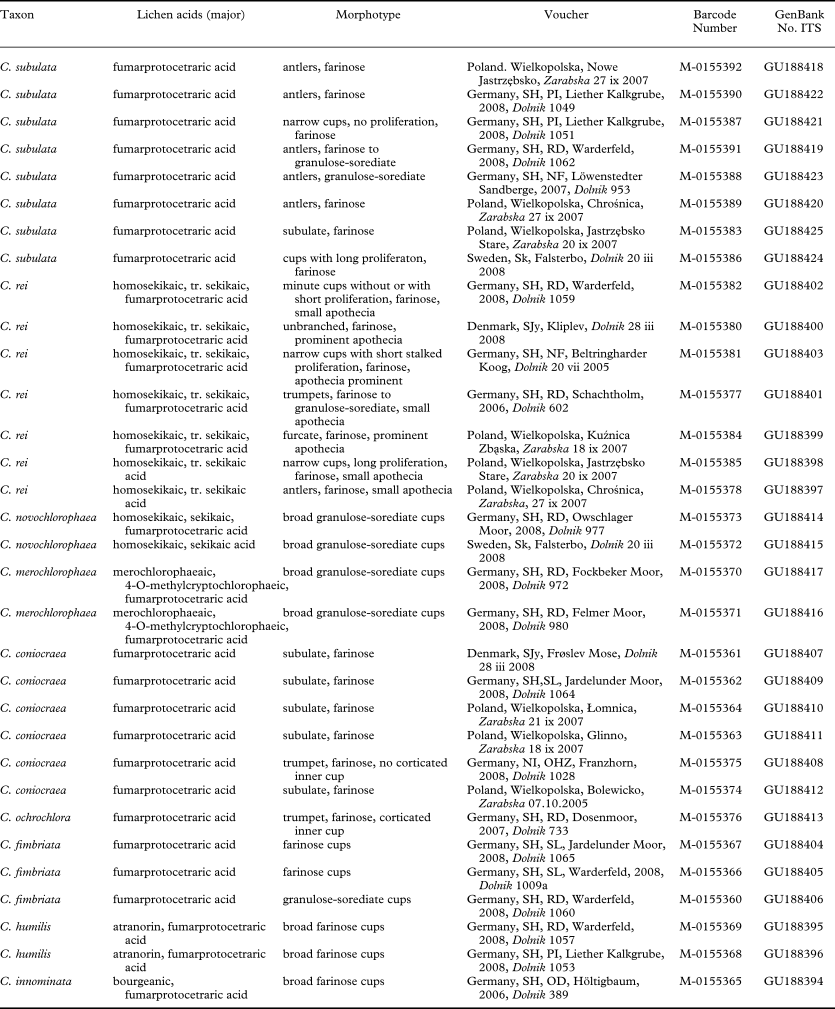
For the molecular analysis, we selected species tested by TLC analysis, with wide distribution ranges and morphological variability. The upper part of a single podetium was used for DNA isolation following the CTAB method (Rogers & Bendich Reference Rogers and Bendich1985), as modified by Cubero et al. (Reference Cubero, Crespo, Fatehi and Bridge1999). PCR was used for the amplification of the ITS from the isolated DNAs using the primers, cycling conditions and instruments described in Beck et al. (Reference Beck, Kasalicky and Rambold2002). Purification of the products with Macherey-Nagel columns (Macherey-Nagel, Düren) was followed by 30 cycles of sequencing reaction (95 °C for 10 s, 50 °C for 15 s, 60 °C for 3 min) using the primers ITS1F and ITS4 (White et al. Reference White, Bruns, Lee, Taylor, Innis, Gelfand, Sninsky and White1990), and the Big Dye Terminator Reaction Kit 3.1 (Perkin-Elmer Inc., Wellesley, MA, USA). Sequences were obtained using an ABI 3730 48 capillary automatic sequencer. Fragments were assembled with the aid of the Staden package (http://staden.sourceforge.net/). GenBank accession numbers for all newly obtained ITS sequences, including voucher specimen details, are listed in Table 2.
Voucher data and GenBank accession numbers for newly sequenced Cladonia species. All vouchers are deposited in M
Data analysis
In addition to the 32 newly produced sequences, further sequences were downloaded from GenBank for comparison. We included 7 sequences produced by Stenroos et al. (Reference Stenroos, Hyvönen, Myllys, Thell and Ahti2002): C. fimbriata (AF455224), C. humilis (AF455209), C. merochlorophaea (AF455227), C. ochrochlora (AF455192), C. rei (AF455191) and C. subulata (AF455180, AF455181). The 39 sequences were aligned using the program BioEdit (Hall Reference Hall1999). For the phylogenetic analysis, all alignment positions with less than 75% gaps were used, resulting in a data matrix with 409 characters. Cladonia humilis and C. innominata were used as out-group taxa. Three different analyses were performed: Maximum Parsimony (MP) and Maximum Likelihood (ML) calculations using PAUP* 4.0b10 (Swofford Reference Swofford2003), and Maximum Likelihood estimations using RAxML version 7.0.3 (Stamatakis Reference Stamatakis2006). For the MP analysis, gaps were treated as missing data, and multistate character interpreted as uncertainty. A heuristic search with 10 000 random-addition sequence replicates was performed using tree bisection-reconnection (TBR) branch-swapping, with MulTrees on and steepest-descent option not in effect. Bootstrap analysis with 5000 replicates, with 25 random-addition sequence replicates each, and with search parameters as above, has been used to estimate branch support. For the ML analysis, the optimal substitution model was tested with hierarchical likelihood ratio tests and by successive evaluation under the Akaike Information Criterion using the program Modeltest v.3.06 (Posada & Crandall Reference Posada and Crandall1998). The symmetrical model (Zharkikh Reference Zharkikh1994) including rate variation among sites was suggested as the best fitting model for the data. A heuristic search with 500 random-addition sequence replicateswas performed using the parameters Nst = 6, Rmat = (1·1233 4·3293 1·9908 0·6999 9·4337), Rates = gamma, Shape = 0·5470 and Pinvar = 0. Bootstrap analysis with 500 replicates, with 10 random-addition sequence replicates each, and search parameters as above has been used to estimate branch support. An alternative assessment of the data has been carried out using RAxML and a GAMMA-GTR model using standard settings and the empirical base frequencies pi(A): 0·200025, pi(C): 0·271850, pi(G): 0·275323 and pi(T): 0·252802. Branch support has been calculated using 500 bootstrap repetitions and the settings detailed above.
Results
Morphological and chemical data
Our observations confirm the high morphological variability with overlapping morphological characters in C. rei and C. subulata found by Paus et al. (Reference Paus, Daniels and Lumbsch1993) and Spier & Aptroot (Reference Spier and Aptroot2007). Apart from the positive UV+ white reaction in C. rei resulting from the presence of homosekikaic acid, the long and subulate proliferations occurring on the cup margin are much more pronounced in C. subulata than in C. rei. Prominent apothecia are much more common in C. rei (Table 3). These two morphological characters found in both species are not absolute, but in combination, they give both species a specific appearance, which is visible in well-developed samples (Fig. 1). The two chemotypes of C. rei (chemotype I: fumarprotocetraic and homosekikaic; chemotype II: homosekikaic with traces of sekikaic, but no fumarprotocetraic acid) show a weak geographical pattern, since chemotype I was found to be more common in the German material (87%), whereas chemotype II was more common in the Kaliningrad Oblast (66%).
Presence of cup proliferations and apothecia as morphological features to distinguish between Cladonia rei and Cladonia subulata

Molecular data
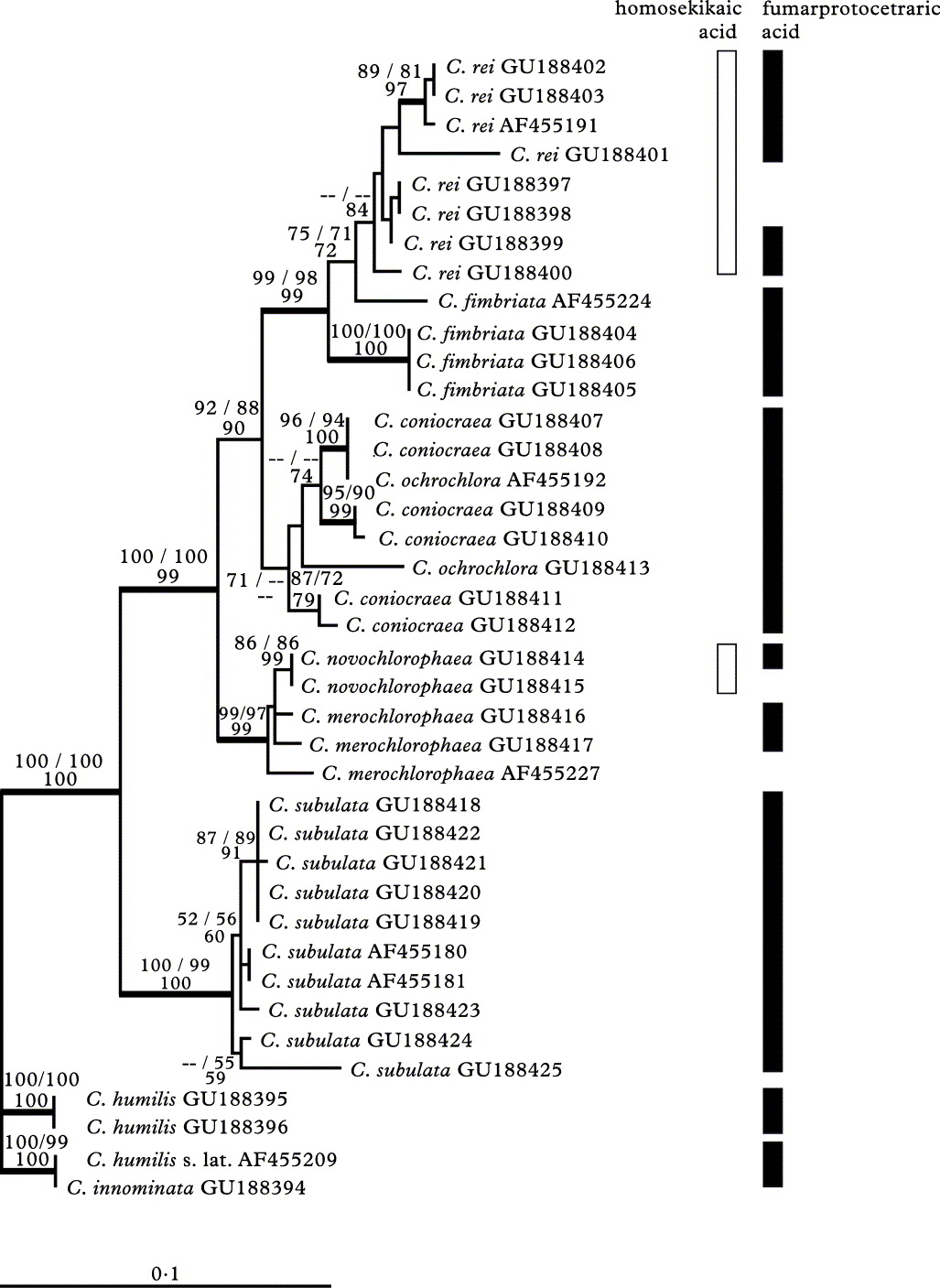
The MP analysis of the ITS nrDNA indicated that out of the 409 characters 285 were constant, 31 variable, but parsimony uninformative, and 93 parsimony informative. The search resulted in 12 equally parsimonious trees of 180 steps length (CI = 0·756, RI = 0·932, RC = 0·704). The ML analysis produced a single best-scoring tree with a likelihood score of 1550·96588, and the RAxML search resulted in one tree with a final ML optimization likelihood of −1584·557787. All search methods resulted in similar phylogenetic trees, with only minor differences in poorly supported branches. Figure 2 shows the ML tree with the bootstrap support values obtained with various methods.
Analysis of members of Cladonia sect. Cladonia inferred in a ML search from ITS nrDNA data. Shown is the best-scoring tree of the ML search (see section Material and Methods for details). Figures associated with branches indicate bootstrap support values inferred by three independent analyses: MP search using PAUP (upper row, left side), ML search using PAUP (upper row, right side) and search using RAxML (lower row). Branches with bootstrap support higher than 90 in all three methods are marked by bold lines.
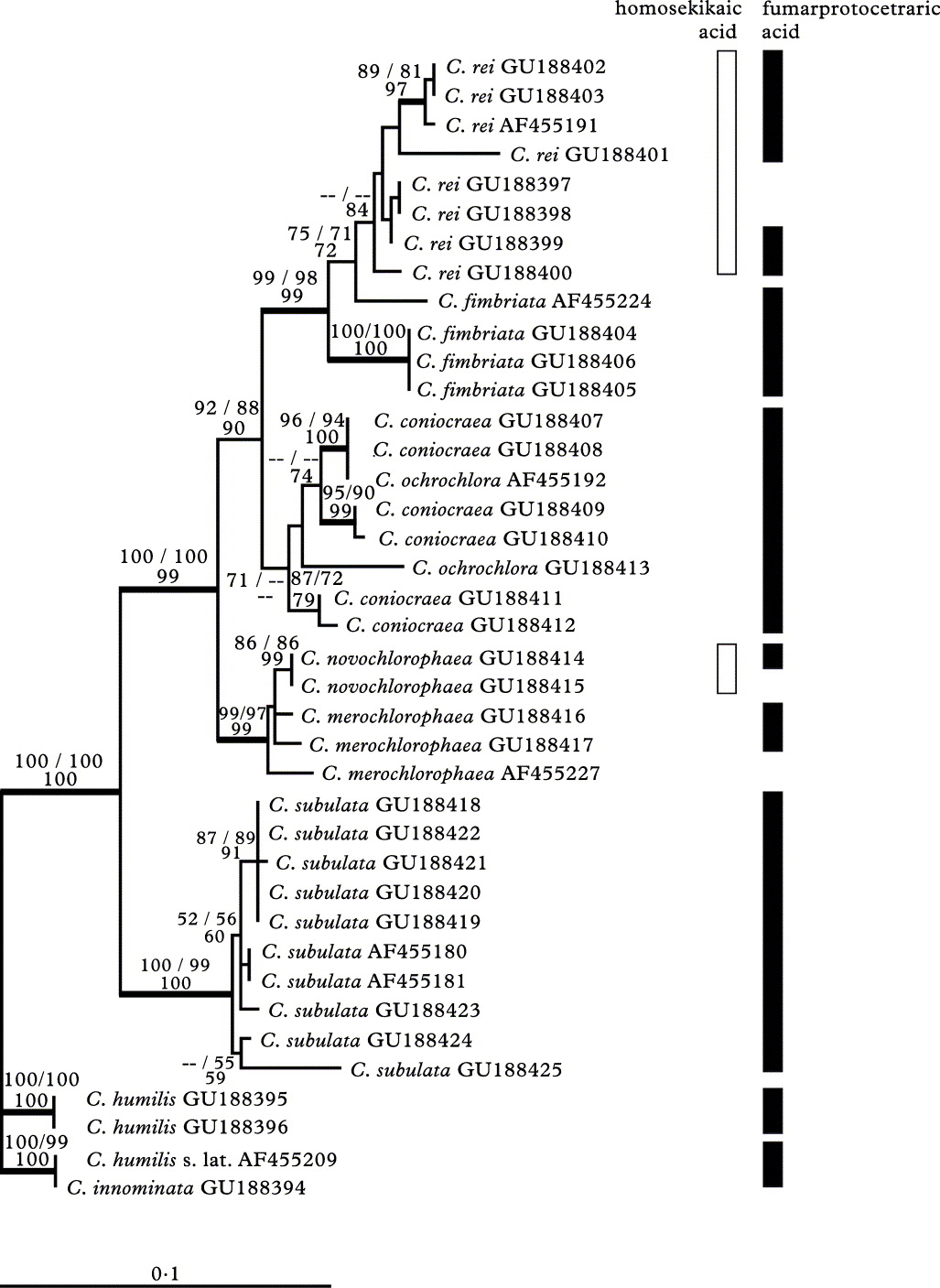
The phylogenetic analysis clearly separated Cladonia subulata and C. rei, which is in accordance with the results obtained by Stenroos et al. (Reference Stenroos, Hyvönen, Myllys, Thell and Ahti2002). They are morphologically similar, but chemically and genetically distinct, confirming our first hypothesis of two distinct species. Furthermore, C. rei forms a clade together with C. merochlorophaea, C. ochrochlora and C. fimbriata.
Homosekikaic acid is present in all samples of C. rei, thus supporting the current use of homosekikaic acid as a diagnostic feature of this species. Samples of C. rei in which fumarprotocetraric acid was detected (chemotype I) are grouped with those without fumarprotocetraric acid (chemotype II), confirming our second hypothesis and the current practice to regard these chemotypes has no taxonomic value. The Canadian sample of C. rei (AF455191, Stenroos et al. Reference Stenroos, Hyvönen, Myllys, Thell and Ahti2002) groups with European material. Cladonia fimbriata from Chile (AF455224, Stenroos et al. Reference Stenroos, Hyvönen, Myllys, Thell and Ahti2002) is separated from the C. rei clade in all three analyses, but without bootstrap support. Furthermore, this specimen does not group with the European samples of C. fimbriata. A granulose sorediate sample of C. fimbriata (GU188406), originally determined as C. chlorophaea, is not separated from farinose forms of C. fimbriata (GU188404, GU188405). This suggests that the size of soredia may be of minor importance in separating C. fimbriata from other members of the C. chlorophaea group containing fumarprotocetraric acid as the major component. The current morphological concept of C. chlorophaea is discussed in more detail by Kowalewska et al. (Reference Kowalewska, Kukwa, Ostrowska, Jabłonska, Oset and Szok2008: 65) and is not the focus of this study. In C. rei and C. subulata, the size of soredia also varies from farinose to granulose, indicating a low taxonomic value of this character in this group.
The next clade contains samples representing C. coniocraea and C. ochrochlora, however, they are intermingled. The C. ochrochlora type sensu Sandstede (Reference Sandstede and Zahlbruckner1931) is characterized by slender podetia with narrow cups and is therefore similar to some morphotypes of C. rei. Nevertheless, the corticated inner cup and the lack of homosekikaic acid are reliable characteristics for distinguishing between C. rei and these species. More distant from C. rei is the clade including C. novochlorophaea and C. merochlorophaea. There are also two chemotypes in C. novochlorophaea (Fig. 2); one contains fumarprotocetraric acid (GU188414) and the other does not (GU188415). The only chemical difference between C. rei and C. novochlorophaea is the co-dominance of sekikaic and homosekikaic acids in C. novochlorophaea, whereas, in C. rei, sekikaic acid occurs only in trace amounts. Thus, our third hypothesis is refuted, since the presence of homosekikaic acid does not indicate a closer relationship of C. rei to C. novochlorophaea.
All samples of Cladonia subulata contain fumarprotocetraric acid as the major chemical component and they form a well-supported group. Regarding morphology, both anisodiametric antler-like branching patterns and cup-bearing patterns can be found. Cladonia humilis s. lat. was demonstrated to be non-monophyletic. Both chemotypes form well-supported groups, and the sample ‘Cladonia humilis’ AF455209 from China (Stenroos et al. Reference Stenroos, Hyvönen, Myllys, Thell and Ahti2002) is grouped together with C. innominata from Germany; both samples contain bourgeanic and fumarprotocetraric acid.
Discussion
As previously found by Stenroos et al. (Reference Stenroos, Hyvönen, Myllys, Thell and Ahti2002), our results confirm that Cladonia rei and Cladonia subulata are not closely related. The ITS region differentiated sequences of Cladonia sect. Cladonia presented in Stenroos et al. (Reference Stenroos, Hyvönen, Myllys, Thell and Ahti2002) quite well. The phylogenetic tree we have constructed in this study for several collections of European C. rei and C. subulata is consistent within itself and with the chemical data and the phylogeny found by Stenroos et al. (Reference Stenroos, Hyvönen, Myllys, Thell and Ahti2002) for these species. We have refrained, therefore, from analysing other genes. Sequences of the ITS region are applied widely and have proved useful in many phylogenetic studies at the levels of genus and species in lichens (e.g., Myllys et al. Reference Myllys, Lohtander, Källersjö and Tehler1999; Tretiach et al. Reference Tretiach, Muggia and Bauffo2009). We also found that the North American specimen of C. rei (AF455191, Stenroos et al. Reference Stenroos, Hyvönen, Myllys, Thell and Ahti2002) does not differ from European material. Such differences were suggested by Spier & Aptroot (Reference Spier and Aptroot2007). The results presented are in perfect agreement with the current species concept of C. rei, in which the presence of homosekikaic acid as the main chemical component is considered characteristic of the species (Suominen & Ahti Reference Suominen and Ahti1966; Paus et al. Reference Paus, Daniels and Lumbsch1993; Hammer Reference Hammer1995), and fumarprotocetraric acid is treated as a common accessory component. Both chemotypes of C. rei have a wide distribution range in Europe. However, the fumarprotocetraric acid-containing chemotype is predominant in central Europe [The Netherlands, 73%, n = 59 (Spier & Aptroot Reference Spier and Aptroot2007); Germany, 78%, n = 128 (Günzl & Fischer Reference Günzl and Fischer2004); Poland, 70%, n = 228 (Syrek & Kukwa Reference Syrek and Kukwa2008)]. Chemotype II is more common in eastern parts of Europe [Kaliningrad Oblast (66%, n = 41, this study], and Finland [69%, n = 59 (Suominen & Ahti Reference Suominen and Ahti1966)], where the climate is more continental. There is no obvious explanation for this geographical pattern. The combined molecular and chemical analysis allows a new assessment of morphological features characteristic of C. rei and C. subulata, a notoriously difficult group to handle, especially in biodiversity studies or vegetation surveys. According to our results, C. fimbriata is most closely related to C. rei. At first glance, this is surprising, since C. fimbriata possesses farinose and much shorter podetia with broader cups and does not contain homosekikaic acid. Nevertheless, C. homosekikaica Nuno, a rare lichen with the chemical pattern of C. rei (Culberson et al. Reference Culberson, Culberson and Johnson1985) and the morphology of C. fimbriata, could serve as the missing link between both species. The specimen collected by T. Feuerer from Chile containing only fumarprotocetraric acid and assigned to C. fimbriata (Stenroos et al. Reference Stenroos, Hyvönen, Myllys, Thell and Ahti2002) appears to be unrelated to European material of C. fimbriata, but requires further analysis on a broader scale that includes more material.
The homosekikaic acid-containing C. novochlorophaea forms a subclade with C. merochlorophaea and is not as closely related to C. rei as put forward in our third hypothesis. This underlines the fact that the meta-depside homosekikaic acid can occur in independent subclades of Cladonia species (Stenroos et al. Reference Stenroos, Hyvönen, Myllys, Thell and Ahti2002) and thus has little or no relevance in establishing phylogenetic relationships above the species level, although distinct patterns of biogenetic relationships in biosynthetic pathways of secondary lichen products should be taken into account (Culberson Reference Culberson1986). According to our ITS sequences, the samples of C. novochlorophaea and C. merochlorophaea from central Europe are very closely related. This was already presumed by Sipman (Reference Sipman1973), who treated both taxa as varieties of C. merochlorophaea. So far, the chemical pattern is the only discernible feature differentiating these taxa. The chemosyndrome of C. merochlorophaea with the depsides merochlorophaeic and 4-O-methylcryptochlorophaeic acids, and the chemosyndrome of C. novochlorophaea with homosekikaic and sekikaic acids are biosynthetically closely related (Culberson et al. Reference Culberson, Culberson and Johnson1985), thus supporting in this case a closer relationship. In North American populations, gene flow between chemotypes of the C. chlorophaea complex has been observed (Culberson et al. Reference Culberson, Culberson and Johnson1988; DePriest Reference DePriest1994), thus indicating the need for further studies. It is therefore beyond the scope of this article to focus on the phylogenetic relationship of C. chlorophaea, C. merochlorophaea and C. novochlorophaea. The molecular studies of Stenroos et al. (Reference Stenroos, Hyvönen, Myllys, Thell and Ahti2002) show that further analyses are necessary in order to clarify which species contain several chemotypes, as was shown for the two chemotypes of Cladonia rei, and which chemical composition could be used as a diagnostic feature to distinguish between different species as, for example, in C. arbuscula (Wallr.) Flot. and Cladonia mitis Sandst. (Myllys et al. Reference Myllys, Stenroos, Thell and Ahti2003).
Our samples of C. subulata from Europe form a homogenous group that includes the specimens used by Stenroos et al. (Reference Stenroos, Hyvönen, Myllys, Thell and Ahti2002). In their phylogenetic study, C. subulata forms a subclade with morphologically very different corticated species such as C. macrophyllodes Nyl. and C. turgida Hoffm. This makes it difficult to find morphological homologies, and provides further evidence that similar morphological patterns have developed independently, as did some chemical patterns.
The presence of phenolic acids can be important for distinguishing between morphologically similar species, such as C. humilis and C. innominata. The molecular differences between these species can be explained by the biogenetic relationship of lichen substances proposed by Culberson (Reference Culberson1986), where fatty acids such as bourgeanic acid and para-depsidones such as atranorin follow different biosynthetic pathways. The well-supported differences in the sister subclades of both species underline genetic differences between these species and between gene loci other than those responsible for the biosynthesis of the mentioned secondary substances.
In central and western Europe, C. humilis is by far the most common chemotype and C. innominata is rare. Cladonia innominata predominates further to the east in Europe, i. e., in Poland (Kowalewska et al. Reference Kowalewska, Kukwa, Ostrowska, Jabłonska, Oset and Szok2008) and in the Kaliningrad Oblast (Dolnik & Petrenko Reference Dolnik and Petrenko2003). Tønsberg (Reference Tønsberg1985) suggests a more oceanic distribution for C. humilis in Europe, whereas C. innominata has more continental site preferences. Both species also occur in North and South America and Australia (Archer Reference Archer1989), but, so far, no geographical differences are known. Laundon (Reference Laundon1984) suggested reducing C. conista (= C. innominata) to the rank of a variety of C. humilis, and Archer (Reference Archer1989) described it under the name C. humilis var. bourgeanica A. W. Archer. For nomenclatorial reasons, Lendemer (Reference Lendemer2008) replaced the invalid name “C. conista” by the new “C. innominata.” Ecological differences between the two sibling species are not known, but we can see once more, two molecularly and chemically separate species, which are morphologically difficult to distinguish. Our results support the view of Lumbsch (Reference Lumbsch1998), that there is neither a simple scheme for accepting all chemotypes as sibling species, nor a scheme neglecting chemical variations on the species level. In the present study, molecular analysis proved to be helpful in detecting examples of both possibilities in Cladonia sect. Cladonia.
Separation of Cladonia rei and C. subulata morphotypes in the field
This study has shown that Cladonia rei and C. subulata are quite distinct species. It is therefore worthwhile distinguishing them in vegetation surveys and biodiversity studies. Unfortunately, typical illustrations of C. rei have been rare in recent lichen handbooks, making it difficult to identify the habitus of this species. Good photographs of C. rei can be found in the North American lichen flora of Brodo et al. (Reference Brodo, Sharnoff and Sharnoff2001), with prominent apothecia on short proliferations of cup margins, and in the Dutch lichen flora by van Herk & Aptroot (Reference van Herk and Aptroot2004). Unfortunately, the photograph of C. subulata in van Herk & Aptroot (Reference van Herk and Aptroot2004) shows young podetia with typical narrow cups and very short, blunt proliferations, which can occur not only in C. subulata but are also common in C. rei. We provide photographs of the morphological range of both species (Fig. 1) and recommend photographs in older literature such as Zopf (Reference Zopf1908: C. subulata, Tab. 1, fig. 4; and C. rei, Tab. 2, fig. 1) and Sandstede (Reference Sandstede and Zahlbruckner1931: C. subulata, Tab. 31, figs. 1, 2, 4 and 5; and C. rei Tab. 32, figs. 8 and 9). Paus et al. (Reference Paus, Daniels and Lumbsch1993) present morphological gradients of both species to underscore the difficulties of differentiation. As Paus et al. (Reference Paus, Daniels and Lumbsch1993) and Spier & Aptroot (Reference Spier and Aptroot2007) pointed out that several features, such as a corticated base of podetia (Syrek & Kukwa Reference Syrek and Kukwa2008), or presence of squamules and podetium surface (granulose to farinose), are unreliable features for differentiation, since they occur in both species. Nevertheless, we think that it is best to study herbarium material and note their morphologies before going out into the field. Cladonia rei is characterized by shallow scyphi, equal usually in diameter to the podetium base. Along the scyphus margin, there are numerous short, blunt proliferations often bearing prominent apothecia. Cladonia subulata, on the other hand, has deep scyphi, usually wider than the podetial base; the proliferations are mostly longer and acute (subulate) (cf. Hammer Reference Hammer1995). If the scyphus is not cup-bearing, older podetia of C. subulata may have an antler-like branching pattern with few long and short acute branches (Fig. 1B, h–k). The morphological determination can be confirmed by a simple UV test (254 nm) with a philatelist's hand lamp; the homosekikaic acid in C. rei reflects whitish. Paus (Reference Paus1997) and Spier & Aptroot (Reference Spier and Aptroot2007) point out that, in a few cases, the concentration of homosekikaic acid may be very low so that the UV test results will be negative or poor, but, in general, the UV+ test is recommended by Paus et al. (Reference Paus, Daniels and Lumbsch1993) and by us to confirm the morphological determination of C. rei.
Although Sandstede (Reference Sandstede and Zahlbruckner1931) described C. rei as having a strong white reflection under UV light, it should be stressed that the similar squamatic acid-containing C. glauca Flörke gives a much stronger white reflection under UV light, but is not cup bearing. Some morphs of C. rei resemble C. cornuta (L.) Hoffm., which is always UV negative (containing only fumarprotocetraric acid) and often has blackened podetium bases, or poorly developed morphs of the red-fruited C. macilenta Hoffm. complex, especially C. bacillaris (Ach.) Genth, which differs chemically in the presence of barbatic and didymic acid. Sometimes, in vegetation surveys, only poorly developed morphs of scyphus-bearing Cladonia species occur. In such a case, a TLC analysis provides reliable results in distinguishing C. rei from other species.
Conclusion
Although some individuals show overlapping morphology, our results clearly indicate that Cladonia rei and C. subulata are chemically and molecularly distinct species and should thus be accepted on the species level. Most morphotypes of both species have very specific characters and can be distinguished in the field without further auxiliary material, or with the help of a UV lamp. Nevertheless, for a definite determination, thin-layer chromatography is a prerequisite.