1 Introduction
Homogeneous Cantor sets have been regarded, on the one hand, as a natural generalization of the middle Cantor sets and, on the other hand, as a particular case of affine Cantor sets. A homogeneous Cantor set can be obtained via an iteration process on the finite union of many discrete closed intervals with the same lengths. Hence, for a homogeneous Cantor set K, there is always a positive real number
 $\unicode{x3bb} $
smaller than 1 and a finite subset A of real numbers for which
 $K=\{\sum _{n=0}^{\infty } a_{n}\unicode{x3bb} ^{n}\mid a_{n}\in A\}$
[Reference Mendes7]. Assume that
 $K^{\prime }$
is also a homogeneous Cantor set corresponding to positive real number
 $\mu $
and subset B. The arithmetic sum
 $K+K^{\prime }:=\{x+y\mid x\in K,~y\in K^{\prime }\}$
can be expressed in the usual form
 $$ \begin{align*}\bigg\{\sum_{n=0}^{\infty} a_{n}\unicode{x3bb}^{n}+\sum_{n=0}^{\infty} b_{n}\mu^{n}\,\bigg|\,\ a_{n}\in A, b_{n}\in B\bigg\}.\end{align*} $$
In the case when the pair
 $(K,K^{\prime })$
does not satisfy the generalized thickness test (GTT) [Reference Moreira9] (which is stronger than the Newhouse thickness condition), the aforementioned sum, generally speaking, is unknown and mysterious and any knowledge of the mathematical structures of the set may be useful in its morphology. When
 ${\log \unicode{x3bb} }/{ \log \mu }$
is rational,
 $K+K^{\prime }$
has a well-behaved structure compared to other cases. In this case, it takes the form of a uniformly contracting self-similar set and, algebraically speaking, there is a positive real number
 $\nu $
and a finite subset C such that
 $K+K^{\prime }=\{\sum _{n=0}^{\infty } c_{n}\nu ^{n}\mid c_{n}\in C\}$
[Reference Mendes7]. It is shown in [Reference Mendes and Oliveira8] that whenever the convex hull of K and
 $K^{\prime }$
are
 $[0,1]$
,
 $K+K^{\prime }$
is topologically a Cantor set, an L, R, M-Cantorval (see Definition 1) or
 $[0,~2]$
. It is also known in [Reference Anisca and Ilie1] whenever
 ${\log \unicode{x3bb} }/{ \log \mu }$
is irrational,
 $K+K^{\prime }$
is topologically a Cantor set, an L, R, M-Cantorval or a finite union of closed intervals. When the sets A and B have exactly two elements,
 $K+K^{\prime }$
is always a Cantor set, an M-Cantorval or a finite union of closed intervals [Reference Anisca, Chlebovec and Ilie3]. Along the same lines, we have characterized all K and
 $K^{\prime }$
for which their sum is a finite union of closed intervals [Reference Pourbarat18]. In the special cases
 $A=\{0,1-\unicode{x3bb} \} ,~\unicode{x3bb} <\tfrac 12$
, homogeneous Cantor sets are the same as middle Cantor sets, and in this context many results have been written about the topological and measure-theoretic structure of their sum [Reference Cabrelli, Hare and Molter4, Reference Ilgar Eroglu6, Reference Mendes and Oliveira8, Reference Pourbarat16–Reference Pourbarat18, Reference Palis and Takens20, Reference Solomyak21]. We emphasize here that in the context of affine Cantor sets, there are pairs for which the topological structures of their sum set are different than the above five structures and are even persistent in keeping their structure [Reference Moreira, Morales and Letelier10]. Some results have been presented in the case where their Markov partitions have two elements [Reference Anisca and Chlebovec2, Reference Peres and Shmerkin19].
In §2 we set out some notation and conventions that are used throughout the paper.
In §3 we introduce a dense and open subset of pairs of homogeneous Cantor sets, such that one of the aforementioned five structures always happens for their sum. This subset includes all the pairs studied in [Reference Anisca and Ilie1, Reference Mendes and Oliveira8].
In §4 we first show that if the pair
 $(K,K^{\prime })$
satisfies the GTT, then there is a recurrent set of relative configurations corresponding to their renormalization operators. Thus, there are translations of K and
 $K^{\prime }$
which have stable intersection. Moreover, we propose a property that is equivalent to the GTT, which may be easier to verify the GTT. This leads us to introduce a family of pairs which have stable intersection while not satisfying the GTT. Note that whenever the pair
 $(K,K^{\prime })$
has stable intersection, there is an open set
 $\mathcal {U}$
containing
 $(K,K^{\prime })$
in the space of pairs of regular Cantor sets such that for each
 $(\widetilde {K} ,\widetilde {K^{\prime }}) \in \mathcal {U}$
, the set
 $\widetilde {K} -\widetilde {K^{\prime }}$
contains an interval. This property was studied by Moreira [Reference Moreira9] in connection with bifurcation phenomena in dynamical systems [Reference Moreira and Yoccoz11–Reference Pourbarat15].
In §5 we extend our results in [Reference Pourbarat18] to the so-called middle homogeneous Cantor sets. We say that a homogeneous Cantor set is middle if the removed intervals at the first step of its construction process have equal lengths. Suppose that the underlying homogeneous Cantor set K (respectively,
 $K^{\prime }$
) is middle with convex hull
 $[0,~a]$
(respectively,
 $[0,~b]$
), and the length of the removed intervals in the first step from its construction is c (respectively,
 $c^{\prime }$
). We show in the case
 $\tau (K)\cdot \tau (K^{\prime })<1$
(where
 $\tau $
is the thickness of Cantor set [Reference Pourbarat15]) that:
-
(I) if
 ${\log \unicode{x3bb} }/{\log \mu }$
is irrational, then
$K+ K^{\prime }\neq [0,~a+b]$
;
-
(II) if
${\log \unicode{x3bb} }/{\log \mu }={n}/{m}$
with
$(m,n)=1$
and
$\gamma :=\unicode{x3bb} ^{-{1}/{n}}$
, then-
• the condition
$\tau (K)\cdot \tau (K^{\prime })<{1}/{\gamma }$
gives
$K+ K^{\prime }\neq [0,~a+b],$
-
• the condition
$\tau (K)\cdot \tau (K^{\prime })\geq {1}/{\gamma }$
gives
$K+ K^{\prime }=[0,~a+b]$
if and only if
$$ \begin{align*} \bigg\lceil n\log_{\unicode{x3bb}}\frac{\unicode{x3bb} a}{c^{\prime}}\bigg\rceil=\bigg\lfloor n\log_{\unicode{x3bb}}\frac{c}{\mu b}\bigg\rfloor+1, \end{align*} $$
-


where
 $\lfloor ~\rfloor $
and
 $\lceil ~\rceil $
are the floor and ceiling functions, respectively.
In the following, a special class of middle homogeneous Cantor sets is introduced and then the sum of its two elements is examined in the same way as in Mendes and Oliveira’s study in [Reference Mendes and Oliveira8]. Take a natural number M and a positive real number
 $\unicode{x3bb} $
with
 $\unicode{x3bb} <{1}/({M+1})$
. The M-middle Cantor set
 $C_{\unicode{x3bb} }^{M}$
is defined as a middle homogeneous Cantor set with convex hull
 $[0,~1]$
such that the number of removed intervals in the first step of its construction process is M and they have the same length
 $({1-(M+1)\unicode{x3bb} })/{M}$
. Algebraically,
 $$ \begin{align*}C_{\unicode{x3bb}}^{M}:=\bigg\{\frac{1-\unicode{x3bb}}{M}\sum_{n=0}^{\infty} a_{n}\unicode{x3bb}^{n}\,\bigg|\, a_{n}\in \{0,1,\ldots, M\}\bigg\}.\end{align*} $$
One may regard this family of homogeneous Cantor sets as a generalization of the middle Cantor sets, since the middle Cantor set
 $C_{\unicode{x3bb} }$
is the
 $1$
-middle Cantor set
 $C_{\unicode{x3bb} }^{1}$
. If
 $(K,K^{\prime })$
is a pair of middle homogeneous Cantor sets, then the set
 $K+K^{\prime }$
can be written as an affine translation of one sumset in the form
 $C_{\unicode{x3bb} }^{M}+\nu C_{\mu }^{N}$
, where
 $\nu>0$
; see §3.
Obviously,
 $HD(C_{\unicode{x3bb} }^{M})=-\log _{\unicode{x3bb} } (M+1)$
and
 $\tau (C_{\unicode{x3bb} }^{M})={M\unicode{x3bb} }/({1-(M+1)\unicode{x3bb} })$
. Take natural numbers
 $M,N,m$
and
 $ n$
with
 $(m,n)=1$
. Moreover, suppose that
 $\unicode{x3bb} _{0}$
and
 $\unicode{x3bb} _{1}$
are real numbers satisfying conditions
 $HD(C_{\unicode{x3bb} _{0}}^{M})+HD(C_{\unicode{x3bb} _{0}^{{m}/{n}}}^{N})=1$
and
 $\tau (C_{\unicode{x3bb} _{1}}^{M})\cdot \tau (C_{\unicode{x3bb} _{1}^{{m}/{n}}}^{N})\,{=}\,1$
. We show the following results.
-
(i) There is
$\alpha>\unicode{x3bb} _{0}$
such that
$C_{\unicode{x3bb} }^{M}+C_{\unicode{x3bb} ^{{m}/{n}}}^{N}$
has zero Lebesgue measure, for all
$\unicode{x3bb} <\alpha $
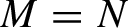
. In the particular case where
$M=N$
and
$\unicode{x3bb} =\mu $
, we have
$\alpha =\unicode{x3bb} _{1}$
. -
(ii) There is
$\beta \leq \unicode{x3bb} _{1}$
such that
$C_{\unicode{x3bb} }^{M}+C_{\unicode{x3bb} ^{{m}/{n}}}^{N}$
is a Cantor set or an M-Cantorval if and only if
$ \unicode{x3bb} <\beta $
. Also,
$\beta = \unicode{x3bb} _{1}$
if and only if there exists r,
$-m+1\leq r<n$
, such that
$\unicode{x3bb} _{1}^{{1}/{n}}$
is a root of the system >
$$ \begin{align*} \begin{cases} M x^{m+r}+(M+1)x^{n}-1=0,\\ \kern3pt (N+1) x^{m} + Nx^{n-r}-1 = 0. \end{cases} \end{align*} $$




In the case where
 $(M,N+1)=1$
and
 $(N,M+1)=1$
, we observe that
 $\beta =\unicode{x3bb} _{1}$
is equivalent to
 ${m}/{n}={\log (2N+1)}/{\log (2M+1)}$
. Thus, in the particular case where
 $M=N$
,
 $\beta <\unicode{x3bb} _{1}$
is equivalent to
 $m\neq n$
. Result (ii) also has the following implications.
-
(1) For every
$M,N\in \mathbb {N}$
, there is a choice of
$\unicode{x3bb} $
and
$\mu $
satisfying
$C_{\unicode{x3bb} }^{M}+C_{\mu }^{N}=[0,~2]$
, while
$\tau (C_{\unicode{x3bb} }^{M})\cdot \tau (C_{\mu }^{N})<1$
. -
(2) Suppose that
$R^{M,N}:=\{(\unicode{x3bb} ,\mu )\mid \tau (C^{M}_{\unicode{x3bb} })\cdot \tau (C^{N}_{\mu })\leq 1\}$
. Then there is an open and dense subset
$\cal {U}$
of
$R^{M,N}$
, such that for each
$(\unicode{x3bb} ,\mu )\in \cal {U},$
the set
$C_{\unicode{x3bb} }^{M}+C_{\mu }^{N}$
is either a Cantor set or an M-Cantorval.


2 Basic notation
This section contains basic notation that is used throughout the paper.
Suppose that M and N are two natural numbers and
 $a,b,\unicode{x3bb} $
and
 $\mu $
are four positive real numbers satisfying
 $(M+1)\unicode{x3bb} <1$
and
 $(N+1)\mu <1$
. The homogeneous Cantor sets K and
 $K^{\prime }$
are obtained geometrically as follows. Let
 $[0,~a]$
(respectively,
 $[0,~b]$
) represent the zeroth step of the construction process. The first step of the construction process is performed by removing M (respectively, N) open intervals from the zeroth step and thus leaving intervals of equal size. For each natural number
 $n>1$
, the nth step of the construction is obtained by removing M (respectively, N) open intervals from each one of the sub-intervals produced in the
 $(n-1)$
th step such that the remaining ones are intervals of equal size, and the additional constraint that the union of basic intervals of the nth step appears in a given basic interval of the
 $(n-1)$
th step is congruent to the
 $(n-1)$
th step at scale
 $\unicode{x3bb} $
(respectively,
 $\mu $
). Let
 $E_{n}$
be the union of nth-step basic intervals of the construction process. Then K (respectively,
 $K^{\prime }$
) is
 $\bigcap _{n=0}^{\infty }E_{n}$
. Note that the lengths of the nth-step intervals are
 $a\unicode{x3bb} ^{n}$
(respectively,
 $b\mu ^{n}$
), which tend to
 $0$
as n goes to
 $\infty $
. Hence, K and
 $K^{\prime }$
are totally disconnected and perfect subsets of
 $[0,~a]$
and
 $[0,~b]$
, respectively. A detailed analysis of the construction process of a homogeneous Cantor set is given below.
A Cantor set K is regular or dynamically defined if the following conditions hold.
-
(i) There are disjoint compact intervals
$I_{0}, I_{1},\ldots ,I_{r}$
such that
$K\subset I_{0}\cup I_{1}\cup \cdots \cup I_{r}$
and the boundary of each
$I_{i}$
is contained in K. -
(ii) There is a
$C^{1+\epsilon }$
expanding map
$\psi $
defined in a neighbourhood of
$I_{0}\cup I_{1}\cup \cdots \cup I_{r}$
such that
$\psi (I_{i})$
is the convex hull of a finite union of some intervals
$I_{j}$
satisfying:-
• for each
$0\leq i\leq r$
and n sufficiently large,
$\psi ^{n}(K\cap I_{i})=K$
; -
•
$K=\bigcap _{n=0}^{\infty }\psi ^{-n}(I_{0}\cup I_{1}\cup \cdots \cup I_{r})$
.
-


The set
 $\{I_{0},I_{1},\ldots ,I_{r}\}$
is, by definition, a Markov partition for K, and the set
 $D:=\bigcup _{i=0}^{r} I_{i}$
is the Markov domain of K. A regular Cantor set K is affine if
 $D\psi $
is constant on every interval
 $I_{i}$
. It is called homogeneous if
 $D\psi $
is constant on the Markov domain D.
It is convenient to let
 $\Sigma := \{0,1,2, \ldots , M\},~\Sigma ^{\prime }:=\{0,1,2, \ldots , N\}$
,
 $p:={1}/{\unicode{x3bb} }$
and
 $q:={1}/{\mu }$
. For all
 $i\in \Sigma $
(respectively,
 $j\in \Sigma ^{\prime }$
), let
 $I_{i}:=[a_{i},~b_{i}], ~a_{i}<a_{i+1}$
with
 $a_{0}=0$
and
 $b_{M}=a$
(respectively,
 $I^{\prime }_{j}:=[a^{\prime }_{j},~b^{\prime }_{j}], ~a^{\prime }_{j}<a^{\prime }_{j+1}$
with
 $a_{0}^{\prime }=0$
and
 $b^{\prime }_{N}=b$
) be disjoint closed intervals of size
 ${a}/{p}$
(respectively,
 ${b}/{q}$
). With this notation, the underlying homogeneous Cantor set K is defined by the Markov domain
 $\{I_{0},I_{1},\ldots ,I_{M}\}$
and expanding map
 $\psi $
, where
 $\psi _{|I_{i}}=:px+e_{i},~e_{i}:=-pa_{i}$
, and also the underlying homogeneous Cantor set
 $K^{\prime }$
is defined by the Markov domain
 $\{{I^{\prime }}_{0},{I^{\prime }}_{1},\ldots ,{I^{\prime }}_{N}\}$
and expanding map
 $\psi ^{\prime }$
, where
 $\psi ^{\prime }_{|I^{\prime }_{j}}=:qx+f_{j},~f_{j}:=-qa^{\prime }_{j}$
.
From [Reference Honary, Moreira and Pourbarat5], transferred renormalization operators (or simply operators) are given by
 $$ \begin{align} (s,t)\overset{T_{i}}\longmapsto (ps,pt+e_{i}),\quad(s,t)\overset{T^{\prime}_{j}}\longmapsto \bigg(\frac{s}{q},t-\frac{f_{j}}{q}s\bigg). \end{align} $$
We say that the pair
 $(s,t)$
is a difference pair for K and
 $K^{\prime }$
if there exists a relatively compact sequence
 $(s_{n}, t_{n})$
in the space
 $\mathbb {R}^{*} \times \mathbb {R}$
with
 $(s_{1},t_{1})=(s,t)$
such that the point
 $(s_{n+1},t_{n+1})$
is obtained from
 $(s_{n}, t_{n})$
by applying one of operators (2.1). The following assertion is proved in [Reference Pourbarat18]:
-
•
$t \in K-sK^{\prime }$
if and only if
$(s,t)$
is a difference pair for K and
$K^{\prime }$
.


Now suppose that
 $a=b=1$
and consider, in the
 $(s,t)$
-plane, the lines
 $L_{j}^{0}:~t=-b_{j}^{\prime }s$
and
 $L_{j}^{1}:~t=-a_{j}^{\prime }s+1, ~j\in \Sigma ^{\prime }$
with
 $s>0$
. It is easy to show that the line
 $L_{j}^{0}$
is placed above the line
 $t=-s$
and the operator
 $T^{\prime }_{j}$
maps the points of
 $L_{j}^{0} $
to the line
 $t=-s$
. The line
 $L^{1}_{j}$
also is placed below the horizontal line
 $t=1$
, and the operator
 $T^{\prime }_{j}$
maps the points of
 $L_{j}^{1} $
to the line
 $t=1$
. The operator
 $T^{\prime }_{j}$
returns the point
 $(s,t)$
to the point with the first component
 ${s}/{q}$
on the line passing through the point
 $(s,t)$
with slope
 ${f_{j}}/({q-1})$
. It is also worth mentioning that the operator
 $T_{i}$
expands distances at the scale p and is invariant on every line that passes through the point
 $(0,{-e_{i}}/({p-1}))$
. Another important property of the operators
 $(2.1)$
is
 $T_{i}\circ T^{\prime }_{j}=T^{\prime }_{j}\circ T_{i}$
.
We say that the homogeneous Cantor set K is middle, if there is a real number c such that
 $a_{i+1}-b_{i}=c$
, for all
 $0\leq i<M$
, and write this as
 $|G(K)|=c$
. When K and
 $K^{\prime }$
are middle,
 $K+K^{\prime }$
and
 $K-K^{\prime }$
have the same structures since
 $K+K^{\prime }=K-K^{\prime }+b$
. We emphasize that the sets
 $K+K^{\prime }$
and
 $K-K^{\prime }$
may have completely different structures. Example III.3 in [Reference Moreira9] proposes two homogeneous Cantor sets with convex hull
 $[0,~1]$
, whose sumset has zero Lebesgue and whose difference set is a closed interval. Note that the set
 $a-K$
is also a homogeneous Cantor set with convex hull
 $[0,~a]$
defined by the Markov partition
 $\{\bar {I}_{0}, \bar {I}_{1},\ldots , \bar {I}_{M}\}$
, where
 $\bar {I}_{i}:=-I_{n-i}+a$
and
 $\bar {\psi }$
is given by
 $\bar {\psi _{i}}(x):=-\psi _{n-i}(a-x)+a$
[Reference Pourbarat18]. Hence, the sumset can always be translated into a difference set and vice versa.
3 Topological structure of the sumset
We begin this section by stating the definition of a Cantorval set which was introduced for the first time by Mendes and Oliveira [Reference Mendes and Oliveira8].
Definition 1. Suppose that A is a perfect subset of
 $\mathbb {R}$
such that any gap has an interval adjacent to its right (respectively, left) and is accumulated on the left (respectively, right) by infinitely many intervals and gaps. Then A is called an L-Cantorval (respectively, R-Cantorval). It is called an M-Cantorval if any gap is accumulated on each side by infinitely many intervals and gaps.
Thus, if A is an L-Cantorval then
 $-A$
is an R-Cantorval, and vice versa. Consequently, when K and
 $K^{\prime }$
are middle (and further,
 $K=a-K$
and
 $K^{\prime }=b-K^{\prime }$
; see the definition of a symmetric Cantor set and Corollary B in [Reference Mendes and Oliveira8]), the L-Cantorval and R-Cantorval cases never happen for the set
 $K+K^{\prime }$
. To state Theorem 1, we need further notation.
If K and
 $K^{\prime }$
are two homogeneous Cantor sets with convex hull
 $[0,~a]$
and
 $[0,~b]$
respectively, then one can write
 $$ \begin{align*}K+ K^{\prime}=a\bigg(\frac{1}{a}K+\frac{ b}{a} \frac{1}{b}K^{\prime}\bigg),\end{align*} $$
in which
 $({1}/{a})K$
and
 $ ({1}/{b})K^{\prime }$
are homogeneous Cantor sets with convex hull
 $[0,1]$
. Consequently, for given homogeneous Cantor sets
 $K_{1}$
and
 $K_{2}$
with arbitrary convex hulls, there are homogeneous Cantor sets K and
 $K^{\prime }$
with convex hull
 $[0,~1]$
and also a positive real number
 $\unicode{x3bb} $
such that
 $K_{1}+K_{2}$
is an affine translation of
 $K+\unicode{x3bb} K^{\prime }$
. Let
 $$ \begin{align*}{\cal{K}}:=\{(K,\unicode{x3bb} K^{\prime})\mid p,q,\unicode{x3bb}>0,~K\text{ and } K^{\prime}\text{ have convex hull }[0,1]\}\end{align*} $$
and
 $$ \begin{align*}{\cal{U}}\kern1pt{:=}\kern1pt\bigg\{(K,\unicode{x3bb} K^{\prime})\kern1.2pt{\in}\kern1.2pt{\cal{K}}\,\bigg|\, \text{there are }m, n\kern1.2pt{\in}\kern1.2pt \mathbb{N}\text{ such that}~\frac{1}{q\min \{a^{\prime}_{1},1-b^{\prime}_{N-1}\}}\kern1.2pt{<}\kern1.2pt\frac{ p^{m}}{q^{n}}\unicode{x3bb}\kern1.2pt{<}\kern1.2pt pa_{1}\bigg\}.\end{align*} $$
Obviously,
 $\cal {U}$
contains all pairs
 $(K,\unicode{x3bb} K^{\prime })$
for which
 ${\log p}/{\log q}$
is an irrational number. It is not hard to show that
 $\cal {U}$
is an open and dense subset of
 $\cal {K}$
. Lastly, let
 $\cal {V}$
be the space of pairs
 $(K,K^{\prime })$
of homogeneous Cantor sets such that there is
 $(K,\unicode{x3bb} K^{\prime })\in {\cal {U}}$
for which
 $K_{1}+K_{2}$
is an affine translation of
 $K+\unicode{x3bb} K^{\prime }$
. Clearly,
 $\cal {V}$
is an open and dense subset in the space of all pairs of homogeneous Cantor sets.
Theorem 1. For each element
 $(K_{1},K_{2})\in \cal {V}$
, the set
 $K_{1}+K_{2}$
is just a Cantor set, an L, R, M-Cantorval or a union of finitely many closed intervals.
Proof. From the above discussion, it is enough to prove the assertion for the elements of
 $\cal {U}$
. Assume that the convex hull of K and
 $ K^{\prime }$
is
 $[0,1]$
and
 $\unicode{x3bb} $
is a positive number. Since
 $(K,\unicode{x3bb} K^{\prime })\in \cal {U}$
is equivalent to
 $(K,\unicode{x3bb} -\unicode{x3bb} K^{\prime })\in \cal {U}$
, we employ the difference set
 $K-\unicode{x3bb} K^{\prime }$
instead of the sumset
 $K+\unicode{x3bb} K^{\prime }$
. The assertion will be proved by invoking the following six lemmas.
Lemma 1. Suppose that
 $\unicode{x3bb} \in \{p,q,{1}/{p},{1}/{q}\}$
. Then, depending on the value of
 $\unicode{x3bb} $
, the set
 $ K-K^{\prime } $
contains an interval if and only if the set
 $ K-\unicode{x3bb} K^{\prime } $
does so.
Proof. We first prove the lemma in the case where
 $\unicode{x3bb} =p$
. Suppose that
 $K-K^{\prime }$
contains an interval and write it as a finite union of sets,
 $$ \begin{align*}K-K^{\prime}=\bigcup_{i=0}^{i=M}\bigg(\frac{1}{p}K+a_{i}\bigg)-K^{\prime}=\frac{1}{p}\bigg(\bigcup_{i=0}^{i=M}((K-pK^{\prime})+pa_{i})\bigg).\end{align*} $$
If the interior of
 $ K-pK^{\prime } $
is empty, then the interior of
 $(K-pK^{\prime })+pa_{i}$
is also empty for each i. Since they are closed sets, the interior of their union is an empty set as well, which is a contradiction. The converse is valid too, since
 $$ \begin{align*} K-pK^{\prime} =p\bigg(\frac{1}{p}K-K^{\prime}\bigg)\subset p( K-K^{\prime}).\end{align*} $$
In the case
 $\unicode{x3bb} ={1}/{p}$
, we see that
 $$ \begin{align*}K-\frac{1}{p}K^{\prime} =\frac{1}{p}(pK-K^{\prime})=\frac{1}{p}\bigg(\bigcup_{i=0}^{i=M}(K-K^{\prime}+pa_{i})\bigg),\end{align*} $$
and a similar discussion gives the result.
Finally, replacing p by q, q by p and
 $\unicode{x3bb} $
by
 ${1}/{\unicode{x3bb} }$
completes the proof.
The following lemma also asserts that, for every pair of homogeneous Cantor sets, whenever the difference set is not a Cantor set, it is the closure of its interior.
Lemma 2. For given
 $\unicode{x3bb} ,$
if
 $ K-\unicode{x3bb} K^{\prime } $
contains an interval, then for each point
 $x\in K-\unicode{x3bb} K^{\prime } $
there is an interval in
 $ K-\unicode{x3bb} K^{\prime } $
arbitrarily close to x.
Proof. Suppose that
 $\epsilon>0.$
Since
 $(\unicode{x3bb} ,x)$
is a difference pair, there are finite sequences
 $\{i_{k}\}_{k=1}^{k=m}$
and
 $\{j_{k}\}_{k=1}^{k=m^{\prime }}$
of the sets
 $\Sigma $
and
 $\Sigma ^{\prime }$
respectively, such that
 $$ \begin{align*} T ^{\prime}_{j_{m^{\prime}}}\circ\cdots\circ T^{\prime}_{j_{1}}\circ T {}_{i_{m}}\circ\cdots\circ T {}_{i_{1}} (\unicode{x3bb},x)\in \bigg\{\frac{p^{m}\unicode{x3bb}}{q^{m^{\prime}}}\bigg\}\times\bigg[-\frac{p^{m}\unicode{x3bb}}{q^{m^{\prime}}},~1\bigg].\end{align*} $$
One can also select the natural numbers m and
 $m^{\prime }$
such that
 $$ \begin{align*}p^{m}\cdot (2\epsilon)>1+2\unicode{x3bb},\quad \frac{p^{m}}{q^{m^{\prime}}}\in [1,~2].\end{align*} $$
On the other hand, from Lemma 1 and the fact that
 $ K-\unicode{x3bb} K^{\prime } $
contains an interval, there is an interval
 $I\subset K- ({p^{m}}/{q^{m^{\prime }})}\unicode{x3bb} K^{\prime } $
. It is easy to check that all points of the interval
 $$ \begin{align*} (T ^{\prime}_{j_{m^{\prime}}}\circ\cdots\circ T^{\prime}_{j_{1}}\circ T {}_{i_{m}}\circ\cdots\circ T {}_{i_{1}})^{-1} \bigg( \bigg\{\frac{p^{m}\unicode{x3bb}}{q^{m^{\prime}}}\bigg\}\times I\bigg)\subset \{\unicode{x3bb}\}\times [x-\epsilon,~ x+\epsilon] \end{align*} $$
are difference pairs, which completes the proof of the lemma.
Lemma 3. If
 $ K- \unicode{x3bb} K^{\prime } $
is a finite union of closed intervals, then
 $ K-({\unicode{x3bb} }/{p}) K^{\prime } $
and
 $ K- q\unicode{x3bb} K^{\prime } $
are also finite unions of closed intervals.
Proof. Express
 $ K-({\unicode{x3bb} }/{p}) K^{\prime } $
and
 $ K- q\unicode{x3bb} K^{\prime } $
as follows:
-
(i)
$K-({\unicode{x3bb} }/{p})K^{\prime } =({1}/{p})(pK-\unicode{x3bb} K^{\prime })=({1}/{p})(\bigcup _{i=0}^{i=M}(K-\unicode{x3bb} K^{\prime }+pa_{i}))$
; -
(ii)
$K-q\unicode{x3bb} K^{\prime }=K-q\unicode{x3bb} (\bigcup _{i=0}^{i=N}(({1}/{q})K^{\prime }+ a^{\prime }_{i}))=\bigcup _{i=0}^{i=N}(K-\unicode{x3bb} K^{\prime }+q\unicode{x3bb} a^{\prime }_{i})$
.


This proves the assertion, since
 $ K- \unicode{x3bb} K^{\prime } $
is a finite union of intervals.
To continue, we introduce some further notation.
Definition 2. Suppose that K is a perfect subset with convex hull
 $[a,b]$
. Then it is called a top-Cantorval (respectively, bottom-Cantorval), if the point b (respectively, the point a) is accumulated by infinitely many intervals and gaps.
Lemma 4. If
 ${\log p}/{\log q}$
is irrational (respectively, rational) and, for given
 $\unicode{x3bb} _{0}>0$
, the set
 $ K-\unicode{x3bb} _{0} K^{\prime } $
is a top-Cantorval, then for all
 $\unicode{x3bb}>0$
(respectively,
 $\unicode{x3bb} \in \{({p^{i}}/{q^{j}})\unicode{x3bb} _{0}\mid i,j\in \mathbb {Z}\}$
), the point
 $1$
is accumulated by infinitely many gaps of
 $ K-\unicode{x3bb} K^{\prime } $
. A similar assertion holds for the point
 $-\unicode{x3bb} $
by replacing ‘top-Cantorval’ with ‘bottom-Cantorval’.
Proof. If
 $ K-\unicode{x3bb} _{0} K^{\prime } $
is a top-Cantorval, then one can choose a point
 $(\unicode{x3bb} _{0}, x)$
that is not a difference pair and satisfies
 $\max \{-a_{j}^{\prime }\unicode{x3bb} _{0}+1, 1-{1}/{p}\}<x<1, $
for all
 $0< j\leq N$
. There are the intervals I and J, containing
 $\unicode{x3bb} _{0}$
and x respectively, such that all the points in
 $I\times J$
are not difference pairs. Fix a
 $\unicode{x3bb} $
and then take sequences
 $\{n_{k}\}$
and
 $\{m_{k}\}$
of natural numbers such that the sequence
 $\{({q^{m_{k}}}/{p^{n_{k}}})\unicode{x3bb} _{0}\}$
converges to
 $\unicode{x3bb} $
and, moreover, the interval
 $(({q^{m_{k}}}/{p^{n_{k}}})\unicode{x3bb} _{0}) I$
contains
 $\unicode{x3bb} $
, for all k. Selecting the point x says that none of the points of the open and connected sets
 $U_{n}:={T_{M}}^{-n_{k}}\circ {T_{0}^{\prime }}^{-m_{k}}(I\times J)$
are difference pairs, since they always stay above the lines
 $L_{j}^{1}$
and
 $t=1-{1}/{p}.$
Suppose that
 $\pi _{2}$
is the map that projects the points of
 $\mathbb {R}^{2}$
to their second component. Then the intervals
 $\pi _{2}(U_{n}\cap \{(\unicode{x3bb} ,t)\mid t\in \mathbb {R}\})$
are subsets
 $[-\unicode{x3bb} ,~ 1]\setminus (K-\unicode{x3bb} K^{\prime })$
which accumulate to
 $1$
. In the case where
 $ K-\unicode{x3bb} _{0} K^{\prime } $
is a bottom-Cantorval, the proof is similar. This concludes the proof of the lemma.
Lemma 5. Suppose that
 ${1}/{qa^{\prime }_{1}}<\unicode{x3bb} <pa_{1}$
and
 $ K-\unicode{x3bb} K^{\prime }$
contains an interval. If
 $ K-\unicode{x3bb} K^{\prime }$
is not a top-Cantorval and bottom-Cantorval, then
 $ K-\unicode{x3bb} K^{\prime }=[-\unicode{x3bb} ,~1]$
.
Proof. Let D be the region
 $\{(s,t)\mid {1}/{qa^{\prime }_{1}} <s<pa_{1},\ -s\leq t\leq 1\}$
. Consider the regions
 $$ \begin{align*}D_{1}:={T^{\prime}_{0}}^{-1}(D\cap \{(s,t)\mid t\geq 0\})=\bigg\{(s,t)\,\bigg|\,\frac{1}{a^{\prime}_{1}} <s<pqa_{1}, \ 0\leq t\leq 1\bigg\}\end{align*} $$
and
 $$ \begin{align*}D_{2}:={T^{\prime}_{N}}^{-1}(D\cap \{(s,t)\mid t\leq 0\})=\bigg\{(s,t)\,\bigg|\, \frac{1}{a^{\prime}_{1}} <s<pqa_{1},\ -s\leq t\leq -a^{\prime}_{N}s\bigg\}.\end{align*} $$
For each
 $0< j\leq N$
, the region
 $D_{1}$
is above the line
 $L_{j}^{1}$
, since the corner point
 $({1}/{a_{1}^{\prime }},0)$
satisfies
 $0+a^{\prime }_{j}\cdot {1}/{a_{1}^{\prime }}\geq 1$
. Also, for each
 $0\leq j<N$
, the region
 $D_{2}$
is below the line
 $L_{j}^{0}$
, since for the corner points
 $({1}/{a_{1}^{\prime }},{-a^{\prime }_{N}}/{a^{\prime }_{1}})$
and
 $(pqa_{1}, -a^{\prime }_{N}pqa_{1})$
we always have
 ${-a^{\prime }_{N}}/{a_{1}^{\prime }}+b^{\prime }_{j}\cdot {1}/{a^{\prime }_{1}}<0$
and
 $- a^{\prime }_{N}pqa_{1}+b^{\prime }_{j}pqa_{1}<0$
. Note that
 ${T^{\prime }_{j}}^{-1}(s,t)=(qs,t+f_{j}s)$
and
 $f_{j}=-qa^{\prime }_{j}$
.
Now suppose that the assertion does not hold. Thus, there is an interval
 $I\subset [0,~1]$
or
 $I\subset [-\unicode{x3bb} ,~0]$
such that
 $I\subset [-\unicode{x3bb} ,~1]\setminus ( K-\unicode{x3bb} K)$
. Suppose that the case
 $I\subset [0,~1]$
happens. Thus, there is an interval
 $J\subset ({1}/{qa^{\prime }_{1}}, ~pa_{1})$
such that all the points of the square
 $U:=J\times I$
are not difference pairs. Since
 ${T^{\prime }_{0}}^{-1}(U)$
is a subset of
 $D_{1}$
and indeed above the lines
 $L_{j}^{1}, ~0< j\leq N$
, its points are not difference pairs. Also, since
 ${(T_{M}\circ T^{\prime }_{0})}^{-1}(U)$
is a subset of the strip
 $\{(s,t)\mid 1-{1}/{p}<t<1\}$
, its points are not difference pairs. By taking a sequence
 $\{({q^{m_{k}}}/{p^{n_{k}}})\unicode{x3bb} \}$
which tends to
 $\unicode{x3bb} $
and proceeding similarly to the proof in the middle of Lemma 4, we observe that the point
 $1$
is accumulated by infinitely many gaps of
 $ K-\unicode{x3bb} K^{\prime }$
. From Lemma 2,
 $ K-\unicode{x3bb} K^{\prime }$
is a top-Cantorval, which leads to a contradiction. Similarly, if the case
 $I\subset [-\unicode{x3bb} ,~1]$
happens, there is an open and connected set V, such that all the points of
 ${T^{\prime }_{N}}^{-1}(V)$
are not difference pairs, since
 ${T^{\prime }_{N}}^{-1}(V)$
is a subset of
 $D_{2}$
and indeed below the lines
 $L_{j}^{0}, ~0\leq j< N$
. Also, it is not hard to see that
 ${(T_{0}\circ T^{\prime }_{N})}^{-1}(V)$
is a subset of the strip
 $ \{(s,t)\mid -s\leq t<-s+a_{1}\}$
and so its points are not difference pairs. Note that for each
 $0<i\leq M$
, the line
 $T_{i}( \{(s,t)\mid t=-s+a_{1}\})$
is below the line
 $ \{(s,t)\mid t=-s\}$
. As above, by taking a sequence which converges to
 $\unicode{x3bb} $
, it follows that
 $ K-\unicode{x3bb} K^{\prime }$
is a bottom-Cantorval. This gives a contradiction, which completes the proof of the lemma.
Lemma 6. If
 $ K-\unicode{x3bb} K^{\prime }$
is a top-Cantorval (respectively, bottom-Cantorval) and
 $(c,~d)$
is its gap, then the point c (respectively, the point d) is accumulated by infinitely many gaps.
Proof. Since
 $(\unicode{x3bb} ,c)$
is a difference pair and c is a boundary point of the gap, there are the finite sequences
 $\{i_{k}\}_{k=1}^{k=m}$
and
 $\{j_{k}\}_{k=1}^{k=m^{\prime }}$
of the sets
 $\Sigma $
and
 $\Sigma ^{\prime }$
respectively, such that
 $$ \begin{align*} T ^{\prime}_{j_{m^{\prime}}}\circ\cdots\circ T^{\prime}_{j_{1}}\circ T {}_{i_{m}}\circ\cdots\circ T {}_{i_{1}} (\unicode{x3bb},c)=\bigg(\frac{p^{m}}{q^{m^{\prime}}}\unicode{x3bb},1\bigg).\end{align*} $$
For given
 $k\in \mathbb {N}$
, let
 $\Sigma _{k}$
and
 $\Sigma ^{\prime }_{k}$
be the sets of all maps from
 $\{1,2, \ldots , k\}$
to
 $\Sigma $
and
 $\Sigma ^{\prime }$
, respectively. Let
 $$ \begin{align*}A\kern1.2pt{:=}\kern1.2pt\bigg\{(T ^{\prime}_{j_{\sigma^{\prime}(m^{\prime})}}\circ\cdots\circ T^{\prime}_{j_{\sigma^{\prime}(1)}}\circ T {}_{i_{\sigma(m)}}\circ\cdots\circ T {}_{i_{\sigma(1)}})^{-1}\bigg(\frac{p^{m}}{q^{m^{\prime}}}\unicode{x3bb},1\bigg)\kern1pt\bigg|\kern1pt \sigma\kern1.2pt{\in}\kern1.2pt \Sigma_{m} ~\text{and} ~\sigma^{\prime}\kern1.2pt{\in}\kern1.2pt \Sigma^{\prime}_{m^{\prime}}\!\bigg\},\end{align*} $$
which is a subset of the line
 $s=\unicode{x3bb} .$
Let
 $$ \begin{align*}a:= \max\{\pi_{2}(z)\mid ~z\in A, ~\pi_{2}(z)<c\}.\end{align*} $$
From Lemma 4, there is a sequence
 $\{U_{n}\}$
of gaps of
 $K-({p^{m}}/{q^{m^{\prime }})}\unicode{x3bb} K^{\prime }$
such that the point
 $1$
is accumulated by them. Thus,
 $$ \begin{align*}\bigg\{\pi_{2}\bigg((T ^{\prime}_{j_{m^{\prime}}}\circ\cdots\circ T^{\prime}_{j_{1}}\circ T {}_{i_{m}}\circ\cdots\circ T {}_{i_{1}})^{-1}\bigg(\bigg\{\frac{p^{m}}{q^{m^{\prime}}}\unicode{x3bb}\bigg\}\times U_{n}\bigg)\bigg)\bigcap [a,c]\bigg\}\end{align*} $$
is a sequence of gaps
 $K-\unicode{x3bb} K^{\prime }$
such that the point c is accumulated by them. The other case follows a similar proof.
We are now ready to prove Theorem 1. Suppose that
 $ K- \unicode{x3bb} K^{\prime } $
is not a Cantor set. Thus it contains an interval. From Lemma 2, for each point
 $x\in K-\unicode{x3bb} K^{\prime } $
there is an interval in
 $ K-\unicode{x3bb} K^{\prime } $
arbitrarily close to x. From Lemma 6, if
 $ K-\unicode{x3bb} K^{\prime }$
is a top-Cantorval and is not bottom-Cantorval, then it is an L-Cantorval, and similarly if
 $ K-\unicode{x3bb} K^{\prime }$
is a bottom-Cantorval and is not top-Cantorval, then it is an R-Cantorval. Moreover, if it is a top-Cantorval and bottom-Cantorval, then it is an M-Cantorval.
There only remains the case where
 $ K-\unicode{x3bb} K^{\prime }$
is neither a top-Cantorval nor a bottom-Cantorval. With regard to the definition of
 $\cal {U}$
, there are natural numbers m and n such that
 $\unicode{x3bb} _{0}:=({p^{m}}/{q^{n}})\unicode{x3bb} $
belongs to the interval
 $({1}/{qa^{\prime }_{1}},~ pa_{1})$
. From Lemma 1,
 $K-({p^{m}}/{q^{n}})\unicode{x3bb} K^{\prime }$
contains an interval, and by Lemma 4,
 $K-({p^{m}}/{q^{n}})\unicode{x3bb} K^{\prime }$
is neither a top-Cantorval nor a bottom-Cantorval, and by Lemma 5, we have
 $K-({p^{m}}/{q^{n}})\unicode{x3bb} K=[-({p^{m}}/{q^{n}})\unicode{x3bb} ,~1]$
. From Lemma 3, we see that
 $ K-\unicode{x3bb} K^{\prime }$
is a finite union of closed intervals, which completes the proof of the theorem.
The following proposition is a direct result of above lemmas which also confirms the results of [Reference Anisca and Ilie1, Reference Mendes and Oliveira8].
Proposition 1. Using the above notation:
-
(1) if
$K+K^{\prime }$
is not a Cantor set, then it is the closure of its interior; -
(2) if
${ \log p}/{\log q}$
is an irrational number, then
$K+K^{\prime }$
is a Cantor set, an L, R, M-Cantorval or a finite union of many closed intervals; -
(3) if
${ \log p}/{\log q}$
is a rational number and
${b}/{q(b-b^{\prime }_{N-1})}<{ b}/{a}<{pa_{1}}/{a}$
, then
$K+K^{\prime }$
is a Cantor set, an L, R, M-Cantorval or a finite union of closed intervals. Furthermore, if then
$$ \begin{align*}\unicode{x3bb} \in \bigcup_{i,j\in \mathbb{N}}\frac{p^{i}}{q^{j}}\bigg(\bigg(\frac{a}{q(b-b^{\prime}_{N-1})},~ \frac{pa_{1}}{b}\bigg) \cup \bigg(-\frac{pa_{1}}{b},~-\frac{a}{qa^{\prime}_{1}}\bigg)\bigg),\end{align*} $$
$K+\unicode{x3bb} K^{\prime }$
takes on one of the five above mentioned structures.


Corollary (2.2) in [Reference Anisca and Ilie1] states that if
 $K+K^{\prime }$
carries none of the five mentioned structures, then it is an LR-Cantorval, which is defined as a perfect subset of
 $\mathbb { R}$
with infinitely many intervals and gaps such that any gap has intervals adjacent to its left and right. Example (1.5) in [Reference Anisca and Ilie1] is an LR-Cantorval, and another example is presented below. Before that I would like to thank Moreira for the following example.
Example 1. Take the middle Cantor set
 $C_{{3}/{10}}$
defined by the expanding map
 $$ \begin{align*} \phi(x):= \begin{cases} \dfrac{20}{7}x, & x \in \bigg[0,~\dfrac{7}{20}\bigg],\\[8pt] \dfrac{20}{7}\bigg(x-\dfrac{13}{20}\bigg),& x \in \bigg[\dfrac{13}{20},~1\bigg]. \end{cases} \end{align*} $$
The set
 $\phi ^{-4}([0,~1])$
is the union of
 $16$
intervals of size
 $0.35^{4}$
each, which we label
 $I_{1},I_{2},\ldots , I_{16}$
. Let J be the closed interval
 $[\tfrac 12-({0.35^{4}}/{2}), ~\tfrac 12+({0.35^{4}}/{2})]$
, of the same size
 $0.35^{4}$
. Let K be the homogeneous Cantor set corresponding to the Markov partition
 $\{I_{1},\ldots , I_{8}, J, I_{9}\ldots ,I_{16}\}$
. So
 $C_{{3}/{10}}\subset K$
. We claim that, for
 $\unicode{x3bb} =0.35^{2}=0.1225$
,
 $K-\unicode{x3bb} K$
is the union of
 $\{\tfrac 12\}$
with a countable union of closed intervals converging to
 $({1-\unicode{x3bb} })/{2}$
.
In order to prove this claim, we first notice that
 $$ \begin{align*}K-\unicode{x3bb} K=((K\cap [0,~0.35]))\cup(K\cap J)\cup((K\cap [0.65,~1]))-\unicode{x3bb} K.\end{align*} $$
-
(i) We always have
$(K\cap [0,~0.35])-\unicode{x3bb} K\subset [0,~0.35] -[0,~\unicode{x3bb} ]=[-\unicode{x3bb} ,~0.35]$
and Since
$$ \begin{align*} (K\cap [0,~0.35])-\unicode{x3bb} K &\subset (C_{{3}/{10}}\cap[0,~0.35]) -\unicode{x3bb} C_{{3}/{10}} \\ &=0.35 C_{{3}/{10}}-\unicode{x3bb} C_{{3}/{10}}\\ &=0.35(C_{{3}/{10}}-0.35 C_{{3}/{10}}). \end{align*} $$
$\tau (C_{{3}/{10}})=({0.35}/{0.3})>1$
and no translation of
$0.35C_{{3}/{10}}$
is contained in a bounded gap of
$C_{{3}/{10}}$
, we have
$C_{{3}/{10}}-0.35 C_{{3}/{10}}=[-0.35,~1]$
, and by using the gap lemma
$0.35C_{{3}/{10}}-\unicode{x3bb} C_{{3}/{10}}=[-\unicode{x3bb} ,~0.35].$
Consequently,
$(K\cap [0,~0.35])-\unicode{x3bb} K=[-\unicode{x3bb} ,~0.35]$
.
-
(ii) Since
$K\cap [0.65,~1]=0.65+(K\cap [0,~0.35])$
, we obtain
$$ \begin{align*}K\cap [0.65,~1]-\unicode{x3bb} K=[0.65-\unicode{x3bb},~1]=[0.5275,~1].\end{align*} $$
-
(iii) Since
$|J|=\unicode{x3bb} ^{2},~ K\cap J=\unicode{x3bb} ^{2}K+(\tfrac 12-({0.35^{4}}/{2})$
we have Since
$$ \begin{align*} (K\cap J)-\unicode{x3bb} K &= \bigg(\frac{1}{2}-\frac{0.35^{4}}{2}\bigg)+\unicode{x3bb}^{2}K-\unicode{x3bb} K \\ &=\bigg(\frac{1}{2}-\frac{0.35^{4}}{2}\bigg)-\unicode{x3bb}(K-\unicode{x3bb} K). \end{align*} $$
$K-\unicode{x3bb} K\subset [-\unicode{x3bb} ,~1]$
, we have
$$ \begin{align*} (K\cap J)-\unicode{x3bb} K &\subset \bigg[\frac{1}{2}-\frac{0.35^{4}}{2}-\unicode{x3bb},~\frac{1}{2}-\frac{0.35^{4}}{2}+\unicode{x3bb}^{2}\bigg]\\ &=[0.369996875,~0.507503125]. \end{align*} $$


The structure of the intersection of
 $K-\unicode{x3bb} K$
with this interval is similar to the structure of the intersection of
 $K-\unicode{x3bb} K$
with itself with rate of similarity
 $-\unicode{x3bb} $
, which implies the result.
We emphasize here that above example is robust in the setting of homogeneous Cantor sets with the same ratio
 $p=q$
.
4 Stable intersection
The GTT establishes a method to check the stable intersection of regular Cantor sets [Reference Moreira9]. We begin this section by examining this concept in the special affine case. Assume that K and
 $K^{\prime }$
are two affine Cantor sets defined by Markov partitions
 $P:=\bigcup _{i=0}^{i=M}[a_{i},~b_{i}]$
and
 $P^{\prime }:=\bigcup _{j=0}^{j=N}[a^{\prime }_{j},~b^{\prime }_{j}]$
, respectively. Here,
 $I_{i}, ~i\in \Sigma $
(respectively,
 $I^{\prime }_{j},~j\in \Sigma ^{\prime }$
) are not necessarily of equal size.
Definition 3. We say that
 $(K,K^{\prime })$
satisfies the GTT if, for each
 $t\in \mathbb {R}$
and
 $\unicode{x3bb}>0$
, either
 $\unicode{x3bb} P+t$
is contained in the gap of
 $P^{\prime }$
or
 $P^{\prime }$
is contained in the gap of
 $\unicode{x3bb} P+t$
or
 $(\unicode{x3bb} P+t)\cap P^{\prime }\neq \emptyset $
.
A generalization of the gap lemma which has been proved in [Reference Moreira9] is as follows. Suppose that
 $(K,K^{\prime })$
satisfies the GTT. Then either K is contained in a gap of
 $K^{\prime }$
or
 $K^{\prime }$
is contained in a gap of K or
 $K\cap K^{\prime }\neq \emptyset $
. Theorem 2 introduces a family of homogeneous Cantor sets K and
 $K^{\prime }$
that may not satisfy the GTT, are linked together and robustly do not intersect, while there are translations of them which have stable intersection. When we say that ‘K is linked to
 $K^{\prime }$
we mean that the intersection of convex hulls of K and
 $K^{\prime }$
has non-empty interior. Also, when we say that K robustly does not intersect
 $K^{\prime }$
we mean that there are open sets
 ${\cal {U}}_{K}$
and
 ${\cal {V}}_{K^{\prime }}$
, in the context of regular Cantor sets, such that for all
 $\tilde {K}\in {\cal {U}}_{K}$
and
 $\tilde {K^{\prime }}\in {\cal {V}}_{K^{\prime }}$
,
 $~\tilde {K}\cap {\tilde K^{\prime }}=\emptyset $
. To state the theorem, we need some further notation.
For given
 $\delta \geq 0$
, let
 $ V_{\delta }:=\{(s,t)\mid -s+\delta <t<1-\delta \}$
, and for each
 $X\subset \mathbb {R}^2$
, let
 $\mathbb {B}(\delta ,X):=\{y\in \mathbb {R}^2\mid \text { there is }x\in X \text { such that }d(x,y)<\delta \}$
. Without loss of generality, we may assume that K and
 $ K'$
are homogeneous Cantor sets with convex hull
 $[0,~1]$
. Let
 $$\begin{align*}s_1:=\max\{a_{i+1}\!-\!b_i\mid i\in\Sigma\kern1pt{\setminus}\kern1pt\{M\}\}, \kern-1pt\!\quad s_2:=\min\bigg\{\frac{1}{a^{\prime}_{j+1}\!-\!b^{\prime}_j}\kern1pt\bigg|\kern1pt j\in\Sigma'\kern1pt{\setminus}\kern1pt\{N\}\bigg\},\kern-1pt\!\quad s_0:=pqs_1.\end{align*}$$
Let
 $J:=\{j\mid x_j\leq s_0\}$
, where
 $x_j:={1}/({a^{\prime }_{j+1}-b^{\prime }_j})$
and, for each
 $j\in J$
,
 $$\begin{align*}G_j:=\{(s,t)\mid x_j\leq s\leq s_0,\ 1-a^{\prime}_{j+1}s\leq t\leq -b^{\prime}_js\}.\end{align*}$$
For given
 $i\in \Sigma $
and
 $j\in J $
, let
 $$\begin{align*}A_i^j:=G_j\bigcap\bigg(\bigcap_{k\in \Sigma}\bigg( V_0^C\cup\bigg(\bigcup_{n\in J}G_n\bigg)+(0,(a_k-a_i)p)\bigg)\bigg),\end{align*}$$
and lastly, let
 $A:=\bigcup _{i\in \Sigma ,j\in J}A_i^j$
and
 $B:=\bigcup _{i\in \Sigma }T_i^{-1}(A)$
.
The compact set
 $R\subset \mathbb {R^{*}}\times \mathbb { R} $
is called a recurrent set if for every element of R there exist suitable composites of operators (2.1), which transfer that element to the interior of R. If R is a recurrent compact set and
 $(s,t)\in R$
, then Cantor set K is linked to
 $s K^{\prime }+t$
and the pair
 $(K,s K^{\prime }+t)$
have stable intersection (see [Reference Honary, Moreira and Pourbarat5, Reference Moreira and Yoccoz11, Reference Pourbarat18, Reference Peres and Shmerkin19]).
Theorem 2. Suppose that
 $p>q$
and
 $\tau (K)\cdot \tau (K^{\prime })>{1}/{q}$
. Also suppose that, for each
 $(s,t)\in B$
and
 $j\in \Sigma ^{\prime }$
, there is
 $k\in \Sigma ^{\prime }$
such that
 $(s,t+(a^{\prime }_{k}-a^{\prime }_{j})qs)\in V_{0}\setminus B$
. Then K and
 $K^{\prime }$
carry a recurrent set. Thus, there are translations of them which have stable intersection.
Proof. Since B is a compact set, one can choose a number
 $0<\delta _{1}$
such that, for each
 $(s,t)\in \mathbb {B}(\delta _{1},B)$
and
 $j\in \Sigma ^{\prime }$
, there is
 $k\in \Sigma ^{\prime }$
such that
 $$ \begin{align*}(s,t+(a^{\prime}_{k}-a^{\prime}_{j})qs)\in V_{\delta_{1}}\setminus \mathbb{B}(\delta_{1},B).\end{align*} $$
Let
 $W:=\bigcup _{i\in \Sigma } T_{i}(\mathbb {B}(\delta _{1},B))$
be an open set that contains A. For each
 $j\in J$
and positive numbers
 $\epsilon ,\delta \ll 1$
, let
 $$ \begin{align*}\tilde{G_{j}}=\tilde{G}_{j}^{\epsilon,\delta}:=\{(s,t)\mid (1-2\delta)x_{j}<s\leq (1+2\epsilon)s_{0},\ 1-a^{\prime}_{j+1}s-\delta<t<-b^{\prime}_{j}s+\delta\}.\end{align*} $$
Also, for each
 $i\in \Sigma $
and
 $j\in J $
, let
 $$ \begin{align*}\tilde{A}_{i}^{j}:=\tilde{G}_{j}\bigcap\bigg(\bigcap_{k\in \Sigma}\bigg( V_{\delta}^{C}\cup\bigg(\bigcup_{n\in J}\tilde{G}_{n}\bigg)+(0,(a_{k}-a_{i})p)\bigg)\bigg).\end{align*} $$
One can choose positive numbers
 $\epsilon $
and
 $\delta $
such that:
-
(1)
$\tau (K)\cdot \tau (K^{\prime })>({1+2\epsilon })/({1-2\delta })\cdot {1}/{q}$
; -
(2)
$2\delta <\min \{\delta _{1},\epsilon p s_{1},2-({2pa_{M-1}}/({p-1}))\}$
; -
(3)
$\tilde {A}_{i}^{j}\subset W$
, for all
$i\in \Sigma $
and
$j\in J$
.


Let
 $$ \begin{align*}R_{1}:=\{(s,t)\mid (1+\epsilon)s_{1}\leq s \leq (1+2\epsilon)s_{0},\ -s+\delta\leq t\leq 1-\delta\}\end{align*} $$
and
 $R:=R_{1}\setminus ( \mathbb {B}_{*}(\delta _{1},B)\bigcup (\bigcup _{n\in J}\tilde {G}_{n}))$
, where
 $\mathbb {B}_{*}(\delta _{1},B):=\{(s,t)\in \mathbb {B}(\delta _{1},B)\mid s<{(1+\epsilon )s_{0}}/{p}\}$
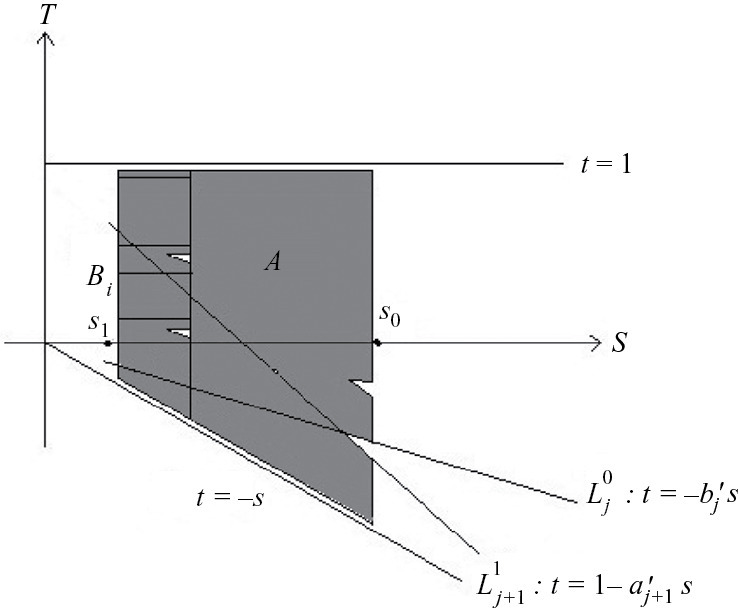
. Obviously, R is a compact set which we will show is recurrent; see Figure 1.
The grey region illustrates the recurrent set R. Here,
 $\mathbb {B}_{*}(\delta _{1},B)$
is the union of two gaps.

We first split the region
 $R_{1}$
as follows:
-
•
$A^{1}:=\{ (s,t)\mid {(1+\epsilon )s_{0}}/{p}\leq s \leq (1+2\epsilon )s_{0},\ -s+\delta \leq t\leq 1-\delta \}$
; -
•
$B^{1}_{0}:=\{ (s,t)\mid (1+\epsilon )s_{1} \leq s < {(1+\epsilon )s_{0}}/{p},\ -s+\delta \leq t< ({1-\delta })/{p}\}$
; -
•
$B_{i}^{1}:=\{ (s,t)\mid (1+\epsilon )s_{1}\leq s < {(1+\epsilon )s_{0}}/{p},\ ({1+pa_{i-1}-\delta })/{p}\leq t< (1+pa_{i}- \delta )/ {p}\}, ~1\leq i\leq M-1$
; -
•
$B_{M}^{1}:=\{ (s,t)\mid (1+\epsilon )s_{1}\leq s < {(1+\epsilon )s_{0}}/{p},\ ({1+pa_{M-1}-\delta })/{p}\leq t\leq 1-\delta \}$
.


Then the region R splits into two subsets A and
 $B_{i}$
as follows:
 $$ \begin{align*}A:=A^{1}\setminus \bigg(\bigcup_{n\in J}\tilde{G}_{n}\bigg), \quad B_{i}:=B_{i}^{1}\setminus \mathbb{B}(\delta_{1},B), \quad i\in \Sigma.\end{align*} $$
For each
 $0\leq j\leq N$
, let
 $$ \begin{align*}A_{j}:=\bigg\{(s,t)\,\bigg|\,\frac {(1+\epsilon)s_{0}}{p}\leq s \leq (1+2\epsilon)s_{0},\ -b^{\prime}_{j}s+\delta\leq t\leq 1-a^{\prime}_{j}s-\delta\bigg\}.\end{align*} $$
Since, for each
 $(s,t)\in A$
, there is at least one j such that
 $-b^{\prime }_{j}s+\delta \leq t\leq 1-a^{\prime }_{j}s-\delta ,$
we have
 $A=\{(s,t)\mid {(1+\epsilon )s_{0}}/{p}\leq s \leq (1+2\epsilon )s_{0}\}\cap (\bigcup _{j=0}^{j=N}A_{j}).$
On the other hand,
 $$ \begin{align*}T^{\prime}_{j}(A_{j})=\bigg\{(s,t)\,\bigg|\,\frac{(1+\epsilon)s_{0}}{pq}\leq s\leq\frac{(1+2\epsilon)s_{0}}{q},\ s+\delta\leq t\leq 1-\delta\bigg\}\subset R.\end{align*} $$
Since
 $\tau (K)\cdot \tau (K^{\prime })>({1+2\epsilon })/{(1-2\delta )q}$
and
 ${(1+\epsilon )s_{0}}/{pq}=(1+\epsilon )s_{1}$
, it follows that, for each
 $(s,t)\in A$
, there are words
 $i_{1},i_{2},\ldots , i_{k} \in \Sigma ^{\prime }$
such that
 $(s_{*},t_{*}):=T^{\prime }_{i_{k}}\circ \cdots \circ T^{\prime }_{i_{1}} (s,t)\in \bigcup _{n=0}^{n=M} B^{1}_{n} $
. Now if
 $(s_{*},t_{*})\in \mathbb {B}(\delta _{1},B)$
, then there is an element
 $k_{*}\in \Sigma ^{\prime }$
such that
 $$ \begin{align*}(s_{*},t_{*}+(a^{\prime}_{k_{*}}-a^{\prime}_{i_{k}})qs)\in V_{\delta_{1}}\setminus \mathbb{B}(\delta_{1},B).\end{align*} $$
Therefore,
 $T^{\prime }_{k_{*}}\circ T^{\prime }_{i_{k-1}}\circ \cdots \circ T^{\prime }_{i_{1}} (s,t)\in \bigcup _{n=0}^{n=M} B^{1}_{n}\setminus \mathbb {B}(\delta _{1},B) $
, since
 $$ \begin{align*}T^{\prime}_{k_{*}}\circ {T^{\prime}_{i_{k}}}^{-1}(s_{*},t_{*})=(s_{*},t_{*}+(a^{\prime}_{k_{*}}-a^{\prime}_{i_{k}})qs).\end{align*} $$
This says that, for each point
 $(s,t)\in A$
, we can select the operators
 $T^{\prime }_{j},~ j\in \Sigma ^{\prime }$
(perhaps several times) and transfer the point to one of sets
 $B_{i},~i\in \Sigma $
.
To continue, we need to know that
 $T_{i}( B_{i})$
is a subset of the interior of
 $R_{1}$
, for all
 $i\in \Sigma $
. In fact, it is easy to see that the assertion holds for
 $i=0$
. For
 $i>0$
,
 $T_{i}$
maps the corner point
 $((1+\epsilon )s_{1},({1+pa_{i-1}-\delta })/{p})$
to
 $(p(1+\epsilon )s_{1},- p(a_{i}-b_{i-1})-\delta )$
, and
 $- p(1+\epsilon )s_{1}+\delta <- p(a_{i}-b_{i-1})-\delta $
always holds, since
 $2\delta <\epsilon p s_{1}$
. Note that the last condition in (2) gives that the region
 $B_{M}$
is well defined.
To show that R is a recurrent set, it is enough to show that, for each
 $j\in J $
and
 $i\in \Sigma $
, each point of
 $ T_{i}^{-1}(\tilde {G}_{j})\setminus \mathbb {B}_{*}(\delta _{1},B)$
goes to the interior of R by one of the operators (2.1), since
 ${(1+\epsilon )s_{0}}/{p}< p(1+\epsilon )s_{1}$
. To do this, suppose that i, j and
 $(s,t)\in \tilde {G}_{j}$
have been chosen such that
 $T^{-1}_{i}(s,t)\notin \mathbb {B}(\delta _{1},B)$
. Thus, from (3),
 $(s,t)\notin \tilde {A}_{i}^{j}$
. Hence, there is at least one
 $ k\in \Sigma $
such that the point
 $(s,t)+(0,(a_{i}-a_{k})p)$
belongs to
 $V_{\delta }\setminus (\bigcup _{n\in J}\tilde {G}_{n})$
. Since
 $T_{k}\circ T_{i}^{-1}(s,t)=(s,t+(a_{i}-a_{k})p),$
we see that
 $T_{k}( T_{i}^{-1}(s,t))$
falls in the interior of R.
Consequently, for each point
 $(s,t)\in A$
, we first use the operators
 $T^{\prime }_{j},~j\in \Sigma ^{\prime }$
(perhaps several times) and transfer
 $(s,t)$
to a point in the sets
 $\bigcup _{i\in \Sigma }B_{i}$
. Then, by using one of the operators
 $T_{i}$
,
 $i\in \Sigma $
, we transfer the latter point to
 $ R^{\circ }$
. This implies that R is a recurrent set for the operators (2.1), which completes the proof of the theorem.
According to what we established above, whenever the hypothesis of Theorem 2 holds, K and
 $\unicode{x3bb} K^{\prime }+t_{0}$
have stable intersection for all
 $$ \begin{align*}(\unicode{x3bb},t_{0})\in\bigg\{(s,t)\,\bigg|\, s\in (s_{1},~s_{*})\setminus \bigg[\inf(\pi_{1}(B)),~\frac{s_{0}}{p}\bigg],~t\in(-s,~1)\bigg\},\end{align*} $$
where
 $s_{*}:=\min \{x_{j}\mid j\in J\}$
. Here,
 $\pi _{1}$
is the map that projects the points of
 $\mathbb {R}^{2}$
into their first component.
In the case where
 $p=q$
and
 $A=\emptyset $
, K and
 $K^{\prime }$
carry a recurrent set too. Indeed, in the proof of Theorem 2, B and consequently
 $\mathbb {B}_{*}(\delta _{1},B)$
become empty sets. Hence, we can transfer each point of the segment
 $ R\cap \{(s,t)\mid s= (1+\epsilon )s_{1}\}$
to
 $ R^{\circ }\cap \{(s,t)\mid s={(1+\epsilon )s_{0}}/{p}\}$
by one of the operators
 $T_{k},~k\in \Sigma $
. Also, we see that when
 $\tau (K)\cdot \tau (K^{\prime })\leq {1}/{q}$
, for all
 $\unicode{x3bb} \in (s_{1},~s_{*})$
, there is
 $t_{0}\in (-s,~1)$
such that
 $P\cap (\unicode{x3bb} P^{\prime }+t_{0})=\emptyset $
, since
 $s_{*}\leq {s_{0}}/{p}$
. These facts lead us to the following theorem.
Theorem 3. The pair
 $(K,K^{\prime })$
satisfies the GTT strictly (see [Reference Moreira9]) if and only if
 $A=\emptyset $
.
Proof. Firstly, suppose that the pair
 $(K,K^{\prime })$
satisfies the GTT strictly and
 $A_{i}^{j}$
is a non-empty set for words
 $i\in \Sigma $
and
 $j\in J $
. Thus, there is
 $x\in G_{j}$
such that for each
 $ k\in \Sigma $
we have
 $x+(0,(a_{i}-a_{k})p)\in V_{0}^{C}\cup (\bigcup _{n\in J}G_{n}).$
Let
 $(\unicode{x3bb} ,t_{0}):=T_{i}^{-1}(x)$
, which gives
 $s_{1}<\unicode{x3bb} <s_{*}$
and
 $t_{0}\in (-s,~1)$
. Thus,
 $P^{\circ }\cap (\unicode{x3bb} P^{\prime }+t_{0})^{\circ }=\emptyset $
, which is a contradiction.
Conversely, suppose that
 $A_{i}^{j}=\emptyset $
for each
 $i\in \Sigma $
and
 $j\in J $
. From the above discussion, we see that for each
 $(\unicode{x3bb} ,t_{0})\in \{(s,t)\mid s\in (s_{1},~s_{*}),~t\in (-s,~1)\}$
, K and
 $\unicode{x3bb} K^{\prime }+t_{0}$
have stable intersection. Thus, the pair
 $(K,K^{\prime })$
satisfies the GTT strictly, and this completes the proof of the theorem.
Consequently, if the pair
 $(K,K^{\prime })$
satisfies the GTT strictly, then K and
 $K^{\prime }$
carry a compact recurrent set. Moreover, for all
 $(\unicode{x3bb} ,t_{0})\in \{(s,t)\mid ~s\in (s_{1},~s_{*}),~t\in (-s,~1)\}$
, K and
 $\unicode{x3bb} K^{\prime }+t_{0}$
have stable intersection.
Example 2. Let
 $p={97}/{6}$
and
 $$ \begin{align*}a_{0}=0,\quad\! a_{1}=\frac{11}{97},\quad\! a_{2}= \frac{22}{97},\quad\! a_{3}=\frac{38}{97},\quad\! a_{4}=\frac{53}{97}, \!\quad a_{5}=\frac{69}{97},\!\quad a_{6}=\frac{80}{97},\!\quad a_{7}=\frac{91}{97}\end{align*} $$
(see Figure 2), and let
 $K^{\prime }$
be the third Cantor set for which
 $q=3$
,
 $a^{\prime }_{0}=0$
and
 $a^{\prime }_{1}=\tfrac 23$
.
Markov partition of homogeneous Cantor set K.

Then K and
 $K^{\prime }$
carry a recurrent set, but do not satisfy the GTT strictly. Moreover, for all
 $\unicode{x3bb} \in [{10}/{97},~{18}/{97}]\cup [{25}/{97},~3]$
and
 $t_{0}\in [-\unicode{x3bb} ,~1]$
, the pair
 $(K,\unicode{x3bb} K^{\prime }+t_{0})$
has stable intersection. Note that here
 $\tau (K)\cdot \tau (K^{\prime })=\tfrac 23<1$
.
To check the above assertion, we first observe that
 $s_{1}={10}/{97}, ~s_{0}=5,~J=\{0\}$
and
 $G_{o}:=A_{1}A_{2}A_{3}$
is a triangle with vertices
 $A_{1}:=(3, -1),~A_{2}:=(5,-\tfrac 73)$
and
 $ A_{3}:=(5, -\tfrac 53)$
. Moreover,
 $(a_{i+1}-a_{i})p$
belong to
 $\{{11}/{6},{16}/{6},{15}/{6}\}$
. Thus, for every
 $i\in \{0,1,2,5,6,7\}$
, we can always choose k with
 $|i-k|=1$
such that
 $(a_{i}-a_{k})p\in \{\pm {11}/{6}\}$
. This implies that for all
 $i\in \{0,1,2,5,6,7\}$
and
 $j\in J$
, we have
 $A_{i}^{j}=\emptyset $
, since
 $G_{0}+(0,(a_{i}-a_{k})p)\subset V_{0}\setminus G_{0}$
.
We claim that for
 $i=3,4$
and
 $j\in J$
,
 $A_{i}^{j}$
is a subset of triangle
 $ A_{1}CD $
, where
 $C:=({25}/{6},-{32}/{18})$
and
 $D:=({25}/{6},-{25}/{18})$
. The claim follows from the following two facts.
-
(i) When
$i=3$
, we have
$(a_{3}-a_{2})p={16}/{6}$
and
$(a_{3}-a_{4})p=-{15}/{6}$
. Thus,-
•
$\{(s,t)\mid {25}/{6}<s\leq 5,\ t<-\tfrac 53\}\cap G_{0}+(0,(a_{3}-a_{2})p)\subset V_{0}\setminus G_{0}$
, -
•
$\{(s,t)\mid {25}/{6}<s\leq 5,\ t\geq -\tfrac 53\}\cap G_{0}+(0,(a_{3}-a_{4})p)\subset V_{0}\setminus G_{0}$
.
-
-
(ii) When
$i=4$
, we have
$(a_{4}-a_{3})p={15}/{6}$
and
$(a_{4}-a_{5})p=-{16}/{6}$
. Thus,-
•
$\{(s,t)\mid {25}/{6}<s\leq 5,\ t<-\tfrac 32\}\cap G_{0}+(0,(a_{4}-a_{3})p)\subset V_{0}\setminus G_{0}$
, -
•
$\{(s,t)\mid {25}/{6}<s\leq 5,\ t\geq -\tfrac 32\}\cap G_{0}+(0,(a_{4}-a_{5})p)\subset V_{0}\setminus G_{0}$
.
-


Therefore, B is a subset of
 $T_{3}^{-1}(A_{1}CD )\cup T_{4}^{-1}(A_{1}CD )$
. Put
 $B_{1}B_{2}B_{3}:=T_{3}^{-1}(A_{1}CD )$
and
 $B^{\prime }_{1}B^{\prime }_{2}B^{\prime }_{3}:=T_{4}^{-1}(A_{1}CD )$
. Since
 $T_{i}^{-1}(s,t)=({s}/{p}, {t}/{p} +a_{i})$
, we obtain
-
•
$ B_{1}=({18}/{97},{32}/{97}),\ B_{2}=({25}/{97},{82}/{291}),\ B_{3}=({25}/{97},{89}/{291})$
, -
•
$ B_{1}^{\prime }=({18}/{97},{47}/{97}),\ B_{2}^{\prime }=({25}/{97},{127}/{291}),\ B_{3}^{\prime }=({25}/{97},{134}/{291})$
.


Consider the maps
 $T_{\pm }(s,t):=(s,t\pm (a^{\prime }_{1}-a^{\prime }_{0})qs)=(s,t\pm 2s)$
. Put
 $B^{+}_{1}B^{+}_{2}B^{+}_{3}:=T_{+}(B_{1}B_{2} B_{3})$
and
 $B^{-}_{1}B^{-}_{2}B^{-}_{3}:=T_{-}(B_{1}B_{2}B_{3})$
. Then we obtain
-
•
$ B^{+}_{1}=({18}/{97},{68}/{97}),\ B^{+}_{2}=({25}/{97},{232}/{291}),\ B^{+}_{3}=({25}/{97},{239}/{291})$
, -
•
$ B^{-}_{1}=({18}/{97},-{4}/{97}),\ B^{-}_{2}=({25}/{97},-{68}/{291}),\ B^{-}_{3}=({25}/{97},-{61}/{291})$
.


Consequently, the triangles
 $B_{1}B_{2}B_{3},~B^{\prime }_{1}B^{\prime }_{2}B^{\prime }_{3},~ B^{+}_{1}B^{+}_{2}B^{+}_{3}$
and
 $B^{-}_{1}B^{-}_{2}B^{-}_{3}$
are disjoint subsets of
 $V_{0}$
, since
-
•
$-{18}/{97}<\pi _{2}(B_{1}^{-})<\pi _{2}(B_{1})<\pi _{2}(B_{1}^{\prime })<\pi _{2}(B_{1}^{+})<1$
, -
•
$-{25}/{97}\kern1.5pt{<}\kern1.5pt\pi _{2}(B_{2}^{-})\kern1.5pt{<}\kern1.5pt\pi _{2}(B_{3}^{-})\kern1.5pt{<}\kern1.5pt\pi _{2}(B_{2})\kern1.5pt{<}\kern1.5pt\pi _{2}(B_{3})\kern1.5pt{<}\kern1.5pt\pi _{2}(B_{2}^{\prime })\kern1.5pt{<}\kern1.5pt\pi _{2}(B_{3}^{\prime })\kern1.5pt{<}\kern1.5pt\pi _{2}(B_{2}^{+})\kern1.5pt{<} \pi _{2}(B_{3}^{+})<1$
.


Also, the triangles
 $B_{1}B_{2}B_{3},~B^{\prime }_{1}B^{\prime }_{2}B^{\prime }_{3},~ T_{+}(B^{\prime }_{1}B^{\prime }_{2}B^{\prime }_{3})$
and
 $T_{-}(B^{\prime }_{1}B^{\prime }_{2}B^{\prime }_{3})$
are disjoint subsets of
 $V_{0}$
, since K and
 $K^{\prime }$
are middle. Therefore, the assumptions of Theorem 2 hold, which guarantees the existence of one recurrent set. Note that from Theorem 3, the pair
 $(K,K^{\prime })$
do not satisfy the GTT strictly since B is a non-empty set. The above discussion also implies that
 $K-\unicode{x3bb} K^{\prime }$
is an interval if and only if
 $\unicode{x3bb} \in [{10}/{97},~{18}/{97}]\cup [{25}/{97},~3]$
.
5 Middle homogeneous Cantor sets
To reach our goal, we first prove the following result. Notice that the
 $\unicode{x3bb} $
stated in the following proposition and its proof is different from the
 $\unicode{x3bb} $
used in the definition of K.
Proposition 2. Assume that K and
 $ K^{\prime }$
are middle homogeneous Cantor sets with convex hull
 $[0,~1]$
and
 $\tau (K)\cdot \tau (K^{\prime })<1.$
-
(I) If
${\log p}/{\log q}$
is irrational, then
$K-\unicode{x3bb} K^{\prime }\neq [-\unicode{x3bb} ,~1]$
, for all
$\unicode{x3bb}>0.$
-
(II) If
${\log p}/{\log q}={n_{0}}/{m_{0}}$
with
$(m_{0},n_{0})=1$
and
$\gamma :=p^{{1}/{n_{0}}}$
, then-
(i)
$\tau (K)\cdot \tau (K^{\prime })<{1}/{\gamma }$
gives
$K- \unicode{x3bb} K^{\prime }\neq [-\unicode{x3bb} ,~1],$
-
(ii)
$\tau (K)\cdot \tau (K^{\prime })\geq {1}/{\gamma }$
gives
$K- \unicode{x3bb} K^{\prime }=[-\unicode{x3bb} ,~1]$
if and only if
$$ \begin{align*} \unicode{x3bb} \in \bigcup_{n=-m_{0}+1} {}^{n=n_{0}}\gamma^{n}\cdot\bigg[\frac{cq}{\gamma },~\frac{1}{pc^{\prime}}\bigg]. \end{align*} $$
-


Proof. Since homogeneous Cantor sets K and
 $ K^{\prime }$
are middle,
 $a_{i+1}-b_{i} $
is constant for each
 $i\in \Sigma $
, which we call c, and also
 $a^{\prime }_{j+1}-b^{\prime }_{j} $
is constant for each
 $j\in \Sigma ^{\prime }$
, which we will call
 $c^{\prime }$
. Thus,
 $a_{i}={i}/{p}+ic,~ i\in \Sigma $
and
 $a^{\prime }_{j}={j}/{q}+jc^{\prime },~ j\in \Sigma ^{\prime }$
. Hence, the transferred renormalization operators (2.1) can be written in the following form:
 $$ \begin{align} (s,t)\overset{T_{i}}\longmapsto (ps,pt-i-pic),\quad(s,t)\overset{T^{\prime}_{j}}\longmapsto \bigg(\frac{s}{q},t+\bigg(\frac{j}{q}+jc^{\prime}\bigg)s\bigg). \end{align} $$
It is easy to check that
 $[{cq}/{\gamma },~{1}/{pc^{\prime }}]=\emptyset $
if and only if
 $\tau (K)\cdot \tau (K^{\prime })<{1}/{\gamma }$
. When,
 $\unicode{x3bb} \notin [s_{1},~s_{2}]$
, one knows that
 $K- \unicode{x3bb} K^{\prime }\neq [-\unicode{x3bb} ,~1] $
, where
 $s_{1}=c $
and
 $s_{2}={1}/{c^{\prime }}$
(see §4). Since
 $\tau (K)\cdot \tau (K^{\prime })<1$
, we have
 $({1}/{p})s_{2}<qs_{1}$
. Let
 $I:=(({1}/{p})s_{2},~qs_{1})$
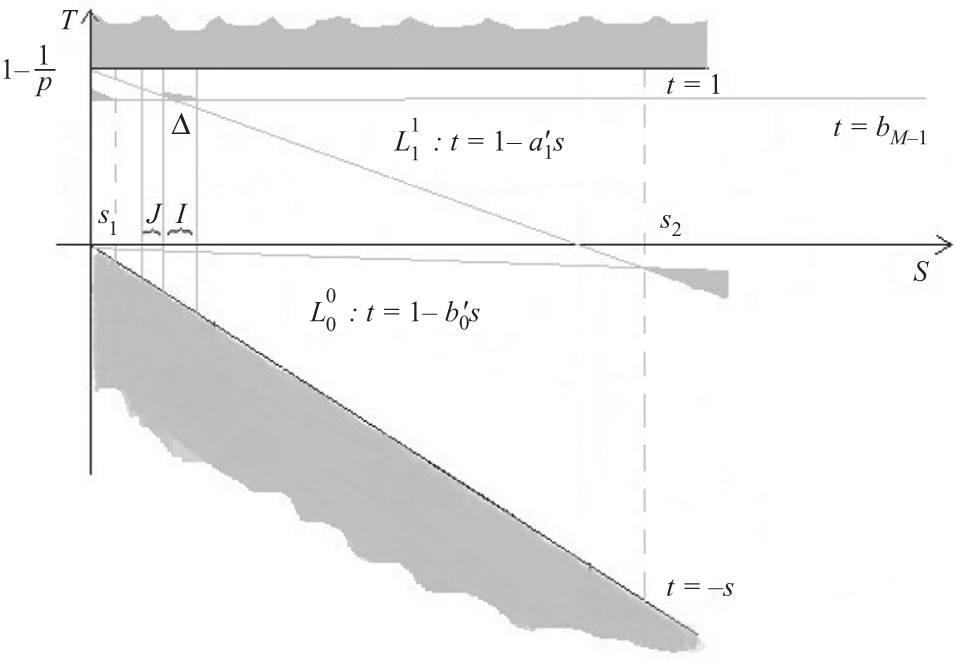
; see Figure 3.
The points
 $s_{1},s_{2}$
, the intervals
 $I,J$
and the set
 $\Delta $
.

Notice that if
 $\unicode{x3bb} \in I$
, then none of the points
 $p\unicode{x3bb} $
and
 $({1}/{q})\unicode{x3bb} $
belong to
 $ [s_{1},~s_{2}]$
. Moreover, we may consider the case
 $I\subseteq [s_{1},~s_{2}]$
. Indeed,
 $I\nsubseteq [s_{1},~s_{2}]$
is equivalent to
 $\tau (K)\cdot \tau (K^{\prime })<{1}/{\min \{p,q\}}$
. A proof similar to [Reference Pourbarat18, p. 22] shows that if
 $\tau (K)\cdot \tau (K^{\prime })<{1}/{\min \{p,q\}}$
, then
 $K- \unicode{x3bb} K^{\prime }\neq [-\unicode{x3bb} ,~1] $
, for every
 $\unicode{x3bb} .$
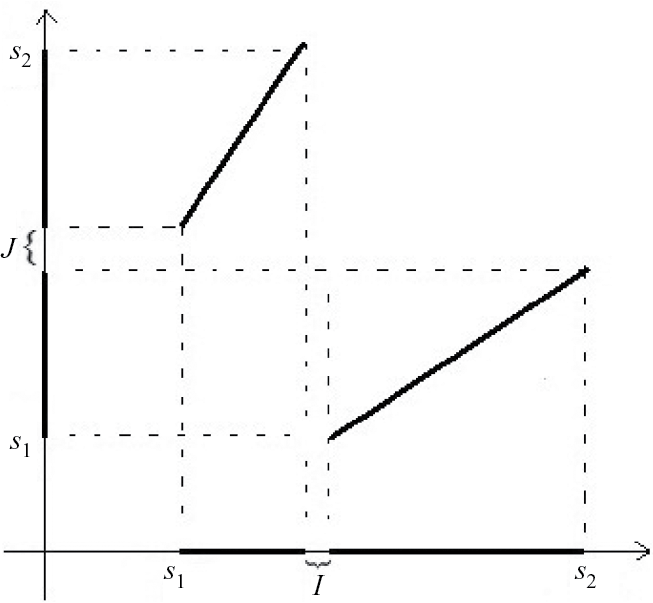
Define
 $$ \begin{align*} T(x):= \begin{cases} px, & x \in \bigg[s_{1},~\dfrac{1}{p}s_{2}\bigg],\\[10pt] \dfrac{1}{q}x, & x\in [qs_{1},~s_{2}], \end{cases} \end{align*} $$
with domain
 $D_{T}:= [s_{1},~({1}/{p})s_{2}]\cup [qs_{1},~s_{2}]$
; see Figure 4.
The graph of the map T.

We emphasize here that, for given
 $n\in \mathbb {N}$
and
 $x\in D_{T}$
,
 $T^{n}(x)$
is well defined and we consider
 $T(T^{n-1}(x))$
if
 $T^{n-1}(x)$
is well defined and belongs to
 $D_{T}.$
In other words, the smallest n such that
 $T^{n}(x)$
is not well defined is when
 $T^{n-1}(x)\in I$
. Moreover, for each
 $n\in \mathbb {N}\cup \{0\}$
and
 $A\subset [s_{1},~s_{2}]$
, consider
 $$ \begin{align*}T^{-n}(A):=\{x\in D_{T} \mid T^{n}(x)\text{ is well defined and belongs to }A\}.\end{align*} $$
A property that is worth mentioning here is that, for each
 $0\leq n\leq m_{0}+n_{0}$
and each x that stays in domain
 $T^{n}$
, there exist
 $0\leq i\leq m_{0}$
and
 $0\leq j\leq n_{0}$
such that
 $T^{n}(x)=({p^{i}}/{q^{j}})x.$
Moreover, if
 $T^{n_{0}+m_{0}}(x)$
is well defined, it is equal to x. The following lemma will be needed.
Lemma 7. For each
 $\unicode{x3bb} \in \bigcup _{n=0}^{\infty }T^{-n}(I)$
, we have
 $K- \unicode{x3bb} K^{\prime }\neq [-\unicode{x3bb} ,~1].$
Proof. Let
 $$ \begin{align*}\Delta:=\bigg\{(s,t)\, \bigg|\, t+a^{\prime}_{1}s> 1 ,\ t> b_{M-1},\ t+b^{\prime}_{0} s< 1-\frac {1}{p}\bigg\};\end{align*} $$
see Figure 3. The point
 $({s_{2}}/{p},1-{a^{\prime }_{1}s_{2}}/{p} )$
, which is the intersection point
 $L_{1}^{1}$
with the line
 $\{(s,t)\mid t+b^{\prime }_{0} s< 1- {1}/{p}\},$
is above the horizontal line
 $\{(s,t)\mid t=b_{M-1}\},$
since
 $\tau (K)\cdot \tau (K^{\prime })<1.$
Thus,
 $\Delta $
is non-empty. Also
 $$ \begin{align*}(qs_{1},b_{M-1})=\{(s,t)\mid t=b_{M-1}\}\cap \bigg\{(s,t)\,\bigg|\, t+b^{\prime}_{0} s= 1-\frac {1}{p}\bigg\}.\end{align*} $$
These facts lead to
 $\pi _{1}(\Delta )=I$
. On the other hand,
 $T_{i}(\Delta )$
is placed above the line
 $\{(s,t)\mid t=1\},$
for all
 $0\leq i<M$
. Also
 $T_{M}(\Delta )\subset \{(s,t)\mid t+a^{\prime }_{1}s> 1,~t+b^{\prime }_{0} s< 0\}$
, which implies that
 $T^{\prime }_{j}(T_{M}(\Delta ) )$
is placed above the line
 $\{(s,t) \mid t=1\},$
for all
 $0< j\leq N$
and
 $T^{\prime }_{0}(T_{M}(\Delta ) )$
is placed below the line
 $\{(s,t) \mid t=-s\}$
. Consequently, none of the points of
 $\Delta $
are difference pairs.
Now suppose that
 $\unicode{x3bb} \in \bigcup _{n=0}^{\infty }T^{-n}(I)$
. Thus, there is an
 $n\in \mathbb {N}$
such that
 $T^{n}(\unicode{x3bb} )\in I$
. This implies that there exist
 $0\leq i_{0}\leq m_{0}$
and
 $0\leq j_{0}\leq n_{0}$
such that
 $T^{n}(\unicode{x3bb} )=({p^{i_{0}}}/{q^{j_{0}}})\unicode{x3bb} \in I.$
From the above discussions, there is a
 $0<t<1$
such that
 $(({p^{i_{0}}}/{q^{j_{0}}})\unicode{x3bb} ,t)\in \Delta $
. The set
 ${T^{\prime }_{0}}^{-{j_{0}}}(\Delta )$
always stays above the lines
 $L_{j}^{1}, ~0< j\leq N$
, hence its points are not difference pairs. Also, since
 $T_{M}^{-i_{0}}\circ {T^{\prime }_{0}}^{-{j_{0}}}(\Delta )$
is a subset of the strip
 $\{(s,t) \mid b_{M-1}<t<1\}$
, its points are not difference pairs. On the other hand,
 $\unicode{x3bb} \in \pi _{1}(T_{M}^{-i_{0}}\circ {T^{\prime }_{0}}^{-{j_{0}}}(\Delta ))$
, which gives the existence of
 $-\unicode{x3bb} <t_{1}<1$
with
 $(\unicode{x3bb} ,t_{1})\in T_{M}^{-i_{0}}\circ {T^{\prime }_{0}}^{-{j_{0}}}(\Delta )$
such that
 $(\unicode{x3bb} ,t_{1})$
is not one difference pair. This implies
 $K- \unicode{x3bb} K^{\prime }\neq [-\unicode{x3bb} ,~1]$
which completes the proof.
Define
 $\Lambda := [s_{1},~s_{2}]-\bigcup _{n=0}^{\infty }T^{-n}(I)$
. It is straightforward to show that
 $T(\Lambda )\subset \Lambda $
, meaning that
 $\Lambda $
is invariant under the map T.
Lemma 8.
 $\unicode{x3bb} \in \Lambda ~\Longleftrightarrow ~ C_{\alpha }- \unicode{x3bb} C_{\beta }=[-\unicode{x3bb} ,~1].$
Proof. Take the subset
 $$ \begin{align*}R:= \{ (s,t) \mid s \in \Lambda, ~ -s\leq t\leq1\}\end{align*} $$
of
 $\mathbb {R}^{*} \times \mathbb {R}$
, which is obviously bounded and far from zero. We show that for every element of R there exists at least one of the operators (5.1) which transfers that element to R and so the element is a difference pair. To prove this assertion, fix s with
 $(s,t)\in R$
. Two possible cases may occur.
Case 1:
 $s_{1}\leq s\leq ({1}/{p})s_{2}$
. We observe that the points
 $T_{0}(s,t)=(ps,pt)$
and
 $T_{M}(s,t)=(ps,pt-pa_{M})$
are placed in the regions
 $\{ (s,t)\mid t\geq -s\}$
and
 $\{ (s,t) \mid t\leq 1\}$
, respectively. Moreover, for each
 $1\leq i\leq M$
, we have
 $\pi _{1}(T_{i}(s,t))=ps$
and
 $$ \begin{align*}0<\pi_{2}(T_{i-1}(s,t))-\pi_{2}(T_{i}(s,t))=1+cp\leq 1+ps,\end{align*} $$
since
 $s_{1}=c$
. Thus, one of the points
 $\{T_{i}(s,t)\}_{i=0}^{i=M}$
is placed in the region R, since
 $\Lambda $
is invariant under T.
Case 2:
 $qs_{1}\leq s\leq s_{2}$
. We prove that one of the operators
 $\{T^{\prime }_{j}(s,t)\}_{j=0}^{j=N}$
transfers the point
 $ (s,t)$
to the set R. To do this, take
 $$ \begin{align*}V_{j}:=\bigg\{ (s,t)\,\bigg|\, -\frac{s}{q}-\bigg(\frac{j}{q}+jc^{\prime}\bigg)s\leq t\leq 1-\bigg(\frac{j}{q}+jc^{\prime}\bigg)s\bigg\},\end{align*} $$
for each
 $j\in \Sigma ^{\prime }$
. We have
 $\sup \pi _{2}(V_{0})=1$
and
 $\inf \pi _{2}(V_{N})=-s$
, since
 $({N+1})/{q}+Nc^{\prime }=1$
. Moreover, for all
 $0\leq j <N$
, we have
 $$ \begin{align*}\inf \pi_{2}(V_{j+1})\leq\inf \pi_{2}(V_{j})\leq \sup \pi_{2}(V_{j+1}) \leq \sup \pi_{2}(V_{j}),\end{align*} $$
since
 $s\leq s_{2}={1}/{c^{\prime }}$
. On the other hand,
 $T^{\prime }_{j}(V_{j})=\{ ({s}/{q},t)\mid {-s}/{q}\leq t\leq 1\}$
for each
 $j\in \Sigma ^{\prime }$
. Thus, for each
 $(s,t)\in \{ (s,t) \mid s\leq s_{2},~-s\leq t\leq 1\}$
, there is
 $j\in \Sigma ^{\prime }$
such that
 $T^{\prime }_{j}(s,t)\in R$
, since
 $\Lambda $
is invariant under the map T.
If
 $\unicode{x3bb} \in \Lambda $
and
 $t\in [-\unicode{x3bb} ,~1]$
, then the pair
 $(\unicode{x3bb} ,t)$
belongs to R and cases (1) and (2) lead to the conclusion that it is a difference pair, which implies
 $K- \unicode{x3bb} K^{\prime }=[-\unicode{x3bb} ,~1]$
.
The converse is implied by Lemma 7, which completes the proof of the lemma.
Consequently, if
 ${\log p}/{\log q}$
is irrational then
 $\Lambda =\emptyset $
, and by Lemma 7, we have
 $K- \unicode{x3bb} K^{\prime }\neq [-\unicode{x3bb} ,~1],$
for all
 $\unicode{x3bb}>0$
. This proves assertion (I) of the proposition. To prove assertion (II), suppose that
 ${\log p}/{\log q}={n_{0}}/{m_{0}}$
with
 $(m_{0},n_{0})=1$
and
 $\gamma =p^{{1}/{n_{0}}}$
. This implies
 $$ \begin{align*}\bigcup_{n=0} {}^{\infty}T^{-n}(I)=\bigcup_{n=0} {}^{n_{0}+m_{0}-2}T^{-n}(I).\end{align*} $$
Let
 $$ \begin{align*}J:=\bigg[\frac{qs_{1}}{\gamma },~\frac{s_{2}}{p}\bigg].\end{align*} $$
When
 $\tau (C_{\alpha })\cdot \tau (C_{\beta })< {1}/{\gamma }$
, the sets J and so
 $\Lambda $
are empty and Lemma 7 proves (II.i).
Now assume that
 ${1}/{\gamma } \leq \tau (C_{\alpha })\cdot \tau (C_{\beta })< 1$
. This gives that
 $J:=[{qs_{1}}/{\gamma },~{s_{2}}/{p}]$
is non-empty. Note that
 $J\subset [s_{1},~s_{2}]$
and
 $\sup J=\inf I$
; see Figure 3. By a similar proof in [Reference Pourbarat18], we obtain
 $$ \begin{align*} \bigcup_{n=0}^{n=n_{0}+m_{0}-1}T^{n}(J)= [s_{1},~s_{2}]-\bigcup_{n=0}^{n_{0}+m_{0}-2}T^{-n}(I). \end{align*} $$
Another result that we proved in [Reference Pourbarat18] is that for each
 $x\in J$
,
 $$ \begin{align*}\{ D T^{n}(x)\mid 0\leq n\leq n_{0}+m_{0}-1 \}=\{ \gamma^{n} \mid -m_{0}+1\leq n\leq n_{0} \}.\end{align*} $$
However,
 $T^{n}(J)={ DT^{n}|}_{J}J$
. Thus,
 $$ \begin{align*}\bigcup_{n=0}^{n=n_{0}+m_{0}-1}T^{n}(J)= \bigcup_{n=-m_{0}+1}^{n=n_{0}}\gamma^{n}\cdot\bigg[\frac{qs_{1}}{\gamma },~\frac{s_{2}}{p}\bigg].\end{align*} $$
Consequently,
 $$ \begin{align*}\Lambda=\bigcup_{n=-m_{0}+1}^{n=n_{0}}\gamma^{n}\cdot\bigg[\frac{qs_{1}}{\gamma },~\frac{s_{2}}{p}\bigg].\end{align*} $$
The conclusion (II.ii) follows from Lemma 8. Finally, the proof of the proposition is completed.
For given regular Cantor sets K and
 $K^{\prime }$
, the gap lemma asserts that if
 $\tau (K)\cdot \tau (K^{\prime })\geq 1,$
then
 $K+ K^{\prime }$
is one interval. Also, it is shown in [Reference Moreira9] that if
 $\tau (K)\cdot \tau (K^{\prime })<1$
and
 ${\log p}/{\log q}$
is irrational, then
 $K+ K^{\prime }$
is non-connected. In the context of middle homogeneous Cantor sets we have the following result.
Theorem 4. Suppose that K and
 $K^{\prime }$
are two middle homogeneous Cantor sets with
 $|G(K)|=c$
and
 $|G(K^{\prime })|=c^{\prime }$
.
-
(I) If
$\tau (K)\cdot \tau (K^{\prime })\geq 1,$
then
$K+ K^{\prime }=[0,~a+b]$
. -
(II) If
$\tau (K)\cdot \tau (K^{\prime })<1,$
then-
(i) if
${\log p}/{\log q}$
is irrational, then
$K+ K^{\prime }\neq [0,~a+b]$
, -
(ii) if
${\log p}/{\log q}={n_{0}}/{m_{0}}$
with
$(m_{0},n_{0})=1$
and
$\gamma :=p^{{1}/{n_{0}}}$
, then-
• if
$\tau (K)\cdot \tau (K^{\prime })\geq {1}/{\gamma },$
then
$K+ K^{\prime }=[0,~a+b],$
if and only if
$$ \begin{align*} \bigg\lceil n_{0}\log_{p}\frac{pc^{\prime}}{a}\bigg\rceil=\bigg\lfloor n_{0}\log_{p}\frac{b}{qc}\bigg\rfloor+1, \end{align*} $$
-
• if
$\tau (K)\cdot \tau (K^{\prime })<({1}/{\gamma }),$
then
$K+ K^{\prime }\neq [0,~a+b].$
-
-


Proof. Assertion (I) follows from the gap lemma. The middle homogeneous Cantor sets
 $({1}/{a})K$
and
 $({1}/{b})K^{\prime }$
have convex hull
 $[0,~1]$
with
 $|G(({1}/{a})K)|={c}/{a}$
and
 $|G(({1}/{b})K^{\prime })|={c^{\prime }}/{b}$
. Recall that
 $$ \begin{align*}K+ K^{\prime}=a\bigg(\frac{1}{a}K+\frac{ b}{a} \frac{1}{b}K^{\prime}\bigg).\end{align*} $$
Assertion (II.i) and the second part of assertion (II.ii) follow from Proposition 2 and the above relation. It only remains to prove the first assertion of
 $(II.ii)$
. Again, by using Proposition 2 and the above relation,
 $K+ K^{\prime }=[0,~a+b],$
if and only if
 $$ \begin{align*} \frac{b}{a} \in \bigcup_{n=-m_{0}+1}^{n=n_{0}}\gamma^{n}\cdot\bigg[\frac{cq}{a\gamma },~\frac{b}{pc^{\prime}}\bigg], \end{align*} $$
which is equivalent to
 $$ \begin{align*}1\in\bigcup_{n=-m_{0}+1}^{n=n_{0}}\gamma^{n}\cdot\bigg[\frac{cq}{b\gamma },~\frac{a}{pc^{\prime}}\bigg].\end{align*} $$
Equivalently, there exists
 $-m_{0}+1\leq n\leq n_{0}$
such that
 $\gamma ^{-n}\in [{cq}/{b\gamma },~{a}/{pc^{\prime }}].$
This, in turn, is equivalent to
 $[\log _{\gamma }({pc^{\prime }}/{a}),~1-\log _{\gamma }({cq}/{b})]\cap \{ -m_{0}+1,\ldots ,-1,0,1,\ldots , n_{0}\} \neq \emptyset .$
Since
 $\tau (K)\cdot \tau (K^{\prime })<1$
, the length of the interval in the previous relation is smaller than
 $1$
and so the latter is equivalent to
 $\lceil \log _{\gamma }({pc^{\prime }}/{a})\rceil =\lfloor 1-\log _{\gamma }({cq}/{b})\rfloor .$
Putting
 $\gamma =p^{{1}/{n_{0}}}$
into the above relation yields the result.
We now turn to the proof of results (i) and (ii) mentioned at the end of §1. Recall that for given
 $M\in \mathbb {N}$
and
 $\unicode{x3bb} <{1}/({M+1})$
(respectively,
 $N\in \mathbb {N}$
and
 $\mu <({1}/({N+1}))$
),
 $C_{\unicode{x3bb} }^{M}$
(respectively,
 $C_{\mu }^{N}$
) is a middle homogeneous Cantor set with convex hull
 $[0,~1]$
and
 $c=({1-(M+1)\unicode{x3bb} })/{M}$
(respectively,
 $c^{\prime }=({1-(N+1)\mu })/{N}$
). Assume that the pair
 $(C_{\unicode{x3bb} }^{M},C_{\mu }^{N})$
satisfies the condition
 $\tau (C_{\unicode{x3bb} }^{M})\cdot \tau (C_{\mu }^{N})<1$
, and there are the natural numbers m and
 $ n$
with
 $(m,n)=1$
such that
 $\unicode{x3bb} ^{m}=\mu ^{n}$
.
Let us first prove (ii). From Theorem 4,
 $C_{\unicode{x3bb} }^{M}+ C_{\mu }^{N}=[0,~2],$
if and only if
 $$ \begin{align} \bigg\lceil n\log_{\unicode{x3bb}}\frac{N\unicode{x3bb}}{1-(N+1)\unicode{x3bb}^{{m}/{n}}}\bigg\rceil=\bigg\lfloor n\log_{\unicode{x3bb}}\frac{1-(M+1)\unicode{x3bb}}{M\unicode{x3bb}^{{m}/{n}}}\bigg\rfloor+1. \end{align} $$
On the interval
 $(0,~({1}/({M+1})))$
take two functions
 $$ \begin{align*}f_{1}(\unicode{x3bb}):=n\log_{\unicode{x3bb}}\frac{N\unicode{x3bb}}{1-(N+1)\unicode{x3bb}^{{m}/{n}}},\quad f_{2}(\unicode{x3bb}):=n\log_{\unicode{x3bb}}\frac {1-(M+1)\unicode{x3bb}}{M\unicode{x3bb}^{{m}/{n}}}+1.\end{align*} $$
The functions
 $f_{1}$
and
 $f_{2}$
are
 $C^{\infty }$
-smooth and
 ${f_{1}}(0_{+})=n,~{f_{2}}(0_{+})=-m+1.$
It is easy to check that the function
 $f_{1}$
is strictly decreasing and
 $f_{2}$
is strictly increasing. Note that if the function h is
 $C^{1}$
on
 $(0,~1)$
satisfying
 $0<h\leq 1$
and
 $h^{\prime }<0$
, and if, moreover,
 $H(x):=\log _{x}{h(x)}$
, then
 $H^{\prime }(x)>0$
since
 $H^{\prime }(x)=({1}/{\ln ^{2} x})({h^{\prime }(x)\ln x}/{h(x)}-({\ln h(x)}/{x}))$
.
Suppose that
 $\tau (C_{\unicode{x3bb} _{1}}^{M})\cdot \tau (C_{{\unicode{x3bb} _{1}}^{{m}/{n}}}^{N})=1$
, which gives
 $f_{1}(\unicode{x3bb} _{1})+1=f_{2}(\unicode{x3bb} _{1})$
. Put

Thus, for all
 $\unicode{x3bb} <\unicode{x3bb} _{1}$
,
 $C^{M}_{\unicode{x3bb} }+C^{N}_{\unicode{x3bb} ^{m/n}}= [0,~2] $
if and only if
 $\unicode{x3bb} \in K_{n,m}$
.
Depending on the values of n and m, two cases may occur.
Case 1. If
 $f_{1}(\unicode{x3bb} _{1})\notin \mathbb {Z}$
, then let
 $\beta :=\inf K$
. In this case
 $\unicode{x3bb} _{1}\in K_{m,n}$
since
 $f_{1}(\unicode{x3bb} _{1})+1=f_{2}(\unicode{x3bb} _{1})\notin \mathbb {Z}$
, and so
 $ K_{m,n}$
is non-empty. Since the function
 $f_{1}$
is strictly decreasing and
 $f_{2}$
is strictly increasing, one concludes that
 $\beta $
belongs to K and obviously is smaller than
 $\unicode{x3bb} _{1}$
.
Case 2. If
 $f_{1}(\unicode{x3bb} _{1})\in \mathbb {Z}$
, then let
 $\beta :=\unicode{x3bb} _{1}$
. In this case
 $ K_{m,n}$
is empty since
 $f_{1}(\unicode{x3bb} _{1})+1=f_{2}(\unicode{x3bb} _{1})\in \mathbb {Z}$
, and the function
 $f_{1}$
is strictly decreasing and
 $f_{2}$
is strictly increasing.
The above cases imply that

On the other hand, the relation
 $f_{1}(\unicode{x3bb} _{1})=n\log _{\unicode{x3bb} _{1}}({N\unicode{x3bb} _{1}}/({1-(N+1){\unicode{x3bb} _{1}}^{{m}/{n}}}))\in \mathbb {Z}$
is equivalent to the existence of an integer number
 $-m+1\leq r\leq n$
such that
 $$ \begin{align*}n\log_{\unicode{x3bb} _{1}}\frac{N\unicode{x3bb} _{1}}{1-(N+1){\unicode{x3bb} _{1}}^{{m}/{n}}}=r=n\log_{\unicode{x3bb} _{1}}\frac{1-(M+1)\unicode{x3bb} _{1}}{M{\unicode{x3bb} _{1}}^{{m}/{n}}}.\end{align*} $$
Note that
 $f_{1}$
is decreasing and
 $f_{2}$
is increasing and, moreover,
 ${f_{1}}(0_{+})=n,~{f_{2}}(0_{+})=-m+1$
and
 $f_{1}(\unicode{x3bb} _{1})+1=f_{2}(\unicode{x3bb} _{1})$
. It is easy to show that
 $\unicode{x3bb} _{1}$
is a root of the system
 $$ \begin{align} \begin{cases} \dfrac{r}{n}=\log_{\unicode{x3bb}}\dfrac {N+1-(M+N+1)\unicode{x3bb}}{M}, \\[6pt] \dfrac{m}{n}=\log_{\unicode{x3bb}}\dfrac{1-(M+1)\unicode{x3bb}} {N+1-(M+N+1)\unicode{x3bb}}. \end{cases} \end{align} $$
The first equation in (5.3) gives
 $M\unicode{x3bb} ^{r/n}=N+1-(M+N+1)\unicode{x3bb} $
. By putting
 $\rho :=\unicode{x3bb} ^{1/n}$
, we see that
 $\rho>0$
satisfies
 $$ \begin{align*} (M+N+1) \rho^{n} + M\rho^{r}-(N+1) =0.\end{align*} $$
Summing up both equations in (5.3) yields
 $$ \begin{align*}M\rho {}^{m+r}=1-(M+1)\unicode{x3bb}=1-(M+1) \rho^{n}.\end{align*} $$
It is easy to check that
 $\rho $
is a root of the system
 $$ \begin{align} \begin{cases} p_{1}(x):=M x^{m+r}+(M+1)x^{n}-1=0, \\ p_{2}(x):=(N+1) x^{m} + Nx^{n-r}-1=0.\end{cases} \end{align} $$
Since
 $-m+1\leq r\leq n$
, the polynomials
 $p_{1}$
and
 $p_{2}$
are decreasing on
 $(0,\infty )$
, and so each one takes exactly one real root in
 $ (0,~1)$
. Thus,
 $0<\unicode{x3bb} <{1}/({M+1})$
is a positive real root of (5.3) if and only if
 $\rho =\unicode{x3bb} ^{1/n}\in (0,~1)$
is a positive real root of (5.4). Consequently, since the function
 $f_{1}$
is strictly decreasing,
 $n\log _{\unicode{x3bb} _{1}}({N\unicode{x3bb} _{1}}/({1-(N+1){\unicode{x3bb} _{1}}^{{m}/{n}}}))\in \mathbb {Z}$
if and only if there is an integer number
 $-m+1\leq r\leq n$
such that (5.4) has a positive real root.
Since
 $0<\unicode{x3bb} <{1}/({M+1})$
, we have
 $\unicode{x3bb} ^{{r}/{n}}=({N+1-(M+N+1)\unicode{x3bb} })/{M}\in (\unicode{x3bb} , (N+ 1)/{M})$
and so
 $r<n$
. Hence, we have the following assertions.
-
(i) If
$N<M$
, then
$\unicode{x3bb} ^{{r}/{n}}\in (\unicode{x3bb} ,~1)$
and so
$0<r<n$
. -
(ii) If
$N>M$
, then
$\unicode{x3bb} ^{{r}/{n}}\in (1,({N+1})/{M})$
and so
$-m+1\leq r<0$
. -
(iii) If
$N=M$
, then three cases are possible.-
•
$m> n$
, so we have
$0<r<n$
. In this case,
$\unicode{x3bb} ^{{m}/{n}}=({1-(M+1)\unicode{x3bb} })/({N+1}- {(M+N+1)\unicode{x3bb} })<\unicode{x3bb} $
, which gives
${1}/({M+N+1})<\unicode{x3bb} $
. Thus,
$\unicode{x3bb} ^{{r}/{n}}=({N+1}- {(M+N+1)\unicode{x3bb} })/{M}\in (\unicode{x3bb} ,~1)$
, which gives the result. -
•
$m< n$
, so we have
$-m+1\leq r<0$
. In this case
$0<\unicode{x3bb} <{1}/({M+N+1})$
and so
$\unicode{x3bb} ^{{r}/{n}}=({N+1-(M+N+1)\unicode{x3bb} })/{M}\in (1,({N+1})/{M})$
, which gives the result. -
•
$m=n$
, so we have
$r=0$
. Indeed,
$m=n=1$
since
$(m,n)=1$
, and so
$r=0$
.
-


Theorem 5. Suppose that
 $(M,N+1)=1$
and
 $(N,M+1)=1$
. Then, for given
 $m,n\in \mathbb {N}$
, the system (5.4) has a positive real root if and only if
 ${m}/{n}={\log (2N+1)}/{\log (2M+1)}$
.
Proof. First, suppose that
 ${m}/{n}={\log (2N+1)}/{\log (2M+1)}$
. Let
 $\rho :=(2N+1)^{{-1}/{m}}=(2M+1)^{{-1}/{n}}$
and
 $r:=n-m$
. Thus,
 $\rho $
is a positive real root of the system (5.4).
To prove the converse, suppose that
 $\unicode{x3bb} $
is a positive real root of the system (5.4) and
 ${m}/{n}\neq {\log (2N+1)}/{\log (2M+1)}$
. Suppose that
 $p(x)\in \mathbb {Z}[x]$
is the minimal polynomial of
 $\unicode{x3bb} $
. Thus, there are polynomials
 $q_{1}(x),q_{2}(x)\in \mathbb {Z}[x]$
such that
 $p_{1}=pq_{1}$
and
 $p_{2}=pq_{2}$
. Consequently, p is monic, since
 $(M,N+1)=1$
and
 $(N,M+1)=1$
, and
 $p(0)={\pm }1$
. Note that:
-
• if
$m+r>n,$
then the leading coefficients of
$p_{1}$
and
$p_{2}$
are M and
$N+1$
, respectively; -
• if
$m+r<n,$
then the leading coefficients of
$p_{1}$
and
$p_{2}$
are
$M+1$
and N, respectively; -
• if
$m+r=n,$
then the leading coefficients of
$p_{1}$
and
$p_{2}$
are
$2M+1$
and
$2N+1$
, respectively. Thus,
$p_{1}$
and
$p_{2}$
have a common positive real root if and only if
${m}/{n}={\log (2N+1)}/{\log (2M+1)}$
. Obviously, this case never occurs.


On the other hand, if s is a root (probably complex) of
 $p_{2}(x)$
with
 $|s| \geq 1$
, then
 $$ \begin{align*}0=|p_{2}(s)| \geq |(N+1)s^{m}|-N|s^{n-r}|-1\geq |s|^{m}-1\geq 0, \end{align*} $$
and so
 $|s|=1$
. Thus, the norm of each root of
 $p_{2}$
is less than or equal to
 $1$
. Therefore the norm of the product of the roots of p is less than or
 $1$
, since
 $p(\unicode{x3bb} )=0$
and
 $\unicode{x3bb} <1$
. This leads to contradiction since
 $p(0)={\pm }1$
, and this concludes the proof.
Theorem 5 and explanations before that complete the proof of the main assertion of (ii). For given
 $M,N\in \mathbb {N}$
, let
 ${\cal {D}}:=\{~{m}/{n}\mid K_{n,m}\neq \emptyset \}$
. When
 $M= N$
, from Theorem 5,
 $\cal {D}$
is a dense subset of
 $\mathbb {Q}$
. Also, when
 $M\neq N$
and
 $\unicode{x3bb} =\mu $
, we have
 $m=n=1$
and
 $r=0$
. Thus the system (5.4) does not have any positive real root and so
 $\beta <\unicode{x3bb} _{1}$
. This indicates that
 $\cal {D}$
is a non-empty set, which proves (ii.1). Of course, we guess that
 $\#\{\mathbb {Q}\setminus {\cal {D}}\}\leq 2$
, although we cannot prove this.
Proposition 3. Suppose that
 $1<N<M\leq (N+1)^{2}$
or
 $1<M<N\leq (M+1)^{2}$
. Then there is a dense subset
 ${\cal {D}}_{0}$
of
 $\mathbb {Q}$
such that, for all
 ${m}/{n}\in {\cal {D}}_{0}$
, we have
 $\beta <\unicode{x3bb} _{1}.$
Proof. We only prove the first case; the second case follows a similar proof. On the interval
 $(0,~{1}/({M+1}))$
, take two functions
 $f(\unicode{x3bb} ):=\log _{\unicode{x3bb} }({N+1-(M+N+1)\unicode{x3bb} })/{M}$
and
 $g(\unicode{x3bb} )=\log _{\unicode{x3bb} }({1-(M+1)\unicode{x3bb} })/({N+1-(M+N+1)\unicode{x3bb} })$
. It is easy to check that the functions f and g are positive and increasing since
 $N<M$
. Moreover
 $f^{\prime }<g^{\prime }$
; see Figure 5. To see this, let
 $H:=g-f$
and
 $h(\unicode{x3bb} ):=({M(1-(M+1)\unicode{x3bb} )})/({(N+1-(M+N+1)\unicode{x3bb} )^{2}})$
. Thus,
 $H(\unicode{x3bb} )=\log _{\unicode{x3bb} {h(\unicode{x3bb} )}}$
. Since
 $1<N<M$
, we obtain
 $h^{\prime }< 0$
. Moreover,
 $h\leq 1$
, since
 $h(0)={M}/{(N+1)^{2}}\leq 1$
. This implies
 $H^{\prime }>0$
and proves the claim.
The functions f and g are illustrated. Note that
 $f<g$
always holds, since
 $f^{\prime }<g^{\prime }$
and
 $f^{\prime }(0_{+})= g^{\prime }(0_{+})=0$
. Geometrically, we see that
 $f(\unicode{x3bb} _{1}^{*}) \in ({k}/{n},~({k+1})/{n})$
.

In order to prove that
 ${\cal {D}}_{0}$
is a dense subset of rational numbers, it is enough to prove that, for all m and
 $ n$
with
 $(n,~m)=1$
and
 $(n,~m+1)=1$
, we have
 $K_{n,m}\neq \emptyset $
or
 $K_{n,{m+1}}\neq \emptyset $
. To see this, suppose that for such a pair
 $m,n$
, we have
 $K_{n,m}=\emptyset $
. Suppose that
 $\unicode{x3bb} _{1}$
is the solution of system (5.3) and also
 $\unicode{x3bb} _{1}^{*}$
satisfies
 $({m+1})/{n}=g(\unicode{x3bb} _{1}^{*})$
. Thus
 $$ \begin{align*}\frac{k}{n}<f(\unicode{x3bb} _{1}^{*})<\frac{k+1}{n},\end{align*} $$
since
 $f^{\prime }<g^{\prime }$
. This implies that, replacing
 $m+1$
by m in (4.2), the new system never has a root in the interval
 $(0,~{1}/({M+1}))$
for each
 $k\in \mathbb {N}$
.
For the proof of (ii.2), fix the natural numbers M and N and suppose that
 $$ \begin{align*}R\kern1.2pt{:=}\kern1.2pt\{(\unicode{x3bb},\mu) \mid \tau(C^{M}_{\unicode{x3bb}})\cdot\tau(C^{N}_{\mu})\kern1.2pt{\leq}\kern1.2pt 1\},\ C\kern1.2pt{:=}\kern1.2pt\{(\unicode{x3bb},{\unicode{x3bb}}^{{m}/{n}})\mid \unicode{x3bb}\kern1.2pt{\in}\kern1.2pt K_{m,n},~m,n\kern1.2pt{\in}\kern1.2pt\mathbb{N},~(m,n)\kern1.2pt{=}\kern1.2pt1\kern-1.2pt\}.\end{align*} $$
Suppose that
 $x_{0}:=(\unicode{x3bb} _{0},\mu _{0})\in R\setminus C$
,
 $\epsilon $
is a positive real number such that
 $\mathbb {B}_{x_{0}}(\epsilon )\subset \overline {R}$
and
 $E:=\{(\unicode{x3bb} ,\mu )\mid \tau (C^{M}_{\unicode{x3bb} })\cdot \tau (C^{N}_{\mu })=1\}$
. For given
 $\theta>0$
, let
 $\bar {\unicode{x3bb} }_{1}:=\sup \{\unicode{x3bb} \mid (\unicode{x3bb} ,{\unicode{x3bb} }^{\theta })\in \mathbb {B}_{x_{0}}(\epsilon )\}$
. Note that it is possible such a number does not exist. For given
 $m,n\in \mathbb {N}$
with
 $(m,n)=1$
, let
 $L_{m,n}:=\{(\unicode{x3bb} ,{\unicode{x3bb} }^{{m}/{n}})\mid \bar {\unicode{x3bb} }_{1}({m}/{n})\leq \unicode{x3bb} \leq \unicode{x3bb} _{1}({m}/{n})\}$
provided that
 $\bar {\unicode{x3bb} }_{1}({m}/{n})$
exists, and otherwise let
 $L_{m,n}:=\emptyset $
. Also let
 $\delta :=\inf \{|L_{m,n}| \mid m,n\in \mathbb {N},~L_{m,n}\neq \emptyset \}$
, where
 $|L_{m,n}|$
is the length of the arc
 $L_{m,n}$
. Lastly, let
 $H(\unicode{x3bb} ):=\log _{\unicode{x3bb} }({1-(M+1)\unicode{x3bb} })/{M}$
on the interval
 $(0,~{1}/({M+1}))$
. Since
 $$ \begin{align*}H^{\prime }(\unicode{x3bb} ) &=\frac{1}{\unicode{x3bb} \ln ^{2}\unicode{x3bb} }\Big(\frac{-(M + 1)\unicode{x3bb} \ln \unicode{x3bb} }{1-(M+1)\unicode{x3bb} }-\ln \frac{1-(M+1)\unicode{x3bb} }{M}\Big) > \frac{-(M+1)}{\ln \unicode{x3bb} (1-(M+1)\unicode{x3bb} )},\end{align*} $$
one can choose a positive number c such that
 $c\leq H^{\prime }(\unicode{x3bb} ),$
for each
 $\unicode{x3bb} \in (\unicode{x3bb} _{0}-\epsilon ,~{1}/({M+1})).$
Now suppose that
 $\theta $
is a positive real number and
 $\bar {\unicode{x3bb} }_{1}(\theta )$
exists.
-
• If
$\theta $
is irrational, then
$\beta =\unicode{x3bb} _{1}(\theta )\in E$
and so
$(\beta ,{\beta }^{\theta })\notin \mathbb {B}_{x_{0}}(\epsilon )$
. -
• If
$\theta ={m}/{n}$
and
$\beta =\unicode{x3bb} _{1}(\theta )\in E$
, then
$(\beta ,{\beta }^{\theta })\notin \mathbb {B}_{x_{0}}(\epsilon )$
. -
• If
$\theta ={m}/{n}$
and
$\beta (\theta )\notin E$
, then
$(\beta ,{\beta }^{\theta })\notin \mathbb {B}_{x_{0}}(\epsilon )$
for all
${1}/{c\delta }<n$
. To see this, let
$k:=\lfloor f_{2}(\beta )\rfloor $
and
$\bar {\unicode{x3bb} }$
be the point such that
$f_{2}(\bar {\unicode{x3bb} })=k$
. Since
$f_{2}=nH-m+1$
on the interval
$(0,~{1}/({M+1}))$
, we always have
$nc\leq f_{2}^{\prime }.$
In view of the definition of
$\beta $
and using the mean value theorem, one has Thus,
$$ \begin{align*}\unicode{x3bb} _{1}-\beta\leq \unicode{x3bb} _{1}-\bar{\unicode{x3bb}}\leq \frac{f_{2}(\unicode{x3bb} _{1} )-f_{2}(\bar{\unicode{x3bb}})}{nc}<\frac{1}{nc}<\delta.\end{align*} $$
$(\beta ,{\beta }^{\theta })\notin \mathbb {B}_{x_{0}}(\epsilon )$
since
$\unicode{x3bb} _{1}-\beta <\delta <|L_{m,n}|.$


From the above discussion, we see that there is at least one finite sequence of rational numbers
 $\{\theta _{i}\}_{i=1}^{i=r}$
such that
 $(\beta (\theta _{i}),{\beta (\theta _{i})}^{\theta _{i}})\in \mathbb {B}_{x_{0}}(\epsilon )$
for all
 $1\leq i\leq r$
. Now one can choose
 $\epsilon _{1}<\epsilon $
such that
 $\mathbb {B}_{x_{0}}(\epsilon _{1})\subset R\setminus C$
, and this completes the proof of (ii.2).
Finally, it remains to prove the assertion (i). For given real number
 $\unicode{x3bb} <({1}/({M+1}))$
, let
 $\mu :={\unicode{x3bb} }^{{m}/{n}}$
, which gives
 $\mu ^{n}=\unicode{x3bb} ^{m}$
. Thus,
 $C_{\unicode{x3bb} }^{M}+C_{\mu }^{N}$
is a union of
 $(M+1)^{m}(N+1)^{n}-1$
translated copies of
 $\unicode{x3bb} ^{m}(C_{\unicode{x3bb} }^{M}+C_{\mu }^{N})$
. Hence,
 $$ \begin{align*}HD(C_{\unicode{x3bb}}^{M}+C_{\mu}^{N})\leq\frac{\log ((M+1)^{m}(N+1)^{n}-1)}{\log(1/\unicode{x3bb}^{m})}.\end{align*} $$
On the other hand,
 $({-1}/{m})\log _{\unicode{x3bb} _{0}}((M+1)^{m}(N+1)^{n})=1$
, since
 $HD(C_{\unicode{x3bb} _{0}}^{M})+ HD(C_{\unicode{x3bb} _{0}^{{m}/{n}}}^{N})=1$
. Consequently, there is always
 $\unicode{x3bb} _{0}<\alpha $
, such that
 $|C_{\unicode{x3bb} }^{M}+C_{\mu }^{N}|=0$
for all
 $\unicode{x3bb} <\alpha $
.
When
 $M=N$
and
 $\unicode{x3bb} =\mu $
with
 $\unicode{x3bb} <{1}/({2M+1})$
(in fact
 $\tau (C_{{1}/({2M+1}})^{M})=1$
), we have that
 $C_{\unicode{x3bb} }^{M}+C_{\unicode{x3bb} }^{M}$
is a disjoint union of
 $2M+1$
translated copies of
 $\unicode{x3bb} (C_{\unicode{x3bb} }^{M}+C_{\unicode{x3bb} }^{M})$
. Thus,
 $C_{\unicode{x3bb} }^{M}+C_{\unicode{x3bb} }^{M}$
is an affine Cantor set with
 $HD(C_{\unicode{x3bb} }^{M}+C_{\unicode{x3bb} }^{M} )=({\log (2M+1)})/({-\log \unicode{x3bb} })$
. This implies that
 $C_{\unicode{x3bb} }^{M}+C_{\unicode{x3bb} }^{M} $
has zero Lebesgue measure, for all
 $\unicode{x3bb} <({1}/({2M+1}))=\unicode{x3bb} _{1}$
, which concludes the proof of (i).
Acknowledgments
I am deeply grateful to IMPA and CAPES for their hospitality and financial support (88887.136371/207-00) in 2017. The last part of the research was supported by INSF (99003151). Also, I would like to thank my colleagues Dr Kh. Monsef, Dr R. Taleb and Dr A. Sharifi for their comments.